1. Introduction
The rapid expansion of financial technology (FinTech) has redefined how financial services are delivered, regulated, and accessed, providing emerging economies with opportunities to foster innovation, strengthen financial inclusion, and diversify their growth models. In Kuwait, FinTech is increasingly recognized as a driver of national priorities under Kuwait Vision 2035, which emphasizes digital transformation as a strategic pillar. Yet, Kuwait’s FinTech ecosystem remains at an early stage, marked by regulatory fragmentation, weak infrastructure coordination, and the absence of structured foresight tools in policy planning [
1].
The international literature consistently stresses the role of strategic foresight in anticipating disruption, guiding innovation, and supporting adaptive policymaking. Tools such as scenario planning, horizon scanning, and Delphi methods have been applied in advanced economies to embed foresight within governance and regulatory frameworks. However, within the Gulf, much of the FinTech scholarship has focused on adoption readiness, regulatory reform, or ecosystem benchmarking, with limited attention to how foresight approaches can be operationalized to guide long-term FinTech strategies [
2,
3]. This leaves a significant gap in the integration of foresight with FinTech governance, particularly in contexts like Kuwait where vulnerabilities linked to cybersecurity, energy reliability, and human capital remain unresolved.
This gap motivates the study’s central research question: Which strategic foresight interventions should be prioritized to strengthen Kuwait’s FinTech ecosystem under alternative future scenarios?
To address this question, the research applies a scenario-based Multi-Criteria Decision Analysis (MCDA) framework, combining the Analytic Hierarchy Process (AHP) and the Technique for Order Preference by Similarity to Ideal Solution (TOPSIS). Drawing on expert input, the model evaluates five strategic foresight interventions against eight criteria under three plausible scenarios: optimistic growth, status quo continuation, and crisis and contraction. This approach ensures that interventions are prioritized not in isolation but with sensitivity to different possible futures, consistent with foresight theory and adaptive governance principles.
The contribution of the study is twofold. Theoretically, it advances the literature by linking foresight research with decision-support methods, showing how priorities shift depending on scenario assumptions. Practically, it provides structured evidence that can guide policymakers in aligning national FinTech strategies with long-term uncertainty. While the focus is on Kuwait, the framework offers transferable insights for other emerging economies where foresight integration into financial governance remains underdeveloped.
This study addresses key theoretical and methodological gaps by integrating strategic foresight with decision-support tools to operationalize adaptive governance in FinTech policy. It applies a scenario-based MCDA (AHP–TOPSIS) to evaluate the robustness of policy interventions across multiple futures, providing an evidence-based framework that aligns Kuwait Vision 2035 with long-term uncertainty and sustainable digital transformation.
The remainder of the paper is structured as follows:
Section 2 reviews the literature and conceptual framework;
Section 3 details the methodology;
Section 4 presents the findings;
Section 5 discusses the results;
Section 6 outlines implications; and
Section 7 concludes with limitations and future research directions.
2. Literature Review
2.1. Strategic Foresight in Digital Finance
Strategic foresight refers to a structured, long-term approach for anticipating future developments and informing present-day decision-making [
4]. In sectors such as financial technology (FinTech), foresight enables policymakers to prepare for uncertainty, navigate disruption, and align innovation with national priorities. As digital finance expands through blockchain, open banking, and AI-driven credit scoring, foresight has become essential for sustaining competitiveness, regulatory coherence, and financial inclusion [
5].
Recent scholarship emphasizes that foresight is not only about forecasting but also about building adaptive governance capacities. This distinction highlights an important debate in the literature: predictive foresight, which seeks to identify the most likely future, versus adaptive foresight, which prepares institutions for multiple plausible futures. Adaptive approaches are increasingly viewed as more effective in volatile environments such as FinTech, where technological change is rapid and regulatory risks are systemic [
6].
Operational tools include scenario planning, horizon scanning, Delphi surveys, and trend impact analysis. These methods help policymakers uncover systemic weaknesses, test resilience under uncertainty, and anticipate second-order effects of innovation. In developed markets, foresight is embedded within regulatory structures: Singapore uses regulatory sandboxes and policy labs to experiment with digital finance regulation, while the UK applies agile supervision and RegTech initiatives to adapt its frameworks to innovation cycles [
7]. Such practices show how foresight supports both innovation and stability.
By contrast, many emerging economies, including those in the Gulf, rely on reactive rather than anticipatory policy responses. Although national visions such as Kuwait Vision 2035 and Saudi Vision 2030 outline digital ambitions, explicit foresight frameworks tailored to FinTech remain absent or fragmented. This limits the ability of regulators to anticipate vulnerabilities such as cyber risks, talent shortages, energy constraints, and geopolitical shocks, all of which can undermine digital transformation [
2,
3].
In this context, the integration of strategic foresight interventions into FinTech policymaking is not only a technical exercise but a governance necessity. It enables governments to move beyond compliance-driven responses and align regulation, infrastructure, and innovation ecosystems with the uncertainties of digital finance. This study adopts an adaptive foresight orientation, focusing on preparing for multiple plausible futures rather than predicting a single trajectory.
2.2. Economic and Sectoral Foundations of FinTech Governance
FinTech has transformed the economics of financial intermediation by lowering transaction costs, improving efficiency, and expanding access, yet it also introduces coordination and stability challenges. Ref. [
8] argues that FinTech enhances efficiency by reducing overhead and information frictions but depends on regulatory systems that often evolve too slowly to match innovation. Ref. [
9] similarly shows that FinTech reshapes risk-sharing, liquidity management, and competition in banking, requiring adaptive governance to balance innovation and systemic stability. Ref. [
10] adds that while digital finance improves inclusion, it can also amplify instability if regulation and consumer protection lag behind technology. Empirical evidence from [
11] further demonstrates that weak regulatory frameworks in emerging markets can expose investors to governance failures—underscoring the centrality of regulatory clarity, cybersecurity, and inclusion as foresight criteria in FinTech governance. Beyond these theoretical foundations, FinTech’s influence spans multiple sectors of the economy. In business finance, digital platforms facilitate factoring, accounting, and debt collection, strengthening SME liquidity [
12]. For individuals, digital lending and personal finance tools expand credit access and financial literacy, though they raise new concerns about data privacy and bias [
13]. In capital markets, mobile trading and robo-advisory services democratize investment but may heighten volatility [
14]. Meanwhile, cybersecurity-focused FinTech firms play a stabilizing role by safeguarding digital transactions, a public good essential for maintaining trust in financial ecosystems [
15].
Overall, FinTech’s economic and sectoral breadth highlights its dual character as both a catalyst for inclusion and a potential source of systemic vulnerability. Static regulation cannot fully manage these trade-offs. Therefore, foresight-based and adaptive governance—such as the scenario-based MCDA framework applied in this study—offers a structured means to anticipate how innovation, regulation, and resilience interact under uncertain futures. This integrative perspective bridges economic theory with practical foresight, positioning FinTech governance as both an economic coordination problem and a strategic policy challenge.
2.3. Futures Literacy and Anticipatory Governance in FinTech
Futures literacy, defined by UNESCO as the capability to “imagine, anticipate, and respond to change” [
16], has become a critical dimension of strategic foresight. Rather than focusing solely on predicting probable futures, futures literacy emphasizes developing institutional capacity to recognize multiple possibilities and adapt accordingly. This perspective is particularly relevant for FinTech, where technological disruptions such as blockchain innovations, decentralized finance (DeFi), and AI-driven credit scoring reshape financial systems in nonlinear and uncertain ways.
Closely linked is the concept of anticipatory governance, which refers to the systematic integration of foresight practices into decision-making processes to manage emerging risks and opportunities [
17]. Anticipatory governance frameworks stress proactive policy design, early stakeholder engagement, and iterative adaptation, helping governments to align regulation with evolving innovation cycles. For FinTech ecosystems, this implies embedding foresight not only in high-level visions but also in regulatory sandboxes, digital infrastructure planning, and consumer protection frameworks.
By linking futures literacy with anticipatory governance, policymakers can shift from reactive regulation toward building adaptive capacity in FinTech governance. This study reflects this perspective by evaluating how scenario-based foresight interventions can strengthen Kuwait’s ability to anticipate risks and seize opportunities in its digital finance transformation.
2.4. FinTech Ecosystem Development: Kuwait in Comparative Perspective
The development of FinTech ecosystems varies significantly across national contexts, shaped by institutional capacity, regulatory flexibility, infrastructure maturity, and strategic vision. In Kuwait, FinTech remains at a formative stage. The Central Bank of Kuwait (CBK) has introduced a regulatory sandbox and issued a draft Open Banking Regulatory Framework in 2025, yet implementation delays, fragmented infrastructure, and weak cross-sectoral coordination continue to hinder progress compared to regional peers.
In contrast, the UAE and Bahrain have implemented governance models that combine regulatory foresight with institutional support. The UAE, through the Dubai International Financial Centre (DIFC) and Abu Dhabi Global Market (ADGM), has established internationally recognized sandboxes, digital banking licenses, and agile consultation mechanisms that integrate foresight into financial policymaking [
18]. Bahrain’s FinTech Bay serves as a dedicated innovation hub, coordinating regulatory flexibility, open banking adoption, and experimentation with Islamic FinTech applications [
19]. Saudi Arabia has similarly advanced by embedding FinTech within its Vision 2030 framework, supporting development through SAMA’s regulatory sandbox and the Fintech Saudi initiative, which align private-sector innovation with national objectives [
20].
Global leaders reinforce how foresight-based governance can drive FinTech resilience. The United Kingdom’s Financial Conduct Authority (FCA) integrates regulatory technology (RegTech), data-driven supervision, and consumer-protection safeguards into its FinTech oversight. Singapore’s Monetary Authority (MAS) complements regulatory sandboxes with foresight grants, policy labs, and structured scenario planning, enabling policymakers to stress-test digital finance strategies under conditions of cyber risk and geopolitical uncertainty [
21,
22]. These cases illustrate that foresight, when embedded institutionally, enables innovation while mitigating systemic risk.
By comparison, Kuwait faces persistent structural barriers that compromise foresight potential. These include underdeveloped cybersecurity systems, low levels of SME digital literacy, bottlenecks in energy infrastructure, unregulated cryptocurrency activity, and a shortage of FinTech-specific human capital [
2]. The absence of integrated foresight frameworks exacerbates these vulnerabilities, leaving policy largely reactive and fragmented. Without anticipatory mechanisms, regulators struggle to prioritize interventions, sequence reforms, or coordinate ecosystem stakeholders.
Although Kuwait possesses considerable potential, it lacks the governance mechanisms that distinguish more advanced ecosystems. Addressing these gaps requires embedding strategic foresight interventions into FinTech policy design to accelerate ecosystem preparation, reduce systemic vulnerabilities, and align national strategy with long-term digital transformation goals.
2.5. Comparative Literature Survey on FinTech Governance and Foresight
Existing research on FinTech foresight and governance in emerging economies remains fragmented and largely descriptive. Studies conducted in Kuwait have evaluated Vision 2035 and the regulatory sandbox, emphasizing institutional readiness but without applying structured foresight or multi-criteria evaluation. Similar analyses in Saudi Arabia and the United Arab Emirates have relied on scenario narratives and expert consultations to identify cybersecurity and infrastructure priorities, but they did not incorporate quantitative weighting or sensitivity testing [
18,
23].
The present study advances this literature by combining strategic foresight with Multi-Criteria Decision Analysis (MCDA) to assess how FinTech priorities shift across alternative futures. Unlike prior qualitative approaches, the integrated AHP–TOPSIS model quantifies expert judgment and enables systematic comparison of trade-offs among regulation, inclusion, and resilience. This framework provides a replicable, data-driven approach that links foresight analysis with measurable policy implications, contributing to a more rigorous understanding of FinTech governance in Kuwait and offering methodological value for other emerging economies.
2.6. Scenario-Based Foresight in National Innovation Strategies
Scenario-based foresight has emerged as one of the most widely applied approaches in innovation strategy and public policy, particularly in complex and uncertain technological environments. By mapping multiple plausible futures, scenarios enable policymakers to uncover systemic weaknesses, test resilience, and develop strategies that remain effective under different conditions [
24]. Unlike predictive models that assume a single trajectory, scenario-based foresight supports adaptive governance, where decisions are stress-tested against volatility and disruption.
Globally, several countries have institutionalized scenario planning within their innovation ecosystems. The Netherlands and Finland use long-term scenario workshops and policy labs to guide digital infrastructure and sustainability transitions. Singapore’s Committee on the Future Economy employed scenario foresight to anticipate financial risks from geopolitical and cybersecurity shocks, leading to targeted reforms in data protection and infrastructure investment [
25]. These examples demonstrate that scenario-based foresight functions as both a planning tool and a policy instrument, allowing governments to prepare proactively rather than reactively.
In the Gulf, scenario-based foresight is referenced in high-level national visions—such as Saudi Vision 2030 and Kuwait Vision 2035—but remains absent at the sectoral or regulatory level. Without structured foresight processes, financial governance is characterized by short-term responses, leaving states ill-prepared for shocks such as cyberattacks, capital flight, or technological obsolescence [
26]. In Kuwait, this gap is particularly evident in FinTech governance, where the absence of futures analysis limits the ability to prioritize interventions and align regulatory design with long-term uncertainty.
Thus, scenario-based foresight interventions provide distinctive value for FinTech policy. They capture the sector’s nonlinear risks—ranging from delayed open banking implementation to talent migration—and allow policymakers to pre-emptively identify strategies that are robust across different futures [
27].
2.7. Multi-Criteria Decision Analysis (MCDA) in Technology and Policy Decision-Making
Multi-Criteria Decision Analysis (MCDA) provides a structured framework for evaluating alternatives against multiple, often conflicting criteria, making it especially relevant for policy and technology domains where trade-offs are unavoidable [
28]. By incorporating both quantitative and qualitative judgments, MCDA facilitates transparent and systematic prioritization in uncertain environments, enabling stakeholders to balance efficiency, resilience, and innovation.
Among the most widely used methods, the Analytic Hierarchy Process (AHP) structures expert judgments into weighted priorities through pairwise comparisons, while the Technique for Order Preference by Similarity to Ideal Solution (TOPSIS) ranks alternatives based on their closeness to an “ideal” outcome. When applied together, AHP and TOPSIS allow researchers and policymakers to evaluate competing strategies in a participatory and reproducible manner [
29].
In governance and policy research, MCDA has been used extensively to support decision-making in urban planning, environmental management, energy transitions, and digital transformation strategies. It has enabled governments to clarify stakeholder preferences and weigh competing objectives such as cost versus sustainability or innovation versus regulation. In digital policy specifically, MCDA has been employed to assess smart city strategies, e-government platforms, and ICT investment priorities [
30].
However, its application to FinTech governance and foresight remains rare. Most existing FinTech studies focus on adoption models or short-term performance indicators, overlooking how structured decision-support tools can guide long-term strategic planning. The integration of MCDA with scenario-based foresight is especially limited, even though such combinations have proven effective in fields like energy security and environmental sustainability [
31].
This gap is significant in the FinTech domain, where uncertainty around regulation, infrastructure, cybersecurity, and talent development demands structured prioritization across divergent futures. By combining AHP and TOPSIS with scenario analysis, this study extends decision-support methodologies into FinTech governance, offering a replicable framework for policymakers to evaluate the robustness of foresight interventions under uncertainty.
2.8. Research Gaps, Theoretical Contribution, and Hypotheses Development
Despite the rapid growth of FinTech scholarship, much of the literature remains focused on adoption models and institutional readiness, often framed through TAM, UTAUT, or TOE. While valuable for understanding user behavior and organizational uptake, these approaches offer limited insight into how policymakers and regulators can anticipate shocks, manage systemic risks, or prioritize interventions under uncertainty. This leaves a substantial gap in foresight-oriented approaches to FinTech governance, particularly in emerging economies.
Globally, advanced jurisdictions such as Singapore and the UK illustrate how foresight and anticipatory governance can be embedded in regulatory practice through policy labs, scenario exercises, and regulatory sandboxes. Regionally, the UAE, Bahrain, and Saudi Arabia have begun integrating foresight into national FinTech strategies, aligning innovation with long-term visions. By contrast, Kuwait’s ecosystem remains fragmented, constrained by delayed regulatory implementation, weak infrastructure, limited cybersecurity capacity, and shortages of skilled talent. Although Vision 2035 articulates digital ambitions, it does not provide operational foresight mechanisms for guiding FinTech policy under technological or geopolitical uncertainty.
At the methodological level, Multi-Criteria Decision Analysis (MCDA) has been successfully applied to policy domains such as energy, environment, and digital transformation. Yet, its integration with scenario-based foresight in FinTech governance is almost absent. Most existing studies emphasize short-term adoption metrics or performance outcomes, overlooking structured decision-support frameworks that can evaluate the robustness of policy interventions across multiple possible futures.
This study addresses these gaps in three key ways. First, it integrates strategic foresight theory with decision-support methods, bridging futures literacy [
16] and anticipatory governance [
32] with MCDA. Second, it introduces a scenario-based AHP–TOPSIS model that prioritizes foresight interventions under divergent conditions, testing the stability of strategies across optimistic, status quo, and crisis scenarios. Third, it situates Kuwait as an illustrative case, highlighting both the risks of fragmented governance and the potential of foresight-based planning. The framework provides theoretical value by extending foresight research into FinTech governance and practical value by offering policymakers in emerging economies a replicable tool for aligning innovation strategies with long-term uncertainty.
2.9. Hypotheses: Exploring Trade-Offs in Foresight-Based FinTech Governance
Drawing on strategic foresight theory and contingency-based scenario planning, this study reconceptualizes its hypotheses as exploratory propositions designed to reveal how the prioritization of FinTech policy interventions changes across alternative futures. Rather than confirming predetermined expectations, the analysis seeks to uncover empirical trade-offs—how long-term innovation and inclusion objectives interact with short-term resilience and regulatory stability under varying conditions [
16,
33].
H1. Regulatory clarity will generally remain an enabling factor but may not dominate across all future scenarios.
While transparent and predictable regulation is widely viewed as a “no-regret” condition for FinTech growth [
14], its relative importance may decline in crisis settings where immediate resilience and cybersecurity take precedence. This hypothesis examines whether regulatory certainty functions as a stable baseline or whether it competes with more urgent interventions under stress.
H2. Infrastructure-oriented strategies (e.g., cybersecurity and energy resilience) will gain priority in crisis or high-risk scenarios compared with stable or optimistic contexts.
Foresight and risk governance literature emphasize that external shocks amplify latent vulnerabilities [
3]. This hypothesis tests whether expert preferences systematically shift toward resilience investments when uncertainty and systemic risk intensify.
H3. Human-capital and inclusion strategies (e.g., talent development and SME digital finance) will dominate under stable or growth-oriented scenarios but may lose priority during crises.
Futures literacy theory suggests that capability-building thrives when resources and institutional confidence are high [
34]. The hypothesis explores whether long-term inclusion remains valued when macroeconomic conditions deteriorate or whether short-term stabilization displaces developmental goals.
H4. The prioritization of foresight interventions will vary significantly across scenarios, reflecting adaptive—not fixed—governance preferences.
In line with contingency theory, this hypothesis tests whether shifts in macro-financial and institutional assumptions generate measurable changes in the ranking of interventions [
35]. It positions adaptability itself as an indicator of foresight maturity within governance systems.
Together, these four hypotheses frame the MCDA analysis as an exploratory test of contextual variation rather than confirmation of static expectations. Each hypothesis corresponds to one or more foresight domains—regulatory (H1), infrastructure (H2), innovation and inclusion (H3), and integrated adaptability (H4)—allowing the scenario-based framework to assess how FinTech governance priorities evolve under uncertainty.
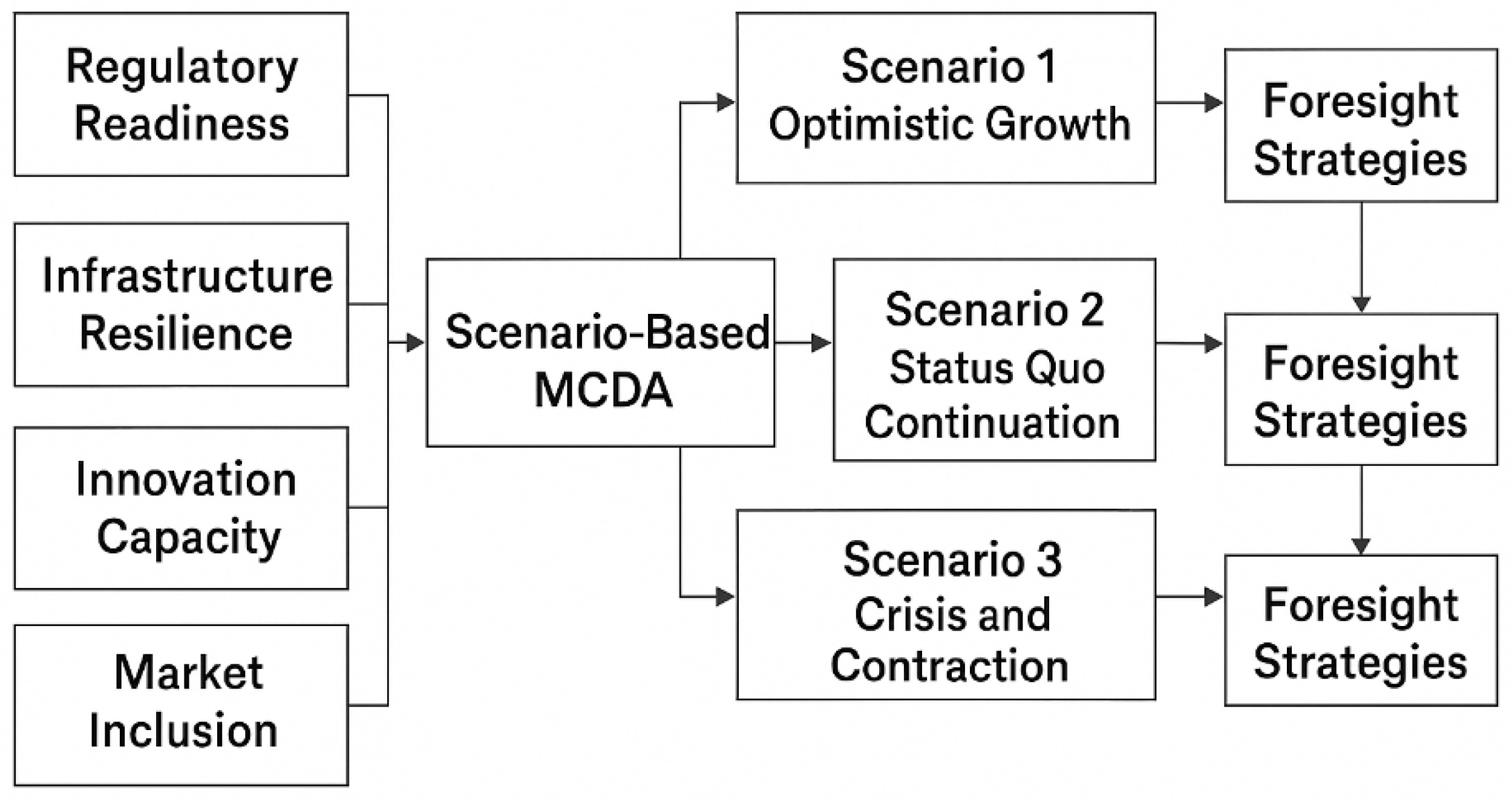
Figure 1 illustrates the methodological flow of the study rather than causal relationships among variables. The three parallel scenarios—Optimistic Growth, Status Quo, and Crisis and Contraction—serve as distinct analytical settings feeding into the AHP–TOPSIS evaluation, which generates scenario-specific rankings of foresight interventions. The framework highlights how each scenario independently informs the prioritization process, reflecting the study’s adaptive foresight orientation. Accordingly, the scenarios should be viewed as parallel and non-sequential, and the figure’s layout has been adjusted to remove any implication of temporal or hierarchical dependence among them.
3. Methodology
3.1. Research Design
This study applies a scenario-based Multi-Criteria Decision Analysis (MCDA) framework to evaluate foresight challenges and strategic priorities in Kuwait’s FinTech sector. MCDA is suitable for contexts with multiple, conflicting criteria and high uncertainty, where linear forecasting provides limited guidance [
28]. By integrating MCDA with scenario planning, the framework enables evaluation of interventions across divergent futures, strengthening strategic planning and policy resilience.
The design is grounded in strategic foresight theory, which emphasizes preparation for multiple plausible futures rather than single-point predictions. It also draws on anticipatory governance, which embeds foresight capacities into decision-making to manage risks and opportunities proactively [
14,
36]. From a decision theory perspective, MCDA operationalizes these ideas by structuring expert judgments into weighted priorities.
For consistency, the study defines strategic foresight interventions as governance measures to strengthen FinTech ecosystems (e.g., regulatory clarity, cybersecurity, SME financing, talent development, infrastructure resilience). The MCDA approach combines two methods: the Analytic Hierarchy Process (AHP), which derives weights through pairwise expert comparisons, and the Technique for Order Preference by Similarity to Ideal Solution (TOPSIS), which ranks alternatives by their closeness to an ideal outcome [
29].
This framework links foresight and decision theory, enabling structured prioritization of FinTech strategies under uncertainty and offering a replicable model for emerging economies [
37].
3.2. Intervention Identification
The five foresight strategies were identified through a structured three-stage process combining horizon scanning, Delphi consultation, and stakeholder validation. First, an extensive review of policy reports, regional foresight frameworks, and FinTech governance studies was conducted to map recurring themes within the four conceptual domains—regulation, infrastructure, innovation, and market. Second, two Delphi rounds with experts from academia, regulatory authorities, and the FinTech sector refined these themes into actionable policy measures that achieved consensus (median importance ≥ 4.0, IQR ≤ 1.0). Third, a validation workshop aligned the proposed measures with Kuwait’s Vision 2035 priorities. This process yielded five interventions: Regulatory fast-tracking, Cybersecurity investment fund, Talent development, National coordination body, and SME digital financing platforms, each corresponding to a specific foresight domain and empirically tested in the MCDA framework.
3.3. Scenario Development
To examine foresight strategies under uncertainty, this study developed three plausible scenarios for Kuwait’s FinTech environment to 2030. The process followed the structured foresight methodology proposed by [
38], which builds scenario logics around key drivers of change and critical contextual uncertainties.
The scenario-building process unfolded in four steps. First, horizon scanning was conducted using Central Bank of Kuwait policy reports, international FinTech outlooks, and academic literature to identify drivers of change in regulation, technology, macroeconomics, energy, and human capital. Second, two critical uncertainties were selected through stakeholder discussions: (i) the adaptability of regulatory frameworks, and (ii) the stability of Kuwait’s macro-financial environment. Third, these uncertainties were mapped into a scenario matrix, which generated contrasting pathways. Finally, draft scenario narratives were developed to illustrate implications for FinTech development and governance [
39].
The resulting three scenarios reflect alternative macroeconomic, regulatory, and technological trajectories:
Scenario 1—Optimistic Growth: Effective execution of Vision 2035, stronger regulation, cybersecurity investment, venture capital inflows, and global partnerships.
Scenario 2—Status Quo Continuation: Slow regulatory progress and uneven infrastructure; adoption grows moderately, led by incumbent banks with limited SME engagement.
Scenario 3—Crisis and Contraction: Reform stagnation caused by cyberattacks, energy grid strain, or macroeconomic shocks, resulting in weakened investor confidence and declining trust in digital finance.
Twelve national stakeholders—representing startups, banks, regulators, academia, and investors—participated in scenario construction. A second consultation round validated plausibility, internal consistency, and policy relevance, ensuring scenarios provided a robust foundation for the MCDA evaluation.
3.4. Criteria Identification
Selecting evaluation criteria is a critical step in MCDA, as it determines how foresight strategies are assessed and compared. In line with foresight and decision-support literature, this study defines evaluation criteria as the dimensions that capture essential conditions for FinTech governance under uncertainty (
Table 1 and
Table 2).
A two-round Delphi method was applied to ensure both rigor and consensus. Delphi is widely recognized in foresight research for refining expert knowledge and building convergence around uncertain or contested issues. The panel included 20 experts from Kuwait’s FinTech ecosystem—policymakers, bankers, startup founders, cybersecurity professionals, and academics. This sample size aligns with prior Delphi studies, where 15–25 experts are considered adequate for diverse representation while allowing iterative feedback [
40].
In Round 1, participants proposed key factors influencing FinTech foresight success. These inputs were clustered into four domains: regulatory readiness, infrastructure resilience, innovation ecosystem, and market readiness. In Round 2, experts rated each item on a 5-point Likert scale (1 = not important; 5 = extremely important). Criteria with a median score ≥4.0 and interquartile range ≤1.0 were retained, resulting in eight final evaluation criteria [
41,
42]
These criteria, validated through the Delphi process, form the foundation for the AHP weighting and TOPSIS ranking, ensuring structured prioritization of foresight interventions across scenarios.
3.5. Expert Recruitment and Panel Composition
To enhance transparency and validity, the recruitment, composition, and participation of experts in the Delphi, AHP, and TOPSIS stages are described in greater detail below.
Experts were recruited through a purposive sampling strategy designed to capture diverse perspectives from across Kuwait’s FinTech ecosystem. Invitations were extended through three channels:
professional and academic networks linked to the Central Bank of Kuwait, Kuwait University, and regional FinTech associations;
nominations by national regulators and incubator programs;
open calls circulated via LinkedIn and professional mailing lists.
To ensure independence and reduce group conformity, all data collection rounds were conducted individually and anonymously, with no group deliberations. Participation was voluntary, and informed consent was obtained under approved ethical protocols (ZUJ-REC-2025-014).
The final Delphi panel comprised 20 experts, of whom 18 participated in the AHP and TOPSIS evaluations. Panelists were selected for demonstrated expertise in financial regulation, technology, entrepreneurship, or academia. The group represents a balanced mix of institutional backgrounds (
Table 3).
Potential conflicts of interest were managed by excluding respondents directly affiliated with policy initiatives evaluated in the study (e.g., regulatory sandbox management). To minimize bias, responses were anonymized before aggregation.
3.6. Subgroup Comparison and Robustness
To evaluate representativeness and potential bias, subgroup analyses were conducted. Rankings generated by regulators, entrepreneurs, and academics were compared using Spearman rank correlation tests. While absolute scores differed slightly—for example, regulators emphasized cybersecurity and governance, while entrepreneurs prioritized SME financing—the top three strategies were consistent across groups, with correlations above 0.85. This convergence supports the robustness of the findings while acknowledging contextual variation in expert perspectives.
3.7. Weighting and Method
To determine the relative importance of the foresight criteria identified in
Section 3.3, this study applied the Analytic Hierarchy Process (AHP). AHP is widely recognized for expert-based decision-making, as it accommodates both qualitative judgments and quantitative measures while ensuring logical consistency.
Using Saaty’s 9-point scale, the 20 Delphi panel experts conducted pairwise comparisons of the eight criteria under conditions of uncertainty. Each expert response generated a comparison matrix, for which a Consistency Ratio (CR) was calculated. Matrices with CR values greater than 0.10 were excluded to maintain reliability. Normalized weights from consistent matrices were aggregated using the geometric mean to form the final criteria weight vector [
43,
44].
Table 4 presents the resulting weights, which reflect strong emphasis on regulatory clarity (0.160), cybersecurity (0.145), and investment attractiveness (0.145), with digital literacy and energy resilience receiving lower relative weights.
These weights were then incorporated into the TOPSIS model, where each foresight intervention was evaluated under the three scenarios developed in
Section 3.2. TOPSIS allowed ranking by proximity to an “ideal” intervention, while sensitivity analysis tested robustness to weight variation. This integration ensured a transparent, replicable process linking foresight theory with structured decision support.
3.8. Alternative Evaluation Using TOPSIS
Following the AHP weighting of foresight criteria, this study applied the Technique for Order Preference by Similarity to Ideal Solution (TOPSIS) to evaluate and prioritize foresight interventions under the three scenarios developed in
Section 3.2. TOPSIS is widely used in MCDA as it identifies the best alternative by measuring each option’s distance from an “ideal” and “anti-ideal” solution, based on weighted performance scores [
45].
Through expert consensus and stakeholder validation, five strategic foresight interventions were identified as most relevant for Kuwait’s FinTech ecosystem: (1) regulatory fast-tracking, (2) talent development programs, (3) cybersecurity investment fund, (4) national coordination body, and (5) SME-focused financing platforms. Each intervention was rated against the eight criteria (
Table 1) across all three scenarios, using a scale from 1 (very low impact) to 9 (very high impact). Ratings were provided by 18 experts after scenario-specific briefings to ensure contextual relevance.
The TOPSIS procedure involved six steps: (i) constructing the decision matrix, (ii) normalizing values to remove unit differences, (iii) applying AHP-derived weights, (iv) identifying ideal and anti-ideal solutions, (v) calculating Euclidean distances from these reference points, and (vi) computing relative closeness coefficients for ranking.
Applying TOPSIS within each scenario generated differentiated rankings, highlighting which strategies remained robust and which shifted depending on external conditions. Sensitivity analysis, conducted by varying criteria weights within ±10%, confirmed the stability of the main results. This scenario-based use of TOPSIS provided a transparent and adaptive prioritization framework, strengthening the methodological rigor of the study and ensuring practical relevance for policymakers.
3.9. Sensitivity and Robustness Checks
To guarantee the robustness and the reliability of the rankings of the foresight strategy derived by the TOPSIS method, various sensitivity analyses were applied. They assessed the result’s stability in conditions of variable uncertainty, indicative of the uncertainty of the strategic foresight as well as of the experts’ judgment [
46].
3.9.1. Variation in Scenario Weighting
Although each scenario was treated with equal weight in the initial analysis, additional simulations were performed to evaluate how changes in scenario likelihood would affect strategy rankings. Three weight distributions were tested:
Scenario-Dominant Model: 70% weight to one scenario, 15% to the others.
Risk-Averse Model: Higher weight assigned to Scenario 3 (Crisis and Contraction).
Growth-Optimistic Model: Higher weight assigned to Scenario 1 (Optimistic Growth).
In all cases, the top-ranked foresight intervention remained within the top two positions, confirming the resilience of the strategic priority set.
3.9.2. Criteria Weight Perturbation
To examine the influence of expert-derived criteria weights, the AHP weights were systematically perturbed ±10% and ±20%. The TOPSIS rankings were recalculated for each case. The Spearman rank correlation coefficients between the original and perturbed rankings ranged from 0.87 to 0.95, indicating high stability [
47].
3.9.3. Stakeholder Subgroup Comparison
Subgroup analysis was conducted by comparing rankings generated from three stakeholder groups: regulators, entrepreneurs, and academics. While some variation in individual scores existed, the overall ranking of top interventions showed convergence across groups, further supporting the validity and consensus of the results.
These sensitivity checks demonstrate that the scenario-based MCDA model is not only methodologically sound but also resilient to uncertainties in assumptions and inputs, making it a credible tool for strategic foresight in Kuwait’s evolving FinTech sector.
3.10. Ethical Considerations
This study received ethical approval from Al-Zaytoonah University of Jordan (Ref. No.: ZUJ-REC-2025-014). All participants were provided with an information sheet and signed informed consent prior to taking part in the Delphi, AHP, or TOPSIS stages. Participation was voluntary, with the right to withdraw at any point.
To ensure confidentiality, no identifying data were recorded or disclosed. All responses were securely stored and used solely for academic purposes. No incentives were offered. The study involved minimal risk and adhered to institutional and international ethical guidelines for expert-based research.
4. Findings
4.1. Overview of Evaluation Matrix and Data Quality
The evaluation matrix was constructed from expert judgments provided by 18 panelists, who assessed five foresight strategies against the eight AHP-weighted criteria under three scenarios: Optimistic Growth, Status Quo, and Crisis. Each strategy was rated on a 9-point scale, and the aggregated values were processed through the TOPSIS procedure to determine each strategy’s relative closeness to the ideal solution [
48].
To ensure methodological rigor, only AHP responses with a consistency ratio (CR) ≤0.10 were retained. Missing values (<2%) were corrected using within-group mean substitution. Experts received standardized scenario briefings and instructions to reduce interpretation bias. Robustness checks confirmed that rankings were stable across replications, enhancing confidence in the data’s reliability.
In addition to the mean closeness scores, dispersion statistics were calculated to capture the degree of consensus among experts. Across all scenarios, the standard deviation of expert ratings for each strategy ranged between 0.58 and 0.91 (on a 1–9 scale), indicating moderate variation in perceived impact. The average coefficient of variation was approximately 12%, suggesting that while general agreement existed on the ranking order, some heterogeneity remained regarding the intensity of each intervention’s importance. Notably, the highest disagreement occurred for “Talent Development” in the Crisis scenario (SD = 0.91), reflecting differing views on its relevance under economic stress. Conversely, “Cybersecurity Investment Fund” in the same scenario showed the lowest dispersion (SD = 0.58), implying strong expert consensus that cybersecurity dominates under adverse conditions. Including these dispersion measures strengthens confidence in the reliability of the aggregated rankings while highlighting areas where policy preferences diverge.
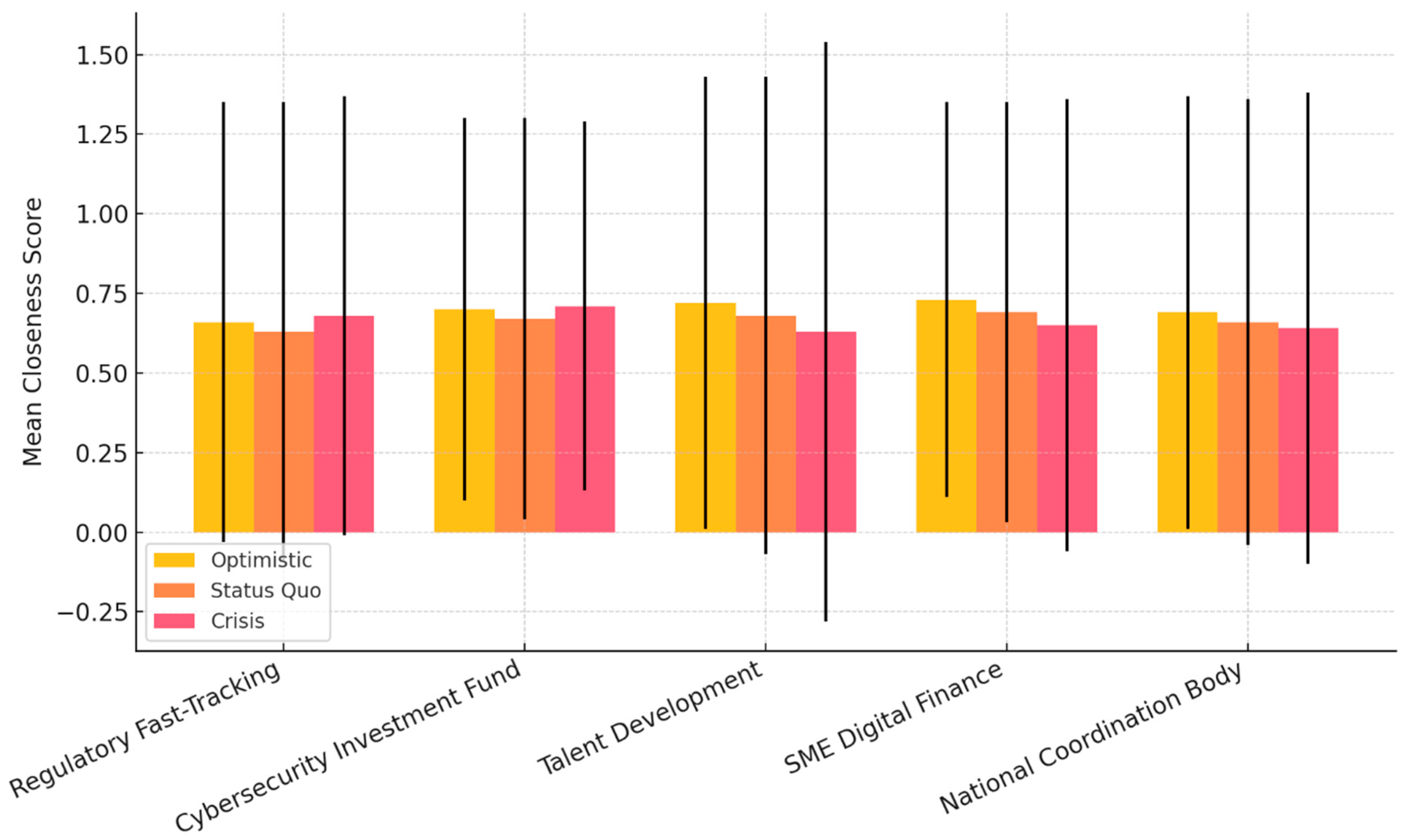
Table 5 and
Figure 2 present the scenario-based closeness scores. The results indicate clear scenario-dependent priorities: SME Digital Financing Platforms scored highest under Optimistic Growth and Status Quo, emphasizing inclusion and access, while the Cybersecurity Investment Fund dominated in Crisis, reflecting resilience needs. Regulatory Fast-Tracking maintained steady mid-level importance across all contexts, highlighting its consistent though secondary role in FinTech foresight.
This radar graph shows the relative effectiveness of five foresight strategies against three future scenarios. Talent growth and SME financing platforms appear as highest priority in the Optimistic Growth scenario, indicative of concern for inclusion and capacity building. Conversely, in the Crisis scenario, cybersecurity investment is the most important intervention, showing the requirement for resilience. Regulatory fast-tracking shows steady priority in all scenarios, showing its essential function in facilitating FinTech growth in the face of different conditions.
4.2. Scenario 1—Optimistic Growth
Under the Optimistic Growth scenario, Kuwait’s FinTech sector benefits from sustained economic expansion, effective regulatory reforms, and infrastructure investments consistent with Vision 2035. In this favorable environment, foresight priorities shift toward capacity building and ecosystem expansion rather than short-term resilience.
The TOPSIS results (
Table 6) show that SME Digital Financing Platforms ranked highest (0.723), followed closely by Talent Development Programs (0.710). Experts emphasized that SME platforms would expand credit access, increase adoption among underserved groups, and foster diversification beyond oil. Similarly, talent development was viewed as critical for meeting labor market needs and sustaining FinTech-driven innovation.
The Cybersecurity Investment Fund (0.674) ranked third, indicating that even in stability, digital trust remains an enabling condition. Regulatory Fast-Tracking (0.660) and the FinTech Coordination Body (0.652) were moderately prioritized, reflecting their supportive role in creating a conducive environment, though not seen as immediate growth levers.
These findings partially support H1 (regulatory clarity as a consistent enabler), strongly support H3 (talent and inclusion strategies dominate in stable contexts), and provisionally support H4 (scenario-specific ranking shifts). They highlight the foresight principle that in optimistic futures, long-term enablers—financial inclusion and skills—carry the greatest strategic weight [
49].
The dominance of SME Digital Financing Platforms and Talent Development Programs under optimistic conditions aligns with adaptive foresight theory, emphasizing capacity building and inclusion when environmental uncertainty is low. These findings reflect the absorptive-capacity principle in anticipatory governance, where institutions leverage stability to invest in long-term innovation and human capital rather than short-term resilience.
4.3. Scenario 2—Status Quo Continuation
The Status Quo scenario assumes moderate FinTech progress, marked by incremental regulatory reforms, uneven infrastructure, and limited cross-sector coordination. Without major shocks or breakthroughs, foresight priorities emphasize sustaining momentum while addressing inefficiencies.
The TOPSIS results (
Table 7) place SME Digital Financing Platforms highest (0.654), reaffirming financial inclusion as a core driver of ecosystem stability. Experts emphasized that supporting SMEs in this context would expand usage of digital services while compensating for limited innovation from larger incumbents.
Regulatory Fast-Tracking (0.648) ranked second, reflecting concerns about bureaucratic delays and fragmented implementation of open banking and data governance. Its elevated position compared to the optimistic scenario underscores the perceived need to accelerate reforms when growth is modest.
Talent Development Programs (0.632) remained important but dropped slightly, suggesting that resource limitations under steady conditions constrain investment in long-term skills. The FinTech Coordination Body (0.617) and Cybersecurity Investment Fund (0.594) ranked lowest, indicating that structural resilience and institutional alignment are not viewed as urgent in stable environments.
These findings support H1 (regulatory clarity remains a consistent enabler), confirm H3 (talent and SME strategies are prioritized under stable conditions), and reinforce H4, as the ranking differs from Scenario 1, reflecting scenario-dependent shifts.
The high ranking of Regulatory Fast-Tracking and sustained importance of SME Digital Financing Platforms illustrate anticipatory governance in incremental environments. Here, foresight acts as a mechanism for maintaining adaptability within policy inertia. The shift in priority from capacity-building to procedural efficiency supports the adaptive foresight notion that moderate uncertainty requires institutional agility and regulatory coherence to sustain progress
4.4. Scenario 3—Crisis and Contraction
The Crisis and Contraction scenario envisions a future where Kuwait’s FinTech sector faces structural disruptions, including cyberattacks, energy shortages, regulatory stagnation, or geopolitical shocks. In such conditions, foresight priorities shift from ecosystem expansion to resilience and systemic trust.
The TOPSIS results (
Table 8) show the Cybersecurity Investment Fund as the highest-ranked strategy (0.712). Experts stressed that government-backed or hybrid investment in cybersecurity is indispensable for safeguarding digital platforms and sustaining confidence when financial and energy risks converge.
The second-ranked strategy, SME Digital Financing Platforms (0.603), indicates that inclusion remains important even under stress, with SMEs viewed as vulnerable actors requiring targeted support to maintain business continuity. The FinTech Coordination Body (0.565) ranked third, suggesting that institutional alignment gains some importance during instability, though not as urgently as direct resilience measures.
By contrast, Regulatory Fast-Tracking (0.556) and Talent Development Programs (0.481) dropped to the bottom, reflecting that longer-term reforms and capacity-building are deprioritized when short-term stabilization takes precedence [
50].
These findings partially support H1 (regulation less critical under crisis), strongly support H2 (infrastructure resilience, especially cybersecurity, becomes dominant), align with H3 (talent and inclusion lose priority in adverse futures), and confirm H4, as the ranking diverges sharply from Scenarios 1 and 2.
The prominence of the Cybersecurity Investment Fund during crisis scenarios embodies the resilience logic central to foresight and risk governance frameworks. When systemic shocks dominate, foresight transitions from growth-enabling functions to trust preservation and systemic stability. This supports theoretical propositions that adaptive foresight prioritizes immediate resilience over long-term expansion under adverse futures
4.5. Cross-Scenario Comparison of Strategy Rankings
A cross-scenario comparison reveals distinct shifts in strategic priorities depending on contextual assumptions, underscoring the value of a scenario-based MCDA approach.
Table 8 summarizes the rank order of strategies across the three scenarios. SME Digital Financing Platforms ranked first in both Optimistic Growth and Status Quo, and second in Crisis, indicating strong robustness as a consistently important intervention. Talent Development Programs, by contrast, fell from second under growth to last in crisis, illustrating high sensitivity to environmental stability. The Cybersecurity Investment Fund rose from third in growth to first in crisis, confirming that resilience-oriented measures become decisive under adverse conditions.
Regulatory Fast-Tracking maintained moderate but steady importance, ranking between second and fourth, suggesting it is widely valued as an enabling condition though not perceived as transformative. The FinTech Coordination Body consistently occupied middle-to-lower positions, implying limited independent impact but supporting roles in governance alignment.
These patterns provide strong evidence for H4, as rankings vary significantly across scenarios. They also support H1 (regulation remains important but not dominant), H2 (infrastructure resilience dominates in crisis), and H3 (talent and inclusion are prioritized in favorable conditions).
Overall, the analysis highlights that while some strategies demonstrate robustness across futures (e.g., SME financing), others are highly contingent on scenario dynamics (e.g., talent vs. cybersecurity), reinforcing foresight’s role in adaptive policymaking (
Table 9).
4.6. Sensitivity Analysis Results
To confirm the robustness of the scenario-based MCDA findings, multiple sensitivity tests were conducted. These analyses examined whether strategy rankings would shift under different assumptions regarding scenario weights, criteria weights, and stakeholder perspectives.
4.6.1. Scenario Weight Perturbation
Alternative weighting schemes were applied to reflect policy emphasis on growth or risk aversion. For example, a growth-biased model (60% Optimistic, 20% Status Quo, 20% Crisis) and a risk-averse model (20% Optimistic, 20% Status Quo, 60% Crisis) were tested. Across all schemes, the top-ranked strategies shifted by at most one position. This stability indicates that recommendations remain valid even when policymakers prioritize particular futures.
4.6.2. Criteria Weight Perturbation
Each AHP-derived criterion weight was perturbed by ±10% and ±20%, with recalculated rankings compared to the baseline. Spearman rank correlations ranged from 0.87 to 0.96, confirming a strong preservation of rank order. This suggests that no single criterion dominates outcomes, reducing the risk of bias from expert weighting.
4.6.3. Stakeholder Subgroup Analysis
When analyzed separately, regulators, entrepreneurs, and academics showed minor variations in absolute scores—for instance, entrepreneurs ranked SME financing slightly higher, while regulators emphasized cybersecurity. However, the top three strategies remained consistent across groups, reinforcing the generalizability of the results.
Overall, the sensitivity tests demonstrate that strategy rankings are not fragile to model assumptions or subgroup perspectives. This reliability enhances confidence in the MCDA framework, ensuring that the identified priorities—such as SME financing in stable conditions and cybersecurity in crises—can inform robust and adaptive foresight planning for Kuwait’s FinTech ecosystem.
5. Discussion
5.1. Theoretical Contributions
This study applied a scenario-based MCDA model to evaluate foresight priorities in Kuwait’s FinTech sector, extending foresight theory into an underexplored policy domain. The findings support prior calls for anticipatory governance in digital finance, especially in emerging economies where foresight is often reactive or absent [
4,
51]. Consistent with evidence from advanced ecosystems such as Singapore and the UK, the study demonstrates that structured foresight tools enable policymakers to anticipate shifts in strategic priorities under different conditions [
26].
By combining AHP and TOPSIS with scenario analysis, the research also addresses a methodological gap in the application of MCDA to FinTech governance [
28,
52]. The robustness checks conducted confirm that the framework is reliable, offering a replicable approach for integrating foresight into digital financial policy planning.
5.2. Scenario-Specific Insights
The results reveal how foresight strategies vary with contextual assumptions, enriching debates in foresight literature that emphasize adaptive, rather than fixed, planning [
3,
38]. The mid-to-high ranking of regulatory fast-tracking across scenarios underscores its foundational importance for FinTech ecosystems, consistent with studies highlighting regulatory clarity as a precondition for innovation [
27]. However, its reduced priority during crisis scenarios suggests that regulatory reform alone cannot safeguard systemic stability.
The consistent prioritization of SME digital financing platforms aligns with calls for inclusion-led FinTech growth [
2,
49]. Even in contraction scenarios, experts regarded SME financing as a resilience strategy, positioning inclusion as both a growth enabler and a stabilizer. Conversely, the decline of talent development in crises reflects a strategic shift from long-term capacity-building to immediate stabilization, adding nuance to literature that often frames human capital development as a universal priority [
18]. The sharp rise of cybersecurity investment in crisis scenarios highlights the context-dependent nature of resilience strategies, reinforcing foresight theory’s focus on adaptive priorities.
5.3. Policy Relevance and Adaptive Governance
Regionally, the findings highlight the risks of Kuwait’s reactive policymaking compared to foresight-driven approaches in the UAE and Bahrain, where national FinTech strategies embed structured foresight mechanisms. Unlike those peers, Kuwait’s regulatory fragmentation and lack of anticipatory frameworks hinder long-term digital finance resilience. By showing that strategic priorities shift under growth, stability, and crisis scenarios, this study provides policymakers with a pathway to move beyond short-term compliance. The model aligns with Kuwait Vision 2035 by offering a structured, adaptive framework to harmonize foresight, regulation, and innovation in national FinTech governance.
5.4. Theoretical Extension and Adaptive Orientation
This study extends foresight theory by showing how scenario-based MCDA operationalizes adaptive foresight in FinTech governance. Unlike predictive models focused on single outcomes, the AHP–TOPSIS integration quantifies how policy priorities shift across alternative futures, demonstrating foresight as a continuous learning and adjustment process. This approach transforms foresight from qualitative anticipation to a structured analytical method, strengthening its explanatory and practical value in uncertain policy environments.
5.5. Adaptive vs. Predictive Foresight Models
The findings validate an adaptive foresight model. Variations in strategy rankings across growth, stability, and crisis contexts confirm that FinTech governance requires flexibility rather than prediction. Adaptive foresight views uncertainty as a resource for institutional learning—encouraging iterative evaluation and recalibration instead of fixed planning.
5.6. Economic Interpretation of Scenario-Based Rankings
The scenario-based MCDA results indicate economically meaningful trade-offs rather than minor preference shifts. The TOPSIS closeness coefficient (
) is a dimensionless, bounded (0–1) index that summarizes each strategy’s relative proximity to the ideal alternative in the weighted criteria space, rather than a direct percentage change in any single outcome. To convey magnitude, we interpret score gaps on a proportional basis,
, where
is a representative benchmark level (
Table 5: mean ≈ 0.632; range 0.481–0.723). Under this scaling,
corresponds to ~7.9% of the mean (0.05/0.632) and ~6.9–10.4% across the observed range, hence the description of a 0.05 difference as roughly a 5–10% variation in the composite performance index implied by the MCDA criteria [
8,
10]. Under optimistic scenarios, higher rankings for SME digital finance and talent development reflect greater potential for long-term growth and inclusion, consistent with [
9] argument that innovation-driven intermediation enhances productivity. In contrast, during crisis scenarios, the prominence of cybersecurity and regulatory clarity suggests stronger short-term welfare effects through the preservation of trust and risk containment [
11].
Overall, these results imply that FinTech governance priorities are context-dependent: inclusion and capability strategies yield higher marginal returns in stability, while resilience-oriented measures mitigate losses in volatility. This reinforces the foresight principle that effective policy design must balance capacity building and crisis resilience, aligning adaptive governance with established financial intermediation dynamics.
6. Implications
6.1. Practical Implications
The results offer targeted guidance for policymakers, regulators, and industry stakeholders in Kuwait’s FinTech ecosystem. The repeated top ranking of SME digital financing platforms in optimistic and status quo scenarios indicates that inclusion-oriented strategies are both growth enablers and stabilizers in favorable conditions. This suggests that long-term policy planning should institutionalize SME-focused digital platforms to ensure wider access to credit and support diversification beyond large financial institutions.
Regulatory fast-tracking emerged as moderately important across all three scenarios. Its consistent presence in the middle-to-high range confirms its role as a structural enabler, but its decline in crisis conditions underscores that regulation alone cannot address systemic risks. This highlights the need to pair regulatory reforms with complementary resilience strategies, such as investments in infrastructure and security, to maintain ecosystem stability.
Cybersecurity investment, by contrast, shifted from a secondary concern in stable futures to the highest-ranked priority during crises. This demonstrates that digital trust becomes the defining factor when the ecosystem is under pressure. Practical implications include the establishment of cybersecurity investment funds, stronger technical standards, and incentives for startups to adopt robust security frameworks. Proactively embedding resilience into digital finance policy will ensure that shocks—whether technological, economic, or geopolitical—do not derail long-term FinTech ambitions.
Taken together, these findings show that adaptive policymaking is essential. Strategies that prioritize inclusion and capacity-building in growth phases must be balanced with resilience measures that dominate in crises. Policymakers in Kuwait can use this insight to align Vision 2035 goals with the dynamic realities of digital transformation.
6.2. Research Implications
For academic research, the study demonstrates the utility of integrating scenario-based foresight with multi-criteria evaluation techniques. By showing how strategic priorities shift under varying assumptions, it highlights that foresight interventions cannot be assessed in static contexts. This methodological approach provides a template for extending foresight studies beyond descriptive analysis into structured, evidence-based evaluation.
The framework also opens avenues for comparative studies. Applying the model to other Gulf states would reveal whether the patterns identified in Kuwait—such as the dominance of inclusion strategies in stable conditions and cybersecurity in crises—are regionally consistent or context-specific. Expanding the expert base and incorporating mixed methods could further validate the findings and provide richer insights into stakeholder perspectives. Finally, future research could examine how foresight-driven policy tools interact with adoption behavior, cross-border regulation, and emerging technologies, offering a broader theoretical contribution to digital governance studies.
7. Conclusions
This study applied a scenario-based Multi-Criteria Decision Analysis (MCDA) framework to evaluate strategic foresight interventions for Kuwait’s FinTech ecosystem. By integrating AHP and TOPSIS with structured scenario planning, the research demonstrated how policy priorities shift depending on whether the future is characterized by optimistic growth, status quo continuation, or crisis and contraction. The results show that SME digital financing platforms and talent development dominate in favorable futures, while cybersecurity investment becomes the leading priority during crises. Regulatory fast-tracking remained moderately important across all scenarios, confirming its role as a foundational enabler rather than a transformative driver.
The findings underline that foresight strategies are highly context-dependent. Interventions cannot be assumed to hold equal relevance across all futures; instead, their importance changes with underlying assumptions about stability, growth, and disruption. This highlights the value of adaptive policymaking and provides a replicable model for aligning FinTech strategies with uncertain environments. While applied to Kuwait, the framework can be adapted to other emerging economies facing similar challenges in digital transformation.
At the same time, the study is not without limitations. The reliance on a relatively small expert panel, while sufficient for exploratory foresight, may restrict the diversity of perspectives included. Expanding stakeholder participation in future studies—particularly by incorporating consumers and international investors—could enhance robustness. The analysis also drew on qualitative expert judgments rather than quantitative performance data, and further research could combine mixed-method approaches to validate and extend the findings. Finally, the focus on Kuwait constrains generalizability, and applying the framework to other Gulf or emerging economies would provide valuable comparative insights.
Future research should also examine how foresight-driven strategies interact with emerging developments such as digital assets, cross-border regulation, and AI-enabled financial services. Exploring these dynamics would advance understanding of how adaptive governance models can support resilience and innovation in fast-evolving digital ecosystems.
While this study applies the foresight-based MCDA framework to Kuwait’s FinTech ecosystem, its design is intentionally hybrid—combining context-specific insights with generalizable methodological elements. The framework reflects Kuwait’s institutional priorities, such as Vision 2035, the regulatory sandbox, and the country’s energy and human-capital conditions. These contextual anchors enhance policy relevance but also limit direct transferability to economies with different institutional capacities or regulatory maturity.
Nonetheless, the core structure of the framework—spanning regulation, infrastructure, innovation, and market readiness—is adaptable to other emerging economies seeking to align FinTech development with resilience and inclusion goals. Future research could extend the model through cross-country comparisons or larger expert panels to test its robustness under varying institutional settings. By treating Kuwait as a case study of anticipatory governance in FinTech, the paper contributes both a national illustration and a transferable analytical method for managing digital transformation under uncertainty.