
Next Article in Journal
Strategic Foresight for FinTech Governance: A Scenario-Based MCDA Approach for Kuwait
Previous Article in Journal
From Connectivity to Continuity: The Power of Cashless Mobile Access and Experience in Micro and Small Businesses in Fragile Contexts
Previous Article in Special Issue
Knowledge or Confidence? Exploring the Interplay of Financial Literacy, Digital Financial Behavior, and Self-Assessment in the FinTech Era
error_outline You can access the new MDPI.com website here. Explore and share your feedback with us.
 
 
Article

Unraveling User Switching Dynamics in P2P Mobile Payments: Investigating Satisfaction and Trust in a Duopoly Market

by
Claudel Mombeuil
1,2,* and
Sadrac Jean Pierre
1,3
1
Rezo Inovasyon Edikatif Ayisyen (RINOVEDA), Mirebalais HT 5210, Haiti
2
Faculté des Sciences Administratives, Université Notre Dame d’Haïti, Port-au-Prince HT 6110, Haiti
3
Faculté des Sciences Administratives, Université Notre Dame d’Haïti, UDERS de Hinche, Hinche HT 5110, Haiti
*
Author to whom correspondence should be addressed.
Submission received: 10 October 2025 / Revised: 17 December 2025 / Accepted: 29 December 2025 / Published: 8 January 2026

Abstract

Research on users’ switching intentions in peer-to-peer (P2P) mobile payment systems, particularly in developing markets, remains limited. This study examines how two satisfaction dimensions, transaction-based satisfaction and experience-based satisfaction, influence switching intentions through two layers of trust: institution-based trust and disposition to trust. Grounded in Expectancy-Disconfirmation Theory, data from 529 users of Haiti’s leading P2P mobile payment platform were analyzed using structural equation modeling. Results show that while transaction-based satisfaction has minimal impact on switching intentions, experience-based satisfaction strengthens institution-based trust, which in turn significantly reduces switching intentions. These findings highlight the central role of institutional reliability in shaping post-adoption behavior in duopolistic and resource-constrained markets. The study extends satisfaction-trust theory to digital financial ecosystems and offers practical insights for improving user retention through sustained institutional credibility and long-term service reliability.

1. Introduction

The rapid growth of financial technology (FinTech) has transformed the way individuals manage money, enabling faster, more secure, and more inclusive financial transactions [1]. Among these innovations, peer-to-peer (P2P) mobile payments have emerged as a dominant mode of exchange, particularly in developing economies where digital solutions increasingly substitute for cash [2,3]. As P2P payment services expand, competition among providers intensifies, lowering switching barriers and increasing the likelihood of users switching between platforms [4,5]. Although prior studies have extensively examined adoption behavior in mobile payment contexts, post-adoption phenomena such as users’ switching intentions have received comparatively limited attention e.g., [6,7]. Most research on switching focuses on dissatisfaction, switching costs, or the attractiveness of alternative platforms [8,9], overlooking how different forms of satisfaction and trust jointly shape users’ decisions to remain or switch.
Furthermore, although both experience-based satisfaction (EBS) and transaction-based satisfaction (TBS) capture users’ evaluative responses, they represent distinct facets of satisfaction with digital services. TBS refers to users’ immediate evaluation of specific transactions or payment episodes, focusing on performance-related outcomes such as reliability, speed, and security during a single exchange [10]. EBS, by contrast, reflects users’ cumulative affective assessment formed through repeated interactions and overall engagement with the service ecosystem, encompassing perceptions of consistency, relational quality, and emotional attachment over time [11]. These two forms of satisfaction are therefore conceptually different, TBS being episodic and cognitive, and EBS being holistic and affective, and may exert distinct influences on user behavior.
Despite their theoretical relevance, prior studies have primarily examined how these satisfaction dimensions jointly or independently influence trust formation and switching intentions within P2P accommodation-sharing contexts and other related contexts [10,12,13]. However, their roles remain underexplored in P2P mobile payment settings, leaving a critical gap in understanding user switching behavior across digital service environments. Furthermore, P2P mobile payment systems involve interactions not only between users and service providers but also with authorized agents who facilitate transactions. This dual interface makes it critical to distinguish between institution-based trust (IBT), trust in the provider or platform, and disposition to trust (DTT), trust in intermediaries or agents. Building on this distinction, we propose that TBS and EBS may exert both direct and indirect effects on switching intentions through these trust mechanisms.
Empirically, the study analyzes these relationships in Haiti’s duopolistic peer-to-peer mobile payment market, where Digicel’s MonCash, established in 2010, remains dominant and Natcom’s NatCash, launched in December 2021, has begun to challenge MonCash after more than a decade of monopolistic leadership. At the time of data collection, MonCash’s official figures reported more than 2 million users and over 8500 service points. This unique context, characterized by limited financial inclusion and strong agent intermediation, offers an opportunity to explore how satisfaction and trust dynamics operate under competitive yet constrained market conditions. Accordingly, this study aims to investigate how experience-based and transaction-based satisfaction influence user switching intentions directly and indirectly through institution-based and disposition to trust within Haiti’s P2P mobile payment ecosystem.
Theoretically, this context enables a refined analysis of trust and satisfaction mechanisms within peer-to-peer mobile payment systems. Specifically, Institution-Based Trust (IBT) captures users’ confidence in Digicel, the dominant institutional provider, while Disposition to Trust (DTT) reflects trust in authorized agents who mediate transactions. By disentangling these trust dimensions and their links to satisfaction and switching intentions, this study contributes to a more nuanced understanding of user loyalty formation in competitive mobile payment ecosystems and offers practical insights for customer retention in emerging markets while offering theoretical and empirical contributions to the literature. Although Liang, Choi [10] and Prasetya Nugroho and Rahayu Hijrah Hati [13] laid important groundwork for understanding trust in the sharing economy, their studies leave several questions that are not fully settled. Our work advances this discussion in areas where prior research may have been constrained, particularly with regard to competitive market dynamics.
Earlier investigations typically focused on a single platform, Airbnb in Liang et al.’s case, or on service environments that operate independently of direct platform competition. By contrast, our study is situated within a genuine duopoly, where two major platforms vie for the same user base. This duopoly setting provides a unique empirical lens, allowing us to observe how switching intentions and trust mechanisms operate when users engage in cross-platform comparative evaluation. Crucially, it enables us to analyze the complex interactions involving both the platform system and the provider/representative, offering insights into how generalized system assurance and specific service experience jointly influence competitive user behavior. The duopoly context appears to offer a clearer view of how EBS, TBS, IBS, and DTT may influence switching intentions, and, more broadly, competitive behavior, issues that single-platform studies can only approximate. Prior studies have yielded nuanced and context-dependent findings regarding the direct and indirect effects of EBS and TBS. Furthermore, these works [10,13] demonstrated mixed results concerning how factors like Institution-Based Trust and Disposition to Trust operate as critical mediators. This inconsistency and complexity across different P2P contexts underscore the urgent need to test these pathways in a new competitive setting. Our study directly addresses this by testing the complex interplay of these variables in predicting switching intentions specifically within a competitive P2P duopoly setting, thereby contributing critical insights into multi-platform user behavior.

2. Theoretical Background and Prior Empirical Research

2.1. Behavioral Intention and Expectancy-Disconfirmation Theory

Behavioral intention refers to an individual’s stated likelihood to perform a specific action [14]. In service contexts, it encompasses a spectrum of post-consumption behaviors, such as repurchase, loyalty, or switching, that reflect customers’ ongoing evaluations of service performance [15,16]. Whereas loyalty and repurchase indicate favorable outcomes, switching intentions typically signal dissatisfaction or eroding trust.
Customer satisfaction, a key determinant of behavioral intention, is most commonly explained by Expectancy-Disconfirmation Theory (EDT) [17]. EDT posits that satisfaction results from the comparison between pre-use expectations and post-use performance. Positive disconfirmation, when performance exceeds expectations, leads to satisfaction, whereas negative disconfirmation produces dissatisfaction. This mechanism has been validated across diverse service settings, including hospitality, e-commerce, and financial technologies e.g., [18,19,20].
In digital financial services, satisfaction can arise from both specific transactions and cumulative experiences. These two levels, transaction-based satisfaction (TBS) and experience-based satisfaction (EBS), reflect distinct cognitive and affective processes. TBS captures users’ evaluations of individual payment episodes (e.g., reliability, speed, security), while EBS reflects a broader, long-term affective assessment shaped by repeated interactions and overall engagement [10,11]. Grounded in EDT, both dimensions influence users’ post-usage evaluations and, ultimately, their intentions either to remain or to switch. Accordingly, this study extends EDT to the context of P2P mobile payments by examining how TBS and EBS jointly shape trust (institution-based and dispositional) and switching intentions.
However, it is important to note that satisfaction does not act in isolation. Drawing on Cognitive Trust Formation Theory [21] and Institutional Theory [22], satisfaction is also a cognitive and affective foundation for building trust, both at the institutional level (confidence in the system and rules) and the dispositional level (confidence in agents and interpersonal interactions). In markets characterized by high systemic dependence and limited alternatives, such as duopolistic mobile payment ecosystems, Switching Cost Theory [23] suggests that these layered trust relationships play a critical role in influencing satisfaction and switching intentions. Accordingly, this study extends EDT by integrating these complementary perspectives to explain how TBS and EBS jointly influence institutional trust, dispositional trust, and switching behavior in a duopolistic P2P mobile payment context. Table 1 summarizes key findings from prior research that inform the conceptual model.

2.2. Satisfaction

Numerous theoretical models have been developed to explain consumer satisfaction, with Oliver’s [17] Expectancy-Disconfirmation Theory (EDT) and its extension by Kristensen, Martensen [24] among the most influential. These models emphasize the interplay between expectations, perceived performance, belief confirmation, and overall satisfaction. Subsequent research has refined these ideas by viewing satisfaction as an evaluative judgment formed from past experiences [25] or as the comparison between expected and perceived service quality [26]. Although satisfaction has been extensively studied, prior work often treats it as a unidimensional construct. However, emerging research suggests that satisfaction can manifest through distinct but complementary dimensions, particularly experience-based satisfaction and transaction-based satisfaction [10]. The present study extends this line of inquiry by examining how these two dimensions interact to shape trust and switching intentions within a triadic mobile payment environment.

2.3. Experience-Based Satisfaction (EBS) and Transaction-Based Satisfaction (TBS)

Bitner and Hubbert [27] distinguished between two perspectives of satisfaction: encounter satisfaction (evaluations of specific service interactions) and overall service satisfaction (cumulative evaluations of all interactions with an organization). While encounter satisfaction reflects transient reactions to discrete events, overall satisfaction emerges as an aggregated judgment shaped by repeated engagements [28,29,30]. Critically, each service encounter contributes asymmetrically to overall satisfaction, as customers weigh interactions differently based on perceived importance or emotional salience [31,32]. Building on this dichotomy, Jones and Suh [33] conceptualized transaction-based satisfaction (TBS) as the emotional state following a single service interaction, influenced by expectations, perceived performance, and post-purchase reflections [28]. Crucially, TBS may not directly predict overall satisfaction because service quality can vary across transactions, and customers often compartmentalize experiences [33]. For instance, a negative TBS from a delayed delivery might coexist with positive overall satisfaction if other interactions (e.g., responsive customer support) offset the issue.
In contrast, experience-based satisfaction (EBS) reflects a holistic evaluation of repeated interactions with a service, technology, or platform over time [10]. EBS incorporates the performance of individual transactions and their cumulative impact on perceived value, trust, and fulfillment of needs. This distinction is particularly salient in triadic business relationships (e.g., mobile payment platforms involving users, service providers, and authorized agents), where customers interact with distinct entities during a single transaction [10]. Here, TBS may focus on isolated elements (e.g., ease of payment processing), while EBS evaluates the end-to-end experience (e.g., security, interoperability, long-term usability).
The interplay between TBS and EBS is critical for three reasons. First, TBS provides granular insights into immediate pain points or delights, enabling firms to optimize specific touchpoints [28]. Second, EBS captures the evolving relationship between the user and the service, which better predicts loyalty and long-term engagement [29]. Third, in multi-actor ecosystems, discrepancies between TBS (e.g., satisfaction with an agent) and EBS (e.g., distrust in the platform) can reveal systemic risks, such as fragmented accountability [31]. For example, a user might rate a specific agent interaction highly (TBS) yet report low EBS due to unresolved platform-wide privacy concerns. By analyzing both constructs, researchers and practitioners can distinguish between context-specific frustrations and systemic dissatisfaction, enabling targeted interventions.

2.4. TBS, EBS, and Switching Intention

The link between satisfaction and behavioral intentions has been extensively explored in management and marketing research, with a wealth of studies consistently highlighting a positive link between satisfaction and repurchase intentions [34,35,36] and loyalty e.g., [37,38,39]. Moreover, satisfaction has been shown to exhibit an inverse relationship with switching intentions e.g., [40,41]. This implies that dissatisfied customers are inclined to switch to alternative service providers, driven by negative experiences or inadequate service quality [42]. Liang, Choi [10] examined the direct and indirect effects of experience-based satisfaction (EBS) and transaction-based satisfaction (TBS) on repurchase and switching intentions in P2P accommodation services. Their results showed that both EBS and TBS positively influenced repurchase intentions while reducing switching intentions through Institution-Based Trust (IBT) and Disposition to Trust (DTT).
Similarly, Prasetya Nugroho and Rahayu Hijrah Hati [13] examined the effects of experience-based and transaction-based satisfaction on repeat purchase and switching intentions across online travel agencies, virtual hotel operators, and P2P accommodation sharing. They found that transaction-based satisfaction positively influenced repeat purchase intentions in all contexts, while the effect of experience-based satisfaction on switching intention was negative but largely insignificant across the three service types. Nonetheless, Ofori, Chai [12] found that TBS and EBS had a positive and significant impact on continuance intention in P2P accommodation sharing. These studies reveal inconsistencies in the effects of TBS and EBS across service contexts and economic settings. Drawing on these empirical insights, we propose to examine the following hypotheses within the P2P mobile payment settings:
Hypothesis 1.
Transaction-based satisfaction has a negative effect on switching intentions.
Hypothesis 2.
Experience-based satisfaction has a negative effect on switching intentions.

2.5. Experience-Based/Transaction-Based Satisfaction, Trust, and Switching Intentions

Trust, rooted in social psychology, is characterized as an individual’s confidence in the benevolence, honesty, and competence of others, coupled with a willingness to accept vulnerability in relationships [21,43]. It is a dynamic, rational process actively constructed and nurtured over time through tangible engagements [44]. While traditional trust frameworks often focus on dyadic interactions (e.g., between a customer and a single entity), modern digital ecosystems, such as peer-to-peer (P2P) platforms, require a triadic perspective [10,31]. For instance, in P2P mobile payment systems, users interact with two distinct actors: the service provider and its authorized agents (e.g., local merchants or intermediaries). This triadic structure necessitates a dual trust framework. First, Institution-Based Trust (IBT) reflects users’ confidence in the service provider as an institution, anchored in systemic assurances like security protocols, regulatory compliance, and brand reputation [45,46]. Second, Disposition to Trust (DTT) captures users’ inherent willingness to trust authorized agents (e.g., individual merchants or intermediaries) based on interpersonal cues, such as perceived competence or benevolence, during transactions [47,48].
Studies highlight the distinct roles of TBS and EBS in shaping institution-based trust and disposition to trust. Liang, Choi [10] found that transaction-based satisfaction significantly and positively influences dispositions to trust as well as institution-based trust within the context of P2P accommodation. However, their study did not support a similar impact of experience-based satisfaction on either type of trust. In contrast, research by Prasetya Nugroho and Rahayu Hijrah Hati [13] indicated that transaction-based satisfaction positively affects institution-based trust across various contexts, including online travel agents, P2P accommodations, and virtual hotel operators. Notably, they found that transaction-based satisfaction only significantly influences the disposition to trust virtual hotel operators. Furthermore, their findings revealed that experience-based satisfaction positively affects both institution-based trust and disposition to trust across all three examined service settings.
In line with these perspectives, this study examines how TBS and EBS differentially influence IBT and DTT in the context of P2P mobile payments, where trust is distributed across institutional and interpersonal levels.
Hypothesis 3a.
Transaction-based satisfaction has a positive effect on institution-based trust.
Hypothesis 3b.
Transaction-based satisfaction has a positive effect on disposition to trust.
Hypothesis 4a.
Experience-based satisfaction has a positive effect on institution-based trust.
Hypothesis 4b.
Experience-based satisfaction positively influences disposition to trust.
Research findings by Liang, Choi [10] revealed that institution-based trust positively and significantly affected repeat purchase intention but negatively and insignificantly affected switching intention within the P2P accommodation setting. Furthermore, Liang, Choi [10] demonstrated that the disposition to trust positively and significantly affected repurchase intention, but negatively and significantly affected switching intention. Research findings by Prasetya Nugroho and Rahayu Hijrah Hati [13], however, revealed that institution-based trust positively and significantly affects repurchase intentions in the virtual hotel and travel agency service settings, but not in the P2P accommodation service setting. More importantly, they found that institution-based trust negatively and insignificantly affected switching intention across the three examined contexts. Additionally, Prasetya Nugroho and Rahayu Hijrah Hati [13] found that disposition to trust negatively and significantly affected switching intentions in the Virtual Hotel Operator setting, but it had an insignificant effect within the travel agency and P2P accommodation service settings. These findings from Liang, Choi [10] and Prasetya Nugroho and Rahayu Hijrah Hati [13] further highlight significant inconsistent results, particularly for disposition to trust and switching intention relationships across different triadic business contexts. Guided by these findings and the context of this study, we aim to test the subsequent hypotheses:
Hypothesis 5.
Institution-based trust has a negative effect on switching intentions.
Hypothesis 6.
Disposition to trust has a negative effect on switching intentions.

2.6. The Mediating Role of Trust

Trust plays a crucial role in shaping cross-environment relationships and, when combined with both positive and negative influencing factors, has both direct and indirect effects on behavioral intentions [49]. While the mediating role of trust has been widely explored across various service contexts, few studies have simultaneously examined the mediating effects of institution-based trust and disposition to trust in the relationship between EBS/TBS and switching intentions in mobile payment settings. Liang, Choi [10] revealed that institutional trust mediated the link between transactional satisfaction and repurchase intentions but not between transactional satisfaction and switching intentions. Additionally, their findings indicated that disposition to trust served as a mediator in both the link between transactional satisfaction and repurchase intentions, as well as the connection between transactional satisfaction and switching intentions. However, the study of Liang, Choi [10] provides no evidence to support the mediating role of disposition to trust in the connections between experience-based satisfaction and either repurchase or switching intentions. Prasetya Nugroho and Rahayu Hijrah Hati [13] did not explicitly report the mediating effects of institution-based trust and disposition to trust, but their structural equation modeling analysis offered significant insights. Their results indicated an insignificant indirect effect of both transaction-based satisfaction and experience-based satisfaction on switching intentions through disposition to trust in the contexts of online travel agents and peer-to-peer accommodations. Conversely, a significant negative indirect effect was observed for virtual hotel operators in the study of Prasetya Nugroho and Rahayu Hijrah Hati [13]. Furthermore, a significant positive indirect effect of transaction-based satisfaction on repurchase intention through institution-based trust was identified, but only among online travel agents.
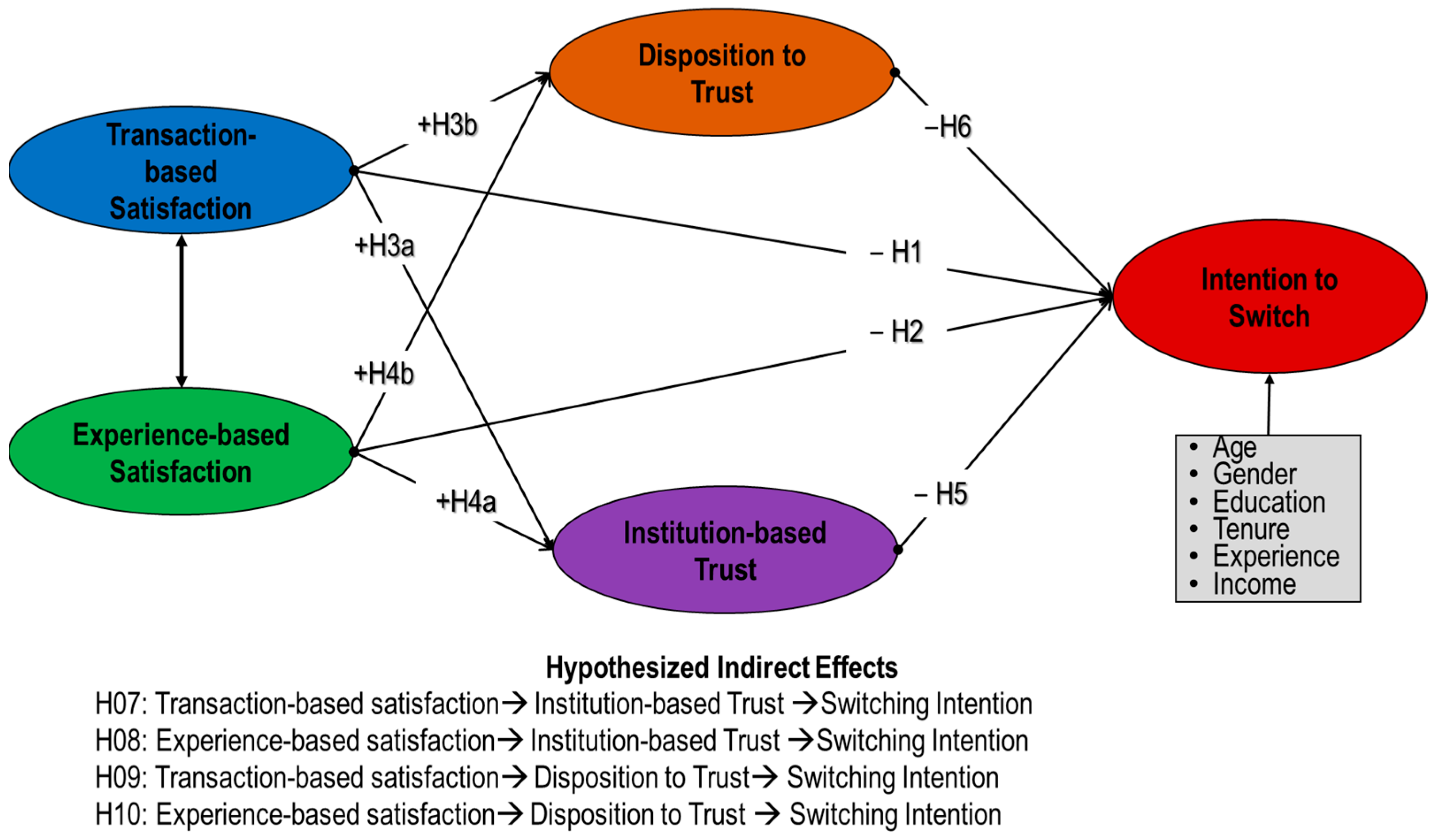
The research findings discussed above reveal inconsistencies in how transaction-based satisfaction and experience-based satisfaction influence trust across digital service contexts, suggesting that these effects are context-dependent and shaped by the structure of the service ecosystem. Drawing on institutional theory [50,51], we argue that in Haiti’s duopolistic mobile payment market, MonCash has evolved beyond a mere service provider to function as a de facto financial institution, deeply integrated into users’ daily lives through essential services such as remittances. This institutionalization positions Institution-Based Trust as a critical anchor of legitimacy. Moreover, sustained satisfaction generates a halo effect that extends trust from the institution to its agents, strengthening Disposition to Trust. Hence, both satisfaction dimensions—transactional and experiential—are expected to indirectly reduce switching intention through the dual trust pathways (institutional and interpersonal), implying the presence of mediating effects, as demonstrated in Figure 1.
While Liang, Choi [10] and Prasetya Nugroho and Rahayu Hijrah Hati [13] have explored nuanced direct and indirect effects within this domain, our research framework introduces several novel contributions. Specifically, Liang, Choi [10] validated their model using North American Airbnb data, a context defined by a mature and highly competitive market. Similarly, Prasetya Nugroho and Rahayu Hijrah Hati [13] examined service booking platforms in the competitive Indonesian market. In contrast, our research evaluates this framework within a mobile payment duopoly, offering unique insights into consumer behavior in low-trust settings. By shifting the focus to this specific competitive structure, we offer fresh insights into market dynamics. Consequently, we propose the following mediation hypotheses:
Hypothesis 7.
Disposition to Trust mediates the relationship between Transaction-Based Satisfaction and switching intentions.
Hypothesis 8.
Institution-Based Trust mediates the relationship between Experience-Based Satisfaction and switching intentions.
Hypothesis 9.
Transaction-Based Satisfaction has a significant indirect effect on switching intentions through Institution-Based Trust.
Hypothesis 10.
Experience-Based Satisfaction has a significant indirect effect on switching intentions through Disposition to Trust.

2.7. Sociodemographic Factors as Control Variables

In research combining social sciences and online technologies, demographic factors can serve as either moderators or control variables. Researchers use these factors as moderators to examine their interactions with the main variables, but they employ them as control variables to mitigate potential confounding effects. While control variables are a common practice in management and organizational research [52,53], their use in information systems studies is less prevalent [54]. Furthermore, these variables are often omitted from hypothesis formulation, and their effects are not reported when included [54]. This practice fails to provide a complete understanding of the consequences of controlling or not controlling for these variables in the analysis [54]. Ultimately, the exclusion of the control variables can lead to biased or incomplete findings [55]. To mitigate potential biases and confounding factors, we included gender, age, education, monthly income, and customer tenure as control variables in our SEM analysis. We report the results both with and without these controls.

3. Methodology

Design and Sampling

To meet the objective of this study, we designed a quantitative questionnaire instrument. During the design phase, we took a series of procedural measures to limit instances of common method variance, as commonly recommended See, [56,57]. In the first section of the questionnaire, we employed clear and concise item measurements for all variables: Transaction-Based Satisfaction (3 items), Experience-Based Satisfaction (3 items), Institution-Based Trust (4 items), Disposition to Trust (4 items), and Switching Intention (3 items). The measurement items were adapted from Liang, Choi [10] and Prasetya Nugroho and Rahayu Hijrah Hati [13] to reflect the P2P mobile payment context in Haiti. The instrument was translated into French using a forward–backward translation procedure and subsequently reviewed by two research fellows with fluency in both French and English to ensure semantic and conceptual equivalence. All items were assessed using a 5-point Likert scale, ranging from 1 (strongly disagree) to 5 (strongly agree).
To ensure data quality, two attention-check questions (“red herrings”) were included, requiring respondents to enter a specific value (zero). Participants who failed these checks or provided identical ratings across all items were excluded as unengaged. The second section of the questionnaire collected key socio-demographic information, including gender, age group, user tenure (active vs. non-active), education level, economic status, type of service used, length of experience with the leading P2P mobile payment service, and bank account ownership.
A pilot test was conducted with a sample of 35 users of Haiti’s leading P2P mobile payment service to assess the clarity, comprehensibility, and cultural relevance of the French version of the questionnaire. This sample size aligns with methodological recommendations, indicating that 30–40 participants are adequate for pretesting survey instruments [58,59]. The feedback from the pilot test was carefully analyzed, and minor adjustments were made to the questionnaire before the main data collection phase. Data were collected in two phases (September–October 2022 and April–May 2023) through 1000 distributed questionnaires. Six trained surveyors targeted active users of Haiti’s leading P2P mobile payment service in Mirebalais and Hinche. Respondents voluntarily and anonymously completed paper-based surveys after providing informed consent.
To estimate the minimum sample size, we used an online calculator with a 5% margin of error, a 95% confidence level, and a population of 1.5 million P2P mobile payment users; the result indicated a minimum required sample of 385. We distributed 1000 paper questionnaires in public locations within the target community (local markets, community centers, and places of worship) and obtained 700 responses after participants provided informed consent. Following our data-quality protocol, we excluded 171 questionnaires because of failed attention checks or excessive missing data (notably near-empty responses on the dependent variable), yielding a final analytical sample of 529 unique responses. Research assistants administered the questionnaires using a paper-and-pencil format and recorded consent and field notes according to standard procedures.

4. Data Analysis and Results

This research utilized Covariance-Based Structural Equation Modeling (CB-SEM) via the AMOS software version 24, owing to the intricate interconnections and robust theoretical framework involving numerous latent variables. CB-SEM is a confirmatory technique suitable for testing theoretically grounded models and evaluating overall model fit [60,61,62]. Unlike Partial Least Squares SEM, which is primarily prediction-oriented and preferred for exploratory research or small samples, CB-SEM is appropriate when the objective is to confirm hypothesized relationships based on established theory [63,64]. To investigate the links between the studied constructs, we utilized a range of statistical techniques. First, we summarized the sample’s demographic information using SPSS 27.0. Next, we followed Anderson and Gerbing’s [65] two-step method, which included an exploratory factor analysis then followed by a confirmatory factor analysis to validate the measurement items. Furthermore, CB-SEM was utilized to test the underlying hypotheses.

4.1. Demographic Analysis

Table 2 presents the demographic analysis of our sample, which includes 529 respondents. Among them, 59.2% reported having a bank account, while 40.8% did not. In terms of MonCash usage, 40.1% (212 respondents) exclusively used the service for peer-to-peer (P2P) money transfers, and 33.8% (179 respondents) utilized it for both money transfers and other transactions such as bill payments, purchases, and mobile phone or internet top-ups. The majority identified as active users, with 58.0% conducting more than four transactions per month, whereas 42.0% were classified as non-active users with fewer than four transactions per month. Regarding the duration of MonCash usage, 19.5% have been using it for less than a year, 45.6% for one to three years, and 35.0% for four years or more. The gender distribution included 53.7% males and 46.3% females. Age-wise, the largest group was aged 18–25 at 38.6%, followed by those aged 26–35 at 32.9%, 36–45 at 16.1%, 46–55 at 10.0%, and individuals over 56 at 2.5%.
In terms of educational attainment, 20.4% did not complete secondary school, while 52.4% finished secondary education. Additionally, 24.6% completed university or technical studies, and only 2.6% attained higher education degrees. This comprehensive overview provides valuable insights into the characteristics and behaviors of MonCash users in our study. The majority of respondents belonged to the Low-Income group, accounting for 54.6%, followed by the Lower-Middle-Income group at 35.2%, and the Upper-Middle-Income group at 10.0% (These income groups were established based on the reported monthly income categories of the respondents).

4.2. Measurements, Model Assessment, and Common Method Bias

The assessment of the psychometric properties of the measurement variables (items) is presented in Table 3, and the itemized questions are provided in the Appendix A. The normality test results for the dataset reveal that both skewness and kurtosis values fell within the acceptable range of ±2, confirming a normal distribution [66]. All the loadings were significant, and most of them were strong, ranging from 0.71 to 0.83 and demonstrating statistical significance at the 0.001 level [67,68,69] as demonstrated in Table 3. This table shows that the average variance extracted values surpassed the recommended threshold of 0.5, indicating good reliability [70,71]. To assess the internal consistency of the measurement scales, McDonald’s omega (ω) was calculated. This coefficient is considered a more rigorous estimate of reliability than Cronbach’s alpha, as it makes fewer restrictive assumptions about the data structure [72,73]. Table 3 indicated that the lowest omega (ω) value was 0.763 and the highest value was 0.869, indicating the measurement scales had good internal consistency. Furthermore, discriminant validity was also supported by the values of MaxR(H) < 0.9 and HTMT coefficients < 0.85). See Refs. [70,74,75,76,77], and also by the values of the square root of AVE [78]. We also found no significant common method bias (VIF < 3.3) as Kock [79] suggested. The confirmatory factor analysis in AMOS version 24 indicated an excellent fit of our model to the collected data: CMIN/DF = 1.830; CFI = 0.974; SRMR = 0.040; RMSEA = 0.040; PClose = 0.989 [80]. Correlations, Mean, and Discriminant Validity Analysis in Table 4. This table indicates a significant and negative correlation between each independent variable and switching intention.

4.3. Hypothesis Testing

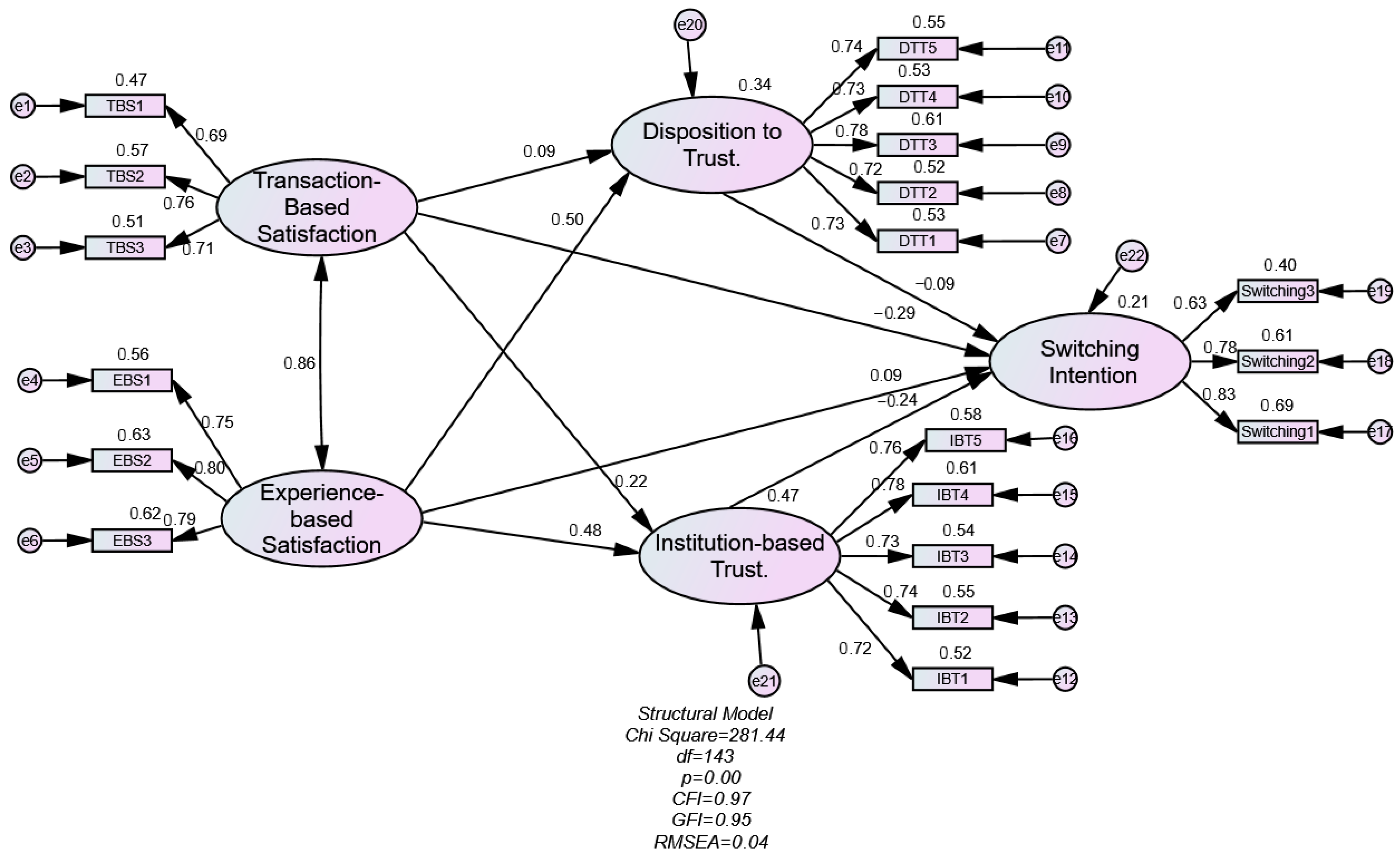
Following the approach outlined by Shiau, Chau [54], our analysis proceeded in two stages. Initially, we performed a comprehensive Structural Equation Modeling (SEM) analysis without incorporating the control variables. Subsequently, we performed a second SEM analysis, this time integrating the relevant control variables into the model. The initial SEM analysis showed that the combined effect of EBS and TBS explains 47% of the variance in institution-based trust and 33.7% of the variance in disposition to trust. Furthermore, the overall model explains a 21.0% variance in switching intention. When the control variables were included in the SEM analysis, we observed a change in the variance of switching intention (29.3%). Table 5 presents the direct effects of the model in the absence of sociodemographic controls. Table 6 presents the same model, but with the inclusion of sociodemographic controls, allowing for a comparison of results. In Figure 2, the graph of the SEM analysis is reported.

4.3.1. Results of the Hypothesized Direct Effects Without the Control Variables

Analyses excluding control variables showed a marginal negative effect of TBS on switching intentions (β = −0.299, p = 0.056), suggesting that users who experience slightly better transaction-level performance tend to be less inclined to switch, although this pattern is not statistically robust. EBS had a nonsignificant positive effect on switching intentions (β = 0.087, p = 0.590), indicating that cumulative positive experiences alone do not meaningfully reduce switching behavior in this context.
Regarding trust mechanisms, TBS showed nonsignificant effects on both IBT (β = 0.224, p = 0.080) and DTT (β = 0.090, p = 0.518), meaning that individual transactions do not substantially strengthen either institutional or interpersonal trust. In contrast, EBS had strong positive effects on IBT (β = 0.483, p < 0.001) and DTT (β = 0.502, p < 0.001). This implies that long-term, accumulated experience meaningfully enhances both confidence in the institution and trust in its human agents.
IBT significantly reduced switching intentions (β = −0.237, p = 0.001), showing that users who perceive the system as reliable are substantially less likely to switch providers. DTT showed no meaningful effect (β = −0.094, p = 0.139), indicating that trust in individual agents plays a limited role in switching decisions.

4.3.2. Results of the Hypothesized Effects with the Control Variables

When incorporating control variables, the pattern remained largely consistent. TBS continued to show a nonsignificant negative effect on switching intentions (β = −0.239, p = 0.095), again indicating that isolated transaction quality does not strongly influence switching. EBS also showed a nonsignificant negative effect (β = −0.026, p = 0.866), reinforcing the conclusion that accumulated experience alone does not directly reduce switching in this market.
As in the previous model, TBS did not significantly affect IBT (β = 0.224, p = 0.080) or DTT (β = 0.089, p = 0.519), whereas EBS maintained strong effects on both IBT (β = 0.483, p < 0.001) and DTT (β = 0.502, p < 0.001). This again indicates that repeated positive experiences, rather than isolated transactions, are the primary drivers of both institutional and dispositional trust. IBT showed a significant negative effect on switching intentions (β = −0.203, p = 0.004), confirming that trust in the platform’s institutional reliability is a key factor in user retention. DTT remained nonsignificant (β = −0.113, p = 0.060), suggesting once more that trust in agents plays a secondary role compared to trust in the leading mobile payment provider (Digicel).
Among the control variables, two factors significantly predicted switching intentions. Education positively influenced switching (β = 0.098, p = 0.020), meaning more educated users are more willing to consider alternatives, possibly because they have better digital literacy, higher expectations of service quality, or greater awareness of competing platforms. Age showed a negative effect (β = −0.187, p < 0.001), indicating that younger users are more likely to switch, likely due to greater technological openness and lower inertia, while older users tend to remain with familiar systems.

4.4. Results of the Indirect Effects

Analyses without control variables (Table 7) revealed nonsignificant indirect effects for both TBS (β = −0.010, 95% CI [−0.258, 0.118], p = 0.423) and EBS (β = −0.063, 95% CI [−0.377, 0.303], p = 0.200) through IBT, rejecting Hypotheses 7 and 8. Similarly, the indirect path from TBS to switching intentions through DTT was nonsignificant (β = −0.053, 95% CI [−1.905, 0.024], p = 0.173), aligning with Hypothesis 9. However, the indirect effect of EBS through DTT reached significance (β = −0.128, 95% CI [−1.999, −0.001], p = 0.048), contradicting Hypothesis 10. When control variables were included (Table 8), the indirect effects of TBS (β = −0.012, 95% CI [−0.417, 0.192], p = 0.473) and EBS (β = −0.055, 95% CI [−0.439, 0.203], p = 0.198) through IBT remained nonsignificant, reaffirming the rejection of Hypotheses 7 and 8. The indirect effect of TBS through DTT also remained nonsignificant (β = −0.065, 95% CI [−1.816, 0.020], p = 0.113), supporting Hypothesis 9. However, the indirect effect of EBS through DTT shifted to marginal non-significance (β = −0.113, 95% CI [−1.800, 0.005], p = 0.058), weakening support for Hypothesis 10. These results highlight the instability of EBS’s indirect effect through DTT across models and underscore the persistent non-significance of all other hypothesized mediation paths, regardless of covariate inclusion.

5. Discussion and Theoretical Implications

This study extends prior research on satisfaction, trust, and switching intentions by examining a duopolistic peer-to-peer (P2P) mobile payment market in Haiti, where MonCash (Digicel) dominates and NatCash (Natcom) serves as the sole rival. From the perspective of the market structure–behavior–performance framework, such duopolies simultaneously intensify competition and constrain consumer choice, producing a paradoxical environment in which user behavior is shaped by dependency rather than variety. Consistent with Switching Cost Theory [23], this limited market structure elevates perceived switching barriers and dampens users’ responsiveness to marginal differences in service quality, thus reshaping the traditional satisfaction, switching mechanism observed in more competitive markets [10,13].
Expectation–Confirmation Theory [17] provides a useful lens for interpreting the weak or inconsistent effects of transaction-based satisfaction (TBS) on trust and switching intentions. Satisfaction arises when users’ expectations are confirmed or positively disconfirmed by performance outcomes. In Haiti’s duopolistic P2P environment, however, users’ expectations are constrained by structural limitations and systemic risks, such as network outages and agent liquidity shortages. Because users have adapted to these systemic inefficiencies, the confirmation–disconfirmation mechanism becomes muted: minor transactional dissatisfaction does not strongly alter overall evaluations. This explains why, contrary to findings in more open markets, TBS fails to predict trust or switching intentions in this context significantly. Theoretically, this suggests that users are not necessarily “satisfied” but are “resigned,” perceiving few viable alternatives and little utility in switching.
In contrast, experience-based satisfaction emerges as a significant and robust driver of both institution-based trust and disposition to trust. This pattern aligns with Cognitive Trust Formation Theory [21], which posits that repeated positive experiences strengthen users’ reliability-based beliefs and reinforce confidence in the provider’s integrity and competence. Over time, such experiential consistency cultivates institutional assurance, in line with Institutional Theory [22,81], wherein organizations build legitimacy by signaling stability, procedural fairness, and reliability. Within Haiti’s mobile payment ecosystem, continuous exposure to consistent messages on fraud prevention, system reliability, and transaction security reinforces institutional credibility. Consequently, users generalize these positive experiences to both the institution (the service provider) and its representatives (agents), resulting in enhanced trust and a lower likelihood of switching.
The dominance of institution-based trust over disposition to trust in predicting switching intentions further reinforces the primacy of systemic assurances in duopolistic service markets. This finding aligns with the Trust–Commitment Model [82], which emphasizes that lasting commitment arises from trust in institutional integrity rather than from interpersonal or dispositional trust, particularly under high-risk conditions. In the Haitian P2P market, users remain with the dominant provider not necessarily because of personal affinity toward agents but because they believe in the provider’s ability to ensure security, reliability, and continuity. This contrasts with findings from fragmented or competitive markets [10], where disposition to trust often serves as the foundation of trust, and switching decisions are more flexible.
Theoretically, this study contributes to the literature by demonstrating that the mechanisms linking satisfaction, trust, and switching are context-dependent and structurally constrained. By integrating Expectation–Confirmation Theory, Cognitive Trust Formation Theory, Institutional Theory, and the Trust–Commitment Model, the study offers a theoretically cohesive explanation of why transaction-based satisfaction loses predictive power while experience-based satisfaction and institutional trust dominate user retention in duopolistic digital payment systems.

6. Managerial Implications

The theoretical implications discussed above provide valuable guidance for practical strategies that P2P mobile payment providers can implement, particularly those operating in Haiti. Our study highlights the distinct nature of consumer behavior in duopolistic P2P mobile payment markets, underscoring the need for tailored managerial strategies beyond generic service improvements. One key finding is that transaction-based satisfaction is limited in deterring switching behavior in a duopolistic P2P mobile payment market. This suggests that simply improving transaction quality may not be sufficient to retain users. Instead, providers should focus on strategies that enhance switching costs and network stickiness. For instance, integrating exclusive partnerships with local businesses, offering embedded financial services such as microloans or insurance, and facilitating seamless interoperability between services can create more compelling reasons for users to remain within an ecosystem beyond transactional satisfaction alone.
Our findings also indicate that experience-based satisfaction significantly enhances both dispositions to trust and institution-based trust, suggesting that positive service experiences play a critical role in trust formation. Instead of focusing solely on technical improvements, providers should invest in personalized engagement strategies such as AI-driven customer support, localized agent training programs, and proactive issue resolution mechanisms. These initiatives can help establish deeper trust and reduce user uncertainties, which is particularly important in regions where financial literacy and digital confidence are lower.
Moreover, given that institution-based trust exerts a strong negative effect on switching intentions, providers must go beyond standard transparency practices to actively cultivate institutional credibility. Collaborating with regulatory bodies to establish robust consumer protection policies, implementing verifiable security certifications, and developing educational campaigns about fraud prevention can significantly strengthen trust and loyalty. Additionally, while loyalty incentives such as cashback and discounts remain important, they should be complemented by long-term engagement strategies that differentiate providers in meaningful ways. For example, leveraging social capital through community-based financial initiatives, such as peer savings groups or localized financial literacy programs, can embed P2P mobile payment services more deeply into users’ daily financial lives. Providers should also explore gamification techniques, where users earn progressive benefits based on usage consistency and tenure, fostering deeper engagement rather than short-term transactional retention.
Lastly, the competitive landscape of P2P mobile payments in developing economies requires providers to rethink traditional retention models. Instead of reacting to user dissatisfaction post-transaction, providers should employ predictive analytics to anticipate switching risks and implement targeted interventions. Data-driven approaches, such as machine learning models that identify at-risk users and trigger personalized retention efforts, can significantly enhance customer stickiness. Overall, our findings suggest that practitioners should adopt a multi-dimensional approach to retention, one that integrates financial ecosystem development, proactive trust-building measures, and personalized engagement rather than relying solely on generic service quality improvements. These strategies will be particularly crucial for navigating the unique challenges of duopolistic P2P mobile payment markets in developing economies.

7. Policy Implications

For policymakers and regulators, the findings highlight how trust and satisfaction mechanisms shape financial inclusion and market competition in the P2P mobile payment market in developing economies. Since Institution-Based Trust negatively influences switching intentions (exemplifying user retention), policymakers should mandate reliability and transparency reporting for mobile payment providers, such as service uptime, fraud rates, and user dispute resolution statistics. These standards will foster systemic confidence across the ecosystem. In duopolistic markets, user mobility is constrained by technological and institutional barriers. Regulators should encourage interoperable payment infrastructures between MonCash, NatCash, and banks, enabling users to transfer funds across platforms seamlessly. This could promote both competition and consumer protection. Given the key role of agents in maintaining user trust, public authorities can establish certification schemes or accreditation systems for authorized mobile payment agents. Training modules could focus on fraud prevention, customer service ethics, and liquidity management. Public agencies and telecom regulators should partner with providers to develop nationwide awareness campaigns on secure mobile payment usage, digital fraud prevention, and user rights. These initiatives can reduce cognitive barriers, improve satisfaction, and foster sustained participation in digital finance.

8. Limitations and Future Directions

This study has some limitations besides its contributions. Firstly, the focus on a single mobile money provider (MonCash) in a specific region of Haiti limits the generalizability of the findings to other contexts. Future research should investigate the applicability of these findings to other mobile money providers and regions within Haiti, as well as in other developing countries with diverse socio-economic and technological contexts. Secondly, the cross-sectional design of this study precludes the establishment of causal relationships. Longitudinal studies or experimental designs would be necessary to more definitively examine the causal impact of service quality on user satisfaction and switching behavior. Thirdly, the study relied solely on self-reported data, which may be subject to biases such as social desirability bias. Future research could explore these limitations by conducting comparative studies across different mobile money providers and regions within Haiti, employing longitudinal research designs to analyze the dynamics of user satisfaction and switching behavior, utilizing mixed methods research, investigating the role of other factors, and exploring the impact of technological advancements on the quality of mobile money services and user experiences.
This study provides a valuable foundation for future research on the factors that influence user satisfaction and switch intentions in the mobile money sector. Finally, although SEM was useful for estimating the net effects of TBS, EBS, IBT, and DTT on switching intentions, it is limited in its ability to identify how combinations of factors jointly produce those intentions. Future research should complement SEM with configurational methods such as fuzzy-set qualitative comparative analysis or clustering and interaction-focused approaches to capture causal complexity and equifinality. Addressing this limitation and using mixed-methods designs will deepen understanding of user decision processes and support the design of more inclusive, effective mobile-money services in developing-country contexts.

Author Contributions

C.M. completed the following tasks: Conceptualization, Methodology, Supervision, Project Administration-Formal analysis—Review & Editing. S.J.P. completed the following tasks: Original draft preparation—Methodology, Data collection, Writing—Formal Analysis. All authors have read and agreed to the published version of the manuscript.

Funding

This research received no external funding.

Institutional Review Board Statement

Ethics approval was not required for this study.

Informed Consent Statement

Respondents provided verbal consent before participating in the questionnaire survey.

Data Availability Statement

The dataset supporting the findings of this study is publicly available in the Harvard Dataverse repository and can be accessed at the following link: https://doi.org/10.7910/DVN/5XZADL.

Conflicts of Interest

The authors declare no conflict of interest.

Appendix A. Questionnaire

Part 1. Transaction-based satisfaction
TBS1: I have been satisfied with recent money transfer transactions with MonCash mobile payment.
TBS2: I am satisfied with the information provided on the MonCash mobile payment service.
TBS3: I am satisfied with the mechanism used by MonCash mobile payment.
Part 2. Experience-based Satisfaction
EBS1: I am satisfied with my experiences using the MonCash mobile payment service
EBS2: My experience with the MonCash mobile payment service is pleasant.
EBS3: My choice to use MonCash’s mobile payment service was a good decision.
Part 3. Institution-based Trust (trust in Digicel, the mobile payment service provider)
IBT1: The mobile service provider MonCash (Digicel) is trustworthy.
IBT2: I trust Digicel to keep its promises and commitments.
IBT3: I believe that Digicel always acts in the best interests of MonCash users.
IBT4: I think mobile payment provider MonCash will always deliver on its promises.
IBT5: I think Digicel wants to be known as a company that always delivers on its promises and commitments.
Part 4. Disposition to Trust (trust in the agents of MonCash)
DTT1: I think MonCash’s authorized agents are honest
DTT2: I think MonCash’s authorized agents care about customers.
DTT3: I think MonCash’s authorized agents are consistent in the quality and offering of MonCash’s service.
DTT4: I believe that MonCash’s authorized agents are trustworthy.
DTT5: I believe MonCash’s authorized agents are reliable
Part 5. Switching Intention
Switching1: I plan to replace the mobile payment service MonCash with NatCash in the coming months.
Switching2: I plan to gradually reduce the use of MonCash mobile payments.
Switching3: I would like to try the service of NatCash, the competitor of MonCash.

References

  1. Ryu, H.-S.; Min, J. Innovation recipes for high use on four Fintech types: A configurational perspective. Inf. Manag. 2025, 62, 104058. [Google Scholar] [CrossRef]
  2. Wang, L.; Luo, X.R.; Yang, X. Carrot or stick? Exploring the effect of word-of-mouth on mobile payment application switching behaviors. J. Electron. Commer. Res. 2022, 23, 77–98. [Google Scholar]
  3. Albuainain, A.; Ashby, S. Enablers and Barriers in FinTech Adoption: A Systematic Literature Review of Customer Adoption and Its Impact on Bank Performance. FinTech 2025, 4, 49. [Google Scholar] [CrossRef]
  4. Zhu, Y.-Q.; Fang, Y.-H.; Lim, S.-Y. Investigating drivers of service extension success for a super app. Comput. Hum. Behav. 2023, 149, 107928. [Google Scholar] [CrossRef]
  5. Tew, H.-T.; Tan, G.W.-H.; Loh, X.-M.; Lee, V.-H.; Lim, W.-L.; Ooi, K.-B. Tapping the Next Purchase: Embracing the Wave of Mobile Payment. J. Comput. Inf. Syst. 2022, 62, 527–535. [Google Scholar]
  6. Dang, T.-Q.; Tan, G.W.-H.; Aw, E.C.-X.; Ooi, K.-B.; Metri, B.; Dwivedi, Y.K. How to generate loyalty in mobile payment services? An integrative dual SEM-ANN analysis. Int. J. Bank Mark. 2023, 41, 1177–1206. [Google Scholar] [CrossRef]
  7. Zhong, J.; Chen, T. Antecedents of mobile payment loyalty: An extended perspective of perceived value and information system success model. J. Retail. Consum. Serv. 2023, 72, 103267. [Google Scholar] [CrossRef]
  8. Mu, H.-L.; Lee, Y.-C. Will proximity mobile payments substitute traditional payments? Examining factors influencing customers’ switching intention during the COVID-19 pandemic. Int. J. Bank Mark. 2022, 40, 1051–1070. [Google Scholar] [CrossRef]
  9. Tang, Z.; Chen, L. Exploring the drivers of brand fan page follower discontinuance intention: An adaptation of the Furneaux and Wade’s framework. Inf. Technol. People 2020, 33, 1381–1401. [Google Scholar]
  10. Liang, L.J.; Choi, H.C.; Joppe, M. Exploring the relationship between satisfaction, trust and switching intention, repurchase intention in the context of Airbnb. Int. J. Hosp. Manag. 2018, 69, 41–48. [Google Scholar] [CrossRef]
  11. Nyamekye, M.B.; Kosiba, J.P.; Boateng, H.; Agbemabiese, G.C. Building trust in the sharing economy by signaling trustworthiness, and satisfaction. Res. Transp. Bus. Manag. 2022, 43, 100727. [Google Scholar] [CrossRef]
  12. Ofori, K.S.; Chai, J.; Adeola, O.; Abubakari, A.; Ampong, G.O.A.; Braimah, S.M.; Boateng, R. Exploring users’ continuance intention towards a peer-to-peer accommodation sharing platform. J. Hosp. Tour. Technol. 2023, 14, 330–346. [Google Scholar]
  13. Prasetya Nugroho, A.; Rahayu Hijrah Hati, S. Determinants of repurchase intention and switching intention: Analysis of online travel agent, peer-to-peer accommodation, and virtual hotel operator platforms. Market-Tržište 2020, 32, 79–96. [Google Scholar]
  14. Oliver, R.L. Satisfaction: A Behavioral Perspective on the Consumer: A Behavioral Perspective on the Consumer; Routledge: Oxfordshire, UK, 2014. [Google Scholar]
  15. Bansal, H.S.; Taylor, S.F. The Service Provider Switching Model (SPSM): A Model of Consumer Switching Behavior in the Services Industry. J. Serv. Res. 1999, 2, 200–218. [Google Scholar]
  16. Han, H.; Back, K.-J.; Barrett, B. Influencing factors on restaurant customers’ revisit intention: The roles of emotions and switching barriers. Int. J. Hosp. Manag. 2009, 28, 563–572. [Google Scholar] [CrossRef]
  17. Oliver, R.L. A Cognitive Model of the Antecedents and Consequences of Satisfaction Decisions. J. Mark. Res. 1980, 17, 460–469. [Google Scholar]
  18. Choi, I.Y.; Moon, H.S.; Kim, J.K. Assessing personalized recommendation services using expectancy disconfirmation theory. Asia Pac. J. Inf. Syst. 2019, 29, 203–216. [Google Scholar] [CrossRef]
  19. Bollenbach, J.; Halbrügge, S.; Wederhake, L.; Weibelzahl, M.; Wolf, L. Customer satisfaction at large charging parks: Expectation-disconfirmation theory for fast charging. Appl. Energy 2024, 365, 122735. [Google Scholar] [CrossRef]
  20. Hien, N.N.; Long, N.T.; Liem, V.T.; Luu, D.X. Customer Responses to Airline Service Failure: Perspectives from Expectation Disconfirmation Theory. Sage Open 2024, 14, 21582440241248334. [Google Scholar] [CrossRef]
  21. Harrison McKnight, D.; Choudhury, V.; Kacmar, C. The impact of initial consumer trust on intentions to transact with a web site: A trust building model. J. Strateg. Inf. Syst. 2002, 11, 297–323. [Google Scholar]
  22. Scott, C. Analysing Regulatory Space: Fragmented Resources and Institutional Design; Public Law; Sweet and Maxwell: London, UK, 2001; pp. 283–305. [Google Scholar]
  23. Burnham, T.A.; Frels, J.K.; Mahajan, V. Consumer Switching Costs: A Typology, Antecedents, and Consequences. J. Acad. Mark. Sci. 2003, 31, 109–126. [Google Scholar] [CrossRef]
  24. Kristensen, K.; Martensen, A.; Gronholdt, L. Measuring the impact of buying behaviour on customer satisfaction. Total Qual. Manag. 1999, 10, 602–614. [Google Scholar]
  25. Holmes, J.G. Trust and the appraisal process in close relationships. In Advances in Personal Relationships: A Research Annual; Jessica Kingsley Publishers: Oxford, UK, 1991; Volume 2, pp. 57–104. [Google Scholar]
  26. Kim, D.J. An investigation of the effect of online consumer trust on expectation, satisfaction, and post-expectation. Inf. Syst. e-Bus. Manag. 2012, 10, 219–240. [Google Scholar] [CrossRef]
  27. Bitner, M.J.; Hubbert, A.R. Encounter satisfaction versus overall satisfaction versus quality. In Service Quality: New Directions in Theory and Practice; Rust, R., Oliver, R., Eds.; Sage: Thousand Oaks, CA, USA, 1994; pp. 72–94. [Google Scholar]
  28. Prentice, C. Linking internal service quality and casino dealer performance. J. Hosp. Mark. Manag. 2018, 27, 733–753. [Google Scholar] [CrossRef]
  29. L. Keiningham, T.; Aksoy, L.; C. Malthouse, E.; Lariviere, B.; Buoye, A. The cumulative effect of satisfaction with discrete transactions on share of wallet. J. Serv. Manag. 2014, 25, 310–333. [Google Scholar] [CrossRef]
  30. Liu, X.; He, M.; Gao, F.; Xie, P. An empirical study of online shopping customer satisfaction in China: A holistic perspective. Int. J. Retail. Distrib. Manag. 2008, 36, 919–940. [Google Scholar] [CrossRef]
  31. Huang, D.; Coghlan, A.; Jin, X. Understanding the drivers of Airbnb discontinuance. Ann. Tour. Res. 2020, 80, 1–14. [Google Scholar] [CrossRef]
  32. Huang, W.Y.; Dubinsky, A.J. Measuring customer pre-purchase satisfaction in a retail setting. Serv. Ind. J. 2014, 34, 212–229. [Google Scholar] [CrossRef]
  33. Jones, M.A.; Suh, J. Transaction-specific satisfaction and overall satisfaction: An empirical analysis. J. Serv. Mark. 2000, 14, 147–159. [Google Scholar] [CrossRef]
  34. Fared, M.A.; Darmawan, D.; Khairi, M. Contribution of E-Service Quality to Repurchase Intention with Mediation of Customer Satisfaction: Study of Online Shopping Through Marketplace. J. Mark. Bus. Res. (MARK) 2021, 1, 93–106. [Google Scholar]
  35. Choi, D.; Chung, C.Y.; Young, J. Sustainable online shopping logistics for customer satisfaction and repeat purchasing behavior: Evidence from China. Sustainability 2019, 11, 5626. [Google Scholar] [CrossRef]
  36. Li, X.; Zhu, X.; Lu, Y.; Shi, D.; Deng, W. Understanding the continuous usage of mobile payment integrated into social media platform: The case of WeChat Pay. Electron. Commer. Res. Appl. 2023, 60, 101275. [Google Scholar] [CrossRef]
  37. Supriyanto, A.; Wiyono, B.B.; Burhanuddin, B. Effects of service quality and customer satisfaction on loyalty of bank customers. Cogent Bus. Manag. 2021, 8, 1937847. [Google Scholar] [CrossRef]
  38. Alzoubi, H.; Alshurideh, M.; Al Kurdi, B.; Akour, I.; Azi, R. Does BLE technology contribute towards improving marketing strategies, customers’ satisfaction and loyalty? The role of open innovation. Int. J. Data Netw. Sci. 2022, 6, 449–460. [Google Scholar] [CrossRef]
  39. Kim, Y.; Wang, Q.; Roh, T. Do information and service quality affect perceived privacy protection, satisfaction, and loyalty? Evidence from a Chinese O2O-based mobile shopping application. Telemat. Inform. 2021, 56, 101483. [Google Scholar] [CrossRef]
  40. Mannan, M.; Mohiuddin, F.; Chowdhury, N.; Sarker, P. Customer satisfaction, switching intentions, perceived switching costs, and perceived alternative attractiveness in Bangladesh mobile telecommunications market. South Asian J. Bus. Stud. 2017, 6, 142–160. [Google Scholar] [CrossRef]
  41. Calvo-Porral, C.; Faíña-Medín, A.; Nieto-Mengotti, M. Satisfaction and switching intention in mobile services: Comparing lock-in and free contracts in the Spanish market. Telemat. Inform. 2017, 34, 717–729. [Google Scholar] [CrossRef]
  42. Deng, Z.; Lu, Y.; Wei, K.K.; Zhang, J. Understanding customer satisfaction and loyalty: An empirical study of mobile instant messages in China. Int. J. Inf. Manag. 2010, 30, 289–300. [Google Scholar] [CrossRef]
  43. Gefen, D. E-commerce: The role of familiarity and trust. Omega 2000, 28, 725–737. [Google Scholar] [CrossRef]
  44. Panigrahi, S.; Azizan, N.A.; Waris, M. Investigating the empirical relationship between service quality, trust, satisfaction, and intention of customers purchasing life insurance products. Indian J. Mark. 2018, 48, 19. [Google Scholar] [CrossRef]
  45. Shao, Z.; Yin, H. Building customers’ trust in the ridesharing platform with institutional mechanisms. Internet Res. 2019, 29, 1040–1063. [Google Scholar] [CrossRef]
  46. Zucker, L.G. Production of trust: Institutional sources of economic structure, 1840–1920. Res. Organ. Behav. 1986, 8, 53–111. [Google Scholar]
  47. Möllering, G. Trust, Institutions, Agency: Towards a Neoinstitutional Theory of Trust u: Bachmann, Reinhard i Akbar Zaheer (ur.) Handbook of Trust Research; Edward Elgar Publishing: Northampton, UK, 2006. [Google Scholar]
  48. Lu, B.; Wang, Z.; Zhang, S. Platform-based mechanisms, institutional trust, and continuous use intention: The moderating role of perceived effectiveness of sharing economy institutional mechanisms. Inf. Manag. 2021, 58, 103504. [Google Scholar] [CrossRef]
  49. Gong, X.; Zhang, K.Z.; Chen, C.; Cheung, C.M.; Lee, M.K. What drives trust transfer from web to mobile payment services? The dual effects of perceived entitativity. Inf. Manag. 2020, 57, 103250. [Google Scholar] [CrossRef]
  50. Koçoğlu, İ.; Akgün, A.E.; Keskin, H. The collective unconscious at the organizational level: The manifestation of organizational symbols. Procedia-Soc. Behav. Sci. 2016, 235, 296–303. [Google Scholar] [CrossRef]
  51. Scott, W. Institutions and Organizations: Ideas, Interests, and Identities; Sage Publications: Thousand Oaks, CA, USA, 1995. [Google Scholar]
  52. Becker, T.E. Potential Problems in the Statistical Control of Variables in Organizational Research: A Qualitative Analysis with Recommendations. Organ. Res. Methods 2005, 8, 274–289. [Google Scholar] [CrossRef]
  53. Becker, T.E.; Atinc, G.; Breaugh, J.A.; Carlson, K.D.; Edwards, J.R.; Spector, P.E. Statistical control in correlational studies: 10 essential recommendations for organizational researchers. J. Organ. Behav. 2016, 37, 157–167. [Google Scholar]
  54. Shiau, W.-L.; Chau, P.Y.; Thatcher, J.B.; Teng, C.-I.; Dwivedi, Y.K. Have we controlled properly? Problems with and recommendations for the use of control variables in information systems research. Int. J. Inf. Manag. 2024, 74, 102702. [Google Scholar]
  55. Carlson, K.D.; Wu, J. The Illusion of Statistical Control:Control Variable Practice in Management Research. Organ. Res. Methods 2012, 15, 413–435. [Google Scholar]
  56. Podsakoff, P.M.; MacKenzie, S.B.; Podsakoff, N.P. Sources of method bias in social science research and recommendations on how to control it. Annu. Rev. Psychol. 2012, 63, 539–569. [Google Scholar] [CrossRef]
  57. Jordan, P.J.; Troth, A.C. Common method bias in applied settings: The dilemma of researching in organizations. Aust. J. Manag. 2020, 45, 3–14. [Google Scholar] [CrossRef]
  58. Johanson, G.A.; Brooks, G.P. Initial Scale Development: Sample Size for Pilot Studies. Educ. Psychol. Meas. 2010, 70, 394–400. [Google Scholar]
  59. Perneger, T.V.; Courvoisier, D.S.; Hudelson, P.M.; Gayet-Ageron, A. Sample size for pre-tests of questionnaires. Qual. Life Res. 2015, 24, 147–151. [Google Scholar]
  60. Gefen, D.; Straub, D.; Boudreau, M.-C. Structural equation modeling and regression: Guidelines for research practice. Commun. Assoc. Inf. Syst. 2000, 4, 7. [Google Scholar] [CrossRef]
  61. Hair, J.F.; Gabriel, M.; Patel, V. AMOS covariance-based structural equation modeling (CB-SEM): Guidelines on its application as a marketing research tool. Braz. J. Mark. 2014, 13, 12. [Google Scholar]
  62. Zhang, M.F.; Dawson, J.F.; Kline, R.B. Evaluating the Use of Covariance-Based Structural Equation Modelling with Reflective Measurement in Organizational and Management Research: A Review and Recommendations for Best Practice. Br. J. Manag. 2021, 32, 257–272. [Google Scholar]
  63. Hair, J.F.; Sarstedt, M.; Ringle, C.M.; Mena, J.A. An assessment of the use of partial least squares structural equation modeling in marketing research. J. Acad. Mark. Sci. 2012, 40, 414–433. [Google Scholar]
  64. Sarstedt, M.; Hair, J.J.F.; Nitzl, C.; Ringle, C.M.; Howard, M.C. Beyond a tandem analysis of SEM and PROCESS: Use of PLS-SEM for mediation analyses! Int. J. Mark. Res. 2020, 62, 288–299. [Google Scholar] [CrossRef]
  65. Anderson, J.C.; Gerbing, D.W. Structural equation modeling in practice: A review and recommended two-step approach. Psychol. Bull. 1988, 103, 411–423. [Google Scholar] [CrossRef]
  66. George, D.; Mallery, P. IBM SPSS Statistics 26 Step by Step: A Simple Guide and Reference; Routledge: New York, NY, USA, 2019. [Google Scholar]
  67. Tabachnick, B.G.; Fidell, L.S.; Ullman, J.B. Using Multivariate Statistics; Pearson: Boston, MA, USA, 2007; Volume 5. [Google Scholar]
  68. Comrey, A.L.; Lee, H.B. A First Course in Factor Analysis; Psychology Press: New York, NY, USA, 2013. [Google Scholar]
  69. Hair, J.F. Multivariate Data Analysis; Prentice Hall: London, UK, 2009. [Google Scholar]
  70. Bagozzi, R.; Yi, Y. On the Evaluation of Structural Equation Models. J. Acad. Mark. Sci. 1988, 16, 74–94. [Google Scholar] [CrossRef]
  71. Hair, J.F. Multivariate Data Analysis, 6th ed.; Pearson Prentice Hall: Hoboken, NJ, USA, 2005. [Google Scholar]
  72. Hayes, A.F.; Coutts, J.J. Use Omega Rather than Cronbach’s Alpha for Estimating Reliability. But…. Commun. Methods Meas. 2020, 14, 1–24. [Google Scholar] [CrossRef]
  73. Revelle, W.; Zinbarg, R.E. Coefficients alpha, beta, omega, and the glb: Comments on Sijtsma. Psychometrika 2009, 74, 145–154. [Google Scholar] [CrossRef]
  74. Field, A. Discovering Statistics Using SPSS; Sage Publications: London, UK, 2009. [Google Scholar]
  75. Kaiser, H.F. An index of factorial simplicity. Psychometrika 1974, 39, 31–36. [Google Scholar] [CrossRef]
  76. Cheung, G.W.; Cooper-Thomas, H.D.; Lau, R.S.; Wang, L.C. Reporting reliability, convergent and discriminant validity with structural equation modeling: A review and best-practice recommendations. Asia Pac. J. Manag. 2023, 41, 745–783. [Google Scholar] [CrossRef]
  77. Voorhees, C.M.; Brady, M.K.; Calantone, R.; Ramirez, E. Discriminant validity testing in marketing: An analysis, causes for concern, and proposed remedies. J. Acad. Mark. Sci. 2016, 44, 119–134. [Google Scholar] [CrossRef]
  78. Fornell, C.; Larcker, D.F. Evaluating Structural Equation Models with Unobservable Variables and Measurement Error. J. Mark. Res. 1981, 18, 39–50. [Google Scholar] [PubMed]
  79. Kock, N. Common method bias in PLS-SEM: A full collinearity assessment approach. Int. J. e-Collab. (IJeC) 2015, 11, 1–10. [Google Scholar]
  80. Hu, L.t.; Bentler, P.M. Cutoff criteria for fit indexes in covariance structure analysis: Conventional criteria versus new alternatives. Struct. Equ. Model. Multidiscip. J. 1999, 6, 1–55. [Google Scholar] [CrossRef]
  81. Scott, W. Institutions and Organizations: Ideas and Interests; Sage Publications: Los Angeles, CA, USA, 2007. [Google Scholar]
  82. Morgan, R.M.; Hunt, S.D. The Commitment-Trust Theory of Relationship Marketing. J. Mark. 1994, 58, 20–38. [Google Scholar] [CrossRef]
Figure 1. Hypothesized relationships.
Fintech 05 00007 g001
Figure 2. Results of the SEM analysis.
Fintech 05 00007 g002
Table 1. A Summary of the Direct Effects of TBS and EBS Across Different Service Settings.
Direct EffectsResults by Prasetya Nugroho and Rahayu Hijrah Hati [13]Results by Liang, Choi [10]Results of the Current Study
Online Travel AgentP2P Accommodation SharingVirtual Hotel OperatorP2P Accommodation SharingP2P Mobile Payment (CVs Excluded)P2P Mobile Payment (CVs Included)
EBS → Disposition to trustSignificant (+)Significant (+)Significant (+)Insignificant (−)Significant (+)Significant (+)
EBS → Institution-based trustSignificant (+)(+) Significant(+) SignificantInsignificant (+)Significant (+)Significant (+)
EBS → Switching intentionInsignificant (+)Insignificant (−)Insignificant (+)Significant (−)Insignificant (+)Insignificant (+)
EBS → Repurchase intentionInsignificant (+)Significant (+)Insignificant (+)Significant (+)Not examinedNot examined
TBS → EBS(+) SignificantSignificant (+)(+) Significant(+) SignificantNot examinedNot examined
TBS → Disposition to trustInsignificant (−)Insignificant (−)Significant (+)Significant (+)Insignificant (+)Insignificant (+)
TBS → Institution-based trustSignificant (+)Significant (+)(+) Significant(+) SignificantInsignificant (+)Insignificant (−)
TBS → Switching intentionSignificant (−)Insignificant (+)Insignificant (−)Significant (−)Significant (−)Insignificant (−)
TBS → Repurchase intentionSignificant (+)Significant (+)Significant (+)Significant (+)Not examinedNot examined
DTT → Switching intentionInsignificant (+)Insignificant (+)Significant (−)Significant (+)Insignificant (+)Insignificant (−)
DTT→ Repurchase intentionInsignificant (+)Insignificant (+)Significant (+)Significant (+)Not examinedNot examined
IBT → Disposition to trustSignificant (+)Significant (+)Significant (+)Insignificant (−)Not examinedNot examined
IBT → Switching intentionInsignificant (−)Insignificant (−)Insignificant (−)Insignificant (−)Significant (−)Significant (−)
IBT → Repurchase intentionSignificant (+)Insignificant (+)Significant (+)Not examinedNot examinedNot examined
Table 2. Demographics of the Respondents (Sample size = 529).
Profile of the RespondentsFrequencyPercentage
TenureActive Users (more than 4 transactions/month)30758.0
Non-active Users (less than 4 transactions/month)22242.0
Usage TypeMake money transfers21240.1
Pay service bundles from the company8516.1
Purchase goods & services5310.0
Select all answers17933.8
Length of ExperienceLess than one year10319.5
Between 1 and 3 years24145.6
4 years or more18535.0
Possession of a Bank accountYes31359.2
No21640.8
Age Distribution18–2520438.6
26–3517432.9
36–458516.1
46–555310.0
56 and above132.5
Gender DistributionMale28453.7
Female24546.3
Educational AttainmentHigh school uncompleted10820.4
High school completed, and currently studying at a university/technical college.27752.4
University/technical studies completed13024.6
Graduate studies (Master’s/Doctorate)142.6
Income LevelLow-Income28954.6
Lower-Middle-Income18635.2
Upper-Middle-Income5310.0
High-Income10.2
Table 3. Results of the Reliability and Validity Analyses.
ItemsSkewKurtosisLoadingsMcDonald’s OmegaCRAVEMSVMaxR(H)Model Fit Measures
Switching1−0.595−0.6010.834 ***0.7990.7970.5700.1710.819CMIN/DF = 1.830.
CFI = 0.974

SRMR = 0.040

RMSEA = 0.040
PClose = 0.989
Switching2−0.458−0.5690.783 ***
Switching3−0.738−0.2630.633 ***
DTT1−0.039−0.8790.726 ***0.8570.8580.5480.3080.860
DTT20.056−0.8630.719 ***
DTT30.083−0.9020.779 ***
DTT40.085−0.8620.732 ***
DTT50.138−0.9110.744 ***
IBT10.248−1.0440.722 ***0.8630.8640.5600.4290.865
IBT20.426−0.7240.737 ***
IBT30.556−0.6250.731 ***
IBT40.342−0.8770.785 ***
IBT50.328−0.8350.763 ***
EBS10.156−1.0940.751 ***0.8250.8240.6100.7440.826
EBS20.215−1.0410.800 ***
EBS3−0.011−1.1220.792 ***
TBS10.066−1.2760.686 ***0.7620.7630.5180.7440.766
TBS20.090−1.0840.759 ***
TBS30.122−1.1630.711 ***
MaxR(H) = Maximum Reliability of H-Index. MSV = Maximum Shared Variance. *** indicates a statistically significant result at the 0.001 level.
Table 4. Correlations, Mean, and Discriminant Validity Analysis (n = 572).
VariablesMeanStd. D12345
1.
Transaction-based satisfaction
2.671.0210.7190.8610.6410.5060.388
2.
Experience-based satisfaction
2.761.090.862 ***0.7810.6570.5540.341
3.
Institution-based Trust
2.510.970.636 ***0.655 ***0.7480.5390.387
4.
Disposition to Trust
2.730.940.508 ***0.555 ***0.538 ***0.7400.282
5.
Switching Intention
3.571.02−0.413 ***−0.371 ***−0.412 ***−0.315 ***0.755
*** p is the significance level of the correlation at the 0.001 confidence level. The Heterotrait-Monotrait (HTMT) matrix is highlighted in grey. The values in bold (diagonal) are the square root of the AVE.
Table 5. Direct Effects on Switching Intention: Model with Control Variables Excluded.
Standardized EstimateS.E.C.R.pLabel
H1: TBS → Switching Intention−0.2900.179−1.9080.056Partially Significant
H2: EBS → Switching Intention0.0870.1810.5380.590Insignificant
H3a: TBS → Institution-based Trust0.2240.1321.7500.080Insignificant
H3b: TBS → Disposition to Trust0.0900.1370.6460.518Insignificant
H4a: EBS satisfaction → Institution-based Trust0.4830.1253.765***Significant
H4b: EBS → Disposition to Trust0.5020.1313.604***Significant
H5: Institution-based Trust → Switching Intention−0.2370.084−3.2110.001Significant
H6: Disposition to Trust → Switching Intention−0.0940.075−1.4800.139Insignificant
*** p is the significance level of the correlation at the 0.001 confidence level. Note: → represents the direct path from the independent variable to the dependent variable.
Table 6. Direct Effects on Switching Intention: Model with Control Variables Included.
Hypothesized Direct EffectsStandardized EstimatesS.E.C.R.pRemarks
H1: TBS → Switching Intention−0.2390.174−1.6670.095Insignificant
H2: EBS → Switching Intention−0.0260.176−0.1680.866Insignificant
H3a: EBS → Institution-based Trust0.2240.1321.7500.080Insignificant
H3b: TBS → Disposition to Trust0.0890.1370.6450.519Insignificant
H4a: EBS → Institution-based Trust0.4830.1263.769***Significant
H4b: EBS → Disposition to Trust0.5020.1303.608***Significant
H5: Institution-based Trust → Switching Intention−0.2030.082−2.9110.004Significant
H6: Disposition to Trust → Switching Intention−0.1130.074−1.8780.060Insignificant
Length of experience → Switching Intention−0.0040.063−0.1050.916Insignificant
Education → Switching Intention0.0980.0622.3290.020Significant
Gender → Switching Intention−0.0290.091−0.6830.494Insignificant
Age → Switching Intention−0.1870.042−4.421***Significant
User tenure → Switching Intention0.0200.0920.4720.637Insignificant
Income → Switching Intention0.0640.0671.5230.128Insignificant
Usage Type → Switching Intention−0.0360.035−0.8490.396Insignificant
*** p is the significance level of the correlation at the 0.001 confidence level. Note: → represents the direct path from the independent variable to the dependent variable.
Table 7. Results of the Mediation Analysis: Model with Control Variables Excluded.
Hypothesized Indirect EffectsIndirect Effects95% CI; 5000 Bootstrap Samplesp-Values
Lower BoundsUpper Bounds
H07: TBS → Institution-based Trust → Switching Intention−0.010−0.2580.1180.423
H08: EBS → Institution-based Trust → Switching Intention−0.063−0.3770.3030.200
H09: TBS → Disposition to Trust → Switching Intention−0.053−1.9050.0240.173
H10: EBS → Disposition to Trust → Switching Intention−0.128−1.999−0.0010.048
Note: → represents the paths from the independent variable to the dependent variable.
Table 8. Results of the Mediation Analysis: Model with Control Variables Included.
Hypothesized Indirect EffectsIndirect Effects95% CI; 5000 Bootstrap Samplesp-Values
Lower BoundsUpper Bounds
H07: TBS → Institution-based Trust → Switching Intention−0.012−0.4170.1920.473
08: EBS → Institution-based Trust → Switching Intention−0.055−0.4390.2030.198
H09: TBS → Disposition to Trust → Switching Intention−0.065−1.8160.0200.113
H10: EBS → Disposition to Trust → Switching Intention−0.113−1.8000.0050.058
Note: → represents the paths from the independent variable to the dependent variable.
Disclaimer/Publisher’s Note: The statements, opinions and data contained in all publications are solely those of the individual author(s) and contributor(s) and not of MDPI and/or the editor(s). MDPI and/or the editor(s) disclaim responsibility for any injury to people or property resulting from any ideas, methods, instructions or products referred to in the content.