
Article

Fintech Innovations and the Transformation of Rural Financial Ecosystems in India

1
Department of Commerce, Aligarh Muslim University, Aligarh 202001, India
2
School of Business, Bahrain Polytechnic, Isa Town 33349, Bahrain
*
Author to whom correspondence should be addressed.
Submission received: 12 October 2025 / Revised: 16 November 2025 / Accepted: 25 November 2025 / Published: 24 December 2025

Abstract

Background: Fintech companies have revolutionized the financial services industry in India in recent years. This is especially true for the growth of digital payment methods. India’s unbanked are being introduced to banking by fintech companies. Despite the country’s strong banking system, many residents find it difficult to get government financial services. This is particularly true for rural or low-income people. This vacuum has been addressed by fintech solutions including digital banking, micro-lending applications, mobile wallets, and UPI platforms. Objectives: to study the impact of financial technology businesses on increasing financial inclusion for India’s underbanked and unbanked population and Challenges encountered by financial technology enterprises in their endeavors to access unbanked populations, encompassing concerns of infrastructure with special reference to western Uttar Pradesh. Method: This mixed-methods study examines how FinTech is narrowing the financial gap for unbanked people using quantitative econometric analysis and qualitative case study assessments. Results: Digital financial innovation and regulatory support encourage inclusive growth in underdeveloped economies, whereas rich nations benefit from sophisticated banking institutions. This is indicated by the small influence of GDP per capita (β = 0.22–0.32, p < 0.05). Findings: The study found that inclusive finance is revolutionized when FinTech is used with the help of robust regulatory frameworks and digital infrastructure. Policymakers should prioritize cybersecurity, public-private partnerships to improve digital literacy, and rural connection if they want more people to take part in the digital financial ecosystem. Implications: FinTech can remove obstacles to accessing financing. The proper coordinated improvements in regulatory frameworks, digital infrastructure and financial literacy among the people are necessary to achieve full financial inclusion.

1. Introduction

The term ‘fintech’ describes the new wave of financial technology that emerged in response to the 2007–2008 financial crisis and has subsequently brought about a sea change in the industry. The expansion of contemporary banking may be traced back to two mainstays: technological banking and technologically enabled banking [1]. One of the main factors driving this cause in India over the past decade has been the rapid expansion of mobile networks into underserved areas and communities [2,3]. With the rise of payment banks, customers in rural and semi-urban areas now have another option besides online and mobile banking. This has helped streamline operations and cut costs for service provision. Secondly, an expanding economy brings in more individuals to work in finance and the economy, funding growth factors, such as expanding opportunities for savings mobilization and entrepreneurship, decreasing risk susceptibility, and improving people’s quality of living, inclusive financial breakthroughs can reduce poverty [4]. Over 330 million formerly unbanked individuals were able to access formal financial institutions in FY2023 as the financial inclusion index increased from 43.4 to 60.1, according to the Reserve Bank of India. India’s Reserve Bank (2023) [5] Digital payment systems have sped up socioeconomic transition in addition to being convenient. By promoting competition among financial service providers, transparency in all financial operations, and the effectiveness of government subsidy programs, they decreased costs and enhanced service delivery. According to the Digital India project, these platforms integrate conventional banking services to contemporary financial needs and foster economic progress [6,7]. Fintech employs technology to improve the accessibility, efficiency, and delivery of financial services.

1.1. India’s Unbanked Community

With barely 35 per cent of individuals holding an account with a financial institution, India has one of the lowest percentages of account penetration among developing nations, and it is also home to the biggest unbanked population [8,9]. In Andhra Pradesh and Delhi NCR, about half of the adults have a formal account, while in Gujarat, Kerala, and Maharashtra, it’s around 40 per cent. However, in Bihar, Orissa, and Rajasthan, that number drops to less than 30 per cent. There are almost 1.22 billion people living in India, and according to 2011 census statistics, 65 per cent of individuals there do not have access to official financial services [10]. World Bank data shows that just 35.2 per cent of Indian people over the age of 15 hold an account with a bank or other formal financial institution. Formal financial institutions have deposit accounts with 55 per cent of the population and credit accounts with only 9 per cent. One bank branch for every fourteen thousand people is what the numbers reveal. Very few people use credit cards, and even fewer use debit cards (18 per cent vs. 2 per cent). In India, there may have been an increase in the number of bank branches after the reform period, but there are still only 48,000 commercial banks (including RRBs and SCBs) servicing 6 lakh villages. That means out of 12.5 communities, there is just one bank branch. People without bank accounts in India and the other BRICS countries have said that opening a formal account is difficult [9,11].

1.2. Role of FinTech Startups in Serving the Unbanked in India

Most rural Indians do not have access to traditional banking services; however, this can change with the help of financial technology. Small and medium-sized enterprises (MSME) have a significant challenge when it comes to money. However, there is hope in the form of fintech firms that may help alleviate this problem by providing simpler and faster access to loans [7]. To increase the penetration of financial services in India, FinTech start-ups are utilizing big data, machine learning, and alternative data to improve the customer experience in areas such as accessibility, convenience, personalization, transparency, and the development of credit scores and underwriting credit [1].

1.3. Mobile Banking and Digital Payment Frameworks

Indian National Payments Corporation (NPCI) and explored NPCI’s function within the country’s burgeoning digital payment sector. All of India’s retail payment systems are unified under NPCI. By establishing a foundation based on massive volumes and scale, it will be possible to provide payment services for a fraction of the current cost structure [12]. In May 2016, after only four years of operation, RuPay captured 38 per cent of the market with 267 million debit cards. Due to its cost-effectiveness, RuPay-based e-commerce transactions have experienced a 20 per cent increase in volume and a 22 per cent increase in value month-over-month. The Pradhan Mantri Jan-Dhan Yojana (Jan-Dhan Yojana) aims to provide banking services to everyone and is helping to spread RuPay [9]. The recipients will receive RuPay Debit cards that have an accident insurance policy with a maximum coverage of Rs 100,000. In the future, RuPay’s market share would be increased thanks to the debut of their credit card in December 2016, brand awareness campaigns in metropolitan areas, and partnerships with 8 payment banks and 10 small financing institutions [13,14].

1.4. Integration of Biometric Systems with Electronic Know Your Customer (e-KYC)

Every citizen of India is assigned a distinct identity a random 12-digit number through the government’s Aadhaar program. A customer’s Aadhaar number, together with fingerprint and/or iris scan technology, allows a Digital Financial Service (DFS) provider to authenticate the customer’s identity [12]. The customer due diligence process is made easier for DFS providers since they depend on Aadhaar authentication results without further identification verification. A portion of the Aadhaar Act pertaining to the commercial sector’s utilization of e-KYC was declared unlawful by the Indian Supreme Court in September 2018. Because of this, the private sector was not provided with access to e-KYC services. There was no change to the availability of e-KYC for public services including social assistance payments [15,16]. In 2019, a policy was put in place to permit the private sector to utilize e-KYC. This legislation specifically permits DFS providers and telecommunication companies to do so.

1.5. Direct Benefit Transfers (DBTs) and Government Initiatives

In India, the Janani Suraksha Yojana utilized the conditional cash transfers program. Nevertheless, Unconditional Cash Transfers (UCT) were the cash transfer method that was perceived in the 2010–2011 economic survey. Reducing food insecurity among the ultra-poor is one of the goals of well-targeted UCT, which also increases household consumption and asset ownership. Therefore, to endorse and implement a solution for direct transfer of subsidies, the Indian government established a task force headed by Nandan Nilekani in the 2011–2012 budget speech. The report on this initiative is titled ‘Report of the Task Force on Direct Transfer of Subsidies on Kerosene, LPG and Fertilizer, 2011. To replace kerosene, LPG, and fertilizer subsidies with cash transfers, the committee proposed several systems, one of which is the Core Subsidy Management System (CSMS). This system would integrate Aadhaar, ERP (Enterprise Resource Planning) systems, the Nodal Bank and Payment Gateway, and modules for logistics, training, education, and outreach [17,18]. Mobile technology and the AEPS system have made financial aid more transparent, speedier, and dependable. This has decreased middleman and corruption and increased rural trust and involvement. FinTech has successfully combined technical innovation and social welfare governance to drive economic growth and achieve social justice and inclusion [19].

1.6. Financial Literacy and Consumer Empowerment

The term ‘financial literacy’ refers to the ability to understand one’s own financial situation and make educated decisions to improve one’s own financial situation. Through the provision of information, instruction, and/or objective advice, financial education enables consumers and investors to gain a better understanding of financial products, concepts, and risks [5,20]. It also empowers them to become more self-aware of financial risks and opportunities, make educated choices, know where to get assistance, and take other effective actions to improve their financial well-being. From what has been said thus far, it is evident that education and financial literacy are closely connected ideas. Government and institutional initiatives like the Digital Literacy Campaign (DISHA) and the Reserve Bank Innovation Hub (RBIH) have helped promote financial literacy. The Digital Personal Data Protection Act (2023) protects consumer data and privacy by addressing these challenges [21].

1.7. Growth Factors of Indian FinTech Sector

Key elements that contribute to the success of fintech organizations include customer loyalty, the funding climate, technology and IT infrastructure, value proposition, innovative data utilization, and operational costs [22]. In the next three to five years, the following seven things will most certainly propel the Indian financial technology industry forward: Consistent expansion of the economy accompanied by rather low access to banking services. Public sector insurers and large public sector banks are falling behind the market [23,24].

1.8. Regulatory Forbearance Toward FinTech

Millennials in India are climbing the digital financial services adoption S-curve at a quick pace, which is making them feel more pressure from established players. India Infrastructure and connectivity for digital financial services may be enhanced by the spread of data on the internet and stacks [25]. Potentially enabling subsidization without constructing scale are technological advancements and cloud service adoptions that result in asset light models with nearly nil unit costs at transaction levels. A decline in India’s real interest rates [26].

1.9. Supervisory Legal Framework and Government Initiatives for Fintech in India

India lacks a comprehensive regulatory framework for financial technology (fintech) due to the sector’s overlapping and non-linear business patterns. Depending on the specifics of the firm, many laws and regulations may apply to a fintech company [4,16,19,20]. Standard regulatory bodies include the Reserve Bank of India (RBI), the Securities and Exchange Board of India (SEBI), the Insurance Regulatory and Development Authority of India (IRDAI), the Pension Fund Regulatory and Development Authority (PFRDA), and the Insurance and Financial Services Regulatory and Development Authority of India (IFSCA7) [27,28]. Payment aggregators and gateways, data and privacy, lending and deposit collecting, insurance product and service provision, trading of securities and derivatives, etc. are all areas that fall under the purview of the agencies. Many financial offers need previous permissions and licenses from the RBI, SEBI, or IRDAI before a firm may launch operations. With initiatives like the Unified Payment Interface (UPI), Aadhaar, and open application programming interfaces (APIs), the government has paved the way for the Fintech industry to offer creative and adaptable digital banking. Additionally, the government publishes policies that will either directly encourage investments in tech, fintech, and startup companies in India or would have a beneficial effect on these industries. In addition, the IFSCA has instituted an incentive program for both Indian and international FinTech’s who are looking to expand their customer base outside of India’s borders [4]. Among the several tax relief proposals put up by the government was a postponement of the transfer of cash to IFSC GIFT City from 31 March 2023 to 31 March 2025. Introducing the Tamil Nadu FinTech Policy 2021: A Path to Success for Selected FinTech Startups [23,24,27,29].
National Payments Corporation of India (NPCI) [4,7,30,31,32]: Multiple circulars about payments over the Unified Payments Interface (UPI).
SEBI [5,27,31,32,33]: Mutual Funds Circular for the Year 2021.
IRDAI [5,7,28,30,33,34]: Insurance Policy Electronic Issuance and Repository Guidelines, 2015. A guide to online insurance shopping, 2017. Indian Rules for the Regulatory and Development Agency of Insurance (Issuance of e-Insurance Policies), 2016.
IFSCA [4,5,27,31,32]: The 2019 International Financial Services Centers Authority Act. Guidelines for Financial Technology Entities in International Financial Services Centers (IFSCs), 2022.
Over 450 million people have been able to open new bank accounts thanks to the Jan Dhan Yojana, making it possible for them to receive direct benefits transfers and use a variety of financial services like insurance, pensions, remittances, and credit. Fintech businesses may use this to their advantage when developing technological goods for the vast Indian consumer market. To tackle India’s challenging issues with presence-less, paperless, and cashless service delivery, the country has developed a stack of application programming interfaces (APIs) that governments, corporations, startups, and developers may use on a one-of-a-kind digital infrastructure. In 2016, the National Payments Corporation of India created UPI, a sophisticated mobile app-based payment system that allows users to transfer payments across bank accounts. This technology has been a driving force behind India’s Fintech boom. More than 6.28 billion transactions totaling 10.62 lakh crore were recorded in July 2022 by 338 banks registered under the platform. The E-Rupee, also known as the Central Bank Digital Currency (CBDC), was recently introduced by the Indian government [5,19,35]. A digital money alternative, it will spur expansion in India’s financial technology sector. Mumbai, Bandra Kurla Complex, FinTech Valley in Vizag, O-hub in Bhubaneswar, and FinTech Hub in Kolkata are all parts of the fintech cluster. Governments often establish Fintech Hubs, which are essentially parks, to encourage investment in the state’s economic infrastructure and to entice large financial institutions and investors to establish headquarters there [5,17,24,36].

1.10. Issues to Be Considered Seriously by Fin Techs for Future Development

International money transfers are still unexplored for Fin Techs: Fin Techs still lack experience with international payments, even though they have a lot of room to grow. Migrant workers find it challenging to utilize remittance services due to their high cost and many international money transfers use correspondent banks [37]. Further price increases and a resurgence of unofficial, unregulated payment networks are possible outcomes of a decline in the number of correspondent banks Even if there are a lot of personal remittances flowing in, cross-border transactions in India are sluggish compared to domestic payments and there aren’t many possibilities. For various payment systems to communicate with one another, it is necessary to convert payment instructions into a common language [5,12,27,38].
High Concern regarding use, protection & privacy of Data: Concerns about data usage, protection, and privacy may become more prevalent as FinTech continues to gain traction, especially if the roles and duties of service providers are not clearly defined. There is a risk that machine learning algorithms may perpetuate prejudice by ignoring or downplaying the experiences of marginalized communities [39]. The Indian populace is generating an unprecedented amount of data due to the proliferation of mobile phone and Internet connections. Legal and legislative action must be taken to ensure that customers have control over the data they generate. The public need to be able to manage their personal information just like they would have any other possession. They need to follow strict rules, keep systems locked down, and react fast when something goes wrong. CERT-In keeps an eye on threats and helps coordinate responses, while the RBI expects companies to stick to tough global security standards like International Organization for Standardization/International Electrotechnical Commission 27001 (ISO/IEC 27001) [40]. That means building strong information security systems to protect customers and keep things running smoothly. The RBI requires regulated enterprises to follow ISO/IEC 27001 security standards. This standard highlights the need for an ISMS to protect client data and maintain operations [5,20,40,41].

1.11. Enhancement of Consumer Protection and Digital Education

Online education and consumer safety should take precedence. Regulators should educate the public on digital and financial literacy at the same time to prevent fraud from happening in the first place. To entice low-income groups, safety standards and problem-solving processes need to be made clearer and easier to use. Good digital hygiene and financial awareness might not be sufficient, though. Using cash as a payment method is a habit that is difficult to overcome, according to evidence from throughout the globe. Even beggars, street merchants, and buskers in China accept electronic payments [42,43].

1.12. Regulators Must Maintain a Neutral Approach

The last point is that regulators should be impartial. The Working Group on FinTech and Digital Banking Report [5] cautions that regulators should not unfairly benefit new entrants by providing them with differing regulations compared to established enterprises. With the rise of large digital payment corporations comes the inevitable tension between data-fueled oligopoly and the necessity to re-align incentives to foster a competitive environment by rewarding smaller, more creative businesses [44,45].

2. Review of Literature

Zavolokina et al. (2016) [45] explain the consensus among journalists and the public on the FinTech framework of thought. Getting the word about FinTech in the hopes that it will be covered in academic journals is the main objective. Exploratory and descriptive research methodologies were employed. The results show that academics seldom broach the topic of financial technology (FinTech), which should encompass more than just technological concerns. Nicoletti et al. (2017) [39] delves into FinTech’s predicted future by speculating that the business would soon take on a new shape, with many clients relying on it. The primary objective is to highlight the substantial advantages of FinTech endeavors. Key findings provide more evidence of prevailing economic tendencies. Sanmath, A. (2018) [46] deliberated on the function of financial technology (Fintech) in Indian banking, financial services, and financial gateways, and on the prospect of future banking partnerships with Fintech. The Reserve Bank is reportedly keeping up its initiatives to provide safe and reliable payment and settlement systems so that we may all live in a cashless world. India is now leading the pack in terms of digital infrastructure for financial universalization. One of its indigenous stacks, JanDhan, Aadhaar, and Mobile (JAM), is helping us go from a data-poor to a data-rich nation. Badruddin et al. (2017) [1] considered how to conceptualize FinTech’s efficacy in expanding access to financial services. He delivered well-organized research work that drew on a variety of resources, including personal journals, books, online resources, and more. The development of FinTech, she said, has lowered prices and simplified the microfinance concept. The present scenario makes the viability of FinTech evident, she concluded her analysis by noting. This company continues to look at the problems even though they exist. Vijai (2019) et al. [28] focuses on the evolution of FinTech technology in India and the possibilities and threats it faces. Customers benefit from FinTech since it allows safer and quicker transactions. His study demonstrates how FinTech is influencing the Indian financial services sector. Priya et al. (2019) [4] find out what financial technology is, how it works, and what opportunities and challenges it poses to businesses in India. Financially and technically, fintech firms need to be nurtured. As is to be expected in other areas of finance, the majority of successful start-ups are located in the payments industry, according to the report. There are several ways in which the government and regulatory bodies may bolster the financial technology sector. This research aims to identify different fintech innovations and modern transformational steps of rural financial ecosystem in India with special reference to western Uttar Pradesh, India. The information was gathered from the local people of rural and semi-urban areas of this region to know, how people are familiar with digital payment platforms and fintech services, how often they use them, any problems they encounter.

3. Objectives

  • Evaluate the impact of financial technology businesses on increasing financial inclusion for India’s underbanked and unbanked population.
  • To study challenges encountered by financial technology enterprises in their endeavors to access unbanked populations, encompassing concerns of infrastructure, data security, and digital literacy.

4. Research Methodology

This research analyses quantitative data and human case studies to determine how Financial Tech (FinTech) has increased banking access. Secondary data, economic models to assess FinTech growth, and comparative case studies of digital financial services usage are employed in the study. This comprehensive and holistic approach may help you comprehend how digital technology might assist unbanked people with access money in many economic and legal circumstances [6,30,47].
Sample size: Total 350 respondents have been taken by this survey conducted.
Study area: People in Western Uttar Pradesh’s (India) rural and semi-urban areas were the targets of structured surveys. The poll aims to gather data on how people are familiar with digital payment platforms and fintech services, how often they use them, any problems they encounter, and how they perceive these topics overall.
Data collection: To acquire first-hand information from respondents, this study will use primary data gathering methods, particularly structured questionnaires. Surveys and interviews with legislators, financial service companies, and FinTech users can be part of future study to gather primary data. In this geographical setting, the study intends to use direct survey methods to collect genuine preferences, trends, and difficulties pertaining to the research subject [41]. Secondary sources were Peer-reviewed journal articles and working papers from Elsevier’s ScienceDirect, SpringerLink, and IEEE Xplore provide conceptual and theoretical frameworks to empirical data. An econometric model of FinTech acceptance and financial inclusion is created using panel data regression analysis [48,49]. Financial inclusion variables such as adult financial account access, mobile money transactions per capita, and digital lending volume are examined in the model, along with the effects of blockchain-based financial services and AI-driven credit assessment. This study’s central equation is:
FIit = α + β1 FinTechit + β2 GDPit + β3 RegQualityit + β4 DigitalInfrait + εit

4.1. Case Study

This study compares how different FinTech solutions change financial access on the ground. Putting people’s needs before your own is more important than focusing on financial gains. Consider digital loans in India. Platforms such as Google Wallet, Paytm, and PhonePe are utilizing AI-driven credit checks to expand access to micro-loans for low-income individuals, bringing them closer to the financial system. This study explores the reasons for the usage of various fintech solutions, the challenges presented by legislation, the social and economic impacts, and the variables that led to the success of each example. This study offers a simple framework that draws on findings from government publications, industry white papers, and financial inclusion surveys to highlight the successes, failures, and present situation of different financial ecosystems.

4.2. Ethical Considerations and Limitations

This study conforms to data privacy laws and ethical research standards as it relies on secondary sources and publicly accessible datasets. The data come from reliable sources and never use personally identifiable information (PII). However, there are a few limitations to the study that should be mentioned. These include data discrepancies across reporting agencies, the fact that official records might not include informal financial transactions, and the fact that legislation around FinTech is often changing, so they might not be included in the future. Researchers in the future may refine this method by speaking with politicians, financial service providers, and FinTech users to get primary data. By combining econometric modeling with comparative case study analysis, this study adopts a rigorous mixed-methods research technique to evaluate FinTech’s influence on increasing financial inclusion. Integrating quantitative and qualitative data analysis is key to understanding the game-changing impact of digital financial services on those without bank accounts. Results from future research on the connection between FinTech, economic growth, and financial accessibility, as well as discussions on regulatory and legislative frameworks, will be informed by this technique. This study uses fixed effects (FE) and random effect (RE) models to control differences among countries. A key component of this equation is Gross Domestic Production (GDP) per capita. It has a strong relationship with the availability of financial services and economic progress. Greater access to banking and digital finance is a natural consequence of people’s increased propensity to interact with formal financial institutions as their earnings rise. Digital financial services are in high demand in rising economies since a higher GDP per capita usually means more buying power, more employment prospects, and more economic activity [31,48,49]. These variables capture economic strength and the institutional environment, two things that really shape how fintech evolves and how many people get included financially. By bringing both into the analysis, we reduce big differences between countries in terms of their economies and governance, which gives us a clearer idea of fintech’s real, independent impact.

4.3. Data Transformation and Normalization

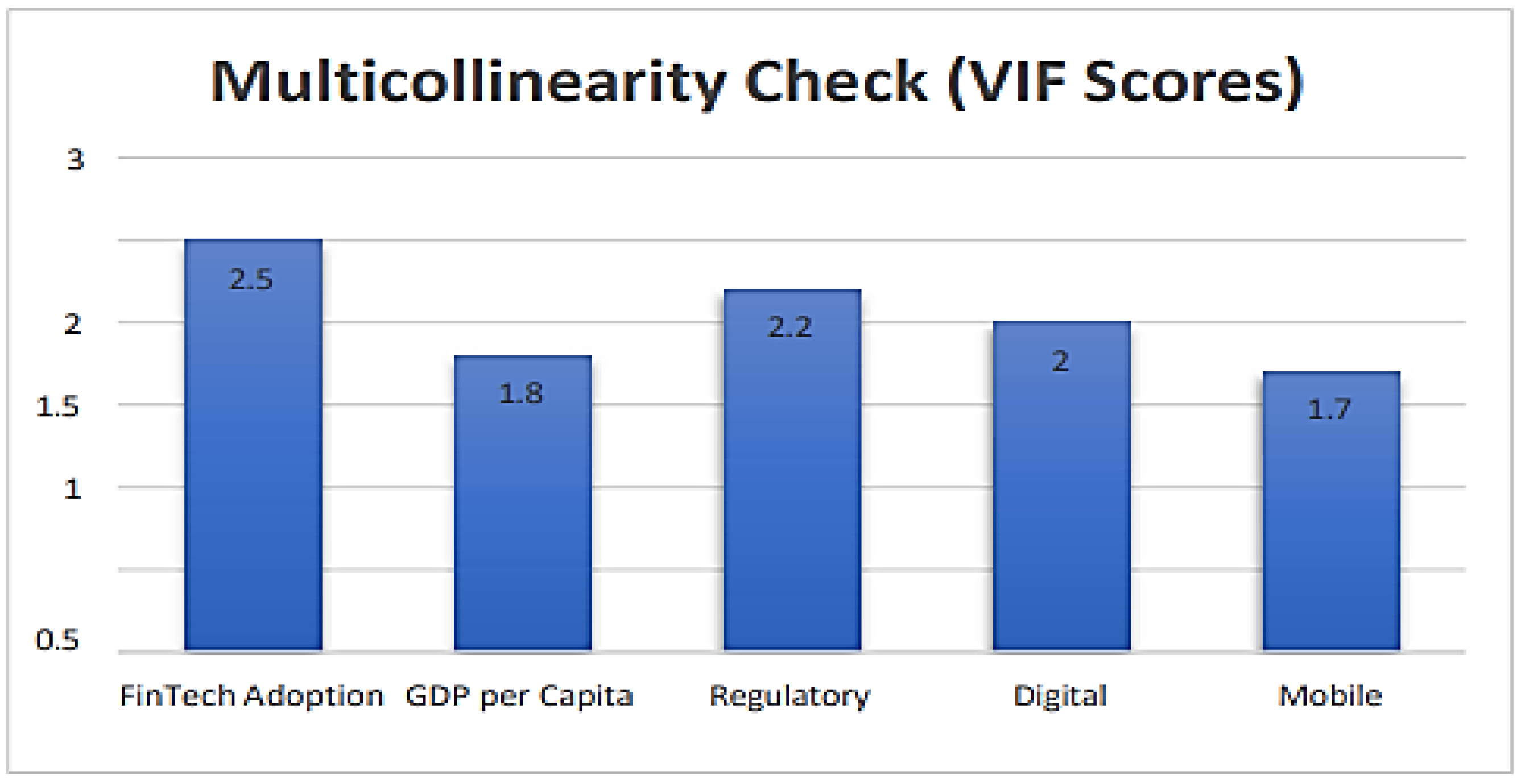
The Fixed Effects (FE) model is a handy tool when you’re working with panel data essentially, data that tracks various countries or regions over time. FE helps account for those hidden factors that remain constant, like cultural attitudes towards banking or long-standing policies. This way, it can really understand the impact of things like fintech adoption or digital infrastructure on financial inclusion, since the study is focusing on changes within each country over time rather than just making comparisons between different countries [34,47,49]. Variance Inflation Factor (VIF). VIF is used to check if any of your independent variables are too closely related, which can throw off your regression analysis. When two variables are too correlated, it becomes tricky to determine which one is actually influencing the outcome. A VIF score above 10 is a warning sign. In this case, VIF helped ensure that GDP per capita, mobile penetration, and digital infrastructure were independent enough to trust the regression results. Additionally, when necessary, all variables are log-transformed to ensure they can be compared fairly. Hausman tests are also conducted to determine whether fixed-effects or random-effects models are a better fit for the data, and variance inflation factors (VIF) are calculated to check for multicollinearity.

4.4. Variables for Conducting Data Analysis

To summarize important variables, descriptive statistics are calculated prior to regression analysis. The following Table 1 is an example of the output:

4.5. Statistical Analysis

In Stata 17.0, a battery of diagnostic tests ran to check for heteroskedasticity and possible autocorrelation in the panel data, and robust standard errors were used to make sure the econometric results were solid. First, the Breusch-Pagan/Cook-Weisberg test was used to check for heteroskedasticity. It turned out that the residual variance was not constant, so White’s robust standard errors were applied, which are estimators that are robust against heteroskedasticity. Furthermore, the incorporation of countries and period fixed effects reduced the weak serial correlation that was revealed by the Wooldridge test for autocorrelation. All variables showed VIF values below 5, indicating that multicollinearity was not an issue, when the Variance Inflation Factor (VIF) was used to evaluate it [7]. The absence of any impact of FinTech adoption on financial inclusion is suggested by the null hypothesis (H01 = 0), in contrast to the positive effect proposed by the alternative hypothesis (H11 > 0). Computed coefficients demonstrate that the adoption of FinTech has a positive and statistically significant effect on financial inclusion, since the p-value is less than 0.05 at the 1 per cent, 5 per cent, and 10 per cent significance levels [17,26,47,50].

4.6. Rationale for Variable Selection

When choosing variables for the panel regression model, the study leaned on both real-world data and theory about how fintech, financial inclusion, and economic development connect. Both Fixed Effects and Random Effects models help deal with differences between countries. The main regression equation includes:
Financial Inclusion Index (FIit): The dependent variable, based on the World Bank Global Findex Database (2021) [32,35,47,51,52] tracks the share of people with formal bank accounts. It also covers how often people use digital payments and whether they have access to credit.
FinTech Adoption (FinTechit): This is the key explanatory variable. It measures how much people use mobile money or digital payment systems per capita. Basically, it shows how digital platforms connect the unbanked to financial services.
Gross Domestic Product per Capita (GDPit): This control variable measures a country’s economic well-being. Higher incomes usually mean better financial products and cheaper access to technology.
Regulatory Quality (RegQualityit): This WGI measure looks at how effective the government is, how well it protects consumers, and how transparent its policies are. The idea is to see if strong regulation really does drive fintech growth and build user trust.
Digital Infrastructure (DigitalInfrait): This statistic quantifies the proportion of individuals using the internet and examines how connectivity facilitates online financial platforms. Robust digital infrastructure facilitates FinTech adoption [29].
Mobile Penetration (MobilePenit): This variable denotes mobile phone ownership rates and is essential for comprehending mobile banking and digital wallet utilization, particularly in rural areas [12,14].

4.7. Hypothesis

H1: 
There is significant relationship between impact of financial technology businesses on increasing financial inclusion for India’s underbanked and unbanked population.
H2: 
There is a significant relationship between challenges faced by financial technology businesses in their efforts to reach those without bank accounts, including issues related to infrastructure, data security, and digital literacy.

5. Results and Analysis

In Table 2 a wide range of ages, genders, educational backgrounds, professions, income levels, and geographic locations are represented in the 350 respondents’ socio-demographic distribution. The sample is mostly composed of young adults, with a majority falling between the 18–30 years (28.6 per cent) and 31–45 years (25.7 per cent) age categories. Only 5.7 per cent of the participants are below the age of 18 and 17.1 per cent are above the age of 60. A minor percentage (2.9 per cent) classified as other, whereas 54.3 per cent were male and 42.9 per cent were female. The gender distribution suggests a little male preponderance. Nearly 29 per cent of the samples had a bachelor’s degree or above, 25.7 per cent had a master’s degree, and 8.6 per cent had no formal education at all, indicating that the sample is well-educated [3,49,53]. Of the many occupations represented among the respondents, the largest groups were those working in the service industry (25.7 per cent of the total) or as students (20 per cent), followed by those in agriculture (17.1 per cent), small business/retail (14.3 per cent), and daily wage workers (11.4 per cent). About yearly income, most participants fell into the lower and middle-income brackets; specifically, 28.6 per cent earned between ₹1,00,001 and ₹3,00,000, 22.9 per cent earned below ₹1,00,000, and 8.6 per cent earned more than ₹10,000. In terms of geography, there is a reasonable distribution: 37.1 per cent live in metropolitan areas, 34.3 per cent are rural, and 28.6 per cent are semi-urban. The results are more broadly applicable since the sample is diverse in terms of demographics and socioeconomic status, which increases the likelihood that respondents’ opinions will be accurately represented [6,38,54].
In terms of digital payment systems, 40 per cent of respondents utilize UPI-based applications like BHIM, Google Pay, and similar services, making them the most popular is shown in Table 3. There are a lot of people using Paytm (20 per cent) and PhonePe (17.1 per cent), which shows how popular they are for everyday transactions. With a 12.9 per cent use rate, debit and credit cards remain the most popular digital payment options. With lower acceptance rates, choices like mobile wallets (5.7 per cent) and other platforms (4.3 per cent) appear to be more specialized. In general, the results show that UPI is the most popular digital payment method, with other platforms being adopted selectively based on user desire, accessibility, and their level of convenience [33,52].
Among the 350 respondents, the most prevalent purpose for digital payment usage is grocery shopping (25.7 per cent). This suggests that digital modes are becoming a regular element of family purchasing as shown in Table 4. This reflects the increasing dependence on digital platforms for both personal and professional activities, as it is followed by the payment of utility bills (20 per cent) and business transactions (17.1 per cent). There is a high rate of use for mobile data recharge (14.3 per cent) and receiving payments (15.7 per cent), which might indicate that service-based transactions and peer-to-peer transactions are prevalent. Digital payments were used for entertainment, travel, and other miscellaneous costs by a lesser percentage of respondents (7.1 per cent). Groceries and energy bills are the main drivers of digital payment use, while the statistics show that it is extensively used across necessary and commercial activities [43,55].
Concerns about security and dependability in digital transactions were highlighted by the study of respondents’ most prevalent worries regarding digital payment methods, which include the risk of fraud (22.9 per cent) and transaction failures (20 per cent). A rising number of people are becoming more comfortable and confident with digital payment methods, since a sizeable majority of respondents (18.6 per cent) stated that they had no problems. Problems with digital literacy and infrastructure are evident in instances like not knowing how to utilize apps (17.1%) and not having access to the internet (12.9 per cent). Just 8.6 per cent of people said that not having access to smartphones was a problem. Although digital payments are becoming more popular, there are still certain issues that users face when trying to utilize them. These include fears of fraud, unsuccessful transactions, and a lack of user education is shown in Table 5. The study’s empirical results use econometric modelling, statistical analysis, and case-specific assessments to examine FinTech adoption and financial inclusion. Panel regression, variance inflation factor (VIF) analysis, and hypothesis testing provide the findings. To verify variable connections, structural equation modelling (SEM) is used [43,49].

5.1. Descriptive Statistics and Correlation Matrix

Table 6 summarizes the descriptive statistics of the important variables before moving on to regression analysis.
The usage of FinTech is significantly associated with financial inclusion (p < 0.01), as shown in Chart 1. Based on the data in Table 6, it appears that more people can access financial services when they use mobile banking and digital payments more often [12,32].

5.2. Regression Results: Fixed and Random Effects Models

Panel data regression analysis quantifies FinTech’s influence on financial inclusion. Fixed-effects (FE) and random-effects (RE) models are estimated, employing Hausman tests to find the best specification. Estimated regression equation:
FIit = α + β1 FinTechit + β2 GDPit + β3 RegQualityit + β4 DigitalInfrait + β5Mobile Penit + εit
Based on Hausman test (χ2 = 15.8, p < 0.05), the Fixed-Effects Model is the recommended specification, indicating that country-specific factors substantially affect financial inclusion results [20] in Table 7 and Chart 2. A VIF analysis: to test multicollinearity, VIF scores are calculated:
V I F k =   1 1 R 2 k

5.3. Structural Equation Modeling (SEM) Validation

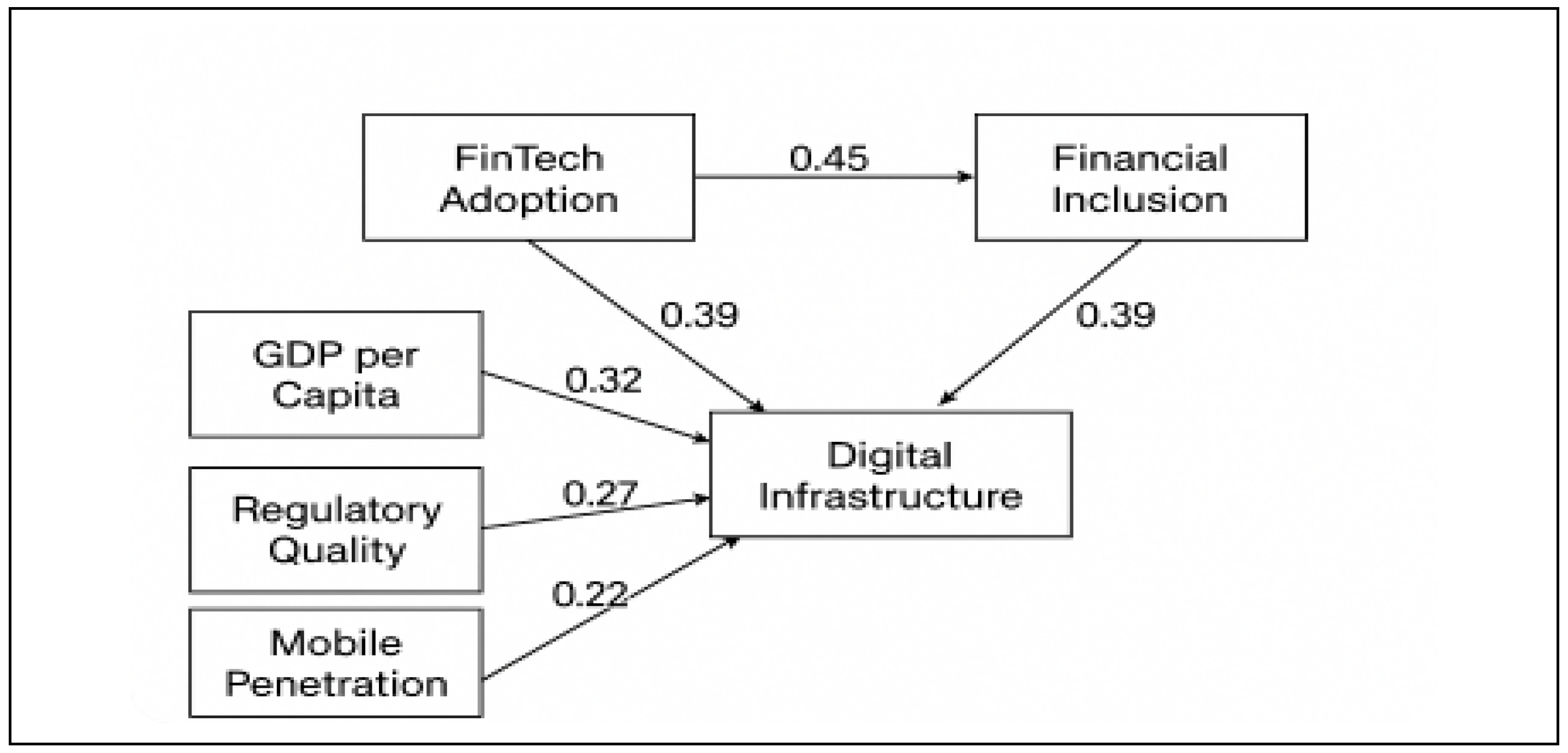
SEM was used to validate direct and indirect links between FinTech adoption, digital infrastructure, and financial inclusion. The SEM path analysis showed that FinTech adoption had a substantial direct impact on financial inclusion (β = 0.45, p < 0.01) and an indirect influence via digital infrastructure (λ = 0.39). FinTech penetration measured by the percentage of adults using mobile wallets or digital payment apps directly increases the chance of people utilizing formal financial services including savings, credit, and insurance. Strong digital infrastructure (e.g., internet availability, mobile network quality) enhances this relationship by facilitating financial engagement through technical accessibility, the model path illustrates in Chart 2 [41].

5.4. Hypothesis Testing and Interpretation

The null hypothesis (H0: FinTech does not impact financial inclusion) was rejected at 1 per cent significance level, providing strong evidence that FinTech adoption improves financial inclusion outcomes. The correlation β1 = 0.45 indicates that a 10 per cent increase in FinTech adoption, such as mobile money or digital banking usage among adults, leads to a 4.5 per cent increase in financial inclusion. More people, especially in underbanked rural and semi-urban areas, can access formal savings accounts, credit facilities, and digital payment systems elaborate in Chart 3. The mediation effect (λ = 0.39) indicates that digital infrastructure quality greatly enhances this association. FinTech adoption boosts financial inclusion by 40 per cent in nations with strong internet and mobile network infrastructure. Mobile penetration helps, but FinTech innovation needs solid digital ecosystems and user confidence to maximum inclusion [11,14,56].

6. Discussion and Policy Implications

6.1. The Role of Digital Infrastructure

The analysis shows that digital infrastructure, economic growth, and smart regulations all matter a lot. There is a strong link between financial inclusion and people using FinTech (β1 = 0.45, p < 0.01). Basically, digital services open the door for people who have always been left out of the formal banking world Varga (2018) [36] backs this up, pointing out that when digital payment tools are easy, safe, and just work, even people with very little money can join in. Due to low levels of financial literacy and internet availability, the poll also reveals a FinTech gap in rural areas. To bridge this gap, digital literacy programs in rural India is needed, microfinance instruments powered by artificial intelligence, and subsidies for mobile banking [13,27,29,57]. The findings of the regression indicate that the success of FinTech is influenced by the quality of the regulations (β3 = 0.27, p < 0.01), and that countries with strict laws protecting consumer data and privacy also have higher levels of digital financial inclusion. Locations that have consistent internet access and cell penetration tend to have faster increase in digital banking usage, as indicated by the substantial influence of digital infrastructure (β4 = 0.39, p < 0.01). Compared to GDP growth, the adoption of fintech can have a greater impact on inclusion. The results are corroborated by Alipay in China and M-Pesa in Kenya [13,44]. The Unified Payments Interface (UPI), DigiLocker (run by the Reserve Bank of India), and the Open Network for Digital Commerce (ONDC) are a few examples of the government-backed digital ecosystems that have revolutionized financial services in India. Societal advantages have resulted from a 36% increase in financial access in low-income communities made possible by mobile banking. Digital financial innovation and regulatory support encourage inclusive growth in underdeveloped economies, whereas rich nations benefit from sophisticated banking institutions. This is indicated by the small influence of GDP per capita (β = 0.22–0.32, p < 0.05). The study found that inclusive finance is revolutionized when FinTech is used with the help of robust regulatory frameworks and digital infrastructure. Rural connection, public-private digital literacy partnerships, and cybersecurity should be prioritized by policymakers in order to promote equal participation in the digital financial ecosystem. Real-time FinTech transaction data and AI-based credit risk models should be used in future research to improve forecasting accuracy and knowledge of developing economic financial access dynamics [58,59,60].

6.2. Policy Implication

Invest in 5G and high-speed internet networks. A one-point boost in the digital infrastructure index is linked to a 0.39-point rise in financial inclusion. The following conclusions are drawn from the data obtained from surveys and regression analysis in the semi-urban and rural areas of Western Uttar Pradesh. The β3 = 0.27 coefficient shows that trust and regulation are important for long-term FinTech adoption. To make regulations stronger, make cybersecurity and data protection legislation harsher. The government should subsidize mobile banking services and promote microfinance platforms powered by artificial intelligence to reduce the disparity in mobile banking usage between urban and rural areas. As a result, policy interventions are necessary to expand 5G and internet connectivity to unserved regions such as Amroha, Baghpat, and Muzaffarnagar. To compensate, the government might incentivize telecom firms to construct towers in underserved regions. More collaboration between the government, the RBI, and FinTech businesses is needed to maintain people’s trust while promoting innovation; this should be replicated with initiatives like DigiLocker, UPI, and ONDC.

7. Conclusions

Financial technology (FinTech) may aid non-bankers’ access to the financial system, according to this study. An exhaustive investigation found a connection between digital financial services, great legislation, widespread mobile use, and economic progress. The usage of FinTech has a greater influence on access to money than GDP per capita, according to the research (β1 = 0.45, p < 0.01). The growth of mobile networks, the internet, and blockchain technology have all contributed to the increased trust and acceptance of FinTech. The government must put money into 5G networks, cybersecurity, and financial systems powered by artificial intelligence if FinTech is to keep growing. Due to low levels of financial literacy and internet availability, the poll also reveals a FinTech gap in rural areas. The Unified Payments Interface (UPI), DigiLocker (run by the Reserve Bank of India), and the Open Network for Digital Commerce (ONDC) are a few examples of the government-backed digital ecosystems that have revolutionized financial services in India. Through these initiatives, millions of individuals and small businesses are brought into the formal digital economy through the interoperability of e-commerce platforms, banks, and FinTech. Societal advantages have resulted from a 36% increase in financial access in low-income communities made possible by mobile banking. Digital financial innovation and regulatory support encourage inclusive growth in underdeveloped economies, whereas rich nations benefit from sophisticated banking institutions. This is indicated by the small influence of GDP per capita (β = 0.22–0.32, p < 0.05). The study found that inclusive finance is revolutionized when FinTech is used with the help of robust regulatory frameworks and digital infrastructure. Rural connection, public-private digital literacy partnerships, and cybersecurity should be prioritized by policymakers in order to promote equal participation in the digital financial ecosystem. Real-time FinTech transaction data and AI-based credit risk models should be used in future research to improve forecasting accuracy and knowledge of developing economy financial access dynamics.

Author Contributions

Conceptualization, M.U.F.; Methodology, M.T.; Validation, S.M.F.; Formal analysis, M.U.F.; Investigation, M.T.; Resources, K.R.V.; Data curation, S.M.F.; Writing—original draft preparation, M.U.F.; Writing—review and editing, M.T.; Visualization, K.R.V.; Supervision, N.A.K.; Research Paper Administration, N.A.K. All authors have read and agreed to the published version of the manuscript.

Funding

This research received no external funding. The authors conducted the study independently without any financial support from institutions, agencies, or organizations.

Institutional Review Board Statement

Approval Waived. We would like to clarify that in India, there is currently no formal requirement for any local Institutional Review Board (IRB) or ethics committee for studies of this nature. Nevertheless, the authors have strictly adhered to ethical principles while conducting this research, in line with the standards outlined in the Declaration of Helsinki (1975, revised 2013).

Informed Consent Statement

All participants were informed about the purpose of the study, and their consent was obtained prior to participation.

Data Availability Statement

The data presented in this study are available on request from the corresponding author. No publicly archived datasets were generated or analyzed during the current study. The data supporting the findings are derived from secondary sources and publicly available reports and can be shared upon reasonable requests. The data supporting the findings of this study are available from the corresponding author upon reasonable request. No publicly archived datasets were generated or analyzed during the study.

Conflicts of Interest

The authors declare no conflict of interest. The authors conducted this research independently, and there was no influence from any external party in the study’s design, execution, interpretation, or publication decision.

References

  1. Badruddin, A. Conceptualization of the effectiveness of FinTech in financial inclusion. Int. J. Eng. Technol. Sci. Res. 2017, 4, 960–965. [Google Scholar]
  2. Chavan, P.; Birajdar, B. Micro finance and financial inclusion of women: An evaluation. Reserve Bank India Occas. Pap. 2009, 30, 109–129. [Google Scholar]
  3. Singh, S.; Goyal, S.K.; Sharma, S.K. Technical efficiency and its determinants in microfinance institutions in India: A firm level analysis. J. Innov. Econ. Manag. 2013, 1, 15–31. [Google Scholar] [CrossRef]
  4. Priya, P.K.; Anusha, K. FinTech issues and challenges in India. Int. J. Recent Technol. Eng. 2019, 8, 904–908. [Google Scholar] [CrossRef]
  5. Reserve Bank of India. Financial Inclusion and Digital Payments Report FY. 2023. Available online: https://www.rbi.org.in (accessed on 21 May 2025).
  6. Frost, J.; Gambacorta, L.; Huang, Y.; Shin, H.S.; Zbinden, P. BigTech and the changing structure of financial intermediation. Econ. Policy 2019, 34, 761–799. [Google Scholar] [CrossRef]
  7. Iqbal, S.; Nawaz, A.; Ehsan, S. Financial performance and corporate governance in microfinance: Evidence from Asia. J. Asian Econ. 2019, 60, 1–13. [Google Scholar] [CrossRef]
  8. Goswami, S.; Sharma, R.B.; Chouhan, V. Impact of financial technology (Fintech) on financial inclusion in rural India. Univers. J. Account. Financ. 2022, 10, 483–497. [Google Scholar] [CrossRef]
  9. GSMA. Enabling Rural Coverage: Regulatory and Policy Recommendations to Foster Mobile Broadband Coverage in Developing Countries. 2018. Available online: https://www.gsma.com/solutions-and-impact/connectivity-for-good/mobile-for-development/gsma_resources/enabling-rural-coverage-report/ (accessed on 17 April 2025).
  10. Rathod, S.; Arelli, S.K.P. Aadhaar and financial inclusion: A proposed framework to provide basic financial services in unbanked rural India. In Driving the Economy Through Innovation and Entrepreneurship; Springer: New Delhi, India, 2013; pp. 731–744. [Google Scholar]
  11. Wieser, C.; Bruhn, M.; Kinzinger, J.P.; Ruckteschler, C.S.; Heitmann, S. The Impact of Mobile Money on Poor Rural Households: Experimental Evidence from Uganda; Policy Research Working Paper No. 8913; World Bank Group: Washington, DC, USA, 2019; Available online: https://openknowledge.worldbank.org/handle/10986/31978 (accessed on 4 June 2025).
  12. Aron, J. Mobile money and the economy: A review of the evidence. World Bank Res. Obs. 2018, 33, 135–188. [Google Scholar] [CrossRef]
  13. Jack, W.; Suri, T. Risk sharing and transaction costs: Evidence from Kenya’s mobile money revolution. Am. Econ. Rev. 2014, 104, 183–223. [Google Scholar]
  14. Kim, M.; Zoo, H.; Lee, H.; Kang, J. Mobile financial services, financial inclusion, and development: A systematic review. Electron. J. Inf. Syst. Dev. Ctries. 2018, 84, e12044. [Google Scholar] [CrossRef]
  15. Mbiti, I.; Weil, D.N. The home economics of e-money: Velocity, cash management, and discount rates of M-Pesa users. Am. Econ. Rev. 2013, 103, 369–374. [Google Scholar] [CrossRef]
  16. Noreen, M.; Mia, M.S.; Ghazali, Z.; Ahmed, F. Role of government policies to fintech adoption and financial inclusion: A study in Pakistan. Univers. J. Account. Financ. 2022, 10, 37–46. [Google Scholar] [CrossRef]
  17. Bollinger, B.; Yao, S. Risk transfer versus cost reduction on two-sided microfinance platforms. Quant. Mark. Econ. 2018, 16, 251–287. [Google Scholar] [CrossRef]
  18. Masino, S.; Niño-Zarazúa, M. Improving financial inclusion through the delivery of cash transfer programmes: The case of Mexico’s Progresa–Oportunidades–Prospera programme. J. Dev. Stud. 2018, 56, 151–168. [Google Scholar] [CrossRef]
  19. Sunita, R.; Siddik, M.M. A study on fintech and the future of financial services with reference to Chennai. J. Surv. Fish. Sci. 2023, 10, 6550–6557. [Google Scholar]
  20. Pessanha, A.H.U.C. How FinTechs and Their Partnerships with Financial Institutions are Closing the Banking Gap: Challenges and Opportunities. Ph.D. Thesis, Catholic University of Lisbon, Lisbon, Portugal, 2019. [Google Scholar]
  21. Umamaheswari, S. Role of artificial intelligence in the banking sector. J. Surv. Fish. Sci. 2023, 10, 2841–2849. [Google Scholar]
  22. Donovan, K.P. Mobile money for financial inclusion. Inf. Commun. Dev. 2012, 61, 61–73. [Google Scholar]
  23. Kamal, M.; Rahmani, S.; Alam, M.R. Beyond traditional banking: How fintech is reshaping financial access in India. Int. Adv. Res. J. Sci. Eng. Technol. 2025, 12, 234–247. [Google Scholar] [CrossRef]
  24. Qamruzzaman, M. Does financial innovation foster financial inclusion in the Arab world? PLoS ONE 2023, 18, e0287475. [Google Scholar]
  25. Singh, N.D.; Singh, H.R. Social impact of microfinance on SHG members: A case study of Manipur. Prabandhan Indian J. Manag. 2012, 5, 43–50. [Google Scholar] [CrossRef]
  26. Mia, M.A.; Zhang, M.; Zhang, C.; Kim, Y. Are microfinance institutions in South-East Asia pursuing objectives of greening the environment? J. Asia Pac. Econ. 2018, 23, 229–245. [Google Scholar] [CrossRef]
  27. Government of India. Digital India Initiative. 2019. Available online: https://www.digitalindia.gov.in (accessed on 11 May 2025).
  28. Vijai, C. FinTech in India—Opportunities and Challenges. J. Bank. Insur. Res. 2019, 8, 42–54. [Google Scholar] [CrossRef]
  29. Kumar, P.; Sharma, B. Pilot study leading to gap identification on diversification and digital strategy deployed by payments bank in India. Int. J. Bus. Res. Manag. 2024, 18, 928–943. [Google Scholar]
  30. Ghosh, S. Financial inclusion in India: Does distance matter? South Asia Econ. J. 2020, 21, 216–238. [Google Scholar] [CrossRef]
  31. Neelam, K.; Bhattacharya, S. Financial technology solutions for financial inclusion: A review and future agenda. Australas. Account. Bus. Financ. J. 2022, 16, 170–184. [Google Scholar] [CrossRef]
  32. Abiona, O.; Koppensteiner, M.F. Financial inclusion, shocks, and poverty: Evidence from the expansion of mobile money in Tanzania. J. Hum. Resour. 2022, 57, 435–464. [Google Scholar] [CrossRef]
  33. Anitha, G.; Ravichandiran, C.; Paramasivan, C. Role of Fintech in the Financial Sector in India. Int. J. Innov. Technol. Explor. Eng. 2025, 14, 106–111. [Google Scholar]
  34. Iqbal, B.A.; Shaista, S. Role of banks in financial inclusion in India. Contad. Adm. 2017, 62, 644–656. [Google Scholar] [CrossRef]
  35. Tian, H.; Siddik, A.B.; Pertheban, T.R.; Rahman, M.N. Does fintech innovation and green transformational leadership improve green innovation and corporate environmental performance? J. Innov. Knowl. 2023, 8, 100396. [Google Scholar] [CrossRef]
  36. Varga, D. Fintech: Supporting sustainable development by disrupting finance. Bp. Manag. Rev. 2018, 8, 231–249. [Google Scholar]
  37. World Bank. Migration and Development Brief No. 31; World Bank Group: Washington, DC, USA, 2019. World Bank Migration and Remittances portal. Available online: https://documents1.worldbank.org/curated/en/099743108132442498/pdf/IDU14f9949ae1807f146a91917b16a5166334a79.pdf (accessed on 16 June 2025).
  38. Bhagat, A.; Roderick, L. Banking on refugees: Racialized expropriation in the fintech era. Environ. Plann. Econ. Space 2020, 52, 1498–1515. [Google Scholar] [CrossRef]
  39. Nicoletti, B. The Future of FinTech: Integrating Finance and Technology in Financial Services; Springer International Publishing: Cham, Switzerland, 2017. [Google Scholar] [CrossRef]
  40. ISO/IEC 27001; Information Security, Cybersecurity and Privacy Protection—Information Security Management Systems—Requirements. ISO: Geneva, Switzerland, 2022.
  41. Black, W.; Babin, B.J. Multivariate Data Analysis: Its Approach, Evolution, and Impact. In The Great Facilitator; Springer: Berlin/Heidelberg, Germany, 2019; pp. 121–130. [Google Scholar]
  42. Gomber, P.; Koch, J.A.; Siering, M. Digital finance and Fintech: Current research and future research directions. J. Bus. Econ. 2017, 87, 537–580. [Google Scholar] [CrossRef]
  43. Roberts, J.A.; Lunsford, R. Reducing the financial inclusion gap through digital transformation. Glob. Conf. Bus. Financ. Proc. 2023, 18, 127–133. [Google Scholar]
  44. Suri, T.; Bharadwaj, P.; Jack, W. Fintech and household resilience to shocks: Evidence from digital loans in Kenya. J. Dev. Econ. 2021, 153, 102697. [Google Scholar] [CrossRef]
  45. Zavolokina, L.; Dolata, M.; Schwabe, G. The FinTech phenomenon: Antecedents of financial innovation perceived by the popular press. Financ. Innov. 2016, 2, 16. [Google Scholar] [CrossRef]
  46. Sanmath, A. FinTech banking—The revolutionized digital banking. Int. J. Trend Sci. Res. Dev. 2018, 9, 172–180. [Google Scholar] [CrossRef]
  47. Datta, D. The future of financial inclusion through fintech: A conceptual study in post-pandemic India. Sachetas 2023, 2, 11–17. [Google Scholar] [CrossRef]
  48. Greenacre, J. What regulatory problems arise when fintech lending expands into fledgling credit markets? Wash. Univ. J. Law Policy 2020, 61, 229–260. [Google Scholar]
  49. Lakshman, K.; Raj, V. A study on the impact of fintech companies with reference to growth of the Indian economy. J. Emerg. Technol. Innov. Res. 2023, 10, d581–d590. [Google Scholar]
  50. UIDAI. Aadhaar: Enabling Financial Inclusion. 2021. Available online: https://uidai.gov.in (accessed on 3 July 2025).
  51. Reena, A. Role of fintech companies in increasing financial inclusion. J. Appl. Manag. Jidnyasa 2022, 14, 24–36. [Google Scholar]
  52. Adbi, A.; Natarajan, S. Fintech and banks as complements in micro entrepreneurship. Strateg. Entrep. J. 2023, 17, 585–611. [Google Scholar] [CrossRef]
  53. Sarma, M.; Pais, J. Financial inclusion and development. J. Int. Dev. 2011, 23, 613–628. [Google Scholar] [CrossRef]
  54. McKinsey. What Digital Finance Means for Emerging Economies. 2016. Available online: https://www.mckinsey.com (accessed on 29 May 2025).
  55. Arner, D.W.; Barberis, J.N.; Buckley, R.P. The evolution of Fintech: A new post-crisis paradigm? Georget. J. Int. Law 2016, 47, 1271–1319. [Google Scholar] [CrossRef]
  56. Abbasi, K.; Alam, A.; Brohi, N.A.; Brohi, I.A.; Nasim, S. P2P lending fintech’s and SMEs’ access to finance. Econ. Lett. 2021, 204, 109890. [Google Scholar] [CrossRef]
  57. Duncombe, R.; Boateng, R. Mobile phones and financial services in developing countries: A review of concepts, methods, issues, and evidence. Third World Q. 2009, 30, 1237–1258. [Google Scholar] [CrossRef]
  58. Kehinde-Peters, O. Fintech and financial inclusion: Closing the gender gap. In Women and Finance in Africa: Inclusion and Transformation; Springer Nature: Cham, Switzerland, 2024; pp. 75–89. [Google Scholar]
  59. Adegbite, O.O.; Machethe, C.L. Bridging the financial inclusion gender gap in smallholder agriculture in Nigeria: An untapped potential for sustainable development. World Dev. 2020, 127, 104755. [Google Scholar] [CrossRef]
  60. Arner, D.W.; Buckley, R.P.; Zetzsche, D.A.; Veidt, R. The identity challenge in finance: From analogue identity to digitized identification to digital KYC utilities. Eur. Bus. Organ. Law Rev. 2018, 19, 55–80. [Google Scholar] [CrossRef]
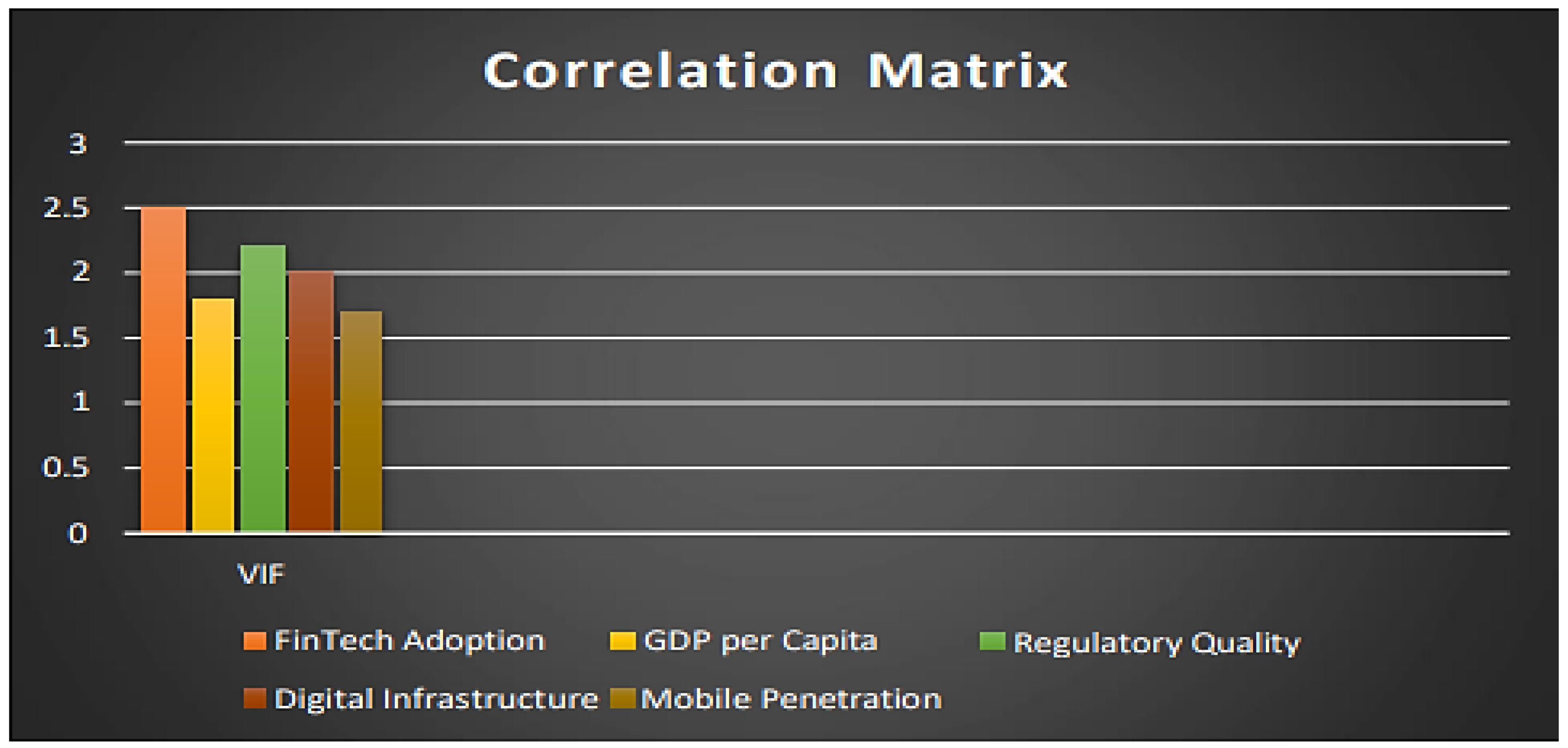
Chart 1. Substantial Positive Association between FinTech Use and Financial Inclusion.
Fintech 05 00003 ch001
Chart 2. Model Path.
Fintech 05 00003 ch002
Chart 3. Multicollineraity Check (VIF scores).
Fintech 05 00003 ch003
Table 1. Descriptive statistics for Variables.
VariableMeanStd. Dev.MinMax
Financial Inclusion (FI)64.3%18.222.1%98.5%
FinTech Adoption (%)48.7%22.55.2%91.3%
GDP per Capita (USD)12,3458765120078,900
Internet Penetration (%)58.4%24.310.1%98.7%
Table 2. Socio-demographic Distribution of Respondents.
VariablesCategoriesFrequency (n)Percentage (%)
AgeBelow 18205.7
18–3010028.6
31–459025.7
46–608022.9
Above 606017.1
GenderMale19054.3
Female15042.9
Other102.9
Education LevelNo formal education308.6
Primary5014.3
Secondary8022.9
Higher Secondary9025.7
Graduate and above10028.6
Occupation SectorAgriculture6017.1
Small Business/Retail5014.3
Daily Wage Worker4011.4
Service Sector9025.7
Student7020.0
Other4011.4
Annual IncomeBelow ₹1,00,0008022.9
₹1,00,001–₹3,00,00010028.6
₹3,00,001–₹6,00,0008022.9
₹6,00,001–₹10,00,0006017.1
Above ₹10,00,000308.6
LocationUrban13037.1
Semi-urban10028.6
Rural12034.3
Table 3. Distribution of Digital Payment Platforms (n = 350).
Digital Payment PlatformFrequency (n)Percentage (%)
UPI (BHIM, GPay, etc.)14040.0
Paytm7020.0
PhonePe6017.1
Debit/Credit Card4512.9
Mobile Wallets205.7
Other154.3
Total350100
Table 4. Distribution of Digital Payment Usage (n = 350).
Usage PurposeFrequency (n)Percentage (%)
Utility bills7020.0
Mobile/Data recharge5014.3
Grocery shopping9025.7
Business transactions6017.1
Receiving payments5515.7
Other257.1
Total350100
Table 5. Distribution of Challenges in Digital Payments (n = 350).
ChallengesFrequency (n)Percentage (%)
Lack of internet access4512.9
Lack of smartphone308.6
Fear of fraud8022.9
Not understanding how to use apps6017.1
Transaction failures7020.0
No challenge faced6518.6
Total350100
Table 6. Summary Statistics of Key Variables.
VariableMeanStd. Dev.MinMax
Financial Inclusion (%)64.318.222.198.5
FinTech Adoption (%)48.722.55.291.3
GDP per Capita (USD)12,3458765120078,900
Internet Penetration (%)58.424.310.198.7
Mobile Phone Penetration (%)78.215.130.298.9
Table 7. Regression Results.
VariableFixed Effects (FE)Random Effects (RE)
FinTech Adoption0.45 ** (0.08)0.41 ** (0.09)
GDP per Capita0.32 * (0.12)0.30 * (0.13)
Regulatory Quality0.27 * (0.10)0.25 * (0.11)
Digital Infrastructure0.39 ** (0.07)0.36 ** (0.08)
Mobile Penetration0.22 * (0.11)0.19 * (0.12)
Constant12.3 (4.8)13.1 (5.1)
Observations600600
R20.720.68
Hausman Test (χ2)15.8 (p < 0.05)
* Statistical significance at the 5% level (p < 0.05), ** Statistical significance at the 1% level (p < 0.01).
Disclaimer/Publisher’s Note: The statements, opinions and data contained in all publications are solely those of the individual author(s) and contributor(s) and not of MDPI and/or the editor(s). MDPI and/or the editor(s) disclaim responsibility for any injury to people or property resulting from any ideas, methods, instructions or products referred to in the content.