Next Article in Journal
Detecting Cyber Fraud in Banking Transactions via Machine Learning Techniques: Implications for Financial Stability
Previous Article in Journal
Comparative Analysis of Stablecoin Architectural Features in Fragmented Regulatory Environments
Previous Article in Special Issue
Hybrid Machine Learning–Econometric Framework for Financial Distress Scoring: Evidence from German Manufacturing Firms
 
 
Due to scheduled maintenance work on our servers, there may be short service disruptions on this website between 11:00 and 12:00 CEST on March 28th.
Review

Trust as Predictor and Mechanism in Green FinTech Adoption: A Systematic Review and Meta-Analysis


by
Stefanos Balaskas
eGovernment & eCommerce Lab (Innovation & Entrepreneurship), Department of Business Administration, University of Patras, 26504 Patras, Greece
FinTech 2026, 5(1), 22; https://doi.org/10.3390/fintech5010022
Submission received: 28 January 2026 / Revised: 24 February 2026 / Accepted: 2 March 2026 / Published: 5 March 2026

Abstract

Green FinTech involves facilitating sustainable payments, banking, and investment; nevertheless, it is subject to consumer trust and perceptions of ‘green’ value. The literature on this topic is fragmented, with information systems literature typically considering trust as a broad acceptance construct, while sustainable literature considers it as a risk of ‘greenwashing’ without integrating credibility into adoption models. This systematic review aggregates 15 empirical studies and addresses five research questions. RQ1 examines the theoretical models applied to examine trust in green/sustainable FinTech adoption. RQ2 examines the conceptualization and measurement of trust across different contexts, distinguishing institutional/provider trust, platform/tech trust, and sustainability claim credibility trust. RQ3 examines the function of trust within behavioral models (predictor, mediator, moderator). RQ4 examines methodological characteristics and quality indicators (research design, sampling frame, reliability, and bias). RQ5 examines the direct relationship between trust and adoption intention using meta-analysis. The systematic review follows a set of PRISMA guidelines, where we searched Scopus and Web of Science (2015–2026) and applied an RQ-based coding scheme to peer-reviewed articles. Measures of trust varied significantly (unidimensional, integrity–competence–benevolence, and technology-specific scales), limiting cross-study comparability. Using random effects, we found a significant positive relationship between trust and intention (pooled standardized direct path coefficient β = 0.27, 95% CI [0.14, 0.41]) with considerable heterogeneity (I2 = 88%) and a wide prediction interval including near-zero effects. Literature essentially endorses trust as a significant yet context-dependent construct, emphasizing the necessity for measurement standardization, a more distinct differentiation between sustainability trust and general platform trust, regular reporting of reliability and bias assessments, and focused evaluations of boundary conditions (e.g., environmental skepticism, regulatory framework, and FinTech type).

1. Introduction

Green and sustainable FinTech services, such as ESG-focused robo-advisors, sustainability-linked investment technologies, and eco-friendly digital banking, are expanding as scalable infrastructures for reducing transaction costs, increasing service accessibility, and promoting eco-friendly financial behavior through routine digital touchpoints [1,2,3]. In low-switching-cost markets where credibility concerns are prevalent, adoption is uneven, intention-behavior gaps persist, and sustained engagement is challenging despite policy momentum and product proliferation [4,5,6]. Trust continuously shows up as a key explanatory construct in this growing body of evidence: it can predict adoption intention directly, translate upstream beliefs into downstream outcomes, or affect the circumstances in which other cues translate into intention [7,8,9].
Trust is particularly critical in digital finance due to users’ need to manage uncertainty regarding transactional security, service reliability, institutional integrity, and the validity of sustainability assertions [1,10,11,12]. Thus, “green” adoption encompasses not merely an instrumental assessment of utility or convenience but also a credibility evaluation regarding the authenticity and reliability of the responsible actor’s sustainability commitments [13,14,15]. This dual uncertainty renders trust both practically significant (in terms of uptake and retention) and theoretically intricate, as it frequently pertains to multiple targets—technology/channel, provider/platform, and the overarching institutional environment—each capable of forecasting distinct outcomes [16,17,18]. In “green” settings, trust may increasingly pivot towards claim credibility, emphasizing environmental performance and commitment beyond fundamental transactional reliability [19,20,21,22].
However, the literature defines “trust” inconsistently. In certain models, it serves as green-claim credibility, closely linked to brand trust and perceived environmental integrity, whereas in others, it resembles technology/security trust, enhancing the influence of performance cues (e.g., ESG personalization) on intention [6,7,23,24,25,26,27]. Moreover, some sustainable FinTech models entirely exclude trust, opting instead for trust-adjacent ethical indicators (e.g., transparency, responsibility) as upstream credibility signals. This results in construct and causal-positioning non-equivalence across studies, thereby fostering heterogeneity in synthesis and meta-analytic aggregation [28,29,30,31,32,33].
Despite growing interest, the literature on trust in green/sustainable FinTech adoption remains fragmented in three ways. First, trust is conceptualized and operationalized in an array of ways, from platform security trust to general bank trust to explicitly “green trust” that emphasizes environmental commitment and credibility [34,35,36]. Second, trust functions in behavioral models in a variety of ways, including as an independent predictor, a moderator that modifies how other cues translate into intention, or a mediator within multi-step mechanisms (such as through attitude, confirmation, and satisfaction) [10,11,13,34,35,37]. Third, the methods and contexts of the studies differ significantly (PLS-SEM vs. CB-SEM vs. regression/PROCESS; adoption intention vs. continuance vs. behavioral proxies; banking vs. apps vs. robo-advisors; varied sampling frames). This suggests that effect sizes and even qualitative conclusions may not generalize well across settings [20,38,39]. While prior reviews on sustainable finance and FinTech adoption have mapped broad drivers, regulatory themes, or technology adoption factors, they are typically narrative/conceptual in scope and do not isolate trust as a focal construct spanning both platform risk and sustainability-claim credibility. As a result, existing reviews provide limited guidance on (i) how trust is targeted (provider vs. platform vs. green-claim credibility), (ii) where trust operates in adoption models (predictor vs. mediator vs. moderator), and (iii) what the quantitative strength of the Trust → Adoption Intention link is across comparable studies. This review addresses these gaps by providing four complementary contributions.
This review addresses these gaps by providing four complementary contributions. First, it provides a theoretical framework of the prevailing models utilized to examine trust in the adoption of green FinTech, encompassing TAM/UTAUT/TPB-family models and post-adoption frameworks such as ECM [16,18]. Second, it provides a construct map that sorts various approaches of conceptualizing trust as well as how to measure it (institution/provider trust, technology/platform trust, green credibility/integrity analogues), illustrating where the measurement targets tie together or drift apart [16,18,22]. Third, it provides a role map that shows whether trust is modeled as a predictor, mediator, or moderator, and what that means for claims about mechanisms and points of intervention [19,20,22]. Fourth, it gives an initial quantitative benchmark by meta-analyzing the standardized Trust → Adoption Intention direct path (β) reported in comparable models. This creates a time-stamped estimate that can be updated as more evidence becomes available [1,15,40]. Accordingly, this review is guided by five research questions:
RQ1. 
What theoretical models and conceptual frameworks are used to examine trust in the context of green or sustainable FinTech adoption?
RQ2. 
How is trust conceptualized, operationalized, and measured in studies focused on sustainable or green FinTech services?
RQ3. 
In what roles (predictor, mediator, moderator) does trust appear within behavioral models predicting the adoption of green FinTech?
RQ4. 
What are the methodological characteristics and quality indicators of the included studies (e.g., sample size, design, scale reliability, and bias checks)?
RQ5. 
What is the strength and direction of the direct effect of trust on adoption intention in green FinTech contexts?

2. Background Literature

2.1. Trust in Technology-Enabled Financial Adoption: Conceptual Anchors

In technology-enabled financial services, trust signifies users’ readiness to depend on a system amidst uncertainty, especially when results hinge on ambiguous processes, asymmetric information, and perceived financial and privacy risks [1,10,11]. Trust is commonly framed through competence, integrity, and kindness that make them feel less vulnerable and help them form intentions [14,20,40]. In digital finance, trust is also specific to the target: it can be directed toward (a) the institution or provider, (b) the technology or channel, or (c) the larger institutional environment that allows for accountability and recourse [10,16,17]. These targets can affect adoption either directly or indirectly through beliefs like usefulness, confirmation, satisfaction, and risk [14,17,19,41,42]. In empirical research on green/sustainable FinTech, trust is usually measured using reflective multi-item scales, which suggest an underlying “assurance” perception rather than a collection of separate elements [43,44,45,46].

2.2. The Green-Specific Layer: Credibility, Greenwashing Risk, and Regulatory Context

Fintech adoption is further complicated by a “green” framing, which requires users to assess whether sustainability claims are validated, significant, and non-opportunistic in addition to transactional safety and functional performance [13,15,20,47]. Accordingly, green trust is frequently understood as credibility in environmental commitment and performance, serving as a mechanism that supports attitudes and intentions downstream [14,15,48,49]. The role of institutional assurances and signals is increased by this credibility layer; performance cues may be amplified or transparency cues, responsibility framing, or ESG personalization may directly promote trust [4,10,11,12,50]. Particularly in value-laden fields like ESG investing, “green” contexts can actually change trust from a largely technological belief (reliability/security) to a hybrid judgment combining performance assurance with claim veracity and moral legitimacy [15,40,43,49,51,52]. These dynamics also account for measurement misalignment: while some “green FinTech” studies specifically target environmental integrity or green credibility, others capture baseline provider or channel trust with limited sustainability referents [53,54,55,56,57].

2.3. Why Heterogeneity Is Expected: Contexts, Product Risk, and Measurement/Modeling Choices

Substantial heterogeneity is expected for three reasons. To begin with, green/sustainable FinTech includes a wide range of services, such as green banking channels, digital-only green banks, green fintech apps, ESG robo-advisors, and sustainable crypto-investment. Each of these services has its own risk profile, decision-making time frame, and trust target [10,14,40,49,50]. Second, outcomes range from pre-adoption intention to continuance intention and post-adoption use, with trust potentially functioning through confirmation and satisfaction dynamics rather than merely serving as a direct predictor [14,19,49]. Third, methodological dispersion (PLS-SEM vs. CB-SEM vs. regression/PROCESS; cross-sectional vs. longitudinal designs; varied measurement and CMB checks) likely exacerbates between-study variability in estimated trust effects [13,14,16,19,49,58,59,60,61,62]. Therefore, pooled estimates must be analyzed in conjunction with heterogeneity statistics and prediction intervals, rather than being regarded as a universal parameter [1,11,14].

3. Research Method

3.1. Search Strategy

To identify empirical studies investigating the role of trust in adoption-related outcomes (e.g., adoption, intention to use, behavioral intention, continuance intention, and actual use) in green/sustainable/ESG-oriented FinTech and sustainable finance technologies, a systematic literature search was carried out in Scopus and Web of Science. To locate morphological variations, searches employed truncation (asterisk), phrase searching (quotation marks), and Boolean operators. The final Boolean search string was:
(trust) AND (“sustainable finance” OR “climate fintech” OR “carbon fintech*” OR “ESG platform*” OR “green banking*” OR “green fintech*” OR “sustainable fintech*” OR “ESG invest*” OR “green investment platform*” OR “eco-friendly bank*” OR “carbon tracking app*” OR “sustainable finance technolog*”) AND (“adopt*” OR “intention to use*” OR “usage intention*” OR “behavioral intention*”)**
The final string emphasized sustainability and finance technology descriptors instead of listing every channel label (such as “robo-advisor,” “digital banking,” or “mobile banking”). However, the search nevertheless identified ESG robo-advisor and app-based green fintech contexts as the included sustainability terms are often used to index these services in titles, abstracts, and keywords. ESG robo-advisor studies were specifically obtained using the ESG invest* and platform/FinTech descriptors alongside adoption-intention terminology, whereas app-based green fintech contexts were identified through explicit terms like green fintech* and carbon tracking app* (and, more generally, “sustainable finance technolog*”) in conjunction with adoption-intention keywords. We retained the pre-set query to find a balance between sensitivity and accuracy. The resulting included set already covered the key contexts of interest, such as banking channels, apps, and ESG investing/robo-advisory settings.
Title, abstract, and keywords (or the closest equivalent field setting available in each database) were the search criteria. For de-duplication and screening, records from both databases were exported and combined into a single library.

3.2. Eligibility Criteria

The eligibility criteria were predetermined to align with the review objective: to synthesize empirical evidence regarding whether, and under what circumstances, trust predicts adoption-related outcomes in green, sustainable, or ESG-oriented financial technologies. Studies were included if they: (i) examined green/sustainable finance technologies or FinTech platforms/channels (e.g., green banking channels, ESG investing/robo-advisory technologies, carbon-tracking apps linked to financial decision-making); (ii) modeled trust (e.g., platform/provider/technology trust, initial trust, e-trust, green trust) as a predictor, mediator, and/or moderator; (iii) reported an adoption-related outcome (e.g., adoption/intention/continuance/actual use); (iv) used quantitative empirical data with analyzable outcomes (e.g., SEM/PLS-SEM, regression, experiments) enabling extraction of study characteristics and—where applicable—effect sizes; (v) were available as full empirical papers with sufficient methodological and results detail for coding; and (vi) were peer-reviewed journal articles or peer-reviewed full conference proceedings papers with complete methods/results (excluding abstracts-only). Given the novelty and relatively small empirical base in this domain, peer-reviewed proceedings were permitted when they met the same transparency and extractability standards as journal articles.
Studies were excluded if they fell outside green/sustainable/ESG FinTech, did not analytically test trust, lacked an adoption-related dependent variable, or were non-empirical (conceptual, legal/doctrinal, qualitative-only, or review articles). Borderline cases (e.g., “sustainable cryptocurrency investment”) were included only when the technology/service was explicitly framed as sustainable/green/ESG in the study (i.e., sustainability claims were part of the focal adoption context), and excluded when the context was generic crypto/FinTech adoption without sustainability framing. Table 1 operationalizes these rules.

3.3. Screening and Study Selection

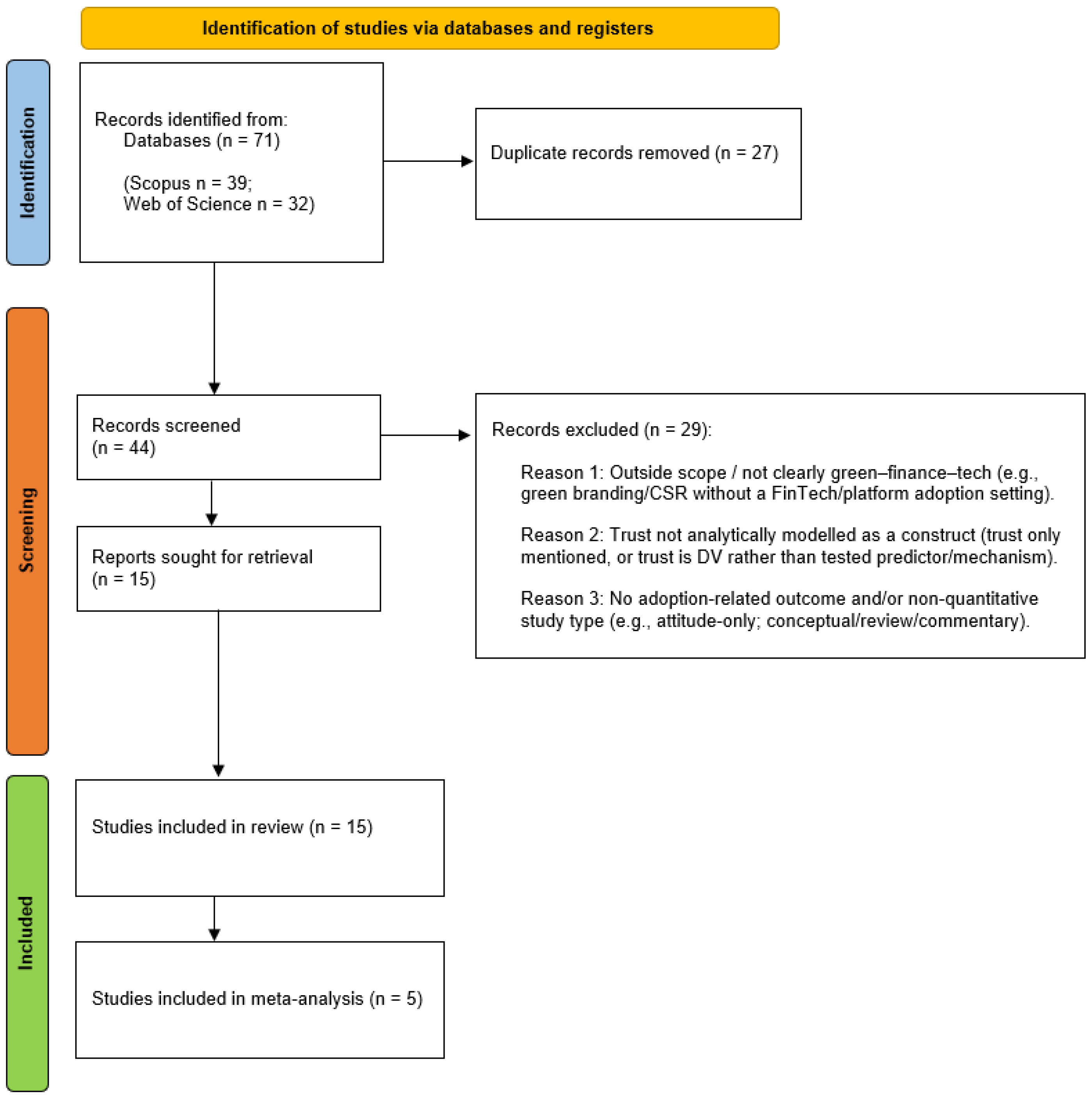
Records from Scopus and Web of Science were merged and de-duplicated using DOI and bibliographic matching (title/author/year). Screening followed two stages: (1) title/abstract screening against eligibility criteria and (2) full-text assessment for potentially eligible records. Across databases, 71 records were identified (Scopus n = 39; Web of Science n = 32). After removing 27 duplicates, 44 unique records were screened at title/abstract level, and 29 were excluded. The narrative synthesis included 15 studies, and the meta-analysis of the standardized Trust → Adoption Intention path included 5 studies (Figure 1). The final set included one peer-reviewed conference proceeding meeting all eligibility criteria and providing full reporting sufficient for coding and effect extraction.

3.4. Quality/Risk-of-Bias Appraisal Approach

Given the heterogeneity of contexts and methods, quality appraisal focused on study-level indicators that are most relevant to trust–adoption inference in predominantly survey-based evidence. Quality coding was employed to contextualize the narrative synthesis and meta-analysis rather than to exclude studies solely on quality grounds. The following domains were coded in a Risk of Bias/Quality Notes field: (a) sampling/external validity (sampling frame, geographic scope, population definition); (b) measurement quality (internal consistency and construct metrics such as α/CR/AVE; item trimming/weak loadings); (c) common method bias (procedural/statistical checks such as Harman, full collinearity/VIF, marker-variable, time-lag designs); (d) analytic transparency/model adequacy (estimation details, bootstrapping, fit reporting where applicable, and internal reporting consistency); and (e) design-related threats (cross-sectional timing vs. stronger designs; one-tailed testing). Overall, reporting varied: some studies provided detailed measurement and CMB diagnostics, while others reported limited uncertainty (e.g., p-values without SE/CI), and sampling representativeness ranged from national panels to localized con-venience or student-heavy samples—factors treated as interpretive lenses for heterogeneity.

3.5. Narrative Synthesis Approach

A theory-driven narrative synthesis amalgamated findings from diverse contexts, frameworks, and analytical methodologies, emphasizing cross-study patterns rather than individual paper summaries. We coded study-level data into a standardized evidence table that included the context (country/region, population, FinTech type), the theoretical framing, the analytic method, the trust operationalization, the trust role in the model (predictor/mediator/moderator), and the outcome definition. To achieve conceptual harmonization, trust measures were categorized into: (a) institution/provider trust, (b) technology/platform trust, and (c) integrity/credibility-based “green trust” equivalents. Following that, the evidence was compared based on model role, trust meaning/target, context (like green banking channels, apps, ESG robo-advisors, or sustainable crypto), and methodological features (like PLS-SEM vs. CB-SEM vs. regression/PROCESS; cross-sectional vs. longitudinal timing). Standardized effects were utilized descriptively to compare direction and relative magnitude; however, quantitative pooling was confined to the pre-defined subset of studies indicating a comparable standardized direct Trust → Adoption Intention effect (k = 5). The remaining evidence was synthesized narratively due to non-comparable outcomes, model roles (mediation/moderation), or inadequate reporting.

4. Results

4.1. Descriptive Characteristics

Table 2 provides an overview of the 15 empirical studies conducted between 2016 and 2025, encompassing a diverse array of green and sustainable finance technology contexts, populations, and analytical frameworks. Most of the evidence comes from digital channels and services that are “green” and related to banking. These include green banking technologies and channels (like online or mobile banking that is framed as green banking) and sustainable banking services [1,17,19,21]. A smaller subset expands the domain to include ESG investment technologies, such as robo-advisory contexts [10] and sustainable investing settings that are related to FinTech but not always platform-based [11,18]. One study used ethical/credibility cues to focus on AI-based “sustainable FinTech” tools [12], while another study used a nationally representative consumer panel to look at the adoption of sustainable bank account products [16]. As a result, the evidence base is generally skewed toward consumer-facing banking and investment adoption intentions, with fewer studies based on adoption behavior that has been objectively observed.
Geographically, the literature is concentrated in Asia, especially India, where numerous studies have been carried out in regional or metropolitan banking settings [1,13,15,18,19,20,21]. Further single-country studies were carried out in China [10,14], France [40], Germany [16], Indonesia [17], and one multi-country study covering 50 countries in the sustainable cryptocurrency domain [11], as well as one two-country comparative design covering China and Korea [12]. Samples varied from comparatively small convenience frames (e.g., [11,22]) to larger panel-based samples with more than 1000 respondents [16,40]. Additionally, the Korean–Chinese comparative study had more than 800 participants [12]. Population frames exhibited significant variation, encompassing general adult consumers [40], bank customers with specific awareness and eligibility criteria [1,15,21], current users of green banking channels or platforms [14,19], and investor samples within ESG/sustainable investing contexts [10,11,18]. This variation in population type (users, prospective users, investors, and student-heavy samples) is likely significant for trust formation and, consequently, for the comparability of trust–adoption relationships across studies.
Methodologically, most studies relied on structural modeling of cross-sectional survey data, with PLS-SEM and covariance-based SEM both well represented [1,10,12,13,14,15,17,18,20,40]. Several studies advanced beyond standard SEM by employing mediation/moderation modeling or hybrid approaches. For example, Drăgan (2025) used configurational analysis (fsQCA) in the context of cryptocurrency, ref. [22] used conditional process analysis and predictive modeling, and [16] used PROCESS-based mediation with robustness checks in regression form. Significantly, only one study utilized a two-wave longitudinal design to investigate adoption and sustained usage over time [19], while the remaining evidence is primarily cross-sectional, limiting causal interpretation and indicating that the relationships between trust and adoption-related outcomes should be regarded as correlational and context-specific (e.g., [1,13,14,40]). The study characteristics collectively suggest a literature that is significantly diverse (in terms of service type and “green” framing), geographically uneven, and methodologically heterogeneous. This establishes expectations for variability in reported trust effects and necessitates a careful distinction between narrative synthesis and the more precisely defined meta-analytic estimand presented in Section 4.3 (RQ5).

4.2. Systematic Review Narrative Synthesis

4.2.1. RQ1—Theoretical Models and Frameworks

The predominant theoretical framework used in the included studies to explain adoption-related outcomes in green/sustainable FinTech is derived from behavioral intention and mainstream technology acceptance traditions, most frequently TAM/UTAUT- and TPB-family models [1,11,13,17,18,20,21] (Table 3). In these frameworks, perceived usefulness/ease of use, perceived risk, social influence/norms, and enabling conditions are often placed alongside trust as an additional belief construct (either as trust in the service/provider, trust in the technology/channel, or a green credibility analogue) [1,11,17,21]. This pattern indicates that a significant portion of the empirical literature regards trust not as an independent theory, but as a complementary extension to existing adoption models designed to enhance explanatory efficacy in scenarios marked by uncertainty, perceived risk, or credibility issues related to sustainability assertions [11,13,20].
A limited number of studies diverge from conventional acceptance models by emphasizing reasoning- or motivation-driven explanations. For instance, Behavioural Reasoning Theory posits trust as a determinant influencing sustainable banking account adoption, highlighting intention formation via reason-based pathways rather than solely technology-belief mechanisms [16]. An integrated TPB–SDT approach also places trust within a larger framework of motivations and norms to explain different types of green banking behavior (for example, higher-cost sacrificial engagement versus lower-cost behaviors). This suggests that trust may work differently depending on whether the adoption outcome is seen as a minimal-effort behavior or as a commitment-like action [22]. One study utilizes a deliberately integrated model that combines traditional IS adoption factors (such as innovativeness, trust, and risk) with pro-environmental preferences and green savings orientations in the context of adopting online “green bank” pure players [40]. All these approaches show that even though TAM/TPB/UTAUT are the most popular, there is also a push to include trust in bigger decision-making and motivation logics when “green” adoption is seen as more than just a tool choice [16,22,40].
Evidence explicitly grounded in post-adoption theory is more constrained yet conceptually significant. The Expectation–Confirmation Model (ECM) is present in research focused on continuance and sustained usage rather than initial intention, situating trust within mechanisms driven by satisfaction and confirmation [14,19]. In this framework, trust is not merely a pre-adoption belief but is conceptualized as an integral component of a dynamic process: trust is associated with confirmation and satisfaction, which subsequently influences continued usage and continuance intention [14,19]. Malik et al. [19] operationalizes this post-adoption logic through a two-wave design, emphasizing that the ECM-based conceptualization corresponds with temporal processes that are challenging to fully encapsulate in cross-sectional intention models. In contrast to most TAM/TPB/UTAUT-based studies, which mainly use single-time-point survey measures of intention for predicting how trust affects adoption (e.g., [1,17]).
A distinctive theoretical perspective regards trust as a mechanism for brand and claim credibility rather than predominantly as a belief in technology adoption. In the green branding/green brand equity framework, “green brand trust” is defined as a mediator connecting green brand image to downstream brand equity and purchase intention, embodying a marketing-centric rationale focused on perceived environmental reliability and dependability [15]. Similarly, some TPB-based green banking models operationalize trust in ways that overlap with the integrity and credibility of environmental commitments [13,20]. This demonstrates that “trust” can serve as a sign of the credibility of a green claim even when the primary concept is an adoption or intention model. Because it highlights the credibility of green claims and commitments as an attitudinal or equity-building mechanism rather than merely as a risk-reduction belief about using a digital service, this branding-oriented perspective can be analytically separated from technology acceptance models [15,20].
Lastly, one cross-national study is better described as trust-adjacent than trust-based; it fails to model trust directly but instead employs ethical and credibility cues, especially perceived transparency and responsibility, within a value/attitude-intention structure for AI-based “sustainable FinTech” tools [12]. While conceptually related to trust formation, this design choice highlights a significant limitation in the evidence base: certain studies consider transparency and responsibility as substitutes for trust constructs, resulting in conceptual and measurement non-equivalence when comparing “trust effects” across models [12]. RQ1 suggests that the field is theoretically diverse yet structurally organized: the majority of studies augment TAM/TPB/UTAUT with trust, a limited group employs ECM to analyze post-adoption processes, a marketing-focused segment considers green trust as a means of brand credibility, and at least one study utilizes transparency cues as a trust-related alternative instead of explicitly modeling trust [11,12,14,15].

4.2.2. RQ2—Trust Conceptualization and Measurement

Across the included studies, trust is conceptualized along three recurring dimensions: institution/provider trust, technology/platform trust, and integrity–competence–benevolence (ICB)-type trust, with substantial overlap between these categories in “green” contexts [11,16,40] (Table 4). The most common framing remains institutional/provider trust, operationalized as confidence in banks, green banks, or service providers and typically expressed through items about honesty, advisability, and confidence in the provider’s commitments [16,22,40]. This institutional stream also appears in “green banking practices” research where trust is tied to perceived credibility and promise-keeping of banks’ environmental practices rather than system functionality [13,20,22].
In FinTech-native contexts, there also exists a technology/security/privacy-oriented trust dimension. Here, trust means that the platform is reliable, honest, and safe for digital transactions or investment decision support [1,10,11]. In this context, trust is defined as confidence in the technological channel (e.g., internet banking; robo-advisors) and its perceived safeguards, often reinforcing intention either directly or as a boundary condition [1,10,11]. Finally, several studies more clearly refer to ICB-type trust, focusing on providers or “pure players” kindness, reliability, and honesty, and combining moral character and competence cues into one idea [14,20,40]. “Environmental integrity” [20] and “green trust” [14] are significant considering they are at the crossroads of institutional trust and ICB-style expectations. They show beliefs about real concern for the environment and ability, not just transactional dependability [14,15,20].
In measurement terms, most studies employ multi-item Likert scales, with variation in whether the instrument is presented as validated, adapted, or contextually re-labeled from earlier IS/marketing work [11,17,19]. In technology-oriented and IS-adoption designs, it is common to see evidence of adaptation from earlier sources. For example, trust measures are based on established streams (like technology trust or channel trust) and are specifically adapted for green banking technology or platform settings [10,17,19]. Other studies utilize generic institutional trust items (e.g., “I trust my bank”), which are face-valid yet less distinctly associated with a specific theoretical trust framework, even when integrated into broader behavioral reasoning or planned behavior models [13,16,22]. When details about the measurement model are given, trust is mostly seen as reflective, especially in PLS-SEM applications where item loadings and CR/AVE are [11,14,17,21]. None of the included papers clearly define trust as formative within the extracted descriptions; instead, trust is consistently represented as an internally consistent latent perception indicated by interchangeable items [11,14,40]. Reliability reporting is generally robust (α/CR typically ≥ 0.80); however, there are exceptions indicating measurement instability in older or more condensed scales, exemplified by the relatively low reliability for perceived environmental integrity and the two-item intention measure in [20], as well as the diminished internal consistency for “sacrificial” behavior in [22] compared to trust itself [20,22].
A primary conceptual concern arising from Table 3 is the partial congruence—and frequent divergence—between “green trust” and general trust. Certain studies explicitly associate green trust with environmental performance, reputation, and commitment, utilizing metrics specifically designed to gauge sustainability-related credibility [14,15]. In these instances, trust transcends mere confidence in functional reliability; it embodies a conviction regarding the authenticity and reliability of environmental assertions, which closely aligns with brand-level green trust paradigms [15] and post-adoption “green fintech use” contexts [14]. Conversely, numerous studies on the adoption of “green banking” conceptualize trust primarily in broad institutional contexts (e.g., trusting the bank; receiving honest advice), resulting in a construct that may not distinctly differentiate trust in environmental commitments from fundamental bank trust [13,16,22].
This misalignment is particularly noticeable when sustainability is the main context but environmental integrity, green performance, or verification are not explicitly mentioned in the trust scale. This could increase interpretive ambiguity regarding whether observed effects represent “green trust” or merely generalized provider trust [1,16,21]. Another variation occurs in platform settings where trust is determined by reliability/security cues for ESG-oriented FinTech use; although this is substantively plausible, it might function more as technology trust than as “green trust” unless the measurement specifically links security/reliability beliefs to sustainability governance or ESG credibility [10,11,17]. In line with this pattern, ref. [40] operationalizes trust toward pure players using a broad ICB-style trustworthiness/benevolence framing. This may capture a hybrid of institutional trust and moral expectations but does not necessarily ensure “greenness” is the referent of trust rather than the provider’s general character.
Lastly, Table 4 presents a clear instance of a trust-adjacent but trust-absent situation: [12] models perceived transparency (and perceived responsibility) as ethical/credibility cues influencing perceived value and adoption attitude, with downstream implications for intention, rather than incorporating a trust construct. In contrast to studies that directly embed trust as a predictor, mediator, or moderator, this approach effectively treats transparency as a proximal antecedent of credibility judgments without labeling the latent perception as trust [10,11,12]. When considered collectively, the data indicates that “trust” in green FinTech adoption research is frequently measured accurately and thoughtfully, but its conceptual target varies—sometimes capturing institutional assurance, sometimes platform security expectations, and sometimes sustainability-specific credibility—creating a significant comparability challenge for synthesis and effect aggregation [10,14,16].

4.2.3. RQ3—Roles of Trust in Adoption Models

A large proportion of the included evidence base provides evidence that trust is a direct predictor of adoption-related outcomes, usually positioned as a proximal belief shaping intention independently or in conjunction with traditional cognitive antecedents [11,18,40] (Table 5). For example, in some cases, perceived trust in the service/platform or provider directly predicts intention [17,20,21], and in other cases, trust is modeled as a parallel driver to core attitudinal or usefulness-based mechanisms [1,11,40]. Trust still has a direct predictive role, even when the modeled outcome is different (for example, sacrificial engagement as a behavioral proxy). This indicates that trust is frequently perceived as a “shortcut” belief that transforms sustainability-focused positioning into behavioral readiness [18,21,40]. Some designs, however, restrict the positioning of trust above intention by primarily conceptualizing it as a precursor to attitude rather than intention itself. This effectively directs trust effects through attitudinal appraisal, despite the absence of formal testing as an indirect effect [1,11,13].
In addition to direct prediction, a second recurring role positions trust as a mediating mechanism, particularly in models where sustainability-related cues are posited to influence adoption through trust-associated evaluative judgments [14,15,16]. In [16], trust in the bank influences intention partially through adoption attitude, resulting in a distinction between direct and indirect components. This suggests that trust functions as a reason-based belief that becomes significant when assessed through evaluative stance [1,13,16]. In the green branding stream, there is a clearer “credibility-to-value” mediation logic. The green brand image affects green trust, which then helps build brand equity downstream [14,15,20]. Additionally, mediation appears in post-adoption frameworks, where green trust maintains a residual direct link to continuance intention while predicting confirmation and perceived usefulness, which in turn influences satisfaction and continuance intention through an ECM-consistent chain [14,16,19]. Although the reporting implies that these indirect pathways may be brittle and dependent on model specification, trust also plays a mechanistic intermediary role in a longer conditional process sequence (EC → PER → TB → SEB) in [22]. This emphasizes the need to interpret mediated trust effects cautiously when statistical details are incomplete or inconsistent [13,16,22].
A third, less prevalent role interprets trust as a moderator or boundary condition. Thus, trust can change the strength of other adoption drivers instead of being merely an additive predictor [1,10,11]. The clearest example is Chen (2025) [10], where perceived trust moderates the effect of ESG personalization on intention, implying that personalization cues translate into adoption readiness more strongly when the platform is already perceived as reliable and secure [10,11,40]. Moderation is evidenced in only one focal model within this set, and the existing literature primarily considers trust as a main effect or mediator. Hence, this boundary-condition evidence should be regarded as suggestive rather than conclusive, awaiting replication in other green FinTech contexts and designs [10,14,16]. The “trust-adjacent” contrast case significantly elucidates this role gap: ref. [12] completely leaves out trust and instead uses transparency as an ethical/credibility cue that affects perceived value and adoption attitude. It indicates that studies can sometimes use upstream cues to measure trust-related processes without directly measuring trust [11,12,21].

4.2.4. RQ4—Methods, Quality Indicators, and Sources of Heterogeneity

Methodological heterogeneity across the included studies is substantial. The majority of the evidence is based on SEM, with a small number of regression/PROCESS designs, PLS-SEM, and CB-SEM being the most popular (Table 6). While CB-SEM is more frequently used for CFA-based refinement, global fit emphasis, and multi-group comparisons [1,13,15], PLS-SEM is generally employed in prediction-oriented models with bootstrapping, interaction terms, and post-adoption chains (e.g., sustainable crypto, ESG robo-advisors, and green banking adoption) [10,11,14,17,21,40]. Only a handful of studies combine SEM with conditional process analysis and ANN, which increases model complexity but decreases comparability [22], or employ alternative traditions (such as OLS/ordered logit with PROCESS mediation [16]).
Sampling and design choices further contribute to variability. Numerous studies employ cross-sectional, single-country convenience or purposive samples, encompassing metro-only or student-dominant frames [1,12,17,19,21]. Conversely, a limited number offer extensive coverage (multi-country recruitment or substantial weighted panels) [11,16], and merely one utilizes a two-wave longitudinal design that more effectively captures trust evolution and sustained usage over time [19].
Quality reporting shows recurring but uneven patterns. Reliability evidence (α and/or CR/AVE) is frequently documented, and numerous PLS-SEM studies offer comprehensive measurement reporting with bootstrapped inference [11,14,40]; however, some publications present limited uncertainty (e.g., p-values without SE/CI) or modest reliability for focal constructs [17,20,22]. Handling of CMB is inconsistent: some studies report Har-man/VIF/marker-variable checks and, in one case, an extensive multi-check workflow alongside invariance-oriented steps prior to MGA [14], while others depend on procedural remedies or offer limited CMB detail [1,17,40]. Explicit measurement invariance documentation is infrequent, manifesting most distinctly when MICOM precedes multi-group comparisons [12,14].
Finally, outcome definitions and adoption stage amplify heterogeneity. The majority of studies conceptualize adoption as behavioral intention, whereas a smaller number investigate continuance/use, in which trust is integrated within confirmation–satisfaction dynamics [14,19]. Intention–behavior discrepancies (e.g., elevated intentions coupled with diminished observed uptake) exacerbate interpretative challenges [16]. These differences mean that when comparing trust effects across studies, you need to think about the estimator family (PLS/CB/regression), the sampling frame, CMB/invariance assurance, and whether the outcome is intention or use/continuance [11,12,14].
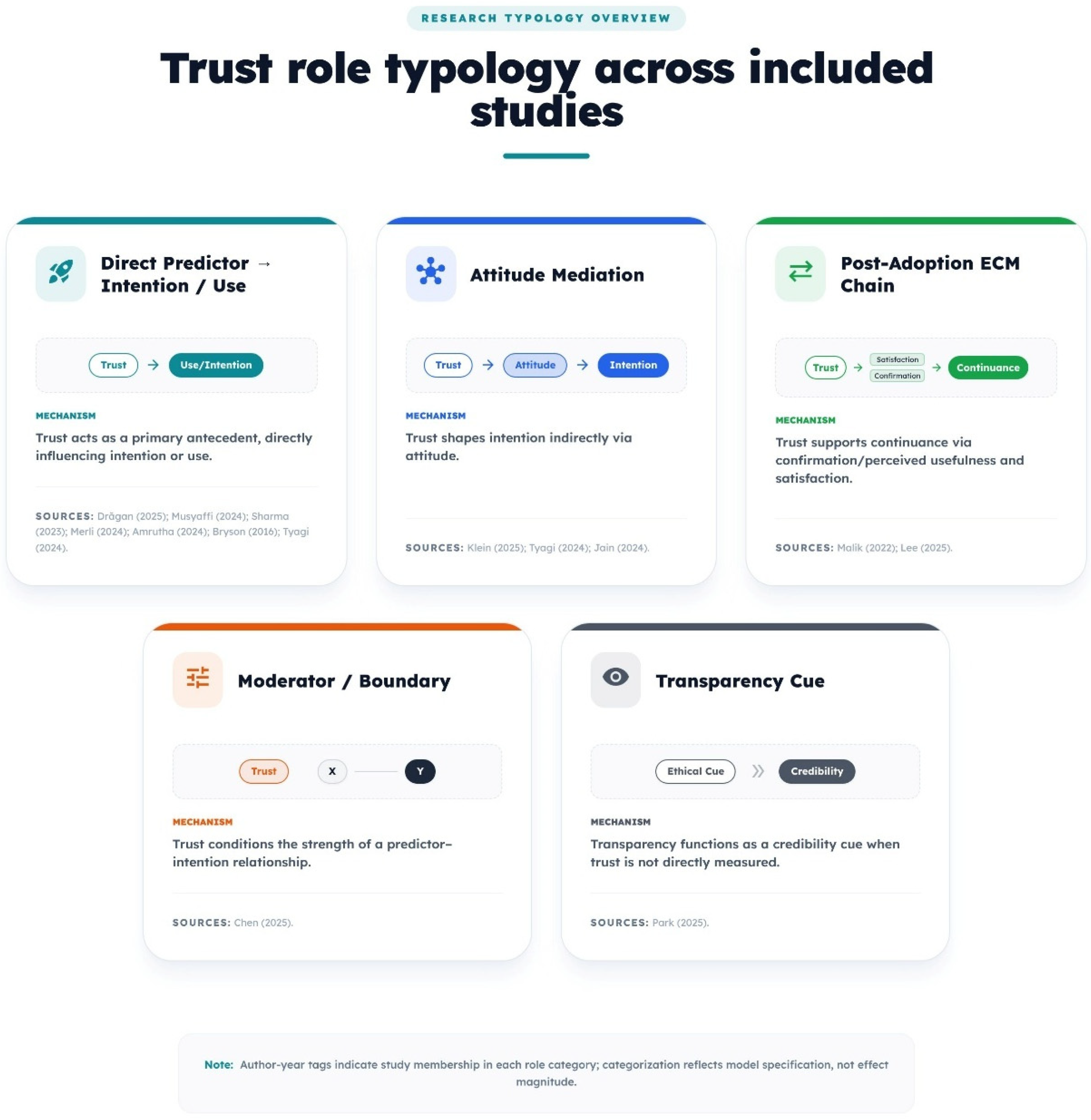
To reduce repetition and provide a structural overview, Figure 2 summarizes the typology of trust roles observed across the included studies.

4.2.5. Synthesis Across RQs: What Is Consistent vs. Inconsistent

In the studies reviewed, a consistent cross-research question pattern indicates that trust, regardless of its designation, is generally regarded as a proximal belief that facilitates pro-sustainable FinTech acceptance, frequently conceptualized as a positive precursor to adoption intention within TAM/TPB/UTAUT frameworks [1,11,17,18,21,40]. This convergence manifests despite significant contextual heterogeneity (green crypto vs. green banking vs. ESG robo-advisors vs. app-based green fintech) and conceptual disparities in the trust target, encompassing provider/institution trust, technology/platform trust, and “green trust” rooted in environmental performance or commitment [10,11,14,20,40]. This recurring trust–acceptance linkage is methodologically reinforced by the fact that most studies report sufficient internal consistency and convergent validity indices for trust measures (often α/CR/AVE above common thresholds), which supports comparability at the level of “trust as a reliably measured latent belief,” even when item sources are adapted or context-specific [10,11,14,17,21,40]. Nonetheless, this consistency ought to be regarded as associational rather than causal, given that the prevailing evidence is cross-sectional, self-reported, and derived from a single source, with only a few design variations (e.g., longitudinal two-wave measurement and temporal change) [1,11,19,21,40].
At the same time, the synthesis suggests that there exists a substantial absence of agreement on (a) what “trust” means, (b) how it fits into the model, and (c) which stage of adoption is being explained. These differences plausibly account for divergence in findings. First, trust conceptualization varies by target. For example, institutional/provider trust [1,16,22,40] is different from technology/platform trust [10,11,17] that is based on reliability and security. There is further “green” trust [14,15,20] that is based on environmental integrity, environmental performance, or brand ecological credibility. This heterogeneity is significant because the trust object is not uniform: trust in a bank’s integrity or competence is theoretically distinct from trust in a robo-advisor’s platform security or trust in an app’s environmental impact claims, which can alter both effect sizes and the mechanisms through which trust should function [10,14,20,40]. A related source of divergence is the alignment or misalignment between “green trust” and general trust. While some studies treat green trust as essentially a sustainability-flavored version of trust [14,20], others place trust within a stream of green branding and equity, where trust serves more as a mechanism for building brand credibility than as a direct driver of intention [15]. This could alter the outcome that is most closely associated with trust (e.g., brand equity rather than intention).
Second, trust plays a variety of roles. The most common pattern is trust as a direct predictor [1,11,17,18,20,21,40]. However, a number of studies highlight indirect pathways where trust functions through belief-updating chains or attitudes, which can make “trust → intention” appear weaker or contingent when modeled alongside mediators [13,14,16]. This is most evident when trust is not modeled as a stand-alone determinant of intention [13,16], but rather is primarily linked to attitudinal appraisal (e.g., trust predicts adoption attitude, with intention following from attitude), and when post-adoption models incorporate trust into a confirmation–usefulness–satisfaction sequence that ends in continuance intention [14,19]. Because moderation estimates are more susceptible to measurement error, scaling, and design constraints in cross-sectional self-report settings, the lone moderator configuration—trust as a boundary condition that strengthens another predictor’s effect on intention—should be handled carefully as a source of heterogeneity [10].
Third, the findings differ because the literature conflates pre-adoption intention, post-adoption/continuance, and behavioral proxies under the general term “adoption,” despite these outcomes representing distinct decision-making stages. Most studies focus on intention as the primary DV [1,11,18,20,21,40], which is conceptually closer to attitudinal beliefs and thus often yields clearer trust associations; in contrast, post-adoption outcomes (continuance intention, continued use) are modeled in fewer cases and embed trust within satisfaction-confirmation dynamics [14,19]. This stage-mixing can also clarify the attitude–behavior gap evidenced by minimal observed uptake, indicating that the “trust → intention” relationship may not directly correlate with actual adoption in certain contexts [16].
Methodological and quality indicators provide further clarity in terms of where we might generalize or not. The synthesis indicates that the type of analysis used (PLS-SEM vs. CB-SEM vs. Regression/PROCESS vs. Mixed Configurational) is a non-trivial source of heterogeneity in terms of effect patterns [1,11,13,16,40]. PLS-SEM tends to focus on the use of CR/AVE and bootstrapping [10,11,14,17,40], while CB-SEM tends to focus on global fit indices and trimming, which changes the definition of trust [1,13,18]. Evidence quality in terms of CMB is inconsistent in terms of Harman test, VIF, marker variables, etc., while some provide limited detail, suggesting that reliability is more consistent across studies than bias control [10,13,14,16,17,19]. Multi-group and cross-national studies feature in a minority of the studies, while these strengthen the external scope, measurement invariance is not consistent across these studies, which might contribute to some of the differences that might be measurement-based [12,13,14]. Finally, there is a conceptual divergence in the presence of a ‘trust adjacent’ body of work where trust is not actually measured, but rather the perception of transparency is used as an ethical/credibility factor in terms of perceived value and adoption [10,12].
In summary, it can be asserted without exaggeration that trust-related beliefs are frequently identified as immediate drivers or mechanisms of sustainable/green FinTech acceptance. Furthermore, the most reliable empirical indication manifests at the level of intention rather than actual adoption, with more robust evidence when trust is conceptualized as a direct precursor or integrated within clearly defined mediational frameworks [1,11,14,16,40]. The primary explanations for discrepancies in results are differences in trust targets (institution vs. platform vs. green trust), adoption stage (intention vs. continuance/use), and analytic/modeling decisions (SEM family, mediation vs. direct specification, and the rarity of moderation tests), which are exacerbated by inconsistent CMB/invariance reporting and cross-sectional self-report designs [10,12,13,14,19]. Building on this narrative synthesis, the next section (RQ5) uses meta-analysis to quantitatively aggregate the five comparable Trust → Adoption Intention effects (k = 5) in order to estimate the overall magnitude and heterogeneity of the trust–intention relationship.

4.3. Meta-Analysis (RQ5)

4.3.1. Meta-Analysis Methodology

A meta-analysis was conducted to integrate the Trust → Adoption Intention association utilizing studies that provided the direct standardized path coefficient (β) (Table 7). Quantitative pooling was limited to k = 5, as only this subset exhibited a sufficiently comparable Trust → Adoption Intention direct effect with extractable uncertainty information, while the other studies varied in outcome type (e.g., continuance/use), model role (mediation/moderation), or reporting precision.
Standardized path/regression coefficients are not equal to zero-order correlations, and their sampling variance is contingent upon model specification. Consequently, effects were aggregated on the β scale utilizing inverse-variance weighting according to the reported uncertainty of each study. When available, sampling variances were taken from reported standard errors (SE), like bootstrapped SE in PLS-SEM or reconstructed from reported test statistics (SE = β/t) or confidence intervals where applicable.
We used restricted maximum likelihood (REML) to estimate random-effects models [63,64]. Due to the limited evidence base (k = 5), the Hartung–Knapp adjustment was employed for inference, and heterogeneity was quantified using Cochran’s Q, τ, τ2, and I2 (including confidence intervals). A 95% prediction interval (PI) was reported to demonstrate how true effects are spread out across similar settings.
Robustness was assessed through casewise influence diagnostics (standardized residuals, DFFITS, Cook’s distance, covariance ratio, hat values, and study weights), including leave-one-out heterogeneity checks [65,66]. Sensitivity re-estimation evaluated the effects of different variance reconstructions when possible (reported SE; SE = β/t; or CI-based approximations); zero-order correlations, when available, served solely as exploratory directional cross-checks rather than the principal estimand. Small-study/publication-bias diagnostics (funnel-based approaches, asymmetry tests, trim-and-fill, fail-safe N) were considered exploratory due to k = 5. Consequently, the meta-analysis is regarded as a benchmark synthesis of comparable standardised structural coefficients rather than a mere pooled correlation.
To record estimand comparability, each effect was assigned a simple Model scope flag (Minimal vs. Extended) to show whether the Trust → Intention coefficient was estimated in a parsimonious specification or in an extended adoption structure with significant mediators/competing predictors (Table 7 note). Since all the effects that were included were coded as Extended, the pooled β should be seen mainly as a standard for conditional direct effects.

4.3.2. Meta-Analysis Results

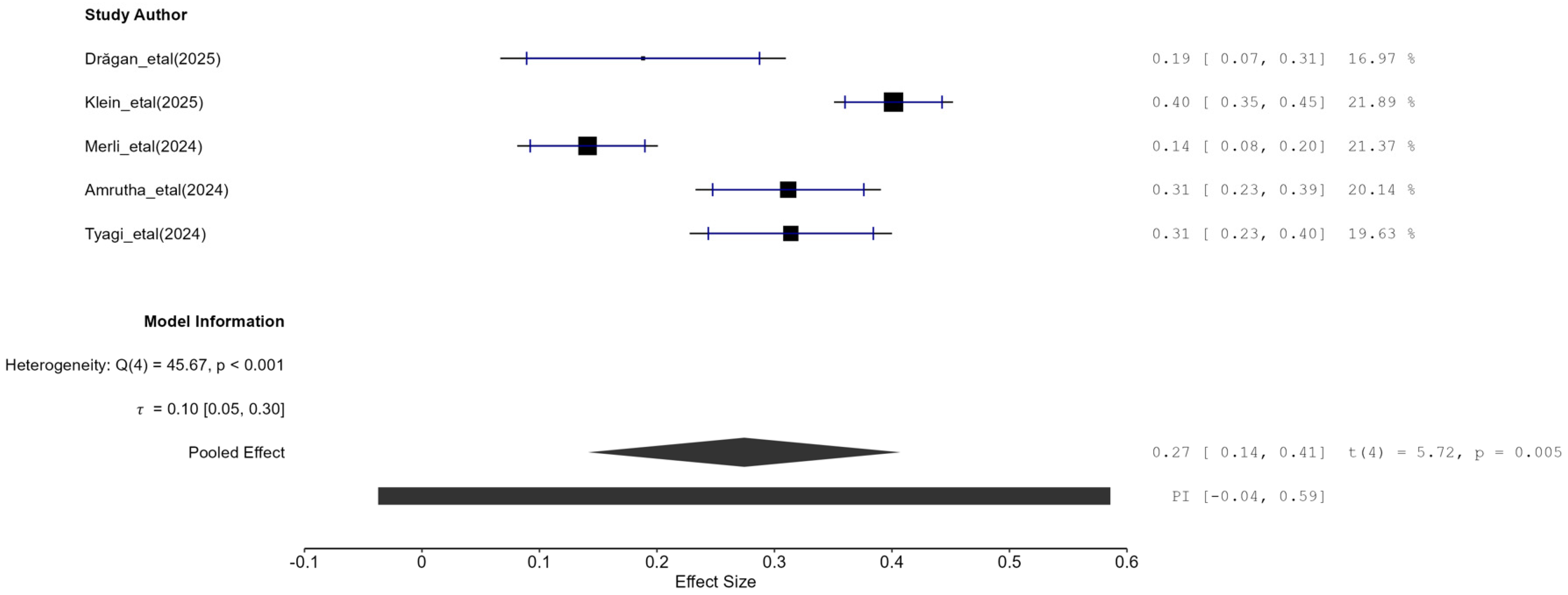
The overall Trust → Adoption Intention effect across five studies was z = 0.274, 95% CI [0.141, 0.407], which was statistically different from zero, t(4) = 5.72, p = 0.005. This pooled estimate is interpreted on the standardized path-coefficient scale (β), reflecting the average magnitude of the direct Trust → Adoption Intention association as modeled in each study’s structural specification. Individual study effects were consistently positive, ranging from about 0.14 to 0.40 (Figure 3).
There was significant between-study heterogeneity (Q(4) = 45.67, p < 0.001). With τ 2 = 0.010, 95% CI [0.003, 0.090], the estimated between-study standard deviation was τ 2 = 0.101, 95% CI [0.053, 0.300]. Heterogeneity accounted for a large percentage of the observed variability ( I 2 = 88.29%, 95% CI [67.04%, 98.51%]). The wide 95% prediction interval (z: −0.037 to 0.586; back-transformed r −0.037 to 0.527) is consistent with this, suggesting that while the average association is positive, the underlying true association may differ significantly depending on the context.

4.3.3. Influence and Robustness Checks

Casewise diagnostics identified Klein et al. (2025) [16] and Merli et al. (2024) [40] as significant, exhibiting higher leverage and influence statistics (Table 8). Leave-one-out analyses indicated that excluding either study diminished heterogeneity indices (i.e., lower Q, τ, and τ2), implying that a portion of the observed heterogeneity is influenced by a limited subset of studies rather than a singular extreme outlier. Significantly, standardized residuals did not surpass conventional heuristic thresholds (largest r std 1.95 ), corroborating the notion that heterogeneity probably signifies contextual and model variations rather than data errors. Sensitivity re-estimation using alternative variance assumptions yielded convergent pooled effects (reported SE weighting: pooled β ≈ 0.268; S E z = 1 / N 3 weighting: pooled β ≈ 0.266), with closely overlapping confidence intervals, while heterogeneity remained substantial in both cases.

4.3.4. Small-Study and Publication-Bias Assessment

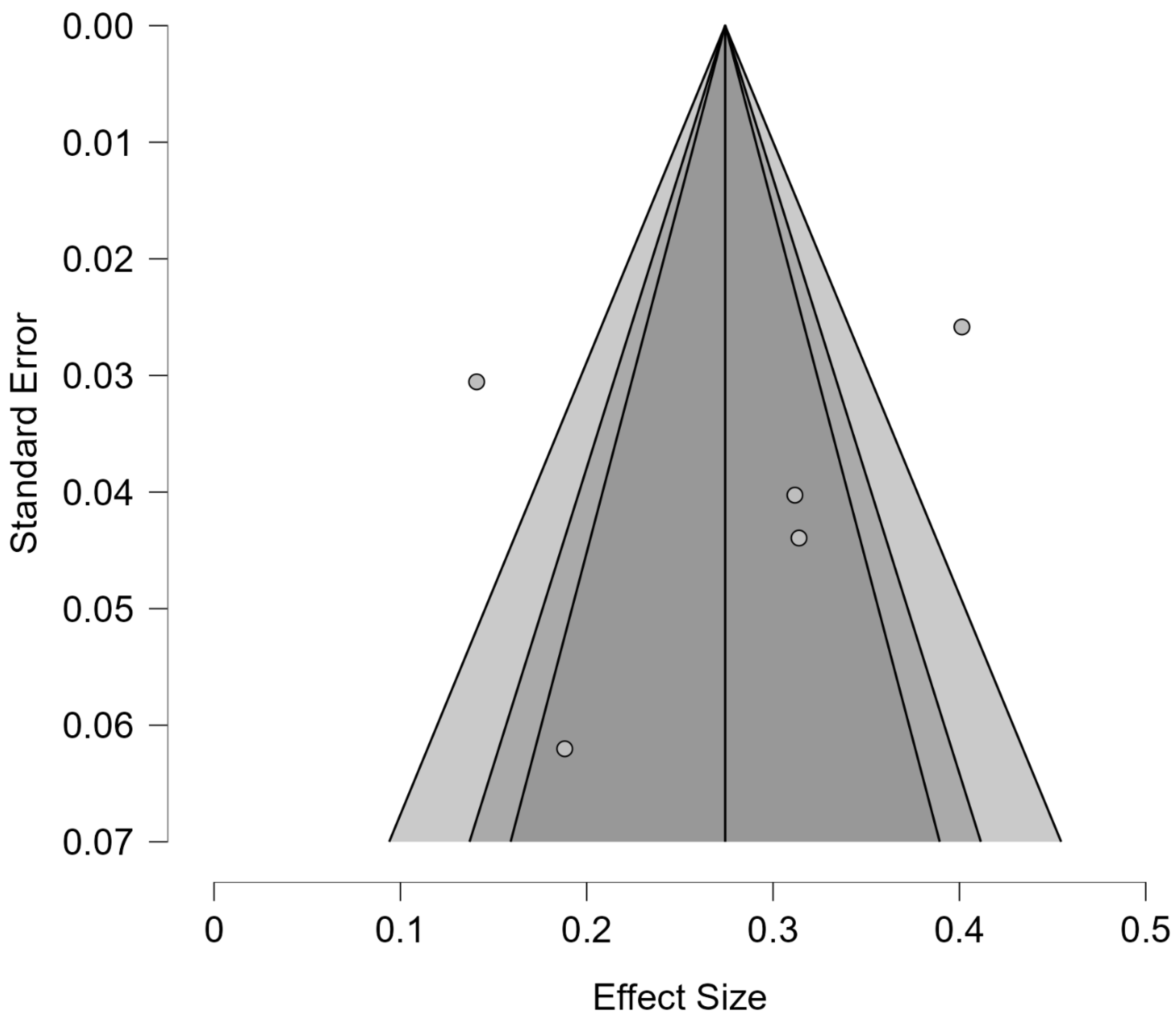
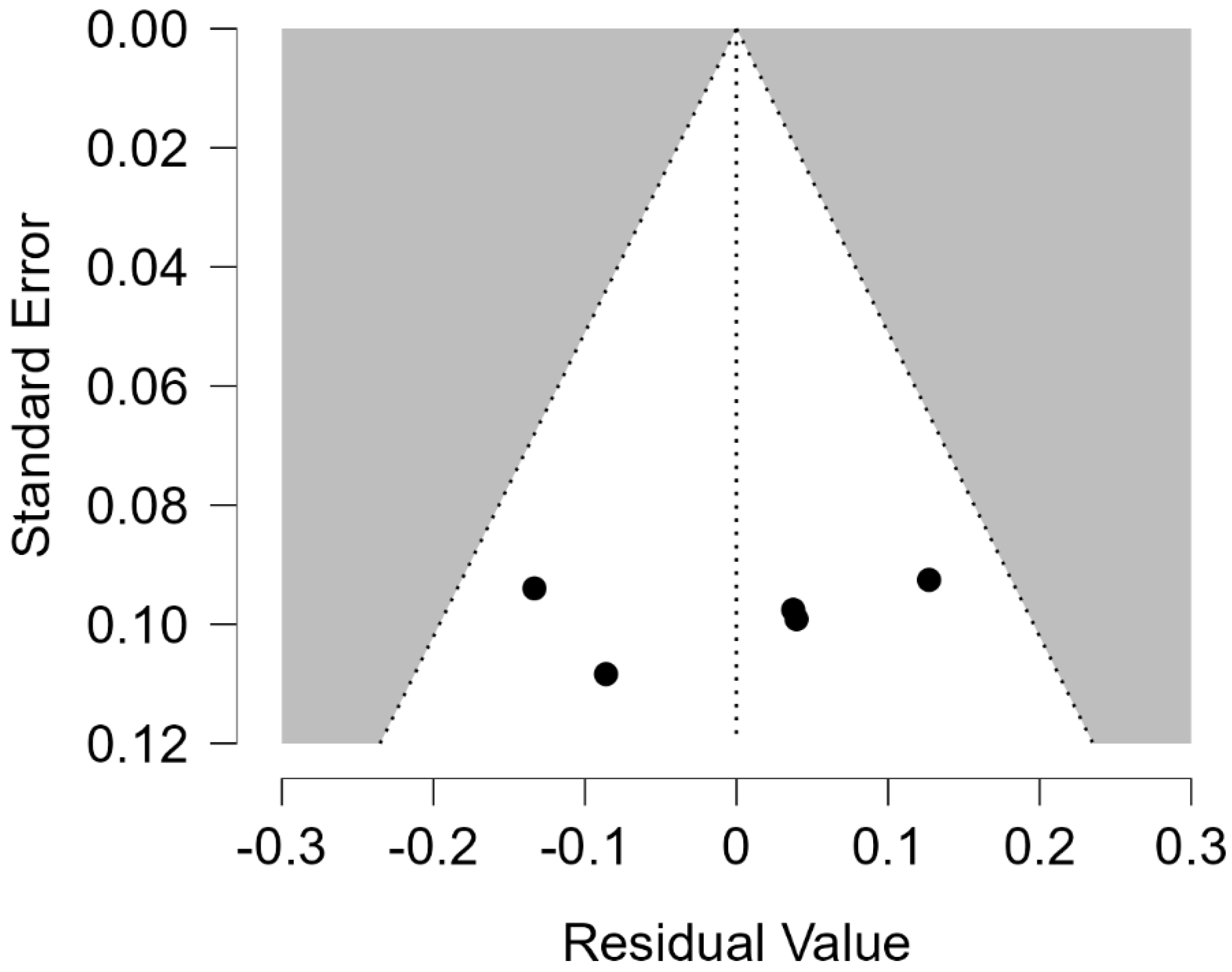
The visual examination of funnel plots did not reveal significant asymmetry, while the asymmetry tests yielded non-significant results (meta-regression: z = −0.651, p = 0.515; weighted regression/Egger-type: t(3) = −0.580, p = 0.602) (Table 9 and Table 10). Trim-and-fill did not impute 0 missing studies, so the adjusted pooled estimate was the same as the primary model (z = 0.274). Under the Rosenthal and Rosenberg methods, the fail-safe N values were large (531 and 434, respectively). However, Orwin’s method showed a fail-safe N value of 5. Since k = 5, such approaches have very little power and can be unstable. Because of this, they should not be interpreted as evidence for the absence of publication bias. They are reported as exploratory sensitivity checks only (Figure 4 and Figure 5).

4.4. Implications for Meta-Analysis and Interpretation

This meta-analysis relies on a limited evidence base (k = 5), constraining (a) the accuracy of heterogeneity estimates, (b) the viability of moderator analyses, and (c) the interpretability of small-study/publication-bias diagnostics, which are inadequately powered at a very small k. Consequently, the aggregated estimate ought to be regarded as a provisional benchmark for the Trust → Adoption Intention standardized path association (β), rather than a conclusive population effect size.
Additionally, the pooled coefficient combines standardized structural paths that may show different model specifications, such as different covariates/mediators and estimation traditions. The extracted Trust → Intention coefficients from the meta-analytic subset may not represent the same estimand. The “Model scope” coding (Minimal vs. Extended) shows that the available effects mostly come from extended adoption structures. Thus, the pooled β should be considered an average conditional direct effect instead of an overall trust effect. This mixed-estimand structure likely contributes to heterogeneity and may attenuate the pooled magnitude where trust operates partly through modeled mediators.
Notwithstanding these limitations, the synthesis offers a time-stamped baseline for upcoming cumulative meta-analyses as the body of evidence grows and reporting guidelines advance. Significant context sensitivity is suggested by the high I2 and wide prediction interval, highlighting the need for more primary research and follow-up syntheses that can test theoretically motivated moderators (e.g., FinTech subtype, institutional context, sampling frame, and trust operationalization).

5. Discussion

5.1. Principal Findings: Integrating the Narrative Synthesis and Meta-Analysis

For the subset of studies reporting similar direct effects (k = 5), the meta-analysis offers a preliminary quantitative benchmark for the Trust → Adoption Intention association. Significant heterogeneity (Q(4) = 45.67, p < 0.001; I2 ≈ 88%) and a wide prediction interval accompanied the positive and statistically significant pooled estimate (β ≈ 0.27), suggesting meaningful context sensitivity rather than a single stable magnitude. This pattern is consistent with the narrative synthesis: the adoption stage being modeled (intention vs. continuance), whether “green trust” captures sustainability-claim credibility versus general institutional confidence, and the trust target (provider vs. platform) all plausibly affect the trust effects [10,14,16,40]. According to influence diagnostics, a small number of influential studies could be partially responsible for heterogeneity, which is consistent with variations in context and model specification rather than anomalies in the data.
The synthesis demonstrates that “trust” is not a singular, interchangeable construct. Across studies, it consolidates into three recurring dimensions: (a) institutional/provider trust, (b) technology/platform trust (encompassing reliability/security/system quality), and (c) integrity–competence–benevolence-type trust, which integrates moral character and capability expectations [10,11,14,16,20,40]. A significant issue of comparability is that “green trust” is not uniformly operationalized; in certain studies, it directly addresses environmental performance, reputation, and commitment, whereas in others, it mirrors general bank/provider trust with minimal sustainability indicators, conflating baseline institutional trust with trust in green assertions [13,14,15,21,22]. In FinTech-native environments (e.g., robo-advisors/digital channels), trust frequently signifies platform reliability/security and may be regarded as “green trust” solely when measurement explicitly correlates confidence with ESG governance or claim veracity. Some studies examine credibility processes through transparency and responsibility cues, omitting an explicit trust construct, and consider trust as replaceable by upstream credibility signals in the adoption chain [10,11,12,17].
In structural models, trust predominantly serves as a direct predictor of intention-related outcomes, with supplementary evidence supporting mediated roles via attitudes, confirmation, and satisfaction; instances of moderation or boundary-condition applications are relatively infrequent and should be regarded as context-dependent [1,10,14,16,19]. Outcome heterogeneity complicates synthesis: the majority of studies concentrate on behavioral intention, while a smaller number investigate use/continuance, wherein trust is more cohesively integrated within post-adoption confirmation and satisfaction dynamics [14,19].
For the subset of studies indicating analogous direct effects (k = 5), the meta-analysis provides an initial quantitative benchmark for the Trust → Adoption Intention relationship. The positive and statistically significant pooled estimate (β ≈ 0.27) was accompanied by significant heterogeneity (Q(4) = 45.67, p < 0.001; I2 ≈ 88%) and a wide prediction interval. This suggests that context sensitivity is more important than a single stable magnitude. This pattern aligns with the narrative synthesis: the modeled adoption stage (intention vs. continuance), the interpretation of “green trust” as sustainability-claim credibility versus general institutional confidence, and the trust target (provider vs. platform) all likely influence the trust effects [10,14,16,40]. Influence diagnostics suggest that a limited number of significant studies may contribute to heterogeneity, aligning with variations in context and model specification rather than data anomalies.
Overall, evidence points to a “consistent but contingent” conclusion: trust is generally associated positively with the intention to adopt green and sustainable FinTech, but its significance and function vary depending on the adoption stage, measurement target, and context. Given that most studies remain cross-sectional and intention-based, the current evidence does not justify strong claims about a universal effect size, stable causal ordering across stages, or a single definitive interpretation of “green trust” [1,14,16,19,21].

5.2. Theoretical Implications: How Trust Should Be Modeled in Green FinTech Adoption

Through the literature surveyed, trust is not considered a theory by itself. Rather, it is a belief that can be transferred and inserted into the existing adoption theories (TAM, UTAUT, TPB) to deal with the uncertainty, risk, and credibility issues that arise when green or eco-friendly attributes are included in the value chain [1,11,13,17]. The net effect is that the actual theoretical issue is no longer “is trust important?” but rather “what is trust actually referring to?”—the source, the technology, or the green claims—and when it occurs in the causal chain (prior to adoption beliefs, during attitude formation, or post-adoption as reinforcement) [14,16,20,40].
Trust is robustly “non-trivial” as a direct predictor, but it is not a universal constant.
The reviewed literature indicates that trust operates not as an independent explanatory theory but as a transferable belief construct integrated into established adoption frameworks (TAM/UTAUT/TPB) to address uncertainty, perceived risk, and credibility issues, particularly when “green” claims are included in the value proposition [1,11,13,17]. This pattern suggests that the fundamental theoretical inquiry is not the significance of trust, but rather the referent of trust (provider versus technology versus sustainability claims) and its position within the causal chain (pre-adoption beliefs, attitudinal formation, or post-adoption reinforcement), as these determinations significantly influence interpretability and cross-study comparability [14,16,20,40].
Specify the referent: provider trust, technology/security trust, and green-claim credibility are not interchangeable.
A persistent issue of comparability arises as studies frequently designate a construct as “trust” while focusing on distinct objects: (a) institution/provider trust (e.g., trust in bank/pure player), (b) technology/security trust (confidence in channel reliability, safeguards, and platform quality), and (c) integrity/competence/benevolence or green-claim credibility (belief that environmental commitments are genuine and dependable) [10,14,16,40]. When “green trust” is primarily defined as general bank trust (e.g., honest information, being well advised), the resultant effect is theoretically ambiguous—one cannot distinctly attribute intention formation to sustainability credibility rather than baseline provider confidence [13,16,21]. On the other hand, when trust is based on environmental performance, reputation, or commitment, it is a clearer example of a sustainability-credibility mechanism than a general reassurance [10,14,16,40]. Future models should designate the object of trust within the construct label (e.g., “provider trust,” “platform security trust,” “green-claim credibility trust”) and organize items accordingly to prevent the conflation of institution-level trust with sustainability-specific credibility assessments [13,16,21].
Treat “green trust” as a mechanism when sustainability cues are central and test it as mediation, not only as an added predictor.
The main theoretical story is about sustainability cues, like a green brand image, personalized ESG, and environmental commitments. The evidence shows that trust is often best understood as a way to turn those cues into evaluative outcomes, rather than just a parallel predictor added to TAM/TPB [14,15,22]. Models that incorporate trust into explanatory frameworks (e.g., cue → trust → downstream outcomes) align more closely with the conceptual function of trust as credibility/assurance in contexts of informational asymmetry, in contrast to specifications that merely append trust to usefulness/ease/risk without elucidating its origins [11,14,15]. This also helps reconcile “trust-adjacent” designs: transparency and responsibility cues may be upstream antecedents to trust-like evaluations even when the model does not include an explicit trust construct [10]. The implication is that green FinTech models should more routinely test trust as mediation when sustainability signals are theorized as inputs, rather than leaving mediation as an “implied” interpretation [11,15,16].
Model trust dynamically in post-adoption settings: continuance logic differs from initial intention logic.
Evidence from post-adoption/continuance streams suggests that trust may function as part of a reinforcement process connected to confirmation, satisfaction, and continued use in addition to being a pre-adoption belief [14,19]. When the result is continuance intention or use, trust likely operates both directly and indirectly through ECM-type mechanisms. This suggests that cross-sectional intention models may either underestimate or inaccurately define trust’s role in ongoing engagement with green FinTech services [14,19]. The theoretical implication is that research must differentiate between adoption (establishing intention amidst uncertainty) and continuance (sustaining usage in light of experienced performance), and delineate trust accordingly [14,19].
Moderation by trust is rare; treat boundary-condition claims as provisional unless replicated and well-identified.
There is only limited evidence that trust functions as a moderator or boundary condition (for example, trust can make a sustainability-related feature have a stronger effect on intention). These results should be interpreted cautiously, given cross-sectional designs, small k in comparable moderator studies, and sensitivity to measurement/construct labeling [10,11,12]. A practical implication is that moderation hypotheses should only be used when there is a strong theory (for example, trust changes reliance on personalization and automation when they are unsure), enough power, and careful targeting of constructs (for example, technology trust vs. green-claim credibility). They should not be used as a default extension [10,14,40].
Incorporate “behavioral realism”: intention effects may not map cleanly to adoption in sustainable banking contexts.
When objective or revealed-preference indicators indicate an attitude–behavior gap, it should not be presumed that trust effects on intention will directly correlate with actual uptake. This suggests that models must either integrate behavioral outcomes or explicitly theorize intention–behavior discrepancies [1,16,19,20]. This further emphasizes the importance of differentiating between low-cost adoption intentions and higher-commitment outcomes (such as sacrificial engagement), where trust may function differently because the choice is more akin to moral commitment than convenience-driven adoption [15,22].
In conclusion, the evidence indicates that trust is significant in the adoption of green FinTech; however, its theoretical significance is contingent upon accuracy: clearly defining the object of trust, aligning measurement with that object, appropriately situating trust within the causal framework (as a predictor, mediator, or dynamic post-adoption mechanism), and refraining from overinterpreting boundary-condition effects until they are replicated [10,14,16].

5.3. Practical Implications (Design, Regulation, and Communication)

Trust is a functional lever for the adoption of green and sustainable FinTech; however, there is no singular “build trust” objective. The pertinent trust referent is context-dependent, and the diversity of contexts necessitates that interventions enhance the specific credibility or assurance mechanism that influences the user’s decision [1,10,11,40]. The meta-analytic benchmark reveals a moderate positive relationship between Trust and Adoption Intention (pooled β ≈ 0.27); however, variability across contexts advises against universal trust-building approaches and supports context-specific strategies [14,16,20].
In green banking and “pure player” contexts, where trust is mostly aimed at the institution or provider, design and communication must concentrate on verifiable sustainability information (audited claims, clear eligibility criteria, accessible impact explanations) and avoid broad “green” rhetoric without substantiation, especially when sustainability credibility can be confused with general bank trust [1,13,15,16,20,21,40]. In platform-centric contexts (FinTech apps, robo-/AI-enabled ESG tools), adoption depends more on platform competence/security trust (reliability, data protection, decision-support quality), implying “trust-by-design” features such as clear data-use disclosures, intelligible security assurances, and interfaces that make ESG logic understandable without overload; sequencing also matters, with safeguards and reliability cues most salient early in the user journey before emphasizing advanced personalization [1,10,11,17].
Trust formation is shaped by institutional assurance and market-wide credibility infrastructure. Standardized disclosure templates, clearer taxonomies for “green” financial products, and enforcement against ambiguous or unverifiable claims can reduce market uncertainty and mitigate greenwashing risk by making sustainability claims comparable and checkable across providers [12,16,20].
Additional recommendations follow directly from these patterns. For researchers, researchers should (i) measure multiple trust targets in the same model (provider/institution vs. platform/security vs. green-claim credibility) and test discriminant validity; (ii) pre-specify and report the estimand (direct vs. total effects) with SE/CI to support synthesis; (iii) move beyond cross-sectional intention-only studies via time-lag/longitudinal or mixed survey + behavioral outcomes; and (iv) report a minimum set of bias/robustness checks (CMB diagnostics; invariance before MGA). For practitioners, use “proof-before-persuasion” by linking claims to checkable evidence at decision points. Add simple verification alternatives (“learn/verify”), clarify data governance and security in simple terms for ESG tools, and track trust as a multi-dimensional KPI to diagnose whether adoption barriers are credibility-, security-, or value-clarity-driven.

5.4. Why Heterogeneity Is High: Integrated Explanation and What the Prediction Interval Implies

The meta-analysis indicates a positive average trust-intention association; however, the heterogeneity is substantial (Q(4) = 45.67, p < 0.001; I2 ≈ 88%), and the prediction interval is extensive (z: −0.037 to 0.586), suggesting that effects may be negligible in certain comparable contexts and distinctly positive in others. This is similar to the narrative synthesis: studies differ in what “trust” means, what “adoption” means, and the decision environment in which trust works [1,10,11,16,40]. A fundamental source of dispersion is construct non-equivalence. Trust is variously operationalized, including provider/institutional trust, technology/channel trust (security/reliability), or green-credibility analogues (green trust/environmental integrity). Thus, the same modeled label (Trust → Intention) can have different meanings and effect sizes [1,14,15,16,20,40]. Context matters equally: crypto, ESG robo-advisors, online green “pure players,” and green internet banking all have distinct levels of perceived risk, regulatory clarity, and verifiability of sustainability claims. These factors affect how diagnostic trust compares to usefulness, self-efficacy, or price [1,10,11,13,16,17,40]. Heterogeneity is further amplified by the adoption stage and model structure. The majority of outcomes are cross-sectional intentions; however, certain contexts exhibit intention–behavior discrepancies. Furthermore, post-adoption employment positions trust within confirmation/satisfaction frameworks, and the inclusion of attitude, risk, and usefulness as mediators or competing predictors alters the estimated “direct” trust coefficient [1,11,14,16,19]. Finally, mixed analytic traditions (PLS-SEM/CB-SEM/PROCESS), sampling frames, and inconsistent CMB management likely introduce variance beyond substantive differences [1,10,11,14,21,40]. Overall, the evidence supports trust as meaningful but context-sensitive, the prediction interval warns against assuming that “trust-building” without specifying the trust referent and adoption context [10,11,14,16,40].

5.5. Future Research Agenda

Table 11 consolidates recurring gaps and links each to a practical methodological next step. Overall, the evidence base remains dominated by cross-sectional, self-report designs (often convenience/platform samples) and intention-focused outcomes rather than observed adoption or sustained use [1,11,40]. A primary objective is the enhancement of causal and temporal evidence; subsequent research should utilize time-lagged and longitudinal methodologies (including multi-wave trust measurement and post-adoption tracking) and, when possible, experimental or field-experimental approaches that manipulate credibility and assurance indicators (such as verification, transparency, and security assurances) to elucidate mechanisms and boundary conditions [14,16,19].
A second priority is standardized trust measurement tailored to green FinTech. rust is variably operationalized as institution/provider trust, platform/security trust, or integ-rity–competence–benevolence-type trust, and “green trust” is sometimes conflated with general trust rather than treated as claim-contingent credibility [10,20,40]. This necessitates harmonized instruments that delineate trust targets (provider, platform, and green-claim credibility) and mandate explicit assessments of construct distinctiveness within a singular model [1,11,14]. Third, methodological transparency is still not consistent. Reporting on reliability and validity typically is acceptable, but CMB diagnostics and invariance procedures are inconsistently applied, limiting comparability in subgroup or cross-national claims [10,12,13]. Lastly, boundary-condition research should be cautiously and adequately expanded, as trust moderation remains rare and vulnerable to measurement and specification decisions [10,14,22].

5.6. Limitations

This review has several constraints that temper inference. First, the meta-analysis relies on a limited evidence base (k = 5) of analogous Trust → Adoption Intention pathways, constraining accuracy in heterogeneity assessment and preventing moderator tests (e.g., FinTech subtype, institutional context, trust referent). Small-study/publication-bias procedures (Egger-type tests, trim-and-fill, fail-safe N) exhibit insufficient power at very small k and are consequently regarded as exploratory only. A related limitation pertains to estimand comparability: while each meta-analysis study presents a Trust → Intention coefficient, β values may not be directly comparable due to variations in models that estimate conditional direct effects within extended adoption frameworks (e.g., attitude/usefulness/risk and multiple competing predictors), whereas others approach more total/overall associations (e.g., mediation-derived total effects). We included a basic Minimal vs. Extended coding flag to record this. In the current evidence base, the effects are primarily Extended, so the pooled estimate should be seen as a benchmark for conditional direct effects rather than an evidence-based overall trust effect. Future cumulative meta-analyses should pre-specify a common estimand (direct vs. total), code mediator inclusion more granularly, and prioritize extraction of comparable statistics (e.g., zero-order correlations or consistently reported total effects).
Second, the predominant literature consists of cross-sectional, same-source self-report surveys, which constrain causal inference and elevate common-method bias risk. Some studies report CMB diagnostics (e.g., Harman, VIF, marker-variable approaches), but their application is inconsistent, and temporal trust dynamics are only partially captured, with few longitudinal/post-adoption designs [10,14,16,19]. Third, construct comparability is constrained due to the heterogeneous operationalization of “trust” (including provider/bank trust, platform/security trust, and green-claim credibility equivalents), with certain measures potentially conflating sustainability-specific credibility with baseline institutional trust, especially in green banking contexts [1,11,14,20]. Lastly, outcomes differ among intention, continuance, and behavioral proxies; intention–behavior gaps are conceivable in sustainable finance contexts; and evidence is predominantly confined to single-country/metro and convenience sampling frameworks, exhibiting restricted cross-national representation and inconsistent invariance reporting [12,13,14,16,19].

6. Conclusions

Based on the evidence reviewed, trust is a consistently significant factor in models for adopting green/sustainable FinTech, but its impact is clearly dependent on the context rather than being uniform. Most studies include trust as an additional belief within established adoption frameworks (e.g., TAM/UTAUT/TPB), but the meaning of “trust” varies widely, from institutional/provider trust to platform/security trust and sustainability-specific credibility (i.e., “green trust” as belief in environmental integrity and commitments). This conceptual and measurement variation corresponds with the noted variability in effects across contexts and outcomes (intention versus continuance/use), elucidating the reasons for significant between-study heterogeneity despite a consistently positive average association. In this context, the meta-analysis establishes an initial quantitative benchmark for the direct Trust → Adoption Intention association (pooled Fisher’s z ≈ 0.274; back-transformed r ≈ 0.27). The extensive prediction interval indicates that the actual effect may vary in magnitude based on FinTech subtype, trust operationalization, sampling frame, and institutional context. This synthesis offers a time-stamped benchmark for future cumulative meta-analyses to evaluate whether the magnitude and dispersion of trust effects evolve as the literature expands, measurement standards are established, and new FinTech subtypes and institutional contexts are examined.

Funding

This research received no external funding.

Institutional Review Board Statement

Not applicable.

Informed Consent Statement

Not applicable.

Data Availability Statement

Dataset available upon reasonable request from the author.

Conflicts of Interest

The author declares no conflicts of interest.

Abbreviations

The following abbreviations are used in this manuscript:
ANNArtificial neural network
ATTAttitude
AVEAverage variance extracted
BIBehavioral intention
BRTBehavioural Reasoning Theory
CB-SEMCovariance-based structural equation modeling
CMBCommon Method Bias
CFAConfirmatory factor analysis
CFIComparative Fit Index
ECMExpectation-Confirmation Model
EFAExploratory factor analysis
ESGEnvironmental, social, and governance
fsQCAFuzzy-set Qualitative Comparative Analysis
GBEGreen Brand Equity
GBIGreen Brand Image
GPIGreen Purchase Intention
GTGreen Trust
ICBIntegrity–Competence–Benevolence (trust dimensions)
MGAMulti-Group Analysis
MICOMMeasurement Invariance of Composite Models
NEPNew Ecological Paradigm
OLSOrdinary Least Squares
PEIPerceived Environmental Integrity
PEOUPerceived Ease of Use
PLS-SEMPartial Least Squares Structural Equation Modeling
PROCESSPROCESS macro (Hayes) for mediation/moderation
PUPerceived Usefulness
PVPerceived Value
SATSatisfaction
SDTSelf-Determination Theory
SEMStructural Equation Modeling
TAMTechnology Acceptance Model
TPBTheory of Planned Behavior
TRTrust (generic trust construct label)
UTAUTUnified Theory of Acceptance and Use of Technology
VAMValue-based Adoption Model
VIFVariance Inflation Factor

References

  1. Tyagi, S.; Gupta, A.; Ansari, N. Adoption and Perception of Banking Customers towards Green Mode of Banking: A Demonstration of Structural Equation Modelling. J. Financ. Serv. Mark. 2024, 29, 826–842. [Google Scholar] [CrossRef]
  2. de Mariz, F.; Bosmans, P.; Leal, D.; Bisaria, S. Reforming Sustainability-Linked Bonds by Strengthening Investor Trust. J. Risk Financ. Manag. 2024, 17, 290. [Google Scholar] [CrossRef]
  3. Trivedi, S.; Mehta, K.; Sharma, R. Systematic Literature Review on Application of Blockchain Technology in E-Finance and Financial Services. J. Technol. Manag. Innov. 2021, 16, 89–102. [Google Scholar] [CrossRef]
  4. van der Heever, W.; Satapathy, R.; Park, J.M.; Cambria, E. Understanding Public Opinion towards ESG and Green Finance with the Use of Explainable Artificial Intelligence. Mathematics 2024, 12, 3119. [Google Scholar] [CrossRef]
  5. Geetha, S.; Biju, A.V.N. Is Green FinTech Reshaping the Finance Sphere? Unravelling through a Systematic Literature Review. Environ. Sci. Pollut. Res. Int. 2024, 31, 1790–1810. [Google Scholar] [CrossRef]
  6. Nnamani, K.E.; Ngoka, R.O.; Okoye, K.M.; Nwoke, H.U. The Nigerian State and the Realities of Managing COVID-19 Pandemic: Whither Political Restructuring and Economic Diversification? Afr. Identities 2024, 22, 366–387. [Google Scholar] [CrossRef]
  7. Buttigieg, C.P.; Pulis, S. Strategic Initiatives to Address Greenwashing. ERA Forum 2024, 25, 327–337. [Google Scholar] [CrossRef]
  8. Shalhoob, H. ESG Disclosure and Financial Performance: Survey Evidence from Accounting and Islamic Finance. Sustainability 2025, 17, 1582. [Google Scholar] [CrossRef]
  9. Khalil, M.K.; Khalil, R. Leveraging Buyers’ Interest in ESG Investments through Sustainability Awareness. Sustainability 2022, 14, 14278. [Google Scholar] [CrossRef]
  10. Chen, A.; Wang, S.; Mehta, A.M.; Asif, M.; Xu, S.; Shahzad, M.F. FinTech Adoption for ESG Integration through Robo Advisors, Personalization, and Perceived Trust. Sci. Rep. 2025, 15, 31125. [Google Scholar] [CrossRef]
  11. Drăgan, G.B.; Ben Arfi, W.; Tiberius, V.; Ammari, A.; Khvatova, T. Navigating the Green Wave: Understanding Behavioral Antecedents of Sustainable Cryptocurrency Investment. Technol. Forecast. Soc. Change 2025, 210, 123909. [Google Scholar] [CrossRef]
  12. Park, S.; Yoon, S. Cross-National Findings of Factors Affecting the Acceptance of AI-Based Sustainable Fintech. Sustainability 2025, 17, 49. [Google Scholar] [CrossRef]
  13. Jain, A.; Yadav, P.; Kochhar, K. Do Green Banking Practices Change Customers’ Attitudes and Behavior: A Conceptual Model. Indian J. Financ. 2024, 18, 25–43. [Google Scholar] [CrossRef]
  14. Lee, J.C.; Li, T.; Zhang, L. Environmental Concerns and Green Trust in Continuous Green Fintech Use: An Expectation-Confirmation Model with Insights from Ant Forest. Humanit. Soc. Sci. Commun. 2025, 12, 540. [Google Scholar] [CrossRef]
  15. Sharma, M. Determinants of Green Purchase Intention in the Banking Sector. J. Environ. Plan. Manag. 2024, 67, 1125–1147. [Google Scholar] [CrossRef]
  16. Klein, S.M.A.; Polzin, F. Greening the Retail Banking Industry: Evidence from German Bank Account Consumers. Int. Rev. Financ. Anal. 2025, 104, 104326. [Google Scholar] [CrossRef]
  17. Musyaffi, A.M.; Bongomin, G.O.C.; Jamal, A.A.A.; Mahmudah, H.; Respati, D.K.; Khairunnisa, H. Value Creation of Green Banking Technology Sustainability: The Role of Initial Trust. Int. J. Manag. Sustain. 2024, 13, 572–586. [Google Scholar] [CrossRef]
  18. Sharma, M.; Deka, J.; Sharma, V.; Verma, P.; Verma, P.; Tiwari, K. An Analytical Framework for Assessing Equity Investor Preferences in Green Technology Shares. In Proceedings of the 2023 4th International Conference on Computation, Automation and Knowledge Management, ICCAKM 2023; Institute of Electrical and Electronics Engineers Inc.: Piscataway, NJ, USA, 2023. [Google Scholar]
  19. Malik, G.; Singh, D. Personality Matters: Does an Individual’s Personality Affect Adoption and Continued Use of Green Banking Channels? Int. J. Bank Mark. 2022, 40, 746–772. [Google Scholar] [CrossRef]
  20. Bryson, D.; Atwal, G.; Chaudhuri, A.; Dave, K. Antecedents of Intention to Use Green Banking Services in India. Strateg. Change 2016, 25, 551–567. [Google Scholar] [CrossRef]
  21. Sasidharan, A.; Santhi, V. Customers Intention to Adopt Sustainable Banking Services Based on the Green Development in Chennai. J. Environ. Prot. Ecol. 2024, 25, 979–987. [Google Scholar]
  22. Kaçani, K.; Kokthi, E.; González-Limón, M.; López-Bonilla, L.M. From Collective Norms to Personal Responsibility: Integrating TPB and SDT to Explain Green Banking Behaviors in a Transitional Society. Bus. Strategy Dev. 2025, 8, e70229. [Google Scholar] [CrossRef]
  23. Dadabada, P.K. Analyzing the Impact of ESG Integration and FinTech Innovations on Green Finance: A Comparative Case Studies Approach. J. Knowl. Econ. 2025, 16, 7959–7978. [Google Scholar] [CrossRef]
  24. Sharma, S.; Aswal, N.; Aggarwal, V.; Reepu; Tiwari, V. Time-Varying Volatility Among Bahrain Stock Exchange with Disruptive Technology and Sustainable Asset Class- Insights for Portfolio Diversification. In Proceedings of the 2024 ASU International Conference in Emerging Technologies for Sustainability and Intelligent Systems, ICETSIS 2024; Institute of Electrical and Electronics Engineers Inc.: Piscataway, NJ, USA, 2024; pp. 1929–1933. [Google Scholar]
  25. Teichmann, F.M.J.; Wittmann, C.; Sergi, B.S.S. What Are the Consequences of Corporate Greenwashing? A Look into the Consequences of Greenwashing in Consumer and Financial Markets. J. Inf. Commun. Ethics Soc. 2023, 21, 290–301. [Google Scholar] [CrossRef]
  26. Ardiana, P.A.; Diantini, N.N.A.; Sudirman, I.M.S.N.; Sudana, I.P.G.; Putri, N.P.A.W.; Yanthi, K.D.L. Institutional Work in Making Sustainability Reporting Mandatory in Indonesia through Sustainable Finance. J. Account. Emerg. Econ. 2025, 15, 645–669. [Google Scholar] [CrossRef]
  27. Yasuda, Y.; Demydenko, Y.; Faloutsos, D.; Tremblay-Lévesque, L.C. Multistakeholder Regional Dialogues as Catalysers for Transboundary Water Cooperation. Water Int. 2024, 49, 540–552. [Google Scholar] [CrossRef]
  28. Li, S.; Yin, P.; Liu, S. Evaluation of ESG Ratings for Chinese Listed Companies From the Perspective of Stock Price Crash Risk. Front. Environ. Sci. 2022, 10, 933639. [Google Scholar] [CrossRef]
  29. Kumar, P.; Taneja, S.; Ozen, E. Exploring the Influence of Green Bonds on Sustainable Development through Low-Carbon Financing Mobilization. Int. J. Law Manag. 2025, 67, 249–270. [Google Scholar] [CrossRef]
  30. Strauß, N.; Krakow, J.; Chesney, M. It’s the News, Stupid! The Relationship between News Attention, Literacy, Trust, Greenwashing Perceptions, and Sustainable Finance Investment in Switzerland. J. Sustain. Financ. Invest. 2023, 13, 1480–1505. [Google Scholar] [CrossRef]
  31. Boros, A.; Lentner, C.; Nagy, V.; Tőzsér, D. Perspectives by Green Financial Instruments—A Case Study in the Hungarian Banking Sector during COVID-19. Banks Bank Syst. 2023, 18, 116–126. [Google Scholar] [CrossRef]
  32. Aslam, W.; Jawaid, S.T. Let’s Go Green: Achieving Consumer-Related Performance Outcomes in Banks. Int. J. Ethics Syst. 2024, 40, 456–476. [Google Scholar] [CrossRef]
  33. Bozkurt, M.A.K.T.A.Ş.; Köse, Y.; Çelik, S. Analyzing the Dynamic Behavior and Market Efficiency of Green Energy Investments: A Geometric and Fractional Brownian Motion Approach. Energy Sources Part B Econ. Plan. Policy 2025, 20, 2457438. [Google Scholar] [CrossRef]
  34. Lo, H.W.; Lin, S.W. Identifying ESG Investment Key Indicators and Selecting Investment Trust Companies by Using a Z-Fuzzy-Based Decision-Making Model. Socioecon. Plann. Sci. 2023, 90, 101759. [Google Scholar] [CrossRef]
  35. Palos-Sanchez, P.R.; Chang-Tam, R.J.; Folgado-Fernández, J.A. The Role of Neobanks and FinTech in Sustainable Finance and Technology. The Customer/User Perspective for Entrepreneurs. Sustain. Technol. Entrep. 2025, 4, 100109. [Google Scholar] [CrossRef]
  36. Yu, Z.; Farooq, U.; Alam, M.M.; Dai, J. How Does Environmental, Social, and Governance (ESG) Performance Determine Investment Mix? New Empirical Evidence from BRICS. Borsa Istanb. Rev. 2024, 24, 520–529. [Google Scholar] [CrossRef]
  37. Vieru, D.; Plugge, A. Overcoming the AI Opacity in ESG Reporting: A Digital Platform-Based Knowledge Boundary-Spanning Perspective. In Proceedings of the 58th Hawaii International Conference on System Sciences; Hawaii International Conference on System Sciences: Honolulu, HI, USA, 2025; ISBN 9780998133188. [Google Scholar]
  38. Gour, K.; Agarwal, M. The Mediating Role of Customer Perceived Ethicality in Green Banking’s Impact on Trust and Loyalty. Int. J. Ethics Syst. 2025. Epub ahead of printing. [Google Scholar] [CrossRef]
  39. Huseynov, F.; Mitchell, J. Blockchain for Environmental Peacebuilding: Application in Water Management. Digit. Policy Regul. Gov. 2024, 26, 55–71. [Google Scholar] [CrossRef]
  40. Merli, M.; Pallud, J.; Pulikova, M. Going Green? On the Drivers of Individuals’ Green Bank Adoption. Bus. Ethics Environ. Responsib. 2024, 33, 780–794. [Google Scholar] [CrossRef]
  41. Saeudy, M.; Atkins, J.; Barone, E.A.V. Interpreting Banks’ Sustainability Initiatives as Reputational Risk Management and Mechanisms for Coping, Re-Embedding and Rebuilding Societal Trust. Qual. Res. Financ. Mark. 2022, 14, 169–188. [Google Scholar] [CrossRef]
  42. Rose, K.J. De-Risking or Recontracting—The Risk Dilemma of EU Money Laundering Regulation. J. Risk Financ. 2020, 21, 445–458. [Google Scholar] [CrossRef]
  43. Foley, A.M.; Heffron, R.J.; Al Kez, D.; Furszyfer Del Rio, D.D.; McInerney, C.; Welfle, A. Restoring Trust in ESG Investing through the Adoption of Just Transition Ethics. Renew. Sustain. Energy Rev. 2024, 199, 114557. [Google Scholar] [CrossRef]
  44. Pawar, D.S.; Munuswamy, J. The Linkage between Green Banking Practices and Green Loyalty: A Customer Perspective. Banks Bank Syst. 2022, 17, 201–212. [Google Scholar] [CrossRef]
  45. Alfityani, A.; Alghadi, M.Y.; Alnsour, I.R.; Al-Smadi, R.W.; Samroodh, M.; Al-Gasawneh, J. Financial Services Industry in Digital Era: Emerging Cyber Security and Sustainability Perspectives. Qual.-Access Success 2024, 25, 134–142. [Google Scholar] [CrossRef]
  46. Venegas, P.; Britez, I.; Gobet, F. Ensemble Models Using Symbolic Regression and Genetic Programming for Uncertainty Estimation in ESG and Alternative Investments. In Big Data in Finance: Opportunities and Challenges of Financial Digitalization; Springer International Publishing: Cham, Switzerland, 2022; pp. 69–91. ISBN 9783031122408. [Google Scholar]
  47. Sharma, M.; Choubey, A. Green Banking Initiatives: A Qualitative Study on Indian Banking Sector. Environ. Dev. Sustain. 2022, 24, 293–319. [Google Scholar] [CrossRef] [PubMed]
  48. Hasan, N.; Agarwal, C.; Joshi, A.; Rahal, D.; Traisa, R.; Sharma, S. The Two-Way Influence of Green Banking Practices and Green Electronic Word of Mouth in Driving Green Trust and Green Loyalty: A Trust Transfer Perspective. Int. J. Ethics Syst. 2025. Epub ahead of printing. [Google Scholar] [CrossRef]
  49. Lee, Y.L.; Chow, Y.P. Nonlinear Effects of ESG on Operational Efficiency and Operational Performance of REITs. Prop. Manag. 2025, 43, 717–746. [Google Scholar] [CrossRef]
  50. Chen, S.; Song, Y.; Gao, P. Environmental, Social, and Governance (ESG) Performance and Financial Outcomes: Analyzing the Impact of ESG on Financial Performance. J. Environ. Manag. 2023, 345, 118829. [Google Scholar] [CrossRef]
  51. Jatmiko, W.; Smaoui, H.; Hendranastiti, N.D. Competing Institutional Logics in Corporate ESG: Evidence From Developing Countries. Bus. Strategy Environ. 2025, 34, 6184–6209. [Google Scholar] [CrossRef]
  52. Tripopsakul, S.; Puriwat, W. Understanding the Impact of ESG on Brand Trust and Customer Engagement. J. Hum. Earth Future 2022, 3, 430–440. [Google Scholar] [CrossRef]
  53. Erol, I.; Unal, U.; Coskun, Y. ESG Investing and the Financial Performance: A Panel Data Analysis of Developed REIT Markets. Environ. Sci. Pollut. Res. 2023, 30, 85154–85169. [Google Scholar] [CrossRef]
  54. Rabbani, M.R.; Kiran, M.; Cepni, O.; Naeem, M.A. Fortune Favors the Green: Role of Green Investment in Mitigating Climate Risk and the Moderating Role of ESG Performance. Q. Rev. Econ. Financ. 2025, 103, 102028. [Google Scholar] [CrossRef]
  55. Dias, G.F. Sustainability and Sustainable Finance: A Regulator’s Perspective and Beyond. In The Palgrave Handbook of ESG and Corporate Governance; Springer International Publishing: Cham, Switzerland, 2022; pp. 217–229. ISBN 9783030994686. [Google Scholar]
  56. Kang, S.; Hong, A. Navigating ESG Challenges in ICT: Risks and Rewards across the Pandemic Landscape. Int. Rev. Econ. Financ. 2025, 99, 103994. [Google Scholar] [CrossRef]
  57. Apicella, G.; Carannante, M.; D’Amato, V. Policyholders’ Subjective Beliefs: Approaching New Drivers of Insurance ESG Reputational Risk. Decis. Econ. Financ. 2025. [Google Scholar] [CrossRef]
  58. Ibe-enwo, G.; Igbudu, N.; Garanti, Z.; Popoola, T. Assessing the Relevance of Green Banking Practice on Bank Loyalty: The Mediating Effect of Green Image and Bank Trust. Sustainability 2019, 11, 4651. [Google Scholar] [CrossRef]
  59. Elarabi, H.A.O.; Khalifa, W. Impact of Sustainable Finance on Business Financial Performance: Insight from London Stock Exchange Firms. Sustainability 2025, 17, 4898. [Google Scholar] [CrossRef]
  60. Baioni, R.; Águila, N.; Urban, J.; Haufe, P.; Schairer, S.; Wullweber, J. Playing the Capital Market? Sustainable Finance and the Discursive Construction of the Capital Markets Union as a Common Good. J. Eur. Public Policy 2025, 1–28. [Google Scholar] [CrossRef]
  61. Balcarová, T.; Mráčková, A.; Prokop, M.; Kvasničková Stanislavská, L.; Pilařová, L.; Pilař, L. Disentangling Greenwashing Discourse: A Topic and Sentiment Analysis of Public Engagement on Twitter. Chall. Sustain. 2025, 13, 295–315. [Google Scholar] [CrossRef]
  62. Dempere, J.; Alamash, E.; Mattos, P. Unveiling the Truth: Greenwashing in Sustainable Finance. Front. Sustain. 2024, 5, 1362051. [Google Scholar] [CrossRef]
  63. Bartoš, F.; Wagenmakers, E.-J.; Viechtbauer, W. Meta-Analysis with JASP, Part I: Classical Approaches. arXiv 2025, arXiv:2509.09845. [Google Scholar] [CrossRef]
  64. Durlak, J.A.; Lipsey, M.W. Methodology A Practitioner’s Guide to Meta-Analysis I. Am. J. Community Psychol. 1991, 19, 291–332. [Google Scholar] [CrossRef]
  65. Israel, H.; Richter, R.R. A Guide to Understanding Meta-Analysis. J. Orthop. Sports Phys. Ther. 2011, 41, 496–504. [Google Scholar] [CrossRef]
  66. Cheung, M.W.L.; Vijayakumar, R. A Guide to Conducting a Meta-Analysis. Neuropsychol. Rev. 2016, 26, 121–128. [Google Scholar] [CrossRef]
Figure 1. PRISMA flow diagram for study selection.
Fintech 05 00022 g001
Figure 2. Trust role typology across included studies. Studies are grouped by the role assigned to trust in the estimated adoption model (direct predictor, attitude-mediated pathway, post-adoption ECM pathway, moderator/boundary condition, or trust-adjacent transparency cue). Author–year tags indicate category membership and reflect model specification rather than effect magnitude [1,10,11,12,13,14,15,16,17,18,19,20,21,22,40].
Fintech 05 00022 g002
Figure 3. Study-specific standardized Trust → Adoption Intention effects and the pooled random-effects estimate (with 95% CI) [1,11,16,21,40]. Heterogeneity statistics (Q, τ ) are shown.
Fintech 05 00022 g003
Figure 4. Funnel plot of effect sizes against standard error with reference contours; intended as a descriptive visualization given k = 5.
Fintech 05 00022 g004
Figure 5. Residual-based funnel visualization to inspect asymmetry patterns after model fitting; interpreted cautiously due to small k.
Fintech 05 00022 g005
Table 1. Inclusion/exclusion criteria (operational rules).
CriterionIncludeExcludeNotes
Topical domainSustainable finance/green FinTech/ESG-related finance technologies (e.g., green FinTech platform, ESG investing tech/robo-advisors, green banking technology/channels, carbon tracking apps tied to financial behaviour)General banking “green branding” with no technology/platform angle; non-financial sustainability techMust be clearly finance + sustainability + technology/platform/channel context. Borderline “green” FinTech cases (e.g., sustainable crypto) were included only when the study explicitly framed the product/service as sustainable/green/ESG (not generic crypto/FinTech).
Trust constructTrust explicitly modeled as a construct/variable (trust in platform/provider/technology; initial trust; e-trust; green trust)Trust only mentioned narratively/background; or DV is trust itself without adoption outcomeTrust must be analytically tested in a model, not just discussed
Outcome (DV)Adoption, intention to use, usage intention, behavioural intention, continuance intention, actual use/acceptanceLoyalty, satisfaction, attitude-only, brand image, market efficiency/prices/volume, firm performance, reputational risk (unless adoption DV is also present)Adoption-related outcomes were mandatory at screening
Study typeQuantitative empirical study (survey, experiment, panel) with statistical modelingConceptual frameworks, commentaries, legal/doctrinal papers, qualitative-only studies, systematic/scoping reviewsQualitative may inform background but excluded from the quantitative evidence base
Technology/setting clarityFinTech/platform/channel clearly specified (e.g., app/platform/robo-advisor/digital banking channel)Vague “green practices” with no definable service/channel adoption outcomeRequired enough clarity to classify the technology and outcome
Extractability for synthesisSufficient reporting to code study characteristics (sample, method, constructs, outcomes)Insufficient information to determine eligibility (e.g., only a short abstract with no full paper available)At this stage, all 15 full texts were retrievable
Publication typePeer-reviewed journal articles and peer-reviewed full conference proceedings papers (full methods/results reported).Editorials, book chapters/tutorials, notes, dissertations, non-empirical viewpointsApplied mainly during title/abstract screening and confirmed at full text
Table 2. Study characteristics of included empirical studies (N = 15).
Study (Author, Year)Journal/OutletCountry/RegionNPopulation TypeGreen/ESG FinTech ContextStatistical MethodSoftware
Drăgan et al. (2025) [11]Technological Forecasting & Social ChangeMulti-country (50)263Prospective investors/crypto users (online)Sustainable/green cryptocurrency investmentPLS-SEM + fsQCASmartPLS 4; FS/QCA 4.0
Klein et al. (2025) [16]International Review of Financial AnalysisGermany1501Retail bank account consumers (national panel; weighted)Sustainable bank accountsOLS + ordered logit robustness; mediation (PROCESS); clusteringNot reported (PROCESS used)
Musyaffi et al. (2024) [17]International Journal of Management and SustainabilityIndonesia456Adult users of green banking tech (online)Green banking technology (digital/mobile/online)PLS-SEMSmartPLS 4.0
Jain et al. (2024) [13]Indian Journal of FinanceIndia (Haryana)540Banking customers (millennials 26+; public vs. private)Green banking practices/servicesCB-SEM (CFA → SEM); multi-groupSPSS AMOS 24 (+SPSS noted)
Sharma et al. (2023) [18]ICCAKM 2023 (IEEE proceedings)India (Delhi NCR)417Retail equity investorsGreen technology shares (sustainable investing; non-FinTech service)CB-SEM (CFA + SEM)AMOS
Kaçani et al. (2025) [22]Business Strategy & DevelopmentAlbania (Tirana)217Bank customers (convenience; mostly <35)Green banking behaviors/servicesCB-SEM + conditional process (Model 11) + ANNJASP; PROCESS (platform NR)
Merli et al. (2024) [40]Business Ethics, the Environment & ResponsibilityFrance1075Adults (panel), household financial decision-makersOnline green bank adoption (“pure players”)PLS-SEM (bootstrap)SmartPLS 3.0
Sharma et al. (2024) [15]Journal of Environmental Planning and ManagementIndia739Bankers + customers (eligibility criteria applied)Green banking initiatives; green brand frameworkCB-SEM (ML); bootstrap mediationSPSS + AMOS
Malik et al. (2022) [19]International Journal of Bank MarketingIndia (metro)826Green banking channel usersGreen banking channels (e-/m-banking, etc.)Two-wave longitudinal; PLS-SEM; paired t-testsSmartPLS 3
Amrutha et al. (2024) [21]Journal of Environmental Protection and EcologyIndia (Chennai)620Bank customers (regional; purposive)Sustainable/green banking servicesPLS-SEM (bootstrap)SmartPLS 3.0; Jamovi
Tyagi et al. (2024) [1]Journal of Financial Services MarketingIndia (8 metros)521Bank customers/adult internet users“Green mode” internet bankingCB-SEM (two-step CFA → SEM)IBM AMOS v22
Chen et al. (2025) [10]Scientific ReportsChina393Investors with ESG-FinTech experienceESG robo-advisors; personalizationPLS-SEM (moderation)SmartPLS 4
Lee et al. (2025) [14]Humanities and Social Sciences CommunicationsChina653Ant Forest users (survey)Green fintech app/platform (Ant Forest)PLS-SEM; mediation; MICOM + MGA; PLSpredictSmartPLS 3
Bryson et al. (2016) [20]Strategic ChangeIndia (Delhi, Kolkata)298Banked consumers (intercept; English-literate)Green banking services (broadly defined)Two-stage SEM (CFA → SEM)SPSS + AMOS
Park et al. (2025) [12]SustainabilityKorea + China809Primarily graduate studentsAI-based “sustainable FinTech” toolsCB-SEM (EFA + CFA; multi-sample)SPSS 26; AMOS 26
Table 3. Theoretical models and conceptual frameworks examining trust in green/sustainable FinTech adoption (RQ1).
Study (Author, Year)Theoretical FrameworkHow Trust Is Integrated in the Model (Conceptual Level)
Drăgan et al. (2025) [11]Extended TAM with perceived risk and sustainability dimensions (economic, environmental, social)Trust is treated as an added belief construct alongside risk and sustainability considerations within a TAM-style attitude–intention pathway.
Klein et al. (2025) [16]Behavioural Reasoning Theory (BRT)Trust is positioned as a reason-based antecedent shaping adoption-related outcomes (via attitudes and intention), evaluated through direct and indirect pathways.
Musyaffi et al. (2024) [17]Extended TAM (TAM + perceived value + trust + user satisfaction)Trust is a core adoption belief (“initial trust”) within a TAM/value-based explanation of intention/continuance intentions.
Jain et al. (2024) [13]Extended TPB with environmental factors, trust, and government regulation (SRI referenced as supportive framing)Trust is integrated as an additional TPB-related determinant operating primarily through proximal evaluative constructs (attitude).
Sharma et al. (2023) [15]Extended TPB with trustTrust is incorporated as an added construct within a TPB-based intention model for sustainable investing preferences.
Kaçani et al. (2025) [22]Integrated TPB + SDTTrust is embedded within a motivational–normative framework, treated as an institutional/relational mechanism relevant for higher-cost “sacrificial” green banking behaviors.
Merli et al. (2024) [40]Integrated model combining IS adoption factors (e.g., innovativeness, trust, risk) with pro-environmental/values and green savings preferenceTrust is conceptualized as a direct adoption driver within a broader integrated account that combines classic IS adoption beliefs with pro-environmental preference mechanisms.
Sharma et al. (2024) [15]Green branding/green brand equity framework (GBI–GT–GBE–GPI)Trust is conceptualized as green brand trust, operating as a brand-level mechanism linking green brand perceptions to downstream brand equity and purchase intention.
Malik et al. (2022) [19]Combined Big Five personality + TAM + ECM with trust theoryTrust is incorporated as a distinct construct within both adoption-stage (TAM) and post-adoption (ECM) processes, enabling comparison across time (two-wave design).
Amrutha et al. (2024) [21]Extended UTAUT (adds risk perception, trust perception, government support, timeliness, cost–benefit, environmental concerns)Trust is positioned as a UTAUT-extension belief (“trust perception”) explaining behavioral intention alongside risk and enabling conditions.
Tyagi et al. (2024) [1]Integrated TPB + TAM with risk/price/credibility and trustTrust is treated as a central belief construct influencing intention directly and indirectly via attitude in a hybrid TPB–TAM model.
Chen et al. (2025) [10]TAM extended with perceived trust as a moderatorTrust is framed as a boundary condition, strengthening the effect of personalization on adoption intention in ESG robo-advisor adoption.
Lee et al. (2025) [14]ECM integrated with environmental concerns (NEP framing) and green trust (commitment–trust theory); gender MGATrust is conceptualized as green trust within a post-adoption confirmation–usefulness–satisfaction mechanism and also modeled as a direct driver of continuance intention.
Bryson et al. (2016) [20]TPB combined with environmental psychology constructs and collectivism; trust operationalized as perceived environmental integrityTrust is represented via a credibility/integrity analogue (“environmental integrity”), embedded within a TPB-style intention model in green banking.
Park et al. (2025) [12]VAM + TAM extended with perceived responsibility and perceived transparencyTrust is not modeled explicitly; credibility-related cues (transparency/responsibility) are integrated into a value/attitude–intention structure and treated as trust-adjacent rather than trust itself.
Note. TAM = Technology Acceptance Model; TPB = Theory of Planned Behavior; UTAUT = Unified Theory of Acceptance and Use of Technology; ECM = Expectation–Confirmation Model; SDT = Self-Determination Theory; VAM = Value-based Adoption Model; BRT = Behavioural Reasoning Theory.
Table 4. Trust conceptualization and measurement across included studies (RQ2).
Study (Author, Year)Trust Dimension (Conceptualization)Measurement of TrustOutcome MeasurementReliability Evidence Reported
Drăgan et al. (2025) [11]Perceived trust in sustainable cryptocurrencies/platforms (reliability/integrity/security)4 items (PT1–PT4), 5-point LikertBI: 3 items, 5-point LikertPT: α = 0.83, ρA = 0.85, CR = 0.89, AVE = 0.66; BI: α = 0.93, ρA = 0.93, CR = 0.95, AVE = 0.87
Klein et al. (2025) [16]Trust in bank/provider (general institutional trust)3 items, 7-point Likert (“I trust my bank”; “honest information”; “well advised”)BI: 2 items; AA: 2 items (7-point Likert)α(TB) = 0.89; α(AA) = 0.902; α(BI) = 0.93
Musyaffi et al. (2024) [17]Trust in green banking technology (initial trust)4 items, 5-point LikertINUGBT: 4 items, 5-point Likert)TGBT: CA = 0.838, CR = 0.892, AVE = 0.674; INUGBT: CA = 0.860, CR = 0.906, AVE = 0.707
Jain et al. (2024) [13]Trust in bank green practices (credibility/keeps promises; reliability framing)4 items (TR1–TR4), 5-point LikertBI: 4 items; AT: 3 items (5-point Likert)TR: α = 0.833, CR = 0.965, AVE = 0.836
Sharma et al. (2023) [18]Trust in green-tech companies (general trust in investee/firm)Multi-item trust scale, 5-point Likert (loadings 0.722–0.913)Intention: 5 items, 5-point Likert (loadings 0.705–0.911)Trust: α = 0.922, CR = 0.899, AVE = 0.691; Intention: α = 0.913, CR = 0.897, AVE = 0.637
Kaçani et al. (2025) [22]Institutional trust in green banks (credibility/integrity; “genuine concern”)6 items, 5-point Likert; later CFA suggests trimming (TB1–TB3 retained)Green behaviors (CEB/LEB/SEB scales) + WTP ordinal itemTrust α = 0.825 (also ≈ 0.892 in CFA table); SEB α = 0.617; CEB α = 0.898; LEB α = 0.890
Merli et al. (2024) [40]Trust toward “pure players” (trustworthiness/benevolence/reliability)4 items, 5-point LikertIntention: 3 items, 5-point LikertTrust: α = 0.908, CR = 0.936, AVE = 0.785
Sharma et al. (2024) [15]Green brand trust (eco-credibility/dependability/trustworthiness)5 items, 5-point LikertGPI: 4 itemsα reported for constructs: GBI = 0.939; GT = 0.942; GBE = 0.935; GPI = 0.908
Malik et al. (2022) [19]Trust in green banking channels/provider (institution/channel trust)4 items per wave (Trust1/Trust2), 5-point LikertUSE1: 2 items; USE2: 3 items (5-point Likert)Trust1 α = 0.741, CR = 0.818, AVE = 0.684; Trust2 α = 0.757, CR = 0.851, AVE = 0.642
Amrutha et al. (2024) [21]“Trust perception” (not further specified; bank/service trust implied)Reflective scale TPR1–TPR4; loadings ≈ 0.911–0.927BHI1–BHI4; loadings ≈ 0.948–0.955Trust α = 0.936, CR = 0.954, AVE = 0.840; BI α = 0.965, CR = 0.974, AVE = 0.905
Tyagi et al. (2024) [1]“E-trust/bank trust” (internet banking trust + transparency claims)4 items, 5-point LikertIntention: 3 items retained in CFA, 5-point LikertTrust α = 0.881, CR = 0.882, AVE = 0.652; Intention α = 0.742
Chen et al. (2025) [10]Platform trust for ESG robo-advisors (reliability/quality/security)PTST: 4 items, 5-point LikertINT: 5 items, 5-point LikertAll constructs α and CR > 0.70; AVE range 0.640–0.754
Lee et al. (2025) [14]Green trust (environmental performance/reputation/commitment)4 items, 7-point LikertCI: 3 items, 7-point LikertGT: α = 0.903, CR = 0.912, AVE = 0.721
Bryson et al. (2016) [20]“Environmental integrity” (green-trust analogue: competence + honesty + concern)PEI: 3 items, 7-point LikertIntention: 2 items, 7-point LikertPEI α = 0.687; Intention Spearman–Brown = 0.656 (other construct αs also reported)
Park et al. (2025) [12]Trust not modeled; transparency used as trust-adjacent ethical/credibility cueN/A (Perceived Transparency measured instead)IU scale (Likert 1–5)Reliability reported for PT/PV/AA/IU separately by country (αs ≈ 0.864–0.928 for core constructs)
Note. BI = behavioral intention; AA = adoption attitude; AT = attitude; INUGBT = intention to use green banking technology; USE = use/continued use; CI = continuance intention; PEI = perceived environmental integrity; PTST = perceived trust (platform trust); PT (Park, 2025) denotes perceived transparency (not trust). Where authors reported composite reliability/AVE (PLS-SEM), these are shown alongside Cronbach’s α.
Table 5. Role and function of trust in green/sustainable FinTech adoption models (RQ3 mapping).
Study (Author, Year)Trust Role in ModelPath(s) Involving TrustPath Type
Drăgan et al. (2025) [11]Predictor (to attitude and intention); also used in fsQCA recipesPT → ATT; PT → BIDirect (both paths); indirect via attitude implied but not tested for PT
Klein et al. (2025) [16]Antecedent/predictor; tested direct and indirect via attitudeTB → AA; TB → BI; TB → AA → BIDirect + indirect (partial/complementary mediation via AA)
Musyaffi et al. (2024) [17]Predictor (IV)TGBT → INUGBTDirect
Jain et al. (2024) [13]Antecedent to attitude; no direct trust → intention path modeledTR → ATDirect (TR → AT); trust → intention not modeled (indirect implied via AT)
Sharma et al. (2023) [18]Predictor (antecedent of intention)TR → IntentionDirect
Kaçani et al. (2025) [22]Mediator and predictor (mechanism; salient for sacrificial behavior)TB → SEB; EC → PER → TB → SEBDirect (TB → SEB) + indirect (EC → PER → TB → SEB); conditional/fragile in PROCESS reporting
Merli et al. (2024) [40]Direct predictor of adoption intentionTrust → Intention (online green bank adoption)Direct
Sharma et al. (2024) [15]Mediator (brand-credibility mechanism)GBI → GT; GT → GBE; GBI → GT → GBEDirect + indirect (partial mediation)
Malik et al. (2022) [19]Antecedent in adoption and continuance stagesTrust1 → PEOU; Trust1 → PU; Trust2 → Confirmation; Trust2 → Satisfaction; Trust2 → Use2Direct effects; trust–initial use link not modeled directly (indirect via PEOU/PU)
Amrutha et al. (2024) [21]Antecedent/predictor of behavioral intentionTrust perception → Behavioral intentionDirect
Tyagi et al. (2024) [1]Trust as predictor of intention and attitudeTrust → Intention; Trust → AttitudeDirect + indirect component via attitude → intention
Chen et al. (2025) [10]Moderator (boundary condition)PTST × PESG → INTModerator
Lee et al. (2025) [14]Antecedent + mechanism within ECM; also direct predictor of continuance intentionGT → CONF; GT → PU; GT → CI (direct + indirect via CONF/PU/SAT)Direct + indirect (mediation through ECM chain); gender MGA does not target trust paths
Bryson et al. (2016) [20]Predictor (antecedent of adoption intention)PEI → IntentionDirect; hypothesized PEI → Attitude non-significant and removed
Park et al. (2025) [12]Trust not modeled; trust-adjacent ethical/credibility cue used insteadPT → PV; PT → AADirect paths for transparency cue (not trust)
Note. PT = perceived trust; TB = trust in bank; TR = trust; TGBT = trust in green banking technology; GT = green trust; PEI = perceived environmental integrity; PESG = ESG personalization; PTST = perceived trust (moderator); ATT = attitude; AA = adoption attitude; BI/INT = behavioral intention; PV = perceived value; PEOU = perceived ease of use; PU = perceived usefulness; CI = continuance intention; GBI = green brand image; GBE = green brand equity; SEB = sacrificial engagement behavior.
Table 6. Methods, quality indicators, and likely sources of heterogeneity in included studies (RQ5).
Study (Author, Year)Sample (N)Method/DesignKey Quality Indicators ReportedRisk of Bias/Quality NotesLikely Sources of Heterogeneity (for Synthesis)
Drăgan et al. (2025) [11] 263PLS-SEM + fsQCA (cross-sectional survey)Extensive reliability/validity (α, ρA, CR, AVE); BCa bootstrap (5000); one-tailed tests reportedConvenience/mixed recruitment; self-report cross-sectional; limited clarity on CMB controls in excerpt; multi-country composition unevenModel family (TAM + extensions + fsQCA), FinTech type (sustainable crypto), multi-country heterogeneity, analysis mix (PLS-SEM + configurational)
Klein et al. (2025) [16]1501OLS + ordered logit robustness; mediation (PROCESS Model 4, 5000 bootstraps); k-meansMultiple α values; explicit CMB check (Harman); VIF range; robustness via ordered logitCross-sectional self-report; item reduction; intention vs. very low observed adoption (“attitude–behavior gap” context)Method family (regression/PROCESS vs. SEM), population (representative panel, Germany), behavior vs. intention gap, attitude mediation
Musyaffi et al. (2024) [17]456PLS-SEM (cross-sectional online)CA/CR/AVE + loadings; p-values reportedCMB controls not visible in excerpt; SE/CI not reported; likely convenience samplingSetting (Indonesia), trust-as-technology framing, reporting granularity (no CI/SE), PLS-SEM
Jain et al. (2024) [13]540CB-SEM (AMOS): CFA → SEM; MGA (public vs. private banks)CMB checks (Harman + VIF); global fit indices; reliability (α/CR/AVE)Single region + restricted age cohort; some low loadings retained; reporting inconsistency in R2 statement; intention outcomesCB-SEM vs. PLS-SEM, bank-type subgroup, regional sampling, measurement quality variation
Sharma et al. (2023) [18]417CB-SEM (conference proceeding)Reliability/validity indices (α/CR/AVE)Conference format; limited CMB detail in excerpt; single-region sample; intention (not behavior)Publication type (conference), TPB stream, sampling frame (India, NCR), intention-only
Kaçani et al. (2025) [22]217CB-SEM + PROCESS Model 11 (moderated moderated mediation) + ANNMultiple α values (some modest); multi-method analytics (SEM + PROCESS + ANN)Convenience/local sample; cross-sectional self-report; fit concerns noted (e.g., SRMR high in notes); outcome reliability mixed (SEB α modest)Complex modeling (SEM + conditional process + ANN), behavioral outcomes (CEB/LEB/SEB), measurement strength variability, small N
Merli et al. (2024) [40]1075PLS-SEM (bootstrap 10,000)Strong reliability (α/CR/AVE); large bootstrapCross-sectional panel; same-source self-report; intention outcome; context is “pure player” online green banksFinTech type (digital-only green banks), trust target (provider/pure players), France context, PLS-SEM
Sharma et al. (2024) [15]739CB-SEM (AMOS, ML) + bootstrap mediation (2000)High α across constructs; mediation reportedCross-sectional; trust positioned within branding/equity mechanism (not direct intention path)Theoretical stream (green branding/equity), trust role (mediator), banking marketing framing, CB-SEM
Malik et al. (2022) [19]826Two-wave longitudinal; PLS-SEM (5000 bootstrap) + paired t-testsReliability/validity at both waves; explicit change over time for use/trust; CMB test (Harman)Metro-only sample limits generalizability; self-report; stronger design due to longitudinal structureDesign (longitudinal vs. cross-sectional), post-adoption/continuance, India metro users, temporal change
Amrutha et al. (2024) [21]620PLS-SEM (bootstrapping) + descriptives (Jamovi)High α/CR/AVE; loadings reportedSample-size inconsistencies across sections; purposive sampling; mixed administration (translation/assistant-recorded) adds measurement varianceMeasurement/administration mode, single-city context, reporting consistency, PLS-SEM
Tyagi et al. (2024) [1]521CB-SEM (AMOS; CFA → SEM)Construct α/CR/AVE; item trimming in CFACross-sectional self-report; metro-city bias; time-lagged collection mentioned in notes but still same-sourceCB-SEM, urban metro sampling, model trimming decisions, trust strongest predictor claim
Chen et al. (2025) [10]393PLS-SEM + moderation (interaction), bootstrap 5000α/CR/AVE thresholds reported; Harman test reportedCross-sectional single-country; potential construct-label inconsistency (INT wording noted)Moderator modeling (trust as boundary), ESG robo-advisors, China investors, measurement labeling issues
Lee et al. (2025) [14]653PLS-SEM, bootstrapping 10,000; mediation; MICOM + MGA; PLSpredict (10-fold CV)Strong reliability/validity; multiple CMB checks (Harman, full collinearity VIF, marker variable); MICOM before MGACross-sectional; mixed recruitment may bias sample; context-specific (Ant Forest)Post-adoption ECM, green trust construct, strong CMB controls, app-specific context
Bryson et al. (2016) [20]298Two-stage SEM (CFA → SEM; AMOS), legacy reportingMixed reliability (some modest); construct dropped due to overlapConvenience intercept + English-literate; urban/educated skew; construct overlap led to dropping PCE; intention-onlyOlder study, construct operationalization (PEI as trust-analogue), sampling constraints, measurement revisions
Park et al. (2025) [12]809CB-SEM (ML) with EFA + CFA; multi-sample (Korea vs. China)High α by country; cross-national estimationStudent-heavy convenience sample likely; invariance testing not clearly documented; internal reporting inconsistencies noted; trust absent (transparency used instead)Trust-adjacent design (transparency not trust), cross-national comparison, sample composition, reporting consistency
Note. Quality indicators reflect what is explicitly visible in the extraction table (e.g., reliability indices, CMB diagnostics, bootstrap settings, model fit reporting, and design features such as longitudinal vs. cross-sectional).
Table 7. Random-effects Meta-analytic tests of the standardized Trust → Adoption Intention path (β) and estimates.
ComponentStatistic/ParameterEstimate/Testp95% CI (Lower)95% CI (Upper)95% PI (Lower)95% PI (Upper)
HeterogeneityQₑQₑ(4) = 45.67<0.001
Pooled effect (overall)Test of pooled effectt(4) = 5.720.005
Pooled effect (overall)μ (pooled effect)0.274 0.1410.407−0.0370.586
Between-study SDτ0.101 0.0530.300
Between-study varianceτ20.010 0.0030.090
Heterogeneity proportionI2 (%)88.291 67.04098.506
Note. Cochran’s Q test for heterogeneity and the pooled effect test (Hartung–Knapp). Random-effects estimates are reported as the pooled standardized path coefficient (β) with 95% confidence interval and 95% prediction interval; τ , τ 2 , and I 2 with confidence intervals. Model scope coding (Minimal vs. Extended) for the k = 5 included studies: Drăgan et al. (2025) [11] = Extended; Klein et al. (2025) [16] = Extended (total/mediated); Merli et al. (2024) [40] = Extended; Amrutha et al. (2024) [21] = Extended; Tyagi et al. (2024) [1] = Extended. Minimal = Trust → Intention estimated without major mediators on the trust–intention link; Extended = Trust → Intention estimated within an extended adoption structure including major mediators and/or multiple competing predictors; coefficients should therefore be interpreted as conditional direct effects.
Table 8. Casewise influence diagnostics for the Trust → Adoption Intention meta-analysis (k = 5), including leave-one-out heterogeneity estimates.
Leave One Out
LabelStandardized ResidualDFFITSCook’s DistanceCovariance Ratio τ τ2QₑHatWeightInfluential
Drăgan et al. (2025) [11]−0.777−0.3520.1351.3370.1070.01142.690.17016.97
Klein et al. (2025) [16]1.7310.9260.5600.8780.0810.00716.670.21921.89Yes
Merli et al. (2024) [40]−1.951−1.1280.7350.7790.0710.00512.320.21421.37Yes
Amrutha et al. (2024) [21]0.3530.1890.0451.5910.1160.01345.370.20120.14
Tyagi et al. (2024) [1]0.3700.1950.0481.5770.1160.01345.370.19619.63
Note. Standardized residuals, DFFITS, Cook’s distance, covariance ratio, hat values, weights, and “influential” flags for each study, including leave-one-out heterogeneity indices.
Table 9. Exploratory funnel asymmetry tests for the Trust → Adoption Intention meta-analysis (k = 5).
TestkTest StatisticdfpLimit Estimate μ95% CI (Lower)95% CI (Upper)
Meta-regression test for asymmetry5z = −0.6510.5150.3850.0350.734
Weighted regression (Egger-type) test for asymmetry5t = −0.58030.6020.408−0.2591.076
Note. Tests of funnel plot asymmetry are underpowered and can be unstable when k is very small; therefore, results are reported as exploratory sensitivity checks. The meta-regression test reports a z statistic, and the weighted regression (Egger-type) test reports a t statistic with degrees of freedom. “Limit estimate (μ)” refers to the estimated effect at the intercept (i.e., the extrapolated pooled effect under the regression-based adjustment framework) and is reported on Fisher’s z scale.
Table 10. Trim-and-fill sensitivity analysis.
kMissing Studies ImputedAdjusted Pooled μ95% CI (Lower)95% CI (Upper)pAdjusted τ95% CI (Lower)95% CI (Upper)p
500.2740.1780.370<0.0010.1010.0530.300<0.001
Table 11. Evidence-based future research agenda for trust in green/sustainable FinTech adoption.
Agenda Item (Gap)Evidence in Current StudiesWhat Future Studies Should DoImplementation Notes (Design/Analysis)Anchor Evidence
(1) Move beyond cross-sectional intention-only evidenceMost studies are cross-sectional and self-report; outcomes often BI rather than observed behavior/useUse longitudinal, time-lag, or field designs with behavioral outcomes (adoption, continued use, transaction logs, verified account opening)At minimum: temporal separation (predictors → trust → outcome). Ideally: multi-wave (T1 trust, T2 adoption/use), or mixed survey + behavioral trace[14,16,19,40]
(2) Address attitude–behavior gaps explicitlyBI frequently substitutes for adoption; one study documents very low observed adoption despite positive self-reportsCombine BI with revealed preference indicators (verification, provider classification, usage frequency) and model intention-to-behavior conversionAdd follow-up behavior checks; test mediation (trust → attitude → BI) alongside conversion (BI → behavior)[1,16,19]
(3) Standardize trust targets and dimensionsTrust varies: provider/bank trust, platform/tech trust, security/reliability trust, “green trust” analoguesMeasure multiple trust targets in the same study (provider vs. platform vs. green-claim trust) and test discriminant validityInclude parallel scales (e.g., institution/provider trust + technology/security trust + green trust). Report HTMT/Fornell–Larcker; test alternative models[10,11,20,40]
(4) Clarify “green trust” vs. general trustSome studies operationalize trust as generic bank trust; others as green brand trust or environmental integrityTreat “green trust” as claim-contingent (environmental performance, credibility of green commitments) and test (mis)alignment with general trustModel green trust and general trust simultaneously; test incremental validity (ΔR2/nested model comparison). Examine when green trust matters most (high claim salience)[13,14,15,20]
(5) Improve CMB controls and reporting consistencyCMB checks present in some, absent/unclear in others; occasional reporting inconsistencies (e.g., N or R2)Use multi-pronged CMB strategy and audit reporting coherence (sample size, item counts, paths)Combine procedural remedies (item separation, anonymity, time-lag) + statistical checks (marker, full collinearity VIF, Harman as minimal baseline). Provide SE/CI consistently[10,13,14,21]
(6) Strengthen measurement invariance for subgroup/country comparisonsMGA exists, but invariance is uneven/unclear, especially in multi-sample workTest measurement invariance prior to MGA (MICOM for PLS; config/metric/scalar for CB-SEM)Pre-register subgroup hypotheses; report invariance steps and decisions; avoid interpreting group differences without invariance support[12,13,14]
(7) Replicate and validate moderation/boundary effectsModeration is rare; one study uses trust as moderator; some conditional process models have fit/reliability concernsPrioritize replication of moderation with better power and clearer theory (why/when trust strengthens a cue → intention link)Use interaction models with adequate sample size; test robustness across trust dimensions (provider vs. platform). Prefer theory-anchored moderators (risk, regulation, greenwashing exposure)[10,11,22]
(8) Expand contexts beyond dominant geographies and narrow sampling framesConcentration in China/India and metro/urban or convenience samples; multi-country samples may be unbalancedDiversify settings (EU/UK/Global South comparisons), include rural/older/low-literacy segments; improve sampling framesUse stratified panels or mixed-mode recruitment; include regulatory and market-maturity indicators as contextual moderators[1,11,12,21]
(9) Compare analytic choices and report uncertainty consistentlyMix of PLS-SEM, CB-SEM, regression/PROCESS; some papers report only p-values without SE/CIReport full uncertainty (SE/CI), compare PLS vs. CB-SEM where feasible, and justify estimator choiceProvide path estimates + SE + CI; include robustness checks (alternative specifications). For mediation, report indirect CI and total effects[1,11,16,17]
(10) Test mechanism chains that link sustainability cues to trust and adoptionTrust often treated as a direct predictor; mediation chains appear but are not consistently tested across modelsBuild cue → trust → (attitude/PU/confirmation/satisfaction) → adoption/continuance models and test competing mechanismsUse theory-specific chains (TAM/ECM/BRT/branding) but include comparable core pathways for synthesis; report indirect effects explicitly[11,14,15,16]
Disclaimer/Publisher’s Note: The statements, opinions and data contained in all publications are solely those of the individual author(s) and contributor(s) and not of MDPI and/or the editor(s). MDPI and/or the editor(s) disclaim responsibility for any injury to people or property resulting from any ideas, methods, instructions or products referred to in the content.