
Article

Comparative Analysis of Stablecoin Architectural Features in Fragmented Regulatory Environments
by
Andrey Vlasov
1,2,*,
Andrey Egorov
3 and
Alexander M. Karminsky
3,*
1
International Laboratory of Experimental and Behavioral Economics, HSE University, 11 Pokrovsky Boulevard, 109028 Moscow, Russia
2
Institute of Psychology Russian Academy of Sciences, 13K1 Yaroslavskaya Str., 129366 Moscow, Russia
3
Faculty of Economic Sciences, HSE University, 20 Myasnitskaya Ul., 101100 Moscow, Russia
*
Authors to whom correspondence should be addressed.
FinTech 2026, 5(1), 21; https://doi.org/10.3390/fintech5010021
Submission received: 29 December 2025 / Revised: 13 February 2026 / Accepted: 24 February 2026 / Published: 5 March 2026
(This article belongs to the Special Issue Fintech Innovations: Transforming the Financial Landscape)

Abstract

Amidst the escalating geopolitical fragmentation of the global financial system, divergent stablecoin architectures are emerging. This study employs Qualitative Comparative Analysis (QCA) and introduces a formalized ‘Geopolitical Stablecoin’ (GPSC) model to conduct a systematic comparison of three representative cases: A quasi-sovereign asset within a coordinated closed-loop system, a commercial asset with global open-market circulation, and a state-issued asset representing a failed local initiative. Our analysis reveals that in the model implemented as a quasi-sovereign asset, parameters traditionally viewed as vulnerabilities—such as reserve opacity and a high degree of centralization—are functionally reinterpreted as elements ensuring its operational resilience. In contrast, the risks associated with the commercial asset model are emergent properties of its scale and decentralized distribution. The findings highlight the necessity for a differentiated regulatory approach aimed at targeted intervention in key architectural components of the model rather than the use of universal bans.

1. Introduction

The Geopolitical Fragmentation and Rise of Alternative Payment Infrastructures

The architectural diversity of modern stablecoin designs has become a direct reflection of the fragmented global regulatory landscape. Research shows that the choice of a specific model—whether fiat-backed, crypto-collateralized, or algorithmic—is decided not only by technical feasibility but also by the necessity to follow or adapt to various legal regimes [1]. While multiple networks like Solana and Binance Smart Chain offer high throughput, the Ethereum network remains the primary benchmark due to its ERC-20 smart contract standard [2], which provides unparalleled composability for asset-backed tokens. This infrastructure is currently undergoing a stress test following the enactment of the GENIUS Act (2025) [3]. The Act shifts stablecoin oversight to banking regulators, mandating 1:1 liquid reserves and effectively bifurcating the market into ‘permitted payment stablecoins’ and ‘unregulated digital assets’. However, for the purposes of this study, it is important to consider infrastructure diversification; networks like Tron and BNB Smart Chain (BSC) play a critical role in enabling mass P2P payments in developing economies due to their low transaction costs and widespread support by local OTC platforms. This highlights that network selection is determined not only by technical excellence but also by its accessibility to the target user base in the face of institutional constraints. Networks like Ethereum, with their smart contract standards, enable the creation of hybrid models integrating decentralized technologies with elements of centralized oversight [4]. Parallel to this, comprehensive analytical frameworks such as the Stablecoin Architecture & Resilience Matrix (SARM) are being developed to show correlations between a stablecoin’s structural robustness and its capacity for integration into a regulated environment [5].
An examination of specific legislative initiatives, such as the GENIUS Act in the USA, demonstrates that regulatory uncertainty itself stimulates the emergence of adaptive architectures with complex reserve management mechanisms [6]. Global regulatory fragmentation poses serious challenges to the architectural integrity of stablecoins, amplifying systemic risks and encouraging regulatory arbitrage [7]. Academic discourse reflects this concern: We propose organizational-legal theories emphasizing the need for a structural separation of reserve management and platform functions to minimize jurisdictional conflicts [8]. Empirical modeling, including Monte Carlo methods, vividly illustrates how divergent regulatory approaches—for instance, the banking model in the US versus the market model in the EU—generate cascading risks in cross-border operations [9].
In response, we developed risk control frameworks that underscore the critical importance of reserve transparency and technological neutrality for adoption by institutional investors [10]. There is a growing consensus that without the international harmonization of standards, stablecoin architectures will remain vulnerable to liquidity crises, particularly under conditions of unclear property rights on reserve assets [11,12,13].
Two interconnected forces define the modern transformation of financial infrastructure: Technological disintermediation driven by FinTech development and deepening geopolitical fragmentation. These parallel processes shape demand and create institutional opportunities for the emergence of alternative payment systems functioning outside traditional centralized channels [14]. In this context, stablecoins—digital assets backed by stable underlying assets—acquire a dual nature [15]. On one hand, they are positioned as efficiency tools capable of accelerating cross-border payments, reducing costs, and expanding financial inclusion [16]. On the other hand, they objectively become key elements in ensuring operational continuity and the resilience of settlement flows in situations where access to channels like SWIFT is limited not by technical failures, but by institutional barriers.
The current regulatory landscape for stablecoins is characterized by significant heterogeneity and is in a state of active formation. In key jurisdictions, such as the European Union with the MiCA Regulation and the United States with the GENIUS Act [3], approaches are crystallizing based on principles of strict transparency, bank-like licensing for issuers, and mandatory compliance with AML/CFT standards. This vector aims to integrate stablecoins into the existing regulated financial system. At the same time, legal conditions favoring regulatory arbitrage and experiments with minimal oversight were supported or deliberately created in many other countries. Such divergence inevitably leads to the emergence of alternative, often opaque, channels for cross-border liquidity movement, forming a parallel ecosystem that coexists with the emerging regulated market.
Despite the growing volume of academic literature [17], research remains primarily focused on the macroeconomic impact of stablecoins and the purely technical aspects of their design. Meanwhile, the question of how different architectural models adapt to specific geopolitical challenges and what profiles of systemic risk they generate is still understudied. The existing gap lies in the absence of a comprehensive analysis linking the structural features of these assets to their resilience under conditions of fragmentation and external pressure.
This study aims to bridge this gap. Its goal is not to assess legitimacy or normative compliance, but to systematically analyze structural features, architectural differences, and the resulting risk profiles. The goal of this work is to conduct a systematic comparative analysis of stablecoin architectural features arising and evolving within a fragmented financial environment. A key methodological premise is the departure from the simplified “compliance–evasion” dichotomy. Instead, the phenomenon under study is viewed as rational economic responses to existing institutional barriers, motivated by the goal to ensure the “operational resilience” of settlement systems.
The contribution of this research is threefold: First, it proposes a formalized analytical ontology—the architectural model of the ‘Geopolitical Stablecoin’ (GPSC)—serving as a tool for the systemic analysis of this asset class. Second, based on this model, a comparative qualitative analysis of three representative cases is conducted. Third, this facilitates the formulation of differentiated recommendations for financial regulation and compliance, considering the specific architectural features of each analyzed system.

2. Methods

2.1. Methodological Framework for Stablecoin Architecture Analysis

The research design for studying the phenomenon of stablecoin adaptation [18] in a fragmented geopolitical landscape is comprehensive and multi-stage [19]. It includes Qualitative Comparative Analysis (QCA), the formalization of the proprietary analytical Geopolitical Stablecoin model (GPSC model), the description of selection criteria, and the justification of cases based on the “most different systems” design.

2.2. Justification for Qualitative Comparative Analysis

The QCA methodology allows for identifying equifinality—where different architectural configurations lead to the same outcome of operational resilience. Although case anonymization complicates direct replication, it is essential for analyzing sensitive transaction patterns in sanctioned environments. To mitigate this, we provide a detailed parameter calibration scale (1–5) based on verifiable on-chain metrics and legal status.
To address the research objective, the method of QCA is selected as the foundational tool. We dictated this choice by the epistemological specificity of the research object. First, the study touches upon a new and dynamically developing area functioning at the intersection of regulated and shadow economic sectors. Under such conditions, established, verifiable quantitative datasets are often absent or fragmented, and causal mechanisms are complex, non-linear, and deeply context dependent [15]. Relying exclusively on an econometric approach would fail to capture institutional nuances, hidden strategic decisions, and subtle architectural distinctions that are central to understanding mechanisms of sanctions evasion and resilience [20].
Second, the primary goal of the work is theory-generating; it aims to develop a new analytical framework (GPSC model) to explain how different stablecoin ecosystems achieve operational resilience in a hostile environment. Qualitative comparative analysis possesses high resolution for this purpose. It allows for the systematic comparison of a limited number of carefully selected, strategically significant cases (Alpha, Tango, Papa) to identify the necessary and sufficient conditions for specific outcomes—such as system stability versus collapse [21]. This approach enables the integration of heterogeneous data (legal status, on-chain activity, political context) into a unified explanatory model, which is critical for bridging the gap between regulatory theory and the empirical reality of digital asset markets (Appendix A.1).

2.3. The Geopolitical Stablecoin Model as an Analytical Ontology

To ensure analytical rigor and case comparability, we propose formalizing and utilizing the GPSC model. This model represents an abstract analytical tool designed for regulators and researchers to map the structural features and assess the systemic properties of stablecoins functioning under geopolitical and institutional constraints [22]. The model is strictly diagnostic in nature and does not imply a moral, ethical, or legal assessment of the analyzed systems and assets; its task is to identify key architectural components and dynamic parameters determining their resilience and risk profile [20].
The GPSC model is described through five systematically interconnected components:
  • State Actor ( A _ S ). A sovereign or quasi-sovereign entity that forms the institutional demand for alternative settlement channels and provides implicit or explicit support to the system, including access to national financial infrastructure [23,24,25,26].
  • Custodian ( A _ C ). An authorized national financial institution responsible for holding the fiat reserves backing the stablecoin and acting as a bridge between the digital ecosystem and the traditional financial system [16].
  • Issuer ( A _ I ). A legal entity formally conducting the issuance and redemption of tokens. Note: Often registered in a third-party jurisdiction with a more flexible regulatory regime to exercise jurisdictional arbitrage [27,28].
  • Distribution Network ( A _ D ). The aggregate of centralized and decentralized exchanges, Over-the-Counter (OTC) desks, and P2P platforms that ensure asset liquidity and accessibility for end-users [22].
  • User Base ( A _ U ). Economic agents (individuals and legal entities) that utilize the stablecoin for cross-border settlements (payments) under conditions of limited access to traditional payment channels [29,30].
System functioning and resilience are defined by six key parameters assessed from a regulatory perspective:
  • Sanctions Pressure ( P _ S ). The intensity and effectiveness of external economic and financial restrictions. A high value of P _ S acts as the primary driver of demand for the system’s services from the User Base ( A _ U ).
  • Reserve Opacity ( O _ R ). The degree to which assets backing the stablecoin and held by the Custodian ( A _ C ) is shielded from independent external audits.
  • Efficiency of Jurisdictional Arbitrage ( E _ J A ). The ability of the Issuer ( A _ I ) to utilize the legal system of its jurisdiction to protect against external legal and regulatory pressure.
  • Network Liquidity ( L _ N ). The depth and availability of trading pairs involving the stablecoin within its Distribution network ( A _ D ). High liquidity is a critical factor for the asset’s practical utility.
  • State Support Factor ( F _ G S ). The level of explicit or implicit support for the system from a State Actor ( A _ S ), including regulatory preferences and protection from enforcement actions.
  • Technical Control ( C _ T ). The centralized capability of the Issuer ( A _ I ) or affiliated structures to manage the token ledger, including freezing accounts, burning tokens, and reversing transactions.
The Geopolitical Stablecoin model is an original analytical ontology developed to fill a conceptual gap in the existing literature. Current approaches to analyzing stablecoin architecture—including the SARM [5], the institutional theory of reserve management separation [8], and studies of wild stablecoins within a single jurisdiction [31]—focus primarily on technical design or regulatory integration in transparent markets. None of these tools offers a systematic way to analyze the architectural adaptation of digital assets to exogenous sanctions pressure and the fragmentation of financial infrastructure. In contrast, the GPSC model integrates theoretical foundations from related disciplines: The State Actor ( A _ S ) component draws on state-market theory and economic diplomacy [23,24,25,26]; the Custodian ( A _ C ) and Issuer ( A _ I ) formalize the concepts of financial intermediation and jurisdictional arbitration [18,27,28]; the Distribution Network ( A _ D ) and User Base ( A _ U ) borrow elements of network theory and market microeconomics [22,32].
The GPSC model does not replace existing approaches, but complements them with an analytical tool for the context of geopolitical fragmentation. Its components are based on established theoretical foundations: The State Actor ( A _ S )—on the theory of state-market relations [23,24,25,26]; the Custodian ( A _ S ) and Issuer ( A _ I )—on the concepts of financial intermediation and jurisdictional arbitration [18,27,28]; the Distribution Network ( A _ D )—on network theory and market microeconomics [22,32]. The novelty of the model lies in its systemic integration for the diagnosis of architectural patterns that arise under the pressure of institutional barriers.
The key hypothesis tested via this model is that under conditions of high external pressure on a local financial market, an inversion of traditional risk belief occurs. Parameters such as Reserve Opacity ( O _ R ) and Centralized Technical Control ( C _ T ), which are considered critical vulnerabilities in a standard financial system, transform within the GPSC architecture into functional elements ensuring operational resilience and protection against external shocks.

2.4. Case Selection Criteria and Justification

Case selection is based on the “most different systems design” strategy. Under this strategy, cases vary significantly across key parameters (governance model, scale, legal status) but face a similar macro-context (geopolitical and regulatory fragmentation). This approach allows for the isolation of key architectural principles determining the success or failure of the analyzed systems.
The selection of three specific cases (Alpha System, Tango System, Papa System—see Appendix A.2 and Appendix B Table A1 for details) creates a “triangulation of failure and success”. The analysis moves beyond a simple binary comparison (Alpha System vs. Tango System) by introducing the Papa System as a control case. This construction enables a stronger causal inference: Specifically, the success of the Alpha System is driven not merely by state support (which the Papa System also possessed), but by the successful integration of all five GPSC model components, particularly a functional Distribution Network ( A _ D ) and User Base ( A _ U ), which the Papa System lacked.
A simple comparison of both the Alpha System and Tango System reveals the difference between state and market models. However, a critic might argue that the success of the Alpha System is an anomaly or the result of the State Actor’s brute force. Introducing the Papa System case challenges this thesis. The Papa System had maximum state support ( F _ G S = 5) yet suffered a total collapse. The comparison shows that state support is not a sufficient condition for success. The model must also include market components: Network Liquidity ( L _ N ) and user trust, which are the core of Tango’s success and are embedded into the Alpha System design via its P2P network and exchanges. Consequently, successful “geopolitical stablecoins”, regardless of their origin (state or private), must solve the fundamental problem of market creation and liquidity provision. They represent hybrid entities that must satisfy both political goals and basic economic functions. The Papa System failed because it was a political project devoid of any economic utility.
This formalization (Appendix B Table A1) shows that the study compares three distinct strategic architectures for navigating global financial fragmentation, elevating the analysis from a descriptive to a theoretical level.

2.5. Construction and Validation of the Analytical Model

The deconstruction of the GPSC model and the justification of its structure, components, and parameters are provided in Appendix A.3, Appendix A.4, and Appendix B Table A2. The model serves as a robust, theoretically grounded analytical tool with explanatory and predictive power. The model’s innovation lies in postulating that a stable system requires the presence and functional integration of all five components. The absence or failure of any single component leads to systemic collapse, as demonstrated by the case of the Papa System.

3. Results

3.1. Comparative Analysis of Stablecoin Ecosystems

This section applies the GPSC model for the systemic analysis of three representative cases, anonymized to shift focus from specific actors to the examination of typical architectural features of GPSC implementation.

3.1.1. Analysis of the Alpha System as a Quasi-Sovereign Asset in a Coordinated Closed-Loop System

The Alpha System represents a quasi-state coordinated ecosystem developed to ensure cross-border settlements under severe external restrictions. Its architecture fully corresponds to the GPSC model components. It includes a State Actor ( A _ S ), an Authorized Custodial Institution ( A _ C ), an offshore Issuer structure in a third-party jurisdiction ( A _ I ), a closed Distribution Network ( A _ D ), and a User Base ( A _ U ) consisting of economic agents deprived of access to the global financial infrastructure.
The financial-technological structure is three-tiered:
Reserve Level. Token backing is provided by deposits in national currency placed in an authorized custodial institution under sanctions.
Issuance Level. Token issuance is carried out by a structure registered in a third-party jurisdiction with lenient regulation, ensuring a high level of Jurisdictional Arbitrage Efficiency ( E _ J A ).
Infrastructure Level. Asset management occurs through a specialized infrastructure platform, “Omega”, affiliated with the custodian. Transactions are controlled via multi-sig mechanisms requiring approval from multiple participants, indicating a high degree of centralization (see Appendix B Table A3 «Comparison of Alpha System Market Capitalization with Other Non-Dollar Stablecoins» for details).
The parametric profile of the Alpha System is characterized by maximum values for the State Support Factor ( F _ G S ), Sanctions Pressure ( P _ S ), and Technical Control Parameters ( C _ T ). This makes the system resilient to external pressure but extremely dependent on the political will of the State Actor ( A _ S ) and the stability of the intermediary jurisdiction, custodian ( A _ C ), and issuer ( A _ I ). (Appendix A.1).
An empirical stress-test of the Technical Control Parameters ( C _ T ) occurred during the wAlpha de-pegging incident on Uniswap (August 2025). A localized liquidity shock caused a 90% price drop on the DEX platform (see Appendix A.5 and Appendix B Table A4 for details). However, the issuer leveraged its high technical control ( C _ T = 5) to freeze the ledger and migrate the system to a new smart contract with full compensation for snapshot-verified holders. This demonstrates that in isolated ecosystems, centralization acts as a resilience asset, preventing market panic from destroying the core system”.

3.1.2. Analysis of the Tango System as a Commercial Asset with Global Open Market Circulation

The Tango System represents a fundamentally different financial architecture. It is not the product of a deliberate state strategy and does not fit the GPSC model in its strict form, as it lacks a dominant State Actor ( A _ S ). Its resilience and systemic significance are driven by other factors: Global liquidity, multi-chain compatibility, and deep integration into the global cryptoeconomy (see Appendix A.6 for details).
The parametric profile of the Tango System is as follows: Low State Support Factor ( F _ G S ), but high Efficiency of Jurisdictional Arbitrage ( E _ J A ) due to issuer registration in an offshore jurisdiction. The system possesses critically important Network Liquidity ( L _ N ), moderate Reserve Opacity ( O _ R )—which has historically been a subject of dispute—and a medium level of Technical Control ( C _ T ), allowing the issuer to freeze accounts but not manage liquidity on decentralized platforms.
The use of the Tango token in environments with weakened oversight is not the result of strategic intent, but an emergent property of its design: accessibility, low transaction costs, and global recognition. For economic agents under institutional barriers, it becomes not a tool for intentional violation of norms, but a mechanism for adaptation and ensuring “operational resilience”. Thus, the system functions as a global transactional settlement layer connecting fragmented local financial markets.

3.1.3. Analysis of Papa System as a State Asset with a Failed Local Initiative

The Papa System serves as an illustrative example of systemic failure caused by internal architectural insolvency, acting as a negative case study. It confirms the validity of the GPSC model. The project received maximum State Support ( F _ G S ) and functioned under high Sanctions Pressure ( P _ S ), which theoretically should have stimulated demand for settlements using the Papa token. However, it failed due to the complete absence of key components necessary for viability.
Analysis via GPSC model parameters reveals critical failures, specifically:
Network Liquidity ( L _ N ) was close to zero. The asset was not integrated into any functioning distribution network ( A _ D ); trading pairs on exchanges, OTC desks, and P2P infrastructure were absent.
Reserve Opacity ( O _ R ) was extreme, as even basic reports on collateral composition were missing, undermining user trust.
Efficiency of Jurisdictional Arbitrage ( E _ J A ) was zero due to complete tethering to the sanctioned jurisdiction without the use of offshore structures.
The failure of the Papa System demonstrates that political will alone is not sufficient to create a sustainably functioning GPSC model. Without a minimally functional market infrastructure ( A _ D ) ensuring liquidity, and basic trust from users ( A _ U ), the system is non-viable, even with maximum support from the State Actor ( A _ S ).

3.2. Comparative Risk Matrix of Stablecoin Architectural Features Based on the GPSC Model

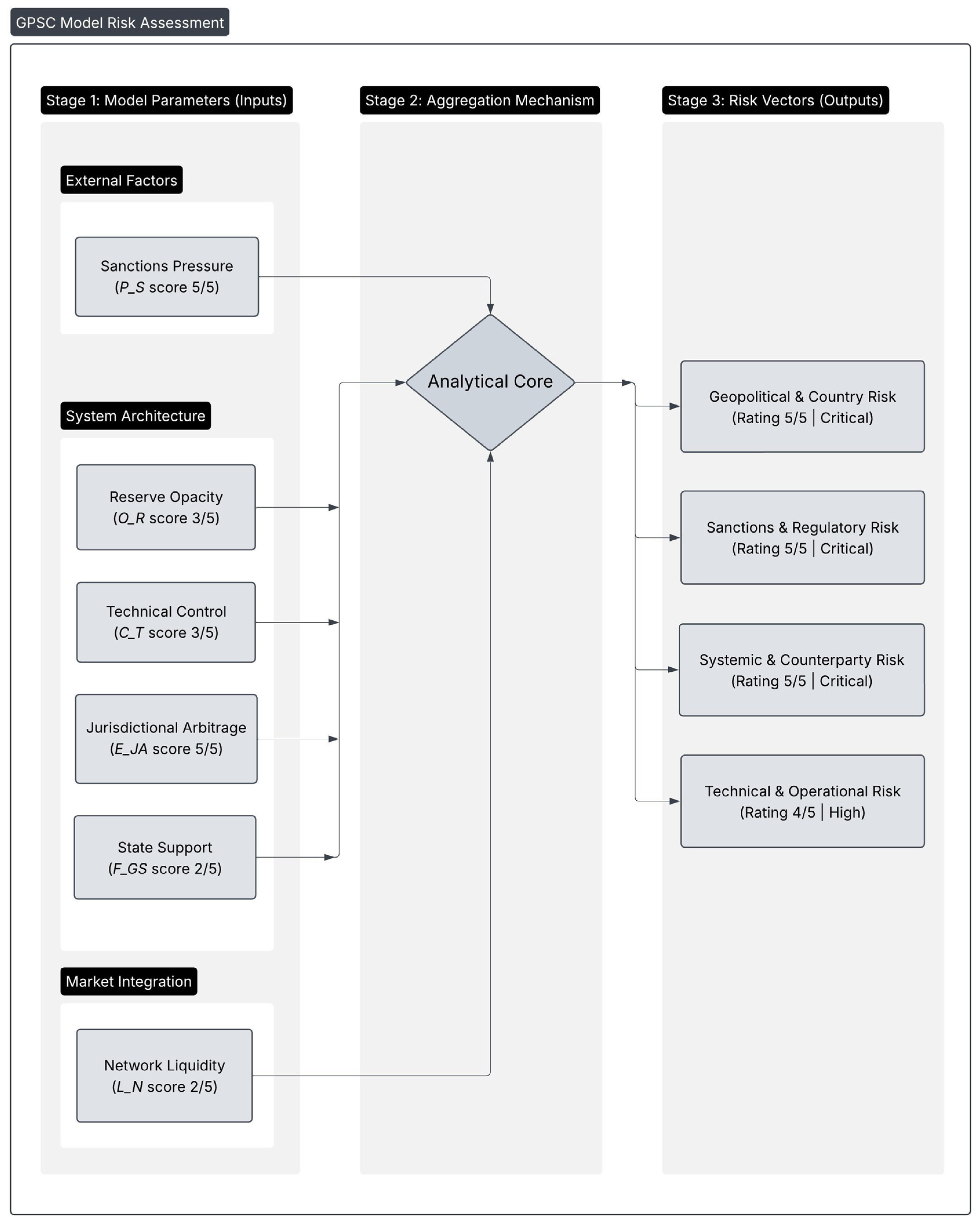
The synthesis of the results of the analysis allows for a direct comparison of architectural features and their corresponding risk profiles (risk vectors). Application of the GPSC model (Figure 1) clearly shows the fundamental differences between the GPSC systems under study, as reflected in Table 1.
Note: Figure 1 shows the Alpha system scoring based on the GPSC model. The figure outlines the conceptual design of a three-stage flowchart, visualizing a risk aggregation model. Stage 1 represents the fundamental inputs for the model: External Factors [Sanctions Pressure ( P _ S )]; System Architecture [Reserve Opacity ( O _ R ); Jurisdictional Arbitrage ( E _ J A ); State Support ( F _ G S ); Technical Control ( C _ T )]; Market Integration (Network Liquidity ( L _ N )]. Stage 2 represents the processing of the inputs. Stage 3 displays the aggregated results of the analysis (Geopolitical & Country Risk; Sanctions & Regulatory Risk; Systemic & Counterparty Risk; Technical & Operational Risk). The object of evaluation in this model is the architecture of the stablecoin system, which is assessed for its resilience to geopolitical and regulatory risks. The model’s users are regulators, analysts, and researchers, who use it to diagnose systemic vulnerabilities and forecast risks. The input parameters (Stage 1) reflect the specifics of a specific stablecoin system, and the output risk vectors (Stage 3) provide a structured assessment for decision-making. It should be noted that the model is diagnostic in nature and does not imply a moral or legal assessment of the system. In the GPSC model, the User ( A _ U ) is at the end of the value chain.
The liquidity flow is initiated by the State Actor ( A _ S ), which provides access to the Custodian’s ( A _ C ) banking infrastructure. The Issuer ( A _ I ), taking advantage of jurisdictional arbitrage, converts fiat reserves into digital tokens, which are then distributed through the Distribution Network ( A _ D ). The flow direction is interpreted as follows:
Institutional flow: Vector from A _ S to A _ C , ensuring legitimacy and access;
Technological flow: Vector from A _ C to A _ I (reserve confirmation and token minting);
Market flow: Vector from A _ I through A _ D to A _ U (liquidity distribution);
Feedback flow (risks): Vectors from external factors ( P _ S ) to all system components, requiring an adaptive response through changes in parameters O _ R and C _ T .
A detailed description of the GPSC model and risk assessment is provided in Appendix A.7, Appendix A.8, Appendix A.9, and Appendix B Table A5.
The table data shows that the successful models (the Alpha System and the Tango System) represent two different strategies for achieving sustainability. The Alpha System relies on maximizing administrative resources ( F _ G S , C _ T ), while the Tango System relies on market factors ( L _ N , E _ J A ). The Papa System failed due to a lack of network liquidity ( L _ N ), which is a necessary condition for the functioning of any stablecoin.
We classify stablecoin risks into two categories to account for their dynamic nature (Table 2):
  • Intrinsic (Endogenous) Risks: Inherently linked to the system’s design (e.g., O _ R or C _ T ).
  • Emergent (Ex-post) Risks: Arising from the interaction between the system’s scale and its environment (e.g., regulatory shifts or liquidity attacks).
The key conclusion of this comparison is that the nature of risks in the implementation of these two systems is fundamentally different. In the Alpha System, risks are systemic and intentional—they are built into the architecture as necessary elements for achieving operational resilience in isolation. In the Tango System, risks are incidental and scale-dependent—they arise because of its global, spontaneous, and uncontrolled spread.
These two systems can be viewed as two alternative evolutionary paths for the development of financial systems in the context of fragmentation. The Alpha System architecture implements the circulation of a quasi-state asset, which represents the circulation of a “sovereign” or “Balkanized” token, where tokenomics is aimed at creating an autarkic, transactionally self-sufficient financial ecosystem. The Tango System architecture, by contrast, implements a commercial asset, which represents the circulation of a “transnational” token without any state (non-state) involvement, where tokenomics forms the settlement layer and functions at a global, supranational level, and between disparate national jurisdictions.

4. Discussion

4.1. Implications for Global Financial Regulation and Stability

The passing of the GENIUS Act, in July 2025, created a qualitatively new landscape for the emergent risks of stablecoins. For commercial systems like Tango, this law acts as a catalyst for “regulatory squeeze”, requiring issuers to disclose their reserve structure and comply with the FATF Travel Rule, undermining their traditional advantages in jurisdictional arbitrage. Conversely, for quasi-governmental systems like Alpha, this act validates the strategy of architectural isolation: Increasing federal oversight in the US makes intrinsic opacity ( O _ R = 5) a prerequisite for protection from extraterritorial sanctions and asset confiscation. Thus, regulatory pressure generates a dynamic feedback loop, leading to a polarization of architectural models into “fully transparent” and “intentionally isolated”.
The dynamic between Alpha-type systems and global regulation creates regulatory feedback loops. Because tools like the GENIUS Act strengthen the ‘regulated perimeter,’ sanctioned actors shift liquidity to P2P and OTC networks. These decentralized distribution networks ( A _ D ) are not marginal; they process over $4 trillion in volume annually as of 2025, serving as the critical transactional layer for geopolitical arbitrage.
The results obtained allow us to rethink the models under study not in terms of violation or compliance, but as different forms of adaptation to a fragmented global financial environment. The Alpha System architecture, with its centralized control and jurisdictional isolation, is a rational response to the need for cross-border solvency in the face of external pressure. Synchronization between national financial institutions and offshore structures ensures a closed circulation loop resilient to external shocks.
Stablecoins are becoming a dominant tool in P2P networks and over-the-counter trading, especially in jurisdictions with strict currency controls and sanctions. P2P and OTC platforms form the core of the “Distribution Network” ( A _ D ) in the GPSC model. They provide network liquidity ( L _ N ), bypassing centralized exchanges subject to sanctions compliance. In particular, research by TRM Labs shows that the use of USDT in Tron networks for P2P transfers in developing countries has reached record volumes, exceeding traditional banking transactions. Further evidence of the effectiveness of the Alpha model’s architectural solutions is the wAlpha token incident on Uniswap in August 2025. This incident confirms that a high level of technical control ( C _ T ) in isolated systems is transforming from a vulnerability into a crisis management tool. Unlike decentralized algorithmic stablecoins (like Terra/Luna), which collapse in a “death spiral”, GPSC’s quasi-government model uses centralization to “cut off” external shocks.
The use of the Tango System in environments with weakened oversight should also be interpreted not as a deliberate violation, but as a rational response by economic agents to institutional barriers. Data from analytical companies [32] shows that significant transaction volumes are processed through P2P platforms and OTC platforms in jurisdictions with weakened compliance controls. This behavior is motivated by a desire for operational resilience in places where traditional financial instruments are unavailable or ineffective [23,24]. The effectiveness of such restrictions has been a subject of extensive academic debate [25,26].
Despite architectural differences, both models serve a similar function: They reduce dependence on traditional centralized intermediaries and create alternative channels for value transfer. This confirms the findings of international organizations such as the FATF [27] that, in conditions of regulatory fragmentation, financial innovation often emerges at the interface between formal and informal systems.
This poses a significant challenge for global regulators. Regulatory frameworks such as MiCA and the GENIUS Act are designed to integrate stablecoins into the traditional financial system through requirements for reserve transparency, issuer licensing, and entry/exit control (on/off ramps). This approach may be effective for regulating Tango-type systems, as it allows for a stronger regulatory perimeter. However, it is inapplicable to closed, self-contained systems such as Alpha, which are designed from the outset to operate outside the reach of such regulatory regimes.

4.2. Literature Gaps and Open Research Paths

The presented research with a developed GPSC model is positioned at the intersection of several academic fields—financial regulation, geoeconomics, and monetary systems theory—and addresses existing gaps in the literature. As noted in the Introduction, existing works predominantly focus on either the macroeconomic impact of stablecoins on traditional finance [29,30] or their technical design and risks in the context of developed, transparent markets [20,31]. This paper identifies and addresses four key conceptual gaps.
The current literature is dominated by an “integration” approach to regulation. Studies analyzing the European MiCA regulation or US legislative initiatives [19,28] view stablecoins as an asset class that must be integrated into the existing regulatory perimeter to prevent arbitrage. Our study shows that this approach is ineffective for analyzing Alpha-type systems, which are architecturally designed to operate outside this perimeter, leveraging the “financialization” of digital technologies to create autonomous circuits [21]. The GPSC model offers a diagnostic tool for assessing the operational resilience of such systems, shifting the focus from assessing their compliance, which is inherently lacking.
Studies of the geopolitics of digital currencies [23] often construct a binary opposition between state-backed digital currencies (CBDCs) and private global stablecoins (such as Tango). The BIS concept of a “Unified Ledger” also presupposes centralized coordination [30]. Our analysis reveals a third, hybrid model ignored in this dichotomy: A “quasi-sovereign asset” (Alpha) that combines state backing ( A _ S , A _ C ) with the flexibility of an offshore commercial issuer ( A _ I ). This architecture represents a form of “geoeconomic guerrilla warfare” [33] that has thus far remained outside the focus of detailed academic analysis, despite growing evidence of crypto-asset use in sanctioned environments [34].
Stablecoin risks are often discussed as a homogeneous category. This paper contributes by differentiating the nature of risk. Drawing on historical parallels with “wild banks” [31] and empirical evidence on Tango reserves, we show that the risks of Tango-type systems are emergent properties of scale and market structure. Meanwhile, the risks of Alpha-type systems (opacity ( O _ R ), centralization ( C _ T ) are intentional and functional elements of protection against external pressure. This distinction requires fundamentally different regulatory responses.
Although challenges faced by state-driven digital projects like Papa have been noted in [35], they are infrequently examined from the perspective of insufficient market infrastructure when contrasted with more successful examples. Our comparative analysis allowed us to formalize the role of “Network Liquidity” ( L _ N ) and “Jurisdictional Arbitrage” ( E _ J A ) as critical survival factors. The failure of the Papa system occurred precisely due to the lack of effective arbitrage ( E _ J A   ≈ 1) and liquidity, despite maximum state support ( F _ G S ), which refutes the hypothesis of the self-sufficiency of administrative resources.
The central hypothesis of this study—the transformation of traditionally vulnerable parameters (the opacity of reserves O _ R and centralized control C _ T ) into functional elements of operational resilience under high sanctions pressure ( P _ S )—requires a clear distinction between the levels of analysis. The statement is purely descriptive: It captures the architectural pattern observed under exogenous institutional shocks, rather than asserting the desirability of such characteristics from a financial stability perspective. The empirical basis of the hypothesis is supported by data on the preservation of operational continuity of systems with high O _ R under sanctions [29] and the wAlpha depegging incident (August 2025), where high C _ T allowed the issuer to stabilize the system through centralized intervention. However, the hypothesis has strict applicability limits: It applies to short-term operational resilience (the ability to function under pressure), but not to long-term financial stability, where the opacity of reserves creates systemic risks of “bank runs” [31]. The key difference between our approach and critical positions in the literature lies in the level of analysis: Works in the “wild stablecoin” tradition assess O _ R and C _ T as vulnerabilities in the context of integration into the global financial system, whereas our model analyzes the same parameters in the context of architectural isolation from it. This is not a contradiction, but a complementarity: the same parameter can simultaneously be a vulnerability to integration and a condition for survival in isolation, confirming the need for a context-specific, rather than universal, assessment of architectural decisions.
This research opens several promising avenues. First, quantitative analysis (large-N studies) is needed to test the GPSC model’s correlations, in particular the hypothesis regarding the compensatory role of government support ( F _ G S ) in the absence of natural liquidity. Second, the role of “intermediary jurisdictions” that provide the infrastructure for regulatory arbitrage, as noted in the FATF reports [27], requires a critical examination. Third, the phenomenon of “Balkanization” of payment systems should be explored: how closed-loop systems like “Alpha” will interact with or compete with emerging supranational projects such as mBridge or the digital yuan.

5. Conclusions

Before drawing final conclusions, it is necessary to clearly distinguish between the two levels of analysis presented in this paper. The first level—diagnostic—was implemented using the GPSC model and applied to the three case studies (Alpha, Tango, and Papa). At this level, the model serves a purely descriptive function: It systematizes the architectural components of stablecoins, measures their parameters, and identifies risk profiles without assessing the legitimacy of the systems or prescribing any regulatory measures. The second level—interpretative—represents hypothetical (potentially possible) scenarios that can be derived from the diagnostic results. These scenarios are formulated in the following conditional form: “If the regulatory goal is X, then the architectural features of system Y make instrument Z more or less effective.” This formulation preserves the scientific neutrality of the proposed model while demonstrating its practical applicability for the development of regulatory and other policies. The main conclusions of our study are presented strictly adhering to the logic described above.
This study demonstrates that, in the context of geopolitical fragmentation, stablecoins are evolving from simple payment instruments into key elements of alternative settlement infrastructures. A comparative analysis reveals two fundamentally different architectural models: An institutionally coordinated closed-loop system and a decentralized, market-oriented global network.
The developed GPSC model and comparative risk matrix allow us to differentiate the vulnerabilities of each system. In the case of quasi-governmental models, the risks are intentional and systemic, forming part of the architectural design. In the case of global commercial stablecoins, the risks are a side effect of their scale and contextual use.
This distinction has direct implications for regulatory policy, which must shift from universal prohibitive measures to a differentiated approach:
Regarding quasi-governmental systems (such as Alpha): Direct financial regulation, along the lines of MiCA or the GENIUS Act [3], is ineffective. The most effective strategy is targeted interventions against the system’s architectural vulnerabilities identified by the GPSC model. This includes applying diplomatic and economic pressure on third-party jurisdictions where issuers ( A _ I ) are located, with the goal of severing ties between key ecosystem components.
Regarding global commercial systems (such as Tango): Banning such systems is impractical and could harm legitimate users. A more effective approach is to strengthen controls at the interface between regulated and unregulated environments. This includes mandatory application of the FATF ‘Travel Rule’ [35], strict KYC/AML requirements for all centralized exchanges and P2P platforms, and monitoring of OTC flows.
These findings highlight the need to adapt regulatory strategies to the architectural features of digital assets. Promising areas for further research include quantitative analysis of the resilience of such systems to external shocks and exploring the role of fully regulated forms of tokenized assets as a legitimate alternative for providing cross-border liquidity.
This research may be constrained due to its reliance on a small number of case studies ( N = 3) and an emphasis on assessing resilience instead of broader normative policies, which could affect the applicability and generalizability of results across different categories of digital assets. Subsequent studies should investigate the impact of stablecoin adoption on current account flows and currency transfers between Emerging Market and Developing Economies (EMDEs). Specifically, the role of stablecoins in facilitating ‘digital dollarization’ and its effect on national monetary sovereignty requires quantitative modeling using on-chain data triangulation.

Author Contributions

A.V.—Conceptualization, methodology, writing—original draft, formal analysis, writing—review and editing, data curation, investigation, visualization; A.E.—formal analysis, investigation, visualization, writing—review and editing; A.M.K.—methodology, validation, supervision, writing—review and editing. All authors have read and agreed to the published version of the manuscript.

Funding

This research received no external funding.

Institutional Review Board Statement

Not applicable.

Informed Consent Statement

Not applicable.

Data Availability Statement

The on-chain analysis data used in this study is publicly available. Other data sources, links to specific transactions, and reports from analytical platforms are available upon reasonable request to the corresponding author.

Conflicts of Interest

The authors declare no conflicts of interest. The authors have no financial, legal, or other ties to, and have not received funding from, the organizations mentioned in this study.

Abbreviations

The following abbreviations are used in this manuscript:
GPSC modelGeopolitical Stablecoin model
MiCAMarkets in Crypto-Assets Regulation
AML/KYCAnti-Money Laundering/Know Your Customer
FATFFinancial Action Task Force
CBDCCentral Bank Digital Currency
QCAQualitative Comparative Analysis
OTCOver-the-Counter
P2PPeer-to-Peer
GENIUS ActGuidance and Establishing National Innovation for United States Stablecoins Act
DeFiDecentralized Finance
CEXCentralized Exchange
DEXDecentralized Exchange
A _ S State Actor
A _ C Custodian
A _ I Issuer
A _ D Distribution Network
A _ U User Base
P _ S Pressure of Sanctions
O _ R Reserve Opacity
E _ J A Effectiveness of Jurisdictional Arbitrage
L _ N Network Liquidity
F _ G S State Support Factor
C _ T Technical Control

Appendix A

Appendix A.1

The chosen method must be weighed against possible alternatives. For example, a single case study of the Alpha system would lack sufficient generalizability, while a statistical analysis on a large sample (large-N) would be subject to omitted variable bias and the inability to effectively measure critical but non-quantifiable concepts such as “state support” or “jurisdictional arbitration”. Thus, a qualitative comparative analysis allows for both the depth of individual case studies and the structured comparison necessary for theoretical inference.

Appendix A.2

The Alpha System. This case was chosen as the archetype of a “quasi-state-coordinated system”. It represents a centralized, institutionally embedded model, designed specifically to operate under sanctions restrictions. Key characteristics for analysis include a high degree of centralization and direct links to the state financial infrastructure through a banking organization. and the use of a foreign intermediary jurisdiction to minimize external pressure.
The Tango System. This case study is chosen as the archetype of a “global commercial asset with decentralized distribution”. It represents a bottom-up market model that thrives on regulatory arbitrage and network effects. Its key analytical characteristics are its enormous scale (market capitalization over $174 billion), multi-chain architecture, and its de facto role as a global liquidity standard in environments with weak regulatory oversight.
The Papa System. This case is included in the analysis as a critical “negative example” or “failed government initiative”. Its presence has methodological significance for the validation of the model. The Papa project pursued the same goal as the Alpha system but suffered a catastrophic failure. By comparing the Alpha and Papa Systems, one can identify the necessary conditions for a functioning government-backed system that the Papa System completely lacked: Market liquidity, user trust, and a functional infrastructure. This comparison helps counter simplistic explanations (e.g., “all government-backed stablecoins are doomed to fail”).

Appendix A.3

Theoretical Foundations of the Model Components

The GPSC model integrates concepts from network theory, institutional economics, and international political economy to create a coherent framework.
  • A _ S (State Actor). This component is based on theories of state-market relations and economic diplomacy. A _ S is an actor that shapes institutional constraints and opportunities.
  • A _ C (Custodian). This component is rooted in the theory of financial intermediation. A _ C is a critical bridge between the digital asset and the traditional banking system.
  • A _ I (Offshore Issuer). This component draws on the literature on regulatory arbitrage and offshore finance. An A _ I is a legal entity created to minimize exposure to adverse regulatory actions.
  • A _ D (Distribution Network). This component is based on network theory and market microstructure. A _ D is a collection of nodes (exchanges, OTC desks) that provide the crucial function of liquidity.
  • A _ U (User base). This component is based on theories of technology adoption and economic sociology. A _ U represents the demand side of the ecosystem, driven by specific needs (e.g., capital flight, trade settlements under sanctions).

Appendix A.4

Operationalization and Calibration of Model Parameters

Each of the six parameters (from P _ S to C _ T ) of the GPSC model is defined, measured using empirical indicators from the collected data, and scored on a semi-quantitative scale from 1 to 5. This transparency is necessary to ensure the replicability of the study. The process of operationalizing the parameters (Appendix B Table A2) forces rigorous definitions of terms. It shows that, for example, “government support” ( F _ G S ) is not simply a political statement, but a set of observable actions; providing access to a state custodian (banking organization), creating favorable legal regimes, and promoting the asset in state trading. This operationalization transforms the GPSC model from a descriptive typology into a genuine analytical tool.

Appendix A.5

A critical stress test for the system occurred in August 2025, when a crowdsale of a wrapped version of the token (“wAlpha”) on the decentralized exchange Uniswap resulted in its complete loss of pegging to the underlying asset (the timeline is presented in Appendix B Table A3). The issuer’s response was revealing: Support for the liquidity pool on the decentralized platform was terminated, and a centralized compensation program was launched for affected users based on a snapshot of the ledger taken at a specific point in time. This incident clearly demonstrated that, despite the presence of a DeFi-compatible shell, the system’s core remains completely centralized, and technical control ( C _ T ) is used as a key crisis management tool. (Note: Appendix B Table A4 provides a timeline of this incident.)

Appendix A.6

For reference: As of October 2025, the Tango token’s market capitalization exceeded $174 billion, making it a systemically important asset for the entire digital asset financial system. Its key architectural advantage is multi-chain issuance, particularly active use in networks with low transaction costs (such as Tron), making it the de facto standard for mass P2P settlements in developing countries and jurisdictions with currency restrictions or high inflation.

Appendix A.7

Model Validation Through Application to Cases

A step-by-step analysis of the application of the operationalized GPSC model to each of the three cases demonstrates its explanatory power.
Alpha System (high functionality). The GPSC model shows that the Alpha System scores highly on all necessary components. High sanctions pressure ( P _ S = 5) creates demand. High government support ( F _ G S = 5) and technical control ( C _ T = 5) ensure stability and governance. High jurisdictional arbitrage efficiency (use of a foreign jurisdiction) provides a protective barrier. The system is functional because all parameters are optimized to ensure resilience in its specific environment. The Uniswap de-pegging incident in August 2025 serves as an ideal empirical confirmation of the high C _ T (Technical control) parameter. During the incident, the issuer simply fixed the holders’ ledger at a specific point in time and compensated users for losses, which would be impossible in a truly decentralized system.
The Tango System (Adaptive Functionality). The GPSC model explains the stability of the Tango digital asset differently. It has a low F _ G S score (1), but maximum L _ N (5) and E _ J A (5) scores. Its stability stems not from government support, but from the market depth and its ability to exist across multiple jurisdictions and blockchains, making it a challenging target for any single regulator.
The Papa System serves as a crucial element of validation through falsification. The GPSC model accurately diagnoses the cause of its failure. Despite maximum government support ( F _ G S = 5) and high sanctions pressure ( P _ S = 5), it received near-zero scores on the L _ N (Network Liquidity) and E _ J A (Jurisdictional Arbitrage) parameters. There were no exchanges for its trading, and it was inextricably linked to a single, heavily sanctioned jurisdiction. The GPSC model predicts that a system with L _ N   ~ 0 will fail regardless of other factors. The empirical collapse of the Papa System confirms this key proposition of the model.
Applying the GPSC model reveals that the stability of these alternative financial systems is not static but dynamic, depending on their development trajectory. The parameters interact with each other. For example, high sanctions pressure ( P _ S ) is a double-edged sword: It simultaneously increases demand from the user base ( A _ U ) and increases operational risk for the distribution network ( A _ D ) and custodian ( A _ C ). A successful system, such as the Alpha System, is one that has found a dynamic equilibrium by using high government support ( F _ G S ) and technical controls ( C _ T ) to counter the risks posed by high P _ S . While the main manuscript notes that high P _ S “stimulates demand”, a deeper analysis reveals that sanctions also hinder the operations of exchanges and banks. Theoretically, high P _ S should reduce network liquidity ( L _ N ). In the case of the Alpha System, the negative impact of P _ S on L _ N was offset by a massive infusion of P _ S G . The state actor actively supported the distribution network (crypto exchange, etc.) and provided a sanctioned but operationally functional custodian (banking organization), creating a “sanction-proof bubble”. Thus, these systems are not simply static structures; they exist in a state of constant “risk homeostasis”, actively managing and rebalancing their parameters for survival.
For reference: as of October 2025, the Alpha token’s market capitalization reached $520 million, making it the largest non-dollar stablecoin in the world. The cumulative transaction volume, since its launch, has exceeded $51 billion, with daily volume exceeding $1 billion, demonstrating its systemic importance within its operating niche.

Appendix A.8

Construction of a Multi-Vector Risk Assessment Matrix

The logical process of aggregating the six parameters of the GPSC model into four risk vectors presented in Table 2 (Figure 1) of the main manuscript: Geopolitical, sanctions/regulatory, systemic/counterparty, and technical/operational. For example, the “Geopolitical and Country Risk” vector is a composite function of P _ S (Sanctions Pressure), F _ G S (State Support Factor), and E _ J A (Jurisdictional Arbitration Effectiveness). A system with high P _ S , high F _ G S from a sanctioned state, and low E _ J A (i.e., tied to a single jurisdiction) will have a critical geopolitical risk score.

Appendix A.9

Justification of Risk Assessment

The process of assigning a score in the risk matrix reveals the fundamentally different nature of risk in the two systems. For the Alpha System, risks are intentional and structural—features, not bugs, designed to ensure control and isolation. For the Tango System, they are emergent and systemic—by-products of its scale, decentralization, and regulatory ambiguity. This distinction is crucial for developing effective regulatory measures. Regulating the Alpha System requires addressing its structural vulnerabilities (the custodian), while regulating the Tango System requires managing its emergent properties (implementing KYC at the network’s edges).

Appendix B

Table A1. Case Selection Justification Matrix.
ParameterAlpha SystemTango SystemPapa System
Management modelQuasi-state, centralizedCommercial, marketState, forced
Provision mechanismDeposits in Russian rublesCash, cash equivalents, other assetsNominally—oil reserves
Regulatory statusUnder sanctions (USA, EU, UK)Regulatory uncertainty, jurisdictional arbitrationUnder sanctions (USA)
Main use caseCross-border B2B payments under restrictionsA global store of value and payment method in low-supervision environmentsForced use within the country
Scale (capitalization/volume)$520 million/>$51 billion (total)>$174 billion/>$3 trillion (daily volume)Close to zero
ResultSustainable (in its niche)Adaptive (globally)Failed
Table A2. Operationalization of GPSC model parameters.
ParameterDefinitionEmpirical IndicatorsData SourcesRating Scale (1–5)
P _ S  (Pressure of Sanctions)The intensity and scope of international sanctions targeting ecosystem actors or jurisdictions.Number of jurisdictions imposing sanctions (US, EU, UK); type of sanctions (blocking, sectoral); mentioned in official recommendations (OFAC, FATF).US Treasury press releases, EU official journal, FATF reports.1 = no sanctions; 3 = sanctions against individual users/secondary entities; 5 = direct blocking sanctions against key components ( A _ S ,   A _ C ,   A _ I ).
O _ R  (Opacity of Reserves)The extent to which the reserves held by the custodian ( A _ C ) are not independently audited by internationally recognized auditors.Presence/absence of regular certifications; level of detail of assurance reports; auditor reputation.Public statements of the issuer, reports of analytical agencies (Chainalysis).1 = full transparency, audited by the Big Four; 3 = occasional attestations from lesser-known firms; 5 = no independent confirmation of reserves.
E _ J A  (Efficiency of Jurisdictional Arbitration)The ability of the issuer ( A _ I ) to use the legal system of its jurisdiction to protect itself from external pressure (e.g., requests to freeze assets).Legal regime of the issuer’s jurisdiction of registration; existence of legal assistance agreements with hostile jurisdictions; law enforcement precedents.Legal analyses (FATF reports), public documents of the issuer.1 = registration in a highly cooperative jurisdiction (e.g., US/EU); 3 = registration in a neutral jurisdiction; 5 = registration in a jurisdiction that is systematically non-cooperative with external regulators.
L _ N  (Network Liquidity)Volume and availability of trading pairs within the distribution network ( A _ D ) .Order book depth on key exchanges; number of trading pairs with fiat currencies and other crypto assets; trading volumes on OTC and P2P platforms.Cryptocurrency exchange data, reports (Elliptic, Chainalysis), on-chain analytics.1 = low liquidity, not listed on major exchanges; 3 = liquidity on niche exchanges; 5 = high liquidity on global CEX, DEX, and OTC markets.
F _ G S  (State Support Factor)The degree of implicit or explicit support for the system by a state actor ( A _ S ).Use of the asset in government settlements; provision of access to government banking infrastructure; public statements by officials.Reports (TRM Labs, Chainalysis), official statements, news reports.1 = no support; 3 = implicit approval; 5 = direct integration into the state financial system.
C _ T  (Technical Control)The issuer’s ability to centrally manage the token (freeze accounts, issue/burn tokens, change the registry).The presence of blacklist or freeze functions in the smart contract; the degree of centralization of key management; precedents of issuer intervention.Smart contract analysis, technical documentation, public statements (e.g., in a Telegram channel).1 = no control (completely decentralized); 3 = ability to freeze accounts by court order; 5 = complete administrative control over the registry and transactions.
Table A3. Comparison of Alpha System Market Capitalization with Other Non-Dollar Stablecoins (October 2025).
StablecoinBindingMarket Capitalization
(USD Million)
Notes
Alpha TokenNational currency S520Increase from USD 146 million in August 2025
EURC (Euro Coin)Euro261Issuer—Circle
BRZ (Transfer)Brazilian real181
TRYB (BiLira)Turkish lira14
GYEN (GMO Trust)Japanese yen12
Table A4. Timeline of the wAlpha token per loss incident (August 2025).
Date and TimeEventConsequences
21 August 2025 (6:25 p.m.–6:40 p.m.)A large sale of wAlpha tokens on the decentralized exchange Uniswap from three wallets.The beginning of pressure on the price.
21 August 2025 (6:42 p.m.)The value of the wAlpha token plummeted to near zero on Uniswap.Complete loss of link to the underlying asset on a given platform.
22 August 2025 (12:15 p.m.)Official announcement from the system operator about the end of support for liquidity in the pool on Uniswap.Stop Losses for DEX Traders.
22 August 2025 (6:00 PM)Announcement of the compensation program for holders based on a registry snapshot taken as of 21 August 2025, 18:57:59.Demonstration of centralized control and an attempt to maintain trust within the core ecosystem.
Note: This incident confirms the thesis that centralization in geopolitically oriented stablecoins serves as a resilience resource rather than a point of failure, which distinguishes them from purely market-driven algorithmic models. The event demonstrated that, in the face of market shocks and declining liquidity in decentralized markets, the issuer’s ability to centrally manage the ledger (through snapshot mechanisms and compensation payments) allows for the operational continuity of the entire system to be maintained.
Table A5. Detailed risk assessment rationale for the Alpha and Tango Systems.
Risk VectorAlfa System (Quasi-State Model)Tango System (Commercial Model)
Geopolitical and country-specificCritical (5/5) Rationale:
  • Direct Link to Sanctioned Economy: The system’s operation is inextricably linked to the Russian financial system, which is under extensive international sanctions.
  • Dependence on Intermediary Jurisdiction: Using Kyrgyzstan as an issuer jurisdiction ( A _ I ) creates dependence on political and regulatory stability in that country. Any change in its policy towards tighter controls could paralyze the system.
  • Targeted Vulnerability: The system is designed to operate in an environment of geopolitical conflict, making it a direct target for further restrictive measures.
Average (3/5) Rationale:
  • Global distribution: Tango is used worldwide, reducing its dependence on the political situation in any one country.
  • Offshore registration: The issuer is registered in a jurisdiction with minimal geopolitical weight, reducing direct country risks.
  • Risk of use by sanctioned entities: Active use of Tango by sanctioned entities creates ongoing geopolitical tension and the risk of regulatory action by the US and its allies.
Sanctions and regulatoryCritical (5/5) Rationale:
  • Direct blocking sanctions: Key components of the ecosystem, including the custodian bank and related platforms, are under direct sanctions from the US, EU and UK.
  • Risk of secondary sanctions: Any interaction with the Alfa token carries a high risk of secondary sanctions for non-Russian entities and individuals.
  • Non-compliance with international standards: The system architecture is fundamentally incompatible with FATF requirements (e.g., Travel Rule) and future MiCA/GENIUS Act regulations.
High (4/5) Rationale:
  • No Direct Sanctions Against Issuer: Tether Limited is not currently under direct sanctions.
  • High Enforcement Risk: The use of Tango for sanctions evasion and money laundering schemes attracts close scrutiny from the US Treasury and the DOJ, creating an ongoing risk of regulatory action, including sanctions.
  • Regulatory Pressure: The issuer is under ongoing pressure to improve transparency and AML/KYC compliance, which may result in changes to its business model.
System and counterpartyCritical (5/5) Rationale:
  • Concentration Risk: Reserves are held in a single, sanctioned, government-owned bank. The collapse of this single counterparty would lead to a complete collapse of the system.
  • Opacity Risk: Reserves are not independently audited by an internationally recognized auditor, creating a fundamental risk for token holders ( O _ R is functionally high).
  • Control Risk: Extremely high concentration of control allows the issuer and infrastructure operator to unilaterally freeze assets and alter the ledger, as demonstrated in August 2025. This creates enormous counterparty risk for users.
High (4/5) Rationale:
  • Historical opacity of reserves: The transparency of Tango reserves has historically been a subject of controversy and litigation, which undermines confidence in the asset.
  • Risk of a “bank run”: In the event of a crisis of confidence, there is a systemic risk of a massive redemption of tokens, which could lead to a collapse, given that not all reserves may be highly liquid. This risk is systemic across the crypto economy.
  • Asset quality of reserves: The composition of reserves, including commercial paper and other less liquid assets, creates additional risk in times of market stress.
Technical and operationalHigh (4/5) Rationale:
  • Absolute control of the issuer: The issuer has completed technical control over users’ assets, including the ability to freeze and confiscate ( C _ T = 5).
  • Artificial pegging: Exchange rate stability is maintained not by market mechanisms, but by administrative control in a closed system.
  • Vulnerability of smart contracts: Like any digital asset, the system is vulnerable to hacking, although centralization reduces the attack vectors.
Average (3/5) Rationale:
  • Address Freezing Ability: The issuer retains the technical ability to freeze accounts, which is a centralized risk element, but uses it sparingly.
  • Market-Based Pegging: Price stability is primarily maintained by arbitrage market mechanisms rather than administrative intervention.
  • Multi-Chain Complexity: Existence on multiple blockchains increases resilience to single-chain failure, but also increases the complexity and potential risks associated with bridging between networks.
Table A6. Detailed calibration scale for GPSC model parameters.
Parameter (Designation)Score 1 (Minimum)Score 3 (Average)Score 5 (Maximum)
Sanctions Pressure ( P _ S )No restrictions; full integration into global networksSectoral sanctions; FATF monitoring without blockingDirect blocking sanctions against key components ( A _ S ,   A _ C )
Opacity of Reserves ( O _ R )Full audit by the Big Four firms; 1:1 transparency in real timePeriodic certifications by local firms; partial asset disclosureComplete lack of independent verification; hidden custodian structure
Jurisdictional Arbitration ( E _ J A )Registration in jurisdictions with strict compliance with international requirementsNeutral offshore zones with limited legal cooperationSystematic unwillingness of a jurisdiction to cooperate with regulators (safe haven)
Network Liquidity ( L _ N )No listing on major exchanges; low trading volumeLiquidity available on niche P2P networks and local OTC platformsGlobal presence on CEX, DEX, and leading OTC markets
Government Support Factor ( F _ G S )Lack of government interest or hostilityIndirect approval; use in limited pilot projectsDirect integration into government infrastructure and payment gateways
Technical Control ( C _ T )Full decentralization; no possibility of blocking or censorshipPossibility of freezing accounts by court order; availability of multisig schemesAbsolute control of the issuer over the registry; possibility of transaction rollback
Note: Using this scale allows us to evaluate why successful models (Alpha and Tango) show high optimization of specific parameters, while the Papa System failed due to zero indicators for L _ N and E _ J A , despite maximum government support.

References

  1. Mahrous, A.; Caprolu, M.; Di Pietro, R. Stablecoins: Fundamentals, Emerging Issues, and Open Challenges. arXiv 2025, arXiv:2507.13883. [Google Scholar] [CrossRef]
  2. ERC-20; ERC-20 Token Standard; ethereum.org; Ethereum Foundation, Zug, Switzerland. 2015. Available online: https://ethereum.org/developers/docs/standards/tokens/erc-20/ (accessed on 15 February 2026).
  3. GENIUS Act, Guiding and Establishing National Innovation for U.S. Stablecoins Act. U.S. Congress, 2025; Public Law No: 119-27. Available online: https://www.govinfo.gov/app/details/PLAW-119publ27 (accessed on 1 December 2025).
  4. Sarkar, S. Ethereum’s Role in the US Government’s New Stablecoin Architecture: A Detailed Analysis of Regulatory, Technical, and Economic Implications. SSRN 2025. [Google Scholar] [CrossRef]
  5. Wen, Y.; Chen, K. Stablecoin Architecture & Resilience Matrix (SARM): A Multi-Dimensional Framework for Assessing Digital Asset Stability. SSRN 2025. [Google Scholar] [CrossRef]
  6. Krause, D. Navigating Cryptocurrency Regulation: Stablecoins, Market Structure, and the Role of Centralized Entities in DeFi. SSRN 2025. [Google Scholar] [CrossRef]
  7. Zeng, J.S. An Organizational Law Theory of Stablecoins; University of Hong Kong Faculty of Law Research Paper No. 2025/22. SSRN 2025. [Google Scholar] [CrossRef]
  8. Naifar, N. Mapping Systemic Tail Risk in Crypto Markets: DeFi, Stablecoins, and Infrastructure Tokens. J. Risk Financ. Manag. 2025, 18, 329. [Google Scholar] [CrossRef]
  9. Anus, M.; Khan, M.A.; Ngadi, A.; Ramakrishnan, S. The GENIUS Act and Stablecoin Adoption in 2025: Legal, Computational, and Financial Stability Perspectives. SSRN 2025. [Google Scholar] [CrossRef]
  10. Shukanayev, D. Stablecoin Settlement Infrastructure: A Risk-Control Framework for Institutional Treasury Operations. SSRN 2025. [Google Scholar] [CrossRef]
  11. Chitraju, S. Digital Assets and Cryptocurrency Regulation: A Roadmap for Financial Stability. SSRN 2025. [Google Scholar] [CrossRef]
  12. Rahman, J.; Rahman, H.; Islam, N.; Tanchangya, T.; Ridwan, M.; Ali, M. Regulatory Landscape of Blockchain Assets: Analyzing the Drivers of NFT and Cryptocurrency Regulation. BenchCouncil Trans. Benchmarks Stand. Eval. 2025, 5, 100214. [Google Scholar] [CrossRef]
  13. Kanu, D.H. Regulation of Cryptocurrency and Its Implication for Financial Stability: A Qualitative Analysis. SSRN 2025. [Google Scholar] [CrossRef]
  14. Kochergin, D.A. Modern Tokenization of Money and Assets: Forms, Features and Prospects for Russia. Econ. J. HSE 2025, 29, 407–447. [Google Scholar] [CrossRef]
  15. Briola, A.; Vidal-Tomás, D.; Wang, Y.; Aste, T. Anatomy of a Stablecoin’s Failure: The Terra-Luna Case. Finance Res. Lett. 2023, 51, 103358. [Google Scholar] [CrossRef]
  16. Sitnik, A.A. Use of Cryptocurrencies in Cross-Border Settlements: Problems and Prospects of Legal Regulation. Actual Probl. Russ. Law 2025, 20, 33–41. [Google Scholar] [CrossRef]
  17. de Carvalho, R.M.; Inácio, H.C.; Marques, R.P.F. From Instability to Regulation: A Systematic Literature Review on Stablecoins. Int. J. Digit. Account. Res. 2025, 25, 71–101. [Google Scholar] [CrossRef] [PubMed]
  18. Aldasoro, I.; Minesso, M.F.; Gambacorta, L.; Habib, M.M.; Cornelli, G. Stablecoins, Money Market Funds and Monetary Policy; ECB Working Paper Series No. 2987; European Central Bank: Frankfurt am Main, Germany, 2024; Available online: https://www.ecb.europa.eu/pub/pdf/scpwps/ecb.wp2987~1919e51abf.en.pdf (accessed on 1 December 2025).
  19. Ante, L.; Fiedler, I.; Willruth, J.M.; Steinmetz, F. A Systematic Literature Review of Empirical Research on Stablecoins. FinTech 2023, 2, 34–47. [Google Scholar] [CrossRef]
  20. Lyons, R.K.; Viswanath-Natraj, G. What Keeps Stablecoins Stable? J. Int. Money Financ. 2023, 131, 102777. [Google Scholar] [CrossRef]
  21. Arner, D.W.; Zetzsche, D.A.; Buckley, R.P.; Kirkwood, J. The Financialization of Crypto: Lessons from FTX and the Crypto Winter of 2022–2023; University of Hong Kong Faculty of Law Research Paper No. 2023/19; UNSW Law Research Paper No. 23-31; University of Hong Kong: Kowloon Tong, Hong Kong, 2023. [Google Scholar] [CrossRef]
  22. Kennedy, J.; Bryan, E.; Ploom, I.; Veebel, V. Russia’s Use of Crypto Schemes; RAND Corporation Commentary; RAND Corporation: Santa Monica, CA, USA, 2025; Available online: https://www.rand.org/pubs/commentary/2025/08/russias-use-of-crypto-schemes.html (accessed on 1 December 2025).
  23. Juma, J.M. The use of sanctions in enforcing international law: A shift to individual responsibility. SSRN 2023. [Google Scholar] [CrossRef]
  24. Morgan, T.C.; Syropoulos, C.; Yotov, Y.V. Economic Sanctions: Evolution, Consequences, and Challenges. J. Econ. Perspect. 2023, 37, 3–30. [Google Scholar] [CrossRef]
  25. Morgenroth, E. A Brief Review of the Effectiveness of Economic Sanctions; Institute of International and European Affairs (IIEA): Dublin, Ireland, 2023; Available online: https://www.iiea.com/briefings/a-brief-review-of-the-effectiveness-of-economic-sanctions (accessed on 1 December 2025).
  26. Pala, T. The Effectiveness of Economic Sanctions: A Literature Review. J. Lib. Int. Aff. 2021, 7, 187–199. [Google Scholar] [CrossRef]
  27. Financial Action Task Force (FATF). Status of Implementation of Recommendation 15 by FATF Members and Jurisdictions with Materially Important VASP Activity; FATF/OECD: Paris, France, 2024; Available online: https://www.fatf-gafi.org/en/publications/Virtualassets/VACG-Snapshot-Jurisdictions.html (accessed on 1 December 2025).
  28. Zetzsche, D.A.; Buckley, R.P.; Arner, D.W.; van Ek, M.C. Remaining Regulatory Challenges in Digital Finance and Crypto-Assets After MiCA; Study PE 740.083; European Parliament, Policy Department for Economic, Scientific and Quality of Life Policies: Brussels, Belgium, 2023; Available online: https://www.europarl.europa.eu/thinktank/en/document/IPOL_STU(2023)740083 (accessed on 1 December 2025).
  29. Aldasoro, I.; Aquilina, M.; Lewrick, U.; Lim, S.H. Stablecoin growth—Policy challenges and approached. BIS Bulletins No. 108. Bank for International Settlements. Basel, Switzerland. 2025. Available online: https://www.bis.org/publ/bisbull108.pdf (accessed on 1 December 2025).
  30. Bank for International Settlements (BIS). Blueprint for the Future Monetary System: Improving the Old, Enabling the New. Basel, Switzerland. 2023. Available online: https://www.bis.org/publ/arpdf/ar2023e3.htm (accessed on 1 December 2025).
  31. Gorton, G.B.; Zhang, J.Y. Taming Wildcat Stablecoins. Univ. Chicago Law Rev. 2023, 90, 909–971. Available online: https://lawreview.uchicago.edu/print-archive/taming-wildcat-stablecoins (accessed on 1 December 2025).
  32. Chainalysis Team. The 2024 Geography of Cryptocurrency Report; Chainalysis Inc.: New York, NY, USA, 2024; Available online: https://www.chainalysis.com (accessed on 1 December 2025).
  33. Demertzis, M.; Lipsky, J. The Geopolitics of Central Bank Digital Currencies. Intereconomics 2023, 58, 173–177. [Google Scholar] [CrossRef]
  34. Ante, L.; Fiedler, I.; Strehle, E. The Influence of Stablecoin Issuances on Cryptocurrency Markets. Finance Res. Lett. 2021, 41, 101867. [Google Scholar] [CrossRef]
  35. Financial Action Task Force (FATF). Best Practice on Travel Rule Supervision; FATF: Paris, France, 2025; Available online: https://www.fatf-gafi.org/content/dam/fatf-gafi/recommendations/Best-Practices-Travel-Rule-Supervision.pdf (accessed on 1 December 2025).
Figure 1. GPSC model: model parameters and risk vectors.
Fintech 05 00021 g001
Table 1. Parametric evaluation of stablecoin models based on the GPSC model.
Parameter (Designation)Alpha System
(Quasi-State Asset)
Tango System
(Commercial Asset)
The Papa System
(State Asset)
Pressure of Sanctions ( P _ S )5 (High)3 (Moderate)5 (High)
Opacity of Reserves ( O _ R )4 (High)3 (Moderate)5 (Extreme)
Effectiveness of Jurisdictional Arbitration ( E _ J A )4 (High)5 (High)1 (Missing)
Network Liquidity ( L _ N )3 (Limited)5 (Critical)1 (Missing)
State Support fFactor ( F _ G S )5 (High)1 (Low)5 (High)
Technical Control ( C _ T )5 (High)3 (Average)4 (High)
Note: The rating is based on a scale from 1 (minimum value) to 5 (maximum value) and is based on a qualitative analysis. A detailed calibration scale for the GPSC model parameters is presented in Appendix B Table A6 «Detailed calibration scale for GPSC model parameters».
Table 2. Comparative matrix of systemic risk profiles based on the GPSC model.
Risk LevelIntrinsic (Designed) RisksEmergent (Scale-Dependent) Risks
Alpha SystemStructural Opacity
Intentional lack of audit to prevent asset seizures
Liquidity Fragility
Vulnerability to coordinated attacks as TVL exceeds $500 M
Tango SystemCustodial Dependence
Reliance on offshore banking rails for reserve management
Regulatory Squeeze
Impact of the GENIUS Act forcing assets out of the ‘regulated perimeter’
Disclaimer/Publisher’s Note: The statements, opinions and data contained in all publications are solely those of the individual author(s) and contributor(s) and not of MDPI and/or the editor(s). MDPI and/or the editor(s) disclaim responsibility for any injury to people or property resulting from any ideas, methods, instructions or products referred to in the content.