

From Threat to Opportunity: Digital Infrastructure and Bank Adaptation to Cryptocurrency Cycles—Global Evidence

Abstract
1. Introduction
2. Theoretical Framework and Hypothesis Development
2.1. National Digital Infrastructure as a Binding Constraint
2.2. Cryptocurrency Markets as FinTech Innovation Shocks
2.3. Revenue Diversification and Credit Stability as Adaptation Indicators
2.4. Digital Infrastructure Heterogeneity and Threshold Mechanisms
2.5. Hypotheses Development
- Rationale. Regulatory limits on crypto exposures insulate core intermediation from valuation swings, preventing shifts in credit allocation [23].
- Rationale. Monetizing attention-driven demand requires digital distribution, platform integration, and scalable service delivery [13]. Where infrastructure is weak, innovation shocks cannot be operationalized into revenue.
- Rationale. Moderate uncertainty increases information search and service uptake, whereas instability elevates risk aversion, limiting customer engagement [21]. This prediction reflects a bounded attention mechanism consistent with behavioral and platform adoption theory.
3. Data and Empirical Strategy
3.1. Sample Construction and Data Sources
3.2. Empirical Strategy
3.3. Robustness and Identification
4. Results
4.1. Descriptive Patterns and Preliminary Diagnostics
4.2. Credit Stability in the FinTech–Crypto Environment
4.3. Temporal Heterogeneity and Fee-Based Adaptation
4.4. Platform-Banking Capacity and Fee-Based Adaptation
4.5. State-Dependent Fee Responses to Cryptocurrency Volatility
4.6. Robustness and Supplementary Analyses
5. Discussion
5.1. From Disruption to Complementarity: Infrastructure as Allocation Mechanism
5.2. Threshold Effects and Platform Based Intermediation
5.3. Attention Driven Adaptation and State Dependent FinTech Diffusion
5.4. Regional Heterogeneity and Mechanism Consistency
6. Conclusions
6.1. Synthesis of Findings
6.2. Theoretical Contribution
6.3. Implications for Policy and Practice
6.4. Limitations and Future Research
Funding
Institutional Review Board Statement
Informed Consent Statement
Data Availability Statement
Conflicts of Interest
Appendix A. Data and Diagnostics
Appendix A.1. Correlation Matrices

| Panel A: Bank–Year Correlations | ||||||
|---|---|---|---|---|---|---|
| (1) | (2) | (3) | (4) | (5) | (6) | |
| (1) Fee share (std.) | 1.000 | |||||
| (2) Loan-income growth (std., lag) | 0.000 | 1.000 | ||||
| (3) Fee share | 1.000 *** | 0.000 | 1.000 | |||
| (4) Loan-income growth (lag) | 0.004 | 0.289 *** | 0.004 | 1.000 | ||
| (5) Equity return | −0.014 | 0.008 | −0.014 | −0.002 | 1.000 | |
| (6) Digital exposure | 0.019 ** | 0.011 | 0.019 ** | 0.016 ** | 0.007 | 1.000 |
| Panel B: Country–Year Correlations | ||||||
| (1) | (2) | (3) | (4) | (5) | (6) | |
| (1) Bitcoin (BTC) | 1.000 | |||||
| (2) Ethereum (ETH) | 0.313 *** | 1.000 | ||||
| (3) Ripple (XRP) | 0.336 *** | 0.182 *** | 1.000 | |||
| (4) Binance Coin (BNB) | 0.110 | −0.019 | −0.398 *** | 1.000 | ||
| (5) Equity return | 0.906 *** | 0.521 *** | 0.313 *** | 0.402 *** | 1.000 | |
| (6) Digital exposure | 0.001 | 0.005 | 0.006 | 0.001 | 0.005 | 1.000 |
Appendix A.2. Variance Inflation Diagnostics
| Individual Coins | Composite Index | ||||||
|---|---|---|---|---|---|---|---|
| BTC | ETH | XRP | BNB | Exposure | Equity | Exposure | |
| VIF | 6.54 | 1.11 | 7.51 | 2.84 | 1.00 | 1.00 | 1.00 |
Appendix A.3. Panel Unit Root Diagnostics
| Variable | Test | Statistic | p-Value | Conclusion |
|---|---|---|---|---|
| Cryptocurrency returns | ||||
| Bitcoin (BTC) | Fisher-ADF | 22,147 | <0.001 | Stationary *** |
| Ethereum (ETH) | Fisher-ADF | 23,819 | <0.001 | Stationary *** |
| Ripple (XRP) | Fisher-ADF | 21,563 | <0.001 | Stationary *** |
| Binance Coin (BNB) | Fisher-ADF | 24,102 | <0.001 | Stationary *** |
| Composite (equal-weighted) | Fisher-ADF | 23,456 | <0.001 | Stationary *** |
| Banking outcomes | ||||
| Fee share | Fisher-ADF | 19,284 | <0.001 | Stationary *** |
| Return on assets (ROA) | Fisher-ADF | 18,761 | <0.001 | Stationary *** |
| Loan-income growth | Fisher-ADF | 21,392 | <0.001 | Stationary *** |
| Net interest margin (NIM) | Fisher-ADF | 20,145 | <0.001 | Stationary *** |
| Digital connectivity | ||||
| Internet users (% pop.) | Fisher-ADF | 17,892 | <0.001 | Stationary *** |
Appendix B. Heterogeneity and Robustness Checks
Appendix B.1. Digital Heterogeneity
| High-Digital Banks | Low-Digital Banks | ||||||
|---|---|---|---|---|---|---|---|
| Coin | Digital Proxy | β | SE | N | β | SE | N |
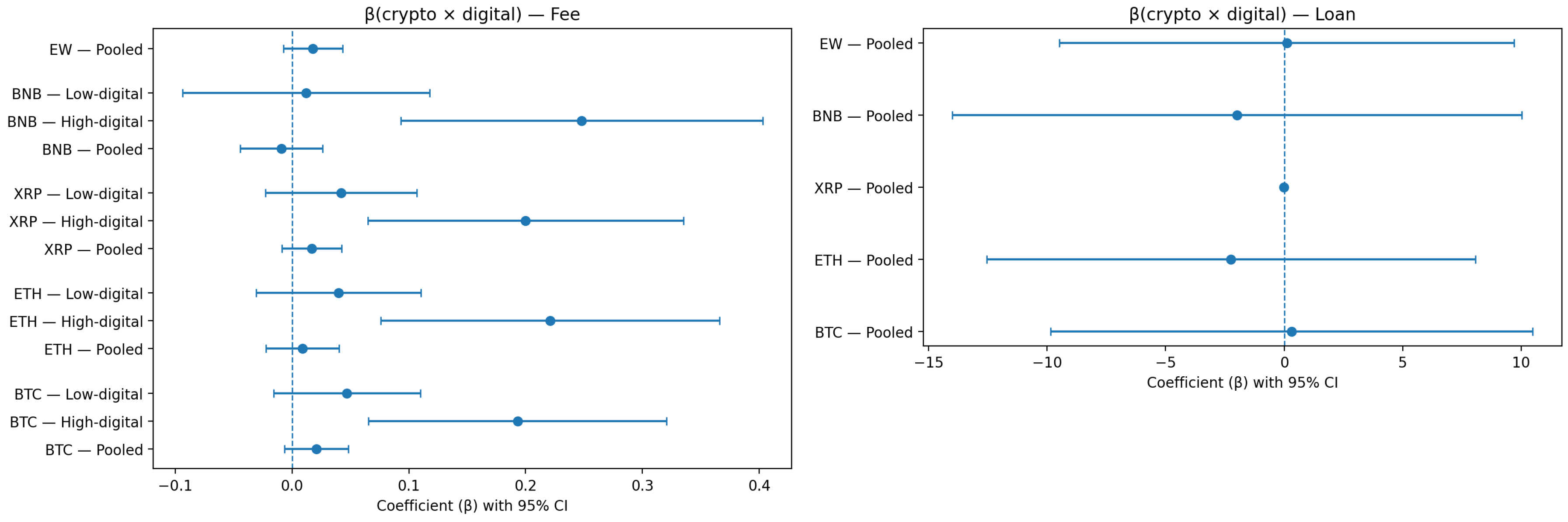
| BTC | Internet | 0.193 ** | 0.065 | 1891 | 0.047 | 0.032 | 3668 |
| ETH | Internet | 0.221 ** | 0.074 | 1795 | 0.040 | 0.036 | 3212 |
| XRP | Internet | 0.200 ** | 0.069 | 1891 | 0.042 | 0.033 | 3668 |
| BNB | Internet | 0.248 ** | 0.079 | 1457 | 0.012 | 0.054 | 2227 |
| BTC | Broadband | 0.131 | 0.076 | 1891 | −0.055 * | 0.025 | 3668 |
| ETH | Broadband | 0.136 | 0.076 | 1795 | −0.074 ** | 0.025 | 3212 |
| XRP | Broadband | 0.116 | 0.072 | 1891 | −0.061 ** | 0.024 | 3668 |
| BNB | Broadband | 0.149 * | 0.073 | 1457 | −0.104 *** | 0.026 | 2227 |
Appendix B.2. Geographic Heterogeneity
| Europe | Non-Europe | |||
|---|---|---|---|---|
| β | SE | β | SE | |
| Fee Share (t + 1) | 0.882 * | (0.526) | −0.225 | (0.724) |
| N (observations) | 3360 | 790 | ||
| N (banks) | 1343 | 161 | ||
Appendix B.3. Consolidated Robustness
| Fee Share (t) | Loan-Income Growth (t − 1) | ||||
|---|---|---|---|---|---|
| Specification | Coin | β | SE | β | SE |
| Panel A: Broadband penetration proxy | |||||
| BTC | 0.031 | (0.019) | 0.208 | (5.073) | |
| EW | 0.026 | (0.016) | 0.164 | (4.762) | |
| Panel B: Stricter winsorization (2.5–97.5 percent) | |||||
| BTC | −0.000135 | (0.000152) | 0.000446 * | (0.000241) | |
| EW | −0.000035 | (0.000036) | 0.000118 ** | (0.000054) | |
| Panel C: Excluding pandemic years (2020–2021) | |||||
| BTC | −0.000053 | (0.000178) | 0.000299 | (0.000295) | |
| EW | −0.000021 | (0.000041) | 0.000066 | (0.000065) | |
| Panel D: Wild-bootstrap inference (p-values) | |||||
| BTC | |||||
| EW | |||||
Appendix B.4. Extended Outcomes (ROA, NIM)
| β(ret × digital) Coefficient (SE) | |||||
|---|---|---|---|---|---|
| Coin | Digital | ROA (t) | Fee Share (t) | Loan-Income Growth (t − 1) | NIM (t) |
| Panel A: Broadband penetration | |||||
| BNB | Broadband | 0.0377 (0.0293) | −0.0001 (0.0001) | 0.0530 (0.0326) | 0.0000 (0.0000) |
| BTC | Broadband | 0.2074 (0.1512) | 0.0000 (0.0007) | 0.2019 (0.1902) | 0.0000 (0.0000) |
| ETH | Broadband | 0.0318 (0.0235) | −0.0001 (0.0001) | 0.0376 (0.0294) | 0.0000 (0.0000) |
| XRP | Broadband | 0.0082 (0.0059) | −0.0000 (0.0000) | 0.0094 (0.0076) | 0.0000 (0.0000) |
| Panel B: Internet penetration | |||||
| BNB | Internet | 0.0514 (0.0245) | −0.0000 (0.0001) | −0.0073 (0.0305) | 0.0000 (0.0000) |
| BTC | Internet | 0.1606 (0.1247) | 0.0004 (0.0006) | −0.0021 (0.1866) | −0.0000 (0.0000) |
| ETH | Internet | 0.0342 (0.0193) | 0.0000 (0.0001) | −0.0093 (0.0278) | −0.0000 (0.0000) |
| XRP | Internet | 0.0073 (0.0048) | 0.0000 (0.0000) | −0.0002 (0.0072) | 0.0000 (0.0000) |
Appendix B.5. Clustering Sensitivity
| Coin | Outcome | Clustering | SE | |
|---|---|---|---|---|
| BTC | Fee share (t) | Bank-only | −0.000124 | (0.000190) |
| Country–year (fallback) | −0.000124 | (0.000190) | ||
| Two-way | −0.000124 | (0.000155) | ||
| Loan-income growth (t − 1) | Bank-only | −0.000272 | (0.000315) | |
| Country–year (fallback) | −0.000272 | (0.000315) | ||
| Two-way | −0.000272 | (0.000252) | ||
| EW | Fee share (t) | Bank-only | −0.000033 | (0.000044) |
| Country–year (fallback) | −0.000033 | (0.000044) | ||
| Two-way | −0.000033 | (0.000036) | ||
| Loan-income growth (t − 1) | Bank-only | −0.000077 | (0.000072) | |
| Country–year (fallback) | −0.000077 | (0.000072) | ||
| Two-way | −0.000077 | (0.000057) |
Appendix B.6. Reconciliation: XRP Coefficient Across Sample Definitions
| Specification | SE | p-Value | N | |
|---|---|---|---|---|
| Pooled (full sample) | 0.0059 | 0.506 | 17,825 | |
| Global tercile splits: | ||||
| High connectivity | 0.0859 | 0.846 | 5811 | |
| Low connectivity | 0.0120 | 0.141 | 5961 | |
| Global quartile splits: | ||||
| Top quartile (Q4) | 0.0933 | 0.847 | 4371 | |
| Bottom quartile (Q1) | 0.0127 | 0.164 | 5321 | |
| Within-year tercile splits: | ||||
| High connectivity | 0.0177 | 0.336 | 5944 | |
| Low connectivity | 0.0118 | 0.202 | 5943 | |
Appendix B.7. Linear Trend Controls
| Coin | Outcome | SE | |
|---|---|---|---|
| BTC | Fee share (t) | (0.00015) | |
| BTC | Loan-income growth (t − 1) | (0.00025) | |
| EW | Fee share (t) | (0.00004) | |
| EW | Loan-income growth (t − 1) | (0.00006) |
References
- Gomber, P.; Kauffman, R.J.; Parker, C.; Weber, B.W. On the Fintech Revolution: Interpreting the Forces of Innovation, Disruption and Transformation in Financial Services. J. Manag. Inf. Syst. 2018, 35, 220–265. [Google Scholar] [CrossRef]
- Tankha, M.; Dalinghaus, U. Mapping the intermediate: Lived technologies of money and value. J. Cult. Econ. 2020, 13, 345–352. [Google Scholar] [CrossRef]
- Jafari, S.M.; Dinarvand, S.; Zand, M.; Hwang, Y.; Hwang, E. Identification and prioritization of artificial intelligence applications in FinTech. J. Econ. Stud. 2025, 1–18. [Google Scholar] [CrossRef]
- Nambisan, S. Digital entrepreneurship: Toward a digital technology perspective of entrepreneurship. Entrep. Theory Pract. 2017, 41, 1029–1055. [Google Scholar] [CrossRef]
- Verhoef, P.C.; Broekhuizen, T.; Bart, Y.; Bhattacharya, A.; Dong, J.Q.; Fabian, N.; Haenlein, M. Digital transformation: A multidisciplinary reflection and research agenda. J. Bus. Res. 2021, 122, 889–901. [Google Scholar] [CrossRef]
- Cornelli, G.; De Fiore, F.; Gambacorta, L.; Manea, C. Fintech vs. Bank Credit: How Do They React to Monetary Policy? BIS Working Paper 1157; Bank for International Settlements: Basel, Switzerland, 2023. [Google Scholar]
- Ojiako, U.; AlRaeesi, E.J.H.; Chipulu, M.; Marshall, A.; Bashir, H. Innovation readiness in public sector service delivery: An exploration. Prod. Plan. Control 2024, 35, 437–460. [Google Scholar] [CrossRef]
- Frost, J.; Gambacorta, L.; Huang, Y.; Shin, H.S.; Zbinden, P. BigTech and the changing structure of financial intermediation. Econ. Policy 2019, 34, 761–799. [Google Scholar] [CrossRef]
- Philippon, T. On Fintech and Financial Inclusion; Working Paper 26330; National Bureau of Economic Research: Cambridge, MA, USA, 2019. [Google Scholar] [CrossRef]
- Thakor, A.V. Fintech and banking: What do we know? J. Financ. Intermediat. 2020, 41, 100833. [Google Scholar] [CrossRef]
- Navaretti, G.B.; Calzolari, G.; Pozzolo, A.F. Fintech and Banking: Friends or Foes? European Economy: Brussels, Belgium, 2018; pp. 9–30. [Google Scholar]
- Vives, X. Digital Disruption in Banking. Annu. Rev. Financ. Econ. 2019, 11, 243–272. [Google Scholar] [CrossRef]
- Boot, A.; Hoffmann, P.; Laeven, L.; Ratnovski, L. Fintech: What’s old, what’s new? J. Financ. Stab. 2021, 53, 100836. [Google Scholar] [CrossRef]
- Gorton, G.; Pennacchi, G. Financial intermediation and the role of capital in credit markets. J. Financ. 1990, 45, 49–71. [Google Scholar] [CrossRef]
- Li, Z.; Yang, C.; Huang, Z. How does the fintech sector react to signals from central bank digital currencies? Financ. Res. Lett. 2022, 50, 103308. [Google Scholar] [CrossRef]
- Martens, W. Navigating Complexity: Uncovering the Intricate Dynamics Between Intellectual Capital, Efficiency, and Performance in Taiwan’s Banking Sector. Qeios 2024. [Google Scholar] [CrossRef]
- Martens, W. Economic Empowerment: Unveiling Asian Bank Performance Trends. Qeios 2024. [Google Scholar] [CrossRef]
- Beck, T. Fintech and Financial Inclusion: Opportunities and Pitfalls; Technical Report ADBI Working Paper 1165; Asian Development Bank Institute: Tokyo, Japan, 2020. [Google Scholar]
- BIS. Digitalisation of Finance; Technical Report; Bank for International Settlements: Basel, Switzerland, 2024. [Google Scholar]
- Da, Z.; Engelberg, J.; Gao, P. In search of attention. J. Financ. 2011, 66, 1461–1499. [Google Scholar] [CrossRef]
- Barber, B.M.; Odean, T. All that glitters: The effect of attention and news on the buying behavior of individual and institutional investors. Rev. Financ. Stud. 2008, 21, 785–818. [Google Scholar] [CrossRef]
- Joebges, H.; Herr, H.; Kellermann, C. Crypto assets as a threat to financial market stability. Eurasian Econ. Rev. 2025, 15, 473–502. [Google Scholar] [CrossRef]
- BIS. Report on the 2023 Banking Turmoil; BIS Report; Bank for International Settlements: Basel, Switzerland, 2023. [Google Scholar]
- Wątorek, M.; Skupień, M.; Kwapień, J.; Drożdż, S. Decomposing cryptocurrency high-frequency price dynamics into recurring and noisy components. Chaos Interdiscip. J. Nonlinear Sci. 2023, 33, 083146. [Google Scholar] [CrossRef]
- Aquilina, M.; Cornelli, G.; Frost, J.; Gambacorta, L. Cryptocurrencies and Decentralised Finance: Functions and Financial Stability Implications; BIS Papers No. 156; Bank for International Settlements: Basel, Switzerland, 2025. [Google Scholar]
- Yousaf, I.; Ali, S.; Bouri, E.; Saeed, T. Information transmission and hedging effectiveness for the pairs crude oil-gold and crude oil-Bitcoin during the COVID-19 outbreak. Econ. Res.-Ekon. Istraživanja 2022, 35, 1913–1934. [Google Scholar] [CrossRef]
- Conlon, T.; McGee, R. Safe haven or risky hazard? Bitcoin during the COVID-19 bear market. Financ. Res. Lett. 2020, 35, 101607. [Google Scholar] [CrossRef]
- Chan-Lau, J.A.; Quach, T.L. Cryptocurrencies and Banking Sector Connectedness: Don’t Worry, Be Happy … for Now; Technical Report WP/23-04; ASEAN+3 Macroeconomic Research Office: Singapore, 2023. [Google Scholar]
- Iyer, R.; Popescu, A. New Evidence on Spillovers Between Crypto Assets and Financial Markets; International Monetary Fund: Washington, DC, USA, 2023. [Google Scholar]
- Liu, J.; Julaiti, J.; Gou, S. Decomposing interconnectedness: A study of cryptocurrency spillover effects in global financial markets. Financ. Res. Lett. 2024, 61, 104950. [Google Scholar] [CrossRef]
- Zhu, K.; Guo, L. Financial technology, inclusive finance and bank performance. Financ. Res. Lett. 2024, 60, 104872. [Google Scholar] [CrossRef]
- Chiu, J.; Davoodalhosseini, M.; Jiang, J.; Zhu, Y. Bank Market Power and Central Bank Digital Currency: Theory and Quantitative Assessment; Staff Working Paper 2019-20; Bank of Canada: Ottawa, ON, Canada, 2019. [Google Scholar] [CrossRef]
- Keister, T.; Sanches, D.R. Stablecoins: Growth Potential and Impact on Banking; Technical Report; Board of Governors of the Federal Reserve System: Washington, DC, USA, 2022.
- Boot, A.W.A. The Future of Banking: From Scale & Scope Economies to FinTech. In European Economy—Banks, Regulation, and the Real Sector; Special Issue: FinTech and Banking: Friends or Foes? Associazione Centro Studi Luca d’Agliano: Torino, Italy, 2017. [Google Scholar]
- Benigno, G.; Rosa, C. The Bitcoin–Macro Disconnect; Staff Report 1052; Federal Reserve Bank of New York: New York, NY, USA, 2023. [Google Scholar]
- ITU. Global Connectivity Report 2022: Meeting the New Connectivity Challenge in the Decade of Action; Technical Report; International Telecommunication Union: Geneva, Switzerland, 2022. [Google Scholar]
- Röller, L.H.; Waverman, L. Telecommunications infrastructure and economic development: A simultaneous approach. Am. Econ. Rev. 2001, 91, 909–923. [Google Scholar] [CrossRef]
- Asongu, S.A.; Biekpe, N.; Cassimon, D. Understanding the greater diffusion of mobile money innovations in Africa. Telecommun. Policy 2020, 44, 102000. [Google Scholar] [CrossRef]
- Mohammed, A. Open Banking and APIs: Research on how open banking frameworks and APIs are reshaping the financial ecosystem. Int. J. Adv. Eng. Manag. 2024, 7, 770–784. [Google Scholar] [CrossRef]
- Begenau, J.; Bigio, S.; Majerovitz, J.; Vieyra, M. A q-theory of banks. Rev. Econ. Stud. 2026, 93, 106–143. [Google Scholar] [CrossRef]
- Makarov, I.; Schoar, A. Cryptocurrencies and decentralized finance (DeFi). Brookings Pap. Econ. Act. 2022, 2022, 141–215. [Google Scholar] [CrossRef]
- Ozili, P.K. Digital Finance, Green Finance and Social Finance: Is There a Link? Financ. Internet Q. 2021, 17, 1–7. [Google Scholar] [CrossRef]
- Asongu, S.; Odhiambo, N.M. Governance and renewable energy consumption in Sub-Saharan Africa. Int. J. Energy Sect. Manag. 2022, 16, 209–223. [Google Scholar] [CrossRef]

| Study | Context | Key Finding | Gap Addressed Here |
|---|---|---|---|
| Theoretical Foundations | |||
| [34] | Financial intermediation theory | Substitution vs. complementarity depends on informational rents | Tests infrastructure as the allocation mechanism |
| [9] | US cost efficiency | Digital innovation reduces intermediation costs | Shows cost gains require connectivity to translate into service adaptation |
| FinTech Adoption and Platform Banking | |||
| [6] | Global adoption | Digitally mature banks capture platform rents | Demonstrates threshold effects rather than smooth diffusion |
| [8] | BigTech entry | Platforms reshape payments and customer engagement | Shows similar dynamics emerge for banks once connectivity is high |
| [35] | US mortgage market | Banks adjust pricing amid competition | Identifies pricing shifts; we test service-revenue shifts |
| [16,40] | P2P lending | FinTech expands access but raises defaults | Focuses on credit; we focus on fee-based adaptation |
| Cryptocurrency and Banking Stability | |||
| [35] | Crypto–macro interactions | Crypto booms trigger minimal deposit flight | Shows insulation; we show selective revenue complementarity |
| [28] | ASEAN+3 banking | Limited systemic spillovers from crypto | Lacks heterogeneity by digital capability |
| [41] | Market structure | Concentration and manipulation in crypto trading | Examines markets; we examine incumbent bank response |
| Digital Infrastructure and Financial Development | |||
| [42] | Africa digital finance | Infrastructure and regulation drive uptake | Provides case evidence; we provide global threshold tests |
| [43] | ICT and inclusion | Internet penetration expands access | Focuses on inclusion; we examine incumbent service monetization |
| Europe (79.9%) | Europe (Cont.) | Asia–Pacific, Middle East & Other (20.1%) | ||||||
|---|---|---|---|---|---|---|---|---|
| Country | Banks | % | Country | Banks | % | Country | Banks | % |
| Croatia | 13 | 0.7 | Italy | 150 | 7.6 | Australia | 14 | 0.7 |
| Czechia | 9 | 0.5 | Latvia | 1 | 0.1 | Hong Kong | 14 | 0.7 |
| Denmark | 28 | 1.4 | Lithuania | 4 | 0.2 | Korea, Rep. | 20 | 1.0 |
| Estonia | 1 | 0.1 | Norway | 33 | 1.7 | Malaysia | 12 | 0.6 |
| Finland | 21 | 1.1 | Portugal | 77 | 3.9 | Taiwan | 86 | 4.4 |
| France | 78 | 4.0 | Russia | 72 | 3.7 | Vietnam | 37 | 1.9 |
| Germany | 1063 | 54.1 | Slovenia | 9 | 0.5 | Bahrain | 13 | 0.7 |
| Greece | 7 | 0.4 | Spain | 45 | 2.3 | Israel | 6 | 0.3 |
| Ireland | 3 | 0.2 | Sweden | 67 | 3.4 | Jordan | 17 | 0.9 |
| Kuwait | 2 | 0.1 | ||||||
| Oman | 10 | 0.5 | ||||||
| Qatar | 7 | 0.4 | ||||||
| UAE | 22 | 1.1 | ||||||
| Canada | 24 | 1.2 | ||||||
| Total: 1964 banks across 32 countries (2014–2023) | ||||||||
| Panel A: Full Sample (2014–2023) | |||||
|---|---|---|---|---|---|
| Variable | N | Mean | SD | Min | Max |
| Banking outcomes | |||||
| Fee share (z-score) | 18,438 | 0.000 | 1.000 | 2.015 | |
| lending-revenue growth (z-score) | 16,204 | 0.000 | 1.000 | 0.641 | |
| Cryptocurrency returns | |||||
| Bitcoin (BTC) | 18,420 | 1.248 | 1.500 | ||
| Ethereum (ETH) | 16,578 | 0.447 | 0.750 | ||
| Ripple (XRP) | 18,420 | 0.033 | 0.542 | 0.667 | |
| Binance Coin (BNB) | 12,894 | 0.938 | 0.000 | ||
| Equal-weighted composite | 18,420 | 0.489 | 0.604 | ||
| Digital connectivity | |||||
| Internet users (% pop.) | 18,420 | 0.003 | 0.075 | 0.160 | |
| Panel B: By Market Regime (Standardized Outcomes) | |||||
| Variable | N | Mean | SD | Min | Max |
| Fee share (std.) | |||||
| Bust | 3249 | 0.009 | 0.351 | 0.934 | |
| Mid | 4642 | 0.002 | 0.347 | 0.934 | |
| Boom | 4600 | 0.007 | 0.330 | 0.934 | |
| lending-revenue growth (std.) | |||||
| Bust | 3256 | 0.344 | 0.641 | ||
| Mid | 4667 | 0.350 | 0.641 | ||
| Boom | 4754 | 0.412 | 0.641 | ||
| BTC | ETH | XRP | BNB | Composite (EW) | |
|---|---|---|---|---|---|
| Panel A: Fee share (t) | |||||
| Crypto × Internet | 0.021 | 0.009 | 0.017 | 0.018 | |
| (0.014) | (0.016) | (0.013) | (0.018) | (0.013) | |
| Panel B: Loan-Income Growth (t − 1) | |||||
| Crypto × Internet | 0.312 | 0.115 | |||
| (5.191) | (5.259) | (0.006) | (6.125) | (4.893) | |
| Fee Share (t) | Loan-Income Growth (t − 1) | ||||
|---|---|---|---|---|---|
| Panel/Specification | Regime | SE | SE | ||
| Panel A: Pooled Sample (2014–2023) | |||||
| Full sample | 0.006 | (0.006) | –0.003 | (0.006) | |
| Panel B: Temporal Heterogeneity | |||||
| 2014–2016 (Pre-Adoption Baseline) | 0.143 | (0.279) | 0.759 ** | (0.294) | |
| 2017–2019 (Early Adoption) | 0.002 | (0.010) | –0.007 | (0.010) | |
| 2020–2023 (Mature Period) | 0.058 | (0.510) | –0.005 | (1.095) | |
| Panel C: Volatility States | |||||
| Low volatility | 0.374 | (0.241) | 0.016 | (0.307) | |
| Mid volatility | 0.433 *** | (0.155) | 0.311 ** | (0.134) | |
| High volatility | 0.001 | (0.013) | –0.010 | (0.014) | |
| (1) | (2) | (3) | |
|---|---|---|---|
| Contemporaneous | Lagged Effect | GDP Control | |
| Variables | Fee Share (t) | Fee Share (t + 1) | Fee Share (t + 1) |
| Crypto (t) × Digital (t) | 0.004 | 0.024 ** | 0.021 ** |
| (0.40) | (2.38) | (2.16) | |
| Crypto (t) × GDP (t) | −0.010 | ||
| (−1.57) | |||
| Bank Fixed Effects | Yes | Yes | Yes |
| Year Fixed Effects | Yes | Yes | Yes |
| Observations | 18,420 | 17,685 | 17,685 |
| (Within) | 0.041 | 0.045 | 0.046 |
Disclaimer/Publisher’s Note: The statements, opinions and data contained in all publications are solely those of the individual author(s) and contributor(s) and not of MDPI and/or the editor(s). MDPI and/or the editor(s) disclaim responsibility for any injury to people or property resulting from any ideas, methods, instructions or products referred to in the content. |
© 2026 by the author. Licensee MDPI, Basel, Switzerland. This article is an open access article distributed under the terms and conditions of the Creative Commons Attribution (CC BY) license.
Share and Cite
Martens, W. From Threat to Opportunity: Digital Infrastructure and Bank Adaptation to Cryptocurrency Cycles—Global Evidence. FinTech 2026, 5, 20. https://doi.org/10.3390/fintech5010020
Martens W. From Threat to Opportunity: Digital Infrastructure and Bank Adaptation to Cryptocurrency Cycles—Global Evidence. FinTech. 2026; 5(1):20. https://doi.org/10.3390/fintech5010020
Chicago/Turabian StyleMartens, Wil. 2026. "From Threat to Opportunity: Digital Infrastructure and Bank Adaptation to Cryptocurrency Cycles—Global Evidence" FinTech 5, no. 1: 20. https://doi.org/10.3390/fintech5010020
APA StyleMartens, W. (2026). From Threat to Opportunity: Digital Infrastructure and Bank Adaptation to Cryptocurrency Cycles—Global Evidence. FinTech, 5(1), 20. https://doi.org/10.3390/fintech5010020