Article

Effect of Tomato Seed Vigor on the Early Competition with Green Foxtail (Setaria viridis) and Jimsonweed (Datura stramonium)


Laboratory of Weed Science, BenakiPhytopathological Institute, S. Delta 8, 14561 Athens, Greece
*
Author to whom correspondence should be addressed.
Seeds 2026, 5(3), 33; https://doi.org/10.3390/seeds5030033
Submission received: 28 April 2026 / Revised: 5 June 2026 / Accepted: 8 June 2026 / Published: 12 June 2026

Abstract

Direct-seeded industrial tomato (Solanum lycopersicum L.) systems are highly vulnerable to early-season interference, yet the role of seed vigor as a competitive determinant remains under-quantified. This study evaluated the performance of high-vigor (HV; 91% germination) and accelerated-aged low-vigor (LV; 60% germination) tomato seeds against two weeds: green foxtail (Setaria viridis) and jimsonweed (Datura stramonium). While mean emergence timing was statistically comparable between HV and LV cohorts (6.0 vs. 7.2 days), LV seedlings entered the post-emergence phase with a numerical deficit in initial seedling dry weight (7.1 mg vs. 8.5 mg for HV; difference not statistically significant), suggesting a potential early competitive disadvantage. In replacement series experiments, HV tomatoes maintained stable leaf and root biomass within the 0.76–1.24 relative yield (RY) confidence interval when competing with jimsonweed. In contrast, LV plants were significantly suppressed at low weed proportions (25%), where root RY dipped below the 0.76 threshold. Against the aggressive below-ground strategy of S. viridis (which produced ~1200 mg of root mass by 40 DAE), LV tomato root RY collapsed to 0.10–0.15, whereas HV plants maintained significantly higher niche occupancy. Physical separation of above- and below-ground competition confirmed that HV seeds provide a “physiological buffer”; specifically, in below-ground treatments, HV plants achieved a root mass of 0.25 g/plant compared to only 0.15 g/plant for LV plants. These results identify seed vigor as a primary driver of the “priority effect” and suggest that high-vigor lots are essential for Integrated Weed Management (IWM) strategies to mitigate early-season resource pre-emption. These findings suggest that seed vigor assessment should be integrated into seed quality standards for direct-seeded tomato systems as a component of Integrated Weed Management. Future field-based studies are needed to validate these greenhouse findings under variable agronomic conditions.

1. Introduction

Industrial tomatoes (Solanum lycopersicum L.) are an important summer crop in the Mediterranean region. While transplantation remains the predominant method for ensuring industrial tomato crop uniformity and early maturity [1], direct seeding is an increasingly relevant alternative in modern sustainable systems. This method offers substantial economic benefits by reducing nursery and labor costs by up to 65%. Furthermore, direct seeding avoids the physiological setback of transplant shock, promoting a more balanced and deep-reaching taproot system that enhances drought resilience and nutrient acquisition. Despite these advantages, the success of direct-seeded systems is highly dependent on seed vigor, as rapid and uniform emergence is critical to mitigating the extended period of weed competition characteristic of this establishment method.
Seed vigor is a complex physiological trait encompassing multiple processes, including metabolic activity, reserve mobilization efficiency, and tolerance to environmental stresses during germination and emergence [2,3]. High-vigor seeds function as a critical biological buffer, ensuring that the crop can maintain a faster metabolic transition to photo-autotrophic growth. This “pioneer advantage” is a prerequisite for rapid canopy closure, which effectively suppresses weed growth before it can dominate the soil surface [3,4].
In industrial tomato (Solanum lycopersicum L.) systems, high-vigor seeds are perceived as essential for success, as they influence vegetative growth through four major components: percentage of emergence, relative time of emergence, and both pre- and post-emergent seedling growth [5]. High-vigor seed lots are typically associated with faster, more synchronous emergence and robust early growth, whereas low-vigor seeds often exhibit delayed and uneven emergence, leading to reduced seedling biomass and increased susceptibility to environmental stresses [5,6].
These differences in vigor have significant implications for field performance, as documented in crops like barley and wheat, where low seed vigor results in reduced germination and lower overall crop density [7,8,9]. Such establishment dynamics are critical in the context of crop–weed interactions, where even small delays in emergence can pivotally alter competitive outcomes [9,10]. The importance of emergence timing is well-established; early-emerging weeds gain a distinct “priority effect,” pre-empting resources and leading to substantial yield losses [11,12]. Conversely, crops that establish rapidly and uniformly can suppress competing weed flora through early canopy closure and efficient resource capture [13].
While using the highest possible seed vigor is a hallmark of commercial cultivars, its specific role as a determinant of competitive ability has received relatively limited attention in vegetable systems like tomato. Leveraging high-vigor seeds to positively modify crop–weed interference offers a promising, economically viable, and environmentally safe component for Integrated Weed Management (IWM) strategies [14,15]. However, as the influence of vigor on subsequent growth stages remains less clearly documented [5], there is a clear need to evaluate how these physiological traits specifically shape competitive success against different weed species.
To quantify these crop–weed interactions, experimental designs such as additive and replacement series are routinely employed. Replacement series designs, in particular, have been used extensively to characterize interference by analyzing the shape of yield curves relative to expected values [16,17,18].
Furthermore, the outcome of competition is strongly influenced by the distinct biological and ecological strategies of the competing weed species. Grass weeds, such as green foxtail (Setaria viridis L.), are characterized by rapid early growth and efficient light interception, exerting strong above-ground pressure. In contrast, broadleaf weeds, such as jimsonweed (Datura stramonium L.), often allocate greater biomass below-ground to enhance the acquisition of soil resources [19,20]. These two weed species were selected because they represent contrasting ecological strategies commonly encountered in direct-seeded tomato systems in the Mediterranean region: S. viridis as a dominant grass weed with aggressive above- and below-ground growth, and D. stramonium as a broadleaf weed with a distinct below-ground resource acquisition strategy. These contrasting strategies suggest that the interaction between crop seed vigor and specific weed traits may play a critical role in determining the final competitive balance.
Despite the value of separating above- and below-ground interactions to gain mechanistic insights [19,21], few studies have combined these techniques with vigor-controlled replacement series. Consequently, there is a clear need to understand how seed vigor influences resource competition during the critical early growth stages across different ecological strategies. Addressing this knowledge gap is essential for developing sustainable Integrated Weed Management (IWM) strategies that prioritize enhanced crop competitiveness over chemical inputs.
In the context of Integrated Weed Management (IWM), seed vigor is no longer viewed merely as a germination parameter but as a strategic cultural tool. High-vigor lots enhance the efficacy of other interventions, such as mechanical weeding, by providing a more robust and resilient crop stand that can withstand physical soil disturbances [4,22].
The overall objective of this study was to investigate the effect of tomato seed vigor on early competition with Setaria viridis and Datura stramonium. Specifically, we aimed to: (i) Characterize the germination and emergence dynamics of high- and low-vigor tomato seeds alongside the selected weed species; (ii) Quantify early growth differences among the crop and weeds; (iii) Evaluate competitive interactions using replacement series experiments; and (iv) Distinguish between the above- and below-ground components of competition.
We hypothesized that plants derived from high-vigor seeds would exhibit enhanced early growth and superior competitive ability compared to those from low-vigor seeds, particularly when facing interspecific competition from weeds with aggressive resource-acquisition strategies.

2. Materials and Methods

Experiments utilized a high-quality commercial tomato cv. “Cuore di Bue” (92% initial germination). Seeds of Datura stramonium and Setaria viridis were sourced from local populations and stored at 4 °C to maintain dormancy/viability. To generate the low-vigor (LV) treatment, a subset of high-vigor (HV) tomato seeds was subjected to accelerated aging at 42 °C and ~100% relative humidity for 72 h, following [23]. Preliminary experiments confirmed effective reduction in seed vigor through the accelerated aging treatment, as evidenced by the substantial decrease in germination percentage from 91% (HV) to 60% (LV). While additional physiological indicators such as electrical conductivity or seedling vigor index were not assessed, the magnitude of the germination difference (31 percentage points) was considered sufficient to establish two clearly distinct vigor categories for the purposes of this study.

2.1. Germination and Emergence Patterns

Germination was assessed under optimal laboratory conditions (Petri dishes, growth chamber) and represents the potential germination capacity of the seed lot. Emergence was assessed under simulated field conditions (soil substrate, greenhouse) and represents the actual seedling establishment under realistic growing conditions. Germination patterns were measured by placing seeds in Petri dishes, which were then sealed and placed in a growth chamber with light for 12 days, until no further germination was measured. Three replicates of 25 seeds per replication were used; the germination was measured daily for the whole period. Emergence patterns were measured by placing seeds in aluminum trays, filled with a mixture of 2:1:1 (soil, compost, perlite) at a precise depth (2 cm below soil surface), and then the trays were kept in a greenhouse [30/18 °C (±4 °C); day/night temperature] with natural sunlight. Three replicates of 25 seeds per replication were used; the emergence was measured daily for the whole period.
For germination and emergence patterns, the following characteristics were computed: [N: Total number of seeds and Ni: germinated seeds at the end of counting days, ni: germinated seeds per day and di: counting day].
Percent germination/emergence: PG = N/Ni ∗ 100; N;
Mean germination/emergence: MGT = Σni ∗ di/N; [24].
Germination time (T50, T90); GT = ti + (N/2 − ni) × (tj − ti)/(nj − ni); ni and nj are the cumulative number of seeds germinated by adjacent counts at time ti and tj, respectively, when ni < N/2 < nj [25].
Uniformity of germination/emergence U = (−T90 − T10).

2.1.1. General Experimental Conditions

For pot experiments, pots (15 cm deep and 11 cm in diameter) filled with soil (silt loam, 27% sand, 51% silt, 20% clay, 1.6% organic matter, and 6.8 pH) were used. Experiments were conducted in an unheated greenhouse [30/18 °C (±4 °C); day/night temperature] with natural sunlight (no extra light supplement was needed). This particular period of the study corresponds to the growing period of industrial tomato in Greece, where conditions (temperature, photoperiod) are optimal for the crop. Pots were well irrigated approximately twice a week with surface irrigation. Fertilization was performed twice during the whole duration of the experiment by applying 10 mL of liquid fertilizer per pot per time (Complesal 12N-12K-17P). In all experiments, seeds were carefully planted at a 2 cm depth to avoid variation in emergence time due to planting depth. Whenever thinning was required, it was done immediately after emergence to avoid any unwanted intra/inter competition.

2.1.2. Growth Analysis

Plant height was measured prior to harvest, which took place at 8, 16, 32 and 40 days after emergence (DAE). Plants were carefully uprooted from pots and separated into stem, leaves and roots. Root systems were gently placed in water-filled trays to facilitate thorough soil removal by tap water, maximizing root recovery. Leaf, stem and root dry weight were determined at each harvest across all treatments (oven-dried at 90 °C for 48 h). A randomized complete block design with four replications was used for all treatments.

2.1.3. Replacement Series

Treatments in the replacement series experiments were 4 to 0, 3 to 1, 2 to 2, 1 to 3, and 0 to 4 tomato seeds (either HV or LV seeds) to jimsonweed or green foxtail plants. Extra (3) seeds were planted in each pot and thinned to four per pot (equivalent to 421 plants m−2) soon after emergence. All plants were harvested at 40 DAP to determine height, leaf, stem, and root dry weight as previously described. Treatments were arranged in a randomized complete block design with four replications.
Relative yield (leaf, stem, roots) was measured according to the following equations [16]:
Relative yield (leaf, stem, roots) = (yield per pot of species in a mixture)/(yield per pot of species in a monoculture)
Total relative yield (leaf, stem, roots) = (Relative yield of species X) + (Relative yield of species Y)
Separation of above- and below-ground competition.
To distinguish the mechanisms driving interference, above- and below-ground competition were examined separately using physical barriers [21]. Vertical plastic dividers were inserted to limit below-ground interactions, whereas above-ground light competition was controlled through 30 cm tall opaque partitions, which were progressively raised to accommodate the rapid vertical growth of S. viridis. Each pot was initially sown with extra seeds (3 per species) and thinned shortly after emergence, retaining a final density of five plants per pot (one tomato and four weed plants), equivalent to 526 plants m−2. Plant height, leaf, stem, and root dry weight were assessed as previously described.

2.1.4. Statistical Analysis

All experiments were repeated twice, and the data represent the average of the two experiments since no experiment by treatment interaction was revealed.
In each experimental unit (pot), the leaf d.wt and the root d.wt. recorded for each vigor level (HV, LV) and weed species (DATST, SETVI) were the totals from all plants in that type in each pot. Data were analyzed as follows: the two vigor levels as a whole-plot factor, the cultivar-mixture proportion factorial as the split-plot factor, and the weed species (DATST, SETVI) as the split-split-plot factor. All data were subjected to analysis of variance (ANOVA) using SAS software version 9.4 (SAS Institute, Cary, NC, USA). Data were assumed to meet the requirements of normality and homogeneity of variance appropriate for ANOVA, as is standard practice for randomized complete block designs. Mean separations for germination and emergence parameters were performed using Fisher’s Protected Least Significant Difference (LSD) at the p = 0.05 level of significance. For the replacement series experiments, the methodology described by [16] was employed.
To determine statistical significance in the mixture treatments, 95% confidence intervals were calculated around the expected relative yield values (RY = 0.5, for 50:50 mixtures). Based on the pooled standard errors, upper and lower threshold values were established at 1.24 and 0.76, respectively. Actual yields falling outside this range were considered significantly different from the expected values (p < 0.05), indicating a significant competitive advantage or disadvantage for the species involved.
Means were separated by Least Significant Difference (LSD) at the 5% level. Separate analysis of variance was carried out for the 50:50 mixture data. Total yield values comparisons to the 1.0 were made using the following equation ([26]):
Cutoff = 1.0 ± (t* × standard error of the mean),
where t* = the two-sided critical value from the t-table with the degree of freedom (df) equal to the value associated with the term used as the error term in the F-test.

3. Results

3.1. Germination and Emergence

The two weed species exhibited relatively high germination and emergence rates, which is notable given that wild weed seeds often show lower viability compared to commercial seed lots. According to the laboratory results (Table 1), total germination for SETVI (69%) and DATST (59%) was comparable to that of LV tomato seeds (60%), while HV seeds reached a significantly higher 91%. While no significant differences were observed in mean germination time (MGT) across all treatments—ranging closely from 2.3 to 2.9 days—the LV tomato seeds exhibited a significantly higher T50 (3.5 days) and lower uniformity (−2.2 days) compared to the HV seeds (1.6 days and 3.8 days, respectively; Table 1). Among the weed samples, only D. stramonium (DATST) showed high emergence uniformity in the greenhouse, despite a lower total emergence of 49% (Table 2).
Regarding emergence patterns in the greenhouse (Table 2), no statistically significant differences were measured between HV and LV tomato seeds for mean emergence time (6.0 vs. 7.2 days), T50 (5.3 vs. 6.4 days), or uniformity (3.1 vs. 3.3 days). However, it is noteworthy that HV seeds showed a numerical trend toward faster and more synchronized emergence compared to LV seeds. A similar trend was observed in initial seedling growth, where HV seedlings reached a dry weight of 8.5 mg compared to 7.1 mg for LV; although this 1.4 mg difference reflects a higher growth potential for HV, it remained statistically non-significant within the LSD margin (2.7).
In contrast, the weed species demonstrated significant differences in mean emergence time (2.4–3.0 days) and T50 (2.7–3.7 days) when compared to both tomato vigor levels, highlighting a much faster emergence cycle for the weeds (Table 2). Notably, despite these sharp timing differences, seedling growth rates remained statistically similar across all species at the earliest stages, with dry weights ranging from 6.7 to 8.5 mg (Table 2), suggesting that initial biomass accumulation is relatively uniform once emergence occurs.

3.1.1. Growth Analysis

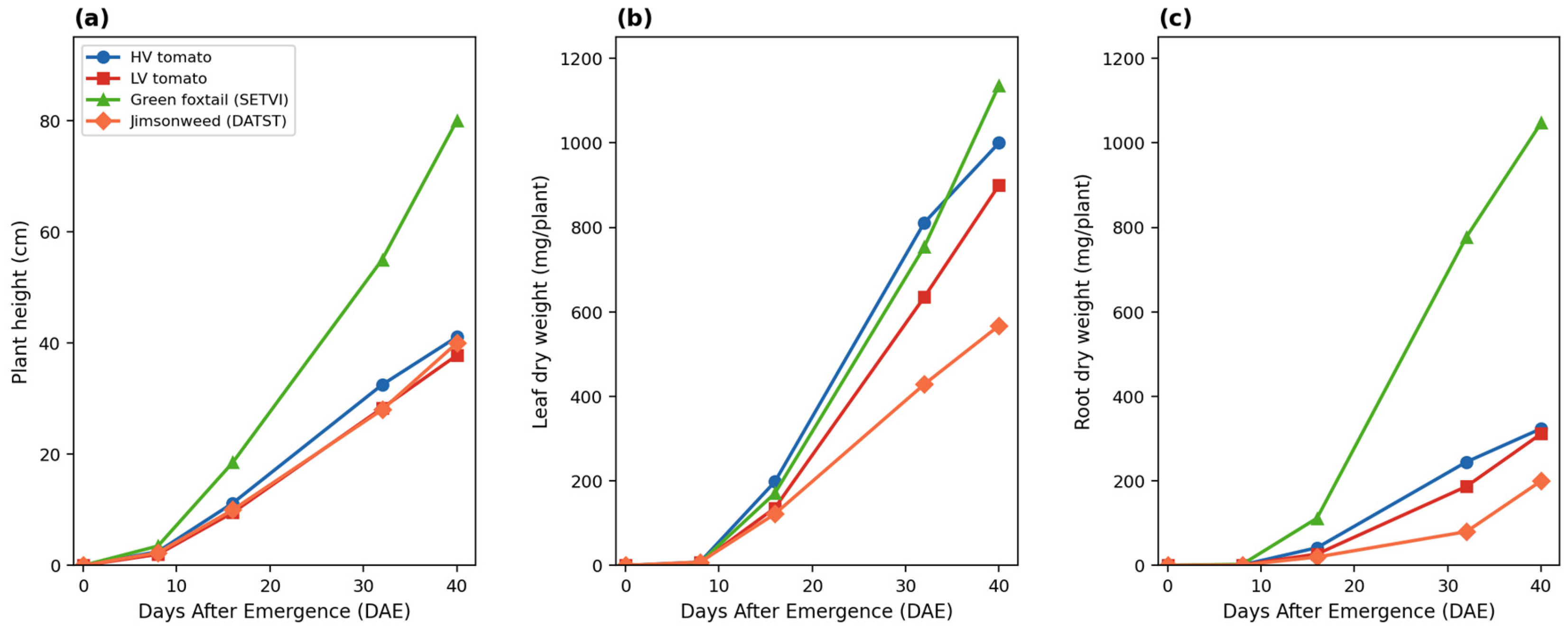
The growth dynamics of the four treatments showed significant differentiation during the 40-day experimental period across several morphological parameters (Figure 1).
Plant Height: S. viridis (SETVI) exhibited the most rapid shoot elongation among all species. From the early stages of development, SETVI maintained a dominant vertical growth profile, reaching a final height of approximately 80 cm by 40 days after emergence (DAE). This was roughly double the height of both the tomato vigor levels (HV and LV) and D. stramonium (DATST), which both plateaued near 40 cm (Figure 1a).
Total Biomass: Although not plotted separately, the total dry weight for each species followed a growth trajectory similar to the trends observed for plant height, reflecting a steady accumulation of biomass over the 40-day period.
Leaf Biomass: Interestingly, leaf dry weight accumulation showed a different pattern from height. SETVI and both tomato vigor levels (HV and LV) produced comparable leaf biomass, following nearly identical slopes to reach approximately 1000 mg per plant at 40 DAE. In contrast, DATST allocated significantly fewer resources to leaf development, producing roughly 500 mg—approximately half the leaf dry weight of the other three treatments—for the majority of the growth period (Figure 1b).
Root Development: A distinct resource allocation strategy was observed for SETVI; it developed a significantly greater root mass than HV, LV, and DATST. This divergence became particularly pronounced after 24 DAE; by 40 DAE, the root dry weight of SETVI surged to approximately 1200 mg, which was roughly five times higher than the 200–250 mg range observed for the other species (Figure 1c). This suggests a highly competitive potential for soil resources despite a smaller canopy.

3.1.2. Replacement Series Experiments

The relative yields (RY) for leaf and root biomass of tomato plants (HV and LV) grown in mixtures or monocultures with D. stramonium (DATST) and S. viridis (SETVI) are detailed in Figure 2 and Figure 3. Relative yields for stem biomass and plant height followed trends similar to leaf biomass and are therefore omitted for brevity.
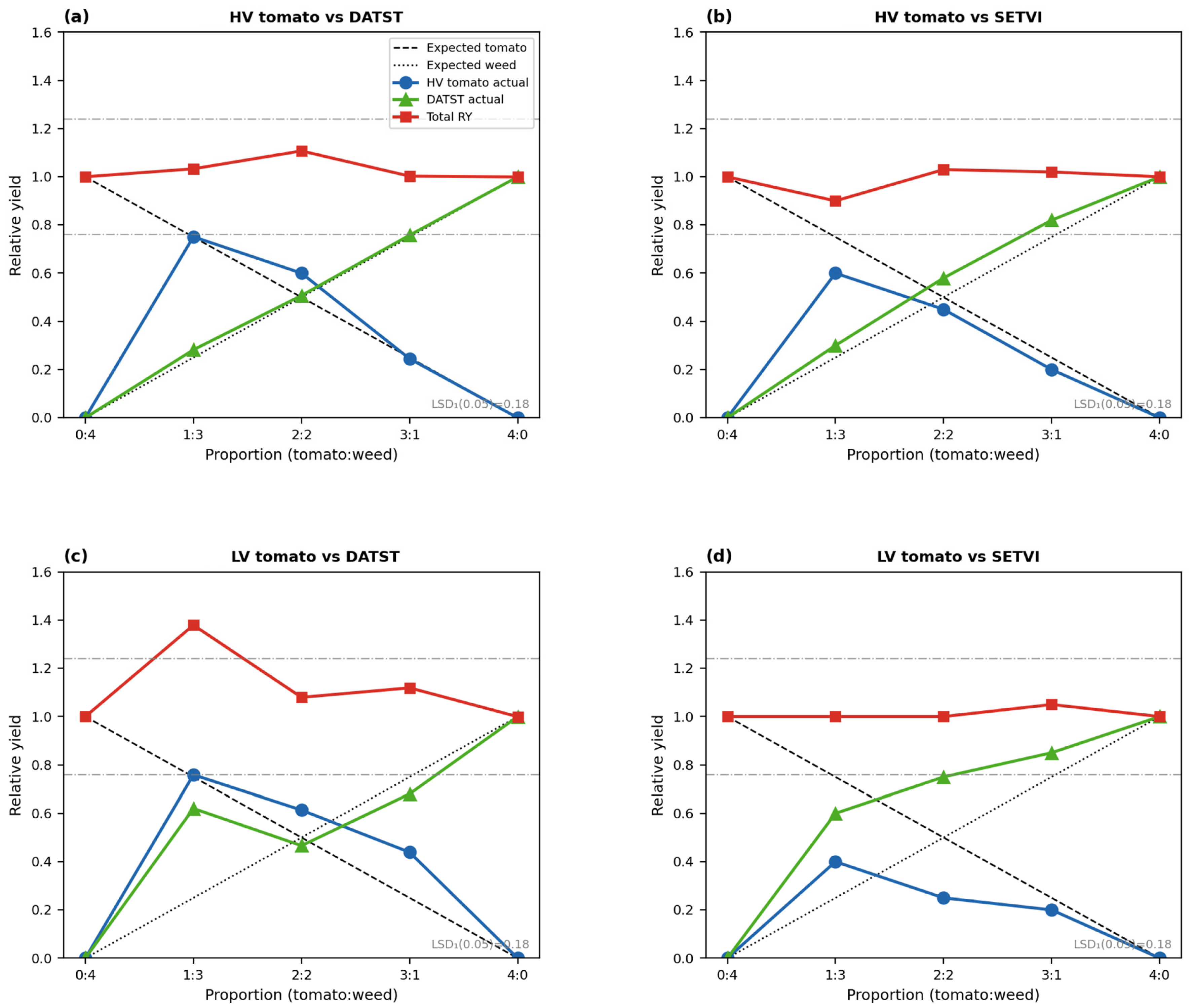
Relative Yields of Leaf Biomass: In the 50:50 mixture with DATST, relative leaf yields for both HV and LV tomato plants remained within the 0.76–1.24 confidence interval, indicating no significant deviation from the expected yield of 0.5 (Figure 2a,c). This suggests that at equal densities, neither tomato vigor level was significantly suppressed by DATST. However, significant differences occurred in the LV treatments at the 25% weed proportion, where the actual yield fell below the 0.76 threshold, deviating from the linear replacement model.
In contrast, competition with SETVI revealed a more aggressive interference pattern, particularly for the LV tomato treatments. The SETVI curve was consistently concave, while the LV tomato curve was convex, frequently dropping toward an RY of 0.2 at higher weed proportions (Figure 2b,d). Despite these fluctuations, the total relative yield (RYT) for leaf mass generally remained within the established 0.76–1.24 cutoff values, suggesting that both species were competing for a common, limited resource pool.
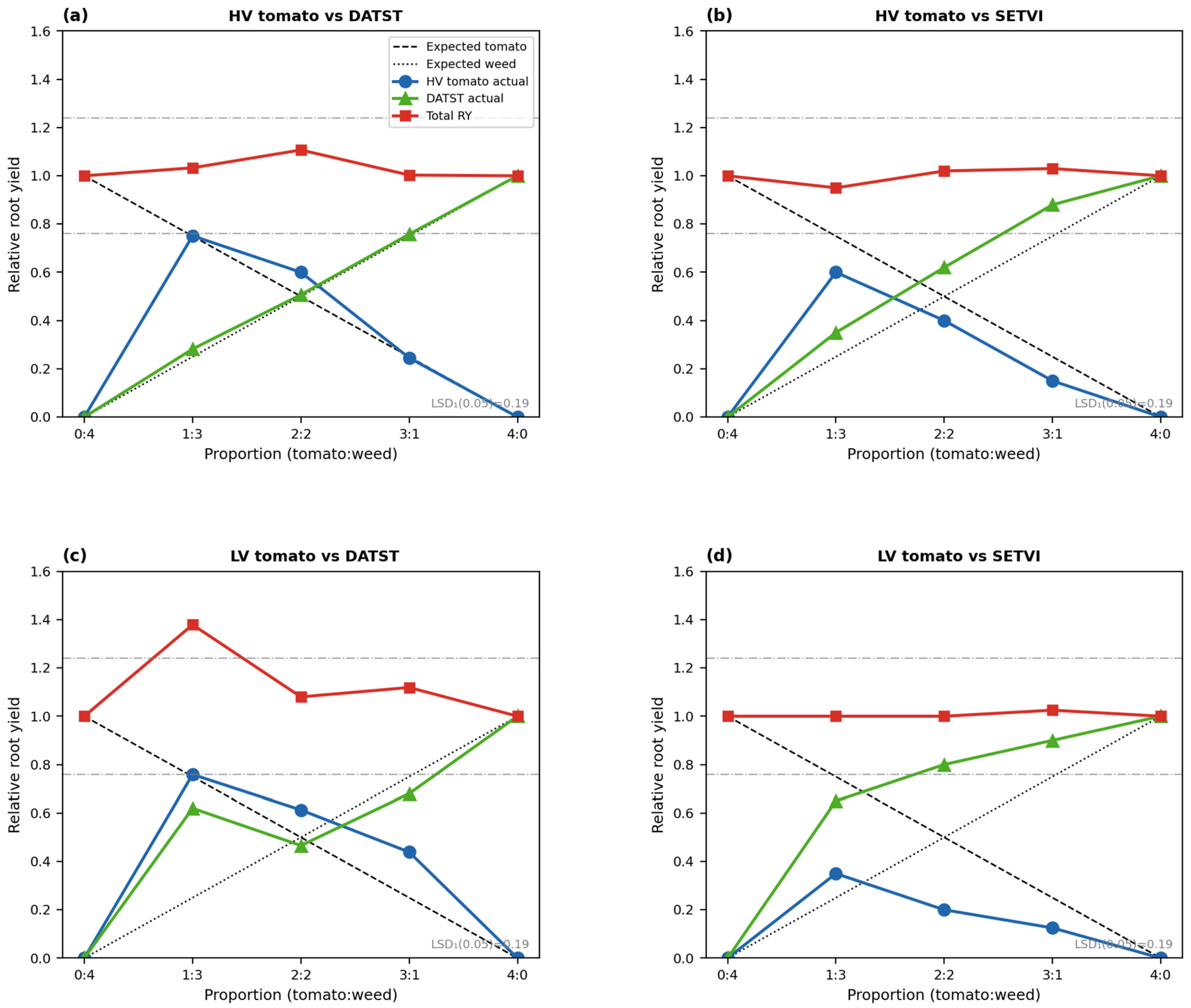
Relative Yields of Root Biomass: Root biomass patterns in tomato-DATST mixtures largely mirrored the leaf biomass data. In 50:50 mixtures, both HV and LV tomato plants showed relative root yields that did not significantly differ from the expected 0.5, remaining well within the statistical confidence limits (Figure 3a,c). The only significant suppression of tomato root development occurred in the LV treatments at the 25% weed proportion, where the relative yield dipped below the 0.76 mark.
Competition with S. viridis (SETVI): In all SETVI mixtures, tomato plant height was not significantly affected by the proportion of weed plants present.
For HV tomato plants, the relative leaf and root biomass were significantly lower than expected values only at the lowest SETVI proportion (25%), where the HV yield dropped to approximately 0.6, falling outside the 0.76–1.24 significance range. However, for LV tomato plants, the competitive disadvantage was more severe; both relative leaf and root biomass remained consistently and significantly lower than the 0.76 threshold across all mixture proportions (Figure 3b,d). Most notably, at the 75% SETVI proportion, the relative yield of LV tomato roots reached values as low as 0.1 to 0.15, clearly demonstrating that low-vigor tomato lots are highly susceptible to SETVI interference.

3.1.3. Separation of Above- and Below-Ground Competition

The height of tomato plants derived from both HV and LV seeds was not significantly affected by the presence of D. stramonium (DATST) or S. viridis (SETVI), regardless of the type of interference.
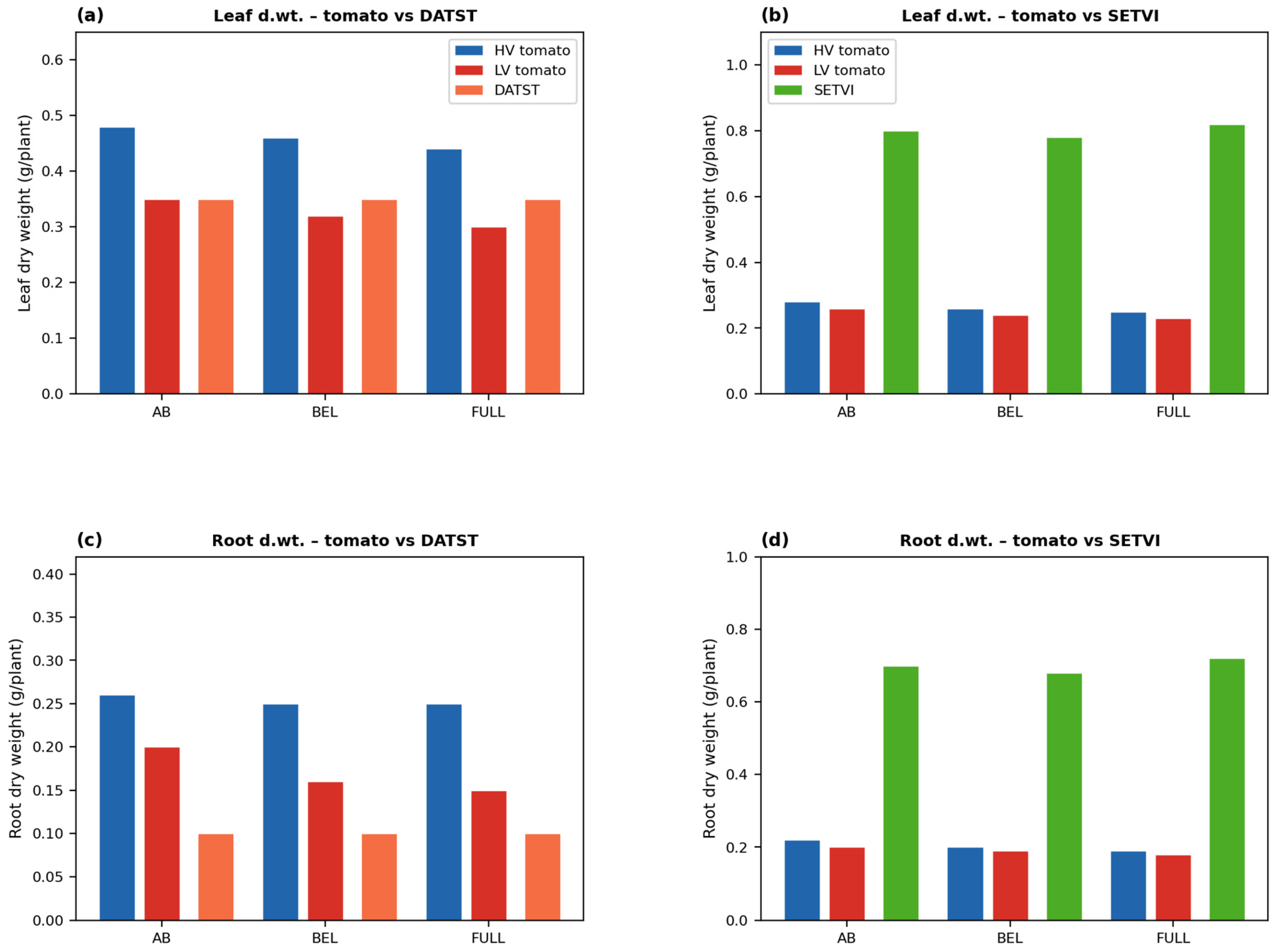
DATST Experiments (Figure 4a,c): Regarding leaf biomass, DATST plants recorded the lowest values (approx. 0.35 g/plant) with no significant differences across the various types of interference (Figure 4a). However, a clear vigor effect was observed: tomato plants from LV seeds consistently produced lower leaf mass in both above-ground (AB) and below-ground (BEL) competition scenarios compared to those from HV seeds.
For root biomass (Figure 4c), DATST plants again exhibited the lowest values (approx. 0.1 g/plant). Notably, tomato plants from LV seeds produced significantly lower root mass than HV plants, specifically in the below-ground (BEL) and full (FULL) competition treatments, where LV roots were suppressed to approximately 0.15 g/plant compared to the 0.25 g/plant achieved by HV plants.
SETVI Experiments (Figure 4b,d): In contrast, SETVI plants achieved dominant biomass values, reaching approximately 0.8 g/plant for leaves and 0.7 g/plant for roots—significantly higher than all tomato treatments (Figure 4b,d). In these mixtures, the aggressive growth of SETVI appeared to overwhelm the crop regardless of initial seed quality; no significant differences were measured between HV and LV tomato plants for either leaf or root biomass, as the weed’s dominance remained consistent across all interference types.

4. Discussion

4.1. Seed Vigor Induction and Early Establishment Dynamics

The germination and emergence rates of HV and LV tomato seeds (91% vs. 83% and 60% vs. 56%, respectively) confirmed that the specific accelerated aging procedure effectively produced a clear separation in seed vigor for the samples used (Table 1). Accelerated aging is widely utilized as a method to generate low-vigor seeds for studying the relationship between vigor and crop performance [5,6]. Frequently, low-vigor seeds exhibit reduced germination and emergence [6,27], effects which are often more pronounced under stressed soil conditions [28]. Our findings suggest that the impact of seed vigor is most strongly expressed in emergence synchrony and final stand establishment rather than in average emergence timing alone, consistent with the view that vigor influences the distribution of emergence events [3]. Under field conditions, biotic factors like soil microorganisms and abiotic factors such as cold or wet soil may cumulatively explain the lower emergence of reduced-vigor seeds. A limitation of the present study is that seed vigor classification relied solely on germination percentage, without the inclusion of additional physiological indicators such as electrical conductivity or seedling vigor index. While the 31-percentage-point difference between HV (91%) and LV (60%) lots was considered sufficient to establish two clearly distinct vigor categories, future studies should incorporate multiple vigor assessment methods to provide a more comprehensive characterization of seed lot quality and to strengthen the generalizability of these findings.

4.2. Mechanisms of Competitive Advantage: The Role of Early Vigor

Previous research reported that under field conditions, low-vigor seed lots exhibit delayed emergence compared to high-vigor seeds [9,10]. This increased emergence time is typically attributed to the level of seed vigor reduction [5,27]. This disadvantage of delayed emergence is well-documented [29]. For instance, Hakansson [11] reported that a 3-day delay in barley emergence doubled weed biomass, while a 12-day delay led to total weed dominance. Such disparities can be explained by the theory of size-asymmetric competition, where small initial differences in size are amplified over time into disproportionate competitive advantages [30,31].

4.3. Species-Specific Competition and Resource Partitioning

In our growth analysis, Setaria viridis was clearly superior in height and biomass regardless of the crop, while Datura stramonium invested more in below-ground biomass. This differentiation in growth strategies suggests that plant species may partition resources spatially to reduce direct competition [19,20].
The distinct resource allocation strategy of S. viridis (SETVI), characterized by a 5-fold increase in root dry weight by 40 DAE (Figure 1c), suggests a high plastic response geared toward below-ground dominance. While SETVI also maintained the greatest height (Figure 1a), its massive root system likely allows it to monopolize soil moisture and nutrients, creating a high-stress environment for neighboring plants [32]. This intensive root-to-shoot investment explains why the relative yield of LV tomato roots collapsed to 0.1–0.15 (Figure 3d) when competing with SETVI, as the low-vigor seedlings may have lacked the physiological capacity to establish a niche before the weed’s root system occupied the available soil volume.
In the replacement series experiments, tomato plants (regardless of vigor level) were shown to compete for the same resources as the weeds. Similar trends have been reported in mayweed competition with peas [33] and barnyard grass interference with rice [26].
The ability of HV tomato plants to maintain relative yields within the 0.76–1.24 significance threshold in most DATST mixtures suggests that high initial vigor provides a “physiological buffer.” This buffer allows the crop to maintain its niche despite the aggressive root expansion of the weed. Conversely, the significant collapse of LV tomato root RY to 0.1–0.15 under SETVI pressure (Figure 3d) confirms that low vigor creates a competitive bottleneck from which the plant cannot recover.
Our results confirm that weed competition acts as a selective filter that amplifies initial physiological differences between vigor levels. While LV seeds might perform adequately in weed-free monocultures, the presence of aggressive competitors like S. viridis forces a trade-off; it has been hypothesized that reduced-vigor seedlings divert limited energy to cellular repair rather than rapid expansion, leading to a permanent competitive deficit [4,33].

4.4. The “Priority Effect” and Competitive Selectivity

In our greenhouse experiments, the higher competitive ability of green foxtail compared to jimsonweed was primarily explained by the order of emergence, with a 2-day difference between species. Delayed emergence relative to weeds significantly increases weed biomass and decreases crop yields [9,10]. Seed vigor affects not only competition but also selectivity, as the relative time of crop-weed emergence influences growth patterns and management outcomes [34].

4.5. Implications for Integrated Weed Management (IWM)

From a practical perspective, enhancing seed vigor represents an efficient, low-cost method for improving crop competitiveness against early-emerging weeds [5,15].
Furthermore, the significantly faster T50 of HV seeds (1.6 days vs. 3.5 days for LV; Table 1) suggests that high-vigor lots are better suited for “stale seedbed” techniques. By narrowing the window between crop emergence and weed canopy closure, HV seeds reduce the “critical period for weed control” (CPWC), thereby potentially reducing the number of herbicide applications required early in the season [35,36].
This approach aligns with modern agroecological trends that prioritize crop traits and cultural practices to manage weeds sustainably [13,37]. In commercial scenarios, low-vigor seed lots expose the crop to early suppression from fast-growing weeds, potentially resulting in long-term yield losses [9,28]. Therefore, seed vigor should be considered a key factor influencing crop–weed dynamics in early growth stages rather than just a germination parameter.

4.6. Limitations and Future Outlook

While our greenhouse data precisely determined vigor effects, it is not yet known if these early competition patterns can be fully extrapolated to field conditions. In some cases, early reduced growth from poor-vigor seeds is later compensated for under normal agronomic conditions [8,38]. Nevertheless, yield variations of up to 16–18% have been recorded due to differences in seed quality alone [9,28]. Future research must move toward identifying the molecular markers of this early-season readiness. Future research leveraging genomic tools to identify seeds with superior transcriptional priming may offer promising avenues and will be essential for developing tomato cultivars capable of maintaining yield stability in the face of combinational biotic and abiotic pressures [39]. Our ongoing research aims to further determine the impact of seed vigor on weed competition and final yields under natural field conditions.

5. Conclusions

Impact of Seed Vigor on Competitive Trajectory: This study demonstrates that seed vigor significantly dictates the early growth and competitive ability of tomato plants when facing interference from Setaria viridis and Datura stramonium. High-vigor (HV) seed lots consistently resulted in superior seedling development and enhanced competitiveness. Conversely, seedlings derived from low-vigor (LV) seeds showed marked performance deficits, leaving the crop vulnerable to early suppression.
Mechanistic Drivers of Competition: The replacement series experiments confirmed that tomato and weed species compete for the same resource pool. The primary drivers of competitive outcomes were identified as: (a) Seed Vigor Level: Directly influencing the plant’s capacity for resource exploitation; (b) Emergence Timing: Granting weeds a “priority effect” that is further exacerbated by reduced crop vigor; (c) Biomass Allocation: Species-specific strategies (e.g., the dominant root system of D. stramonium vs. the rapid shoot elongation of S. viridis) further define the intensity of crop–weed interactions.
Practical Implications for Sustainable Agriculture: Overall, these findings suggest that utilizing high-vigor seed lots is a practical and cost-effective strategy to ensure robust early crop establishment and effective weed suppression. Integrating seed vigor selection into Integrated Weed Management (IWM) systems can improve early-season performance and potentially reduce the need for intensive chemical interventions.
Future Research Directions: While greenhouse conditions allowed for a precise mechanistic analysis, further field-based studies are necessary to validate these results under variable agronomic and environmental conditions. Future research should confirm if the early competitive advantages provided by high seed vigor are sustained through to final crop yield.

Author Contributions

Conceptualization, D.C.; Methodology, D.C., N.V., A.P. and D.V.; Software, N.V., D.V. and A.M.; Validation, D.C., N.V., A.P. and D.V.; Formal analysis, N.V., D.V. and A.M.; Investigation, D.C.; Resources, D.C.; Data curation, N.V.; Writing–original draft, D.C., N.V., A.P., D.V. and A.M.; Writing–review & editing, D.C., N.V. and A.P.; Visualization, D.C.; Supervision, D.C.; Project administration, D.C. and N.V.; Funding acquisition, D.C. and A.P. All authors have read and agreed to the published version of the manuscript.

Funding

This research received no external funding.

Data Availability Statement

The data presented in this study are available in the article.

Acknowledgments

We thank Eirini Chlitsiou for technical assistance with parts of the experimentation.

Conflicts of Interest

The authors declare no conflict of interest.

References

  1. Leskovar, D.I.; Cantliffe, D.J.; Stoffella, P.J. Transplant production systems influence growth and yield of fresh-market tomatoes. J. Am. Soc. Hortic. Sci. 1994, 119, 662–668. [Google Scholar] [CrossRef]
  2. Powell, A.A. Seed vigour in the 21st century. Seed Sci. Technol. 2022, 50, 45–73. [Google Scholar] [CrossRef]
  3. Finch-Savage, W.E.; Bassel, G.W. Seed vigour and crop establishment: Extending performance beyond adaptation. J. Exp. Bot. 2016, 67, 567–591. [Google Scholar] [CrossRef] [PubMed]
  4. Reed, R.C.; Bradford, K.J.; Khanday, I. Seed germination and vigor: Ensuring crop sustainability in a changing climate. Heredity 2022, 128, 450–459. [Google Scholar] [CrossRef] [PubMed]
  5. Ellis, R.H. Seed and seedling vigour in relation to crop growth and yield. Plant Growth Regul. 1992, 11, 249–255. [Google Scholar] [CrossRef]
  6. Hampton, J.G. The relationship between field emergence, laboratory germination and vigour testing of New Zealand seed wheat lines. N. Z. J. Exp. Agric. 1981, 9, 191–197. [Google Scholar] [CrossRef]
  7. Perry, D.A.; Harrison, B.D. Causes and development of differences in the field performance of seed lots. In Seed Production; Hebblethwaite, P.D., Ed.; Butterworths: London, UK, 1977; pp. 401–421. [Google Scholar]
  8. Khah, E.M.; Passam, H.C.; Stylianou, M. The effect of seed quality on the emergence of wheat and barley under stress conditions. Seed Sci. Technol. 1989, 17, 649–655. [Google Scholar]
  9. Rasmussen, K.; Rasmussen, J. Barley seed vigour and mechanical weed control. Weed Res. 2000, 40, 219–230. [Google Scholar] [CrossRef]
  10. O’Donovan, J.T.; Remy, E.A.D.S.; O’Sullivan, P.A.; Dew, D.A.; Sharma, A.K. Influence of the relative time of emergence of wild oat (Avena fatua) on yield loss of barley (Hordeum vulgare) and wheat (Triticum aestivum). Weed Sci. 1985, 33, 498–503. [Google Scholar] [CrossRef]
  11. Hakansson, S. Competitive effects and competitiveness in annual plant stands. 2. Measurements of plant growth as influenced by density and relative time of emergence. Swed. J. Agric. Res. 1997, 27, 75–94. [Google Scholar]
  12. Weiner, J.; Andersen, S.B.; Wille, W.K.M.; Griepentrog, H.W.; Olsen, J.M. Evolutionary agroecology: The potential for cooperative, high density, weed-suppressing cereals. Evol. Appl. 2010, 3, 473–479. [Google Scholar] [CrossRef] [PubMed]
  13. Harker, K.N.; O’Donovan, J.T. Recent weed control, weed management, and integrated weed management. Weed Technol. 2013, 27, 1–11. [Google Scholar] [CrossRef]
  14. Crotser, M.P.; Witt, W.W. Effect of Glycine max canopy characteristics, G. max interference, and weed-free period on Solanum ptycanthum growth. Weed Sci. 2000, 48, 20–26. [Google Scholar] [CrossRef]
  15. Ni, H.; Moody, K.; Robles, R.P.; Paller, E.C., Jr.; Lales, J.S. Oryza sativa plant traits conferring competitive ability against weeds. Weed Sci. 2000, 48, 200–204. [Google Scholar] [CrossRef]
  16. Harper, J.L. Substitutive experiments. In Population Biology of Plants; Academic Press: London, UK, 1977; pp. 255–267. [Google Scholar]
  17. Estorinos, L.E., Jr.; Gealy, D.R.; Talbett, R.E. Growth response of rice (Oryza sativa) and red rice (O. sativa) in a replacement series study. Weed Technol. 2002, 16, 401–406. [Google Scholar] [CrossRef]
  18. Cralle, H.T.; Fojtasek, T.B.; Carson, K.H.; Chandler, J.M.; Miller, T.D.; Senseman, S.A.; Bovey, R.W.; Stone, M.J. Wheat and Italian ryegrass (Lolium multiflorum) competition as affected by phosphorus nutrition. Weed Sci. 2003, 51, 425–429. [Google Scholar] [CrossRef]
  19. Cahill, J.F.; McNickle, G.G.; Haag, J.J.; Lamb, E.G.; Nyanumba, S.M.; St. Clair, C.C. Plants integrate information about nutrients and neighbors. Science 2010, 328, 1657. [Google Scholar] [CrossRef]
  20. Mommer, L.; Kirkegaard, J.; van Ruijven, J. Root–root interactions: Towards a rhizosphere framework. Trends Plant Sci. 2016, 21, 209–217. [Google Scholar] [CrossRef]
  21. Bozsa, R.C.; Oliver, L.R. Competitive mechanisms of common cocklebur (Xanthium strumarium) and soybean (Glycine max) during seedling growth. Weed Sci. 1990, 38, 344–350. [Google Scholar] [CrossRef]
  22. Marcos-Filho, J. Seed vigor testing: An overview of the past, present and future perspective. Sci. Agric. 2015, 72, 363–374. [Google Scholar] [CrossRef]
  23. Chachalis, D.; Smith, M.L. Hydrophobic-polymer application reduces imbibition rate and partially improves germination or emergence of soybean seedlings. Seed Sci. Technol. 2001, 29, 91–98. [Google Scholar]
  24. Ellis, R.H.; Roberts, E.H. The quantification of ageing and survival in orthodox seeds. Seed Sci. Technol. 1981, 9, 373–409. [Google Scholar]
  25. Coolbear, P.; Francis, A.; Grierson, D. The effect of low temperature pre-sowing treatment on the germination performance and membrane integrity of artificially aged tomato seeds. J. Exp. Bot. 1984, 35, 1609–1617. [Google Scholar] [CrossRef]
  26. Gealy, D.R.; Estorninos, L.E., Jr.; Gbur, E.E.; Chavez, R.S.C. Interference interactions of two rice cultivars and their F3 cross with barnyardgrass (Echinochloa crus-galli) in a replacement series study. Weed Sci. 2005, 53, 323–330. [Google Scholar] [CrossRef]
  27. Perry, D.A. Report of the vigour test committee 1974–1977. Seed Sci. Technol. 1978, 6, 159–181. [Google Scholar]
  28. Pedersen, L.H.; Jørgensen, P.E.; Poulsen, I. Effects of seed vigour and dormancy on field emergence, development and grain yield of winter wheat and winter barley. Seed Sci. Technol. 1993, 21, 159–178. [Google Scholar]
  29. Sagar, G.R.; Harper, J.L. Biological flora of the British Isles: Plantago major L., P. media L. and P. lanceolata L. J. Ecol. 1964, 52, 189–221. [Google Scholar] [CrossRef]
  30. Weiner, J. Asymmetric competition in plant populations. Trends Ecol. Evol. 1990, 5, 360–364. [Google Scholar] [CrossRef]
  31. Schwinning, S.; Weiner, J. Mechanisms determining the degree of size asymmetry in competition among plants. Oecologia 1998, 113, 447–455. [Google Scholar] [CrossRef]
  32. Schenk, H.J. Root competition: Beyond resource depletion. J. Ecol. 2006, 94, 725–739. [Google Scholar] [CrossRef]
  33. Rajjou, L.; Duval, M.; Gallardo, K.; Catusse, J.; Bally, J.; Job, C.; Job, D. Seed germination and vigor. Annu. Rev. Plant Biol. 2012, 63, 507–533. [Google Scholar] [CrossRef]
  34. Rasmussen, J.; Thomas, J.M. Can high densities of competitive weeds be controlled efficiently by harrowing or hoeing in agricultural crops? In Proceedings of the Fourth International Conference of IFOAM, Dijon, France, 5–9 July 1993. [Google Scholar]
  35. Zimdahl, R.L. Weed-Crop Competition: A Review, 2nd ed.; Blackwell Publishing Professional: Ames, IA, USA, 2004. [Google Scholar]
  36. Swanton, C.J.; O’Sullivan, J.; Robinson, D.E. The critical weed-free period in carrot. Weed Sci. 2008, 56, 694–699. [Google Scholar] [CrossRef]
  37. Adeux, G.; Munier-Jolain, N.; Meunier, D.; Farcy, P.; Carlesi, S.; Barberi, P.; Cordeau, S. Diversified grain-based cropping systems provide long-term weed control while limiting herbicide use and yield losses. Agron. Sustain. Dev. 2019, 39, 42. [Google Scholar] [CrossRef]
  38. Roberts, E.H. Storage environment and the control of viability. In Viability of Seeds; Roberts, E.H., Ed.; Springer: Dordrecht, The Netherlands, 1972. [Google Scholar]
  39. Sinha, P.; Singh, V.K.; Bohra, A.; Kumar, A.; Reif, J.C.; Varshney, R.K. Genomics and breeding innovations for enhancing genetic gain for climate resilience and nutrition traits. Theor. Appl. Genet. 2021, 134, 1829–1843. [Google Scholar] [CrossRef]
Figure 1. Plant growth characteristics for plum tomato high vigor (HV), low vigor (LV), green foxtail (SETVI), and Jimsoweed (DATST) grown without interference during the first 40 DAE: (a) Plant height, (b) leaf dry weight (d.wt.), and (c) root dry weight (d.wt.).
Seeds 05 00033 g001
Figure 2. Replacement series diagrams for plum tomato high vigor (H.V.; (a,b)) vs. low vigor (L.V.; (c,d)) with Jimsoweed (DATST), and Setaria (SETVI) showing actual (___) and expected (----) relative leaf d.wt (per vigor level and weed species), and total relative leaf d.wt. LSD1(0.05)= 0.18 for comparisons between HV, LV, DATST, SETVI; LSD2(0.05) = 0.27 for comparisons between Total relative leaf d.wt. Analyses were for the three mixture proportions only. Total relative leaf d.wt. cutoff values: >1.24 or <0.76.
Seeds 05 00033 g002
Figure 3. Replacement series diagrams for plum tomato high vigor (H.V.; (a,b)) vs. low vigor (L.V.; (c,d)) with Jimsoweed (DATST), and Setaria (SETVI) showing actual (___) and expected (----) relative root d.wt (per vigor level and weed species), and total relative root d.wt. LSD1(0.05) = 0.19 for comparisons between HV, LV, DATST, SETVI; LSD2(0.05) = 0.29 for comparisons between Total relative leaf d.wt. Analyses were for the three mixture proportions only. Total relative leaf d.wt. cutoff values: >1.27 or <0.73.
Seeds 05 00033 g003
Figure 4. Leaf dry weight (d.wt.) and root dry weight (d.wt.) per plant of plum tomato high vigor (HV) and low vigor (LV), Jimsoweed (DATST), and green foxtail (SETVI) under separated above- and below-ground competition treatments [above-ground (AB), below-ground (BEL), and full (FULL) competition]: (a) leaf d.wt., tomato vs. DATST; (b) leaf d.wt., tomato vs. SETVI; (c) root d.wt., tomato vs. DATST; (d) root d.wt., tomato vs. SETVI. All plants were harvested at 40 DAE.
Seeds 05 00033 g004
Table 1. Percent total germination, mean germination time, T50, and uniformity (T10–T90) for plum tomato high vigor (H.V.), low vigor (L.V.), green foxtail (SETVI), and Jimsoweed (DATST) seeds. The experiments were performed on a separate plant species, without any competition.
TypeTotal Germination
(%)
Mean Germination Time
(Days)
T50
(Days)
Uniformity T90–T10
(Days)
H.V.—plum tomato912.31.63.8
L.V.—plum tomato602.43.52.2
Green foxtail (SETVI)692.93.32.9
Jimsoweed (DATST)592.33.01.4
LSD(0.05)3.40.91.11.7
Table 2. Percent total emergence, mean emergence time, T50, and uniformity (T10–T90) for plum tomato high vigor (H.V.), low vigor (L.V.), green foxtail (SETVI), and Jimsoweed (DATST) seeds. The experiments were performed on a separate plant species, without any competition.
TypeTotal Emergence
(%)
Mean Emergence Time
(Days)
T50
(Days)
Uniformity T90–T10
(Days)
Seedling d.wt.
(Mg)
H.V.—plum tomato 836.05.33.18.5
L.V.—plum tomato567.26.43.37.1
Green foxtail (SETVI)713.03.70.16.7
Jimsoweed (DATST)492.42.7l2.77.9
LSD(0.05)4.41.91.52.42.7
Disclaimer/Publisher’s Note: The statements, opinions and data contained in all publications are solely those of the individual author(s) and contributor(s) and not of MDPI and/or the editor(s). MDPI and/or the editor(s) disclaim responsibility for any injury to people or property resulting from any ideas, methods, instructions or products referred to in the content.