Article

Mutations in the Phenylpropanoid and Starch Synthesis Pathways Are Important Determinants of Seed Longevity in Garden Pea (Pisum sativum L.) Stored at Cool Temperatures

Department of Plant Sciences and Plant Pathology, Montana State University, Bozeman, MT 59715, USA
*
Author to whom correspondence should be addressed.
Submission received: 1 November 2025 / Revised: 19 January 2026 / Accepted: 23 January 2026 / Published: 28 January 2026

Abstract

Two well-known recessive mutations (a, conditioning white flowers and unpigmented testa; and r, conditioning wrinkled seeds) were found to be major contributors to the loss of germination percentage in garden pea (Pisum sativum L.) when seeds were maintained at cool temperatures (5 °C) for extended periods. After approximately 20 years in storage, seeds homozygous for the unpigmented mutation displayed an average germination rate about 20% lower than wildtype seeds, while wrinkled seeds displayed a rate about 25% less. Seeds homozygous for both the a and r mutations (a combination typical of many commercial cultivars) exhibited a reduction in germination percentage of about 50% over the storage period, indicating that the two mutations have an additive effect on the ageing process. Additional results involving a second mutation (a2) in the phenylpropanoid pathway, as well as information available from the literature that a second, independent mutation in starch synthesis (rb) also reduces seed longevity, suggest that an intact phenylpropanoid pathway and a normally functioning starch synthesis pathway are necessary for optimal storage life of pea seeds.

1. Introduction

Seeds, regardless of storage conditions, undergo the process of ageing and gradually lose the ability to germinate [1,2]. The primary environmental factors influencing the rate of the ageing of orthodox seeds (seeds that store well, tolerate freezing, and may be dried to 5% water content [3]) during storage have been identified as temperature, relative humidity, and oxygen exposure [4,5]. Thus, long-term storage facilities for such seeds generally operate at low temperatures (5 °C or less) and often include mechanisms for absorption of water vapour (dehumidifiers or desiccants).
With the establishment of many temperature-controlled seed storage facilities throughout the world, recent reviews [6,7] have focused on the role of oxidation of cellular components caused by free radicals and other reactive oxygen species as the primary factor determining shelf life of orthodox seeds in such facilities. Proposed cellular targets of these oxidation processes include lipids in membranes, nucleic acids, and proteins, with carbohydrates seen as less susceptible but also less studied. The initiation of programmed cell death response may also occur through the action of reactive oxygen species.
The garden pea (Pisum sativum L.) produces orthodox seeds that generally have a long lifetime under good storage conditions [8]. Haferkamp et al. [9] reported that numerous pea varieties retained viability after being held at ambient storage conditions at Lind, Washington USA for 7 to 31 years. In a study where pea seeds were maintained at −18 °C for more than 60 years, only a 26.3% reduction in germination was observed [10]. Aside from the clear effects of temperature and humidity [11], the factors causing loss of viability in peas during storage have been difficult to ascertain. In a series of studies on water uptake in aged pea seeds, Powell and Matthews [11,12,13] concluded that early stages of seed ageing in pea were associated with membrane deterioration, resulting in rapid imbibition and the leakage of solutes. However, the above experiments were performed with artificially aged seeds. In a joint paper, Powell and Harman [14] tested artificially aged seeds and found a lack of clear correspondence with seed viability and either accumulation of peroxides or phospholipid loss. They concluded that changes generated by artificial ageing may not accurately reflect the processes occurring in naturally aged pea seeds. However, both Harman and Powell continued to investigate deterioration of artificially aged pea seeds, with Gorecki and Harman [15] finding that antioxidants retarded the loss of vigour in pea seeds and Powell [16] examining near-isogenic lines of pea differing at the A locus (Mendel’s clear testa factor that has now been determined to encode a bHLH transcription factor regulating the phenylpropanoid pathway [17]). Powell [16] reported that seeds homozygous for the recessive a allele imbibed more rapidly and suffer greater damage (as represented by dead tissue on the cotyledons and higher leakage of cell contents) than wildtype seeds.
Two other groups published results implicating carbohydrate composition as important for pea seed longevity. Lyall et al. [18] reported that the two rugosus mutants (r and rb) reduced seed viability and attributed the effect of the mutants to changes in seed composition, particularly starch structure, rather than direct effects on seed moisture content. Again, these experiments were performed with artificially aged seeds. Veselovsky and Veselova [19] performed a study on naturally aged pea seeds in which they looked for lipid peroxidation products and glucose concentration. They found no evidence for increased lipid peroxidation in aged seeds but did observe an increase in glucose content in what they designated the fraction II (weakened) seed lots. The role of carbohydrate structure/metabolism currently remains a poorly understood factor influencing the viability of pea seeds.
Another variable characteristic of the testa in pea, as well as in many other plant species, is its permeability to water. Wild pea, almost by definition, has a thick, water-impermeable testa that requires scarification before the seed will imbibe [20,21]. During the domestication of pea, a thinner testa has been selected, one that is relatively permeable to water and allows planted seed to germinate within a few days [22]. However, occasionally, as yet undetermined environmental conditions act during seed maturation to produce, in domesticated lines, seeds with a testa impermeable to water, at least during the first 24 to 48 h immersion. Such seeds, referred to as ‘hard seeds’, still have a thin testa that can be easily nicked or cracked, but when prevalent in a seed lot can significantly reduce stand density and uniformity. The thick testa of the wild pea, and possibly the impermeable testa of the ‘hard’ seed of the domestic pea, may protect the seed embryo against ambient water or oxygen, thereby extending longevity. This possibility has rarely been addressed in seed ageing studies.
Pea breeding and genetics programmes require the storage and maintenance of a large number of lines and segregating populations. As mentioned above, pea seeds generally have good longevity under standard storage conditions. However, after ten or more years in the seed storage facility at Montana State University (5 °C, low humidity but no desiccants or oxygen scavengers), some seed stocks showed significant loss in viability (NFW, pers. obs.). Low germination was particularly noticeable in varieties with unpigmented testas, consistent with the findings of Powell [16]. These observations stimulated us to further investigate the factors influencing seed longevity in long-term storage.

2. Materials and Methods

2.1. Plant Material

The seed populations examined in this study are listed in Appendix A. Except for five cases (MxJ, A95-3, A04-cross5, Slow x SGR, and A13-111), pods were harvested from fully mature plants grown in the field at Bozeman, MT. Population A95-3 was grown in the greenhouse at the NYS Agricultural Experiment Station Cornell University, Geneva, NY during the spring of 1995. The remaining three populations were grown in the greenhouse (Plant Growth Centre) at Montana State University, with supplemental lighting during the fall or early spring. In all cases, dry pods were shelled by hand shortly after harvest and, except for A95-3, stored in paper envelopes at 5 °C in the dark at ambient humidity (20–30%) in the seed storage facility at Montana State University Plant Growth Centre. For A95-3, seeds were maintained in the seed storage facility in Sturtevant Hall, NYSAES (same conditions except the relative humidity was higher (40–60%)). In the summer of 1999, these seeds were transported by motor vehicle to Bozeman, MT. This population was therefore exposed to elevated temperatures (20–30 °C) for a period of approximately 60 days before being returned to low temperature storage at Montana State University.
The population type is also listed in Appendix A. Most of the populations were either seeds collected from F1 hybrids or bulks of 7 to 40 F2 plants. Bulks of F2 plants had been generated at harvest by selecting at least one pod from each F2 plant. Seeds were selected randomly from each sample except that poorly developed seeds were discarded. In cases where only one trait was segregating, a similar number of each phenotype was selected. Separating seed into pigmented and unpigmented classes was easily performed. Round and wrinkled classes were also relatively easily separated; however, seeds with a questionable phenotype were avoided when selecting seed for testing. Seeds from the hybrid plants were used only for seed shape comparisons because the phenotype for seed shape is manifested in the cotyledonary tissue and, therefore, segregation could be observed in the seeds from the F1, whereas testa pigmentation reflects the maternal genotype and did not segregate.
Population Slow x SGR (Appendix A) segregated for testa pigmentation, but the gene responsible was a recessive allele (designated here as a2) at the A2 locus. This mutation was first described by Marx et al. [23] and produces a phenotype very similar to that seen in plants homozygous for the a allele. The Slow x SGR population was included to determine if the a2 gene also influenced seed germination percentage.

2.2. Germination Procedure for Seeds

Seeds selected for testing were surface sterilized by placing in 0.6% sodium hypochlorite solution for 5 min. They were then thoroughly rinsed and placed between wet filter paper (Whatman #1) discs in Petri dishes at a density of not more than 1 seed/2 cm2. The covered Petri dishes were maintained under subdued light at 20 °C. After 24 h, the seeds were inspected for imbibition. Seeds not imbibed were scored as ‘hard-seeded’. These were removed from the Petri dish, their testa nicked at a point distant from the hilum and embryo, and replaced between the wet sheets of filter paper at a position where they could be easily identified in successive inspections of the Petri dish. Germination was recognized when the radicle protruded from the testa. Seeds scored as germinated were removed from the Petri dish. The inspection of the seed samples was repeated every 24 h for five days, after which all ungerminated seeds were scored as non-viable.

2.3. Tests Specific to Certain Populations

2.3.1. Effect of Amount of Pigmentation of Testa

Population B04-231 segregated for the gene U, which produces a dark violet testa [24]. The loss of ability to germinate in this population was compared to that in populations with normally pigmented testas, as well as with unpigmented testas.

2.3.2. Effect of Testa Nicking on Rate of Loss of Seed Viability

The testa of about a fifth of the seeds in population grown in spring of 2013 (A13-111) had been compromised shortly after harvest by making a small nick (1–2 mm wide) with a scalpel in order to determine whether the cotyledon was yellow or green. As this population was derived from a cross between two domesticated pea lines, the testa was thin, and little force was needed to make the nick; however, in all the cases, the lesion passed through the testa to the cotyledonary tissue. This population was segregating for the wrinkled seed gene so that the seed could be separated into four categories: intact, round; nicked, round; intact, wrinkled; and nicked, wrinkled. Nineteen seed in each of the first two categories and about 30 seeds in each of the latter categories were subjected to the germination procedure described above.

2.3.3. Effect of Hard Seededness on Germination Percent

Hard seeds were tracked through the 5-day germination period. They were encountered in nearly every population, but (for reasons discussed in the Results section) we analyzed population B03-6 separately from a second ‘combined’ sample that consisted of results from populations B03-11, B03-204, B03-251, B04-231, and B06-8, -11, -51, -67, -68, -79, -80, -85, -87, -91, -92, -189, -194a, -200, -214, and -303. In each of these two groups, the percentage of hard seeds germinating was compared to the germination percentage for the entire test population.

2.3.4. Effect of Testa Browning on Germination Percent

In several populations with pigmented seed, a certain fraction of the seed displayed browning or darkened testa. Such seeds were identified and their positions marked on the Petri plate at the start of the germination procedure. The number of such seeds was limited, but these were treated as a separate group in this analysis.

2.3.5. Genome-Wide Analysis in the MxJ Recombinant Inbred Population

This population consisted of 51 recombinant inbred lines, which had been self-pollinated for at least six generations. The lines had been previously scored for over 400 segregating markers, including 11 monogenic morphological traits and 6 isozyme loci. The remaining markers are DNA-based polymorphisms such as RAPDs, simple sequence repeats (SSRs), and sequence-tagged sites (STSs). A selection of 125 of these markers (listed in Table S1), providing excellent coverage of the linkage map, was used for a genome-wide search for regions influencing germination percentage. DNA was isolated from young leaves using the procedure described in Torres et al. [25]. The procedure used for analysis of RAPD markers was also described in [25], that for STS markers in Brauner et al. [26], and that for SSR markers in Hemmat et al. [27].
The raw data from the germination analysis for the MxJ population was converted to a bimodal data set by identifying those lines with 80% or better germination as ‘good’ for the trait and those with ≤40% germination as ‘poor’ for the trait. RILs giving 60% germination were identified as ‘intermediate’ and not used in the subsequent analysis. Joint segregation analysis was performed between the segregation pattern for germination and that for each of the 125 genetic markers. Deviations from random assortment with a p < 0.001 (LOD > 3) were identified as genomic regions of potential interest.

3. Results

3.1. Effect of a and R Alleles

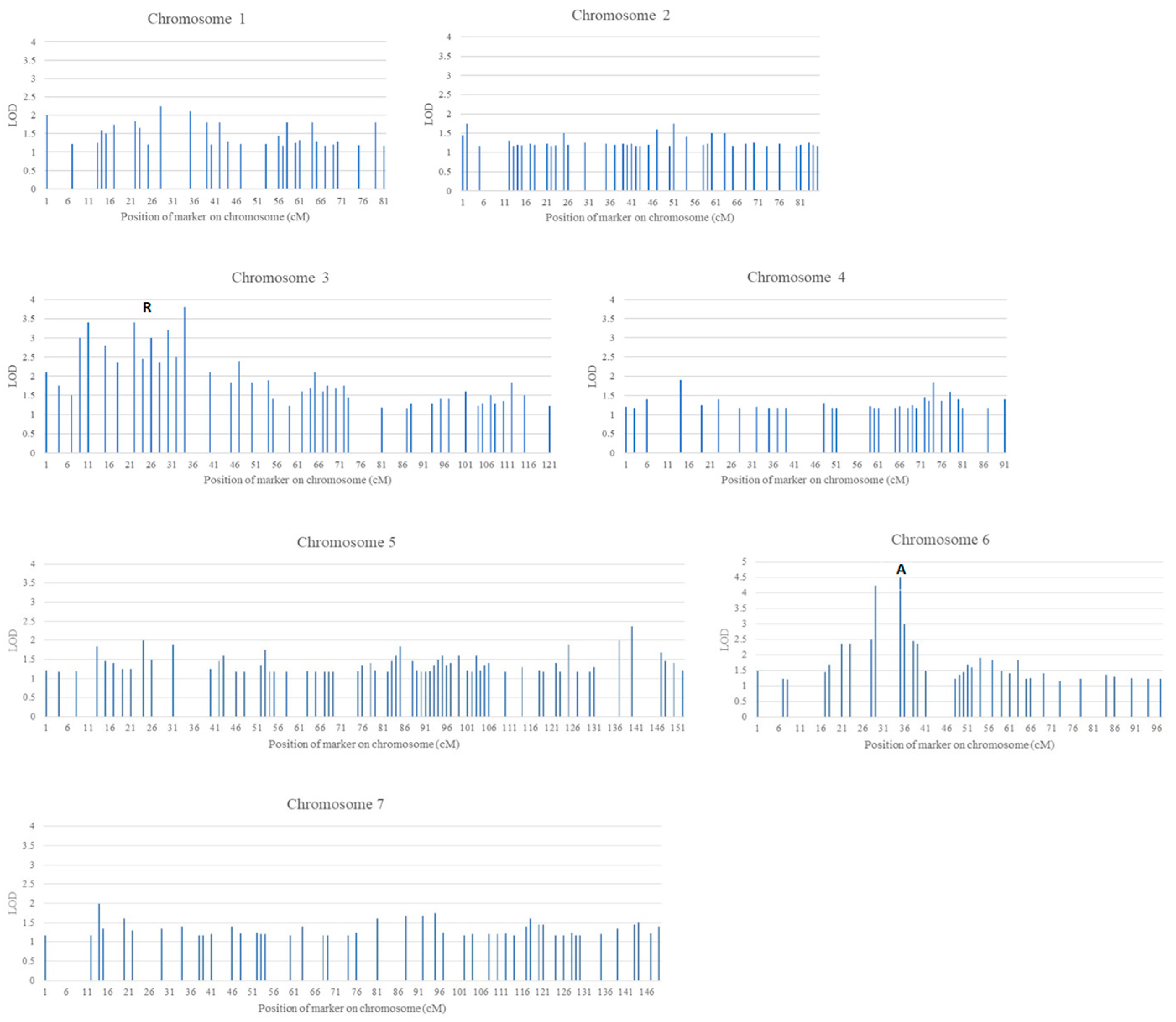
The results of the germination test for the MxJ population gave 24 lines displaying good germination, 18 with poor germination, and 9 with intermediate. Highly significant correlations with germination percentage (LOD > 3) were identified for two regions on the linkage map (Figure 1), one centred over the R locus on chromosome 3 and the other over the A locus on chromosome 6. There was one region on chromosome 5 that reached an LOD of 2.4 and an arm of chromosome 1 where markers occasionally surpassed an LOD of 2.0, but no other genomic region displayed the LOD ≤ 3 that has become standard for identifying marker:phenotype associations in genome-wide studies. The peak on chromosome 3 was broad, extending over 20 cM and could reflect the contributions of two linked loci, one near position 10 and the other centred near position 30. The R locus is located at position 25 (Figure 1). The peak encompassing A on chromosome 6 extends over a 10 cM region and could be caused by a gene closely linked to A, despite A exhibiting the maximum deviation from random assortment of all markers examined. The limited number of RILs (42) that could be used in any comparison limited the resolution of this analysis, and we did not attempt to pursue the genome-wide analysis further. The appearance of major peaks over the A and R loci, albeit broad, encouraged us to continue our investigation on other segregating populations available to us.
The germination results in these other populations consistently displayed a difference between seeds with pigmented and unpigmented testas. Of the ten additional populations analyzed, eight displayed a lower germination percentage in seeds with unpigmented testa, although in two of these the differences were not significant, and a third involved the A2 locus (Table 1). The two exceptions (B06-8 and B03-251) had identical germination percentages for both categories (100% and 74%, respectively). Further analysis of the B03-251 population (see below) revealed peculiarities in this population but did not clarify why it gave an equal loss in germination percentage for the two classes. Excluding the Slow x SGR population (segregating at A2), the overall germination percentages for 2177 seeds scored in the two categories were pigmented seed, 86%, and unpigmented seed, 71%. This comparison is highly significant but suffers from the limitations of combining populations harvested in different years under slightly different conditions. Thus, it is the consistency of the result across individual populations that provides the strongest evidence that loss of germination capability proceeds more rapidly in seeds with unpigmented testas.
The testas of the seeds from population B04-231 were nearly black due to the presence of the U allele in the hybrid from which the seeds were harvested. However, when the germination percentages of seeds from this population were compared to those of B04-271, no significant differences were noted. In both populations, the round seeds displayed very high germination percentages (100% and 97% for the highly pigmented and normally pigmented classes, respectively), so any protective effect of increased pigmentation would have been difficult to see. However, wrinkled seed also displayed similar germination percentages (66% and 70%, respectively). In this latter comparison, a protective effect of higher pigmentation should have been observable. We compared B04-231 with B04-271 because both populations were harvested in the summer of 2004 and were segregating only for pea shape, but the drop in the germination percentage for the wrinkled seeds in B04-231 was typical for most of the populations segregating for seed shape. Although the sample size is limited to one population, this population provided no evidence for a protective influence of increased testa pigmentation.
Similarly, in nearly all the 24 populations in which pairwise comparisons for seed shape could be made, round-seeded phenotypes showed higher germination percentages than wrinkled-seeded phenotypes (Table 1). The one exception to this trend was for B06-208, in which both categories exhibited 100% germination. The differences in germination percentage observed in several of the populations were not significant at p < 0.05, but combining all data on the 2302 seeds tested gave a highly significant difference in the average germination percentages for round versus wrinkled seeds (93% vs. 69%, respectively). As was the case for the data on testa pigmentation, this combined value can be questioned because of the heterogeneous nature of the populations. A more rigorous grouping would be combining the B06 populations, all of which were grown in the field in summer 2006, experiencing the same environmental conditions and storage time. This grouping has the advantage of including nearly all the non-significant results. The difference in the average germination percentages (round: 98.1, wrinkled: 75.1) is highly significant (Student’s t-test = 7.7 × 10⁻⁵). Furthermore, the chance that 98% of the round seeds would germinate if drawn randomly from a pool in which the overall mean germination rate was 86.6% (the combined average for the two seed types) is approximately one in one hundred, suggesting that the round seeds may constitute a separate pool with regard to germination rate.
In several populations, both loci were segregating (Table 2), allowing the opportunity to compare the germination percentage of four phenotypes (pigmented testa and round seeds, pigmented testa and wrinkled seeds, unpigmented testa and round seeds, and unpigmented testa and wrinkled seeds). The pigmented, round seed typically had the highest percent germination (overall average 94%) and the unpigmented, wrinkled class the lowest (overall average 54%). The relative ranking of the A, r and a, R phenotypes in such populations was not consistent. In the initial MxJ RIP, the A, r class gave a higher germination percentage than the a, R category. However, the date of harvest and growing conditions varied slightly for many of the inbred lines, making results from this population less reliable than for most of the other populations. Two other populations, B06-87 and B05-425 displayed the same relative order of A, r and a, R phenotypes as the MxJ population. However, B05-425 contained a limited number of the A, r families, so these results must be treated with caution. In the remaining two populations resolving four seed phenotypes, B03-11 and B06-303, the a, R class showed a higher germination percentage than the A, r class (Table 2).

3.2. Further Analysis of Data for the B03-251 Population

The B03-251 population was seen as an important addition to this study not only because it provided a large number of relatively old seeds but also because it contained a significant number of seeds with hard testa and browning testa. However, this population provided the only case in which testa pigmentation was segregating, yet appeared to have no influence on the observed reduction in germination rate. We examined the raw data (provided in Table S2) in more detail to determine if there might be an alternative explanation for the unique result. The lines listed in Table S2 represent seed from bulked F3 families. The families could be separated into three classes: homozygous unpigmented, homozygous pigmented, and those segregating for testa pigmentation. Occasionally, the number of unpigmented seeds available from an F3 bulk was too small to be tested, and for these ‘lines’, only pigmented seed was used. In total, 25 samples with pigmented seed and 17 samples of unpigmented seed were tested (Table S2), with 8 samples from each category representing duplicate samples from segregating bulks (shown in bold in Table S2).
As is evident from Table S2, ten of the samples consisted of less than ten seed, the majority of these being in the unpigmented category. In addition, line 284 in the pigmented section and line 276 in the unpigmented failed to have a single seed germinate despite ten seeds being tested in each case. These latter two lines represent the only instances in all our experiments where a round-seeded sample failed to give a measurable germination rate. To further complicate the situation, line 276 represented one of the ‘duplicated’ samples, and the pigmented seeds of this line gave a reasonable (70%) germination percentage (Table S2). Elimination of the lines with fewer than ten seeds tested and/or elimination of the results on lines 276 and 284 did not significantly alter the overall result that testa pigmentation did not appear to influence the germination percentage in this population. We conclude that the results from this population are somewhat perplexing but find no clear justification for eliminating them from our analysis.

3.3. Notable Difference in the Rate of Imbibition/Germination Rate for Round Versus Wrinkled Seeds

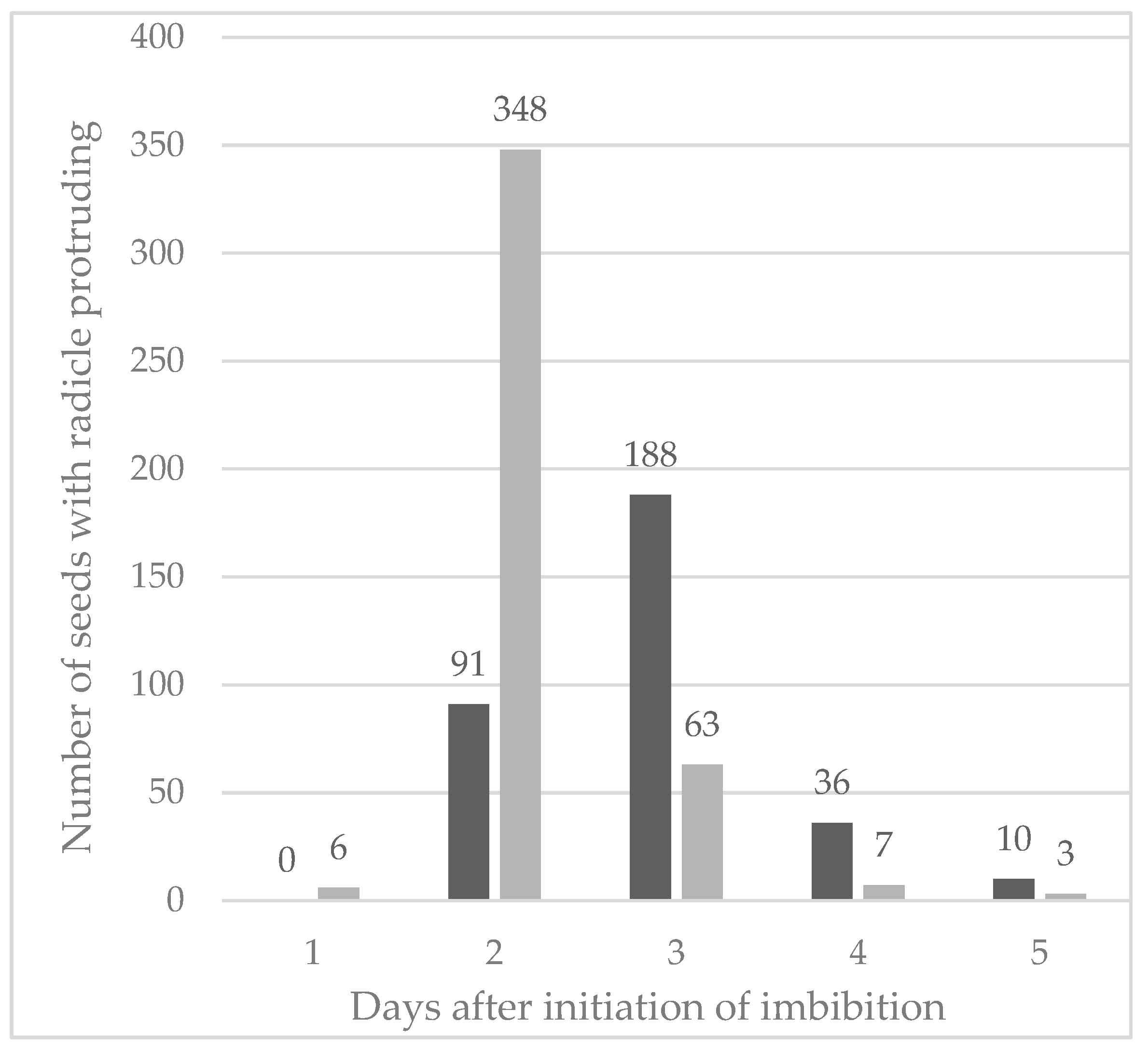
During the collection of germination data, it became obvious that the rate of imbibition/germination for wrinkled seeds was slower than that for round seeds. Most round seeds were fully imbibed after 24 h and (if germinating) showed a protruding radicle after 48 h (Figure 2). In contrast, many of the wrinkled seeds did not fully imbibe in the first 24 h, and radicle emergence maximized only after 72 h (Figure 2). The average time to radical emergence for round seeds was 2.2 days, whereas that for wrinkled seeds was 2.9 days. In several cases, the time allowed for germination of wrinkled seeds was extended to a sixth day, but none of these residual seeds germinated.

3.4. Analysis of Hard Seeds Gave Ambiguous Results

In the overall analysis, of the approximately 2500 seeds examined, nearly 240 were hard-seeded. However, nearly half the hard seeds were present in one population, B06-3, and constituted about a third of the seeds studied from this population. Based on previous experience, the authors agreed that such a high percentage of hard seeds in one population was exceptional and that the results from B06-3 might overwhelm any general trend present in the other populations. Furthermore, the B06-3 results might represent a more consistent sample than a combination of the 20 other populations. We, therefore, analyzed B03-6 separately from a second ‘combined’ sample that consisted of results from 20 populations B03-11, B03-204, B03-251, B04-231, and B06-8, 11, 51, 67, 68, 79, 80, 85, 87, 91, 92, 189, 194a, 200, 214, and 303.
We compared the germination percentage in the hard-seeded class with that for the whole population or combined populations. In the B06-3 comparison, the 141 hard seeds analyzed gave a lower (73%) germination percentage than that population in general (88%, 388 seeds). However, for the combined comparison (2250 seeds of which 141 were identified as hard), the germination percentage of the hard-seeded class was slightly higher (91%) than that calculated for the combined total (84%). These ambiguous results for the hard-seeded character, as found in domesticated germplasm, prevent any conclusion regarding whether this trait could extend the life of seeds by protecting them from the effects of humidity or oxygen. Apparently, if the hard-seeded trait can influence seed longevity, it does not have an appreciable effect under the storage conditions at Montana State University.
In the analysis of the MxJ RIP, 21 lines produced seeds with thick testas comparable to the P. sativum ssp elatius parent (JI1794), which is clearly distinct from the ‘hard’ seeded phenotype found in domesticated germplasm because the testa was much more difficult to nick with a scalpel. Of these lines, 18 gave 80% germination or better and 3 displayed a germination percentage of <40%. In contrast, only 12 lines consistently exhibited thin testas that imbibed within 24 h of contact with water. Half of these showed a noticeable loss of germination percentage. For the remaining lines, including a significant portion with the unpigmented, wrinkled phenotype, we either had insufficient seed for the test or they exhibited an intermediate testa thickness (requiring nicking before they would imbibe but the testa was relatively easily to penetrate with a scalpel). The marked skewing of the hard-seeded category towards high germination percentage compared to the thin-seeded category suggests that the thick testa found in wild pea germplasm may inhibit the ageing process slightly.

3.5. Small Breaks in the Testa Did Not Significantly Influence Loss of Germination Capability

For population A13-111, where small nicks in the testa had been purposely made shortly after harvest on some of the seeds, there were no significant differences in germination percentage either in the round-seeded or the wrinkled-seeded class (Table 3). This result was surprising in that it suggested that testa intactness is not a factor important for seed longevity.

3.6. The Influence of Testa Browning on Loss of Germinability

A correlation between testa browning and reduction in germination percentage was difficult to establish. In the oldest population (A95-3), most of the testas were brown or browning, and this population also had the lowest germination percentage. However, in the population with the next lowest germination rate (B00-179), none of the testas had begun to brown. Except for A04-cross5, most of the populations displayed little difference in the germination rate for seeds with brown or browning testas and those with ‘not browning’ testa colour (Table 4). Due to the low number of brown seeds in the B05, B06, and Slow x SGR populations, we felt that a comparison of the germination percentages of brown versus non-brown seeds would have little value despite there being no clear trend in these differences (Table 4). However, all the B06 populations were harvested in the field during the summer of 2006 and were therefore all exposed to the same growth conditions and storage time. Combining the results from the B06 populations gave an average germination rate of 95% for the brown seeds and 91% for the non-brown seeds, which was not significant (Table 4).
In contrast, the A04-cross5 displayed a highly significance difference (23% vs. 100%) in these germination percentages. Further scrutiny of this population revealed that browning phenotypes could be separated into two categories: (1) completely brown and (2) browning but not uniformly brown. In addition, several seeds placed in the ‘not brown or browning’ category had been noted as having very slightly browning testas. None of the 5 completely brown seeds germinated, 7 of the 26 browning seeds germinated, and all of the very slightly browning seeds germinated. Thus, in this population a definite correlation between degree of browning and germination percentage was evident. Why this population was exceptional remains unclear. However, even if we acknowledge that in some cases a clear correlation between the degree of testa browning and the loss of germination capacity exists, the correlation appears to be inconsistent across genotypes and not a reliable indicator of seed quality.

3.7. Loss of Germination Percentage with Age

There was a clear trend of a decrease in germination percentage with the age of the seed. The oldest seed tested (A95-3) displayed the lowest germination percentages when compared to those for younger populations with similar seed phenotypes. The second oldest population (B00-179) showed the second lowest set of germination rates for the respective phenotypes, and the youngest population (A13-111) gave relatively high germination percentages for all categories. However, the current study was not designed to specifically examine the overall loss of seed viability with time, and there were too many other variables inherent in the experimental design to attempt to establish an accurate correlation between time in storage and seed viability.

4. Discussion

The primary goal of this study was to determine if the a allele at Mendel’s seed pigmentation locus and the r allele at his seed shape locus influence the rate at which pea seeds lose germination capacity under cool-temperature (5 °C) storage. Previous authors [16,18,28] have provided some evidence that the genes may be involved, as well as years of anecdotal observations by the senior author. The present study confirms that in a wide range of genetic backgrounds, both alleles significantly reduce germination percentage of seed lots stored for 20 years or more at cool temperatures.
Using radicle appearance as an indicator of germination gave us a simple measure of germination percentage and rate of the germination process. We realize that radicle emergence is not the only way to measure germination, and our data does not provide much information on whether the two mutants affect initiation of metabolism or seed vigour. Bewley et al. [29] and Welbaum et al. [30] both define three stages (seed germination: imbibition, nutrient conversion, and cell elongation and multiplication of germination). Of these, the presence or absence of a protruding radicle only addressed the final phase, although the difference in rate of appearance of the radicle may also indicate something about the other two phases. To acknowledge this limitation of our study, we have generally limited our wording to ‘germination percentage’ and minimized our use of the terms ‘seed ageing’ or ‘seed viability’.
Despite the wide range of genetic stocks used in the study, nearly all the populations examined displayed a loss of germination percentage associated with either or both mutations. These results indicate that when temperature and humidity are controlled, the two mutants operate in pathways that are among the most important for seed storage facilities to consider. The A locus codes a transcription factor that operates in the phenylpropanoid pathway [17]. The mutation produces a block in this pathway, preventing the biosynthesis of anthocyanins throughout the plant and a reduction in flavonoids and other products of the pathway (see Duenas et al. [31] and Jha et al. [32] for lists of such compounds typically found in the testa and cotyledons of pigmented and unpigmented pea seeds). Furthermore, the results from the Slow x SGR population, in which a different, unlinked mutation in the phenylpropanoid pathway was segregating, provide additional evidence that products of this pathway are responsible for the longer shelf life of seeds with pigmented testas. Products of the pathway include numerous polyphenols that are known for their antioxidant properties [33], suggesting that the lack of certain of these products may explain the more rapid loss of germination capacity in lines homozygous for either the a or a2 alleles. At the very least, the similar effects of two different mutations in the phenylpropanoid pathway indicate that the a and a2 mutations are responsible for the effects on germination percentage and not closely linked loci.
Based on the considerable evidence that reactive oxygen species play a role in seed ageing, it is possible that flavonoid compounds, or some similar product of the phenylpropanoid pathway, act as important antioxidants in the seed, protecting its critical components from oxidizing compounds. Beninger et al. [34] studied the darkening process in the testa of pinto bean and found that procyanidin polymers decreased with ageing, accompanied by an increase in a catechin–kaempferol adduct. Our analyses of the effect of testa anthocyanins, testa nicking, and seed browning on seed germination percentage were, in part, performed to determine if the testa represents an important barrier to oxygen diffusing into the embryo and cotyledon and if oxidation of compounds in the testa affects seed longevity. Our results are preliminary and require verification or clarification, but we were unable to demonstrate a specific protective role for the testa under the storage conditions to which the seeds were exposed. A mutation that increased testa anthocyanin did not increase seed longevity; the browning phenomenon that reflects the oxidation of components in the testa during storage did not display a strong correlation with ability of the seed to germinate except in one population; and compromising the intactness of the testa by making small nicks through it to the cotyledonary tissue before storage did not change germinability, at least for the first decade of storage. This last finding stands in contrast to those of Powell and Matthews [13], and we attribute the differing results to the seeds being totally submerged in water in their study, in contrast to being placed between wet filter paper discs in the present investigation. The greater exposure of the testa to an aqueous environment in Powell and Matthews [13] probably also explains the much more rapid imbibition rate they reported (all varieties they studied possessed a wrinkled-seeded phenotype).
As is the case for the a allele, we are confident that it is the action of the r allele and not some tightly linked gene that is responsible for the decline in germination rate in the many comparisons present in Table 1. In this case, we refer to the work of Lyall et al. [18]. These authors reported a reduction in seed longevity in both lines homozygous for the r allele and in lines homozygous for the rb allele. These two alleles are products of different loci on separate chromosomes. The two loci encode two different enzymes in starch synthesis (starch branching enzyme and ADP glucose pyrophosphorylase, respectively), and their mutant alleles happen to produce similar phenotypes. The importance of this conclusion is that the influence of the allele r on seed germination must act through a different mechanism than that of the a allele. Most likely, the r and rb mutants impact phase 2 of germination (nutrient mobilization), although just why there is a drop in germination percentage and not just germination rate is unclear. We initially hypothesized that having a wrinkled seed coat might cause more cracks to be generated in the testa during seed procession. However, our findings demonstrate that nicks or cracks in the testa do not have a discernible effect on germination percentage (Table 3).
The slower rate of germination of wrinkled seeds imposes a complication on our study. We noticed that after five days many of the ungerminated peas had begun to deteriorate. Although in most instances the seed remaining ungerminated after five days appeared free of pathogens, it often showed small drops of exudate and occasionally marked softening of the cotyledonary tissue. It could be argued that some of the reduction in germination percentage observed for wrinkled seed was due to the slower germination rate of these seeds rather than a direct effect of changes that occurred during storage. Indeed, the high incidence of the hard-seeded trait (causing a 24 h delay in the beginning of imbibition) in combination with the slower germination of the wrinkled seed may have contributed to the lower germination percentage of wrinkled seed in the B06-3 population. However, the consistency of the finding of a lower germination percentage in wrinkled seeds coupled with the healthy appearance of seed germinating on days four or five of our experiments suggests that this potential complication did not influence our results significantly.
These findings should have considerable relevance for operations in seed germplasm facilities, particularly those working with peas and other pulses. Other mutations in pea may influence the storage life of a pea seed, but these would be relatively rare. In contrast, a large fraction of the pea lines maintained in many pea germplasm collections possess unpigmented testa and/or wrinkled seed because nearly all the commercial varieties released in the past century have been unpigmented and all commercial pea lines intended for the fresh and frozen market have the wrinkled phenotype. The half-life of pea seed samples is not constant under specific environmental conditions. Our results suggest that the half-life of unpigmented, wrinkled seed is about half that of seeds with a wildtype phenotype. The shorter shelf life of such genotypes needs to be considered when planning schedules for rejuvenation of seed stocks.

5. Conclusions

As anticipated from previous findings by Powell [16], we found that disruption of the phenylpropanoid pathway reduced seed longevity in the garden pea. Powell supported her conclusion using near isogenic lines that differed for alleles at the A locus. We confirmed our initial findings by examining a second mutation (a2) in the phenylpropanoid pathway that also produces white flowers and an unpigmented testa. Evidence was also provided that the wrinkled seed mutation reduces seed storage life to approximately the same degree as the a mutation. We further suggest that the hypothesis by Powell that rapid imbibition is associated with loss of seed viability probably is a result of the procedure (submerging the seed in water) they used. In our experiments, the more slowly imbibing wrinkled seed phenotype displayed shorter, not longer, shelf life of the seed.
The similarity of the effects of the a and a2 mutations, as well as that of the r and rb mutations on loss of germination percentage, indicates that it is the alteration or loss of the products of the phenylpropanoid and starch synthesis pathways and not an immediate effect of any of the mutations that produce the observed decrease. For both pairs of mutations, the mutations target different steps in the respective pathways. It is likely that other mutations in pea that disrupt these pathways may also reduce seed shelf life. Mutations in other pulse crops that affect these two pathways would also be predicted to influence seed viability.
Other factors we investigated did not appear to have as important an influence on the loss of germination percentage under the storage conditions involved in the study. Although our experiments were limited and must be taken as preliminary, they did not reveal a protective role for the testa relative to the ageing process. The most surprising result was that the introduction of small nicks through the testa did not result in a greater loss in seed germinability over the first decade of storage. Although such nicks were made on the side of the seed opposite to that containing the embryo, they provided a more accessible route for water vapour and oxygen to cotyledonary and embryonic tissue than afforded by an intact testa.
We conclude that under the described storage conditions, the influence of relative humidity is minor compared to that of products of the phenylpropanoid pathway and carbohydrate metabolism. Our working hypothesis is that the processes resulting in a loss of germination in pea seeds in cool temperate storage reflect changes occurring in the embryonic and cotyledonary tissues. There appear to be at least two metabolic pathways involved that probably act by different mechanisms. The pathway involving the phenylpropanoid pathway most likely involves protection of the embryonic cells against reactive oxygen species generated by the metabolic processes in the stored seed. The influence of storage carbohydrate is less clear but may either involve phase II processes during germination or a slower rate of imbibition observed in homozygous rr seeds, allowing other factors interfering with the germination process to become more influential.

Supplementary Materials

The following supporting information can be downloaded at https://www.mdpi.com/article/10.3390/seeds5010007/s1. Tables S1 [Selected markers mapped in the MxJ recombinant inbred population and used to located regions influencing loss in seed] and Table S2 [Original data from population B03-251].

Author Contributions

N.F.W. performed the experiments and contributed to the writing of the manuscript. G.V. advised on experimental design, performed the statistical analyses, and contributed to the writing of the manuscript. All authors have read and agreed to the published version of the manuscript.

Funding

Support for this project came from the Montana State University Foundation.

Data Availability Statement

Nearly all parental pea lines are still maintained at Montana State University and available upon request. Seeds of 50 of the lines from the MxJ RIP are also available upon request. Segregation data for this RIP is available in EXCEL format. Residual seed from several of the original populations analyzed will be maintained and can be requested as long as supplies last.

Acknowledgments

The senior author thanks G.A. Marx, G.E. Harman, and A.C. Leopold, all formerly of Cornell University, for their enlightening discussions concerning pea genetics and seed ageing.

Conflicts of Interest

The authors declare no conflicts of interest.

Appendix A. Details of the 32 Populations Used in Seed Germination Tests

PopulationYear SeedOriginal
PopulationTypeCollected ParentsCharacteristics of Parent 1
MxJRecombinant2001–2003MN313Breeding line from Craig Grau, U. Minnesota (a, r)
inbred population JI1794P. sativum ssp. elatius from Golan Heights (A, R)
A95-3seed from F11995PI 193589P. sativum landrace from Ethiopia (A, R)
SparkleCommercial cultivar (PI 618586) (a, r)
B00-179seed from F12000JI1974Powdery mildew resistant line (A, R)
SparkleCommercial cultivar (PI 618586) (a, r)
B03-11seed from 63 F22003WL1487P. sativum ssp sativum Asiaticum (A, R)
SparkleCommercial cultivar (PI 618586) (a, r)
B03-204seed from F12003F1 hybridBreeding line x PI 220174 landrace (A, R)
SparkleCommercial cultivar (PI 618586) (a, r)
B03-251seed from 34 F22003GP01-78Majoret cross MSU Breeding line (a, R)
(plus 8 duplicated 2) PI 220174landrace from Afghanistan (A, R)
A04-cross5seed from F22004Marx 15299Genetic stock, USDA-WRPIS, Pullman, WA (A, R)
Marx 15253Genetic stock, USDA-WRPIS, Pullman, WA (a, R)
B04-231seed from F1200487-19 I-aRIL derived from Slow x JI1794 (A, R)
WL1018Genetic marker line, Weibullsholm Inst., (A, r)
B04-271seed from BC1F22004CMG-290Breeding line (Crites-Moscow Growers) (a, r)
PI 220174P. sativum landrace from Afghanistan (A, R)
B05-425seed from200519 I-gRIL derived from Slow x JI1794 (A, R)
bulked F2 WL1143Genetic marker line, Weibullsholm Inst. (a, r)
B06-3seed from2006Deltacommercial cultivar (PI 594358) (a, R)
bulked F2 RERP. sativum landrace (A, R)
B06-8seed from2006RERP. sativum landrace (A, R)
bulked F2 C05-50forage-type breeding line (a, R)
B06-11seed from2006B05-8Majoret (PI 594367) x Bolero (PI 635202) (a, r)
single F2 RERP. sativum landrace (A, R)
B06-51seed from2006C05-30Majoret derivative (a, r)
bulked F2 OSU-442-15Breeding line from Oregon State Univ. (a, R)
B06-67seed from2006C05-86Majoret derivative (a, R)
bulked F2 C05-35Majoret (PI 594367) x Bolero (PI 635202) (a, r)
B06-68seed from2006C05-37Breeding line from Montana State Univ. (a, R)
bulked F2 C05-38AMajoret (PI 594367) x Bolero (PI 635202) (a, r)
B06-79seed from2006C05-38AMajoret (PI 594367) x Bolero (PI 635202) (a, r)
bulked F2 C05-82 Majoret derivative (a, R)
B06-80seed from2006C05-83Majoret derivative (a, R)
bulked F2 C05-38A Majoret (PI 594367) x Bolero (PI 635202) (a, r)
B06-85seed from2006C05-73 Breeding line from Montana State Univ (a, R)
bulked F2 C05-39 Majoret (PI 594367) x Bolero (PI 635202) (a, r)
B06-87seed from2006C05-91 Breeding line from Montana State Univ (A, R)
bulked F2 C05-41 Majoret (PI 594367) x Bolero (PI 635202) (a, r)
B06-91seed from 2006C05-46Breeding line from Montana State Univ (a, R)
bulked F2 CMG-307Breeding line (Crites-Moscow Growers) (a, r)
B06-92seed from2006C05-46Breeding line from Montana State Univ (A, R)
bulked F2 C05-47Bolero derivative (A, r)
B06-189seed from F12006C05-76Majoret derivative (a, R)
C05-34 Majoret (PI 594367) x Bolero (PI 635202) (a, r)
B06-194aseed from F12006OSU-442-15Breeding line from Oregon State Univ (a, R)
C05-38A Majoret (PI 594367) x Bolero (PI 635202) (a, r)
B06-200seed from F12006C05-38AMajoret (PI 594367) x Bolero (PI 635202) (a, r)
C05-82Majoret derivative (a, R)
B06-203seed from F12006C05-73 Majoret derivative (a, R)
C05-39 Majoret (PI 594367) x Bolero (PI 635202) (a, r)
B06-204seed from F12006C05-40BBreeding line from Montana State Univ (a, r)
OSU-442-15Breeding line from Oregon State Univ (a, R)
B06-208seed from F12006C05-43Breeding line from Montana State Univ (a, r)
OSU-442-15Breeding line from Oregon State Univ (a, R)
B06-214seed from F12006C05-82 Majoret derivative (a, R)
C05-47A Breeding line from Montana State Univ (a, r)
B06-303seed from2006PI 273679P. sativum landrace from Ethiopia (A, R)
single F2 FR781Breeding line (a, r)
Slow x SGRF3 families2006SlowGenetic marker line developed by NFW (A, r)
SGRP. sativum landrace with the a2 mutation (a2, R)
A13-111seed from2013PI 220174Landrace from Afghanistan (A, R)
bulked F4 A1078-239Marker line from G.A Marx, Cornell Univ (A, r)
1 Original parents (pollen source listed second) with testa pigmentation and seed shape phenotypes given in parentheses. 2 Eight of the F3 families segregated at the A locus and produced sufficient seed to warrant separation into pigmented and unpigmented samples. Thus, seed from 42 samples were initially analyzed in this population.

References

  1. Chhabra, R.; Shabnam; Singh, T. Seed aging, storage, and deterioration: An irresistible physiological phenomenon. Agric. Rev. 2019, 40, 234–238. [Google Scholar] [CrossRef]
  2. Pirredda, M.; Fananas-Pueyo, I.; Onate-Sanchez, L.; Mira, S. Seed longevity and ageing: A review on physiological and genetic factors with an emphasis on hormonal regulation. Plants 2024, 13, 41. [Google Scholar] [CrossRef]
  3. Roberts, E.H. Predicting the storage life of seeds. Seed Sci. Technol. 1973, 1, 499–514. [Google Scholar]
  4. Ellis, R.H.; Roberts, E.H. Improved equations for the prediction of seed longevity. Ann. Bot. 1980, 45, 13–30. [Google Scholar] [CrossRef]
  5. Harrington, J.F. Seed storage and longevity. In Seed Biology; Kozlowski, T.T., Ed.; Academic Press: New York, NY, USA, 1972; Volume III, pp. 145–245. [Google Scholar]
  6. Zhang, K.; Zhang, Y.; Sun, J.; Meng, J.; Tao, J. Deterioration of orthodox seeds during ageing: Influencing factors, physiological alterations and the role of reactive oxygen species. Plant Physiol. Biochem. 2021, 158, 475–485. [Google Scholar] [CrossRef]
  7. Adetunji, A.E.; Adetunji, T.L.; Varghese, B.; Sershen; Pammenter, N.W. Oxidative stress, ageing and methods of seed invigoration: An overview and perspectives. Agronomy 2021, 11, 2369. [Google Scholar] [CrossRef]
  8. Nagel, M.; Börner, A. The longevity of crop seeds stored under ambient conditions. Seed Sci. Res. 2010, 20, 1–12. [Google Scholar] [CrossRef]
  9. Haferkamp, M.E.; Smith, L.; Nilan, R.A. Studies on aged seeds I. Relation of age of seed to germination and longevity. Agron. J. 1953, 45, 434–437. [Google Scholar]
  10. Walters, C.; Wheeler, L.M.; Grotenhuis, J.M. Longevity of seeds stored in a genebank: Species characteristics. Seed Sci. Res. 2005, 15, 1–20. [Google Scholar] [CrossRef]
  11. Powell, A.A.; Matthews, S. Deteriorative changes in pea seeds (Pisum sativum L.) stored in humid or dry conditions. J. Exp. Bot. 1977, 28, 225–234. [Google Scholar] [CrossRef]
  12. Powell, A.A.; Matthews, S. The damaging effect of water on dry pea embryos during imbibition. J. Exp. Bot. 1978, 29, 1215–1229. [Google Scholar] [CrossRef]
  13. Powell, A.A.; Matthews, S. The influence of testa condition on the imbibition and vigour of pea seeds. J. Exp. Bot. 1979, 30, 193–197. [Google Scholar] [CrossRef]
  14. Powell, A.A.; Harman, G.E. Absence of a consistent association of changes in membranal lipids with the ageing of pea seeds. Seed Sci. Technol. 1985, 13, 659–667. [Google Scholar]
  15. Gorecki, R.J.; Harman, G.E. Effects of antioxidants on viability and vigor of aging pea seeds. Seed Sci. Technol. 1987, 15, 109–117. [Google Scholar]
  16. Powell, A.A. The importance of genetically determined seed coat characteristics to seed quality in grain legumes. Ann. Bot. 1989, 63, 169–175. [Google Scholar] [CrossRef]
  17. Hellens, R.P.; Moreau, C.; Lin-Wang, K.; Schwinn, K.E.; Thomson, S.J.; Fiers, M.W.E.J.; Frew, T.J.; Murray, S.R.; Hofer, J.M.I.; Jacobs, J.M.E.; et al. Identification of Mendel’s white flower character. PLoS ONE 2010, 5, e13230. [Google Scholar] [CrossRef]
  18. Lyall, T.W.; Ellis, R.H.; John, P.; Hedley, C.L.; Wang, T.L. Mutant alleles and the rugosus loci in pea affect seed moisture sorption isotherms and the relations between seed longevity and moisture content. J. Exp. Bot. 2003, 54, 445–450. [Google Scholar] [CrossRef] [PubMed]
  19. Veselovsky, V.A.; Veselova, T.V. Lipid peroxidation, carbohydrate hydrolysis, and Amadori—Maillard reaction at early stages of dry seed aging. Russ. J. Plant Physiol. 2012, 59, 811–817. [Google Scholar] [CrossRef]
  20. Zablatzká, L.; Balarynová, J.; Klčová, B.; Kopecký, P.; Smýkal, P. Anatomy and Histochemistry of Seed Coat Development of Wild (Pisum sativum subsp. elatius (M. Bieb.) Asch. et Graebn. and Domesticated Pea (Pisum sativum subsp. sativum L.). Int. J. Mol. Sci. 2021, 9, 4602. [Google Scholar] [CrossRef]
  21. Williams, O.R.; Vander Schoor, J.K.; Butler, J.B.; Hecht, V.F.G.; Weller, J.L. Physical seed dormancy in pea is genetically separable from seed coat thickness and roughness. Front. Plant Sci. 2024, 15, 1359226. [Google Scholar] [CrossRef]
  22. Werker, E.; Marbach, I.; Mayer, A.M. Relation between the anatomy of the testa, water permeability and the presence of phenolics in the genus. Pisum. Ann. Bot. 1979, 43, 765–771. [Google Scholar]
  23. Marx, G.A.; Weeden, N.F.; Muehlbauer, F.J. A-2: A new locus controlling anthocyanin production in Pisum. Pisum Newsl. 1989, 21, 35–36. [Google Scholar]
  24. White, O.E. Studies of inheritance in Pisum. II. The present state of knowledge of heredity and variation in peas. Proc. Am. Phil. Soc. 1917, 56, 487–588. [Google Scholar]
  25. Torres, A.M.; Weeden, N.F.; Martin, A. Linkage among isozyme, RFLP and RAPD markers in Vicia faba. Theor. Appl. Genet. 1993, 85, 609–615. [Google Scholar] [CrossRef]
  26. Brauner, S.; Murphy, R.L.; Walling, J.G.; Przyborowski, J.; Weeden, N.F. STS markers for comparative mapping in legumes. J. Am. Soc. Hort. Sci. 2002, 127, 616–622. [Google Scholar]
  27. Hemmat, M.; Weeden, N.F.; Brown, S.K. Mapping and evaluation of Malus X domestica microsatellites in apple and pear. J. Am. Soc. Hort. Sci. 2003, 128, 515–520. [Google Scholar]
  28. Rayner, T.; Moreau, C.; Ambrose, M.; Isacc, P.G.; Ellis, N.; Domoney, C. Genetic variation controlling wrinkled seed phenotypes in Pisum: How lucky was Mendel? Int. J. Mol. Sci. 2017, 18, 1205. [Google Scholar] [CrossRef]
  29. Bewley, J.D.; Black, M. Seeds: Physiology of Development and Germination, 2nd ed.; Springer: Boston, MA, USA, 1994; ISBN 978-0-306-44748-8. [Google Scholar]
  30. Welbaum, G.E.; Bradford, K.J.; Yim, K.-O.; Booth, D.T.; Oluoch, M.O. Biophysical, physiological and biochemical processes regulating seed germination. Seed Sci. Res. 1998, 8, 161–172. [Google Scholar] [CrossRef]
  31. Duenas, M.; Estrella, I.; Hernandez, T. Occurrence of phenolic compounds in the seed coat and the cotyledon of peas (Pisum sativum L.). Eur. Food Res. Technol. 2004, 219, 116–123. [Google Scholar] [CrossRef]
  32. Jha, A.B.; Purves, R.W.; Elessawy, F.M.; Zhang, H.; Vandenberg, A.; Warkentin, T.D. Polyphenolic profile of seed components of white and purple flower pea lines. Crop Sci. 2019, 59, 2711–2719. [Google Scholar] [CrossRef]
  33. Pandey, K.B.; Rizvi, S.I. Plant polyphenols as dietary antioxidants in human health and disease. Oxid. Med. Cell. Longev. 2009, 2, 270–278. [Google Scholar] [CrossRef] [PubMed]
  34. Beninger, C.W.; Gu, L.; Prior, R.L.; Junk, D.C.; Vandenberg, A.; Bett, K.E. Changes in polyphenols of the seed coat during after-darkening process in pinto beans (Phaseolus vulgaris L.). J. Agric. Food Chem. 2005, 53, 7777–7782. [Google Scholar] [PubMed]
Figure 1. Correlation of loss of germination percentage with segregating markers on each of the seven chromosomes in the MxJ recombinant inbred population. The horizontal axis identifies the location (in cM) of the segregating marker. The vertical axis presents the negative log of the odds (LODs) for the joint segregation analysis of the marker and the germination evaluation. The position of the seed shape locus (R) is shown on chromosome 3 and that of the testa pigmentation locus (A) is shown on chromosome 6.
Seeds 05 00007 g001
Figure 2. Distribution of time to radicle emergence for round (grey) and wrinkled (black) seeds.
Seeds 05 00007 g002
Table 1. Germination results matched with segregation for either testa pigmentation or seed shape.
PopulationPhenotype of Seed 1Number of Seeds Tested 2Hard Seed 3Brown Testa 4Number of Seeds GerminatedPercent Germination 5
Populations segregating for testa pigmentation
MxJA, _29 lines (145)n/a011277 ***
a, _22 lines (110)n/an/a4642 ***
B03-11A, _44 families (224)314720893 ***
a, _19 families (95)1n/a7377 ***
B03-251A, R360386326574 ns
a, R20412n/a16174 ns
A04-cross5A, R14 families (70)17314767 ns
a, R7 families (35)4n/a1749 ns
B05-425A, _14 families (70)016593 ***
a, _13 families (65)0n/a4062 ***
B06-3A, R199841019296 ***
a, R18956n/a15079 ***
B06-8A, R256325100 ns
a, R252n/a25100 ns
B06-68A, r25221872 ns
a, r252n/a1664 ns
B06-87A, _55141055100 ***
a, _551n/a4582 ***
B06-303A, _156652014694 *
a, _459n/a3884 ns
Slow x SGRA2, R1731813980 ***
a2, R600n/a2745 ***
Populations segregating for seed shape
MxJ_, R29 lines (100)n/a07777 **
_, r22 lines (155)n/an/a8152 **
A95-3A, R400most1845 ***
A, r330most26 ***
B00-179A, R32101959 *
A, r32101031 *
B03-11_, R39 families (194)314719098 **
_, r24 families (120)1n/a9176 **
B03-204a, R507n/a50100 **
a, r501n/a4386 **
B04-231A, R402n/a40100 ***
A, r389n/a2566 ***
B04-271a, R690n/a6797 *
a, r700n/a4970 ns
B05-425_, R18 families (90)0--7684 *
_, r9 families (45)0--2964 *
B06-11a, R294n/a29100 ns
a, r311n/a2890 ns
B06-51a, R255n/a2496 ns
a, r252n/a2080 ns
B06-67a, R202n/a20100 ns
a, r150n/a1493 ns
B06-79a, R204n/a20100 *
a, r205n/a1470 *
B06-80a, R206n/a20100 *
a, r208n/a1365 ns
B06-85a, R204n/a20100 **
a, r203n/a1050 **
B06-87A, _701056694 ns
a, _40553485 ns
B06-91a, R497n/a4896 ***
a, r503n/a2754 ***
B06-92a, R5011n/a4998 ***
a, r504n/a3060 ***
B06-189a, R503n/a4998 ***
a, r507n/a1734 ***
B06-194aa, R102n/a10100 ns
a, r101n/a990 ns
B06-200a, R252n/a25100 ns
a, r253n/a2392 ns
B06-203a, R252n/a2392 ns
a, r250n/a1872 ns
B06-208A, R250025100 ns
A, r250025100 ns
B06-214a, R491n/a49100 ns
a, r504n/a4488 ns
B06-303_, R106441210296 ***
_, r953087478 ***
1 A = pigmented testa, a = unpigmented testa, R = round seed, r = wrinkled seed. 2 For lines and families, in nearly all cases 5 seed per line or family were tested. The total number of seeds tested is given in parentheses). 3 Number of seeds that did not imbibe during the first 24 h after contact with water (indicates water-impermeable testa). n/a = not applicable (testa was nicked so that all seeds imbibed). 4 Number of seeds showing a distinct browning of testa, indicating oxidation of products of the phenylpropanoid pathway (not applicable for seeds with unpigmented testa). 5 Asterisks indicate probability that the value represents a significant deviation from the mean for the population. * = p < 0.05, ** = p < 0.01, *** = p < 0.001, ns = non-significant.
Table 2. Germination results for populations in which both the A and R loci segregated.
PopulationPhenotype of Seed 1No. Seeds Tested 2Hard Seed 3Brown Testa 4No. Seeds GerminatedPercent Germination 5
MxJA, R14 lines (70)n/a05984 (a)
A, r15 lines (75)n/a05371 (b)
a, R6 lines (30)n/an/a1860 (c, d)
a, r16 lines (80)n/an/a2835 (d)
B03-11A, R27 families(134)2830134100 (a)
A, r17 families (85)3176981 (c)
a, R12 families (60)1n/a5693 (b)
a, r7 families (35)0n/a2263 (d)
B05-425A, R11 families (55)015091 (a)
A, r3 families (15)0015100 (a)
a, R7 families (35)0n/a2674 (b)
a, r6 families (30)0n/a1447 (c)
B06-87A, R3510535100 (a)
A, r204520100 (a)
a, R350n/a3189 (b)
a, r201n/a1470 (c)
B06-303A, R8137127998 (a)
A, r752885979 (b)
a, R257n/a2392 (a)
a, r202n/a1575 (b)
1 A = pigmented testa, a = unpigmented testa, R = round seed, r = wrinkled seed. 2 For lines and families, in nearly all cases 5 seed per line or family were tested. The total number of seeds tested is given in parentheses. 3 Number of seeds that did not imbibe during the first 24 h after contact with water (indicates water-impermeable testa). n/a = not applicable (testa was nicked so that all seeds imbibed). 4 Number of seeds showing a distinct browning of testa (not applicable for seeds with unpigmented testa). 5 Significant groupings are indicated by letters.
Table 3. Effect of post-harvest nicking on germination percentage after 12 years in storage.
Seed PhenotypeTreatment Number of SeedsNumber GerminatingPercentage
Roundnicked191684 ns 1
Roundintact191789 ns
Wrinklednicked292586 ns
Wrinkledintact302687 ns
1 ns = not differing significantly from other categories.
Table 4. Effect of testa browning on germination rate.
PopulationNo. Brown
Seeds
Germination
Percent
Total Pigmented
but Not Browning
Germination
Percent 1
B03-114796 ns 2172100 ns 2
B03-2516381 ns29774 ns
A04-cross 53123 ***69100 ***
B05-42511006593
B06-3109018996
B06-8310022100
B06-6821002372
B06-87 1010045100
B06-303208514688 ns
Slow x SGR86216580
Combined ’06 35395 ns42591 ns
1 For populations with 10 or fewer brown seeds a statistical analysis for significance was not performed. Rather, at least for those populations grown in 2006 (indicated with a ‘B06’ designation) which formed a relatively uniform set, the results were combined and presented on the last line of the table. 2 ns indicates that the difference between the two germination percentages is not significant; *** indicates that the difference is significant at p < 0.001. 3 combined results from populations harvested in summer 2006 (Student’s t-test = 0.56).
Disclaimer/Publisher’s Note: The statements, opinions and data contained in all publications are solely those of the individual author(s) and contributor(s) and not of MDPI and/or the editor(s). MDPI and/or the editor(s) disclaim responsibility for any injury to people or property resulting from any ideas, methods, instructions or products referred to in the content.