

Wild Seeds as Sustainable Sources of C18-Series Bioactive Fatty Acids: Metabolic Diversity, Nutritional Value, and Functional Applications

 ,
,  , , ,
, , ,
Abstract
1. Introduction
2. Methodology
2.1. Search Strategy and Databases
2.2. Inclusion and Exclusion Criteria
2.3. Screening and Data Extraction
2.4. Quality Appraisal
2.5. Data Synthesis and Analysis
2.6. Ethical Considerations
3. Seeds as Structured Nutrient Reservoirs
3.1. Nutrient Storage in Seeds
3.2. Role of Nutrients During Germination
3.2.1. Nutrient Transport Mechanisms
3.2.2. Seed Structure and Lipid Accumulation
4. Bioactive Fatty Acids in Wild Seeds and Other Bioactive Components
4.1. Nutritional and Health Roles of Bioactive FAs
4.2. Lipid Composition and Bioactive Compounds Profiles of Wild Seeds
4.2.1. Oil Yield and Composition
4.2.2. Minor Bioactives
4.2.3. Taxonomic Diversity

| Plant Species | Oil Yield (%) | Main Fatty Acids | Other Bioactive Components | References |
|---|---|---|---|---|
| Punica granatum (Pomegranate) | 12.92 | Punicic acid (79.64%), PA (3.29%), Stearic acid (2.43%) | Saponification number (192.91), FFA (0.20%), Peroxide value (3.03) | [58] |
| Panax ginseng (Asian Ginseng) | 9–12 | Petroselinic acid (>60%), OA (15–17%), LA (15–16%) | - | [61] |
| Glycine soja | - | ALA (20%), OA (44–46%), LA (42–44%) | Protein, Ascorbic acid, Carotene, Enzyme activities (SOD, CAT, POD, PPO, RNase, Acid phosphatase, Esterase, Amylase) | [62,63] |
| Onosma microcarpum | 17.5–20.5 | PUFAs (74–80%) | Tocopherols (18.2 mg/100 g), Sterols (77.5 mg/100 g) | [54] |
| Prunus virginiana (Chokecherry) | 3.4–11.5 | LA (27.9–65.6%), OA (19.7–61.9%), ALA (29.2–30.8%) | Tocopherols (595–2837 mg/kg), Sterols (β-sitosterol, Δ5-avenasterol, cycloartenol, campesterol, stigmasterol, gramisterol) | [64] |
| Torreya grandis (Chinese nutmeg yew) | 17.68 | LA, OA, Sciadonic acid | - | [65] |
| Pyrus glabra (Smoothleaf Pear) | 33 | OA (49.51%), LA (46.99%) | α-tocopherol (69.80 mg/100 g), Antioxidant activity | [66,67] |
| Pyrus syriaca (Syrian Pear) | 26 | LA (46.99%), OA (41.43%) | α-tocopherol (45.50 mg/100 g), Antioxidant activity | [67] |
| Jatropha Curcas (Physic Nut) | 52–56 | OA (44–46%), LA (42–44%), PA (4–6%), Stearic acid (3–4%) | - | [59] |
| Various Nigerian wild seeds | 19–58.5 | - | Protein (6.5–24.2%), Minerals (Mg, Fe, Zn, Mn, Ca, Na, K, P), Phytate (1043.6–2905.2 mg/100 g), Cyanide (3.7–6.4 mg/kg) | [26] |
4.3. The Importance of the n-6/n-3 FA Ratio
5. Metabolism and Biosynthesis of C18 BFAs
5.1. Overview of Fatty Acid Biosynthesis
5.2. Summary of C18 Fatty Acid Metabolism
6. Profiles and Functions of Major C18 Bioactive Fatty Acids
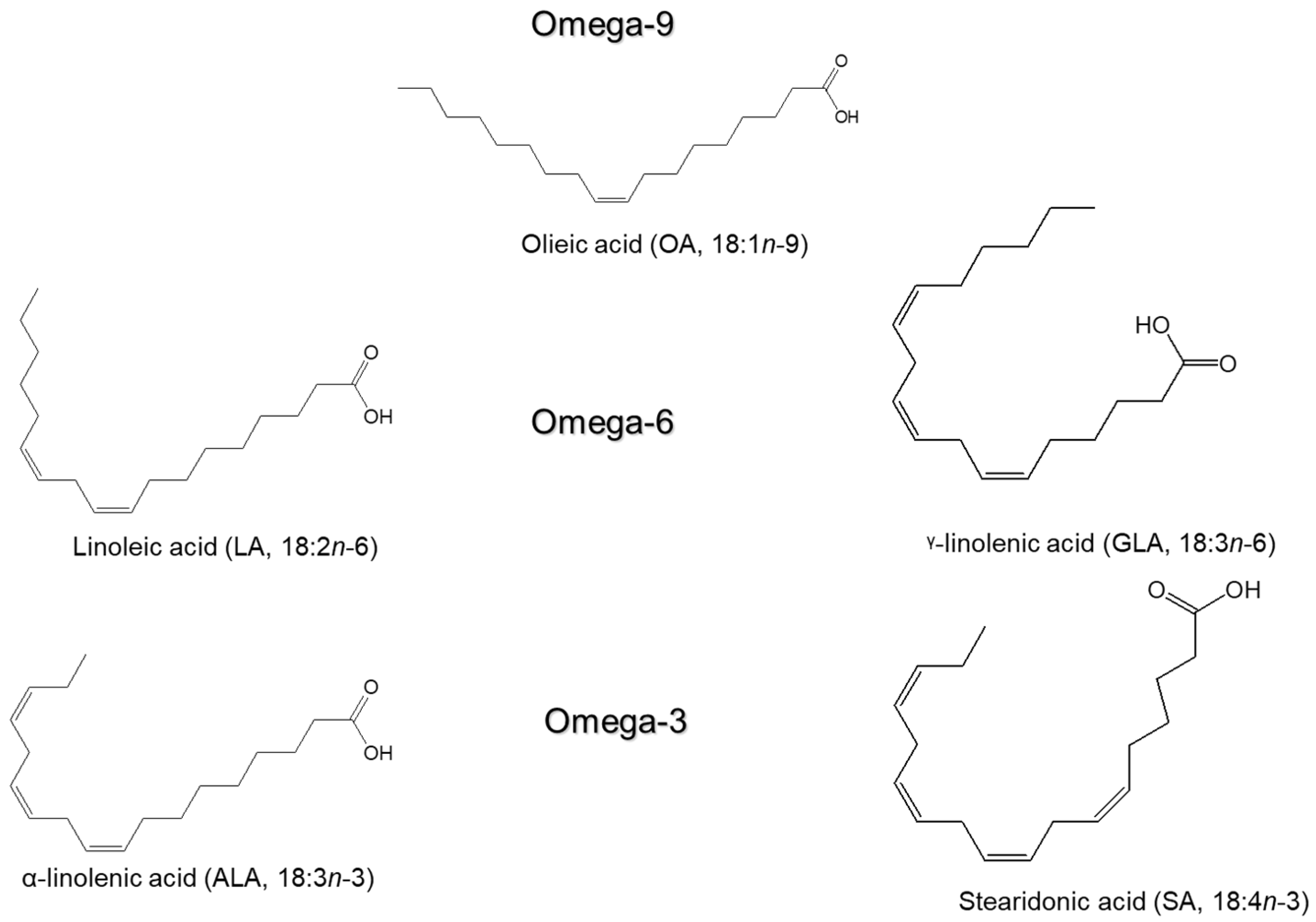
6.1. Oleic Acid (OA 18:1n-9)
| Family/Species | Fatty Acids (FA% of Total FAs) | References | |||||||||
|---|---|---|---|---|---|---|---|---|---|---|---|
| %Oil | 16:0 | 18:0 | 18:1n-9 | 18:2n-6 | 18:3n-3 | 18:3n-6 | 18:4n-3 | 20:1n-9 | 22:1n-9 | ||
| Anacardiaceae | |||||||||||
| Pistacia atlanticus (Atlas Pistachio) | 15.3 | 13.1 | 2.3 | 50.7 | 29.8 | 0.6 | - | - | 0.3 | - | [78] |
| Pistacia terebinthus (Terebinth) | 41.2 | 21.6 | 2.1 | 46.9 | 21.7 | 0.7 | - | - | 0.2 | - | [79] |
| Sclerocarya birrea (Marula) | 53.0 | 14.6 | 8.8 | 67.4 | 5.9 | 0.9 | - | - | - | - | [80] |
| Rosaceae | |||||||||||
| Prunus persica (Peach) | 48.0 | 5.85 | 1.45 | 58.00 | 30.80 | 0.95 | - | - | - | 1.60 | [81] |
| Prunus pedunculata (Long Peduncled Almond) | 50.4 | 1.5 | 0.5 | 66.5 | 30.8 | 0.1 | - | - | - | - | [82] |
| Prunus triloba (Flowering Almond) | 46.3 | 1.8 | 0.5 | 73.1 | 23.8 | 0.1 | - | - | - | - | [82] |
| Prunus mongolica (Mongolian almond) | 49.5 | 2.4 | 0.8 | 65.3 | 31.1 | 0.1 | - | - | - | - | [82] |
| Prunus tangutica (Tangut Cherry) | 43.6 | 5.0 | 1.9 | 75.4 | 17.0 | 0.1 | - | - | - | - | [82] |
| Prunus tenella (Russian Almond) | 45.9 | 3.1 | 1.1 | 71.7 | 23.6 | 0.1 | - | - | - | - | [82] |
| Prunus armeniaca (Apricot) | 8.8 | 4.7 | 0.9 | 62.4 | 28.9 | 0.12 | - | - | 0.1 | - | [83] |
| Pyrus glabra | 33.0 | 7.9 | 2.8 | 49.5 | 37.5 | 0.2 | - | - | - | - | [67] |
| Pinaceae | |||||||||||
| Pinus pinea (Stone Pine) | 44.9 | 6.5 | 3.5 | 38.6 | 47.6 | 0.7 | - | - | - | - | [84] |
| Poaceae | |||||||||||
| Avena fatua (Wild Oat) | 1.4 | 23.4 | 3.3 | 40.9 | 29.5 | - | - | - | - | - | [85] |
| Fabaceae | |||||||||||
| Bauhinia esculenta (Gemsbok Bean) | - | 14.1 | 6.5 | 47.9 | 24.6 | - | - | - | 1.0 | 1.8 | [86] |
| Meliaceae | |||||||||||
| Trichilia emetica (Natal Mahogany) | - | - | 2.2 | 48.5 | 10.4 | 1.0 | - | - | - | - | [86] |
| Myrtaceae | |||||||||||
| Myrcianthes pungens (Guabiyu) | 57.0 | 25.9 | 5.3 | 57.0 | 9.6 | 0.2 | - | - | 1.9 | - | [55] |
| Annonaceae | |||||||||||
| Rollinia sylvatica (Rollinia) | 54.4 | 20.8 | 4.3 | 54.4 | 20.5 | - | - | - | - | - | [55] |
| Boraginaceae | |||||||||||
| Pholistoma auritum (Fiesta Flower) | 56.1 | 12.3 | 1.9 | 56.1 | 26 | 2.1 | - | 1.6 | - | - | [87] |
6.2. Linoleic Acid (LA, 18:2n-6)
| Family/Species | Fatty Acids (FA% of Total FAs) | Source | |||||||||
|---|---|---|---|---|---|---|---|---|---|---|---|
| Oil% | 16:0 | 18:0 | 18:1n-9 | 18:2n-6 | 18:3n-3 | 18:3n-6 | 18:4n-3 | 20:1n-9 | 22:1n-9 | ||
| Amaranthaceae | |||||||||||
| Amaranthus retroflexus (Pigweed) | 7.2 | 9.7 | 2.0 | 23.3 | 61.5 | 1.1 | - | - | - | - | [90] |
| Boraginaceae | |||||||||||
| Symphytum creticum (Cretan Comfrey) | 47.1 | 10.7 | 3.1 | 17.0 | 39.0 | 1.3 | 23.2 | 0.7 | 2.1 | 1.1 | [91] |
| Alkanna graeca (Greek Alkanet) | 10.8 | 22.0 | 7.0 | 5.0 | 33.9 | 14.4 | 9.2 | 3.9 | 1.1 | 0.3 | [91] |
| Amaranthaceae | |||||||||||
| Chenopodium album (Lamb’s Quarters) | 9.1 | 8.4 | 0.9 | 20.7 | 56.3 | 6.5 | - | - | - | - | [85] |
| Asteraceae | |||||||||||
| Carthamus dentatus (Toothed Thistle) | 15.4 | 9.8 | 3.9 | 19.9 | 66.2 | - | - | - | - | - | [92] |
| Centaurea depressa (Iranian Knapweed) | 19.7 | 12.3 | 6.8 | 32.7 | 48.3 | - | - | - | - | - | [92] |
| Pinaceae | |||||||||||
| P. pinea (Stone Pine) | 44.9 | 6.5 | 3.5 | 38.6 | 47.6 | 0.7 | - | - | - | - | [84] |
| Cucurbitaceae | |||||||||||
| Cucurbita pepo (Pumpkin) | - | 13.1 | 5.7 | 24.9 | 54.2 | 0.12 | - | - | - | - | [93] |
| Grossulariaceae | |||||||||||
| Ribes alpinum (Alpine Currant) | 18.7 | 5.6 | 1.4 | 18.1 | 39.0 | 22.0 | 9.6 | 4.4 | - | - | [70] |
| R. nigrum (Blackcurrant) | 30.0 | 7.0 | 1.5 | 11.0 | 47.0 | 13.0 | 18.0 | 3.0 | - | - | [70] |
| R. uva-crispa (Gooseberry) | 18.0 | 7.5 | 1.0 | 17.0 | 40.0 | 19.5 | 11.0 | 4.5 | - | - | [70] |
6.3. α-Linolenic Acid (ALA, 18:3n-3)
| Family/Species | Oil (%) | Fatty Acids (FA% of Total FAs) | References | ||||||||
|---|---|---|---|---|---|---|---|---|---|---|---|
| 16:0 | 18:0 | 18:1n-9 | 18:2n-6 | 18:3n-3 | 18:3n-6 | 18:4n-3 | 20:1n-9 | 22:1n-9 | |||
| Boraginaceae | |||||||||||
| Buglossoides arvensis (Ahiflower) | ~18–40 (cultivar dependent) | ~6 | ~2 | ~12 | ~10.3 | ~48.5 | ~3.9 | ~18.6 | trace | trace | [35] |
| Echium parviflorum (Small-flowered Bugloss) | 12.7 | 6.6 | 3.0 | 8.0 | 10.1 | 47.6 | 7.1 | 17.3 | [35] | ||
| Echium plantagineum (Paterson’s Curse) | ~20–30 | ~6 | ~2–4 | ~16 | ~19 | ~30 | ~10 | ~13 | — | — | [35] |
| Echium vulgare (Viper’s Bugloss) | — | — | — | ~15–18 | ~18–22 | ~25–35 | ~8–12 | ~8–15 | — | — | [35] |
| Brassicaceae | |||||||||||
| Camelina sativa (Camelina) | 30–40 | 6–8 | 2–3 | 14–20 | 15–20 | 30–40 | — | — | trace | trace | [96] |
| Cannabaceae | |||||||||||
| Cannabis sativa (Hemp) | 25–35 | 6–12 | 2–4 | 8–20 | ~50–60 | 12–19 | ~2–4 (var.) | trace | trace | [97] | |
| Elaeagnaceae | |||||||||||
| Hippophae rhamnoides subsp. rhamnoides (Sea buckthorn) | 11.3 | 7.4 | 3.0 | 17.1 | 39.1 | 30.3 | — | — | — | — | [98] |
| Euphorbiaceae | |||||||||||
| Plukenetia volubilis (Sacha Inchi) | 30–55 | ~6 | ~2 | 7–10 | ~35 | 35–50 | — | — | trace | trace | [99] |
| Lamiaceae | |||||||||||
| Lallemantia ibérica (Dragon’s Head) | 30–38 | 6.5 | 1.8 | 10.3 | 10.8 | 68 | [100] | ||||
| Salvia hispanica (Chia) | 30–35 | 5–7 | 2–3 | 6–8 | 20–26 | ~62.2 | — | — | trace | trace | [101] |
| Perilla frutescens (Perilla) | 18–43 | 3–6 | 1–3 | 9–20 | 10–24 | 47–64 | — | — | trace | trace | [102] |
| Linaceae | |||||||||||
| Linum usitatissimum (Flax/Linseed) | 35–45 | 6.6 | 4.4 | 18.5 | 17.3 | 53.2 | — | — | trace | trace | [103] |
6.4. γ-Linolenic Acid (GLA, 18:3n-6)
| Family/Species | Fatty Acids (FA% of Total FAs) | Source | |||||||||
|---|---|---|---|---|---|---|---|---|---|---|---|
| Oil% | 16:0 | 18:0 | 18:1n-9 | 18:2n-6 | 18:3n-3 | 18:3n-6 | 18:4n-3 | 20:1n-9 | 22:1n-9 | ||
| Boraginaceae | |||||||||||
| Aegonychon purpurocaeruleum (Purple Gromwel) | 10.0 | 7.5 | 2.2 | 9.4 | 22.3 | 33.9 | 17.5 | 7.2 | - | - | [87] |
| Alkanna tinctoria (Alkanet) | 31.8 | 8.7 | 2.2 | 13.5 | 28.5 | 29.4 | 13.0 | 3.3 | - | 0.9 | [91] |
| Anchusa calcarea subsp. calcárea (Chalky Anchusa) | 16.6 | 11.8 | 2.8 | 20.8 | 26.6 | 12.0 | 15.6 | 3.9 | 3.9 | 2.9 | [106] |
| A. leptophylla subsp. incana (Slender Bugloss) | 14.2 | 9.7 | 1.2 | 22.8 | 26.6 | 2.9 | 15.1 | 1.5 | 5.0 | 10.6 | [106] |
| A. puechii (Puech’s Anchusa) | 28.0 | 9.7 | 2.5 | 16.1 | 42.3 | 0.4 | 20.0 | 0.2 | 3.4 | 2.1 | [106] |
| A. undulata subsp. undulata (Undulate Bugloss) | 3.7 | 15.7 | 2.2 | 11.4 | 29.6 | 7.8 | 22.0 | 2.7 | 3.3 | 5.4 | [106] |
| Borago morisiana (Starflower) | 15.9 | 11.6 | 4.6 | 14.9 | 34.1 | 1.4 | 24.6 | 1.0 | 2.5 | 1.9 | [75] |
| B. officinalis (Common Borage) | 28.9 | 11.7 | 4.4 | 19.8 | 36.8 | - | 19.5 | - | - | - | [35] |
| B. pygmaea (Corsican Borage) | 21.9 | 14.0 | 6.7 | 20.0 | 27.4 | 1.3 | 22.9 | 1.2 | 2.8 | 1.9 | [75] |
| Buglossoides incrassata (Gromwell) | 10.7 | 9.3 | 2.7 | 8.7 | 19.8 | 31.6 | 13.8 | 6.0 | 1.8 | - | [107] |
| Echium pininana (Giant Viper’s Bugloss) | 26.9 | 7.0 | 3.3 | 11.5 | 13.0 | 34.5 | 17.1 | 11.7 | 0.2 | - | [106] |
| E. sericeum (Blue Devil) | 3.8 | 12.2 | 3.1 | 8.2 | 24.6 | 20.1 | 18.9 | 12.0 | - | - | [35] |
| Glandora nitida (Viniebla azul) | 9.6 | 12.3 | 3.1 | 16.4 | 22.6 | 17.0 | 19.2 | 8.7 | 1.0 | - | [106] |
| G. prostrata subsp. Prostrata (Creeping Gromwell) | 33.6 | 10.5 | 5.9 | 16.7 | 19.0 | 23.6 | 13.6 | 8.8 | 1.1 | 0.3 | [106] |
| Lithodora maroccana (Purple Gromwell) | 16.5 | 10.8 | 3.2 | 15.0 | 18.4 | 23.2 | 20.2 | 8.2 | 1.0 | - | [108] |
| L. zahnii (Zahn’s Gromwell) | 26.4 | 10.9 | 3.4 | 16.9 | 17.7 | 22.4 | 17.4 | 8.9 | 0.8 | 0.2 | [91] |
| Myosotis nemorosa (Wood Forget-Me-Not) | 19.9 | 13.2 | 3.9 | 20.8 | 30.8 | 4.7 | 20.3 | 1.6 | 2.6 | 1.2 | [56] |
| Onosma polyphyllum (Golden Drops) | 26.1 | 5.6 | 2.9 | 15.3 | 28.8 | 23.5 | 13.6 | 8.9 | 0.9 | 0.3 | [87] |
| Pentaglottis sempervirens (Green Alkanet) | 29.2 | 11.3 | 3.1 | 22.7 | 35.7 | 4.7 | 17.0 | 1.3 | 2.2 | 0.9 | [106] |
| Symphytum bulbosum (Bulbous Comfrey) | 39.8 | 13.4 | 2.1 | 10.6 | 30.7 | 9.2 | 26.2 | 2.8 | 1.7 | 1.0 | [91] |
| S. caucasicum (Caucasian Comfrey) | 34.3 | 8.2 | 2.7 | 24.6 | 34.0 | 2.0 | 22.9 | 0.6 | 2.2 | 1.1 | [106] |
| S. creticum (Cretan Comfrey) | 47.1 | 10.7 | 3.1 | 17.0 | 39.0 | 1.3 | 23.2 | 0.7 | 2.1 | 1.1 | [91] |
| S. grandiflorum (Creeping Comfrey) | 35.2 | 10.5 | 3.8 | 19.9 | 34.6 | 4.5 | 21.1 | 1.3 | 2.3 | - | [87] |
| S. ibiricum (Iberian Comfrey) | 6.3 | 12.4 | 3.7 | 22.3 | 32.2 | 4.2 | 18.9 | 1.2 | 2.1 | 0.9 | [87] |
| S. tuberosum subsp. tuberosum (Tuberous Comfrey) | 18.0 | 11.5 | 3.0 | 13.2 | 33.7 | 6.3 | 27.2 | 2.4 | - | 0.9 | [87] |
| Grossulariaceae | |||||||||||
| Ribes alpinum (Alpine Currant) | 16.0 | 7.8 | 1.8 | 10.3 | 44.2 | 15.8 | 15.3 | 3.3 | 0.9 | - | [109] |
| R. diacanthum (Siberian Currant) | 11.6 | 7.0 | 1.3 | 7.7 | 39.0 | 24.6 | 14.1 | 4.8 | - | - | [57] |
| R. komarovii (Komarov’s Currant) | 14.5 | 6.8 | 1.2 | 11.4 | 44.2 | 12.8 | 19.6 | 3.3 | 0.3 | - | [109] |
| R. nigrum ‘Koksa’ (Blackcurrant) | 12.7 | 8.2 | 1.7 | 10.9 | 38.8 | 15.1 | 17.0 | 3.8 | - | - | [57] |
6.5. Stearidonic Acid (SDA, 18:4n-3)
| Family/Species | FA%/ Oil Content | 16:0 | 18:0 | 18:1n-9 | 18:2n-6 | 18:3n-6 | 18:3n-3 | 18:4n-3 | References |
|---|---|---|---|---|---|---|---|---|---|
| Primulaceae | |||||||||
| Aleuritia scotica (Scottish Primrose) | - | 7.7 | 0.4 | 10.3 | 26.9 | 2.2 | 29.0 | 22.5 | [112] |
| A. farinose (Colicroot) | - | 9.1 | 0.4 | 7.3 | 29.9 | 1.8 | 29.2 | 17.5 | [112] |
| Primula macrophylla (Large Leaf Primrose) | - | 9.9 | 1.1 | 18.2 | 7.3 | 0.8 | 55.4 | 17 | [113] |
| P. sikkimensis (Sikkim Cowslip) | 17.6 | 9.4 | 0.9 | 27.8 | 23.6 | 3.5 | 11.3 | 14.9 | [114] |
| Boraginaceae | |||||||||
| Buglossoides arvensis (Corn Gromwell) | 15.0 | 8.9 | 2.3 | 7.6 | 11.6 | 7.4 | 40.9 | 21.3 | [87] |
| B. arvensis subsp. Gasparrini (Corn Gromwell) | 9.1 | 8.3 | 2.8 | 8.3 | 15.0 | 7.1 | 39.9 | 17.0 | [107] |
| B. incrassate (Corn Gromwell) | 14.0 | 10.1 | 2.9 | 8.1 | 12.3 | 6.7 | 39.9 | 19.9 | [87] |
| Echium boissieri (Giant Viper’s Bugloss) | 19.8 | 5.5 | 2.3 | 14.7 | 8.6 | 5.5 | 47.1 | 14.3 | [56] |
| E. creticum (Cretan Viper’s Bugloss) | 14.6 | 5.6 | 3 | 8.2 | 14.3 | 9.7 | 42.7 | 14.7 | [56] |
| E. humile subsp. Pycnanthum (Blueweed) | 7.5 | 5.8 | 2.3 | 12.8 | 18.7 | 10.9 | 34.8 | 16.2 | [108] |
| E. parviloflorum (Small-flowered Viper’s Bugloss) | 12.7 | 6.6 | 3.0 | 8.9 | 10.1 | 7.1 | 47.6 | 17.6 | [35] |
| E. sabulicola (Sand Bugloss) | 20.4 | 5.5 | 2.4 | 8.0 | 16.3 | 10.9 | 40.4 | 14.7 | [56] |
| Glandora oleifolia (Shrubby Gromwell) | 14.9 | 13.6 | 2.2 | 18.2 | 16.0 | 7.5 | 25.0 | 16.3 | [87] |
| G. rosmarinifolia (Gromwell) | 23.2 | 12.6 | 5.2 | 17.8 | 17.5 | 7.4 | 25.4 | 15.4 | [87] |
| Lappula granulata (Stickseed) | 12.7 | 5.3 | 1.9 | 16.1 | 11.7 | 6.9 | 32.6 | 17.7 | [115] |
| L. intermedia (Stickseed | 4.6 | 5.1 | 1.5 | 13.8 | 13.4 | 7.1 | 35.4 | 17.7 | [115] |
| L. myosotis (Myosotis Lappula) | 18 | 5.9 | 1.9 | 13.3 | 12.9 | 6.7 | 34.9 | 17.2 | [115] |
| L. squarrosa (Bluebur) | 12.2 | 10.2 | 7.8 | 12.2 | 13.6 | 7.3 | 27.6 | 17.1 | [116] |
| Lithospermum arvense (B. arvensis synonym) | 16.1 | 7 | 5.6 | 10.9 | 10.6 | 5.2 | 41.5 | 17.4 | [117] |
| Rochelia disperma (Rochelia) | 18 | 6 | 3 | 17 | 10 | 5 | 39 | 15 | [117] |
| R. stylaris (Stickseed) | 21 | 6 | 2 | 18 | 12 | 5 | 40 | 14 | [117] |
6.6. Unusual Fatty Acids
6.6.1. Metabolic Pathways
6.6.2. Botanical Families and Distribution
- -
- Hydroxy FAs—Euphorbiaceae (R. communis) and Brassicaceae (P. fendleri);
- -
- Epoxy FAs—Asteraceae (V. galamensis) and some Euphorbiaceae;
- -
- Conjugated FAs—Euphorbiaceae (V. fordii), Lythraceae (P. granatum), and Cucurbitaceae (Momordica charantia);
- -
- Cyclopropene FAs—Malvaceae (Sterculia foetida), Bombacaceae, and Gossypium (trace);
- -
- VLCMUFAs—Brassicaceae (Brassica napus, B. juncea);
- -
- Δ5-UPIFA—Ephedraceae (Ephedra spp.);
- -
- Lauric acid (LaA, 12:0)—Arecaceae (Cocos nucifera, Elaeis guineensis).
| Fatty Acid | Plant Source | Approx. % of Total FA in Seed Oil (Range) | Unusual/Bioactive Feature | Reference |
|---|---|---|---|---|
| Ricinoleic acid (18:1-OH, ricinoleate) | Ricinus communis (Castor) | ~80–90% of oil FA | Hydroxylated FA (hydroxy group at C12); major HFA in castor oil—industrial uses and biological effects (laxative); seeds also contain toxic ricin. | [125] |
| Lesquerolic acid (20:1-OH) | Lesquerella/Physaria species | ~30–65%; 25% seed oil | Hydroxy LCMUFAs (HFA family)—industrial HFA alternative to castor (lubricants, polymers). | [126] |
| α-Eleostearic acid (conjugated 18:3), 18:3Δ9cis, 11trans, 13trans | Tung tree (Vernicia/tung, e.g., Vernicia fordii), some Momordica (Bitter Gourd) | ~69–83% (tung oil commonly reported ~70–83%; some studies cite ≈ 82–83%); 60% seed oil | Conjugated triene (drying oil) with bioactive/industrial properties (antioxidant/anticancer research; varnishes/paints). | [127] |
| α-Parinaric acid (conjugated 18:4) 18:4Δ9Z,11E,13E,15Z | Parinari laurinum (Makita), some Impatiens species, Sebastiana spp. | ~29–48% (examples: Makita seeds ≈ 46%; Impatiens edgeworthii ≈ 29–48%). | Conjugated tetraene (fluorescent probe; antioxidant/antitumor activity in vitro); unusual polyene pattern. | [128,129] |
| Vernolic acid (epoxy-18:1) | Vernonia galamensis, some Euphorbiaceae | ~61–80% (reported ranges; some accessions 61–80%). | Epoxy FA (epoxide functional group)—industrial value (resins, coatings); bioactivity noted. | [130] |
| Punicic acid (conjugated 18:3, α-CLnA) | Punica granatum (Pomegranate) seed oil | ~55–84% (many cold-pressed oils report ~70–80%; some studies up to ~81–84%). | Conjugated linolenic isomer (CLnA)—strong reported bioactivities (anti-inflammatory, anticancer) in research studies. | [131] |
| Cyclopropene FA (sterculic, malvalic; CPE-FA) | Sterculia foetida (and some Malvaceae; traces in cottonseed) | Sterculic acid often 55–78% of seed oil in S. foetida; other species much lower (Cottonseed ~1% trace). | Cyclopropene ring in FA—highly unusual; toxic effects in animals, inhibit desaturase enzymes; destroyed by high-temp refining. | [132] |
| Δ5-unsaturated polymethylene-interrupted FA (Δ5-UPIFA), e.g., 5,11,14-20:3 and 5,11,14,17-20:4 | Ephedra spp. (seeds of several Ephedra species) Seeds of Pinus species | Δ5-UPIFA): ~17–31% of total FA in Ephedra; ~3–40% in Pinus | Unusual Δ5 double bond position in methylene-interrupted systems—rare among higher plants. Δ5-UPIFAs have potential biomedical (anti-inflammatory effects) and nutritional applications. | [124,133] |
| Erucic acid (22:1n-9, VLC MUFA) | High-erucic rapeseed/mustard varieties | ~20–54% in high-erucic cultivars (typical high-erucic rapeseed reports ~40–50% common); modern edible “canola” has very low levels. | LCMUFA—industrial uses (polymers, lubricants); toxic at high dietary intakes (hence low-erucic cultivars bred). | [134] |
| LaA, medium-chain SFAs (MCSFAs) | C. nucifera (Coconut), E. guineensis (Palm Kernel) | ~45–55% of oil FA in coconut and Palm-Kernel oils (LaA is the major FA: ~45–50% Coconut; 45–55% Palm Kernel). | MCSFAs with antimicrobial properties—uncommon in temperate oilseeds but common in tropical kernel oils. | [135] |
6.6.3. Documented Uses and Health Relevance
6.6.4. Nutritional and Biomedical Activities
6.6.5. Synthesis and Implications
7. Ethnobotanical and Industrial Relevance of Wild Seed Oils
7.1. Ethnobotanical Uses and Traditional Applications
7.2. Functional Foods and Nutraceutical Development
7.3. Industrial Applications: Biodiesel, Lubricants, and Green Chemistry
7.4. Sustainability and Conservation Perspectives
7.5. Challenges and Limitations
8. Conclusions and Future Perspectives
8.1. Opportunities for Food, Nutraceutical, and Pharmaceutical Industries
8.2. Future Directions and Sustainability
Author Contributions
Funding
Institutional Review Board Statement
Informed Consent Statement
Data Availability Statement
Acknowledgments
Conflicts of Interest
References
- Ahmed, I.A.M.; Matthäus, B.; Özcan, M.M.; Juhaimi, F.A.; Ghafoor, K.; Babiker, E.E.; Osman, M.A.; Alqah, H.A.S. Determination of bioactive lipid and antioxidant activity of Onobrychis, Pimpinella, Trifolium, and Phleum spp. Seed and oils. J. Oleo Sci. 2020, 69, 1367–1371. [Google Scholar] [CrossRef]
- Kumar, P.; Singh, J. Industrial microbial bioprocess development: Strategies, applications, environmental management, and challenges. In Industrial Microbiology and Biotechnology: A New Horizon of the Microbial World; Springer Nature: Singapore, 2024; pp. 3–34. [Google Scholar]
- Pal, D.; Lal, P.; Samanta, A. Introduction of seeds as sources of bioactive natural compound(s), effects on health, and general adverse effects. In Seeds: Anti-Proliferative Storehouse for Bioactive Secondary Metabolites; Spring Nature: Singapore, 2024; pp. 1–47. [Google Scholar]
- Harumi Iyda, J.; Fernandes, Â.; Calhelha, R.C.; Alves, M.J.; Ferreira, F.D.; Barros, L.; Amaral, J.S.; Ferreira, I.C.F.R. Nutritional composition and bioactivity of Umbilicus rupestris (Salisb.) Dandy: An underexploited edible wild plant. Food Chem. 2019, 295, 341–349. [Google Scholar] [CrossRef]
- Magalhães, P.; Domingues, R.M.; Alves, E. Hemp seeds, flaxseed, and açaí berries: Health benefits and nutritional importance with emphasis on the lipid content. Curr. Nutr. Food Sci. 2022, 18, 4–14. [Google Scholar] [CrossRef]
- Wang, Y.; Xu, H.; Wei, W.; Yu, L.; Meng, X.; Wang, X. Physicochemical characterization, bioactive compounds, and in vitro digestion characteristics of Moringa oleifera seed oil: A comprehensive investigation. J. Sci. Food Agric. 2025, 105, 3572–3581. [Google Scholar] [CrossRef] [PubMed]
- Celik, F.; Ercisli, S. Lipid and fatty acid composition of wild and cultivated red raspberry fruits (Rubus idaeus L.). J. Med. Plants Res. 2009, 3, 583–585. [Google Scholar]
- Vadivel, V.; Biesalski, H.K. Effect of certain indigenous processing methods on the bioactive compounds of ten different wild type legume grains. J. Food Sci. Technol. 2012, 49, 673–684. [Google Scholar] [CrossRef]
- Petropoulos, S.A.; Fernandes, Â.; Dias, M.I.; Pereira, C.; Calhelha, R.; Di Gioia, F.; Tzortzakis, N.; Ivanov, M.; Sokovic, M.; Barros, L.; et al. Wild and cultivated Centaurea raphanina subsp. Mixta: A valuable source of bioactive compounds. Antioxidants 2020, 9, 314. [Google Scholar] [CrossRef]
- Sudheep, N.M.; Muralikrishna, K.S.; Sridhar, K.R. Fatty Acid Composition of Inedible Seeds as a Source of Bioenergy. In Environmental Science and Engineering; Springer Nature Switzerland AG: Cham, Switzerland, 2024; Volume Part F2491, pp. 361–370. [Google Scholar]
- Peters, M.D.J.; Marnie, C.; Tricco, A.C.; Pollock, D.; Munn, Z.; Alexander, L.; McInerney, P.; Godfrey, C.M.; Khalil, H. Updated methodological guidance for the conduct of scoping reviews. JBI Evid. Synth. 2020, 18, 2119–2126. [Google Scholar] [CrossRef]
- Tricco, A.C.; Lillie, E.; Zarin, W.; O’Brien, K.K.; Colquhoun, H.; Levac, D.; Moher, D.; Peters, M.D.J.; Horsley, T.; Weeks, L.; et al. PRISMA Extension for Scoping Reviews (PRISMA-ScR): Checklist and Explanation. Ann. Intern. Med. 2018, 169, 467–473. [Google Scholar] [CrossRef]
- Pace, R.; Pluye, P.; Bartlett, G.; Macaulay, A.C.; Salsberg, J.; Jagosh, J.; Seller, R. Testing the reliability and efficiency of the pilot Mixed Methods Appraisal Tool (MMAT) for systematic mixed studies review. Int. J. Nurs. Stud. 2012, 49, 47–53. [Google Scholar] [CrossRef]
- Bewley, J.D.; Michael, B. Seeds: Physiology of Development, Germination and Dormancy, 3rd ed.; Springer: New York, NY, USA, 2013. [Google Scholar] [CrossRef]
- Nonogaki, H. Seed biology updates—Highlights and new discoveries in seed dormancy and germination research. Front. Plant Sci. 2017, 8, 524. [Google Scholar] [CrossRef]
- Alves, E.; Simoes, A.; Domingues, M.R. Fruit seeds and their oils as promising sources of value-added lipids from agro-industrial byproducts: Oil content, lipid composition, lipid analysis, biological activity and potential biotechnological applications. Crit. Rev. Food Sci. Nutr. 2021, 61, 1305–1339. [Google Scholar] [CrossRef]
- Carrera-Castaño, G.; Calleja-Cabrera, J.; Pernas, M.; Gómez, L.; Oñate-Sánchez, L. An updated overview on the regulation of seed germination. Plants 2020, 9, 703. [Google Scholar] [CrossRef]
- de Vries, J.; Ischebeck, T. Ties between stress and lipid droplets pre-date seeds. Trends Plant Sci. 2020, 25, 1203–1214. [Google Scholar] [CrossRef]
- Chapman, K.D.; Ohlrogge, J.B. Compartmentation of triacylglycerol accumulation in plants. J. Biol. Chem. 2012, 287, 2288–2294. [Google Scholar] [CrossRef] [PubMed]
- Tan-Wilson, A.L.; Wilson, K.A. Mobilization of seed protein reserves. Physiol. Plant. 2012, 145, 140–153. [Google Scholar] [CrossRef] [PubMed]
- Shewry, P.R.; Halford, N.G. Cereal seed storage proteins: Structures, properties and role in grain utilization. J. Exp. Bot. 2002, 53, 947–958. [Google Scholar] [CrossRef]
- Burrieza, H.P.; López-Fernández, M.P.; Maldonado, S. Analogous reserve distribution and tissue characteristics in quinoa and grass seeds suggest convergent evolution. Front. Plant Sci. 2014, 5, 546. [Google Scholar] [CrossRef] [PubMed]
- Ghosh, S.; Pal, A. Identification of differential proteins of mungbean cotyledons during seed germination: A proteomic approach. Acta Physiol. Plant. 2012, 34, 2379–2391. [Google Scholar] [CrossRef]
- Lott, J.; Greenwood, J.; Batten, G. Mechanisms and regulation of mineral nutrient storage during seed development. In Seed Development and Germination; Kigel, B., Ed.; Springer: Berlin, Germany, 2017. [Google Scholar]
- Zhou, L.; Xiong, Y.; Asad, M.A.; Guan, X.; Zhang, Y.; Su, D.; Pan, G.; Cheng, F. Rice ins(3)P synthase1 (RINO1) participates in embryonic development by regulating inositol-associated changes in auxin synthesis and its distribution. Physiol. Plant. 2024, 176, e14256. [Google Scholar] [CrossRef]
- Oboh, G.; Ekperigin, M.M. Nutritional evaluation of some Nigerian wild seeds. Nahrung 2004, 48, 85–87. [Google Scholar] [CrossRef] [PubMed]
- Zaini, N.S.; Karim, R.; Abdull Razis, A.F.; Zawawi, N. Utilizing nutritional and polyphenolic compounds in underutilized plant seeds for health application. Molecules 2022, 27, 6813. [Google Scholar] [CrossRef]
- Guan, L.; Yin, L.; Liu, Y.; Yan, J.; Wang, B.; Luan, M.; Lan, W. A plasma membrane-localized transporter remobilizes aleurone layer magnesium for seed germination in rice. Plant J. 2024, 119, 1449–1464. [Google Scholar] [CrossRef] [PubMed]
- Yan, M.; Zheng, L.; Li, B.; Shen, R.; Lan, P. Comparative proteomics reveals new insights into the endosperm responses to drought, salinity and submergence in germinating wheat seeds. Plant Mol. Biol. 2021, 105, 287–302. [Google Scholar] [CrossRef] [PubMed]
- Angermann, C.; Heinemann, B.; Nogueira, B.B.; Mai, H.J.; Bauer, P.; Hildebrandt, T.M. Balancing nutrient remobilization and photosynthesis: Proteomic insights into the dual role of lupin cotyledons after germination. Plant J. 2025, 123, e70357. [Google Scholar] [CrossRef]
- Patrick, J.W.; Offler, C.E. Compartmentation of transport and transfer events in developing seeds. J. Exp. Bot. 2001, 52, 551–564. [Google Scholar] [CrossRef]
- Ohlrogge, J.; Browse, J. Lipid biosynthesis. Plant Cell 1995, 7, 957–970. [Google Scholar] [CrossRef][Green Version]
- Bates, P.D.; Browse, J. The significance of different diacylgycerol synthesis pathways on plant oil composition and bioengineering. Front. Plant Sci. 2012, 3, 147. [Google Scholar] [CrossRef]
- Murphy, D.J. Nutrient loading of seeds. In Encyclopedia of Applied Plant Sciences, 2nd ed.; Thomas, B., Murray, B.G., Murphy, D.J., Eds.; Academic Press: Oxford, UK, 2017; pp. 513–520. [Google Scholar]
- Guil-Guerrero, J.L.; Rincón-Cervera, M.Á.; Gómez-Mercado, F.; Ramos-Bueno, R.P.; Venegas-Venegas, E. New seed oils of Boraginaceae rich in stearidonic and gamma-linolenic acids from the Maghreb region. J. Food Compos. Anal. 2013, 31, 20–23. [Google Scholar] [CrossRef]
- Machado, M.; Sousa, S.C.; Rodríguez-Alcalá, L.M.; Pintado, M.; Gomes, A.M. Bigels as delivery systems of bioactive fatty acids present in functional edible oils: Coconut, avocado, and pomegranate. Gels 2023, 9, 349. [Google Scholar] [CrossRef] [PubMed]
- Saini, R.K.; Keum, Y.S. Omega-3 and omega-6 polyunsaturated fatty acids: Dietary sources, metabolism, and significance—A review. Life Sci. 2018, 203, 255–267. [Google Scholar] [CrossRef]
- Arabi, S.M.; Bahari, H.; Chambari, M.; Bahrami, L.S.; Mohaildeen Gubari, M.I.; Watts, G.F.; Sahebkar, A. Omega-3 fatty acids and endothelial function: A GRADE-assessed systematic review and meta-analysis. Eur. J. Clin. Investig. 2024, 54, e14109. [Google Scholar] [CrossRef]
- Walker, R.; Decker, E.A.; McClements, D.J. Development of food-grade nanoemulsions and emulsions for delivery of omega-3 fatty acids: Opportunities and obstacles in the food industry. Food Funct. 2015, 6, 42–55. [Google Scholar] [CrossRef]
- West, A.L.; Miles, E.A.; Lillycrop, K.A.; Napier, J.A.; Calder, P.C.; Burdge, G.C. Genetically modified plants are an alternative to oily fish for providing n-3 polyunsaturated fatty acids in the human diet: A summary of the findings of a Biotechnology and Biological Sciences Research Council funded project. Nutr. Bull. 2021, 46, 60–68. [Google Scholar] [CrossRef] [PubMed]
- Kumar, N.G.; Contaifer, D.; Madurantakam, P.; Carbone, S.; Price, E.T.; Tassell, B.V.; Brophy, D.F.; Wijesinghe, D.S. Dietary bioactive fatty acids as modulators of immune function: Implications on human health. Nutrients 2019, 11, 2974. [Google Scholar] [CrossRef]
- Mititelu, M.; Lupuliasa, D.; Neacșu, S.M.; Olteanu, G.; Busnatu, Ș.S.; Mihai, A.; Popovici, V.; Măru, N.; Boroghină, S.C.; Mihai, S.; et al. Polyunsaturated fatty acids and human health: A key to modern nutritional balance in association with polyphenolic compounds from food sources. Foods 2025, 14, 46. [Google Scholar] [CrossRef] [PubMed]
- Sullivan, J.P.; Jones, M.K. The multifaceted impact of bioactive lipids on gut health and disease. Int. J. Mol. Sci. 2024, 25, 13638. [Google Scholar] [CrossRef] [PubMed]
- Juárez-Hernández, E.; Chávez-Tapia, N.C.; Uribe, M.; Barbero-Becerra, V.J. Role of bioactive fatty acids in nonalcoholic fatty liver disease. Nutr. J. 2016, 15, 72. [Google Scholar] [CrossRef]
- Machado, M.; Rodríguez-Alcalá, L.M.; Maria Gomes, A.; Pintado, M. Does the nature of added bioactive lipids affect the biological properties of yogurts?—Case study coconut and avocado oils. Appl. Sci. 2023, 13, 3101. [Google Scholar] [CrossRef]
- Ferreira, T.C.; Campos, É.G. Modulation of carcinogenesis and inflammation by linoleic acid and its derivatives. In Linoleic Acids: Sources, Biochemical Properties and Health Effects; Nova Biomedical: Waltham, MA, USA, 2012; pp. 147–163. [Google Scholar]
- Hernandez, E.M. Issues in fortification and analysis of omega-3 fatty acids in foods. Lipid Technol. 2014, 26, 103–106. [Google Scholar] [CrossRef]
- Mane, S.; Kumari, P.; Singh, A.; Taneja, N.K.; Chopra, R. Amelioration for oxidative stability and bioavailability of N-3 PUFA enriched microalgae oil: An overview. Crit. Rev. Food Sci. Nutr. 2024, 64, 2579–2600. [Google Scholar] [CrossRef]
- Ryan, E.; Galvin, K.; O’Connor, T.P.; Maguire, A.R.; O’Brien, N.M. Phytosterol, squalene, tocopherol content and fatty acid profile of selected seeds, grains, and legumes. Plant Foods Hum. Nutr. 2007, 62, 85–91. [Google Scholar] [CrossRef]
- Morales, P.; Ferreira, I.C.; Carvalho, A.M.; Fernández-Ruiz, V.; Sánchez-Mata, M.C.; Cámara, M.; Morales, R.; Tardío, J. Wild edible fruits as a potential source of phytochemicals with capacity to inhibit lipid peroxidation. Eur. J. Lipid Sci. Technol. 2013, 115, 176–185. [Google Scholar] [CrossRef]
- Pinho, M.; Marques, F.; Guerra, I.M.S.; Moreira, A.; Melo, T.; Bonciarelli, S.; Goracci, L.; Domingues, P.; Lillebø, A.I.; Cremades, J.; et al. Unveiling the lipidomic profile of aerial plant and seed of the halophyte Suaeda albescens and their bioactive properties for food and nutraceutical applications. J. Food Compos. Anal. 2025, 146, 107924. [Google Scholar] [CrossRef]
- Cogollo-Herrera, K.; Lombana-Carmona, S.; Bonilla-Correa, D.; Peralta-Ruiz, Y. Evaluation of biodiesel production process from Sapium sebiferum tree oil using exergy analysis methodology. Chem. Eng. Trans. 2015, 43, 463–468. [Google Scholar] [CrossRef]
- Kalidass, C.; Mohan, V.R. Biochemical composition and nutritional assessment of selected under-utilized food legume of the genus Rhynchosia. Int. Food Res. J. 2012, 19, 977–984. [Google Scholar]
- Yunusova, S.G.; Lyashenko, S.S.; Fedorov, N.I.; Yunusov, M.S.; Guil-Guerrero, J.L.; Denisenko, O.N.; Abramova, L.M.; Shishlova, Z.N. Seed lipids of Onosma species from various climate zones. Chem. Nat. Compd. 2023, 59, 15–20. [Google Scholar] [CrossRef]
- Andrade, J.M.d.M.; Marin, R.; Apel, M.A.; Raseira, M.d.C.B.; Henriques, A.T. Comparison of the fatty acid profiles of edible native fruit seeds from Southern Brazil. Int. J. Food Prop. 2012, 15, 815–822. [Google Scholar] [CrossRef]
- Guil-Guerrero, J.L.; García Maroto, F.F.; Giménez Giménez, A. Fatty acid profiles from forty-nine plant species that are potential new sources of γ-linolenic acid. J. Am. Oil Chem. Soc. 2001, 78, 677–684. [Google Scholar] [CrossRef]
- Lyashenko, S.; González-Fernández, M.J.; Gómez-Mercado, F.; Yunusova, S.; Denisenko, O.; Guil-Guerrero, J.L. Ribes taxa: A promising source of γ-linolenic acid-rich functional oils. Food Chem. 2019, 301, 125309. [Google Scholar] [CrossRef]
- Zeynalova, A.M.; Novruzov, E.N. Fatty acids composition and physico-chemical constants of Punica granatum L. Seed oil. Khimiya Rastit. Syr’ya 2019, 4, 259–262. [Google Scholar] [CrossRef]
- Araiza Lizarde, N.; Alcaraz-Meléndez, L.; Escalante, M.Á.A.; Reynoso-Granados, T.; Cruz-Hernández, P.; Ortega-Nieblas, M. Physicochemical properties of oil seeds of Jatropha curcas from wild populations, in Mexico. Rev. Fac. Cienc. Agrar. 2015, 47, 127–137. [Google Scholar]
- Karunanithi, S.; Guha, P.; Srivastav, P.P. The sustainability of different applications of insect lipids in comparison to plant-derived lipids. In Insect Oil as a Source of Nutraceuticals: New Approaches in the Food and Feed Industry; Academic Press: London, UK, 2024; pp. 171–190. [Google Scholar]
- Svetashev, V.I.; Burundukova, O.L.; Muzarok, T.I.; Zhuravlev, Y.N. Fatty acid composition of seeds from wild and cultivated ginseng (Panax ginseng Meyer): Occurrence of a high level of petroselinic acid. J. Am. Oil Chem. Soc. 2016, 93, 1319–1323. [Google Scholar] [CrossRef]
- Lavrent’yeva, S.I.; Ivachenko, L.E.; Blinova, A.A.; Bondarenko, O.N.; Kuznetsova, V.A. Chemical composition of seeds in Soybean glycine soja (Fabaceae) of Amur Oblast. Dokl. Biol. Sci. 2024, 518, 194–204. [Google Scholar] [CrossRef] [PubMed]
- Shibata, M.; Takayama, K.; Ujiie, A.; Yamada, T.; Abe, J.; Kitamura, K. Genetic relationship between lipid content and linolenic acid concentration in soybean seeds. Breed. Sci. 2008, 58, 361–366. [Google Scholar] [CrossRef]
- Anwar, F.; Przybylski, R.; Rudzinska, M.; Gruczynska, E.; Bain, J. Fatty acid, tocopherol and sterol compositions of Canadian prairie fruit seed lipids. J. Am. Oil Chem. Soc. 2008, 85, 953–959. [Google Scholar] [CrossRef]
- Yang, Y.; Jin, Z.; Jin, Q.; Dong, M. Isolation and fatty acid analysis of lipid-producing endophytic fungi from wild Chinese Torreya grandis. Microbiology 2015, 84, 710–716. [Google Scholar] [CrossRef]
- Hashemi, S.M.B.; Khaneghah, A.M.; Barba, F.J.; Lorenzo, J.M.; Rahman, M.S.; Amarowicz, R.; Yousefabad, S.H.A.; Movahed, M.D. Characteristics of wild pear (Pyrus glabra Boiss) seed oil and its oil-in-water emulsions: A novel source of edible oil. Eur. J. Lipid Sci. Technol. 2018, 120, 1700284. [Google Scholar] [CrossRef]
- Hazrati, S.; Govahi, M.; Mollaei, S. Fatty acid profile and in vitro biological properties of two Rosacea species (Pyrus glabra and Pyrus syriaca), grown as wild in Iran. Food Sci. Nutr. 2020, 8, 841–848. [Google Scholar] [CrossRef] [PubMed]
- Simopoulos, A.P. Evolutionary aspects of diet and essential fatty acids. World Rev. Nutr. Diet. 2001, 88, 18–27. [Google Scholar] [CrossRef]
- Simopoulos, A.P. The importance of the omega-6/omega-3 fatty acid ratio in cardiovascular disease and other chronic diseases. Exp. Biol. Med. 2008, 233, 674–688. [Google Scholar] [CrossRef]
- Guil-Guerrero, J.L. Stearidonic acid (18:4n-3): Metabolism, nutritional importance, medical uses and natural sources. Eur. J. Lipid Sci. Technol. 2007, 109, 1226–1236. [Google Scholar] [CrossRef]
- Berti, M.; Johnson, B.; Dash, S.; Fischer, S.; Wilckens, R.; Hevia, F. Echium: A Source of Stearidonic Acid Adapted to the Northern Great Plains in the US; ASHS Press: Alexandria, VA, USA, 2007. [Google Scholar]
- Baker, E.J.; Miles, E.A.; Burdge, G.C.; Yaqoob, P.; Calder, P.C. Metabolism and functional effects of plant-derived omega-3 fatty acids in humans. Prog. Lipid Res. 2016, 64, 30–56. [Google Scholar] [CrossRef]
- Ruiz-López, N.; Sayanova, O.; Napier, J.A.; Haslam, R.P. Metabolic engineering of the omega-3 long chain polyunsaturated fatty acid biosynthetic pathway into transgenic plants. J. Exp. Bot. 2012, 63, 2397–2410. [Google Scholar] [CrossRef]
- Bates, P.D.; Shockey, J. Towards rational control of seed oil composition: Dissecting cellular organization and flux control of lipid metabolism. Plant Physiol. 2024, 197, kiae658. [Google Scholar] [CrossRef] [PubMed]
- Guil-Guerrero, J.L.; Guil-Laynez, J.L.; Guil-Laynez, Á. Bioprospecting for seed oils from wild plants in the Mediterranean Basin for biodiesel production. J. Clean. Prod. 2017, 159, 180–193. [Google Scholar] [CrossRef]
- Pravst, I. Oleic acid and its potential health effects. In Oleic Acid: Production, Uses and Potential Health Effects; Nava Science Publishers Inc.: Hauppauge, NY, USA, 2014; pp. 35–54. [Google Scholar]
- Santa-María, C.; López-Enríquez, S.; Montserrat-de la Paz, S.; Geniz, I.; Reyes-Quiroz, M.E.; Moreno, M.; Palomares, F.; Sobrino, F.; Alba, G. Update on anti-inflammatory molecular mechanisms induced by oleic acid. Nutrients 2023, 15, 224. [Google Scholar] [CrossRef]
- Givianrad, M.H.; Saber-Tehrani, M.; Jafari Mohammadi, S.A. Chemical composition of oils from wild almond (Prunus scoparia) and wild pistachio (Pistacia atlantica). Grasas Aceites 2013, 64, 77–84. [Google Scholar] [CrossRef]
- Matthäus, B.; Özcan, M.M. Quantitation of fatty acids, sterols, and tocopherols in turpentine (Pistacia terebinthus Chia) growing wild in Turkey. J. Agric. Food Chem. 2006, 54, 7667–7671. [Google Scholar] [CrossRef]
- Mariod, A.A.; Matthäus, B.; Idris, Y.M.A.; Abdelwahab, S.I. Fatty acids, tocopherols, phenolics and the antimicrobial effect of Sclerocarya birrea Kernels with different harvesting dates. J. Am. Oil Chem. Soc. 2010, 87, 377–384. [Google Scholar] [CrossRef]
- Maikhuri, R.K.; Parshwan, D.S.; Kewlani, P.; Negi, V.S.; Rawat, S.; Rawat, L.S. Nutritional composition of seed kernel and oil of wild edible plant species from Western Himalaya, India. Int. J. Fruit Sci. 2021, 21, 609–618. [Google Scholar] [CrossRef]
- Wang, W.; Wang, H.L.; Xiao, X.Z.; Xu, X.Q. Chemical composition analysis of seed oil from five wild almond species in China as potential edible oil resource for the future. S. Afr. J. Bot. 2019, 121, 274–281. [Google Scholar] [CrossRef]
- Hrichi, S.; Rigano, F.; Chaabane-Banaoues, R.; Oulad El Majdoub, Y.; Mangraviti, D.; Di Marco, D.; Babba, H.; Dugo, P.; Mondello, L.; Mighri, Z.; et al. Identification of fatty acid, lipid and polyphenol compounds from Prunus armeniaca L. kernel extracts. Foods 2020, 9, 896. [Google Scholar] [CrossRef] [PubMed]
- Nergiz, C.; Dönmez, İ. Chemical composition and nutritive value of Pinus pinea L. seeds. Food Chem. 2004, 86, 365–368. [Google Scholar] [CrossRef]
- Daun, J.K.; Tkachuk, R. Fatty acid composition of oils extracted from Canadian weed seeds. J. Am. Oil Chem. Soc. 1976, 53, 661–662. [Google Scholar] [CrossRef]
- Engelter, C.; Wehmeyer, A.S. Fatty acid composition of oils of some edible seeds of wild plants. J. Agric. Food Chem. 1970, 18, 25–26. [Google Scholar] [CrossRef]
- Guil-Guerrero, J.L.; González-Fernández, M.J.; Lyashenko, S.; Fabrikov, D.; Rincón-Cervera, M.Á.; Urrestarazu, M.; Gómez-Mercado, F. γ-Linolenic and stearidonic acids from Boraginaceae of diverse Mediterranean origin. Chem. Biodivers. 2020, 17, e2000627. [Google Scholar] [CrossRef]
- Calder, P.C. Functional roles of fatty acids and their effects on human health. J. Parenter. Enter. Nutr. 2015, 39, 18S–32S. [Google Scholar] [CrossRef]
- Farvid, M.S.; Ding, M.; Pan, A.; Sun, Q.; Chiuve, S.E.; Steffen, L.M.; Willett, W.C.; Hu, F.B. Dietary linoleic acid and risk of coronary heart disease: A systematic review and meta-analysis of prospective cohort studies. Circulation 2014, 130, 1568–1578. [Google Scholar] [CrossRef]
- Opute, F.I. Seed lipids of the grain amaranths. J. Exp. Bot. 1979, 30, 601–606. [Google Scholar] [CrossRef]
- Ezzaitouni, M.; Chileh-Chelh, T.; Rincón-Cervera, M.Á.; Gómez-Mercado, F.; Benteima, H.; López-Ruiz, R.; Guil-Guerrero, J.L. Biocompounds and bioactivities of selected greek boraginaceae seeds. Appl. Sci. 2024, 14, 6026. [Google Scholar] [CrossRef]
- Tonguç, M.; Erbaş, S. Evaluation of fatty acid compositions and some seed characters of common wild plant species of Turkey. Turk. J. Agric. For. 2012, 36, 673–679. [Google Scholar] [CrossRef]
- Martin, M.E.; Grao-Cruces, E.; Millan-Linares, M.C.; Montserrat-De la Paz, S. Grape (Vitis vinifera L.) seed oil: A functional food from the winemaking industry. Foods 2020, 9, 1360. [Google Scholar] [CrossRef]
- Rajaram, S. Health benefits of plant-derived α-linolenic acid. Am. J. Clin. Nutr. 2014, 100, 443S–448S. [Google Scholar] [CrossRef] [PubMed]
- Bertoni, C.; Abodi, M.; D’Oria, V.; Milani, G.P.; Agostoni, C.; Mazzocchi, A. Alpha-linolenic acid and cardiovascular events: A narrative review. Int. J. Mol. Sci. 2023, 24, 14319. [Google Scholar] [CrossRef] [PubMed]
- Peiretti, P.G.; Mussa, P.P.; Prola, L.; Meineri, G. Use of different levels of false flax (Camelina sativa L.) seed in diets for fattening rabbits. Livest. Sci. 2007, 107, 192–198. [Google Scholar] [CrossRef]
- Alonso-Esteban, J.I.; González-Fernández, M.J.; Fabrikov, D.; de Cortes Sánchez-Mata, M.; Torija-Isasa, E.; Guil-Guerrero, J.L. Fatty acids and minor functional compounds of hemp (Cannabis sativa L.) seeds and other Cannabaceae species. J. Food Compos. Anal. 2023, 115, 104962. [Google Scholar] [CrossRef]
- Yang, B.; Kallio, H.P. Fatty acid composition of lipids in sea buckthorn (Hippophaë rhamnoides L.) berries of different origins. J. Agric. Food Chem. 2001, 49, 1939–1947. [Google Scholar] [CrossRef]
- Afifah, D.N.; Salam, D.A.; Nugraheni, F.; Resti, N.; Purwanti, R.; Anjani, G.; Susilo, M.T.; Nuryanto; Astawan, M.; Rahmawati, I.S. Analysis of the nutritional and fatty acid profile of sacha inchi tempe (Plukenetia volubilis L.) using different cooking methods. Front. Nutr. 2025, 12, 1527865. [Google Scholar] [CrossRef] [PubMed]
- Ion, V.; Basa, A.; Sandoiu, D.; Obrisca, M. Results regarding biological characteristics of the species Lallemantia iberica in the specific conditions from South Romania. Sci. Pap. USAMV Buchar. Ser. A 2011, 54, 275–280. [Google Scholar]
- Oteri, M.; Bartolomeo, G.; Rigano, F.; Aspromonte, J.; Trovato, E.; Purcaro, G.; Dugo, P.; Mondello, L.; Beccaria, M. Comprehensive chemical characterization of chia (Salvia hispanica L.) seed oil with a focus on minor lipid components. Foods 2023, 12, 23. [Google Scholar] [CrossRef]
- Kim, H.U.; Lee, K.-R.; Jeon, I.; Jung, H.E.; Heo, J.B.; Kim, T.-Y.; Chen, G.Q. Fatty acid composition and oil content of seeds from perilla (Perilla frutescens (L.) var. frutescens) germplasm of Republic of Korea. Genet. Resour. Crop Evol. 2019, 66, 1615–1624. [Google Scholar] [CrossRef]
- Popa, V.M.; Gruia, A.T.; Raba, I.; Dumbrava, D.G.; Moldovan, C.; Bordean, D.M.; Mateescu, C. Fatty acids composition and oil characteristics of linseed (Linum usitatissimum L.) from Romania. J. Agroaliment. Process. Technol. 2012, 18, 136–140. [Google Scholar]
- Mustonen, A.M.; Nieminen, P. Dihomo-γ-linolenic acid (20:3n-6)-metabolism, derivatives, and potential significance in chronic inflammation. Int. J. Mol. Sci. 2023, 24, 2116. [Google Scholar] [CrossRef]
- Fan, Y.Y.; Chapkin, R.S. Importance of dietary gamma-linolenic acid in human health and nutrition. J. Nutr. 1998, 128, 1411–1414. [Google Scholar] [CrossRef] [PubMed]
- Guil-Guerrero, J.; Gómez Mercado, F.; Rincón Cervera, M.Á.; Venegas, E. Restricted-range Boraginaceae species constitute potential sources of valuable fatty acids. J. Oil Fat Ind. 2014, 91, 301–308. [Google Scholar] [CrossRef]
- Chelh, T.C.; Lyashenko, S.; Lahlou, A.; Belarbi, E.H.; Rincón-Cervera, M.; Rodríguez-García, I.; Urrestarazu-Gavilán, M.; López-Ruiz, R.; Guil-Guerrero, J.L. Buglossoides spp. seeds, a land source of health-promoting n-3 PUFA and phenolic compounds. Food Res. Int. 2022, 157, 111421. [Google Scholar] [CrossRef] [PubMed]
- Guil-Guerrero, J.L.; López-Martínez, J.C.; Gómez-Mercado, F.; Campra-Madrid, P. Gamma-linolenic and stearidonic acids from Moroccan Boraginaceae. Eur. J. Lipid Sci. Technol. 2006, 108, 43–47. [Google Scholar] [CrossRef]
- Golovenko, E.; Lyashenko, S.; Akimova, S.; Mitina, L.; Mulenkova, E.; Belarbi, E.H.; Guil-Guerrero, J.L. Gamma-linolenic acid from fifty-seven Ribes species and cultivars. Plant Foods Hum. Nutr. 2021, 76, 385–393. [Google Scholar] [CrossRef]
- Whelan, J. Dietary stearidonic acid is a long chain (n-3) polyunsaturated fatty acid with potential health benefits. J. Nutr. 2009, 139, 5–10. [Google Scholar] [CrossRef]
- James, M.J.; Ursin, V.M.; Cleland, L.G. Metabolism of stearidonic acid in human subjects: Comparison with the metabolism of other n-3 fatty acids. Am. J. Clin. Nutr. 2003, 77, 1140–1145. [Google Scholar] [CrossRef] [PubMed]
- Sayanova, O.; Napier, J.A.; Shewry, P.R. Δ6-Unsaturated fatty acids in species and tissues of the Primulaceae. Phytochemistry 1999, 52, 419–422. [Google Scholar] [CrossRef]
- Tsydendambaev, V.D.; Christie, W.W.; Brechany, E.Y.; Vereshchagin, A.G. Identification of unusual fatty acids of four alpine plant species from the Pamirs. Phytochemistry 2004, 65, 2695–2703. [Google Scholar] [CrossRef]
- Aitzetmüller, K.; Werner, G. Stearidonic acid (18:4ω3) in Primula florindae. Phytochemistry 1991, 30, 4011–4013. [Google Scholar] [CrossRef]
- Tsevegsüren, N.; Aitzetmüller, K. γ-Linolenic and stearidonic acids in Mongolian Boraginaceae. J. Am. Oil Chem. Soc. 1996, 73, 1681–1684. [Google Scholar] [CrossRef]
- Velasco, L.; Goffman, F.D. Chemotaxonomic significance of fatty acids and tocopherols in Boraginaceae. Phytochemistry 1999, 52, 423–426. [Google Scholar] [CrossRef]
- Miller, R.W.; Earle, F.R.; Wolff, I.A.; Barclay, A.S. Search for new seed oils. XV. Oils of boraginaceae. Lipids 1968, 3, 43–45. [Google Scholar] [CrossRef] [PubMed]
- Broun, P.; Somerville, C. Accumulation of ricinoleic, lesquerolic, and densipolic acids in seeds of transgenic arabidopsis plants that express a fatty acyl hydroxylase cDNA from castor bean. Plant Physiol. 1997, 113, 933–942. [Google Scholar] [CrossRef][Green Version]
- Kim, H.U.; Chen, G.Q. Identification of hydroxy fatty acid and triacylglycerol metabolism-related genes in lesquerella through seed transcriptome analysis. BMC Genom. 2015, 16, 230. [Google Scholar] [CrossRef]
- Cahoon, E.; Carlson, T.; Ripp, K.; Schweiger, B.; Cook, G.; Hall, S.; Kinney, A. Biosynthetic origin of conjugated double bonds: Production of fatty acid components of high-value drying oils in transgenic soybean embryos. Proc. Natl. Acad. Sci. USA 1999, 96, 12935–12940. [Google Scholar] [CrossRef] [PubMed]
- Yuan, G.-F.; Chen, X.-E.; Li, D. Conjugated linolenic acids and their bioactivities: A review. Food Funct. 2014, 5, 1360–1368. [Google Scholar] [CrossRef] [PubMed]
- Yano, I.; Morris, L.J.; Nichols, B.W.; Jams, A.T. The biosynthesis of cyclopropane and cyclopropene fatty acids in higher plants (Malvaceae). Lipids 1972, 7, 35–45. [Google Scholar] [CrossRef]
- Kunst, L.; Taylor, D.; Underhill, E.W. Fatty acid elongation in developing seeds of Arabidopsis thaliana. Plant Physiol. Biochem. 1992, 30, 425–434. [Google Scholar]
- Wolff, R.L.; Christie, W.W.; Pédrono, F.; Marpeau, A.M.; Tsevegsüren, N.; Aitzetmüller, K.; Gunstone, F.D. Δ5-Olefinic acids in the seed lipids from four Ephedra species and their distribution between the α and β positions of triacylglycerols. Characteristics common to coniferophytes and cycadophytes. Lipids 1999, 34, 855–864. [Google Scholar] [CrossRef]
- Patel, V.R.; Dumancas, G.G.; Kasi Viswanath, L.C.; Maples, R.; Subong, B.J. Castor Oil: Properties, uses, and optimization of processing parameters in commercial production. Lipid Insights 2016, 9, 1–12. [Google Scholar] [CrossRef]
- Thompson, A.E.; Dierig, D.A.; Johnson, E.R. Yield potential of Lesquerella fendleri (Gray) Wats., a new desert plant resource for hydroxy fatty acids. J. Arid. Environ. 1989, 16, 331–336. [Google Scholar] [CrossRef]
- Shockey, J.; Rinehart, T.; Chen, Y.; Yangdong, W.; Zhiyong, Z.; Lisong, H. Tung (Vernicia fordii and Vernicia montana); AOCS Press: Champaign, IL, USA, 2016; pp. 243–273. [Google Scholar]
- Ito, H.; Honma, T.; Tabata, H.; Koyama, T.; Ueno, S.; Kita, K.; Suzuki, T. Enzyme from Padina arborescens Holmes synthesizes parinaric acid, a conjugated tetraenoic fatty acid, from α-linolenic acid. J. Oleo Sci. 2024, 73, 743–749. [Google Scholar] [CrossRef]
- Puri, R.; Choudhary, A.K.; Barman, P.; Mishra, G.; Geeta, R. Two unusual conjugated fatty acids, parinaric acid and α-eleostearic acid, are present in several Impatiens species, but not in congener Hydrocera triflora. Physiol. Mol. Biol. Plants 2022, 28, 1109–1118. [Google Scholar] [CrossRef]
- Thompson, A.E.; Dierig, D.A.; Kleiman, R. Variation in Vernonia galamensis flowering characteristics, seed oil and vernolic acid contents. Ind. Crops Prod. 1994, 3, 175–183. [Google Scholar] [CrossRef]
- Almoraie, M.; Spencer, J.; Wagstaff, C. Fatty acid profile, tocopherol content, and phenolic compounds of pomegranate (Punica granatum L.) seed oils. J. Food Compos. Anal. 2025, 145, 107788. [Google Scholar] [CrossRef]
- Bao, X.; Katz, S.; Pollard, M.; Ohlrogge, J. Carbocyclic fatty acids in plants: Biochemical and molecular genetic characterization of cyclopropane fatty acid synthesis of Sterculiafoetida. Proc. Natl. Acad. Sci. USA 2002, 99, 7172–7177. [Google Scholar] [CrossRef]
- Lahlou, A.; Lyashenko, S.; Chileh-Chelh, T.; Belarbi, E.H.; Torres-García, I.; Álvarez-Corral, M.; Rodríguez-García, I.; Rincón-Cervera, M.; Guil-Guerrero, J.L. Fatty acid profiling in the genus Pinus in relation to its chemotaxonomy and nutritional or pharmaceutical properties. Phytochemistry 2023, 206, 113517. [Google Scholar] [CrossRef]
- Wang, P.; Xiong, X.; Zhang, X.; Wu, G.; Liu, F. A review of erucic acid production in Brassicaceae oilseeds: Progress and prospects for the genetic engineering of high and low-erucic acid rapeseeds (Brassica napus). Front. Plant Sci. 2022, 13, 899076. [Google Scholar] [CrossRef]
- Duranova, H.; Kuzelova, L.; Fialkova, V.; Simora, V.; Kovacikova, E.; Joanidis, P.; Borotova, P.; Straka, D.; Hoskin, R.T.; Moncada, M.; et al. Coconut-sourced MCT oil: Its potential health benefits beyond traditional coconut oil. Phytochem. Rev. 2025, 24, 659–700. [Google Scholar] [CrossRef]
- Mutlu, H.; Meier, M.A.R. Castor oil as a renewable resource for the chemical industry. Eur. J. Lipid Sci. Technol. 2010, 112, 10–30. [Google Scholar] [CrossRef]
- Zheng, Y. Evaluation of Tung Oil Based Reactive Diluents for ALKYD Coating Using Experimental Design. Master’s Thesis, University of Akron, Akron, OH, USA, 2014. [Google Scholar]
- Flore, G.; Deledda, A.; Lombardo, M.; Armani, A.; Velluzzi, F. Effects of functional and nutraceutical foods in the context of the Mediterranean diet in patients diagnosed with breast cancer. Antioxidants 2023, 12, 1845. [Google Scholar] [CrossRef] [PubMed]
- Halls, L.S.; Son, Y.; Lorenz, W.W.; Shockey, J.; Heo, J.; Call, J.A.; Paton, C.M. Dihydrosterculic acid induces hepatic PPARα target gene expression in mice. J. Physiol. 2025, 603, 5415–5435. [Google Scholar] [CrossRef]
- Dayrit, F.M. The properties of lauric acid and their significance in coconut oil. J. Am. Oil Chem. Soc. 2015, 92, 1–15. [Google Scholar] [CrossRef]
- Ackman, R.G. Canola fatty acids—An ideal mixture for health, nutrition, and food use. In Canola and Rapeseed: Production, Chemistry, Nutrition and Processing Technology; Shahidi, F., Ed.; Springer US: Boston, MA, USA, 1990; pp. 81–98. [Google Scholar]
- Napier, J.A.; Haslam, R.P.; Beaudoin, F.; Cahoon, E.B. Understanding and manipulating plant lipid composition: Metabolic engineering leads the way. Curr. Opin. Plant Biol. 2014, 19, 68–75. [Google Scholar] [CrossRef]


Disclaimer/Publisher’s Note: The statements, opinions and data contained in all publications are solely those of the individual author(s) and contributor(s) and not of MDPI and/or the editor(s). MDPI and/or the editor(s) disclaim responsibility for any injury to people or property resulting from any ideas, methods, instructions or products referred to in the content. |
© 2026 by the authors. Licensee MDPI, Basel, Switzerland. This article is an open access article distributed under the terms and conditions of the Creative Commons Attribution (CC BY) license.
Share and Cite
García-Cervantes, A.M.; Ezzaitouni, M.; Chileh-Chelh, T.; Haddou, S.; Ferjani, F.A.; Guil-Guerrero, J.L. Wild Seeds as Sustainable Sources of C18-Series Bioactive Fatty Acids: Metabolic Diversity, Nutritional Value, and Functional Applications. Seeds 2026, 5, 6. https://doi.org/10.3390/seeds5010006
García-Cervantes AM, Ezzaitouni M, Chileh-Chelh T, Haddou S, Ferjani FA, Guil-Guerrero JL. Wild Seeds as Sustainable Sources of C18-Series Bioactive Fatty Acids: Metabolic Diversity, Nutritional Value, and Functional Applications. Seeds. 2026; 5(1):6. https://doi.org/10.3390/seeds5010006
Chicago/Turabian StyleGarcía-Cervantes, Ana Minerva, Mohamed Ezzaitouni, Tarik Chileh-Chelh, Salima Haddou, Ferdaous Al Ferjani, and José Luis Guil-Guerrero. 2026. "Wild Seeds as Sustainable Sources of C18-Series Bioactive Fatty Acids: Metabolic Diversity, Nutritional Value, and Functional Applications" Seeds 5, no. 1: 6. https://doi.org/10.3390/seeds5010006
APA StyleGarcía-Cervantes, A. M., Ezzaitouni, M., Chileh-Chelh, T., Haddou, S., Ferjani, F. A., & Guil-Guerrero, J. L. (2026). Wild Seeds as Sustainable Sources of C18-Series Bioactive Fatty Acids: Metabolic Diversity, Nutritional Value, and Functional Applications. Seeds, 5(1), 6. https://doi.org/10.3390/seeds5010006