
Mutations in the Phenylpropanoid and Starch Synthesis Pathways Are Important Determinants of Seed Longevity in Garden Pea (Pisum sativum L.) Stored at Cool Temperatures

Abstract
1. Introduction
2. Materials and Methods
2.1. Plant Material
2.2. Germination Procedure for Seeds
2.3. Tests Specific to Certain Populations
2.3.1. Effect of Amount of Pigmentation of Testa
2.3.2. Effect of Testa Nicking on Rate of Loss of Seed Viability
2.3.3. Effect of Hard Seededness on Germination Percent
2.3.4. Effect of Testa Browning on Germination Percent
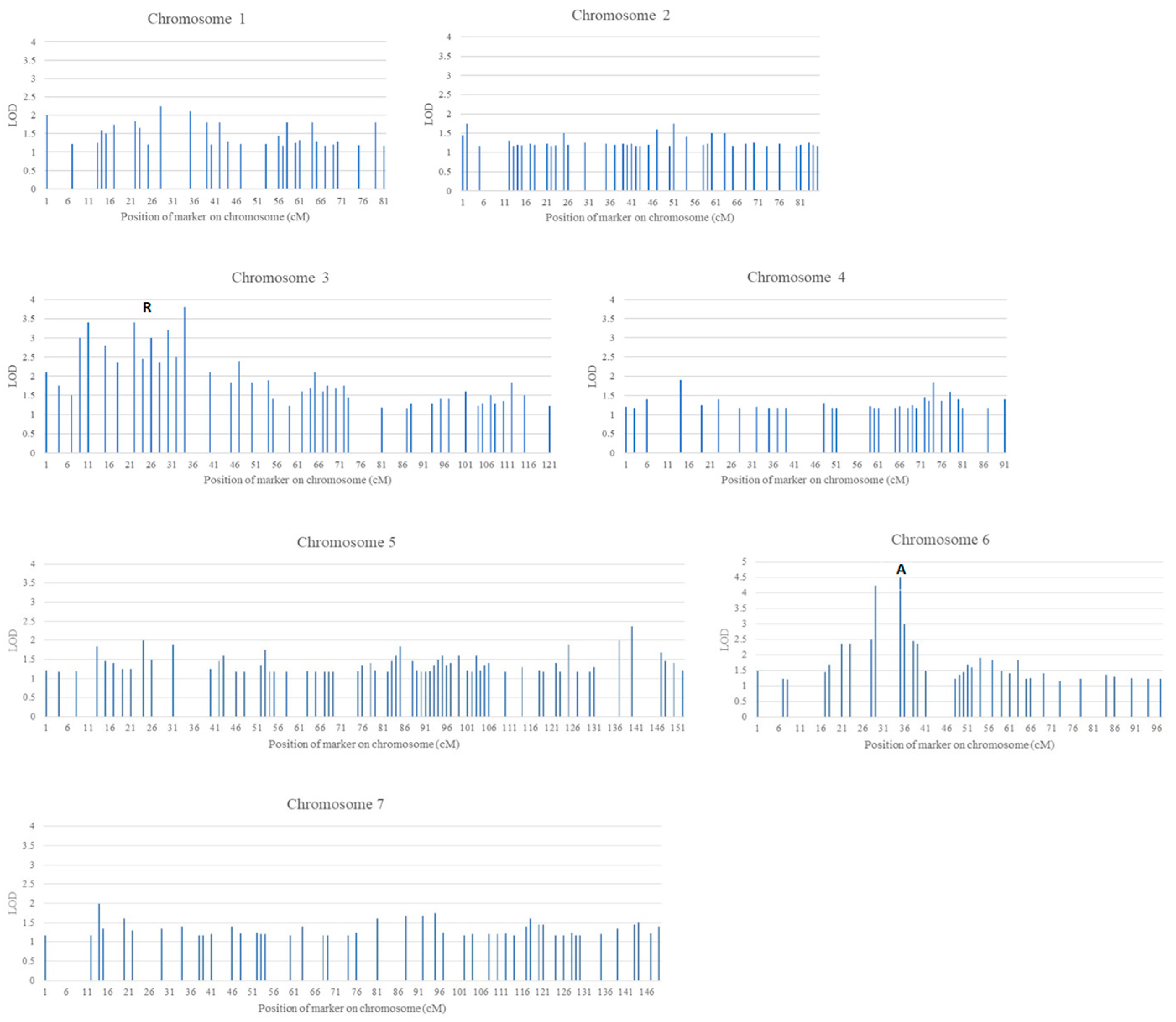
2.3.5. Genome-Wide Analysis in the MxJ Recombinant Inbred Population
3. Results
3.1. Effect of a and R Alleles
3.2. Further Analysis of Data for the B03-251 Population
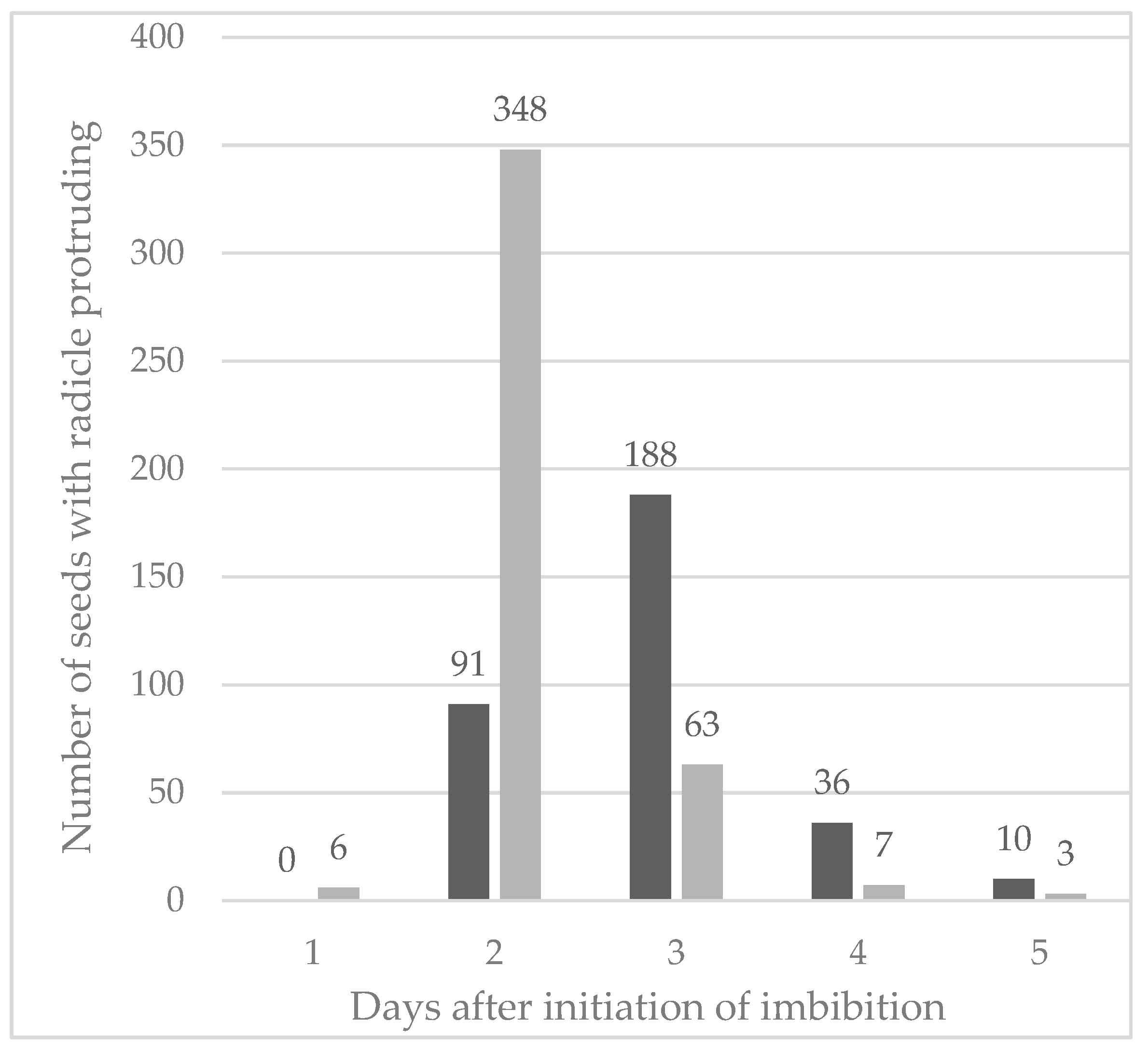
3.3. Notable Difference in the Rate of Imbibition/Germination Rate for Round Versus Wrinkled Seeds
3.4. Analysis of Hard Seeds Gave Ambiguous Results
3.5. Small Breaks in the Testa Did Not Significantly Influence Loss of Germination Capability
3.6. The Influence of Testa Browning on Loss of Germinability
3.7. Loss of Germination Percentage with Age
4. Discussion
5. Conclusions
Supplementary Materials
Author Contributions
Funding
Data Availability Statement
Acknowledgments
Conflicts of Interest
Appendix A. Details of the 32 Populations Used in Seed Germination Tests

| Population | Year Seed | Original | ||
|---|---|---|---|---|
| Population | Type | Collected | Parents | Characteristics of Parent 1 |
| MxJ | Recombinant | 2001–2003 | MN313 | Breeding line from Craig Grau, U. Minnesota (a, r) |
| inbred population | JI1794 | P. sativum ssp. elatius from Golan Heights (A, R) | ||
| A95-3 | seed from F1 | 1995 | PI 193589 | P. sativum landrace from Ethiopia (A, R) |
| Sparkle | Commercial cultivar (PI 618586) (a, r) | |||
| B00-179 | seed from F1 | 2000 | JI1974 | Powdery mildew resistant line (A, R) |
| Sparkle | Commercial cultivar (PI 618586) (a, r) | |||
| B03-11 | seed from 63 F2 | 2003 | WL1487 | P. sativum ssp sativum Asiaticum (A, R) |
| Sparkle | Commercial cultivar (PI 618586) (a, r) | |||
| B03-204 | seed from F1 | 2003 | F1 hybrid | Breeding line x PI 220174 landrace (A, R) |
| Sparkle | Commercial cultivar (PI 618586) (a, r) | |||
| B03-251 | seed from 34 F2 | 2003 | GP01-78 | Majoret cross MSU Breeding line (a, R) |
| (plus 8 duplicated 2) | PI 220174 | landrace from Afghanistan (A, R) | ||
| A04-cross5 | seed from F2 | 2004 | Marx 15299 | Genetic stock, USDA-WRPIS, Pullman, WA (A, R) |
| Marx 15253 | Genetic stock, USDA-WRPIS, Pullman, WA (a, R) | |||
| B04-231 | seed from F1 | 2004 | 87-19 I-a | RIL derived from Slow x JI1794 (A, R) |
| WL1018 | Genetic marker line, Weibullsholm Inst., (A, r) | |||
| B04-271 | seed from BC1F2 | 2004 | CMG-290 | Breeding line (Crites-Moscow Growers) (a, r) |
| PI 220174 | P. sativum landrace from Afghanistan (A, R) | |||
| B05-425 | seed from | 2005 | 19 I-g | RIL derived from Slow x JI1794 (A, R) |
| bulked F2 | WL1143 | Genetic marker line, Weibullsholm Inst. (a, r) | ||
| B06-3 | seed from | 2006 | Delta | commercial cultivar (PI 594358) (a, R) |
| bulked F2 | RER | P. sativum landrace (A, R) | ||
| B06-8 | seed from | 2006 | RER | P. sativum landrace (A, R) |
| bulked F2 | C05-50 | forage-type breeding line (a, R) | ||
| B06-11 | seed from | 2006 | B05-8 | Majoret (PI 594367) x Bolero (PI 635202) (a, r) |
| single F2 | RER | P. sativum landrace (A, R) | ||
| B06-51 | seed from | 2006 | C05-30 | Majoret derivative (a, r) |
| bulked F2 | OSU-442-15 | Breeding line from Oregon State Univ. (a, R) | ||
| B06-67 | seed from | 2006 | C05-86 | Majoret derivative (a, R) |
| bulked F2 | C05-35 | Majoret (PI 594367) x Bolero (PI 635202) (a, r) | ||
| B06-68 | seed from | 2006 | C05-37 | Breeding line from Montana State Univ. (a, R) |
| bulked F2 | C05-38A | Majoret (PI 594367) x Bolero (PI 635202) (a, r) | ||
| B06-79 | seed from | 2006 | C05-38A | Majoret (PI 594367) x Bolero (PI 635202) (a, r) |
| bulked F2 | C05-82 | Majoret derivative (a, R) | ||
| B06-80 | seed from | 2006 | C05-83 | Majoret derivative (a, R) |
| bulked F2 | C05-38A | Majoret (PI 594367) x Bolero (PI 635202) (a, r) | ||
| B06-85 | seed from | 2006 | C05-73 | Breeding line from Montana State Univ (a, R) |
| bulked F2 | C05-39 | Majoret (PI 594367) x Bolero (PI 635202) (a, r) | ||
| B06-87 | seed from | 2006 | C05-91 | Breeding line from Montana State Univ (A, R) |
| bulked F2 | C05-41 | Majoret (PI 594367) x Bolero (PI 635202) (a, r) | ||
| B06-91 | seed from | 2006 | C05-46 | Breeding line from Montana State Univ (a, R) |
| bulked F2 | CMG-307 | Breeding line (Crites-Moscow Growers) (a, r) | ||
| B06-92 | seed from | 2006 | C05-46 | Breeding line from Montana State Univ (A, R) |
| bulked F2 | C05-47 | Bolero derivative (A, r) | ||
| B06-189 | seed from F1 | 2006 | C05-76 | Majoret derivative (a, R) |
| C05-34 | Majoret (PI 594367) x Bolero (PI 635202) (a, r) | |||
| B06-194a | seed from F1 | 2006 | OSU-442-15 | Breeding line from Oregon State Univ (a, R) |
| C05-38A | Majoret (PI 594367) x Bolero (PI 635202) (a, r) | |||
| B06-200 | seed from F1 | 2006 | C05-38A | Majoret (PI 594367) x Bolero (PI 635202) (a, r) |
| C05-82 | Majoret derivative (a, R) | |||
| B06-203 | seed from F1 | 2006 | C05-73 | Majoret derivative (a, R) |
| C05-39 | Majoret (PI 594367) x Bolero (PI 635202) (a, r) | |||
| B06-204 | seed from F1 | 2006 | C05-40B | Breeding line from Montana State Univ (a, r) |
| OSU-442-15 | Breeding line from Oregon State Univ (a, R) | |||
| B06-208 | seed from F1 | 2006 | C05-43 | Breeding line from Montana State Univ (a, r) |
| OSU-442-15 | Breeding line from Oregon State Univ (a, R) | |||
| B06-214 | seed from F1 | 2006 | C05-82 | Majoret derivative (a, R) |
| C05-47A | Breeding line from Montana State Univ (a, r) | |||
| B06-303 | seed from | 2006 | PI 273679 | P. sativum landrace from Ethiopia (A, R) |
| single F2 | FR781 | Breeding line (a, r) | ||
| Slow x SGR | F3 families | 2006 | Slow | Genetic marker line developed by NFW (A, r) |
| SGR | P. sativum landrace with the a2 mutation (a2, R) | |||
| A13-111 | seed from | 2013 | PI 220174 | Landrace from Afghanistan (A, R) |
| bulked F4 | A1078-239 | Marker line from G.A Marx, Cornell Univ (A, r) |
References
- Chhabra, R.; Shabnam; Singh, T. Seed aging, storage, and deterioration: An irresistible physiological phenomenon. Agric. Rev. 2019, 40, 234–238. [Google Scholar] [CrossRef]
- Pirredda, M.; Fananas-Pueyo, I.; Onate-Sanchez, L.; Mira, S. Seed longevity and ageing: A review on physiological and genetic factors with an emphasis on hormonal regulation. Plants 2024, 13, 41. [Google Scholar] [CrossRef]
- Roberts, E.H. Predicting the storage life of seeds. Seed Sci. Technol. 1973, 1, 499–514. [Google Scholar]
- Ellis, R.H.; Roberts, E.H. Improved equations for the prediction of seed longevity. Ann. Bot. 1980, 45, 13–30. [Google Scholar] [CrossRef]
- Harrington, J.F. Seed storage and longevity. In Seed Biology; Kozlowski, T.T., Ed.; Academic Press: New York, NY, USA, 1972; Volume III, pp. 145–245. [Google Scholar]
- Zhang, K.; Zhang, Y.; Sun, J.; Meng, J.; Tao, J. Deterioration of orthodox seeds during ageing: Influencing factors, physiological alterations and the role of reactive oxygen species. Plant Physiol. Biochem. 2021, 158, 475–485. [Google Scholar] [CrossRef]
- Adetunji, A.E.; Adetunji, T.L.; Varghese, B.; Sershen; Pammenter, N.W. Oxidative stress, ageing and methods of seed invigoration: An overview and perspectives. Agronomy 2021, 11, 2369. [Google Scholar] [CrossRef]
- Nagel, M.; Börner, A. The longevity of crop seeds stored under ambient conditions. Seed Sci. Res. 2010, 20, 1–12. [Google Scholar] [CrossRef]
- Haferkamp, M.E.; Smith, L.; Nilan, R.A. Studies on aged seeds I. Relation of age of seed to germination and longevity. Agron. J. 1953, 45, 434–437. [Google Scholar]
- Walters, C.; Wheeler, L.M.; Grotenhuis, J.M. Longevity of seeds stored in a genebank: Species characteristics. Seed Sci. Res. 2005, 15, 1–20. [Google Scholar] [CrossRef]
- Powell, A.A.; Matthews, S. Deteriorative changes in pea seeds (Pisum sativum L.) stored in humid or dry conditions. J. Exp. Bot. 1977, 28, 225–234. [Google Scholar] [CrossRef]
- Powell, A.A.; Matthews, S. The damaging effect of water on dry pea embryos during imbibition. J. Exp. Bot. 1978, 29, 1215–1229. [Google Scholar] [CrossRef]
- Powell, A.A.; Matthews, S. The influence of testa condition on the imbibition and vigour of pea seeds. J. Exp. Bot. 1979, 30, 193–197. [Google Scholar] [CrossRef]
- Powell, A.A.; Harman, G.E. Absence of a consistent association of changes in membranal lipids with the ageing of pea seeds. Seed Sci. Technol. 1985, 13, 659–667. [Google Scholar]
- Gorecki, R.J.; Harman, G.E. Effects of antioxidants on viability and vigor of aging pea seeds. Seed Sci. Technol. 1987, 15, 109–117. [Google Scholar]
- Powell, A.A. The importance of genetically determined seed coat characteristics to seed quality in grain legumes. Ann. Bot. 1989, 63, 169–175. [Google Scholar] [CrossRef]
- Hellens, R.P.; Moreau, C.; Lin-Wang, K.; Schwinn, K.E.; Thomson, S.J.; Fiers, M.W.E.J.; Frew, T.J.; Murray, S.R.; Hofer, J.M.I.; Jacobs, J.M.E.; et al. Identification of Mendel’s white flower character. PLoS ONE 2010, 5, e13230. [Google Scholar] [CrossRef]
- Lyall, T.W.; Ellis, R.H.; John, P.; Hedley, C.L.; Wang, T.L. Mutant alleles and the rugosus loci in pea affect seed moisture sorption isotherms and the relations between seed longevity and moisture content. J. Exp. Bot. 2003, 54, 445–450. [Google Scholar] [CrossRef] [PubMed]
- Veselovsky, V.A.; Veselova, T.V. Lipid peroxidation, carbohydrate hydrolysis, and Amadori—Maillard reaction at early stages of dry seed aging. Russ. J. Plant Physiol. 2012, 59, 811–817. [Google Scholar] [CrossRef]
- Zablatzká, L.; Balarynová, J.; Klčová, B.; Kopecký, P.; Smýkal, P. Anatomy and Histochemistry of Seed Coat Development of Wild (Pisum sativum subsp. elatius (M. Bieb.) Asch. et Graebn. and Domesticated Pea (Pisum sativum subsp. sativum L.). Int. J. Mol. Sci. 2021, 9, 4602. [Google Scholar] [CrossRef]
- Williams, O.R.; Vander Schoor, J.K.; Butler, J.B.; Hecht, V.F.G.; Weller, J.L. Physical seed dormancy in pea is genetically separable from seed coat thickness and roughness. Front. Plant Sci. 2024, 15, 1359226. [Google Scholar] [CrossRef]
- Werker, E.; Marbach, I.; Mayer, A.M. Relation between the anatomy of the testa, water permeability and the presence of phenolics in the genus. Pisum. Ann. Bot. 1979, 43, 765–771. [Google Scholar]
- Marx, G.A.; Weeden, N.F.; Muehlbauer, F.J. A-2: A new locus controlling anthocyanin production in Pisum. Pisum Newsl. 1989, 21, 35–36. [Google Scholar]
- White, O.E. Studies of inheritance in Pisum. II. The present state of knowledge of heredity and variation in peas. Proc. Am. Phil. Soc. 1917, 56, 487–588. [Google Scholar]
- Torres, A.M.; Weeden, N.F.; Martin, A. Linkage among isozyme, RFLP and RAPD markers in Vicia faba. Theor. Appl. Genet. 1993, 85, 609–615. [Google Scholar] [CrossRef]
- Brauner, S.; Murphy, R.L.; Walling, J.G.; Przyborowski, J.; Weeden, N.F. STS markers for comparative mapping in legumes. J. Am. Soc. Hort. Sci. 2002, 127, 616–622. [Google Scholar]
- Hemmat, M.; Weeden, N.F.; Brown, S.K. Mapping and evaluation of Malus X domestica microsatellites in apple and pear. J. Am. Soc. Hort. Sci. 2003, 128, 515–520. [Google Scholar]
- Rayner, T.; Moreau, C.; Ambrose, M.; Isacc, P.G.; Ellis, N.; Domoney, C. Genetic variation controlling wrinkled seed phenotypes in Pisum: How lucky was Mendel? Int. J. Mol. Sci. 2017, 18, 1205. [Google Scholar] [CrossRef]
- Bewley, J.D.; Black, M. Seeds: Physiology of Development and Germination, 2nd ed.; Springer: Boston, MA, USA, 1994; ISBN 978-0-306-44748-8. [Google Scholar]
- Welbaum, G.E.; Bradford, K.J.; Yim, K.-O.; Booth, D.T.; Oluoch, M.O. Biophysical, physiological and biochemical processes regulating seed germination. Seed Sci. Res. 1998, 8, 161–172. [Google Scholar] [CrossRef]
- Duenas, M.; Estrella, I.; Hernandez, T. Occurrence of phenolic compounds in the seed coat and the cotyledon of peas (Pisum sativum L.). Eur. Food Res. Technol. 2004, 219, 116–123. [Google Scholar] [CrossRef]
- Jha, A.B.; Purves, R.W.; Elessawy, F.M.; Zhang, H.; Vandenberg, A.; Warkentin, T.D. Polyphenolic profile of seed components of white and purple flower pea lines. Crop Sci. 2019, 59, 2711–2719. [Google Scholar] [CrossRef]
- Pandey, K.B.; Rizvi, S.I. Plant polyphenols as dietary antioxidants in human health and disease. Oxid. Med. Cell. Longev. 2009, 2, 270–278. [Google Scholar] [CrossRef] [PubMed]
- Beninger, C.W.; Gu, L.; Prior, R.L.; Junk, D.C.; Vandenberg, A.; Bett, K.E. Changes in polyphenols of the seed coat during after-darkening process in pinto beans (Phaseolus vulgaris L.). J. Agric. Food Chem. 2005, 53, 7777–7782. [Google Scholar] [PubMed]


| Population | Phenotype of Seed 1 | Number of Seeds Tested 2 | Hard Seed 3 | Brown Testa 4 | Number of Seeds Germinated | Percent Germination 5 |
|---|---|---|---|---|---|---|
| Populations segregating for testa pigmentation | ||||||
| MxJ | A, _ | 29 lines (145) | n/a | 0 | 112 | 77 *** |
| a, _ | 22 lines (110) | n/a | n/a | 46 | 42 *** | |
| B03-11 | A, _ | 44 families (224) | 31 | 47 | 208 | 93 *** |
| a, _ | 19 families (95) | 1 | n/a | 73 | 77 *** | |
| B03-251 | A, R | 360 | 38 | 63 | 265 | 74 ns |
| a, R | 204 | 12 | n/a | 161 | 74 ns | |
| A04-cross5 | A, R | 14 families (70) | 17 | 31 | 47 | 67 ns |
| a, R | 7 families (35) | 4 | n/a | 17 | 49 ns | |
| B05-425 | A, _ | 14 families (70) | 0 | 1 | 65 | 93 *** |
| a, _ | 13 families (65) | 0 | n/a | 40 | 62 *** | |
| B06-3 | A, R | 199 | 84 | 10 | 192 | 96 *** |
| a, R | 189 | 56 | n/a | 150 | 79 *** | |
| B06-8 | A, R | 25 | 6 | 3 | 25 | 100 ns |
| a, R | 25 | 2 | n/a | 25 | 100 ns | |
| B06-68 | A, r | 25 | 2 | 2 | 18 | 72 ns |
| a, r | 25 | 2 | n/a | 16 | 64 ns | |
| B06-87 | A, _ | 55 | 14 | 10 | 55 | 100 *** |
| a, _ | 55 | 1 | n/a | 45 | 82 *** | |
| B06-303 | A, _ | 156 | 65 | 20 | 146 | 94 * |
| a, _ | 45 | 9 | n/a | 38 | 84 ns | |
| Slow x SGR | A2, R | 173 | 1 | 8 | 139 | 80 *** |
| a2, R | 60 | 0 | n/a | 27 | 45 *** | |
| Populations segregating for seed shape | ||||||
| MxJ | _, R | 29 lines (100) | n/a | 0 | 77 | 77 ** |
| _, r | 22 lines (155) | n/a | n/a | 81 | 52 ** | |
| A95-3 | A, R | 40 | 0 | most | 18 | 45 *** |
| A, r | 33 | 0 | most | 2 | 6 *** | |
| B00-179 | A, R | 32 | 1 | 0 | 19 | 59 * |
| A, r | 32 | 1 | 0 | 10 | 31 * | |
| B03-11 | _, R | 39 families (194) | 31 | 47 | 190 | 98 ** |
| _, r | 24 families (120) | 1 | n/a | 91 | 76 ** | |
| B03-204 | a, R | 50 | 7 | n/a | 50 | 100 ** |
| a, r | 50 | 1 | n/a | 43 | 86 ** | |
| B04-231 | A, R | 40 | 2 | n/a | 40 | 100 *** |
| A, r | 38 | 9 | n/a | 25 | 66 *** | |
| B04-271 | a, R | 69 | 0 | n/a | 67 | 97 * |
| a, r | 70 | 0 | n/a | 49 | 70 ns | |
| B05-425 | _, R | 18 families (90) | 0 | -- | 76 | 84 * |
| _, r | 9 families (45) | 0 | -- | 29 | 64 * | |
| B06-11 | a, R | 29 | 4 | n/a | 29 | 100 ns |
| a, r | 31 | 1 | n/a | 28 | 90 ns | |
| B06-51 | a, R | 25 | 5 | n/a | 24 | 96 ns |
| a, r | 25 | 2 | n/a | 20 | 80 ns | |
| B06-67 | a, R | 20 | 2 | n/a | 20 | 100 ns |
| a, r | 15 | 0 | n/a | 14 | 93 ns | |
| B06-79 | a, R | 20 | 4 | n/a | 20 | 100 * |
| a, r | 20 | 5 | n/a | 14 | 70 * | |
| B06-80 | a, R | 20 | 6 | n/a | 20 | 100 * |
| a, r | 20 | 8 | n/a | 13 | 65 ns | |
| B06-85 | a, R | 20 | 4 | n/a | 20 | 100 ** |
| a, r | 20 | 3 | n/a | 10 | 50 ** | |
| B06-87 | A, _ | 70 | 10 | 5 | 66 | 94 ns |
| a, _ | 40 | 5 | 5 | 34 | 85 ns | |
| B06-91 | a, R | 49 | 7 | n/a | 48 | 96 *** |
| a, r | 50 | 3 | n/a | 27 | 54 *** | |
| B06-92 | a, R | 50 | 11 | n/a | 49 | 98 *** |
| a, r | 50 | 4 | n/a | 30 | 60 *** | |
| B06-189 | a, R | 50 | 3 | n/a | 49 | 98 *** |
| a, r | 50 | 7 | n/a | 17 | 34 *** | |
| B06-194a | a, R | 10 | 2 | n/a | 10 | 100 ns |
| a, r | 10 | 1 | n/a | 9 | 90 ns | |
| B06-200 | a, R | 25 | 2 | n/a | 25 | 100 ns |
| a, r | 25 | 3 | n/a | 23 | 92 ns | |
| B06-203 | a, R | 25 | 2 | n/a | 23 | 92 ns |
| a, r | 25 | 0 | n/a | 18 | 72 ns | |
| B06-208 | A, R | 25 | 0 | 0 | 25 | 100 ns |
| A, r | 25 | 0 | 0 | 25 | 100 ns | |
| B06-214 | a, R | 49 | 1 | n/a | 49 | 100 ns |
| a, r | 50 | 4 | n/a | 44 | 88 ns | |
| B06-303 | _, R | 106 | 44 | 12 | 102 | 96 *** |
| _, r | 95 | 30 | 8 | 74 | 78 *** | |
| Population | Phenotype of Seed 1 | No. Seeds Tested 2 | Hard Seed 3 | Brown Testa 4 | No. Seeds Germinated | Percent Germination 5 |
|---|---|---|---|---|---|---|
| MxJ | A, R | 14 lines (70) | n/a | 0 | 59 | 84 (a) |
| A, r | 15 lines (75) | n/a | 0 | 53 | 71 (b) | |
| a, R | 6 lines (30) | n/a | n/a | 18 | 60 (c, d) | |
| a, r | 16 lines (80) | n/a | n/a | 28 | 35 (d) | |
| B03-11 | A, R | 27 families(134) | 28 | 30 | 134 | 100 (a) |
| A, r | 17 families (85) | 3 | 17 | 69 | 81 (c) | |
| a, R | 12 families (60) | 1 | n/a | 56 | 93 (b) | |
| a, r | 7 families (35) | 0 | n/a | 22 | 63 (d) | |
| B05-425 | A, R | 11 families (55) | 0 | 1 | 50 | 91 (a) |
| A, r | 3 families (15) | 0 | 0 | 15 | 100 (a) | |
| a, R | 7 families (35) | 0 | n/a | 26 | 74 (b) | |
| a, r | 6 families (30) | 0 | n/a | 14 | 47 (c) | |
| B06-87 | A, R | 35 | 10 | 5 | 35 | 100 (a) |
| A, r | 20 | 4 | 5 | 20 | 100 (a) | |
| a, R | 35 | 0 | n/a | 31 | 89 (b) | |
| a, r | 20 | 1 | n/a | 14 | 70 (c) | |
| B06-303 | A, R | 81 | 37 | 12 | 79 | 98 (a) |
| A, r | 75 | 28 | 8 | 59 | 79 (b) | |
| a, R | 25 | 7 | n/a | 23 | 92 (a) | |
| a, r | 20 | 2 | n/a | 15 | 75 (b) |
| Seed Phenotype | Treatment | Number of Seeds | Number Germinating | Percentage |
|---|---|---|---|---|
| Round | nicked | 19 | 16 | 84 ns 1 |
| Round | intact | 19 | 17 | 89 ns |
| Wrinkled | nicked | 29 | 25 | 86 ns |
| Wrinkled | intact | 30 | 26 | 87 ns |
| Population | No. Brown Seeds | Germination Percent | Total Pigmented but Not Browning | Germination Percent 1 |
|---|---|---|---|---|
| B03-11 | 47 | 96 ns 2 | 172 | 100 ns 2 |
| B03-251 | 63 | 81 ns | 297 | 74 ns |
| A04-cross 5 | 31 | 23 *** | 69 | 100 *** |
| B05-425 | 1 | 100 | 65 | 93 |
| B06-3 | 10 | 90 | 189 | 96 |
| B06-8 | 3 | 100 | 22 | 100 |
| B06-68 | 2 | 100 | 23 | 72 |
| B06-87 | 10 | 100 | 45 | 100 |
| B06-303 | 20 | 85 | 146 | 88 ns |
| Slow x SGR | 8 | 62 | 165 | 80 |
| Combined ’06 3 | 53 | 95 ns | 425 | 91 ns |
Disclaimer/Publisher’s Note: The statements, opinions and data contained in all publications are solely those of the individual author(s) and contributor(s) and not of MDPI and/or the editor(s). MDPI and/or the editor(s) disclaim responsibility for any injury to people or property resulting from any ideas, methods, instructions or products referred to in the content. |
© 2026 by the authors. Licensee MDPI, Basel, Switzerland. This article is an open access article distributed under the terms and conditions of the Creative Commons Attribution (CC BY) license.
Share and Cite
Weeden, N.F.; Valentini, G. Mutations in the Phenylpropanoid and Starch Synthesis Pathways Are Important Determinants of Seed Longevity in Garden Pea (Pisum sativum L.) Stored at Cool Temperatures. Seeds 2026, 5, 7. https://doi.org/10.3390/seeds5010007
Weeden NF, Valentini G. Mutations in the Phenylpropanoid and Starch Synthesis Pathways Are Important Determinants of Seed Longevity in Garden Pea (Pisum sativum L.) Stored at Cool Temperatures. Seeds. 2026; 5(1):7. https://doi.org/10.3390/seeds5010007
Chicago/Turabian StyleWeeden, Norman F., and Giseli Valentini. 2026. "Mutations in the Phenylpropanoid and Starch Synthesis Pathways Are Important Determinants of Seed Longevity in Garden Pea (Pisum sativum L.) Stored at Cool Temperatures" Seeds 5, no. 1: 7. https://doi.org/10.3390/seeds5010007
APA StyleWeeden, N. F., & Valentini, G. (2026). Mutations in the Phenylpropanoid and Starch Synthesis Pathways Are Important Determinants of Seed Longevity in Garden Pea (Pisum sativum L.) Stored at Cool Temperatures. Seeds, 5(1), 7. https://doi.org/10.3390/seeds5010007