Article

Modeling of CH4 Emission and Assessment of Energy Potential: A Case Study of Okhla Landfill, South Delhi


1
Department of Civil Engineering, Government College of Engineering, Keonjhar 758002, Odisha, India
2
School of Civil Engineering, KIIT Deemed to be University, Bhubaneswar 751024, Odisha, India
3
Manipal School of Architecture and Planning, Manipal Academy of Higher Education, Manipal 576104, Karnataka, India
4
Circular Bioeconomy Research Group, Shannon Applied Biotechnology Centre, Munster Technological University, V92 CX88 Tralee, Ireland
*
Authors to whom correspondence should be addressed.
Methane 2026, 5(2), 18; https://doi.org/10.3390/methane5020018
Submission received: 16 April 2026 / Revised: 5 June 2026 / Accepted: 9 June 2026 / Published: 11 June 2026
(This article belongs to the Special Issue 250 Years of Methane: From Discovery to Global Challenges)

Abstract

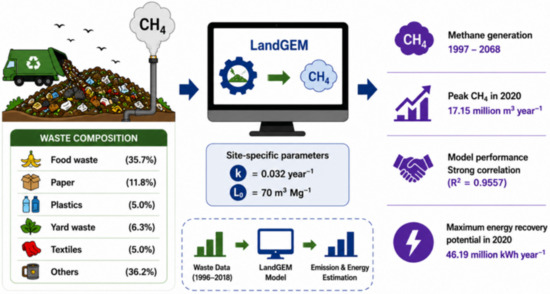
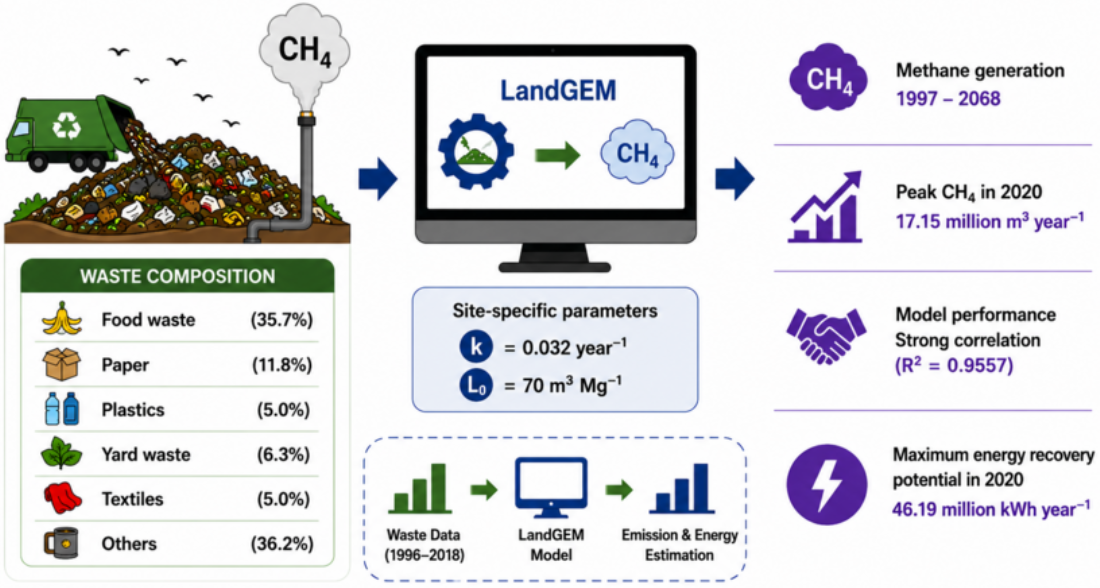
Municipal solid waste (MSW) landfills are major sources of greenhouse gas (GHG) emissions, particularly methane (CH4), which possesses a significantly higher global warming potential than carbon dioxide (CO2). This study evaluates methane emission and energy recovery potential from the Okhla landfill site, South Delhi, India, using the Landfill Gas Emissions Model (LandGEM). Site-specific model parameters suitable for Indian landfill conditions (k = 0.032 year−1 and L0 = 70 m3 Mg−1) were incorporated to improve prediction accuracy. The results showed that methane generation initiated in 1997 and is expected to continue until 2068. Peak methane emission of approximately 17.15 million m3 year−1 was observed in 2020 due to rapid degradation of the biodegradable organic fraction, especially food waste. The corresponding peak total landfill gas (LFG) and CO2 emissions were approximately 35.43 million m3 year−1 and 17.71 million m3 year−1, respectively. A strong correlation (R2 = 0.9557) between cumulative waste deposition and methane generation confirmed model reliability. The estimated maximum energy recovery potential was approximately 46.19 million kWh year−1. The study further discusses the applicability of the LandGEM under non-engineered landfill conditions commonly observed in developing countries. Overall, the findings emphasize the importance of methane recovery for greenhouse gas mitigation, sustainable waste management, and renewable energy generation in urban landfill systems.

Graphical Abstract

1. Introduction

The municipal solid waste (MSW) generation rate in India exhibits a broad spectrum, ranging from 0.2 to 0.5 kg day−1 person−1, influenced by geographical location and prevailing lifestyles [1]. The growing population, combined with rapid industrialization and urbanization, has led to a huge production of 90 million tons (MT) of municipal solid waste annually in the country. On a global scale, a staggering 2 billion tons of waste are generated each year, with projections anticipating a surge to 9.5 billion tons by 2050 [2,3].
Presently, landfill management stands as the predominant method for processing the growing volumes of MSW in India. Notably, over 7% of MSW constitutes the biodegradable fraction, undergoing anaerobic digestion in landfills and producing significant quantities of CH4 (40–65% v/v) and carbon dioxide (CO2) (35–55% v/v). The severe environmental impact of CH4, owing to its global warming potential (GWP) being approximately 30 times greater than that of CO2, highlights the urgent need for effective waste management strategies [4,5,6]. In engineered landfills, a systematic approach involves regular compaction of deposited waste, provision of soil cover, and the installation of gas collection pipes. These measures are required towards capturing and utilizing the generated CH4 for fuel and energy purposes. However, the reality in India reveals that many landfill systems lack proper engineering and management, leading to continuous atmospheric emissions of formed greenhouse gases (GHGs). It is estimated that India contributes approximately 20 Megagrams (Mg) of CO2-equivalent CH4 annually from landfill sources [7,8,9].
Critical to the effective operation and maintenance (O&M) of landfill sites is the accurate design, estimation, and prediction of CH4 generation rates, as CH4 is one of the major GHGs released during the anaerobic decomposition of municipal solid waste. Reliable prediction of CH4 emissions is essential not only for evaluating landfill performance and environmental impacts but also for planning landfill gas (LFG) collection, energy recovery systems, and mitigation strategies [5]. In recent years, considerable research efforts have been directed toward estimating CH4 emissions from landfill sites to better quantify the contribution of solid waste disposal practices to national and global GHG inventories. The modeling of CH4 generation generally considers several important parameters, including waste composition, organic and biodegradable fraction, moisture content, climatic conditions, landfill operational practices, and the degradation rate of waste materials over time. Since landfill waste undergoes complex biological and physicochemical transformations, different mathematical and empirical models have been developed to estimate CH4 generation under varying environmental and operational conditions [10]. Among the most widely used models are the first-order decay (FOD) model, triangular model, Intergovernmental Panel on Climate Change (IPCC) model, and Landfill Gas Emissions Model (LandGEM) [11,12,13]. The FOD model assumes that the degradation of organic waste and CH4 generation occur progressively over time following first-order kinetics, making it one of the most commonly adopted approaches worldwide. The triangular model represents CH4 production through a simplified triangular distribution pattern and incorporates the temporal characteristics of waste degradation. The IPCC model, recommended for GHG inventory estimation, integrates factors such as waste composition, degradable organic carbon content, climate conditions, and landfill management practices to provide standardized emission estimates [11,13]. In contrast, the LandGEM developed by the United States Environmental Protection Agency (USEPA) offers a more detailed estimation approach. These models collectively contribute to a more comprehensive understanding of CH4 emission dynamics from landfill systems and support policymakers, researchers, and environmental engineers in developing effective waste management and GHG strategies [14]. LandGEM is considered superior to other methods for CH4 gas emission estimation due to its comprehensive approach. The model is widely recognized for providing comparatively reliable CH4 emission predictions. Previous studies reported that LandGEM predictions generally agree with field-monitored CH4 emissions within an uncertainty range of approximately ±10–20%, whereas simplified empirical methods and default inventory approaches may show deviations exceeding 30–50% due to insufficient consideration of waste degradation kinetics and landfill operational conditions [10,13]. Kumar et al. [15] estimated CH4 emissions from Indian landfill sites between 0.5 and 1.2 Tg CH4 year−1 using FOD modeling and demonstrated improved prediction accuracy when site-specific parameters were applied. More recently, Bhuiya et al. [16] compared LandGEM, IPCC-ZODM, IPCC-FODM, and modified triangular models for CH4 estimation and reported that LandGEM produced more stable predictions with over 92% explained variability in statistical validation analyses, while some conventional models exhibited significantly higher sensitivity to input uncertainty. Similarly, Dey and Ashok [17] highlighted that LandGEM-integrated machine learning models produced CH4 emission predictions closely matching observed landfill emission trends and improved prediction reliability by approximately 25–40% over conventional empirical approaches. Furthermore, USEPA reports that LFG generally contains 45–60% CH4, and LandGEM remains one of the most extensively validated and regulatory-accepted tools for estimating LFG emissions and energy recovery potential (https://www.epa.gov/; accessed on 26 May 2026) [18]. Therefore, the comparatively lower prediction uncertainty, integration of site-specific variables, and successful validation across diverse landfill conditions support the use of LandGEM over several conventional estimation methods.
However, a major challenge encountered in most LFG emission studies is the lack of reliable and accurate data regarding MSW generation rates and the actual composition of disposed waste. The quantity and characteristics of MSW vary significantly depending on population growth, socioeconomic conditions, seasonal variations, consumption patterns, and waste management practices, making precise estimation difficult [19,20]. In addition, inconsistent waste segregation and limited long-term monitoring further increase uncertainties in CH4 emission prediction models. Since the accuracy of LFG estimation largely depends on input parameters such as waste composition, degradable organic carbon content, moisture conditions, and waste deposition rates, it is essential to incorporate country-specific and site-specific parameters for improving model reliability and prediction accuracy [3,11]. Among the various available LFG prediction models, the LandGEM has gained considerable attention and widespread acceptance due to its simplicity, reliability, and effectiveness in estimating CH4 generation from landfill sites under varying waste disposal conditions. The present study focuses on the Okhla landfill site in Delhi, India, with the objective of estimating the generation of LFG, including CH4, CO2, and non-methane organic compounds (NMOC), using the LandGEM. The study further aims to evaluate the temporal variation and emission characteristics of LFG based on historical waste deposition data. Another important objective of this research is to assess the energy recovery potential of the generated CH4 gas and examine its suitability as a renewable energy resource.

2. Materials and Methodology

2.1. Site Description and Waste Composition

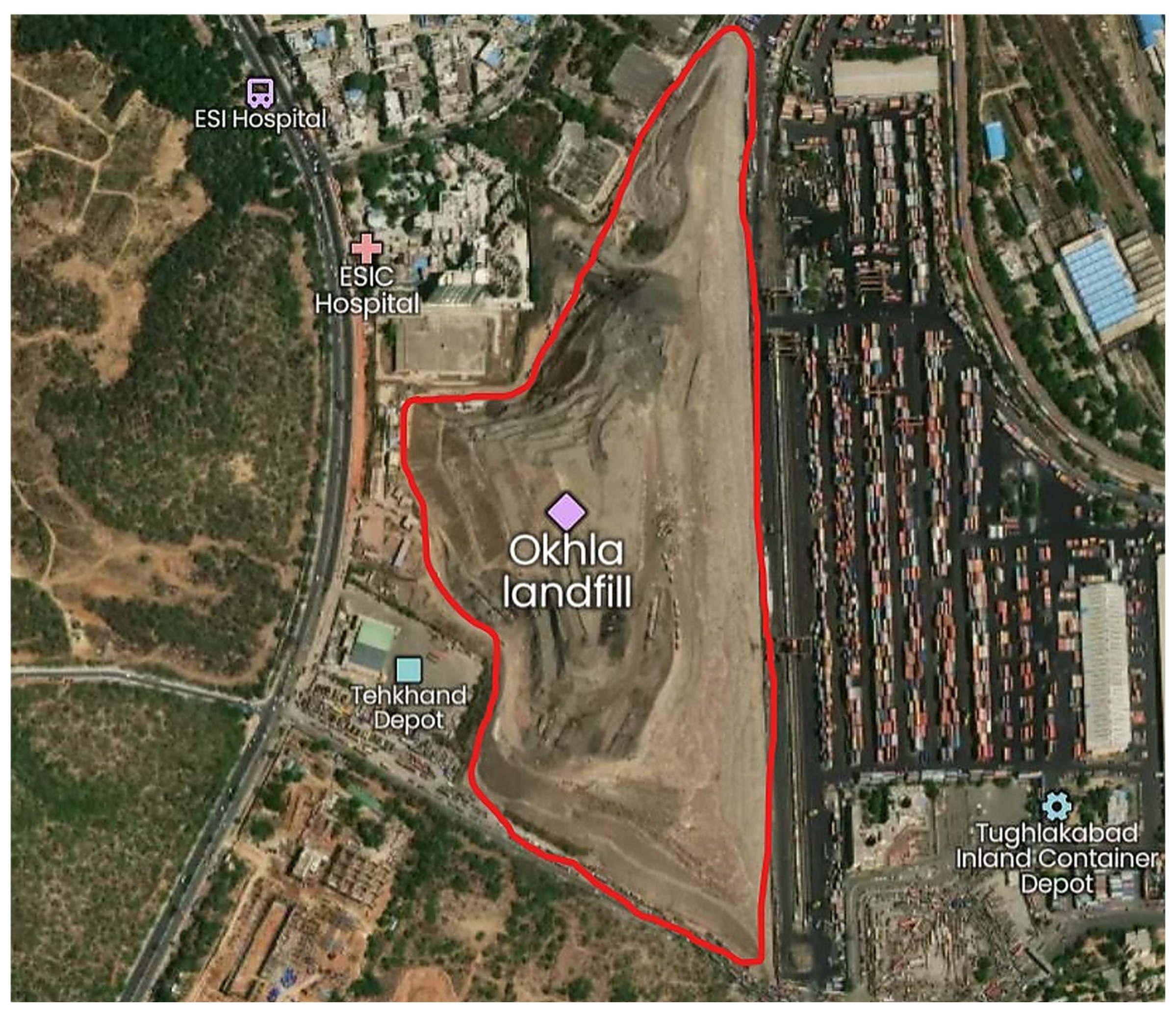
Okhla landfill (28°30′42″ N, 77°16′59″ E) is a dump yard situated in south Delhi with an area of 40 acres (Figure 1). The site was used in the dumping process from 1996 and exhausted in 2018. Okhla receive precipitation of 706 mm year−1 and near the closing period approx. 1800 Tons per day (TPD) waste was being dumped in the landfill. In the current study, annual solid waste deposition data were collected from records of the Delhi Pollution Control along with published research articles to ensure more realistic estimation of LFG emissions [9,13,21]. Waste composition is a major factor for total LFG emission. The biodegradable waste at Okhla landfill contains readily degradable waste (35%), slowly degradable waste (20%), very slowly degradable waste (10%), and other waste. The details of the waste composition are given in Table 1. The waste composition of the Okhla landfill indicates that food waste (35.7%) constitutes the largest fraction, followed by construction and demolition (C&D) waste (30.0%). The high proportion of food waste suggests a substantial biodegradable organic content, which can undergo anaerobic decomposition and generate significant quantities of landfill gas, particularly methane (CH4). Other notable components include paper (11.8%), garden waste (6.3%), plastics (5.0%), rubber and leather (5.0%), and textiles (5.0%), while metals (0.8%) and glass and ceramics (0.4%) are present in smaller quantities. The dominance of biodegradable materials (food, paper, garden waste, textiles, and leather) indicates a high methane generation potential, making the landfill a significant source of GHG emissions as well as a potential resource for energy recovery through landfill gas utilization.

2.2. LandGEM

LandGEM tool (V3.1) is developed by USEPA and used for calculation of total LFG, CH4, CO2 and NMOCs emission from landfill site. The model has parameters related to Clean Air Act (CAA) defaults and inventory defaults [14]. Default parameters can be used for modeling purposes when no site-specific data are available. The model estimate CH4 emissions from landfill sites based on the anaerobic decomposition behavior of biodegradable MSW. The rationale for using these equations lies in the fact that organic waste deposited in landfills decomposes gradually over time through microbial activity, producing LFG mainly composed of CH4 and CO2. Since CH4 generation does not occur uniformly and varies depending on waste age, composition, moisture content, climatic conditions, and landfill operational practices, mathematical equations are essential for accurately predicting gas generation trends [13,14,15]. The first-order decay approach effectively represents the exponential pattern of waste degradation, where CH4 production initially increases, reaches a peak, and subsequently decreases as the biodegradable organic fraction becomes depleted. The LandGEM equations incorporate important parameters such as CH4 generation potential, CH4 generation rate constant, annual waste acceptance rate, and waste age to estimate annual and cumulative CH4 emissions during both operational and post-closure phases of landfill sites. The formula used for emission calculation is given in Equation (1) [10,22]:
Q C H 4 = i = 1 n j = 0.1 1 k L 0 M i 10 e k t i j
  • Q C H 4 = CH4 generation in the particular year (m3 year−1)
  • i = 1-year time increment
  • j = 0.1 year time increment
  • n = (Year of the calculation) − (Initial year of waste acceptance)
  • k = CH4 generation rate (Default value: 0.050 year−1)
  • Lo = Potential CH4 generation capacity (170 m3 Mg−1)
  • Mi = Mass of waste accepted in the year (Mg)
  • tij = Age of the jth sector of waste mass Mi accepted in the ith year
Lo is the Potential CH4 Generation Capacity (PMGC), i.e., the amount of CH4 (m3) generated per million grams (Mg) of MSW decomposed. Waste mass with high cellulose content will have high Lo value, with high lignin content will have low Lo value. k is the CH4 Generation Constant (year−1) i.e., rate of waste decay and CH4 production. The value of k depends on following properties of waste mass such as pH, temperature, moisture content and nutrient availability to microorganisms [12,23]. If the biodegradable content of waste mass is high, CH4 generation rate will be high too, so the k value. In current study the considered Lo and k value are 70 m3 Mg−1 and 0.032 year−1, respectively, as evaluated by Kumar and Sharma (2014) [6] (Table 2).
The LandGEM assumes relatively homogeneous landfill conditions, including uniform waste composition, consistent moisture distribution, stable anaerobic degradation conditions, and constant CH4 generation parameters throughout the modeling period [10,14]. However, in actual landfill environments, particularly under non-engineered landfill conditions such as the Okhla landfill site, waste characteristics and environmental conditions may vary spatially and temporally due to irregular waste deposition, seasonal climatic fluctuations, varying organic content, differential compaction, and uncontrolled aeration [9,13]. These variations can influence microbial degradation behavior and introduce uncertainties in CH4 emission predictions. The use of constant parameter values may simplify the complex biodegradation processes occurring in landfills and may therefore lead to some deviation between predicted and actual LFG generation. Nevertheless, site-specific values of k = 0.032 year−1 and LO = 70 m3 Mg−1, obtained from previous studies under Indian landfill conditions, were incorporated in the present study to improve model reliability and reduce uncertainty [6].
The model estimates the CO2 emission (QCO2) rate from the value of CH4 emission (QCH4) and % CH4 content (PCH4) in total LFG using Equation (2) [9]:
Q C O 2 = Q C H 4 1 P C H 4 100 1
Equation (2) estimates CO2 emission rates based on the calculated CH4 emission rate and the percentage of methane (PCH4) present in the total LFG composition because LFG is primarily composed of CH4 and CO2 generated simultaneously during the anaerobic decomposition of organic waste. The rationale for using this equation is founded on the biological and chemical relationship between CH4 and CO2 production in landfill environments, where both gases are produced as major end products of microbial degradation processes [24]. Since CH4 generation is generally predicted more accurately through first-order decay modeling, the corresponding CO2 emission can be estimated proportionally using the methane emission rate (QCH4) and the methane fraction (PCH4) in the LFG mixture [25]. This approach simplifies the estimation process while maintaining reasonable accuracy because the composition of LFG typically remains within a known range under stable anaerobic conditions. The equation enables researchers to quantify CO2 emissions efficiently without requiring separate complex degradation modeling for CO2 generation.

2.3. Energy Potential Estimation

CH4 generated from landfill can be utilized as energy source and its energy generation potential (Ep in kWh year−1) can be calculated using Equation (3) [24]:
E p = 0.9 × Q C H 4 × L H V C H 4 × η × λ 3.6
  • Q C H 4 = Emitted CH4 gas (m3) from landfill in a particular year
  • L H V C H 4 = Lower Heating Value of CH4 (37.2 MJ m−3)
  • η = Electrical conversion efficiency for the IC engine (33%)
  • λ = Collection efficiency of CH4 from landfill (75%)
  • 0.9 = Empirical coefficient
  • 3.6 = Conversion factor (MJ to kWh)
The estimation of energy potential from landfill CH4 generation is essential because CH4 is a combustible gas with significant calorific value and can serve as an alternative renewable energy source. The rationale for using above equation is based on the direct relationship between the quantity of CH4 generated from landfill waste and the amount of recoverable energy that can be produced through CH4 combustion. Since LFG primarily contains CH4 as its energy-bearing component, the energy generation potential (Ep) is calculated using the CH4 emission rate along with its heating value and appropriate conversion efficiency factors [26,27,28]. This equation enables the conversion of CH4 generation data into electrical energy potential expressed in kilowatt-hours per year (kWh year−1), thereby helping researchers and policymakers evaluate the feasibility of landfill gas-to-energy projects.

3. Results and Discussion

CH4 gas emissions from landfills present a dual environmental impact and energy potential. It is a potent GHG, contributing to climate change; however, it also offers an opportunity for harnessing electrical energy. CH4 can be captured and utilized as a renewable energy source [29]. This approach not only addresses environmental concerns but also taps into the sustainable energy potential inherent in LFG, contributing to an eco-friendly and energy-efficient waste management strategy. The current results focus on the rate of CH4 generation from the Okhla landfill and its electrical energy generation potential.

3.1. Landfill Site Results

Over the past 23 years, the quantities of municipal solid waste disposed at the Okhla landfill site have been systematically documented and are presented in Table 3. The term “waste accepted” refers to the quantity of waste transported and deposited at the landfill before compaction, whereas “waste-in-place” represents the cumulative quantity of compacted waste occupying the landfill after settlement and compaction processes [9]. The waste-in-place values were estimated using the LandGEM software by incorporating annual waste acceptance data and landfill operational assumptions. Initially, the waste quantities were recorded in megagrams per year (Mg/year) and later converted into short tons/year during the modeling process because the LandGEM tool operates primarily using imperial units. In 1996, approximately 2.47 × 10⁵ Mg year−1 of municipal solid waste was disposed at the Okhla landfill site, which gradually increased to about 6.57 × 10⁵ Mg year−1 by 2018, indicating a substantial rise in waste generation and disposal over the years. The observed trend demonstrates a progressive increase in waste deposition during the early operational years, followed by fluctuations and a sharp rise near the final years of landfill operation. Such variability in waste disposal rates may be attributed to changes in waste management policies, diversion of waste to alternative landfill facilities, and variations in municipal waste collection practices within Delhi. The significant increase in waste accumulation is primarily associated with rapid population growth, urban expansion, industrial development, and changing consumption patterns in the metropolitan region [30]. The deposited waste stream consisted of diverse components including food waste, paper, plastics, garden waste, textiles, rubber, leather, construction debris, and other biodegradable and non-biodegradable materials. Among these, biodegradable organic fractions such as food and garden waste played a major role in LFG generation due to their high decomposition potential under anaerobic conditions [26]. The continuous accumulation of such heterogeneous waste materials over the years significantly influenced CH4 generation behavior and LFG emission characteristics at the Okhla landfill site.
Table 4 presents the estimated annual generation of CH4, CO2, total LFG, and non-methane organic compounds (NMOC) from the Okhla landfill site using the LandGEM. The model incorporates waste composition characteristics, CH4 generation parameters, and annual waste deposition history, thereby providing more realistic and reliable emission estimates compared to simplified empirical methods. The waste stream at the Okhla landfill contains a substantial proportion of biodegradable organic matter, particularly food waste, which constitutes approximately 35.7% of the total waste composition as shown in Table 1. The presence of such highly biodegradable and moisture-rich waste significantly accelerates anaerobic decomposition processes and enhances CH4 generation within the landfill environment [7]. In the initial operational year (1996), LFG generation was considered negligible because freshly deposited waste requires a sufficient acclimatization period for microbial communities to establish anaerobic degradation conditions. As waste accumulation increased over the years, microbial decomposition activity intensified, resulting in gradual increases in LFG production. CH4 generation initiated at approximately 3.66 × 10² Mg year−1 in 1997 and subsequently increased rapidly to approximately 1.16 × 10⁴ Mg year−1 by 2018. Similarly, total LFG and CO2 emissions exhibited continuous increases due to the cumulative deposition of biodegradable waste and enhanced microbial degradation activity. During the landfill closure year (2018), total LFG and CO2 emissions reached approximately 4.34 × 10⁴ Mg year−1 and 3.18 × 10⁴ Mg year−1, respectively. The observed increase in gas generation clearly reflects the influence of waste accumulation, organic fraction content, climatic conditions, and long-term anaerobic decomposition processes occurring within the landfill mass.
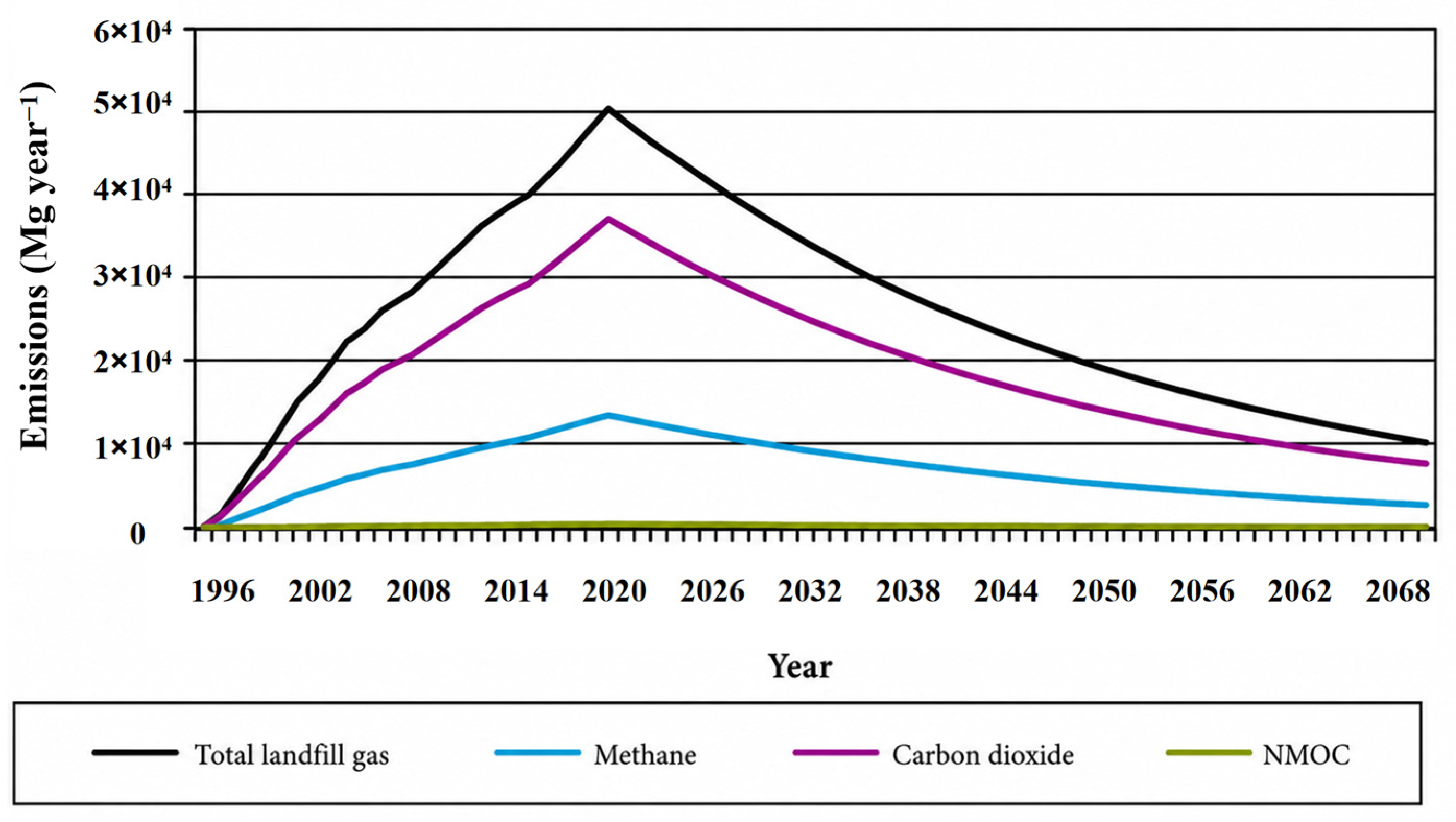
The temporal variation in total LFG, CH4, and CO2 emissions over the study period is illustrated in Figure 2. According to the predicted emission trends, CH4 generation commenced in 1997 and is expected to continue until approximately 2068, even after landfill closure. This prolonged CH4 generation behavior is typical of municipal solid waste landfills because biodegradable organic matter continues to decompose under anaerobic conditions for several decades. The highest CH4 generation of approximately 17.15 million m3 year−1 was predicted in 2020, nearly two years after landfill closure. This delayed peak emission phenomenon can be attributed to the stabilization and intensified anaerobic degradation of the large accumulated biodegradable organic fraction, particularly food waste, present in the landfill [25]. Furthermore, the increasing trend in CH4 generation corresponds closely with the continuous rise in municipal waste disposal caused by rapid urbanization, population growth, industrial development, and changing consumption patterns in Delhi. The CH4 emission curve shown in Figure 2 clearly demonstrates the relationship between cumulative waste deposition and CH4 production potential.
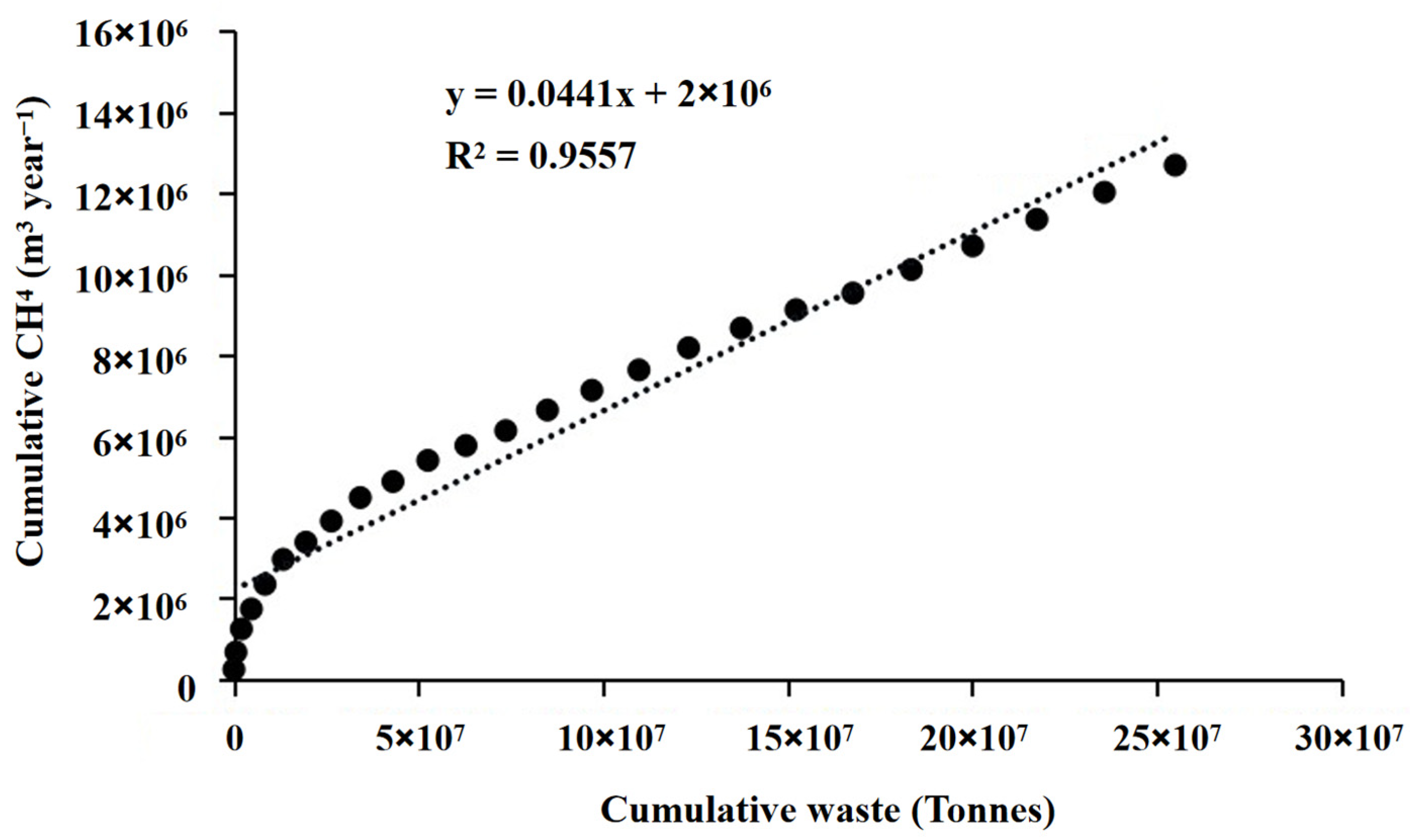
Peak emissions of total LFG and CH4 were observed approximately 24 years after landfill initiation, after which the emission rate gradually declined due to depletion of the biodegradable organic fraction available for microbial decomposition. Figure 2 indicates that the maximum total LFG and CO2 generation occurred in 2020, reaching approximately 35.43 million m3 year−1 and 17.71 million m3 year−1, respectively, followed by a gradual reduction in emission rates over time. The declining trend after the emission peak reflects the reduction in biodegradable carbon content and progressive stabilization of landfill waste. The predicted CH4 emission trend obtained from the LandGEM showed close agreement with earlier studies on Delhi landfill sites reported by Chakraborty et al. [9] and Ghosh et al. [13], which also identified rapid CH4 generation due to the high biodegradable and food waste fraction in Delhi municipal solid waste. The present study estimated peak CH4 generation of approximately 17.15 million m3 year−1 in 2020, whereas Ghosh et al. [13] reported CH4 generation within a comparable range for major landfill sites in Delhi using field-supported modeling approaches. Furthermore, the cumulative CH4 generation showed a strong correlation with cumulative waste deposition (R2 = 0.9557), indicating good consistency between waste input and predicted CH4 generation trends (Figure 3). The obtained CH4 generation behavior and post-closure emission pattern also align with the findings of Gollapalli and Kota [22] and Naveen and Fard [25], who reported that CH4 emissions generally peak shortly after landfill closure and gradually decline due to depletion of biodegradable organic matter. Additionally, elevated temperature and moisture conditions prevailing at the Okhla landfill site likely promoted enhanced microbial activity and accelerated biodegradation of organic waste fractions, consequently increasing CH4 generation rates throughout the operational period of the landfill.

3.2. Electrical Energy Generation Potential

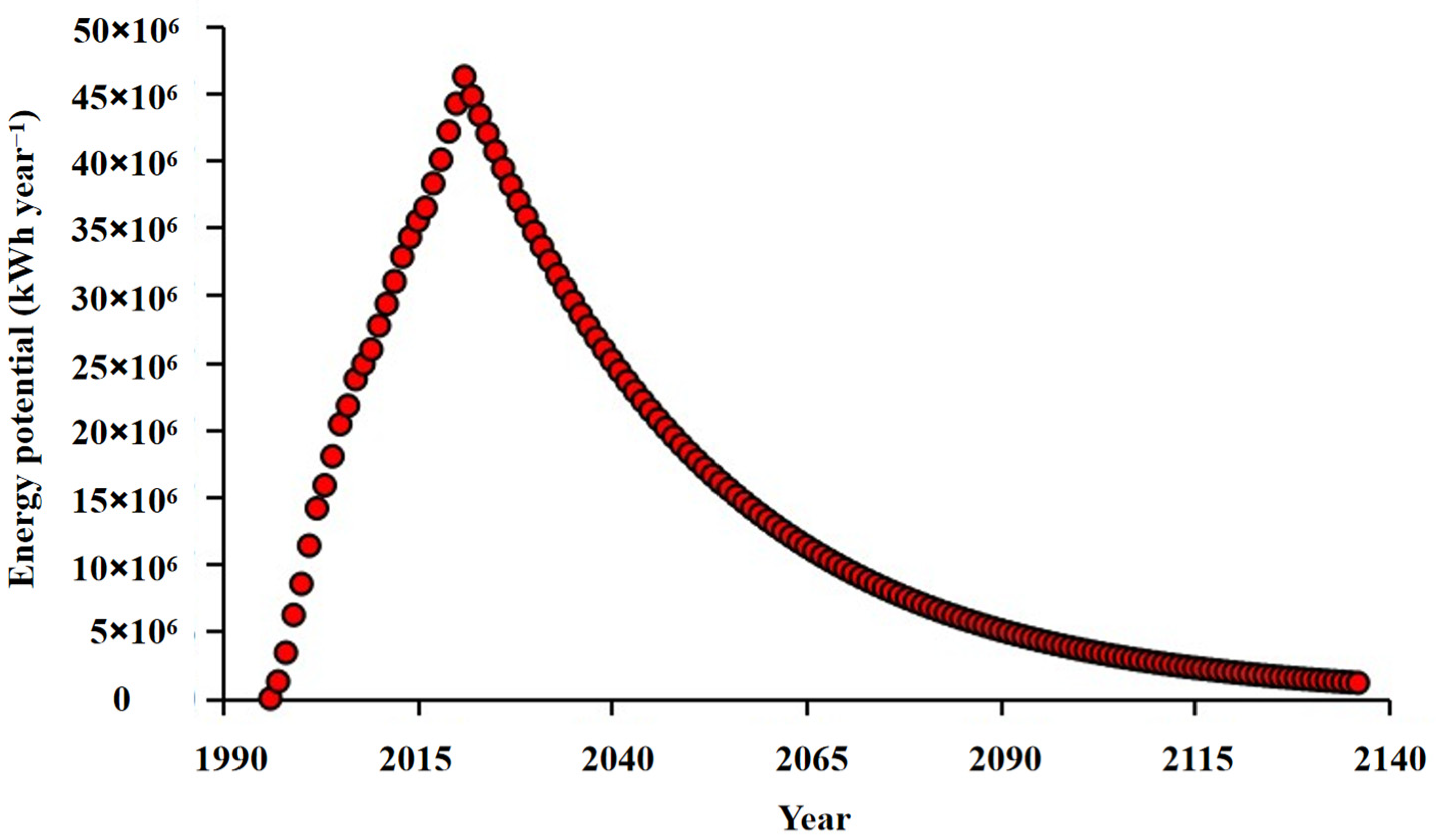
The predicted CH4 emission values from the LandGEM were used to estimate the electrical energy recovery potential from the Okhla landfill site. The energy generation estimation mainly depends on the CH4 generation rate constant (k) and CH4 generation potential (L0) [24,26]. Since CH4 is a combustible gas with high calorific value, its recovery and utilization can provide a sustainable renewable energy source while reducing GHG emissions from landfill sites. Figure 4 illustrates the temporal variation in energy generation potential in kWh year−1, which closely follows the CH4 emission trend. The maximum energy generation potential was estimated at approximately 46.19 million kWh year−1 in 2020, corresponding to the peak CH4 generation period after landfill closure. The high energy potential is primarily attributed to the large biodegradable organic fraction, especially food waste, present in the landfill. Utilization of landfill CH4 for electricity generation can significantly reduce atmospheric GHG emissions and dependence on fossil fuels [29,30]. According to the model prediction, CH4 generation and associated energy recovery potential at the Okhla landfill site are expected to continue for nearly 30 years after landfill closure, although the energy generation rate will gradually decline with the depletion of biodegradable organic matter.

3.3. Application of LandGEM Under Non-Engineered Landfill Conditions

The LandGEM can also be effectively applied under non-engineered landfill conditions, particularly in developing countries where open dumping and poorly managed waste disposal practices are common. Although the model was originally developed for engineered sanitary landfills, several studies have demonstrated its applicability in non-engineered landfill sites when appropriate site-specific parameters such as waste composition, moisture content, climatic conditions, and waste deposition rates are incorporated [12,14,22]. In non-engineered landfills, factors such as irregular waste compaction, absence of leachate collection systems, uncontrolled aeration, and heterogeneous waste characteristics may influence CH4 generation behavior and introduce higher uncertainty in emission predictions. Nevertheless, the first-order decay approach used in LandGEM remains useful for estimating long-term CH4 emissions, GHG inventories, and energy recovery potential under such conditions. Researchers have reported that, despite certain limitations, LandGEM provides reasonably acceptable CH4 generation estimates for unmanaged dumpsites and non-sanitary landfills, especially when local calibration factors are applied [9,10]. Therefore, the model serves as a practical and cost-effective tool for preliminary assessment of LFG emissions and renewable energy potential in regions lacking advanced landfill infrastructure and continuous monitoring systems.

4. Conclusions

The present study demonstrates that the Okhla landfill site is a major source of CH4 emissions and possesses considerable potential for renewable energy recovery through LFG utilization. The application of the LandGEM provided valuable insight into CH4 generation trends under Indian landfill conditions and highlighted the influence of biodegradable waste, particularly food waste, on GHG emissions. The results indicate that CH4 generation continues even after landfill closure, emphasizing the long-term environmental impact of unmanaged municipal solid waste disposal. The estimated energy recovery potential suggests that landfill CH4 can serve as an alternative renewable energy source while reducing GHG emissions and dependence on fossil fuels. Although uncertainties remain due to heterogeneous waste composition, climatic variations, and assumptions associated with first-order decay modeling, the incorporation of site-specific parameters improved prediction reliability.

Author Contributions

S.K.D.: writing—original draft, validation, methodology, investigation, formal analysis, and data curation. M.M.: writing—review and editing, validation, methodology, formal analysis, and data curation. S.R.S.: writing—review and editing, validation, methodology, formal analysis, and data curation. S.C.: writing—review, editing, and proof-reading. J.K.N.: proof-reading, data interpretation, and writing—review and editing. K.S.: Supervision, Project administration, Conceptualization. All authors have read and agreed to the published version of the manuscript.

Funding

This research received no external funding.

Institutional Review Board Statement

Not applicable.

Informed Consent Statement

Not applicable.

Data Availability Statement

All data generated or analyzed during this study are included in this published article. No additional data sets were used or generated outside of those included in the manuscript.

Acknowledgments

The authors express their gratitude to the School of Civil Engineering, KIIT University for providing the necessary facilities to carry out this work.

Conflicts of Interest

The authors declare no conflicts of interest.

References

  1. Meena, M.D.; Dotaniya, M.; Meena, B.; Rai, P.; Antil, R.; Meena, H.; Meena, L.; Dotaniya, C.; Meena, V.S.; Ghosh, A.; et al. Municipal solid waste: Opportunities, challenges and management policies in India: A review. Waste Manag. Bull. 2023, 1, 4–18. [Google Scholar] [CrossRef]
  2. Kaza, S.; Yao, L.; Bhada-Tata, P.; Van Woerden, F. What a Waste 2.0: A Global Snapshot of Solid Waste Management to 2050; World Bank Publications: Washington, DC, USA, 2018. [Google Scholar]
  3. Kumar, S.; Smith, S.R.; Fowler, G.; Velis, C.; Kumar, S.J.; Arya, S.; Rena; Kumar, R.; Cheeseman, C. Challenges and opportunities associated with waste management in India. R. Soc. Open Sci. 2017, 4, 160764. [Google Scholar] [CrossRef]
  4. Johari, A.; Ahmed, S.I.; Hashim, H.; Alkali, H.; Ramli, M. Economic and environmental benefits of landfill gas from municipal solid waste in Malaysia. Renew. Sustain. Energy Rev. 2012, 16, 2907–2912. [Google Scholar] [CrossRef]
  5. Samal, K.; Dash, R.R. Modelling of pollutants removal in Integrated Vermifilter (IVmF) using response surface methodology. Clean. Eng. Technol. 2021, 2, 100060. [Google Scholar] [CrossRef]
  6. Kumar, A.; Sharma, M.P. Estimation of GHG emission and energy recovery potential from MSW landfill sites. Sustain. Energy Technol. Assess. 2014, 5, 50–61. [Google Scholar] [CrossRef]
  7. Mahapatra, S.; Ali, M.H.; Samal, K. Assessment of compost maturity-stability indices and recent development of composting bin. Energy Nexus 2022, 6, 100062. [Google Scholar] [CrossRef]
  8. Boongla, Y.; Changphuek, S.; Saehuang, A. Estimation of characteristics, methane generated and sustainability of municipal landfill waste in Urban City, Thailand. Recycling 2025, 10, 15. [Google Scholar] [CrossRef]
  9. Chakraborty, M.; Sharma, C.; Pandey, J.; Singh, N.; Gupta, P.K. Methane emission estimation from landfills in Delhi: A comparative assessment of different methodologies. Atmos. Environ. 2011, 45, 7135–7142. [Google Scholar] [CrossRef]
  10. Chandra, S.; Ganguly, R. Assessment of landfill gases by LandGEM and energy recovery potential from municipal solid waste of Kanpur city, India. Heliyon 2023, 9, e15187. [Google Scholar] [CrossRef] [PubMed]
  11. Cyril, K.M.; Rodrigue, K.A.; Essi, K.; Albert, T.; Agboue, A. Biochemical methane potential of food wastes from Akouedo landfill, Côte d’Ivoire. Green Sustain. Chem. 2018, 8, 288. [Google Scholar] [CrossRef]
  12. Fallahizadeh, S.; Rahmatinia, M.; Mohammadi, Z.; Vaezzadeh, M.; Tajamiri, A.; Soleimani, H. Estimation of methane gas by LandGEM model from Yasuj municipal solid waste landfill, Iran. MethodsX 2019, 6, 391–398. [Google Scholar] [CrossRef] [PubMed]
  13. Ghosh, P.; Shah, G.; Chandra, R.; Sahota, S.; Kumar, H.; Vijay, V.K.; Thakur, I.S. Assessment of methane emissions and energy recovery potential from the municipal solid waste landfills of Delhi. India. Bioresour. Technol. 2019, 272, 611–615. [Google Scholar] [CrossRef]
  14. Krause, M.; Thorneloe, S. Landfill Gas Emissions Model (LandGEM) Version 3.1 User Manual and Tool; EPA/600/B-24/160; U.S. EPA Office of Research and Development: Washington, DC, USA, 2024.
  15. Kumar, S.; Gaikwad, S.A.; Shekdar, A.V.; Kshirsagar, P.S.; Singh, R.N. Estimation method for national methane emission from solid waste landfills. Atmos. Environ. 2004, 38, 3481–3487. [Google Scholar] [CrossRef]
  16. Bhuiya, K.M.S.; Azad, A.M.A.S.; Udoy, S.A.; Islam, A.; Das, P.; Haque, A.; Hasan, H.; Hasan, M.; Rana, S.; Al-Fahim, A.; et al. Quantifying Methane Emissions and Energy Recovery Potential from Landfill Sites: Insights from Statistical Machine Learning and Predictive Models. Environ. Qual. Manag. 2025, 35, e70179. [Google Scholar] [CrossRef]
  17. Dey, A.; Ashok, S.D. Trustworthy and Human Centric neural network approaches for prediction of landfill methane emission and sustainable waste management practices. Waste Manag. 2025, 195, 44–54. [Google Scholar] [CrossRef]
  18. Available online: https://www.epa.gov/land-research/landfill-gas-emissions-model-landgem?utm_source=chatgpt.com (accessed on 26 May 2026).
  19. Olaguer, E.P.; Jeltema, S.; Gauthier, T.; Jermalowicz, D.; Ostaszewski, A.; Batterman, S.; Xia, T.; Raneses, J.; Kovalchick, M.; Miller, S.; et al. Landfill emissions of methane inferred from unmanned aerial vehicle and mobile ground measurements. Atmosphere 2022, 13, 983. [Google Scholar] [CrossRef]
  20. Samal, K. PFAS as emerging contaminants (EC): Advancement in Remediation Strategies, Impact on Environment and Human Health. Clean. Water 2026, 6, 100274. [Google Scholar] [CrossRef]
  21. Available online: https://dpcc.delhi.gov.in/ (accessed on 10 February 2026).
  22. Gollapalli, M.; Kota, S.H. Methane emissions from a landfill in north-east India: Performance of various landfill gas emission models. Environ. Pollut. 2018, 234, 174–180. [Google Scholar] [CrossRef] [PubMed]
  23. Osra, F.A.; Ozcan, H.K.; Alzahrani, J.S.; Alsoufi, M.S. Municipal solid waste characterization and landfill gas generation in kakia landfill, makkah. Sustainability 2021, 13, 1462. [Google Scholar] [CrossRef]
  24. Ayodele, T.; Ogunjuyigbe, A.; Alao, M. Life cycle assessment of waste-to-energy (WtE) technologies for electricity generation using municipal solid waste in Nigeria. Appl. Energy 2017, 201, 200–218. [Google Scholar] [CrossRef]
  25. Naveen, B.P.; Fard, M.K. Estimation of methane emission and electricity generation potential from Mavallipura landfill site, India. Iran. J. Sci. Technol. Trans. Civ. Eng. 2022, 46, 2531–2541. [Google Scholar] [CrossRef]
  26. Rodrigue, K.A.; Essi, K.; Cyril, K.M.; Albert, T. Estimation of methane emission from Kossihouen sanitary landfill and its electricity generation potential (Côte d’Ivoire). J. Power Energy Eng. 2018, 6, 22–31. [Google Scholar] [CrossRef][Green Version]
  27. Pham, T.P.T.; Kaushik, R.; Parshetti, G.K.; Mahmood, R.; Balasubramanian, R. Food waste-to-energy conversion technologies: Current status and future directions. Waste Manag. 2015, 38, 399–408. [Google Scholar] [CrossRef]
  28. Yasmin, N.; Jamuda, M.; Panda, A.K.; Samal, K.; Nayak, J.K. Emission of greenhouse gases (GHGs) during composting and vermicomposting: Measurement, mitigation, and perspectives. Energy Nexus 2022, 7, 100092. [Google Scholar] [CrossRef]
  29. Behera, S.; Samal, K. Sustainable approach to manage solid waste through biochar assisted composting. Energy Nexus 2022, 7, 100121. [Google Scholar] [CrossRef]
  30. Saluja, S.; Gaur, A.; Ahmad, K. Physico-chemical characterization of stabilized MSW of an Okhla landfill. Mater. Today Proc. 2021, 44, 4287–4292. [Google Scholar] [CrossRef]
Figure 1. A topographical map showing the Okhla Landfill, India. [Source: Google Map, Web version].
Methane 05 00018 g001
Figure 2. Estimation of landfill gas emission using LandGEM.
Methane 05 00018 g002
Figure 3. Annual emission of CH4 production at Okhla landfill site (1996 to 2018).
Methane 05 00018 g003
Figure 4. The energy potential from the Okhla landfill site.
Methane 05 00018 g004
Table 1. Components of Okhla landfill waste.
Waste TypeWeight Avg. (%)
Metals0.8
Construction and demolition waste30.0
Wooden waste0
Paper11.8
Plastics5.0
Food35.7
Garden waste6.3
Rubber, leather5.0
Textiles5.0
Glass and ceramics0.40
Total100.0
Table 2. LandGEM parameters.
VariableUnitSymbolRate (CAA) *Present Study
CH4 generation rateYear−1k0.050.032
Potential CH4 generation capacity m3 Mg−1Lo17070
NMOC concentrationppmv as hexane 40004000
CH4 content% by volume 5050
* Model parameters according to Clean Air Act (CAA) regulations.
Table 3. Input datasheet to the LandGEM software for Okhla [9,13,21].
YearWaste AcceptedWaste-In-Place
(Mg Year−1)(Mg Year−1)
19962.47 × 1050
19974.29 × 1052.47 × 105
19985.70 × 1056.76 × 105
19994.91 × 10512.47 × 105
20006.09 × 10517.39 × 105
20016.15 × 10523.48 × 105
20024.22 × 10529.64 × 105
20035.21 × 10533.86 × 105
20045.79 × 10539.08 × 105
20053.96 × 10544.87 × 105
20065.21 × 10548.84 × 105
20073.66 × 10554.05 × 105
20083.66 × 10557.72 × 105
20095.08 × 10561.39 × 105
20104.86 × 10566.47 × 105
20115.02 × 10571.34 × 105
20125.46 × 10576.37 × 105
20134.86 × 10581.83 × 105
20144.53 × 10586.69 × 105
20154.09 × 10591.22 × 105
20165.80 × 10595.32 × 105
20175.84 × 105101.12 × 105
20186.57 × 105106.96 × 105
Table 4. Production of gases based on LandGEM.
YearTotal Landfill Gas
(Mg Year−1)
CO2 (Mg Year−1)CH4 (Mg Year−1)NMOC
(Mg Year−1)
19960000
19971.37 × 1031.00 × 1033.66 × 1021.57 × 101
19983.70 × 1032.71 × 1039.88 × 1024.25 × 101
19996.74 × 1034.94 × 1031.80 × 1037.74 × 101
20009.25 × 1036.78 × 1032.47 × 1031.06 × 102
20011.23 × 1049.03 × 1033.29 × 1031.42 × 102
20021.53 × 1041.12 × 1044.10 × 1031.76 × 102
20031.72 × 1041.26 × 1044.59 × 1031.97 × 102
20041.95 × 1041.43 × 1045.22 × 1032.24 × 102
20052.21 × 1041.62 × 1045.91 × 1032.54 × 102
20062.36 × 1041.73 × 1046.31 × 1032.71 × 102
20072.58 × 1041.89 × 1046.88 × 1032.96 × 102
20082.70 × 1041.98 × 1047.21 × 1033.10 × 102
20092.82 × 1042.06 × 1047.52 × 1033.23 × 102
20103.01 × 1042.21 × 1048.04 × 1033.45 × 102
20113.18 × 1042.33 × 1048.50 × 1033.65 × 102
20123.36 × 1042.46 × 1048.98 × 1033.86 × 102
20133.56 × 1042.61 × 1049.50 × 1034.08 × 102
20143.71 × 1042.72 × 1049.92 × 1034.26 × 102
20153.85 × 1042.82 × 1041.03 × 1044.42 × 102
20163.95 × 1042.90 × 1041.06 × 1044.54 × 102
20174.15 × 1043.04 × 1041.11 × 1044.76 × 102
20184.34 × 1043.18 × 1041.16 × 1044.98 × 102
Disclaimer/Publisher’s Note: The statements, opinions and data contained in all publications are solely those of the individual author(s) and contributor(s) and not of MDPI and/or the editor(s). MDPI and/or the editor(s) disclaim responsibility for any injury to people or property resulting from any ideas, methods, instructions or products referred to in the content.