1. Introduction
The interviewer-administered 24 h dietary recall is a common approach to assessing food and nutrient intake in research. Yet, underreporting of intake, which leads to underestimation of nutrient intake, is a long-standing problem [
1]. Furthermore, the magnitude of underreporting is greater for some, such as those who have obesity and those with lower socioeconomic status and levels of education [
2,
3,
4,
5,
6,
7,
8]. Addressing these reporting discrepancies is crucial for accurate nutritional assessment and better-informed public health strategies.
One potential approach to reducing underreporting of dietary intake is pairing an image-based mobile food record with an interviewer-administered 24 h dietary recall (gold standard approach). The act of taking photos of foods consumed could potentially improve recollection of foods eaten and the food images could be used during dietary recall collection to spur memory of eating occasions and foods eaten.
There have been a small number of studies evaluating the use of paper-based food records in conjunction with interviewer-administered 24 h dietary recalls, a method referred to as ‘record-assisted dietary recalls) [
9,
10,
11,
12,
13,
14]. But, to our knowledge, no studies have systematically examined whether pairing an image-based mobile food record with an interviewer-administered dietary recall might enhance the completeness of dietary capture, particularly in populations at higher risk for underreporting. Furthermore, the feasibility and acceptability of such an approach—including participant burden, implementation complexity, and potential reactivity effects—remain unexplored. Thus, the primary aim of this study was to evaluate the practicality, acceptability, and preliminary measurement characteristics of this approach to provide with the design of a future adequately powered study. We hypothesized that using a freely available, research-focused, HIPAA compliant, mobile food record (mCC: my Circadian Clock, mycircadianclock.com URL accessed on 3 January 2022) to guide the dietary recall interview might reduce memory burden and potentially improve dietary capture in addition to having less underestimation of energy in populations with more underreporting.
2. Materials and Methods
2.1. Study Population
Participants (n = 10) were recruited from the Twin Cities metropolitan area. This study was conducted at the University of Minnesota between April 2022 to September 2022. Eligibility criteria included: BMI ≥ 30 kg/m2, 18–65 years of age, an education level less than a 4-year college degree and having a smartphone. Participants were provided with incentives for each completed recall and survey totaling $100.
2.2. Study Design
This study was conducted as a feasibility study, approved by The University of Minnesota’s Institutional Review Board, to assess the practicality of implementing a mobile food record-augmented 24 h dietary recall protocol in adults with obesity. Dietary recalls were collected over the telephone and scheduled with the participants. A modified version of the Posner two-dimensional food model booklet was given to participants for use in reporting food amounts consumed [
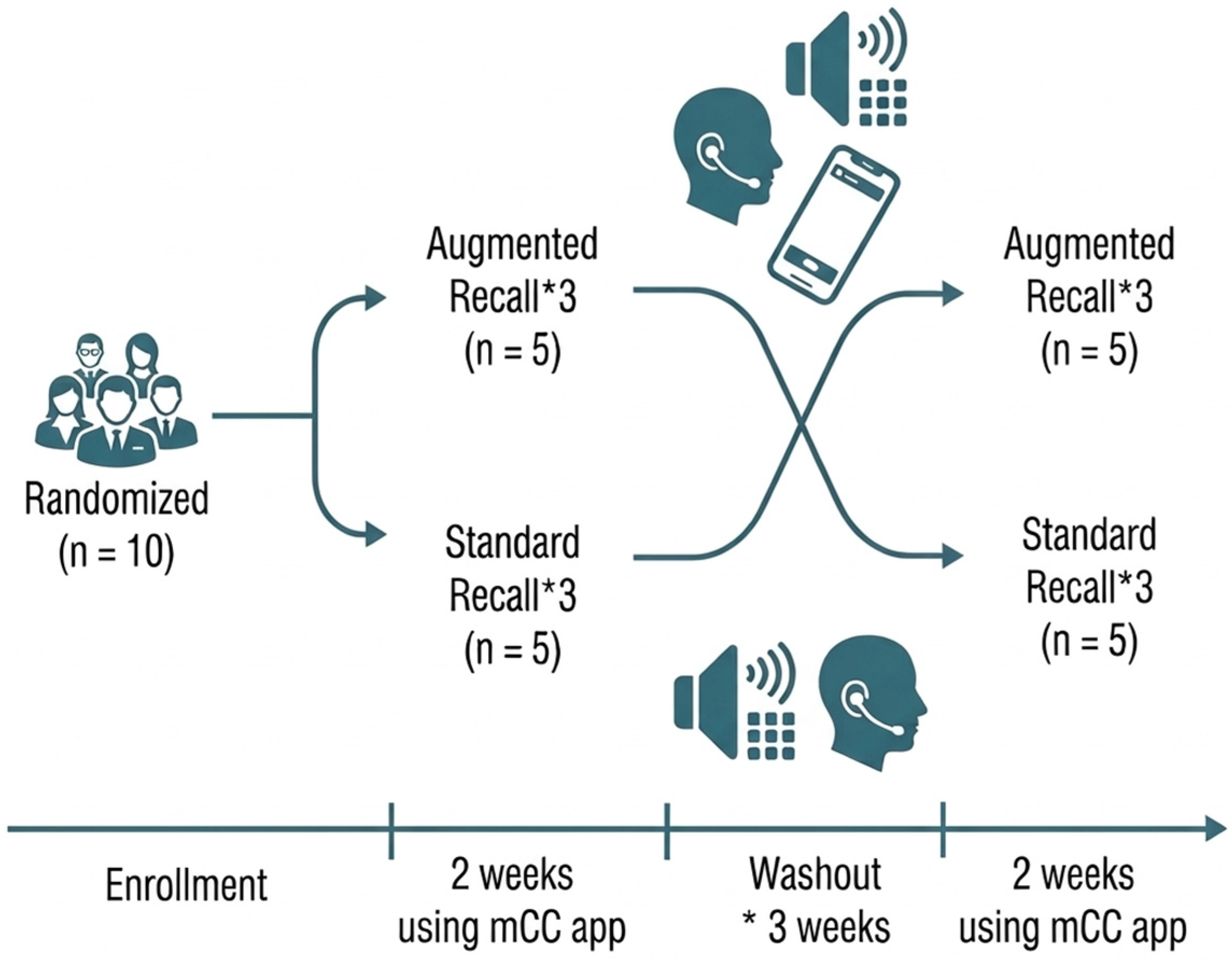
11]. The dietary recalls were collected by trained interviewers at the University of Minnesota using the Nutrition Data System for Research (NDSR) software (Version 2025). We evaluated mCC app-assisted dietary recalls (Augmented Recall) relative to standard 24 h dietary recalls (Standard Recall) using a randomized, cross-over design. Two sets of 24 h dietary recalls were collected from each participant (each set: three recalls over two weeks) in a randomized order, with a 3-week washout period between each set of recalls (
Figure 1).
The Standard Recalls were collected using a five-pass method in which interviewers start by collecting a quick uninterrupted list of what the participant recalls eating the prior day. Next, in the second pass, the quick list and time gaps between meals are reviewed to allow the participant to make corrections or additions. The third pass collects details about each food, including the quantity eaten. The fourth pass is an optional screen for commonly forgotten foods and was not utilized for this study. The fifth and final pass involves reviewing each eating occasion to allow the participant one final chance to make corrections or additions.
For the augmented dietary recalls, the five-pass method was modified by incorporating data from the mCC app into the first pass (quick list). Prior to the recall, interviewers constructed a quick list from the food logged by the participant. The recall with the participant then began with the second pass (review of the quick list) followed by the other passes carried out, as typically done. For example, for the Augmented Recalls instead of asking “What was the first thing you had to eat or drink yesterday?” as in the Standard Recall method, the interviewer populated the quick list with data from the mCC app and started the interview with the participant by asking, “I saw from the mCC app that the first meal you logged you had Cheerios, coffee, and a banana. Was there anything else you ate or drank at that time?” As is standard in the quick list review, participants were also asked if they ate or drank anything between the eating occasions recorded with the mCC app.
The mobile food record was collected using a research-focused, HIPAA-compliant app freely available for use on Android and Apple platforms (mCC: my Circadian Clock, mycircadianclock.com) [
12]. This app allowed participants to use the phone camera to take a picture of food and beverages before eating and enter a description of the foods. This information was transferred to a HIPAA-compliant data server. During the two-week period where participants were undergoing Augmented Recalls, they used the mCC app to document all dietary intake the day before a scheduled dietary recall. Participants were randomly reminded (1–2 times per day) to input food intake. Once an eating event was logged, it became unavailable to the participant while remaining available to the interviewer on the backend.
2.3. Additional Measures Collected
Participants were asked to complete a survey that included demographic questions and self-reported height and weight at baseline. Upon study completion, participants were asked which set of recalls they found more burdensome or time consuming, and which set they thought resulted in a more accurate measure of their eating habits. Additionally, they were asked to rate the difficulty of using the mCC app to log their foods and beverages.
2.4. Statistical Methods
The feasibility aim was assessed through recall adherence (% of recalls completed for the whole study), participant burden, level of difficulty when using the app and protocol completion rate (number of participants that completed all required study components/number of participants enrolled.
The secondary outcome was average energy intake (kcal/day). Exploratory outcomes included: total Healthy Eating Index (HEI)-2015 score [
13], total number of food items reported per day, average number of eating occasions per day, and number of minutes required to complete the recall.
Paired t-tests were used to compare differences in number of reported food items and eating occasions, calories, HEI, and average time to complete the recalls between the two methods. Difference in reported caloric intake between the first and second set of recalls was also analyzed using a paired t-test. Two sample t-tests were used to evaluate whether the differences in calories reported between the two methods differed based on BMI (stratified by the median value), household income (stratified by the median value), and order of recall. Analyses were conducted at a two-sided level of significance of 0.05 using R version 4.2.2.
3. Results
Eleven participants were recruited but only ten were enrolled in this study. The average age was 47.9 (SD = 15) years; the average BMI was 36.7 kg/m
2 (SD = 4.6). Half (n = 5) of the participants identified as Black or African American (
Table 1).
3.1. Dietary Recall and Survey Results
This feasibility study achieved 100% recall adherence and a 100% completion rate, with all enrolled participants completing every scheduled 24 h dietary recall during both study stages (
Table 2). Participants perceived the augmented approach as more demanding: 60% (n = 6) reported that Augmented Recalls were more burdensome than Standard Recalls. However, 60% (n = 6) indicated that the Augmented Recalls reflected their eating habits more accurately or similarly compared with the standard method. This reflects perceived accuracy, not validated accuracy against an objective reference measure. The majority of participants 70% (n = 7) rated the mCC app as “easy” or “very easy” to use. Additional participant perspectives on burden, usability, and suggested protocol improvements are detailed in
Supplementary Table S1.
3.2. Differences in Dietary Intake
Average energy intake estimated with the Augmented method was 274 (95% CI: −597, 50) kcal/day less than that recorded with the Standard method (
p = 0.09;
Table 2). This difference did not differ significantly by BMI (
p = 0.73) or household income (
p = 0.82) (
Supplementary Tables S2 and S3). No difference was detected in reported caloric intake based on order of recall (
p = 0.82;
Supplementary Table S4) Total HEI-2015 scores did not differ between recall methods (
p ≥ 0.99;
Table 3). Individuals reported an average of 1.1 (95% CI: −2.3, 0.1) less food items per day during Augmented Recalls than during Standard Recalls (
p = 0.08;
Table 2). The average number of reported eating occasions per day did not significantly differ between the Augmented and Standard methods (5.5 and 5.1 eating occasions, respectively;
p = 0.35). The number of minutes required to complete the recalls were also similar for the Augmented and Standard Recall methods (23.57 and 24.57 min, respectively;
p = 0.90).
4. Discussions
The main finding of this feasibility study was that incorporating a photo-based mobile food record application to guide interviewer-administered 24 h dietary recalls was operationally feasible and acceptable in adults with obesity, as demonstrated by full protocol completion and 100% recall adherence. Despite this successful implementation without data loss, no clear improvements were observed in the completeness of dietary intake capture or estimated energy intake compared with the standard five-pass recall method. As feasibility investigations are intended to evaluate whether and how a protocol functions in real-world conditions, the present study offers preliminary insight into the measurement variability and participant experience associated with this approach, highlighting areas where the technology-assisted recall process may need modification.
As secondary outcome, energy intake showed no differences between methods and several reasons may exist for these findings.
Although participants showed a good level of acceptance of applications for dietary recalls, if the participant had difficulty using the app, they may have provided an incomplete intake record. Finally, it is possible participants gave less careful thought when recalling their food intake with the Augmented Recalls because they were not starting with a ‘blank slate’ as occurs with Standard Recalls. The study’s outcomes shed light on the complexities of dietary capture in nutrition research. Research investigating deployment of technologies to address underreporting remains nascent.
Having the participants gather real-time dietary information did not lead to significant improvement in energy intake, HEI score or number of food items reported when compared to the Standard Recall method. Similar results were also reported by Ho et al. [
15], although focusing on the validity of an image-assisted food and nutrition app, no differences in energy intake were observed when comparing to a 24 h dietary recall.
In fact, our results were in the opposite direction than expected for reported calories and number of food items reported. Importantly, the lower reported energy intake and fewer food items observed in the Augmented Recalls may reflect factors other than improved reporting accuracy. These findings could indicate incomplete acquisition of food intake, loss of data related to reliance on photographed items, or potential reporting fatigue associated with the added burden of food logging prior to recall. Thus, a clear distinction must be made between perceived accuracy and validated accuracy, as this study did not include objective reference measures, and secondary outcomes should therefore be interpreted cautiously. These findings reinforce the current “gold standard” dietary capture method of a 24 h dietary recall. Further research is needed to determine how technology can be best incorporated to reduce underreporting in dietary capture. This study tested only one method of collection and implementation. Different ways of pairing mobile food records with interviewer-administered dietary recalls could potentially yield different results.
This study had several strengths, such as being the first of its kind to attempt to improve interviewer-administered 24 h dietary recall capture by pairing it with a mobile app, and the focus on populations with higher rates of underreporting. Yet, limitations exist. Although dietary intake was not the primary outcome, this cross-over feasibility study, due to its small sample size, showed limited ability to detect any significant differences. In addition, we used the mCC app data to supplement the 24 h dietary recall by having the dietary interviewer create a quick list prior to the phone call. Whether this data would actually be more effective at augmenting dietary capture in a different manner such as incorporating it later in the dietary recall while the forgotten foods pass remains unknown. Future research may also benefit from incorporating automated image-recognition and portion-size estimation technologies to reduce participant burden and minimize potential data loss associated with manual food logging.
5. Conclusions
Our findings demonstrate that augmenting interviewer-administered 24 h dietary recalls with a photo-based mobile food record is feasible in adults with obesity, with excellent protocol completion and full recall adherence. While the augmented method did not show clear improvements in dietary intake compared with Standard Recalls, participants generally rated the mCC application as easy to use, and many perceived the augmented approach as equally or more reflective of their usual eating habits, although this perception was not evaluated against objective validation measures. These results support continued use of interviewer-administered 24 h recalls as a reference standard and provide practical guidance for refining technology-assisted recall procedures. Further research is warranted to optimize how mobile food records are paired with established methods to address dietary underreporting.
Supplementary Materials
The following supporting information can be downloaded at:
https://www.mdpi.com/article/10.3390/dietetics5020025/s1, Table S1: Participant Feedback Regarding the Different Types of Recalls; Table S2: Comparison of Average Energy Difference (Augmented–Standard) Segmented by BMI; Table S3: Comparison of Average Energy Difference (Augmented–Standard) Segmented by Household Income; Table S4: Comparison of Average Energy Difference (Baseline–Final) by Order of Recall.
Author Contributions
N.O., B.P.Y., L.H. and L.S.C. designed research; B.P.Y. conducted research; S.D. and E.H. analyzed the data; B.P.Y. and T.P.M. wrote the paper; N.O., S.D., E.H., L.S.C. and L.H. edited the paper and provided intellectual input, B.P.Y. has primary responsibility for final content; All authors have read and agreed to the published version of the manuscript.
Funding
This research is supported by the University of Minnesota Institute of Diabetes, Obesity, and Metabolism Pilot and Feasibility Grant program.
Institutional Review Board Statement
This study was conducted according to the guidelines laid down in the Declaration of Helsinki and all procedures involving research study participants were approved by the University of Minnesota’s Institutional Review Board (approval code: STUDY00014542; approval date: 16 December 2021).
Informed Consent Statement
Written informed consent was obtained from all subjects.
Data Availability Statement
Protocol: Posted as
Supplementary Materials at journal website. Documented analytic dataset: Available in 1 years’ time from publication, upon request, review and approval by Chow and the study team if proper IRB approval and material transfer agreements are obtained. This shared data will be provided de-identified for analysis. Statistical Code: This will be provided with the analytic data set upon request as it will be difficult to interpret the code without knowing the details of the variables within the data set.
Conflicts of Interest
The authors declare no conflicts of interest.
References
- Poslusna, K.; Ruprich, J.; de Vries, J.H.M.; Jakubikova, M.; van’t Veer, P. Misreporting of energy and micronutrient intake estimated by food records and 24-hour recalls, control and adjustment methods in practice. Br. J. Nutr. 2009, 101, S73–S85. [Google Scholar] [CrossRef] [Scilit] [PubMed]
- Macdiarmid, J.; Blundell, J. Assessing dietary intake: Who, what and why of under-reporting. Nutr. Res. Rev. 1998, 11, 231–253. [Google Scholar] [CrossRef] [Scilit] [PubMed]
- Wehling, H.; Lusher, J. People with a body mass index ≥30 under-report their dietary intake: A systematic review. J. Health Psychol. 2019, 24, 2042–2059. [Google Scholar] [CrossRef] [Scilit] [PubMed]
- Novotny, J.A.; Rumpler, W.V.; Riddick, H.; Hebert, R.J.; Rhodes, D.; Judd, J.D.; Baer, D.J.; McDowell, M.; Briefel, R. Personality characteristics as predictors of underreporting of energy intake on 24-hour dietary recall interviews. J. Am. Diet. Assoc. 2003, 103, 1146–1151. [Google Scholar] [CrossRef] [Scilit] [PubMed]
- Briefel, R.; Sempos, C.; McDowell, M.; Chien, S.; Alaimo, K. Dietary methods research in the third National Health and Nutrition Examination Survey: Underreporting of energy intake. Am. J. Clin. Nutr. 1997, 65, 1203S–1209S. [Google Scholar] [CrossRef] [Scilit] [PubMed]
- Johansson, G.; Wikman, Å.; Åhrén, A.M.; Hallmans, G.; Johansson, I. Underreporting of energy intake in repeated 24-hour recalls related to gender, age, weight status, day of interview, educational level, reported food intake, smoking habits and area of living. Public Health Nutr. 2001, 4, 919–927. [Google Scholar] [CrossRef] [Scilit] [PubMed]
- Hirvonen, T.; Männistö, S.; Roos, E.; Pietinen, P. Increasing prevalence of underreporting does not necessarily distort dietary surveys. Eur. J. Clin. Nutr. 1997, 51, 297–301. [Google Scholar] [CrossRef] [Scilit] [PubMed]
- Klesges, R.C.; Eck, L.H.; Ray, J.W. Who underreports dietary intake in a dietary recall? Evidence from the Second National Health and Nutrition Examination Survey. J. Consult. Clin. Psychol. 1995, 63, 438–444. [Google Scholar] [CrossRef] [PubMed]
- Chow, L.S.; Manoogian, E.N.; Alvear, A.; Fleischer, J.G.; Thor, H.; Dietsche, K.; Wang, K.; Hodges, J.S.; Esch, N.; Malaeb, S.; et al. Time-Restricted Eating Effects on Body Composition and Metabolic Measures in Humans who are Overweight: A Feasibility Study. Obesity 2020, 28, 860–869. [Google Scholar] [CrossRef] [Scilit] [PubMed]
- Manoogian, E.N.C.; Wei-Shatzel, J.; Panda, S. Assessing temporal eating pattern in free living humans through the myCircadianClock app. Int. J. Obes. 2022, 46, 696–706. [Google Scholar] [CrossRef] [Scilit] [PubMed]
- van Horn, L.V.; Stumbo, P.; Moag-Stahlberg, A.; Obarzanek, E.; Hartmuller, V.W.; Farris, R.P.; Kimm, S.Y.; Frederick, M.; Snetselaar, L.; Liu, K. The Dietary Intervention Study in Children (DISC): Dietary assessment methods for 8- to 10-year-olds. J. Am. Diet. Assoc. 1993, 93, 1396–1403. [Google Scholar] [CrossRef] [Scilit] [PubMed]
- Gill, S.; Panda, S. A Smartphone App Reveals Erratic Diurnal Eating Patterns in Humans that Can Be Modulated for Health Benefits. Cell Metab. 2015, 22, 789–798. [Google Scholar] [CrossRef] [Scilit] [PubMed]
- Krebs-Smith, S.M.; Pannucci, T.E.; Subar, A.F.; Kirkpatrick, S.I.; Lerman, J.L.; Tooze, J.A.; Wilson, M.M.; Reedy, J.L. Update of the Healthy Eating Index: HEI-2015. J. Acad. Nutr. Diet. 2018, 118, 1591–1602. [Google Scholar] [CrossRef] [Scilit] [PubMed]
- Lytle, L.A.; Nichaman, M.Z.; Obarzanek, E.; Glovsky, E.; Montgomery, D.; Nicklas, T.; Zive, M.; Feldman, H.; The CATCH Collaborative Group. Validation of 24-hour recalls assisted by food records in third-grade children. J. Am. Diet. Assoc. 1993, 93, 1431–1436. [Google Scholar] [CrossRef] [Scilit] [PubMed]
- Ho, D.K.N.; Chiu, W.-C.; Kao, J.-W.; Tseng, H.-T.; Yao, C.-Y.; Su, H.-Y.; Wei, P.-H.; Le, N.Q.K.; Nguyen, H.T.; Chang, J.-S. Mitigating errors in mobile-based dietary assessments: Effects of a data modification process on the validity of an image-assisted food and nutrition app. Nutrition 2023, 116, 112–212. [Google Scholar] [CrossRef] [Scilit] [PubMed]
| Disclaimer/Publisher’s Note: The statements, opinions and data contained in all publications are solely those of the individual author(s) and contributor(s) and not of MDPI and/or the editor(s). MDPI and/or the editor(s) disclaim responsibility for any injury to people or property resulting from any ideas, methods, instructions or products referred to in the content. |





 ,
,