Article

Higher Ultra-Processed Food (UPF) Intake Is Associated with Lower Food Literacy in Greek Adults with Overweight or Obesity: Results from a Cross-Sectional Study


by
Maria Ioannidou
1,
Marios Skordis
2,
Ioannis Kavvadias
1,
Georgios I. Panoutsopoulos
1 and
Evaggelia Fappa
1,*
1
Department of Nutritional Science and Dietetics, University of the Peloponnese, 24100 Kalamata, Greece
2
School of Science and Technology, Hellenic Open University, 26335 Patras, Greece
*
Author to whom correspondence should be addressed.
Dietetics 2026, 5(2), 24; https://doi.org/10.3390/dietetics5020024
Submission received: 6 January 2026 / Revised: 15 February 2026 / Accepted: 6 April 2026 / Published: 9 April 2026

Abstract

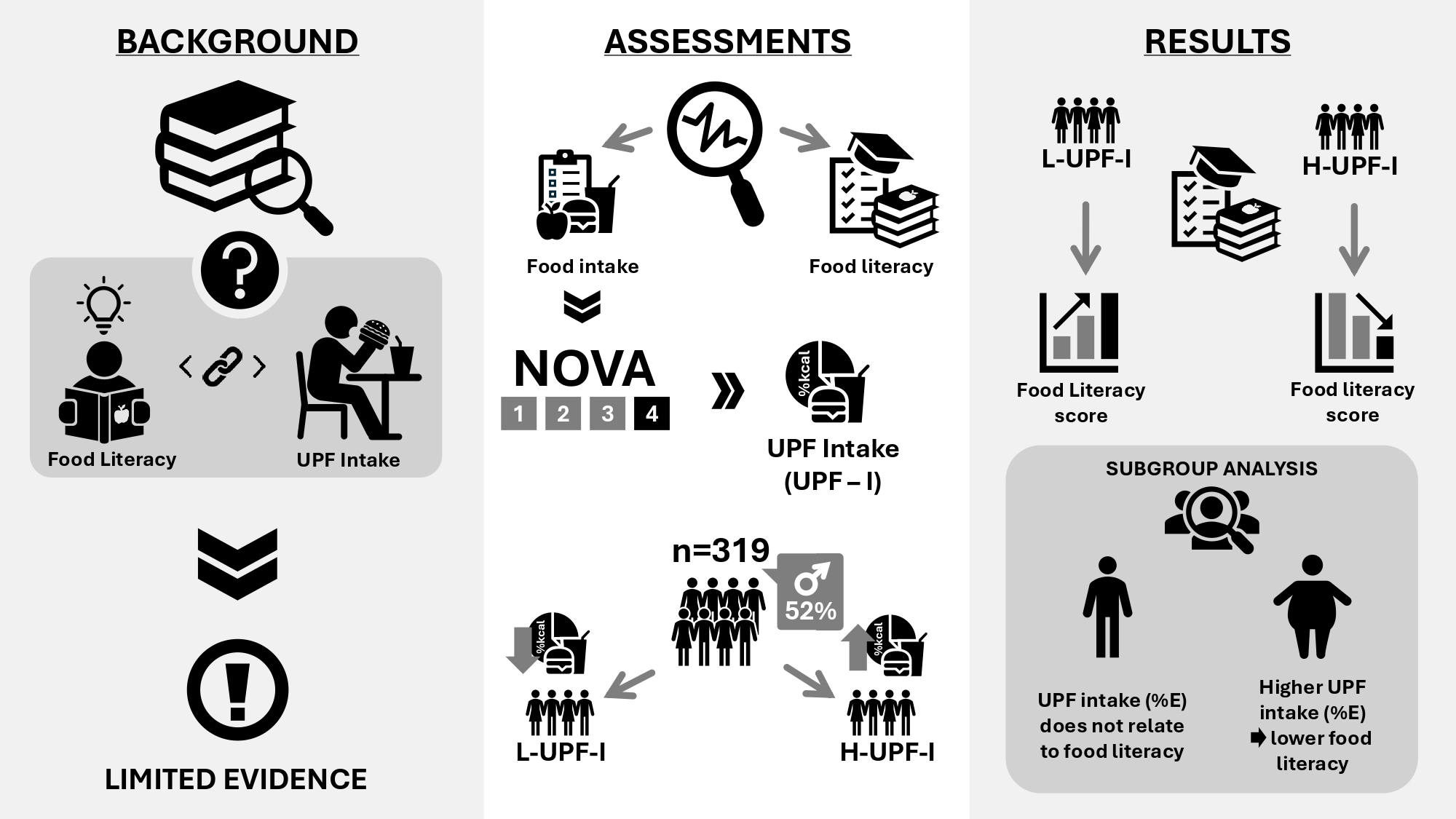
Background: Given the limited evidence in the field, the present study aimed to explore the association of UPF intake with food literacy levels in an adult Mediterranean-based population. Methods: Self-reported demographic and anthropometric data were collected from 317 apparently healthy adults (52.5% males) Food literacy and dietary intake of this population were also assessed. Foods were classified as ultra-processed according to the NOVA system, and their contribution to total daily energy intake (%) was calculated. Then, participants were grouped into the (1) higher UPF intake (HUPFI), and (2) lower UPF intake (LUPFI) groups, based on the median value of this population as a cut-off. Results: Between-group analysis revealed that LUPFI scored statistically significantly higher than the HUPFI group in total food literacy (93.5 [84.0–104.0] vs. 86.0 [78.0–99.0], p < 0.001) and in three out of five food literacy sub-dimensions. Sub-analysis revealed no differences between LUPFI and HUPFI groups of individuals with normal weight. In participants with overweight or obesity, the LUPFI group scored lower than the HUPFI in the total food literacy score (95.0 [87.0–104.0] vs. 81.0 [70.0–94.0], p < 0.001) and in each sub-dimension. Conclusions: Higher UPF intake was associated, in adults with overweight or obesity, with lower levels of food literacy.

Graphical Abstract

1. Introduction

The development of industrial food processing has improved the availability, safety, and self-life of food but at the same time led, in many cases, to its nutritional degradation which raised concerns among health scientists [1]. To address the need to classify foods based on the degree of food processing, several systems emerged, of which the most applicable and widespread, according to a systematic review, is the NOVA system [2]. The latter classifies foods into four categories, based on the nature, degree, and purpose of processing, with ‘ultra-processed foods’ (UPF) being the most processed category [1]. In this system, UPFs are defined as ready-to-eat or heated industrial products, for the preparation of which little or no unprocessed, fresh materials are used.
In recent years, an increasing trend in the use of UPFs has been documented in their share of the total daily energy intake of the population [3,4]. In developed countries such as the US, Canada, and the UK more than 50% of energy intake comes from such foods [5,6,7]. In Europe, data from 22 countries revealed percentages of energy intake from UPF ranging from 14 to 44% [8]. In the Mediterranean countries known for their traditional health-related cuisine, a 20.0% corresponding percentage has been recorded in Italy, 21.9% in Greece and 24.4% in Spain [8,9,10].
The increasing trend in UPF consumption has coincided with the upward trend in the prevalence of obesity and a plethora of other non-communicable diseases (NCD), raising concerns about their long-term health implications [3]. Indeed, multiple meta-analyses have documented positive correlations between higher UPF intake and chronic diseases such as obesity, cardiovascular disease, cerebrovascular disease, metabolic syndrome, and depression, as well as all-cause mortality [11,12]. These phenomena have been attributed both to the displacement of more healthful foods, as well as to the intake of common ingredients found in UPF per se—affecting nutrition in a way contrary to healthy dietary recommendations and leading to an increase in risk for NCDs [13,14]. At the same time, emerging evidence supports the mediating role of UPF intake in other health conditions such as asthma, through its effect on the intestine beyond the aforementioned pathways [15].
Consumers’ preference for UPFs appears to be driven by their convenience, affordability, extended shelf life, and heightened palatability, particularly in contexts characterized by time scarcity and demanding daily routines [16,17]. The contemporary food environment further reinforces these choices through widespread availability, aggressive marketing strategies, and strategic product placement, which collectively normalize UPF consumption as a default dietary option [16]. In addition, qualitative data have highlighted that factors such as lack of knowledge regarding which foods are considered ultra processed as well as their impact on health, lack of understanding of the term, and poor cooking skills, along with time-constraints, seem to play a role in choosing UPF to consume [18]. Furthermore, reduced cooking and meal-planning skills have been associated with higher percentages of daily energy intake derived from UPFs [19].
Within this context, food literacy—defined as the set of knowledge, skills, and behaviors that allow the individual to make informed dietary choices consistent with nutrition recommendations and guidelines [20]—may emerge as a relevant determinant of UPF intake. However, only a few studies have investigated the relationship between food literacy and UPF intake [21,22,23,24]. Of those, only two have been conducted in adults, both publishing data from Turkish populations [23,24]. So far, data have reported inverse associations between food literacy and UPF consumption, with individuals exhibiting lower food literacy showing significantly higher odds of frequent UPF intake [23,24]. Given the fact that cooking skills have been associated with greater adherence to the Mediterranean diet [25], a healthy pattern encompassing mainly minimally or no processed foods [26], it would be of value to investigate associations between UPF intake and food literacy within a Mediterranean population, in which data are scarce. Hence, the present study aimed to explore associations between UPF intake and food literacy levels among Greek adults, while additionally examining whether BMI status modifies this association.

2. Materials and Methods

2.1. Study Design and Procedures

This was a cross-sectional study conducted between December 2022 and January 2024. After approval by the Collaborative Research Ethics Committee (Metropolitan College, Athens, Greece) (Protocol number 2138, 12 December 2022), volunteer recruitment was conducted through the researchers’ social media platforms using a snowball recruitment methodology [27]. A brief description of the study’s purpose was published and potential participants could contact the researchers for further clarifications. Those who agreed to participate and gave consent received an email link to a Google Forms file. The file included the participant information sheet and the consent form. After signing the consent form, research data was collected through self-completed questionnaires. In addition, an appointment was scheduled between the volunteer and one of the researchers to conduct a 24 h recall. The meetings took place either through online meetings (tele-conference) or by phone. Data collection for each participant did not exceed 30 min, namely 10 min for the questionnaires and 20 min for the 24 h recall. All procedures followed the ethical principles for medical research involving human subjects as described in the Declaration of Helsinki [28]. All participants provided consent for participation. Anonymity was ensured via alphanumerical coding of participants. Contact information of participants was kept encrypted in a password-protected file on the researchers’ computer.

2.2. Participants

Subjects were included in the study if they were adults (18 to 64 years of age), of any gender, and apparently healthy. Individuals were excluded from the study if they were pregnant or lactating or followed a diet for any medical reason. Recruitment was conducted via social media using a broad invitation to maximize reach. Eligibility criteria were assessed during the survey using specific screening questions. To minimize potential misreporting, participants identified as under-reporting energy intake were excluded from the analysis. Additionally, extreme values for age and BMI were excluded to enhance data reliability.

2.3. Assessment

Demographic, anthropometric, food literacy and dietary intake data were collected from the participants. Demographic (age, gender, marital status, and level of education) and anthropometric characteristics (body weight and height) were self-reported through relevant online questions.
Food literacy was assessed with an existing validated tool of 26 questions [29]. Each question is rated on a five-point Likert scale (1 = strongly disagree; 5 = strongly agree). The tool assesses 5 aspects of food literacy: food and nutrition knowledge (score: 5–25), food (preparation) skills (score: 5–25), resilience/control ability (4–20), health promotion literacy (6–30), and healthy eating habits (6–30). The total score ranges from 26 to 130 with a higher score depicting a better literacy level. Even though this tool was originally developed to be used in a Korean population, it is grounded in a dietetics-oriented, multidimensional conceptualization of food literacy, encompassing food planning, selection, preparation, and eating behaviors [20]. Also, the original validation study demonstrated significant associations between food literacy, health promotion literacy, and healthy eating habits. To be used in the present study, the tool was translated and culturally adapted based on an already published proposed methodology [30]. Internal consistency of the Greek version of the Food Literacy questionnaire was assessed in the present sample using Cronbach’s alpha, calculated for the total scale and for each of the five subscales. In detail, the Greek version of the Food Literacy questionnaire showed high internal consistency for the total scale (Cronbach’s α = 0.891). Subscale Cronbach’s alpha values were Food Knowledge (α = 0.881), Food Skills (α = 0.612), Resilience/Control Ability (α = 0.800), Health Promotion Literacy (α = 0.561), and Healthy Eating Habit Score (α = 0.792).
Dietary intake data were collected through a telephone 24 h dietary recall method [31]. The interview was conducted by trained fourth-year dietetics students as part of their thesis project. Participants were asked to report the type and quantity of the foods and drinks they had consumed during the 24 h preceding the day of the interview. Emphasis was placed on getting the brand name of the packaged products. During the interview, household measures (e.g., cups, glasses, tablespoons, and teaspoons) were used in order to estimate the amount of foods and drinks consumed. The recalls were conducted using a structured, interviewer-administered approach based on the multiple-pass method to enhance completeness and reduce recall bias [32]. UPF were defined according to the NOVA food classification system [1].

2.4. Data Processing

Body mass index (BMI) was calculated as body weight (kg) divided by height squared (m2) and weight status was then decided using the cutoffs recommended for Caucasians [33]. The individuals having a BMI ≥ 25.0 kg/m2 formed the group of people with overweight or obesity. Dietary data collected through 24 h dietary recalls were analyzed using the nutritional analysis software Athlisis [34]. This software utilizes open-access food composition databases, including the USDA National Nutrient Database [35] and the Greek Food Composition Tables developed by Trichopoulou [36], to estimate the nutrient content of foods commonly available in the Greek market. In addition, to enable classification of foods by processing level, items specific to the Greek market (e.g., regional cheese varieties) were added to the database using information from their food labels. Through this process, estimates of total energy intake, macronutrient and sodium consumption were obtained for each participant. Furthermore, we calculated the contribution of UPFs to total energy intake by macronutrient, as well as sodium intake. To estimate UPF consumption, the proportion of daily energy intake derived from ultra-processed foods relative to total energy intake was calculated. To examine the association between UPF intake and food literacy, participants were stratified into two groups based on the median UPF intake: the “lower UPF intake (LUPFI)” and the “higher UPF intake (HUPFI)” groups.

2.5. Statistical Analysis

The distribution of the variables was tested for normality using the Shapiro–Wilk test. Data are presented as medians (IQR) unless otherwise stated. Between-group comparisons were conducted for macronutrient intake (proteins, carbohydrates, and fats), saturated fat, simple sugars, dietary fiber, sodium and UPF macronutrient and sodium contribution, as well as demographic and anthropometric variables (age, BMI, marital status, household size, and education level). Subsequently, the sample was further stratified by BMI into individuals with normal weight and individuals with overweight or obesity, and the above comparisons between LUPFI and HUPFI were repeated within these subgroups. To address statistical power for the overall and subgroup comparisons, we performed a sensitivity power analysis in G*Power (v3.1) [37] using the Wilcoxon–Mann–Whitney test (two groups), two-tailed, with α = 0.05 and power (1 − β) = 0.80, applying the min-ARE parental distribution as the default distribution for non-normal distributed data in G*Power (expressing detectable effects as Cohen’s d). Based on the achieved sample sizes, the minimum detectable standardized mean differences (Cohen’s d) with 80% power were 0.35 for the overall comparison (LUPFI [n = 150] vs. HUPFI [n = 151]), 0.44 for the subgroup with normal weight (LUPFI [n = 102] vs. HUPFI [n = 88]), and 0.58 for the subgroup with overweight/obesity (LUPFI [n = 48] vs. HUPFI [n = 63)]. Independent-samples t-tests were used for variables that satisfied parametric assumptions, while the Mann–Whitney U test was used for variables that did not. For between-group differences, the Hodges–Lehmann estimate of the location shift (LUPFI vs. HUPFI) and its 95% confidence interval are presented. All analyses were performed using Jamovi, version 2.6.26.0 [38]. Statistical significance was defined as a two-sided p-value less than 0.05.

3. Results

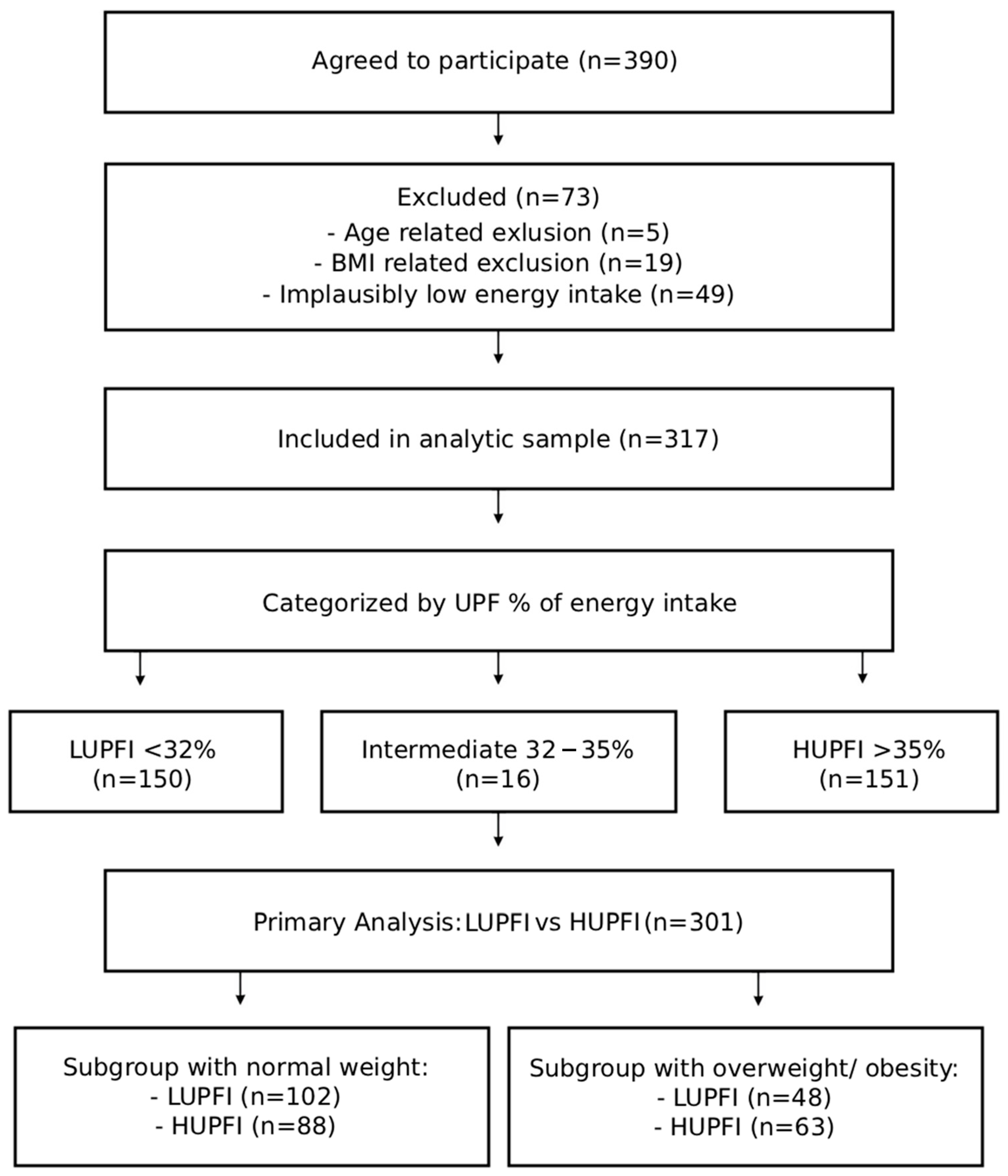
Three hundred and ninety people agreed to participate in the study. After applying the exclusion criteria, 73 cases were removed, 5 because of age, 19 because of BMI, and 49 because they reported implausibly low energy intake (defined as the energy intake to basal metabolic rate ratio ≤0.85, per Goldberg cut-off methodology [39,40,41], leaving 317 apparently healthy individuals for the present analysis (Figure 1). The median age of the sample was 29 years, with an interquartile range (IQR) of 25 to 37. The median BMI of the participants was 23.5 kg/m2 (21.6–26.3) and the majority was categorized as having normal body weight (63.7%). Male and female gender showed a similar distribution within the sample (52.4% males). The majority of participants were single (73.5%) and had a higher education degree (54.6%). The median UPF intake, expressed as a percentage of total energy intake, was 33.5% (17.1–53.1%).
Dietary intake data of the assessed population—including total energy intake; the percentage of energy derived from UPFs; the percentage of energy from macronutrients, saturated fats, and sugars; and fiber and sodium intake—are presented in Table 1. The overall scores for food literacy and for its subcategories are shown in Table 2.
The LUPFI and HUPFI groups did not differ significantly in demographic and anthropometric characteristics, or in energy intake (Table 3).
Regarding food literacy, the HUPFI group demonstrated lower overall food literacy as well as lower scores in three of the five dimension-specific food literacy domains compared with the LUPFI group (Table 4).
Further analysis based on BMI showed that neither food literacy nor energy intake differed between LUPFI and HUPFI groups of individuals with normal weight (Table 5).
However, the same comparisons among individuals with overweight or obesity showed that the HUPFI participants scored lower both in the total score as well as in each dimension of the food literacy compared to its LUPFI counterpart, while no difference was revealed for the energy intake between the two groups (Table 6).

4. Discussion

Results of the present analysis showed that adults with a higher percentage of energy intake coming from UPF had lower scores of food literacy as well as its dimensions: food knowledge, food (preparation) skills and resilience. However, further analysis revealed that this discrepancy was merely due to differences observed in food literacy between HUPFI and LUPFI in the group of people with overweight or obesity, rather than the ones with normal weight. In more detail, food literacy levels and dimensions did not differ between HUPFI and LUPFI groups of participants with normal weight, and all aspects of food literacy were found to score lower in the HUPFI participants that had overweight or obesity compared to their LUPFI counterparts. It is of note, though, that similar food literacy scores were observed for participants with normal weight and those with overweight or obesity belonging in the LUPFI group. For the overall food literacy score, this was a score a little bit over 90 out of 130, whereas for the HUPFI group with overweight or obesity it was approximately 81/130. Studies have documented the negative association of BMI status with food literacy [42,43], but in the present study people with overweight or obesity and low UPF intake had statistically significant better food literacy scores compared to the ones of similar body weight status and high UPF intake.
The association observed between higher ultra-processed food (UPF) consumption and lower food literacy, particularly among individuals with overweight or obesity, may be partly influenced by a range of psychological and contextual factors. Previous studies indicate that time constraints and poor cooking and meal planning skills often limit engagement in home food preparation and encourage greater reliance on ready-to-eat and ultra-processed products [18,19]. In addition, psychological factors such as depression, anxiety and stress have been associated with higher UPF intake [44]. Furthermore, emotional eating has been shown to mediate the inverse association between resilience and UPF intake [45]. However, due to the cross-sectional nature of the present study, no conclusions can be drawn regarding causality. It is plausible that limited food literacy contributes to higher UPF intake through reduced cooking and food management skills. At the same time, frequent consumption of UPFs may gradually erode food-related competencies and nutritional awareness, resulting in a reinforcing feedback loop [13,46].
Previous research verifies the results found in this study regarding the negative association found between UPF intake and food literacy [23,24]. In a study of 3572 adults (67.6% female) aged 18–65 years selected through snowball sampling in Ankara, Türkiye, a negative association was found between UPF intake and overall food literacy and cooking and food preparation skills, assessed by two separate tools [23]. In this population, UPF intake was found to be high for 42.0% of the participants and was assessed by an 11-item questionnaire including the UPFs found in the Turkish diet. For each food included in the list consumed, one mark is appointed. Scores 6 and above on the scale depict a high UPF intake. The mean score of UPF intake in this population was 4.9  ±  3.0 out of 11 and the total average score obtained from the Food Literacy Tool was 41.3  ±  12.7 out of 72. Even though a lower overall food literacy score was found in this population compared to ours, similar to the present study’s results, total and sub-dimension (cooking skills, production and quality knowledge, selection and planning, environmentally safe, and origin) scores of food literacy were significantly lower in individuals with high UPF consumption compared to those with low. In addition, no significant difference was found between the UPF groups (high vs. low) in terms of BMI. In the present study, not all sub-categories of food literacy were different between the two groups (high vs. low UPF intake). However, food knowledge, food preparation skills and resilience were lower in the HUPFI group compared to the LUPFI participants, food literacy aspects which may correlate to the cooking skills, production and quality knowledge and selection and planning dimensions of the study in the Turkish population. Environmentally safe and food origin topics were not assessed in the present study as the food literacy tool used included dimensions having to do with health, which may explain why no differences were found for all food literacy aspects between this study’s groups (HUPFI vs. LUPFI). Indeed, having knowledge of the effect of foods on health can improve diet quality but it has been shown that gaps in food literacy and competing priorities can often lead to unhealthy food choices [47].
On the contrary, healthy budgeting and healthy food stockpiling, two of the dimensions of the self-perceived food literacy questionnaire, have been shown to have small negative correlations with UPF intake (r = −0.108, p < 0.05 and r = −0.096, p < 0.05, respectively) in university students studying in Turkey [24]. In the same group, small negative correlations were also found between UPF intake and resilience and resistance (r = −0.252, p < 0.001), social and conscious eating (r = −0.105, p < 0.05), examining food labels (r = −0.118, p < 0.001) and the overall food literacy score (r = −0.189, p < 0.001). At the same time, contrary to the present study and to the previous one from Turkey, no associations were found for food preparation skills, healthy snack styles and food planning. Based on 24 h recall data and using the NOVA system, the mean UPF intake of this population was found to be somewhat in between 28 to 30% of energy intake with no gender differences, whereas food literacy level was found to be higher in females compared to males (93.00 ± 12.73 vs. 89.35 ± 13.88 out of 145, p = 0.001). The relatively high food literacy score of this population, which is similar to ours, along with the findings in its sub-dimensions and the relatively moderate UPF intake, may depict that in an effort to eat healthy while not using food preparation or culinary skills, the participants of this study seem to read food labels and use their budget towards bringing healthier foods to their home. Their BMI levels were also within the normal range and lower than those in the present study and the previous one discussed from Turkey, probably depicting better food choice skills [43].
In the present study’s population, the median UPF intake in terms of energy percentage was found to be 33.5%, which is lower than that calculated in Greek university students (40.7 ± 13.6%) in a previous study and higher than that reported for the adults in the country in 2021 (20.1%) [8,48]. However, the present study’s population was older than the Greek university students having provided data for the aforementioned study, with a median age of 29 years (25–37), which might explain the lower intake of UPF compared to that population. Indeed, studies have shown that UPF intake is higher in younger populations compared to older ones, with age being inversely associated with this dietary intake [9]. In addition, the UPF intake has increased worldwide in recent years which might explain the higher percentage found in the present study compared to that published for the adult Greeks in 2021 [8]. On the other hand, there is great variability in UPF intake among the adult Europeans, with the present study’s findings being similar to those of France (31.1%) [49], higher than those of Italy [9] and lower than those of UK (54%) [50].
The present study has several strengths, including the use of a comprehensive validated instrument to assess food literacy and its dimensions [29], as well as the use of 24 h recalls along with the application of the most widely used NOVA system to categorize food items into processing levels [2]. Twenty-four-hour recalls have been said to be more appropriate than conventional FFQs to classify food items based on their processing as they offer more detailed food/brand information crucial for NOVA classification [51]. However, this study relied on a single 24 h dietary recall for each person, which may not adequately reflect participants’ usual dietary intake, as despite this structured approach, self-reported dietary data are subject to limitations such as reliance on memory, potential under-reporting, and the fact that a single 24 h recall may not reflect the day-to-day variability in food consumption or differences between weekdays and weekends [32]. To address the above, we have excluded all cases of under-reporting from our analysis and we have collected 24 h dietary recalls in a randomized manner, aiming to cover all calendar days of the week. However, we did not retain specific data on weekday versus weekend distribution of recalls, which represents a limitation of our study given known day-to-day variation in dietary intake [32]. Notably, for the purpose of comparing usual intake of ultra-processed foods between groups (HUPFI vs. LUPFI), the recall collection protocol was applied identically across all participants before group assignment was known. This consistent methodology across groups reduces the likelihood that differential recall timing would bias the inter-group comparisons [52]. However, future studies should consider using repeated 24 h dietary recalls across multiple days, including at least one weekend day, or alternative methods such as food frequency questionnaires (FFQs) to better assess usual dietary intake. Another strength of the present study was the approximately equal gender distribution observed in the population, allowing for safer conclusions regarding the research hypothesis, as differences in food literacy scores between the genders have been previously documented in the literature with women scoring higher [53,54]. However, it has to be noted that the sample consisted predominantly of young adults with relatively high educational attainment, which may limit the generalizability of the findings to the broader Greek population. In addition, potential confounding variables, such as physical activity, income, and urban versus rural residence, were not accounted for. These factors may influence both food literacy and dietary behaviors [55,56], and their omission could have affected the observed associations. However, given that the sub-analysis was stratified by BMI and energy intake did not differ between HUPFI and LUPFI groups within categories with normal weight and overweight/obese, physical activity levels may also be less likely to differ. Another strength of the present study was that this is the first time, to-our-knowledge, that the interplay of BMI status with food literacy and UPF intake is highlighted. However, it must be noted that BMI was calculated based on self-reported anthropometric data, which may be subject to reporting bias [57].
Regarding the limitation of the present work, apart from those already stated, the study relied exclusively on self-reported measures, without including blood tests or other objective health indicators. Although self-report instruments are widely used and practical for large-scale studies, the absence of objective measurements may have introduced reporting bias, which should be considered when interpreting the results [58]. In addition, the sampling procedure relied on convenience and snowball recruitment, which are non-probability methods and inherently limit the generalizability of the findings due to potential selection bias and lack of representativeness [59]. Also, the high or low UPF intake that was used to classify participants in the present analysis was based on a population-specific cut-off point, instead of a universally agreed threshold, which would allow for better comparisons and conclusions integrating evidence from other studies. To our knowledge, such a threshold does not yet exist but researchers have considered less than 30% of energy intake coming from UPF intake as low, which is comparable to the median used in the present study, and an intake exceeding 50% as high, [13,60,61,62], which reflects the levels observed in the HUPFI group in the present study.

5. Conclusions

The findings of the present study are consistent with previous evidence indicating a negative association between ultra-processed food intake and food literacy levels, with statistically significant differences observed between participants with high and low UPF consumption. Even though various tools and methodologies have been used to assess both metrics in adult populations, specific cooking and food preparation and planning skills as well as food knowledge have been negatively associated with UPF intake. Moreover, this study showed that BMI status seems to mediate this relationship, as participants with normal BMI did not differ in any of the dimensions or the overall food literacy score. On the other hand, participants with overweight or obesity and high UPF intake were found to have poorer overall and specific-dimension food literacy scores compared to their counterparts having a lower UPF consumption. It is of note that this was a population of rather high food literacy level, which might be attributed to the fact that this was a highly educated sample [63].
Future research should aim to include participants across a broader age-range and with more diverse educational and socioeconomic backgrounds, account for potential confounding variables, and incorporate objective health measurements. Further studies are also warranted to replicate the present study’s findings and to explore potential mediators underlying the associations between ultra-processed food intake, food literacy, and BMI status, in order to inform targeted public health interventions.

Author Contributions

Conceptualization, M.I. and E.F.; methodology, M.I., M.S., and E.F.; formal analysis, M.S. and E.F.; investigation, M.I., M.S., and I.K.; writing—original draft preparation, M.I., M.S., and E.F.; writing—review and editing, E.F. and G.I.P.; visualization, M.S. and E.F.; supervision, E.F. and G.I.P.; project administration, M.I. All authors have read and agreed to the published version of the manuscript.

Funding

This research received no external funding.

Institutional Review Board Statement

This study was conducted in accordance with the Declaration of Helsinki and approved by the Collaborative Research Ethics Committee (Metropolitan College) (protocol code 2138 and date of approval 12 December 2022).

Informed Consent Statement

Informed consent was obtained from all subjects involved in the study.

Data Availability Statement

Dataset available on request from the authors.

Acknowledgments

The authors would like to thank the participants for their volunteer work in this study and the time spent filing out the study’s questionnaires.

Conflicts of Interest

The authors declare no conflicts of interest.

References

  1. Monteiro, C.A.; Cannon, G.; Lawrence, M.; Costa Louzada, M.L.; Machado, P.P. Ultra-Processed Foods, Diet Quality, and Health Using the NOVA Classification System; Food and Agriculture Organization: Rome, Italy, 2019. [Google Scholar]
  2. Lawrence, M.A.; Baker, P.I. Ultra-Processed Food and Adverse Health Outcomes. BMJ 2019, 365, l2289. [Google Scholar] [CrossRef] [PubMed]
  3. Yi, L.; Wu, J.; Li, Z.; Wang, J. The Rapid Rise of Ultra-Processed Foods Brings up Human Health Concerns. J. Future Foods 2025. [Google Scholar] [CrossRef]
  4. Marino, M.; Puppo, F.; Del Bo’, C.; Vinelli, V.; Riso, P.; Porrini, M.; Martini, D. A Systematic Review of Worldwide Consumption of Ultra-Processed Foods: Findings and Criticisms. Nutrients 2021, 13, 2778. [Google Scholar] [CrossRef]
  5. Moubarac, J.C.; Batal, M.; Louzada, M.L.; Martinez Steele, E.; Monteiro, C.A. Consumption of Ultra-Processed Foods Predicts Diet Quality in Canada. Appetite 2017, 108, 512–520. [Google Scholar] [CrossRef]
  6. Baraldi, L.G.; Martinez Steele, E.; Canella, D.S.; Monteiro, C.A. Consumption of Ultra-Processed Foods and Associated Sociodemographic Factors in the USA between 2007 and 2012: Evidence from a Nationally Representative Cross-Sectional Study. BMJ Open 2018, 8, e020574. [Google Scholar] [CrossRef]
  7. Rauber, F.; Louzada, M.L.D.C.; Steele, E.M.; Millett, C.; Monteiro, C.A.; Levy, R.B.; Rauber, F.; Louzada, M.L.D.C.; Steele, E.M.; Millett, C.; et al. Ultra-Processed Food Consumption and Chronic Non-Communicable Diseases-Related Dietary Nutrient Profile in the UK (2008–2014). Nutrients 2018, 10, 587. [Google Scholar] [CrossRef]
  8. Mertens, E.; Colizzi, C.; Peñalvo, J.L. Ultra-Processed Food Consumption in Adults across Europe. Eur. J. Nutr. 2022, 61, 1521–1539. [Google Scholar] [CrossRef] [PubMed]
  9. Ruggiero, E.; Dinu, M.; Angelino, D.; Di Costanzo, G.; Esposito, S.; Godos, J.; Grosso, G.; Lotti, S.; Martini, D.; Vitale, M.; et al. Ultra-Processed Foods Consumption, Mediterranean Diet Adherence and Sociodemographic Correlates in an Italian Adult Population: The UFO Survey. Nutrients 2025, 17, 3651. [Google Scholar] [CrossRef] [PubMed]
  10. Ferreiro, C.R.; Martín-Arriscado Arroba, C.; Navia, P.C.; Pablos, D.L.; De La Cámara, A.G. Ultra-Processed Food Intake and All-Cause Mortality: DRECE Cohort Study. Public Health Nutr. 2022, 25, 1854–1863. [Google Scholar] [CrossRef]
  11. Pagliai, G.; Dinu, M.; Madarena, M.P.; Bonaccio, M.; Iacoviello, L.; Sofi, F. Consumption of Ultra-Processed Foods and Health Status: A Systematic Review and Meta-Analysis. Br. J. Nutr. 2021, 125, 308–318. [Google Scholar] [CrossRef] [PubMed]
  12. Lane, M.M.; Gamage, E.; Du, S.; Ashtree, D.N.; McGuinness, A.J.; Gauci, S.; Baker, P.; Lawrence, M.; Rebholz, C.M.; Srour, B.; et al. Ultra-Processed Food Exposure and Adverse Health Outcomes: Umbrella Review of Epidemiological Meta-Analyses. BMJ 2024, 384, e077310. [Google Scholar] [CrossRef]
  13. Monteiro, C.A.; Cannon, G.; Moubarac, J.C.; Levy, R.B.; Louzada, M.L.C.; Jaime, P.C. The UN Decade of Nutrition, the NOVA Food Classification and the Trouble with Ultra-Processing. Public Health Nutr. 2018, 21, 5–17. [Google Scholar] [CrossRef]
  14. Gramza-Michałowska, A. The Effects of Ultra-Processed Food Consumption—Is There Any Action Needed? Nutrients 2020, 12, 2556. [Google Scholar] [CrossRef]
  15. Frontela-Saseta, C.; Finlayson, G.; Sánchez-Moya, T.; Lorenzetti, S.; López-Nicolás, R.; Frontela-Saseta, C.; Finlayson, G.; Sánchez-Moya, T.; Lorenzetti, S.; López-Nicolás, R. Ultra-Processed Foods Consumption and Asthma in the Western Diet. Dietetics 2024, 3, 144–158. [Google Scholar] [CrossRef]
  16. Moran, A.J.; Khandpur, N.; Polacsek, M.; Rimm, E.B. What Factors Influence Ultra-Processed Food Purchases and Consumption in Households with Children? A Comparison between Participants and Non-Participants in the Supplemental Nutrition Assistance Program (SNAP). Appetite 2019, 134, 1–8. [Google Scholar] [CrossRef] [PubMed]
  17. Djupegot, I.L.; Nenseth, C.B.; Bere, E.; Bjørnarå, H.B.T.; Helland, S.H.; Øverby, N.C.; Torstveit, M.K.; Stea, T.H. The Association between Time Scarcity, Sociodemographic Correlates and Consumption of Ultra-Processed Foods among Parents in Norway: A Cross-Sectional Study. BMC Public Health 2017, 17, 447. [Google Scholar] [CrossRef] [PubMed]
  18. Lavelle, F.; George, C.V.; McKernan, C.; Martins, C.A.; Shrewsbury, V.A.; Wolfson, J.A.; Taylor, R.M.; Duncanson, K.; Elliott, C.; Collins, C.E. ‘What Have I Just Eaten?’ A Qualitative Exploration of Awareness and Use of Ultra-Processed Food Products during Pregnancy and the Post-Partum Period in Line with the COM-B Behaviour Model. Appetite 2025, 214, 108231. [Google Scholar] [CrossRef]
  19. Shinozaki, N.; Murakami, K.; Yuan, X.; Tajima, R.; Matsumoto, M.; Asakura, K.; Masayasu, S.; Sasaki, S. The Association of Highly Processed Food Consumption with Food Choice Values and Food Literacy in Japanese Adults: A Nationwide Cross-Sectional Study. Int. J. Behav. Nutr. Phys. Act. 2023, 20, 143. [Google Scholar] [CrossRef]
  20. Truman, E.; Lane, D.; Elliott, C. Defining Food Literacy: A Scoping Review. Appetite 2017, 116, 365–371. [Google Scholar] [CrossRef]
  21. Guo, J.; Shi, Y.; Su, Y.; Jiang, K.; Luo, Y.; Zhang, H.; Li, S.; Shi, Z.; Ran, L.; Zhao, Y. Adolescents’ Ultra-Processed Food Consumption Status and Its Association with Food Literacy: A Cross-Sectional Study in Chongqing, China. Front. Nutr. 2025, 12, 1494896. [Google Scholar] [CrossRef] [PubMed]
  22. Ponce-Carreón, A.; Monrroy-Campos, R.; Rucano Paucar, F.H.; Talavera-Mendoza, F. Associations between Ultra-Processed Food Consumption and Food Literacy in Preadolescents. Discov. Food 2025, 5, 296. [Google Scholar] [CrossRef]
  23. Kabasakal-Cetin, A.; Aksaray, B.; Sen, G. The Role of Food Literacy and Sustainable and Healthy Eating Behaviors in Ultra-Processed Foods Consumption of Undergraduate Students. Food Qual. Prefer. 2024, 119, 105232. [Google Scholar] [CrossRef]
  24. Mengi Çelik, Ö.; Güler, Ü.; Ekici, E.M.; Aytekin Şahin, G. Factors Associated with Ultra-Processed Foods Consumption: Cooking and Food Preparation Skills and Food Literacy. BMC Public Health 2025, 25, 3078. [Google Scholar] [CrossRef]
  25. Gonçalves, C.; Padrão, P.; Pinho, O.; Silva-Santos, T.; Moreira, P.; Gonçalves, C.; Padrão, P.; Pinho, O.; Silva-Santos, T.; Moreira, P. Cooking Skills and Mediterranean Diet Adherence: Societal Insights from the IMC SALT Trial. Societies 2025, 15, 164. [Google Scholar] [CrossRef]
  26. Lăcătușu, C.-M.; Grigorescu, E.-D.; Floria, M.; Onofriescu, A.; Mihai, B.-M.; Lăcătușu, C.-M.; Grigorescu, E.-D.; Floria, M.; Onofriescu, A.; Mihai, B.-M. The Mediterranean Diet: From an Environment-Driven Food Culture to an Emerging Medical Prescription. Int. J. Environ. Res. Public Health 2019, 16, 942. [Google Scholar] [CrossRef]
  27. Ting, H.; Memon, M.A.; Thurasamy, R.; Cheah, J.-H. Snowball Sampling: A Review and Guidelines for Survey Research. Asian J. Bus. Res. 2025, 15, 1–15. [Google Scholar] [CrossRef]
  28. World Medical Association. World Medical Association Declaration of Helsinki: Ethical Principles for Medical Research Involving Human Subjects. JAMA 2013, 310, 2191–2194. [Google Scholar] [CrossRef] [PubMed]
  29. Lee, Y.; Kim, T.; Jung, H. The Relationships between Food Literacy, Health Promotion Literacy and Healthy Eating Habits among Young Adults in South Korea. Foods 2022, 11, 2467. [Google Scholar] [CrossRef]
  30. Gjersing, L.; Caplehorn, J.R.; Clausen, T. Cross-Cultural Adaptation of Research Instruments: Language, Setting, Time and Statistical Considerations. BMC Med. Res. Methodol. 2010, 10, 13. [Google Scholar] [CrossRef]
  31. Posner, B.M.; Borman, C.L.; Morgan, J.L.; Borden, W.S.; Ohls, J.C. The Validity of a Telephone-Administered 24-Hour Dietary Recall Methodology. Am. J. Clin. Nutr. 1982, 36, 546–553. [Google Scholar] [CrossRef] [PubMed]
  32. World Health Organization. Obesity: Preventing and Managing the Global Epidemic: Report of a WHO Consultation; World Health Organization: Geneva, Switzerland, 2000; Volume i–xii, pp. 1–253. [Google Scholar]
  33. Athlisis; Athlisis Health Development: Athens, Greece, 2025.
  34. USDA. Composition of Foods Raw, Processed, Prepared: USDA National Nutrient Database for Standard Reference, Release 28; USDA: Washington, DC, USA, 2015.
  35. Trichopoulou, A. Composition Tables of Foods and Greek Dishes, 3rd ed.; Parisianou Publications: Athens, Greece, 2004. [Google Scholar]
  36. Erdfelder, E.; FAul, F.; Buchner, A.; Lang, A.G. Statistical Power Analyses Using G*Power 3.1: Tests for Correlation and Regression Analyses. Behav. Res. Methods 2009, 41, 1149–1160. [Google Scholar] [CrossRef]
  37. Jamovi, version 2.6.26.0; The jamovi project: Melbourne, Australia, 2025.
  38. Livingstone, M.B.E.; Black, A.E. Markers of the Validity of Reported Energy Intake. J. Nutr. 2003, 133, 895S–920S. [Google Scholar] [CrossRef]
  39. Black, A. Critical evaluation of energy intake using the Goldberg cut-off for energy intake: Basal metabolic rate. A practical guide to its calculation, use and limitations. Int. J. Obes. 2000, 24, 1119–1130. [Google Scholar] [CrossRef]
  40. Goldberg, G.R.; Black, A.E.; Jebb, S.A.; Cole, T.J.; Murgatroyd, P.R.; Coward, W.A.; Prentice, A.M. Critical Evaluation of Energy Intake Data Using Fundamental Principles of Energy Physiology: 1. Derivation of Cut-off Limits to Identify under-Recording. Eur. J. Clin. Nutr. 1991, 45, 569–581. [Google Scholar]
  41. Arslan, N.; Ayyıldız, F.; Esin, K.; Arslan, N.; Ayyıldız, F.; Esin, K. A Mediation Model of Food Literacy: A Potential Relationship between Body Image Dissatisfaction and Body Mass Index. Medicina 2024, 60, 1196. [Google Scholar] [CrossRef]
  42. Cui, Y.; Qi, Q.; Sun, Y.; Liu, R.; Yin, W.; Liu, H. Nutrition Literacy Is Associated with General Obesity, Abdominal Obesity, and Body Fat Percentage Obesity. Front. Nutr. 2025, 12, 1555725. [Google Scholar] [CrossRef]
  43. Mengi Çelik, Ö.; Güler, Ü.; Ekici, E.M. Factors Affecting Ultra-Processed Food Consumption: Hedonic Hunger, Food Addiction, and Mood. Food Sci. Nutr. 2025, 13, e70248. [Google Scholar] [CrossRef] [PubMed]
  44. Robert, M.; Shankland, R.; Bellicha, A.; Kesse-Guyot, E.; Deschasaux-Tanguy, M.; Andreeva, V.A.; Srour, B.; Hercberg, S.; Touvier, M.; Leys, C.; et al. Associations between Resilience and Food Intake Are Mediated by Emotional Eating in the NutriNet-Santé Study. J. Nutr. 2022, 152, 1907–1915. [Google Scholar] [CrossRef] [PubMed]
  45. Lawrence, M.A.; Dickie, S.; Woods, J.L. Do Nutrient-Based Front-of-Pack Labelling Schemes Support or Undermine Food-Based Dietary Guideline Recommendations? Lessons from the Australian Health Star Rating System. Nutrients 2018, 10, 32. [Google Scholar] [CrossRef] [PubMed]
  46. Guiné, R.P.F.; Florença, S.G.; Aparício, M.G.; Cardoso, A.P.; Ferreira, M.; Guiné, R.P.F.; Florença, S.G.; Aparício, M.G.; Cardoso, A.P.; Ferreira, M. Food Knowledge for Better Nutrition and Health: A Study among University Students in Portugal. Healthcare 2023, 11, 1597. [Google Scholar] [CrossRef]
  47. Detopoulou, P.; Dedes, V.; Syka, D.; Tzirogiannis, K.; Panoutsopoulos, G.I. Relation of Minimally Processed Foods and Ultra-Processed Foods with the Mediterranean Diet Score, Time-Related Meal Patterns and Waist Circumference: Results from a Cross-Sectional Study in University Students. Int. J. Environ. Res. Public Health 2023, 20, 2806. [Google Scholar] [CrossRef]
  48. Andrade, G.C.; Julia, C.; Deschamps, V.; Srour, B.; Hercberg, S.; Kesse-Guyot, E.; Allès, B.; Chazelas, E.; Deschasaux, M.; Touvier, M.; et al. Consumption of Ultra-Processed Food and Its Association with Sociodemographic Characteristics and Diet Quality in a Representative Sample of French Adults. Nutrients 2021, 13, 682. [Google Scholar] [CrossRef]
  49. Bussa, M.; Ambrogi, F.; Edefonti, V.; O’Flaherty, M.; Chavez-Ugalde, Y.; Colombet, Z. Identifying the Patterns of Ultra-Processed Food Consumption and Their Characteristics in the UK Adults Using the UK National Diet and Nutritional Surveys 2008/09 to 2018/19. Public Health Nutr. 2025, 28, e149. [Google Scholar] [CrossRef] [PubMed]
  50. Jung, S.; Park, S.; Kim, J.Y. Comparison of Dietary Share of Ultra-Processed Foods Assessed with a FFQ against a 24-h Dietary Recall in Adults: Results from KNHANES 2016. Public Health Nutr. 2022, 25, 1166–1175. [Google Scholar] [CrossRef]
  51. Bailey, R.L. Overview of Dietary Assessment Methods for Measuring Intakes of Foods, Beverages, and Dietary Supplements in Research Studies. Curr. Opin. Biotechnol. 2021, 70, 91–96. [Google Scholar] [CrossRef]
  52. Aaby, D.; Siddique, J. Effects of Differential Measurement Error in Self-Reported Diet in Longitudinal Lifestyle Intervention Studies. Int. J. Behav. Nutr. Phys. Act. 2021, 18, 125. [Google Scholar] [CrossRef]
  53. van Damme, I.; van Veldhuisen, E.R.; Geleijnse, J.M.; Winkels, R.M. Self-Perceived Food Literacy Is Positively Associated with Diet Quality among Dutch Individuals with Type 2 Diabetes. Prev. Med. Rep. 2025, 58, 103229. [Google Scholar] [CrossRef]
  54. Svendsen, K.; Torheim, L.E.; Fjelberg, V.; Sorprud, A.; Narverud, I.; Retterstøl, K.; Bogsrud, M.P.; Holven, K.B.; Myhrstad, M.C.W.; Telle-Hansen, V.H. Gender Differences in Nutrition Literacy Levels among University Students and Employees: A Descriptive Study. J. Nutr. Sci. 2021, 10, e56. [Google Scholar] [CrossRef] [PubMed]
  55. Araque-Padilla, R.A.; Montero-Simo, M.J. The Importance of Socio-Demographic Factors on Food Literacy in Disadvantaged Communities. Front. Sustain. Food Syst. 2025, 9, 1441694. [Google Scholar] [CrossRef]
  56. Zweifler, G.; Zimny-Zając, A.; Babicki, M.; Kłoda, K.; Mazur, G.; Jankowska-Polańska, B.; Mastalerz-Migas, A.; Agrawal, S. Socio-Demographic Disparities in Diet and Their Association with Physical and Mental Well-Being: Million-Participant Cross-Sectional Study in Poland. Nutrients 2025, 17, 2924. [Google Scholar] [CrossRef]
  57. Fayyaz, K.; Bataineh, M.F.; Ali, H.I.; Al-Nawaiseh, A.M.; Al-Rifai’, R.H.; Shahbaz, H.M. Validity of Measured vs. Self-Reported Weight and Height and Practical Considerations for Enhancing Reliability in Clinical and Epidemiological Studies: A Systematic Review. Nutrients 2024, 16, 1704. [Google Scholar] [CrossRef] [PubMed]
  58. Rosenman, R.; Tennekoon, V.; Hill, L.G. Measuring Bias in Self-Reported Data. Int. J. Behav. Healthc. Res. 2011, 2, 320–332. [Google Scholar] [CrossRef]
  59. Ahmed, S.K. How to Choose a Sampling Technique and Determine Sample Size for Research: A Simplified Guide for Researchers. Oral Oncol. Rep. 2024, 12, 100662. [Google Scholar] [CrossRef]
  60. Chen, X.; Zhang, Z.; Yang, H.; Qiu, P.; Wang, H.; Wang, F.; Zhao, Q.; Fang, J.; Nie, J. Consumption of Ultra-Processed Foods and Health Outcomes: A Systematic Review of Epidemiological Studies. Nutr. J. 2020, 19, 86. [Google Scholar] [CrossRef] [PubMed]
  61. Srour, B.; Fezeu, L.K.; Kesse-Guyot, E.; Allès, B.; Méjean, C.; Andrianasolo, R.M.; Chazelas, E.; Deschasaux, M.; Hercberg, S.; Galan, P.; et al. Ultra-Processed Food Intake and Risk of Cardiovascular Disease: Prospective Cohort Study (NutriNet-Santé). BMJ 2019, 365, l1451. [Google Scholar] [CrossRef] [PubMed]
  62. Rico-Campà, A.; Martínez-González, M.A.; Alvarez-Alvarez, I.; De Deus Mendonça, R.; De La Fuente-Arrillaga, C.; Gómez-Donoso, C.; Bes-Rastrollo, M. Association between Consumption of Ultra-Processed Foods and All Cause Mortality: SUN Prospective Cohort Study. BMJ 2019, 365, l1949. [Google Scholar] [CrossRef] [PubMed]
  63. Sanlier, N.; Kocaay, F.; Kocabas, S.; Ayyildiz, P. The Effect of Sociodemographic and Anthropometric Variables on Nutritional Knowledge and Nutrition Literacy. Foods 2024, 13, 346. [Google Scholar] [CrossRef]
Figure 1. Participant flow diagram.
Dietetics 05 00024 g001
Table 1. Dietary intake of the assessed population.
Dietary IntakeMdn (IQR)
Total Energy Intake (kcal)2069 (1761–2469)
Total Carbohydrate Percentage (%)39.8 (34.0–45.5)
Total Protein Percentage (%)16.3 (13.7–19.6)
Total Fat Percentage (%)43.6 (37.2–50.3)
Total Saturated Fats Percentage (%)13.2 (10.1–16.6)
Total Sugars Percentage (%)12.2 (7.7–17.6)
Total Dietary Fiber (g)17.5 (13.0–24.5)
Total Sodium (mg)1972 (1410–2862)
UPF Contribution to Total Energy Intake (%)33.5 (17.1–53.1)
Table 2. Food literacy scores of the assessed population.
Dietary IntakeMdn (IQR)
Food Knowledge (5–25)17.0 (12.0–19.0)
Food (Preparation) Skills (5–25)18.0 (16.0–21.0)
Resilience/Control Ability (4–20)13.0 (10.0–16.0)
Health Promotion Literacy (6–30)23.0 (21.0–26.0)
Healthy Eating Habits (6–30)21.0 (18.0–25.0)
Total Food Literacy Score (26–130)92.0 (81.0–103.0)
Table 3. Comparison of demographic, anthropometric and dietary characteristics between LUPFI and HUPFI groups.
VariablesLUPFI [Ν]HUPFI [N]pMedian Difference95% CI
Age (years) [Mdn (IQR)]29.0 (25.0–39.0) [150]29.0 (25.0–35.0) [151]0.712>0.0−1.0–2.0
BMI (kg/m2) [Mdn (IQR)]23.2 (21.6–25.6) [150]24.1 (21.7–27.7) [151]0.065−0.7−1.6–0.04
Gender 0.120
Male [N (%)]72 (48.0%)86 (57.0%)
Female [N (%)]78 (52.0%)65 (43.0%)
Level of Education [N (%)] 0.076
High School Diploma48 (32.0%)44 (29.1%)
Vocational Training Institute Diploma13 (8.7%)28 (18.5%)
Bachelor’s Degree (University/Technological Education Institute)56 (37.3%)58 (38.4%)
Master’s/Doctoral Degree32 (21.3%)20 (13.2%)
Other1 (0.7%)1 (0.7%)
Marital Status [N (%)] 0.085
Single105 (70.0%)118 (78.1%)
Married41 (27.3%)26 (17.2%)
Divorced/Widowed4 (2.7%)7 (4.6%)
Household Size [Mdn (IQR)]2 (2–4) [150]3 (2–4) [150]0.455<0.0<0.0–>0.0
UPF Contribution to Total Energy Intake (%) [Mdn (IQR)]16.7 (7.1–24.3) [150]54.7 (44.7–73.6) [151]<0.001−41.9−45.3–−38.4
Total Energy Intake (kcal) [Mdn (IQR)]2034 (1743–2404) [150]2144 (1807–2496) [151]0.168−83−208–36
Table 4. Comparison of food literacy scores between LUPFI and HUPFI groups.
Food LiteracyLUPFIHUPFIpMedian Difference95% CI
Mdn (IQR) [Ν]Mdn (IQR) [Ν]
Food Knowledge (5–25)17.0 (14.0–20.0) [150]15.0 (10.0–19.0) [151]0.0072.0>0.0–3.0
Food (Preparation) Skills
(5–25)
19.0 (16.3–21.0) [150]18.0 (15.0–20.5) [151]0.0121.0>0.0–2.0
Resilience/Control Ability
(4–20)
13.0 (11.0–16.0) [150]12.0 (9.0–15.0) [151]0.0021.01.0–3.0
Health Promotion Literacy
(6–30)
24.0 (21.0–26.0) [150]23.0 (21.0–26.0) [151]0.1071.0<0.0–2.0
Healthy Eating Habits (6–30)21.5 (18.3–25.0) [150]21.0 (18.0–24.0) [151]0.0521.0<0.0–2.0
Total Food Literacy Score
(26–130)
93.5 (84.0–104.0) [150]86.0 (78.0–99.0) [151]<0.0016.03.0–10.0
Table 5. Comparison of energy, UPF intake and food literacy between LUPFI and HUPFI groups among individuals with normal weight.
Dietary IntakeLUPFIHUPFI Median Difference95% CI
Mdn (IQR) [N]Mdn (IQR) [N]p
UPF to Total Energy Intake (%)14.5 (7.0–24.3) [102]52.5 (44.4–67.6) [88]<0.001−40.4−44.4–−36.2
Total Energy Intake (kcal)1986 (1681–2267) [102]2066 (1768–2405) [88]0.222−86−230–58
Total Food Literacy Score (26–130)93.0 (83.0–103.75) [102]92.0 (82.0–101.0) [88]0.4142.0−2.0–6.0
Food Knowledge (5–25)16.5 (13.0–20.0) [102]16.5 (12.0–19.0) [88]0.566>0.0−1.0–2.0
Food (Preparation) Skills
(5–25)
19.0 (16.0–21.0) [102]18.0 (15.0–21.0) [88]0.3481.0−1.0–2.0
Resilience/Control Ability
(4–20)
14.0 (11.0–16.0) [102]13.0 (10.75–16.0) [88]0.514>0.0−1.0–2.0
Health Promotion Literacy
(6–30)
24.0 (21.0–26.0) [102]23.0 (21.0–26.0) [88]0.830>0.0−1.0–1.0
Healthy Eating Habits (6–30)22.0 (19.0–25.0) [102]22.0 (19.0–24.0) [88]0.765>0.0−1.0–1.0
Table 6. Comparison of energy, UPF intake and food literacy between LUPFI and HUPFI groups among individuals with overweight or obesity.
Dietary IntakeLUPFIHUPFIpMedian Difference95% CI
Mdn (IQR) [N]Mdn (IQR) [N]
UPF to Total Energy Intake (%)17.4 (9.1–24.6) [48]59.1 (46.8–77.9) [63]<0.001−44.1−51.5–−38.2
Total Energy Intake (kcal)2171 (1941–2572) [48]2271 (1908–2597) [63]0.826−22−253–196
Total Food Literacy Score
(26–130)
95.0 (87.0–104.0) [48]81.0 (70.0–94.0) [63]<0.00114.08.0–20.0
Food Knowledge
(5–25)
17.5 (15.0–20.0) [48]13.0 (6.0–18.0) [63]<0.0014.02.0–6.0
Food (Preparation) Skills
(5–25)
19.0 (18.0–21.0) [48]17.0 (15.0–20.0) [63]0.0032.01.0–3.0
Resilience/Control Ability
(4–20)
13.0 (11.0–17.0) [48]11.0 (8.0–13.0) [63]<0.0013.01.0–5.0
Health Promotion Literacy
(6–30)
23.5 (21.75–26.0) [48]22.0 (20.0–25.0) [63]0.0191.0>0.0–3.0
Healthy Eating Habits
(6–30)
21.0 (18.0–25.0) [48]19.0 (15.0–22.5) [63]0.0153.01.0–5.0
Disclaimer/Publisher’s Note: The statements, opinions and data contained in all publications are solely those of the individual author(s) and contributor(s) and not of MDPI and/or the editor(s). MDPI and/or the editor(s) disclaim responsibility for any injury to people or property resulting from any ideas, methods, instructions or products referred to in the content.