1. Introduction
Substance use among adolescents and young adults is an important public health concern associated with significant health, social and economic consequences. In Greece, recent data indicate that approximately one in thirteen high school students has tried cannabis at least once, highlighting early exposure among youth [
1]. In the broader population aged 15–64 years, high-risk opioid use and polysubstance use remain relevant issues, while opioid-related deaths constitute a major proportion of substance-related mortality [
1].
Early initiation of substance use is also a key concern, with cannabis use often beginning in adolescence. This underscores the need for targeted prevention strategies, particularly in healthcare settings where young individuals may present with acute complications related to substance use.
Emergency departments (EDs) frequently serve as the first point of contact for individuals experiencing acute toxicity, overdose, or other substance-related complications. In Greece, substance-related ED visits represent a relevant but under-characterized burden, with a substantial proportion involving multiple substances, highlighting the complexity of acute presentations [
1].
Although screening and brief interventions in ED settings can improve outcomes and facilitate linkage to care, implementation remains inconsistent. These approaches, including risk assessment and motivational interventions, aim to reduce harmful use and improve engagement with addiction services [
2,
3].
Despite the clinical relevance of acute substance-related presentations, there is limited systematic evidence describing their characteristics in Greek ED settings. In particular, data on polysubstance use patterns, clinical manifestations, and outcomes of acute toxicity presentations remain scarce. Moreover, information on emerging substance use trends, including novel psychoactive substances (NPSs), and real-world toxicological surveillance remains limited.
Within this context, the Euro-DEN Plus network provides a standardized European framework for monitoring acute drug toxicity presentations, enabling harmonized data collection and comparison across countries. Greek data can contribute to identifying regional patterns of substance use and improving the understanding of emerging trends across Europe. However, national-level data from Greece within the Euro-DEN Plus network remains limited.
Therefore, the aim of this study was to describe the demographic characteristics, substances involved, clinical features, and outcomes of acute psychoactive substance-related ED presentations in a Greek tertiary hospital participating in the Euro-DEN Plus network during 2024, contributing to both national surveillance and broader European toxicological monitoring [
1,
2,
3,
4,
5,
6].
2. Materials and Methods
This study was conducted as part of the European Drug Emergencies Network (Euro-DEN) Plus project, in which the Emergency Department (ED) of the General Hospital of Nikaia-Piraeus “Agios Panteleimon” participates. Within this framework, systematic recording of substance-related ED presentations was implemented.
The aim of this study was to provide a descriptive overview of acute recreational drug toxicity presentations to the ED during 2024. Accordingly, the analysis focused on the distribution of demographic characteristics, substances involved, clinical features, and patient outcomes. No inferential statistical analyses were performed to assess associations between variables.
Data were collected from ED medical records and emergency department logbooks for the year 2024, using a retrospective design. Presentations involving the use of psychoactive substances, either alone or in combination with alcohol, were included, while cases involving alcohol use alone were excluded. Inclusion was based on the presence of clinical features consistent with acute recreational drug toxicity. Acute recreational drug toxicity was defined as the occurrence of acute symptoms or signs following the use of one or more psychoactive substances for non-medical purposes, leading to presentation to the ED. In this context, recreational use refers to substance use for non-medical and non-self-harm purposes. Therefore, presentations related to intentional self-harm or suicide attempts were excluded. Information on substance use was primarily based on patient self-report and clinician documentation in the medical records, rather than analytical confirmation. Therefore, substance classification may be subject to recall bias and potential misclassification, as toxicological verification is not routinely available in most ED settings.
The severity of clinical presentation was described based on documented clinical features, vital signs, and disposition outcomes (e.g., hospital or ICU admission), as no formal validated severity scoring system was applied.
Records were entered into the Euro-DEN Plus data collection platform. Data were derived from routine clinical documentation and were fully anonymized in accordance with GDPR regulations.
Variables collected included patient demographics (age and sex), self-reported substance(s) used, mode of arrival to the ED, clinical presentation and vital signs upon admission, and patient outcomes, including hospital and intensive care unit (ICU) admission. Clinical presentation was assessed based on documented symptoms and signs, including psychological manifestations (e.g., anxiety, agitation, or psychotic features) and physical findings (e.g., tachycardia or vomiting).
In parallel, data were compiled into a local database for descriptive statistical analysis. Continuous variables are presented as mean values, while categorical variables are expressed as percentages.
3. Results
A total of 76 Emergency Department (ED) presentations related to psychoactive substance use were identified during 2024. The mean age of patients was 30 years, with most individuals aged between 15 and 50 years. The majority of patients were male (61%).
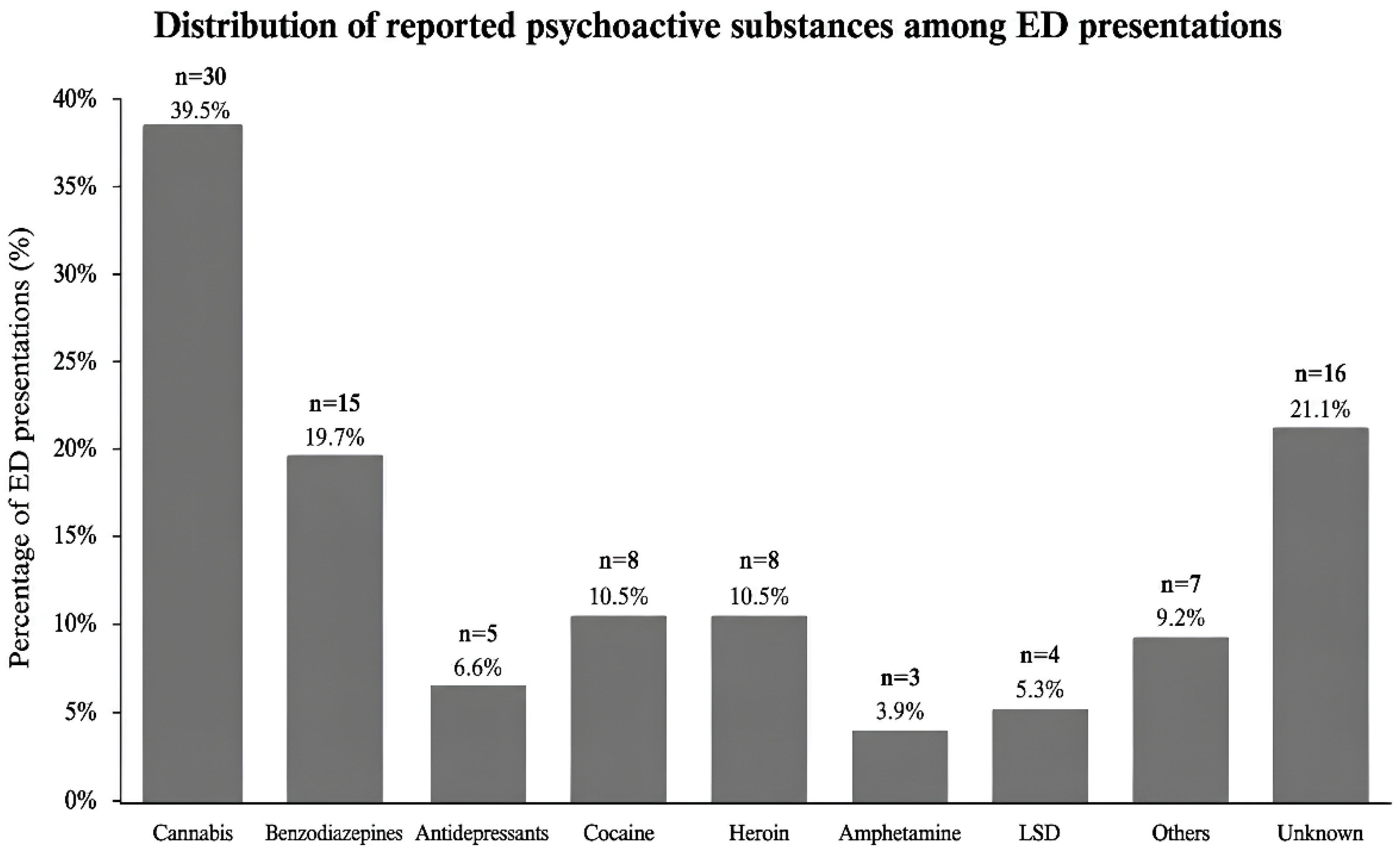
The distribution of the most commonly reported substances is shown in
Figure 1. Cannabis was the most frequently used substance, accounting for 38.9% (
n = 30) of cases, followed by benzodiazepines (
n = 15, 19.7%), cocaine (
n = 8, 10.5%), heroin (
n = 8, 10.5%), antidepressants (
n = 5, 6.6%), LSD (
n = 4, 5.3%) and amphetamine (
n = 3, 3.9%). The “others” category comprises the remaining less frequently declared substances (
n = 7, 9.2%).
Polysubstance use was documented in 17.1% (n = 13) of presentations. Categories are not mutually exclusive, as patients may have reported the use of more than one substance during the same presentation. In a substantial proportion of these cases, cannabis use was part of a polysubstance pattern.
In 21% of cases, the substance used was not disclosed and could not be confirmed due to the absence of toxicological testing; these cases were classified as “unknown” in
Figure 1 (
n = 16).
The most common clinical features at presentation included anxiety, agitation, psychotic symptoms, vomiting, and tachycardia. Most patients arrived at the ED by ambulance, suggesting an urgent clinical presentation.
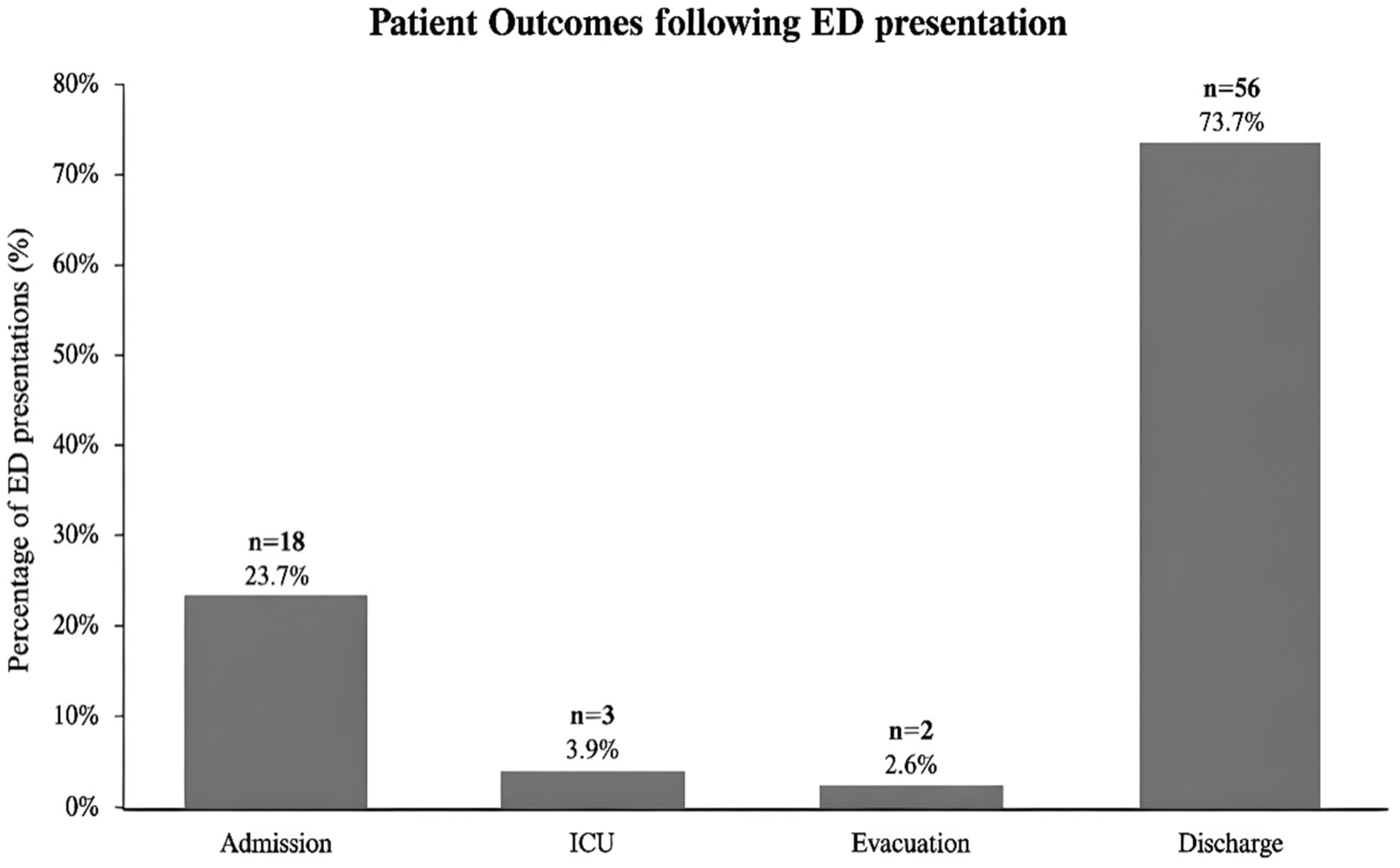
Regarding outcomes, hospital admission was required in 24% (
n = 18) of cases. Among those admitted, 16% (
n = 3) required intensive care unit (ICU) management. Evacuation, defined as transfer to another healthcare facility, occurred in 2.6% (
n = 2). No fatalities were recorded during the study period. Patient outcomes are summarized in
Figure 2.
A summary of patient characteristics and outcomes is provided in
Table 1. No associations were assessed between variables.
4. Discussion
This study describes the pattern of psychoactive substance-related Emergency Department (ED) presentations in a tertiary hospital in Greece during 2024. These findings are broadly consistent with published Euro-DEN reports, which have similarly described young male predominance and cannabis as a leading substance in ED presentations across Europe. The observed demographic profile, with a mean age of 30 years and predominance of male patients, reflects patterns commonly reported in emergency care settings for substance-related presentations [
6].
Cannabis was the most frequently documented substance in our study. In this cohort, cannabis-related presentations mainly involved young adults and were frequently recorded as part of polysubstance use. This finding is consistent with increasing reports of cannabis-related ED presentations in Europe and reflects its evolving clinical relevance in emergency care. From a clinical perspective, cannabis-related toxicity may present with acute neuropsychiatric symptoms such as agitation, anxiety, and psychosis, as well as gastrointestinal manifestations, which can contribute to increased ED utilization and diagnostic uncertainty in acute settings [
6,
7,
8]. These presentations may require careful differential diagnosis in younger patients and can place additional demands on ED triage and short-term clinical observation.
The frequent occurrence of polysubstance use in this study is notable. In this cohort, polysubstance use was documented in 17.1% of presentations, with cannabis being frequently involved in these cases. Relevant studies have reported that combined substance use may be associated with increased clinical complexity and more severe presentations [
4,
5]. In the present study, polysubstance use was described as a common feature of ED presentations; however, no analyses were performed to evaluate its association with clinical severity or outcomes.
A substantial proportion of patients arrived by ambulance, indicating that these presentations frequently required emergency medical evaluation.
Hospital admission occurred in approximately one quarter of cases, with a smaller proportion requiring ICU. Although no fatalities were observed, these findings demonstrate that substance-related presentations accounted for a measurable proportion of emergency healthcare utilization during the study period.
EDs serve as a key point of contact for individuals using psychoactive substances, particularly younger patients who may not be engaged with healthcare systems otherwise. This setting provides a valuable opportunity for early identification and intervention, including brief motivational approaches and referral pathways to specialist care [
2,
3]. However, these interventions were not evaluated in the present study and are discussed only within the context of existing literature on ED-based approaches.
Beyond individual patient care, substance-related ED visits contribute significantly to healthcare resource utilization, including increased admissions and service burden [
4]. This reinforces the importance of structured approaches to screening, management and referral within emergency care pathways.
Additionally, the present study was designed as a descriptive analysis of psychoactive substance-related emergency department presentations. Accordingly, the findings should be interpreted as a characterization of the demographic, clinical and outcome patterns observed in this cohort. No inferential statistical analyses were performed and the study was not designed to evaluate associations between specific substances, clinical features or patient outcomes.
An important limitation of the present study is the lack of routine toxicological testing in the ED. Consequently, in a considerable proportion of cases, the substances involved could not be objectively verified, particularly when patients were unwilling or unable to accurately disclose the substances used. Substance identification therefore relied primarily on patient self-reporting and clinical history, which may have led to underrecognition or misclassification of certain psychoactive agents. This reliance on self-reported information may have influenced the epidemiological interpretation of substance use patterns, potentially leading to an underestimation of certain substances and affecting the observed distribution of specific drugs. In particular, 21% of cases were classified as “unknown”, which should be considered when interpreting substance distribution findings. The reported distribution of substance categories should therefore be interpreted cautiously, as some cases may have been subject to misclassification or incomplete substance identification. This limitation also precludes reliable identification of novel psychoactive substances (NPS), which may be included within the “unknown” category.
The incorporation of systematic toxicological screening into routine ED practice would strengthen the accuracy and objectivity of substance-related surveillance, provide a more comprehensive characterization of patterns of use, and enhance both clinical assessment and epidemiological monitoring in future studies, particularly in prospective study designs.
Finally, systematic surveillance of substance-related presentations, such as that enabled through the Euro-DEN framework, remains essential for understanding evolving patterns of use and informing targeted public health responses. Continued research is needed to optimize ED-based interventions and strengthen linkage to addiction treatment services [
2,
5]. Overall, while the findings provide useful local surveillance data, they remain exploratory and hypothesis-generating rather than confirmatory.
Author Contributions
Conceptualization, D.T., A.P. and N.E.-F.; methodology, D.T., A.P. and N.E.-F.; validation, N.E.-F.; formal analysis, F.P. and N.E.-F.; resources, D.T.; data curation, F.P.; writing—original draft preparation, F.P.; writing—review and editing, F.P., N.E.-F. and A.P.; visualization, F.P.; supervision, D.T. and A.P.; project administration, A.P. All authors have read and agreed to the published version of the manuscript.
Funding
This research received no external funding.
Institutional Review Board Statement
This retrospective observational study was based on anonymized routinely collected clinical data from emergency department records and the Euro-DEN Plus registry. No identifiable patient information was accessed or analyzed. In accordance with local institutional requirements for retrospective studies using fully anonymized data, formal ethical approval was not required. The study was conducted in compliance with the Declaration of Helsinki and applicable data protection regulations.
Informed Consent Statement
Patient consent was waived due to the retrospective nature of the study.
Data Availability Statement
Data are not publicly available due to privacy and ethical restrictions.
Acknowledgments
During the preparation of this manuscript, OpenAI-CHAT GPT 5.5 was used as a supportive tool for language refinement, structuring and editing suggestions. All intellectual content, interpretation of data and final decisions were made solely by the authors, who take full responsibility for the manuscript.
Conflicts of Interest
The authors declare no conflicts of interest.
Abbreviations
The following abbreviations are used in this manuscript:
| ED | Emergency Department |
| ICU | Intensive Care Unit |
| Euro-DEN | European Drug Emergency Network |
| GDPR | General Data Protection Regulation |
References
- National Documentation and Information Center on Drugs. National Report on Substance Use in Greece; National Center for Documentation and Information on Drugs: Athens, Greece, 2022.
- Renny, M.H.; Love, J.S.; Walton, M.A.; Levy, S.; Merchant, R.C. Emergency department screening and interventions for adolescents with substance use: A narrative review. J. Emerg. Med. 2024, 67, e414–e424. [Google Scholar] [CrossRef] [PubMed]
- Hawk, K.; D’Onofrio, G. Emergency department screening and interventions for substance use disorders. Addict. Sci. Clin. Pract. 2018, 13, 18. [Google Scholar] [CrossRef] [PubMed]
- Beckerleg, W.; Hudgins, J. Substance use-related emergency department visits and resource utilization. West. J. Emerg. Med. 2022, 23, 166–173. [Google Scholar] [CrossRef] [PubMed]
- Stevens, M.W.R.; Harland, J.; Alfred, S.; Ali, R.L. Substance use in the emergency department: Screening for risky drug use, using the ASSIST-Lite. Drug Alcohol. Rev. 2022, 41, 1565–1576. [Google Scholar] [CrossRef] [PubMed]
- Renny, M.H.; Stecher, Y.; Vargas-Torres, C.; Zebrowski, A.M.; Merchant, R.C. Trends in substance use-related emergency department visits by youth, 2018–2023. Am. J. Emerg. Med. 2025, 92, 1–9. [Google Scholar] [CrossRef] [PubMed]
- Bechard, M.; Cloutier, P.; Lima, I.; Salamatmanesh, M.; Zemek, R.; Bhatt, M.; Suntharalingam, S.; Kurdyak, P.; Baker, M.; Gardner, W. Cannabis-related emergency department visits by youths and their outcomes in Ontario: A trend analysis. CMAJ Open 2021, 10, E100–E108. [Google Scholar] [CrossRef] [PubMed]
- Myran, D.T.; Pugliese, M.; McDonald, A.J.; Xiao, J.; Fischer, B.; Finkelstein, Y.; Tanuseputro, P.; Firth, J.; Pakpour, A.; Hsu, C.-W.; et al. Cannabis use disorder emergency department visits and hospitalizations and 5-year mortality. CMAJ Open 2024, 8, e2457852. [Google Scholar] [CrossRef] [PubMed]
| Disclaimer/Publisher’s Note: The statements, opinions and data contained in all publications are solely those of the individual author(s) and contributor(s) and not of MDPI and/or the editor(s). MDPI and/or the editor(s) disclaim responsibility for any injury to people or property resulting from any ideas, methods, instructions or products referred to in the content. |