
Article

Accessing Optimism: Rethinking Wellbeing, Inclusion, and Belonging for Young People in Britain Who Are Not in Education, Employment, or Training (NEET)

1
Department of Education, University of Bath, Claverton Down, Bath BA2 7AY, UK
2
Institute for Policy Research, University of Bath, Claverton Down, Bath BA2 7AY, UK
*
Authors to whom correspondence should be addressed.
Youth 2026, 6(2), 41; https://doi.org/10.3390/youth6020041
Submission received: 30 January 2026 / Revised: 26 February 2026 / Accepted: 25 March 2026 / Published: 3 April 2026
(This article belongs to the Special Issue NEET Youth: Experiences, Needs, and Aspirations)

Abstract

The ambition of policymakers to ‘raise aspirations’ among young people from disadvantaged backgrounds as a means for improving social mobility in Britain has been a mainstay of political rhetoric for the last three decades. Reports such as Higher Education in the Learning Society in 1997, Unleashing Aspiration in 2009, and Success as a Knowledge Economy in 2016 are all underpinned by an ideology of neoliberal meritocracy that has transcended political parties and governments since the Thatcher administration. Even those who lean more to the left of the Labour Party within contemporary Britain have perpetuated this narrative by reframing it as ‘working-class ambition’. This paper advances an alternative view which reconceptualises the way in which young people from non-privileged backgrounds experience and perceive the world, and their place within it. Drawing upon our work on Connected Belonging in 2025 and our research on the From the Centre to the Periphery project in 2025, we suggest that ‘hopeful optimism’ offers a more realistic lens through which to understand what is needed to address the ‘personal troubles and public issues’ that young people face. Unlike aspiration, which has an inherently individualistic and future-orientated framing, with value systems directed by dominant hegemonic notions of ‘success’ that are commonly positioned in economic terms, we recognise optimism as being a holistic and relational process that resides in the present as well as looks to the future. Optimism, grounded within principles of hope, allows young people the freedom to be and to dream; by celebrating who they are and their interconnectedness, it protects them from fears of failure; by reimaging what success might mean, it liberates them as creators.

1. Introduction

For many developed economies, ensuring smooth youth transitions from education to the labour market is often problematic (C. Brown et al., 2022). Completion of secondary education and progression onto further study, education, or employment are commonly recognised by policymakers as being indicators of young people’s life chances and long-term opportunities (Shah et al., 2010; Archer et al., 2014). When young people stray from these markers of success, it can result in social and economic exclusion (Maguire, 2021). Within the UK, this exclusion has become heightened during periods of crisis, such as austerity, Brexit, and the COVID-19 pandemic, as young people who are not in education, employment, or training become labelled within a ‘NEET’ policy discourse that has characterised UK education and youth unemployment policy thinking since the turn of the century (Wrigley, 2024). The negative effects of this labelling have included ‘welfare conditionality and sanctioning [that] has continued to be utilised inauspiciously against NEET young people during recurrent political and social crisis’ (Wrigley, 2024, p. 22). This, in turn, further exacerbates existing inequalities—inequalities which may help to explain why some young people are more likely than others to experience unemployment or not continue within the formal education system in the first place. For example, when compared with their more privileged peers, children who are eligible for free school meals (FSM) due to living in a low-income household often have reduced access to high-quality schooling (Gamsu & Donnelly, 2021; C. Brown & Siddiqui, 2025). Furthermore, the private schooling system in Britain acts as a mechanism through which privilege becomes reinforced via networks that create and sustain social and cultural capital, which exclude those without the economic capital to enter (Koh & Kenway, 2016; Sutton Trust, 2019). Elitism that operates through the private schooling system in Britain allows children within these institutions to be governed in different ways than children within state schools; the ability to inflate GCSE grades through teacher-assessed grading during the COVID-19 pandemic is one such example (Whittaker, 2022).
The role of education in creating and sustaining social and economic inequalities within Britain, and the correlation between these inequalities and labour market demands, can be traced back to the mid-nineteenth century (C. Cunningham & Samson, 2024). Conscious of the importance of this history, through this paper, we support the call from Wrigley (2024, p. 9) that:
structural and institutional levels of support from central government are needed to meaningfully engage NEET experienced young people in their education, employment, and training trajectories
We recognise that current approaches within UK education and youth unemployment policy are not sufficiently orientated towards addressing the United Nations’ (UN) Sustainable Development Goals (SDG) 3: Good Health and Wellbeing, or 10: Reduced Inequalities (United Nations, 2026). We also recognise that in order to meet the UN’s SDG 4: Quality Education, Goals 3 and 10 must first be addressed. Oftentimes, issues of youth unemployment and non-participation within formal systems of education are positioned as being an issue of individual deficit or lack of aspiration, as opposed to being a reflection of deeper structural problems. The Social Mobility Commission’s State of the Nation 2025 report highlights an increase between 2022 and 2024 in the number of young people aged 16 to 24 years who are not in education, employment, or training (NEET). With 22% of ‘NEETs’ coming from a working-class background, compared with 9% being from higher professional backgrounds, and with these gaps running in parallel since 2014 (Social Mobility Commission, 2025), issues of NEEThood (C. Brown et al., 2022) can be seen as a representation of the entrenched class-based nature of British society through which social and economic inequalities are played out. Meanwhile, understandings of NEEThood remain politically bound by methods of measurement and interpretation (Matli, 2021), with the response from policymakers to address the ‘problem’ of NEEThood often creating a ‘pathologized status’ among young people (McPherson, 2021).
The incorporation of NEEThood into the political narrative of social mobility (C. P. Cunningham, 2024) risks reinforcing the reductive, economistic lens that embodies the NEET label (Wrigley, 2024). The Social Mobility Commission’s emphasis on the ‘need to refocus on the skills, knowledge and behaviours needed to support innovation, growth and enterprise’ (Social Mobility Commission, 2025, p. 9) could be understood as an agenda to address the NEET ‘problem’ (McPherson, 2021). Yet, the Commission’s ‘place-based’ approach to improving social mobility, which focuses on ‘place and on the real obstacles to opportunity in different areas, along with the family, community, neighbourhood and cultural aspects of these’ may offer channels through which the voice of NEET-experienced young people can be brought to the fore in a way that can influence policy from the ground up.
This paper applies our research on the From the Centre to the Periphery research project (From the Centre to the Periphery, 2025) to consider the extent to which place-based approaches to social mobility can work to both enhance and/or disrupt existing power relations. We argue that political narratives that aim to ‘raise aspirations’ among young people can often reinforce predetermined value systems through homogenised understandings of ‘disadvantage’, through which notions of NEEThood become incorporated. Considering our work on Connected belonging (2025), we propose that ‘hopeful optimism’ offers a more realistic lens through which to understand what is needed to address the ‘personal troubles and public issues’ (Wright Mills, 1959/1970) that young people face.
The paper begins by laying out our materials and methods. It introduces our work on the From the Centre to the Periphery research project—an ESRC-funded study that addresses education and regional divisions by evaluating the DfE’s Opportunity Areas programme that ran between 2017 and 2022 in twelve selected areas of England. Our preliminary findings from this research offer a lens through which to scrutinise the Social Mobility Commission’s relationship with NEEThood. Situating our analysis of this relationship within a broader conceptualisation of the social mobility narrative allows us to unpack the shortfalls of the current political response to the empowerment of NEET-experienced youth. In applying our findings from our work on Connected Belonging—a relational and identity approach to wellbeing—we are able to offer an alternative lens through which policymakers can respond to the needs of NEET-experienced youth, an approach that embraces the place-based worldview that the Social Mobility Commission champions.
This paper adopts a theoretical position that considers empirical research and practitioner-informed learning, situated within a critical discourse analysis. The three existing studies, each of which was conducted by the co-authors of this paper, will be explained in more detail in the Materials and Methods section below. We bring together these stand-alone projects to form a position paper that aims to offer a theoretical model for rethinking current approaches to NEEThood within Britain. As this paper is empirically informed by a number of studies, we structure this article in an unorthodox fashion—the ‘Results’ and ‘Discussion’ sections of this manuscript merge to offer more of an interpretative sociological critique that aims to rethink wellbeing, inclusion, and belonging for young people who are NEET. To our knowledge, there has been little, if any, work that has applied a wellbeing perspective to understanding and addressing the problem of young people who are NEET; we believe this to be crucial for meeting the UN’s Sustainable Development Goals mentioned above. Our purpose in this paper is to argue for a model of hopeful optimism, which, we suggest, offers an alternative lens through which to conceptualise social mobility and the ways in which young people from non-privileged backgrounds experience and perceive the world, and their place within it. Our theorisation of hopeful optimism provides an alternative re-framing of the NEET ‘problem’ that can be utilised by policymakers to offer a more inclusive and supportive approach to understanding and addressing education and youth unemployment.

2. Materials and Methods

As a project of interpretive sociological analysis, this paper aims to ‘interpret the meaning of social action and thereby give a causal explanation of the way in which the action proceeds and the effects which it produces’ (Weber, 1978, p. 7). Through this framework of analysis, we question the action of policymakers that seek to address the NEET ‘problem’, while simultaneously offering an alternative view that places emphasis on the need to understand the complexity and non-homogenous nature of NEET experiences. The concept of ‘lived experience’ is a term commonly used by those in positions of power, including researchers, to explain social phenomena from which they are often detached, yet are given responsibility for trying to fix. Efforts to include the participation of people with ‘lived experience’ are a method that researchers and policymakers often adopt in an attempt to generate more authentic research or policy solutions. Yet, it is important to distinguish between a fixed notion of experience that was ‘lived’ and the fact that in many ways, experiences are still ‘living’, with structural inequalities often going on to impact individuals throughout their entire life-course. These personal ‘living experiences’ (C. Cunningham, 2024) can be understood as connections that bridge ‘personal troubles and public issues’ as detailed by Wright Mills (1959/1970) in “The Sociological Imagination”. In this paper, we champion a sociological understanding of NEEThood that seeks to consider how structural elements can influence the lives of NEET-experienced youth. We challenge these structural barriers by offering ‘a novel point of departure from the largely individualistic approach reflected in the prevailing policy positions of many countries in the Global North’ and champion a relational approach to wellbeing that ‘links identity-building and affirmation’ to strengthen a sense of belonging across different arenas of young people’s daily lives (C. Brown et al., 2025b).
As co-authors, we have been brought together by our work on the From the Centre to the Periphery research project. Preliminary findings from this project inspired the creation of this article, yet this article is not informed by that study alone. Rather, we present here a position paper that is informed by three separate stand-alone projects, with each one being authored by the co-authors of this article: (1) the PhD thesis of C. P. Cunningham (2024), entitled “The Engine of Widening Participation in the Drive for Social Mobility”, which examined the relationship between political narratives of social mobility and widening participation within higher education in England. The study employed a discourse analysis of the political narrative of social mobility that lays the foundation for this paper through its critique of the aspiration discourse, which we argue here, underpins approaches to NEEThood within Britain. (2) The work of C. Brown and M. Donnelly in 2023 and 2025 on the Connected Belonging project, which includes practitioner-informed learning within schools. This work helps us to rethink how issues of NEEThood can be reimagined beyond the lens of individual aspiration, and orientated towards a relational approach that fosters a sense of belonging that can enhance feelings of optimism. (3) J. Davies and M. Dickson’s quantitative findings from their work in 2025 on the From the Centre to the Periphery project, which suggest that young people’s study and work optimism can be enhanced through place-based policy solutions.
As this paper is informed by three separate bodies of work, there is no scope to explain the methodology of each project in turn. Similarly, detailing the findings from each of the three studies is not feasible and would distract from the focus of what we are attempting to do within this article. By synthesising these three existing studies, we aim to produce and present a theoretical framework that can be applied to the concept of NEEThood within Britain. We aim to lay the groundwork for further research while offering suggestions for ways in which policy can be developed. As such, the methodological approach of this paper is not intricately designed or expansively explained, and our Results and Discussion sections merge as each of these three independent studies is considered collectively within the context of NEEThood in Britain.
Our analysis begins by offering an overview of the political narrative of social mobility. To do this, we invert the focus on NEET experiences by considering the relationship between ideas of social mobility and policies and practices that aim to widen participation in higher education in England. Drawing on C. P. Cunningham’s (2024) study, which uses policy and discourse analysis, we show how ‘homogenising knowledge regimes’ create a ‘class’ of students that can be measured and monitored. We consider the ways in which ‘disadvantaged students’ are synonymous with ‘NEETs’ in this regard, and the extent to which the ‘raising aspirations’ agenda threatens to colonise the lifeworld (Habermas, 1987) of NEET-experienced young people through the imposition of an ideology of neoliberal meritocracy (Littler, 2017).
C. Brown et al.’s (2025a, 2025b) work on Connected Belonging offers a practitioner view that is used to reset the narrative of social mobility through the problematisation of the ‘raising aspirations’ agenda. We create and propose a model of hopeful optimism, which we argue, offers a more realistic lens through which to conceptualise the ways in which young people from non-privileged backgrounds experience and perceive the world, and their place within it. Using this tripartite model of hopeful optimism, we compare and contrast the concepts of aspiration and optimism to suggest that by directing attention away from the individualised and economistic narrative of aspiration, we can rethink wellbeing, inclusion, and belonging for young people who are NEET and offer practical steps that can be promoted through policy.
We then move on to look at Davies et al.’s (2025) quantitative findings in the From the Centre to the Periphery research project, which includes analysis of nationally representative survey data that estimates the impact that the DfE’s Opportunity Area programme has had upon young people’s hopes and confidence for their future studies and working lives (Davies et al., 2025). We situate this quantitative analysis alongside preliminary qualitative findings from the From the Centre to the Periphery project, which involved interviewing board members and having conversations with community leaders from various Opportunity Areas to consider the extent to which place-based approaches to social mobility can move beyond the individualistic approach that dominates many policy positions orientated towards addressing NEEThood (C. Brown et al., 2025b).
By merging these three stand-alone projects, we create the model of hopeful optimism to show that place-based approaches to social mobility can help to address the concerns of policymakers keen to tackle issues of NEEThood within Britain. We propose a relational approach that can be applied to empower young people to drive change within their localities, positioning social mobility as an effect of the bottom-up social action that precedes it (Weber, 1978).

3. Results and Discussion

3.1. The Political Narrative of Social Mobility

The concept of social mobility has been a longstanding feature of sociological study (see, for example, Blau & Duncan, 1967; Heath, 1981; Hopper, 1981; Sorokin, 1927). Throughout the twenty-first century, there has been increasing political interest in social mobility (Goldthorpe & Jackson, 2007; R. Erikson & Goldthorpe, 2010). However, unlike sociological understandings of social mobility, which are often complex and incorporate indicators of income and occupation measured either throughout an individual’s own lifetime and/or across generations while considering downward as well as upward mobility, political discussions of ‘social mobility’ often frame the concept in terms of intragenerational upward social mobility—an individual experiencing higher relative earnings and/or increased job prospects than their parents achieved throughout their own lifetime (Payne, 2012). This political narrative of social mobility delegitimises the complex nature and meaning of social mobility, reducing it to an empty signifier that is open to interpretation and yet devoid of meaning (C. P. Cunningham, 2024).
So, what can explain this growing political interest in the term ‘social mobility’? Diane Reay notes that:
Social mobility has an iconic place in English political discourse. It appears as if the less mobility there is, the more it becomes a preoccupation of politicians and policymakers.
(Reay, 2017, p. 101)
This would suggest that the increasing emphasis given to social mobility within political discourse is a reflection of the widening social and economic inequalities of British society. Indeed, Ingram and Gamsu (2022, p. 189) discuss the ‘political performance’ of the ‘language of social mobility’ to argue that:
The social mobility agenda is axiomatically an equality of opportunity agenda where the focus is on ‘levelling up’ those who are considered to be falling behind. Its focus on opportunity to the detriment of outcome thus rules out considerations of structural solutions to inequalities.
C. P. Cunningham (2024) highlights this ‘equality of opportunity agenda’ through the study of the relationship between political narratives of social mobility and widening participation to higher education in England. The macro-level policy analysis within this study documents the political history of widening participation to show that:
The strategy of WP, underpinned by the ideology of neoliberal meritocracy had been gathering pace since the introduction of tuition fees in 1998, but really took off after 2010, when announcements of the tripling of fees were made. Signifiers of ‘success’, ‘opportunity’, and ‘aspiration’ became packaged within a narrative of social mobility which worked to justify the investment of fee-paying students.
These notions of ‘success’, ‘opportunity’, and ‘aspiration’ are explored further within a meso-level analysis which scrutinises the Access and Participation Plans of a selection of English universities to determine the ways in which widening participation works at an institutional level, and interrogates the Opportunity Area Delivery Plans of two ‘social mobility coldspots’ to understand the ways in which widening participation becomes recognised at a local level. The study goes further still to conduct a micro-level analysis looking at the work of university outreach organisations to ascertain how widening participation becomes facilitated at a local level, concluding that:
inequalities become obscured by WP through the creation in the belief of ‘equality of opportunity’ that is facilitated by strategies that aim to ‘raise aspirations’. I propose that this legitimises a belief in meritocracy through which a failure to reach a desired destination is positioned as individual fault as opposed to structural injustice. I present this as a diversion strategy that averts the gaze from privilege through over-emphasising ‘disadvantage’.
Policies and practices of widening participation to higher education in England create a homogenised ‘class’ of ‘disadvantaged’ students that becomes targeted, tracked, and monitored, with data from their ‘access’, ‘success’, and ‘progression’ feeding systems which create homogenising knowledge regimes that are underpinned by an ideology of neoliberal meritocracy (C. P. Cunningham, 2024). Following the Augar Review (2019), there has been a loss of political appetite for widening participation in university study, and the narrative of social mobility has redirected its sights (C. P. Cunningham, 2024). In 2025, Prime Minister Keir Starmer ‘ended Tony Blair’s pledge made in 1999’ and university leaders are now openly admitting that ‘a university degree is no longer a “passport to social mobility”’ (Adams, 2026).
Yet, despite shifts within the higher education landscape, the narrative of social mobility is still prevalent, although there has been some shift in the Social Mobility Commission towards a wider definition, such as ‘stability’, ‘health’, and ‘security’ as also constituting desirable outcomes for mobility. Nevertheless, the impact that this narrative has upon NEET-experienced youth is similar to that of ‘disadvantaged’ students—homogenised categorisation, targeting, monitoring, and the measuring of ‘success’ rates. In November 2025, the Social Mobility Policy Committee concluded that:
those who are considered NEET are a high priority group as they are the most disadvantaged, furthest from the labour market, and in danger of experiencing the least amount of social mobility, if any. We endorse the Government’s intention to transform their approach to supporting young people who are NEET or at risk of becoming NEET.

3.2. Rethinking Wellbeing, Inclusion, and Belonging

In November 2025, it was announced that the former Labour Health Secretary, Alan Milburn, had been tasked with leading an inquiry into ‘NEETs’ to address the ‘crisis of opportunity’ (Wright & Wilson, 2025). Milburn, who was once chair of the board of the Social Mobility Commission, before handing in his resignation in 2017, stating that he has ‘little hope of the current government making the progress … necessary to bring about a fairer Britain’ (Ingram & Gamsu, 2022, p. 195), also authored the 2012 progress report entitled “University Challenge: how higher education can advance social mobility”. This report championed widening participation for disadvantaged students, so much so that the term ‘disadvantage’ appears 65 times within the report. Linked to this notion of disadvantage is the concept of aspiration, which appears 24 times. Discussing ways to measure the success of the widening participation strategy, the report notes that:
Some forms of activity are relatively easy to measure, for example those which target young people just before they apply to university. Others are more difficult, in particular those which target younger children and aim to raise their aspirations.
(Milburn, 2012, p. 35)
Yet, the aims of ‘raising aspirations’ of young children from ‘disadvantaged’ backgrounds by targeting them and encouraging them to invest in higher education can largely be seen as a success. Over the last decade, the number of disadvantaged students enrolling at universities has increased dramatically, with the admissions body UCAS reporting in 2024 a ‘record high’ of 27,600 UK 18-year-olds from the most disadvantaged backgrounds (UCAS, 2024). But so too has the cost of outstanding student loans to the Treasury increased—in 2023, this amounted to over £206 billion, with forecasts rising to £460 billion by the mid-2040s (Bolton, 2023). This suggests that many of those investing in their education will not earn enough to pay back what they have borrowed. For many enrolling in university, their disadvantage continues, with around 1 in 10 students accessing food banks (NUS, 2022) and some reporting lack of sleep, poor diet, and poor mental health as direct results of financial insecurity (Save the Student, 2023). Even after graduating, disadvantaged students remain lower earners than their more privileged peers, with a report entitled “The Value of Higher Education” suggesting that this ‘gap in labour market outcomes’ sits at around 10% (TASO, 2023).
Despite the success of the ‘raising aspirations’ and widening participation to higher education agenda, social and economic inequalities in Britain remain stubbornly rigid. According to ONS statistics published in February 2025, around 10.6% of the NEET population were graduates—around 90,000 of the 923,000 young people not in education, employment, or training (McGough & Dunkley, 2025). It is important to consider the graduate demographic within the concept of NEEThood, as, arguably, creating ‘opportunity’ through ‘raising aspirations’ has not proved an effective method for tackling social and economic inequalities.
We propose that an alternative approach to ‘access’ is needed—one that is conceptualised in terms of wellbeing, inclusion, and belonging. This alternative approach seeks to push back against the ‘NEET’ label in ways that challenge the individual success story narrative, as documented by Littler (2017) in Against Meritocracy. Drawing on the work of cultural theorist Raymond Williams, Littler (2017, p. 3) highlights:
as Raymond Williams argued in a book review in 1958, the ladder is a perfect symbol for the bourgeois idea of society, for while it undoubtedly offers the opportunity to climb, ‘it is a device that can only be used individually; you go up the ladder alone’. Such an ‘alternative to solidarity’, pointed out Williams, has dazzled many working-class leaders and is objectionable in two respects: firstly, it weakens community and the task of common betterment; and secondly, it ‘sweetens the poison of hierarchy’ by offering advancement through merit rather than money or birth, whilst retaining a commitment to the very notion of hierarchy itself.
(Williams, 1958, p. 331)
It is important to question whose interests the attempts to address the NEET ‘problem’ (McPherson, 2021) serve. The reluctance to recognise the diverse experiences of young people who are NEET and rather to conceptualise them as a homogenous bloc (Wrigley, 2024) can be seen as a de-humanising process that looks no further than their individual ability to contribute to the economy. To avoid the trap that Williams (1958) explained almost seventy years ago, there needs to be alternative symbols of success and opportunity other than ‘the ladder’—ones which celebrate common betterment and push back against dominating ideologies of hierarchy.
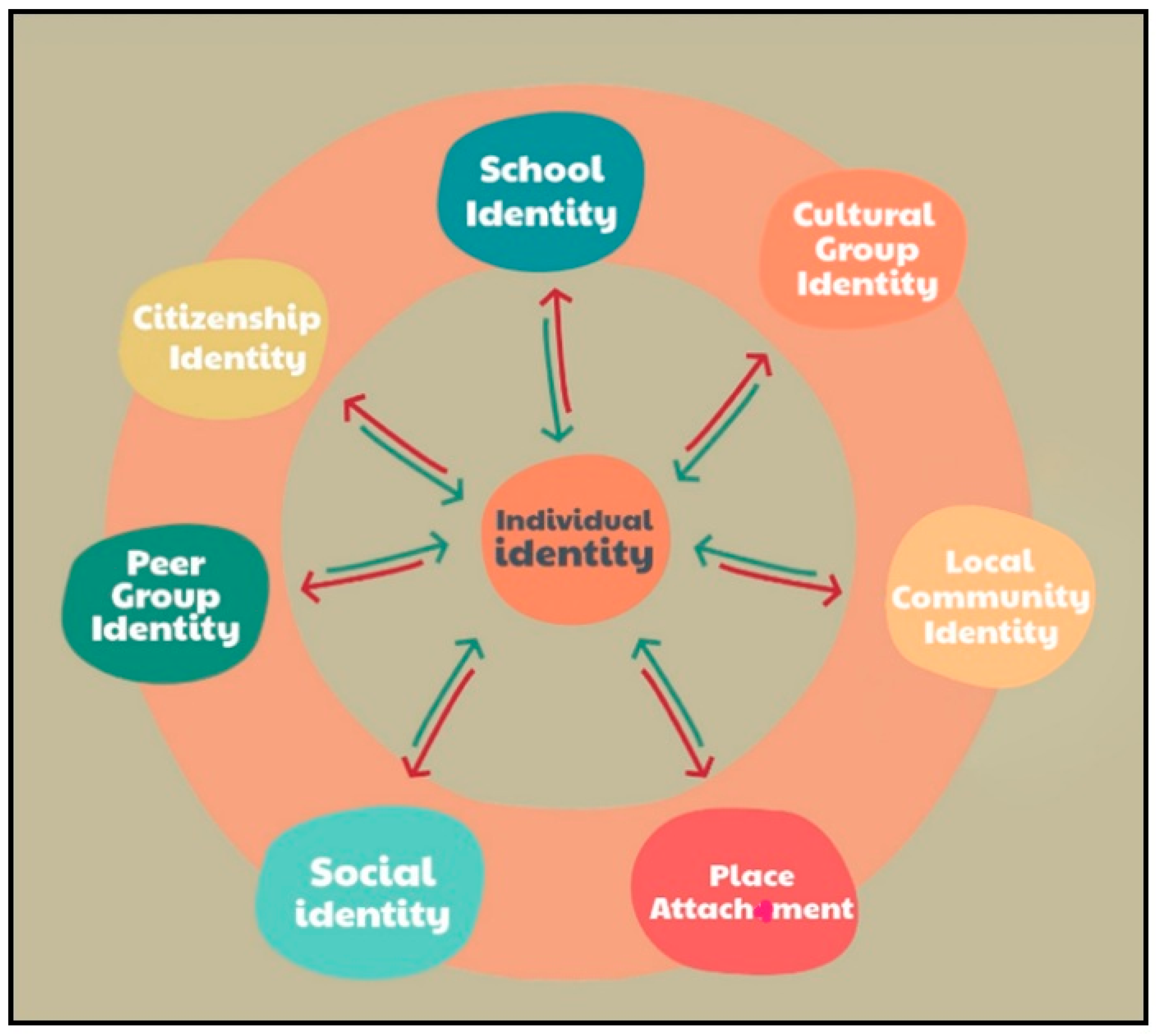
Our work on Connected Belonging1, a holistic approach to school wellbeing strategies, considers the reciprocal relationships between young people and the different social domains of their lives (see Figure 1). These social domains are identity sources that play an important role in building trust and validation; they can also be a source of struggle for young people. Wellbeing initiatives aim to support young people within the seven key domains of their lives: school identity, cultural group identity, local community identity, place attachment, social identity, peer group identity, and citizenship identity. By helping young people to nurture a sense of self-acceptance and authenticity, these initiatives lead to a cohesive sense of self, creating confident and compassionate people with a secure sense of belonging (see C. Brown et al., 2025a).
We believe that policies orientated towards helping young people to develop a sense of optimism through the Connected Belonging framework would have the potential to offer a preventative rather than a reactionary approach to NEEThood. They would allow goals for success to be determined by the young people themselves in collaborative yet independent ways. In the next section, we set out why we believe that optimism is a more realistic lens than aspiration through which to view social mobility, making a case for the concept of hopeful optimism to be seen as a pathway towards common betterment.

3.3. The Role of Optimism in Offering a Clearer View of Social Mobility

Below, we present a tripartite explanation that we have formulated to describe why optimism is a more realistic lens than aspiration through which to view social mobility. The critique of aspiration discussed within this paper thus far is extended further and used as a measuring stick to show that, with notions of optimism, understandings of social mobility can become more than just a political performance (Ingram & Gamsu, 2022).
(a) 
Aspiration is an individualistic/neoliberal endeavour, whereas optimism can also be collective.
Contemporary education policy has frequently positioned aspiration as a key mechanism through which social inequalities might be addressed. It has been repeatedly mobilised as an individual attribute that students are expected to cultivate, raise, or ‘unlock’. UK policy discourse is especially explicit here. Emerging most prominently within the schools’ white paper The Importance of Teaching (Department for Education, 2010), the concept ‘Aspiration Nation’ has dominated social mobility strategies under multiple governments. Here, aspiration is framed as something that individuals or families either possess or lack, and which explains differential educational outcomes. However, critical scholarship has shown that aspiration is rarely a neutral or expansive concept. Rather, it is typically framed as an individual attribute to be cultivated, raised, or corrected, often in relation to scarce and positional educational outcomes such as elite qualifications or competitive labour market advantages. Within this framing, aspiration functions as a fundamentally competitive phenomenon: success is contingent upon differentiation, and structural constraints are reinterpreted as individual shortcomings. As P. Brown et al. (2011) argue, such policies operate within conditions of global positional competition, rendering aspiration a zero-sum endeavour in which not all participants can succeed, regardless of effort or motivation.
In studying the experiences of British-born Bangladeshi women in higher education, Scandone (2018, p. 522) suggests that aspiration discourses set by policymakers are ‘strongly pathologizing’ towards students of working-class and minority ethnic backgrounds. Using Bourdieu’s concepts of habitus and capital, Scandone (2018) problematises these ‘individualistic understandings of aspirations and ‘choice’’ to show that aspiration, as an aspect of habitus, is in a reciprocal relationship with intersecting social structures and aspects of social identity that are influenced by collective imaginaries handed down through generations and that go on to shape collective experiences. And as Cairns (2025) suggests, the capacity to imagine is often influenced and limited by Western scientific modernity. Yet, a focus on spiritual ecology and efforts of collective imagining can lead to meaning-making that can help us to honour emotions such as joy, hope, and grief in ways through which we can collectively imagine ‘beyond crisis’.
This critique aligns with wider analyses of how aspiration discourse operates as a technology of responsibilisation. Policymakers’ efforts to recalibrate aspirations often obscure the structural production of inequality, instead locating educational marginalisation within students’ attitudes, ambitions, or cultural orientations. Aims of policymakers to ‘correct’ the aspirations of students from working-class and ethnic minority origins (Scandone, 2018) are on par with ambitions to address the NEET ‘problem’, inasmuch as they are framed as ‘individual deficiencies’ (McPherson, 2021). This framing acts as a form of ‘symbolic violence’ through which imposed value systems become internalised to shape self-understandings that can work to ‘legitimise the power of certain groups over others’ (Bourdieu, 2002, in, Scandone, 2018, p. 534). Aspiration, in this sense, becomes both a moral and disciplinary concept, legitimising unequal outcomes by presenting them as the natural result of differential ambition within an ostensibly meritocratic system.
In contrast to aspiration’s competitive and scarcity-based logic, optimism may be understood as a non-rivalrous phenomenon, capable of being collectively held and collectively beneficial. Psychological and sociological research suggests that optimism is not tied to positional outcomes, nor does its presence in one individual diminish its availability to others (Carver et al., 2010). Rather, optimism can operate relationally, shaping shared expectations, behaviours, and capacities for resilience. However, as studies relating to the COVID-19 crisis have shown, higher levels of optimism and actions of collective resilience can lead to positive health- and lifestyle-related behavioural changes (Guèvremont et al., 2022). Therefore, the potential for optimism to be collective can be seen as a defence against the imposition of symbolic violence, with its capacity to be a driver of positive behavioural change, positioning it as having desirable and pragmatic features. From this perspective, optimism functions less as a promise of individual advancement and more as a shared orientation towards possibility, care, and mutual recognition. Its collective character challenges the zero-sum assumptions underpinning aspiration discourse and opens conceptual space for educational futures grounded not in competition, but in belonging, solidarity, and shared flourishing.
(b) 
Aspiration is contingent on a future-orientated attainment of a fixed outcome; optimism, in contrast, is set in the here and now, and it is an ongoing process that is relevant to young people’s current wellbeing.
A further distinction between aspiration and optimism lies in their temporal orientation and implications for young people’s wellbeing. Aspiration, as it is typically mobilised in education policy, is contingent upon the future attainment of fixed and externally defined outcomes, such as qualifications, earnings, or labour market position. Its value is therefore deferred and conditional: aspiration matters insofar as it culminates in a particular achievement at a later point in time. Optimism, by contrast, operates in the present as an ongoing interpretative and affective process, shaping how young people make sense of their current circumstances while remaining open to future possibilities.
For Appadurai (2004, p. 59), the issue is not so much with the concept of aspiration, but rather with the ‘capacity to aspire’. Capacity is conceptualised as being problematic on a temporal level, with the thesis arguing that the capacity to aspire is a cultural capacity that ‘the poor’ lack. With the economic actor being a person of the future and the cultural actor being a person of and from the past (Appadurai, 2004, p. 60), without building the capacity to aspire among the poor, it is argued that poverty will continue from the past and into the future. Building a capacity to aspire involves reconceptualising culture as being ‘a dialogue between aspirations and sedimented traditions’ (Appadurai, 2004, p. 60). Yet, future-orientated policies that are centred through an economic-centric lens, such as earnings and labour market position (Department for Education, 2024), and that do not offer dialogue in a cultural sense, are void of the ability to consider the human experiences that go on to shape future selves, thereby restricting the ability to build a genuine capacity to aspire. This analysis exposes a critical limitation in aspiration-led policy: while aspiration is framed as future-facing, it is frequently detached from the lived, emotional, and cultural conditions of the present. When aspiration is reduced to projected economic outcomes, it neglects the ways in which young people’s current wellbeing, sense of meaning, and relational experiences shape their ability to engage with the future at all. In this sense, aspiration becomes temporally distant and experientially thin.
Markus and Nurius (1987) position the creation of future selves in the here and now by considering the importance of self-knowledge in determining possible selves. By focusing on unpacking cognitive components such as hopes, fears, goals, and threats in the present, they suggest that emphasis is given to the future through the formation of meaning, organisation, and direction. The evaluative and interpretative understandings of the self that are created in the present can then go on to shape future behaviours and outcomes. This ongoing process, based upon young people’s current wellbeing that is informed by the past and orientated towards the future, can be conceptualised through the lens of optimism.
This distinction is crucial. Where aspiration locates value in a future endpoint, optimism operates as a continuous process through which individuals interpret their present circumstances as meaningful and navigable. Psychological research consistently shows that optimism functions as a process variable rather than a fixed trait or goal, influencing how individuals cope with adversity, sustain motivation, and maintain wellbeing over time (Carver et al., 2010). Moreover, optimism has been empirically linked to wellbeing in ways that are immediate rather than deferred. Fredrickson’s (2001) broaden-and-build theory demonstrates that optimistic and other positive orientations expand individuals’ cognitive and emotional repertoires in the present, enabling greater flexibility, social connection, and resilience. These benefits accumulate over time, enhancing wellbeing without being contingent on the achievement of specific outcomes. In educational contexts, this suggests that optimism may support young people’s wellbeing and engagement regardless of whether future aspirations are realised in conventional or policy-sanctioned ways.
Taken together, this body of work supports a reframing of optimism as a temporally grounded and relational phenomenon. Unlike aspiration, which is oriented towards fixed and often scarce future gains, optimism is embedded in young people’s present experiences and contributes to wellbeing as an ongoing process. Its value lies not in what it promises in the future, but in how it shapes meaning-making, resilience, and belonging in the here and now.
(c) 
Aspiration is contingent on a fixed (future) outcome; it is subject to a narrow definition of success/failure, which can be demotivating in the case of failure—it is an ideology that inherently and necessarily produces ‘winners’ and ‘losers’. Optimism, in contrast, is an ongoing state; it is aligned with other psychological traits like self-confidence, trust, and care, which are effectively relational mechanisms that build and are additive (optimism is internally focused and cannot be ‘lost’ if a certain desired outcome does not come about).
A third and related distinction between aspiration and optimism concerns how success and failure are defined, experienced, and emotionally internalised. Aspiration, as mobilised in education policy, is typically tethered to the attainment of fixed future outcomes and narrow metrics of success. As a result, aspiration is vulnerable to collapse in contexts where those outcomes are not realised. Optimism, by contrast, functions as an ongoing and internally sustained state, aligned with relational psychological processes such as trust, care, and self-confidence, and is therefore not extinguished by the absence of a single desired outcome.
Policy directives that aim to raise aspirations towards the achievement of a future outcome of success become problematic, not only through their inability to consider the importance of social structures and social identities that have been shaped by cultural and temporal influences (Appadurai, 2004; Scandone, 2018), but also through their lack of consideration of the influence that spatial dimensions have upon lived experiences. As Marzi (2016) highlights, neighbourhoods are places within which capital is acquired, and habitus and skills are developed, all of which go on to shape how young people experience physical and social mobilities. Furthermore, the very definitions of success, which have traditionally been measured in terms of income and occupation, have been revealed as insufficient for responding to the challenges of the 21st century; rather, ‘true success’, argues Atherton (2017), should incorporate recognition of economic, social, and personal achievements. This critique highlights how aspiration discourse is underpinned by a narrow and homogenising model of success that fails to account for structural, spatial, and cultural differentiation. When success is defined primarily through economic attainment, those whose lives and trajectories do not align with these pathways are positioned as deficient, regardless of their relational, social, or personal achievements.
Narrowly defined narratives of success risk exacerbating existing inequalities further. Those without the social and cultural capital needed to navigate the pathways of pre-determined notions of what success means can feel further marginalised and demotivated by fears of failure, especially if they are comparing themselves to their more privileged peers. As studies of acute psychological stressors have shown, performance tasks that incorporate aspects of social-evaluative threat (SET), i.e., performance tasks that can be judged negatively by others, lead to physiological stress responses (Dickerson & Kemeny, 2004; Woody et al., 2018). This evidence is particularly important, as it demonstrates that aspiration-oriented environments do not simply motivate; they can also produce stress, anxiety, and disengagement when individuals perceive themselves as failing against externally imposed standards. Where aspiration is contingent upon outperforming others or reaching fixed benchmarks, failure is internalised as personal inadequacy rather than recognised as structurally produced. In such contexts, aspiration becomes psychologically fragile.
In contrast, optimism is not dependent on the achievement of singular outcomes and therefore remains intact in the face of setbacks. By directing focus away from competitive notions of individual success and showing attention towards relational mechanisms and psychological traits such as trust and care, individuals can begin to imagine their ‘possible selves’ (Markus & Nurius, 1987), developing a sense of optimism that lives in the present and is not dependent upon future achievement. Psychological research further suggests that optimism is closely associated with self-efficacy, adaptive coping, and sustained motivation, enabling individuals to reinterpret obstacles without relinquishing a positive orientation towards their lives and futures (Carver et al., 2010).
As Ernest Bloch suggested when writing his ‘philosophy of hope’ during the mid-twentieth century, optimism can be at risk of becoming passive, introverted, and detached from social action. Yet, hope, which Bloch (1954/1995) conceptualised as being a kind of ‘militant optimism’, was seen as liberatory through its outward-looking unlimited nature that celebrates human interconnectivity and creativity (Menozzi, 2020). Based on this philosophy of human interconnection and social action that is rooted within self-knowledge, we champion a hopeful optimism that is (a) a collective endeavour, (b) an ongoing process relevant to young people’s current wellbeing, and (c) an internally focused relational mechanism.

3.4. From Aspiration to Hopeful Optimism

Taken together, the three claims created within and advanced through this paper under the rubric of hopeful optimism challenge the dominance of aspiration as a policy solution to educational inequality. First, aspiration has been shown to operate as an individualised and competitive construct, oriented towards scarce positional outcomes and embedded within neoliberal logics of responsibilisation. Second, aspiration is future-bound and outcome-contingent, often detached from young people’s present wellbeing and lived experiences, while optimism functions as an ongoing process rooted in meaning-making in the here and now. Third, aspiration relies upon narrow definitions of success and failure that risk demotivation and psychological harm when outcomes are not achieved, whereas optimism is internally sustained, relationally reinforced, and resilient in the face of uncertainty.
We argue that a shift from aspiration to hopeful optimism offers a more ethically grounded and empirically defensible framework for supporting young people. Hopeful optimism is collective rather than competitive, processual rather than outcome-bound, and aligned with wellbeing, belonging, and recognition rather than scarcity and exclusion. In re-centring education policy and practice on relational mechanisms such as trust, care, and shared possibility, this framework moves beyond deficit models of aspiration and towards educational futures that are inclusive, humane, and socially just.
Re-centring education policy and practice towards these relational mechanisms has potential to prevent NEEThood. Our work on the Connected Belonging research programme2 has shown that when the school supports children’s sense of connection and identity within the different social domains of their life (e.g., home, friendship group, local community, and wider society) young people feel a stronger sense of belonging and more positive relationships—a key conduit for wellbeing and inclusion (C. Brown et al., 2024). The image below of our Connected Belonging model (Figure 1) demonstrates how children’s connections through their relationships with trusted peers and adults activate a positive sense of belonging across the different identity domains. Crucially, young people must be enabled to balance their dual needs to feel a sense of membership affiliation and connection (sense of similarity with others) alongside their need to feel unique and valued for their individual aspects (sense of feeling distinct from others) in order to achieve a secure and enduring sense of belonging. That is, young people must be enabled to feel part of a broader collective but not at a cost to themselves. Furthermore, while individuals may hold membership in multiple groups across the varied landscapes of their lives, the ability to maintain an optimistic sense of self in the social world rests on the presence of a connecting thread that weaves these affiliations into a coherent whole. To flourish, a person must be able to recognise themselves as fundamentally continuous across settings, even as roles and expectations shift. When the identities invited or imposed by school, home, and peer networks feel misaligned or contradictory, this sense of continuity can be unsettled, and the self risks becoming divided rather than integrated, as E. H. Erikson (1968) famously observed. Yet this also points toward a hopeful possibility. Belonging is not merely a matter of occupying several social spaces; it is about cultivating the conditions in which individual identity can act as a bridge between them. In this view, the personal self is not detached from social identities but serves as their organising centre, capable of harmonising difference into a more integrated and resilient whole. Policies orientated towards building relational mechanisms such as trust, care, and shared possibility can help with fostering a hopeful optimism that can act as a preventative method for tackling NEEThood.

3.5. The Power of Place-Based Approaches to Social Mobility

As this paper posits, the ‘opportunity agenda’ (Ingram & Gamsu, 2022) that works through efforts to ‘raise aspirations’ (C. P. Cunningham, 2024) has not been sufficient in addressing social and economic inequalities. We suggest, therefore, that other opportunities for young people are needed: ones which give access to optimism. Our tripartite model of the previous section sets out a clearer view of social mobility that considers economic, social, and personal achievements (Atherton, 2017), which come into focus through the lens of hopeful optimism. Our development of this concept has been influenced, not only by our work on Connected Belonging, but also by findings from our work on the From the Centre to the Periphery research project—a major 3-year evaluation of the UK’s government’s Opportunity Areas (OA) programme (2017–2022), which provided targeted funding for increasing young people’s life chances to 12 disadvantaged areas across England.
From the Centre to the Periphery has shaped our understanding of the power that place-based approaches can have for boosting young people’s optimism. One strand of our research to date used data from the UK Household Longitudinal Study ‘Understanding Society’ for the period 2009–2024 to compare responses to questions measuring study/work expectations from 16 to 21 year-olds living in OAs with those of similar individuals living in 19 comparable social mobility ‘cold spots’ that did not receive additional funding, as well as to the responses observed nationwide. The findings were striking, demonstrating that, in contrast to a national downward trend in optimism (a trend similarly documented in other research (e.g., The King’s Trust, 2025) and particularly outside of London (Stavrou, 2025), optimism amongst those living in OAs increased following the programme’s introduction (Davies et al., 2025). Moreover, our analyses showed that the national downward trend in optimism is particularly marked in the comparison areas. The contrasting positive change in the OAs thus suggested that the OA programme may have played an important role in boosting young people’s optimism.
However, the Understanding Society data we drew on only provides a measure of young people’s expectations—it cannot tell us why those in OAs feel more hopeful about their futures than similar young people elsewhere. Yet, another strand of recent work—a set of interviews with OA board members, whose role was to provide local expertise and tailor interventions—has highlighted that one of the key strengths of the OA programme was how it brought together a diverse range of organisations that support young people (e.g., in education, sport, mental health, poverty, youth voice, community, etc.) within each local area—sometimes for the first time—to partner in the shared goal of improving young people’s lives. It could be, then, that it is this holistic, relational, place-based partnership that has had this striking effect on boosting young people’s confidence about their futures. Although the Understanding Society data cannot tell us whether the increased study/work optimism observed amongst young people in OAs is related to increased life chances in the longer term, the potential power that place-based approaches have for generating hopeful optimism in the present is worth noting. The relational place-based partnership work of community-based organisations shows signs of improving young people’s wellbeing in a way that ‘links identity-building and affirmation’ through a sense of belonging (C. Brown et al., 2024; this is vital for building trust and care in ways which can help young people to imagine their ‘possible selves’ (Markus & Nurius, 1987).
The Social Mobility Commission suggests that ‘the real obstacles to opportunity’ exist within places—‘within the family, community, neighbourhood, and cultural aspects of these’ (2025: 9). This interpretation is aligned with scholarship which recognises the need to include collective imaginaries (Scandone, 2018; Cairns, 2025), collective resilience (Guèvremont et al., 2022), cultural dialogue (Appadurai, 2004), and spatial considerations (Marzi, 2016) within understandings of the barriers and successes that young people experience. The place-based objectives of the Social Mobility Commission can be supported by our Connected Belonging framework, which recognises ‘place attachment’ as a key social domain where the identity of young people becomes shaped; the emotional connections between young people and spaces can enhance feelings of safety and security while promoting a sense of responsibility (C. Brown et al., 2023). Place attachment, alongside the other identities formed through the social domains: school identity, cultural group identity, local community identity, social identity, peer group identity, and citizenship identity, is intrinsically relational. By understanding these relationships and supporting young people in their development, it becomes possible to enhance young people’s sense of hopeful optimism.
As proposed in the previous section, policies orientated towards building relational mechanisms such as trust, care, and shared possibility can act as a preventative method for tackling NEEThood. Educational settings may offer logistical ease as spaces within which to implement these policies of prevention. However, hopeful optimism is not limited to implementing policy within education settings alone. The other identity source domains detailed (such as the local community) within our Connected Belonging model (Figure 1) are sites within which there is potential to implement policy, which allows hopeful optimism to be both a reactionary response to NEEThood and a preventative method. We argue that place-based policies rooted in hopeful optimism are a fruitful area for future research.

4. Conclusions

The sociologist Wright Mills (1959/1970), in his classic text “The Sociological Imagination”, speaks of the need to understand the relationships between biography and history, or in other words, individual experiences and broader societal forces; an understanding of the true depth and nature of ‘personal troubles’ requires awareness of the ‘public issues’ with which they are intertwined. In this paper, we have shown how the actions of policymakers to raise the aspirations of young people in a bid to create equality of opportunity have fallen short through their inability to consider the societal forces that have shaped the individuals who become targets of the aspiration-raising agenda. Without addressing the social and economic inequalities which create disadvantage in the first place, efforts to raise the aspirations of individuals will not result in meaningful systemic change that can alleviate structural inequalities.
It is not in the scope of this paper to propose methods of tackling social and economic inequalities on a structural level. Rather, the ideas being put forward here make a case for the need for policymakers to look beyond the current approach of viewing social mobility through the lens of aspiration. We propose that the concept of hopeful optimism is a more constructive lens through which to view social mobility, recognising this as being a method through which young people can begin to imagine their ‘possible selves’ (Markus & Nurius, 1987) through the creation of collective ‘meaning-making’ that can support them through their challenges by honouring their emotions (Cairns, 2025).
We have developed the theory of hopeful optimism with the view that, by orientating policy towards building relational mechanisms such as trust, care, and shared possibility, it becomes possible to approach issues of NEEThood in a preventative way. Contemporary education policy has frequently framed aspiration as an individual attribute to be raised, corrected, or unlocked, particularly through narratives such as the “Aspiration Nation” advanced in The Importance of Teaching. In this formulation, success is positional, scarce, and future-bound, tethered to qualifications, earnings, and labour market advantage. A policy shift towards hopeful optimism would require structural rather than rhetorical change. Instead of ranking individuals against narrow economic benchmarks, policymakers could embed multidimensional wellbeing and belonging indicators into accountability systems, fund collective and intergenerational projects, and broaden definitions of success to include civic, relational, and creative contribution. Drawing on insights advanced in this paper, hopeful optimism can be understood as a present-centred, relational orientation that expands cognitive and social capacities while sustaining engagement even in the absence of singular outcomes.
Crucially, this reframing aligns with a conception of identity as the synthesising centre through which social memberships are organised. Where aspiration discourse risks individualising failure and reproducing symbolic hierarchies, hopeful optimism strengthens both individual coherence and collective belonging. Policymakers could therefore prioritise identity-responsive curricula, participatory youth governance, reduced high-stakes social-evaluative threat, and explicit measurement of school belonging alongside attainment. In doing so, optimism becomes a shared infrastructure rather than a private trait: additive rather than competitive, grounded in young people’s present wellbeing, and capable of cultivating educational futures oriented towards solidarity and shared flourishing rather than zero-sum advancement.
Nurturing young people who are confident in their sense of self and who feel that they belong may not produce immediate results that can easily be measured within goals that seek to address NEEThood. Yet, the ongoing process of encouraging young people to be proud of who they are, where they live, and the ways in which they contribute to the world around them can empower them with the confidence and skills required to communicate their needs to those who are placed in positions that have a responsibility to respond. But we also recognise that this shift requires radical change, and a drastic shift in how schools and teachers educate young people—starting from the earliest ages. Messages around individualised success in narrow terms, such as attainment and economic outcomes, become cemented at the primary level. By this age, children are likely already firmly socialised into what constitutes ‘success’ (and the ‘unsuccessful’). A shift towards the kind of perspective advanced in this paper needs a root and branch re-configuration for how we socialise children through schools, families, and wider society.

Author Contributions

Conceptualization, C.C., C.B., J.D., M.D. (Michael Donnelly) and M.D. (Matt Dickson); methodology, C.C., C.B., J.D., M.D. (Michael Donnelly) and M.D. (Matt Dickson); software, J.D. and M.D. (Matt Dickson); validation, M.D. (Michael Donnelly) and C.B.; formal analysis, C.B., M. Donelly, M.D. (Matt Dickson); investigation, M. Donnelly, C, Brown and M.D. (Matt Dickson); resources, C.C., C.B., J.D., M.D. (Michael Donnelly) and M.D. (Matt Dickson); data curation, C.C., C.B., J.D., M.D. (Michael Donnelly) and M.D. (Matt Dickson); writing—original draft preparation, C.C.; writing—review and editing, C.B., J.D., M.D. (Michael Donnelly) and M.D. (Matt Dickson); visualization, C.C.; supervision, C.B., M.D. (Michael Donnelly) and M.D. (Matt Dickson); project administration, C.C. and J.D.; funding acquisition, M.D. (Michael Donnelly) and C.B. All authors have read and agreed to the published version of the manuscript.

Funding

This manuscript is informed by three main bodies of work: (1) the PhD thesis of Dr Cunningham, which was funded by a Silberrad Scholarship at the University of Essex; (2) Professor Brown and Professor Donnelly’s work on Connected Belonging, which was funded by the Economic and Social Research Council’s Impact Acceleration Funding; and (3) the research team’s work on the From the Centre to the Periphery research project, which has been funded by the Economic and Social Research Council.

Institutional Review Board Statement

The study was conducted in accordance with the Declaration of Helsinki, and approved by the Social Sciences Research Ethics Committee, University of Bath (protocol code 1561-7803 and date of approval 23 October 2024).

Informed Consent Statement

Informed consent was obtained from all subjects involved in the study.

Data Availability Statement

The original contributions presented in this study are included in the article. Further inquiries can be directed to the corresponding authors.

Conflicts of Interest

The authors declare no conflict of interest. The funding sponsors had no role in the design of the study; in the collection, analyses, or interpretation of data; in the writing of the manuscript, and in the decision to publish the results.

Notes

1
For an overview of the research programme and associated tools and policy influences see www.connectedbelonging.co.uk.
2
Ibid. For an overview of the research programme and associaugarated tools and policy influences see www.connectedbelonging.co.uk.

References

  1. Adams, R. (2026). UK university degree no longer ‘passport to social mobility’ says King’s vice-chancellor. The Guardian. Available online: https://www.theguardian.com/education/2026/jan/03/uk-university-degree-no-longer-passport-to-social-mobility-says-kings-vice-chancellor (accessed on 3 January 2026).
  2. Appadurai, A. (2004). The capacity to aspire: Culture and the terms of recognition. In R. Vijayendra, & W. Michael (Eds.), Culture and public action (pp. 59–84). Stanford University Press: Stanford Social Sciences. [Google Scholar]
  3. Archer, L., DeWitt, J., & Wong, B. (2014). Spheres of influence: What shapes young people’s aspirations at age 12/13 and what are the implications for education policy? Journal of Education Policy, 29(1), 58–85. [Google Scholar] [CrossRef]
  4. Atherton, G. (2017). The success paradox: Why we need a holistic theory of social mobility. Bristol/Policy Press. [Google Scholar]
  5. Augar Review. (2019). Review of post-18 education and funding. Available online: https://assets.publishing.service.gov.uk/government/uploads/system/uploads/attachment_data/file/805127/Review_of_post_18_education_and_funding.pdf (accessed on 1 January 2026).
  6. Blau, P. M., & Duncan, O. D. (1967). The American occupational structure. John Wiley & Sons, Inc. [Google Scholar]
  7. Bloch, E. (1954/1995). The principle of hope. The Mit Press. (Original work published 1954). [Google Scholar]
  8. Bolton, P. (2023). Student loan statistics. House of commons library. Available online: https://researchbriefings.files.parliament.uk/documents/SN01079/SN01079.pdf (accessed on 1 January 2026).
  9. Brown, C., Douthwaite, A., Donnelly, M., & Olaniyan, Y. (2024). Belonging, identity and safety in London schools: Research and policy briefing on behalf of London’s violence reduction unit. Mayor of London’s Office. [Google Scholar]
  10. Brown, C., Douthwaite, A., Donnelly, M., & Olaniyan, Y. D. (2025a). Resilience through belonging: Schools’ role in promoting the mental health and well-being of children and young people. Behavioral Sciences, 15(10), 1421. [Google Scholar] [CrossRef] [PubMed]
  11. Brown, C., Douthwaite, A., Donnelly, M., & Shay, M. (2023). Practitioner video—Introduction to connected belonging. Available online: https://vimeo.com/839666963 (accessed on 1 January 2026).
  12. Brown, C., Douthwaite, A., Donnelly, M., & Shay, M. (2025b). Connected belonging: A relational and identity-based approach to schools’ role in promoting child wellbeing. British Educational Research Journal, 51(4), 1927–1965. [Google Scholar] [CrossRef]
  13. Brown, C., Douthwaite, A., Savvides, N., & Costas Batlle, I. (2022). Five mechanisms for tackling the risks to NEEThood: Introducing a pathway to change to guide educators’ support strategies. International Journal of Adolescence and Youth, 27(1), 457–474. [Google Scholar] [CrossRef]
  14. Brown, C., & Siddiqui, N. (2025, April 8). Children from poorer families do worse at school—Here’s how to understand the disadvantage gap. The Conversation. Available online: https://www.durham.ac.uk/research/news-events/latest-news/2025/04/children-from-poorer-families-do-worse-at-school--heres-how-to-understand-the-disadvantage-gap/ (accessed on 1 January 2026).
  15. Brown, P., Lauder, H., & Ashton, D. (2011). The global auction: The broken promises of education, jobs, and incomes. Oxford University Press. [Google Scholar]
  16. Cairns, R. (2025). Cultivating collective imagination beyond crisis. Environmental Science & Policy, 169, 104074. [Google Scholar] [CrossRef]
  17. Carver, C. S., Scheier, M. F., & Segerstrom, S. C. (2010). Optimism. Clinical Psychology Review, 30(7), 879–889. [Google Scholar] [CrossRef]
  18. Connected belonging. (2025). Available online: https://www.connectedbelonging.co.uk/index.html (accessed on 1 January 2026).
  19. Cunningham, C. (2024). In response to the editorial for the BJSW 54(4), lived versus living experience by dominic watters. The British Journal of Social Work, 55, 919–923. [Google Scholar] [CrossRef]
  20. Cunningham, C., & Samson, C. (2024). Hewers of wood and drawers of water: English subaltern education from the charity schools to the neoliberal meritocracy of widening participation. Critical Social Policy, 45(2), 191–211. [Google Scholar] [CrossRef]
  21. Cunningham, C. P. (2024). The engine of widening participation in the drive for social mobility [Doctoral thesis, University of Essex]. Available online: https://repository.essex.ac.uk/37977/ (accessed on 1 January 2026).
  22. Davies, J., Dickson, M., Donnelly, M., Brown, C., Siddiqui, N., Pearce, N., Harris, R., Young, E., & Cunningham, C. (2025). Green shoots of hope? Increased optimism about future study and work in England’s opportunity areas. Available online: https://www.bath.ac.uk/publications/green-shoots-of-hope-increased-optimism-about-future-study-and-work-in-englands-opportunity-areas/attachments/green-shoots-of-hope.pdf (accessed on 1 January 2026).
  23. Department for Education. (2010). The importance of teaching: The schools white paper. The Stationery Office Ltd. Available online: https://www.gov.uk/government/publications/the-importance-of-teaching-the-schools-white-paper-2010 (accessed on 1 January 2026).
  24. Department for Education. (2024). Longitudinal education outcomes (LEO): Collection. Available online: https://www.gov.uk/government/collections/longitudinal-education-outcomes-leo-collection (accessed on 1 January 2026).
  25. Dickerson, S. S., & Kemeny, M. E. (2004). Acute stressors and cortisol responses: A theoretical integration and synthesis of laboratory research. Psychol Bull, 130(3), 355–391. [Google Scholar] [CrossRef] [PubMed]
  26. Erikson, E. H. (1968). Identity: Youth and crisis. Norton. [Google Scholar]
  27. Erikson, R., & Goldthorpe, J. H. (2010). Has social mobility in Britain decreased? Reconciling divergent findings on income and class mobility. The British Journal of Sociology, 61(2), 211–230. [Google Scholar] [CrossRef]
  28. Fredrickson, B. L. (2001). The role of positive emotions in positive psychology: The broaden-and-build theory of positive emotions. American Psychologist, 56(3), 218. [Google Scholar] [CrossRef] [PubMed]
  29. From the Centre to the Periphery. (2025). Available online: https://www.bath.ac.uk/projects/from-the-centre-to-the-periphery-reducing-spatial-divides-through-area-based-education-initiatives/ (accessed on 1 January 2026).
  30. Gamsu, S., & Donnelly, M. (2021). Social network analysis methods and the geography of education: Regional divides and elite circuits in the school to university transition in the UK. Tijdschrift voor Economische en Sociale Geografie, 112(4), 370–386. [Google Scholar] [CrossRef]
  31. Goldthorpe, J. H., & Jackson, M. (2007). Intergenerational class mobility in contemporary Britain: Political concerns and empirical findings. British Journal of Sociology, 58, 526–546. [Google Scholar] [CrossRef] [PubMed]
  32. Guèvremont, A., Boivin, C., Durif, F., & Graf, R. (2022). Positive behavioral change during the COVID-19 crisis: The role of optimism and collective resilience. Journal of Consumer Behaviour, 21(6), 1293–1306. [Google Scholar] [CrossRef]
  33. Habermas, J. (1987). Theory of communicative action: The critique of functionalist reason. Available online: https://dn721604.ca.archive.org/0/items/jurgen-habermas-religion-and-rationality-essays-on-reason-god-and-modernity/Jurgen%20Habermas%20-%20The%20Theory%20of%20Communicative%20Action%2C%20Vol.%20Two%20-%20Polity.pdf (accessed on 1 January 2026).
  34. Heath, A. (1981). Social mobility. Fontana Paperbacks. [Google Scholar]
  35. Hopper, E. (1981). Social mobility: A study of social control and insatiability. Basil Blackwell. [Google Scholar]
  36. Ingram, N., & Gamsu, S. (2022). Talking the talk of social mobility: The political performance of a misguided agenda. Sociological Research Online, 27(1), 189–206. [Google Scholar] [CrossRef]
  37. Koh, A., & Kenway, J. (Eds.). (2016). Elite schools: Multiple geographies of privilege. Routledge. [Google Scholar]
  38. Littler, J. (2017). Against meritocracy: Culture, power and myths of mobility. Routledge. [Google Scholar]
  39. Maguire, S. (2021). Early leaving and the NEET agenda across the UK. Journal of Education and Work, 34(7–8), 826–838. [Google Scholar] [CrossRef]
  40. Markus, H., & Nurius, P. (1987). Possible selves: The interface between motivation and the self-concept. In K. Yardley, & T. Honess (Eds.), Self and identity: Psychosocial perspectives (pp. 157–172). John Wiley & Sons. [Google Scholar]
  41. Marzi, S. (2016). Aspirations and social mobility: The role of social and spatial (im)mobilities in the development and achievement of young people’s aspirations. In C. Ni Laoire, A. White, & T. Skelton (Eds.), Movement, mobilities, and journeys. Geographies of children and young people. Springer Nature Singapore Pte. Ltd. [Google Scholar]
  42. Matli, W. (2021). The changing nature and use of the concept NEET in contemporary society: Normalising the NEET age cohort. In Handbook of research on institutional, economic, and social impacts of globalization and liberalization. IGI Global Scientific Publishing. [Google Scholar]
  43. McGough, K., & Dunkley, E. (2025). ’I’ve applied for hundreds of jobs’: One in eight youths not in work or education. BBC News. Available online: https://www.bbc.co.uk/news/articles/cp92218jpryo (accessed on 1 January 2026).
  44. McPherson, C. (2021). Between the rhetoric of employability and the reality of youth (under) employment: NEET policy rhetoric in the UK and Scotland. Journal of Applied Youth Studies, 4(2), 135–152. [Google Scholar] [CrossRef]
  45. Menozzi, F. (2020). Militant optimism: A state of mind that can help us find hope in dark times. The Conversation. Available online: https://theconversation.com/militant-optimism-a-state-of-mind-that-can-help-us-find-hope-in-dark-times-141165 (accessed on 1 January 2026).
  46. Milburn, A. (2012). University Challenge: How higher education can advance social mobility. Available online: https://www.gov.uk/government/publications/independent-reviewer-s-report-on-higher-education (accessed on 1 January 2026).
  47. NUS. (2022). Cost of living rise sees 96% of students cutting back. Available online: https://www.nus.org.uk/cost_of_living_rise_sees_96_of_students_cutting_back (accessed on 1 January 2026).
  48. Payne, G. (2012). A New Social Mobility? The political redefinition of a sociological problem. Contemporary Social Science: Journal of the Academy of Social Sciences, 7(1), 55–71. [Google Scholar] [CrossRef]
  49. Reay, D. (2017). Miseducation: Inequality, education and the working-classes (p. 101). Policy Press. [Google Scholar]
  50. Save the Student. (2023). Student money survey 2023—Results. Available online: https://www.savethestudent.org/money/surveys/student-money-survey-2023-results.html#financialstruggle (accessed on 1 January 2026).
  51. Scandone, B. (2018). Re-thinking aspirations through habitus and capital: The experiences of British-born Bangladeshi women in higher education. Ethnicities, 18(4), 518–540. [Google Scholar] [CrossRef]
  52. Shah, B., Dwyer, C., & Modood, T. (2010). Explaining educational achievement and career aspirations among young British Pakistanis: Mobilizing ‘ethnic capital’? Sociology, 44(6), 1109–1127. [Google Scholar] [CrossRef]
  53. Social Mobility Commission. (2025). State of the nation 2025: The evolving story of social mobility in the UK. Available online: https://assets.publishing.service.gov.uk/media/69316dce4bedc0e762304080/11745_Social_Mobility_Commission_State_of_the_Nation_2025_V17_FINAL-19-04.pdf (accessed on 1 January 2026).
  54. Social Mobility Policy Committee. (2025). Social mobility: Local roots, lasting change. Available online: https://publications.parliament.uk/pa/ld5901/ldselect/ldsocmob/201/20102.htm (accessed on 1 January 2026).
  55. Sorokin, P. (1927). Social mobility. Harper and Row. [Google Scholar]
  56. Stavrou, A. (2025, February 27). Young people outside London fear they’ll ‘never succeed’ as regional optimism hits new low. The Independent. Available online: https://www.independent.co.uk/news/uk/home-news/kings-trust-youth-index-survey-london-portsmouth-young-people-b2697782.html (accessed on 20 March 2026).
  57. Sutton Trust. (2019). Elitist Britain 2019: The educational backgrounds of Britain’s leading people. Available online: https://www.suttontrust.com/our-research/elitist-britain-2019/ (accessed on 1 January 2026).
  58. TASO. (2023). The value of higher education rapid evidence review and initial data analysis. Available online: https://cdn.taso.org.uk/wp-content/uploads/2023-05-03_Summary_Value-of-higher-education_TASO.pdf (accessed on 1 January 2026).
  59. The King’s Trust. (2025). TK Maxx Youth Index 2025. Available online: https://www.kingstrust.org.uk/about-us/news-views/youthindex2025 (accessed on 20 March 2026).
  60. UCAS. (2024). Number of disadvantaged students getting a place at university hits record high. Available online: https://www.ucas.com/corporate/news-and-key-documents/news/number-disadvantaged-students-getting-place-university-hits-record-high (accessed on 1 January 2026).
  61. United Nations. (2026). Department of economic and social affairs, sustainable development. Available online: https://sdgs.un.org/goals (accessed on 22 February 2026).
  62. Weber, M. (1978). Selections in translation (E. Matthews, Trans.). Cambridge University Press. [Google Scholar]
  63. Whittaker, F. (2022). Private schools over-inflated GCSE’s during COVID, analysis suggests. Schools Week. Available online: https://schoolsweek.co.uk/private-schools-over-inflated-gcses-during-covid-analysis-suggests (accessed on 1 January 2026).
  64. Williams, R. (1958, October 30). Democracy or meritocracy? Manchester Guardian. p. 10.
  65. Woody, A., Hooker, E. D., Zoccola, P. M., & Dickerson, S. S. (2018). Social-evaluative threat, cognitive load, and the cortisol and cardiovascular stress response. Psychoneuroendocrinology, 97, 149–155. [Google Scholar] [CrossRef] [PubMed]
  66. Wright, B., & Wilson, T. (2025). Inquiry to review rise in young people not working or studying. BBC News. Available online: https://www.bbc.co.uk/news/articles/c0l7elxrr7ko (accessed on 1 January 2026).
  67. Wright Mills, C. (1959/1970). The Sociological Imagination. Penguin Books Limited. (Original work published 1959). [Google Scholar]
  68. Wrigley, L. (2024). “With the pandemic everything changes!”: Examining welfare reform and conditionality prior to and during the COVID-19 pandemic amongst NEET experienced young people. Journal of Applied Youth Studies, 7(1), 9–25. [Google Scholar] [CrossRef]
Figure 1. Connected belonging: social domains as identity sources.
Youth 06 00041 g001
Disclaimer/Publisher’s Note: The statements, opinions and data contained in all publications are solely those of the individual author(s) and contributor(s) and not of MDPI and/or the editor(s). MDPI and/or the editor(s) disclaim responsibility for any injury to people or property resulting from any ideas, methods, instructions or products referred to in the content.