
Predicting and Managing the Mass Occurrence of Lyngbya sensu lato in Marine and Freshwater Environments: Current Knowledge, Challenges, and Opportunities




Abstract
1. Introduction
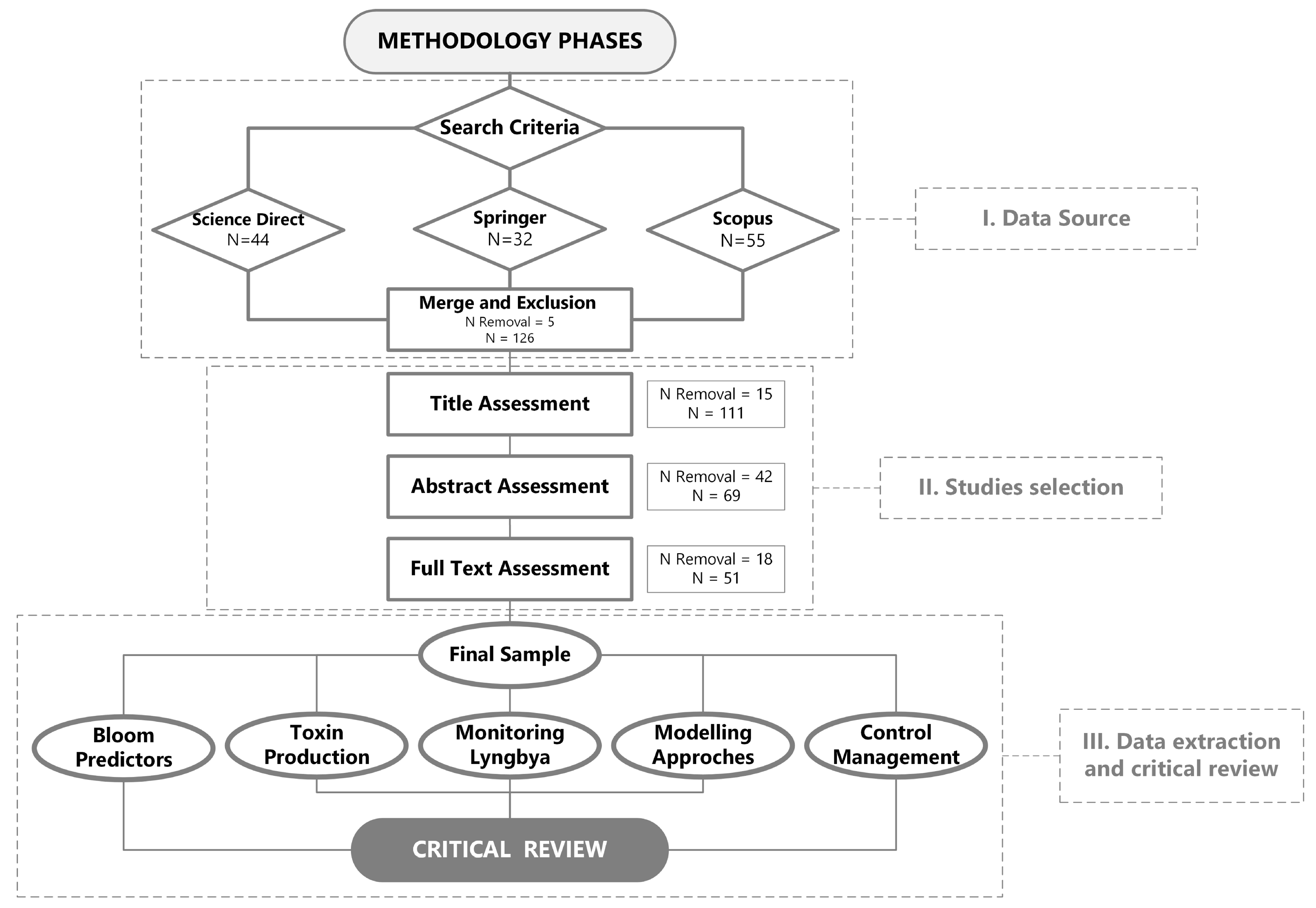
2. Materials and Methods
2.1. Data Source and Search Criteria
2.2. Data Extraction and Summary
- i.
- Proximate Factors: The factors that are directly related to Lyngbya bloom.
- ii.
- Underlying Factors: The factors that enable proximate factors to occur.
- iii.
- Predominant toxins produced by Lyngbya.
- iv.
- Different approaches to monitor Lyngbya.
- v.
- Different modeling approaches applied to Lyngbya issue.
- vi.
- Approaches for managing Lyngbya control.
3. Results
3.1. Overview of Analyzed Literature
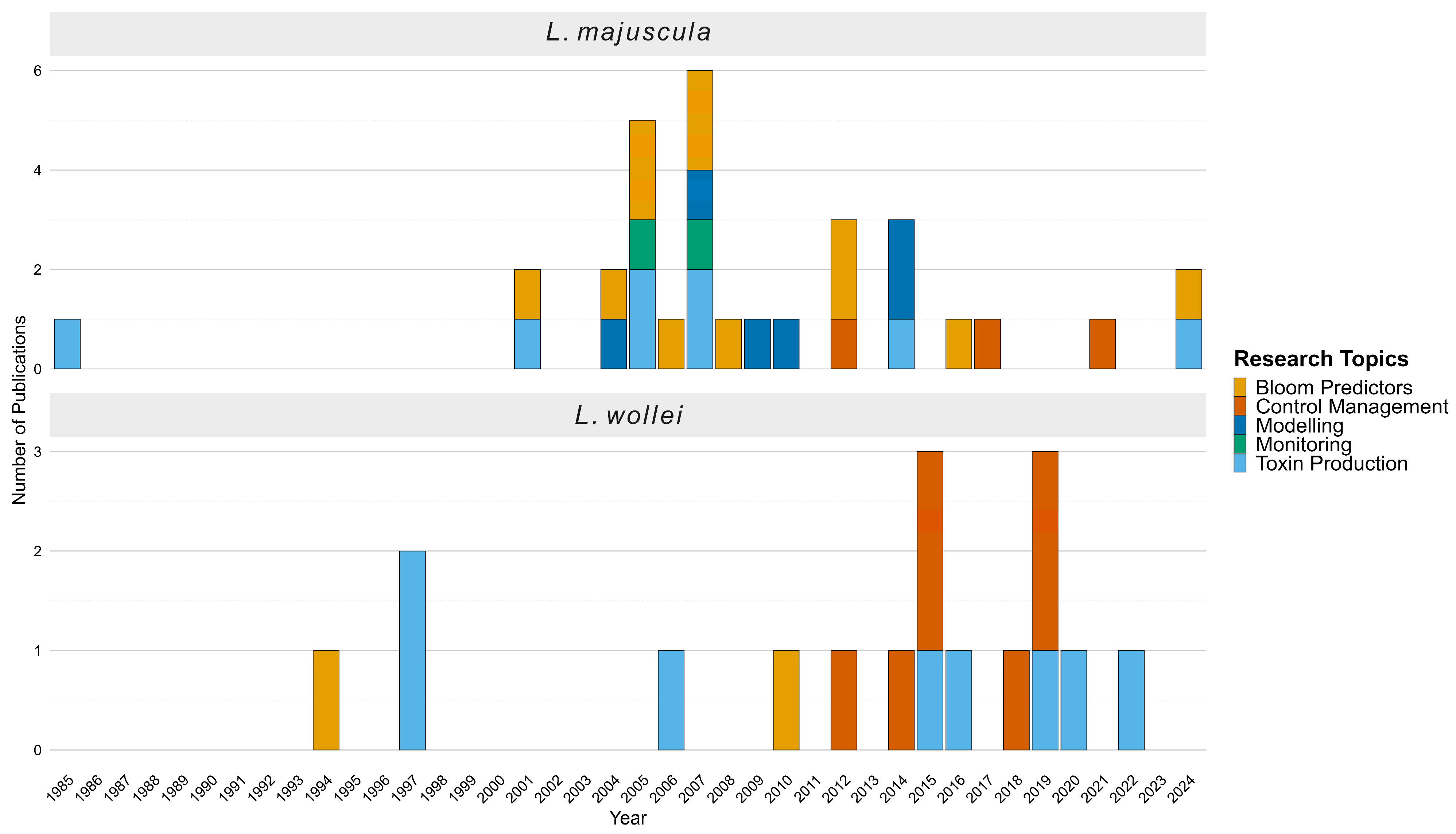
3.1.1. Chronological Order of Publication
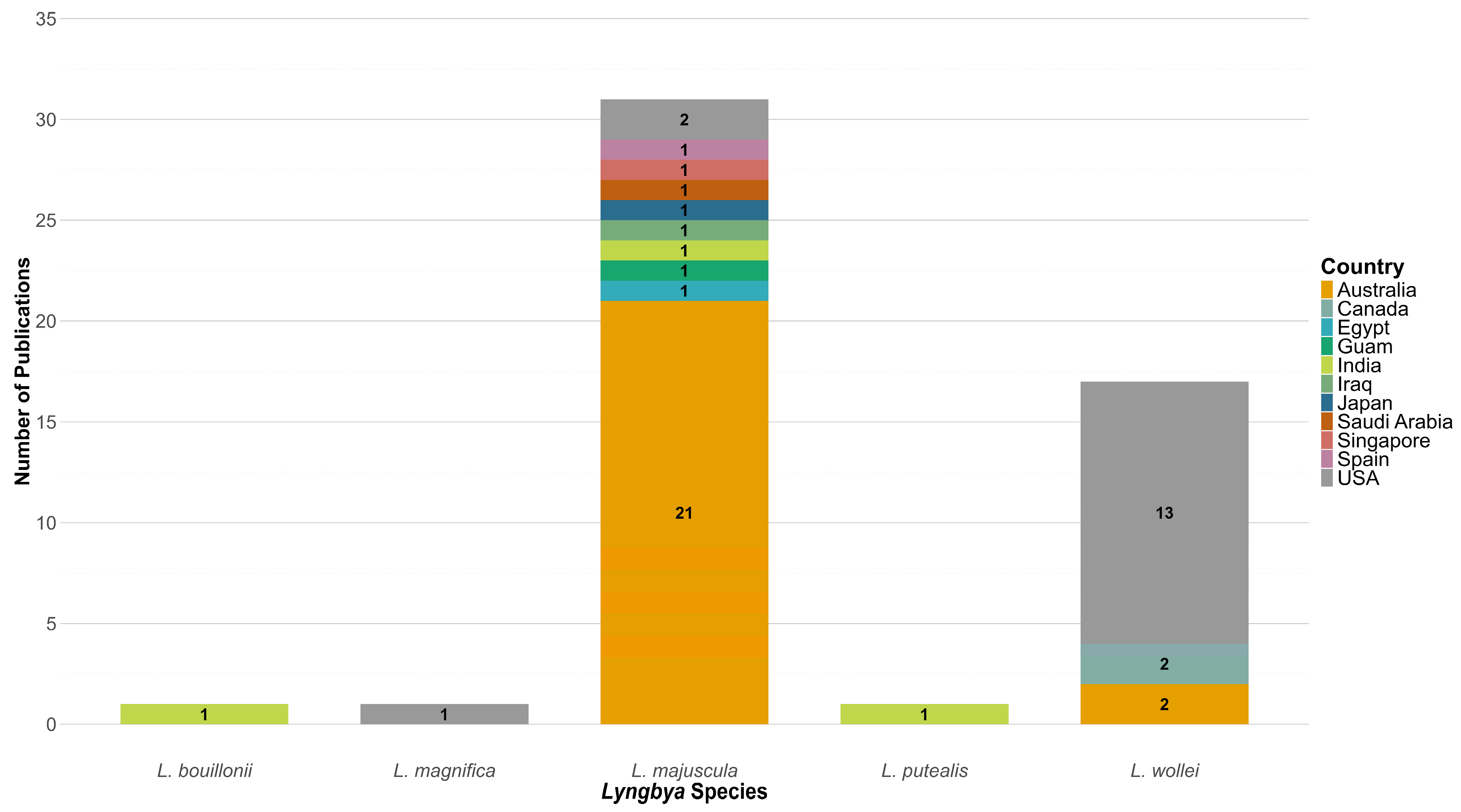
3.1.2. Geographical Distribution of Published Research
3.2. Bloom Predictors
3.2.1. Proximate Factors
3.2.2. Underlying Factors
3.3. Toxin Production
3.4. Monitoring Lyngbya
3.5. Modeling Approches
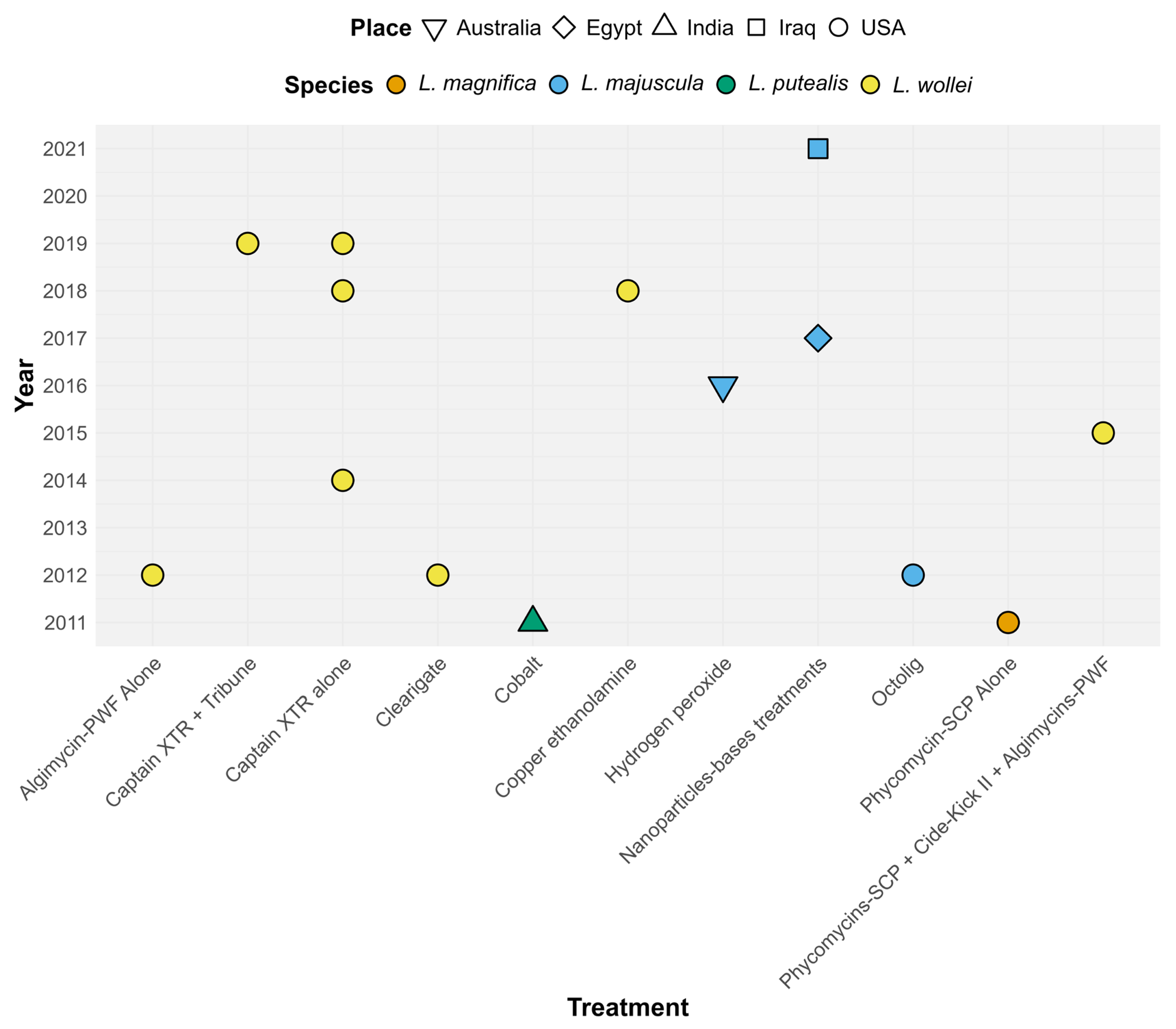
3.6. Lyngbya Control Management
4. Discussion
4.1. Geographic Expansion and Reporting of Lyngbya Occurrences
4.2. Bloom Predictors and Critical Knowledge Gaps in Lyngbya Proliferation
4.3. Monitoring Innovations and Management Implications
4.4. Modeling Approaches, Their Limitations, and Opportunities for Future Work
4.5. Considerations in Using Algaecides for Lyngbya Management
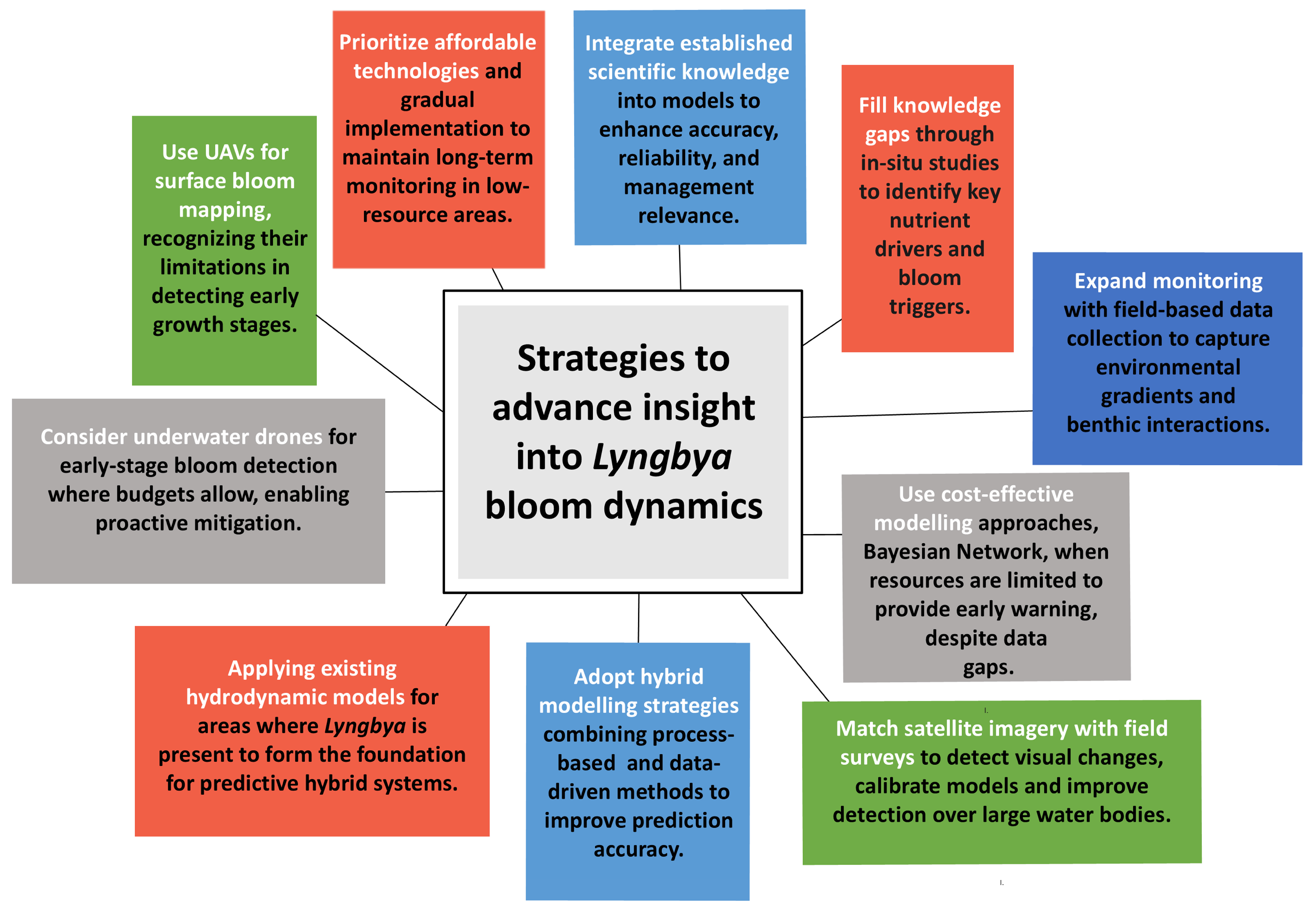
4.6. A Framework for Proactive Lyngbya Blooms Monitoring, Prediction and Control
5. Conclusions
Supplementary Materials
Author Contributions
Funding
Data Availability Statement
Conflicts of Interest
References
- Li, H.; Te, S.H.; Tavakoli, Y.; Zhang, J.; Yew-Hoong Gin, K.; He, Y. Rapid detection methods and modelling simulations provide new insights into cyanobacteria detection and bloom management in a tropical reservoir. J. Environ. Manag. 2023, 326, 116730. [Google Scholar] [CrossRef]
- O’Neil, J.M.; Davis, T.W.; Burford, M.A.; Gobler, C.J. The rise of harmful cyanobacteria blooms: The potential roles of eutrophication and climate change. Harmful Algae 2012, 14, 313–334. [Google Scholar] [CrossRef]
- Ranjbar, M.H.; Hamilton, D.P.; Etemad-Shahidi, A.; Helfer, F. Individual-based modelling of cyanobacteria blooms: Physical and physiological processes. Sci. Total Environ. 2021, 792, 148418. [Google Scholar] [CrossRef]
- Burford, M.A.; Carey, C.C.; Hamilton, D.P.; Huisman, J.; Paerl, H.W.; Wood, S.A.; Wulff, A. Perspective: Advancing the research agenda for improving understanding of cyanobacteria in a future of global change. Harmful Algae 2020, 91, 101601. [Google Scholar] [CrossRef] [PubMed]
- Paerl, H.W.; Barnard, M.A. Mitigating the global expansion of harmful cyanobacterial blooms: Moving targets in a human- and climatically-altered world. Harmful Algae 2020, 96, 101845. [Google Scholar] [CrossRef]
- Tiling, K.; Proffitt, C.E. Effects of Lyngbya majuscula blooms on the seagrass Halodule wrightii and resident invertebrates. Harmful Algae 2017, 62, 104–112. [Google Scholar] [CrossRef] [PubMed]
- ITIS. Integrated Taxonomic Information System. Lyngbya. Available online: https://www.itis.gov (accessed on 24 May 2026).
- Fuentes-Tristan, S.; Parra-Saldivar, R.; Iqbal, H.M.N.; Carrillo-Nieves, D. Bioinspired biomolecules: Mycosporine-like amino acids and scytonemin from Lyngbya sp. with UV-protection potentialities. J. Photochem. Photobiol. B Biol. 2019, 201, 111684. [Google Scholar] [CrossRef]
- Diaz, M.R.; Corredor, J.E.; Morell, J.M. Nitrogenase Activity of Microcoleus-Lyngbyaceus Mat Communities in a Eutrophic, Tropical Marine-Environment. Limnol. Oceanogr. 1990, 35, 1788–1795. [Google Scholar] [CrossRef]
- Speziale, B.J.; Dyck, L.A. Lyngbya Infestations: Comparative Taxonomy of Lyngbya wollei Comb. Nov. (Cyanobacteria). J. Phycol. 1992, 28, 693–706. [Google Scholar] [CrossRef]
- Ahern, K.S.; Ahern, C.R.; Savige, G.M.; Udy, J.W. Mapping the distribution, biomass and tissue nutrient levels of a marine benthic cyanobacteria bloom (Lyngbya majuscula). Mar. Freshw. Res. 2007, 58, 883–904. [Google Scholar] [CrossRef]
- Bishop, W.M.; Rodgers, J.H. Responses of Lyngbya magnifica Gardner to an algaecide exposure in the laboratory and field. Ecotoxicol. Environ. Saf. 2011, 74, 1832–1838. [Google Scholar] [CrossRef]
- Hudon, C.; Gagnon, P.; Larabie, S.P.; Gagnon, C.; Lajeunesse, A.; Lachapelle, M.; Quilliam, M.A. Spatial and temporal variations of a saxitoxin analogue (LWTX-1) in Lyngbya wollei (Cyanobacteria) mats in the St. Lawrence River (Quebec, Canada). Harmful Algae 2016, 57, 69–77. [Google Scholar] [CrossRef]
- Zegura, B.; Straser, A.; Filipic, M. Genotoxicity and potential carcinogenicity of cyanobacterial toxins—A review. Mutat. Res.-Rev. Mutat. 2011, 727, 16–41. [Google Scholar] [CrossRef]
- Carmichael, W.W.; Azevedo, S.M.; An, J.S.; Molica, R.J.; Jochimsen, E.M.; Lau, S.; Rinehart, K.L.; Shaw, G.R.; Eaglesham, G.K. Human fatalities from cyanobacteria: Chemical and biological evidence for cyanotoxins. Environ. Health Perspect. 2001, 109, 663–668. [Google Scholar] [CrossRef] [PubMed]
- Neumann, C.; Bain, P.; Shaw, G. Studies of the comparative in vitro toxicology of the cyanobacterial metabolite deoxycylindrospermopsin. J. Toxicol. Environ. Health A 2007, 70, 1679–1686. [Google Scholar] [CrossRef]
- Deng, H.; Shang, X.; Zhu, H.; Huang, N.; Wang, L.; Sun, M. Saxitoxin: A Comprehensive Review of Its History, Structure, Toxicology, Biosynthesis, Detection, and Preventive Implications. Mar. Drugs 2025, 23, 277. [Google Scholar] [CrossRef]
- Taylor, M.S.; Stahl-Timmins, W.; Redshaw, C.H.; Osborne, N.J. Toxic alkaloids in Lyngbya majuscula and related tropical marine cyanobacteria. Harmful Algae 2014, 31, 1–8. [Google Scholar] [CrossRef]
- Albert, S.; O’Neil, J.M.; Udy, J.W.; Ahern, K.S.; O’Sullivan, C.M.; Dennison, W.C. Blooms of the cyanobacterium Lyngbya majuscula in coastal Queensland, Australia: Disparate sites, common factors. Mar. Pollut. Bull. 2005, 51, 428–437. [Google Scholar] [CrossRef]
- Poirier-Larabie, S.; Hudon, C.; Poirier Richard, H.P.; Gagnon, C. Cyanotoxin release from the benthic, mat-forming cyanobacterium Microseira (Lyngbya) wollei in the St. Lawrence River, Canada. Environ. Sci. Pollut. Res. Int. 2020, 27, 30285–30294. [Google Scholar] [CrossRef] [PubMed]
- Ramesh, C.H.; Koushik, S.; Shunmugaraj, T.; Murthy, M.V.R. Underwater bloom of toxic cyanobacterium Lyngbya majuscula Harvey ex Gomont, 1892 on coral reefs in Hare Island, Gulf of Mannar Marine Biosphere Reserve. Indian J. Geo-Mar. Sci. 2024, 53, 230–233. [Google Scholar] [CrossRef]
- Narayana, S.; Tapase, S.; Thamke, V.; Kodam, K.; Mohanraju, R. Primary screening for the toxicity of marine cyanobacteria Lyngbya bouillonii (Cyanophyceae: Oscillatoriales) recorded for the first time from Indian Ocean. Reg. Stud. Mar. Sci. 2020, 40, 101510. [Google Scholar] [CrossRef]
- Smith, Z.J.; Martin, R.M.; Wei, B.; Wilhelm, S.W.; Boyer, G.L. Spatial and Temporal Variation in Paralytic Shellfish Toxin Production by Benthic Microseira (Lyngbya) wollei in a Freshwater New York Lake. Toxins 2019, 11, 44. [Google Scholar] [CrossRef]
- Kiran, B.; Thanasekaran, K. Metal tolerance of an indigenous cyanobacterial strain, Lyngbya putealis. Int. Biodeterior. Biodegrad. 2011, 65, 1128–1132. [Google Scholar] [CrossRef]
- Lee, H.; Depuydt, S.; Choi, S.; Kim, G.; Kim, Y.; Pandey, L.K.; Häder, D.-P.; Han, T.; Park, J. Potential use of nuisance cyanobacteria as a source of anticancer agents. In Natural Bioactive Compounds; Elsevier Inc.: Amsterdam, The Netherlands, 2021; pp. 203–231. [Google Scholar]
- Garcia-Pichel, F. Cyanobacteria. In Encyclopedia of Microbiology, 3rd ed.; Ensevier: Amsterdam, The Netherlands, 2009; pp. 107–124. [Google Scholar]
- Arthur, K.E.; Paul, V.J.; Paerl, H.W.; O’Neil, J.M.; Joyner, J.; Meickle, T. Effects of nutrient enrichment of the cyanobacterium Lyngbya sp. on growth, secondary metabolite concentration and feeding by the specialist grazer Stylocheilus striatus. Mar. Ecol. Prog. Ser. 2009, 394, 101–110. [Google Scholar] [CrossRef]
- Watkinson, A.J.; O’Neil, J.M.; Dennison, W.C. Ecophysiology of the marine cyanobacterium, Lyngbya majuscula (Oscillatoriaceae) in Moreton Bay, Australia. Harmful Algae 2005, 4, 697–715. [Google Scholar] [CrossRef]
- Metz, T.T.; Putnam, S.P.; Scott, G.I.; Ferry, J.L. Shoreline Drying of Biomass Can Lead to the Release and Formation of Toxic Saxitoxin Analogues to the Water Column. Environ. Sci. Technol. 2022, 56, 16866–16872. [Google Scholar] [CrossRef] [PubMed]
- Anderson, W.T.; Yerby, J.N.; Carlee, J.; Bishop, W.M.; Willis, B.E.; Horton, C.T. Controlling Lyngbya wollei in three Alabama, USA reservoirs: Summary of a long-term management program. Appl. Water Sci. 2019, 9, 178. [Google Scholar] [CrossRef]
- Willis, B.E.; Gravelie, J.T.; Bishop, W.M.; Buczek, S.B.; Cope, W.G. Managing the Invasive Cyanobacterium Lyngbya wollei in a Southeastern USA Reservoir: Evaluation of a Multi-year Treatment Program. Water Air Soil Pollut. 2020, 231, 196. [Google Scholar] [CrossRef]
- Abal, E.G.; Bunn, S.E.; Dennison, W.C. Healthy Waterways Healthy Catchments: Making the Connection in South East Queensland, Australia; Moreton Bay Waterways and Catchments Partnership: Brisbane, Australia, 2005.
- Steffensen, D.A. Economic cost of cyanobacterial blooms. In Cyanobacterial Harmful Algal Blooms: State of the Science and Research Needs. Advances in Experimental Medicine and Biology; United States Environmental Protection Agency, Ed.; Springer: New York, NY, USA, 2008; Volume 619. [Google Scholar]
- Dennis, J. Toxic Lyngbya algal Blooms ‘Inevitable’ in Moreton Bay if Development Continues Unchecked, Experts Say. Available online: https://www.abc.net.au/news/2024-08-08/qld-moreton-bay-algae-lyngbya-oysters-sediment-erosion-nutrients/104183278 (accessed on 15 January 2026).
- Smith, R.B.; Bass, B.; Sawyer, D.; Depew, D.; Watson, S.B. Estimating the economic costs of algal blooms in the Canadian Lake Erie Basin. Harmful Algae 2019, 87, 101624. [Google Scholar] [CrossRef]
- Lakshmikandan, M.; Li, M.; Pan, B. Cyanobacterial blooms in environmental water: Causes and solutions. Curr. Pollut. Rep. 2024, 10, 606–627. [Google Scholar] [CrossRef]
- Martín-García, L.; Herrera, R.; Moro-Abad, L.; Sangil, C.; Barquín-Diez, J. Predicting the potential habitat of the harmful cyanobacteria Lyngbya majuscula in the Canary Islands (Spain). Harmful Algae 2014, 34, 76–86. [Google Scholar] [CrossRef]
- Al-Shehri, A.M.; Mohamed, Z.A. Mass occurrence and toxicity of the cyanobacterium Lyngbya majuscula under phosphorus-limited conditions in the Red Sea. Ecohydrol. Hydrobiol. 2007, 7, 51–57. [Google Scholar] [CrossRef]
- Johnson, S.; Abal, E.; Ahern, K.; Hamilton, G. From Science to Management: Using Bayesian Networks to Learn about Lyngbya. Stat. Sci. 2014, 29, 36–41. [Google Scholar] [CrossRef][Green Version]
- Rousso, B.Z.; Bertone, E.; Stewart, R.; Hamilton, D.P. A systematic literature review of forecasting and predictive models for cyanobacteria blooms in freshwater lakes. Water Res. 2020, 182, 115959. [Google Scholar] [CrossRef] [PubMed]
- Tronholm, A.; Engene, N. Moorena gen. nov., a valid name for “Moorea Engene & al.” nom. inval. (Oscillatoriaceae, Cyanobacteria). Not. Algarum 2019, 122, 1–2. [Google Scholar]
- Curren, E.; Leong, S.C.Y. Global phylogeography of toxic cyanobacteria Moorea producens reveals distinct genetic partitioning influenced by Proterozoic glacial cycles. Harmful Algae 2019, 86, 10–19. [Google Scholar] [CrossRef] [PubMed]
- Engene, N.; Rottacker, E.C.; Kastovsky, J.; Byrum, T.; Choi, H.; Ellisman, M.H.; Komarek, J.; Gerwick, W.H. Moorea producens gen. nov., sp. nov. and Moorea bouillonii comb. nov., tropical marine cyanobacteria rich in bioactive secondary metabolites. Int. J. Syst. Evol. Microbiol. 2012, 62, 1171–1178. [Google Scholar] [CrossRef] [PubMed]
- Gomont, M. Monographie Des Oscillariées (Nostocacées Homocystées). Deuxième Partie—Lyngbyées. In Annales des Sciences Naturelles, Botanique (Série 7); Masson et Cie: Paris, France, 1892; Volume 16, pp. 91–264. [Google Scholar]
- Kenins, A. Validation of the Noxious Cyanophyte Microseira Wollei (Farlow Ex Gomont) G.B.Mcgregor & Sendall (Oscillatoriaceae). Not. Algarum 2017, 43, 1–3. [Google Scholar]
- Anagnostidis, K.; Komárek, J. Modern Approach to the Classification System of Cyanophytes 3: Oscillatoriales. Algol. Stud. 1988, 50–53, 327–472. [Google Scholar]
- Shang, K.; Han, Y.; Gao, X.; Sun, D.; Jiang, H.; Wu, X.; Lin, P. Spatial pattern of periphytic algae communities in major tributaries of the upper Jinsha River and the environmental drivers. J. Lake Sci. 2024, 36, 1392–1402. [Google Scholar] [CrossRef]
- Zhang, Y.; Yan, J.; Huang, B.-X.; Guo, Y.-X.; Liang, J.-X.; Wang, X.-C.; Yan, P.-Z.; Ding, L.-P. The epiphytic macroalgae on red alga Gelidium amansii from the Qinhuangdao area, Bohai Sea in autumn based on thermostatic incubation experiments. Oceanol. Limnol. Sin. 2023, 54, 493–501. [Google Scholar] [CrossRef]
- Xu, M.J.; Dong, W.Z.; Zhang, Z.; Zhu, X.H.; Guo, M.H.; Sun, X.F.; Liu, Q.G. Changes of phytoplankton community structure and environmental factors before and after emergency treatment of cyanobacteria bloom in Nanjiang reservoir. J. Shanghai Ocean. Univ. 2022, 31, 1467–1477. [Google Scholar] [CrossRef]
- Koji, E.; Tchakonté, I.; Missoup, D.A.; Onana, F.M.; Fobane, J.L.; Nola, M. Water quality assessment and plankton communities of the River Ntem (Southern-Cameroon) in relation to the Memve’ele hydroelectric dam construction. Int. J. Biol. Chem. Sci. 2022, 16, 1775–1794. [Google Scholar] [CrossRef]
- Hu, Y.-X.; Cao, L.; Qu, R.-C.; Huang, J.; Hu, S.; Zhou, Z.; Wang, Y.-C.; Zhang, J. Community Composition and Assessment of the Aquatic Ecosystem of Periphytic Algae in the Yangtze River Basin. Huan Jing Ke Xue 2022, 43, 3998–4007. [Google Scholar] [CrossRef]
- Drozdenko, T.V.; Aleksandrova, S.M.; Antal, T.K.; Tikhomirova, E.I. Structural indicators and toxic species of cyanobacteria of Pskov Lake. Povolzhskiy J. Ecol. 2022, 388–399. [Google Scholar] [CrossRef]
- Wu, Y.-S.; Jiang, H.-X.; Li, Y.; Yu, G.-L. Microfabric features of microbial carbonates: Experimental and natural evidence of mold holes and crusts. J. Palaeogeogr. 2021, 10, 19. [Google Scholar] [CrossRef]
- Lei, B.; Liu, S.-R.; Zhang, F.-H.; Yan, S.-S.; Li, J.-H.; Zhang, S. Seasonal phytoplankton dynamics and its relationship with key environmental factors in Lake Changshou, upper reaches of the Three Gorges Reservoir. J. Lake Sci. 2017, 29, 369–377. [Google Scholar] [CrossRef][Green Version]
- Huang, T.-L.; Zeng, M.-Z.; Qiu, X.-P.; Shi, J.-C.; Zhou, S.-L.; Liu, F. Phytoplankton functional groups and their spatial and temporal distribution characteristics in a temperate seasonally stratified reservoir. China Environ. Sci. 2016, 36, 1157–1166. [Google Scholar]
- Yi, K.-L.; Dai, Z.-G.; Liu, B.-Y.; Lin, Q.-W.; Zeng, L.; Xu, D.; He, F.; Wu, Z.-B. Effects of vertical location and artificial substrate on colonization of algal periphyton. Acta Ecol. Sin. 2016, 36, 4864–4872. [Google Scholar] [CrossRef]
- Taboada, M.A.; Gultemirian, M.L.; Martinez de Marco, S.N.; Tracanna, B.C. Epilithic phycoflora and environmental variables of Calimayo Stream (Tucuman, Argentina). Bol. Soc. Argent. Bot. 2015, 50, 467–480. [Google Scholar] [CrossRef]
- Osorio Ávila, F.J.; Rodríguez Barrios, J.; Montoya Moreno, Y. Succession of microalgae periphytic in tributaries the gaira river, sierra nevada de santa marta, Colombia. Acta Biológica Colomb. 2014, 20, 119–131. [Google Scholar] [CrossRef]
- Daga, I.C.; Pierotto, M.J. Cyanobacteria of the San Roque reservoir (Córdoba, Argentina). Bol. Soc. Argent. Bot. 2011, 46, 227–234. [Google Scholar]
- Erkaya, I.A.; Ozer, T.B.; Akbulut, A.; Udoh, A.U.; Yildiz, K. The Abundant and Wide-Spread Species of Algae in the Algal Flora of the Lower Euphrates Basin Wetlands. Turk. J. Fish. Aquat. Sci. 2011, 11, 55–62. [Google Scholar] [CrossRef]
- Priakhin, E.A.; Dukhovnaia, N.I.; Triapitsyna, G.A.; Deriabina, L.V.; Gavrilova, E.V.; Andreev, S.S.; Osipov, D.I.; Kostiuchenko, V.A.; Stukalov, P.M.; Aleksandrova, O.N.; et al. Phytoplankton in reservoir R-11 of Techa reservoir cascade of Industrial Association “Maiak”. Radiat. Biol. Radioecol. 2010, 50, 423–433. [Google Scholar]
- Kurt, O.; Ulcay, S.; Taskin, E.; Ozturk, M. Taxonomy and Description of the Three Marine Cyanophycean Algae from the Mediterranean Sea. Turk. J. Fish. Aquat. Sci. 2010, 10, 33–37. [Google Scholar] [CrossRef]
- Silva e Silva, L.; Cavalcanti, A.; Damazio, C. Composition of the stratiform stromatolites of lagoa Salgada, Rio de Janeiro, Brazil. Anuário Do Inst. De Geociências—UFRJ 2008, 31, 42–49. [Google Scholar] [CrossRef]
- Sánchez, C.; Benintende, S.; Benintende, M. Comunidad de cianobacterias durante el ciclo de cultivo de arroz (Oryza sativa L.). Cienc. Del Suelo 2007, 25, 1–6. [Google Scholar]
- Ben Rejeb Jenhani, A.; Bouaïcha, N.; El Herry, S.; Fathalli, A.; Zekri, I.; Haj Zekri, S.; Limam, A.; Alouini, S.; Romdhane, M.S. Cyanobacteria and their toxic potential in dam water content in Northern Tunisia. Arch. L’institut Pasteur Tunis 2006, 83, 71–81. [Google Scholar]
- Min, L.; Chi, Z.; Zhu, G.; Niu, P. Palaeoenvironment of quaternary stromatolites at Dongmulian, Yangyuan County, Hebei Province. Acta Geol. Sin. 2002, 76, 452–460. [Google Scholar]
- Yokokawa, F.; Shioiri, T. Total synthesis of antillatoxin, an ichthyotoxic cyclic lipopeptide from marine cyanobacterium Lyngbya majuscula. J. Soc. Synth. Org. Chem. 2000, 58, 634–641. [Google Scholar] [CrossRef]
- Iwasaki, S.; Shirai, R. Natural organic compounds that affect microtubule functions: Syntheses and structure–activity relationships of combretastatins, curacin A and their analogs as the colchicine-site ligands on tubulin. J. Pharm. Soc. Jpn. 2000, 120, 875–889. [Google Scholar] [CrossRef]
- Shirai, R. Synthetic study of curacin A, a novel antimitotic agent isolated from cyanobacterium Lyngbya majuscula. J. Synth. Org. Chem. 1999, 57, 532–540. [Google Scholar] [CrossRef]
- Sánchez, R.; Perera, G.; Sánchez, J. The cultivation of Fossaria cubensis (Pfeiffer) (Pulmonata: Lymnaeidae), the intermediate host of Fasciola hepatica (Linnaeus) in Cuba. Rev. Cuba. De Med. Trop. 1995, 47, 71–73. [Google Scholar]
- Hong, Y.; Li, Y.-Y.; Li, S.-H. Preliminary study on the blue-green algae community of arid soil in Qaidam Basin. Acta Bot. Sin. 1992, 34, 161–168. [Google Scholar]
- Freytet, P. Les cristallisations de calcite associées à des restes végétaux (algues, feuilles) en milieu fluviatile et lacustre, actuel et ancien (tufs et travertins). Bull. Société Bot. Fr. Actual. Bot. 2014, 139, 69–74. [Google Scholar] [CrossRef][Green Version]
- Noguerol Seoane, A. Phycological study of the thermal spring of Torneiros (Lovios, Orense, Spain). An. Del Jard. Bot. Madr. 1990, 47, 295–300. [Google Scholar]
- Horodyski, R.J.; Donaldson, J.A.; Kerans, C. A new shale-facies microbiota from the Middle Proterozoic Dismal Lakes Group, District of Mackenzie, Northwest Territories, Canada. Can. J. Earth Sci. 1980, 17, 1166–1173. [Google Scholar] [CrossRef]
- Backhaus, D. Contributions to the Ecology of Benthic Algae in the Alpine Zone of the Pyrenees II. Cyanophycees and other Algal Groups. Int. Rev. Der Gesamten Hydrobiol. Und Hydrogr. 1976, 61, 471–516. [Google Scholar] [CrossRef]
- Smedberg, C.T.; Cannon, R.E. Cyanophage analysis as a biological pollution indicator—Bacterial and viral. Water Pollut. Control Fed. 1976, 48, 2416–2426. [Google Scholar]
- Bourrelly, P. Note sur la famille des Oscillatoriacées. Hydrologie 1970, 32, 519–522. [Google Scholar] [CrossRef]
- Pringsheim, E.G. Der Polymorphismus von Lyngbya kuetzingii. Arch. Für Mikrobiol. 1966, 53, 402–412. [Google Scholar] [CrossRef]
- Półtoracka, J. Seasonal changes in phytoplankton of five lakes in Węgorzewo district. Acta Soc. Bot. Pol. 2015, 31, 667–681. [Google Scholar] [CrossRef]
- Osborne, N.J.T.; Webb, P.M.; Shaw, G.R. The toxins of Lyngbya majuscula and their human and ecological health effects. Environ. Int. 2001, 27, 381–392. [Google Scholar] [CrossRef] [PubMed]
- Hoffmann, L.; Demoulin, V. Marine Cyanophyceae of Papua New Guinea. II Lyngbya bouillonii sp. nov., a remarkable tropical reef-inhabiting blue-green alga. Belg. J. Bot. 1991, 124, 82–88. [Google Scholar]
- O’Neil, J.M.; Dennison, W.C. Discerning the Causes of Toxic Cyanobacteria (Lyngbya majuscula) Blooms in Moreton Bay, Australia. In Aquatic Microbial Ecology and Biogeochemistry: A Dual Perspective; Patricia, M., Glibert, T.M.K., Eds.; Springer: Cham, Switzerland, 2016. [Google Scholar]
- Xiao, M.; Burford, M.A.; Wood, S.A.; Aubriot, L.; Ibelings, B.W.; Prentice, M.J.; Galvanese, E.F.; Harris, T.D.; Hamilton, D.P. Schindler’s legacy: From eutrophic lakes to the phosphorus utilization strategies of cyanobacteria. FEMS Microbiol. Rev. 2022, 46, fuac029. [Google Scholar] [CrossRef]
- Ahern, K.S.; Ahern, C.R.; Udy, J.W. Nutrient additions generate prolific growth of Lyngbya majuscula (cyanobacteria) in field and bioassay experiments. Harmful Algae 2007, 6, 134–151. [Google Scholar] [CrossRef]
- Ahern, K.S.; Ahern, C.R.; Udy, J.W. In situ field experiment shows Lyngbya majuscula (cyanobacterium) growth stimulated by added iron, phosphorus and nitrogen. Harmful Algae 2008, 7, 389–404. [Google Scholar] [CrossRef]
- Kuffner, I.B.; Paul, V.J. Effects of nitrate, phosphate and iron on the growth of macroalgae and benthic cyanobacteria from Cocos Lagoon, Guam. Mar. Ecol. Prog. Ser. 2001, 222, 63–72. [Google Scholar] [CrossRef]
- Bell, P.R.F.; Elmetri, I. Some chemical factors regulating the growth of Lyngbya majuscula in Moreton Bay, Australia: Importance of sewage discharges. Hydrobiologia 2007, 592, 359–371. [Google Scholar] [CrossRef]
- Anderson, M.A.; Morel, F.M.M. The influence of aqueous iron chemistry on the uptake of iron by the coastal diatom Thalassiosira weissflogii. Limnol. Oceanogr. 1982, 27, 789–813. [Google Scholar] [CrossRef]
- Karametaxas, G.; Hug, S.; Sulzberger, B. Photodegradation of EDTA in the presence of lepidocrocite. Environ. Sci. Technol. 1995, 29, 2992–3000. [Google Scholar] [CrossRef]
- Hanington, P.; Rose, A.; Johnstone, R. The potential of benthic iron and phosphorus fluxes to support the growth of a bloom forming toxic cyanobacterium Lyngbya majuscula, Moreton Bay, Australia. Mar. Freshw. Res. 2016, 67, 1918–1927. [Google Scholar] [CrossRef]
- Elmetri, I.; Bell, P. Effects of phosphorus on the growth and nitrogen fixation rates of Lyngbya majuscula: Implications for management in Moreton Bay, Queensland. Mar. Ecol. Prog. Ser. 2004, 281, 27–35. [Google Scholar] [CrossRef]
- Hamilton, G.S.; Fielding, F.; Chiffings, A.W.; Hart, B.T.; Johnstone, R.W.; Mengersen, K. Investigating the Use of a Bayesian Network to Model the Risk of Lyngbya majuscula Bloom Initiation in Deception Bay, Queensland, Australia. Hum. Ecol. Risk Assess. Int. J. 2007, 13, 1271–1287. [Google Scholar] [CrossRef]
- Kehoe, M.; O’ Brien, K.; Grinham, A.; Rissik, D.; Ahern, K.S.; Maxwell, P. Random forest algorithm yields accurate quantitative prediction models of benthic light at intertidal sites affected by toxic Lyngbya majuscula blooms. Harmful Algae 2012, 19, 46–52. [Google Scholar] [CrossRef]
- Hamilton, G.; McVinish, R.; Mengersen, K. Bayesian model averaging for harmful algal bloom prediction. Ecol. Appl. 2009, 19, 1805–1814. [Google Scholar] [CrossRef] [PubMed]
- Johnson, S.; Fielding, F.; Hamilton, G.; Mengersen, K. An Integrated Bayesian Network approach to Lyngbya majuscula bloom initiation. Mar. Environ. Res. 2010, 69, 27–37. [Google Scholar] [CrossRef]
- Bridgeman, T.B.; Penamon, W.A. Lyngbya wollei in western Lake Erie. J. Great Lakes Res. 2010, 36, 167–171. [Google Scholar] [CrossRef]
- Cowell, B.C.; Botts, P.S. Factors influencing the distribution, abundance and growth of Lyngbya wollei in central Florida. Aquat. Bot. 1994, 49, 1–17. [Google Scholar] [CrossRef]
- Hill, K.L.; Fulton, H.M.; McGovern, T.W. Aquatic Antagonists: Seaweed Dermatitis (Lyngbya majuscula). Cutis 2024, 113, E38–E40. [Google Scholar] [CrossRef] [PubMed]
- Osborne, N.; Seawright, A.; Shaw, G. Dermal toxicology of Lyngbya majuscula, from Moreton Bay, Queensland, Australia. Harmful Algae 2008, 7, 584–589. [Google Scholar] [CrossRef]
- Arthur, K.E.; Limpus, C.J.; Roelfsema, C.M.; Udy, J.W.; Shaw, G.R. A bloom of Lyngbya majuscula in Shoalwater Bay, Queensland, Australia: An important feeding ground for the green turtle (Chelonia mydas). Harmful Algae 2006, 5, 251–265. [Google Scholar] [CrossRef]
- Capper, A.; Tibbetts, I.R.; O’Neil, J.M.; Shaw, G.R. The fate of Lyngbya majuscula toxins in three potential consumers. J. Chem. Ecol. 2005, 31, 1595–1606. [Google Scholar] [CrossRef]
- Fujiki, H.; Sugimura, T.; Moore, R.E. New classes of environmental tumor promoters: Indole alkaloids and polyacetates. Environ. Health Perspect. 1983, 50, 85–90. [Google Scholar] [CrossRef]
- Yin, Q.; Carmichael, W.W.; Evans, W.R. Factors influencing growth and toxin production by cultures of the freshwater cyanobacterium Lyngbya wollei Farlow ex Gomont. J. Appl. Phycol. 1997, 9, 55–63. [Google Scholar] [CrossRef]
- Carmichael, W.W.; Evans, W.R.; Yin, Q.Q.; Bell, P.; Moczydlowski, E. Evidence for Paralytic Shellfish Poisons in the Freshwater Cyanobacterium Lyngbya wollei (Farlow ex Gomont) comb. nov. Appl. Environ. Microbiol. 1997, 63, 3104–3110. [Google Scholar] [CrossRef]
- McGregor, G.B.; Sendall, B.C. Phylogeny and toxicology of Lyngbya wollei (Cyanobacteria, Oscillatoriales) from north-eastern Australia, with a description of Microseira gen. nov. J. Phycol. 2015, 51, 109–119. [Google Scholar] [CrossRef]
- Seifert, M.; McGregor, G.; Eaglesham, G.; Wickramasinghe, W.; Shaw, G. First evidence for the production of cylindrospermopsin and deoxy-cylindrospermopsin by the freshwater benthic cyanobacterium, Lyngbya wollei (Farlow ex Gomont) Speziale and Dyck. Harmful Algae 2007, 6, 73–80. [Google Scholar] [CrossRef]
- Osborne, N.J.; Shaw, G.R.; Webb, P.M. Health effects of recreational exposure to Moreton Bay, Australia waters during a Lyngbya majuscula bloom. Environ. Int. 2007, 33, 309–314. [Google Scholar] [CrossRef] [PubMed]
- Roelfsema, C.M.; Phinn, S.R.; Dennison, W.C.; Dekker, A.G.; Brando, V.E. Monitoring toxic cyanobacteria Lyngbya majuscula (Gomont) in Moreton Bay, Australia by integrating satellite image data and field mapping. Harmful Algae 2006, 5, 45–56. [Google Scholar] [CrossRef]
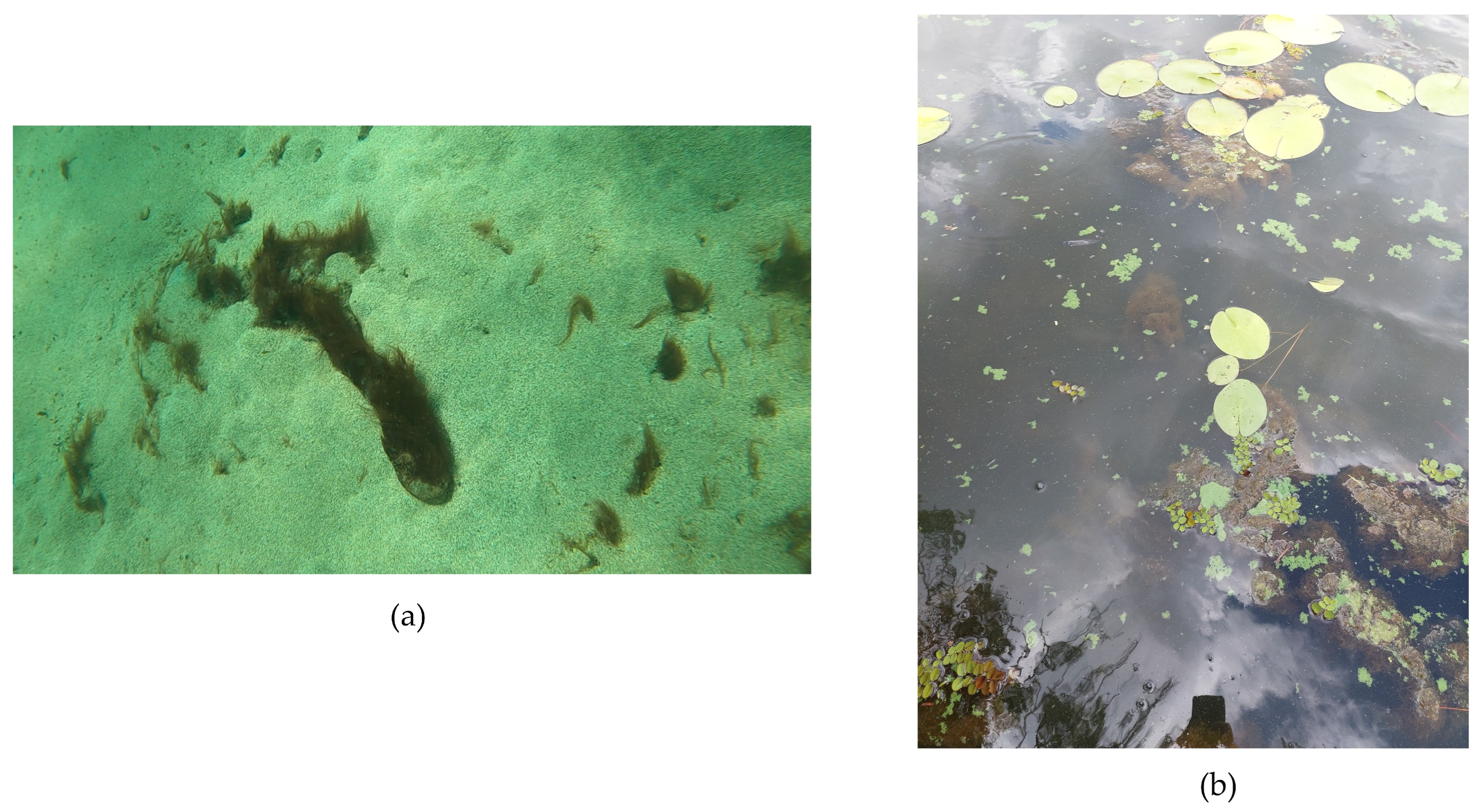
- Salazar, R.R. Lyngbya majuscula. iNaturalist. 2023. Available online: https://www.inaturalist.org/photos/312977051 (accessed on 24 May 2026).
- Kenins, A. n.d. Microseira wollei. iNaturalist. Available online: https://www.inaturalist.org/photos/592731734 (accessed on 24 May 2026).
- Arquitt, S.; Johnstone, R. A scoping and consensus building model of a toxic blue-green algae bloom. Syst. Dyn. Rev. 2004, 20, 179–198. [Google Scholar] [CrossRef]
- Bishop, W.M.; Lynch, C.L.; Willis, B.E.; Cope, W.G. Copper-Based Aquatic Algaecide Adsorption and Accumulation Kinetics: Influence of Exposure Concentration and Duration for Controlling the Cyanobacterium Lyngbya wollei. Bull. Environ. Contam. Toxicol. 2017, 99, 365–371. [Google Scholar] [CrossRef] [PubMed]
- Bishop, W.M.; Villalon, G.V.; Willis, B.E. Assessing Copper Adsorption, Internalization, and Desorption Following Algaecide Application to Control Lyngbya wollei from Lake Gaston, NC/VA, USA. Water Air Soil Pollut. 2018, 229, 152. [Google Scholar] [CrossRef]
- Bishop, W.M.; Rodgers, J.H., Jr. Responses of Lyngbya wollei to exposures of copper-based algaecides: The critical burden concept. Arch. Environ. Contam. Toxicol. 2012, 62, 403–410. [Google Scholar] [CrossRef]
- Calomeni, A.J.; Kinley, C.M.; Geer, T.D.; Hendrikse, M.; Rodgers, J.H., Jr. Lyngbya wollei responses to copper algaecide exposures predicted using a concentration—Exposure time (CET) model: Influence of initial biomass. J. Aquat. Plant Manag. 2018, 56, 73–83. [Google Scholar]
- Bishop, W.M.; Willis, B.E.; Horton, C.T. Affinity and efficacy of copper following an algicide exposure: Application of the critical burden concept for Lyngbya wollei control in Lay Lake, AL. Environ. Manag. 2015, 55, 983–990. [Google Scholar] [CrossRef]
- Wagner, J.L.; Townsend, A.K.; Velzis, A.E.; Paul, E.A.; Fantke, P. Temperature and toxicity of the copper herbicide (NautiqueTM) to freshwater fish in field and laboratory trials. Cogent Environ. Sci. 2017, 3, 1339386. [Google Scholar] [CrossRef]
- Calomeni, A.J.; Iwinski, K.J.; Kinley, C.M.; McQueen, A.; Rodgers, J.H., Jr. Responses of Lyngbya wollei to algaecide exposures and a risk characterization associated with their use. Ecotoxicol. Environ. Saf. 2015, 116, 90–98. [Google Scholar] [CrossRef]
- Thatcher, K.L.; Martin, D.F. Growth of Lyngbya majuscula in crystal river water treated with Octolig. Fla. Sci. 2012, 75, 63–70. [Google Scholar]
- Alghanimy, D.; Alghanmi, H. Effect of different Magnesium Oxide Nanoparticles concentration on the growth of the Lyngbya majuscula. Ecol. Environ. Conserv. 2021, 27, 110–115. [Google Scholar]
- El-Kassas, H.Y.; Abd El-Aziz Okbah, M. Phytotoxic effects of seaweed mediated copper nanoparticles against the harmful alga: Lyngbya majuscula. J. Genet. Eng. Biotechnol. 2017, 15, 41–48. [Google Scholar] [CrossRef]
- Whitchurch, R. The Effect of Iron on Marine Filamentous Cyanobacteria Growth and Investigations into Bloom Management of Moreton Bay, Queensland Species. Ph.D. Thesis, Griffith University, Nathan, Australia, 2016. [Google Scholar]
- Drozdenko, T.V.; Aleksandrova, S.M.; Antal, T.K.; Tikhomirova, E.I. Structural Indices and Toxic Species of Cyanobacteria of Pskov Lake. Biol. Bull. 2024, 50, 2623–2629. [Google Scholar] [CrossRef]
- Ng, C.; Ong, L.; Chou, L. Lyngbya majuscula Blooms in an Enclosed Marine Environment. EnrivonmentAsia 2012, 5, 93–98. [Google Scholar] [CrossRef]
- Ahern, K.S.; O’Neil, J.M.; Udy, J.W.; Albert, S. Effects of iron additions on filament growth and productivity of the cyanobacterium Lyngbya majuscula. Mar. Freshw. Res. 2006, 57, 167–176. [Google Scholar] [CrossRef]
- Haakonsson, S.; Maciel, F.; Rodríguez, M.A.; Ponce de León, L.; Rodríguez-Gallego, L.; Arocena, R.; Pedocchi, F.; Bonilla, S. Monitoring cyanobacterial blooms: A strategy combining predictive modeling and remote sensing approaches. Environ. Earth Sci. 2024, 83, 195. [Google Scholar] [CrossRef]
- Berdalet, E.; Tester, P.; Chinain, M.; Fraga, S.; Lemée, R.; Litaker, W.; Penna, A.; Usup, G.; Vila, M.; Zingone, A. Harmful Algal Blooms in Benthic Systems: Recent Progress and Future Research. Oceanography 2017, 30, 36–45. [Google Scholar] [CrossRef]
- Guan, W.; Bao, M.; Lou, X.; Zhou, Z.; Yin, K. Monitoring, modeling and projection of harmful algal blooms in China. Harmful Algae 2022, 111, 102164. [Google Scholar] [CrossRef] [PubMed]
- Xiao, X.; Peng, Y.; Zhang, W.; Yang, X.; Zhang, Z.; Ren, B.; Zhu, G.; Zhou, S. Current status and prospects of algal bloom early warning technologies: A Review. J. Environ. Manag. 2024, 349, 119510. [Google Scholar] [CrossRef]
- Kislik, C.; Dronova, I.; Kelly, M. UAVs in Support of Algal Bloom Research: A Review of Current Applications and Future Opportunities. Drones 2018, 2, 35. [Google Scholar] [CrossRef]
- Fernandez-Figueroa, E.; Wilson, A.; Rogers, S. Commercially available unoccupied aerial systems for monitoring harmful algal blooms: A comparative study. Limnol. Oceanogr. Methods 2021, 20, 146–158. [Google Scholar] [CrossRef]
- Rousso, B.; Bertone, E.; Stewart, R.; Hamilton, D.; Smith, S. Optical Sensorsand Machine Learning for Optimised Cyanobacteria Bloom Management. In Proceedings of the 38th IAHR World Congress—“Water: Connecting the World”; International Association for Hydro-Environment Engineering and Research (IAHR): Panama City, Panama, 2019; pp. 635–646. [Google Scholar]
- Cheng, K.H.; Chan, S.N.; Lee, J.H.W. Remote sensing of coastal algal blooms using unmanned aerial vehicles (UAVs). Mar. Pollut. Bull. 2020, 152, 110889. [Google Scholar] [CrossRef]
- Su, T.-C.; Chou, H.-T. Application of Multispectral Sensors Carried on Unmanned Aerial Vehicle (UAV) to Trophic State Mapping of Small Reservoirs: A Case Study of Tain-Pu Reservoir in Kinmen, Taiwan. Remote Sens. 2015, 7, 10078–10097. [Google Scholar] [CrossRef]
- Aguirre-Gómez, R.; Salmerón-García, O.; Gómez-Rodríguez, G.; Peralta-Higuera, A. Use of unmanned aerial vehicles and remote sensors in urban lakes studies in Mexico. Int. J. Remote Sens. 2016, 38, 2771–2779. [Google Scholar] [CrossRef]
- Casper, A.F.; Dixon, B.; Steimle, E.T.; Hall, M.L.; Conmy, R.N. Scales of heterogeneity of water quality in rivers: Insights from high resolution maps based on integrated geospatial, sensor and ROV technologies. Appl. Geogr. 2012, 32, 455–464. [Google Scholar] [CrossRef]
- Meng, H.; Zhang, J.; Chang, Y.; Zheng, Z. A new method for predicting -a concentration in a reservoir: Coupling EFDC hydrodynamic and water quality model with ConvLSTM-MLP network. J. Hydrol. 2025, 660, 133485. [Google Scholar] [CrossRef]
- Kim, J.; Kim, H.; Kim, K.; Ahn, J.M. Assessing the Applicability of Deep-Learning Method for Predicting Cyanobacteria in a Regulated River. J. Environ. Eng. 2024, 150, 04024012. [Google Scholar] [CrossRef]
- Lin, S.; Pierson, D.C.; Mesman, J.P. Prediction of algal blooms via data-driven machine learning models: An evaluation using data from a well-monitored mesotrophic lake. Geosci. Model Dev. 2023, 16, 35–46. [Google Scholar] [CrossRef]
- DHI. MIKE 21 Flow Model FM: Hydrodynamic Module; DHI: Hørsholm, Denmark, 2024. [Google Scholar]
- Mastin, B.J.; Rodgers, J.H., Jr. Risk evaluation of cyanobacteria-dominated algal blooms in a North Louisiana reservoir. J. Aquat. Ecosyst. Stress Recovery 2002, 9, 103–114. [Google Scholar] [CrossRef]
- Kang, L.; Mucci, M.; Fang, J.; Lurling, M. New is not always better: Toxicity of novel copper based algaecides to Daphnia magna. Ecotoxicol. Environ. Saf. 2022, 241, 113817. [Google Scholar] [CrossRef]
- Watson, S.E.; Taylor, C.H.; Bell, V.; Bellamy, T.R.; Hooper, A.S.; Taylor, H.; Jouault, M.; Kille, P.; Perkins, R.G. Impact of copper sulphate treatment on cyanobacterial blooms and subsequent water quality risks. J. Environ. Manag. 2024, 366, 121828. [Google Scholar] [CrossRef]
- Sahu, N.; Maldhure, A.; Labhasetwar, P. Management of cyanobacteria and cyanotoxins in drinking water: A comprehensive review on occurrence, toxicity, challenges and treatment approaches. Sci. Total Environ. 2025, 976, 179260. [Google Scholar] [CrossRef]



| Previously Reported Name (Lyngbya) | Current Accepted Name | Taxonomic Status/Notes | References |
|---|---|---|---|
| Lyngbya majuscula Harvey ex Gomont (1892) | Lyngbya majuscula (currently accepted, though often reassigned to Moorea in recent literature) | Still formally accepted, but widely discussed as Moorea in modern taxonomy | [42,43,44] |
| Lyngbya wollei (Farlow ex Gomont) Speziale & Dyck (1992) | Microseira wollei (Farlow ex Gomont) G.B. McGregor & Sendall ex Kenins | Reclassified to Microseira | [45] |
| Lyngbya putealis Montagne ex Gomont (1892) | Phormidium puteale (Montagne ex Gomont) Anagnostidis & Komárek | Reclassified to Phormidium; Lyngbya name is now a synonym | [46] |
| Lyngbya bouillonii Hoffmann & Demoulin (1991, nom. inval.) | Moorena bouillonii (Hoffmann & Demoulin) Engene & Tronholm | Transferred to Moorena; original name invalid | [41] |
| Lyngbya magnifica Gardner (1927) | Microseira wollei (Farlow ex Gomont) G.B. McGregor & Sendall ex Kenins | Reclassified to Microseira | [45] |
| Species | Toxins | Symptoms/Characteristics | References |
|---|---|---|---|
| L. majuscula | Lyngbyatoxin A (LA) |
| [18,80,98,99,100,101] |
| L. majuscula | Debromoaplysia-toxin (DAT) |
| [17,18,39,58,59,60,61,80,98,99,100,101] |
| L. majuscula | Aplysiatoxin (AT) |
| [18,80,102] |
| L. majuscula | Manauealides (derived from DAT & AT) |
| [18] |
| L. wollei | Saxitoxin (STX) & Paralytic Shellfish Toxins (PSTs) |
| [23,103] |
| L. wollei | L. wollei toxins (LWTs 1–6) |
| [13,20,29,104] |
| L. wollei | Cylindrospermopsin (CYN) |
| [105,106] |
| L. wollei | Deoxy-cylindrospermopsin (deoxy-CYN) |
| [105,106] |
| L. bouillonii | Unkown |
| [22] |
| Modeling Approach | Research Goal | References |
|---|---|---|
| Bayesian Network |
| [39,92,95] |
| Bayesian Network + Probit Time Series Model |
| [94] |
| Model based on the Classic System Dynamics Model of Eutrophication Lakes |
| [111] |
| Random Forest Algorithm |
| [93] |
| Maxent Distribution Model |
| [37] |
Disclaimer/Publisher’s Note: The statements, opinions and data contained in all publications are solely those of the individual author(s) and contributor(s) and not of MDPI and/or the editor(s). MDPI and/or the editor(s) disclaim responsibility for any injury to people or property resulting from any ideas, methods, instructions or products referred to in the content. |
© 2026 by the authors. Licensee MDPI, Basel, Switzerland. This article is an open access article distributed under the terms and conditions of the Creative Commons Attribution (CC BY) license.
Share and Cite
Meira, Y.; Bertone, E.; Sahin, O.; Zhang, H.; Burford, M.A. Predicting and Managing the Mass Occurrence of Lyngbya sensu lato in Marine and Freshwater Environments: Current Knowledge, Challenges, and Opportunities. Hydrobiology 2026, 5, 16. https://doi.org/10.3390/hydrobiology5020016
Meira Y, Bertone E, Sahin O, Zhang H, Burford MA. Predicting and Managing the Mass Occurrence of Lyngbya sensu lato in Marine and Freshwater Environments: Current Knowledge, Challenges, and Opportunities. Hydrobiology. 2026; 5(2):16. https://doi.org/10.3390/hydrobiology5020016
Chicago/Turabian StyleMeira, Yasmim, Edoardo Bertone, Oz Sahin, Hong Zhang, and Michele A. Burford. 2026. "Predicting and Managing the Mass Occurrence of Lyngbya sensu lato in Marine and Freshwater Environments: Current Knowledge, Challenges, and Opportunities" Hydrobiology 5, no. 2: 16. https://doi.org/10.3390/hydrobiology5020016
APA StyleMeira, Y., Bertone, E., Sahin, O., Zhang, H., & Burford, M. A. (2026). Predicting and Managing the Mass Occurrence of Lyngbya sensu lato in Marine and Freshwater Environments: Current Knowledge, Challenges, and Opportunities. Hydrobiology, 5(2), 16. https://doi.org/10.3390/hydrobiology5020016