Systematic Review

Systematic Review on the Reproductive Aspects of the Chelidae Family

by
Lucas Maia Garcês
1,
Fernanda Victoria Nery Dias
1,
Paulo Henrique Rocha Aride
1,2,3 and
Adriano Teixeira de Oliveira
1,2,3,4,5,*
1
Center for the Study of Invertebrates and Vertebrates of the Amazon (NEIVA), Federal Institute of Education, Science and Technology of Amazonas (IFAM), Manaus 69020-120, Brazil
2
Graduate Program in Veterinary Sciences (PPGCVET), Federal Institute of Education, Science and Technology of Amazonas (IFAM) and Nilton Lins University Center (CUNL), Manaus 69086-475, Brazil
3
Graduate Program in Biodiversity and Science Education in the Amazon (PPGBEC), Federal Institute of Education, Science and Technology of Amazonas (IFAM) and Amazonas State University (UEA), Manaus 69020-120, Brazil
4
Graduate Program in Animal Science and Fisheries Resources (PPGCARP), Faculty of Agricultural Sciences (FCA), Federal University of Amazonas (UFAM), Manaus 69077-000, Brazil
5
Amazonas State University (UEA), Manaus 69050-010, Brazil
*
Author to whom correspondence should be addressed.
Hydrobiology 2026, 5(1), 1; https://doi.org/10.3390/hydrobiology5010001
Submission received: 9 November 2025 / Revised: 11 December 2025 / Accepted: 11 December 2025 / Published: 31 December 2025

Abstract

The Austro-American Side-necked Turtles originated in Gondwana and are found only in South America and Australasia. This paper aimed to review the reproductive aspects of the Chelidae family systematically. The searches were conducted in several databases, resulting in 86 studies, of which only 21 were considered adequate. The research was mainly conducted in Australia and Brazil, in both natural and laboratory settings, across different ontogenetic stages among the sixteen species studied. The analyzed publications focused on different aspects of the reproductive biology of the Chelidae family, including ecology, anatomy, morphology, behavior, and other perspectives. Thus, this study aimed to answer questions related to reproduction and the factors that can affect the preparation, mating, sexual activity, and oviposition phases, highlighting the most researched areas and those that still require attention for the conservation of these species.

1. Introduction

Turtles of the suborder Pleurodira retract their necks laterally and are composed of three families: Chelidae, Pelomedusidae, and Podocnemidae [1]. The Chelidae family, commonly known as Austro-American Side-necked Turtles, has a Gondwanan origin, with a distribution restricted to South America and Australasia, and is not known outside this area, not even as fossils [2,3]. Currently, the living species comprises 68 species across 15 genera, with a wide distribution throughout all South American countries, Australia, Papua New Guinea, and Indonesia [4,5].
Chelonians face many adversities before reaching adulthood, such as predation (by other animals and humans), fish nets, pollutants, loss of habitat, and others, resulting in a massive loss during the first steps of development (hatchling, youngster and juvenile) [6].
After becoming an adult and reaching sexual maturity, which depends from species species (5 to 10 years in average), the turtles have to invest energy to find a partner and perform the courtship, taking on risks and, if successful, passing on their genes [7].
Some Chelidae species lay more eggs than others, with parental care being reported in Podocnemis expansa, pointing to an r strategy, while Platemys platycephala lays only one egg, adopting a K strategy, showing the importance of understanding the behavior of each species to adopt the most fit conservation methodology [8,9].
According to the International Union for Conservation of Nature (IUCN) Red List of Threatened Species, the Chelidae family has more than 60% of its species as Not Available (NA) due to the difficulty of capture, being distributed at sites of hard access, hidden or not being appreciated as a delicacy or primary product [10,11,12]. The captures exceed the period of population recovery due to the withdrawal of females and eggs, resulting in fewer breeders and future members of the species, thereby disrupting the ecological balance [13].
Consumption is directly influenced by indigenous people, indicating a secondary protein source. The practice intensified with the colonization and export of goods, driven by increased demand for meat, eggs, and fat, putting many populations at risk of overexploitation [10,14,15]. Thus, the status is updated based on several criteria, such as human pressure, habitat loss, pollution, and climate change, to reevaluate population status and determine the measures to be taken to reclassify and restore the population [11,16].
Therefore, reproduction can be considered a critical demographic parameter for management and conservation strategies when considering long-lived organisms such as chelonians [17]. The reproductive parameters of tropical freshwater turtles worldwide have received little attention compared to those of temperate species, especially for the Chelidae family, for which limited information is available [18,19,20].
Species of the Chelidae family present a distinct pattern of sex determination compared to other turtle families. While many species have incubation temperature-dependent (TSD) sex determination, chelids stand out as the most diverse group among Pleurodira, exhibiting diverse karyotypic configurations, the presence of differentiated and undifferentiated sex chromosomes, and most species have the GSD (genetic sex determination) mechanism as a mode of sexual determination [21,22].
This paper aimed to systematically review the reproductive aspects of the Chelidae family by the following central question: “What is the status of studies related to the reproduction of the Chelidae family?” To answer this question, the following sub-items were formulated: (a) Which countries have studies focused on the reproductive aspects of the Chelidae family? (b) Which sub-areas of the reproductive aspects are most studied? (c) Which species are most studied? (d) What is the primary life cycle studied? (e) What are the records of studies on reproductive hormones in species of the Chelidae family?

2. Materials and Methods

2.1. Study Selection Area

The authors conducted this systematic review in four sequential stages (Garcês, L.M. and Oliveira, A.T.). The first stage involved preliminary selection based on the titles, abstracts, and keywords of the articles. Articles whose abstracts did not address reproductive aspects of the Chelidae family as the focus of the research were removed.

2.2. Information Sources and Data Curation

The search was conducted in the PubMed, Scopus, and Web of Science databases in March 2025. The search components were defined as “TS = (Chelidae AND reprodu*)”. After obtaining the search results, books, book chapters, reviews, theses, and short communications were excluded, and all languages were accepted for the first stage selection, ending with English and Portuguese studies. The Start tool uses the Preferred Reporting Items for Systematic Review and Meta-Analyses (PRISMA) to support the results [23].
Then, based on the first reading of titles, abstracts, and keywords, the articles were imported for full reading, and all relevant data were extracted and entered into a Microsoft Excel spreadsheet for evaluation. From the data obtained, maps and graphs were produced using QGIS 3.36.3 [24] and R software v.4.0.4 ggplot2 package [25], and additional information on the identification of turtle species was obtained from the Reptile Database [5].

2.3. Risk of Bias Assessment

The database used, the date, the languages (English and Portuguese), the number of articles, the types of articles chosen for this study, and the inclusion/exclusion criteria are all potential sources of bias.

2.4. Statistical Analyses

The R program [25] was used for research analyses with statistical description.

3. Results

3.1. Literature Search

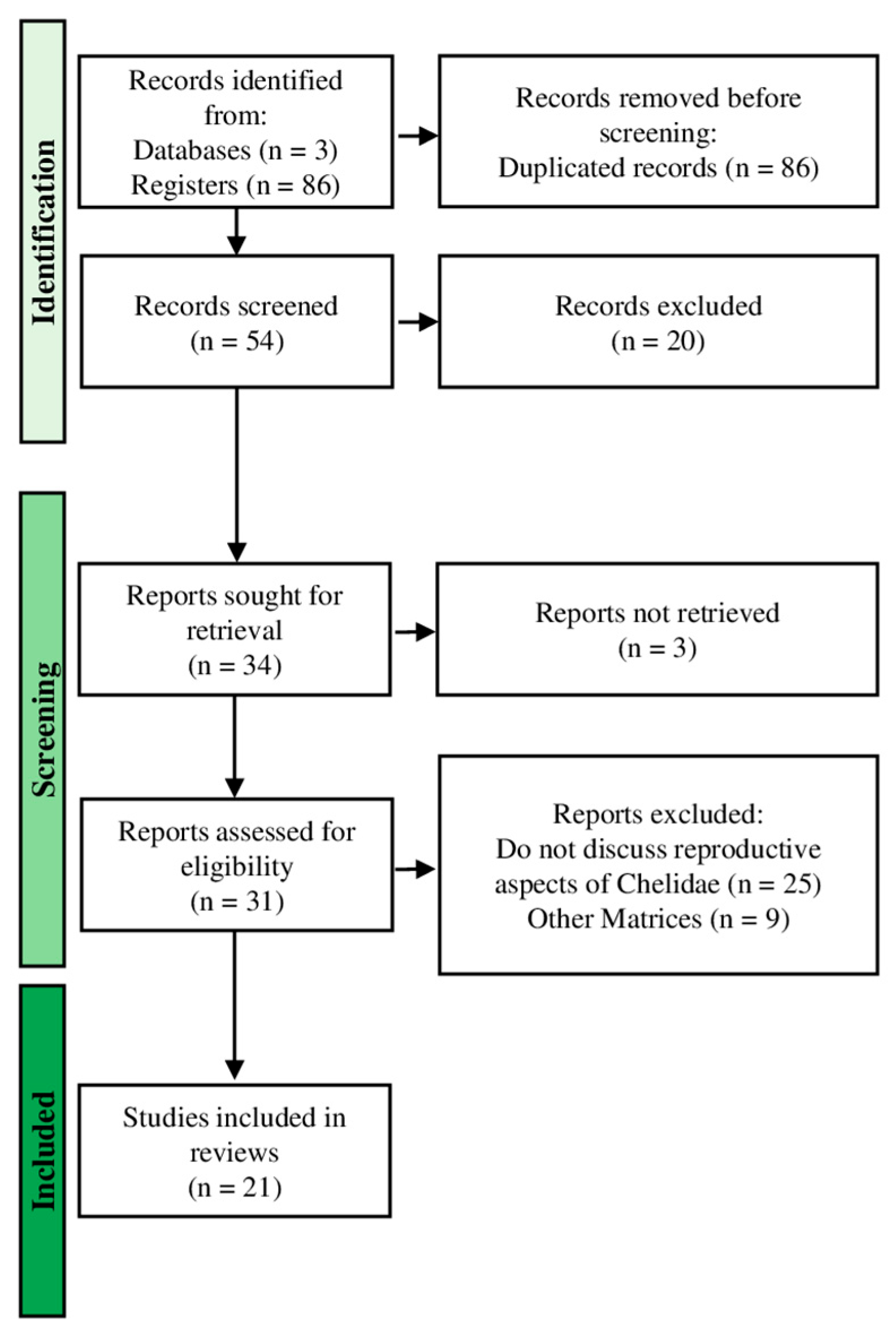
During the initial database search, 86 resources were identified: 41 in Web of Science, 38 in Scopus, and 7 in PubMed. Of these 86, 32 were duplicated/triplicated, resulting in 54 articles. These were analyzed in the second stage (screening) regarding titles and keywords; 25 were rejected for not containing the search components of topic 2.2 before reading the abstracts, with emphasis on papers that address aspects of reproduction in the Chelidae family, with 9 studies rejected for not being scientific articles, resulting in 21 papers suitable for this review (Figure 1).

3.2. Global and Ecological Distribution

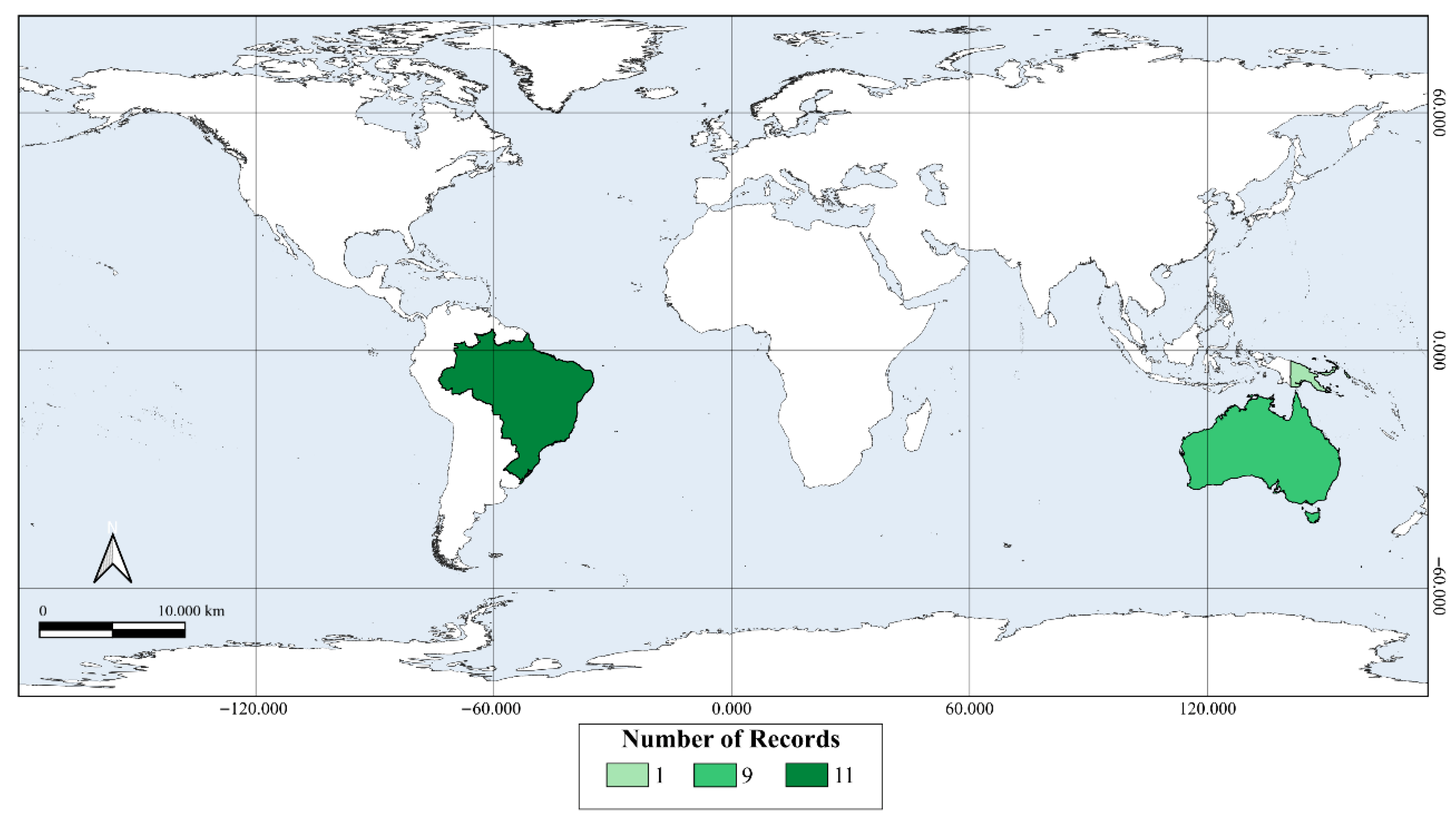
Studies focused on the reproductive aspects of the Chelidae family were not widely distributed worldwide. The results showed that 85.71% were focused on the wild environment and 14.28% on animals obtained from captivity/laboratory. Of these, studies from Brazil (52.38%), Australia (42.85%) and Papua New Guinea (4.76%) were tabulated (Figure 2).
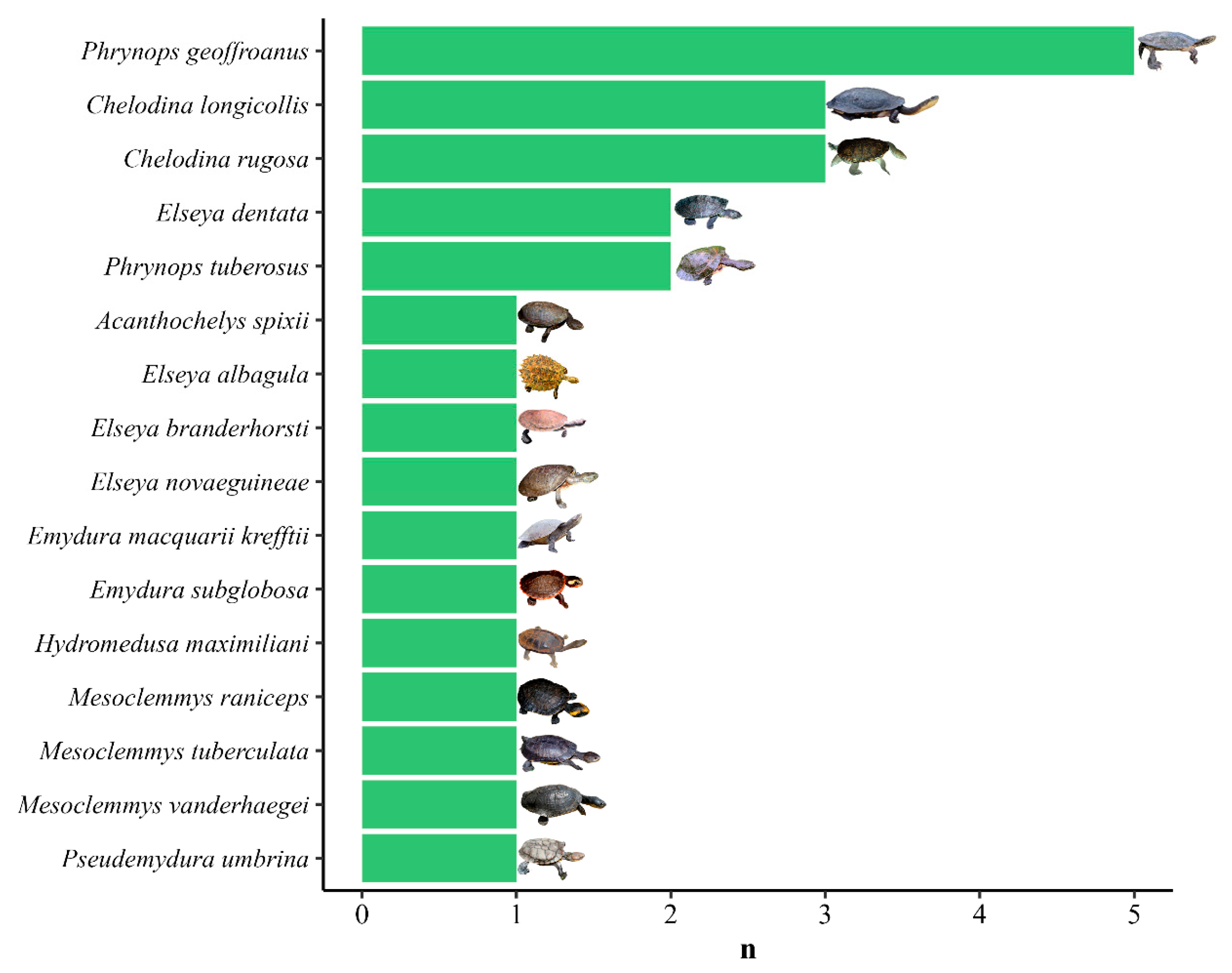
Sixteen species of the Chelidae family were found, the most frequent being Phrynops geoffroanus Schewigger, 1812, Geoffroy’s Toadhead Turtle; Chelodina longicollis Shaw, 1764 Eastern Long-necked; Turtle and Chelodina rugosa Ogilby, 1889, North Australian Snake-necked Turtle (Figure 3).
The studies carried out in the articles found focused mainly on the influence of seasonal periods (47.61%), external and internal anatomy and morphology (28.57%), considering variations in the gonads and other parts of the reproductive system, reproductive behavior (14.28%) and dimorphism considering sexual rate (9.52%) (Table 1).

3.3. Threat Status IUCN Red List of Chelids

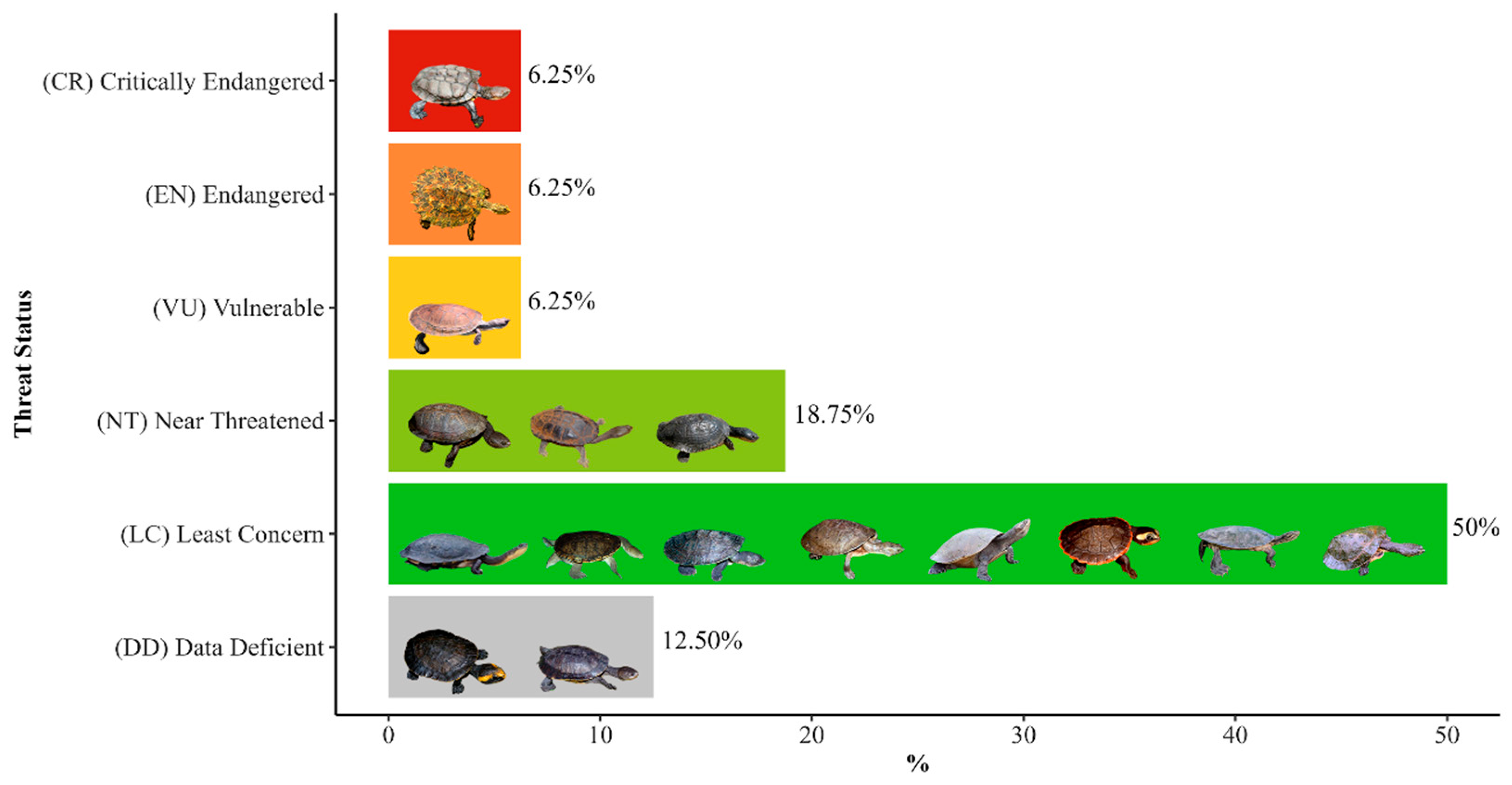
According to the IUCN and Turtle Taxonomy Working Group (TTWG) [16] recommendations, the following percentages of turtle species at risk were identified in this study: 50% of the species are listed as Least Concern (LC) with Chelodina longicollis, Chelodina rugosa, Elseya dentata Gray, 1863; Northern Australian Snapping Turtle, Elseya novaeguineae Meyer, 1874; Western New Guinea Stream Turtle, Emydura macquarii krefftii Gray, 1831; Krefft’s River Turtle, Emydura subglobosa Krefft, 1876 Red-bellied Short-necked Turtle; Phrynops geoffroanus, and Phrynops tuberosus Peters, 1870 Cotinga River Toadhead Turtle; 18.75% as Near Threatened (NT) with Acanthochelys spixii Duméril & Bibron, 1835 Black Spine-necked Swamp Turtle; Hydromedusa maximiliani Mikan, 1825 Maximilian’s Snake-headed Turtle and Mesoclemmys vanderhaegei Bour, 1973 Vanderhaege’s Toad-head Turtle; 6.25% as Endangered (EN) with Elseya albagula Thomson, Georges & Limpus, 2006 White-throated Snapping Turtle; 6.25% as Critically Endangered (CR) with Pseudemydura umbrina Siebenrock, 1901 Western Swamp Turtle; 12.50% as Data Deficient (DD) with Mesoclemmys raniceps Gray, 1856 Black-lined Toadhead Turtle and Mesoclemmys tuberculata Luederwaldt, 1926 Tuberculate Toadhead Turtle; and 6.25% as Vulnerable (VU) with Elseya banderhorsti Ouwens, 1914 New Guinea Snapping Turtle (Figure 4).

4. Discussion

4.1. Global and Ecological Distribution

Eleven papers studied species that occur in Brazil related to the reproductive aspects of the Chelidae (Figure 2), with most studies focusing on seasonal phenomena and anatomy and morphology of chelids (Table 1). Although it is the country with the most research on the reproductive biology of chelids, it ranks second in species richness, currently containing 23 species [44,45,46,47]. In Brazil, the richness of Chelidae is influenced by the north–south climatic gradient of temperature and rainfall, which shapes diverse habitats, from floodplain and montane forests to Cerrado and pastures. These climatic and habitat features around river basins are key factors in the distribution of Brazilian chelids [48].
Most species in the Chelidae family are found in Australia, and this research identified articles more focused on seasonal phenomena, demonstrating that some species are endemic to the region and are threatened by various anthropogenic pressures [49]. In Papua New Guinea, one paper was published that discussed reproductive behavior and brought it to light [3]. Papua New Guinea is home to a high diversity of chelids, particularly in the southern lowlands [3,50]. These turtles play important roles in the subsistence economies and traditional practices of indigenous communities [50,51]. However, they face increasing threats due to habitat loss, overexploitation for local consumption, and the international pet trade [3,52]. Conservation efforts are hampered by limited ecological data, a lack of information on sustainable harvesting, and insufficient knowledge on captive breeding for most species [3].
Figure 3 shows the frequency of chelid surveys in the review. Chelodina longicollis is widely distributed throughout southeastern Australia, from the vicinity of Port Lincoln on the Eyre Peninsula west of Adelaide in South Australia, along the coastal rivers of Victoria and New South Wales, north to the Fitzroy River drainage on the Queensland coast and occurs in sympatry with Emydura macquarii Gray, 1830 Murray River Turtle and Chelodina expansa Gray, 1857 Giant Snake-necked Turtle throughout much of the southern portion of its range [53]. C. longicollis generally inhabits shallow or ephemeral bodies of water, such as farm dams, and frequently migrates or spends its time on land, being active in significant temperature variations. There are also records of prolonged hibernation under the ice [26,54,55].
Chelodina rugosa is a long-necked chelid, widely distributed in the wet-dry tropics of northern Australia, where it occurs in greatest densities in ephemeral water bodies with shallow vegetation. C. rugosa survives the dry season by burrowing into the muddy bottom of its recessive habitat and aestivating underground. This species was shown to be the only known reptile that lays its eggs underwater. However, Chelus fimbriata Schneider, 1783 (Amazon Mata Mata) was later shown to exhibit the same behavior in captivity [56,57].
Phrynops geoffroanus is widely distributed throughout South America and is the largest Chelidae species in Brazil. P. geoffroanus uses a variety of water bodies, such as streams, canals, flooded forests, lakes, small streams, ponds and dams, although it prefers to inhabit large rivers with currents. The species inhabits clear, white waters and can also be found in polluted canals in some cities. It nests in open places with clay soils (banks), where shallow holes are dug and the sex is genetically determined [11].

4.2. Seasonal Phenomena

Accelerated climate change is a critical variable in ecological research, given its measurable effects on habitat integrity and species survival [58]. Thus, considering seasonal cycles and the reproductive period are crucial factors for understanding anatomy, morphology, hormonal level variation, the timing of sexual activity, birth success rate, and other elements important to the topic [59].
In freshwater turtles, reproductive patterns, including clutch size, can vary across a species’ geographic range. Clutch size is an important life cycle trait for management programs, especially for species with wide geographic ranges [17]. The distribution of freshwater turtles and their reproductive characteristics are closely related to rain-fed fisheries. Increased resource availability during the rainy season is a significant cause of this synchronization [40].
Seasonality in reproduction for most turtle species is associated with periods of specific habitat conditions for energy acquisition, nesting, incubation, and hatching. In contrast, local habitat characteristics can induce variation in the body size of turtles hatching from natural nests [17]. Seasonal differences generate different ecological specifications that affect the size of turtle species. However, these differences were not significant in Phrynops geoffroanus and Mesoclemmys tuberculata, where their sizes in the Caatinga Biome were like those in the Atlantic Forest [34].
The rainy season provides soil moisture for egg development [40]. Turtles are typically observed nesting during the driest periods of the year, with hatchlings emerging in the rainy season [34]. Records of multiple clutches in the same season are common among different turtles, whether freshwater, marine, or brackish. Santana et al. [34] also reported that the simultaneous presence of eggs and vitellogenic follicles indicates the presence of more than one clutch per reproductive season.
Rainfall and cold temperatures can delay hatchling emergence, so it is necessary to evaluate whether environmental drought-flood cycles influence hatchling hibernation responses in chelid turtles [60]. Hibernation in the nest was once considered an uncommon behavior observed in only a few species of North American turtles. However, extensive research now indicates it is much more common in many species worldwide [26].
Ferronato, Roe & Georges [26] were the first to document chelid hatchlings hibernating inside the nest in Chelodina longicollis. Environmental conditions that allow females to nest and hatchlings to emerge from the nest are permitted, sometimes with a specific time interval between the two events. This gap may be filled in Australian tortoises by early embryonic diapause, as in Chelodina expansa and Chelodina rugosa, late embryonic aestivation, or by delayed emergence of hatchlings from the nest in C. longicollis during winter [26,60,61].
Incubation periods in many tropical turtles, including Mesoclemmys, are controlled by soil moisture and temperature. They do not initiate embryonic development immediately after oviposition, as do most emydid turtles. Most of these species exhibit embryonic aestivation, in which the embryo remains in an early embryonic stage until environmental cues, usually fertilization of the nest substrate, initiate embryogenesis [36]. Excessive soil or soil moisture during incubation can be detrimental to embryos, especially at a later stage of development [43].
Freshwater turtles of the wet and dry tropics cope with the unpredictability of conditions suitable for laying, development, and hatching. Rather than nesting underwater, other species that occupy ephemeral marshes with seasonally unpredictable water levels seek limited nesting opportunities on higher ground (e.g., Elseya branderhorsti) or nest in fluctuating waves that rise and fall with the water level (e.g., Emydura subglobosa) [28]. Hatchling survival depends on emergence coinciding with resource availability, so emergence is likely to be delayed until an appropriate signal, such as rains at the beginning of the wet season. However, this has not been demonstrated [62]. In addition to these developmental responses, Chelodina rugosa appears to employ a dispersed strategy to cope with the unpredictability of the onset of the period suitable for hatchling emergence and survival.
A prolonged nesting season, during which many clutches are laid by individual females, and embryonic diapause, coupled with high variability in developmental rates between clutches and between eggs within clutches [63], ensure that some eggs are available to hatch at the onset of the wet season, either early or late. These diverse reproductive traits, comparable to those of some lower vertebrates facing similar environmental challenges, are studied in the context of evolutionary responses to environmental stochasticity in the variables that govern the timing of reproduction, the duration of development, and the timing of hatching and emergence [28].
Reproduction of the neotropical species Hydromedusa maximiliani is associated with the rainy season [17]. Studies have also shown that the hatching of Phrynops geoffroanus is synchronized with the period of heavy rains in the state of São Paulo, Brazil [43]. Although apparently well established, population viability analyses have shown that local populations of H. maximiliani can be negatively impacted and prone to extinction according to environmental and demographic stochasticity [17].

4.3. Anatomy and Morphology

At the macroscopic level, reproductive studies rely on observations of shape, size, weight, and color. At the same time, microscopic analyses focus on cell types and developmental stages under different external and internal conditions [37,41,42]. A correlation between corporal size and sexual maturity was also noted [37], with larger females being ready for reproductive activities, while smaller ones were not yet prepared.
Additional tools, such as ultrasound, have been used to monitor the female ovarian cycle from vitellogenesis to the oviducal period, revealing seasonal influences and linking sexual maturity to body and reproductive size [30]. This pattern contrasts with the prenuptial cycle of homeotherms and, as described for temperate-zone turtles [33,64], reveals that spermatogenic and ovarian cycles of Australian chelid turtles, such as Emydura macquarii krefftii, are comparable to those of Northern Hemisphere freshwater turtles.
Chelodina longicollis completes most of its follicular enlargement in autumn, whereas Emydura macquarii undergoes follicular growth primarily in spring. Both species were studied in southern regions of the continent (Victoria), and follicular development was halted during the cold winter months. In contrast, ovarian follicular enlargement in E. krefftii at the lower latitudes of Fraser Island began in late summer and continued uninterrupted through winter [33].
Reptilian corpus luteum can synthesize progesterone, and these structures appear to be the primary source of this hormone post-ovulation in turtles [33]. Progesterone inhibits ovulation in Chrysemys picta by suppressing ovarian growth rather than directly inhibiting ovulation [65]. Callard et al. [66] concluded that progesterone may induce ovarian regression post-ovulation. However, in species that produce multiple clutches per year, it is more likely that the function is to suppress the development and ovulation of subsequent clutches until the preceding clutch is laid [33].
As progesterone is known to delay smooth muscle contractions in the turtle oviduct [67], the hormone may also prevent premature egg expulsion, thereby controlling oviposition timing. Corporea lutea plays a role in albumin secretion, shell membrane formation, and eggshell calcification [68]. The corpora lutea of Emydura krefftii regress rapidly after oviposition, a finding consistent with their hypothesized functions [33].
The study conducted by Kennett [18] investigated the reproductive biology of Chelodina rugosa and Elseya dentata in permanent and ephemeral aquatic habitats. Specimens were captured, weighed and measured for carapace length, and subjected to reproductive assessments. Females were evaluated using radiography, abdominal palpation, and dissection, while collected tissues (testes and ovaries) were prepared for microscopic analysis through staining and visualization.
In Trachemys scripta males, the testes exhibited active spermatogenesis, and sexual maturity was determined by gonadal development, sperm presence, and tail morphology [69]. Female analyses included fat body indices, ovarian follicle counts, and classification of luteal bodies into two distinct phases, using a minimum size threshold of 10 gravid individuals to confirm maturity [70]. Results indicated that male gonadal activity initiated during the rainy season, peaked in January, and regressed between April and September. Notably, Chelodina rugosa retained sperm post-copulation, whereas Elseya dentata did not [18].
Female reproductive cycles were synchronized with seasonal rainfall, though luteal body dynamics differed between species [71]. Chelodina rugosa maintained consistent numbers and sizes of corpora lutea year-round, while Elseya dentata displayed periodic presence [18]. These findings demonstrate that Chelodina rugosa and Elseya dentata exhibit distinct reproductive strategies shaped by their respective habitats. C. rugosa, inhabiting ephemeral water bodies, employs a continuous reproductive cycle characterized by a “scattergun” strategy, producing multiple clutches to maximize reproductive success in unpredictable environments. In contrast, E. dentata, restricted to permanent waters, adopts a conservative approach, timing a single clutch to coincide with the predictable rainy season [18].

4.4. Reproductive Behavior

The present research has shown that chelids have been extensively analyzed in terms of systematics, physiology, zoogeography and ecology. However, little is known about the mating behaviors and reproductive dynamics of this group [27]. The existing reports are primarily found in original descriptions, related personal communications, and scientific notes [3,72,73].
Although reproductive behavior in chelonians is considered stereotypical, 1st pair encounter; 2nd female pursuit; 3rd pre-copulation; and 4th copulation, interspecific, intraspecific, and environmental influences should be considered potential sources of variation in characteristics such as the total duration of the mating sequence and the duration of each phase [72]. Reproductive patterns in chelid turtles are classified due to the region as temperate, typically nesting in the austral spring and early summer, and tropical, typically nesting in the austral winter [3,74,75]. Both patterns showed a clear correlation with the cycles of the species examined by Georges et al. [3].
Landscape and climatic disturbance may influence the selection of sites for oviposition, enhancing hormones levels and energy cost in trading places and retaining the eggs, with weather conditions also affecting the eggs and hatchlings, causing overheating or overcooling, nest flooding, soil compression, and other influences, as for the adults, may turn the migration for oviposition rougher, changing the ideal conditions of habitat [76,77].
Although harsh scenarios, adults, eggs and hatchlings tend to adopt other paths to enhance survival rates, such as hibernations, aestivation, different nest configurations, advancing or delaying hatch. If the individuals are well prepared for unusual conditions by having viable energy resources, turtles can overcome the most panorama presented [76,77].
According to Georges et al. [3], Elseya branderhorsti exhibited tropical patterns that are also expressed in species such as Elseya dentata and Chelodina rugosa. Emydura subglobosa and Elseya novaeguineae also exhibited a temperate pattern, as did the genera Emydura, Elusor, Pseudemydura, Rheodytes, and the species Chelodina longicollis and Elseya latisternum [30,33]. The multiple clutching observed in Emydura subglobosa and Elseya novaeguineae was not eliminated as a biological feature of Elseya branderhorsti and is typical of chelid turtles inhabiting latitudes with relatively long activity seasons [50].
Reproduction in freshwater turtles is related to rainfall, and this relationship is stronger in semiarid regions [19]. Females of Phrynops tuberosus lay eggs and appear to be in reproductive condition from July to November, which is the end of the dry season in the region.
Agonistic interactions and courtship behavior in turtles of the Chelidae family involve biting and other dominance behaviors [72]. Therefore, minor injuries may result from intra- or intersexual interactions.
Reports by Rodrigues and Silva [39] suggest that amputated animals can perform as well as their intact counterparts in terms of energy acquisition. However, these injuries may hurt courtship behavior, when, for example, the male needs to chase and dominate the female before copulation. In this situation, the absence of a limb can reduce swimming performance or make it difficult for females to be dominated, reducing the reproductive success of males.
Understanding a species’ mating system is therefore not only relevant to behavioral ecology. However, it is necessary to understand how different reproductive strategies affect the population’s overall genetic diversity, an important consideration for species conservation and management [78]. The production of multiple mated litters is a common mating strategy among reptilian taxa [79]. Several factors are thought to influence the extent and variation in multiple paternities in each population. These include factors that influence the frequency of mate encounters, such as the operational sex ratio, population size, and density [27]. The authors also state that, in a conservation context, multiple paternity is generally considered a favorable reproductive strategy, increasing genetic diversity among related offspring and, presumably, the adequate population size of cohorts.

4.5. Sexual Dimorphism

Sexual dimorphism can be driven by ecological causes, fecundity selection, and sexual selection [80]. Kennett and Georges [32] argue for an ecological cause in which reproductive potential and onset of sexual maturity depend on turtle size rather than age, so that any delay in growth during occupation of a drought refuge would have considerable consequences for the reproduction of individuals. Under these circumstances, occupation of ephemeral waters would provide much greater selective advantages than could be predicted simply by comparing production in ephemeral and permanent waters.
Pseudemydura umbrina is morphologically the Australian chelid best suited to survive without water and estivates annually in leaf litter or in burrows when the ephemeral wetlands it occupies dry out in summer. Chelodina rugosa survives the annual drought of floodplain billabongs in northern Australia by burrowing into the substrate and remaining dormant until the billabongs are replenished [32].
Chelodina longicollis is also capable of terrestrial aestivation, but like P. umbrina and C. rugosa, it often occupies ephemeral waters that may remain unpredictably dry for several consecutive years. Furthermore, sex determination in C. longicollis is independent of incubation temperature, both under constant-temperature regimes in the laboratory and in the field [31].
Fecundity selection favoring large females is common among ectothermic turtles [19]. Female freshwater turtles are also commonly larger and heavier than males, and reproductive advantages for large females, along with differences in energy allocation, may explain this dimorphism in these reptiles [34].
Bager et al. [38] and Rodrigues & Silva [39] found that the relationship between males’ and females’ sizes was relevant to reproduction, with males being smaller than females. Smaller body size in males is most often correlated with the absence of male combat, the presence of male precoital displays, and mate choice by females. Male combat would occur in species in which males are larger than females, being an exception within the Chelidae, where this appears to be supported in Pseudemydura umbrina and Elusor macrurus [29]. The females are larger than the males because of differences in maturation time between the sexes or a positive relationship between female size and reproductive output [34].
Rodrigues and Silva [39] reported a difference in the specificity of the relationship between plastron length and body mass between males and females of Phrynops tuberosus, corroborating the reproductive advantages of adult females that store energy to reproduce and adult males that invest energy to capture females [19,81].
Kenneth [29] and Cox et al. [81] also reported that females had wider heads than similarly sized males, like what is found in the genus Graptemys, where differences in diet and reduced intersexual competition explain sexual dimorphism in head width. Furthermore, Chelodina rugosa and Elseya dentata are sexually dimorphic in body size at maturity and at maximum size, with females being the larger sex in each species [29].

4.6. Threat Status IUCN Red List of Chelids

Chelids have few studies about reproductive aspects in the literature on their species; therefore, in the IUCN, half are listed as Not Assessed (NA), whereas, according to the TFTSG studies in conjunction with the IUCN, they are listed as Least Concern [16,20].

4.6.1. Species Listed as Least Concern (LC)

Phrynops geoffroanus and Phrynops tuberosus were found, both listed as LC. Deforestation is the main threat to P. geoffroanus, given its wide distribution, as is contamination by heavy metals. P. tuberosus does not have a known distribution due to its similarity to P. geoffroanus, which sometimes confuses identification. In addition, there is no information about threats to the species, only its occasional consumption by some Amazonian indigenous communities [11,16].
Chelodina longicollis is widely distributed and is common in all major river systems. Although agricultural and urban development have had adverse effects on the species’ natural habitat, this may have been offset by the construction of numerous artificial water bodies for agricultural and pastoral purposes. Its threat may be due to a combination of factors, including increased loss and degradation of wetlands associated with urban development, increased mortality of migratory turtles on roads, and increased predation by foxes [53]. Like C. longicollis, Chelodina rugosa has a wide distribution in Australia, where the species has no conservation status. In addition, research has been conducted to develop an indigenous enterprise initially focused on harvesting eggs for the production and sale of hatchling turtles and later expanding to the breeding of turtles for meat and medicinal purposes, offering little threat to the persistence of the species population [82].
Elseya dentata is found in northern Australia and inhabits permanent riverine habitats; it is primarily herbivorous, feeding on riparian vegetation and fruits, with some opportunistic carnivory, and faces potential threats from land management practices affecting riparian forests, which are crucial to its diet [83]. Recent taxonomic studies have led to the description of new species previously considered part of E. dentata, including one in central coastal Queensland, highlighting the need for further research on the distribution and conservation status of this species complex [84].
Elseya novaeguineae is found throughout New Guinea, including both northern and southern lowlands, but is absent from the central mountain ranges [50,85]. The species faces increasing threats from human population growth, development, and westernization in New Guinea, which are impacting natural resources, including turtles [50].
Emydura macquarii krefftii, a subspecies of the Macquarie turtle, is abundant in parts of Queensland, Australia [86]. However, introduced populations of E. macquarii pose a significant threat to endangered native turtles, particularly Myuchelys species, through competition, hybridization, and potential disease transmission, as Emydura macquarii expands its range through human-mediated translocation [87]. Management strategies, including restricting the spread of E. macquarii and potentially removing or controlling invasive populations, may be necessary to ensure the persistence of endangered native turtle species [87,88].
Emydura subglobosa is a freshwater turtle species found in the southern lowlands of Papua New Guinea and Indonesia [3,50]. It is one of seven turtle species documented in Papua New Guinea’s TransFly region, where it faces potential threats from increasing human population, development, and the Asian turtle trade [3]. Conservation efforts are hindered by insufficient demographic information and a lack of sustainable harvest guidelines [3].

4.6.2. Species Listed as near Threatened (NT)

Acanthochelys spixii is distributed throughout Brazil, with populations studied in Minas Gerais, Rio Grande do Sul and Brasília [38]. Climatic factors, particularly precipitation and temperature, influence the demographic parameters of the species [89]. Although not explicitly stated for A. spixii, habitat loss and fragmentation in the Atlantic Forest domain represent potential threats to freshwater turtle species in the region [90]. Furthermore, some populations of A. spixii have been reported in extra-limited areas, raising questions about their origin and potential anthropogenic influences [91].
Hydromedusa maximiliani, endemic to the Brazilian Atlantic Forest, is threatened with extinction due to habitat loss [92]. It has small clutches of 1 to 3 eggs and late sexual maturity, reaching a reproductive age around 13 years [17].
Mesoclemmys vanderhaegei is widely distributed in central South America, inhabiting several aquatic environments [93]. Its population status is uncertain, but it demonstrates ecological adaptability to both pristine and altered habitats. Conservation efforts for these species are crucial, given that they are listed as NT, particularly for H. maximiliani, given their limited distribution and vulnerability [16].

4.6.3. Species Listed as Vulnerable (VU)

The freshwater turtle species Elseya branderhostii, native to New Guinea, is listed as VU because it faces threats from increasing human populations, development, and westernization in the region [50].

4.6.4. Species Listed as Endangered (EN)

Elseya albagula is a species of freshwater turtle found in Queensland, Australia [94], and is facing significant threats, mainly due to flooding of nests caused by water level fluctuations in its habitat [16,95].

4.6.5. Species Listed as Critically Endangered (CR)

Pseudemydura umbrina is threatened by climate change, altered hydrological regimes, and habitat loss from land and water management in southwestern Australia [96,97]. Invasive species, especially the yabby Cherax destructor, pose additional risks by competing for resources and preying on hatchlings [98,99]. Conservation strategies, such as assisted colonization and legal protection, are essential for its long-term survival.

4.6.6. Species Listed as Data Deficient (DD)

Mesoclemmys raniceps is widely distributed in the northern Amazon Basin [36] and has been recorded in several Brazilian states [100]. M. tuberculata is found primarily in northeastern Brazil, with its first record in the Cerrado of Minas Gerais expanding its known distribution [101]. Both species, along with other members of the Chelidae family, have been identified as priorities for investigation due to gaps in biological knowledge and are currently listed as DD [16,102]. Conservation efforts are hampered by the rarity and discrete nature of Mesoclemmys species, making population studies challenging [100].

5. Conclusions

This study presented papers that examined Chelidae species reproduction, highlighting shared features across natural and artificial habitats, and the influence of biotic and abiotic factors. Climatic variables, such as rainfall, river levels, and seasonal flood–drought cycles, have been shown to affect spermatogenesis and oogenesis across different species. Despite the information presented, considering that only 16 species from a total of 68 were approached in the present paper, further research is needed on many other aspects of reproduction, and correlations among the variables, as the initial display of reproduction.
Links between regions and percentages of studies showed bias as the material reported was mostly performed in Brazil, followed by Australia, while other occurrence places lacked information about the aspects treated previously, showing the data deficiency in other areas, despite the kinship between species.
In view of the extreme events, such as the Amazonian drought in 2023 in the Amazon, and their changes, animals sometimes do not have enough time to adapt, leading to population declines due to various factors that limit their offspring’s growth and prioritize energy conservation over reproduction. In this context, combining knowledge and gaps in research about reproduction with conservation strategies is crucial, as understanding how environmental changes affect reproductive cycles can guide actions to protect habitats and ensure the long-term survival of the Chelidae family.

Author Contributions

L.M.G.: Conceptualization; Methodology; Visualization; Formal analysis; Writing—original draft; Writing—review and editing. F.V.N.D.: Methodology; Visualization; SEM operator; Formal analysis; Writing—review and editing. P.H.R.A.: Resources; Funding acquisition; Writing—review and editing. A.T.d.O.: Resources; Funding acquisition; Writing—review and editing. All authors have read and agreed to the published version of the manuscript.

Funding

This research received no external funding.

Institutional Review Board Statement

Not applicable.

Informed Consent Statement

Not applicable.

Data Availability Statement

All data generated or analyzed during this study are included in this published article.

Acknowledgments

We would like to thank the Center for the Study of Amazonian Invertebrates and Vertebrates-NEIVA for the technical training. ATO (process 310966/2025-6) is the beneficiary of a research productivity grant from the National Council for Scientific and Technological Development (CNPq) and Post-Doctoral studies at the Amazonas State University (UEA).

Conflicts of Interest

The authors declare no conflicts of interest.

References

  1. Andrade, J.S.; Abreu-Junior, A.N.G.; Barbosa, D.B.S.; Pederassi, J.; Lima, M.S.C.S. Dependência morfométrica de carapaça e plastrão de Phrynops geoffroanus (SCHWEIGGER, 1812). Cad. UniFOA 2020, 43, 143–150. [Google Scholar]
  2. Georges, A.; Adams, M. Electrophoretic delineation of species boundaries within the short-necked freshwater turtles of Australia (Testudines: Chelidae). Zool. J. Linn. Soc. 1996, 118, 241–260. [Google Scholar] [CrossRef]
  3. Georges, A.; Guarino, F.; Bito, B. Freshwater turtles of the TransFly region of Papua New Guinea—Notes on diversity, distribution, reproduction, harvest and trade. Wildl. Res. 2006, 33, 373–384. [Google Scholar] [CrossRef]
  4. Prieto, Y.A.; Bernardi, C.; Rozycki, V.; Manzano, A.S. Chemical Composition of the eggs of the freshwater turtle Phrynops hilarii (Chelidae: Testudines). Herpetol. Conserv. Biol. 2019, 14, 393–401. [Google Scholar]
  5. Uetz, P.; Freed, P.; Aguilar, R.; Reyes, F.; Kudera, J.; Hošek, J. The Reptile Database. 2025. Available online: http://www.reptile-database.org (accessed on 1 October 2025).
  6. Plummer, M.V.; Krementz, D.G.; Powell, L.A.; Mills, N.E. Effects of habitat disturbance on survival rates of softshell turtles (Apalone spinifera) in an urban stream. J. Herpetol. 2008, 42, 555–563. [Google Scholar] [CrossRef][Green Version]
  7. Rafferty, A.R.; Scheelings, T.F.; Foley, L.J.; Johnstone, C.P.; Reina, R.D. Reproductive investment compromises maternal health in three species of freshwater turtle. Physiol. Biochem. Zool. 2014, 87, 411–419. [Google Scholar] [CrossRef]
  8. Ferrara, C.R.; Vogt, R.C.; Sousa-Lima, R.S. Turtle vocalizations as the first evidence of posthatching parental care in chelonians. J. Comp. Psychol. 2013, 127, 24–32. [Google Scholar] [CrossRef]
  9. Burke, R.L.; Clendening, B.; Kanonik, A. Long-term increases in clutch size in common snapping turtles (Chelydra serpentina) and diamondback terrapins (Malaclemys terrapin). J. Nat. Hist. 2018, 52, 1723–1732. [Google Scholar] [CrossRef]
  10. Vogt, R.C. Amazon Turtles; Biblos: Lima, Peru, 2008. [Google Scholar]
  11. Ferrara, C.R.; Fagundes, C.K.; Morcatty, T.; Vogt, R.C. Quelônios Amazônicos: Guia de Identificação e Distribuição; Wildlife Conservation Society: Bronx, NY, USA, 2017. [Google Scholar]
  12. Mitgaard, R. RepFocus—A Survey of the Reptiles of the World. Chelidae. 2025. Available online: https://repfocus.dk/Chelidae.html (accessed on 1 October 2025).
  13. Rachmansah, A.; Norris, D.; Gibbs, J.P. Population dynamics and biological feasibility of sustainable harvesting as a conservation strategy for tropical and temperate freshwater turtles. PLoS ONE 2020, 15, e0229689. [Google Scholar] [CrossRef] [PubMed]
  14. Pezzuti, J.C.; Lima, J.P.; Silva, D.F.; Begossi, A. Uses and taboos of turtles and tortoises along Rio Negro, Amazon Basin. J. Ethnobiol. 2010, 30, 153–168. [Google Scholar] [CrossRef]
  15. Jackson, S.; Finn, M.; Featherston, P. Aquatic resource use by Indigenous Australians in two tropical river catchments: The Fitzroy River and Daly River. Hum. Ecol. 2012, 40, 893–908. [Google Scholar] [CrossRef]
  16. Turtle Taxonomy Working Group; Rhodin, A.G.J.; Iverson, J.B.; Bour, R.; Fritz, U.; Georges, A.; Shaffer, H.B.; Van Dijk, P.P. Turtles of the world: Annotated checklist and atlas of taxonomy, synonymy, distribution, and conservation status. In Conservation Biology of Freshwater Turtles and Tortoises: A Compilation Project of the IUCN/SSC Tortoise and Freshwater Turtle Specialist Group; Rhodin, A.G.J., Iverson, J.B., Van Dijk, P.P., Stanford, C.B., Goode, E.V., Buhlmann, K.A., Mittermeier, R.A., Eds.; Chelonian Research Monographs: Luneburg, MA, USA, 2021; Volume 8, pp. 1–472. [Google Scholar] [CrossRef]
  17. Famelli, S.; Adriano, L.R.; Pinheiro, S.C.P.; Souza, F.L.; Bertoluci, J. Reproductive Biology of the freshwater turtle Hydromedusa maximiliani (Chelidae) from Southeastern Brazil. Chelonian Conserv. Biol. 2014, 13, 81–88. [Google Scholar] [CrossRef]
  18. Kennett, R. Reproduction of two species of freshwater turtle, Chelodina rugosa and Elseya dentata, from the wet-dry tropics of northern Australia. J. Zool. 1999, 247, 457–473. [Google Scholar] [CrossRef]
  19. Rodrigues, J.F.M.; Silva, J.R.F. Population structure, activity, and sex ratio of Phrynops tuberosus (Testudines: Chelidae) in Caatinga, Brazil. North-West. J. Zool. 2015, 11, 141511. [Google Scholar]
  20. Dias, F.V.N.; Garcês, L.M.; Oliveira, A.T. Contaminant levels and their effects on the American continent chelonian: A systematic review. Acta Zool. 2025, 106, 247–264. [Google Scholar] [CrossRef]
  21. Ferreira-Júnior, P.D. Aspectos Ecológicos da Determinação Sexual em Tartarugas. Acta Amaz. 2009, 39, 139–154. [Google Scholar] [CrossRef]
  22. Viana, P.F.; Feldberg, E.; Takagui, F.H.; Menezes, S.; Vogt, R.C.; Ezaz, T. Matamatas Chelus spp. (Testudines, Chelidae) have a remarkable evolutionary history of sex chromosomes with a long-term stable XY microchromosome system. Sci. Rep. 2022, 12, 6676. [Google Scholar] [CrossRef] [PubMed]
  23. Page, M.J.; McKenzie, J.E.; Bossuyt, P.M.; Boutron, I.; Hoffmann, T.C.; Mulrow, C.D.; Shamseer, L.; Tetzlaff, J.M.; Aki, E.A.; Brennan, S.E.; et al. The PRISMA 2020 statement: An updated guideline for reporting systematic reviews. BMJ 2021, 372, 71. [Google Scholar] [CrossRef]
  24. QGIS Geographic Information System. Open Source Geospatial Foundation Project. 2025. Available online: https://qgis.org/ (accessed on 1 October 2025).
  25. R Core Team. R: A language and Environment for Statistical Computing. R Foundation for Statistical Computing. 2025. Available online: https://www.R-project.Org/ (accessed on 1 October 2025).
  26. Ferronato, B.O.; Roe, J.H.; Georges, A. First record of hatchling overwintering inside the natal nest of a chelid turtle. Aust. J. Zool. 2015, 63, 287–291. [Google Scholar] [CrossRef]
  27. Todd, E.V.; Blair, D.; Limpus, C.J.; Limpus, D.J.; Jerry, D.R. High incidence of multiple paternity in an Australian snapping turtle (Elseya albagula). Aust. J. Zool. 2012, 60, 412–418. [Google Scholar] [CrossRef]
  28. Fordham, D.; Georges, A.; Corey, B. Compensation for inundation-induced embryonic diapause in a freshwater turtle: Achieving predictability in the face of environmental stochasticity. Funct. Ecol. 2006, 20, 670–677. [Google Scholar] [CrossRef]
  29. Kennett, R. Growth Models for two species of freshwater turtle, Chelodina rugosa and Elseya dentata, from the wet-dry tropics of Northern Australia. Herpetologica 1996, 52, 383–395. [Google Scholar]
  30. Kuchling, G.; Bradshaw, S.D. Ovarian cycle and egg production of the western swamp tortoise Pseudemydura umbrina (Testudines: Chelidae) in the wild and in captivity. J. Zool. 1993, 229, 405–419. [Google Scholar] [CrossRef]
  31. Palmer-Allen, M.; Beynon, F.; Georges, A. Hatchling sex ratios are independent of temperature in field nests of the long-necked turtle, Chelodina longicollis (Testudinata: Chelidae). Wildl. Res. 1991, 18, 225–231. [Google Scholar] [CrossRef]
  32. Kennett, R.M.; Georges, A. Habitat utilization and its relationship to growth and reproduction of the eastern long-necked turtle, Chelodina longicollis (Testudinata: Chelidae), From Australia. Herpetologica 1990, 46, 22–33. [Google Scholar]
  33. Georges, A. Reproduction of the Australian freshwater turtle Emydura krefftii (Chelonia: Chelidae). J. Zool. 1983, 201, 331–350. [Google Scholar] [CrossRef]
  34. Santana, D.O.; Faria, R.G.; Mesquita, D.O. Ecology of Phrynops geoffroanus and Mesoclemmys tuberculata (Testudines: Chelidae) in climatically Distinct Areas of the Semiarid Caatinga and Atlantic Forest in Northeast Brazil. Chelonian Conserv. Biol. 2022, 22, 89–102. [Google Scholar] [CrossRef]
  35. Lima, M.S.C.S.; Santos-Sousa, C.A.; Pederassi, J.; Barbosa, D.B.S.; Frazão-Sobrinho, J.M.; Souza, C.A.S.; Amorim, I.A.; Andrade, J.S.; Abreu-Junior, A.N.G. Phallus eversion sexing in Phrynops geoffroanus (Testudines: Chelidae): A new non-invasive approach. Braz. J. Biol. 2021, 84, e249808. [Google Scholar] [CrossRef]
  36. Cunha, F.A.G.; Fernandes, T.; Franco, J.; Vogt, R.C. Reproductive biology and hatchling morphology of the Amazon toad-headed turtle (Mesoclemmys raniceps) (Testudines: Chelidae), with motes on species morphology and taxonomy of the Mesoclemmys group. Chelonian Conserv. Biol. 2019, 18, 195–209. [Google Scholar] [CrossRef]
  37. Silva, W.F.; Lima, R.L.; Pinheiro, J.N.; Brito, E.S.; Ferraz, R.H.S. Morfologia de órgãos genitais femininos de quelônio semi-aquático Mesoclemmys vanderhaegei. Pesqui. Veterinária Bras. 2017, 37, 1015–1024. [Google Scholar] [CrossRef][Green Version]
  38. Bager, A.; Lucas, P.S.; Costa, A.; Lima, J.C.S.; Silveira, M.L. Morphology and sexual dimorphism of Acanthochelys spixii (Testudines, Chelidae) in Brazil. Trop. Zool. 2016, 29, 73–86. [Google Scholar] [CrossRef]
  39. Rodrigues, J.F.M.; Silva, J.R.F. Sexual dimorphism, deformations, and epibionts of Phrynops tuberosus (Testudines, Chelidae). Anim. Biol. 2015, 65, 311–320. [Google Scholar] [CrossRef]
  40. Rodrigues, J.F.M.; Silva, J.R.F. How Phrynops tuberosus (Testudines: Chelidae) reproduce in the Brazilian Caatinga? North-West. J. Zool. 2014, 10, 143–148. [Google Scholar]
  41. Cabral, S.R.P.; Santos, L.R.S.; Franco-Belussi, L.; Zieri, R.; Zago, C.E.S.; Oliveira, C. Anatomy of the male reproductive system of Phrynops geoffroanus (Testudines: Chelidae). Acta Sci. Biol. Sci. 2011, 33, 487–492. [Google Scholar] [CrossRef][Green Version]
  42. Cabral, S.R.P.; Zieri, R.; Franco-Belussi, L.; Santos, L.S.; Zago, C.E.S.; Taboga, S.R.; Oliveira, C. Morphological Changes of the Epididymis and Description of the Excurrent Ducts of Phrynops geoffroanus (Testudines: Chelidae) During the Reproductive Cycle. Anat. Rec. 2011, 294, 145–155. [Google Scholar] [CrossRef]
  43. Souza, F.L.; Abe, A.S. Population Structure and Reproductive Aspects of the Freshwater Turtle, Phrynops geoffroanus, Inhabiting an Urban River in Southeastern Brazil. Stud. Neotrop. Fauna Environ. 2001, 36, 57–62. [Google Scholar] [CrossRef]
  44. Cunha, F.A.G.; Sampaio, I.; Carneiro, J.; Vogt, R.C. A new species of amazon freshwater toad-headed turtle in the Genus Mesoclemmys (Testudines: Pleurodira: Chelidae) from Brazil. Chelonian Conserv. Biol. 2021, 20, 151–166. [Google Scholar] [CrossRef]
  45. Cunha, F.A.G.; Sampaio, I.; Carneiro, J.; Vogt, R.C.; Mittermeier, R.A.; Rhodin, A.G.I.; Andrade, M.C. A New South American Freshwater Turtle of the Genus Mesoclemmys from the Brazilian amazon (Testudines: Pleurodira: Chelidae). Chelonian Conserv. Biol. 2022, 21, 158–180. [Google Scholar] [CrossRef]
  46. Iverson, J.B. A review of chelonian type specimens (order Testudines). Megataxa 2022, 7, 1–85. [Google Scholar] [CrossRef]
  47. Vargas-Ramírez, M.; Caballero, S.; Morales-Betancourt, M.A.; Lasso, C.A.; Amaya, L.; Martínez, J.G.; Viana, M.N.S.; Vogt, R.C.; Farias, I.P.; Hrbek, T.; et al. Genomic analyses reveal two species of the matamata (Testudines: Chelidae: Chelus spp.) and clarify their phylogeography. Mol. Phylogenetics Evol. 2020, 148, 106823. [Google Scholar] [CrossRef]
  48. Souza, F.L. Geographical distribution patterns of South American side-necked turtles (Chelidae), with emphasis on Brazilian species. Rev. Española Herpetol. 2005, 19, 33–46. [Google Scholar]
  49. Petrov, K.; Sutcliffe, S.; Truscott, H.; Kutay, C.; Eisemberg, C.C.; Spencer, R.J.; Lawler, I.; Bower, D.S.; Van Dyke, J.U.; Georges, A. Turtles in trouble. Conservation ecology and priorities for Australian freshwater turtles. Austral Ecol. 2023, 48, 1603–1656. [Google Scholar] [CrossRef]
  50. Rhodin, A.G.J.; Genorupa, V.R. Conservation status of freshwater turtles in Papua New Guinea. Chelonian Res. Monogr. 2000, 2, 129–136. [Google Scholar]
  51. Georges, A.; Alacs, E.; Pauza, M.; Kinginapi, F.; Ona, A.; Eisemberg, C. Freshwater turtles of the Kikori Drainage, Papua New Guinea, with special reference to the pig-nosed turtle, Carettochelys insculpta. Wildl. Res. 2008, 35, 700–711. [Google Scholar] [CrossRef]
  52. Lyons, J.; Natusch, D.J.; Shepherd, C.R. The harvest of freshwater turtles (Chelidae) from Papua, Indonesia, for the international pet trade. Oryx 2013, 47, 298–302. [Google Scholar] [CrossRef]
  53. Kennett, R.; Roe, J.; Hodges, K.; Georges, A. Chelodina longicollis (Shaw 1784)—Eastern long-necked turtle, common long-necked turtle, common snake-necked turtle. In Conservation Biology of Freshwater Turtles and Tortoises: A Compilation Project of the IUCN/SSC Tortoise and Freshwater Turtle Specialist Group; Rhodin, A.G.J., Pritchard, P.C.H., van Dijk, P.P., Saumure, R.A., Buhlmann, K.A., Iverson, J.B., Mittermeier, R.A., Eds.; Chelonian Research Monographs: Luneburg, MA, USA, 2009; Volume 5, pp. 031.1–031.8. [Google Scholar]
  54. Deppe, A.R.; Bower, D.S.; McKnight, D.T. Impact of severe drought on movement and survival of freshwater turtles in the Gwydir Wetlands, Australia. Mar. Freshw. Res. 2024, 75, MF23226. [Google Scholar] [CrossRef]
  55. Dowling, J.; Bower, D.S.; Nordberg, E.J. Overwintering under ice: A novel observation for an Australian freshwater turtle. Ecol. Evol. 2024, 14, e11578. [Google Scholar] [CrossRef]
  56. Kennett, R.; Christian, K.; Pritchard, D. Underwater nesting by tropical freshwater turtle, Chelodina rugosa (Testudinata: Chelidae). Aust. J. Zool. 1993, 41, 47–52. [Google Scholar] [CrossRef]
  57. Meier, H.; Schaefer, I. Erfahrungen und Beobachtungen an Chelus fimbriatus, deren Haltung im Terrarium sowie die erfolgreiche Nachzucht. Radiata 2003, 12, 3–20. [Google Scholar]
  58. Whitney, J.E.; Al-Chokhachy, R.; Bunnell, D.B.; Caldwell, C.A.; Cooke, S.J.; Eliason, E.J.; Rogers, M.W.; Lynch, A.J.; Paukert, C.P. Physiological basis of climate change impacts on North American inland fishes. Fisheries 2016, 41, 332–345. [Google Scholar] [CrossRef]
  59. Grazer, V.M.; Martin, O.Y. Investigating climate change and reproduction: Experimental tools from evolutionary biology. Biology 2012, 1, 411–438. [Google Scholar] [CrossRef] [PubMed]
  60. Lovich, J.E.; Gibbons, J.W.; Agha, M. Does the timing of attainment of maturity influence sexual size dimorphism and adult sex ratio in turtles? Biol. J. Linn. Soc. 2014, 112, 142–149. [Google Scholar] [CrossRef]
  61. Booth, D.T. The breaking of diapause in embryonic broad-shell river turtles (Chelodina expansa). J. Herpetol. 2002, 36, 304–307. [Google Scholar] [CrossRef]
  62. Doody, J.S. Environmentally Cued Hatching in Reptiles. Integr. Comp. Biol. 2011, 51, 49–61. [Google Scholar] [CrossRef]
  63. Oliveira, T.A.P.; Miorando, P.S.; Pezzuti, J.C.B. Deeper nests enhance embryo survivorship of the Yellow-Spotted River Turtle in the southern Amazon Region. Biota Neotrop. 2024, 24, e20241659. [Google Scholar] [CrossRef]
  64. Risley, P.L. Seasonal changes in the testis of the musk turtle, Sternotherus odoratus L. J. Morphol. 1938, 63, 301–313. [Google Scholar] [CrossRef]
  65. Klicka, J.; Mahmoud, I.Y. The effects of hormones on the reproductive physiology of the painted turtle, Chrysemys picta. Gen. Comp. Endocrinol. 1977, 31, 407–413. [Google Scholar] [CrossRef] [PubMed]
  66. Callard, I.P.; Lance, V.; Salhanick, A.R.; Barad, D. The annual ovarian cycle of Chrysemys picta: Correlated changes in plasma steroids and parameters of vitellogenesis. Gen. Comp. Endocrinol. 1978, 35, 245–257. [Google Scholar] [CrossRef]
  67. Callard, I.P.; Hirsch, M. The influence of oestradiol-17beta and progesterone on the contractility of the oviduct of the turtle, Chrysemys picta, in vitro. J. Endocrinol. 1976, 68, 147–152. [Google Scholar] [CrossRef]
  68. Cox, W.A.; Marion, K.R. Observations on the female reproductive cycle and associated phenomena in spring-dwelling populations of Sternotherus minor in North Florida (Reptilia: Testudines). Herpetologica 1978, 34, 20–33. [Google Scholar]
  69. Readel, A.M.; Warner, J.K.; Holberton, R.L.; Phillips, C.A. Maturational changes in male slider turtles (Trachemys scripta) From Illinois. Herpetol. Conserv. Biol. 2008, 3, 170–175. [Google Scholar]
  70. Pérez, E.; Ruiz, A.; Espinosa, G.; Lee, I. Histología gonadal y criterios fenotípicos de maduración en las tortugas marinas Chelonia mydas y Eretmochelys imbricata (Testudines: Chelonidae) de Cuba. Rev. Biol. Trop. 2010, 58, 287–298. [Google Scholar] [CrossRef] [PubMed][Green Version]
  71. Licht, P. Endocrine Patterns in the Reproductive Cycle of Turtles. Herpetologica 1982, 38, 51–61. [Google Scholar]
  72. Brito, E.S.; Strussmann, C.; Baicere-Silva, C.M. Courtship behavior of Mesoclemmys vanderhaegei (Bour, 1973) (Testudines: Chelidae) under natural conditions in the Brazilian Cerrado. Herpetol. Notes 2009, 2, 67–72. [Google Scholar]
  73. McKnight, D.T. Courtship and homosexual behaviour in saw-shelled turtles (Myuchelys latisternum). Austral Ecol. 2023, 48, 1700–1704. [Google Scholar] [CrossRef]
  74. Legler, J.M. The taxonomy, distribution, and ecology of Australian freshwater turtles (Testudines: Pleurodira: Chelidae). Natl. Geogr. Soc. Res. Rep. 1981, 13, 391–404. [Google Scholar]
  75. Legler, J.M. Australian chelid turtles: Reproductive patterns in wide-ranging taxa. In Biology of Australasian Frogs and Reptiles; Grigg, G., Shine, R., Ehmann, H., Eds.; Royal Zoological Society of New South Wales: Sydney, Australia, 1985; pp. 117–123. [Google Scholar]
  76. Guimarães, A.E.B.; Ribeiro, T.N.L.; Ribeiro, A.B.N.; Navarro, R.D. Factors Affecting Nest Site Selection by Freshwater Turtles: A Systematic Review. Front. J. Soc. Technol. Environ. Sci. 2023, 12, 183–198. [Google Scholar] [CrossRef]
  77. Topping, N.E.; Valenzuela, N. Turtle nest-site choice, anthropogenic challenges, and evolutionary potential for adaptation. Front. Ecol. Evol. 2021, 9, 808621. [Google Scholar] [CrossRef]
  78. Clo, J.; Awad, D.A.; Bilde, T.; Bocedi, G.; Haag, C.R.; Pannell, J.; Hartfield, M. Perspectives on mating–system evolution: Comparing concepts in plants and animals. J. Evol. Biol. 2025, 38, 673–692. [Google Scholar] [CrossRef]
  79. Uller, T.; Olsson, M. Multiple paternity in reptiles: Patterns and processes. Mol. Ecol. 2008, 17, 2566–2580. [Google Scholar] [CrossRef]
  80. Monroe, M.J.; South, S.H.; Alonzo, S.H. The evolution of fecundity is associated with female body size but not female-biased sexual size dimorphism among frogs. J. Evol. Biol. 2015, 28, 1793–1803. [Google Scholar] [CrossRef] [PubMed]
  81. Cox, R.M.; Butler, M.A.; John-Alder, H. The evolution of sexual size dimorphism in reptiles. In Sex, Size and Gender Roles: Evolutionary Studies of Sexual Size Dimorphism, 1st ed.; Fairbairn, D.J., Blanckenhorn, W.U., Székely, T., Eds.; Oxford University Press: Oxford, UK, 2007. [Google Scholar] [CrossRef]
  82. Fordham, D.; Georges, A.; Corey, B. Optimal conditions for egg storage, incubation and post-hatching growth for the freshwater turtle, Chelodina rugosa: Science in support of an indigenous enterprise. Aquaculture 2007, 270, 105–114. [Google Scholar] [CrossRef]
  83. Kennett, R.; Tory, O. Diet of two freshwater turtles, Chelodina rugosa and Elseya dentata (Testudines: Chelidae) from the Wet-Dry Tropics of Northern Australia. Copeia 1996, 2, 409–419. [Google Scholar] [CrossRef]
  84. Thomson, S.; Georges, A.; Limpus, C.J. A new species of freshwater turtle in the Genus Elseya (Testudines: Chelidae) from Central Coastal Queensland, Australia. Chelonian Conserv. Biol. 2006, 5, 74–86. [Google Scholar] [CrossRef]
  85. Georges, A.; Zhang, X.; Unmack, P.; Reid, B.N.; Le, M.; McCord, W.P. Contemporary genetic structure of an endemic freshwater turtle reflects Miocene orogenesis of New Guinea. Biol. J. Linn. Soc. 2014, 111, 192–208. [Google Scholar] [CrossRef]
  86. Limpus, C.J.; Limpus, D.J.; Hamann, M. Freshwater turtle populations in the area to be flooded by the Walla Weir, Burnett River, Queensland: Baseline study. Mem. Qld. Mus. 2002, 48, 155–168. [Google Scholar]
  87. Chessman, B.C. Distribution, abundance and population structure of the threatened western saw-shelled turtle, Myuchelis belli, in New South Wales, Australia. Aust. J. Zool. 2015, 63, 245–252. [Google Scholar] [CrossRef]
  88. Chessman, B.C. A creeping threat? Introduced Macquarie turtles and the future of endangered helmeted turtles in southern Australia. Aquat. Conserv. Mar. Freshw. Ecosyst. 2021, 31, 3429–3436. [Google Scholar] [CrossRef]
  89. Fraxe Neto, H.J.; Brasil, M.A.; Horta, G.F.; Barros, T.O.; Falcon, G.B.; Colli, G.R. Demography of Acanthochelys spixii (Testudines, Chelidae) in the Brazilian Cerrado. Chelonian Conserv. Biol. 2011, 10, 82–90. [Google Scholar] [CrossRef]
  90. Garbin, R.C.; Karlguth, D.T.; Fernandes, D.S.; Pinto, R.R. Morphological variation in the Brazilian Radiated Swamp Turtle Acanthochelys radiolata (Mikan, 1820) (Testudines: Chelidae). Zootaxa 2016, 4105, 45–64. [Google Scholar] [CrossRef]
  91. Sánchez, R.M.; Semeñiuk, M.B.; Cassano, M.J.; Alcalde, L.; Leynaud, G.C.; Moreno, L. Review of chelid and emydid turtle distributions in southern South America with emphasis on extralimital populations and new records for Argentina. Herpetol. J. 2019, 29, 219–229. [Google Scholar] [CrossRef]
  92. Costa, H.C.; Rezende, D.T.; Molina, F.B.; Nascimento, L.B.; Leite, F.S.F.; Fernandes, A.P.B. New distribution records and potentially suitable areas for the threatened snake-necked turtle Hydromedusa maximiliani (Testudines: Chelidae). Chelonian Conserv. Biol. 2015, 14, 88–94. [Google Scholar] [CrossRef]
  93. Marques, T.S.; Böhm, S.; Brito, E.S.; Cabrera, M.R.; Verdade, L.M. Mesoclemmys vanderhaegei (Bour, 1973)—Vanderhaege’s Toad-headed Turtle, Karumbé-hy. In Conservation Biology of Freshwater Turtles and Tortoises: A Compilation Project of the IUCN/SSC Tortoise and Freshwater Turtle Specialist Group; Rhodin, A.G.J., Pritchard, P.C.H., Van Dijk, P.P., Saumure, R.A., Buhlmann, K.A., Iverson, J.B., Mittermeier, R.A., Eds.; Chelonian Research Monographs: Luneburg, MA, USA, 2014; Volume 5, pp. 083.1–083.8. [Google Scholar]
  94. Thomson, S.A.; Georges, A. A new species of freshwater turtle of the genus Elseya (Testudinata: Pleurodira: Chelidae) from the Northern Territory of Australia. Zootaxa 2016, 4061, 18–28. [Google Scholar] [CrossRef]
  95. Espinoza, T.; Marshall, S.M.; Limpus, D.J.; Limpus, C.J.; McDougall, A.J. Adaptive management to reduce nest inundation of a critically endangered freshwater turtle: Confirming the win-win. Environ. Manag. 2022, 69, 972–981. [Google Scholar] [CrossRef]
  96. Michaelis, F.B. Conservation of Australian Aquatic Fauna. In Limnology in Australia; De Deckker, P., Williams, W.D., Eds.; Monographiae Biologicae; Springer: Dordrecht, The Netherlands, 1986; Volume 61, pp. 599–613. [Google Scholar] [CrossRef]
  97. Dade, M.C.; Pauli, N.; Mitchell, N.J. Mapping a new future: Using spatial multiple criteria analysis to identify novel habitats for assisted colonization of endangered species. Anim. Conserv. 2014, 17, 4–17. [Google Scholar] [CrossRef]
  98. Lynas, J.; Lindhjem, P.; Storey, A.; Knott, B. Is The Yabby, Cherax destructor (Parastacidae) in Western Australia an Ecological Threat? Freshw. Crayfish 2004, 14, 37–44. [Google Scholar]
  99. Bradsell, P.; Prince, J.; Kuchling, G.; Knott, B. Aggressive interactions between freshwater turtle, Chelodina oblonga, hatchlings and freshwater crayfish, Cherax spp.: Implications for the conservation of the critically endangered western swamp turtle, Pseudemydura umbrina. Wildl. Res. 2002, 29, 295–301. [Google Scholar] [CrossRef]
  100. Brito, E.S.; Valadão, R.M.; Cunha, F.A.G.; Araújo, C.G.; Viana, P.F.; Médice, I.F. New records of Mesoclemmys raniceps (Testudines, Chelidae) for the states of Amazonas, Pará and Rondônia, North Brazil, including the Tocantins basin. Herpetol. Notes 2019, 12, 283–289. [Google Scholar]
  101. Silveira, A.L.; Valinhas, R.V. Primeiro registro de Mesoclemmys tuberculata (Reptilia, Testudines, Chelidae) em área de Cerrado no Estado de Minas Gerais, Sudeste do Brasil. Biotemas 2010, 23, 157–161. [Google Scholar] [CrossRef][Green Version]
  102. Forero-Medina, G.; Páez, V.P.; Garcés-Restrepo, M.F.; Carr, J.L.; Giraldo, A.; Vargas-Ramírez, M. Research and conservation priorities for tortoises and freshwater turtles of Colombia. Trop. Conserv. Sci. 2016, 9, 1–14. [Google Scholar] [CrossRef]
Figure 1. PRISMA flow diagram displays the literature search results (PubMed, Scopus and Web of Science).
Hydrobiology 05 00001 g001
Figure 2. Occurrence of papers evaluating reproductive aspects of the Chelidae family.
Hydrobiology 05 00001 g002
Figure 3. Occurrence of chelids in studies that discuss reproductive aspects.
Hydrobiology 05 00001 g003
Figure 4. Vulnerability status of chelids according to the International Union for Conservation of Nature (IUCN).
Hydrobiology 05 00001 g004
Table 1. Focus of studies on chelids related to reproductive aspects.
CountryCommon NameSpeciesVulnerability StatusHabitatStudies FocusReference
AustraliaEastern Long-necked TurtleChelodina longicollisLCAround pondsSeasonal phenomena[26]
White-throated Snapping TurtleElseya albagulaENA stretch of the river below the dam to the upper dammed watersReproductive behavior[27]
North Australian Snake-necked TurtleChelodina rugosaLCEphemeral billabongsSeasonal phenomena[28]
North Australian Snake-necked TurtleChelodina rugosaLCSeasonal ephemeral waterholesSeasonal phenomena[18]
Northern Australian Snapping TurtleElseya dentataLCPermanents waterholesSeasonal Phenomena[18]
North Australian Snake-necked TurtleChelodina rugosaLCSeasonal ephemeral waterholesSexual dimorphism[29]
Northern Australian Snapping TurtleElseya dentataLCPermanents waterholesSexual dimorphism[29]
Western Swamp TurtlePseudemydura umbrinaCRCaptivity’sAnatomy and Morphology[30]
Western Swamp TurtlePseudemydura umbrinaCRNatures reservesAnatomy and Morphology[30]
Eastern Long-necked TurtleChelodina longicollisLCPondsSeasonal phenomena[31]
Eastern Long-necked TurtleChelodina longicollisLCSwamps ephemeralSexual dimorphism[32]
Krefft’s River TurtleEmydura macquarii krefftiiLCLakesSeasonal phenomena[33]
BrazilGeoffroy’s Toadhead TurtlePhrynops geoffroanusLCRivers, streams and lagoonsSeasonal phenomena[34]
Tuberculate Toadhead TurtleMesoclemmys tuberculataDDRivers, streams and lagoonsSeasonal phenomena[34]
Geoffroy’s Toadhead TurtlePhrynops geoffroanusLCCreeksAnatomy and Morphology[35]
Black-lined Toadhead TurtleMesoclemmys ranicepsDDRiversSeasonal phenomena[36]
Vanderhaege’s Toad-head TurtleMesoclemmys vanderhaegeiNTStreamsAnatomy and Morphology[37]
Black Spine-neck Swamp TurtleAcanthochelys spixiiNTLakesAnatomy and Morphology[38]
Cotinga River Toadhead TurtlePhrynops tuberosusLCPerennial stretch of the riversSexual dimorphism[39]
Cotinga River Toadhead TurtlePhrynops tuberosusLCArtificial pondsSeasonal phenomena[40]
Maximilian’s Snake-headed TurtleHydromedusa maximilianiNTCreeksSeasonal phenomena[17]
Geoffroy’s Toadhead TurtlePhrynops geoffroanusLCStreamsAnatomy and Morphology[41]
Geoffroy’s Toadhead TurtlePhrynops geoffroanusLCStreamsAnatomy and Morphology[42]
Geoffroy’s Toadhead TurtlePhrynops geoffroanusLCStreamsSeasonal phenomena[43]
Papua New GuineaNew Guinea Snapping TurtleElseya branderhorstiVURiversReproductive behavior[3]
Western New Guinea Stream TurtleElseya novaeguineaeLCRiversReproductive behavior[3]
Red-bellied Short-necked TurtleEmydura subglobosaLCRiversReproductive behavior[3]
CR: Critically Endangered, EN: Endangered, VU: Vulnerable, NT: Near Threatened, LC: Least Concern, DD: Data Deficient.
Disclaimer/Publisher’s Note: The statements, opinions and data contained in all publications are solely those of the individual author(s) and contributor(s) and not of MDPI and/or the editor(s). MDPI and/or the editor(s) disclaim responsibility for any injury to people or property resulting from any ideas, methods, instructions or products referred to in the content.