
Comparative Analysis of Second- and Fourth-Order Runge–Kutta Methods for Solving Chaotic Dynamical Systems

Abstract
1. Introduction
2. Problem Formulation
3. Theoretical Results
3.1. Theorem 1: Existence and Uniqueness of Solution [26]
3.2. Theorem 2: Consistency of the Runge–Kutta Methods
3.3. Theorem 3: Order of Accuracy of RK2 and RK4
3.4. Theorem 4: Convergence of the Runge–Kutta Methods
3.5. Theorem 5: Global Error Bound
4. Chaotic Systems and Stability Analysis
4.1. Lorenz System
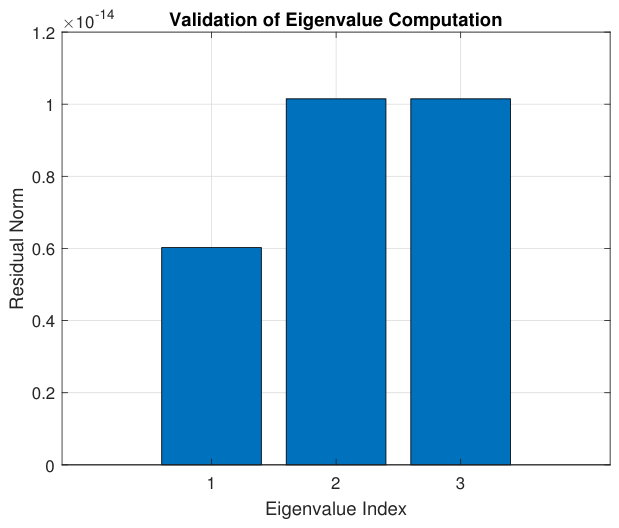
Stability Analysis of the Lorenz System
4.2. Genesio–Tesi System
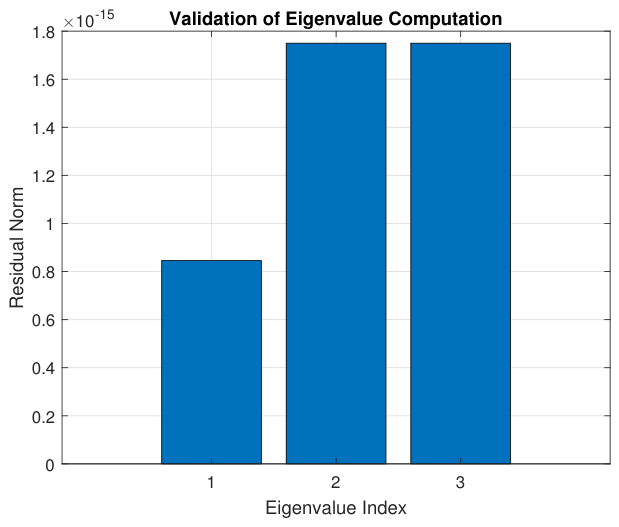
Stability Analysis of the Genesio–Tesi System
4.3. Rössler System
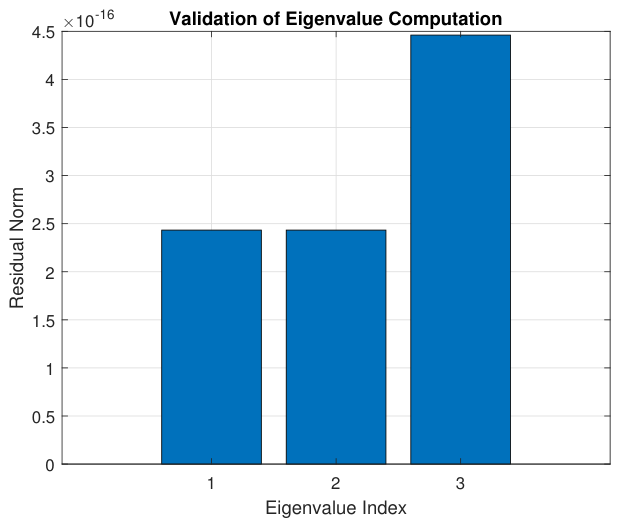
Stability Analysis of the Rössler System
4.4. Derivation of the Runge–Kutta Methods of Order Two and Four
4.5. Derivation of Runge–Kutta Method of Order Four
5. Algorithm Addition
Algorithm 1: Numerical Solution Procedure
| Algorithm 1: Numerical Solution Procedure |
|
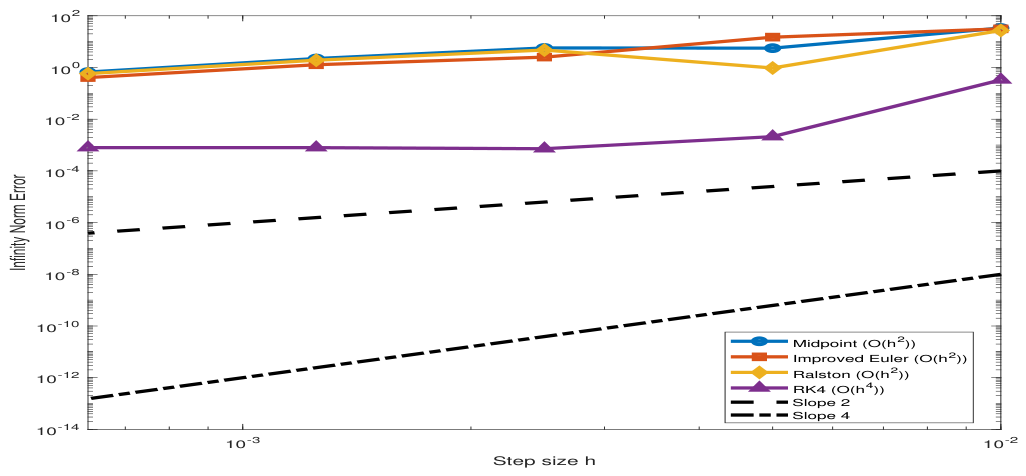
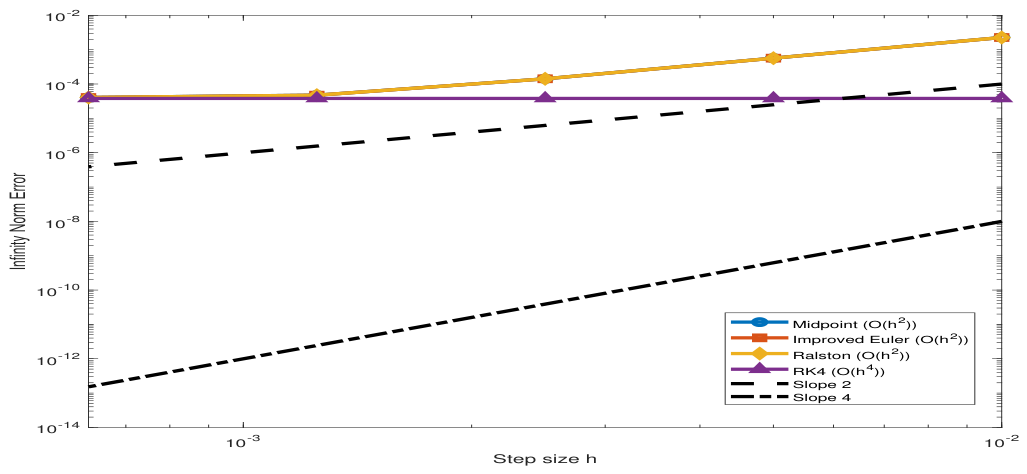
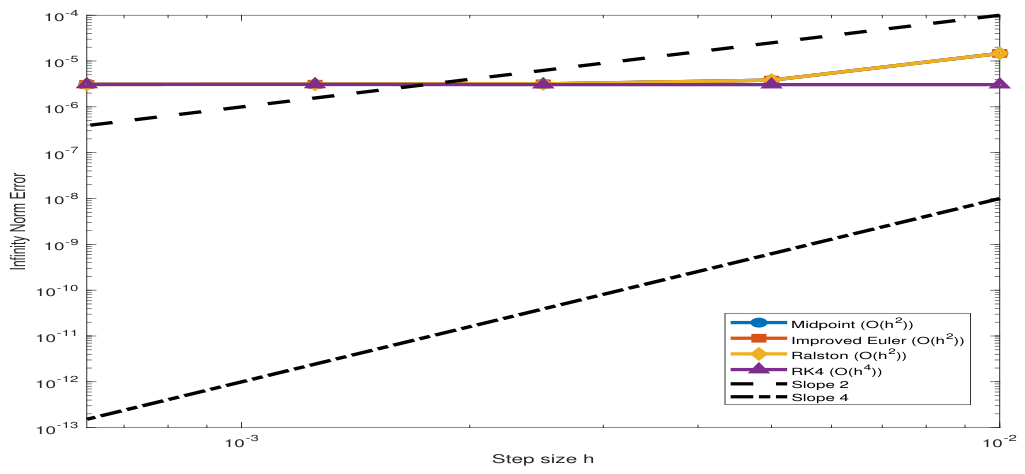
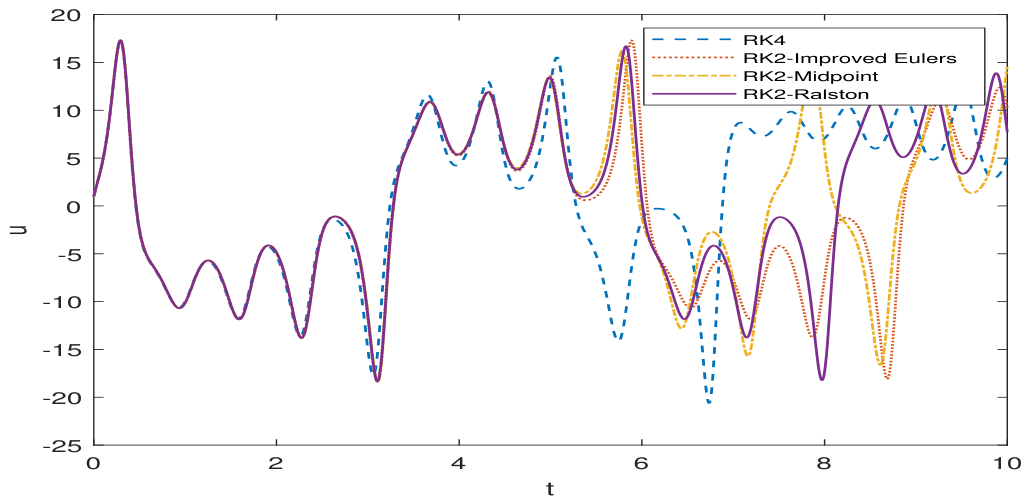
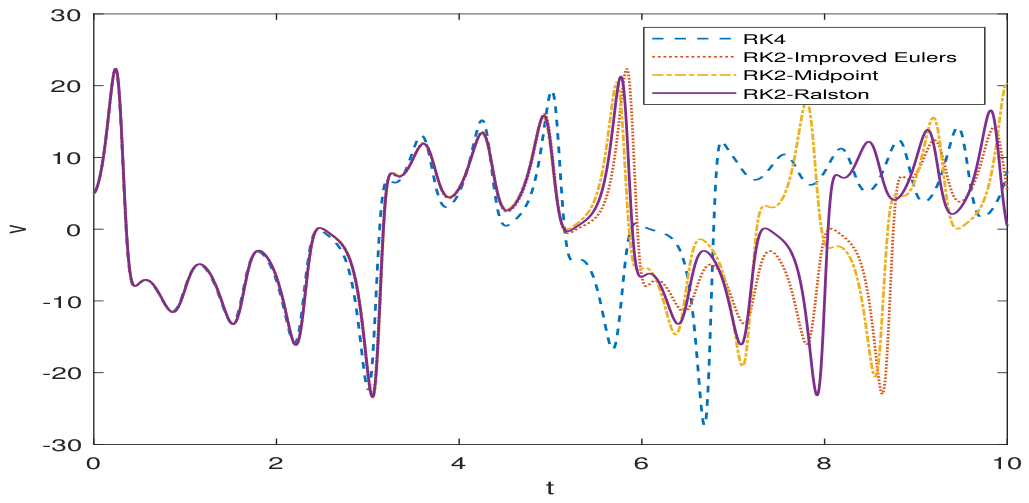
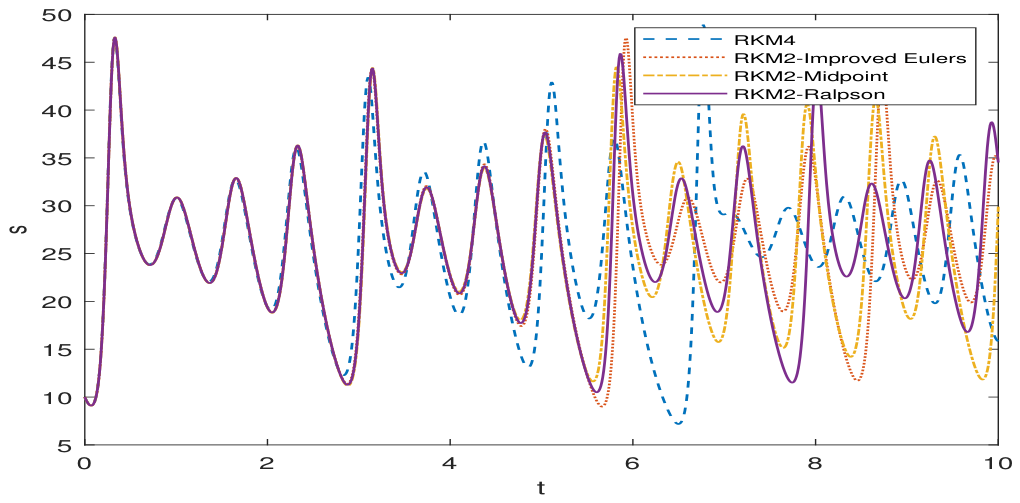
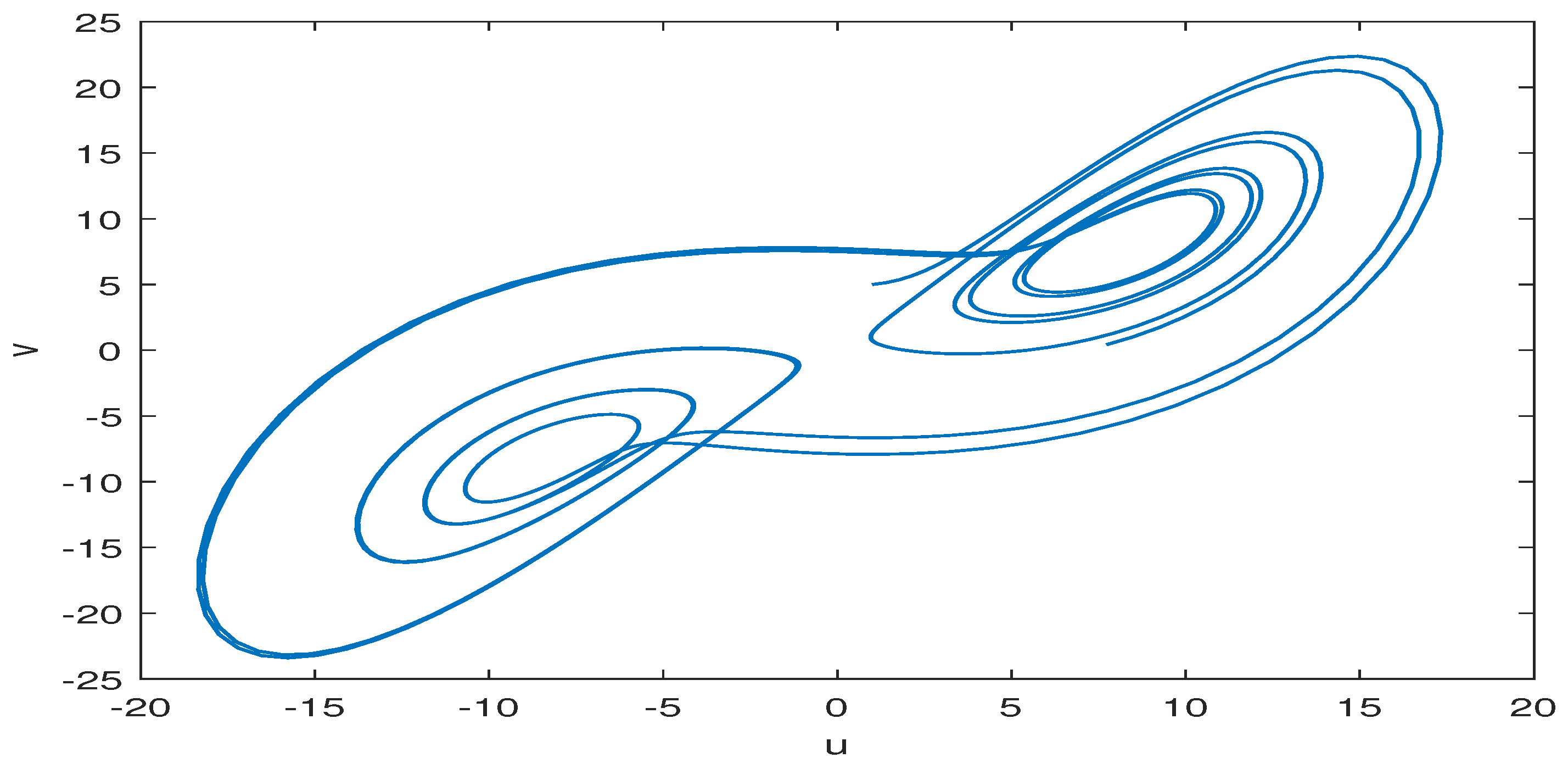
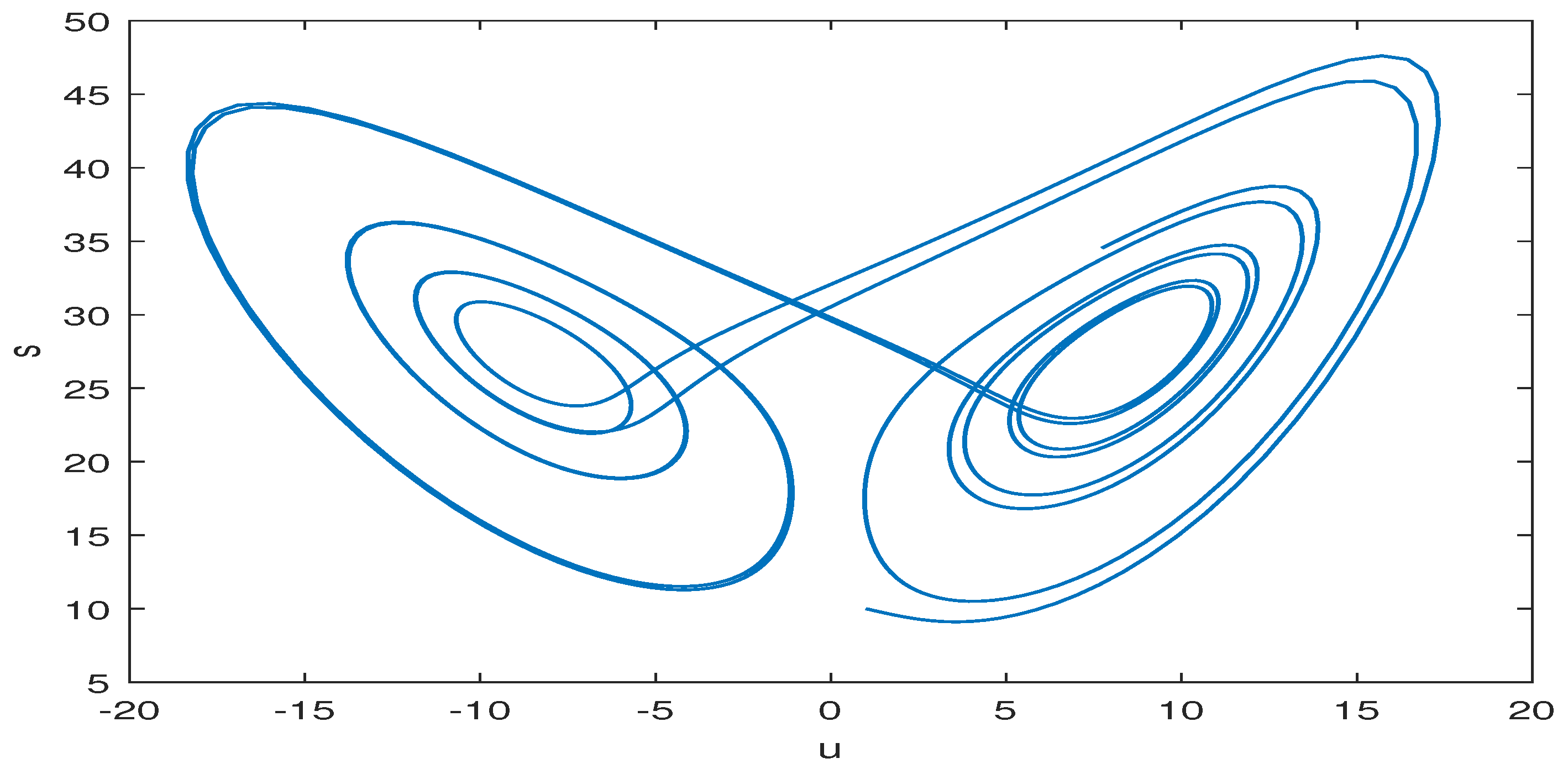
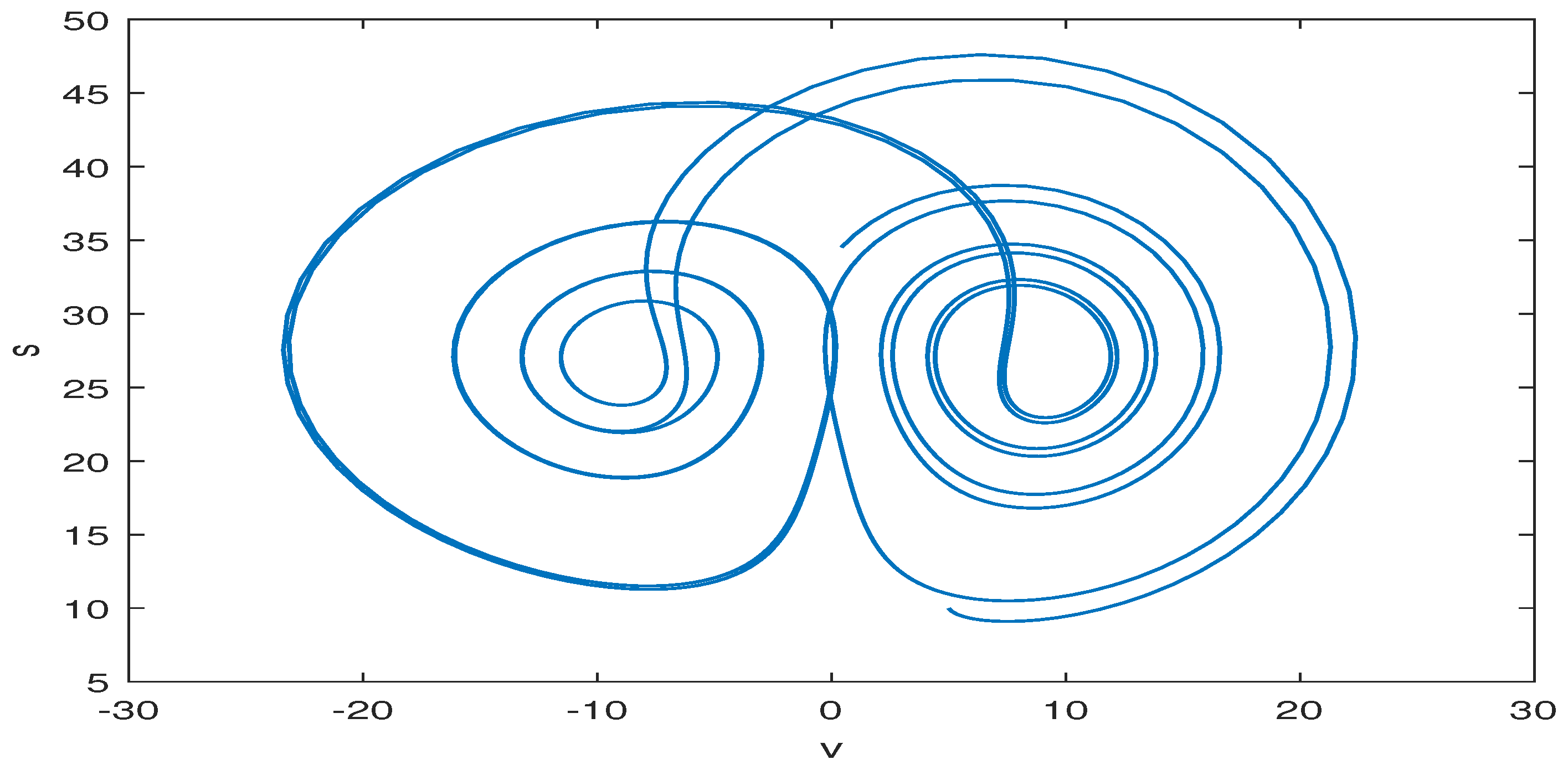
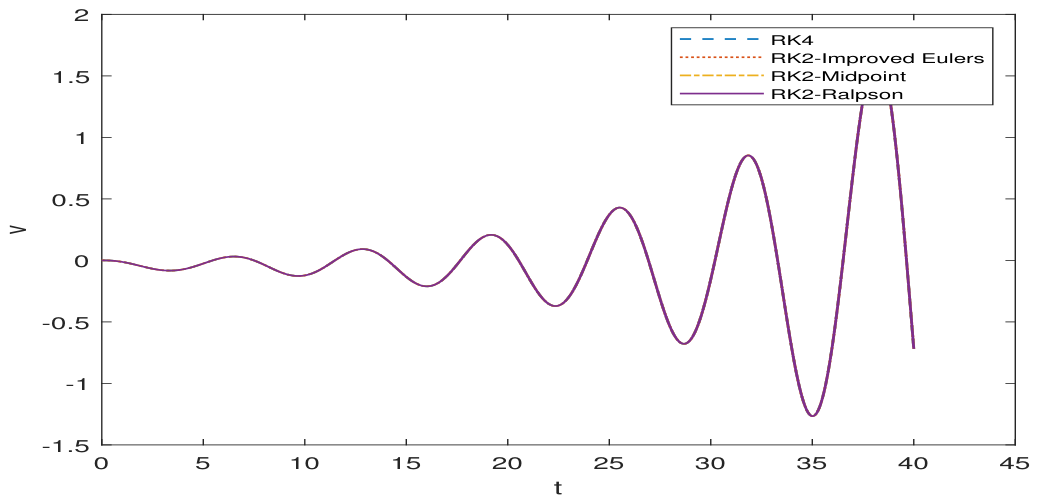
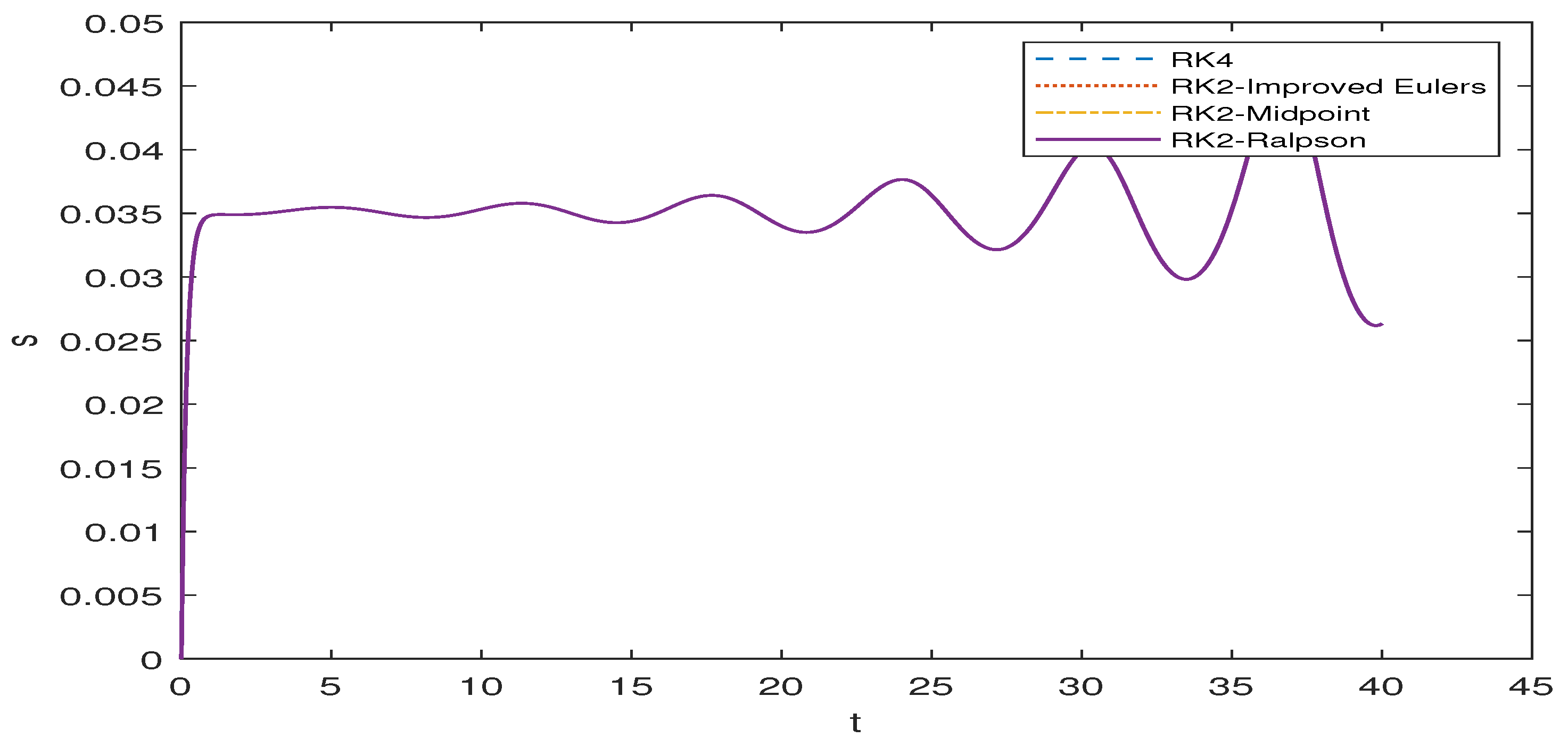
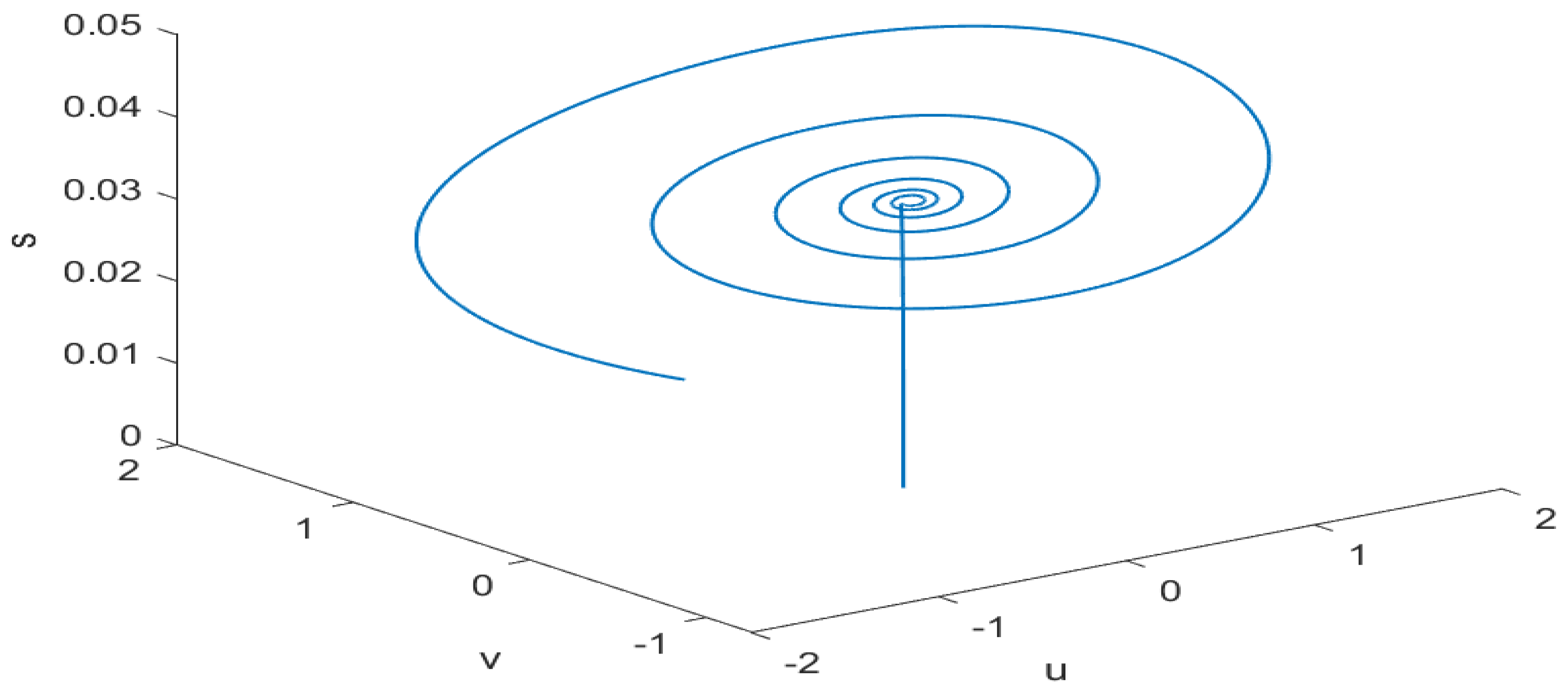
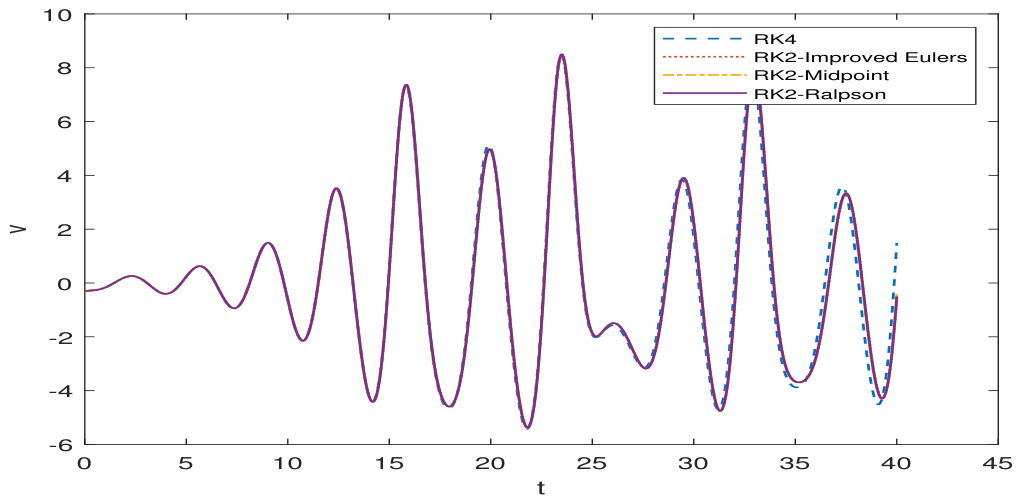
6. Results and Discussion
7. Conclusions
Funding
Data Availability Statement
Acknowledgments
Conflicts of Interest
Abbreviations
| Abbreviations: | |
| RK2 | Runge-Kutta Methods of order two |
| RK4 | Runge Kutta Method of order four |
| CPU time | Computational time |
| Nomenclature: | |
| x | Spatial variable |
| t | Time variable |
| Change in spatial variable | |
| Change in time variable |
References
- Buscarino, A.; Fortuna, L.; Frasca, M.; Sciuto, G. A Concise Guide to Chaotic Electronic Circuits; Springer International Publishing: Berlin/Heidelberg, Germany, 2014. [Google Scholar]
- Letellier, C.; Roulin, E.; Rössler, O.E. Inequivalent topologies of chaos in simple equations. Chaos Solitons Fractals 2006, 28, 337–360. [Google Scholar] [CrossRef] [Scilit]
- Suli, E.; Mayers, D.F. Solution of Equations by iteration. In An Introduction to Numerical Analysis; University of Oxford: Oxford, UK, 2003; pp. 2–35. [Google Scholar]
- Peinado, J.; Ibáñez, J.; Arias, E.; Hernández, V. Adams–Bashforth and Adams–Moulton methods for solving differential Riccati equations. Comput. Math. Appl. 2010, 60, 3032–3045. [Google Scholar] [CrossRef] [Scilit]
- Lorenz, E.N.; Haman, K. The essence of chaos. Pure Appl. Geophys. 1996, 147, 598–599. [Google Scholar]
- Gleick, J. Chaos: Making a New Science; Penguin: New York, NY, USA, 2008. [Google Scholar]
- Dogan, N. Numerical solution of chaotic Genesio system with multi-step Laplace Adomian decomposition method. Kuwait J. Sci. 2013, 40, 109–121. [Google Scholar] [CrossRef] [Scilit]
- Eftekhari, S.A.; Jafari, A.A. Numerical simulation of chaotic dynamical systems by the method of differential quadrature. Sci. Iran. 2012, 219, 1299–1315. [Google Scholar] [CrossRef] [Scilit]
- Li, J.M.; Wang, Y.L.; Zhang, W. Numerical Simulation of the Lorenz-Type Chaotic System Using Barycentric Lagrange Interpolation Collocation Method. Adv. Math. Phys. 2019, 2019, 1030318. [Google Scholar] [CrossRef] [Scilit]
- Ghorbani, A.; Saberi-Nadjafi, J. A piecewise-spectral parametric iteration method for solving the nonlinear chaotic Genesio system. Math. Comput. Model. 2011, 54, 131–139. [Google Scholar] [CrossRef] [Scilit]
- Butcher, J.C. A history of Runge-Kutta methods. Appl. Numer. Math. 1996, 20, 247–260. [Google Scholar] [CrossRef] [Scilit]
- Ahamad, N.; Charan, S. Study of numerical solution of fourth order ordinary differential equations by fifth order runge-kutta method. Int. J. Sci. Res. Sci. Eng. Technol. 2019, 6, 230–238. [Google Scholar] [CrossRef] [Scilit]
- Roman, P. Application of the Adams-Bashfort-Mowlton method to the numerical study of linear fractional oscillators models. In AIP Conference Proceedings; AIP Publishing LLC: Melville, NY, USA, 2021; Volume 2365, p. 020007. [Google Scholar]
- Galeone, L.; Garrappa, R. Fractional adams–moulton methods. Math. Comput. Simul. 2008, 79, 1358–1367. [Google Scholar] [CrossRef] [Scilit]
- Dattani, N.S. Linear multistep numerical methods for ordinary differential equations. arXiv 2008, arXiv:0810.4965. [Google Scholar]
- Hahn, G.D. A modified Euler method for dynamic analyses. Int. J. Numer. Methods Eng. 1991, 32, 943–955. [Google Scholar] [CrossRef] [Scilit]
- Kapitaniak, T. Chaotic Oscillations in Mechanical Systems; Manchester University Press: Mancherster, UK, 1991. [Google Scholar]
- Oestreicher, C. A history of chaos theory. Dialogues Clin. Neurosci. 2022, 9, 279–289. [Google Scholar]
- Marion, R. Complexity theory for organizations and organizational leadership. Complex. Leadersh. 2008, 1, 1–15. [Google Scholar]
- Mann, S.R. Chaos Theory and Strategic Thought; Army War Coll Carlisle Barracks PA: Carlisle, PA, USA, 1992. [Google Scholar]
- Moaddy, K.; Hashim, I.; Momani, S. Non-standard finite difference schemes for solving fractional-order Rössler chaotic and hyperchaotic systems. Comput. Math. Appl. 2011, 62, 1068–1074. [Google Scholar] [CrossRef] [Scilit]
- Park, J.H. Synchronization of Genesio chaotic system via backstepping approach. Chaos Solitons Fractals 2006, 27, 1369–1375. [Google Scholar] [CrossRef] [Scilit]
- Ogata, S.; Iwayama, T.; Terachi, S. Effect of system noise on chaotic behavior in Roessler type nonlinear system. Int. J. Bifurc. Chaos Appl. Sci. Eng. 1997, 7, 2871–2879. [Google Scholar] [CrossRef] [Scilit]
- Yu, Y.; Li, H.X.; Wang, S.; Yu, J. Dynamic analysis of a fractional-order Lorenz chaotic system. Chaos Solitons Fractals 2009, 42, 1181–1189. [Google Scholar] [CrossRef] [Scilit]
- Unbehauen, H. (Ed.) Control systems, robotics and automation-volume III. In System Analysis and Control: Classical Approaches-III; EOLSS Publications: Abu Dhabi, United Arab Emirates, 2009. [Google Scholar]
- Heinonen, J. Lectures on Lipschitz Analysis; University of Jyvaskyla: Jyvaskyla, Finland, 2005. [Google Scholar]
- Leonov, G.A.; Kuznetsov, N.V. On differences and similarities in the analysis of Lorenz, Chen, and Lu systems. Appl. Math. Comput. 2015, 256, 334–343. [Google Scholar] [CrossRef] [Scilit]
- Mathale, D.; Dlamini, P.G.; Khumalo, M. Compact finite difference relaxation method for chaotic and hyperchaotic initial value systems. Comput. Appl. Math. 2018, 37, 5187–5202. [Google Scholar] [CrossRef] [Scilit]
- Lorenz, E.N. Predictability: A problem partly solved. Proc. Semin. Predict. 1996, 1, 1–18. [Google Scholar]
- DeJesus, E.X.; Kaufman, C. Routh-Hurwitz criterion in the examination of eigenvalues of a system of nonlinear ordinary differential equations. Phys. Rev. A 1987, 35, 5288. [Google Scholar] [CrossRef] [Scilit]
- Faieghi, M.R.; Delavari, H. Chaos in fractional-order Genesio–Tesi system and its synchronization. Commun. Nonlinear Sci. Numer. Simul. 2012, 17, 731–741. [Google Scholar] [CrossRef] [Scilit]
- Wu, X.; Wu, H.; Yan, Z.; Huang, Y. Chaos Anti-Synchronization between Chen System and Genesio System. Open Access Libr. J. 2016, 3, 1. [Google Scholar] [CrossRef]
- Dlamini, P.G. On Spectral Relaxation and Compact Finite Difference Schemes for Ordinary and Partial Differential Equations; University of Johannesburg: Johannensburg, South Africa, 2015. [Google Scholar]
- Li, C.; Hu, W.; Sprott, J.C.; Wang, X. Multistability in symmetric chaotic systems. Eur. Phys. J. Spec. Top. 2015, 224, 1493–1506. [Google Scholar] [CrossRef] [Scilit]
- Carpenter, M.H.; Kennedy, C.A. Fourth -order 2N-storage Runge-Kutta schemes (No. NASA-TM-109112). 1994. Available online: https://ntrs.nasa.gov/citations/19940028444 (accessed on 1 July 2026).
- Amma, B.B.; Melliani, S.; Chadli, L.S. Numerical solution of intuitionistic fuzzy differential equations by Runge-Kutta Method of order four. Notes Int. Fuzzy Sets 2016, 22, 42–52. [Google Scholar]
- Kaps, P.; Rentrop, P. Generalized Runge-Kutta methods of order four with stepsize control for stiff ordinary differential equations. Numer. Math. 1979, 33, 55–68. [Google Scholar] [CrossRef] [Scilit]





| h | Midpoint | Improved Euler | Ralston | RK4 |
|---|---|---|---|---|
| 0.01000 | ||||
| 0.00500 | ||||
| 0.00250 | ||||
| 0.00125 | ||||
| 0.00063 |
| h | Midpoint | Improved Euler | Ralston | RK4 |
|---|---|---|---|---|
| 0.01000 | ||||
| 0.00500 | ||||
| 0.00250 | ||||
| 0.00125 | ||||
| 0.00063 |
| h | Midpoint | Improved Euler | Ralston | RK4 |
|---|---|---|---|---|
| 0.01000 | ||||
| 0.00500 | ||||
| 0.00250 | ||||
| 0.00125 | ||||
| 0.00063 |
| Method | Order | Lorenz | Genesio–Tesi | Rössler |
|---|---|---|---|---|
| Midpoint | 2 | |||
| Improved Euler | 2 | |||
| Ralston | 2 | |||
| RK4 | 4 |
Disclaimer/Publisher’s Note: The statements, opinions and data contained in all publications are solely those of the individual author(s) and contributor(s) and not of MDPI and/or the editor(s). MDPI and/or the editor(s) disclaim responsibility for any injury to people or property resulting from any ideas, methods, instructions or products referred to in the content. |
© 2026 by the author. Licensee MDPI, Basel, Switzerland. This article is an open access article distributed under the terms and conditions of the Creative Commons Attribution (CC BY) license.
Share and Cite
Ndou, N. Comparative Analysis of Second- and Fourth-Order Runge–Kutta Methods for Solving Chaotic Dynamical Systems. AppliedMath 2026, 6, 112. https://doi.org/10.3390/appliedmath6070112
Ndou N. Comparative Analysis of Second- and Fourth-Order Runge–Kutta Methods for Solving Chaotic Dynamical Systems. AppliedMath. 2026; 6(7):112. https://doi.org/10.3390/appliedmath6070112
Chicago/Turabian StyleNdou, Ndivhuwo. 2026. "Comparative Analysis of Second- and Fourth-Order Runge–Kutta Methods for Solving Chaotic Dynamical Systems" AppliedMath 6, no. 7: 112. https://doi.org/10.3390/appliedmath6070112
APA StyleNdou, N. (2026). Comparative Analysis of Second- and Fourth-Order Runge–Kutta Methods for Solving Chaotic Dynamical Systems. AppliedMath, 6(7), 112. https://doi.org/10.3390/appliedmath6070112