


A High-Strain-Rate Viscohyperelastic Constitutive Framework for Soft Biological Tissues: A Multi-Tissue Evaluation

Abstract
1. Introduction
2. Materials and Methods
2.1. Fundamentals of Continuum Mechanics
2.2. Constitutive Modeling
2.3. Review of Experimental Data
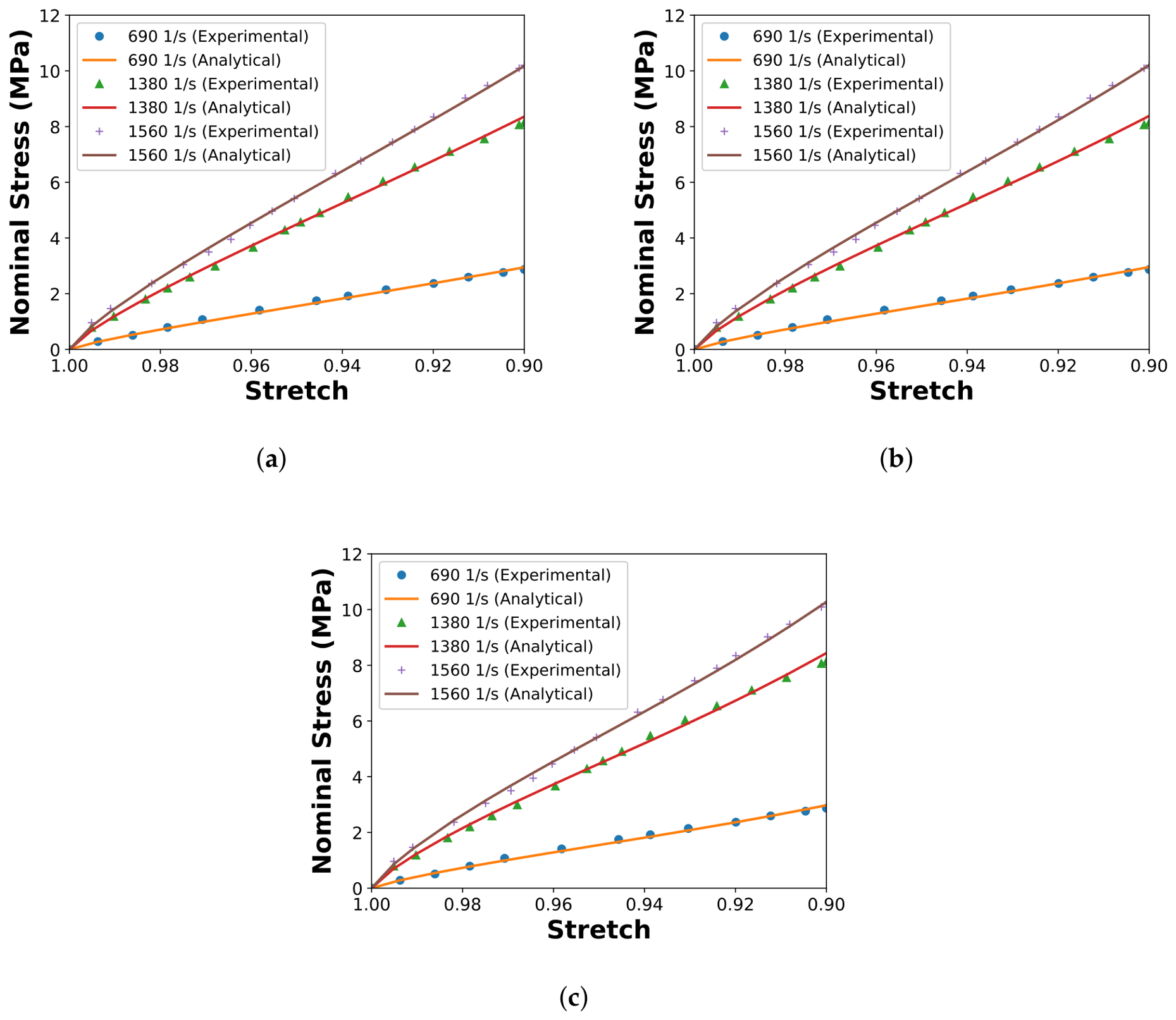
2.3.1. Case 1: Porcine Meniscus [17]
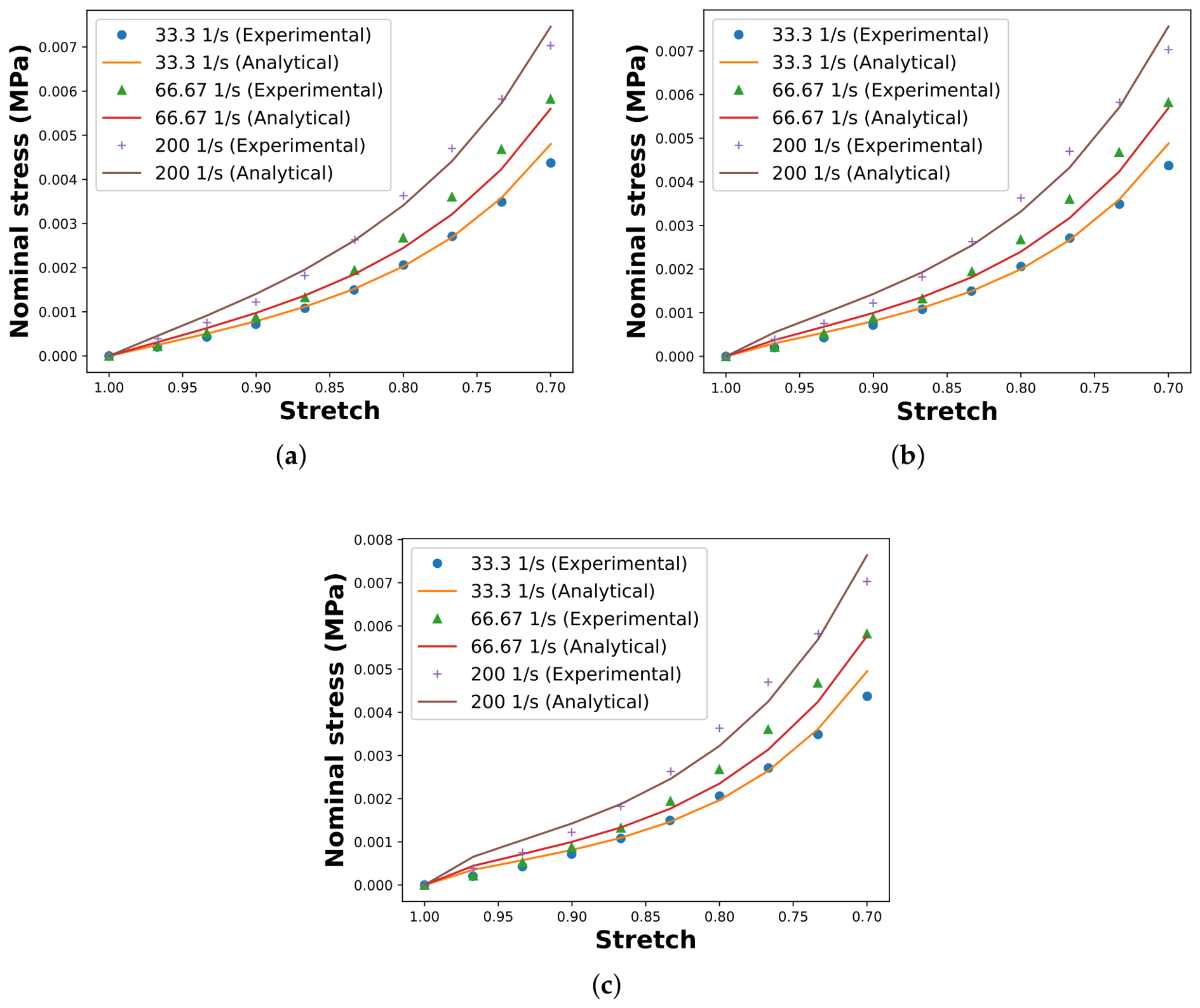
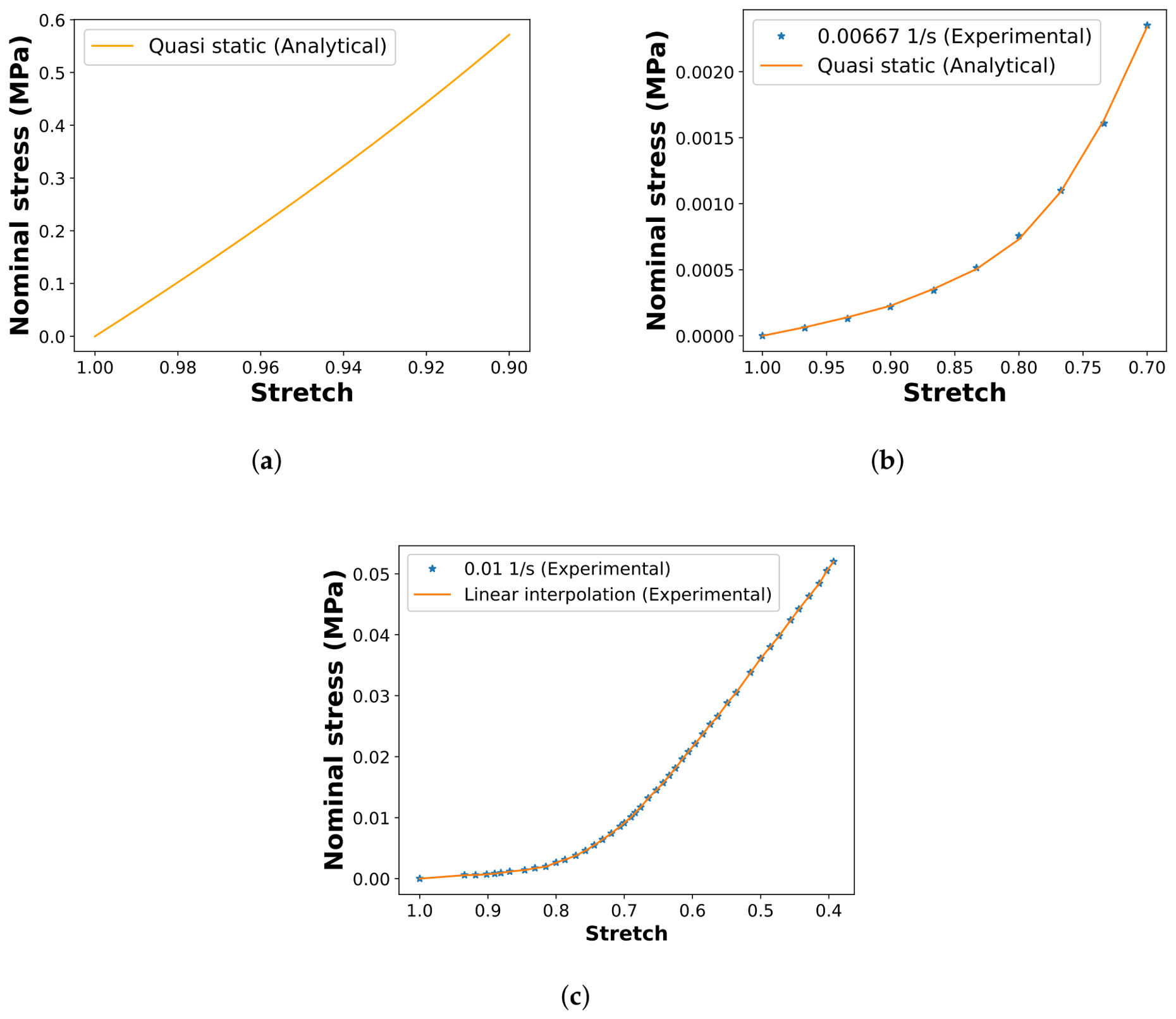
2.3.2. Case 2: Ovine Brain [18]
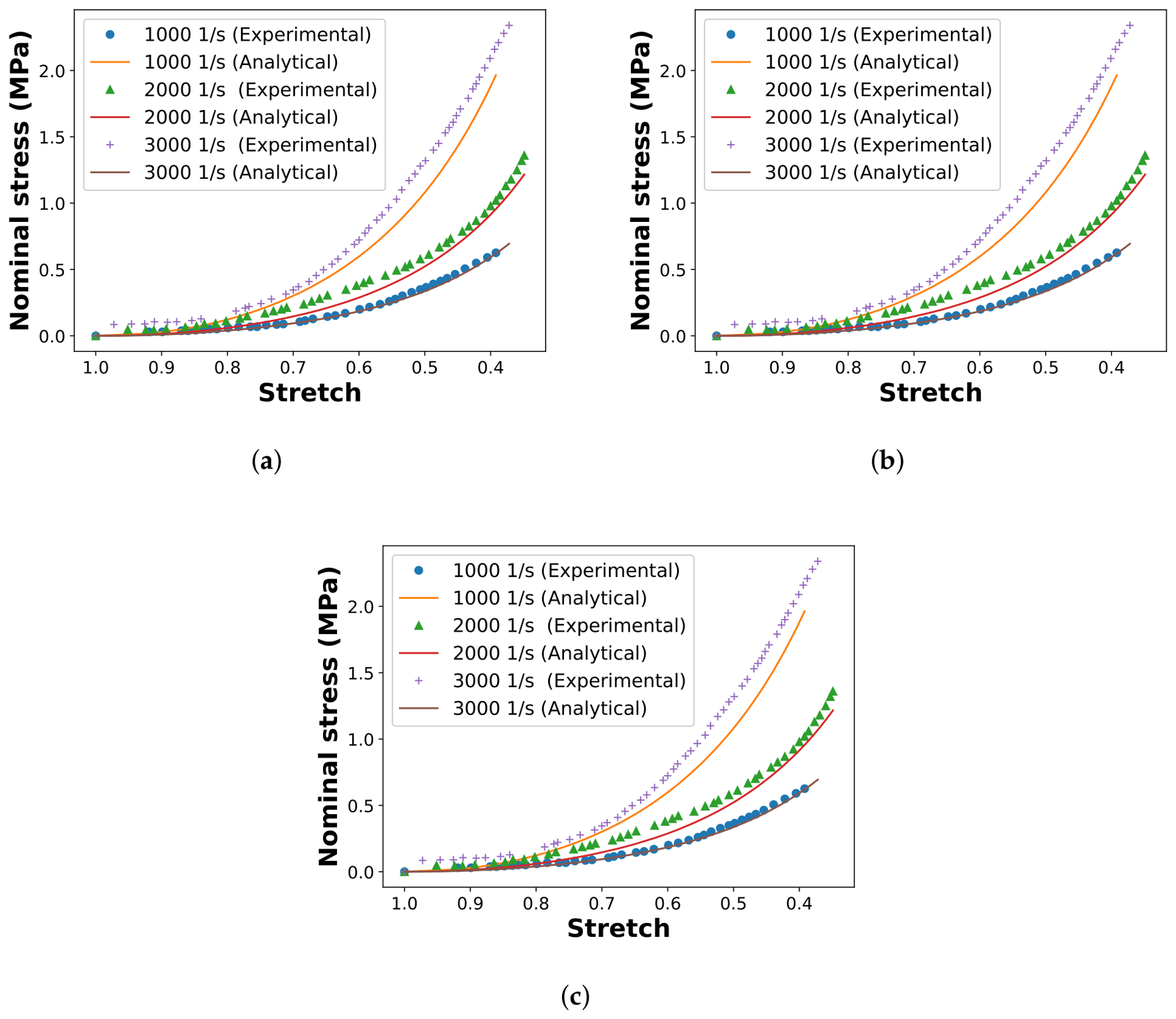
2.3.3. Case 3: Bovine Liver [20]
2.4. Optimization
3. Results
3.1. Case 1: Porcine Meniscus
3.2. Case 2: Ovine Brain
3.3. Case 3: Bovine Liver
4. Discussion
5. Conclusions and Further Work
Funding
Informed Consent Statement
Data Availability Statement
Conflicts of Interest
Appendix A
Appendix A.1

| Strain Energy Function | Nominal Stress Expression |
|---|---|
| 2() () | |
| 2()( | |
| 4()( | |
| 2()( | |
| 2()( | |
| 4()( | |
| 4()( |
Appendix A.2
| Case | |||
|---|---|---|---|
| Case 1 | 8.3498 × 10⁻¹ | 3.0237 × 10⁻¹ | 0.0000 |
| Case 2 | 2.8332 × 10⁻⁴ | 6.9382 × 10⁻⁴ | 3.0616 × 10⁻⁴ |

References
- Saraf, H.; Ramesh, K.; Lennon, A.; Merkle, A.; Roberts, J. Mechanical properties of soft human tissues under dynamic loading. J. Biomech. 2007, 40, 1960–1967. [Google Scholar] [CrossRef] [PubMed]
- Hartung, B.; Schäuble, A.; Peldschus, S.; Schüssler, M.; Meyer, H.L. The documentation of injuries caused by traffic accidents. Dtsch. Ärzteblatt Int. 2024, 121, 27. [Google Scholar] [CrossRef] [PubMed]
- Hu, T.; Desai, J.P. Characterization of soft-tissue material properties: Large deformation analysis. In Proceedings of the International Symposium on Medical Simulation; Springer: Berlin/Heidelberg, Germany, 2004; pp. 28–37. [Google Scholar] [CrossRef]
- Holzapfel, G.A. Nonlinear solid mechanics: A continuum approach for engineering science. Meccanica 2002, 37, 489–490. [Google Scholar] [CrossRef]
- Eringen, A.C. Mechanics of Continua; R.E. Krieger Publishing Co.: Huntington, NY, USA, 1980. [Google Scholar]
- Comley, K.; Fleck, N. The high strain rate response of adipose tissue. In Proceedings of the IUTAM Symposium on Mechanical Properties of Cellular Materials; Springer: Berlin/Heidelberg, Germany, 2009; pp. 27–33. [Google Scholar] [CrossRef]
- Sanborn, B.; Nie, X.; Chen, W.; Weerasooriya, T. High strain rate pure shear and axial compressive response of porcine lung tissue. J. Appl. Mech. 2013, 80, 011029. [Google Scholar] [CrossRef]
- Kulkarni, S.; Gao, X.; Horner, S.; Mortlock, R.; Zheng, J. A transversely isotropic visco-hyperelastic constitutive model for soft tissues. Math. Mech. Solids 2016, 21, 747–770. [Google Scholar] [CrossRef]
- Limbert, G.; Middleton, J. A transversely isotropic viscohyperelastic material: Application to the modeling of biological soft connective tissues. Int. J. Solids Struct. 2004, 41, 4237–4260. [Google Scholar] [CrossRef]
- Pioletti, D.P.; Rakotomanana, L.; Benvenuti, J.F.; Leyvraz, P.F. Viscoelastic constitutive law in large deformations: Application to human knee ligaments and tendons. J. Biomech. 1998, 31, 753–757. [Google Scholar] [CrossRef] [PubMed]
- Vogel, A.; Rakotomanana, L.; Pioletti, D.P. Viscohyperelastic strain energy function. In Biomechanics of Living Organs; Elsevier: Amsterdam, The Netherlands, 2017; pp. 59–78. [Google Scholar] [CrossRef]
- Sista, S.N.B. Viscohyperelastic Constitutive Modeling of Bovine Brain Tissue at High Strain Rates to Simulate Traumatic Brain Injury. Master’s Thesis, University of Cincinnati, Cincinnati, OH, USA, 2011. [Google Scholar]
- Yousefi, A.A.K.; Nazari, M.A.; Perrier, P.; Panahi, M.S.; Payan, Y. A visco-hyperelastic constitutive model and its application in bovine tongue tissue. J. Biomech. 2018, 71, 190–198. [Google Scholar] [CrossRef] [PubMed]
- Roan, E.; Vemaganti, K. Strain rate-dependent viscohyperelastic constitutive modeling of bovine liver tissue. Med. Biol. Eng. Comput. 2011, 49, 497–506. [Google Scholar] [CrossRef] [PubMed]
- Long, T. Mechanical Behavior of Porcine Knee Meniscus: Hyperelastictity, Viscohyperelasticity and Damage. Ph.D. Thesis, University of Cincinnati, Cincinnati, OH, USA, 2023. [Google Scholar]
- Kanada, R.; Tokuhisa, A.; Tsuda, K.; Okuno, Y.; Terayama, K. Exploring successful parameter region for coarse-grained simulation of biomolecules by Bayesian optimization and active learning. Biomolecules 2020, 10, 482. [Google Scholar] [CrossRef] [PubMed]
- Juang, Y.C.; Tsai, L.; Lin, H. Dynamic response of porcine articular cartilage and meniscus under shock loading. In Dynamic Behavior of Materials; Springer: Berlin/Heidelberg, Germany, 2011; Volume 1, pp. 393–398. [Google Scholar]
- Hosseini Farid, M.; Eslaminejad, A.; Ziejewski, M.; Karami, G. A study on the effects of strain rates on characteristics of brain tissue. In Proceedings of the ASME International Mechanical Engineering Congress and Exposition; American Society of Mechanical Engineers: New York, NY, USA, 2017; Volume 58363, p. V003T04A003. [Google Scholar] [CrossRef]
- Salzman, O.; Ulloa, C.H.; Felner, A.; Koenig, S. Multi-Objective Search: Algorithms, Applications, and Emerging Directions. Proc. AAAI Conf. Artif. Intell. 2026, 40, 40990–40999. [Google Scholar] [CrossRef]
- Pervin, F.; Chen, W.W.; Weerasooriya, T. Dynamic compressive response of bovine liver tissues. J. Mech. Behav. Biomed. Mater. 2011, 4, 76–84. [Google Scholar] [CrossRef] [PubMed]
- Miller, K.; Chinzei, K. Constitutive modelling of brain tissue: Experiment and theory. J. Biomech. 1997, 30, 1115–1121. [Google Scholar] [CrossRef] [PubMed]
- Hodson, T.O. Root mean square error (RMSE) or mean absolute error (MAE): When to use them or not. Geosci. Model Dev. Discuss. 2022, 15, 5481–5487. [Google Scholar] [CrossRef]
- Charilogis, V.; Tsoulos, I.G. Introducing a parallel genetic algorithm for global optimization problems. AppliedMath 2024, 4, 709–730. [Google Scholar] [CrossRef]
- Alhijawi, B.; Awajan, A. Genetic algorithms: Theory, genetic operators, solutions, and applications. Evol. Intell. 2024, 17, 1245–1256. [Google Scholar] [CrossRef]
- El-Shorbagy, M. A Review of Genetic Algorithms: Principles, Procedures, and Applications in Optimization. Comput. Model. Eng. Sci. 2026, 147, 6. [Google Scholar] [CrossRef]
- Kripka, M.; de Medeiros, G.F.; Kripka, R.M.L. Nelder-Mead Optimization Method. In Encyclopedia of Engineering Optimization and Heuristics; Springer: Berlin/Heidelberg, Germany, 2026; pp. 1–7. [Google Scholar] [CrossRef]
- Jones, E.; Oliphant, T.; Peterson, P. SciPy: Open Source Scientific Tools for Python. 2001. Available online: https://www.scienceopen.com/document?vid=ab12905a-8a5b-43d8-a2bb-defc771410b9 (accessed on 2 April 2026).
- Long, T. High Strain Rate Visco-hyperelastic Constitutive Modeling: A Porcine Knee Meniscus Study. SSRN 2026. [Google Scholar] [CrossRef]


| Reference | Soft Tissue | Strain Rate (s−1) | Material Model Expression |
|---|---|---|---|
| Comley et al. [6] | Porcine skin | 1500–6300 | Prony series |
| Sanborn et al. [7] | Porcine lung | 1300–3000 | Prony series |
| Sista et al. [12] | Bovine brain | 1000–3000 | |
| Kulkarni et al. [8] | Porcine and human brain | 0.1–90 | |
| Limbert et al. [9] | Human knee and tendons | 0.00012–0.5 | |
| Vogel et al. [11] | Porcine intervertebral disc | 0.0005–0.13 | with |
| Yousefi et al. [13] | Bovine tongue | 0.0146–0.066 | |
| Roan et al. [14] | Bovine liver | 0.001–0.04 | |
| Pioletti et al. [10] | Human ACL | NA |
| Strain Rate | |||
|---|---|---|---|
| Equation (47) | 9.8963 | 0.3951 | 1.3563 |
| Equation (48) | 4.2971 | 0.4054 | 1.3559 |
| Equation (49) | 4.4791 | 0.4037 | 1.3552 |
| Strain Rate | |||
|---|---|---|---|
| Equation (47) | 211.9293 × 10⁻⁶ | 0.4680 | 0.7055 |
| Equation (48) | 109.4789 × 10⁻⁶ | 0.3894 | 0.7022 |
| Equation (49) | 86.1830 × 10⁻⁶ | 0.3019 | 0.6985 |
| Strain Rate | |||
|---|---|---|---|
| Equation (47) | 4.7031 × 10⁸ | 1.0000 | 9.5024 × 10⁻⁷ |
| Equation (48) | 1.0651 × 10¹⁰ | 1.0000 | 4.1960 × 10⁻⁸ |
| Equation (49) | 1.3172 × 10⁹ | 1.0000 | 3.3928 × 10⁻⁷ |
Disclaimer/Publisher’s Note: The statements, opinions and data contained in all publications are solely those of the individual author(s) and contributor(s) and not of MDPI and/or the editor(s). MDPI and/or the editor(s) disclaim responsibility for any injury to people or property resulting from any ideas, methods, instructions or products referred to in the content. |
© 2026 by the author. Licensee MDPI, Basel, Switzerland. This article is an open access article distributed under the terms and conditions of the Creative Commons Attribution (CC BY) license.
Share and Cite
Long, T. A High-Strain-Rate Viscohyperelastic Constitutive Framework for Soft Biological Tissues: A Multi-Tissue Evaluation. AppliedMath 2026, 6, 105. https://doi.org/10.3390/appliedmath6070105
Long T. A High-Strain-Rate Viscohyperelastic Constitutive Framework for Soft Biological Tissues: A Multi-Tissue Evaluation. AppliedMath. 2026; 6(7):105. https://doi.org/10.3390/appliedmath6070105
Chicago/Turabian StyleLong, Teng. 2026. "A High-Strain-Rate Viscohyperelastic Constitutive Framework for Soft Biological Tissues: A Multi-Tissue Evaluation" AppliedMath 6, no. 7: 105. https://doi.org/10.3390/appliedmath6070105
APA StyleLong, T. (2026). A High-Strain-Rate Viscohyperelastic Constitutive Framework for Soft Biological Tissues: A Multi-Tissue Evaluation. AppliedMath, 6(7), 105. https://doi.org/10.3390/appliedmath6070105