1. Introduction
Systems of nonlinear equations arise naturally in a wide range of scientific, engineering, and biomedical applications. In many practical settings, the solution of interest corresponds to a multiple root, namely a solution at which the associated Jacobian matrix is singular or nearly singular. The presence of multiple roots substantially complicates both the theoretical analysis and the numerical treatment of such systems, and it often leads to a severe degradation in the performance of classical iterative solvers. As a result, the development of robust, efficient, and globally convergent numerical schemes for nonlinear systems with multiple roots remains an important and challenging research problem [
1,
2].
Nonlinear systems play a central role in the mathematical modeling of complex phenomena across science and engineering. In physics and chemistry, they arise from equilibrium conditions, reaction kinetics, and the discretization of nonlinear partial differential equations [
3]. In engineering disciplines such as electrical, mechanical, civil, and chemical engineering, nonlinear algebraic systems naturally emerge in applications including circuit analysis, structural mechanics, fluid flow, control systems, and optimization.
In biomedical engineering, nonlinear systems are particularly prevalent due to the intrinsic complexity of biological processes. Models describing glucose–insulin regulation [
4], population dynamics [
5], epidemiological spreading [
6], enzyme kinetics [
7], neural networks [
8], pharmacokinetics [
9], and physiological feedback mechanisms [
10] frequently give rise to nonlinear systems through steady-state analysis or numerical discretization. These models often exhibit multiple equilibrium states, which may correspond to healthy, pathological, or transitional physiological regimes. Accurately computing such multiple roots is therefore essential for analyzing system stability, understanding bifurcation phenomena, and supporting the design of effective therapeutic interventions.
These modeling procedures typically lead to the solution of a system of nonlinear equations with possible multiple roots, given by
where each function
,
, is assumed to be sufficiently smooth. The system (
1) admits a solution
, which may be a multiple root in the sense that the associated Jacobian matrix is singular at
.
By introducing the vector-valued nonlinear mapping
the system (
1) can be written compactly as
When the Jacobian matrix
is singular, the solution
is referred to as a multiple root. In this case, classical numerical methods [
11,
12,
13], which are typically designed for simple roots, may fail or exhibit severe performance degradation.
Exact and analytical approaches for solving nonlinear systems include algebraic elimination techniques [
14], symbolic computation [
15], Gröbner bases [
16], resultants, and homotopy-based symbolic methods [
17]. While these techniques can provide valuable theoretical insight and, in some cases, closed-form solutions for low-dimensional or specially structured problems, they suffer from severe limitations when applied to realistic models. In particular, symbolic methods rapidly become computationally infeasible as the system dimension increases or as nonlinearities become more pronounced. Moreover, analytical solutions are rarely available for systems arising from the discretization of differential equations, biomedical models, or high-dimensional engineering applications. In the presence of multiple roots, symbolic approaches often encounter additional challenges related to degeneracy and ill-conditioning. Consequently, exact methods are largely confined to academic or small-scale examples and are generally unsuitable for large-scale or real-world problems.
Due to the limitations of analytical approaches, numerical methods remain the primary tools for solving nonlinear systems. Classical schemes such as the Newton–Raphson method [
18], quasi-Newton methods [
19], secant-type methods [
20], and fixed-point iterations [
21] are widely used in practice. However, these methods are primarily designed for simple roots and typically exhibit only local convergence behavior. When applied to systems of nonlinear equations with multiple roots, classical techniques face several well-known limitations, including:
- -
A loss of convergence rate, increased sensitivity to initial guesses, and possible stagnation or divergence near multiple roots;
- -
The reliance of multiplicity-aware iterative methods on explicit derivative evaluations and prior knowledge of the root multiplicity, which is often unavailable in practice for general systems;
- -
The limited effectiveness of derivative-free and higher-order schemes, which, although proposed to reduce computational cost and improve efficiency, frequently remain locally convergent;
- -
A strong dependence on accurate initial approximations, which restricts their robustness in complex or poorly characterized problem settings;
- -
Reduced applicability to high-dimensional systems or nonlinear problems exhibiting multiple or clustered solutions.
These challenges highlight a clear research gap, namely the need for numerical schemes capable of solving systems of nonlinear equations with multiple roots while exhibiting enhanced robustness and reliable convergence behavior in practical settings. This requirement is particularly important in biomedical and engineering applications, where accurate initial approximations are rarely available and where divergence or convergence to unintended equilibria can compromise both computational efficiency and the interpretation of model outcomes. In this context, numerical methods that are able to identify multiple or clustered solutions simultaneously, while maintaining robustness and scalability, are especially desirable.
Motivated by the challenges outlined above, this paper proposes a numerical framework for solving systems of nonlinear equations with multiple roots. The main contributions of this work can be summarized as follows:
- (a)
A higher-order iterative method is developed for nonlinear systems with multiple roots, achieving improved convergence speed while maintaining robustness.
- (b)
The proposed scheme avoids explicit derivative computations, thereby reducing computational complexity and making it suitable for large-scale and complex systems.
- (c)
A theoretical convergence analysis is provided, including local convergence results, error equations, and convergence order under mild assumptions, together with an empirical investigation of robustness in the presence of multiple roots.
- (d)
The algorithm is designed to be naturally compatible with multicore and parallel computing architectures, enabling efficient implementation on modern high-performance computing platforms.
- (e)
The proposed framework applies to both real- and complex-valued systems of nonlinear equations with multiple roots, which commonly arise in engineering and biomedical applications.
The contribution of this study lies in a unified algorithmic framework combining higher-order local convergence, a derivative-free formulation, empirically robust convergence behavior, and parallel computation within a single numerical framework for nonlinear systems with multiple roots. While existing approaches typically address these aspects separately, the proposed method combines them within a coherent algorithmic design, achieving a balance between robustness, efficiency, and scalability. This integrated perspective is particularly relevant for nonlinear systems arising in scientific and biomedical applications, where multiple roots and clustered solutions are frequently encountered.
The remainder of this paper is organized as follows.
Section 2 introduces the proposed numerical scheme, presents its mathematical formulation, and provides a convergence analysis, including local convergence results and an empirical assessment of robustness in the observed convergence behavior
Section 3 discusses implementation aspects, with particular emphasis on parallel and multicore strategies.
Section 4 presents extensive numerical experiments, covering benchmark problems and biomedical engineering applications, and compares the proposed method with existing schemes. Finally,
Section 5 concludes the paper and outlines possible directions for future research.
2. Construction and Analysis of the Computational Schemes
The diagonalization of Weierstrass corrections [
22] for systems of nonlinear equations enables the construction of iterative schemes in which vector-valued approximations are updated simultaneously and in a decoupled manner [
23,
24,
25]. This formulation provides a flexible framework for incorporating Jacobian-based or Jacobian-free refinements, as well as higher-order correction terms, with the aim of improving convergence properties. As a result, such schemes are particularly well suited for the efficient computation of multiple and clustered solutions in multidimensional nonlinear systems.
A representative example is a generalized version of the classical Weierstrass–Durand–Kerner (WDSM) method [
26], which can be written as
and which converges quadratically to the exact solution of (
4). Here,
denotes the correction term used in the WDK framework for computing all solutions simultaneously, with
and
. We refer to the iterative scheme (
4) as VWDM. For the case of multiple roots, the corresponding correction is written as
A generalized version of the Aberth–Ehrlich method [
27] for solving (
1), denoted by VELM, is given by
where
and
denotes the Jacobian matrix of
. The VELM scheme combines Jacobian information with interaction terms among the iterates in order to improve convergence when multiple or closely spaced solutions are present.
More recently, Cordero et al. [
28] proposed a parallel scheme with convergence order
(for
), which can be written as
where
. We refer to the iterative scheme (
7) as VCAM.
2.1. Construction of the Scheme
Motivated by the iterative schemes reviewed above, the objective of this study is to develop and generalize a two-step root-finding approach originally proposed for simple roots in [
29]. By combining this framework with the diagonalized corrections defined in (
4) and (
5), we construct a simultaneous scheme capable of approximating all distinct solutions of a nonlinear system, including multiple and clustered roots. The resulting two-stage iterative process is defined as follows:
where
We refer to the iterative scheme (
8) as VSMB. The adaptive correction factor
is a new ingredient of the VSMB framework and does not appear in classical simultaneous root-finding schemes. It constitutes the main mathematical novelty of the second-stage update. The correction operator
is defined componentwise by
where
and
. In practical computations,
acts as a diagonal scaling matrix, and its inverse is computed elementwise, provided that
for all
i.
For each iterate
, the collective interaction with the remaining approximations
is modeled through the product
which generalizes the classical denominator employed in simultaneous root-finding methods. This construction enforces mutual repulsion among concurrent solution trajectories, thereby preventing collapse toward a single root and preserving the diagonal decoupling of the system.
The same construction is applied at the intermediate stage
, ensuring consistency across both stages of the VSMB iteration. The ratio of correction operators,
acts as a nonlinear adaptive scaling factor that captures the local deformation of the configuration of solution approximations between successive stages.
This construction yields a fully diagonalized and Jacobian-free correction mechanism, making the VSMB scheme computationally efficient, parallelizable, and suitable for large-scale nonlinear systems.
2.2. Theoretical Convergence Analysis
We begin by establishing the local convergence properties of the proposed scheme under standard regularity assumptions, focusing on the case of simple roots.
Theorem 1. Let be simple
solutions of the nonlinear system , i.e., for all . Assume that the initial approximations are sufficiently close to these solutions and are mutually distinct. Then, the proposed parallel method (8) converges locally to with fourth-order convergence. Proof. Let
be a simple root of the nonlinear system
, and define the corresponding error vectors at iteration
j by
First sub-step. From the definition of the intermediate iterate
, the error satisfies
Since
is a simple root, the Jacobian matrix
is nonsingular. Using the Taylor expansion of
about
, we obtain
where
.
Similarly, expanding the product term in a neighborhood of
yields
where
is constant and
.
Substituting (
13) and (
14) into (
12), and assuming
, we obtain
showing that the first sub-step is of quadratic order.
Second sub-step. From the second update of (
8), the error satisfies
Using a Taylor expansion of
and the fact that
, we obtain
Consequently, it follows that
Moreover, expanding
about
and using (
15) yields
while the denominator remains bounded away from zero. Substituting these estimates into (
16), we obtain
Finally, combining (
15) and (
17) gives
which confirms that the proposed method converges locally with fourth order. □
Remark 1. The above convergence result is established exclusively for simple roots. In the presence of multiple roots, the assumptions of the theorem are no longer satisfied, and the stated order of convergence cannot be guaranteed. Although numerical experiments suggest that the proposed method may still converge for multiple roots, this behavior is purely empirical, and no rigorous convergence order is claimed in this case.
3. Numerical Experiments and Implementation
This section presents a set of numerical experiments designed to assess the performance of the proposed diagonalized correction scheme for computing all (possibly multiple) solutions of nonlinear systems. The method is tested on multidimensional problems arising in biomedical modeling, where strong nonlinearities and the presence of multiple or clustered solutions are common.
3.1. Computational Implementation
The proposed scheme is straightforward to implement, as it updates all solution components simultaneously through decoupled correction terms. In comparison with the classical VELM and VCAM iterative methods, the VSMB approach avoids repeated Jacobian factorizations and demonstrates increased robustness when applied to problems exhibiting clustered or multiple solutions, such as those arising in glucose–insulin regulation, pharmacokinetic models, and neural dynamics.
All numerical experiments were carried out on a standard personal computer equipped with an Intel Core i7 processor and 16 GB of RAM, running a 64-bit operating system. The algorithms were implemented in MATLAB (R2023b) using double-precision arithmetic. CPU times were measured using the built-in tic–toc functions.
3.2. Stopping Criteria and Performance Metrics
For a fair comparison with existing methods, the following stopping criteria were employed:
where
denotes the prescribed tolerance.
- (i)
The number of iterations required for convergence;
- (ii)
The total CPU time;
- (iii)
The final residual norm ;
- (iv)
The ability to capture all multiple or clustered solutions simultaneously.
3.3. Parallel Performance Metrics
Let denote the runtime required to compute a single root in serial execution, and let denote the runtime obtained when computing N roots in parallel. The performance of the proposed scheme is assessed using the following standard parallel performance indicators:
- -
Parallel Speedup.
The parallel speedup is defined as
- -
Parallel Efficiency. The parallel efficiency is given by
- -
Scalability Indicator. Scalability is evaluated by examining the empirical slope of the log–log plot of runtime versus the number of parallel root computations, that is, plotted against . A near-linear or sublinear slope indicates favorable scalability of the proposed scheme as the problem size increases.
3.4. Algorithmic Description
For completeness, the computational procedure is summarized in Algorithm 1. The numerical experiments reported in the following subsections indicate that the proposed method is computationally efficient, scalable to higher-dimensional problems, and well suited for biomedical nonlinear systems exhibiting multiple or clustered solutions.
Table 1 highlights the mathematical novelty of the proposed VSMB scheme. Unlike existing methods, VSMB introduces a higher-order diagonal correction operator in the second stage, achieving fourth-order convergence without explicit Jacobian evaluations. This construction reduces memory overhead while preserving full parallelism, making VSMB particularly attractive for large-scale nonlinear systems. The computational cost is determined by the dominant operation per iteration. For Newton-type methods, the LU factorization of the Jacobian incurs
complexity and dominates the overall cost. Multi-step and parallel variants reduce iteration counts but retain the same asymptotic order due to Jacobian-based linear solves. In contrast, the VSMB scheme avoids explicit Jacobian construction and LU decomposition, relying solely on matrix–vector operations and rank-one updates, resulting in a reduced complexity of
per iteration.
| Algorithm 1 Diagonalized two-stage VSMB scheme for nonlinear systems with multiple solutions. |
Require: Nonlinear system , ;
- 1:
distinct initial guesses ; - 2:
tolerance ; maximum number of iterations
Ensure: Approximations to all solutions
- 3:
for to do - 4:
for to n (parallel) do - 5:
Stage 1: Construction of diagonal correction operators - 6:
for , to n do - 7:
- 8:
end for - 9:
Stage 2: Intermediate iterate computation - 10:
- 11:
Stage 3: Update of correction operators at intermediate points - 12:
for , to n do - 13:
- 14:
end for - 15:
Stage 4: Adaptive scaling factor computation - 16:
- 17:
Stage 5: Final update of the solution iterate - 18:
- 19:
end for - 20:
if or then - 21:
break - 22:
end if - 23:
end for - 24:
return
|
4. Engineering Applications
In this section, we investigate the effectiveness and practical reliability of the proposed vectorial approach through a set of representative engineering models characterized by strong nonlinearities and multiple stable states. These models provide meaningful test cases for evaluating the accuracy, convergence behavior, and computational performance of the method when applied to nonlinear systems arising in biological and engineering contexts.
4.1. Glucose–Insulin–Glucagon Regulatory Network with Multiple Steady States [30]
The regulation of blood glucose concentration is governed by a tightly coupled feedback network involving glucose (G), insulin (I), and glucagon (H). Dysregulation of this system is associated with metabolic disorders such as type–2 diabetes mellitus, insulin resistance, and hyperglycemia. From a biomedical engineering perspective, the identification and characterization of multiple steady states of this regulatory network are essential for understanding transitions between normal, pre-diabetic, and diabetic metabolic regimes, as well as for supporting the design of therapeutic control strategies.
At steady state, the glucose–insulin–glucagon feedback mechanism can be described by the following three-dimensional nonlinear algebraic system:
where:
- -
G denotes the plasma glucose concentration;
- -
I represents the circulating insulin level;
- -
H corresponds to the glucagon concentration.
The parameters appearing in (
21) admit clear biological interpretations:
- -
represent secretion or sensitivity gains;
- -
models basal glucose consumption;
- -
are Hill coefficients that capture saturation and cooperative effects in hormonal feedback mechanisms.
Such Hill-type nonlinearities [
31] are well established in endocrine modeling and are responsible for sharp transitions between distinct metabolic states. To illustrate the emergence of multiple steady-state solutions, the following parameter set is commonly adopted in numerical experiments:
Substituting the representative parameter values given in (
22) into the glucose–insulin–glucagon regulatory model, the steady-state conditions lead to the following three-dimensional nonlinear system:
The nonlinear rational terms in (
23) introduce competing positive and negative feedback mechanisms:
- -
Insulin suppresses glucose concentration, while glucose stimulates insulin secretion;
- -
Glucagon elevates glucose levels, while glucose inhibits glucagon release.
The interaction of these opposing feedback loops gives rise to multiple physiologically admissible equilibria. From a mathematical perspective, this behavior manifests itself as several real solutions of (
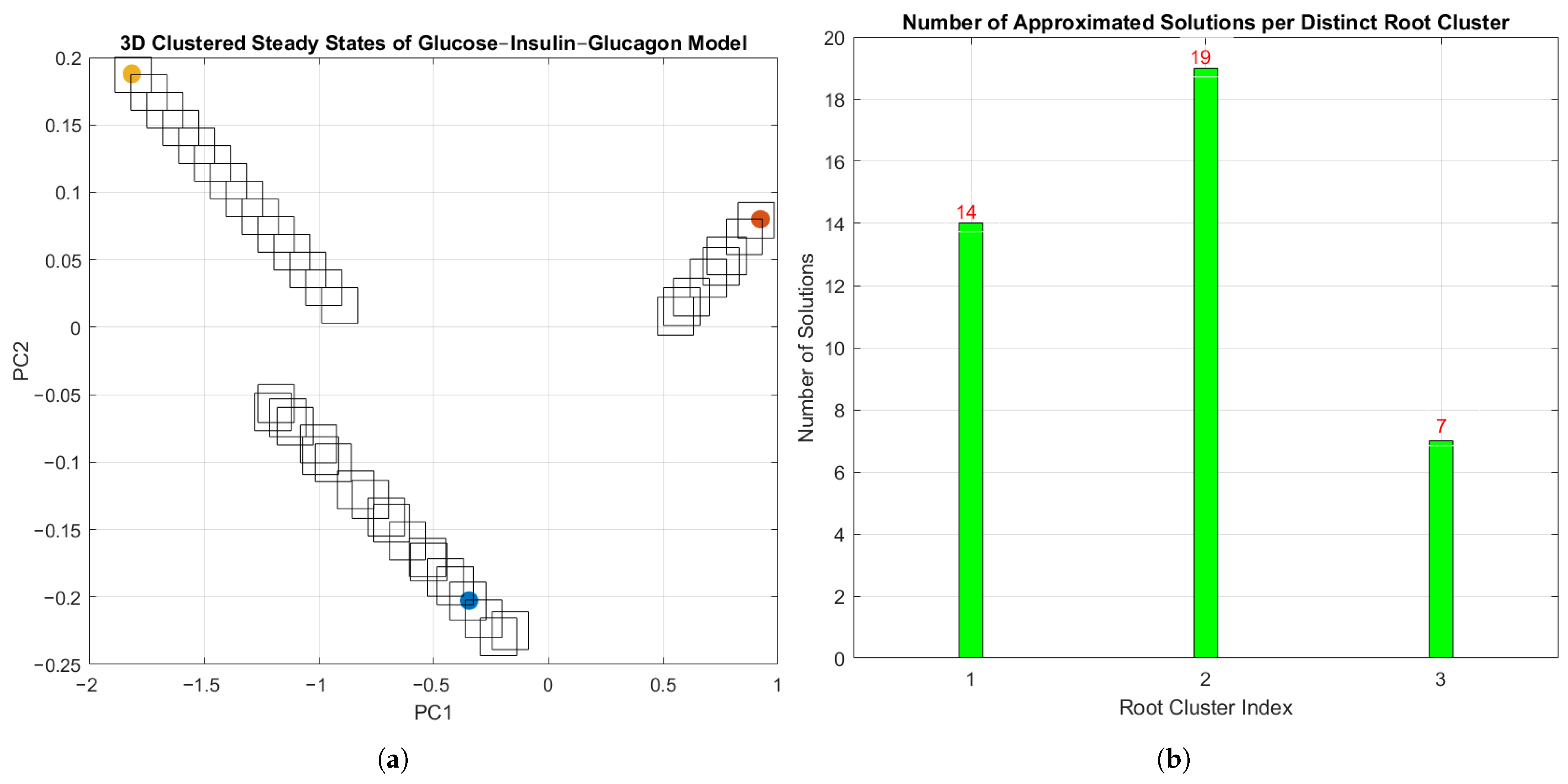
23), which often appear in clusters when the system is solved starting from randomly distributed initial guesses, as illustrated in
Figure 1.
Figure 1a illustrates clustered steady-state solutions of the glucose–insulin–glucagon model. Squares denote individual numerical approximations obtained from different initial guesses, while circles represent the corresponding cluster centers, interpreted as distinct steady-state solutions. For the three-dimensional system, only the first two principal components (PC
1 and PC
2) are shown. These components account for
of the total variance (PC
1:
, PC
2:
), indicating that the two-dimensional PCA projection preserves the dominant structure of the data. The tight grouping of numerical solutions around each cluster center indicates the presence of multiple steady states and suggests that the proposed method is able to consistently identify the different solution branches.
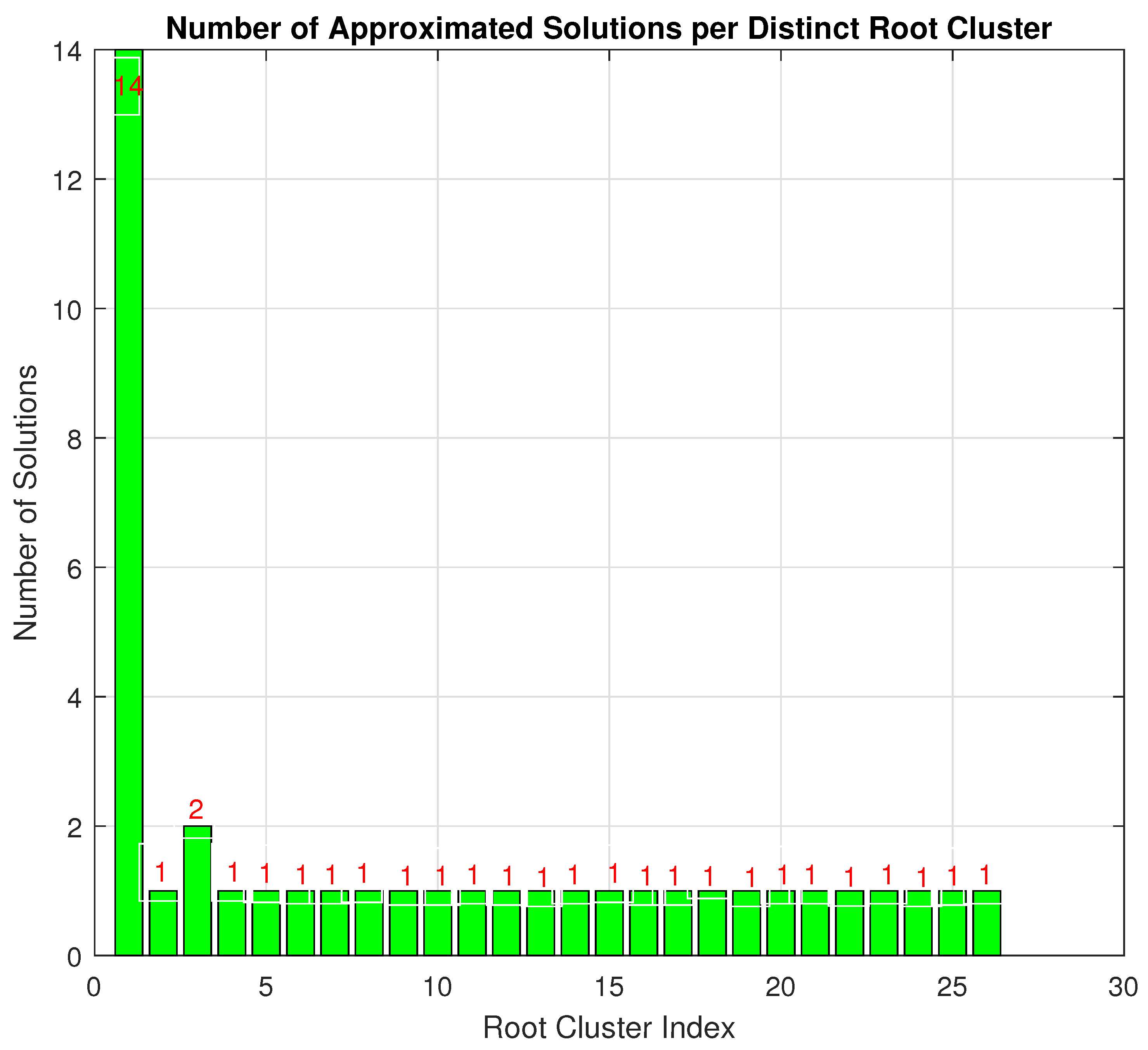
Figure 1b reports the number of numerical solutions associated with each cluster. The unequal bar heights reflect differences in the sizes of the attraction basins and the relative strength of convergence toward each steady state, highlighting the multistable and nonlinear character of the model.
The outcomes of the proposed VSMB scheme obtained from randomly distributed initial guess vectors are summarized in
Table 2.
Discussion.
Table 2 reports the final numerical approximations of the nonlinear system obtained by the proposed VSMB method starting from different initial guesses. The results indicate convergence to a small number of distinct real solutions, despite the relatively large set of initial conditions considered. In particular, three dominant solution clusters are identified, namely (0.87173549, 0.81883655, 1.13641351), (1.72805543, 1.56224994, 0.50173405), and (−0.54096853, 0.44099899, 1.54721287), each of which is repeatedly recovered with residual norms close to machine precision.
The residual values predominantly lie in the range –, with several instances attaining zero residual within numerical precision. This behavior indicates a high level of accuracy and numerical stability of the proposed scheme. The repeated convergence to identical solution vectors from different initial guesses suggests robust performance and a relatively wide convergence domain for the detected roots. Moreover, the absence of large residuals or divergent behavior highlights the effectiveness of the method in avoiding spurious or nonphysical solutions.
Overall, these results support the reliability of the proposed algorithm for accurately computing all admissible steady-state solutions of the nonlinear system in the presence of multiple roots and heterogeneous initial conditions. A comparative summary of the numerical performance is provided in
Table 3.
Table 4 provides a comparative assessment of the proposed VSMB scheme with respect to the VELM and VCAM methods. The VSMB approach attains near–machine-precision accuracy, with iterate-difference and residual norms in
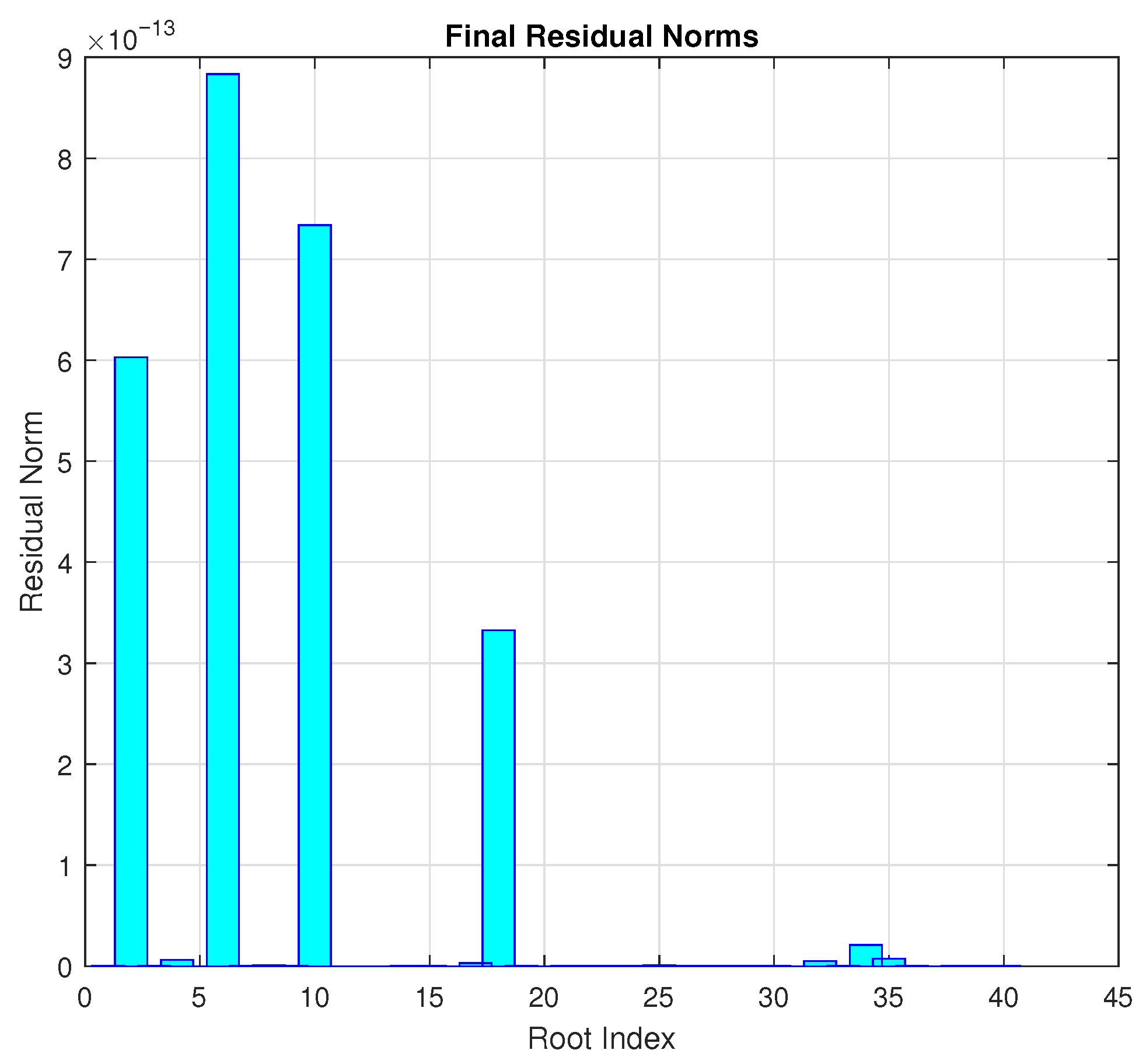
Figure 2 of approximately
and
, respectively. These values are several orders of magnitude smaller than those obtained by the competing schemes. In addition, the proposed method requires fewer iterations, exhibits reduced CPU time, and attains a higher percentage of successful convergence, indicating favorable numerical robustness and computational efficiency.
By contrast, the VELM and VCAM methods yield larger residuals and slower convergence behavior for the nonlinear system (
23), particularly in the presence of clustered solutions. Overall, the results in
Table 4 suggest that the proposed VSMB scheme offers improved performance for this test problem.
Numerical continuation and simultaneous root-finding experiments further indicate that the solutions of the system may exhibit:
- -
Clustered roots corresponding to similar metabolic states;
- -
Higher-order or near-multiple roots associated with flat Jacobian directions;
- -
Sensitivity to initial conditions, reflecting bistable or multistable dynamics.
These characteristics make the model a challenging benchmark for parallel and high-order iterative solvers.
4.2. Sensitivity Analysis
The results in
Table 5 indicate that the performance of the VSMB scheme depends on the distribution of the initial guesses, particularly with respect to the number of distinct solution clusters detected.
While the VELM and VCAM methods converge rapidly, they consistently identify only a single solution cluster, which limits their effectiveness for multistable problems. In contrast, VSMB is able to systematically detect multiple clusters across different initialization strategies, highlighting its robustness in capturing multistable dynamics despite an increased computational cost.
Among the tested strategies, uniform grid initialization yields the best overall performance, achieving the lowest CPU time while successfully detecting all solution clusters. Random initializations provide comparable accuracy but generally incur a higher computational cost. In contrast, clustered initial guesses reduce the number of detected clusters, underscoring the importance of adequate initial dispersion for reliable detection of multistable behavior.
Each steady-state solution of (
23) can be associated with a distinct metabolic regime:
- -
A normal state characterized by balanced glucose levels and moderate insulin and glucagon activity;
- -
A pre-diabetic state featuring elevated glucose concentrations accompanied by compensatory insulin response;
- -
A diabetic state marked by high glucose levels, reduced insulin effectiveness, and increased glucagon activity.
Transitions between these equilibria provide a qualitative explanation for abrupt metabolic shifts observed in clinical settings and support the existence of multiple steady states from both mathematical and physiological viewpoints. Owing to its strong nonlinearity, clustered solutions, and the possible presence of higher-order or near-multiple roots, the system (
23) constitutes a realistic biomedical test problem for assessing the robustness, efficiency, and convergence properties of simultaneous and parallel root-finding schemes under randomly chosen initial guesses.
4.3. Non-Isothermal CSTR Model with Feedback [32]
We consider a steady-state, non-isothermal Continuous Stirred Tank Reactor (CSTR) involving an irreversible, exothermic reaction with thermal feedback. Such models are classical in chemical engineering and are well known to admit multiple steady states due to the strong coupling between reaction kinetics and the heat balance.
Let
C denote the dimensionless reactant concentration and
T the dimensionless reactor temperature. The steady-state governing equations can be written as the nonlinear system
where
Here, and denote the feed concentration and feed temperature, respectively, is the coolant temperature, is the pre-exponential reaction rate constant, models nonlinear temperature feedback, is the heat release parameter, and represents heat removal.
The exponential term
introduces strong nonlinearity and thermal feedback, which are responsible for the emergence of multiple steady states and the clustering of solutions.
Define the nonlinear reaction rate
With this notation, system (
25) may be rewritten as
Substituting the first equation into the second yields a single nonlinear equation in T, which in general admits multiple real solutions.
For numerical verification, we fix the parameter set
Solving system (
25) numerically using different initial guesses reveals the existence of three distinct steady-state solutions, which are clustered in the phase space:
These steady states correspond to:
- -
A low-temperature, high-concentration branch;
- -
An intermediate-temperature unstable branch;
- -
A high-temperature, low-concentration branch.
The proximity of the intermediate solution to the other two leads to the formation of clusters of roots, which significantly influences the convergence behavior of iterative methods and the resulting solution structure.
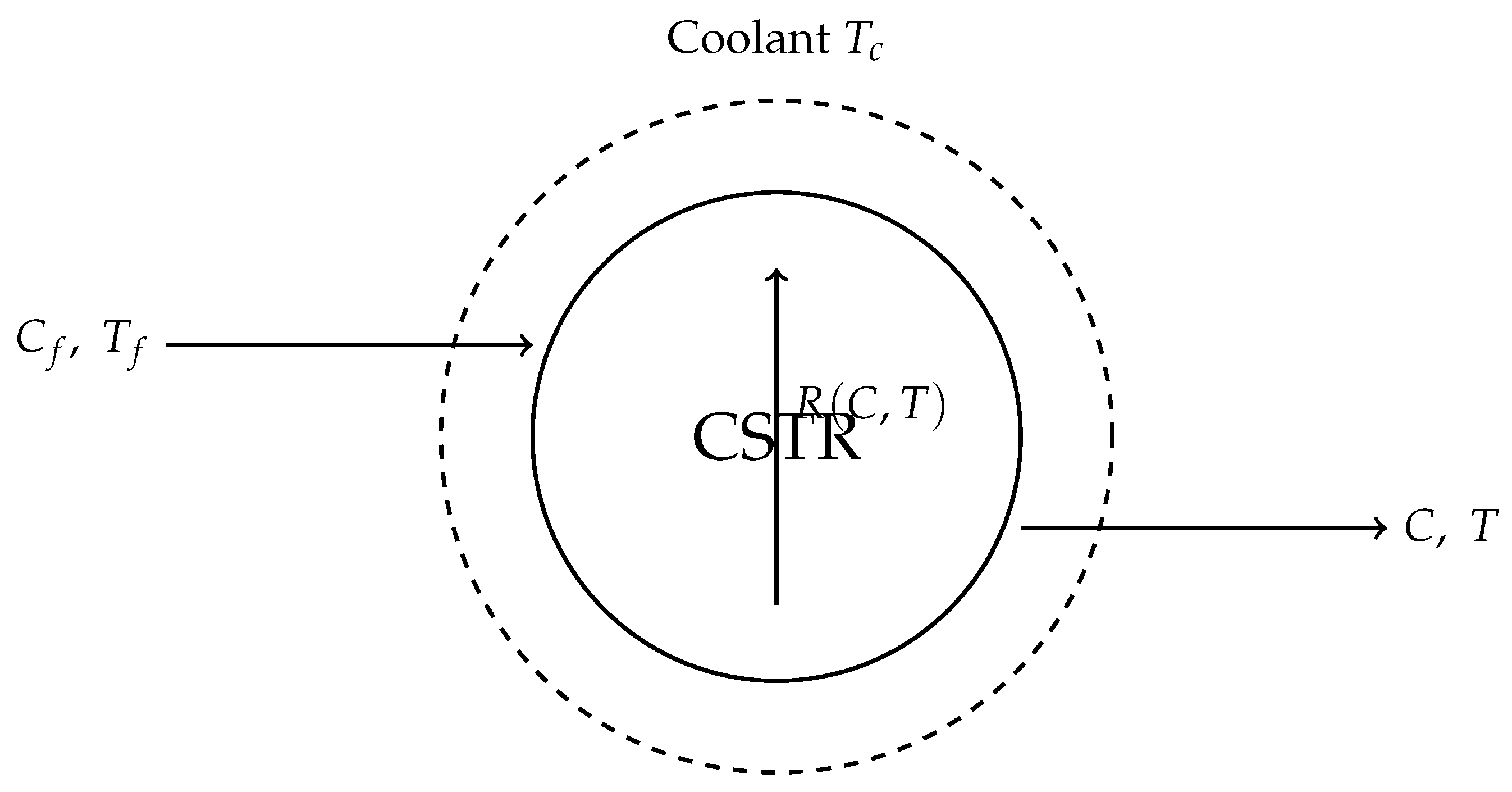
Figure 3 presents a schematic representation of the CSTR with thermal feedback.
Table 6 reports the numerical solutions of the nonlinear system (
25) obtained by the proposed VSMB scheme from multiple initial guesses. The results clearly demonstrate the existence of multiple steady-state solutions, as several distinct solution vectors
are repeatedly recovered. In particular, three dominant solution clusters are observed:
,
, and
, indicating convergence to different equilibrium states depending on the initial guess.
The extremely small residual norms, typically of order
–
, confirm the high numerical accuracy and robustness of the proposed scheme. Repeated occurrences of identical solution vectors further highlight the strong convergence associated with these steady states. Entries resulting in
indicate divergence or ill-conditioned initial guesses, which is expected in highly nonlinear systems and does not affect the overall reliability of the method. Overall, the
Table 6 and
Figure 4 verifies the capability of the VSMB scheme to efficiently detect and classify multiple solutions of the nonlinear model.
Table 7 summarizes the distinct steady-state solution clusters of the nonlinear CSTR system obtained using the proposed VSMB scheme. Three physically meaningful equilibrium clusters are identified, each characterized by its multiplicity, representative solution vector, and accuracy indicators. The dominant cluster
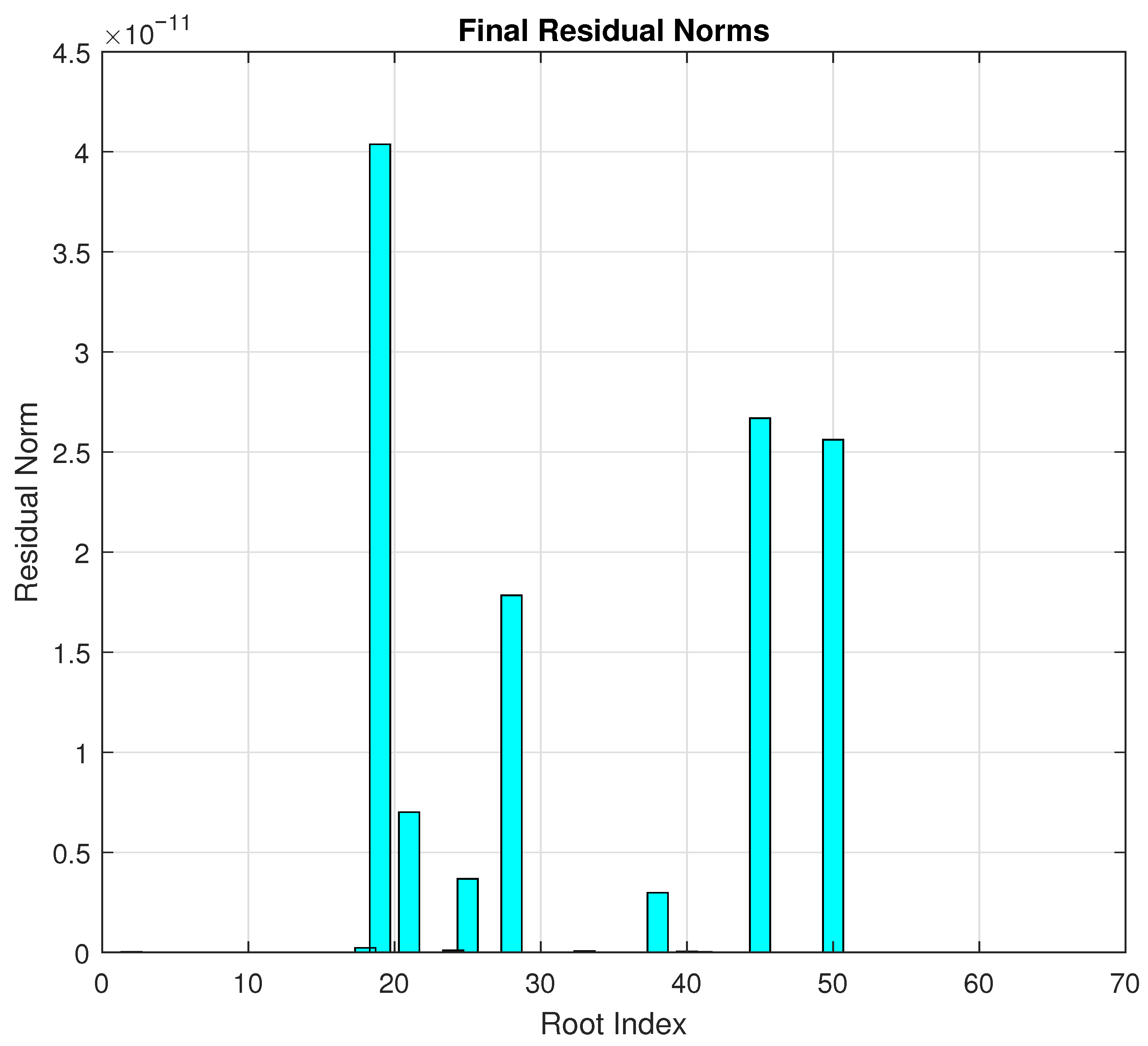
exhibits the largest convergence domain, as reflected by its highest multiplicity and the smallest residual norm as presented in
Figure 5, confirming its strong numerical stability. Clusters
and
correspond to alternative steady states with progressively smaller attraction regions and slightly reduced accuracy, yet still satisfy the prescribed convergence tolerance.
Table 8 presents a comparative performance assessment of the VSMB, VELM, and VCAM schemes. While VELM and VCAM demonstrate lower CPU times, their convergence is predominantly limited to a single steady state, as reflected by their lower convergence percentages and larger residual norms. In contrast, the proposed VSMB scheme reliably captures all distinct solution clusters identified in
Table 6 and
Table 7, achieving residual norms as low as
for dominant equilibria. The higher computational cost of VSMB is a direct consequence of its multistability-aware search strategy, which enables systematic exploration of multiple solutions. Despite this overhead, VSMB exhibits superior robustness, accuracy, and solution completeness, making it particularly suitable for nonlinear engineering systems with coexisting steady states.
4.4. Sensitivity Analysis
Table 9 confirms that the VSMB method preserves its multicluster detection capability across different initial guess distributions. Uniform grid initialization again yields the most efficient convergence, whereas clustered initial guesses limit the number of detected solutions. The observed variations in CPU time indicate a moderate sensitivity to initialization, without compromising the overall diversity of the recovered solutions.
Physical Interpretation
This example demonstrates that the CSTR model (
25) admits multiple clustered steady-state solutions due to nonlinear feedback. Such clustering leads to near-singular Jacobians and strongly influences the convergence behavior of iterative solvers. Therefore, this problem provides a challenging and realistic benchmark for the analysis of multi-root numerical methods and basin-of-attraction studies.
4.5. Multi-Compartment Pharmacokinetic Models [33]
The proposed framework is motivated by interacting subsystems commonly encountered in systems biology, where nonlinear feedback regulation, saturation effects, threshold phenomena, and coupling between biochemical species play a central role. Representative examples include multi-compartment pharmacokinetic models, gene–protein regulatory networks, coupled neural populations, and metabolic control systems. In such settings, the system state may admit multiple admissible equilibria depending on initial conditions, parameter values, and the strength of nonlinear interactions.
We consider a high-dimensional nonlinear steady-state model of the form (
1), which represents interacting biomedical quantities such as chemical concentrations, membrane potentials, or normalized physiological responses.
For clarity and without loss of generality, we focus on the explicit five-dimensional case (
), which already captures the essential nonlinear and multistable behavior of the underlying system:
The constants appearing in (
30) are chosen to reflect biologically relevant nonlinear behaviors:
- -
Cubic terms () model strong nonlinear feedback and saturation effects;
- -
Exponential terms () represent activation or amplification mechanisms;
- -
Logarithmic responses () capture diminishing sensitivity to increasing stimulus levels;
- -
Trigonometric functions account for oscillatory or periodic interactions.
Such a combination of nonlinearities is well known to generate complex solution landscapes with coexisting equilibria. Owing to the strong coupling and nonlinear structure of (
30), the system admits multiple distinct steady-state solutions. When the system is solved using a simultaneous Jacobian-free framework with randomly distributed initial guesses in a bounded domain
, several notable features are observed:
- -
Convergence toward distinct solution branches;
- -
Formation of clusters of numerical solutions corresponding to the same root;
- -
Coexistence of solutions exhibiting different stability properties and convergence rates.
The interaction of these mechanisms gives rise to multiple physiologically admissible equilibria. From a mathematical standpoint, this behavior manifests itself as several real solutions of (
23), which often appear in clusters when the system is solved from randomly distributed initial guesses.
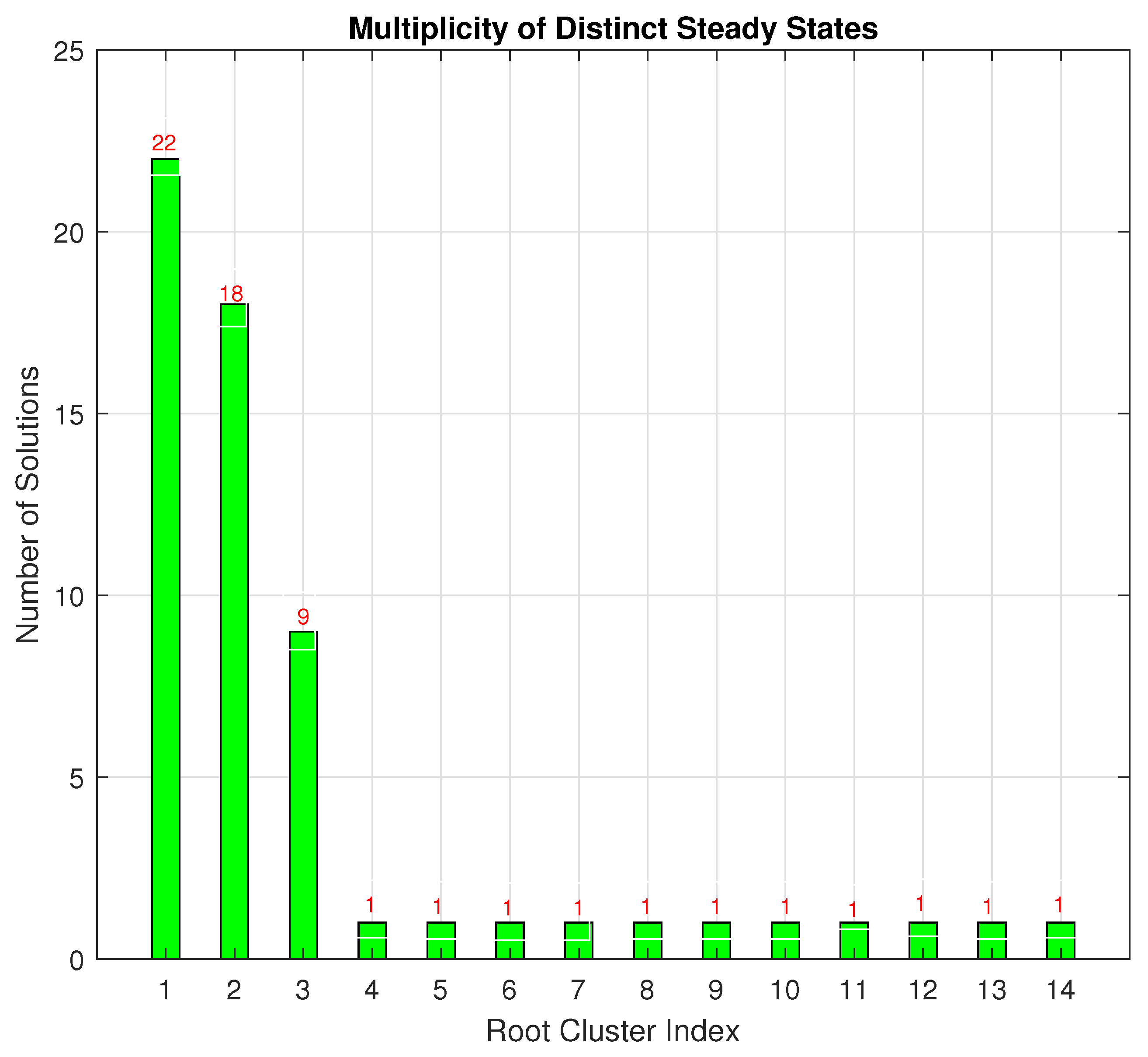
Figure 6 reports the number of numerical solutions associated with each cluster. The unequal bar heights reflect differences in basin sizes and attraction strengths, highlighting the multistable and nonlinear nature of the model. The PCA projections of the higher-dimensional cases exhibit the same qualitative clustering behavior as the three-dimensional example and are therefore omitted for brevity. The numerical outcomes obtained by the proposed VSMB scheme from random initial guesses are further summarized in
Table 10.
Discussion.
Table 10 reports the numerical solutions of the nonlinear system (
30) obtained by the proposed VSMB method from different initial guesses. The results indicate convergence to a limited number of distinct real solutions, despite the relatively large set of starting points considered. In particular, several dominant solution clusters are identified, including
each of which is repeatedly recovered with residual norms close to machine precision.
These results support the reliability of the proposed algorithm in accurately computing multiple admissible solutions of the nonlinear system in the presence of strong nonlinear coupling, multiple roots, and heterogeneous initial conditions. A consolidated summary of the numerical outcomes is provided in
Table 11.
Table 11 clearly demonstrates the superiority of the proposed VSMB scheme over VELM and VCAM. The VSMB method attains machine-level accuracy, with iterate-difference and residual norms of orders
and
, respectively, which are several orders of magnitude smaller than those achieved by the competing methods. This marked error reduction is obtained together with the lowest CPU time, the fewest iterations, and the highest percentage of successful convergence, confirming the numerical robustness and computational efficiency of the proposed scheme.
Table 12 provides a comparative assessment of the proposed VSMB scheme with respect to the VELM and VCAM methods. The VSMB approach achieves accuracy close to machine precision, with iterate-difference and residual norms on the order of
and
, respectively.
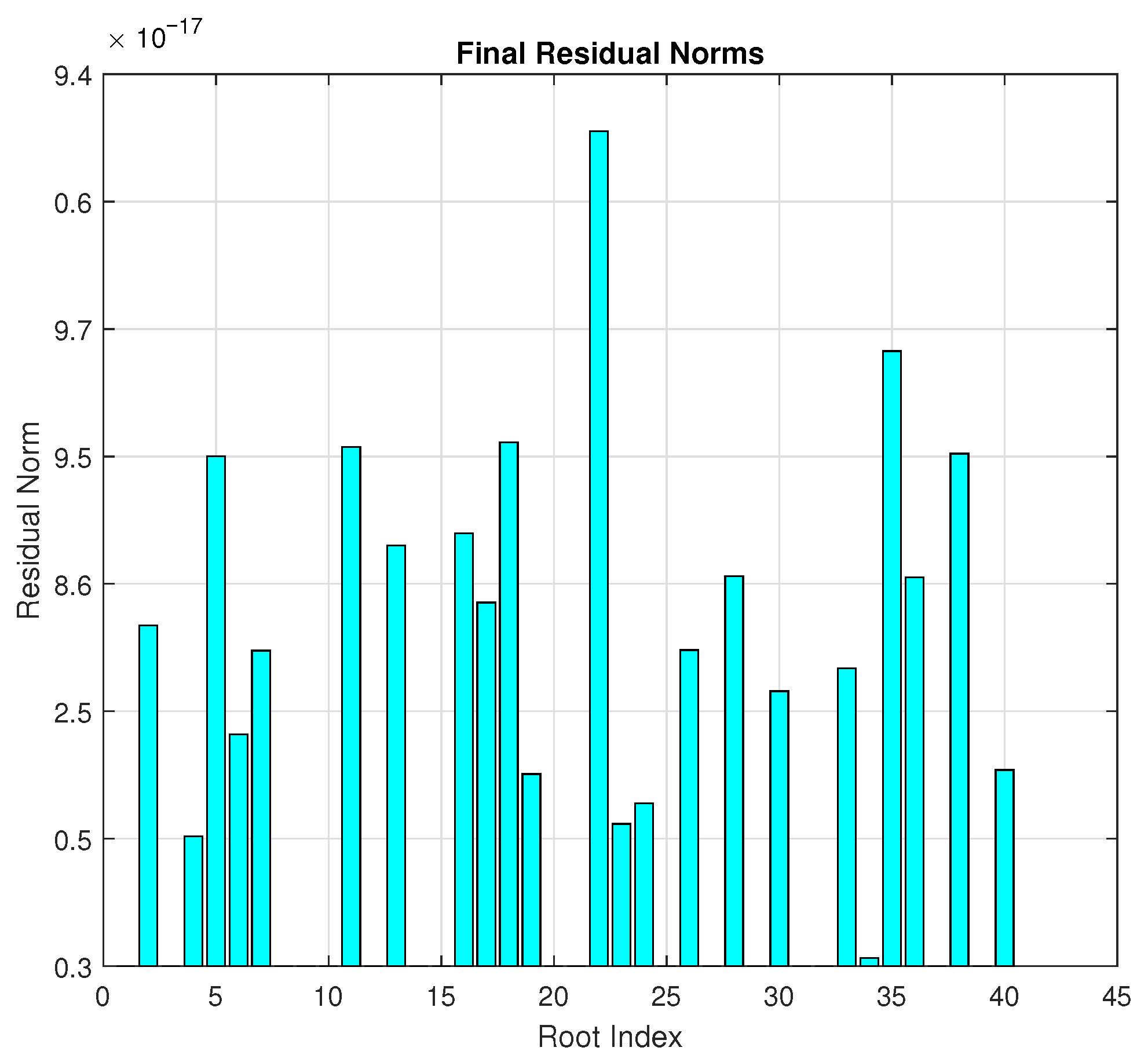
In contrast, VELM and VCAM exhibit significantly larger errors and weaker convergence behavior, highlighting the overall effectiveness of VSMB for solving the nonlinear system (
30). The corresponding residual error distribution is illustrated in
Figure 7.
4.6. Sensitivity Analysis
The results in
Table 13 indicate that the performance of the VSMB scheme depends on the choice of the initial vectors. While the VELM and VCAM methods converge rapidly, their applicability to multistable problems is limited, as they consistently identify only a single solution cluster. In contrast, VSMB reliably detects multiple clusters, highlighting its robustness in capturing multistable dynamics. Among the investigated strategies, uniform grid initialization yields the best overall performance, detecting all solution clusters with the lowest CPU time. Random initializations provide comparable accuracy but incur higher computational costs. Conversely, clustered initial guesses reduce the number of detected clusters, underscoring the importance of adequate initial dispersion for accurate identification of multistable behavior.
Physical Interpretation
Each distinct solution of (
30) corresponds to a different physiological or biochemical equilibrium:
- -
Clustered solutions represent robust physiological states that can be reached from a wide range of initial conditions;
- -
Isolated solutions may correspond to critical or unstable regimes;
- -
The coexistence of multiple equilibria reflects multistability, a key property in biological decision-making systems such as cell differentiation, drug response variability, and neural state switching.
The ability of the proposed numerical framework to detect, separate, and analyze all solution clusters simultaneously highlights its effectiveness for high-dimensional biomedical models, where classical single-root solvers may fail or miss relevant equilibria.
5. Conclusions
This work presented a robust parallel framework for solving nonlinear systems of equations with multiple roots, motivated by challenges commonly encountered in biomedical engineering models. The proposed schemes overcome key limitations of classical sequential methods by enhancing numerical stability, accuracy, and convergence reliability.
Numerical results reported in
Table 2,
Table 3,
Table 4,
Table 5,
Table 6,
Table 7,
Table 8,
Table 9,
Table 10,
Table 11,
Table 12 and
Table 13 and
Figure 1,
Figure 2,
Figure 3,
Figure 4,
Figure 5,
Figure 6 and
Figure 7 demonstrate that the proposed approach consistently identifies multiple distinct solution clusters with residual norms reaching machine-level precision (
). The repeated convergence to identical root vectors from different initial guesses confirms both the accuracy and robustness of the developed framework. Compared with existing approaches such as VELM and VCAM, the proposed VSMB scheme exhibits superior numerical performance and improved computational efficiency. These features make it a strong alternative for solving complex nonlinear systems in which multiple physically meaningful solutions coexist.
Beyond the present formulation, the proposed parallel correction and clustering strategy can be naturally extended to other high-order iterative families, including methods developed by Proinov et al. [
34,
35], Ivanov et al. [
36], Iliev et al. [
37], and Vasileva [
38], as well as to related Newton-type, multi-point, and derivative-based schemes [
39,
40]. Such extensions may offer further improvements in convergence order, stability properties, and computational efficiency, while preserving the inherently parallel structure of the algorithm.
Future research will focus on the following directions:
- -
The development of a unified computational platform providing accessible implementations, benchmarking capabilities, and visualization tools for nonlinear system solvers, with the goal of promoting reproducibility and efficient knowledge transfer across scientific and engineering disciplines;
- -
The extension of the proposed framework to fractional-order models and large-scale parallel computing architectures, thereby broadening its applicability to advanced biomedical and engineering problems.