Article

Advanced Frequency of Thick FGM Spherical Shells by Nonlinear Shear and TSDT

Department of Mechanical Engineering, Hsiuping University of Science and Technology, Taichung 412406, Taiwan
AppliedMath 2026, 6(3), 42; https://doi.org/10.3390/appliedmath6030042

Submission received: 22 January 2026 / Revised: 21 February 2026 / Accepted: 3 March 2026 / Published: 7 March 2026

Abstract

An advanced frequency study in thick-walled functionally graded material (FGM) spherical shells is investigated with advanced shear correction. The values of advanced shear correction can be greater than one, be a negative value, and be affected by a nonlinear term of third-order shear deformation theory (TSDT) of displacements, FGM power law index, and temperature. It is novel and interesting to consider using TSDT and advanced shear correction to derive a simple homogeneous equation with reasonable simplifications into a symmetrical sparse matrix subjected to free vibration. The zero determinant of the symmetrical sparse matrix can be expressed to calculate the natural frequency by Newton’s method. The parameter effects of advanced shear correction, a nonlinear TSDT term, temperature, and the FGM power-law index on the natural frequencies of thick-walled FGM spherical shells are presented. The natural-frequency data for the axial and circumferential mode shapes are obtained. This is a new finding, as the assumed simplification in a sparse matrix causes a numerical truncation error; the natural-frequency values of the presented sparse matrix are much greater than those in a full matrix for thick-walled FGM spherical shells.

1. Introduction

Free vibration studies in the materials of spherical shells were investigated for the natural frequency. In 2021, Bagheri et al. [1] presented the free vibration of a functionally graded material (FGM) conical-spherical shell by using the first-order shear deformation theory (FSDT) of displacements and considering various types of boundary conditions on the result of natural frequencies. In 2021, Liu et al. [2] used the three-dimensional (3D) elasticity theory and the state space method to study the free vibrations of functionally graded graphene platelets reinforced composite (FG-GPLRC) spherical shells. In 2021, Tang and Dai [3] used the multiscale method and hygrothermal effects to obtain the analytical results for the nonlinear free vibration of carbon fiber-reinforced polymer (CFRP) spherical shell panels. In 2021, Roy et al. [4] presented the modified higher order zigzag theory (HOZT) of displacements and the experimental modal by Bruel and Kjaer to study the free vibration of laminated composite hybrid and glass fiber reinforced plastic (GFRP) shells. In 2019, Sayyad and Ghugal [5] presented the results of free vibration for laminated spherical shells by using a generalized higher-order shell theory. In 2019, Li et al. [6] presented the free vibration analysis of combined spherical-cylindrical-spherical (CSCS) shells based on the Ritz method with thin FSDT of displacements. In 2019, Li et al. [7] presented the Ritz method and the FSDT of displacements to obtain the free vibration analyses for functionally graded porous spherical shell (FGPSS). In 2016, Fantuzzi et al. [8] presented two-dimensional (2D) computational models and 3D exact shell models for the free vibration of FGM shells. In 2010, Sepiani et al. [9] presented the numerical results of free vibration for FGM shells by using the FSDT of displacements without considering the thermal effect.
Mathematical simulation reviews on thick FGM spherical shell structures are presented. In 2020, Zannon et al. [10] presented a free vibration numerical study for thick-walled FGM spherical shells by using the third-order shear deformation theory (TSDT) model. In 2023, Keibolahi et al. [11] presented a thermal-shock vibration numerical study for deep FGM spherical shells by using the FSDT model. In 2017, Khoa and Tung [12] presented a pressure load study for moderately-thick FGM sandwich spherical shells by using the FSDT model. In 2025, Zhang et al. [13] presented a thermal and mechanical loads static study for thick FGM spherical shells by using a heat conduction model. In 2026, Nejad et al. [14] presented a pressure load study for an FGM spherical solid by using the plane-elasticity theory (PET) model. In 2021, Dastjerdi et al. [15] presented a mathematical study for thick FGM spherical shells by using the FSDT model. In 2022, Arslan and Mack [16] presented a pressure load stress study for thick FGM spherical shells by using the homogenized-properties model. In 2014, Khaire et al. [17] presented a free vibration numerical study for FGM spherical shells by using the higher-order shear deformation theory (HSDT) model. In 2020, Zeverdejani and Kiani [18] presented a thermal-shock vibration numerical study for FGM spherical shells. In 2019, Shariyat and Ghafourinam [19] presented a pressure load stress study for thick FGM spherical shells by using Norton’s creep model.
Free vibration computational studies with shear correction effect in FGM spherical shells under environment-temperature were investigated for natural frequency. In 2020, Hong [20] used TSDT to present the frequency results for thick-walled FGM spherical shells with a simple homogeneous equation and varied shear correction, which was usually positive, smaller than one, and not affected by the nonlinear TSDT term. It is novel and interesting to investigate the natural frequency for thick-walled FGM spherical shells with advanced shear correction, whose value can be greater than one, can be a negative value, and can be affected by the nonlinear TSDT term. Four parameter effects of advanced shear correction, nonlinear TSDT term, temperature, and FGM power law index on the natural frequencies of thick-walled FGM spherical shells for a given angle with respect to the z axis and radius are investigated.
It is interesting to investigate what is fundamentally new on the effects of natural frequency, e.g., treatment of advanced shear correction presented in Section 2.2, Section 2.3, Section 3 and Section 4; nonlinear TSDT term effects presented in Section 2.1, Section 3 and Section 4; temperature dependency on FGMs presented in Section 3 and Section 4; and compared homogeneous equation in sparse matrix and full matrix presented in Section 2.4 and Section 4.

2. Materials and Methods

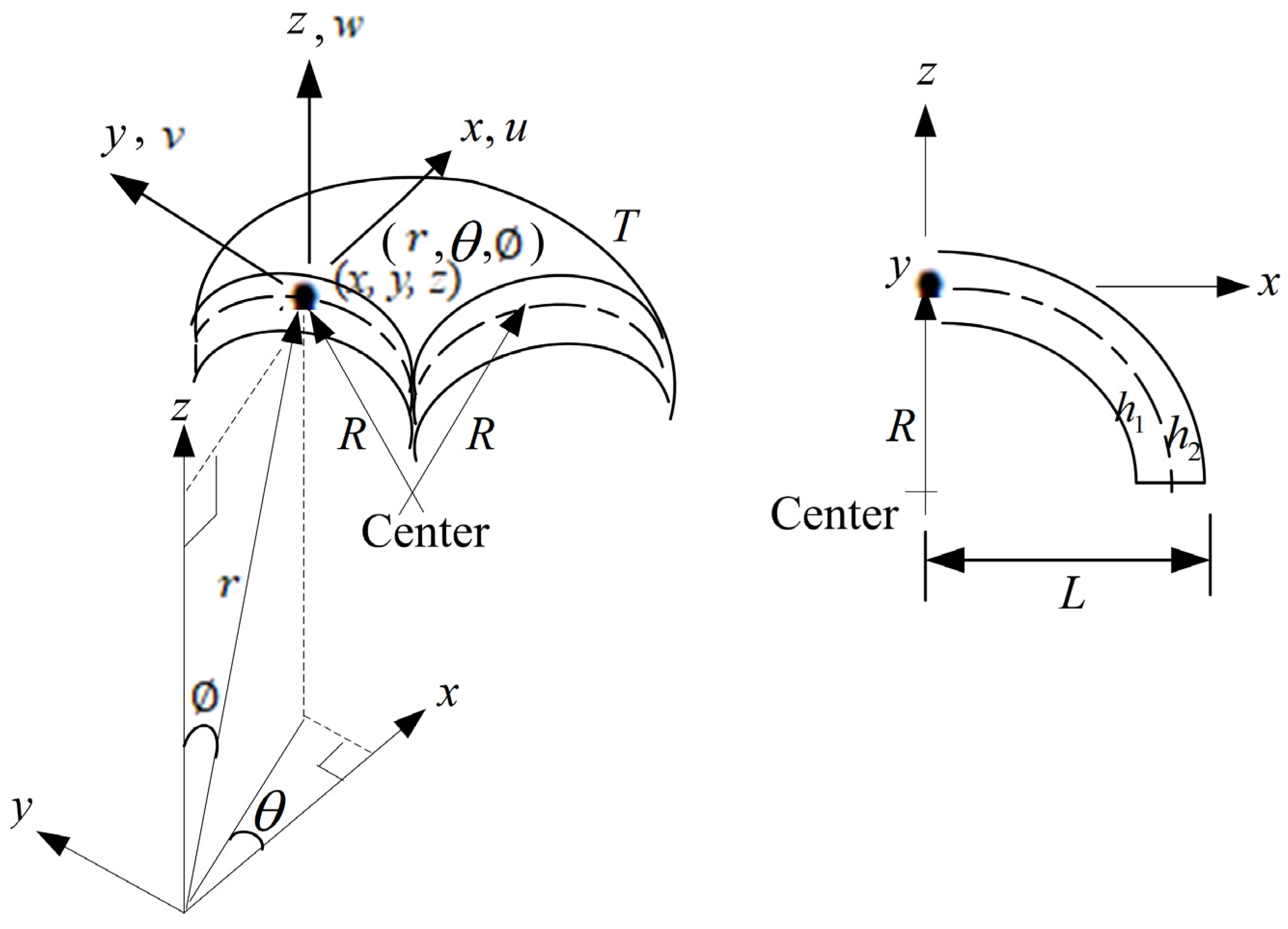
A two constituent-material in thick-walled FGM spherical shells has FGM material 1 on the inner layer and FGM material 2 on the outer layer [20]. A position point on FGM spherical shells in two coordinate systems between spherical axes ( r ,   θ ,   ) and Cartesian axes (x, y, z) is displayed in Figure 1, where r denotes the radius, θ is the circumferential angle, and is the angle between the z axis and the r axis. The power law function type material properties of FGM spherical shells are considered. They are functions of the environment-temperature T [21,22].

2.1. TSDT Model of Displacements

The nonlinear TSDT model of displacements u , v , and w of thick-walled FGM spherical shells in Figure 1 on a given angle and x axial length L are expressed with c 1 denotes the nonlinear TSDT term of z3 as follows [22],
u = u 0 ( x , θ , t ) + z ϕ x ( x , θ , t ) c 1 z 3 ( ϕ x + w x ) ,
v = v 0 ( x , θ , t ) + z ϕ θ ( x , θ , t ) c 1 z 3 ( ϕ θ + w R θ ) ,
w = w ( x , θ , t ) ,
in which u 0 and v 0 are tangential-displacement in x and θ axes, respectively, w denotes the transverse-displacement in the z axis of the middle plane in shells. ϕ x and ϕ θ denote the shear-rotations. R denotes the radius of the middle surface in shells. t denotes the time. c 1 = 4 / ( 3 h * 2 ) , in which h is the total thickness equal to h 1 + h 2 , where h 1 denotes the thickness of constituent-material 1 and h 2 denotes the thickness of constituent-material 2.

2.2. Dynamic Equilibrium Equation with TSDT

The dynamic partial differential equation (PDE) of motion represented in TSDT on the given of thick-walled FGM spherical shells can be applied [20]. Also, the Von Karman strain-displacement relations with not negligible shear strains are applied to the given of thick-walled FGM spherical shells. Thus, the five dynamic equilibrium PDE with TSDT in matrix form can be represented for FGM spherical shells. The coefficients of elements containing stiffness integrals A i s j s , B i s j s , D i s j s , E i s j s , F i s j s , H i s j s , i s , j s = 1 , 2 , 6 , A i j , B i j , D i j , E i j , F i j , H i j , i , j = 4 , 5 and c 1 terms. The stiffness integrals that are in integrals of stiffness Q ¯ i s j s , Q ¯ i j can be applied to the given ≠ 0 in the following [22],
A i s j s , B i s j s , D i s j s , E i s j s , F i s j s , H i s j s = h 2 h 2 Q ¯ i s j s ( 1 , z , z 2 , z 3 , z 4 , z 6 ) d z ,
A i j , B i j , D i j , E i j , F i j , H i j = h 2 h 2 k α Q ¯ i j ( 1 , z , z 2 , z 3 , z 4 , z 5 ) d z .
in which k α denotes shear correction, usually considered and used in transverse stresses to make a good adjustment for thick-walled materials.

2.3. Advanced k α

The advanced k α expression for the given in the thick-walled FGM spherical shells can be applied in the following [22]:
k α = 1 h F G M Z S V F G M Z I V ,
where F G M Z S V = ( F G M Z S c 1 F G M Z S N ) 2 expressed in ( h ) 6 power and F G M Z I V = F G M Z I 2 c 1 F G M Z I V 1 + c 1 2 F G M Z I V 2 expressed in ( h ) 5 power, in which F G M Z S , F G M Z S N , F G M Z I , F G M Z I V 1 , and F G M Z I V 2 are parameters in the functions of the Young’s modulus on FGM constituent-material 1 and 2 for E 1 , E 2 , respectively, and the power law index R n . Thus, the advanced k α values are non-dimensional and nonlinear and functions of c 1 , R n , and T , but the advanced k α values are not functions of parameter h .

2.4. Simple Homogeneous Equation

In the free vibration study, there are no thermal loads for temperature-difference Δ T = 0, no in-plane distributed forces p 1 = p 2 = 0 and no external pressure load q = 0 . The free vibration frequency ω m n with subscripts m and n denote that the mode shape number can be used in the following typical four-sided simple supported time sinusoidal displacements u 0 , v 0 , w and shear rotations ϕ x , ϕ θ expressions with amplitudes a m n , b m n , c m n , d m n and e m n .
u 0 = a m n c o s m π x / L s i n n π θ / R s i n ( ω m n t ) ,
v 0 = b m n s i n m π x / L c o s n π θ / R s i n ( ω m n t ) ,
w = c m n s i n m π x / L s i n n π θ / R s i n ( ω m n t ) ,
ϕ x = d m n c o s m π x / L s i n n π θ / R s i n ( ω m n t ) ,
ϕ θ = e m n s i n m π x / L c o s n π θ / R s i n ( ω m n t ) ,
where ω m n is the natural frequency with subscripts m is the number of axial half-waves and n is the number of circumferential waves. By substituting Equations (7)–(11) into PDE under free vibration with no external loads f 1 = f 2 = = f 5 = 0 and assumed reasonable simplifications of F H 13 = F H 14 = F H 15 = F H 23 = F H 24 = F H 25 = 0, B i j = E i j = A 16 = A 26 = D 16 = D 26 = A 45 = D 45 = F 45 = 0 and I 1 = I 3 = J 1 = I 6 = J 4 = 0 in the homogeneous matrix. Thus, the simple homogeneous equation in a symmetrical sparse matrix can be obtained in the following [22].
F H 11 λ m n F H 12 0 0 0 F H 12 F H 22 λ m n 0 0 0 0 0 F H 33 λ m n F H 34 F H 35 0 0 F H 34 F H 44 K 2 I 0 λ m n F H 45 0 0 F H 35 F H 45 F H 55 K 2 I 0 λ m n a m n b m n c m n d m n e m n = 0 0 0 0 0 ,
where I i = k = 1 N k k + 1 ρ ( k ) z i d z , (i = 0,1,2,…,6), in which N is the total number of layers, ρ ( k ) is the density of the (k)th ply. J i = I i c 1 I i + 2 , ( i = 1 , 4 ) , K 2 = I 2 2 c 1 I 4 + c 1 2 I 6 , λ m n = I 0 ω m n 2 , F H 11 , , F H 55 coefficients are listed in the Appendix A.
Thus, the stiffness integrals A i s j s , B i s j s , D i s j s , E i s j s , F i s j s , H i s j s value, A i j , B i j , D i j , E i j , F i j , H i j containing k α value, and c 1 value of TSDT; they are all included in the homogeneous matrix of (12).

2.5. Numerical Method

The determinant of (12) vanishes for obtaining a non-trivial solution that can be used in the simple fifth-order of λ m n in a polynomial equation as follows,
A ( 1 ) λ m n 5 + A ( 2 ) λ m n 4 + A ( 3 ) λ m n 3 + A ( 4 ) λ m n 2 + A ( 5 ) λ m n + A ( 6 ) = 0 ,
where A ( 1 ) ,   , A ( 6 ) coefficients are listed in the Appendix A.
The Lahey-Fujitsu Fortran 7.8 program is used to solve (13) by using the algorithm of Newton’s method [23]. In the numerical calculation for choosing and iterating a λ m n into (13) until the tolerance is less than or equal to the 1 × 10⁻⁶ value, then the root λ m n can be solved. Thus, the ω m n can be calculated for the given ≠ 0 of the thick-walled FGM spherical shells under free vibration.

3. Numerical Results

The FGM constituent-material 1 on the inner part of the spherical shells is SUS304, the FGM constituent-material 2 on the outer part of the spherical shells is Si3N4 on the given 0 ° < 90 ° . They are used for free vibration frequency computations with a simple homogeneous equation under the effects of T , advanced k α and four-sided simple supported boundary conditions. The basic geometric values are L / R = 1 , h 1 = h 2 , h = 1.2 mm. The calculated values of advanced k α , referred to by Hong [21], which are much different from the varied values of k α calculated by Hong [20], e.g., the compared values of advanced k α with varied k α for T = 300 K and 1000 K are listed in Table 1. The values of advanced k α can be greater than one, can be a negative value, and can be affected by c 1 . The values of varied k α are usually positive, smaller than one, and not affected by c 1 . Both types of k α values are affected by R n and T.

3.1. Non-Dimensional Frequency

The non-dimensional frequency f = 4 π ω 11 R I 2 / A 11 defined, in which ω 11 is the first natural frequency for mode shape m = n = 1 . Values of f under c 1 = 0.925925/mm2 and c 1 = 0/mm2 for L / h = 5, 8 and 10, respectively, on = 10 ° , 45 ° and 90 ° are displayed in Table 2, Table 3 and Table 4 for the present solution of simple homogeneous Equation (12). The f greatest values under environment-temperature 1 K, 100 K, 300 K, 600 K, and 1000 K with advanced k α and c 1 = 0.925925/mm2 are 208.72235 on = 10 ° and 24.658657 on = 45 ° , 10.076400 on = 90 ° , respectively, but when c 1 = 0/mm2 is applied, then f greatest values become 366.27481 on = 10 ° , 24.460136 on = 45 ° and 7.898860 on = 90 ° . Thus the f values are significantly affected by c 1 . On = 10 ° , L / h = 10, a non-zero drastically reduces the frequency f value from 366.27 (for R n = 10, c 1 = 0/mm2, T = 600 K) to 208.72 (for R n = 0.5, c 1 = 0.925925/mm2, T = 1000 K); the f value reduces mainly due to the effects of R n , c 1 , T, and k α . On = 90 ° (become a circular cylindrical shell), a non-zero value smoothly increases the frequency f value from 7.90 (for L / h = 5, R n = 10, c 1 = 0/mm2, T = 600 K) to 10.08 (for L / h = 8, R n = 1, c 1 = 0.925925/mm2, T = 300 K); the f value increases mainly due to the effects of L / h , R n , c 1 , T and k α .
Another one non-dimensional frequency Ω = ( ω 11 L 2 / h ) ρ 1 / E 1 defined, where ρ 1 is the density of FGM constituent-material 1. Values of Ω under c 1 = 0.925925/mm2 and c 1 = 0/mm2 for L / h = 5, 8, and 10, respectively, on = 10 ° , 45 ° , and 90 ° are displayed in Table 5, Table 6 and Table 7 for the present solution of simple homogeneous Equation (12). The Ω greatest values under environment-temperature 1 K, 100 K, 300 K, 600 K, and 1000 K with advanced k α and c 1 = 0.925925/mm2 are 811.82086 on = 10 ° , 63.836673 on = 45 ° , and 18.566265 on = 90 ° , respectively, but when c 1 = 0/mm2 is applied, then Ω greatest values become 1119.0484 on = 10 ° , 68.950126 on = 45 ° , and 17.473329 on = 90 ° . Thus, the Ω values are significantly affected by c 1 .
Comparisons for the present solution of frequency parameters f , Ω with published available work are displayed in Table 8 and Table 9. The values of f vs. h for SUS304/Si3N4, L / h = 10 under T = 300 K with advanced k α are displayed in Table 8. The compared value f = 2.336681 is mainly affected by the advanced k α = −4.392341 on c 1 = 0.925925/mm2. R n = 1 is much smaller than 11.616583 due to linear variation k α = 0.138573 presented by Hong [20] and is also much smaller than 11.8633 presented by Sayyad and Ghugal [5] for a/h = 10, R/a = 10, in which a is the arc length and h is the thickness, three-layer 0 ° / 90 ° / 0 ° spherical laminates without considering the shear correction. Thus the f values are significantly affected by k α . The values of Ω vs. h for SUS304/Si3N4, L / h = 10 under T = 1000 K with advanced k α and varied k α effects are displayed in Table 9. The compared value Ω = 38.434036 is mainly affected by the advanced k α = −0.532898, c 1 = 0.925925/mm2. R n = 2 is smaller than 59.915550 due to linear variation k α = 0.137812 presented by Hong [20] and is also smaller than 69.520 presented by Li et al. [24] for h/R = 0.02, three-layer 0 ° / 90 ° / 0 ° spherical laminates by using FSDT and constant k α = 5/6. Thus, the Ω values are significantly affected by k α .

3.2. Natural Frequency

The values of dimensional ω m n (1/s) for SUS304/Si3N4 FGM thick-walled spherical shells are presented. Values of ω 11 (1/s) vs. R n on = 10 ° are shown in Table 10 for L / h = 5, 8, and 10, advanced k α , TSDT with c 1 = 0.925925/mm2, FSDT with c 1 = 0/mm2, under environment-temperature 1 K, 100 K, 300 K, 600 K, and 1000 K. Usually, the ω 11 values on L / h = 5 of FSDT are overestimated vs. TSDT except for R n = 1, T = 1 K, 1000 K and R n = 2, T = 1000 K, e.g., ω 11 = 0.030261/s with c 1 = 0/mm2 is greater than ω 11 = 0.017753/s with c 1 = 0.925925/mm2 for R n = 0.5, T = 1 K. Values of ω m n vs. m , n = 1,2,…,9 on = 10 ° are shown in Table 11 for L / h   = 5 and 10, R n = 0.5, T = 300 K, advanced k α , c 1 = 0.925925/mm2. The ω m n values are smaller than 0.008277/s for L / h = 5 and smaller than 0.008056/s for L / h = 10.

3.3. Compared ω 1 n

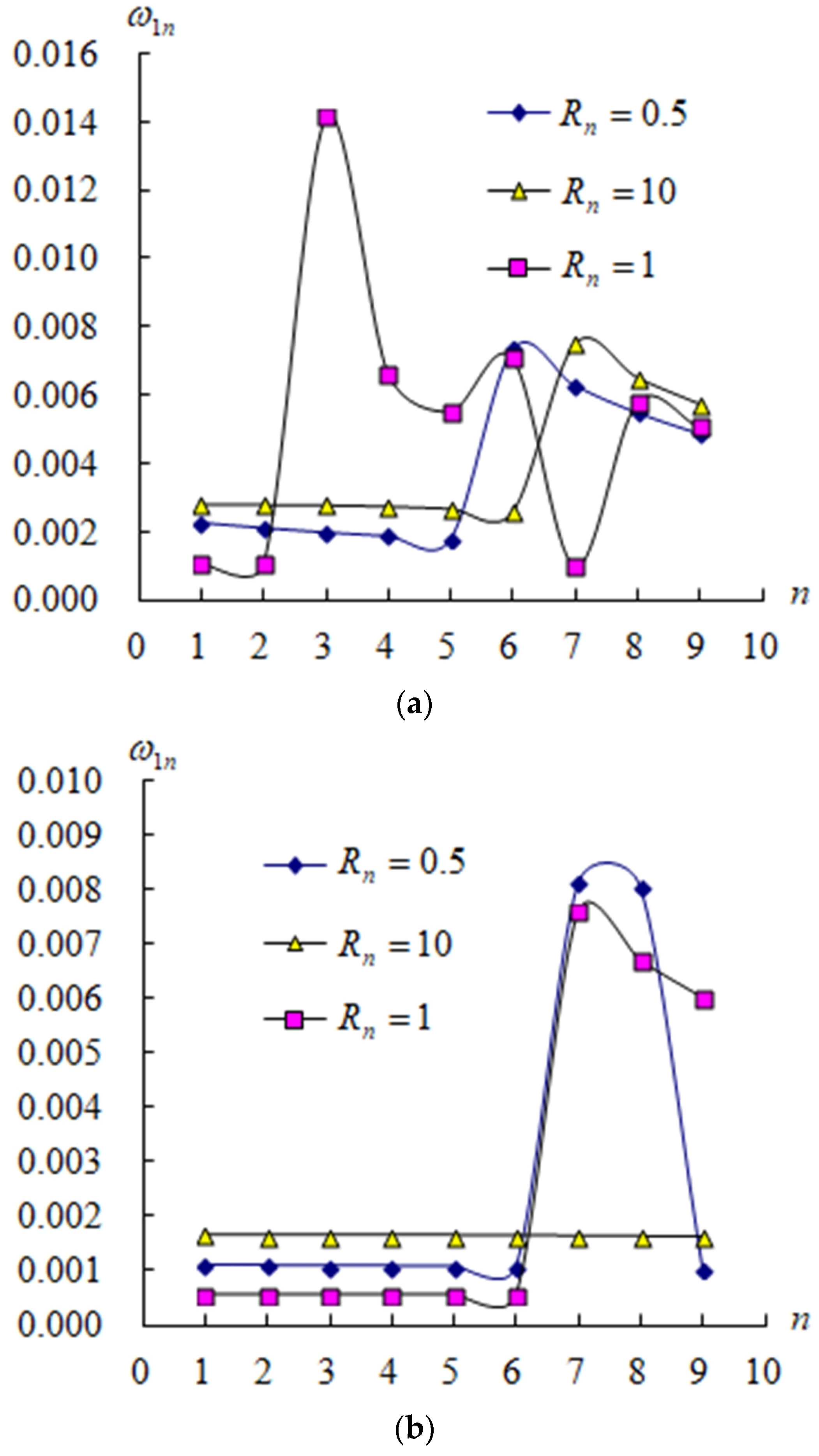
The values of dimensional ω m n for m = 1 and n = 1 to 9 vs. R n and T (K) are presented for SUS304/Si3N4. Figure 2 displays the ω 1 n (1/s) vs. R n for L / h = 5, 10, = 10 ° , advanced k α , c 1 = 0.925925/mm2 under T = 300 K. Usually for thick-walled L / h = 5 in Figure 2a, the ω 1 n values are oscillating with n , versus R n = 1; the ω 1 n values are almost constant firstly, increasing then decreasing with n , versus R n = 0.5 and 10; the maximum ω 13 = 0.014121/s is obtained for R n = 1. Thus, the ω 1 n values are affected by R n or L / h = 5. For moderately thick-walled L / h = 10 in Figure 2b, the ω 1 n values are constant with n , versus R n = 10; the ω 1 n values are a lower constant with n from 1 to 6, increasing then decreasing, versus R n = 0.5 and 1; the maximum ω 17 = 0.008109/s is obtained for R n = 0.5. Thus, the ω 1 n values are also affected by R n or L / h   = 10.
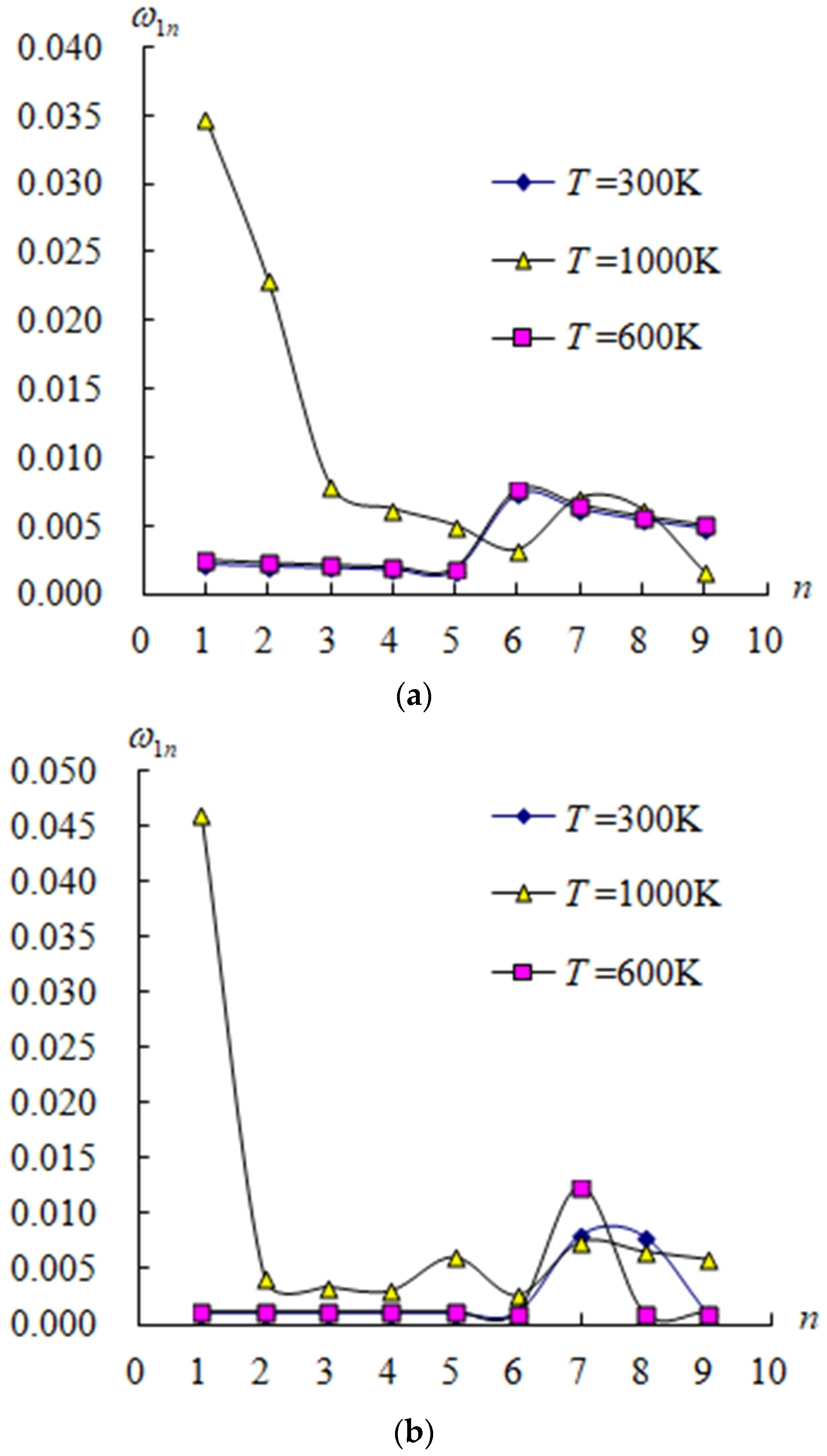
Figure 3 displays the ω 1 n (1/s) vs. T for L / h = 5, 10, = 10 ° , advanced k α , c 1 = 0.925925/mm2 and R n = 0.5. Usually for thick-walled L / h = 5 in Figure 3a, the ω 1 n values are constant with n from 1 to 5, increasing with n from 5 to 6 versus T = 300 K and 600 K, but decreasing with n from 1 to 6 versus T = 1000 K; the maximum ω 11 = 0.034761/s is obtained for T = 1000 K. Thus, the ω 16 and ω 19 values have the endurance ability on higher environment-temperature 1000 K for L / h = 5. For moderately thick-walled L / h = 10 in Figure 3b, the ω 1 n values are constant with n from 1 to 6 versus T = 300 K and 600 K; the maximum ω 11 = 0.046005/s is obtained for T = 1000 K. Thus, the ω 17 value has the endurance ability in a higher environment-temperature of 1000 K for L / h = 10.

4. Discussions

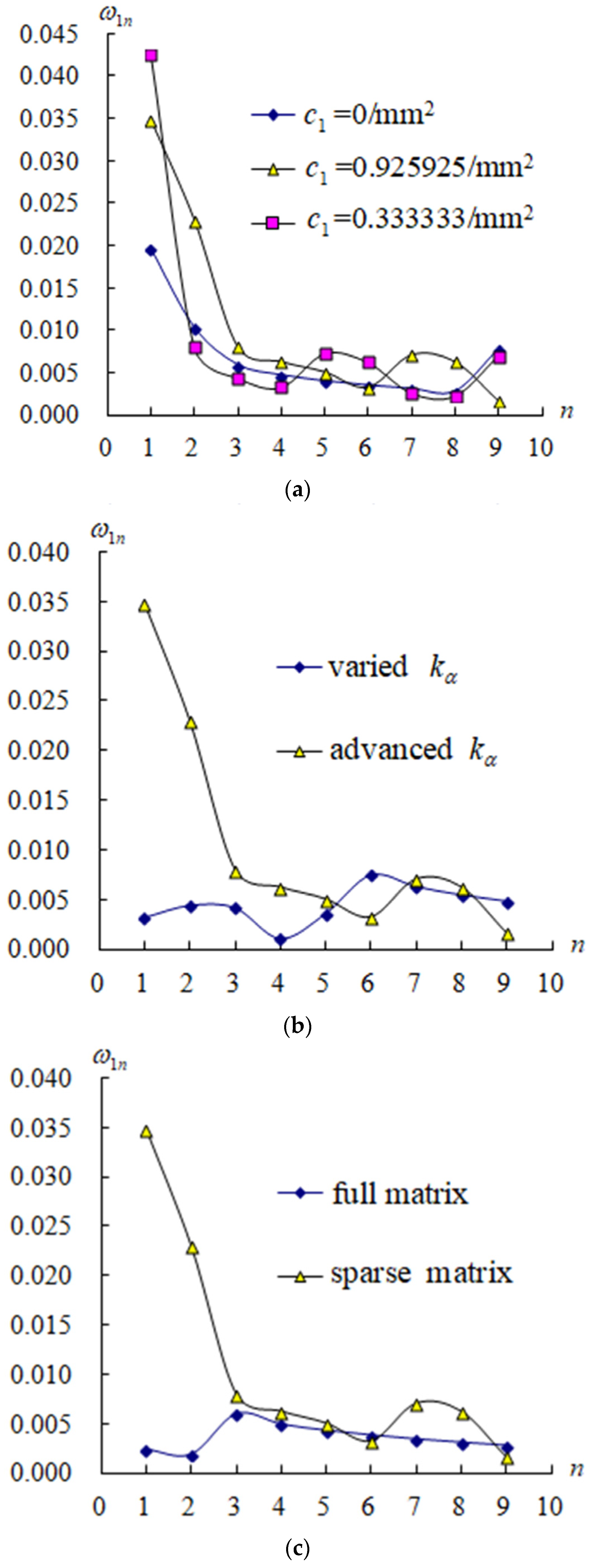
The variation of natural frequency compared ω 1 n (1/s) with respect to c 1 and k α requires further clarification on = 10 ° , L / h = 5, R n = 0.5, T = 1000 K are displayed in Figure 4. The effects of c 1 value are displayed in Figure 4a for ω 1 n , values are decreasing for n = 1 to 6, ω 1 n values on c 1 = 0.925925/mm2 are greater than on c 1 = 0/mm2 for n = 1 to 8, ω 1 n values on c 1 = 0.333333/mm2 are greater than on c 1 = 0.925925/mm2 for n = 1 and oscillate close on c 1 = 0/mm2 for n = 2 to 9. The effects of k α value are displayed in Figure 4b for ω 1 n values on advanced k α [21] are greater than on varied k α [20] for n = 1 to 5, and the ω 1 n values are in sinusoidal oscillating on varied k α case. Basically, the values of advanced k α [21] are mainly functions of material properties E 1 , E 2 , R n , T, which are primarily from stiffness redistribution, but not a function of h which is from a thickness-wise examination of the strain energy approach, and c 1 which is from a correction associated with the assumed kinematic TSDT model. The values of varied k α [20] are mainly functions of material properties E 1 , E 2 , R n , T, and h , but not a function of c 1 .
Thus, when c 1 = 0/mm2 is used, the structure behaves classically for FSDT, whereas when c 1 ≠ 0 is used, e.g., c 1 = 0.333333/mm2 on h = 2 mm and c 1 = 0.925925/mm2 on h = 1.2 mm dominate the h size effects for TSDT. There is a critical temperature, e.g., greater than 600 K or a thickness ratio, e.g., L / h less than 10 for a thick-walled study where local effects become not negligible due to thermal effects for FGMs. The dependence of ω m n on higher mode numbers (m,n ≤ 9) results in very low frequency values. This free vibration behavior is physically expected for thick-walled spherical FGM shells in the given typically sinusoidal displacements and shear rotations. The numerical truncation effects involved in the compared ω 1 n descriptions are displayed in Figure 4c with a presented simple homogeneous equation in a symmetrical sparse matrix (12) and a fully homogeneous equation in a symmetrical full matrix [20]. The assumed simplification in the sparse matrix causes a numerical truncation error, e.g., a large different ω 1 n value occurs at n = 1 and 2; the ω 1 n values of the presented sparse matrix are greater than those in the full matrix. The variation of natural frequency compared ω 1 n , λ 1 n = I 0 ω 1 n 2 with respect to L / h value on = 10 ° , c 1 = 0.925925/mm2, R n = 0.5, 1, 10, T = 300 K are displayed in Figure 2. For L / h = 5, it is displayed in Figure 2a, and for L / h = 10, it is displayed in Figure 2b due to the R n power function of Young’s modulus in the expression E f g m = E 2 E 1 ( z + h / 2 h ) R n + E 1 for FGMs [21]. This E f g m dominates thickness and affects bending-shear coupling for ω 1 n data with L / h = 10 showing slightly lower frequencies than L / h = 5. In Figure 3a, the frequency increases with moderate temperatures T = 600 K but decreases at T = 1000 K. The physical phenomenon causes this trend reversal at high temperature due to the individual temperature-natural material property P i , e.g., E 1 , E 2 , etc. are expressed in P i = P 0 ( P 1 T 1 + 1 + P 1 T + P 2 T 2 + P 3 T 3 ) , in which P 0 , P 1 , P 1 , P 2 , and P 3 denote coefficients of temperature for FGMs [20]. The values of advanced k α expression in (6) are non-dimensional and nonlinear and functions of c 1 , R n , and T , but are not functions of h for thick-walled FGMs [22]. The physical meaning of advanced k α is used to obtain an auto-calculation adjustment value rather than an assumed constant positive value for the transverse stiffness and transverse shear stress. Thus k α behaves unusually, e.g., k α > 1 or k α < 0 due to the given values of c 1 , R n , and T . There are many key parameters studied in the applied mathematical simulation for the FGM spherical shell structure under numerical free vibration. In theory and simulation go first, this is why certain parameters, e.g., advanced shear correction, temperature, and power-law index R n = 0.1 are closely related to ceramic Si3N4; R n = 10 is closely related to metal SUS304, which leads to the influence on increases or decreases in natural frequencies by solving the homogeneous equation in a sparse matrix or a full matrix.
In particular, it is interesting in the related works on nonlinear vibration in 2025 by Putranto et al. [25] and equivalent single-layer (ESL) modeling in 2024 by Putranto [26] to discuss the broader context of advanced structural dynamics. A brief comparison of modeling philosophy and applicability would be valuable if possible in the future. A numerical flowchart summarizing the modeling steps, assumptions, and solution procedure to improve readability is displayed in Figure 5. The comparisons with selected published results would show more agreement in the exact choice of benchmark studies, e.g., FGM type, k α value, c 1 value, sparse matrix, and full matrix. If possible, one further comparison with an ESL-based solution would be more confidence in the future.

5. Conclusions

The parameters of dimensional natural frequency and non-dimensional frequency, respectively, on = 10 ° ,   45 ° , and 90 ° are presented with the simply symmetrical sparse matrix of thick-walled FGM spherical shells subjected to free vibration. Four main effects on frequency values are considered. They are the advanced shear coefficient, the nonlinear TSDT term c 1 of displacements, the FGM power law index, and the environment temperature. The novel and important numerical results are obtained in the following: the frequency parameters f , Ω data are presented and subjected to c 1 effect; the natural frequency ω m n data vs. R n and T subjected to mode-shape number m , n are computed; the frequency values are studied for thick-walled FGM SUS304/Si3N4 spherical shells by using advanced k α . This is a new finding, as the assumed simplification in a sparse matrix causes a numerical truncation error; the ω 1 n values at n = 1 and 2 of the presented sparse matrix are much greater than those in the full matrix for thick-walled FGM spherical shells.

Funding

This research received no external funding.

Data Availability Statement

The original contributions presented in the study are included in the article; further inquiries can be directed to the corresponding authors.

Acknowledgments

The author expresses his thanks to the people helping with this work and acknowledges the valuable suggestions from the peer reviewers.

Conflicts of Interest

The author declares no conflicts of interest.

Abbreviations

The following symbols and abbreviations are used in the nomenclature list for this manuscript:
FGMFunctionally Graded Material
FGMsFunctionally Graded Materials
FG-GPLRCFunctionally Graded Graphene Platelets Reinforced Composite
FGPSSFunctionally Graded Porous Spherical Shell
CSCSCombined Spherical-Cylindrical-Spherical
CFRPCarbon Fiber-Reinforced Polymer
GFRPGlass Fiber Reinforced Plastic
FSDTFirst-order Shear Deformation Theory
TSDTThird-order Shear Deformation Theory
HSDTHigher-order Shear Deformation Theory
HOZTHigher Order Zigzag Theory
PETPlane-Elasticity Theory
PDEPartial Differential Equation
ESLEquivalent Single-Layer
2DTwo-Dimensional
3DThree-Dimensional
r ,   θ ,   A   point   in   spherical   axes   r ,   θ ,  
(x, y, z)A point in Cartesian axes x, y, z
r Radius
θ Circumferential angle
Angle   between   z   axis   and   r axis
u , v , w Displacements in x axis, y axis, z axis
u 0 , v 0 Tangential   displacements   in   x ,   θ axes of the middle-plane of shells
w Transverse   displacement   in   Z axis of the middle-plane of shells
L x axial length of shells
c 1 c 1 = 4 / 3 h 2 , Nonlinear TSDT term of z3
h h = h 1 + h 2 , Total thickness of shells
h 1 Inner layer thickness
h 2 Outer layer thickness
ϕ x , ϕ θ Shear   rotations   in   x ,   θ axes of the middle-plane of shells
R Middle-surface radius of shells
tTime
A i s j s H i s j s Stiffness   integrals ,   i s , j s = 1 , 2 , 6 ,
A i j H i j Stiffness   integrals ,   i , j = 4 , 5
Q ¯ i s j s , Q ¯ i j Stiffness ,   i s , j s = 1 , 2 , 6 ,   i , j = 4 , 5
k α Shear correction
E 1 ,   E 2 Young’s modulus on FGM constituent materials 1 and 2
ρ 1 Density on FGM constituent material 1
R n Power law index
P i Property   of   constituent   material   P i = P 0 P 1 T 1 + 1 + P 1 T + P 2 T 2 + P 3 T 3
P 1 , P 0 P 3 Coefficients of temperature for FGM constituent material
E f g m Young s   modulus   on   FGMs ,   E f g m = E 2 E 1 ( z + h / 2 h ) R n + E 1
T Environment-temperature
Δ T Temperature-difference
p 1 , p 2 In-plane distributed forces
q External pressure load
f 1 , f 2 f 5 External loads
a m n e m n Amplitudes of sinusoidal displacements and shear rotations
ω m n Free vibration frequency with subscripts m, n denote mode shape number
λ m n λ m n = I 0 ω m n 2
I i Density   integrals   I i = k = 1 N k k + 1 ρ ( k ) z i d z , i = 0, 1, 2,…, 6
ρ k Density of the (k)th ply
J i J i = I i c 1 I i + 2 , i = 1, 4
K 2 K 2 = I 2 2 c 1 I 4 + c 1 2 I 6
N Total number of layers
L / h Length to thickness ratio
L / R Length to radius ratio
f Non-dimensional frequency,   f = 4 π ω 11 R I 2 / A 11
Ω Non-dimensional frequency,   Ω = ω 11 L 2 / h ρ 1 / E 1

Appendix A

The coefficients F H 11 ,   , F H 55 in Equation (12) are listed as follows,
F H 11 = A 11 m π / L 2 + A 66 n π / R 2 ,
F H 12 = A 12 + A 66 m π / L n π / R ,
F H 22 = A 66 m π / L 2 + A 22 n π / R 2 ,
F H 33 = A 55 m π / L 2 + A 44 n π / R 2 + c 1 2 H 11 m π / L 4 + ( 2 c 1 2 H 12 + 4 c 1 2 H 66 ) m π / L 2 n π / R 2 + c 1 2 H 22 n π / R 4 3 c 1 ( 2 D 55 3 c 1 F 55 ) m π / L 2 3 c 1 2 D 44 3 c 1 F 44 n π / R 2 ,
F H 34 = A 55 m π / L ( c 1 F 11 c 1 2 H 11 )   m π / L 3 ( 2 c 1 F 66 2 c 1 2 H 66 + c 1 F 12 c 1 2 H 12 ) m π / L n π / R 2 ( 6 c 1 D 55 9 c 1 2 F 55 ) m π / L ,
F H 35 = A 44 n π / R ( c 1 F 22 c 1 2 H 22 ) n π / R 3 ( 2 c 1 F 66 2 c 1 2 H 66 + c 1 F 12 c 1 2 H 12 ) m π / L 2 n π / R ( 6 c 1 D 44 9 c 1 2 F 44 ) n π / R ,
F H 44 = ( D 11 2 c 1 F 11 + c 1 2 H 11 ) m π / L 2 + ( D 66 2 c 1 F 66 + c 1 2 H 66 ) n π / R 2 + A 55 6 c 1 D 55 + 9 c 1 2 F 55 ,
F H 45 = ( D 12 + D 66 2 c 1 F 12 + 2 c 1 2 H 12 2 c 1 F 66 + c 1 2 H 66 ) m π / L n π / R ,
F H 55 = ( D 66 2 c 1 F 66 + c 1 2 H 66 ) m π / L 2 + ( D 22 2 c 1 F 22 + c 1 2 H 22 ) n π / R 2 + A 44 6 c 1 D 44 + 9 c 1 2 F 44 .
The coefficients A 1 ,   , A 6 in Equation (13) are listed as follows,
A ( 1 ) = s d ,
A ( 2 ) = ( F H 11 + F H 22 ) s d + s c ,
A ( 3 ) = [ ( F H 11 F H 22 F H 12 F H 12 ) s d + ( F H 11 + F H 12 ) s c + s b ] ,
A ( 4 ) = ( F H 11 F H 22 F H 12 F H 12 ) s c + ( F H 11 + F H 22 ) s b + s a ,
A ( 5 ) = [ ( F H 11 F H 22 F H 12 F H 12 ) s b + ( F H 11 + F H 22 ) s a ] ,
A ( 6 ) = ( F H 11 F H 22 F H 12 F H 12 ) s a ,
in which
s d = ( K 2 / I 0 ) 2 ,
s c = F H 33 s d + F H 44 K 2 / I 0 ,
s b = ( F H 33 F H 55 + F H 44 F H 55 + F H 33 F H 44 F H 35 F H 35 F H 34 F H 34 ) K 2 / I 0 F H 45 F H 45 ,
s a = F H 33 F H 44 F H 55 + F H 44 F H 34 F H 35 + F H 35 F H 34 F H 45 F H 35 F H 35 F H 44 F H 34 F H 34 F H 55 F H 45 F H 45 F H 33 .

References

  1. Bagheri, H.; Kiani, Y.; Eslami, M.R. Free vibration of FGM conical–spherical shells. Thin-Walled Struct. 2021, 160, 107387. [Google Scholar] [CrossRef]
  2. Liu, D.; Zhou, Y.; Zhu, J. On the free vibration and bending analysis of functionally graded nanocomposite spherical shells reinforced with graphene nanoplatelets: Three-dimensional elasticity solutions. Eng. Struct. 2021, 226, 111376. [Google Scholar] [CrossRef]
  3. Tang, H.; Dai, H.L. Nonlinear vibration analysis of CFRP spherical shell panel under hygrothermal effects. Compos. Struct. 2021, 274, 114343. [Google Scholar] [CrossRef]
  4. Roy, S.; Thakur, S.N.; Ray, C. Free vibration analysis of laminated composite hybrid and GFRP shells based on higher order zigzag theory with experimental validation. Eur. J. Mech. A Solids 2021, 88, 104261. [Google Scholar] [CrossRef]
  5. Sayyad, A.S.; Ghugal, Y.M. Static and free vibration analysis of laminated composite and sandwich spherical shells using a generalized higher-order shell theory. Compos. Struct. 2019, 219, 129–146. [Google Scholar] [CrossRef]
  6. Li, H.; Cong, G.; Li, L.; Pang, F.; Lang, J. A semi analytical solution for free vibration analysis of combined spherical and cylindrical shells with non-uniform thickness based on Ritz method. Thin-Walled Struct. 2019, 145, 106443. [Google Scholar] [CrossRef]
  7. Li, H.; Pang, F.; Ren, Y.; Miao, X.; Ye, K. Free vibration characteristics of functionally graded porous spherical shell with general boundary conditions by using first-order shear deformation theory. Thin-Walled Struct. 2019, 144, 106331. [Google Scholar] [CrossRef]
  8. Fantuzzi, N.; Brischetto, S.; Tornabene, F.; Viola, E. 2D and 3D shell models for the free vibration investigation of functionally graded cylindrical and spherical panels. Compos. Struct. 2016, 154, 573–590. [Google Scholar] [CrossRef]
  9. Sepiani, H.A.; Rastgoo, A.; Ebrahimi, F.; Arani, A.G. Vibration and buckling analysis of two-layered functionally graded cylindrical shell considering the effects of transverse shear and rotary inertia. Mater. Des. 2010, 31, 1063–1069. [Google Scholar] [CrossRef]
  10. Zannon, M.; Abu-Rqayiq, A.; Al-bdour, A. Free vibration analysis of thick FGM spherical shells based on a third-order shear deformation theory. Eur. J. Pure Appl. Math. 2020, 13, 766–778. [Google Scholar] [CrossRef]
  11. Keibolahi, A.; Kiani, Y.; Eslami, M.R. Nonlinear dynamic snap-through and vibrations of temperature-dependent FGM deep spherical shells under sudden thermal shock. Thin-Walled Struct. 2023, 185, 110561. [Google Scholar] [CrossRef]
  12. Khoa1, N.M.; Tung, H.V. Nonlinear thermo-mechanical stability of shear deformable FGM sandwich shallow spherical shells with tangential edge constraints. Vietnam J. Mech. 2017, 39, 351–364. [Google Scholar] [CrossRef][Green Version]
  13. Zhang, Z.; Feng, Z.; Shi, Z.; Xie, H.; Sun, Y.; Gu, Z.; Xiao, J.; Xu, J. Static analysis of temperature-Dependent FGM spherical shells under thermo-mechanical loads. Buildings 2025, 15, 2709. [Google Scholar] [CrossRef]
  14. Nejad, M.Z.; Abedi, M.; Alavi, N. Elastic analysis of FGM solid sphere with parabolic varying properties. J. Comput. Appl. Mech. 2026, 57, 1–10. [Google Scholar]
  15. Dastjerdi, S.; Malikan, M.; Eremeyev, V.A.; Akgöz, B.; Civalek, Ö. On the generalized model of shell structures with functional cross-sections. Compos. Struct. 2021, 272, 114192. [Google Scholar] [CrossRef]
  16. Arslan, E.; Mack, W. Sensitivity of predicted stresses in thick-walled steel/ceramics spherical FGM-structures to parameter uncertainties. Proc. Appl. Math. Mech. 2022, 22, 1. [Google Scholar] [CrossRef]
  17. Khaire, P.; Ambhore, N.; Jagtap, K.R. Nonlinear free vibration analysis of functionally graded materials spherical shell using higher order shear deformation theory. Int. J. Eng. Res. Tech. 2014, 3, 3. [Google Scholar]
  18. Zeverdejani, P.K.; Kiani, Y. Radially symmetric response of an FGM spherical pressure vessel under thermal shock using the thermally nonlinear Lord-Shulman model. Int. J. Pres. Vessel. Pip. 2020, 182, 104065. [Google Scholar] [CrossRef]
  19. Shariyat, M.; Ghafourinam, M. Hygrothermomechanical creep and stress redistribution analysis of thick-walled FGM spheres with temperature and moisture dependent material properties and inelastic radius changes. Int. J. Pres. Vessel. Pip. 2019, 169, 94–114. [Google Scholar] [CrossRef]
  20. Hong, C.C. Free vibration frequency of thick FGM spherical shells with simply homogeneous equation by using TSDT. J. Braz. Soc. Mech. Sci. Eng. 2020, 42, 159. [Google Scholar] [CrossRef]
  21. Hong, C.C. Advanced frequency of thick FGM cylindrical shells with fully homogeneous equation. J. Struct. Eng. Appl. Mech. 2024, 7, 69–83. [Google Scholar] [CrossRef]
  22. Hong, C.C. Advanced dynamic responses of thick FGM spherical shells analyzed using TSDT under thermal vibration. Computation 2025, 13, 245. [Google Scholar] [CrossRef]
  23. Conte, S.D.; de Boor, C. Elementary Numerical Analysis, an Algorithmic Approach, 3rd ed.; McGraw-Hill Book Company: New York, NY, USA, 1980. [Google Scholar]
  24. Li, H.; Pang, F.; Miao, X.; Gao, S.; Liu, F. A semi analytical method for free vibration analysis of composite laminated cylindrical and spherical shells with complex boundary conditions. Thin-Walled Struct. 2019, 136, 200–220. [Google Scholar] [CrossRef]
  25. Putranto, T.; Yulianto, T.; Sujiatanti, S.H.; Setyawan, D.; Zakki, A.F.; Alie, M.Z.M.; Wibowo, W. Numerical analysis of composite stiffened NiTiNOL–Steel wire ropes and panels undergoing nonlinear vibrations. Modelling 2025, 6, 77. [Google Scholar] [CrossRef]
  26. Putranto, T. Equivalent single layer approach for ultimate strength analysis of box girder under bending load. Ocean Eng. 2024, 292, 116535. [Google Scholar] [CrossRef]
Figure 1. Coordinate systems of spherical axes and Cartesian axes for FGM spherical shells on T effect.
Appliedmath 06 00042 g001
Figure 2. ω 1 n (1/s) vs. R n under T = 300 K for: (a) L / h = 5; (b) L / h = 10.
Appliedmath 06 00042 g002
Figure 3. ω 1 n (1/s) vs. T (K) for: (a) L / h = 5; (b) L / h = 10.
Appliedmath 06 00042 g003
Figure 4. Compared ω 1 n (1/s) for: (a) c 1 = 0/mm2, c 1 = 0.333333/mm2, and c 1 = 0.925925/mm2; (b) advanced k α [21] and varied k α [20]; (c) sparse matrix and full matrix [20].
Appliedmath 06 00042 g004
Figure 5. A numerical flowchart.
Appliedmath 06 00042 g005
Table 1. Values of advanced k α and varied k α vs. R n under T = 300 K and 1000 K.
c 1
(1/mm2)
T (K)Advanced kα by Hong [21]
R n = 0.1 R n = 0.2 R n = 0.5 R n = 1 R n = 2 R n = 5 R n = 10
0.925925300−0.821565−0.861923−1.181503−4.3923411.4748440.5839270.463617
03000.8984260.9564981.0878911.1957211.2261061.1219591.019034
0.9259251000−0.189321−0.185984−0.195625−0.252506−0.5328981.5902310.610227
010000.9329491.0292931.2760621.5165311.6168201.4198041.206723
Varied k α by Hong [20]
0.925925300--0.1026770.1385730.217517-0.492255
0300--0.1026770.1385730.217517-0.492255
0.92592510000.0575190.0593820.0679070.0881080.1378120.2706740.355043
010000.0575190.0593820.0679070.0881080.1378120.2706740.355043
Table 2. f for SUS304/Si3N4 on = 10 ° .
L / h R n c 1
(1/mm2)
f
Present Solution, Advanced   k α
T = 1 KT = 100 KT = 300 KT = 600 KT = 1000 K
50.50.925925
0
34.831550
59.372345
38.937732
84.997497
4.556338
35.301105
5.242971
38.132156
78.854614
44.269439
10.925925
0
37.521785
35.943412
31.496433
36.446735
2.192647
69.074363
2.675805
40.791358
82.710907
49.129543
20.925925
0
3.172364
39.290824
10.797158
75.432434
15.345757
40.402904
15.711335
43.702884
56.756023
54.894638
100.925925
0
6.224920
45.137218
6.270420
95.846450
6.432409
44.748584
6.987969
48.461200
8.692406
65.753356
80.50.925925
0
87.841110
214.01928
6.917023
89.241149
4.426317
156.25784
5.012203
101.19923
204.07486
115.87066
10.925925
0
7.279757
94.427879
5.191968
96.072174
2.306787
99.888313
2.802402
107.94323
129.80630
248.56913
20.925925
0
3.276158
103.03987
19.200660
103.89609
26.983800
106.81732
27.396707
270.33493
11.700458
142.53106
100.925925
0
7.108106
118.49715
7.159274
117.54760
7.341172
118.49424
7.977503
128.28086
9.923837
170.61027
100.50.925925
0
8.548742
279.42364
6.684215
133.86978
4.432353
141.63438
5.011566
152.74237
208.72235
279.82177
10.925925
0
6.999097
140.05490
5.163668
143.49270
2.336681
150.47529
2.836246
162.35302
194.80217
185.68304
20.925925
0
3.306802
152.07115
24.810934
154.55258
33.525913
160.42941
34.126480
173.18660
11.050667
205.30691
100.925925
0
7.350216
173.77079
7.403072
174.01590
7.590321
177.39599
8.248464
366.27481
10.257929
242.93650
Table 3. f for SUS304/Si3N4 on = 45 ° .
L / h R n c 1
(1/mm2)
f
Present Solution, Advanced   k α
T = 1 KT = 100 KT = 300 KT = 600 KT = 1000 K
50.50.925925
0
8.463405
6.625898
9.136831
7.118206
10.136724
7.947797
10.686658
8.430737
9.802042
7.683148
10.925925
0
8.861703
6.976523
12.407337
7.458821
10.585899
8.277026
11.246615
8.777153
11.014883
8.156356
20.925925
0
9.246535
7.330720
9.915120
7.796439
11.062045
8.596633
11.759777
9.119574
11.014883
8.678068
100.925925
0
10.029774
7.824207
10.607832
8.254026
11.644557
9.016480
12.391345
9.586984
12.175586
9.520373
80.50.925925
0
5.774473
4.529300
6.245143
4.894484
7.072479
5.521222
7.499098
5.859288
6.646452
15.97286
10.925925
0
6.030556
4.728994
6.499904
5.088683
7.209340
5.709747
7.564799
6.060668
7.008310
22.498374
20.925925
0
12.304396
4.956110
6.783788
5.306417
23.838476
5.917467
24.658657
6.283709
7.438728
24.460136
100.925925
0
6.809462
15.525394
7.224026
17.441642
7.968572
21.958253
8.469730
21.647085
8.213203
16.823829
100.50.925925
0
4.888590
12.409802
5.286721
13.939558
5.980225
16.848964
6.343058
16.896772
5.625683
12.830549
10.925925
0
5.104107
14.62383
5.499571
16.566768
1.546536
20.627670
9.123397
19.451889
5.931276
14.381142
20.925925
0
5.371245
15.131563
5.784337
16.883903
6.357991
20.445615
6.751663
19.658353
6.294243
15.280694
100.925925
0
5.765657
12.868285
6.117527
13.937146
6.750018
15.918221
7.174003
16.623294
6.951572
14.781123
Table 4. f for SUS304/Si3N4 on = 90 ° .
L / h R n c 1
(1/mm2)
f
Present Solution, Advanced   k α
T = 1 KT = 100 KT = 300 KT = 600 KT = 1000 K
50.50.925925
0
3.180231
5.373269
3.437422
5.900316
3.883499
6.836672
4.120175
7.190872
3.663467
5.986253
10.925925
0
3.320887
5.676170
3.575643
6.208767
3.975845
7.160784
0.922096
7.515075
3.863254
6.343256
20.925925
0
3.492469
5.922058
3.733553
6.440915
4.141279
7.375738
4.398373
7.747935
4.100106
6.706929
100.925925
0
3.756472
6.152549
3.984605
6.615449
4.394351
7.462710
4.670895
7.898860
4.532107
7.257466
80.50.925925
0
2.239428
4.160760
2.420821
4.516713
2.734613
5.131114
2.901336
5.437644
2.577111
4.752500
10.925925
0
2.337628
4.345048
2.516835
4.697000
10.076400
5.307589
3.009658
5.623309
2.716942
5.000139
20.925925
0
2.452844
4.543049
3.294041
4.886523
2.921348
5.488020
3.102310
5.817079
2.882582
5.291233
100.925925
0
2.643668
4.871469
2.804904
5.191528
3.095393
5.766388
3.289649
6.127082
3.186127
5.840260
100.50.925925
0
1.926534
3.864588
2.082611
4.189507
2.352230
4.749449
2.495704
5.036603
2.217462
4.427573
10.925925
0
2.010933
4.032133
2.165022
4.352602
2.439111
4.908469
2.586515
5.204863
2.337732
4.656122
20.925925
0
2.109406
4.217228
5.662171
4.530303
2.514311
5.077848
2.670045
5.386767
2.480144
4.928913
100.925925
0
2.274468
4.538136
2.413341
4.830076
2.663402
5.354484
2.830519
5.691110
2.741575
5.452303
Table 5. Ω for SUS304/Si3N4 on = 10 ° .
L / h R n c 1
(1/mm2)
Ω
Present Solution, Advanced k α
T = 1 KT = 100 KT = 300 KT = 600 KT = 1000 K
50.50.925925
0
63.351696
107.98654
69.176635
151.00625
7.872272
60.991939
9.094638
66.145347
153.35162
86.092491
10.925925
0
65.387298
62.636749
53.840740
62.302898
3.664575
115.44409
4.488223
68.420784
152.57975
90.631027
20.925925
0
5.275682
65.341133
17.701944
123.67149
24.750640
65.164451
25.421075
70.711647
98.698249
95.461311
100.925925
0
9.585399
69.504226
9.606960
146.84709
9.802168
68.191116
10.674876
74.029701
13.669148
103.39972
80.50.925925
0
255.62495
622.81396
19.662015
253.67280
12.236204
431.96243
13.910944
280.86987
634.99566
360.54107
10.925925
0
20.297699
263.28744
14.200435
262.76483
6.168540
267.10961
7.520911
289.69122
383.13333
733.67102
20.925925
0
8.717268
274.17056
50.367183
272.54028
69.633987
275.65118
70.924980
699.84686
32.555198
396.57653
100.925925
0
17.512588
291.94723
17.550048
288.15298
17.899211
288.91210
19.498394
313.54055
24.968998
429.26611
100.50.925925
0
31.096941
1016.4325
23.750307
475.66513
15.316110
489.42126
17.386470
529.90429
811.82086
1088.3603
10.925925
0
24.393941
488.13305
17.653791
490.57959
7.810600
502.97924
9.514674
544.64093
718.71704
685.07226
20.925925
0
10.998508
505.79248
81.355064
506.77801
108.14557
517.50213
110.43387
560.43481
38.434036
714.0540
100.925925
0
22.636358
535.15942
22.684612
533.22229
23.133356
540.65759
25.200836
1119.0484
32.261989
764.05432
Table 6. Ω for SUS304/Si3N4 on = 45 ° .
L / h R n c 1
(1/mm2)
Ω
Present Solution, Advanced   k α
T = 1 KT = 100 KT = 300 KT = 600 KT = 1000 K
50.50.925925
0
15.393258
12.051197
16.232461
12.646179
17.513855
13.731909
18.537445
14.624245
19.062410
14.941716
10.925925
0
15.442839
12.157630
21.209392
12.750283
17.692232
13.833409
18.864345
14.722230
19.154790
15.046321
20.925925
0
15.377103
12.191080
16.255842
12.782263
17.841590
13.865214
19.027420
14.755550
19.154790
15.091087
100.925925
0
15.444276
12.048050
16.252342
12.646059
17.744815
13.739962
18.929115
14.645152
19.146585
14.971159
80.50.925925
0
16.804197
13.180641
17.752159
13.912838
19.551309
15.262979
20.813110
16.261955
20.680982
49.700874
10.925925
0
16.814628
13.185563
17.777742
13.917944
19.278373
15.268340
20.301931
16.265239
20.685569
66.405693
20.925925
0
32.739784
13.187316
17.795236
13.919798
61.517211
15.270527
63.836673
16.267355
20.697420
68.057556
100.925925
0
16.776804
38.250671
17.708782
42.755966
19.428937
53.538513
20.701482
52.909210
20.664934
42.329807
100.50.925925
0
17.782756
45.141944
18.784742
49.529937
20.664821
58.222026
22.005773
58.619442
21.880968
49.904129
10.925925
0
17.789335
50.968433
18.802192
56.639240
5.1694598
68.950126
30.605995
65.254684
21.883276
53.058815
20.925925
0
17.864898
50.327957
18.966844
55.362327
20.509168
65.952049
21.848499
63.614772
21.891271
53.145999
100.925925
0
17.756412
39.630275
18.745422
42.706424
20.572330
48.514667
21.918127
50.787746
21.863239
46.487785
Table 7. Ω for SUS304/Si3N4 on = 90 ° .
L / h R n c 1
(1/mm2)
Ω
Present Solution, Advanced   k α
T = 1 KT = 100 KT = 300 KT = 600 KT = 1000 K
50.50.925925
0
5.784212
9.772912
6.106911
10.482480
6.709765
11.812148
7.146997
12.473533
7.124487
11.641697
10.925925
0
5.787141
9.891572
6.112288
10.613412
6.644836
11.967831
1.546665
12.605302
7.126682
11.701632
20.925925
0
5.808020
9.848456
6.121162
10.559882
6.679326
11.896074
7.116606
12.536226
7.130050
11.663293
100.925925
0
5.784378
9.473958
6.104845
10.135582
6.696430
11.372216
7.135295
12.066360
7.126915
11.412649
80.50.925925
0
6.516922
12.108159
6.881316
12.839003
7.559621
14.184557
8.052412
15.091719
8.018895
14.787794
10.925925
0
6.517866
12.115031
6.883740
12.846661
26.945133
14.192934
8.077132
15.091481
8.019266
14.758296
20.925925
0
6.526577
12.088236
8.640930
12.818329
7.538786
14.162303
8.031305
15.059334
8.020460
14.722258
100.925925
0
6.513334
12.002076
6.875865
12.726371
7.547174
14.059581
8.040471
14.975647
8.016496
14.694459
100.50.925925
0
7.007969
14.057844
7.399919
14.886129
8.128190
16.411842
8.658269
17.473329
8.624771
17.220947
10.925925
0
7.008700
14.053184
7.401881
14.880881
8.152981
16.407068
8.676906
17.460603
8.624997
17.178630
20.925925
0
7.015937
14.026609
18.566265
14.854867
8.110490
16.379774
8.640313
17.431673
8.625900
17.142679
100.925925
0
7.004647
13.976033
7.394999
14.800395
8.117367
16.319097
8.647848
17.387567
8.622469
17.147920
Table 8. Comparison of frequency f for = 10 ° .
c 1 (1/mm2) h (mm) f
Present Solution,   L / h = 10, T = 300 K, Advanced kα, SUS304/Si3N4Sayyad and Ghugal, 2019, Spherical [5],
Without   k α
R n = 0.5 R n = 1 R n = 2
0.9259251.24.4323532.33668133.52591311.8633
0.33333329.5870665.05257867.505981-
0.0000332009649.33885082.599165,478.824-
0.00001430017,684.1289230.4921120,311.75-
0.00000360050,019.78926,110.931340,290.03-
0.00000190089,233.83543,224.820625,047.06-
Table 9. Comparison of frequency Ω for = 10 ° .
c 1
(1/mm2)
h (mm) Ω
Present Solution,   L / h   =   10 ,   T =   1000   K ,
Advanced   k α , SUS304/Si3N4
Li et al., 2019,
Spherical [24],
Constant   k α = 5/6
R n = 0.5 R n = 1 R n = 2
0.9259251.2811.82086718.7170438.43403669.520
0.33333321436.66951492.035649.932869-
0.000033200--503.02319-
0.000014300--616.26330-
0.000003600--866.81646-
0.000001900--1066.6158
Table 10. Fundamental natural frequency ω 11 under advanced k α for = 10 ° .
L / h R n c 1
(1/mm2)
ω 11 (1/s)
T = 1 KT = 100 KT = 300 KT = 600 KT = 1000 K
50.50.925925
0
0.017753
0.030261
0.019616
0.042820
0.002242
0.017373
0.002483
0.018059
0.003476
0.019515
10.925925
0
0.018323
0.017553
0.015267
0.017667
0.001043
0.032885
0.001225
0.018680
0.034586
0.020544
20.925925
0
0.001478
0.018310
0.005019
0.035069
0.007050
0.018562
0.006940
0.019306
0.022372
0.021639
100.925925
0
0.002686
0.019477
0.002724
0.041641
0.002792
0.019424
0.002914
0.020212
0.003098
0.023438
80.50.925925
0
0.027982
0.068177
0.002177
0.028099
0.001361
0.048065
0.001483
0.029955
0.056226
0.031924
10.925925
0
0.002221
0.028821
0.001572
0.029106
0.000686
0.029721
0.000802
0.030896
0.033925
0.064964
20.925925
0
0.000954
0.030012
0.005579
0.030189
0.007748
0.030672
0.007564
0.074640
0.002882
0.035115
100.925925
0
0.001917
0.031958
0.001944
0.031918
0.001991
0.032147
0.002079
0.033439
0.002210
0.038010
100.50.925925
0
0.002178
0.071210
0.001683
0.033721
0.001090
0.034853
0.001186
0.036169
0.046005
0.061677
10.925925
0
0.001709
0.034198
0.001251
0.034778
0.000556
0.035819
0.000649
0.037175
0.040729
0.038822
20.925925
0
0.000770
0.035435
0.005767
0.035926
0.007701
0.036853
0.007537
0.038253
0.002178
0.040465
100.925925
0
0.001585
0.037492
0.001608
0.037801
0.001647
0.038502
0.001720
0.076383
0.001828
0.043298
Table 11. ω m n vs. m and n under advanced k α , c 1 , R n = 0.5 and T = 300 K for = 10 ° .
c 1
(1/mm2)
L / h ω 1 n (1/s)
n = 1 n = 2 n = 3 n = 4 n = 5 n = 6 n = 7 n = 8 n = 9
0.9259255
10
0.002242
0.001090
0.002089
0.001088
0.001960
0.001084
0.001851
0.001079
0.001756
0.001072
0.007328
0.001065
0.006254
0.008109
0.005463
0.008041
0.004853
0.001039
L / h ω 2 n (1/s)
n = 1 n = 2 n = 3 n = 4 n = 5 n = 6 n = 7 n = 8 n = 9
5
10
0.002168
0.001085
0.001994
0.001080
0.007582
0.001074
0.001731
0.001065
0.001627
0.001055
0.006977
0.007626
0.006031
0.007417
0.005312
0.006967
0.004745
0.007840
L / h ω 3 n (1/s)
n = 1 n = 2 n = 3 n = 4 n = 5 n = 6 n = 7 n = 8 n = 9
5
10
0.008277
0.001076
0.007304
0.001069
0.006635
0.001058
0.016829
0.001045
0.007538
0.001030
0.006521
0.007651
0.005732
0.006915
0.005104
0.006571
0.004595
0.000960
L / h ω 4 n (1/s)
n = 1 n = 2 n = 3 n = 4 n = 5 n = 6 n = 7 n = 8 n = 9
5
10
0.006493
0.006968
0.006096
0.005591
0.001638
0.001039
0.007733
0.001021
0.006813
0.007836
0.006041
0.007046
0.005398
0.006500
0.004863
0.006990
0.004415
0.004695
L / h ω 5 n (1/s)
n = 1 n = 2 n = 3 n = 4 n = 5 n = 6 n = 7 n = 8 n = 9
5
10
0.005589
0.001050
0.001724
0.001036
0.007466
0.001017
0.006794
0.007803
0.006152
0.007085
0.005569
0.006505
0.005054
0.006635
0.004606
0.005065
0.004220
0.004736
L / h ω 6 n (1/s)
n = 1 n = 2 n = 3 n = 4 n = 5 n = 6 n = 7 n = 8 n = 9
5
10
0.007494
0.001033
0.006872
0.008056
0.006462
0.007519
0.006017
0.006956
0.005561
0.006438
0.005121
0.006257
0.004713
0.005249
0.004344
0.004903
0.004015
0.004557
L / h ω 7 n (1/s)
n = 1 n = 2 n = 3 n = 4 n = 5 n = 6 n = 7 n = 8 n = 9
5
10
0.006218
0.007327
0.005948
0.007031
0.005680
0.006659
0.005372
0.006258
0.005042
0.005948
0.004709
0.005277
0.004387
0.004968
0.004086
0.004640
0.003809
0.004335
L / h ω 8 n (1/s)
n = 1 n = 2 n = 3 n = 4 n = 5 n = 6 n = 7 n = 8 n = 9
5
10
0.005418
0.006453
0.005243
0.006236
0.005056
0.005970
0.004836
0.005699
0.004592
0.005127
0.004337
0.004938
0.004083
0.004650
0.003838
0.004370
0.003606
0.002626
L / h ω 9 n (1/s)
n = 1 n = 2 n = 3 n = 4 n = 5 n = 6 n = 7 n = 8 n = 9
5
10
0.004813
0.005772
0.004686
0.005605
0.005550
0.005418
0.004388
0.005482
0.004203
0.004817
0.004006
0.004591
0.003804
0.004349
0.003604
0.002527
0.003411
0.007561
Disclaimer/Publisher’s Note: The statements, opinions and data contained in all publications are solely those of the individual author(s) and contributor(s) and not of MDPI and/or the editor(s). MDPI and/or the editor(s) disclaim responsibility for any injury to people or property resulting from any ideas, methods, instructions or products referred to in the content.