The Chain Rule for Fractional-Order Derivatives: Theories, Challenges, and Unifying Directions




Abstract
1. Introduction

- Historical and Conceptual Overview: A concise overview of how fractional derivatives evolved from classical to modern formulations, highlighting their key mathematical principles.
- Unified Classification Criterion: A criterion, , that builds upon previous schemes (e.g., ) to systematically guide the derivation of chain rules across different FDs.
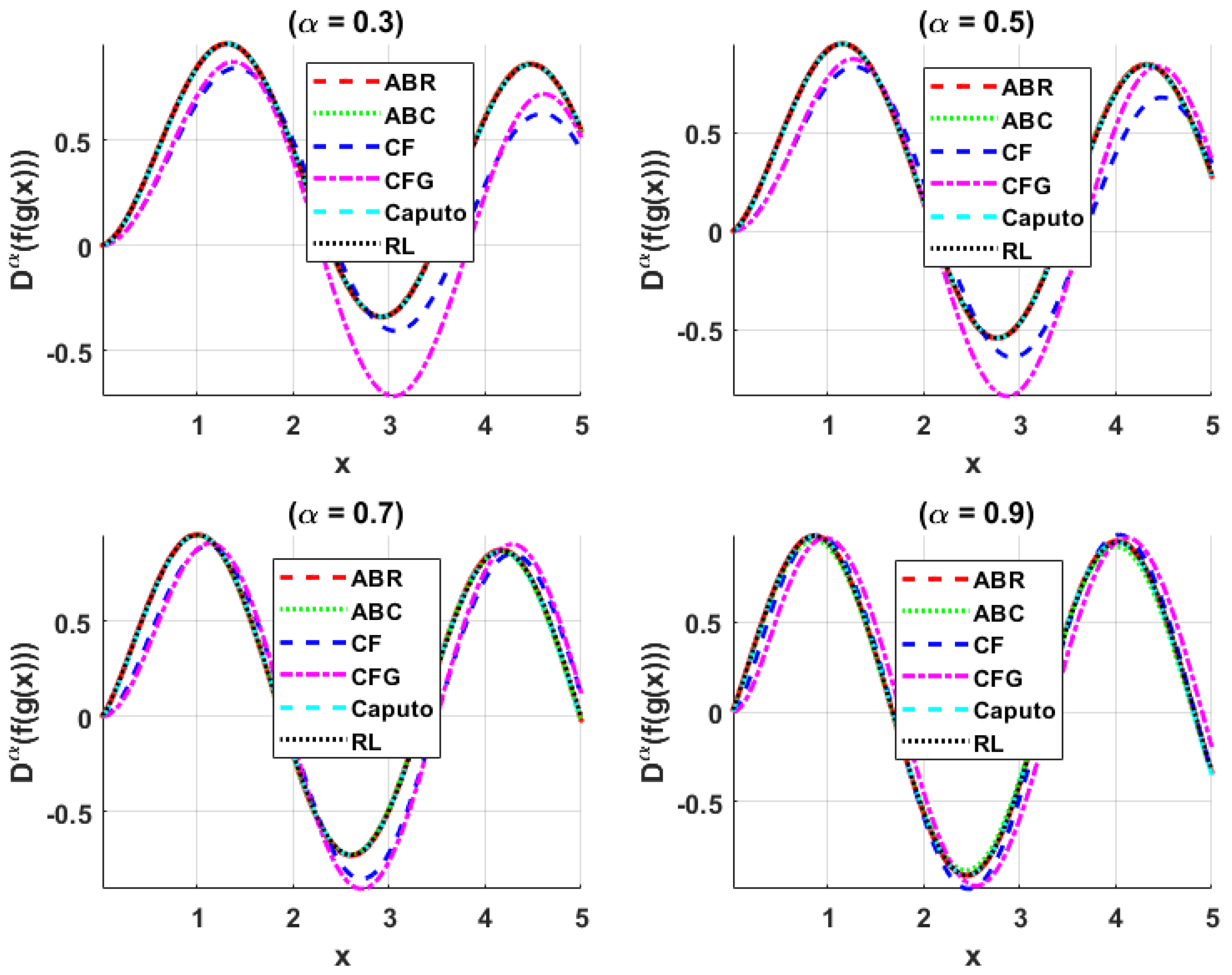
- Survey of Chain Rule Formulations: A comprehensive review of major fractional operators (RL, Caputo, CF, ABR, ABC, CFG), detailing how their kernel structures influence the corresponding chain rules.
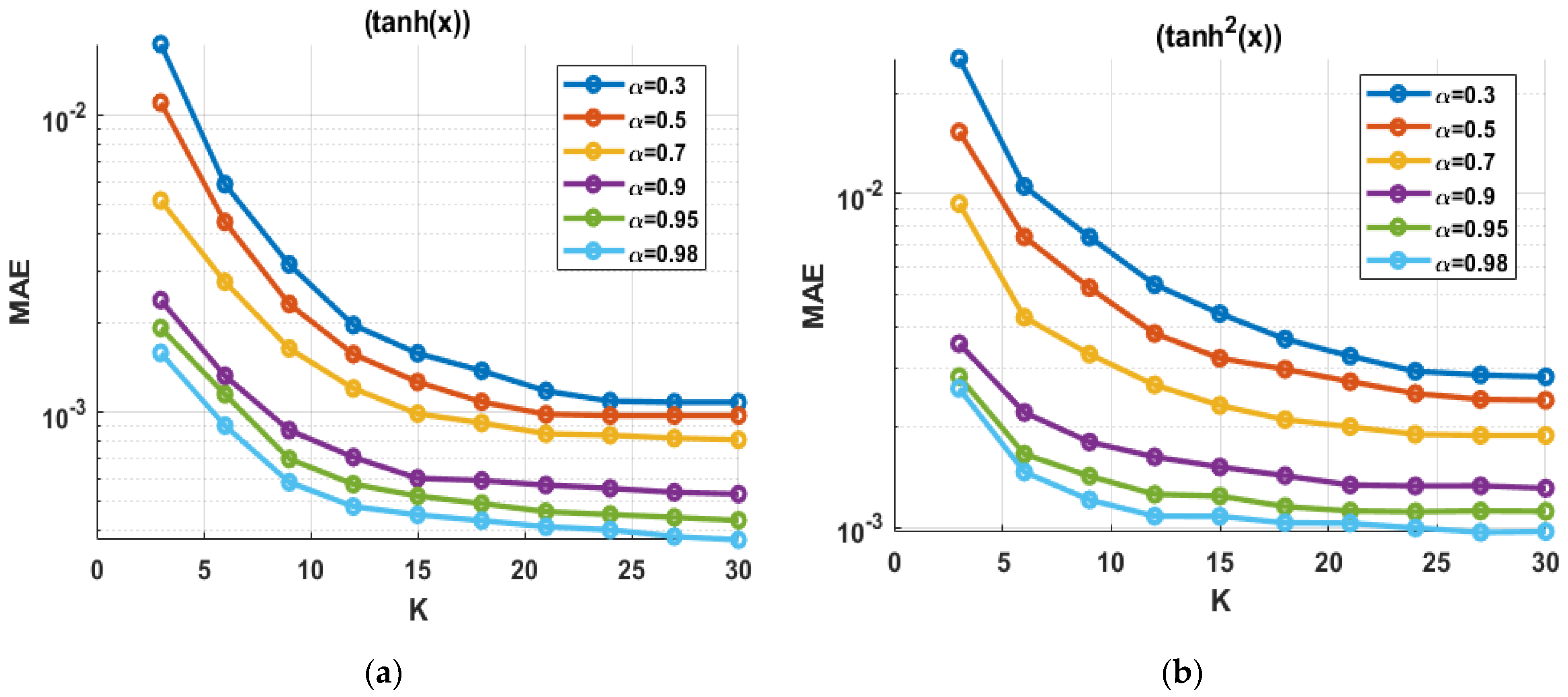
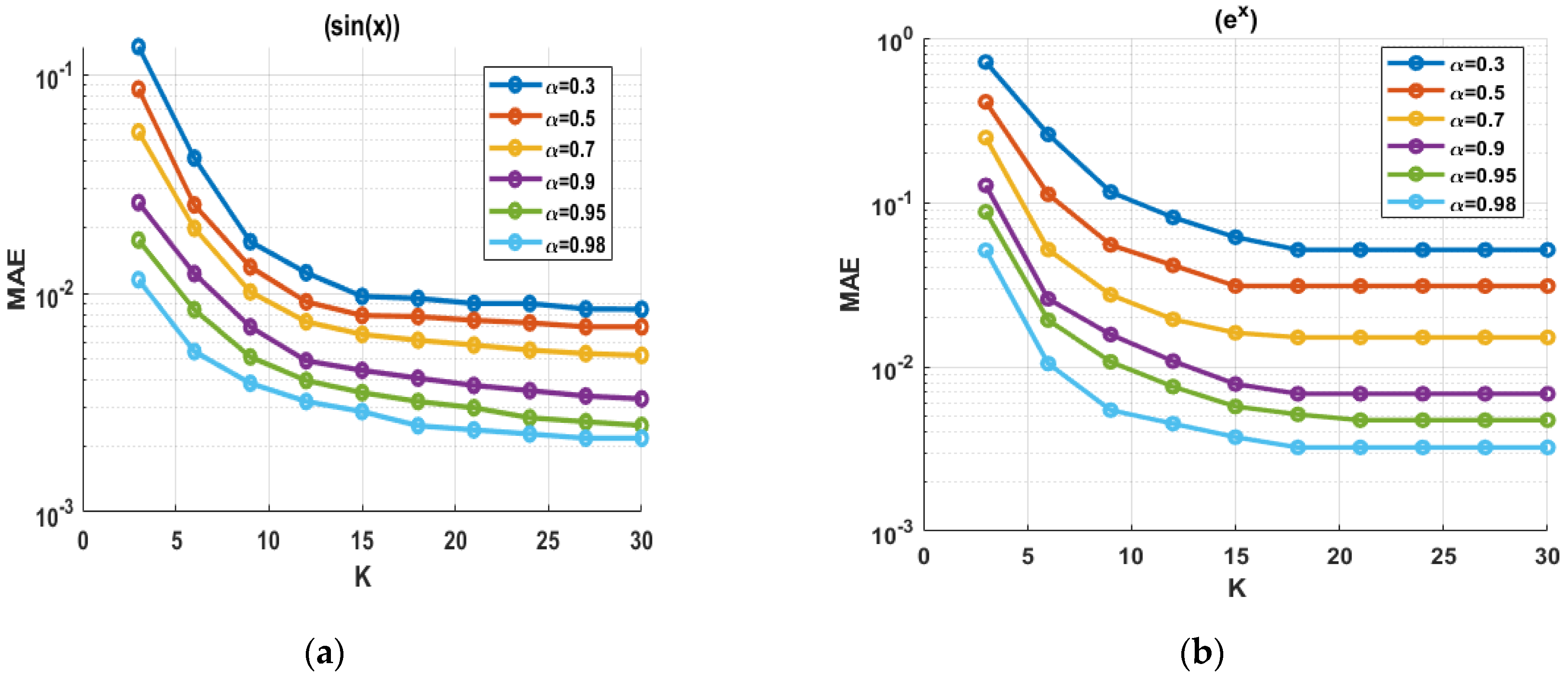
- Approximation and MAE Analysis: A quantitative study of series-based approximations for chain rules, examining the trade-off between truncation depth and computational accuracy.
- Application-Oriented Perspectives: Illustrative examples that highlight how these chain rules are deployed in practical models, illuminating both strengths and limitations.
2. Classification and Definitions of FDs
- (FD1) Classical definitions based on integral or series formulations,
- (FD2) Modified forms that extend classical operators to address specific analytical challenges, and
- (FD3) Operators that employ non-singular kernels to overcome limitations posed by singular kernel behavior.
3. A Unified Criterion for FD Operators
4. Analysis of the Chain Rule for FDs
4.1. Theoretical Background on FDs
4.2. Derivation of the Chain Rule for FDs with Singular and Non-Singular Kernels
- (1)
- Riemann-Liouville FD
- (2)
- Atangana-Baleanu Riemann-Liouville FD (ABR):
4.3. Unified Chain Rule Formulas
5. Number of Terms in Chain Rule for Fractional Derivatives
6. Examples
7. Conclusions and Future Work
- Key Findings Include:
- Operator-Specific Chain Rules: We derived and validated explicit chain rules for major FDs (RL, Caputo, CF, ABR, ABC, CFG), highlighting their dependence on kernel properties and generalized Leibniz expansions.
- Unified Criterion : A cohesive framework, extending prior classifications, which emphasizes the crucial role of the Generalized Leibniz Rule in non-local contexts.
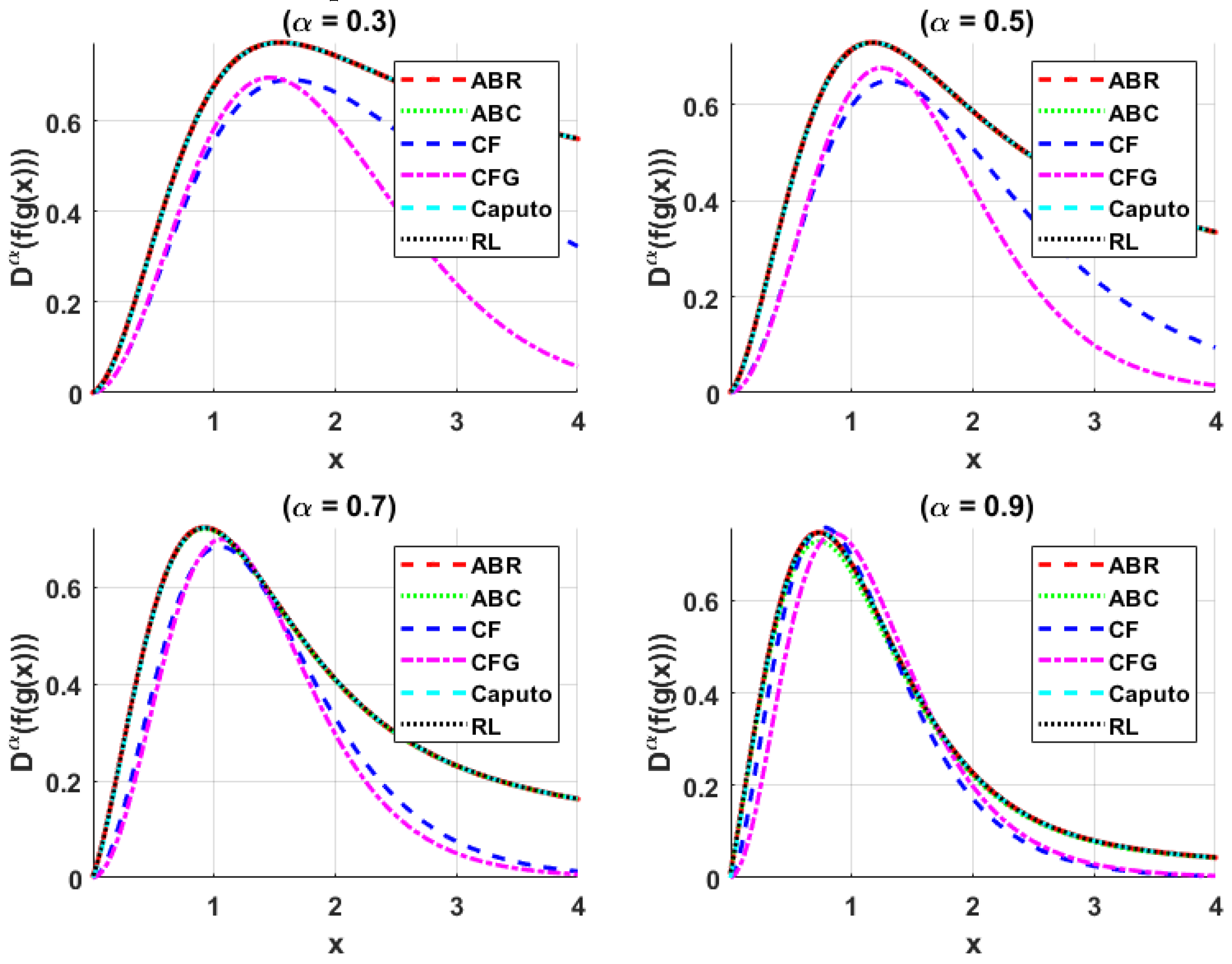
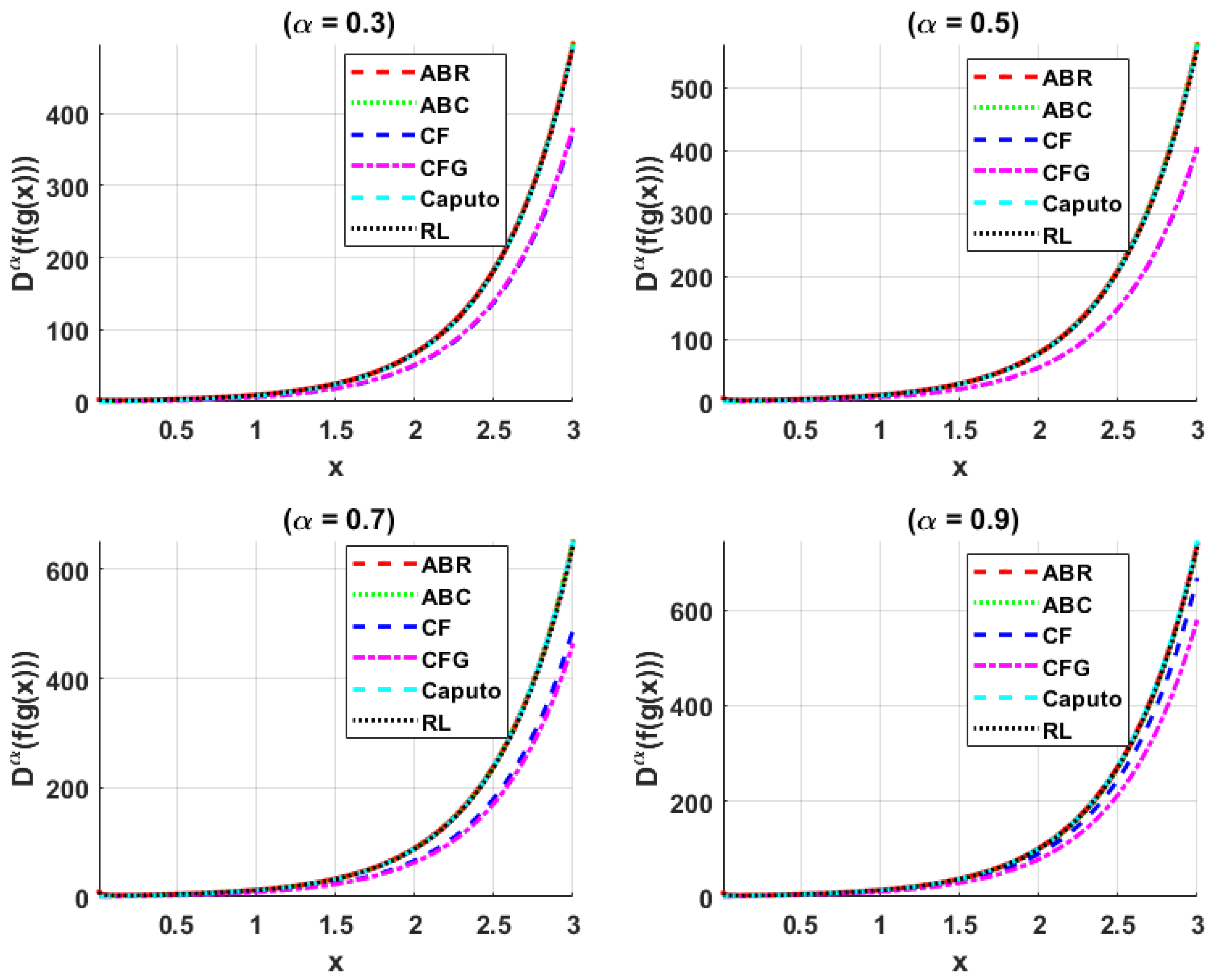
- Optimal Series Truncation: Numerical evidence suggests that retaining 25–30 terms typically minimize MAE, balancing computational cost and accuracy.
- Misconceptions and Boundaries: The widely assumed “RL universal chain rule” does not hold for all operators. Instead, each operator’s unique structure must be accounted for.
- Challenges
- Analytical Complexity: Derivations often involve nested sums, gamma functions, or special functions (e.g., Mittag-Leffler), complicating closed-form solutions.
- Truncation Sensitivity: Selecting for series truncation is problem-dependent; although the range performs well, certain functions or fractional orders may require adjustments.
- Mixed-Criteria Validation: While the proposed criterion is comprehensive, real-world models can introduce nonlinearities, discontinuities, or distributed-order operators requiring further development.
- Future Work
- Simplified Expressions & Error Bounds: Focus on reducing the complexity of chain-rule formulas and establishing rigorous error bounds for truncated expansions.
- Operator Comparison Studies: Systematic evaluations that compare CF, ABR, ABC, and CFG in multi-dimensional or large-scale problems may reveal practical advantages in speed or numerical stability.
- Real-World Model Integration: Applying these chain rules to engineering, biological, or financial models would demonstrate practical relevance and clarify how operator selection impacts predictive accuracy.
- Generalized Chain Rule Approaches: Developing a more universal framework that unifies chain-rule approximations under assumptions common to most FDs could further streamline analysis.
Author Contributions
Funding
Data Availability Statement
Conflicts of Interest
References
- Zhou, X.; Zhao, C.; Huang, Y.; Zhou, C.; Ye, J. Improved fractional-order gradient descent method based on multilayer perceptron. Neural Netw. 2025, 172, 106199. [Google Scholar] [CrossRef] [PubMed]
- Machado, J.T.; Kiryakova, V.; Mainardi, F. Recent history of fractional calculus. Commun. Nonlinear Sci. Numer. Simul. 2011, 16, 1140–1153. [Google Scholar] [CrossRef]
- Azar, T.; Radwan, A.G.; Vaidyanathan, S. Mathematical Techniques of Fractional Order Systems; Elsevier: Amsterdam, The Netherlands, 2018. [Google Scholar]
- Oldham, K.; Spanier, J. The Fractional Calculus Theory and Applications of Differentiation and Integration to Arbitrary Order; Elsevier: Amsterdam, The Netherlands, 1974. [Google Scholar]
- Kopczyński, K.; Piasecki, M. Some theoretical results on fractional-order continuous information measures. Ann. Univ. Paedagog. Cracoviensis Stud. Math. 2024, 24, 7–24. [Google Scholar]
- Rogosin, S.; Dubatovskaya, M. Letnikov vs. Marchaud: A survey on two prominent constructions of fractional derivatives. Mathematics 2017, 6, 3. [Google Scholar] [CrossRef]
- Tarasov, V.E. Local fractional derivatives of differentiable functions are integer-order derivatives or zero. Int. J. Appl. Comput. Math. 2016, 2, 195–201. [Google Scholar] [CrossRef]
- El-Ajou, A. A modification to the Conformable fractional calculus with some applications. Alex. Eng. J. 2020, 59, 2239–2249. [Google Scholar] [CrossRef]
- Teodoro, G.S.; Machado, J.A.T.; De Oliveira, E.C. A review of definitions of fractional derivatives and other operators. J. Comput. Phys. 2019, 388, 195–208. [Google Scholar] [CrossRef]
- Tarasov, V.E. No nonlocality. No fractional derivative. Commun. Nonlinear Sci. Numer. Simul. 2018, 62, 157–163. [Google Scholar] [CrossRef]
- Tarasov, V.E. No violation of the Leibniz rule. No fractional derivative. Commun. Nonlinear Sci. Numer. Simul. 2013, 18, 2945–2948. [Google Scholar] [CrossRef]
- Tarasov, V.E. On chain rule for fractional derivatives. Commun. Nonlinear Sci. Numer. Simul. 2016, 30, 1–4. [Google Scholar] [CrossRef]
- Mainardi, F. Fractional Calculus and Waves in Linear Viscoelasticity: An Introduction to Mathematical Models; World Scientific: Singapore, 2022. [Google Scholar]
- Candan, M.; Çubukçu, M. Implementation of Caputo type fractional derivative chain rule on back propagation algorithm. Appl. Soft Comput. 2024, 155, 111475. [Google Scholar] [CrossRef]
- Ross, B. A brief history and exposition of the fundamental theory of fractional calculus. In Fractional Calculus and Its Applications; Springer: Berlin/Heidelberg, Germany, 1975. [Google Scholar]
- Ortigueira, M.D.; Machado, J.A.T. What is a fractional derivative? J. Comput. Phys. 2015, 293, 4–13. [Google Scholar] [CrossRef]
- Valério, D.; Ortigueira, M.D.; Lopes, A.M. How many fractional derivatives are there? Mathematics 2022, 10, 737. [Google Scholar] [CrossRef]
- De Oliveira, E.C.; Machado, J.A.T. A review of definitions for fractional derivatives and integral. Math. Probl. Eng. 2014, 2014, 238459. [Google Scholar] [CrossRef]
- Ortigueira, M.D. A coherent approach to non-integer order derivatives. Signal Process. 2006, 86, 2505–2515. [Google Scholar] [CrossRef]
- Samko, S.G.; Kilbas, A.A.; Marichev, O.I. Fractional Integrals and Derivatives: Theory and Applications; Gordon and Breach: London, UK, 1993. [Google Scholar]
- Hilfer, R. Applications of Fractional Calculus in Physics; World Scientific: Singapore, 2000. [Google Scholar]
- Jumarie, G. Table of some basic fractional calculus formulae derived from a modified Riemann-Liouville derivative for non-differentiable functions. Appl. Math. Lett. 2009, 22, 378–385. [Google Scholar] [CrossRef]
- Oliveira, S.; De Oliveira, E.C. Hilfer-Katugampola fractional derivatives. Comput. Appl. Math. 2018, 37, 3672–3690. [Google Scholar] [CrossRef]
- Yang, X.J.; Srivastava, H.M.; Machado, J.A. A new fractional derivative without singular kernel: Application to the modelling of the steady heat flow. arXiv 2015, arXiv:1601.01623. [Google Scholar] [CrossRef]
- Atangana, A.; Baleanu, D. New fractional derivatives with nonlocal and non-singular kernel: Theory and application to heat transfer model. arXiv 2016, arXiv:1602.03408. [Google Scholar] [CrossRef]
- Ortigueira, M.D.; Machado, J.T. A critical analysis of the Caputo-Fabrizio operator. Commun. Nonlinear Sci. Numer. Simul. 2018, 59, 608–611. [Google Scholar] [CrossRef]
- Podlubny, I. Fractional Differential Equations: An Introduction to Fractional Derivatives, Fractional Differential Equations, to Methods of Their Solution and Some of Their Applications; Elsevier: Amsterdam, The Netherlands, 1998. [Google Scholar]
- Gladkina, A. Realizing Fractional Derivatives of Elementary and Composite Functions through the Generalized Euler’s Integral Transform and Integer Derivative Series: Building the Mathematical Framework to Model the Fractional Schrödinger Equation in Fractional Spacetime. Master’s Thesis, Colorado School of Mines, Golden, CO, USA, 2018. [Google Scholar]



| Definition | Formula | |
|---|---|---|
| Singular Kernel | Grünwald-Letnikov | |
| Riemann-Liouville | ||
| Caputo | ||
| Canavati | ||
| Non-Singular Kernel | Caputo-Fabrizio | |
| Caputo-Fabrizio with Gaussian kernel | ||
| Atangana-Baleanu Riemann-Liouville | ||
| Atangana-Baleanu Caputo |
| Number | Condition |
|---|---|
| Fractional differentiation operates as a linear operator. | |
| The application of a zeroth-order fractional derivative to any function returns the original function. | |
The fractional derivative must adhere to the conventional derivative outcomes in that:
| |
| The fractional derivative of a constant equal zero | |
| The exponent law is fulfilled for If it returns to the semigroup property. | |
| The Generalized Leibniz Type Rule is upheld. . | |
| A fractional derivative applied to an analytic function yields another analytic function. |
| Operators | ||||||||
|---|---|---|---|---|---|---|---|---|
| Non-Singular Kernels | Caputo-Fabrizio | √ | ⋄ | √ | ⋄ | √ | ⋄ | √ |
| Atangana-Baleanu Riemann-Liouville | √ | √ | ⋄ | x | x | √ | √ | |
| Gaussian kernel | √ | √ | ⋄ | ⋄ | √ | √ | √ | |
| Atangana-Baleanu Caputo | √ | ⋄ | √ | ⋄ | √ | √ | √ | |
| Singular Kernels | Grūnwald-Letnikov | √ | √ | √ | √ | √ | ⋄ | √ |
| Riemann-Liouville | √ | √ | √ | √ | x | ⋄ | √ | |
| Caputo | √ | √ | √ | √ | √ | ⋄ | √ | |
| Canavati | √ | √ | √ | √ | √ | ⋄ | ⋄ | |
| Classical Derivative | Generalized Leibniz Rule |
|---|---|
| Riemann-Liouville | |
| Caputo | |
| Caputo-Fabrizio | |
| Atangana-Baleanu Riemann-Liouville | |
| Gaussian kernel | |
| Atangana-Baleanu Caputo |
| Definition | Chain Rule Formula |
|---|---|
| RL | |
| Caputo | |
| ABR | |
| ABC | |
| CF | |
| CFG |
Disclaimer/Publisher’s Note: The statements, opinions and data contained in all publications are solely those of the individual author(s) and contributor(s) and not of MDPI and/or the editor(s). MDPI and/or the editor(s) disclaim responsibility for any injury to people or property resulting from any ideas, methods, instructions or products referred to in the content. |
© 2026 by the authors. Licensee MDPI, Basel, Switzerland. This article is an open access article distributed under the terms and conditions of the Creative Commons Attribution (CC BY) license.
Share and Cite
Elnady, S.M.; El-Beltagy, M.A.; Fouda, M.E.; Radwan, A.G. The Chain Rule for Fractional-Order Derivatives: Theories, Challenges, and Unifying Directions. AppliedMath 2026, 6, 25. https://doi.org/10.3390/appliedmath6020025
Elnady SM, El-Beltagy MA, Fouda ME, Radwan AG. The Chain Rule for Fractional-Order Derivatives: Theories, Challenges, and Unifying Directions. AppliedMath. 2026; 6(2):25. https://doi.org/10.3390/appliedmath6020025
Chicago/Turabian StyleElnady, Sroor M., Mohamed A. El-Beltagy, Mohammed E. Fouda, and Ahmed G. Radwan. 2026. "The Chain Rule for Fractional-Order Derivatives: Theories, Challenges, and Unifying Directions" AppliedMath 6, no. 2: 25. https://doi.org/10.3390/appliedmath6020025
APA StyleElnady, S. M., El-Beltagy, M. A., Fouda, M. E., & Radwan, A. G. (2026). The Chain Rule for Fractional-Order Derivatives: Theories, Challenges, and Unifying Directions. AppliedMath, 6(2), 25. https://doi.org/10.3390/appliedmath6020025