
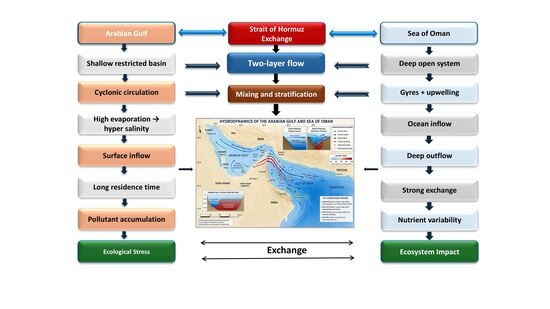
Coastal Hydrodynamics and Circulation Exchange Between the Arabian Gulf and the Sea of Oman


Abstract
1. Introduction
2. Methods
2.1. Literature Selection Criteria
2.2. Literature Search Strategy—Bibliometric Analysis
2.3. Methodological Approaches in Hydrodynamic Studies of the Arabian Gulf and the Gulf of Oman
2.4. Field-Based Observations
2.5. Remote-Sensing Methods
2.6. Numerical Hydrodynamic-Modeling Frameworks
2.7. Analytical Approaches
2.8. Coupled and Application-Specific Models
2.9. Operational Prediction Systems
3. Results and Discussion
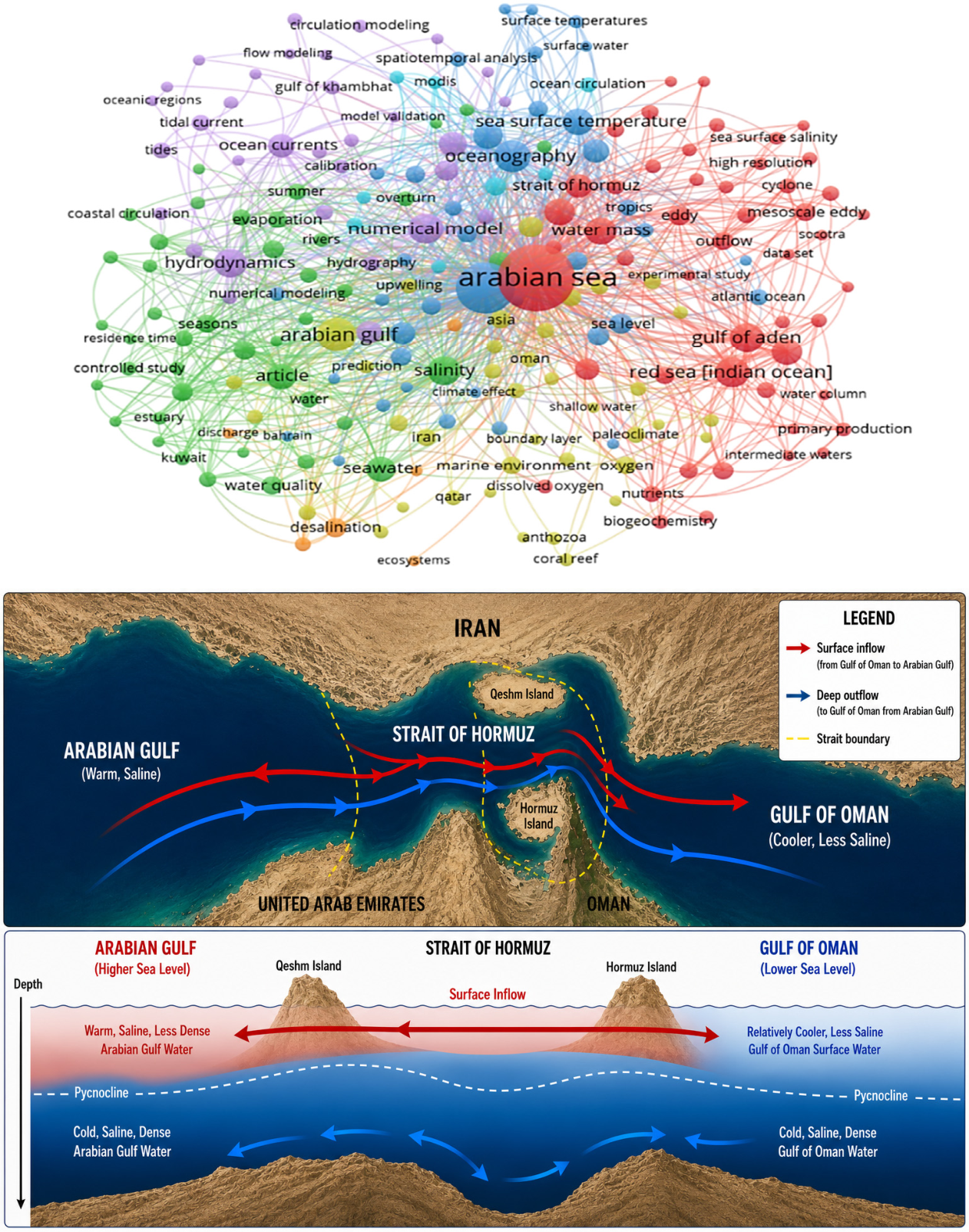
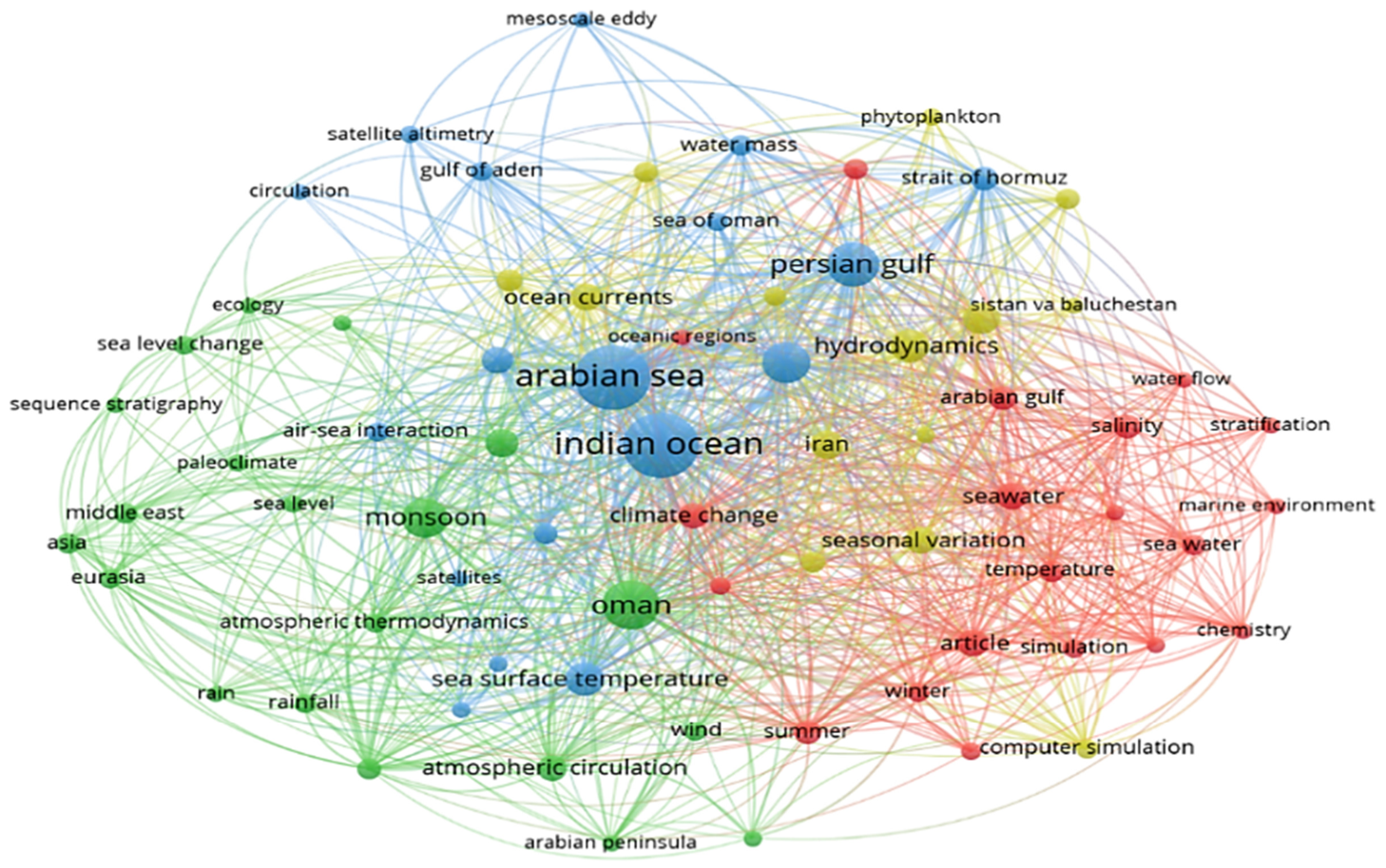
3.1. Patterns of Bibliometric Analysis of the Arabian Gulf and the Gulf of Oman
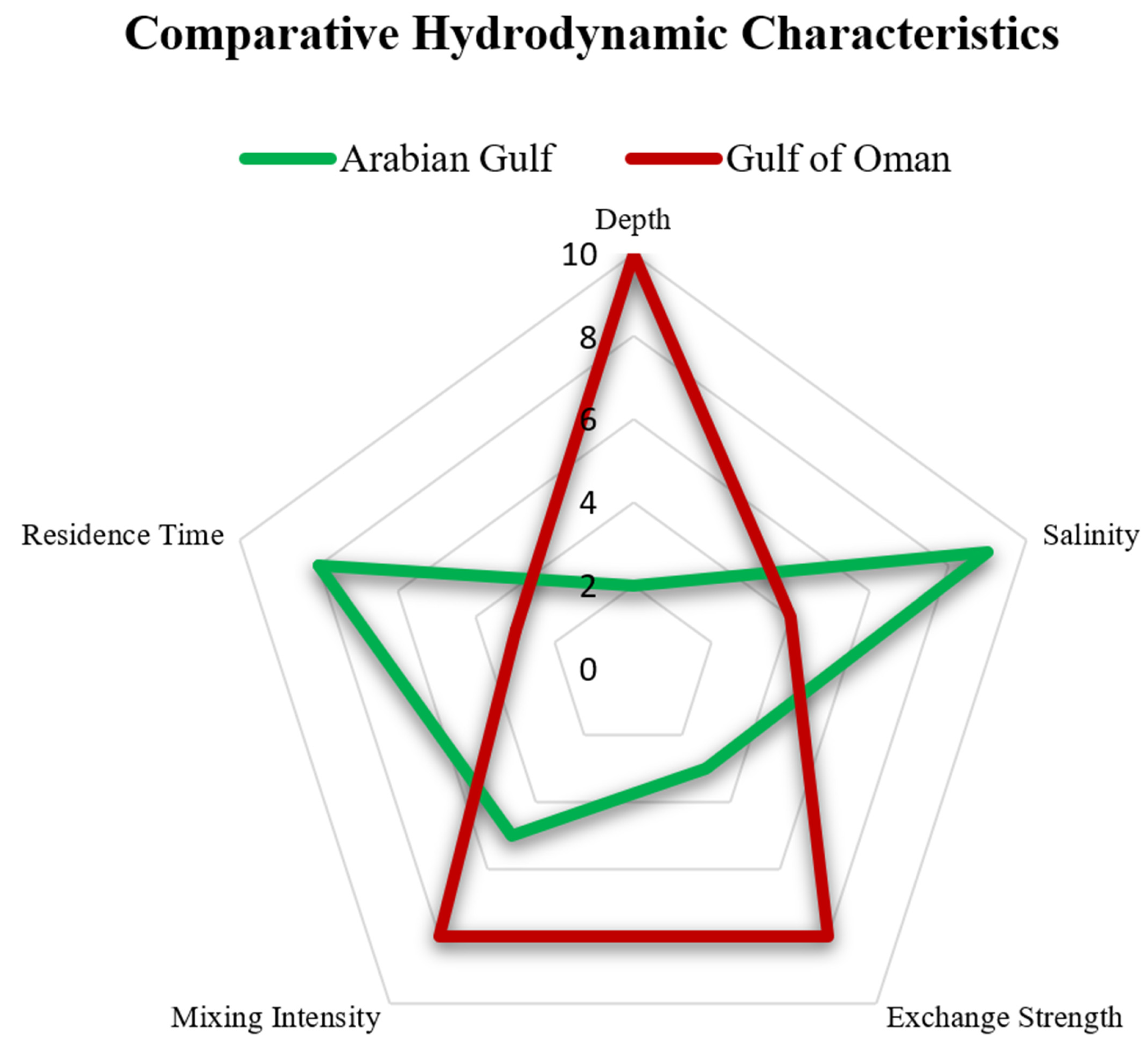
3.2. Physical Characteristics and Their Comparison of the Arabian Gulf and the Gulf of Oman
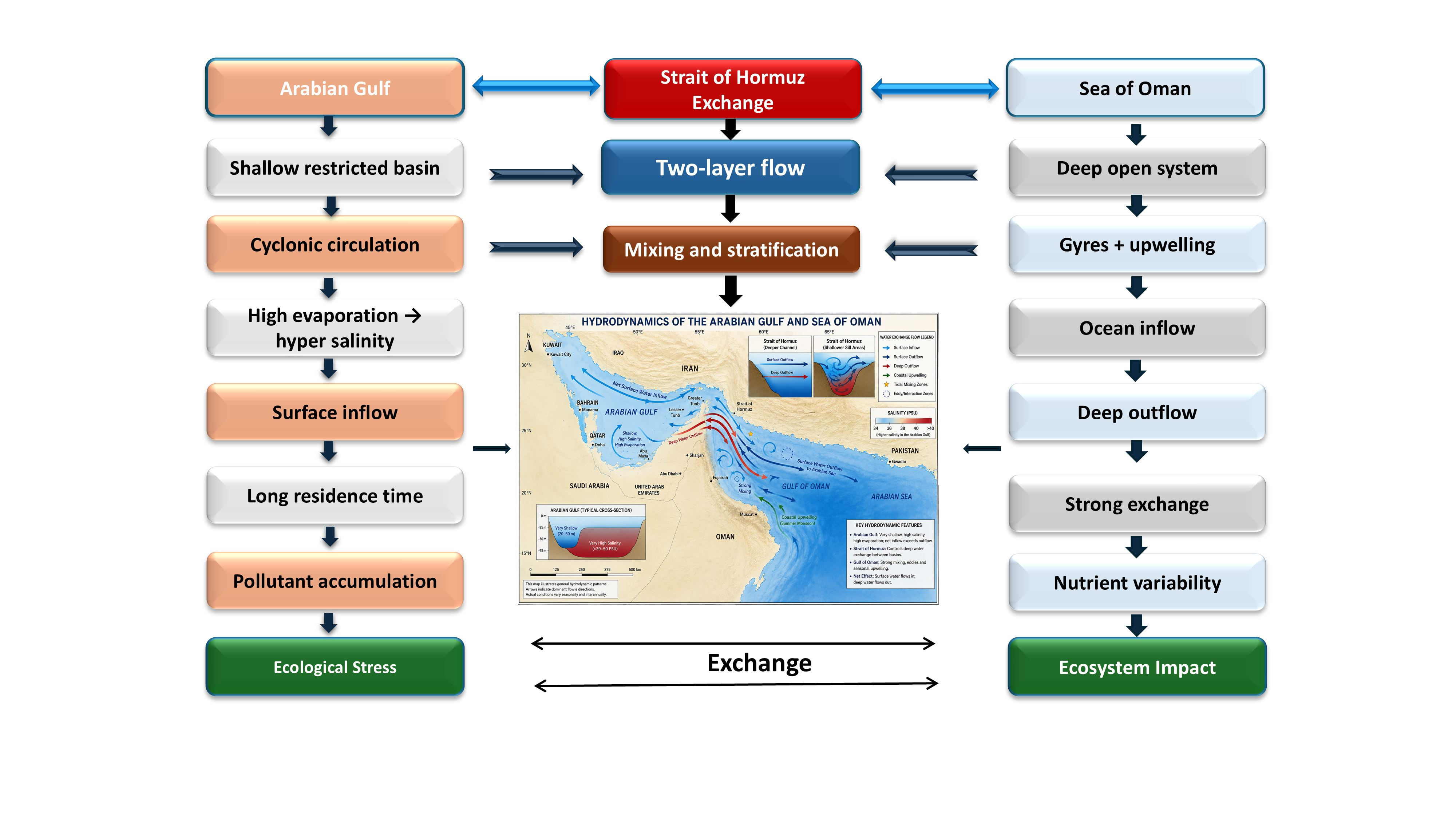
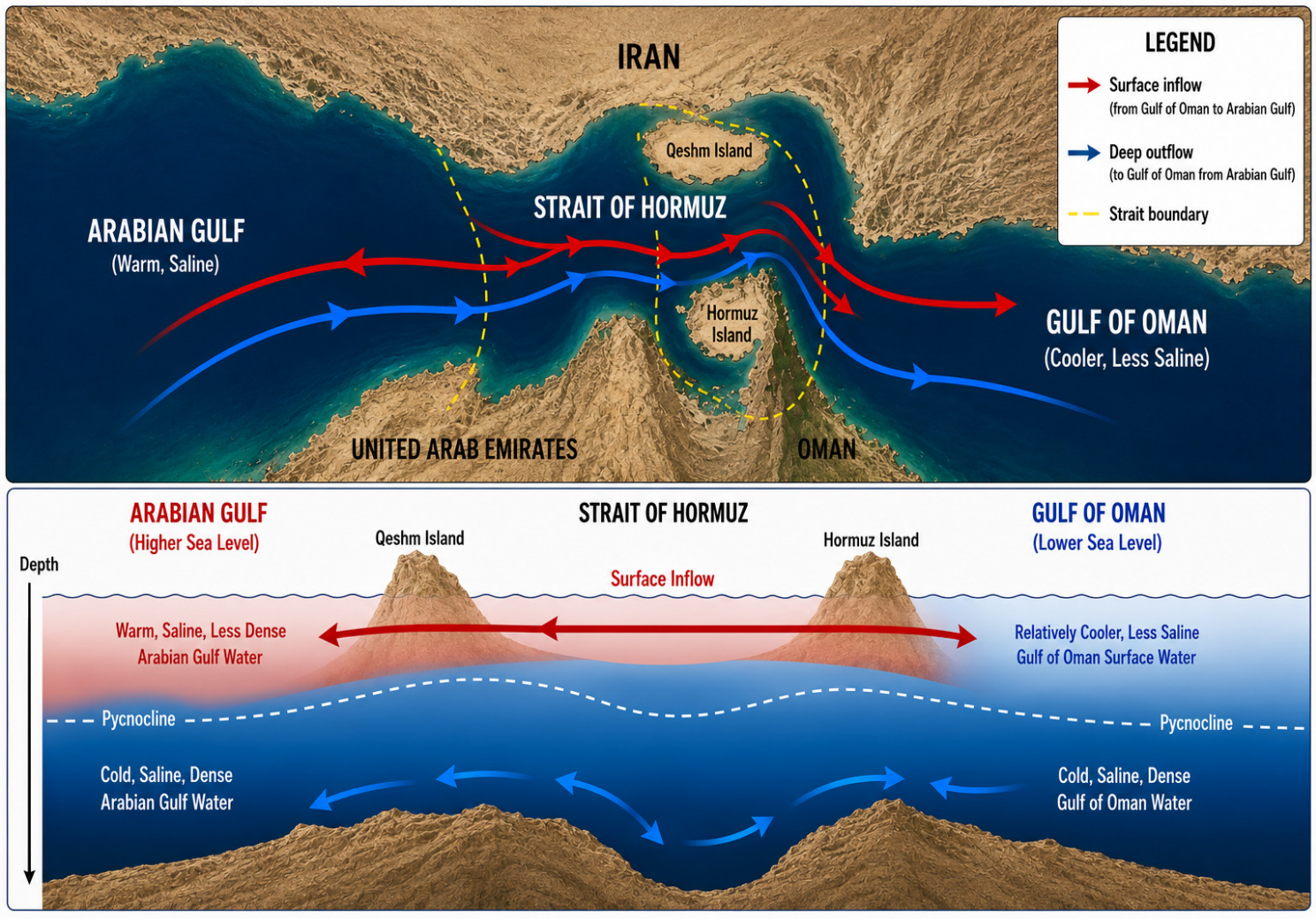
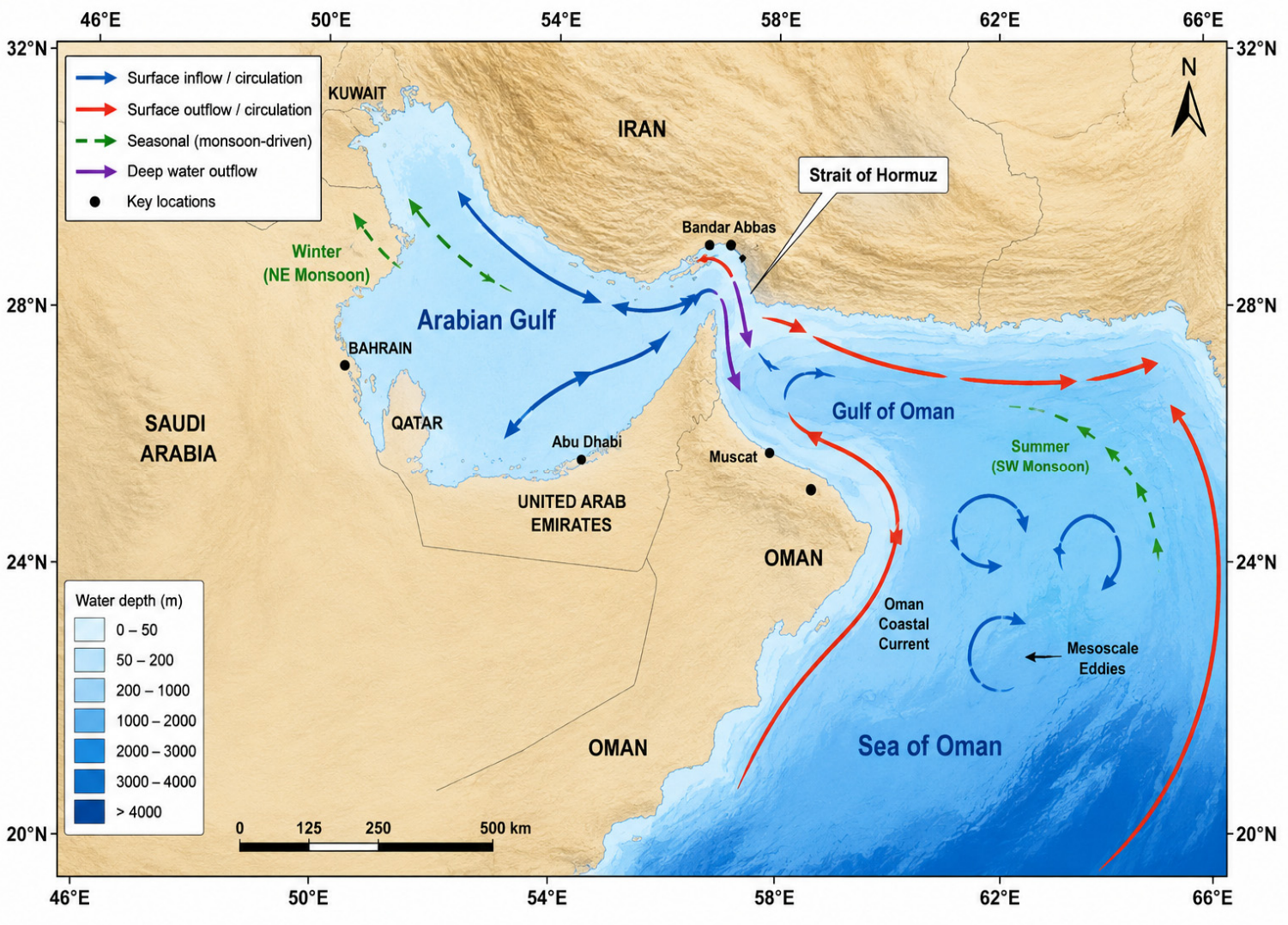
3.3. Strait of Hormuz and System Connectivity (Exchange Processes)
3.4. Density-Driven Circulation
- i.
- Potential Temperature
- ii.
- Potential Density Anomaly
- iii.
- Deep Reference Density
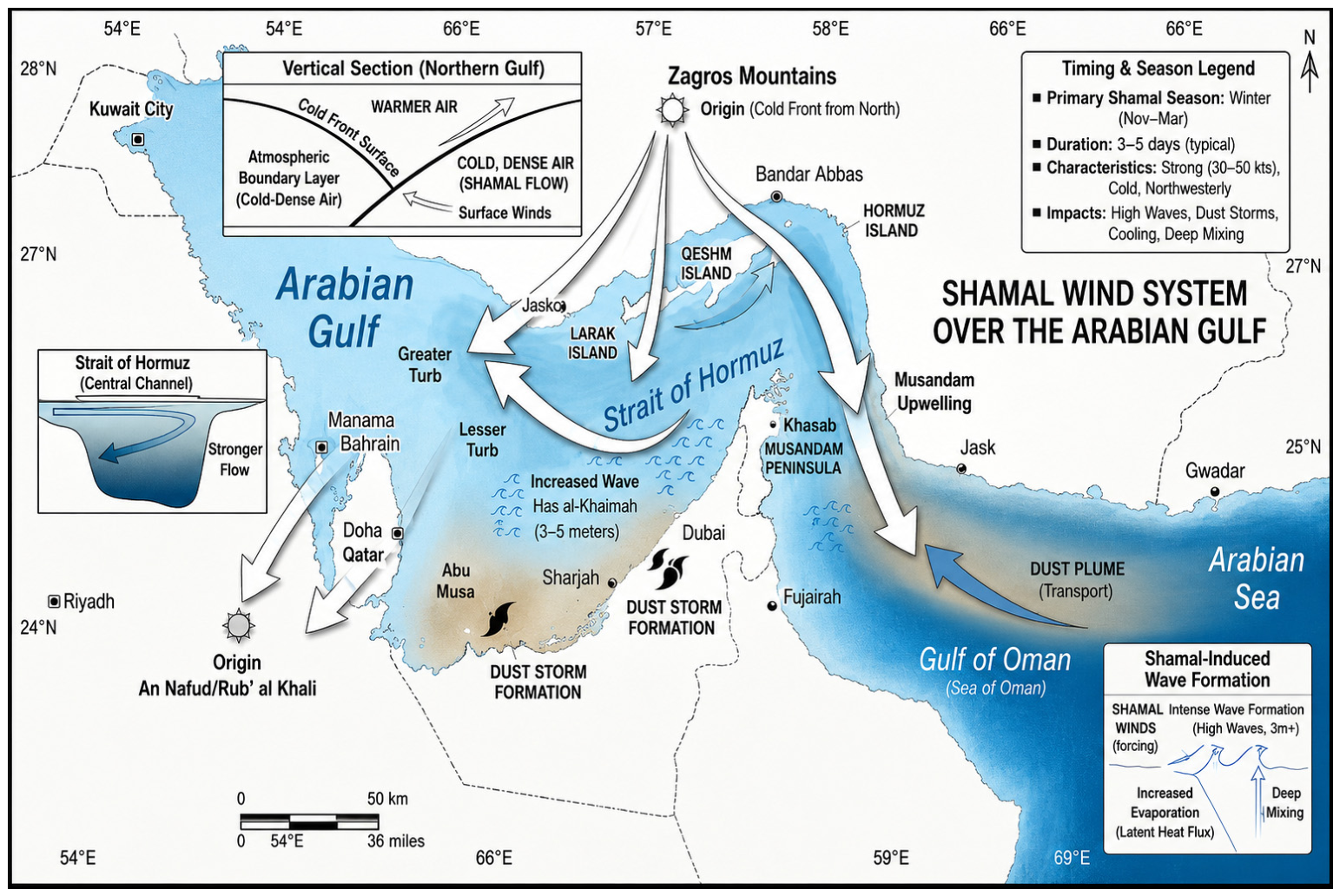
3.5. Wind-Driven Circulation
3.6. Ecological Consequences of Wind-Driven Circulation
- i.
- Wind Stress
- ii.
- Wind Stress Curl (Gyre/Upwelling Forcing)
- iii.
- Momentum Equations-Simplified Form
- iv.
- Parameterization-Regional Models
- v.
- Wave–Wind Interaction
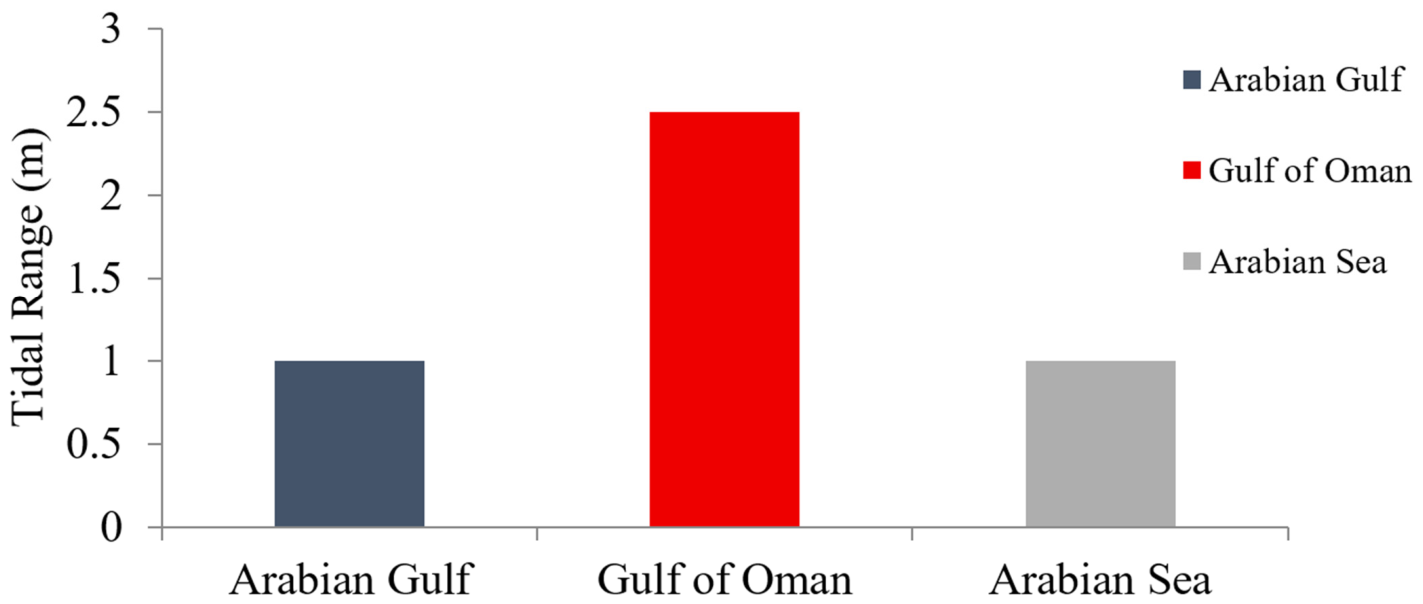
3.7. Tidal Changing Aspects and Mixing
Spatial Tidal Variability and Mixing Role

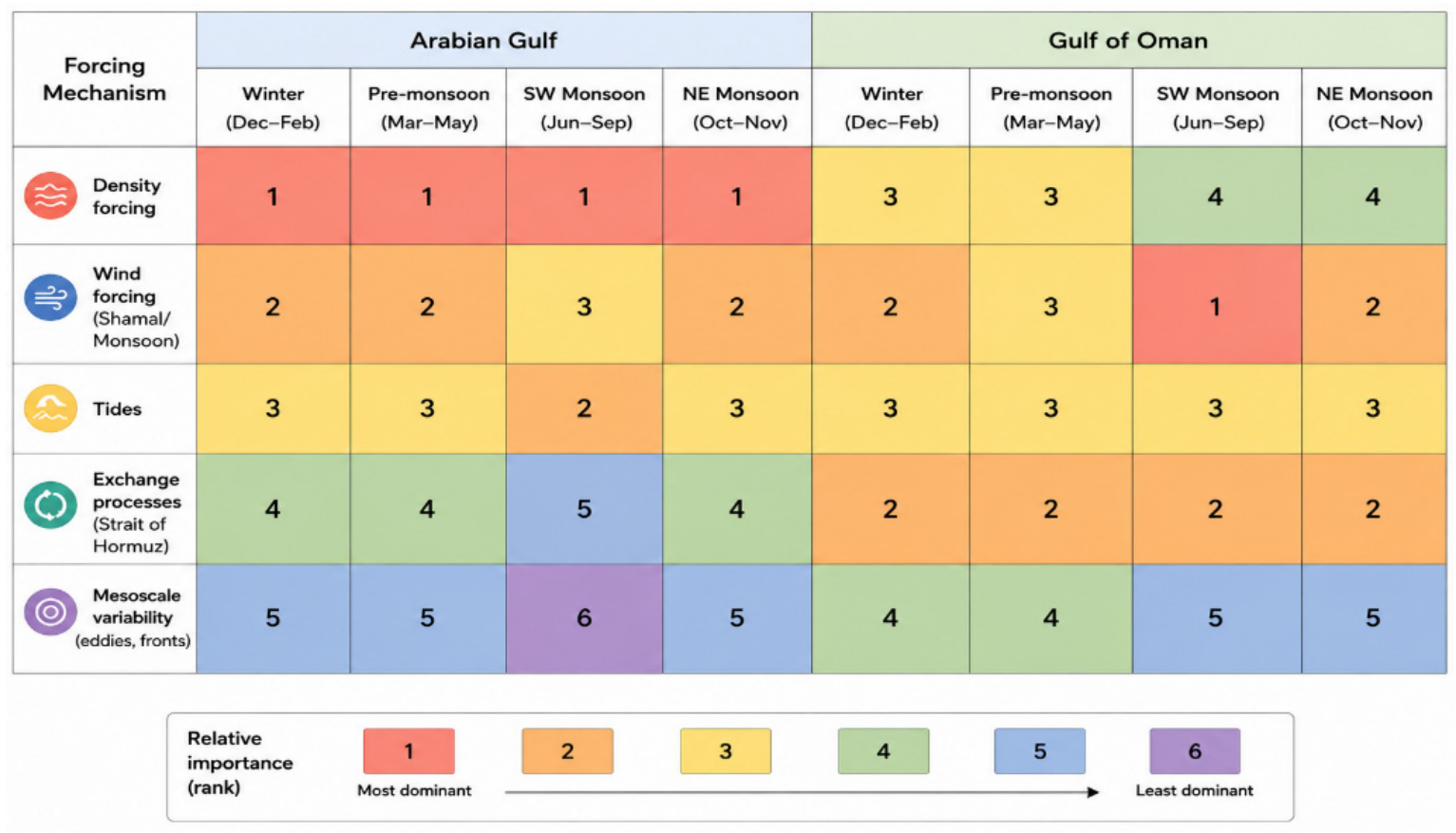
| Season/Period | Arabian Gulf: Dominant Forcing | Gulf of Oman: Dominant Forcing | Main Hydrodynamic Response | References |
|---|---|---|---|---|
| Winter | Shamal winds, density gradients, tides | Northeast monsoon, cooling, convective mixing | Enhanced mixing, reduced stratification, stronger ventilation | [10,48,99,114] |
| Spring transition | Density gradients, tides, changing winds | Transition winds, eddies, gyre adjustment | Reorganization of circulation and exchange pathways | [26,115] |
| Summer | Evaporation, salinity gradients, stratification | Southwest monsoon, upwelling, mesoscale eddies | Strong gulf stratification; upwelling and offshore transport in Gulf of Oman | [15,38,100,103] |
| Autumn transition | Wind variability, tides, weakening stratification | Weakening monsoon, eddies, water-mass adjustment | Increased variability in mixing and circulation | [115,116] |
| Year-round background | Inverse estuarine exchange through Hormuz | Open-ocean exchange and Persian Gulf Water intrusion | Cross-basin heat, salt, and tracer transport | [5,6,7,89] |
- i.
3.8. Mesoscale and Sub-Mesoscale Eddies and Frontal Systems
3.9. Patterns of Seasonal Circulation in the Arabian Gulf and the Gulf of Oman
Stratification and Interannual Variability
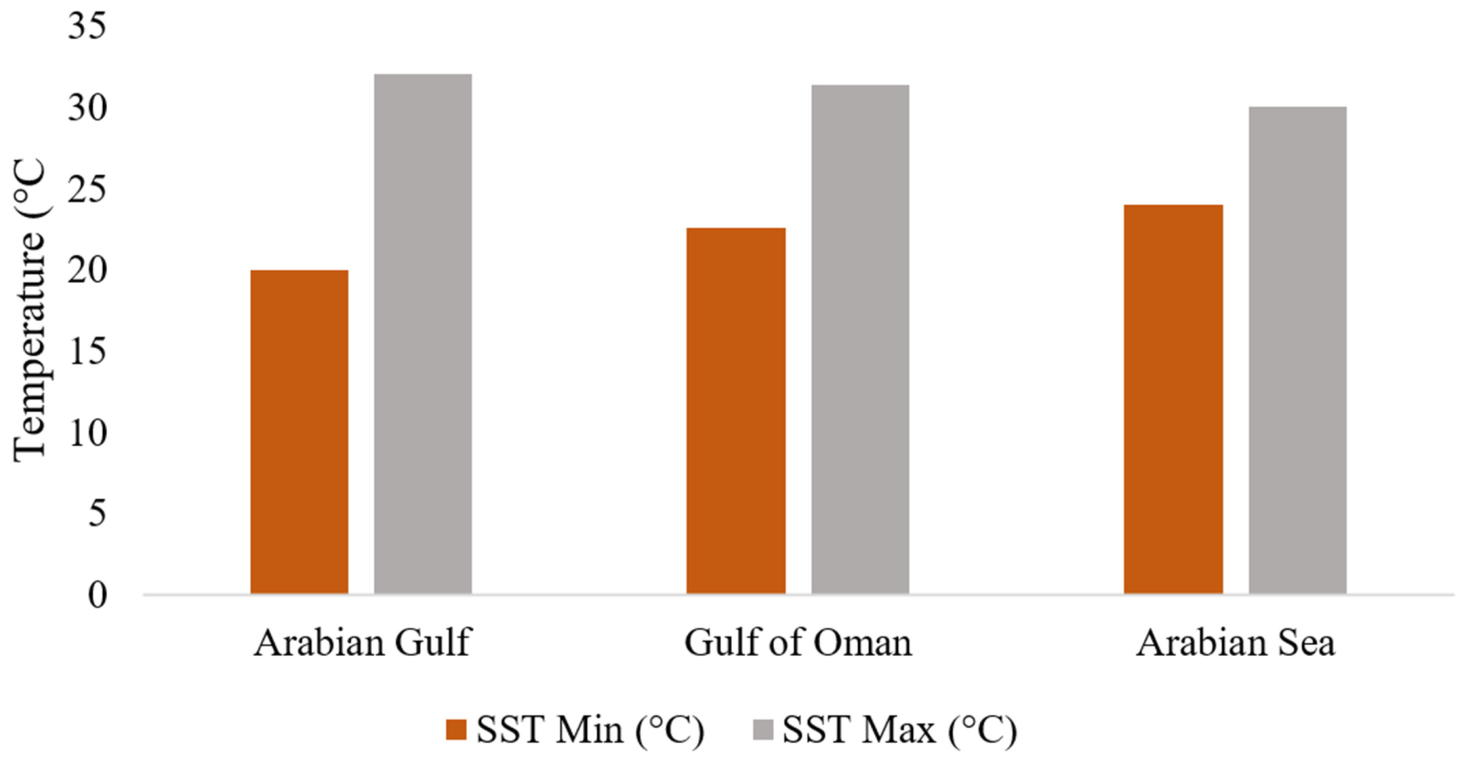
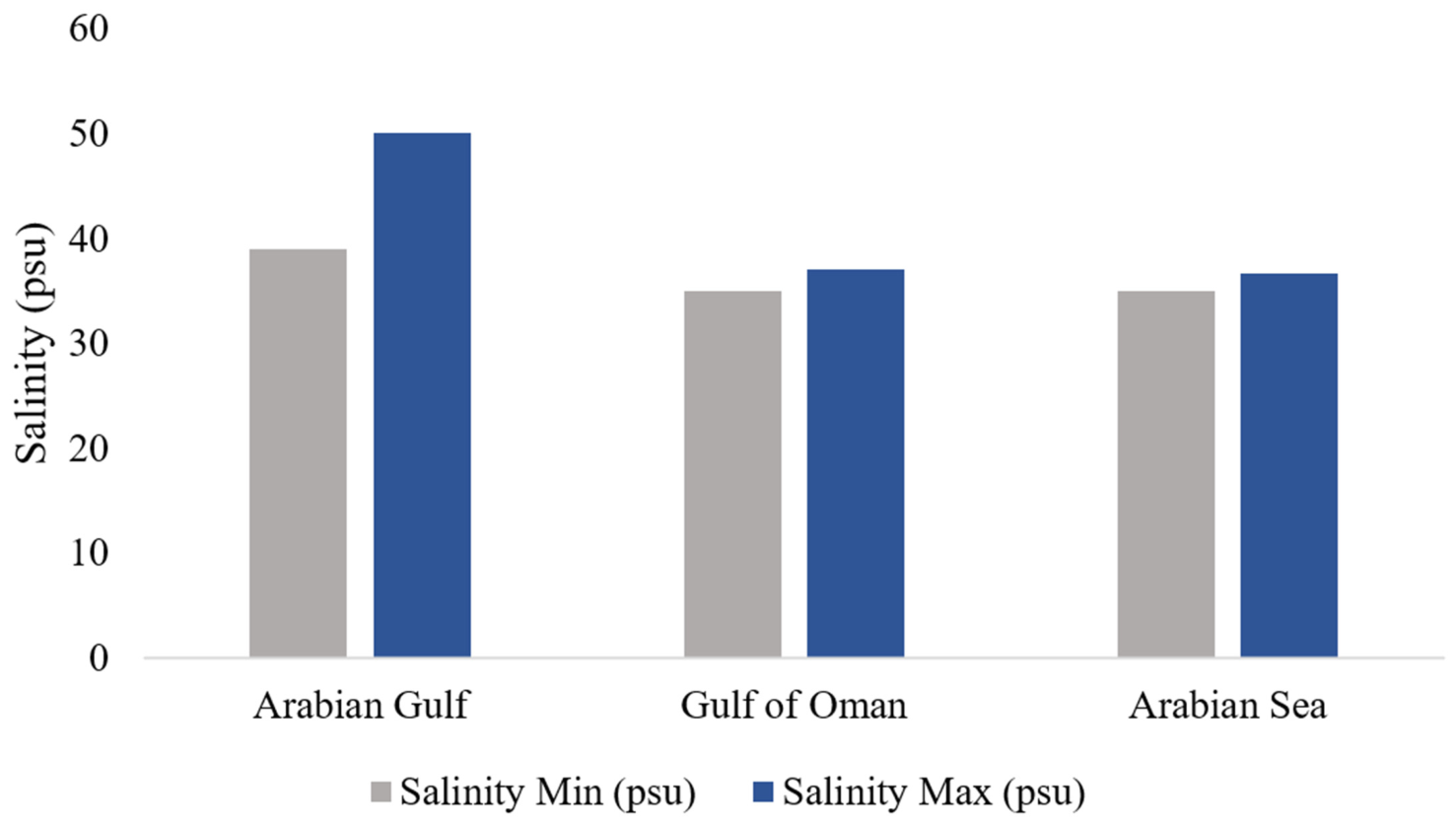
3.10. Seasonal and Interannual Variability in Temperature, Salinity, and Hydrographic Structure
3.10.1. Temperature Variability
3.10.2. Salinity Variability
3.10.3. System-Level Variability and Exchange
3.11. Hydrodynamic Exchange and Coastal Aquifer Interactions
3.12. Ecological Consequences of Seasonal and Interannual Variability
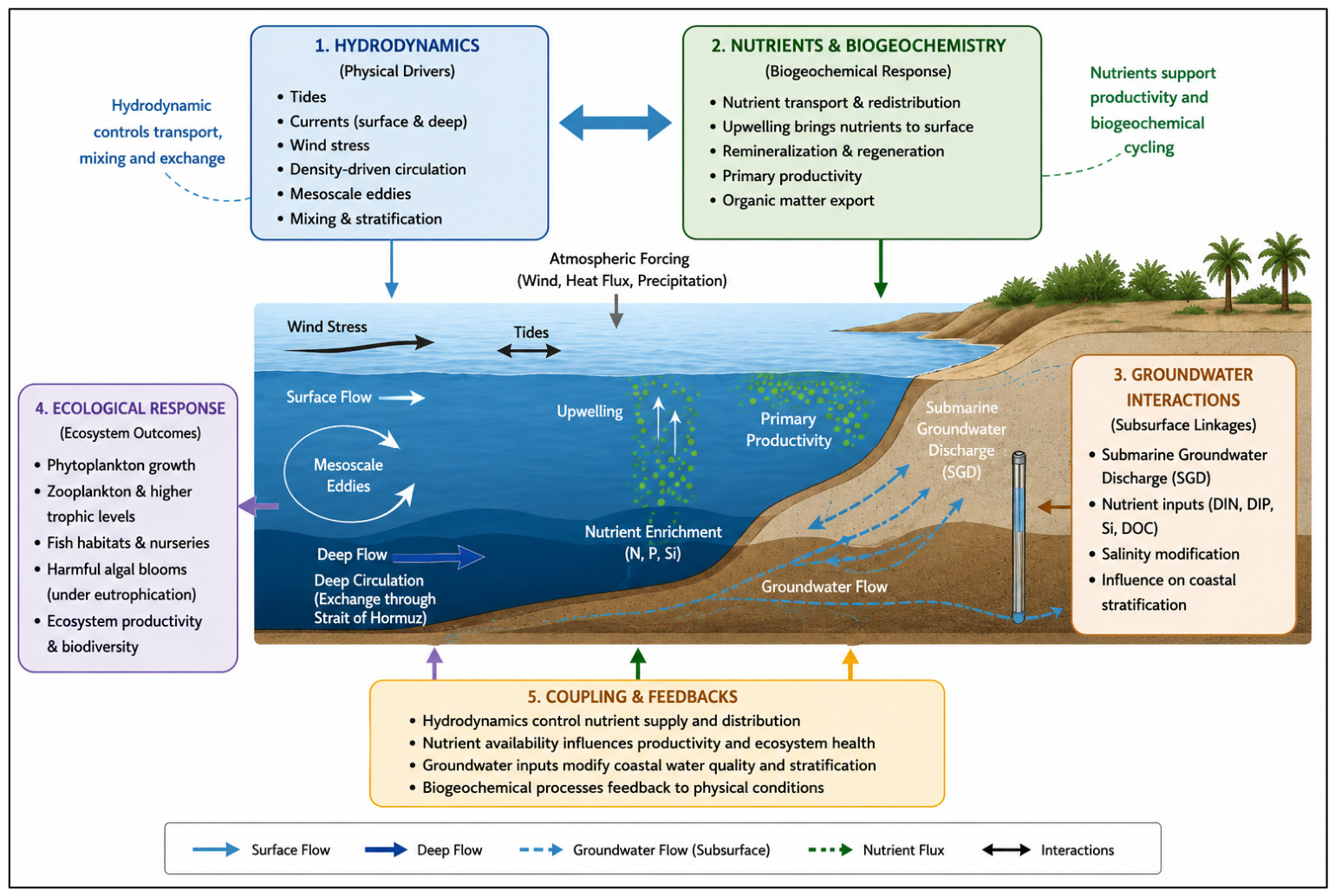
3.13. Integrated Hydrodynamic–Ecological–Groundwater Interactions
- i.
- Hydrodynamics
- ii.
- Aquatic Ecology/Transport
- iii.
- Groundwater and Coupled Exchange
3.14. Hydrodynamic Modeling and Observational Constraints
3.15. Comparative Interpretation Between the Arabian Gulf and the Gulf of Oman
4. Future Recommendations
5. Conclusions
Supplementary Materials
Author Contributions
Funding
Data Availability Statement
Acknowledgments
Conflicts of Interest
Abbreviations
| psu | Practical Salinity Unit |
| GHRSST | Group for High-Resolution Sea Surface Temperature |
| RMS | Root Mean Square |
| Delft3D-FLOW | Delft 3D Hydrodynamic Flow Model |
| COSMOS | Coupled Ocean–Sea Ice Model System |
| GILFHYDRO | Gulf Hydrodynamic Model |
| ERA/ECMWF | European Centre for Medium-Range Weather Forecasts Reanalysis |
| SCHISM | Semi-implicit Cross-scale Hydroscience Integrated System Model |
| MITgcm | Massachusetts Institute of Technology General Circulation Model |
| HYCOM | Hybrid Coordinate Ocean Model |
| CORMIX | Cornell Mixing Zone Expert System |
| MetOcean | Meteorological and Oceanographic Data |
| TEOS-10 | Thermodynamic Equation of Seawater 2010 |
| NOAA | National Oceanic and Atmospheric Administration |
| M2 | Principal Lunar Semidiurnal Tide |
| S2 | Principal Solar Semidiurnal Tide |
| K1 | Luni-solar Diurnal Tide |
| O1 | Principal Lunar Diurnal Tide |
| SWM | Southwest Monsoon |
| NEM | Northeast Monsoon |
| RCP | Representative Concentration Pathway |
| ASHSW | Arabian Sea High-Salinity Water |
| ORAS4 | Ocean Reanalysis System 4 |
| SST | Sea Surface Temperature |
| SGD | Submarine Groundwater Discharge |
| WAVEWATCH III | NOAA Spectral Wave Model |
References
- Umgiesser, G.; Ferrarin, C.; Bajo, M.; Bellafiore, D.; Cucco, A.; De Pascalis, F.; Ghezzo, M.; McKiver, W.; Arpaia, L. Hydrodynamic modelling in marginal and coastal seas—The case of the Adriatic Sea as a permanent laboratory for numerical approach. Ocean Model 2022, 179, 102123. [Google Scholar] [CrossRef]
- Chen, L.; Li, C.; Zhang, Z.; Feng, Q.; Xi, H.; Guo, R.; Zhang, C.; Wei, Y. Landscape differentiation of soil bacteria and bacteria-soil-vegetation interactions in desert-oasis ecosystems. Glob. Planet Change 2024, 232, 104323. [Google Scholar] [CrossRef]
- Gao, J.; Shi, H.; Dai, Z.; Mei, X.; Zong, H.; Yang, H.; Hu, L.; Li, S. Linkages between the spatial toxicity of sediments and sediment dynamics in the Yangtze River Estuary and neighboring East China Sea. Environ. Pollut. 2018, 233, 1138–1146. [Google Scholar] [CrossRef] [PubMed]
- Heinle, M.J.; Kolchar, R.M.; Flandez, A.V.; Clardy, T.R.; Thomas, B.K.; Hikmawan, T.I.; Prihartato, P.K.; Abdulkader, K.A.; Qurban, M.A. Spatial and temporal variability in the phytoplankton community of the Western Arabian Gulf and its regulation by physicochemical factors and zooplankton. Reg. Stud. Mar. Sci. 2021, 47, 101982. [Google Scholar] [CrossRef]
- Ershadifar, H.; Saleh, A.; Koochaknejad, E.; Kor, K.; Agah, H.; Hamzeh, M.A.; Sharifinia, M. Suspended particulate matter in the Gulf of Oman: Spatial variations in concentration, bulk composition, and particulate metals controlled by physical and biogeochemical processes. Sci. Total Environ. 2024, 950, 175396. [Google Scholar] [CrossRef] [PubMed]
- Nesterov, O.; Addad, Y.; Bilal, S.; Bosc, E.; Abida, R.; Al Shehhi, M.R.; Temimi, M. A numerical assessment of the dispersion of dissolved pollutants in the Arabian Gulf associated with the Barakah nuclear power plant. Ocean Model 2023, 186, 102274. [Google Scholar] [CrossRef]
- Sultan, S.A.R.; Elghribi, N.M. Temperature inversion in the Arabian Gulf and the Gulf of Oman. Cont. Shelf Res. 1996, 16, 1521–1544. [Google Scholar] [CrossRef]
- Nunes, S.; González, G.; Qurban, M.; Duarte, C.M.; Agusti, S. Centennial and decadal trends in phytoplankton communities highlight rising eutrophication along the western coast of the Arabian Gulf. Mar. Pollut. Bull. 2024, 209, 117177. [Google Scholar] [CrossRef] [PubMed]
- Rabbaniha, M.; Gerami, M.H.; Golsefid, S.A.M. Temporal phytoplankton diversity patterns and community structure in a monsoonal region, Oman Seawater (Iranian parts). Reg. Stud. Mar. Sci. 2018, 24, 355–363. [Google Scholar] [CrossRef]
- Farkhani, S.; Zaker, N.H. The effects of climate change on the thermal stratification of the Gulf of Oman. Dyn. Atmos. Ocean 2025, 110, 101560. [Google Scholar] [CrossRef]
- Antony, C.; Langodan, S.; Alghamdi, H.A.; Hoteit, I. Storm Surges in the Arabian Gulf: Characteristics and Atmospheric Drivers. Nat. Hazards Res. 2026, in press. [Google Scholar] [CrossRef]
- Khatir, Z.; Leitão, A.; Lyons, B.P. The biological effects of chemical contaminants in the Arabian/Persian Gulf: A review. Reg. Stud. Mar. Sci. 2020, 33, 100930. [Google Scholar] [CrossRef]
- Tariq, S.; Shahzad, H.; Ul-Haq, Z. Assessing the variability in chlorophyll-a and covariates in Arabian Sea using ARIMAX model and wavelet coherence approaches. Mar. Chem. 2024, 265, 104438. [Google Scholar] [CrossRef]
- Shaltout, M.; Eladawy, A. Unveiling marine heatwave dynamics in the Persian/Arabian Gulf and the Gulf of Oman: A spatio-temporal analysis and future projections. Deep Sea Res. Part II Top. Stud. Oceanogr. 2024, 218, 105435. [Google Scholar] [CrossRef]
- Nesterov, O. An assessment of seawater desalination impact on salinities in the Arabian/Persian Gulf using a 3D circulation model. Ocean Model 2025, 194, 102503. [Google Scholar] [CrossRef]
- Youssef, M.; El-Sorogy, A.; Al Kahtany, K.; Al Otiaby, N. Environmental assessment of coastal surface sediments at Tarut Island, Arabian Gulf (Saudi Arabia). Mar. Pollut. Bull. 2015, 96, 424–433. [Google Scholar] [CrossRef] [PubMed]
- Alosairi, Y.; van Maren, D.S.; Scheel, F.; Smits, B.P.; Al-Khaldi, M.S. Aeolian desert dust as a primary estuarine sediment source: Fine sediment transport and dynamics in the northern Arabian/Persian gulf. Estuar. Coast Shelf Sci. 2024, 302, 108771. [Google Scholar] [CrossRef]
- Romdani, A.; Chen, J.L.; Chien, H.; Lin, J.H.; Hung, C.K.; Huang, Y.Q. Downdrift port siltation adjacent to a river mouth: Mechanisms and effects of littoral sediment transport to the navigation channel. J. Waterw. Port. Coast Ocean Eng. 2022, 148, 1. [Google Scholar] [CrossRef]
- Süme, V.; Yılmaz, E.; Marangoz, H.O.; Daneshfaraz, R.; Ebadzadeh, P.; Abraham, J.P. Shoaling and Sedimentation Dynamics in Fishery Shelters: A Case Study of Sandıktaş Fishery Shelter. J. Mar. Sci. Eng. 2025, 13, 779. [Google Scholar] [CrossRef]
- Nikoo, M.R. Integration of Causal Deep Learning for Tide Level Forecasting in Data-Scarce Coasts. Estuar. Coast Shelf Sci. 2026, 330, 109715. [Google Scholar] [CrossRef]
- Carassou, L.; Al-Kindi, A.S.; Dobrestsov, S. Preliminary assessment of the trophic structure of demersal fish community in the Sea of Oman. Reg. Stud. Mar. Sci. 2017, 16, 145–151. [Google Scholar] [CrossRef][Green Version]
- Gray, H.W.I.; Nishida, S.; Welch, A.J.; Moura, A.E.; Tanabe, S.; Kiani, M.S.; Culloch, R.; Möller, L.; Natoli, A.; Ponnampalam, L.S.; et al. Cryptic lineage differentiation among Indo-Pacific bottlenose dolphins (Tursiops aduncus) in the northwest Indian Ocean. Mol. Phylogenet. Evol. 2018, 122, 1–14. [Google Scholar] [CrossRef] [PubMed]
- Elhakeem, A.A.; Mohamed, A.-M.O.; Elshorbagy, W.A. A Decision Support System for Ranking Desalination Processes in the Arabian Gulf Countries Based on Hydrodynamic Modeling Evaluation of Future Changes in Feedwater Properties. In Pollution Assessment for Sustainable Practices in Applied Sciences and Engineering; Butterworth-Heinemann: Oxford, UK, 2021. [Google Scholar] [CrossRef]
- Claereboudt, M.R. Oman. In World Seas: An Environmental Evaluation; Academic Press: Cambridge, MA, USA, 2019. [Google Scholar] [CrossRef]
- Richlen, M.L.; Morton, S.L.; Jamali, E.A.; Rajan, A.; Anderson, D.M. The catastrophic 2008–2009 red tide in the Arabian gulf region, with observations on the identification and phylogeny of the fish-killing dinoflagellate Cochlodinium polykrikoides. Harmful Algae 2010, 9, 163–172. [Google Scholar] [CrossRef]
- Al-Shehhi, M.R.; Nelson, D.; Farzanah, R.; Alshihi, R.; Salehi-Ashtiani, K. Characterizing algal blooms in a shallow & a deep channel. Ocean Coast Manag. 2021, 213, 105840. [Google Scholar] [CrossRef]
- Wilson-Diaz, D.; Mariano, A.J.; Evans, R.H.; Luther, M.E. A principal component analysis of sea-surface temperature in the Arabian Sea. Deep Sea Res. Part II Top. Stud. Oceanogr. 2001, 48, 1097–1114. [Google Scholar] [CrossRef]
- Singh, H.; Singh, A.D.; Maitra, A.; Kumar, B.; Tripathi, S.; Singh, P.; Bharti, S.K. Inter-hemispheric climate linkages and monsoonal controls on the Arabian Sea surface temperatures. Palaeogeogr. Palaeoclimatol. Palaeoecol. 2026, 683, 113460. [Google Scholar] [CrossRef]
- Thoppil, P.G.; Hogan, P.J. Persian Gulf response to a wintertime shamal wind event. Deep Sea Res. Part I Oceanogr. Res. Pap. 2010, 57, 946–955. [Google Scholar] [CrossRef]
- Bauman, A.G.; Pratchett, M.S.; Baird, A.H.; Riegl, B.; Heron, S.F.; Feary, D.A. Variation in the size structure of corals is related to environmental extremes in the Persian Gulf. Mar. Environ. Res. 2013, 84, 43–50. [Google Scholar] [CrossRef] [PubMed]
- Mathew, T.; Prakash, S.; Kumar Baliarsingh, S.; Samanta, A.; Lakshmi, R.S.; Anandrao Lotliker, A.; Chatterjee, A.; Balakrishnan Nair, T.M. Response of phytoplankton biomass to nutrient stoichiometry in coastal waters of the western Bay of Bengal. Ecol. Indic. 2021, 131, 108119. [Google Scholar] [CrossRef]
- Hassanzadeh, S.; Hosseinibalam, F.; Rezaei-Latifi, A. Numerical modelling of salinity variations due to wind and thermohaline forcing in the Persian Gulf. Appl. Math. Model 2011, 35, 1512–1537. [Google Scholar] [CrossRef]
- Alhallaf, A.J.B.; Vilcáez, J.; Liang, Y. Investigating the impact of meteorological factors on sea-level variability in the northwestern Arabian gulf: A case study using deep learning and advanced statistical models for enhanced forecasting. Ocean Model 2026, 199, 102648. [Google Scholar] [CrossRef]
- Wang, Z.; DiMarco, S.F.; Jochens, A.E.; Ingle, S. High salinity events in the northern Arabian Sea and Sea of Oman. Deep Sea Res. Part I Oceanogr. Res. Pap. 2013, 74, 14–24. [Google Scholar] [CrossRef]
- Zheng, H.; Wang, M.; Zhang, T.; Ding, R.; Jin, Y.; Zhang, K.; Zhang, D.; Wu, B.; Zhang, Y. Origin and propagation of M 2 internal tides in the Arabian Sea. Deep Sea Res. Part I Oceanogr. Res. Pap. 2025, 216, 104441. [Google Scholar] [CrossRef]
- Abhishek, V.A.; Vijith, V.; Krishnamohan, K.S.; Safin, I.P.; Shetye, S.R. Mapping of sediment plume of the Cochin estuary, Southwest India, using satellite observations. Reg. Stud. Mar. Sci. 2025, 91, 104567. [Google Scholar] [CrossRef]
- Shuai, Y.; Huang, Z.; Li, W.; Wang, J.; Yang, Y. Microbubble technology and its application in chemical industry. Chin. J. Chem. Eng. 2025, 86, 1–12. [Google Scholar] [CrossRef]
- Polikarpov, I.; Saburova, M.; Al-Yamani, F. Diversity and distribution of winter phytoplankton in the Arabian Gulf and the Sea of Oman. Cont. Shelf Res. 2016, 119, 85–99. [Google Scholar] [CrossRef]
- Liu, H.; Nour El-Din, N.; Rowe, G.; Al-Ansi, M.; Wei, C.-L.; Soliman, Y.; Nunnally, C.; Quigg, A.; Al-Ansari, I.S.; Al-Maslamani, I.; et al. Characteristics and renewal of zooplankton communities under extreme environmental stresses in the oligotrophic hypersaline Arabian Gulf. Prog. Oceanogr. 2022, 201, 102643. [Google Scholar] [CrossRef]
- Bakhtyar, R.; Barry, D.A.; Li, L.; Jeng, D.S.; Yeganeh-Bakhtiary, A. Modeling sediment transport in the swash zone: A review. Ocean Eng. 2009, 36, 767–783. [Google Scholar] [CrossRef]
- Al Shehhi, M.R.; Gherboudj, I.; Ghedira, H. An overview of historical harmful algae blooms outbreaks in the Arabian Seas. Mar. Pollut. Bull. 2014, 86, 314–324. [Google Scholar] [CrossRef] [PubMed]
- Jayachandran, P.R.; Joydas, T.V.; Borja, A.; Manokaran, S.; Franco, J.; Garmendia, J.M.; Gopi, J.; Manikandan, K.P.; Asharaf, M.; Maneja, R.H.; et al. Unveiling the ecological status of the Arabian Gulf’s marine ecosystem: Insights from benthic community analysis. Mar. Pollut. Bull. 2024, 205, 116571. [Google Scholar] [CrossRef] [PubMed]
- Elshorbagy, W.; Azam, M.H.; Elhakeem, A. Temperature–salinity modeling for Ruwais coastal area in United Arab Emirates. Mar. Pollut. Bull. 2013, 73, 170–182. [Google Scholar] [CrossRef] [PubMed]
- Wang, Z.; DiMarco, S.F.; Stössel, M.M.; Zhang, X.; Howard, M.K.; du Vall, K. Oscillation responses to tropical Cyclone Gonu in northern Arabian Sea from a moored observing system. Deep Sea Res. Part I Oceanogr. Res. Pap. 2012, 64, 129–145. [Google Scholar] [CrossRef]
- Nesterov, O.; Temimi, M.; Fonseca, R.; Nelli, N.R.; Addad, Y.; Bosc, E.; Abida, R. Validation and statistical analysis of the Group for High Resolution Sea Surface Temperature data in the Arabian Gulf. Oceanologia 2021, 63, 497–515. [Google Scholar] [CrossRef]
- Elhakeem, A.; Elshorbagy, W. Hydrodynamic evaluation of long term impacts of climate change and coastal effluents in the Arabian Gulf. Mar. Pollut. Bull. 2015, 101, 667–685. [Google Scholar] [CrossRef] [PubMed]
- Jalón, M.L.; Lira-Loarca, A.; Baquerizo, A.; Losada, M.Á. An analytical model for oblique wave interaction with a partially reflective harbor structure. Coast Eng. 2019, 143, 38–49. [Google Scholar] [CrossRef]
- Hanert, E.; Mohammed, A.V.; Veerasingam, S.; Dobbelaere, T.; Vallaeys, V.; Vethamony, P. A multiscale ocean modelling system for the central Arabian/Persian Gulf: From regional to structure scale circulation patterns. Estuar. Coast Shelf Sci. 2023, 282, 108230. [Google Scholar] [CrossRef]
- Alsehli, M. Application of graphene nanoplatelet/platinum hybrid nanofluid in a novel design of solar still for improving water production and energy management. Sustain. Energy Technol. Assess. 2022, 53, 102607. [Google Scholar] [CrossRef]
- Tahir, F.; Al-Ghamdi, S.G.; Al-Ansari, T. Climate change risks and resilience strategies for desalination plants in the Gulf region. Renew. Sustain. Energy Rev. 2026, 227, 116488. [Google Scholar] [CrossRef]
- Madah, F.; Gharbi, S.H. Numerical simulation of tidal hydrodynamics in the Arabian Gulf. Oceanologia 2022, 64, 327–345. [Google Scholar] [CrossRef]
- Reda, A.; Victor Amaechi, C.; Shahin, M.A. Optimization approach for sustainable decommissioning of unpiggable subsea pipelines: Insights from the Arabian Gulf. J. Environ. Manag. 2025, 375, 124180. [Google Scholar] [CrossRef] [PubMed]
- Alosairi, Y.; Al-Salem, S.M.; Al Ragum, A. Three-dimensional numerical modelling of transport, fate and distribution of microplastics in the northwestern Arabian/Persian Gulf. Mar. Pollut. Bull. 2020, 161, 111723. [Google Scholar] [CrossRef] [PubMed]
- Olascoaga, M.J.; Idrisi, N.; Romanou, A. Biophysical isopycnic-coordinate modelling of plankton dynamics in the Arabian Sea. Ocean Model 2005, 8, 55–80. [Google Scholar] [CrossRef]
- Elhakeem, A.; Elshorbagy, W.; Bleninger, T. Long-term hydrodynamic modeling of the Arabian Gulf. Mar. Pollut. Bull. 2015, 94, 19–36. [Google Scholar] [CrossRef] [PubMed]
- McKenna, B. Dubai Operational Forecasting System in Amazon Cloud. In Cloud Computing in Ocean and Atmospheric Sciences; Academic Press: Cambridge, MA, USA, 2016. [Google Scholar] [CrossRef]
- Le Quesne, W.J.F.; Fernand, L.; Ali, T.S.; Andres, O.; Antonpoulou, M.; Burt, J.A.; Dougherty, W.W.; Edson, P.J.; El Kharraz, J.; Glavan, J.; et al. Is the development of desalination compatible with sustainable development of the Arabian Gulf? Mar. Pollut. Bull. 2021, 173, 112940. [Google Scholar] [CrossRef] [PubMed]
- Torquato, F.; Omerspahic, M.H.; Range, P.; Bach, S.S.; Riera, R.; Ben-Hamadou, R. Epibenthic communities from offshore platforms in the Arabian Gulf are structured by platform age and depth. Mar. Pollut. Bull. 2021, 173, 112935. [Google Scholar] [CrossRef] [PubMed]
- Kor, K.; Ghazilou, A.; Ershadifar, H. Microplastic pollution in the littoral sediments of the northern part of the Oman Sea. Mar. Pollut. Bull. 2020, 155, 111166. [Google Scholar] [CrossRef] [PubMed]
- Zhao, J.; Ghedira, H. Monitoring red tide with satellite imagery and numerical models: A case study in the Arabian Gulf. Mar. Pollut. Bull. 2014, 79, 305–313. [Google Scholar] [CrossRef] [PubMed]
- Koeshidayatullah, A.; Amao, A.O.; Herlambang, A.; Al-Ramadan, K. A tale of two Arabian Cenozoic ooids: Factors controlling the differential growth of ooids across the Arabian Plate. J. Afr. Earth Sci. 2023, 207, 105046. [Google Scholar] [CrossRef]
- Lawen, J.; Bhatelia, T.; Fieg, G.; Abdel-Wahab, A. Simulating Natural Gas Plumes Resulting from LNG Tanker Spills in Sea and Atmosphere. In Proceedings of the 3rd International Gas Processing Symposium, Doha, Qatar, 5–7 March 2012; pp. 280–287. [Google Scholar] [CrossRef]
- Hassanvand, M.; Mirnejad, Z. Hydrodynamic model of radionuclide dispersion during normal operation and accident of Bushehr nuclear power plant. Prog. Nucl. Energy 2019, 116, 115–123. [Google Scholar] [CrossRef]
- Elobaid, E.A.; Al-Ansari, E.M.A.S.; Yigiterhan, O.; Aboobacker, V.M.; Vethamony, P. Spatial variability of summer hydrography in the central Arabian Gulf. Oceanologia 2022, 64, 75–87. [Google Scholar] [CrossRef]
- Malik, S.; Muzaffar, S.B. Determination of potentially toxic elements bioaccumulated in the commercially important pelagic fish narrow-barred Spanish mackerel (Scomberomorus commerson). Mar. Pollut. Bull. 2024, 201, 116281. [Google Scholar] [CrossRef] [PubMed]
- Nazeer, Z.; Khan, S.A.; Manikandan, K.; Manokaran, S.; Hsu, H.H.; Joydas, T.; Lyla, P.S. Macrofaunal assemblage in the intertidal area of Saudi Arabian Gulf Coast. Reg. Stud. Mar. Sci. 2021, 47, 101954. [Google Scholar] [CrossRef]
- Al Nadhairi, R.; Hassan, A.N.; Abdelsattar, A.; Bruss, G.; Al Akhazami, S. Ocean responses to Shaheen, the first cyclone to hit the north coast of Oman in 2021. Dyn. Atmos. Ocean 2023, 102, 101358. [Google Scholar] [CrossRef]
- Park, J.C.; Wang, C.M.; Kim, K.H. Innovative Floating Polygonal Ring Breakwaters with Wide Porous Media for Sheltered Basin in Offshore Waters. Engineering 2025. [Google Scholar] [CrossRef]
- Harrison, P.J.; Piontkovski, S.; Al-Hashmi, K. Understanding how physical-biological coupling influences harmful algal blooms, low oxygen and fish kills in the Sea of Oman and the Western Arabian Sea. Mar. Pollut. Bull. 2017, 114, 25–34. [Google Scholar] [CrossRef] [PubMed]
- Pennetta, M. Beach Erosion in the Gulf of Castellammare di Stabia in Response to the Trapping of Longshore Drifting Sediments of the Gulf of Napoli (Southern Italy). Geosciences 2018, 8, 235. [Google Scholar] [CrossRef]
- Li, X.; Leonardi, N.; Plater, A.J. Wave-driven sediment resuspension and salt marsh frontal erosion alter the export of sediments from macro-tidal estuaries. Geomorphology 2019, 325, 17–28. [Google Scholar] [CrossRef]
- Umar, H.; Paotonan, C.; Rachman, T.; Nur, S.H.; Muhiddin, A.H.; Maming, M.I.; Andriadi, A.M.; Assidiq, F.M. Assessing Sediment Transport and Shoreline Dynamics in High-Energy Tropical Coasts. Civil. Eng. J. 2025, 11, 11–17. [Google Scholar] [CrossRef]
- Loureiro dos Santos, R.; Bastos, A.C.; da Silva Quaresma, V. Sedimentological signatures of river-shelf processes in a wave-dominated delta front. J. South. Am. Earth Sci. 2022, 115, 103761. [Google Scholar] [CrossRef]
- Al-Yamani, F. Importance of the Freshwater Influx from the Shatt-Al-Arab River on the Gulf Marine Environment; Birkhäuser Verlag: Basel, Switzerland; Springer Science & Business Media: Berlin, Germany, 2008. [Google Scholar]
- Sucipto, A.; Thaha, M.A.; Hatta, M.P.; Mahmuddin, F. Sedimentation Characteristics and Sediment Transport in the Palu River Estuary. Civil. Eng. J. 2025, 2, 11. [Google Scholar] [CrossRef] [PubMed]
- Tang, D.; Kawamura, H.; Luis, A.J. Short-term variability of phytoplankton blooms associated with a cold eddy in the northwestern Arabian Sea. Remote Sens. Environ. 2002, 81, 82–89. [Google Scholar] [CrossRef]
- Hoseini Karani, M.M.; Nikoo, M.R.; Dolatshahi Pirooz, H.; Shadmani, A.; Al-Saadi, S.; Gandomi, A.H. Multi-objective evolutionary framework for layout and operational optimization of a multi-body wave energy converter. Energy 2024, 313, 134045. [Google Scholar] [CrossRef]
- Stow, D.; Nicholson, U.; Kearsey, S.; Tatum, D.; Gardiner, A.; Ghabra, A.; Jaweesh, M. The Pliocene-Recent Euphrates river system: Sediment facies and architecture as an analogue for subsurface reservoirs. Energy Geosci. 2020, 1, 174–193. [Google Scholar] [CrossRef]
- Rakib, F.; Al-Ansari, E.M.A.S.; Husrevoglu, Y.S.; Yigiterhan, O.; Al-Maslamani, I.; Aboobacker, V.M.; Vethamony, P. Observed variability in physical and biogeochemical parameters in the central Arabian Gulf. Oceanologia 2021, 63, 227–237. [Google Scholar] [CrossRef]
- Vasou, P.; Vervatis, V.; Krokos, G.; Hoteit, I.; Sofianos, S. Variability of water exchanges through the Strait of Hormuz. Ocean Dyn. 2020, 70, 1053–1065. [Google Scholar] [CrossRef]
- Pous, S.P.; Carton, X.; Lazure, P. Hydrology and circulation in the Strait of Hormuz and the Gulf of Oman—Results from the GOGP99 Experiment: 1. Strait of Hormuz. J. Geophys. Res. Oceans 2004, 109, C12037. [Google Scholar] [CrossRef]
- Campos, E.J.D.; Kjerfve, B.; Cavalcante, G.; Vieira, F.; Abouleish, M. Water exchange across the Strait of Hormuz. Effects of tides and rivers runoff. Reg. Stud. Mar. Sci. 2022, 52, 102336. [Google Scholar] [CrossRef]
- Jamshidi, S.; Hamzei, S. Assessment of oceanographic characteristics and water mass exchange in the Persian Gulf and Gulf of Oman. Deep Sea Res. Part II Top. Stud. Oceanogr. 2025, 222, 105503. [Google Scholar] [CrossRef]
- Small, J.; Martin, J. The generation of non-linear internal waves in the Gulf of Oman. Cont. Shelf Res. 2002, 22, 1153–1182. [Google Scholar] [CrossRef]
- Li, D.; Anis, A.; Al Senafi, F. Physical response of the Northern Arabian Gulf to winter Shamals. J. Mar. Syst. 2020, 203, 103280. [Google Scholar] [CrossRef]
- Najah, A.; Al Shehhi, M.R. Seasonal optical backscattering in hypersaline waters: In-situ observations and data analysis. PLoS ONE 2025, 20, e0314567. [Google Scholar] [CrossRef] [PubMed]
- Al-Said, T.; Naqvi, S.W.A.; Al-Yamani, F.; Goncharov, A.; Fernandes, L. High total organic carbon in surface waters of the northern Arabian Gulf: Implications for the oxygen minimum zone of the Arabian Sea. Mar. Pollut. Bull. 2018, 129, 35–42. [Google Scholar] [CrossRef] [PubMed]
- Ghaemi, M.; Saleh, A. Tracking decadal shifts in nutrient regimes and hydrography in the Persian Gulf from 1977 to 2022. Mar. Pollut. Bull. 2025, 221, 118605. [Google Scholar] [CrossRef] [PubMed]
- Campos, E.J.D.; Gordon, A.L.; Kjerfve, B.; Vieira, F.; Cavalcante, G. Freshwater budget in the Persian (Arabian) Gulf and exchanges at the Strait of Hormuz. PLoS ONE 2020, 15, e0233090. [Google Scholar] [CrossRef] [PubMed]
- Schott, F.A.; McCreary, J.P. The monsoon circulation of the Indian Ocean. Prog. Oceanogr. 2001, 51, 1–123. [Google Scholar] [CrossRef]
- Bordbar, M.H.; Nasrolahi, A.; Lorenz, M.; Moghaddam, S.; Burchard, H. The Persian Gulf and Oman Sea: Climate variability and trends inferred from satellite observations. Estuar. Coast Shelf Sci. 2024, 296, 108588. [Google Scholar] [CrossRef]
- Al Shehhi, M.R.; Song, H.; Scott, J.; Gafoor, F.A.; Marshall, J. Impact of desalination on the general circulation of the Arabian Gulf: Present and future scenarios. Mar. Pollut. Bull. 2025, 221, 118520. [Google Scholar] [CrossRef] [PubMed]
- Li, Y.; Wolanski, E.; Zhang, H. What processes control the net currents through shallow straits? A review with application to the Bohai Strait, China. Estuar. Coast Shelf Sci. 2015, 158, 1–11. [Google Scholar] [CrossRef]
- Kovačević, V.; Manca, B.B.; Ursella, L.; Schroeder, K.; Cozzi, S.; Burca, M.; Mauri, E.; Gerin, R.; Notarstefano, G.; Deponte, D. Water mass properties and dynamic conditions of the Eastern Mediterranean in June 2007. Prog. Ocean 2012, 104, 59–79. [Google Scholar] [CrossRef]
- Thoma, M.; Grosfeld, K.; Smith, A.M.; Mayer, C. A comment on the Equation of State and the freezing point equation with respect to subglacial lake modelling. Earth Planet Sci. Lett. 2010, 294, 80–84. [Google Scholar] [CrossRef]
- Li, Y.; Chen, H.; Lv, X. Impact of error in ocean dynamical background, on the transport of underwater spilled oil. Ocean Model 2018, 132, 30–45. [Google Scholar] [CrossRef]
- Al-Yamani, F.; Naqvi, S.W.A. Chemical oceanography of the Arabian Gulf. Deep Sea Res. Part II Top. Stud. Oceanogr. 2019, 161, 72–80. [Google Scholar] [CrossRef]
- Al-Yamani, F.Y.; Burt, J.A.; Goes, J.I.; Jones, B.; Nagappa, R.; Murty, V.S.N.; Polikarpov, I.; Saburova, M.; Alsaafani, M.; Kalampokis, A.; et al. Physical and Biogeochemical Characteristics of the Indian Ocean Marginal Seas. In The Indian Ocean and its Role in the Global Climate System; Elsevier: Amsterdam, The Netherlands, 2024. [Google Scholar] [CrossRef]
- Naidu, P.D.; Niitsuma, N. Carbon and oxygen isotope time series records of planktonic and benthic foraminifera from the Arabian Sea: Implications on upwelling processes. Palaeogeogr. Palaeoclimatol. Palaeoecol. 2003, 202, 85–95. [Google Scholar] [CrossRef]
- Kazemi Shariat Panahi, H.; Dehhaghi, M.; Aghbashlo, M.; Karimi, K.; Tabatabaei, M. Shifting fuel feedstock from oil wells to sea: Iran outlook and potential for biofuel production from brown macroalgae (ochrophyta; phaeophyceae). Renew. Sustain. Energy Rev. 2019, 112, 626–642. [Google Scholar] [CrossRef]
- den Dulk, M.; Reichart, G.J.; Memon, G.M.; Roelofs, E.M.P.; Zachariasse, W.J.; van der Zwaan, G.J. Benthic foraminiferal response to variations in surface water productivity and oxygenation in the northern Arabian Sea. Mar. Micropaleontol. 1998, 35, 43–66. [Google Scholar] [CrossRef]
- Al Shehhi, M.R.; Gherboudj, I.; Ghedira, H. In situ spectral response of the Arabian Gulf and Sea of Oman coastal waters to bio-optical properties. J. Photochem. Photobiol. B 2017, 175, 235–243. [Google Scholar] [CrossRef] [PubMed]
- Naidu, P.D.; Niitsuma, N. Atypical δ 13 C signature in Globigerina bulloides at the ODP site 723A (Arabian Sea): Implications of environmental changes caused by upwelling. Mar. Micropaleontol. 2004, 53, 1–10. [Google Scholar] [CrossRef]
- Širca, A.; Rajar, R.; Harris, R.C.; Horvat, M. Mercury transport and fate in the Gulf of Trieste (Northern Adriatic)—A two-dimensional modelling approach. Environ. Model Softw. 1999, 14, 645–655. [Google Scholar] [CrossRef]
- Babagolimatikolaei, J. Monitoring of oil slicks in the Persian Gulf using Sentinel 1 images. J. Ocean Eng. Sci. 2025, 10, 386–394. [Google Scholar] [CrossRef]
- Al Senafi, F.; Anis, A. Wind-driven flow dynamics off the Northwestern Arabian Gulf Coast. Estuar. Coast Shelf Sci. 2020, 233, 106511. [Google Scholar] [CrossRef]
- Luther, M.E.; O’Brien, J.J. A model of the seasonal circulation in the Arabian Sea forced by observed winds. Prog. Oceanogr. 1985, 14, 353–385. [Google Scholar] [CrossRef]
- Meng, Z.; Ji, Q.; Chen, H.; Lv, G. Quantification of multi-source contributions to volume transport in the Tsushima Strait. Ocean Model 2025, 198, 102597. [Google Scholar] [CrossRef]
- Azizpour, J.; Siadatmousavi, S.M.; Chegini, V. Measurement of tidal and residual currents in the Strait of Hormuz. Estuar. Coast Shelf Sci. 2016, 178, 101–109. [Google Scholar] [CrossRef]
- Li, D.; Anis, A.; Al Senafi, F. Neap-spring variability of tidal dynamics in the Northern Arabian Gulf. Cont. Shelf Res. 2020, 197, 104086. [Google Scholar] [CrossRef]
- Wang, F.; Lin, B. Modelling habitat suitability for fish in the fluvial and lacustrine regions of a new Eco-City. Ecol. Modell. 2013, 267, 115–126. [Google Scholar] [CrossRef]
- Zhang, X.; Khor, C.M.; Zhang, S. Sustainable synthesis of thin film composite covalent organic framework membranes using dual bio-derived solvents. Sep. Purif. Technol. 2025, 367, 132825. [Google Scholar] [CrossRef]
- Cavalcante, G.H.; Feary, D.A.; Burt, J.A. The influence of extreme winds on coastal oceanography and its implications for coral population connectivity in the southern Arabian Gulf. Mar. Pollut. Bull. 2016, 105, 489–497. [Google Scholar] [CrossRef] [PubMed]
- Thoppil, P.G. Mesoscale eddy modulation of winter convective mixing in the northern Arabian Sea. Deep Sea Res. Part II Top. Stud. Oceanogr. 2024, 216, 105397. [Google Scholar] [CrossRef]
- Pourkerman, M.; Marriner, N.; Amjadi, S.; Lak, R.; Hamzeh, M.; Mohammadpor, G.; Lahijani, H.; Tavakoli, M.; Morhange, C.; Shah-Hosseini, M. The impacts of Persian Gulf water and ocean-atmosphere interactions on tropical cyclone intensification in the Arabian Sea. Mar. Pollut. Bull. 2023, 188, 114553. [Google Scholar] [CrossRef] [PubMed]
- Nezlin, N.P.; Polikarpov, I.G.; Al-Yamani, F.Y.; Subba Rao, D.V.; Ignatov, A.M. Satellite monitoring of climatic factors regulating phytoplankton variability in the Arabian (Persian) Gulf. J. Mar. Syst. 2010, 82, 47–60. [Google Scholar] [CrossRef]
- Salim, M.; Subeesh, M.P.; Scott, J.; Song, H.; Marshall, J.; Al Shehhi, M.R. Role of tidal mixing on ocean exchange through the Strait of Hormuz. Environ. Res. Commun. 2024, 6, 071006. [Google Scholar] [CrossRef]
- Keshtgar, M.; Siadatmousavi, S.M.; Azizpour, J. The vertical profiles of the tidal constituents and bed-induced dissipation of tidal signals in the Persian Gulf. Deep Sea Res. Part II Top. Stud. Oceanogr. 2025, 223, 105528. [Google Scholar] [CrossRef]
- Buranapratheprat, A.; Luadnakrob, P.; Yanagi, T.; Morimoto, A.; Qiao, F. The modification of water column conditions in the Gulf of Thailand by the influences of the South China Sea and monsoonal winds. Cont. Shelf Res. 2016, 118, 100–110. [Google Scholar] [CrossRef]
- Pu, X.; Shi, J.Z.; Hu, G.-D.; Xiong, L.-B. Circulation and mixing along the North Passage in the Changjiang River estuary, China. J. Mar. Syst. 2015, 148, 213–235. [Google Scholar] [CrossRef]
- Deng, Z.; Ng, C.; Inoue, K.; Chen, Z.; Xia, Y.; Hu, X.; Greenblatt, M.; Pernis, A.; Zhao, B. Def6 regulates endogenous type-I interferon responses in osteoblasts and suppresses osteogenesis. eLife 2020, 9, e59659. [Google Scholar] [CrossRef] [PubMed]
- Piontkovski, S.A.; Al-Tarshi, M.H.; Al-Ismaili, S.M.; Al-Jardani, S.S.H.; Al-Alawi, Y.H.A. Inter-annual variability of mesoscale eddy occurrence in the western Arabian Sea. Int. J. Ocean Oceanogr. 2019, 13, 1–23. [Google Scholar]
- Ghaderi, D. Analysis of seasonal surface current patterns in the Persian Gulf using a numerical ocean model. Intell. Mar. Technol. Syst. 2025, 3, 31. [Google Scholar] [CrossRef]
- Fischer, A.S.; Weller, R.A.; Rudnick, D.L.; Eriksen, C.C.; Lee, C.M.; Brink, K.H.; Fox, C.A.; Leben, R.R. Mesoscale eddies, coastal upwelling, and the upper-ocean heat budget in the Arabian Sea. Deep Sea Res. Part II Top. Stud. Oceanogr. 2002, 49, 2231–2264. [Google Scholar] [CrossRef]
- Wiggert, J.D.; Hood, R.R.; Banse, K.; Kindle, J.C. Monsoon-driven biogeochemical processes in the Arabian Sea. Prog. Oceanogr. 2005, 65, 176–213. [Google Scholar] [CrossRef]
- Menezes, V.V. Advective pathways and transit times of the Red Sea Overflow Water in the Arabian Sea from Lagrangian simulations. Prog. Oceanogr. 2021, 199, 102697. [Google Scholar] [CrossRef]
- Fu, Y.; Wu, X.; Jin, P.; Chen, X.; Xing, Q.; Chai, F.; Cao, J.; Yu, W. Evaluating the potential impacts of mesoscale eddies on the distribution and abundance of an environmentally sensitive squid species (Sthenoteuthis oualaniensis) in the Arabian Sea. Mar. Environ. Res. 2025, 210, 107337. [Google Scholar] [CrossRef] [PubMed]
- McCoy, D.; Bianchi, D.; Stewart, A.L. Global observations of submesoscale coherent vortices in the ocean. Prog. Oceanogr. 2020, 189, 102452. [Google Scholar] [CrossRef]
- Ma, Y.; Liu, W.; Huang, B.; Tian, F.; Chen, G. EFGAN: An automatic GAN-based methodology for mining eddy-front coupling with fused remote sensing data. Inf. Fusion. 2024, 101, 101982. [Google Scholar] [CrossRef]
- Marra, J.; Barber, R.T. Primary productivity in the Arabian Sea: A synthesis of JGOFS data. Prog. Oceanogr. 2005, 65, 159–175. [Google Scholar] [CrossRef]
- McCreary, J.P.; Yu, Z.; Hood, R.R.; Vinaychandran, P.N.; Furue, R.; Ishida, A.; Richards, K.J. Dynamics of the Indian-Ocean oxygen minimum zones. Prog. Oceanogr. 2013, 112, 15–37. [Google Scholar] [CrossRef]
- Nukapothula, S.; Chen, C.; Yunus, A.P.; Wu, J. Satellite-based observations of intense chlorophyll- a bloom in response of cold core eddy formation: A study in the Arabian Sea, Southwest Coast of India. Reg. Stud. Mar. Sci. 2018, 24, 303–310. [Google Scholar] [CrossRef]
- Nisha, P.G.; Pranesha, T.S.; Vidya, P.J.; Ravichandran, M.; Murtugudde, R. Trend and interannual variability of the Arabian Sea heat content. J. Mar. Syst. 2024, 242, 103935. [Google Scholar] [CrossRef]
- Esenkov, O.E.; Olson, D.B.; Bleck, R. A study of the circulation and salinity budget of the Arabian Sea with an isopycnic coordinate ocean model. Deep Sea Res. Part II Top. Stud. Oceanogr. 2003, 50, 2091–2110. [Google Scholar] [CrossRef]
- Bartolacci, D.M.; Luther, M.E. Patterns of co-variability between physical and biological parameters in the Arabian Sea. Deep Sea Res. Part II Top. Stud. Oceanogr. 1999, 46, 1933–1964. [Google Scholar] [CrossRef]
- Sarma, V.V.S.S.; Bhaskar, T.V.S.U.; Kumar, J.P.; Chakraborty, K. Potential mechanisms responsible for occurrence of core oxygen minimum zone in the north-eastern Arabian Sea. Deep Sea Res. Part I Oceanogr. Res. Pap. 2020, 165, 103393. [Google Scholar] [CrossRef]
- Ravichandran, M.; Girishkumar, M.S.; Riser, S. Observed variability of chlorophyll- a using Argo profiling floats in the southeastern Arabian Sea. Deep Sea Res. Part I Oceanogr. Res. Pap. 2012, 65, 15–25. [Google Scholar] [CrossRef]
- Pous, S.; Lazure, P.; Carton, X. A model of the general circulation in the Persian Gulf and in the Strait of Hormuz: Intraseasonal to interannual variability. Cont. Shelf Res. 2015, 94, 55–70. [Google Scholar] [CrossRef]
- Al-Yamani, F.; Yamamoto, T.; Al-Said, T.; Alghunaim, A. Dynamic hydrographic variations in northwestern Arabian Gulf over the past three decades: Temporal shifts and trends derived from long-term monitoring data. Mar. Pollut. Bull. 2017, 122, 488–499. [Google Scholar] [CrossRef] [PubMed]
- Bauman, A.G.; Feary, D.A.; Heron, S.F.; Pratchett, M.S.; Burt, J.A. Multiple environmental factors influence the spatial distribution and structure of reef communities in the northeastern Arabian Peninsula. Mar. Pollut. Bull. 2013, 72, 302–312. [Google Scholar] [CrossRef] [PubMed]
- Al-Rabeh, A.H.; Lardner, R.W.; Gunay, N. Gulfspill Version 2.0: A software package for oil spills in the Arabian Gulf. Environ. Model Softw. 2000, 15, 425–442. [Google Scholar] [CrossRef]
- Krestenitis, Y.N.; Kombiadou, K.D.; Androulidakis, Y.S. Interannual variability of the physical characteristics of North Thermaikos Gulf (NW Aegean Sea). J. Mar. Syst. 2012, 96, 132–151. [Google Scholar] [CrossRef]
- Berman, T.; Paldor, N.; Brenner, S. Simulation of wind-driven circulation in the Gulf of Elat (Aqaba). J. Mar. Syst. 2000, 26, 349–365. [Google Scholar] [CrossRef]
- Xing, C.; Zhang, Y.; Guo, X.; Sun, J. Time series investigation of electrical resistivity tomography reveals the key drivers of tide and storm on groundwater discharge. Estuar. Coast Shelf Sci. 2023, 282, 108225. [Google Scholar] [CrossRef]
- Mohamed, M.M.; Parimalarenganayaki, S.; Khan, Q.; Murad, A. Review on the use of environmental isotopes for groundwater recharge and evaporation studies in the GCC countries. Groundw. Sustain. Dev. 2021, 12, 100546. [Google Scholar] [CrossRef]
- Sherif, M.; Liaqat, M.U.; Baig, F.; Al-Rashed, M. Water resources availability, sustainability and challenges in the GCC countries: An overview. Heliyon 2023, 9, e20543. [Google Scholar] [CrossRef] [PubMed]
- Prasad, T.G.; Ikeda, M.; Kumar, S.P. Seasonal spreading of the Persian Gulf Water mass in the Arabian Sea. J. Geophys. Res. 2001, 106, 17059–17071. [Google Scholar] [CrossRef]
- Hameau, A.; Frölicher, T.L.; Mignot, J.; Joos, F. Is deoxygenation detectable before warming in the thermocline? Biogeosciences 2020, 17, 1877–1895. [Google Scholar] [CrossRef]
- Forootan, E.; Rietbroek, R.; Kusche, J.; Sharifi, M.A.; Awange, J.L.; Schmidt, M.; Omondi, P.; Famiglietti, J. Separation of large scale water storage patterns over Iran using GRACE, altimetry and hydrological data. Remote Sens. Environ. 2014, 140, 580–595. [Google Scholar] [CrossRef]
- Al-Said, T.; Madhusoodhanan, R.; Pokavanich, T.; Al-Yamani, F.; Kedila, R.; Al-Ghunaim, A.; Al-Hashem, A. Environmental characterization of a semiarid hyper saline system based on dissolved trace metal-macronutrient synergy: A multivariate spatio-temporal approach. Mar. Pollut. Bull. 2018, 129, 846–858. [Google Scholar] [CrossRef] [PubMed]
- Al-Said, T.; Naqvi, S.W.A.; Ahmed, A.; Madhusoodhanan, R.; Fernandes, L.; Kedila, R.; Almansouri, H.; Al-Rifaie, K.; Al-Yamani, F. Heterotrophic consumption may mask increasing primary production fuelled by anthropogenic nutrient loading in the northern Arabian/Persian Gulf. Mar. Pollut. Bull. 2019, 148, 30–46. [Google Scholar] [CrossRef] [PubMed]
- Longhurst, A.R. The Indian Ocean. In Ecological Geography of the Sea; Academic Press: Cambridge, MA, USA, 2007. [Google Scholar] [CrossRef]
- Al-Saidi, M. Cooperation or competition? State environmental relations and the SDGs agenda in the Gulf Cooperation Council (GCC) region. Environ. Dev. 2021, 37, 100581. [Google Scholar] [CrossRef]
- Bento, R.; Jabado, R.W.; Sawaf, M.; Bejarano, I.; Samara, F.; Yaghmour, F.; Mateos-Molina, D. Oyster beds in the United Arab Emirates: Important fishing grounds in need of protection. Mar. Pollut. Bull. 2022, 182, 113992. [Google Scholar] [CrossRef] [PubMed]
- Xu, Y.; Zhou, F.; Meng, Q.; Zeng, D.; Yan, T.; Zhang, W. How do topography and thermal front influence the water transport from the northern Laotieshan Channel to the Bohai Sea interior in summer? Deep Sea Res. Part II Top Stud. Oceanogr. 2023, 208, 105261. [Google Scholar] [CrossRef]
- Yi, L.; Ma, B.; Liu, L.; Tang, G.; Wang, T. Simulation of groundwater-seawater interaction in the coastal surficial aquifer in Bohai Bay, Tianjin, China. Estuar. Coast Shelf Sci. 2016, 177, 20–30. [Google Scholar] [CrossRef]
- Pandey, A.; Padhya, V.; Chakra, S.; Deshpande, R.D. Seasonality in groundwater recharge in Coastal Southwestern India and its hydrological implications based on stable isotopes (δ 18 O, δD). Phys. Chem. Earth Parts A/B/C 2023, 130, 103396. [Google Scholar] [CrossRef]
- Debnath, P.; Mukherjee, A.; Singh, H.K.; Mondal, S. Delineating seasonal porewater displacement on a tidal flat in the Bay of Bengal by thermal signature: Implications for submarine groundwater discharge. J. Hydrol. 2015, 529, 1185–1197. [Google Scholar] [CrossRef]
- Sharaf, M.A.M. Review of the hydrogeological and hydrochemical aspects of groundwater in the Umm-Er-Radhuma aquifer system, Arabian Peninsula. J. Afr. Earth Sci. 2001, 33, 349–362. [Google Scholar] [CrossRef]
- Jansen, M.F.; Adcroft, A.; Griffies, S.M.; Grooms, I. The averaged hydrostatic Boussinesq ocean equations in generalized vertical coordinates. J. Adv. Model Earth Syst. 2024, 16, e2024MS004506. [Google Scholar] [CrossRef]
- Kariman, H.; Hoseinzadeh, S.; Khiadani, M.; Nazarieh, M. 3D-CFD analysing of tidal Hunter turbine to enhance the power coefficient by changing the stroke angle of blades and incorporation of winglets. Ocean Eng. 2023, 287, 115713. [Google Scholar] [CrossRef]
- Sakaizawa, R.; Kawai, T.; Sato, T.; Oyama, H.; Tsumune, D.; Tsubono, T.; Goto, K. The inclusion of ocean-current effects in a tidal-current model as forcing in the convection term and its application to the mesoscale fate of CO2 seeping from the seafloor. Ocean Model 2018, 123, 40–54. [Google Scholar] [CrossRef]
- Liu, H.; Ding, Y.; Wang, H.; Zhang, J. Lattice Boltzmann method for the age concentration equation in shallow water. J. Comput. Phys. 2015, 299, 613–629. [Google Scholar] [CrossRef]
- Naifar, F.; Wilders, P.; Heemink, A.W.; Stelling, G.S. On the coupling of uncoupled flow and transport solvers. Estuar. Coast Shelf Sci. 2007, 74, 732–741. [Google Scholar] [CrossRef]
- Periáñez, R. APERTRACK: A particle-tracking model to simulate radionuclide transport in the Arabian/Persian Gulf. Prog. Nucl. Energy 2021, 142, 103998. [Google Scholar] [CrossRef]
- Zhao, H.; Tao, J.; Li, Q.; Yuan, D.; Gao, Q. Microbial ecological characteristics in the Red Tide-Monitoring area of Bohai Bay. J. Hydro-Environ. Res. 2013, 7, 141–151. [Google Scholar] [CrossRef]
- Nagai, T. One-Dimensional Models. In Encyclopedia of Ocean Sciences; Elsevier: Amsterdam, The Netherlands, 2018. [Google Scholar] [CrossRef]
- Paparella, F.; Popolizio, M. Lagrangian numerical methods for ocean biogeochemical simulations. J. Comput. Phys. 2018, 360, 229–246. [Google Scholar] [CrossRef]
- Xu, Y.-S.; Shen, S.-L.; Ma, L.; Sun, W.-J.; Yin, Z.-Y. Evaluation of the blocking effect of retaining walls on groundwater seepage in aquifers with different insertion depths. Eng. Geol. 2014, 183, 254–264. [Google Scholar] [CrossRef]
- Yang, X.; Liu, C.; Fang, Y.; Hinkle, R.; Li, H.-Y.; Bailey, V.; Bond-Lamberty, B. Simulations of ecosystem hydrological processes using a unified multi-scale model. Ecol. Modell. 2015, 296, 93–101. [Google Scholar] [CrossRef]
- Attari, M.J.; Farhangmehr, A.; Bakhtiari, A.; Delkhosh, E.; Ameri, F.; Jahromi, E.H.; Ghader, S.; Haghshenas, S.A. A 45-year updating wind and wave hindcast over the Oman Sea and the Arabian Sea. Reg. Stud. Mar. Sci. 2024, 80, 103882. [Google Scholar] [CrossRef]
- Kawamiya, M.; Oschlies, A. An eddy-permitting, coupled ecosystem-circulation model of the Arabian Sea: Comparison with observations. J. Mar. Syst. 2003, 38, 221–257. [Google Scholar] [CrossRef]
- Al Shehhi, M.R.; Kaya, A. Time series and neural network to forecast water quality parameters using satellite data. Cont. Shelf Res. 2021, 231, 104612. [Google Scholar] [CrossRef]
- Shahmiri, A.; Seyed-Djawadi, M.H.; Siadatmousavi, S.M. AI-driven forecasting of harmful algal blooms in Persian Gulf and Gulf of Oman using remote sensing. Environ. Model Softw. 2025, 185, 106311. [Google Scholar] [CrossRef]
- Tapiador, F.J.; Navarro, A.; Moreno, R.; Sánchez, J.L.; García-Ortega, E. Regional climate models: 30 years of dynamical downscaling. Atmos. Res. 2020, 235, 104785. [Google Scholar] [CrossRef]
- Al Azhar, M.; Temimi, M.; Zhao, J.; Ghedira, H. Modeling of circulation in the Arabian Gulf and the Sea of Oman: Skill assessment and seasonal thermohaline structure. J. Geophys. Res. Ocean 2016, 121, 1700–1720. [Google Scholar] [CrossRef]
- Edwards, C.A.; De Mey-Frémaux, P.; Barceló-Llull, B.; Charria, G.; Choi, B.-J.; Halliwell, G.R.; Hole, L.R.; Kerry, C.; Kourafalou, V.H.; Kurapov, A.L.; et al. Assessing impacts of observations on ocean circulation models with examples from coastal, shelf, and marginal seas. Front. Mar. Sci. 2024, 11, 1458036. [Google Scholar] [CrossRef]
- Wang, Z.; Yin, X.; Zheng, X.; Qiao, F. A robust sponge layer relaxation scheme for complex open boundary regional ocean model. Ocean Model 2026, 202, 102744. [Google Scholar] [CrossRef]
- Zhao, J.; Temimi, M.; Ghedira, H. Remotely sensed sea surface salinity in the hyper-saline Arabian Gulf: Application to landsat 8 OLI data. Estuar. Coast Shelf Sci. 2017, 187, 168–177. [Google Scholar] [CrossRef]
- Wang, Z.; Jia, W.; Wang, K.; Wang, Y.; Hua, Q. Digital twins supported equipment maintenance model in intelligent water conservancy. Comput. Electr. Eng. 2022, 101, 108033. [Google Scholar] [CrossRef]
- Subeesh, M.P.; Song, H.; Addad, Y.; Scott, J.R.; Marshall, J.; Al Shehhi, M.R. Seasonality of internal tides in the Strait of Hormuz: Observations and modeling. J. Geophys. Res. Ocean 2025, 130, e2024JC021007. [Google Scholar] [CrossRef]
- Shi, W.; Morrison, J.M.; Böhm, E.; Manghnani, V. The Oman upwelling zone during 1993, 1994 and 1995. Deep Sea Res. Part II Top. Stud. Oceanogr. 2000, 47, 1227–1247. [Google Scholar] [CrossRef]



| Methodological Approaches | Arabian Gulf | Gulf of Oman | Methodological Benefit | References |
|---|---|---|---|---|
| Field-Based Observations | Coastal monitoring campaigns measuring tides, currents, temperature, salinity, and sediments | Hydrographic cruises and exchange-flow observations near the Strait of Hormuz | Delivers empirical validation and seasonal characterization | [8,41,42,51] |
| Remote Sensing (SST & Surface Monitoring) | Monitoring extreme summer warming and shallow-water gradients | Recognition of upwelling, frontal systems, and monsoon variability | Basin-scale surface validation and seasonal trend findings | [43] |
| 3D Hydrodynamic Models (Structured Grid) | Delft3D-FLOW, COSMOS, GULFHYDRO for thermohaline circulation and coastal processes | MITgcm and regional-scale structured frameworks | Determines stratification, tides, and basin-scale circulation. | [15,41,44,46,53] |
| Unstructured Mesh/Multiscale Models | Increasing use of pollutant dispersion and the coastal infrastructure effect | Extensively applied to exchange dynamics and complex bathymetry | High spatial flexibility and fine-scale resolution | [52,54] |
| 2D/Depth-Averaged Models | Applied for tidal-dominated studies in shallow sectors | Rarely used due to deeper bathymetry | Computational proficiency in shallow regions | [55] |
| Coupled Eco–Hydrodynamic Models | Water quality and contaminant fate modeling | Biophysical coupling in idealized or regional simulations | Connects circulation with ecological processes | [21,56] |
| Transport & Dispersion Modeling | Oil spills, radionuclides, and industrial discharge calculation | Regional tracer and exchange simulations | Environmental risk assessment | [47,52] |
| Analytical Approaches | Rare due to geometric complexity | Consumed for benchmarking and basic hydrodynamic circumstances | Fast computation and sensitivity insight | [53,54] |
| Operational Forecast Systems | GULFHYDRO and applied coastal management tools | Regional prediction and cloud-based systems | Real-time decision support | [15,42] |
| Characteristic | Arabian Gulf | Gulf of Oman | References |
|---|---|---|---|
| Basin Type | Shallow, semi-enclosed basin | Deep, open marginal sea | [21,57] |
| Length | 1000 km | 950 km | [19,58,59] |
| Maximum Width | 338–370 km | 340 km | [58,59,60] |
| Average Depth | 30–36 m | >1000 m (75% of basin) | [19,55] |
| Maximum Depth | 100 m (Hormuz) | 3200–3500 m | [5,21] |
| Surface Area | 226,000–251,000 km2 | about 94,000 km2 | [59,61] |
| Evaporation Rate | 1.84–2 m/year | Lower, ocean-influenced | [14,55] |
| Precipitation | 0.07–0.1 m/year | Low but less dominant | [58,59] |
| River Discharge | 35–133 km3/year | Limited direct input | [62] |
| Salinity (Typical) | 38–44 psu | 35–37 psu | [53,63] |
| Salinity (Extreme) | Up to 50–70 psu | Relatively stable | [64,65] |
| SST (Summer) | 32–36 °C (peaks > 40 °C) | 30–33 °C | [19,38] |
| SST (Winter) | <13 °C | 22–23 °C | [46,66] |
| Water Exchange | Restricted (Hormuz-controlled) | Strong open-ocean exchange | [5,64] |
| Water Renewal Time | 1.2–5 years | Shorter (well-flushed) | [55,63] |
| Circulation Pattern | Cyclonic, inverse estuarine | Gyres + upwelling circulation | [56,65] |
| Shelf Structure | Broad shallow shelves | Narrow shelf, steep slope | [67] |
| Topographic Controls | Limited | Ridges (e.g., Murray Ridge), eddies | [39,68] |
| Monsoon Influence | Indirect (via winds) | Strong (SW & NE monsoon) | [34,38] |
| Water-Mass Exchange | Surface inflow + deep outflow | Two-layer exchange system | [65,69] |
| Feature | Typical Description/Range Reported | References |
|---|---|---|
| Dominant exchange structure | Reverse-estuarine exchange with surface inflow and deep outflow; two-layer flow is broadly dominant | [6,84] |
| Evidence of added complexity | Temperature inversions and subsurface intrusions signifying intermittent three-layer behavior; double diffusion processes (salt fingering/layering) | [7] |
| Deep outflow properties | Dense gulf water; salinity frequently around 39–41 psu | [10,78] |
| Depth of gulf water signature in the Gulf of Oman | Subsurface spreading is often observed around 150–300 m, with salinity maxima near 250 m | [63,85] |
| Internal wave generation | Internal waves at density interfaces; possibly linked to tidal flow over shelf-edge/topography | [7] |
| Main drivers | Evaporation-driven density gradients as the main control; modulation by winds/tides | [6] |
| Seasonal variability | Exchange strength and water-mass intrusion vary seasonally; IOSW intrusion is stronger in early summer | [80] |
| Outflow transport magnitude (Sv) | Deep outflow is often estimated at 0.1–0.28 Sv; high speeds are 0.2 m/s | [81,82] |
| Annual volume transport (km3 yr−1) | Inflow 2696–7250 km3/yr; outflow 2375–6620 km3/yr (method-dependent) | [10,79] |
| Residence/flushing time | 1.2–5 years, depending on method/period; some field-based estimates 350–500 days | [40,79] |
| Environmental implications | Restricted exchange and multi-year residence increase sensitivity to pollutant retention; export of dense water affects the Gulf of Oman subsurface conditions and possibly oxygen/biogeochemistry | [6,23] |
| Climate-scale modulation | Possible effect of climate modes (e.g., IOD/ENSO) on variability through winds/upper-ocean forcing | [83] |
| Region | Main Wind System | Important Wind-Driven Circulation Features | Seasonal Properties and Biophysical Consequences | References |
|---|---|---|---|---|
| Arabian Gulf | Shamal (NW winds) | Strong wind-stress control on surface currents; ICC development; wind-driven eddies; enhanced exchange variability near Hormuz | Strongest in winter; SST cooling up to around 10 °C; mixed-layer deepening up to around 30 m; stratification erosion and enhanced dispersion | [11,44,64,72] |
| Gulf of Oman | Monsoon influence + local winds | Monsoon-linked current variability; interaction with Gulf outflow; seasonal gyre/eddy activity and coastal flow changes | Strong seasonal restructuring; transition-season intensification; eddy-driven mixing influences nutrient transport and productivity | [38,94,95,96] |
| Process/ Characteristics | Chief Region(s) | Usual Seasonality | Core Physical Outcome | Important Ecological/Biogeochemical Impacts | References |
|---|---|---|---|---|---|
| Mesoscale eddies (cyclonic/anticyclonic) | Arabian Sea, Gulf of Oman | Year-round; enhanced during SWM | Upwelling/downwelling, relocation of heat/salt, modifies stratification and mixing | Patchy productivity; cyclonic eddies enhance upwelling, nutrient supply, and chlorophyll concentrations, whereas anticyclonic eddies promote downwelling and stratification and are generally associated with lower nutrient availability and chlorophyll concentrations. | [69,114,115,124,125,126,127] |
| Eddy kinetic energy hotspot | Omani coast/western margin | Peak during SWM | Intensified variability in SSH and currents near the coast | Supports offshore export of coastal waters via eddy-filament interactions | [124,125,126] |
| Fronts at eddy margins + frontal instability | Omani margin; eddy perimeters | Episodic; strongest when gradients sharpen | Strong vertical motion: fronts can spawn eddies and sub-mesoscale action | Improves vertical exchange, nutrient injections, and biological patchiness | [129] |
| Sub-mesoscale processes (0.1–50 km) | Gulf of Oman; frontal/eddy zones | Episodic; coupled to mesoscale activity | Anomalous vertical heat transport; enhanced vertical mixing | Supports clarifying short-term bloom variability and strong small-scale gradients | [11,33,40,100,115] |
| Coastal upwelling and Omani coastal current | Omani coast | Strongest in SWM; reversals/changes in NEM | Upwelling, frontal formation (incl. Ras Al Hadd); filament export offshore | Nutrient enrichment, strong chlorophyll variability, and blooms | [100,112,115,116] |
| Filaments/jets exporting upwelled water | From the Omani margin to offshore waters | SWM | Lateral export of cool, nutrient-rich water >100 s km offshore | Extends productivity influences far from the coastline | [7,105,112] |
| Internal wave/nearshore mixing linked to jets and eddies | Coastal Gulf of Oman | Year-round; modulated by eddies/fronts | Strengthens nearshore mixing and cross-shelf exchange | Effects oxygen/nutrient redistribution and subsurface variability | [35,109,111,113,114] |
| Water-mass transport (PGW, salinity maxima waters) | Gulf of Oman and the adjacent Arabian Sea | Strongly controlled by mesoscale activity | Lateral advection of salinity maxima alters heat content and fluxes | Changes biogeochemical gradients and habitat settings | [105,114] |
| Validation Data Type | Common Use | Strength | Main Limitation | References |
|---|---|---|---|---|
| Tide gauges | Sea-level and tidal validation | Long time series; useful for tidal amplitude and phase | Limited vertical information; cannot validate subsurface exchange | [32,51,63] |
| Satellite SST/altimetry | Surface thermal patterns and sea-level variability | Wide spatial coverage; useful where field data are sparse | Cannot validate subsurface exchange, deep currents, or vertical stratification | [10,45,179] |
| Short-term ADCP/current measurements | Current velocity validation and nearshore circulation assessment | Direct velocity measurements; useful for model calibration | Often short deployment duration and limited spatial coverage | [6,43,48] |
| CTD/hydrographic profiles | Temperature–salinity structure, stratification, and water-mass validation | Provides vertical water-column information | Sparse temporal coverage; often from cruises or seasonal datasets | [10,79,180] |
| Long-term moorings | Seasonal/interannual exchange, subsurface variability, and deep circulation | Best dataset for validating long-term subsurface dynamics | Rare in the region; limited full-depth coverage across Hormuz and the Gulf of Oman | [8,44,125,171] |
| Feature | Arabian Gulf | Gulf of Oman | References |
|---|---|---|---|
| Bathymetry & openness | Shallow semi-enclosed basin (35–36 m mean depth); restricted exchange via Hormuz | Deep basin (3000–3500 m); open to Arabian Sea/Indian Ocean | [5,6,43,87] |
| Primary density forcing | Extreme evaporation drives hypersalinity; salinity commonly >39 psu; embayments may exceed 70 psu | Density structure shaped by Indian Ocean influence, plus inflow of dense Persian Gulf Water at subsurface depths | [5,45,86,87] |
| Circulation type | Inverse estuarine: surface inflow from the Gulf of Oman + deep outflow of dense Gulf water | Thermohaline layering + wind-driven circulation; gyres/eddies and coastal upwelling patterns | [5,6,50,86] |
| Exchange pathway | Surface inflow typically along the Iranian margin; dense outflow exits at depth through Hormuz | Receives Persian Gulf water forming a subsurface layer (100–300 m) | [5,48,87,165] |
| Vertical structure | Clear two-layer system; dense outflow often below 40 m; outflow speeds 0.2 m s−1 reported with salinity 39–41 psu | Subsurface Persian Gulf water layer; intrusion and mixing influenced by isopycnal spreading and double diffusion | [5,89] |
| Main modulators | Tides, Shamal winds, bathymetry, and anthropogenic brine discharge can alter stratification/exchange | Monsoon winds, mesoscale eddies, and climate-driven thermocline variability influence stratification and ventilation | [5,10,82,92] |
| Seasonality | Strong seasonal changes in inflow intensity; outflow persists year-round | Strong seasonal and interannual variability; thermocline strength and mixing vary with climate forcing | [6,10,48] |
Disclaimer/Publisher’s Note: The statements, opinions and data contained in all publications are solely those of the individual author(s) and contributor(s) and not of MDPI and/or the editor(s). MDPI and/or the editor(s) disclaim responsibility for any injury to people or property resulting from any ideas, methods, instructions or products referred to in the content. |
© 2026 by the authors. Licensee MDPI, Basel, Switzerland. This article is an open access article distributed under the terms and conditions of the Creative Commons Attribution (CC BY) license.
Share and Cite
Sarfraz, U.; Mohamed, M.M.; Hamza, W. Coastal Hydrodynamics and Circulation Exchange Between the Arabian Gulf and the Sea of Oman. Coasts 2026, 6, 34. https://doi.org/10.3390/coasts6030034
Sarfraz U, Mohamed MM, Hamza W. Coastal Hydrodynamics and Circulation Exchange Between the Arabian Gulf and the Sea of Oman. Coasts. 2026; 6(3):34. https://doi.org/10.3390/coasts6030034
Chicago/Turabian StyleSarfraz, Uzma, Mohamed M. Mohamed, and Waleed Hamza. 2026. "Coastal Hydrodynamics and Circulation Exchange Between the Arabian Gulf and the Sea of Oman" Coasts 6, no. 3: 34. https://doi.org/10.3390/coasts6030034
APA StyleSarfraz, U., Mohamed, M. M., & Hamza, W. (2026). Coastal Hydrodynamics and Circulation Exchange Between the Arabian Gulf and the Sea of Oman. Coasts, 6(3), 34. https://doi.org/10.3390/coasts6030034