Article

Coastal Vulnerability and Risk Analysis Along the Littoral of Togo

1
Directorate of Maritime Affairs, Ministry of Maritime Economy and Coastal Protection, Lomé P.O. Box 4771, Togo
2
Coastal Group, Department of Mathematics, Informatics and Geosciences, University of Trieste, Via E. Weiss 1, 34128 Trieste, Italy
*
Authors to whom correspondence should be addressed.
Coasts 2026, 6(2), 18; https://doi.org/10.3390/coasts6020018
Submission received: 9 February 2026 / Revised: 27 March 2026 / Accepted: 15 April 2026 / Published: 4 May 2026

Abstract

This study presents the first fine-scale Coastal Vulnerability Index (CVI) assessment for Togo, evaluating coastal vulnerability and risk along the country’s 50 km barrier coastline in the context of accelerating erosion, rising sea level, and growing human exposure. Using remote sensing, GIS, and a CVI framework, shoreline trend rates, beach width, land use, and the role of existing coastal defences were analysed to support risk-informed decision-making. The coastline was segmented into 99 coastal units of 500 m, and shoreline trend rates were computed using the End Point Rate (EPR) method based on multi-temporal satellite-derived shorelines spanning from 1988 to 2024. Results show strong spatial contrasts in vulnerability, with the eastern sector of the Port of Lomé, particularly a 24.5 km stretch, exhibiting high vulnerability due to persistent shoreline retreat and narrow beach widths. In contrast, the western coastline displays lower vulnerability levels. Several erosion hotspots were identified, including Baguida and Dévinkemé, where recent shoreline retreat reaches up to −12.8 m/year. Existing coastal defences locally mitigate erosion impacts, reducing the extent of highly vulnerable shoreline from 23.5 km to 15 km. The integrated risk assessment identifies 6.5 km of coastline, primarily in the eastern port area, as being at high risk due to the combined effects of erosion and dense human settlement. These results provide spatially explicit information to support integrated coastal zone management, land-use planning, and adaptation strategies in Togo.

1. Introduction

Shorelines represent a critical nexus of economic activity and human settlement, with approximately 50% of the world’s population living within 150 km of the coast [1,2,3]. This concentration of people and assets makes coastal zones acutely vulnerable to ongoing environmental change. Globally, Luijendijk et al. [4] demonstrated through satellite analysis that over 70% of the world’s sandy shores are experiencing net erosion. In the context of accelerating climate change, sea level rise has emerged as a defining threat. Under intermediate emissions scenarios (RCP 4.5), the sea level along the West African coast is projected to rise between 14 and 36 cm by 2050, rising to 21–52 cm under the worst-case scenario (RCP 8.5), with increases exceeding 1 m by the end of the century across much of the region [5]. Coastal environments are inherently dynamic, and this combination of rising seas, intensifying storm events, and longshore sediment disruption poses compounding challenges to ecosystems, populations, and their assets [6,7]. The primary physical drivers of coastal erosion include regional anomalies in mean sea level pressure alongside local factors, such as tidal range, beach slope, and beach width [8], but in West Africa these are increasingly compounded by large-scale anthropogenic interventions, notably the construction of river dams, port infrastructure, and coastal protection works that interrupt sediment supply and alter longshore transport dynamics [5].
West African coastal cities face an overlapping set of crises [9,10]: rising seas, rapid population growth, intense pressure on land, and chronic shortages of affordable housing [11]. The coastline from Mauritania to Nigeria spans approximately 10,000 km and is predominantly sedimentary in character, making it especially susceptible to marine weather hazards, erosion, and submersion. West Africa has been identified as a global hotspot of climate change by the IPCC Fifth Assessment Report, and the region is already witnessing rapid coastal change driven by the interaction of climate forcing, river basin modifications, and expanding coastal development [5]. The 2011 Dakar declaration, following the restitution of the West Africa Coastal Areas Master Plan (SDLAO) to environment ministers across the region, was a landmark moment in regional coastal governance. It led to the establishment of the West African Coastal Observation Mission (WACOM), bringing together eleven countries, from Mauritania to Benin, under the coordination of the Centre de Suivi Ecologique (CSE) of Dakar and the technical support of IUCN, with the aim of providing evidence-based plans for mitigation and adaptation through systematic coastal vulnerability studies [5].
This study addresses the coastal vulnerability of Togo within this regional frame-work by focusing on shoreline dynamics, sea level rise exposure, coastal protection, and land-use change along Togo’s narrow barrier coast. Existing research on the Togolese coastline has largely concentrated on shoreline dynamics and associated impacts [12,13,14,15]. Konko et al. [16] examined the influence of climate change on Togolese coastal areas with particular attention to temperature trends, sea level rise, and population dynamics. Dada et al. [17] undertook a large-scale assessment of West African coastal vulnerability to flooding and erosion, integrating geophysical and socioeconomic indicators to produce a CVI. Blivi [18] assessed Togo’s coastal susceptibility to sea level rise driven by the greenhouse effect through analysis of oceanographic data and coastal resource inventories.
The environmental challenges confronting Togo’s coast are acute. Approximately 28% of Togo’s total population lives on the country’s barrier beach [5] and is exposed to a permanent risk of coastal flooding and shoreline regression, a process that could affect more than 7% of the national territory by 2070 [12]. Coastal erosion is almost ubiquitous along the Togolese shoreline, driven by the disruption of longshore sediment transport (exacerbated by the Port of Lomé erected in 1968), human occupation of hazard zones, and climate-related intensification of marine forcing.
The present study establishes fine-scale levels of vulnerability and risk along the Togo coast using the CVI method, representing the first analysis of this kind at this spatial resolution for the country. Four parameters are employed: past and present shoreline trends, beach width, and land use. The findings are intended to support government coastal management planning and policy development, providing an evidence base for targeted adaptation strategies that will directly benefit coastal communities. The results are relevant for governmental and non-governmental organisations engaged in disaster risk reduction, coastal infrastructure planning, and climate resilience investment along this critically exposed shoreline.

2. Study Area

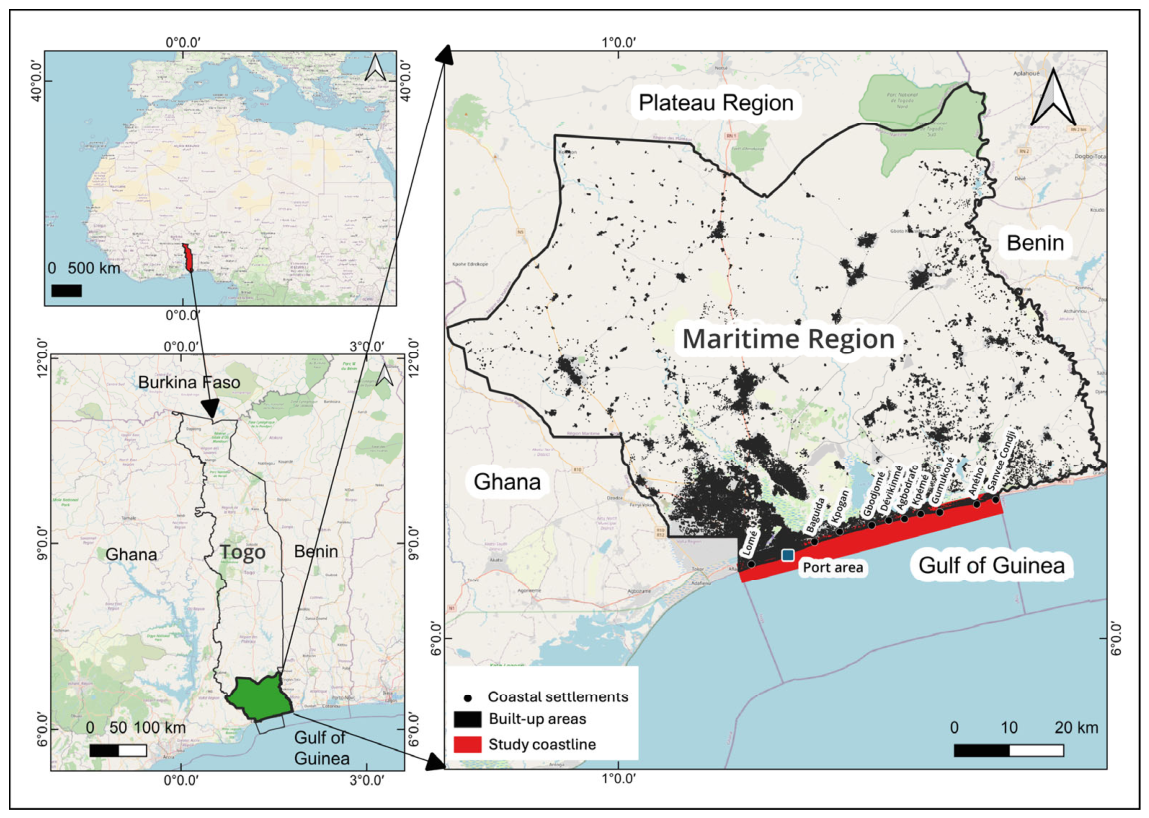
This study focuses on the Togolese coastal zone, located in the Maritime Region of Togo (West Africa), a narrow coastal strip stretching approximately 50 km along the Gulf of Guinea, a sub-meridian-orientated ridge separating the Niger River basin from the Volta River basin. The Maritime Region is bordered by Ghana to the west, the Plateau Region to the north, Benin to the east, and the Atlantic Ocean to the south. It is delimited between latitudes 6°00′ and 6°50′ N and longitudes 0°25′ and 2°00′ E (Figure 1).

2.1. Physical and Geological Setting

The coastal area of Togo is part of the coastal sedimentary Atlantic basin. The geology of southern Togo consists of a Meso–Cenozoic sedimentary cover relying unconformably on a Pan-African gneiss-migmatitic basement [19]. More recent deposits in the coastal zone include basal upper Pleistocene river sands transitioning to Holocene estuarine and deltaic sediments [16].
The seabed morphology features a narrow continental shelf, averaging 10 km in width and sloping abruptly beyond the 100 m isobath. Offshore, the seabed is mainly sandy with two distinct rocky zones, including fossilised coral reefs [20]. Coastal sediments are mainly sourced from the Volta River and redistributed alongshore from west to east by prevailing currents [21].

2.2. Climate and Oceanographic Dynamics

The Maritime Region experiences a subequatorial Guinean climate marked by an alternation of two rainy seasons and two dry seasons. These seasonal cycles result from the interaction between the dry, dusty harmattan winds from the northeast and the humid, warm monsoon winds from the southwest [22]. Annual rainfall ranges between 1000 and 1400 mm, and the average temperature is about 27 °C [23].
Oceanographic conditions are driven by several dynamic processes. The Guinea Current, a slow, warm, west-to-east surface current, plays a significant role in sediment transport, with seasonal speeds ranging from 0.5 m/s in winter to 1.5 m/s in summer [24]. The region experiences semi-diurnal tides with a mean tidal range of about 1 m and regular tidal swell directed toward the south-southwest. Coastal wave patterns are generated both by local monsoon winds and distant Atlantic storms, with average significant wave heights of 1.36 m and dominant directions from the SSW (189°) [24].

2.3. Coastal Geomorphology and Ecosystems

Togo’s coast is low-sloping and dominated by sandy beaches, tidal flats, and shallow lagoons. It features a beach-barrier system fronted by littoral dunes that protect a series of backshore wetlands, including lagoons, ponds, and marshes. The Mono River marks the eastern limit with Benin and discharges into a lagoon complex forming Lake Togo.
This coastal zone is highly dynamic and fragile. Natural forces such as wave action, tides, wind, and marine currents continually reshape the 0. Small-scale processes, including storms and tidal fluctuations, govern short-term changes, while long-term transformations are influenced by climate variability, tectonic movements, and sea level rise [20].

2.4. Anthropogenic Pressure and Vulnerability

The region is densely populated and urbanised, particularly in and around the capital, Lomé. According to the 2022 national census, the Maritime Region has a population of 3,534,991 and a density of 553 people/km2, making it the most densely populated region in Togo [25]. The Lomé metropolitan area alone houses over 2.1 million inhabitants, representing nearly 60% of the national urban population. The region is ethnically diverse, comprising all 43 ethnic groups of Togo, with the Ewe forming the majority [26].
About 28% of Togo’s people live on or near the barrier beach, which makes them very vulnerable to coastal hazards [5]. Coastal erosion, intensified by the construction of infrastructure such as the Port of Lomé, has led to significant shoreline retreat, habitat loss, and the displacement of local communities [21]. Without mitigation, projections indicate that coastal regression could affect more than 7% of the national territory by 2070 [12]. Additional aggravating factors encompass marine submersion, saltwater intrusion, degradation of mangroves, and contamination of soil, air, and water resources.

2.5. Relevance to Coastal Vulnerability

The interplay of geomorphological, hydrodynamic, climatic, and anthropogenic factors renders the Togolese coastal zone a hotspot of vulnerability. The flat topography, high population density, and intense urban development, coupled with increasing climate-induced hazards, emphasise the critical importance of a comprehensive assessment of coastal risks. This study area presents a critical case for understanding how environmental and human-induced drivers interact to shape coastal vulnerability in low-lying West African regions [17].

2.6. History of Coastal Protection

The Port of Lomé, erected in 1968, is central in the chronology of coastal defence construction along the Togolese coast when interpreting observed shoreline trends and forms an integral component of the vulnerability analysis presented here.
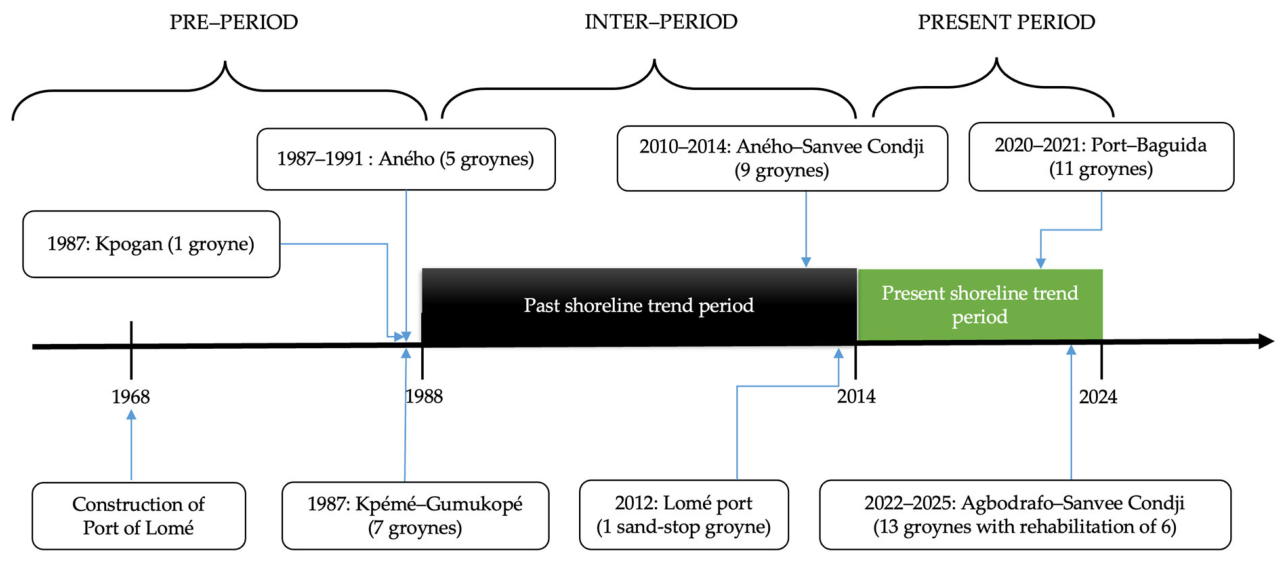
The first groyne systems were installed at Aného (5 groynes, 1987), Kpogan (1 groyne, 1987), and Kpémé–Gumukopé (7 groynes, 1987) [27,28]. In an effort to strengthen the resilience of communities and target areas in the coastal zone, the government of Togo developed the WACA ResIP Togo project (West Africa Coastal Areas Resilience Investment Project) with the support of the World Bank Group in 2018. Some emergency coastal protection works were undertaken in the Gbodjomé–Agbodrafo sector between 2020 and 2023. This included the installation of nozzle wells over a total length of 1.180 km in 5 villages. The long-term WACA works (2022–2025) covered the 18 km Agbodrafo–Sanvee Condji segment. It included 7 new groynes at Agbodrafo, the rehabilitation of 6 existing groynes, the replenishment of 700,000 m3 of sand, and the construction of a 1.2 km protective sand dike in Aného [27].

3. Materials and Methods

3.1. Overview of the Coastal Vulnerability Assessment Framework

The coastal vulnerability assessment method employed in this study follows the index-based approach originally developed by Gornitz et al. [29], and subsequently modified by Fontolan et al. [30], Bisiccia et al. [31], and Bezzi et al. [32].
The advantage of the modified CVI method used here is that it is modular, meaning that a ranked value, to which a weight must be assigned, can be included in the set of indicators. Its effectiveness has already been tested in many cases along the coastline of Italy [30,31,32,33]. The procedure, which involves the use of multiple regression, overcomes the problem associated with the rigidity of using a set of indicators linked to the square root of a multiple product, as in the original formulation.
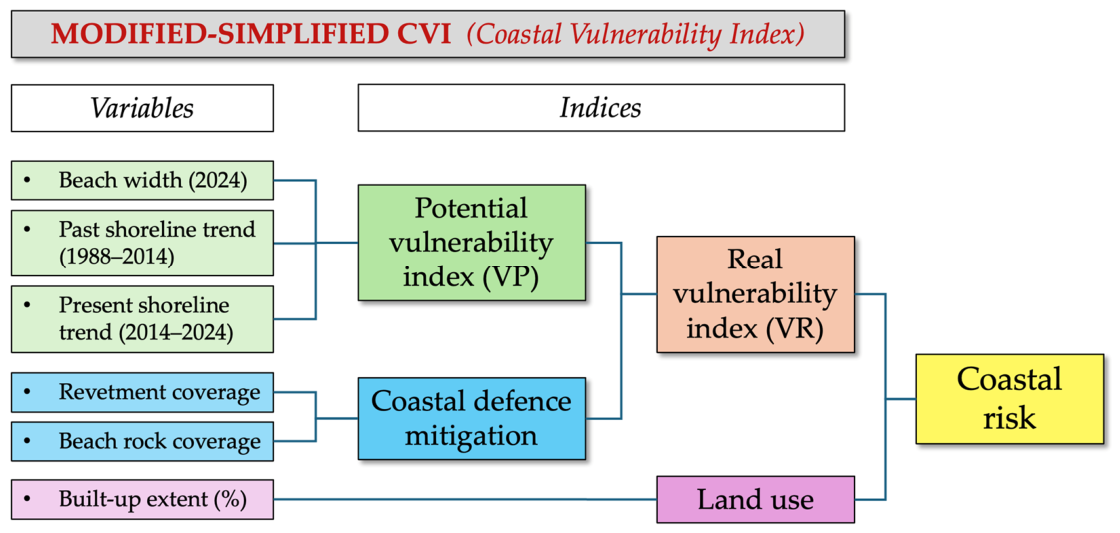
The framework was implemented using data derived from satellite remote sensing and consists of two sequential steps: estimation of the potential vulnerability index (VP), which establishes a baseline of physical susceptibility based on morphological and historical trends without applying explicit mitigation coefficients for current defence structures; and derivation of the real vulnerability index (VR), which adjusts the baseline by incorporating the specific mitigating effects of such defences. Risk estimation was subsequently obtained by combining real vulnerability with land-use information (Figure 2).
The coastline was divided into 99 cells of 500 m each, based on the minimum spatial resolution arising from the ensemble of input variables. Within each cell, a ranking index from 1 (very low vulnerability) to 5 (very high vulnerability) was assigned to each variable, as detailed in Table 1. The overall vulnerability and risk were then computed as weighted combinations of these indices (Section 3.5 and Section 3.6).

3.2. Shoreline Position Extraction (1988–2024)

Shoreline positions from 1988 to 2024 were extracted using the Normalised Difference Water Index (NDWI), computed within the Google Earth Engine (GEE) cloud-computing environment from multi-temporal satellite imagery (Table 2). The processing followed a JavaScript workflow analogous to the method described by Ujaval [34], in which the median composite of all available images within a given year was used to represent the mean annual shoreline position. The resulting shoreline vectors were exported as GeoJSON files for subsequent spatial analysis in QGIS v3.34 and the Digital Shoreline Analysis System (DSAS) standalone version 6.

3.3. Shoreline Trend Analysis

Shoreline trend rates were calculated in DSAS v6 [35] following standard procedures. The annual shoreline vectors were merged in QGIS, and an inland baseline (setting a buffer of 500 m inland along the coastline of Togo) was digitised from which shore-perpendicular transects were generated at 100 m intervals. The End Point Rate (EPR), computed as the net displacement between the oldest (1988) and most recent (2024) shorelines divided by the elapsed time, was selected as the primary rate-of-change metric. Results were re-imported into QGIS and visualised using a graduated colour scheme: high erosion (red), moderate erosion (orange), stable (green), moderate accretion (light blue), and high accretion (blue). Two temporal windows were distinguished to capture past (1988–2014) and present (2014–2024) shoreline dynamics, both of which were used as inputs to the vulnerability index (Section 3.6).
To evaluate the effect of groynes on shoreline dynamics, the installation dates of all known groyne structures along the Togolese coastline were compiled from published reports and project documentation. Structures were assigned to one of three temporal categories relative to the two study periods: pre-period structures, installed before 1988 and therefore active throughout both study windows; inter-period structures, installed between 1988 and 2014, whose effect should become detectable in the transition from the past to the present period; and recent structures, installed after 2014, whose influence may only be partially captured in the 2014–2024 present-period shoreline data.
For each defended cell or cluster of cells, the dominant shoreline trend category (high erosion, moderate erosion, stable, moderate accretion, high accretion) was extracted for both the past and present periods from the DSAS analysis. The direction and magnitude of change between periods was then interpreted in relation to the installation chronology, allowing before/after attribution of trend shifts where the temporal correspondence is unambiguous.

3.4. Beach Width Measurement

Beach width was derived from Google Earth imagery (2024) as the cross-shore distance between the 2024 shoreline position and the backshore limit, defined as the landward edge of the vegetated zone up to the boundary of built structures. The backshore line was manually digitised in Google Earth, and both the shoreline and backshore line were imported into DSAS v6 as separate shoreline layers. The Net Shoreline Movement (NSM) computed between these two lines provided the beach width for each transect, subsequently aggregated to the 500 m cell scale.

3.5. Land-Use Data and Risk Estimation

Land-use data were obtained from the European Space Agency (ESA) WorldCover product (10 m resolution, 2021) [36]. The built-up layer was extracted within QGIS by applying a 500 m inland buffer along the coastline of Togo, and the proportion of built-up areas within each 500 m cell was quantified using the Zonal Histogram tool. Settlement levels were then classified according to the ranking scheme in Table 1.
Coastal risk was estimated by multiplying the real vulnerability index (VR) by the land-use index within each cell. The resulting product was classified into five risk categories following the scheme presented in Table 3, bounded by a minimum score of 5 (VR × 1) and a maximum score of 25 (VR × 5).

3.6. Computation of Vulnerability Indices

3.6.1. Potential Vulnerability Index (VP)

The potential vulnerability index (VP) was computed from three physical parameters—beach width, recent shoreline trend (2014–2024), and past shoreline trend (1988–2014)—to represent the inherent physical hazard level before accounting for active structural protection, using the following weighted formula:
VP = 0.5 × (beach width index) + 0.4 × (recent shoreline trend index) + 0.1 × (past shoreline trend index)
Parameter weights were assigned following Dada et al. [17], who quantified the relative contribution of physical variables to coastal vulnerability along the Gulf of Guinea. Their analysis indicated that geomorphology, shoreline movement, and sea level rise each contributed approximately one-third to the vulnerability of the Togolese coast. Since only beach width and shoreline trend were available as direct metrics, equal weight (50% combined) was distributed between them. Within the shoreline trend component, the recent trend was assigned a substantially larger share of the weight (40%) relative to the historical trend (10%), reflecting its greater relevance to current coastal dynamics.

3.6.2. Real Vulnerability Index (VR) and Coastal Defence Mitigation

The real vulnerability index (VR) was obtained by subtracting the mitigation effect (ME) of existing coastal defence structures from VP. Two categories of defence were identified along the study coastline: artificial structures (revetments) and natural defences (beach rock). Groynes were excluded from this calculation as their influence is already implicitly captured by the shoreline trend metrics. Beach rock outcrops were considered only where they are exposed at or near the surface and capable of dissipating wave energy.
Maximum wave energy reduction capacities were assigned as 80% for revetments and 20% for beach rock. Indeed, in coastal segments where beach rock is documented, a wave energy mitigation coefficient of 20% was applied to the significant wave height variable used in CVI scoring. This coefficient reflects the partial dissipative role of the discontinuous, low-crested beach rock outcrops present along Togo’s intertidal zone, which induce wave breaking and energy attenuation prior to shoreline contact. The value is consistent with the range reported for low-crested natural and artificial coastal structures (10–30%) and is supported by the morphological characterisation of Togo’s beach rock by Blivi [37] and the broader literature in coastal engineering [38]. The mitigation effect within each cell was calculated as:
ME = DLr × 80% + DLbr × 20%
where DLr and DLbr denote the length (m) of revetment and beach rock within the cell, respectively. The real vulnerability was then derived as:
VR = VP − ME

3.7. Vulnerability Classification

Both VP and VR were classified into four vulnerability categories based on the continuous index range 1 to 5, as shown in (Table 4).

4. Results

A total of 46.5 km of the Togolese coastline was analysed. The 3 km stretch adjacent to the port was excluded because it is entirely occupied by hard infrastructure and is not subject to natural shoreline dynamics. Results are summarised in Table 5 by vulnerability and risk categories, and expressed as kilometres of coastline.
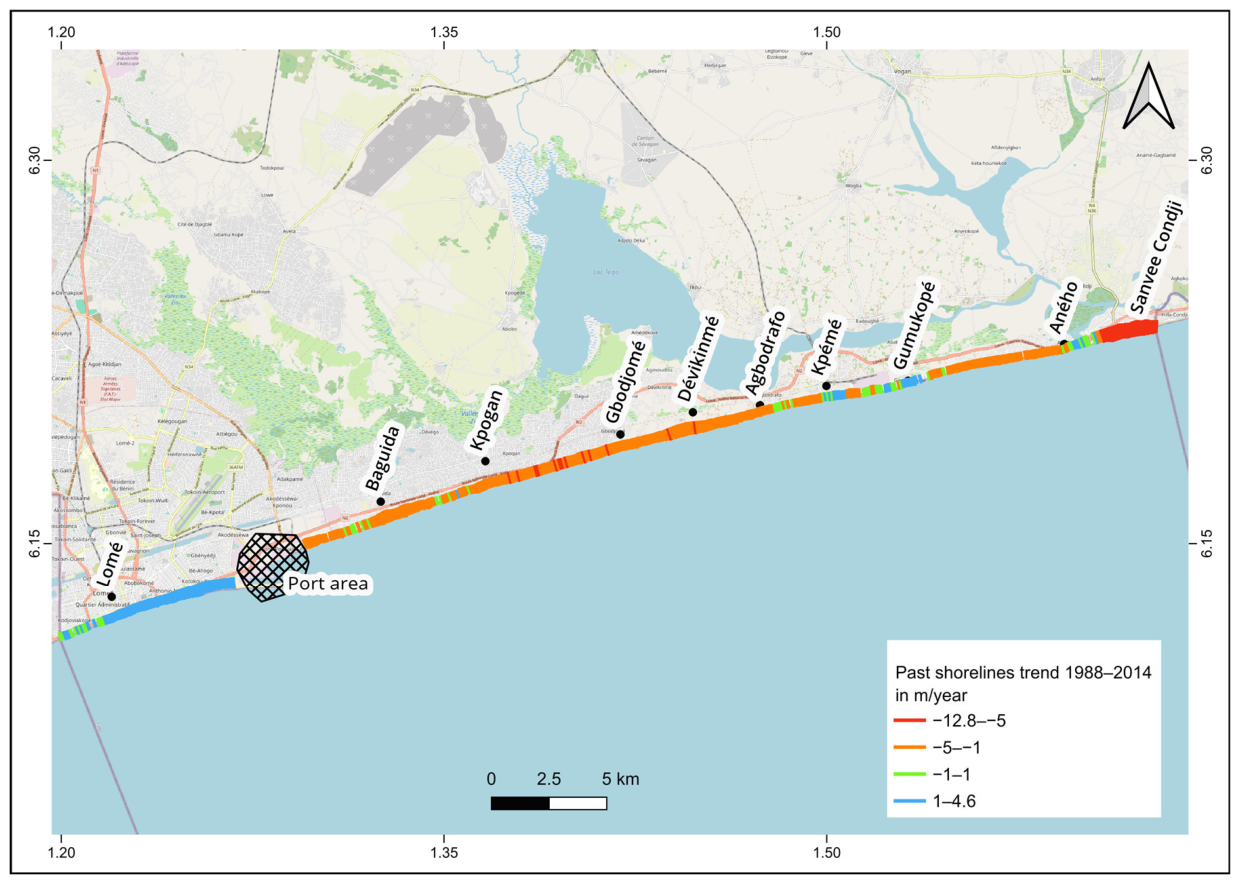
Analysis of historical shoreline positions reveals a net retreat of between −12.8 and −1.0 m/year during the past period (1988–2014), predominantly affecting the 24.5 km segment east of the port (port–Agbodrafo), a 5 km section around Goumou–Kopé, and a 3 km stretch at the eastern extremity (Aného–Sanvee Condji) where retreat rates were most severe (−12.8 to −5.0 m/year) (Figure 3).
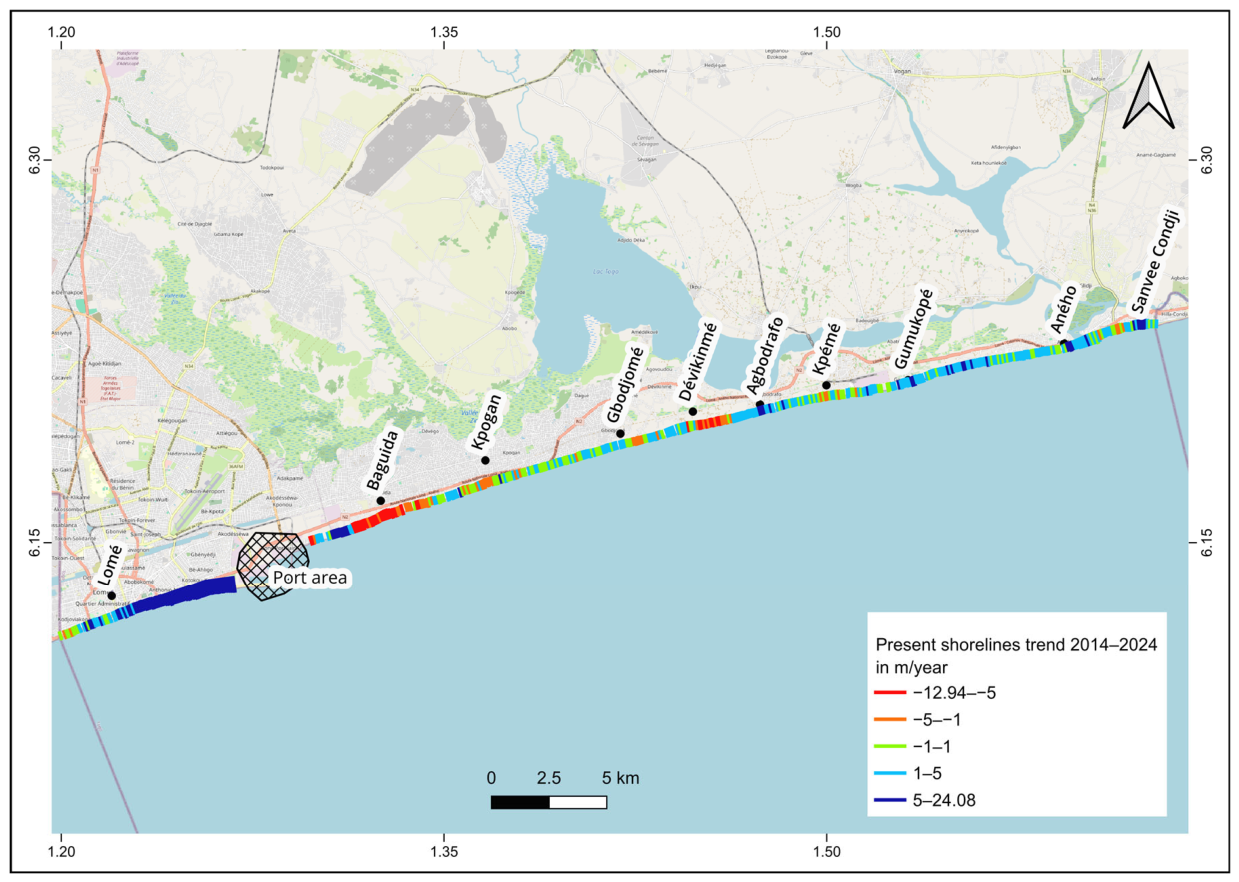
During the present period (2014–2024), erosional hotspots are concentrated in the 8.5 km immediately east of the port (Baguida–Kpogan) and at discrete locations around Gbodjomé, Dévikemé, Kpémé, and Aného–Sanvee Condji (Figure 4). These sectors correspond predominantly to cells assigned medium-high to high potential vulnerability.
A comparison of past and present shoreline trends (Table 6) highlights a substantial redistribution of erosion and accretion across the coastline. The most pronounced shift is the reduction in coastline under moderate erosion from 25.0 km in the past to 5.5 km at present, largely compensated by an expansion of moderate accretion from 9.0 to 20.0 km. Additionally, high accretion emerged as a new category in the present period (5.5 km), which was absent during 1988–2014.
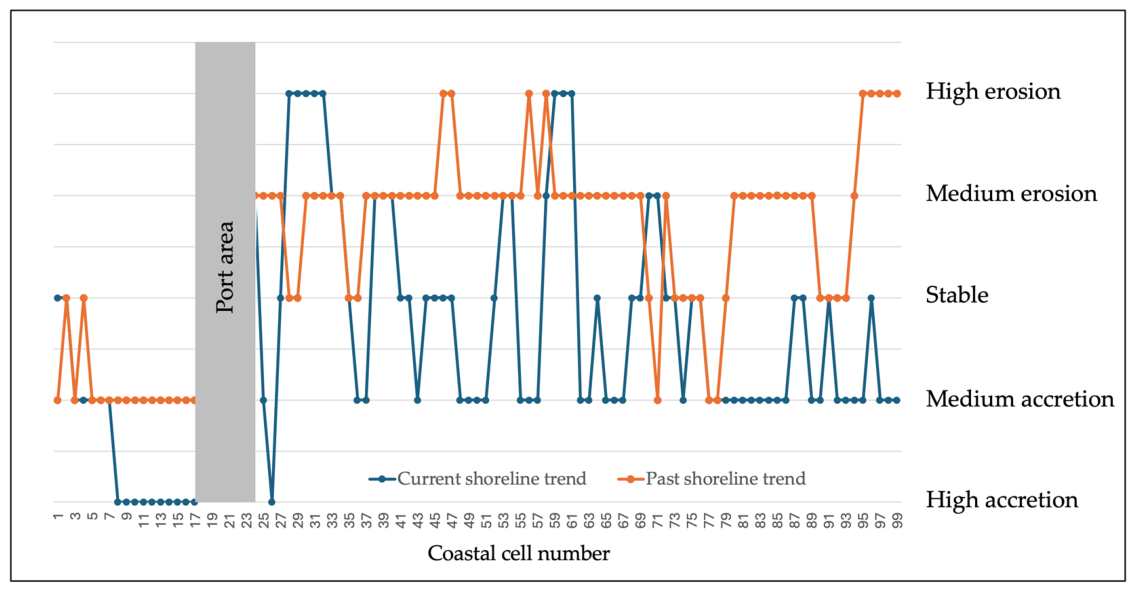
Figure 5 illustrates the cell-by-cell evolution between the two trend periods. On the western side of the port, most cells that showed moderate accretion in the past have shifted to high accretion in the present. On the eastern side, many cells that experienced moderate erosion in the past now show moderate accretion (e.g., cells 56 and 58 (Gbodjomé–Dévikinmé), which shifted from high to moderate erosion, with cell 56 reaching stability). At the far eastern extremity, cells 95–99, Aného–Sanvee Condji, previously characterised by high erosion, are now stable (cell 96) or accreting (cells 95, 97–99).
Conversely, certain sectors display persistent or worsening erosion. Cells 30–32 (around Baguida) and 59–61 (around Dévikinmé) show continuous erosion that has intensified from moderate to high between the two periods. Cells 28 and 29 around Baguida, which were almost stable in the past, now record high erosion. A notable spatial displacement of high erosion is also observed, where the erosional locus has migrated eastward from cells 56 and 58 (past period) to cells 59–61 (present period), while the latter were under moderate erosion in 1988–2014.
An analysis of Figure 6 in relation to Figure 5 reveals how successive generations of groyne installations have successfully reversed long-term erosion in some sectors while simultaneously displacing erosional pressure to others.
The earliest structures, specifically the 1987 Kpogan groyne, the 1987–1991 Aného field (five groynes), and the 1987 Kpémé–Gumukopé field (seven groynes) established the baseline for the past shoreline trend (1988–2014). The Aného sector (cells 92–93) was already stable or weakly accreting during the past period. This reflects the mature trapping capacity of the 1987 structures, which reached an accretionary equilibrium early in the monitoring period. The Kpémé–Gumukopé sector (cells 71–78) exhibited stable or accretionary conditions in the past period due to the 1987 groynes.
In the inter-period (1988–2014), significant shifts occurred following the installation of nine new groynes in Aného–Sanvee Condji (2010–2014) and the 250 m “sand stop” groyne at the Lomé port (2012). At the west of the port (cells 1–17), most of these cells shifted from moderate accretion in the past to high accretion in the present. The 2012 port groyne further extended the beach width here by an average of 50 m to accommodate new terminal infrastructure. At Sanvee Condji (cells 95–99), previously characterised by high erosion in the past period, these transitioned to stable or accreting conditions in the present (2014–2024). This improvement is directly attributed to the cumulative effect of the 2010–2014 groyne additions and the start of WACA rehabilitation and new works.
During the present-period interventions (2014–2024), intense activity between 2020 and 2025 [28] highlights the emergence of new high-erosion hotspots downdrift of these works. In the Baguida sector (cells 28–32), cells 28 and 29, which were stable in the past, now record high erosion. This correlates with the installation of 11 groynes in the port–Baguida stretch (2020–2021). The study identifies this as a spatial displacement of high erosion, where groyne-induced accretion in one sector starves adjacent downdrift cells of sediment. At Dévikinmé (cells 59–61), the “erosional locus” has migrated eastward. While cells 56 and 58 improved from high to moderate erosion (with cell 56 reaching stability), cells 59–61 intensified from moderate to high erosion in the present period.
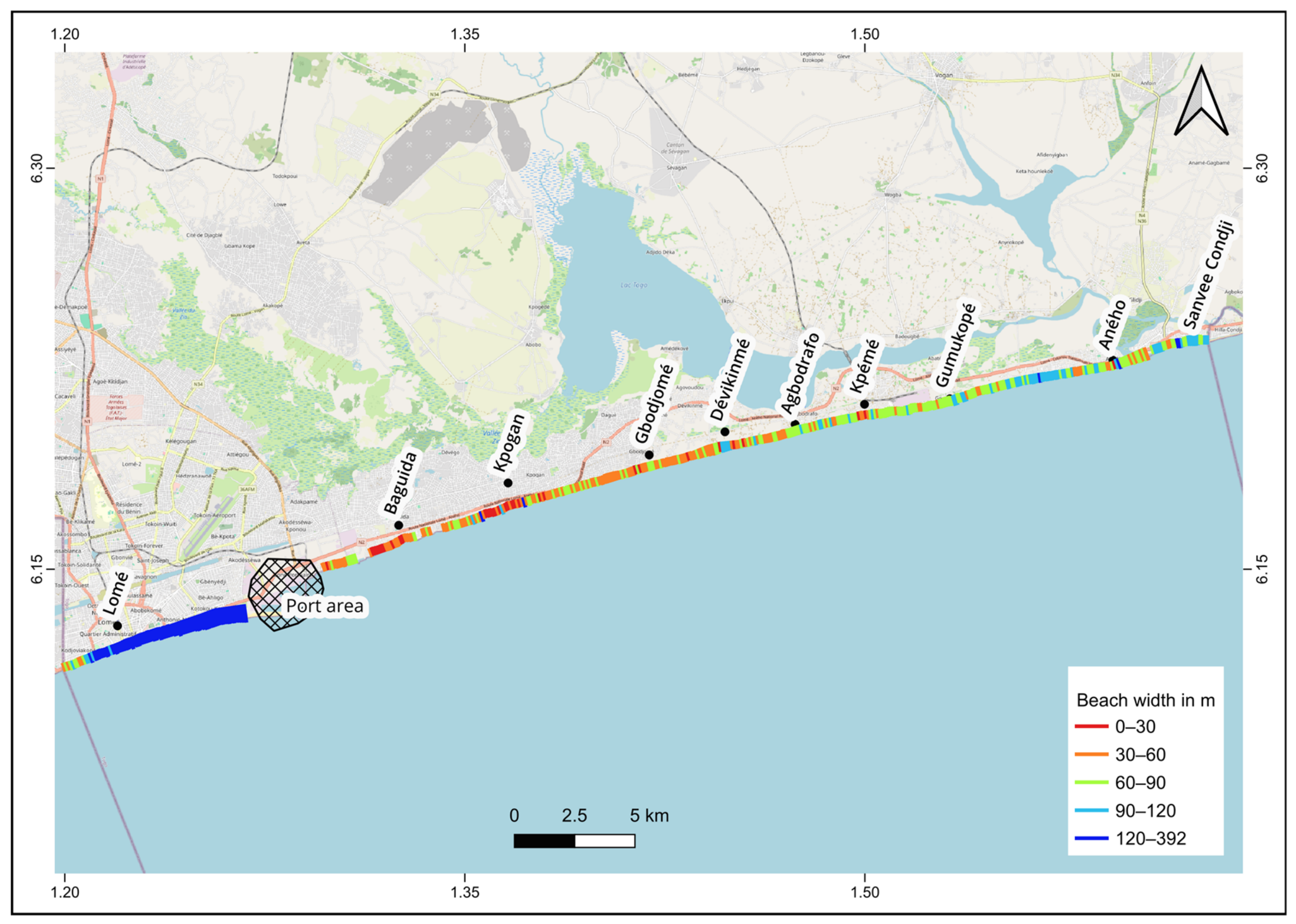
Beach width exhibits a marked spatial asymmetry around the port. The 20 km of coastline immediately east of the port (port–Agbodrafo) is characterised by narrow beaches, predominantly between 0 and 60 m wide (Figure 7), consistent with the sustained erosive trends observed in that sector during both study periods. In contrast, the western segment of the coastline presents considerably wider beaches. Combined with the shoreline trend indices, the narrow beach widths in the eastern sector reinforce its classification as a zone of high potential vulnerability.
All identified coastal defence structures are in the eastern part of the study area. Two categories were recorded as natural defences (beach rock) and artificial structures, notably revetments, breakwater, which we considered a revetment, and groynes, with the latter erected predominantly under the WACA project in response to chronic erosion. Sandbag structures installed by local communities and a limited nozzle wells were also observed but were considered negligible in terms of wave energy dissipation and excluded from the mitigation calculation.
Groynes are the most abundant artificial structure and have been effective in stabilising and even promoting accretion (Figure 5). However, as stated in Section 3.6.2, groynes were excluded from the mitigation effect (ME) calculation as their influence is already captured implicitly by the shoreline trend metrics used to compute VP.
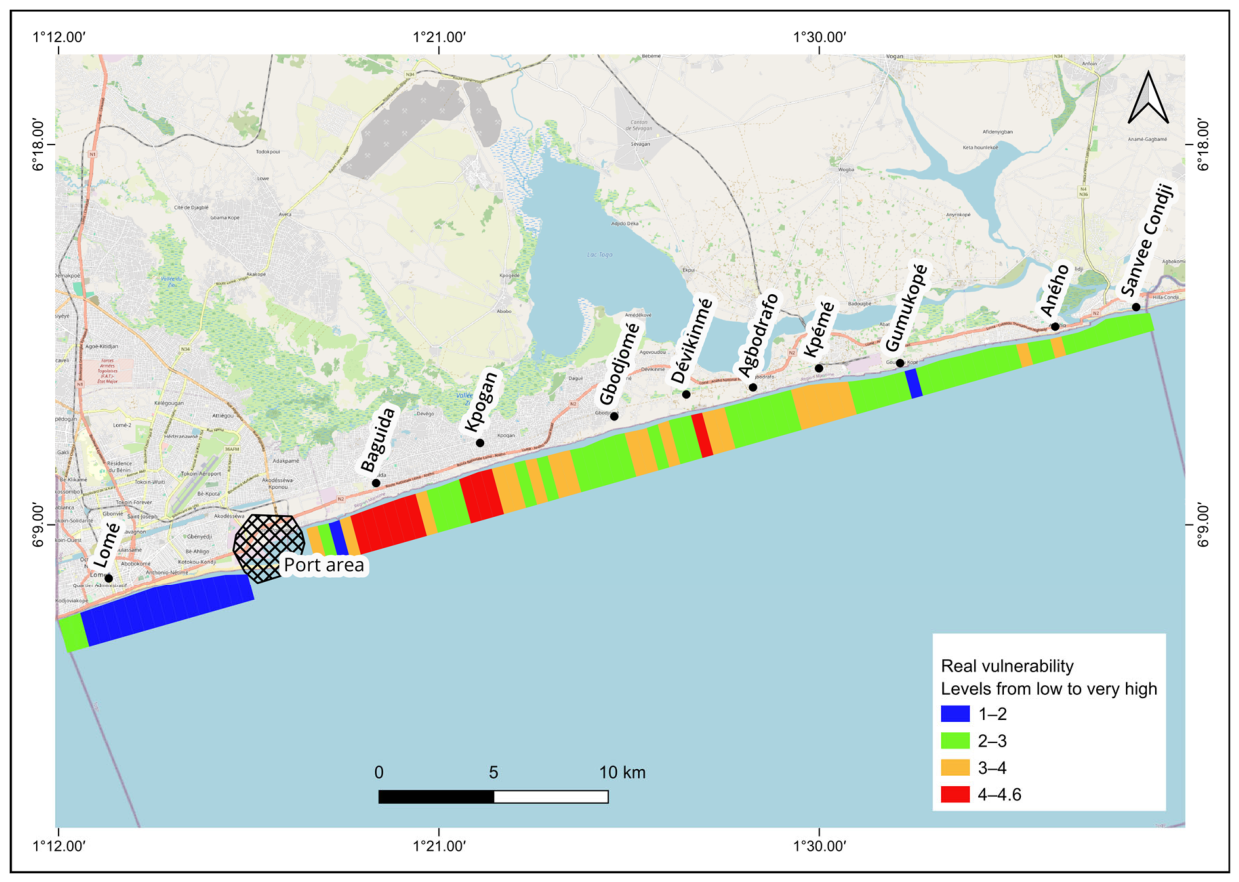
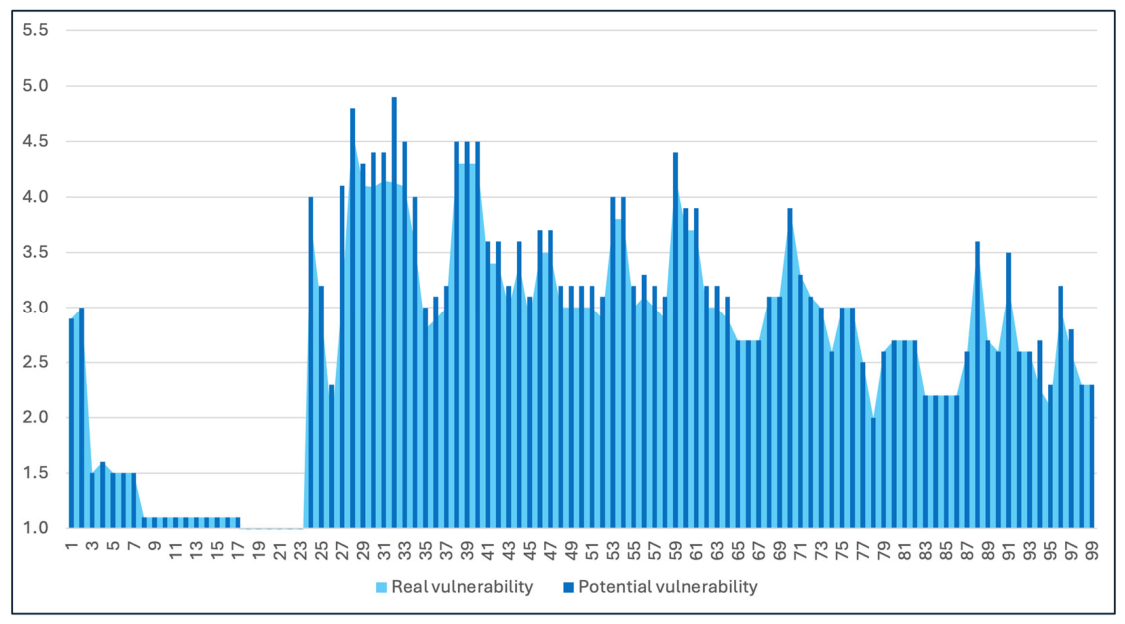
Seven discrete revetment sections were identified, with individual lengths ranging from 75 to 600 m. Five of these are concentrated within the 5.5 km immediately east of the port. Beach rock outcrops visible at or near the surface were recorded across approximately 20 km east of the port and at the far eastern extremity. In accordance with the mitigation coefficients defined in Section 3.6.2 (80% and 20% wave energy reduction for revetments and beach rock, respectively), the combined ME reduced the real extent of high potential vulnerability from 23.5 km to 15.0 km in the eastern sector (Figure 8 and Figure 9).
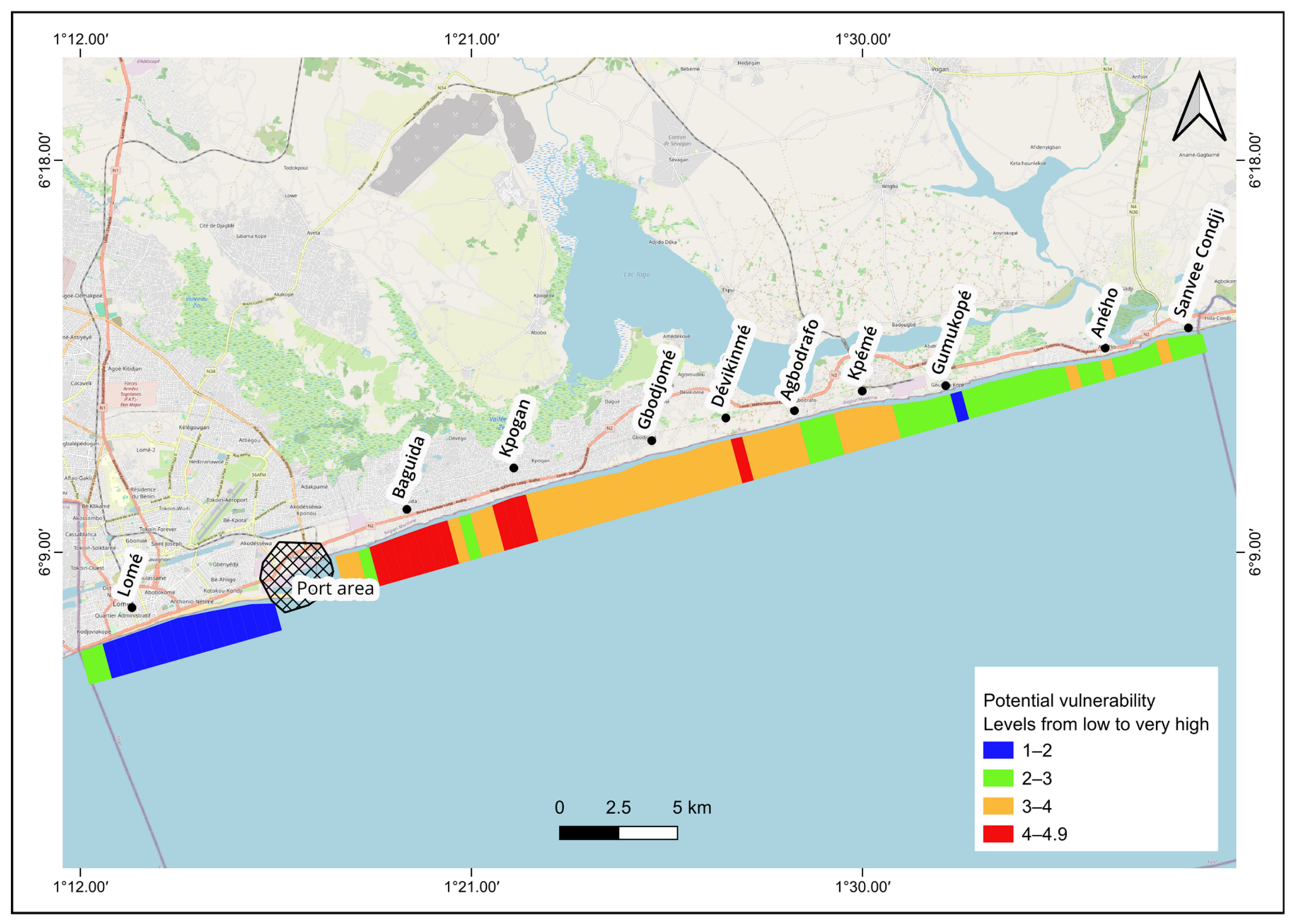
The spatial distribution of VP (Figure 10) reflects the combined influence of shoreline dynamics and beach width. The 24.5 km segment east of the port (port–Agbodrafo) is predominantly classified as medium-high to high vulnerability, with the exception of 2.5 km of disparate cells as medium-low. The remaining 13.5 km of the coastline is largely medium-low, with the exception of 0.5 km as low and 1.5 km as medium-high. The western sector is predominantly of low vulnerability.
Overall, 23.5 km of coastline (approximately 51% of the study area) falls within the high to very high VP categories (Table 5), underlining the disproportionate exposure of the eastern coastal sector. Incorporating the ME of defence structures shifts the vulnerability distribution toward lower classes. The proportion of coastline classified as high or very high vulnerability decreases from 23.5 km (VP) to 15.0 km (VR), while the medium-low category expands from 15.0 to 23.0 km (Table 5). This reduction is entirely confined to the eastern sector, where defence structures are present, and does not affect the western sector, which remains predominantly in low vulnerability.
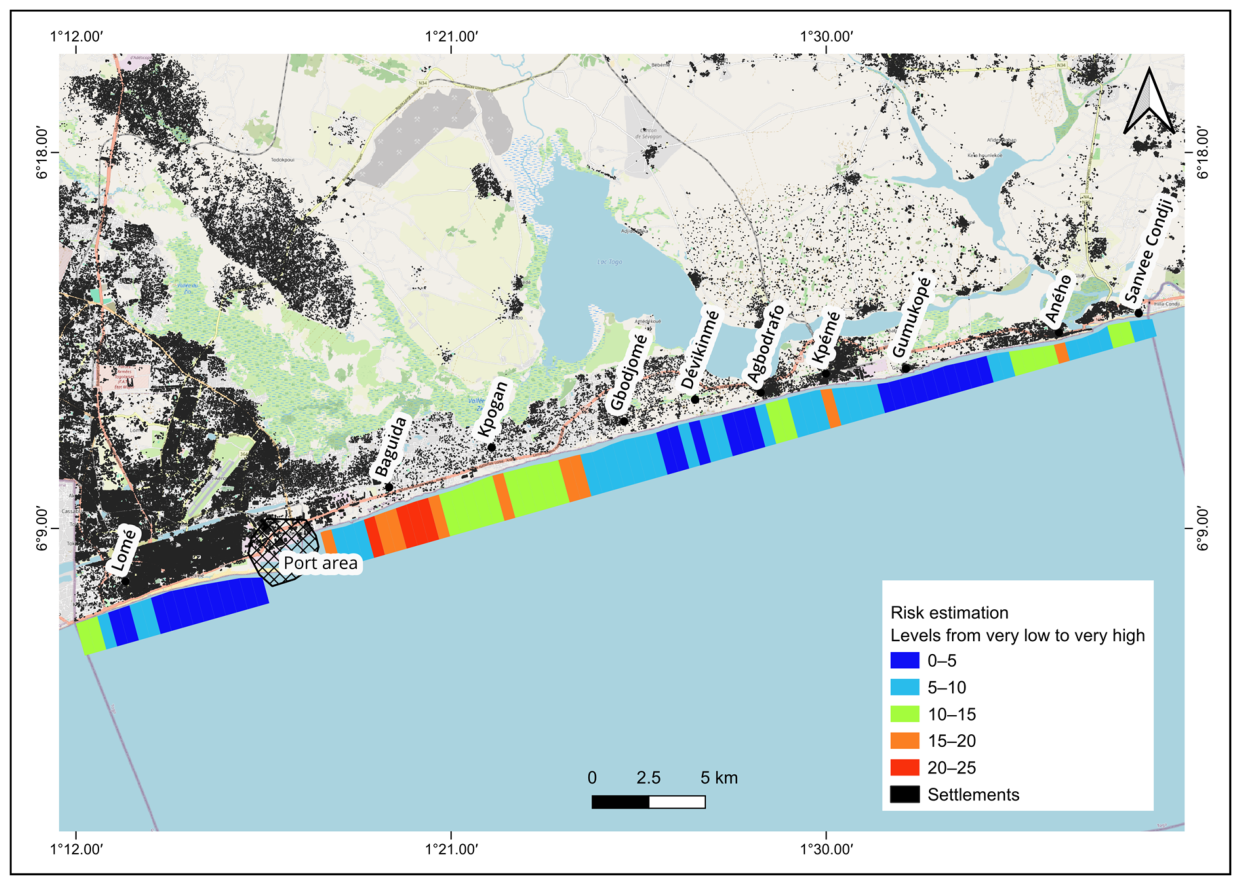
Risk estimation, obtained by combining VR with land-use indices (Section 3.5), identifies 6.5 km of coastline at high risk. The high-risk zone is entirely located in the eastern sector, extending from the port to Gbodjomé, and is characterised by active erosion threatening residential and built-up areas. The highest-risk concentration (very high risk; 5.5 km) is found within the port–Baguida stretch immediately east of the port, where elevated real vulnerability coincides with dense settlements (Figure 11). A substantial portion of the coastline (26 km; very low and low combined) is associated with relatively limited exposure, mainly along the less populated and more stable western sector.

5. Discussion

5.1. Spatial Pattern of Vulnerability

The results demonstrate a pronounced east–west asymmetry in coastal vulnerability along the 46.5 km study coastline. The 24.5 km segment east of the port (port–Agbodrafo), combined with discrete hotspots further east, accounts for the bulk of coastline classified as high to very high potential vulnerability, while the western sector remains predominantly in low vulnerability. This spatial dichotomy is consistent with the findings of Blivi [21], who concluded from a qualitative assessment that sea level rise would disproportionately affect low-lying areas east of the port, and with Dada et al. [17], whose physical vulnerability index placed approximately 50% of the Togolese coast, coinciding with the eastern sector, in the high-vulnerability category. The present study reinforces those conclusions with quantitative, cell-scale resolution and adds the dimension of real vulnerability (VR) by incorporating the mitigating role of defence structures, an aspect not addressed by either prior study.
A critical distinction of the present work relative to Blivi [21] and Dada et al. [17] is the spatial disaggregation of the coastline into 99 discrete 500 m cells. This approach reveals intra-sectoral variability that broad-scale assessments obscure; for instance, 2.5 km within the predominantly high-vulnerability eastern segment are classified as medium-low, while 1.5 km of the otherwise low-vulnerability western sector reach medium-high. Such heterogeneity has direct implications for prioritising site-specific management interventions.

5.2. Shoreline Dynamics and the Role of Port Infrastructure

The historical shoreline analysis (1988–2014) documents retreat rates from −12.8 to −1.0 m/year across much of the eastern sector, which is in close agreement with Konko et al. [14], who identified four major erosion hotspots east of the port with rates from −12 to −0.01 m/year. The underlying driver is widely attributed to the construction of the Lomé deep-sea port in 1968, which interrupted the dominant eastward longshore sediment transport, causing updrift accretion and downdrift starvation [15,21]. Such dynamics are evidenced by the persistent accretionary trend on the western (updrift) side and the chronic erosion deficit on the eastern (downdrift) side, a pattern that persists, albeit in modified form, in the present period (2014–2024).
Between the two periods, the most striking shift is the contraction of moderate erosion from 25.0 km to 5.5 km and the concurrent expansion of moderate accretion from 9.0 to 20.0 km (Table 6). This reversal is attributable in large part to the groyne fields constructed under the WACA project [5], which have intercepted longshore transport and promoted localised accretion in cells 43–53 and 74–99. However, the persistence of high erosion in cells 28–31 and 60–62, as well as the emergence of high erosion in formerly stable cells 25–27, indicate that groyne-induced accretion in one sector can displace erosion to adjacent downdrift cells, a phenomenon of groyne-field compartmentalisation well documented in the coastal engineering literature [39,40,41]. The spatial migration of the high-erosion locus from cells 56 and 58 (past) to cells 59–61 (present) is consistent with this interpretation and warrants targeted monitoring.

5.3. Beach Width as a Vulnerability Amplifier

Beach width emerged as a primary discriminant between high- and low-vulnerability cells. The 20 km of coastline immediately east of the port, where widths are predominantly 0–60 m, coincides spatially with the zones of highest erosion and highest VP scores. This co-occurrence reflects a well-established coastal feedback: sustained net erosion progressively narrows the beach, reducing its capacity to dissipate wave energy and increasing the exposure of backshore infrastructure to swash and storm surge. The 50% weighting assigned to beach width in the VP formula (Section 3.5) is therefore physically justified and consistent with Dada et al.’s [17] finding that geomorphological indicators contribute approximately 34% to coastal vulnerability in this region, the largest single factor in their ranking.
Conversely, the wide beaches of the western sector (>90 m in many cells) provide substantial natural buffering capacity, contributing to the low VP values observed there. This finding underscores the value of beach nourishment as a complementary management strategy in areas where existing beach width is critically narrow, particularly in the port–Agbodrafo corridor.

5.4. Effectiveness and Limitations of Coastal Defence Structures

The transition from VP to VR illustrates that existing defence structures reduce the extent of highly vulnerable coastline from 23.5 to 15.0 km, a mitigation gain of approximately 8.5 km or 36%. This reduction is driven almost entirely by beach rock outcrops, which are extensive (approximately 20 km) but assigned a conservative 20% mitigation coefficient [36], and by seven revetment sections, which carry an 80% coefficient but are spatially limited (75–600 m each, mostly within 5.5 km of the port). The disproportion between the spatial coverage of beach rock and its relatively modest mitigation effect reflects its partial emergence and irregular exposure; as Blivi [37] demonstrated, beach rock acts primarily by reducing abrasion and stabilising sediment through calcium carbonate cementation rather than by providing a rigid wave barrier. Elevating exposed beach rock sections to function as high/low-crested seawalls, where geologically feasible, could substantially increase the mitigation coefficient and reduce VR along the 20 km eastern corridor.
The effectiveness of groynes in fostering accretion between Kpogan and Gbodjomé, as well as Gumukopé–Sanvee Condji, confirms their role as a positive sediment management tool in a longshore-transport-dominated system. However, their exclusion from the ME calculation (Section 3.6.2) is methodologically justified: their contribution is already implicit in the improved shoreline change scores of affected cells. Any double counting would artificially suppress VR values. Notwithstanding their local benefits, the groyne-induced displacement of erosion to downdrift cells illustrates the system-level trade-offs inherent in hard coastal engineering and reinforces the need for integrated management planning at the compartment scale rather than individual cell scale.
The temporal analysis presented in the results demonstrates that the effectiveness of coastal defences is not uniform across installation generations. Pre-period structures at Aného, Kpogan, and Kpémé-Gumukopé have had sufficient time to establish stable groyne–bay geometries, and their contribution is already embedded in both the past and present shoreline trend metrics. Inter-period structures at Aného–Sanvee Condji are responsible for the majority of the trend improvements observed between the two periods: the contraction of moderate erosion from 25.0 to 5.5 km and the expansion of accretion from 9.0 to 25.5 km combined. Recent WACA structures, by contrast, are still in the early phase of morphodynamic adjustment, and their full benefit will only become quantifiable through post-2025 monitoring. This generational pattern has direct implications for management planning: the time lag between structure installation and measurable vulnerability reduction typically takes several years for groyne bays to fill to equilibrium. It means that current VR scores in recently defended cells are conservative estimates of future protection levels. Planning decisions should account for this trajectory rather than treating the present CVI snapshot as a static endpoint.

5.5. Coastal Risk and Implications for Land-Use Planning

The risk analysis identifies 6.5 km of coastline in the high-risk category, concentrated in the port–Gbodjomé corridor, where elevated VR coincides with dense settlement. The port–Baguida stretch (5.5 km) represents the most acute risk concentration in the study area, with residential structures directly exposed to active erosion. This finding has immediate practical implications, as land-use data [36] indicate built-up fractions exceeding 60% in several cells of this corridor (index 4–5; Table 1), leaving little scope for managed retreat without significant displacement of communities. In this context, hybrid solutions combining hard defences (revetment extensions), ecosystem-based approaches (beach nourishment, beach rock enhancement), and regulatory land-use controls (set-back lines, development moratoria) are warranted.
The predominance of low-to-moderate risk along the western sector (26 km in very-low- and low-risk categories; Table 5) suggests that proactive rather than reactive management, such as maintaining current low settlement density and restricting future coastal development, could preserve the natural protective capacity of the wider beaches in that sector and prevent a future increase in risk exposure.

5.6. Validation and Uncertainties

A comprehensive validation of the CVI results against independent field data is not currently possible due to the absence of a systematic in situ coastal monitoring programme in Togo. However, the consistency between the spatial patterns of vulnerability identified here and the qualitative observations reported in prior studies [12,14,17,21] provides a degree of indirect validation, suggesting that the index-based outputs capture the primary known gradients of coastal hazard. The identification of erosion hotspots (Baguida, Dévinkemé) and the pronounced east–west asymmetry align with the established understanding of longshore sediment transport disruption by the Port of Lomé.
Validation of CVI results typically relies on expert judgement or calibration utilising coastline erosion data when this parameter is not directly incorporated in the basic formulation [42]. The VP index obtained by summing two equally weighted physical and dynamic indicators (beach width and shoreline trend) has the power to provide immediate and objective feedback on the intrinsic susceptibility of beaches to erosion.
The assignment of wave energy reduction coefficients for revetments (80%) and beach rock (20%) is a methodological simplification; actual dissipation depends on site-specific parameters (structure height, crest width, degree of emergence) for which quantitative data are lacking. The absence of formal sensitivity analyses on these weights and coefficients constitutes a limitation.
Uncertainties in this study arise from multiple sources. The use of satellite-derived shorelines introduces positional uncertainties related to tidal stage at the time of image acquisition, interannual variability, and the sub-pixel accuracy of the NDWI method. These uncertainties are partially mitigated by using median annual composites, which reduce the influence of ephemeral water-level fluctuations. Nevertheless, the temporal resolution of the shoreline dataset (annual composites) does not capture intra-annual variability, and the comparison between past and present periods is complicated by the transition from Landsat to Sentinel-2 imagery.

5.7. Limitations and Directions for Future Research

Some limitations of this study warrant explicit acknowledgement. First, the VP formula incorporates only beach width and shoreline trend rates, reflecting data availability rather than the full suite of physical drivers. Variables such as wave forcing (height, period, and direction), shoreface gradient, tidal range, and sediment grain size contribute independently to coastal vulnerability and could not be included due to the absence of systematic observational records in Togo. Dada et al. [17] attributed 33% of physical vulnerability to sea level rise, a component that is also omitted here. Incorporating these variables in future assessments, potentially through regional numerical modelling, would improve the physical completeness of the index.
Second, the risk index currently captures exposure (land use/settlement density) but does not account for socioeconomic vulnerability dimensions such as poverty, governance capacity, or community adaptive resilience, which strongly modulate the actual impact of coastal hazards on affected populations. Integrating socioeconomic indicators into a composite risk framework represents a logical next step and would align the methodology with emerging standards for multi-dimensional coastal risk assessment.
Finally, the beach rock distribution was characterised from surface observations only. A systematic geophysical survey to map subsurface continuity and thickness would enable more accurate assignment of mitigation coefficients and identify sections where structural enhancement, as proposed in Section 5.4, is geologically viable. Addressing these limitations through targeted field campaigns and the establishment of a permanent coastal monitoring network would substantially increase the predictive power and management relevance of future iterations of this assessment.

6. Conclusions

This study provides the first cell-scale coastal vulnerability assessment for the full extent of Togo’s 46.5 km active coastline, resolving spatial gradients in potential vulnerability (VP), real vulnerability (VR), and risk at a 500 m unit. The principal findings can be summarised as follows:
  • A pronounced east–west asymmetry governs coastal vulnerability. The 24.5 km segment east of the port (port–Agbodrafo) concentrates the bulk of high to very high VP (approximately 23.5 km; 51% of the study area), driven by narrow beach widths (0–60 m), sustained historical retreat (−1.0 to −12.8 m/year during 1988–2014), and continued erosion at discrete hotspots (Baguida, Kpogan, Gbodjomé, Dévikinmé, and Kpémé) during 2014–2024. The western sector, characterised by wide beaches and net accretion, remains predominantly in low vulnerability.
  • Moderate erosion of the littoral has decreased from 25.0 km to 5.5 km between the past (1988–2014) and present (2014–2024) periods, while moderate accretion has increased from 9.0 to 20.0 km. This redistribution reflects the stabilising influence of groyne fields, though groyne compartmentalisation has displaced erosion to adjacent downdrift cells (notably cells 28–33 and 59–61), which now require priority attention.
  • Existing coastal defences, including seven revetment sections and beach rock outcrops extending approximately 20 km east of the port, reduce the extent of a highly vulnerable coastline from 23.5 km (VP) to 15.0 km (VR), a mitigation gain of approximately 36%. However, spatial coverage remains insufficient to protect the full extent of the high-vulnerability corridor, and the moderate mitigation coefficient of beach rock (20%) limits its current contribution.
  • The risk assessment identifies 6.5 km of coastline in the high-risk category, confined entirely to the eastern sector (port–Gbodjomé). Within this zone, the port–Baguida corridor (5.5 km) represents the most acute risk concentration, where high VR intersects with settlement densities exceeding 60% of the cell area. Active erosion in this corridor directly threatens residential infrastructure, placing it at the forefront of management priority.
  • A temporal attribution analysis, relating known installation dates of coastal defence structures to observed shifts in shoreline trend between the past (1988–2014) and present (2014–2024) periods, confirms that inter-period groyne installations at Aného–Sanvee Condji are the primary drivers of the observed contraction of moderate erosion and expansion of accretion between periods. Pre-period structures at Aného (1987), Kpogan, and Kpémé–Gumukopé have produced mature, stable groyne bays visible in both periods. Recent WACA works (2022–2025) are incompletely captured by the 2014–2024 EPR metric; post-2025 shoreline monitoring is required to quantify their full contribution to vulnerability reduction.
Taken together, these findings demonstrate that the post-1968 disruption of longshore sediment transport by the Lomé port remains the dominant structural driver of coastal vulnerability in Togo, with interventions providing partial but spatially incomplete mitigation. The CVI framework applied here, while constrained by the available data, offers a replicable and updatable baseline for monitoring and adaptive management.
On the basis of these results, three tiers of management action are recommended. In the immediate term, structural reinforcement of revetments and targeted beach nourishment in the port–Baguida corridor are warranted to protect communities at highest risk. In the medium term, coastal set-back regulations and development moratoria in cells currently transitioning toward higher erosion (cells 28–33, 59–61) would limit future risk accumulation. Over the longer term, the potential to enhance beach rock outcrops as low-crested protective structures, as discussed in Section 5.4, merits geophysical investigation and feasibility assessment. All three tiers should be embedded within an Integrated Coastal Zone Management (ICZM) framework that coordinates structural measures with land-use planning and community engagement.
Future research should prioritise: field-based measurements of wave forcing, shoreface morphology, and sediment grain size to improve the physical completeness of the vulnerability index; integration of socioeconomic vulnerability indicators (poverty, adaptive capacity, governance) into the risk assessment; subsurface mapping of beach rock continuity to underpin structural enhancement proposals; and the application of climate scenario forcing (accelerated sea level rise, changing storm climatology) to project how vulnerability and risk distributions may evolve over decadal timescales. The monitoring infrastructure required for these advances also represents an investment in the broader observational capacity needed for evidence-based coastal governance in Togo and the wider Gulf of Guinea.


Author Contributions

Conceptualisation, D.T. and G.F.; methodology, D.T., G.F. and A.B.; software, D.T. and S.F.; validation, D.T. and G.F.; formal analysis, D.T. and G.F.; writing—original draft preparation, D.T.; writing—review and editing, D.T., G.F., S.F. and A.B.; visualisation, D.T., S.F. and A.B.; supervision, G.F., S.F. and A.B.; funding acquisition, D.T. and G.F. All authors have read and agreed to the published version of the manuscript.

Funding

The Italian Ministry of Foreign Affairs and International Cooperation and the Italian Agency for Development Cooperation funded this work (grant number 3240335313) under the TWAS-SISSA-Lincei Research Cooperation Visits Programme.

Data Availability Statement

The Coastal Vulnerability Index ranking in the different cells is available here: https://docs.google.com/spreadsheets/d/162VtD69kGacHSqB2jr83KXaBese4sEgu/edit?usp=sharing&ouid=112696666438732660642&rtpof=true&sd=true (accessed on 14 April 2026).

Acknowledgments

The authors acknowledge the support provided by TWAS-SISSA-Lincei, the Italian Ministry of Foreign Affairs and International Cooperation and the Italian Agency for Development Cooperation. They also thank the staff of the UNESCO-TWAS at the ICTP Campus in Trieste for their support and kind hospitality. The authors acknowledge the logistical support of the Department of Mathematics, Informatics and Geosciences, University of Trieste, including the staff of the Coastal Group who hosted the training. Finally, the authors are grateful to Ibrahima Pouye for his assistance during the review process.

Conflicts of Interest

The authors declare no conflicts of interest.

References

  1. Syvitski, J.P.M.; Kettner, A.J.; Overeem, I.; Hutton, E.W.H.; Hannon, M.T.; Brakenridge, G.R.; Day, J.; Vörösmarty, C.; Saito, Y.; Giosan, L.; et al. Sinking deltas due to human activities. Nat. Geosci. 2009, 2, 681–686. [Google Scholar] [CrossRef]
  2. Neumann, B.; Vafeidis, A.T.; Zimmermann, J.; Nicholls, R.J. Future coastal population growth and exposure to sea-level rise and coastal flooding-A global assessment. PLoS ONE 2015, 10, e0118571. [Google Scholar] [CrossRef]
  3. Güneralp, B.; Perlstein, A.S.; Seto, K.C. Balancing urban growth and ecological conservation: A challenge for planning and governance in China. Ambio 2015, 44, 532–543. [Google Scholar] [CrossRef]
  4. Luijendijk, A.; Hagenaars, G.; Ranasinghe, R.; Baart, F.; Donchyts, G.; Aarninkhof, S. The state of the world’s beaches. Sci. Rep. 2018, 8, 6641. [Google Scholar] [CrossRef]
  5. West Africa Coastal Areas (WACA). Assessment 2020—West Africa Coastal Areas. General Document. MOLOA. 2021. Available online: https://www.giwacaf.net/site/assets/files/2275/sdlao_2020_assessment_general_report_final_version_post_csr_eng.pdf (accessed on 8 February 2026).
  6. Vousdoukas, M.I.; Ranasinghe, R.; Mentaschi, L.; Plomaritis, T.A.; Athanasiou, P.; Luijendijk, A.; Feyen, L. Sandy coastlines under threat of erosion. Nat. Clim. Change 2018, 8, 617–620. [Google Scholar] [CrossRef]
  7. Lovelock, C.E.; Ellison, J.C. Vulnerability of mangroves and tidal wetlands to climate change. Science 2015, 349, 819–820. [Google Scholar] [CrossRef]
  8. Bozzeda, F.; Ortega, L.; Costa, L.L.; Fanini, L.; Barboza, C.A.M.; McLachlan, A.; Defeo, O. Global patterns in sandy beach erosion: Unraveling the roles of anthropogenic, climatic and morphodynamic factors. Front. Mar. Sci. 2023, 10, 1270490. [Google Scholar] [CrossRef]
  9. Nicholls, R.J.; Wong, P.P.; Burkett, V.; Woodroffe, C.D.; Hay, J.E. Climate change and coastal vulnerability assessment: Scenarios for integrated assessment. Sustain. Sci. 2008, 3, 89–102. [Google Scholar] [CrossRef]
  10. UN-HABITAT. State of the World’s Cities 2008/2009: Harmonious Cities. United Nations Human Settlements Programme. Available online: https://unhabitat.org/state-of-the-worlds-cities-20082009-harmonious-cities-2 (accessed on 8 February 2026).
  11. Ocean & Climate Platform. Adapting Coastal Cities and Territories to Sea Level Rise in West Africa: Challenges and Leading Practices. 2023. Available online: https://ocean-climate.org/wp-content/uploads/2023/09/Report-Seaties_Adapting_Coastal_Cities_West_Africa_SLR-v2.pdf (accessed on 8 February 2026).
  12. Konko, Y.; Umaru, E.T.; Nimon, P.; Adjoussi, P.; Kokou, K. Shoreline dynamics and impacts along the Togolese coast. Afr. J. Environ. Stud. 2018, 12, 207–225. [Google Scholar]
  13. Konko, Y.; Umaru, E.T.; Nimon, P.; Adjoussi, P.; Kokou, K. Assessing shoreline retreat in Togo: A multi-temporal analysis. Coast. Geomorph. J. 2020, 15, 45–60. [Google Scholar]
  14. Konko, Y.; Umaru, E.T.; Nimon, P.; Adjoussi, P.; Okhimamhe, A.; Kokou, K. Climate change and coastal erosion hotspots in West Africa: The case of Togo. Reg. Stud. Mar. Sci. 2024, 77, 103691. [Google Scholar] [CrossRef]
  15. Attiq, Z.; Baqi, A.; Abbas, A. Climate-induced coastline changes: A case study in Togo (West Africa). Int. J. Innov. Sci. Technol. 2021, 3, 33–42. [Google Scholar] [CrossRef]
  16. Konko, Y.; Umaru, E.T.; Adjoussi, P.; Okhimamhe, A. Climate change and coastal population dynamics in Togo (West Africa). J. Coast. Conserv. 2023, 27, 47. [Google Scholar] [CrossRef]
  17. Dada, O.A.; Almar, R.; Morand, P. Coastal vulnerability assessment of the West African coast to flooding and erosion. Sci. Rep. 2024, 14, 890. [Google Scholar] [CrossRef]
  18. Blivi, A.B. Vulnérabilité de la Côte Togolaise à l’élévation du niveau marin: Une analyse de prévision et d’impact. In Le Tricentenaire D’Aného Et Du Pays Guin: Actes Du Colloque International Sur Le Tricentenaire Du Pays Guin, Aného, Togo, 18–20 September 2000; Gayibor, N.L., Ed.; Collection Patrimoines no. 11; Presses de l’UB: Lomé, Togo, 2001; Volume 2, pp. 643–660. [Google Scholar]
  19. Padaro, E.; Tairou, M.S.; Costa, Y.D.D.; Amoudji, Z.Y. Evidence of Atlantic extension in South-East Togo: Case of fracturing in the sandstone relics of Tohoun. Int. J. Geosci. 2021, 12, 517–530. [Google Scholar] [CrossRef]
  20. Guerrera, F.; Martín-Martín, M.; Tramontana, M.; Nimon, B.; Kpémoua, K.E. Shoreline changes and coastal erosion: The case study of the coast of Togo (Bight of Benin, West Africa Margin). Geosciences 2021, 11, 40. [Google Scholar] [CrossRef]
  21. Blivi, A. Morphology and current dynamics of the coast of Togo. Geo-Eco-Trop 1993, 17, 21–35. [Google Scholar]
  22. Nimon, P.; Issaou, L.; Konko, Y.; Kokou, K. Spatio-temporal patterns of rainfall variability for wet season over Togo in West Africa. Open Access Libr. J. 2020, 7, e6044. [Google Scholar] [CrossRef]
  23. Blivi, A.; Adjoussi, P. La cinématique du trait de cote du Togo vue par télédétection. Geo-Eco-Trop 2004, 28, 27–38. [Google Scholar]
  24. Allersma, E.; Tilmans, W.M.K. Coastal conditions in West Africa—A review. Ocean Coast. Manag. 1993, 19, 199–240. [Google Scholar] [CrossRef]
  25. Institut National de La Statistique, des Études Économiques et Démographiques (INSEED). Dépliant des Résultats Définitifs du RGPH5. Available online: https://inseed.tg/resultats-definitifs-du-rgph-5-novembre-2022/ (accessed on 8 February 2026).
  26. Institut National de La Statistique, des Études Économiques et Démographiques (INSEED). General Census of the Population and Habitat 2010—IPUMS Subset. Available online: https://inseed.tg/statistiques-demographiques/ (accessed on 8 February 2026).
  27. West African Regional Coastal Observatory (WARCO) Newletter, Issue No. 24 (April–June 2025). Summary of the Achievements of the Coastal Area Resilience Investment Project (WACA ResIP) in Togo. Available online: https://www.orloa.net/wp-content/uploads/2025/07/ORLOA_Bulletin_N%C2%B024_2025_FR-ANG.pdf (accessed on 18 March 2026).
  28. Ministère de l’Environnement, des Ressources Forestières, de la Protection Côtière et du Changement Climatique. Audit De La Mise En Œuvre Des Mesures Environnementales et Sociales De L’eies Des Travaux De Protection Côtière Du Segment Agbodrafo-Sanvee Condji Au Togo (Rapport Final, October 2025). Available online: https://environnement.gouv.tg/wp-content/uploads/2025/11/251105-Rapport-daudit-EIES-protection-cotiere-Agbodrafo-Sanvee-Condji_KK_UGP_BM_UGP_Clean.pdf (accessed on 18 March 2026).
  29. Gornitz, V.M.; Daniels, R.C.; White, T.W.; Birdwell, K.R. The development of a coastal risk assessment database: Vulnerability to sea-level rise in the U.S. Southeast. J. Coast. Res. 1994, 12, 327–338. [Google Scholar]
  30. Fontolan, G.; Bezzi, A.; Pillon, S. Rischio da mareggiata. In Atlante Geologico della Provincia di Venezia; Vitturi, A., Ed.; Cartografie e Note Illustrative: Venice, Italy, 2011; Chapter 18; pp. 581–600. [Google Scholar]
  31. Bisiccia, C.; Baioni, D.; Alesi, P.; Fontolan, G.; Tramontana, M. Scenari di vulnerabilità e rischio da mareggiata nell’area costiera nord marchigiana. Studi Costieri 2017, 24, 21–26. [Google Scholar]
  32. Bezzi, A.; Fracaros, S.; Garcia Lozano, C.; Leccardi, C.; Popesso, C. Coastal vulnerability assessment and challenges for nature-based solutions (coastal dunes) in the Northern Adriatic Sea. In iNEST—Interconnected Nord-Est Innovation Ecosystem: General Frame of the Project and Activities of Young Researchers at the University of Trieste; Barbieri, P., Ed.; EUT Edizioni Università di Trieste: Trieste, Italy, 2025; pp. 15–20. [Google Scholar] [CrossRef]
  33. Martinelli, L.; Zanuttigh, B.; Corbau, C. Assessment of coastal flooding hazard along the Emilia Romagna littoral, IT. Coast. Eng. 2010, 57, 1042–1058. [Google Scholar] [CrossRef]
  34. Ujaval, P. Automated coastline extraction from satellite images using Google Earth Engine. Spatial Thoughts. 2023. Available online: https://spatialthoughts.com/2023/01/18/automated-coastline-extraction-gee/ (accessed on 18 March 2026).
  35. Himmelstoss, E.A.; Henderson, R.E.; Farris, A.S.; Kratzmann, M.G.; Bartlett, M.K.; Ergul, A.; McAndrews, J.; Cibaj, R.; Zichichi, J.L.; Thieler, E.R. Digital Shoreline Analysis System; Version 6.0; U.S. Geological Survey: Reston, VA, USA, 2024. [Google Scholar] [CrossRef]
  36. ESA. World Cover Data. Available online: https://esa-worldcover.org/en/data-access (accessed on 8 February 2026).
  37. Blivi, A. Quelques aspects du beach-rock dans le golfe du Bénin: Le cas du Togo. Rev. CAMES 1998, seríe B, 00, 43–56. [Google Scholar]
  38. d’Angremond, K.; van der Meer, J.W.; de Jong, R.J. Wave transmission at low-crested structures. In Proceedings of the 25th International Conference on Coastal Engineering 1996, Orlando, FL, USA, 2 September 1996; American Society of Civil Engineers: New York, NY, USA, 1996; pp. 3305–3318. [Google Scholar] [CrossRef]
  39. Van Rijn, L.C. Design and Effectiveness of coastal protection structures: Case studies and modelling approaches. J. Environ. Earth Sci. 2025, 7, 72–95. [Google Scholar] [CrossRef]
  40. Van Rijn, L.C. Coastal erosion and control. Ocean Coast. Manag. 2011, 54, 867–887. [Google Scholar] [CrossRef]
  41. Van Rijn, L.C. Coastal Erosion Control Based on the Concept of Sediment cells. Deltares. 2010. Available online: http://www.conscience-eu.net/documents/deliverable13a-controlling.pdf (accessed on 18 March 2026).
  42. Manno, G.; Azzara, G.; Lo Re, C.; Martinello, C.; Basile, M.; Rotigliano, E.; Ciraolo, G. An approach for the validation of a coastal erosion vulnerability index: An application in Sicily. J. Mar. Sci. Eng. 2023, 11, 23. [Google Scholar] [CrossRef]
Figure 1. Study area.
Coasts 06 00018 g001
Figure 2. Workflow diagram, illustrating the simplified procedure used to calculate the coastal vulnerability and risk.
Coasts 06 00018 g002
Figure 3. Past shoreline trend (1988–2014) (red = high erosion, orange = moderate erosion, green = stable areas, light blue = moderate accretion).
Coasts 06 00018 g003
Figure 4. Present shoreline trend (2014–2024) (red = high erosion, orange = moderate erosion, green = stable areas, light blue = moderate accretion, blue = high accretion).
Coasts 06 00018 g004
Figure 5. Cell-by-cell evolution of shoreline trends between the past (1988–2014) and present (2014–2024) periods.
Coasts 06 00018 g005
Figure 6. Timeline of groyne infrastructures in light of past and present shoreline trends [27,28].
Coasts 06 00018 g006
Figure 7. Beach width distribution along the coastline of Togo.
Coasts 06 00018 g007
Figure 8. Distribution of real vulnerability (VR) along the coastline of Togo.
Coasts 06 00018 g008
Figure 9. Mitigation effect of revetment and beach rock structures on potential vulnerability (VP).
Coasts 06 00018 g009
Figure 10. Potential vulnerability estimation along the coast of Togo.
Coasts 06 00018 g010
Figure 11. Coastal risk estimation along the coastline of Togo.
Coasts 06 00018 g011
Table 1. Variables for CVI estimation, index weighting (ranking) explanation.
VariableCVI Weight
12345
Shoreline
accretion/
erosion (my−1)
>+5
High
accretion
+5/+1
Moderate
accretion
+1/−1
Stable
−1/−5
Moderate
erosion
<−5
High
erosion
Beach width (m)>12090–12060–9030–60<30
Land use (built-up,
in %)
0–20
Very low
settlement
20–40
Low
settlement
40–60
Medium
settlement
60–80
High
settlement
80–100
Very high
settlement
Table 2. Characteristics and sources of the datasets used to extract the shoreline position.
SatelliteResolutionPeriodDataset
Landsat 430 m1988https://developers.google.com/earth-engine/datasets/catalog/LANDSAT_LT04_C02_T1 (accessed on 13 March 2026)
Landsat 730 m1999–2014https://developers.google.com/earth-engine/datasets/catalog/LANDSAT_LE07_C02_T1 (accessed on 13 March 2026)
Sentinel 210–60 m2015–2024https://developers.google.com/earth-engine/datasets/catalog/COPERNICUS_S2_HARMONIZED (accessed on 13 March 2026)
Table 3. Categorisation of risk classes.
RiskVery LowLowMediumHighVery High
Classes0–55–1010–1515–2020–25
Table 4. Categorisation of vulnerability classes.
VulnerabilityLowMedium–LowHighVery High
Classes1–22–33–44–5
Table 5. Distribution of potential vulnerability (VP), real vulnerability (VR), and risk along the coastline of Togo (km).
Vulnerability
LowMedium-lowHighVery high
Potential →815185.5
Real →8.523105
Risk
Very lowLowMediumHighVery high
1416104.52
Table 6. Comparison of past (1988–2014) and present (2014–2024) shoreline trends (km of coastline).
High
erosion
Medium
erosion
StableMedium
accretion
High
accretion
Present
(2014–2024)
45.511205.5
Past
(1988–2014)
4.525890
Disclaimer/Publisher’s Note: The statements, opinions and data contained in all publications are solely those of the individual author(s) and contributor(s) and not of MDPI and/or the editor(s). MDPI and/or the editor(s) disclaim responsibility for any injury to people or property resulting from any ideas, methods, instructions or products referred to in the content.