

Influence of Long Jetties on Coastal and Estuarine Hydro-Sedimentological Patterns in a Microtidal Region: Potential for Mud Deposit Formation




Abstract
1. Introduction
2. Materials and Methods
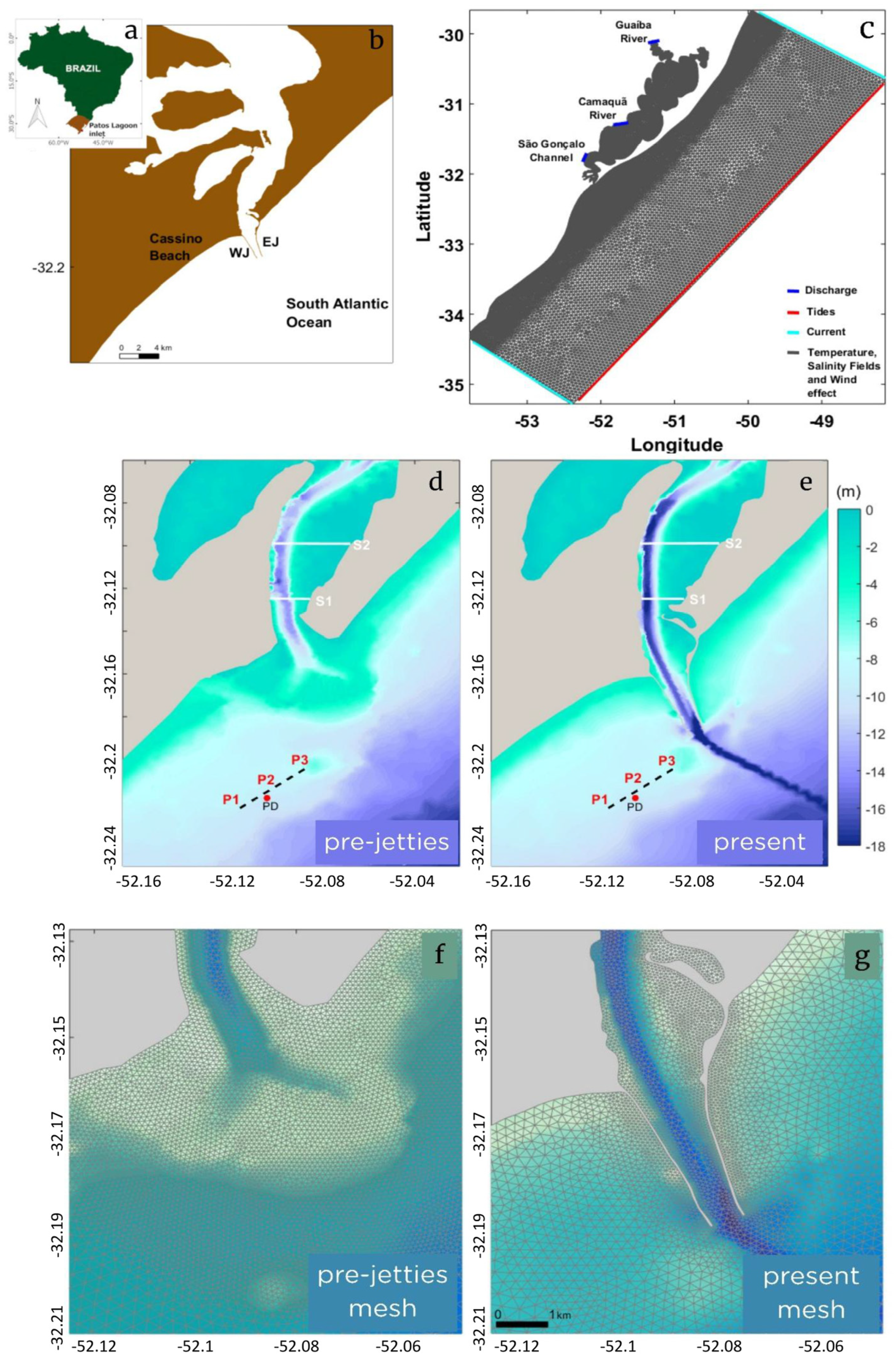
2.1. Study Area and Port Development
2.2. Numerical Model
2.3. Calibration and Validation
2.4. Data Analysis
3. Results
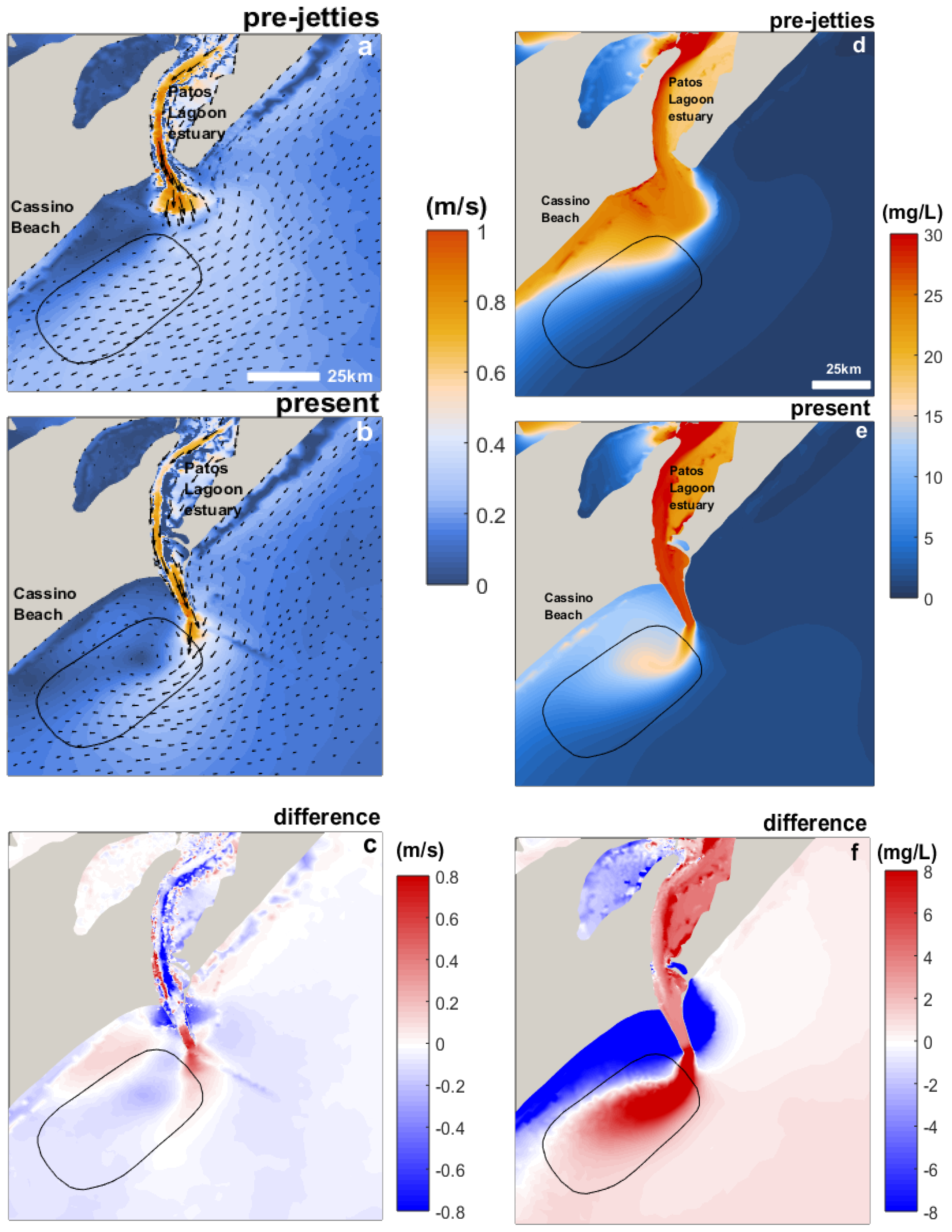
3.1. Coastal and Estuarine Hydro-Sedimentary Dynamics
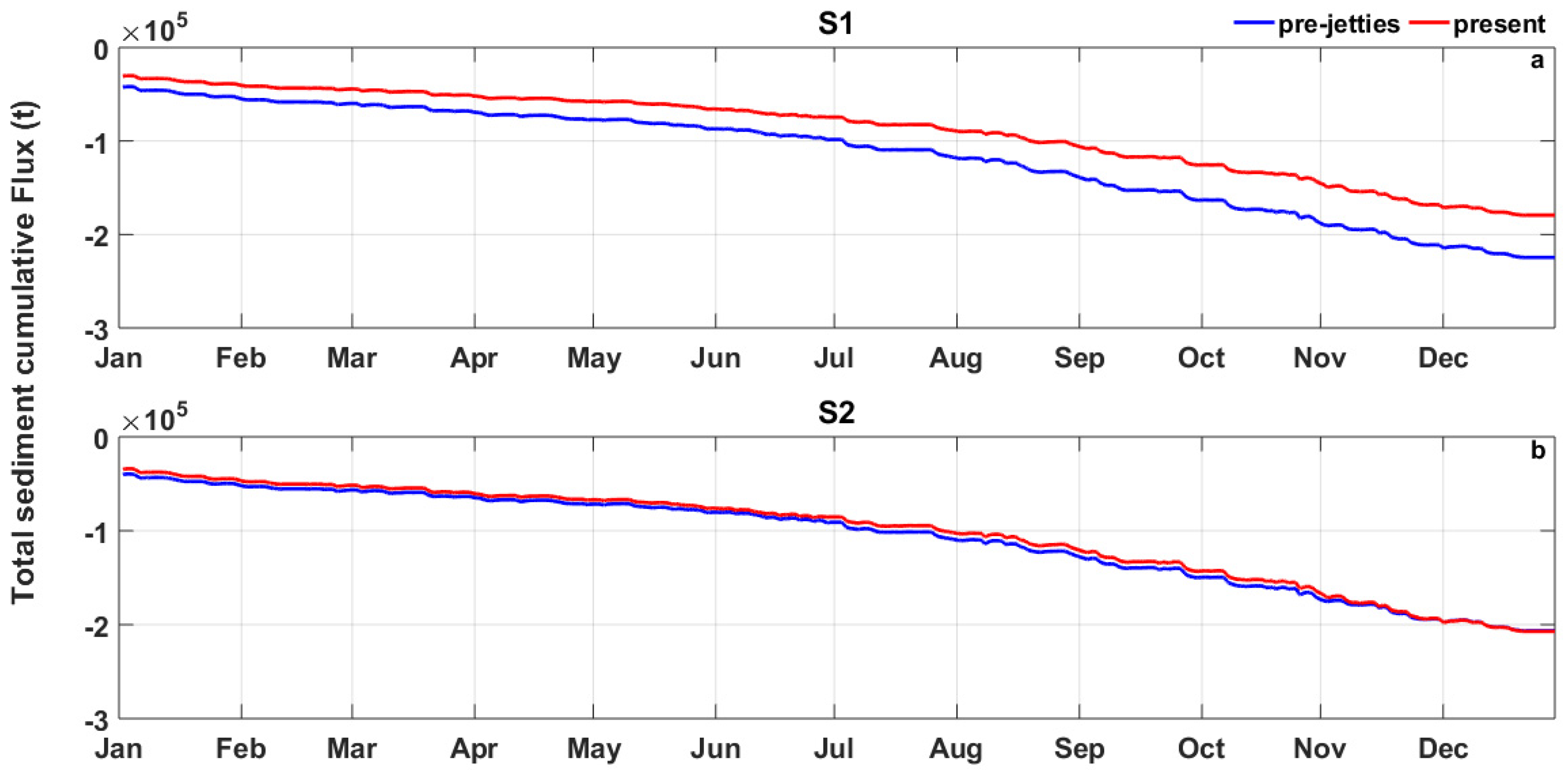
3.2. Changes in the Suspended Sediment Flux in the Channel
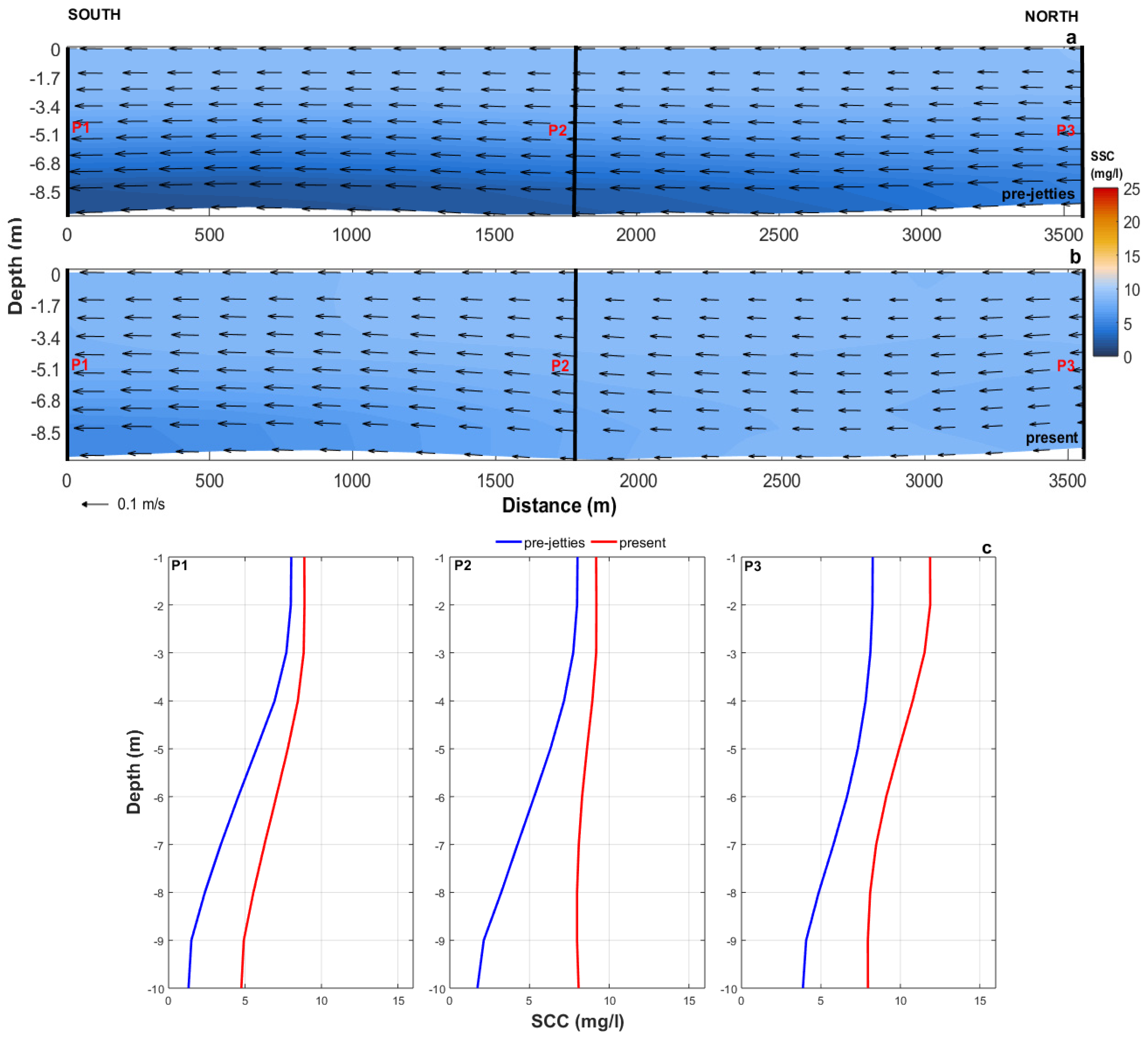
3.3. Contribution of Suspended Sediments in Coastal Plumes to Mud Deposit Formation
4. Discussion
5. Conclusions
- (i)
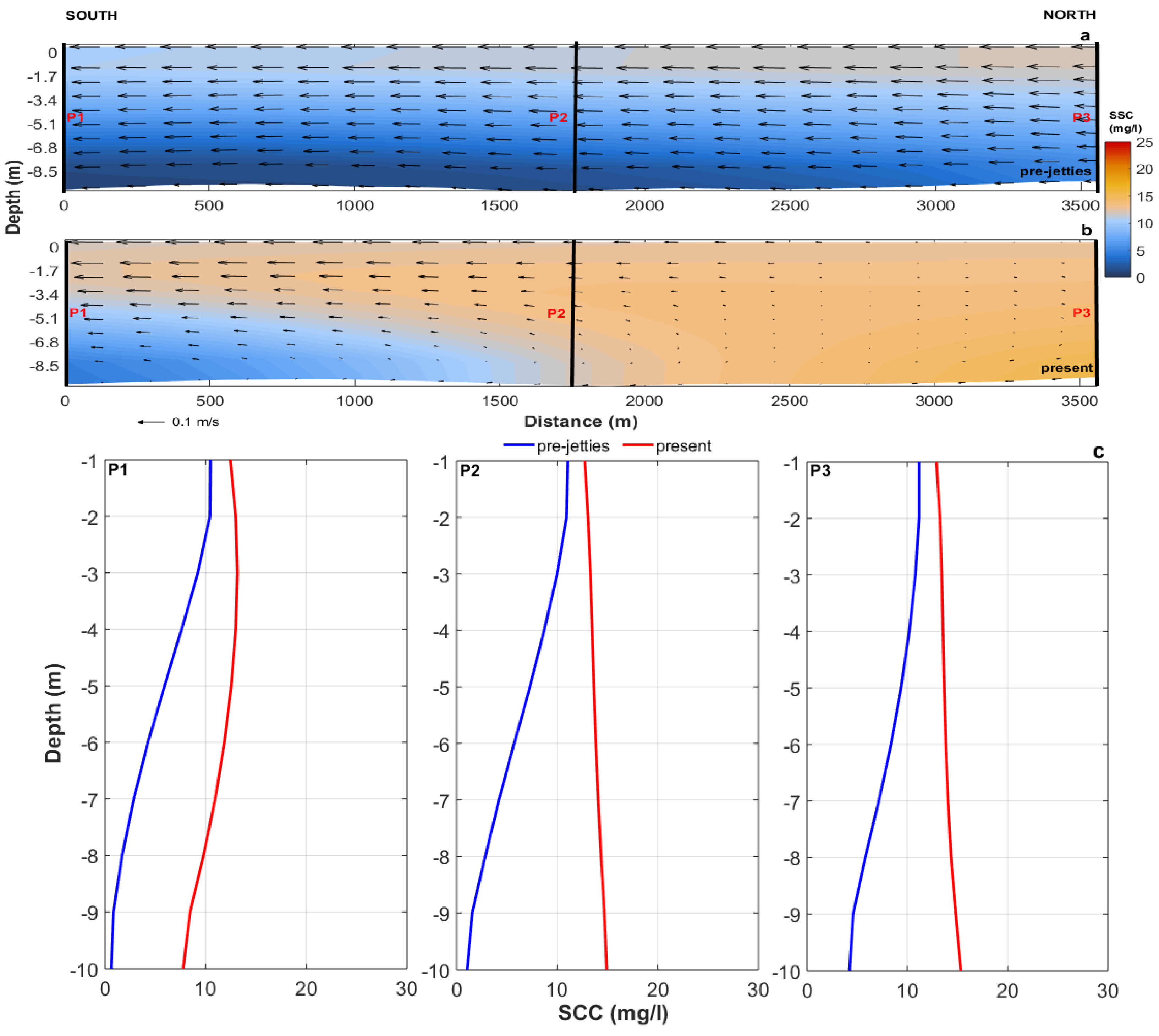
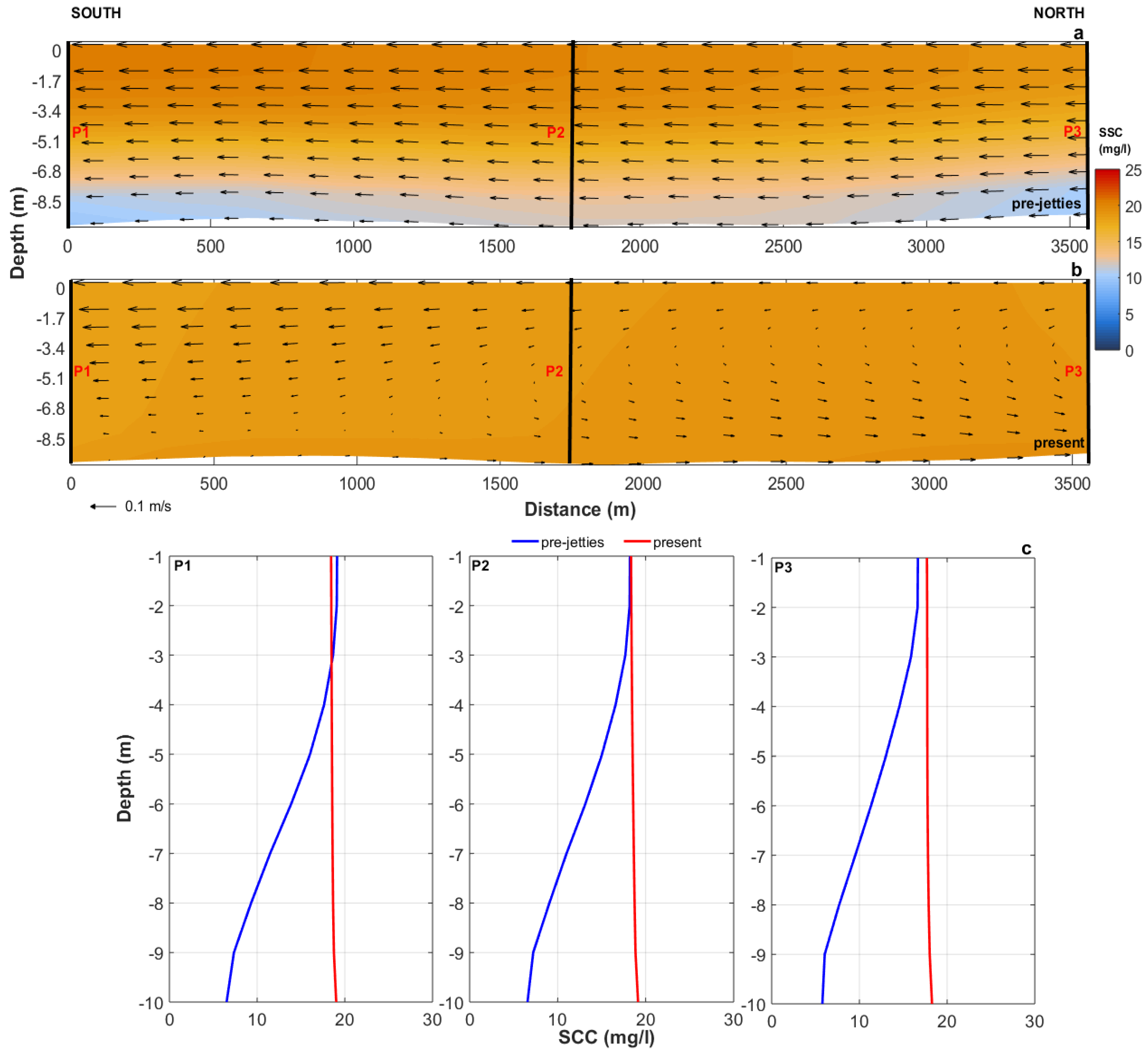
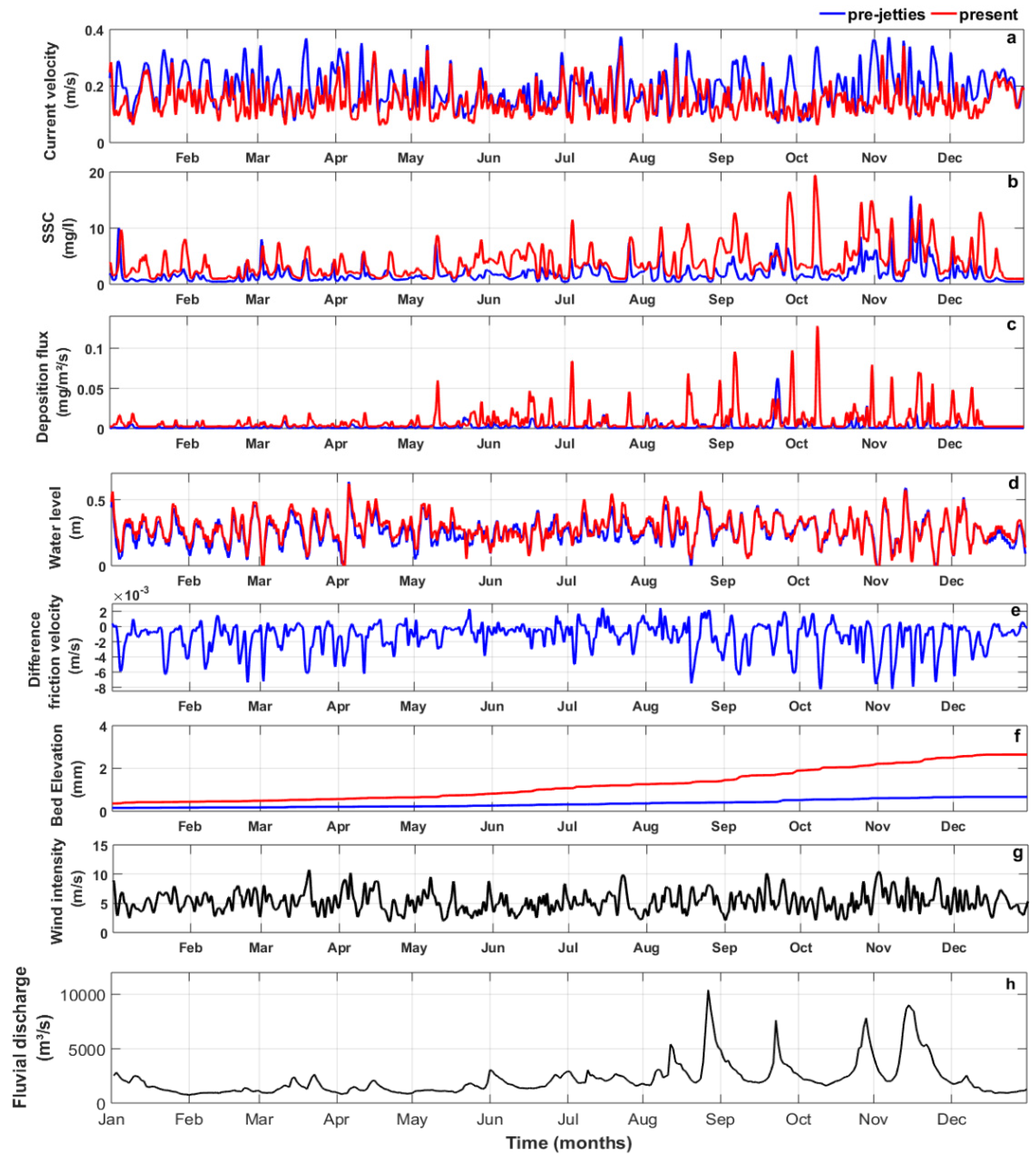
- depositional trends at the bottom and near the bottom at the coast, induced by lower ebb current velocities;
- (ii)
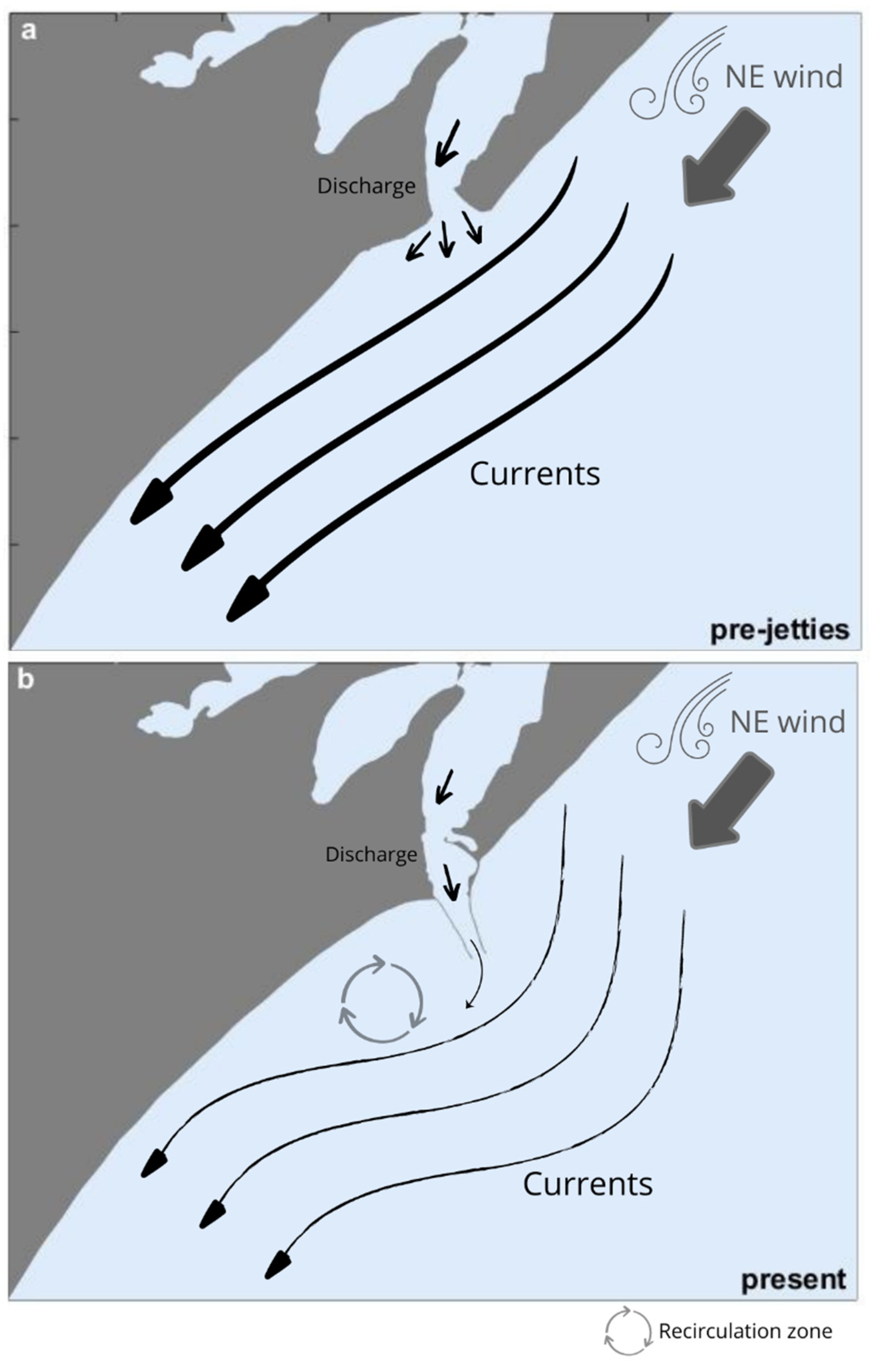
- intensified current velocities in the plume jet, displacing the fine suspended sediment plume to deeper regions at the coast, promoting more deposition;
- (iii)
- a decrease in water and sediment transport during ebb flow inside the channel, caused by lower current velocities;
- (iv)
- and a higher potential for mud deposit formation along the coast near the western jetty, induced by the recirculation zone (low current velocity zone) and NE wind conditions.
Supplementary Materials
Author Contributions
Funding
Data Availability Statement
Acknowledgments
Conflicts of Interest
References
- Burke, L.; Kura, Y.; Kassem, K.; Revenga, C.; Spalding, M.; McAllister, D. Coastal Ecosystems; World Resources Institute: Washington, DC, USA, 2001; Available online: https://pdf.wri.org/page_coastal.pdf (accessed on 27 October 2025).
- Martínez, M.L.; Intralawan Vazquez, G.; Perez-Maqueo, O.; Sutton, P.; Land-grave, R. The coasts of our world: Ecological, economic and social importance. Ecol. Econ. 2007, 63, 254–272. [Google Scholar] [CrossRef]
- Eidam, E.F.; Sutherland, D.A.; Ralston, D.K.; Conroy, T.; Dye, B. Shifting Sediment Dynamics in the Coos Bay Estuary in Response to 150 Years of Modification. J. Geophys. Res. Ocean. 2021, 126, e2020JC016771. [Google Scholar] [CrossRef]
- Tanner, E.L.; Steinberg, P.D.; Soares-Gomes, A.; Leung, K.M. Introduction to the World Harbour Project Special Issue Part II—Global harbours and ports: Different locations, similar problems? Reg. Stud. Mar. Sci. 2020, 33, 100904. [Google Scholar] [CrossRef]
- Wang, X.H.; Andutta, F.P. Sediment Transport Dynamics in Ports, Estuaries and Other Coastal Environments. In Sediment Transport—Processes and Their Modelling Applications; InTech: Hannover, Germany, 2013. [Google Scholar] [CrossRef]
- Mann, R.B. Ten trends in the continuing renaissance of urban waterfronts. Landsc. Urban Plan. 1988, 16, 177–199. [Google Scholar] [CrossRef]
- Suchanek, T.H. Temperate coastal marine communities: Biodiversity and threats. Am. Zool. 1994, 34, 110–114. [Google Scholar] [CrossRef]
- Cunha, P.P.; Pinto, J.; Dinis, J.L. Evolução da fisiografia e ocupação antrópica na área estuarina do Rio Mondego e região envolvente (Portugal centro-oeste), desde 1947. Territorium 1997, 4, 93–99. (In Portuguese) [Google Scholar] [CrossRef] [PubMed]
- Da Silva, P.D.; Fernandes, E.H.; Gonçalves, G.A. Sustainable development of coastal areas: Port expansion with small impacts on estuarine hydrodynamics and sediment transport pattern. Water 2022, 14, 3300. [Google Scholar] [CrossRef]
- Wang, P.; Beck, T.M. Morphodynamics of an anthropogenically altered dual-inlet system: John’s pass and blind pass, west-central Florida, USA. Mar. Geol. 2012, 291–294, 162–175. [Google Scholar] [CrossRef]
- Nassar, K.; Masria, A.; Mahmod, W.E.; Negm, A.; Fath, H. Hydro-morphological modeling to characterize the adequacy of jetties and subsidiary alternatives in sedimentary stock rationalization within tidal inlets of marine Lagoons. Appl. Ocean Res. 2019, 84, 92–110. [Google Scholar] [CrossRef]
- Prumm, M.; Iglesias, G. Impacts of port development on estuarine morphodynamics: Ribadeo (Spain). Ocean Coast. Manag. 2016, 130, 58–72. [Google Scholar] [CrossRef]
- Dyer, K.R.; Gong, W.K.; Ong, J.E. The cross sectional salt balance in a tropical estuary during a lunar tide and a discharge event. Estuar. Coast. Shelf Sci. 1992, 34, 579–591. [Google Scholar] [CrossRef]
- Shubel, J.R.; Carter, H.H. The estuary as a filter for fine-grained suspended sediment. In The Estuary as a Filter; Kennedy, V., Ed.; Academic Press: New York, NY, USA, 1984; pp. 81–105. [Google Scholar]
- Wang, P.; Ebersole, B.A.; Smith, E.R.; Johnson, B.D. Temporal and spatial variations of surf-zone currents and suspended sediment concentration. Coast. Eng. 2002, 46, 175–211. [Google Scholar] [CrossRef]
- Gabioux, M.; Vinzon, S.B.; Paiva, A.M. Tidal propagation over fluid mud layers on the Amazon shelf. Cont. Shelf Res. 2005, 25, 113–125. [Google Scholar] [CrossRef]
- Wan, Y.; Gu, F.; Wu, H.; Roelvink, D. Hydrodynamic evolutions at the Yangtze estuary from 1998 to 2009. Appl. Ocean Res. 2014, 47, 291–302. [Google Scholar] [CrossRef]
- Diaz, M.; Grasso, F.; Le Hir, P.; Sottolichio, A.; Caillaud, M.; Thouvenin, B. Modeling mud and sand transfers between a macrotidal estuary and the continental shelf: Influence of the sediment transport parameterization. J. Geophys. Res. Oceans 2020, 125, e2019JC015643. [Google Scholar] [CrossRef]
- Holland, K.T.; Vinzon, S.B.; Calliari, L.J. A field study of coastal dynamics on a muddy coast offshore of Cassino beach, Brazil. Cont. Shelf Res. 2009, 29, 503–514. [Google Scholar] [CrossRef]
- Perez, L.; García-Rodríguez, F.; Hanebuth, T.J.J. Variability in terrigenous sediment supply offshore of the Río de la Plata (Uruguay) recording the continental climatic history over the past 1200 years. Clim. Past 2016, 12, 623–634. [Google Scholar] [CrossRef]
- Oost, A.P.; Hoekstra, P.; Wiersma, A.; Flemming, B.; Lammerts, E.J.; Pejrup, M.; Hofstede, J.; Van Der Valk, B.; Kiden, P.; Bartholdy, J.; et al. Barrier island management: Lessons from the past and directions for the future. Ocean Coast. Manag. 2012, 68, 18–38. [Google Scholar] [CrossRef]
- Panda, U.S.; Mohanty, P.K.; Samal, R.N. Impact of tidal inlet and its geomorphological changes on Lagoon environment: A numerical model study. Estuar. Coast. Shelf Sci. 2013, 116, 29–40. [Google Scholar]
- Fernandes, E.H.; Da Silva, P.D.; Gonçalves, G.A.; Möller, O.O. Dispersion plumes in open ocean disposal sites of dredged sediment. Water 2021, 13, 808. [Google Scholar] [CrossRef]
- Dyer, K.R. Estuaries: A Physical Introduction; John Wiley and Sons: New York, NY, USA, 1997. [Google Scholar]
- Pranzini, E.; Wetzel, L.; Williams, A.T. Aspects of coastal erosion and protection in Europe. J. Coast. Conserv. 2015, 19, 445–459. [Google Scholar] [CrossRef]
- Guo, L.; Zhu, C.; Xie, W.; Xu, F.; Wu, H.; Wan, Y.; Wang, Z.; Zhang, W.; Shen, J.; Wang, Z.B.; et al. Changjiang delta in the anthropocene: Multi-scale hydro-morphodynamics and management challenges. Earth-Sci. Rev. 2021, 223, 103850. [Google Scholar] [CrossRef]
- Garel, E.; Sousa, C.; Ferreira, Ó. Sand bypass and updrift beach evolution after jetty construction at an ebb-tidal delta. Estuar. Coast. Shelf Sci. 2015, 167, 4–13. [Google Scholar] [CrossRef]
- Tanaka, H.; Lee, H.S. Influence of Jetty construction on morphology and wave set-up at a river mouth. Coast. Eng. J. 2003, 45, 659–683. [Google Scholar] [CrossRef]
- Van Rijn, L.C. Basic of Channel Deposition/Siltation. 2013. Available online: http://www.leovanrijn-sediment.com (accessed on 27 October 2025).
- Shaeri, S.; Tomlinson, R.; Etemad-Shahidi, A.; Strauss, D. Numerical modelling to assess maintenance strategy management options for a small tidal inlet. Estuar. Coast. Shelf Sci. 2017, 187, 273–292. [Google Scholar] [CrossRef]
- Wu, C.; Cai, F.; Zhao, G.; Zheng, Y.; Lu, H. Impact of coastal engineering constructions on the topographic and morphological evolution of Quanzhou Bay, Fujian, China. Ocean Coast. Manag. 2011, 54, 544–555. [Google Scholar] [CrossRef]
- Anh, V.T.; Trung, P.B.; Nguyen, K.A.; Liou, Y.A.; Phan, M.T. Human impacts on estuarine erosion-deposition in southern central Vietnam: Observation and hydrodynamic simulation. Sustainability 2021, 13, 8303. [Google Scholar] [CrossRef]
- Franzen, M.O.; Silva, P.; Siegle, E.; Fernandes, E.H.L. Influence of long jetties on estuarine and coastal hydrodynamics in a microtidal estuary. Reg. Stud. Mar. Sci. 2023, 59, 102809. [Google Scholar] [CrossRef]
- Calliari, L.J.; Speranski, N.S.; Torronteguy, M.; Oliveira, M.B. The Mud banks of cassino beach, southern Brazil: Characteristics, processes and effects. J. Coast. Res. 2000, 34, 318–325. [Google Scholar]
- Calliari, L.J.; Winterwerp, J.C.; Fernandes, E.; Cuchiara, D.; Vinzon, S.B.; Sperle, M.; Holland, K.T. Fine grain sediment transport and deposition in the Patos Lagoon–Cassino beach sedimentary system. Cont. Shelf Res. 2009, 29, 515–529. [Google Scholar] [CrossRef]
- Vinzon, S.B.; Calliari, L.J.; Holland, K.T.; Winterwerp, J.C. On the dynamics of mud deposits in coastal areas. Cont. Shelf Res. 2009, 29, 501–502. [Google Scholar] [CrossRef]
- Marques, W.C.; Fernandes, E.H.L.; Moller, O.O. Straining and advection contributions to the mixing process of the Patos Lagoon coastal plume, Brazil. J. Geophys. Res. Oceans 2010, 115, C06019. [Google Scholar] [CrossRef]
- António, M.H.; Fernandes, E.H.; Muelbert, J.H. Impact of jetty configuration changes on the hydrodynamics of the subtropical Patos Lagoon estuary, Brazil. Water 2020, 12, 3197. [Google Scholar] [CrossRef]
- Kjerfve, B. Comparative oceanography of coastal Lagoons. In Estuarine Variability; Wolfe, D.A., Ed.; Academic Press: New York, NY, USA, 1986; pp. 63–81. [Google Scholar]
- Möller, O.O.; Castaing, P.; Salomon, J.C.; Lazure, P. The influence of local and non-local forcing effects on the subtidal circulation of Patos Lagoon. Estuaries 2001, 24, 297–311. [Google Scholar] [CrossRef]
- Vaz, A.C.; Möller, O.O.; De Almeida, T.L. Análise quantitativa da descarga dos rios afluentes da Lagoa dos Patos. Atlântica 2006, 28, 13–23. (In Portuguese) [Google Scholar]
- Möller, O.O.; Lorenzzentti, J.A.; Stech, J.; Mata, M.M. The Patos Lagoon summertime circulation and dynamics. Cont. Shelf Res. 1996, 16, 335–351. [Google Scholar] [CrossRef]
- Marques, W.C.; Stringari, C.E.; Eidt, R.T. The exchange processes of the Patos Lagoon estuary—Brazil: A typical El Niño year versus a normal meteorological conditions year. Adv. Water Resour. 2014, 63, 113–131. [Google Scholar]
- Möller, O.O.; Castaing, P. Hydrographical characteristics of the estuarine area of Patos Lagoon (30°S, Brazil). In Estuaries of South America: Their Geomorphology and Dynamics; Perillo, G.M.E., Piccolo, M.C., Pino-Quivira, M., Eds.; Springer: Berlin/Heidelberg, Germany, 1999; pp. 83–100. [Google Scholar]
- Tomazelli, L.J. O regime de ventos e a taxa de migração das dunas eólicas costeiras do Rio Grande do Sul, Brasil. Pesquisas 1993, 20, 18–26. (In Portuguese) [Google Scholar] [CrossRef]
- Seeliger, U. The Patos Lagoon estuary Brazil. In Coastal Marine Ecosystems of Latin America; Seeliger, U., Kjerfve, B., Eds.; Springer: Berlin/Heidelberg, Germany, 2001; pp. 167–183. [Google Scholar]
- Castelão, R.M.; Moller, O.O. Sobre a circulação tridimensional forçada por ventos na Lagoa dos Patos. Rev. Atl. 2003, 25, 91–106. (In Portuguese) [Google Scholar]
- De Barros, G.P.; Marques, W.C.; De Paula Kirinus, E. Influence of the freshwater discharge on the hydrodynamics of Patos Lagoon, Brazil. Int. J. Geosci. 2014, 5, 925–942. [Google Scholar] [CrossRef]
- Cunha, R.M.P.; Calliari, L.J. Natural and anthropic geomorphological changes in the inlet of Patos Lagoon before and after its fixation. J. Coast. Res. SI 2009, 56, 708–712. [Google Scholar]
- Bicalho, H. Relatório da Comissão de Melhoramento da Barra do Rio Grande; Obras do Porto e da Barra do Rio Grande do Sul; Oficinas Gráficas da Federação: Porto Alegre, Brazil, 1983. [Google Scholar]
- Malaval, M.B. Travaux du Port et de la Barre de Rio Grande, Brésil; Eyrolles Editeurs: Paris, France, 1922. [Google Scholar]
- Hervouet, J.M. Hydrodynamics of Free Surface Flows: Modeling with the Finite Element Method; Wiley: Chichester, UK, 2007. [Google Scholar]
- Van Leussen, W. The variability of settling velocities of suspended fine-grained sediment in the Ems estuary. J. Sea Res. 1999, 41, 109–118. [Google Scholar] [CrossRef]
- Partheniades, E. Erosion and deposition of cohesive soils. J. Hydraul. Div. 1965, 91, 105–139. [Google Scholar] [CrossRef]
- Krone, R.B. Flume Studies of the Transport of Sediment in Estuarial Processes; Final Report Hydraul; University of California: Berkeley, CA, USA, 1962. [Google Scholar]
- Bitencourt, L.P.; Fernandes, E.; Möller, O.; Ross, L. The contribution of ENSO cycles to the salinity spatio-temporal variability in a bar-built microtidal estuary. Reg. Stud. Mar. Sci. 2020, 40, 101496. [Google Scholar] [CrossRef]
- Toldo, E.E.; Corrêa, I.C.S.; Almeida, L.E.S.B.; Weschenfelder, J.; Gruber, N.L.S. Sedimentação de Longo e Curto Período na Lagoa dos Patos. Pesqui. Geociênc. 2006, 33, 79–86. (In Portuguese) [Google Scholar] [CrossRef]
- NOAA (National Oceanic and Atmospheric Administration). ENSO: Recent Evolution, Current Status and Predictions; Climate Prediction Center: College Park, MD, USA, 2014. Available online: https://www.cpc.ncep.noaa.gov/products/analysis_monitoring/enso_advisory/ (accessed on 11 September 2025).
- Távora, J.; Fernandes, E.H.L.; Bitencourt, L.P.; Orozco, P.M.S. El-Niño Southern Oscillation (ENSO) effects on the variability of Patos Lagoon suspended particulate matter. Reg. Stud. Mar. Sci. 2020, 40, 101495. [Google Scholar] [CrossRef]
- Grimm, A.M.; Ferraz, S.E.T.; Gomes, J. Precipitation anomalies in southern Brazil associated with El Niño and La Niña events. J. Clim. 1998, 11, 2863–2880. [Google Scholar] [CrossRef]
- Grimm, A.M.; Tedeschi, R.G. ENSO and extreme rainfall events in South America. J. Clim. 2009, 22, 1589–1609. [Google Scholar] [CrossRef]
- Vassão, C.M. Planta da barra do rio grande. In Anos de 1883 a 1956 e 1814, 1849, 1866, 1875 e 1881 do Ministério da Viação e Obras Públicas do Departamento Nacional de Portos Rios e Canais—18; DEPREC: Rio Grande, Brazil, 1959. (In Portuguese) [Google Scholar]
- Egbert, G.D.; Erofeeva, S.Y. Efficient inverse modeling of barotropic ocean tides. J. Atmos. Ocean. Technol. 2002, 19, 183–204. [Google Scholar] [CrossRef]
- Neto, J.A.; Rigon, L.; Toldo, E.; Schettini, C. Descarga sólida em suspensão do sistema fluvial do Guaíba, RS, e sua variabilidade temporal. Pesqui. Geociênc. 2012, 39, 161–171. (In Portuguese) [Google Scholar] [CrossRef]
- Van Rijn, L.C.; Walstra, D.J.R.; Grasmeijer, B.; Sutherland, J.; Pan, S.; Sierra, J.P. The predictability of cross-shore bed evolution of sandy beaches at the time scale of storms and seasons using process-based profile models. Coast. Eng. 2003, 47, 295–327. [Google Scholar] [CrossRef]
- Walstra, L.; Van Rijn, L.; Blogg, H.; Van Ormondt, M. Evaluation of a Hydrodynamic Area Model Based on the COAST3D Data at Teignmouth 1999; Report TR121-EC MAST Project No. MAS3-CT97-0086; HR: Wallinford, UK, 2001; pp. D4.1–D4.4. [Google Scholar]
- Airoldi, L.; Abbiati, M.; Beck, M.W.; Hawkins, S.J.; Jonsson, P.R.; Martin, D.; Moschella, P.S.; Sundelöf, A.; Thompson, R.C.; Åberg, P. An ecological perspective on the deployment and design of low-crested and other hard coastal defence structures. Coast. Eng. 2005, 52, 1073–1087. [Google Scholar] [CrossRef]
- Dugan, J.E.; Airoldi, L.; Chapman, M.G.; Walker, S.J.; Schlacher, T. Estuarine and coastal structures: Environmental effects, a focus on shore and nearshore structures. In Treatise on Estuarine and Coastal Science; Wolanski, E., McLusky, D., Eds.; Academic Press: Waltham, MA, USA, 2012; pp. 17–41. [Google Scholar]
- Dai, Z.; Liu, J.T.; Wei, W.; Chen, J. Detection of the Three Gorges Dam influence on the Changjiang (Yangtze River) submerged delta. Sci. Rep. 2013, 3, 6600. [Google Scholar] [CrossRef] [PubMed]
- Ma, G.; Shi, F.; Qi, D.; Liu, S. Hydrodynamic modeling of Changjiang Estuary: Model skill assessment and large-scale structure impacts. Appl. Ocean Res. 2011, 33, 69–78. [Google Scholar] [CrossRef]
- Zhu, L.; He, Q.; Shen, J.; Wang, Y. The influence of human activities on morphodynamics and alteration of sediment source and sink in the Changjiang estuary. Geomorphology 2016, 273, 52–62. [Google Scholar] [CrossRef]
- Milliman, J.D.; Shen, H.; Yang, Z.; Meade, R.H. Transport and deposition of river sediment in the Changjiang estuary and adjacent continental shelf. Cont. Shelf Res. 1985, 4, 37–45. [Google Scholar] [CrossRef]
- Yang, S.L.; Zhang, J.; Zhu, J.; Smith, J.P.; Dai, S.B.; Gao, A.; Li, P. Impact of dams on Yangtze River sediment supply to the sea and delta intertidal wetland response. J. Geophys. Res. 2006, 111, F03006. [Google Scholar] [CrossRef]
- Yuk, J.H.; Aoki, S. Impact of jetty construction on the current and ecological systems in an Estuary with a narrow inlet. J. Coast. Res. SI 2007, 50, 784–788. [Google Scholar] [CrossRef]
- Chant, R.J.; Sommerfield, C.K.; Talke, S.A. Impact of channel deepening on tidal and gravitational circulation in a highly engineered estuarine basin. Estuar. Coasts 2018, 41, 1587–1600. [Google Scholar] [CrossRef]
- Ma, G.; Shi, F.; Liu, S.; Qi, D. Migration of sediment deposition due to the construction of large-scale structures in Changjiang Estuary. Appl. Ocean Res. 2013, 43, 148–156. [Google Scholar] [CrossRef]
- Martins, L.R.; Martins, I.R.; Villwock, J.A.; Calliari, L.J. Ocorrência de lama na praia do Cassino, (RS). An. Hidrogr. 1978, 35, 159–170. (In Portuguese) [Google Scholar]
- Zhang, R.; Chen, L.; Liu, S.; Zhang, H.; Gong, W.; Lin, G. Shoreline evolution in an embayed beach adjacent to tidal inlet: The impact of anthropogenic activities. Geomorphology 2019, 346, 106856. [Google Scholar] [CrossRef]
- Castaing, P.; Allen, G.P. Mechanisms controlling seaward escape of suspended sediment from the Gironde: A macrotidal estuary in France. Mar. Geol. 1981, 40, 101–118. [Google Scholar] [CrossRef]
- Lesourd, S.; Lesueur, P.; Brun-Cottan, J.C.; Garnaud, S.; Poupinet, N. Seasonal variations in the characteristics of superficial sediments in a macrotidal estuary (the Seine estuary, France). Estuar. Coast. Shelf Sci. 2003, 58, 3–16. [Google Scholar] [CrossRef]
- Lisboa, P.; Fernandes, E.H.L.; Sottolichio, A.; Huybrechts, N.; Bendô, A.; Costi, J. Bottom evolution patterns driven by hydrodynamic forcing in the Southwest Atlantic Inner Continental Shelf, off Río de la Plata and Patos Lagoon. Cont. Shelf Res. 2023, 255, 104934. [Google Scholar] [CrossRef]
- Moreira, D.; Simionato, C.G. Modeling the suspended sediment transport in a very wide, shallow, and microtidal estuary, the Río de la Plata, Argentina. J. Adv. Model. Earth Syst. 2019, 11, 3284–3304. [Google Scholar] [CrossRef]
- Jiang, A.W.; Ranasinghe, R.; Cowell, P. Contemporary hydrodynamics and morphological change of a microtidal estuary: A numerical modelling study. Ocean Dyn. 2012, 63, 21–41. [Google Scholar] [CrossRef]
- Bortolin, E.C.; Távora, J.; Fernandes, E.H.L. Long-term variability on suspended particulate matter loads from the tributaries of the world’s largest choked Lagoon. Front. Mar. Sci. 2022, 9, 836739. [Google Scholar] [CrossRef]



| Parameters | |
|---|---|
| Time step | 90 s |
| Coriolis coefficient | −7.70 × 10⁻⁵ Nm−1·s−1 |
| Horizontal turbulence model | Smagorinski |
| Vertical turbulence model | Mixing length |
| Law of bottom friction | Nikuradse |
| Sediment settling velocity | 0.00001 m/s |
| Law of bottom friction | Nikuradse |
| Mixing length scale | 10 m |
| Critical shear stress for deposition | 0.01 Nm−2 |
| Critical erosion shear stress of the mud layers | 0.5 Nm−2 |
| Coefficient of wind influence | 1.8 × 10⁻⁶ Nm−1·s−1 |
| Suspended sediment class | Fine silt |
Disclaimer/Publisher’s Note: The statements, opinions and data contained in all publications are solely those of the individual author(s) and contributor(s) and not of MDPI and/or the editor(s). MDPI and/or the editor(s) disclaim responsibility for any injury to people or property resulting from any ideas, methods, instructions or products referred to in the content. |
© 2026 by the authors. Licensee MDPI, Basel, Switzerland. This article is an open access article distributed under the terms and conditions of the Creative Commons Attribution (CC BY) license.
Share and Cite
Franzen, M.; Siegle, E.; Sottolichio, A.; Fernandes, E.H.L. Influence of Long Jetties on Coastal and Estuarine Hydro-Sedimentological Patterns in a Microtidal Region: Potential for Mud Deposit Formation. Coasts 2026, 6, 17. https://doi.org/10.3390/coasts6020017
Franzen M, Siegle E, Sottolichio A, Fernandes EHL. Influence of Long Jetties on Coastal and Estuarine Hydro-Sedimentological Patterns in a Microtidal Region: Potential for Mud Deposit Formation. Coasts. 2026; 6(2):17. https://doi.org/10.3390/coasts6020017
Chicago/Turabian StyleFranzen, Monique, Eduardo Siegle, Aldo Sottolichio, and Elisa H. L. Fernandes. 2026. "Influence of Long Jetties on Coastal and Estuarine Hydro-Sedimentological Patterns in a Microtidal Region: Potential for Mud Deposit Formation" Coasts 6, no. 2: 17. https://doi.org/10.3390/coasts6020017
APA StyleFranzen, M., Siegle, E., Sottolichio, A., & Fernandes, E. H. L. (2026). Influence of Long Jetties on Coastal and Estuarine Hydro-Sedimentological Patterns in a Microtidal Region: Potential for Mud Deposit Formation. Coasts, 6(2), 17. https://doi.org/10.3390/coasts6020017