Article

Influence of Short-Term Olive Fruit Storage Conditions on the Quality of Virgin Olive Oil: A Case Study of Three Cultivars (‘Kalinjot’, ‘Leccino’, and ‘Frantoio’) in Albania


1
Faculty of Biotechnology and Food, Agriculture University, Kodër-Kamëz, 1029 Tirana, Albania
2
Faculty of Social Sciences, Tourism and Sports, Rruga Frang Bardhi, Barleti University, Selitë, 1060 Tirana, Albania
3
Faculty of Agriculture and Environment, Agriculture University, Kodër-Kamëz, 1029 Tirana, Albania
*
Author to whom correspondence should be addressed.
AppliedChem 2026, 6(1), 6; https://doi.org/10.3390/appliedchem6010006
Submission received: 3 October 2025 / Revised: 23 December 2025 / Accepted: 31 December 2025 / Published: 9 January 2026

Abstract

This study examined the influence of short-term olive fruit storage on the quality of virgin olive oil (VOO) from three cultivars (‘Kalinjot’, ‘Leccino’, and ‘Frantoio’) grown in southwest Albania. Olive fruits were processed immediately after harvest, or after 10 days of storage under ambient conditions (20–22 °C) and refrigeration (5 °C). Oils were evaluated for physicochemical quality parameters (free acidity, peroxide value, and UV absorption indices), as well as bioactive and sensory-related compounds (bitterness index, chlorophylls, carotenoids, and total phenolic content). Results showed that immediate processing yielded the highest quality oils, with low free acidity (0.28–0.35%) and preserved bioactive compounds. Ambient storage led to marked deterioration, including significant increases in free acidity and peroxide values, loss of pigments, and 20–70% reduction in phenolic content, accompanied by decreased bitterness. In contrast, cold storage mitigated these effects, maintaining values closer to baseline and preserving sensory and functional attributes. ANOVA confirmed significant effects of storage duration, temperature, and cultivar on most parameters, with ‘Kalinjot’ exhibiting greater stability compared to ‘Frantoio’ and ‘Lecino’. These findings highlight that minimizing the interval between harvest and milling is critical for ensuring oil quality, while refrigerated storage offers a practical strategy to safeguard chemical and sensory characteristics when immediate processing is not feasible.

1. Introduction

Olive oil is globally valued for its nutritional benefits and distinctive sensory attributes, both strongly influenced by cultivar, harvest timing, postharvest handling, and processing conditions [1,2,3,4,5]. Among these, the interval between harvesting and oil extraction plays a critical role. During storage, olives are highly susceptible to biochemical degradation and microbial activity, which can compromise chemical composition and sensory quality [6].
Biochemical and enzymatic reactions during fruit storage can trigger the hydrolysis of triacylglycerols, resulting in increased free acidity. Concurrently, oxidative processes may elevate peroxide values and degrade essential bioactive compounds such as phenols, tocopherols, chlorophylls, and carotenoids [7,8]. These compounds are vital not only for the oil’s nutritional and antioxidant capacity but also for its oxidative stability and sensory profile.
The temperature of olive fruit storage is a key factor affecting the rate of degradative changes. Inadequate storage at ambient temperatures, particularly in warm climates, can accelerate lipid oxidation, enzymatic hydrolysis, and the production of undesirable fermentation by-products (e.g., ethanol, ethyl acetate, and acetic acid), leading to sensory defects such as fusty or musty aromas [9,10]. Conversely, refrigerated storage (4–5 °C) has been shown to mitigate microbial growth and enzymatic activity, thereby preserving phenolic content, maintaining pigment stability, and minimizing increases in free acidity and peroxide values [11,12].
Given the increasing demand for premium-quality virgin and extra virgin olive oils, understanding the interplay between storage temperature, duration, and cultivar-specific responses is critical for both industrial producers and artisanal mills. Effective postharvest storage practices not only preserve key bioactive and volatile compounds but also reduce the risk of oil downgrading due to sensory or oxidative defects [13].
In Albania, olive cultivation occupies a traditional and strategic position within the agricultural sector, particularly in the southern and western regions where climatic conditions are ideal for olive growing [14]. The country hosts a variety of both indigenous cultivars, like ‘Kalinjot’, and introduced cultivars like ‘Lecino’ and ‘Frantoio’ from Italy. ‘Kalinjot’ is a native cultivar, and is of particular importance, highly valued for its adaptability to local environmental conditions, its late ripening cycle, and its ability to produce high-quality olive oils with unique sensory characteristics [15]. It represents a key genetic resource within Albania’s olive biodiversity and contributes to the sustainability of traditional olive farming systems [16].
This study aims to investigate the effects of postharvest storage, specifically ambient versus refrigerated conditions, on the physicochemical quality and bioactive compound profiles of virgin olive oils from three cultivars: ‘Kalinjot’, ‘Leccino’, and ‘Frantoio’. Special attention is given to evaluating the advantages of refrigerated storage compared to ambient storage and immediate processing. The results are intended to provide practical insights for optimizing postharvest management strategies and enhancing oil quality in both small-scale and industrial production systems.

2. Materials and Methods

2.1. Olive Fruit Sampling and Storage (Revised with Ripeness Index)

Olive fruits used in this study were harvested from the Experimental Station of QTTB Vlorë (Southern Albania), which maintains a genetic collection of olive cultivars cultivated in Albania. Three cultivars with different ripening periods were studied: the introduced cultivars ‘Leccino’ and ‘Frantoio’, and the autochthonous cultivar ‘Kalinjot’. Harvesting of ‘Leccino’ and ‘Frantoio’ took place on 29 October 2024, whereas ‘Kalinjot’ was harvested on 8 November 2024, due to its delayed ripening characteristics.
All fruits were selected based on a ripeness index between 3 and 5 according to Uceda and Frias (1975) [17]. At this stage, the fruit exhibits optimal parameters for yield and other compositional characteristics affecting olive oil quality, ensuring that the extracted oils reflect the cultivars’ maximum potential.
To evaluate the effects of postharvest storage on virgin olive oil quality, approximately 12 kg of fruit per cultivar were transported under ambient conditions to the Food Research Center laboratories, Faculty of Biotechnology and Food, Agriculture University of Tirana. For each cultivar, three storage and processing treatments were performed:
  • Immediate milling;
  • Cold storage for 10 days at 5 °C and 90% relative humidity (RH);
  • Ambient storage for 10 days at 20–22 °C.

2.2. Olive Oil Extraction

Oil extraction was conducted using the Abencor system (MC2 Ingeniería y Sistemas S.L., Sevilla, Spain) [17], a laboratory-scale system that simulates industrial milling. The Abencor system consists of a hammer mill, a malaxer, and a centrifuge. The hammer mill, equipped with stainless steel components and a 3.75 mm screen, was used to crush the olives. The resulting paste was malaxed at 25 °C for 30 min and subsequently centrifuged at 3500 rpm for 1 min. The oily phase was separated by decantation into test tubes and filtered through Whatman filter paper to remove moisture and solid residues. Filtered oil samples were stored in dark glass bottles at −24 °C until further analysis.

2.3. Olive Oil Analyses

2.3.1. Free Acidity (FA)

FA was determined according to the official method of Commission Regulation (EEC) No. 2568/91 and its amendments [18]. A known quantity of oil was dissolved in a diethyl ether–ethanol mixture (diethyl ether, ≥99.5%, VWR, Radnor, PA, USA; ethanol, ≥99.8%, VWR, Radnor, PA, USA) and titrated with 0.1 N NaOH (analytical grade, VWR, Radnor, PA, USA) using phenolphthalein as an indicator. Results are expressed as % oleic acid (w/w).

2.3.2. Peroxide Value (PV)

PV was determined following [18]. Oil reacts with acetic acid–chloroform solution, followed by the addition of potassium iodide. The liberated iodine was titrated with 0.01 N sodium thiosulfate (analytical grade, VWR, Radnor, PA, USA), and the results are expressed as meq O2/kg.

2.3.3. UV Absorption (K232 and K270)

Specific extinction coefficients at 232 and 270 nm were measured according to [18]. Oil samples were dissolved in cyclohexane (Merck, Darmstadt, Germany, ≥99.5% purity), and absorbance was measured using a UV–Vis spectrophotometer (Biochrom Libra S22, Cambridge, UK). Results are expressed per gram of oil in a 1% solution in a 10 mm cuvette.

2.3.4. Total Phenolic Content (TPC)

TPC was determined using the Folin–Ciocalteu analytical grade, (VWR, Radnor, PA, USA) method [19] with slight modifications. One gram of oil was mixed with an 80:20 methanol–water solution, vortexed, and centrifuged. The extract was reacted with Folin–Ciocalteu reagent and sodium carbonate, and absorbance was measured at 725 nm. Results are expressed as mg gallic acid equivalents (GAE)/kg oil.

2.3.5. Chlorophylls and Carotenoids

Chlorophyll and carotenoid contents were determined spectrophotometrically according to [20]. Oil samples were dissolved in cyclohexane (Merck, Darmstadt, Germany, ≥99.5% purity), and absorbance was measured at 670 nm (chlorophylls) and 470 nm (carotenoids). Concentrations are expressed as mg pheophytin or lutein per kg oil.

2.3.6. Bitterness Index (K225)

The bitterness index was determined according to [21]. Oil was dissolved in a 1:1 hexane–methanol mixture (50:50 v/v; Merck, Darmstadt, Germany HPLC grade), and the methanolic phase absorbance was measured at 225 nm using a UV–Vis spectrophotometer (Biochrom Libra S22, Cambridge, UK). Results are expressed as extinction value (K225).

2.4. Statistical Analysis

Statistical analyses were conducted using Statistics 9, version 9.0, build 24 April 2008 (Analytical Software, Tallahassee, FL, USA). The one-way analysis of variance (ANOVA) was used to assess the effect of harvest date on the physicochemical parameters, followed by Turkey’s HSD test for post hoc comparisons at a significance level of p < 0.05.

3. Results and Discussion

3.1. Olive Oil Quality Parameters

The main physicochemical quality parameters of virgin olive oils, including free acidity, peroxide value, and UV absorption indices, measured across the three cultivars and different storage conditions, are summarized in Table 1. Statistical analysis results are presented in Table 2.
The results demonstrated that the duration of fruit storage prior to milling is the key factor affecting olive oil quality, with temperature acting as a modulating variable. Free acidity values at immediate milling (T0) were very low (0.28–0.35%), fulfilling the requirements for extra virgin classification [22]. However, after 10 days of storage under ambient conditions, acidity increased markedly, particularly in ‘Frantoio’ (1.68–1.69%), while cold storage slowed this increase, maintaining values close to baseline (Table 1). This trend reflects the hydrolytic breakdown of triglycerides through enzymatic and microbial activity. This process is time-dependent and significantly accelerated at higher temperatures [23,24].
Peroxide values also increased with storage time, reaching 7–8 meq O2/kg after 10 days at ambient conditions, indicating primary oxidation. In contrast, refrigeration limited the rise in peroxide to 6–7 meq O2/kg. The ANOVA (Table 2) confirmed that storage time and its interaction with cultivar were significant (p < 0.05). These results are consistent with earlier studies demonstrating that delayed milling and prolonged storage at ambient temperatures accelerate oxidative deterioration of virgin olive oil [7,25,26,27]. The findings highlight that proper management of storage conditions, particularly temperature control, is essential to preserve the oil’s oxidative stability and overall quality.
Spectrophotometric indices (K232 and K270) demonstrated similar patterns. K232 values increased significantly during ambient storage, reflecting the accumulation of conjugated dienes, while K270 showed a tendency to rise with prolonged storage, particularly in ‘Frantoio’ (Table 1), although not always reaching statistical significance. These trends confirm that extended storage of olives before milling enhances the susceptibility of oils to both primary and secondary oxidation processes. Similar observations have been reported in studies evaluating the effect of storage time, temperature, and fruit ripening on olive oil quality [7,25,26,28]. Proper postharvest management, especially temperature control and minimization of storage duration, is therefore essential to maintain the oil’s oxidative stability and sensory quality.
Taken together, these findings clearly demonstrate that postharvest storage time is the most critical determinant of oil quality. Cold conditions can partially mitigate the negative effects, but even under refrigeration, prolonged delays contribute to a gradual decline. Thus, minimizing the interval between harvest and milling remains the most effective strategy to safeguard olive oil quality.
Table 2 summarizes the results of ANOVA, confirming that storage time and temperature had highly significant effects on free acidity, peroxide value, and K232, while the impact on K270 was not statistically significant (p > 0.05). Cultivar also contributed significantly to the observed variability, with ‘Kalinjot’ showing greater stability compared to ‘Frantoio’. These findings are consistent with previous studies emphasizing the importance of minimizing olive fruit storage duration and controlling storage conditions to preserve oil quality [23,28].

3.2. Bioactive Compounds in Olive Oil

The following section presents the results for chemical bitterness (K225), pigments, and total phenolic content, which together are key determinants of the chemical and functional quality of virgin olive oil.
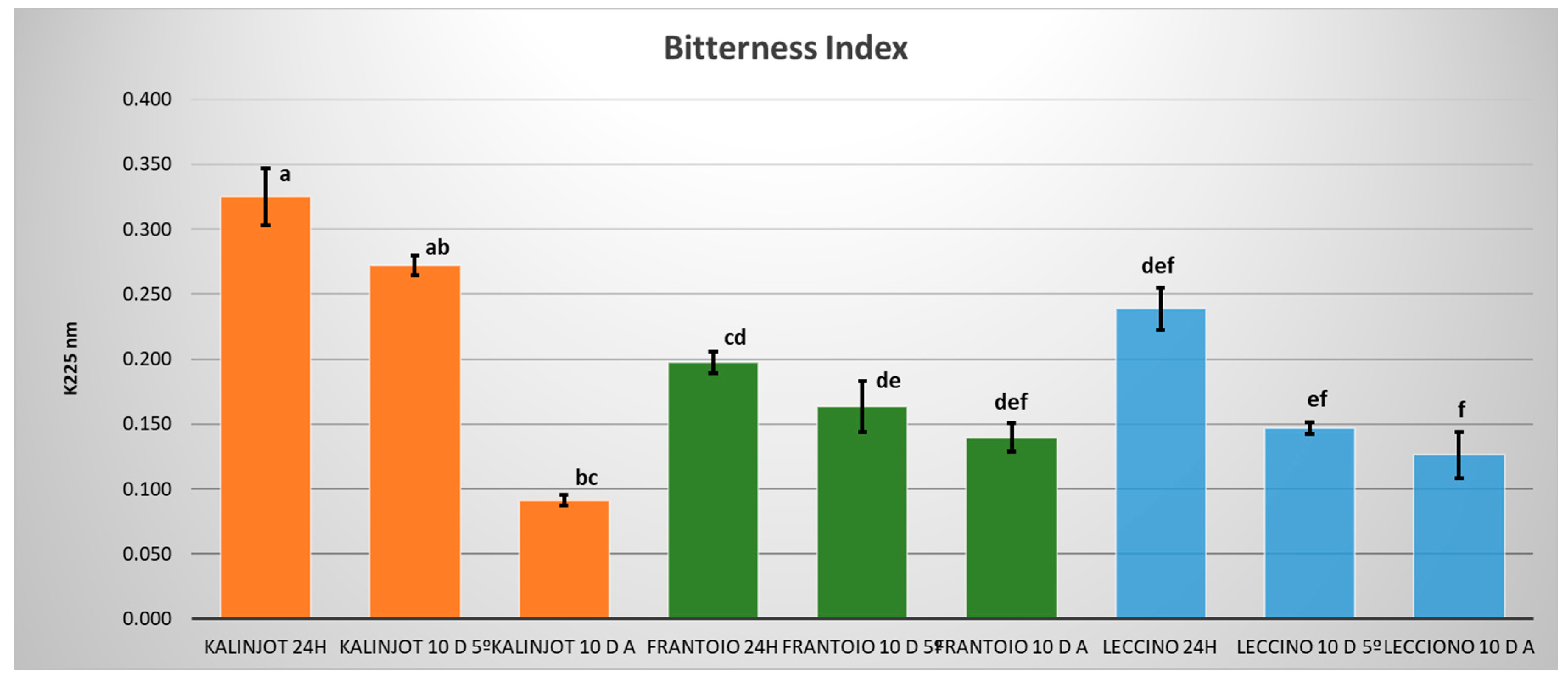
The bitterness index (K225), reflecting secoiridoid phenol levels chemically associated with the bitter taste, decreased slightly under ambient storage (Figure 1). Oils from ‘Kalinjot’ and ‘Frantoio’ retained higher K225 values under cold storage (0.088–0.256), while ‘Leccino’ showed moderate losses. Extended ambient storage led to a marked reduction. ANOVA confirmed significant effects of temperature and storage duration (F = 3.97; p < 0.05). These changes reflect chemical degradation of bitter phenolic compounds rather than direct sensory evaluation [29,30].
The results revealed clear differences in the content of chlorophylls and carotenoids among the three cultivars under different storage conditions (Table 3).
For ‘Kalinjot’, initial levels of both chlorophylls (0.98 mg/kg oil) and carotenoids (0.84 mg/kg oil) were the lowest among the cultivars studied. A modest increase was observed during cold storage (1.26 and 1.13 mg/kg oil, respectively), while ambient storage for 10 days led to a marked accumulation, with chlorophyll content rising more than fivefold (5.36 mg/kg oil) and carotenoids nearly tripling (2.43 mg/kg oil). This suggests that pigment release continues post-milling, and ambient storage accelerates pigment accumulation. Similar observations were reported by [20], who emphasized that pigment evolution during storage is strongly influenced by enzymatic activities and oxygen availability.
In the case of ‘Frantoio’, initial measurements indicated slightly higher levels of chlorophylls (1.46 mg/kg oil) and carotenoids (0.93 mg/kg oil) compared to ‘Kalinjot’. Exposure to cold storage had a minimal impact on these pigments, whereas keeping the fruit at ambient temperature for 10 days resulted in a notable increase. Chlorophyll content surged to 10.84 mg/kg oil, the highest among all cultivars and storage conditions, while carotenoids rose to 4.85 mg/kg oil. These findings are consistent with [31], who reported that ambient storage can significantly enhance pigment levels in some cultivars, intensifying the green-to-golden color, though potentially affecting oxidative stability due to the pro-oxidant behavior of chlorophyll under light.
For ‘Leccino’, the baseline pigments were the highest among the studied cultivars (2.78 mg/kg of chlorophyll oils and 2.45 mg of carotenoid oils). Cold storage markedly favored pigment retention, raising chlorophyll to 8.02 mg/kg oil and carotenoids to 4.79 mg/kg oil. Even after 10 days of ambient storage, the levels remained comparatively high (6.42 and 4.89 mg/kg oil). Unlike ‘Kalinjot’ and ‘Frantoio’, where pigment accumulation peaked under ambient conditions, ‘Leccino’ demonstrated its maximum pigment content under refrigerated storage, highlighting cultivar-specific responses to temperature.
Overall, the data underline the importance of cultivar-dependent storage strategies. While ambient storage promotes pigment accumulation in ‘Kalinjot’ and ‘Frantoio’, cold storage seems more advantageous for ‘Leccino’. From a quality perspective, higher chlorophyll content may enhance the visual freshness of oils, but their pro-oxidant role under illumination poses stability concerns [32]. Carotenoids, on the other hand, not only contribute to golden coloration but also provide antioxidant protection, supporting oil stability during storage [25].
The observed cultivar-specific differences in chlorophyll and carotenoid accumulation indicate that pigment evolution during post-milling storage is influenced by multiple biochemical mechanisms, including enzymatic activity and oxygen exposure. While advanced metabolomic studies in other contexts provide deeper insights into oil composition, our findings highlight practical implications for storage management. Notably, the pro-oxidant potential of chlorophyll under light emphasizes the importance of controlling storage conditions to maintain both the sensory quality and oxidative stability of virgin olive oils [32].
These findings confirm that post-milling storage conditions play a decisive role in shaping pigment composition, and that pigment evolution cannot be generalized across cultivars. This emphasizes the need for cultivar-specific recommendations when optimizing storage conditions for maintaining both the sensory and oxidative quality of virgin olive oils.
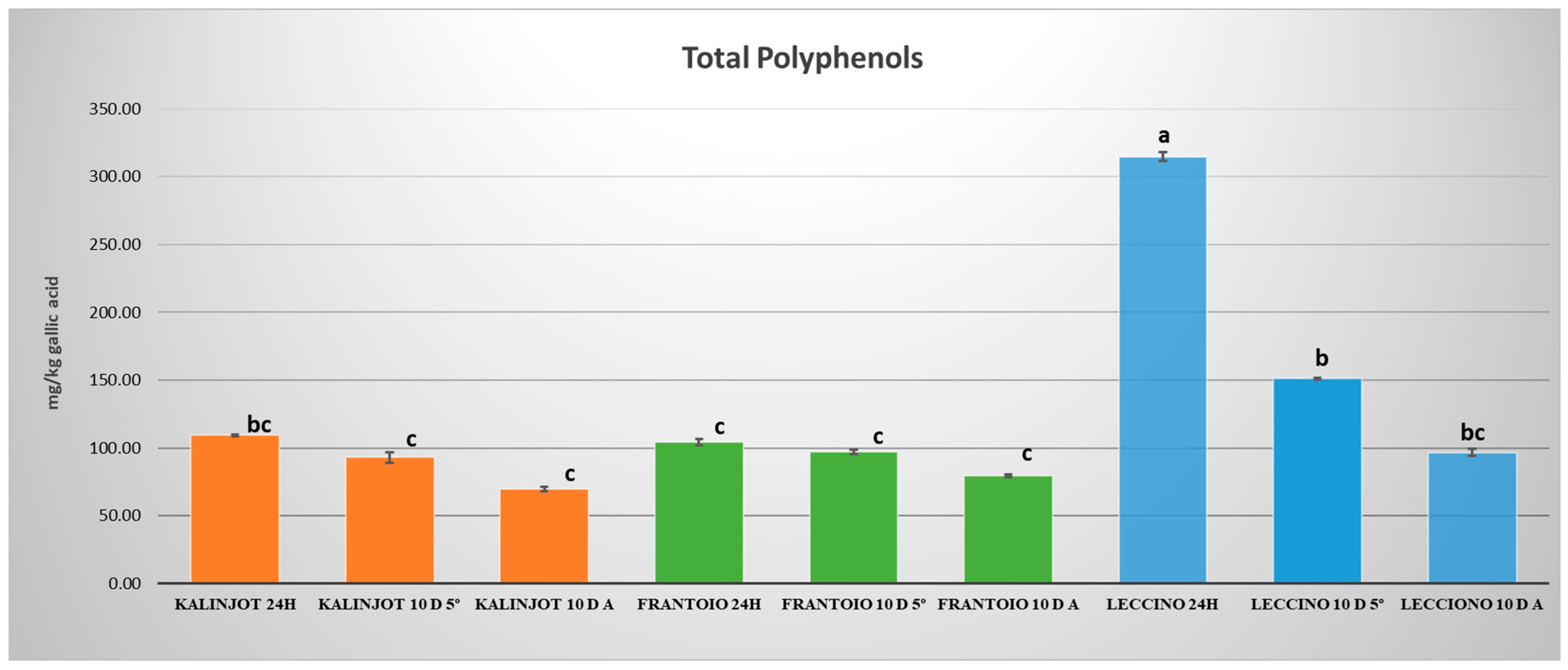
Total Phenolic Content is essential for antioxidant capacity and health benefits, ranging from 108 to 180 mg/kg in freshly milled oils (Figure 2). After 10 days of ambient storage, values decreased by 20–70%, while cold-stored oils retained higher levels (‘Kalinjot’: 103–150 mg/kg; ‘Frantoio’: 145–160 mg/kg). ANOVA confirmed significant effects of cultivar (F = 105.38; p < 0.001), temperature (F = 54.93; p < 0.001), and their interaction (F = 30.23; p < 0.001). The decline under ambient storage is attributed to enzymatic degradation via polyphenol oxidase and peroxidase [33]. Preservation of phenolics under cold storage is supported by [34], who demonstrated that storing olive oil at low temperatures (4 °C and −18 °C) helps maintain total phenolic content and improves oxidative stability compared to storage at higher temperatures. This aligns with our findings, showing that cold storage preserves the bioactive compounds in olive oils from ‘Kalinjot’ and ‘Frantoio’.
Our results demonstrate that postharvest storage conditions significantly affect the bioactive and sensory quality of virgin olive oil. Bitterness, pigment content, and total phenolics are all reduced under ambient conditions, whereas refrigeration mitigates these losses, supporting both sensory quality and functional properties. These findings corroborate prior literature and reinforce the conclusion that the duration and temperature of fruit storage prior to milling are critical factors in determining olive oil quality.

4. Conclusions

This study demonstrates that storage conditions prior to milling have a decisive influence on virgin olive oil quality. Refrigerated storage effectively preserved free acidity, oxidative stability, pigments, phenolic content, and bitterness compared to ambient conditions. Although the three cultivars responded differently, temperature consistently remained the dominant factor.
From a practical standpoint, immediate processing should be prioritized whenever possible. When delays cannot be avoided, cold storage at 5 °C represents a cost-effective solution to limit quality degradation, particularly for more sensitive cultivars such as Frantoio and Kalinjot. Even for the relatively stable Leccino, refrigerated storage remains advantageous.
Overall, these findings provide clear guidance for farmers, collection centers, and mills, emphasizing that proper handling of olives during the pre-milling phase is essential for maintaining the chemical and functional quality of extra-virgin olive oil.

Author Contributions

O.K.: Writing—review and editing, Visualization, Validation, Resources, Data curation, Conceptualization. A.V.: Validation, Resources, Project administration. G.V.: Writing—review and editing, Writing—original draft, Visualization, Methodology, Investigation, Formal analysis, Data curation, Conceptualization. F.P.: Resources, Project administration, Funding acquisition. T.T.: Writing—review and editing, Writing—original draft, Resources. All authors have read and agreed to the published version of the manuscript.

Funding

This work was supported by the National Agency for Scientific Research and Innovation (AKKSHI), within the framework of PTI 2024–2025, funded by the Decision of the AKKSHI Board of Directors no. 7, dated 10 June 2024, and implemented by “Barleti” University in collaboration with the Agricultural University of Tirana and the business “OlivaeOleoteca”, within the framework of the project “Implementation of innovative integrated technologies of olive harvesting and processing for improving the quality of oil”.

Institutional Review Board Statement

Not applicable.

Informed Consent Statement

Not applicable.

Data Availability Statement

The data presented in this study are available on request from the corresponding author. The data are not publicly available, as they are stored in the institutional laboratory archive and have not been deposited in a public repository.

Acknowledgments

The authors express their sincere gratitude to the staff of the Agricultural Technology Transfer Center (ATTC), Vlora, who assisted in establishing the experiments, sample collection, and part of the maturity assessments. We also thank the Food Research Laboratory at the Agricultural University of Tirana for their assistance with the chemical analyses performed for this study. Special appreciation is extended to the business partner OlivaeOleoteca for their continuous engagement throughout the project implementation.

Conflicts of Interest

The authors declare no conflicts of interest.

References

  1. Kalua, C.M.; Bedgood, D.R., Jr.; Bishop, A.G.; Prenzler, P.D. Changes in virgin olive oil quality during low-temperature fruit storage. J. Agric. Food Chem. 2008, 56, 2415–2422. [Google Scholar] [CrossRef]
  2. Famiani, F.; Farinelli, D.; Urbani, S.; Al Hariri, R.; Paoletti, A.; Rosati, A.; Esposto, S.; Selvaggini, R.; Taticchi, A.; Servili, M. Harvesting system and fruit storage affect basic quality parameters and phenolic and volatile compounds of oils from intensive and super-intensive olive orchards. Sci. Hortic. 2020, 263, 109045. [Google Scholar] [CrossRef]
  3. Safarzadeh Markhali, F. Effect of Processing on Phenolic Composition of Olive Oil Products and Olive Mill By-Products and Possibilities for Enhancement of Sustainable Processes. Processes 2021, 9, 953. [Google Scholar] [CrossRef]
  4. Plasquy, E.; García Martos, J.M.; Florido, M.C.; Sola-Guirado, R.R.; García Martín, J.F. Cold Storage and Temperature Management of Olive Fruit: The Impact on Fruit Physiology and Olive Oil Quality—A Review. Processes 2021, 9, 1543. [Google Scholar] [CrossRef]
  5. Lozano-Castellón, J.; Olmo-Cunillera, A.; Casadei, E.; Valli, E.; Domínguez-López, I.; Miliarakis, E.; Pérez, M.; Ninot, A.; Romero-Aroca, A.; Bendini, A.; et al. A targeted foodomic approach to assess differences in extra virgin olive oils: Effects of storage, agronomic and technological factors. Food Chem. 2024, 435, 137539. [Google Scholar] [CrossRef]
  6. Mousavi, S.; de la Rosa, R.; Moukhli, A.; El Riachy, M.; Mariotti, R.; Torres, M.; Pierantozzi, P.; Stanzione, V.; Mastio, V.; Zaher, H.; et al. Plasticity of fruit and oil traits in olive among different environments. Sci. Rep. 2019, 9, 16968. [Google Scholar] [CrossRef] [PubMed]
  7. Rotondi, A.; Morrone, L.; Bertazza, G.; Neri, L. Effect of Duration of Olive Storage on Chemical and Sensory Quality of Extra Virgin Olive Oils. Foods 2021, 10, 2296. [Google Scholar] [CrossRef] [PubMed]
  8. Mousavi, S.; Mariotti, R.; Stanzione, V.; Pandolfi, S.; Mastio, V.; Baldoni, L.; Cultrera, N.G.M. Evolution of Extra Virgin Olive Oil Quality under Different Storage Conditions. Foods 2021, 10, 1945. [Google Scholar] [CrossRef]
  9. Rabiei, V.; Ghorbani, S.; Hajnajari, H. Effect of temperature and storage period of olive (Olea europaea cv. Zard) fruit on olive oil quality. J. Food Agric. Environ. 2011, 9, 74–77. [Google Scholar]
  10. Di Stefano, V.; Melilli, M.G.; Indelicato, S.; Bognanni, R.; Gentile, C.; Palumbo, M. Effect of storage on quality parameters and phenolic composition of extra virgin olive oil. Nat. Prod. Res. 2019, 34, 78–86. [Google Scholar] [CrossRef]
  11. Brkić Bubola, K.; Lukić, M.; Novoselić, A.; Krapac, M.; Lukić, I. Olive fruit refrigeration during prolonged storage preserves the quality of virgin olive oil extracted therefrom. Foods 2020, 9, 1445. [Google Scholar] [CrossRef] [PubMed]
  12. Li, H.; Zou, Y.; Xu, J.; Xu, Y.; He, S. Impact of short-term storage of olive fruits on the quality of virgin olive oil. Foods 2023, 12, 3255. [Google Scholar] [CrossRef] [PubMed]
  13. Pino, C.; Sepúlveda, B.; Tapia, F.; Saavedra, J.; García-González, D.L.; Romero, N. The Impact of Mild Frost Occurring at Different Harvesting Times on the Volatile and Phenolic Composition of Virgin Olive Oil. Antioxidants 2022, 11, 852. [Google Scholar] [CrossRef] [PubMed]
  14. Kullaj, E. Following Olive Footprints in Albania. 2010. Available online: https://www.researchgate.net/publication/231614625_Following_olive_footprints_in_Albania (accessed on 30 September 2025).
  15. Zantedeschi, S.; Casadei, E.; Mandrioli, M.; Barbieri, S.; Ferioli, F.; Hoxha, F.; Valli, E.; Gallina Toschi, T. Fatty acids, volatile and phenolic composition, quality and sensory profile of two Albanian Kalinjot extra virgin olive oils. Ital. J. Food Sci. 2025, 37, 277–289. [Google Scholar] [CrossRef]
  16. European Commission. Sustainable Development of the Olive Sector in Albania. 2020. Available online: https://bujqesia.gov.al/wp-content/uploads/2023/01/3-STUDIMI-I-ULLIRIT-ANGLISHT.pdf (accessed on 30 September 2025).
  17. Martínez, J.M.; Muñoz, E.; Alba, J.; Lanzón, A. Informe sobre la utilización del analizador de rendimientos Abencor. Grasas Aceites 1975, 26, 379–385. [Google Scholar]
  18. European Commission. Commission Regulation (EEC) No. 2568/91 of 11 July 1991 on the characteristics of olive oil and olive-residue oil and on the relevant methods of analysis. Off. J. Eur. Communities 1991, L248, 1–83. Available online: https://eur-lex.europa.eu/legal-content/EN/TXT/?uri=CELEX%3A31991R2568 (accessed on 30 September 2025).
  19. Mateos, R.; Cert, A.; Pérez-Camino, M.C.; García, J.M. Evaluation of virgin olive oil bitterness by quantification of secoiridoid derivatives. J. Am. Oil Chem. Soc. 2004, 81, 71–75. [Google Scholar] [CrossRef]
  20. Minguez-Mosquera, I.; Rejano, L.; Gandul, B.; Sánchez, A. Color-pigment correlation in virgin olive oil. J. Am. Oil Chem. Soc. 1991, 68, 332–336. [Google Scholar] [CrossRef]
  21. Gutiérrez Rosales, F.; Perdiguero Camacho, S.; Gutiérrez, R.; Olias, J.M. Study of effectiveness of octadecyl C18 extraction columns in the evaluation of the bitter taste (K225) in virgin olive oil. Grasas Aceites 1992, 43, 93–96. [Google Scholar] [CrossRef][Green Version]
  22. European Commission. Commission Delegated Regulation (EU) 2015/1830 of 8 July 2015 amending Regulation (EEC) No 2568/91 on the characteristics of olive oil and olive-residue oil and on the relevant methods of analysis. Off. J. Eur. Union 2015, L266, 9–13. Available online: https://eur-lex.europa.eu/eli/reg_del/2015/1830/oj (accessed on 30 September 2025).
  23. Inarejos-García, A.M.; Gómez-Rico, A.; Salvador, M.D.; Fregapane, G. Effect of preprocessing olive storage conditions on virgin olive oil quality and composition. J. Agric. Food Chem. 2010, 58, 4858–4865. [Google Scholar] [CrossRef] [PubMed]
  24. Di Giovacchino, L.; Sestili, S.; Di Vincenzo, D. Influence of olive processing on virgin olive oil quality. Eur. J. Lipid Sci. Technol. 2002, 104, 587–593. [Google Scholar] [CrossRef]
  25. Velasco, J.; Dobarganes, M.C. Oxidative stability of virgin olive oil. Eur. J. Lipid Sci. Technol. 2002, 104, 661–676. [Google Scholar] [CrossRef]
  26. Méndez, A.; Falqué, E. Effect of storage time and container type on the quality of extra-virgin olive oil. Food Control 2007, 18, 521–529. [Google Scholar] [CrossRef]
  27. Kondratowicz-Pietruszka, E.; Wojdyło, A. Analysis of oxidative changes occurring in olive oil during storage. Pol. J. Food Nutr. Sci. 2007, 57, 391–396. [Google Scholar]
  28. Varzakas, T.H.; Zakynthinos, G.I.; Arapoglou, D. Fruit ripening in relationship to oil quality and some quality characteristics of the Greek olive cultivar Koroneiki. Ital. J. Food Sci. 2010, 22, 401–407. [Google Scholar]
  29. Kiritsakis, A.K. Olive Oil: Chemistry and Technology; AOCS Press: Champaign, IL, USA, 1998. [Google Scholar]
  30. Servili, M.; Montedoro, G.; Baldioli, M.; Selvaggini, R. Phenolic compounds in olive oil: Antioxidant, health and organoleptic activities according to their chemical structure. In Natural Antioxidants: Chemistry, Health Effects, and Applications; Shahidi, F., Ed.; AOCS Press: Champaign, IL, USA, 2004; pp. 113–145. [Google Scholar]
  31. Criado, M.-N.; Romero, M.-P.; Casanovas, M.; Motilva, M.-J. Pigment profile and colour of monovarietal virgin olive oils from Arbequina cultivar obtained during two consecutive crop seasons. Food Chem. 2008, 110, 873–880. [Google Scholar] [CrossRef]
  32. Aparicio, R.; Harwood, J. Handbook of Olive Oil: Analysis and Properties; Springer: New York, NY, USA, 2013. [Google Scholar]
  33. Caipo, L.; Sandoval, A.; Sepúlveda, B.; Fuentes, E.; Valenzuela, R.; Metherel, A.H.; Romero, N. Effect of Storage Conditions on the Quality of Arbequina Extra Virgin Olive Oil and the Impact on the Composition of Flavor-Related Compounds (Phenols and Volatiles). Foods 2021, 10, 2161. [Google Scholar] [CrossRef]
  34. Sánchez-Gimeno, A.C.; Benito, M.; Oria, R. Effect of cold storage on total phenolic content and other quality parameters of olive oil. Riv. Ital. Sostanze Grasse 2015, 92, 243–249. [Google Scholar]
Figure 1. Bitterness Index (K225) in olive oils from three cultivars under different storage conditions (n = 3, mean ± SD, different letters indicate significant differences, p < 0.05). Orange line represents Kalinjot, green line represents Frantoio, and blue line represents Leccino.
Appliedchem 06 00006 g001
Figure 2. Total phenolic content (mg/kg gallic acid) in olive oils from three cultivars under different storage conditions. Orange line represents Kalinjot, green line represents Frantoio, and blue line represents Leccino. Values are expressed as mean ± SD (n = 3). Different letters indicate statistically significant differences among treatments according to Tukey’s HSD test (p < 0.05).
Appliedchem 06 00006 g002
Table 1. Mean values (±SD) of physicochemical quality parameters in virgin olive oils from three cultivars under different postharvest storage conditions.
CultivarStorage ConditionFA
(% of Oleic Acid)
K232K270PV
(meq O2/kg)
‘Kalinjot’Immediate (T0)0.282 ± 0.00 c1.881 ± 0.06 bcd0.128 ± 0.05 a6.454 ± 0.06 ab
Cold (5 °C) 10 days0.281 ± 0.01 c1.957 ± 0.05 ab0.159 ± 0.04 a6.188 ± 0.08 b
Ambient 10 days0.839 ± 0.01 b1.988 ± 0.04 ab0.169 ± 0.03 a7.464 ± 0.03 ab
‘Frantoio’Immediate (T0)0.350 ± 0.07 c1.814 ± 0.06 cd0.118 ± 0.04 a6.321 ± 0.07 ab
Cold (5 °C) 10 days0.281 ± 0.00 c1.933 ± 0.06 abc0.192 ± 0.05 a8.080 ± 0.04 a
Ambient 10 days1.686 ± 0.00 a2.059 ± 0.08 a0.220 ± 0.07 a7.871 ± 0.05 a
‘Leccino’Immediate (T0)0.282 ± 0.00 c1.755 ± 0.04 de0.126 ± 0.01 a7.050 ± 0.02 ab
Cold (5 °C) 10 days0.281 ± 0.00 c1.671 ± 0.01 e0.145 ± 0.01 a7.076 ± 0.01 ab
Ambient 10 days0.283 ± 0.00 a1.926 ± 0.02 bcd0.189 ± 0.02 a7.944 ± 0.04 a
Notes: Values are expressed as mean ± SD of three biological replicates per treatment. FA: Free Acidity; PV: Peroxide Value; K232/K270: specific UV absorbance coefficients. Different superscript letters within each cultivar indicate statistically significant differences among storage conditions (p < 0.05).
Table 2. Summary of ANOVA results for olive oil quality parameters.
ParameterVarieties (p)Time (p)TemperatureVarieties × Time (p)Varieties × Temperature (p)Significance
Free Total Acidity<0.0001<0.0001<0.0001<0.0001<0.0001***
Peroxide value0.39810.01500.01500.02800.0280**
K232<0.00010.00880.0088<0.0001<0.0001***
K2700.33080.05920.05920.07020.0702ns
ns = not significant; ** p < 0.01; *** p < 0.001.
Table 3. Total chlorophyll and carotenoid contents (mean ± SD, n = 3) in olive oils from three cultivars under different storage conditions.
CultivarStorage ConditionTotal Carotenoids
(mg/kg Oil)
Total Chlorophyll (mg/kg Oil)
‘Kalinjot’Immediate (T0)
Cold (5 °C) 10 days Ambient 10 days
0.98 ± 0.50 e0.84 ± 0.13 c
1.26 ± 0.31 e1.13 ± 0.09 c
5.36 ± 0.30 c2.43 ± 0.15 b
‘Frantoio’Immediate (T0)
Cold (5 °C) 10 days Ambient 10 days
1.46 ± 0.14 de0.93 ± 0.04 c
1.57 ± 0.47 de1.09 ± 0.14 c
10.84 ± 0.66 a4.85 ± 0.12 a
‘Leccino’Immediate (T0)
Cold (5 °C) 10 days Ambient 10 days
2.78 ± 0.28 d2.45 ± 0.05 b
8.02 ± 0.62 b4.79 ± 0.25 a
6.42 ± 0.54 c4.89 ± 0.21 a
Notes: Values are expressed as mean ± SD of three replicates per treatment. Different superscript letters within each cultivar indicate statistically significant differences among storage conditions (p < 0.05).
Disclaimer/Publisher’s Note: The statements, opinions and data contained in all publications are solely those of the individual author(s) and contributor(s) and not of MDPI and/or the editor(s). MDPI and/or the editor(s) disclaim responsibility for any injury to people or property resulting from any ideas, methods, instructions or products referred to in the content.