1. Introduction
Polymer blending in the melt represents one of the most extensively employed strategies for the development of novel polymeric materials, primarily because it enables the tuning of final properties through controlled adjustments in blend composition [
1]. This approach may also prove highly valuable in the context of synthetic textile recycling, which is essential for reducing environmental impact and conserving resources by addressing the valorisation of both post-consumer and post-industrial waste [
2,
3]. The recovery of scraps and surplus materials from manufacturing processes, together with the reuse of end-of-life garments [
4], contributes to lowering landfill accumulation and reducing the demand for virgin raw materials, thereby supporting a more sustainable and circular economy within the fashion and textile industries.
However, the recycling of textiles remains particularly challenging due to the widespread use of mixed-fibre fabrics, which cannot be easily separated even under optimized sorting processes [
5,
6]. In addition, issues of immiscibility, incompatibility, and the occurrence of chemical changes in the polymeric structure (generally resulting in loss of properties) often hinder the direct reprocessing of such materials.
Although immiscibility is the prevailing condition in polymer blends, rendering most systems inherently incompatible and in need of compatibilization strategies, it is equally true that the in situ formation of reaction products, for instance, grafted block copolymers, during melt mixing can promote interfacial compatibilization [
7,
8,
9,
10].
This study focuses specifically on polyamide–elastane blends (PA/EL), which represent a non-negligible fraction of textiles, particularly in the field of sportswear, active-wear, and hosiery, where elasticity, comfort, and durability are key performance requirements. In textile applications labelled PA/EL, the EL component is generally a poly(ether)–urethane-based spandex from major brands such as Lycra®, Creora®, Dorlastan®, or Roica®, featuring polytetramethylene glycol (PTMG) soft segments and a diol chain extender.
Currently, textile scraps where PA is combined with EL to provide specific properties are recycled by the selective dissolution of EL [
11,
12], leaving the PA recyclable as a monomaterial. However, dissolution-based recycling still has several limitations. Elastane degradation due to high temperatures and harsh solvents can reduce molecular weight and elasticity, making the recovered material unsuitable for reuse without further modification. Residual solvents and additives may further affect its performance. While the recovered PA largely maintains its structure, slight chain scission and impurities can lower its viscosity and impact spinnability. Additionally, the sustainability of the process depends heavily on solvent recovery and scalability [
3,
13,
14,
15].
With a different approach, mechanical recycling, through melt processing, offers the capability to reprocess and partially compatibilize immiscible blend components in a single step, significantly lowering energy consumption and environmental impact. This approach enhances the economic viability of recycling such material streams—provided that the resulting product demonstrates properties suitable for applications with added value.
It is necessary to highlight that degradation and structural modification of polymers are known to occur during extrusion and other thermal or mechanical processing operations [
16]. These changes may result from free-radical reactions or from the cleavage of ester, ether, or amide bonds. In particular, polyurethane-based materials, including elastane, are particularly susceptible to such degradation due to the inherent instability of their urethane and urea linkages [
17,
18]. Experimental studies have shown that treatment at 220 °C for 2 h leads to complete degradation of elastane when blended with polyamide fibres [
19,
20]. These findings collectively confirm that polyurethane structures undergo substantial chemical breakdown when exposed to elevated temperatures during processing, not excluding their reactivity during extrusion in the melt.
Polyamide degradation under thermal or thermo-oxidative conditions proceeds primarily through a free-radical mechanism involving hydrogen abstraction [
21,
22].
Several studies have examined the blending of PA6 with EL, or more broadly with polyurethane, yielding diverse and sometimes conflicting results concerning their miscibility, compatibility, and stability [
23]. Likewise, the applicability and performance of the resulting materials are often evaluated inconsistently, highlighting both the intrinsic complexity of these systems and the strong influence of processing conditions and formulation parameters.
In a study addressing the long-standing challenge of improving polymer toughness without compromising tensile strength, Cai et al. [
24] developed a hydrogen bonding-based self-assembly strategy for melt blending. The authors demonstrated that adding 10 wt% PA to polyester-based TPU increased elongation at break from 1150% to 1375% without significantly reducing tensile strength. Melt blending at 190–220 °C promoted in situ hydrogen bonding between TPU urethane/ester groups and PA amide groups, which disrupted TPU’s internal network while enhancing interfacial adhesion between phases, resulting in improved toughness and strength. Likewise, in a study aimed at valorising multi-component textile waste, Kunchimon et al. [
25] investigated the blending of PA with TPU through twin-screw melt extrusion. The materials were melt-blended using a twin-screw extruder with a temperature profile of 180–230 °C. The resulting fibres showed mechanical properties intermediate between those of neat PA and TPU. The results suggest that, despite phase separation, PA and TPU can be compatibilized through hydrogen bonding between amide and urethane/urea groups. In a study on melt modification of PA, Agnol et al. [
26] investigated its blending with TPU via extrusion performed at 225–280 °C, enabling transurethanization reactions in which dissociated urethane groups formed isocyanate species that reacted with PA end-groups. This led to chain extension and increased PA molar mass, reducing thermo-mechanical degradation. TPU also improved toughness while slightly lowering tensile strength, acting both as an impact modifier and reactive compatibilizer. These findings support the potential of melt blending with TPU or EL to enhance PA6 recyclability and performance. Despite the growing interest in the recycling of textiles, only a limited number of studies have investigated the direct melt processing of PA6/EL blends. Most published research has concentrated on selective dissolution techniques or on highlighting the incompatibility between the two phases, whereas few contributions have explored the processing influence on dispersion or interfacial behaviour. This work aims to contribute to this area by examining how specific extrusion parameters affect the structure and properties of PA/EL blends, and by assessing the potential of melt mixing as a feasible approach for the recycling of this type of textile waste. This study investigates blends of PA and EL derived from a commercial fabric containing 16% EL. The blends were produced via extrusion under varying processing conditions to examine the relationship between parameters such as temperature and screw speed, and the resulting phase morphology and thermo-mechanical properties. The findings are discussed in relation to the chemical characteristics of the PA and EL macromolecules, highlighting how different processing conditions influence their structural and functional behaviour.
3. Results
A pilot-scale separation process of EL from the bi-component PA/EL textile was employed with the aim of recovering individual purified materials (i.e., separated PA and EL fractions). Characterization tests—such as ATR-FTIR (
Figure S2), DSC (
Figure S3a,b), SEM (
Figure S4), and composition analysis (
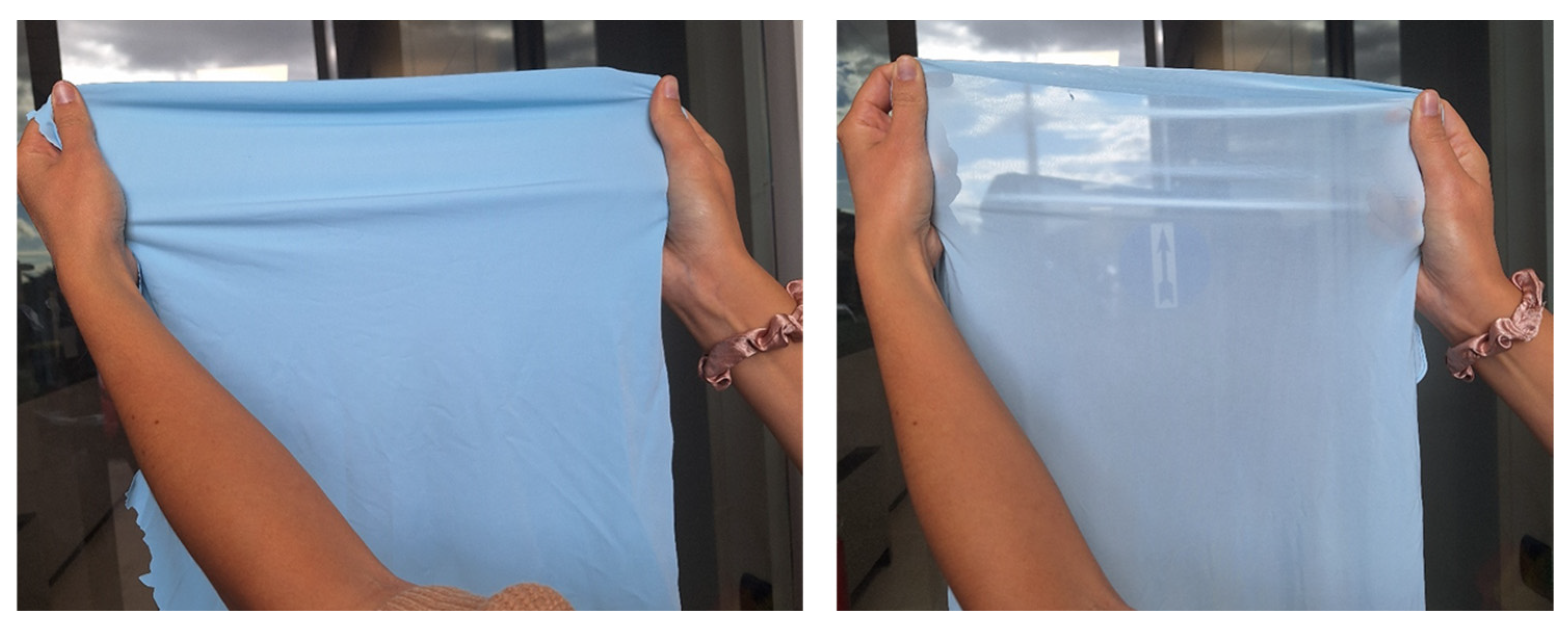
Table S1)—were conducted on both the recovered materials and the initial bi-component fabric to assess the effectiveness of the separation process. The results confirmed that the EL fibres have been almost totally removed from the starting material, which macroscopically retained its structure, emphasizing the efficiency and the potential of this process. The resulting PA-based fabric appeared lighter, more transparent, and less elastic, attributable to the absence of EL fibre (
Figure 1). Concurrently, the recovered EL material exhibited a rubber-like, compact morphology and partially retained the original colour of the fabric.
Separated PA and all PA/EL blends were successfully extruded into continuous, homogeneous filaments, cooled in water at room temperature, and then pelletized.
The observed variations in MFR and MVR may be mainly attributed to the processing conditions and could provide information about their effect on melt viscosity (
Table 2).
Increasing the processing temperature from 230 °C to 260 °C led to a pronounced increase in MFR/MVR values, suggesting that thermal degradation resulting in a decrease in molecular weight reasonably occurs at the higher temperature. Variations in screw speed or screw type did not significantly affect the post-processing melt fluidity, indicating that the mechanical shear applied during extrusion did not induce measurable polymer degradation. When comparing the neat PA (RES-PA-C35-230) with the corresponding blend containing EL (C-35-230), a clear decrease in MFR is observed, which can be attributed to interactions occurring between the PA matrix and the dispersed EL domains.
The mechanical data in
Table 3 highlight the effect of processing conditions on the stiffness and ductility of the PA/EL blends. The separated PA (RES-PA) exhibits the highest stiffness (tensile modulus ≈ 2.6 GPa) and the lowest elongation at break (~2–3%), typical of a rigid and brittle matrix. The presence of EL markedly reduced both the flexural and tensile moduli, whereas the elongation at break increased up to one order of magnitude compared to the neat PA, reaching 18–19% for M-70-230, suggesting a toughening effect.
The M screw produces materials with slightly higher ductility than the C screw, whereas an increase in screw speed from 35 to 70 rpm further enhanced elongation. Conversely, the sample C-35-260 processed at the higher temperature exhibited lower ductility, consistent with the occurrence of thermal degradation.
The Izod impact results (
Table 3) confirm the toughening effect of EL addition to the PA. The neat PA samples (RES-PA) show the lowest impact strength (~34 J/m). Incorporation of 16 wt% EL increases the impact resistance to values in the range of 40–47 J/m.
Samples processed with the M screw exhibit the highest and most reproducible impact values (up to 46.5 J/m). Statistical evaluation of the IZOD impact strength results was performed using a one-way analysis of variance (ANOVA) and Student’s t-test to verify the significance of the differences among the samples. Despite the relatively high standard deviations observed for some samples, the statistical analysis confirmed that the differences between the mean values are significant (p < 0.05). This indicates that the observed variations in impact strength are not due to random experimental error but reflect real differences in material performance.
Overall, the impact behaviour mirrors the tensile results: moderate processing conditions (230 °C, M screw, 70 rpm) produce the most balanced combination of stiffness, ductility, and impact strength, confirming that the EL acts as an effective toughening phase.
Regarding the thermal characterization of EXT-EL (
Table 4), the endothermic melting peak appearing at approximately 10 °C during the first heating scan can be attributed to the melting of the soft segments of EL, while the melting of the hard aromatic urethane domains is not evident within the investigated temperature range that is up to 240 °C, consistently with the behaviour of segmented polyurethanes whose hard phases do not show a sharp melting peak, because they melt very gradually. The absence of a hard segment melting peak may therefore be related to the fact that at standard DSC cooling rates, low and heterogeneous hard segment content typical of elastane reorganizes sufficiently to produce a distinct endotherm, which would require much slower cooling or dedicated annealing treatments.
Therefore, when the temperature processing is set at 230 °C, only the soft segments are molten, while the hard domains probably preserve their integrity. When processed at 260 °C, the EL phase melts more extensively. However, this elevated temperature may also cause thermal scission of the urethane linkages, leading to a reduction in molecular weight. This degradation promotes more efficient crystalline packing, resulting in an increase in melting enthalpy, as observed in sample C-35-260.
RES-PA-C35-230 exhibits the typical melting (Tm ≈ 220–225 °C) and crystallization (Tc ≈ 180–185 °C) peaks, with the occurrence of double melting (e.g., 221/212 °C) indicating recrystallization or α/γ crystalline transitions commonly observed in reprocessed materials or under different cooling conditions.
In the compounds, both melting and crystallization peaks are present. The shift and variation in the melting peak of the soft segments of EL between the first and second heating indicate the thermally induced cleavage of urethane linkages, leading, as reported by some authors [
17], to partial separation of the flexible ether segments and rigid aromatic blocks.
The thermal parameters of the PA phase remain substantially unaffected by the screw type and the screw speed. Both the melting and crystallization temperatures of PA show only minor variations, while the enthalpy values are comparable among all samples. This indicates that the processing conditions did not significantly influence the crystalline structure of PA. A slight increase in both Tm and ΔHm is observed for the samples processed at 260 °C, suggesting a mild thermal degradation of the PA. Shorter molecular chains resulting from limited chain scission can, in fact, exhibit higher mobility, promoting crystallization.
In contrast, the EL phase shows small but consistent differences depending on the processing conditions. Samples processed with the C screw, especially at 260 °C, display slightly higher melting temperatures and enthalpy values than those obtained with the M screw.
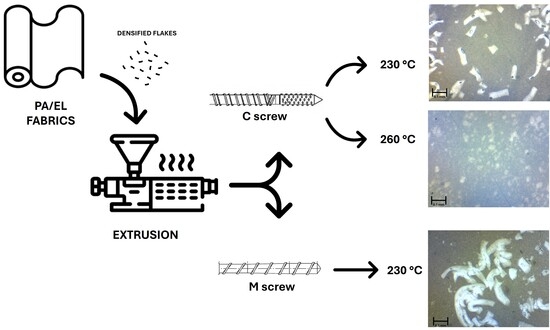
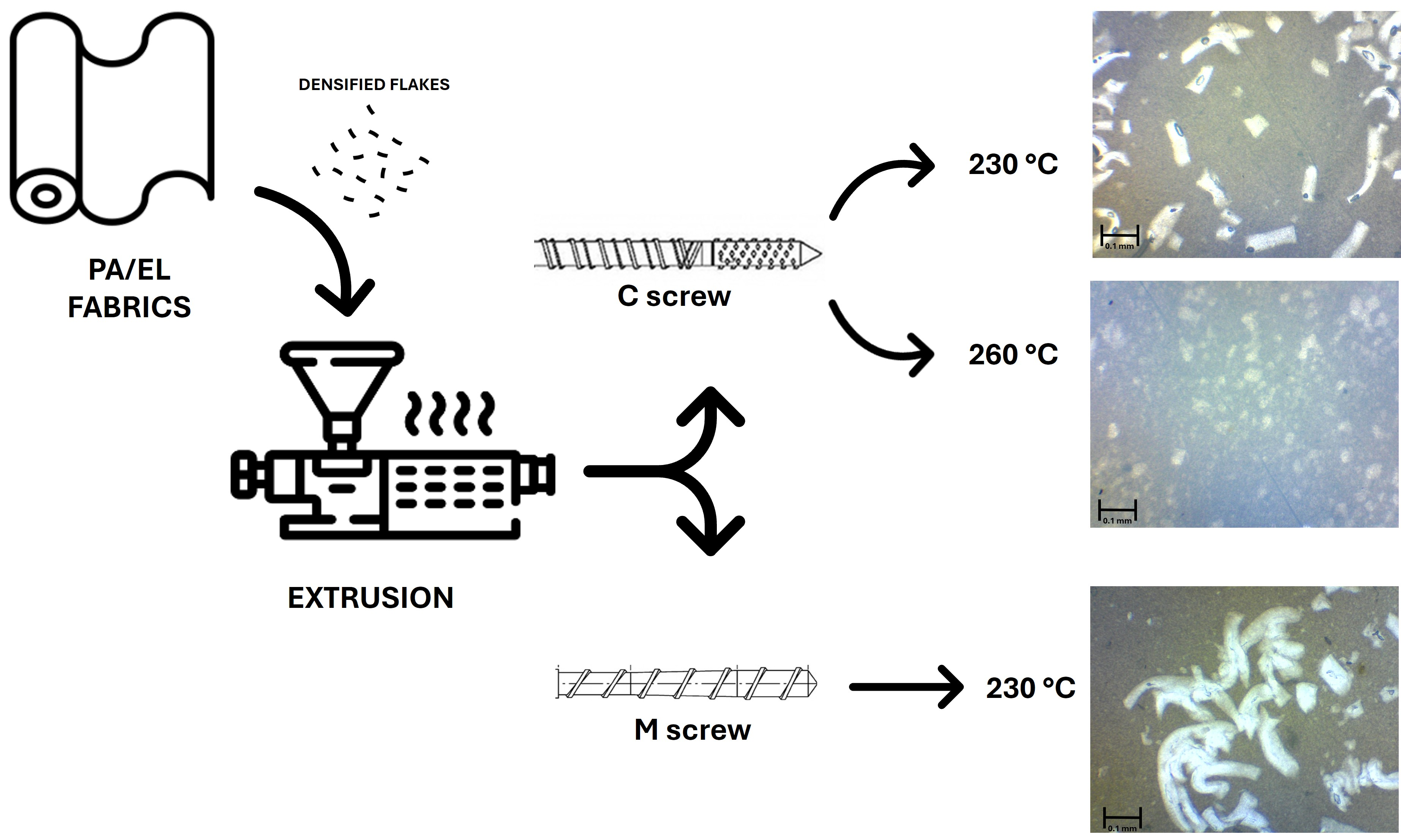
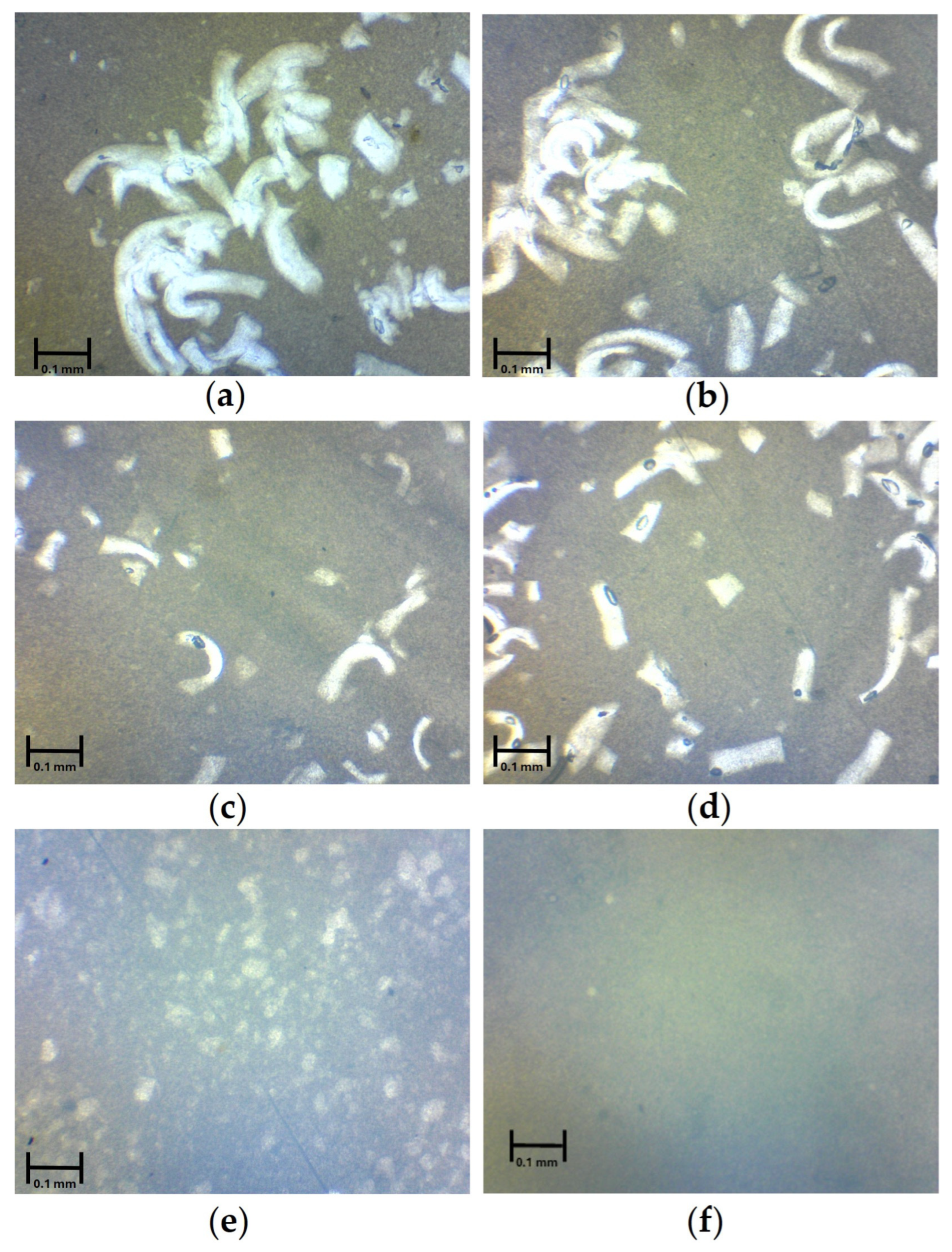
The optical micrograph of the samples processed at 230 °C (
Figure 2a–d) shows elongated and irregular bright domains dispersed within the darker PA matrix. These domains correspond to the EL phase (hypothesis that is corroborated by the absence of those domains in RES-PA-230), which is only partially molten at this temperature. The retained integrity of the hard domains prevents complete coalescence and leads to the formation of viscoelastic inclusions embedded in the continuous PA matrix. This morphology is consistent with the fibrous origin of the EL, which preserves its filamentous structure when only the soft segments are molten. Samples processed with the M screw display longer dispersed EL particles compared to those obtained with the C screw.
In contrast, the micrograph of the sample processed at 260 °C (
Figure 2e) reveals a much finer and more homogeneous dispersion of bright domains, indicating a loss of the original fibrous morphology. This change can be attributed to thermal degradation and chain scission of the urethane hard segments, which cause the breakup of the EL filaments into smaller fragments. The disappearance of elongated structures and the appearance of small, rounded domains confirm the microphase disintegration of the EL at higher temperature, consistent with the DSC results showing increased melting enthalpy and partial phase separation of the soft and hard segments.
Overall, morphological evidence confirms that at moderate temperatures (230 °C) the EL behaves as a partially softened dispersed phase with preserved fibrous integrity, whereas at 260 °C it undergoes significant structural breakdown, resulting in a finer dispersion in the rigid PA matrix.
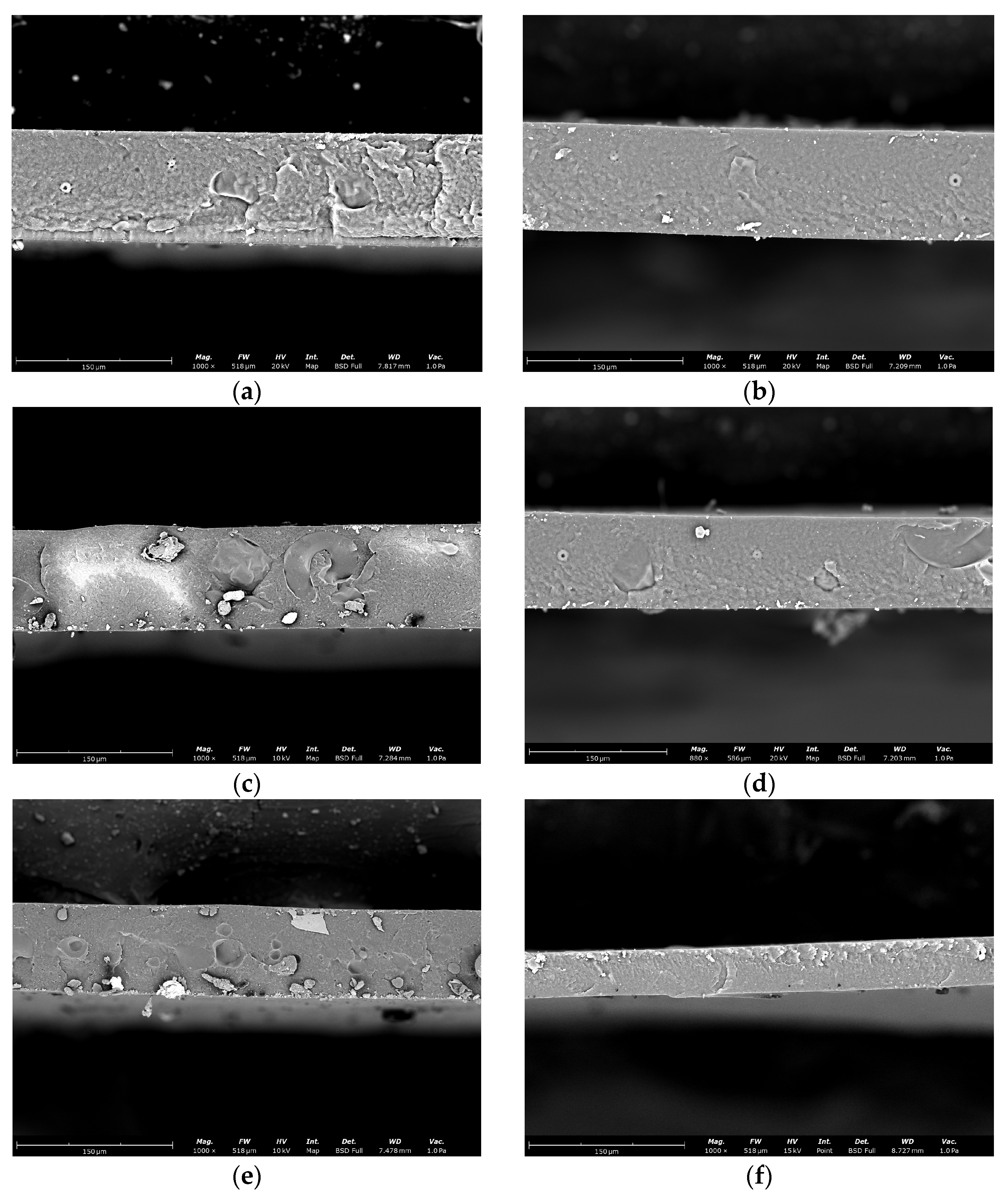
The SEM micrographs (
Figure 3) show the morphology of the cryofracture film of the PA/EL blends. The assignment of EL-rich domains was supported by EDS analysis, which revealed the presence of magnesium in the extracted elastane but not in the polyamide. This elemental marker was used to differentiate the two phases in the blends, as detailed in the
Supplementary Materials (Figures S5–S7).
At 230 °C, all samples exhibit a biphasic morphology with discrete EL inclusions distributed within the PA matrix. The domains show irregular and partially elongated shapes, consistent with the partial melting of the soft segments and the retention of cohesive hard domains already evidenced by optical microscopy.
Again, the morphology changes markedly in the C-35-260 sample, where the EL domains appear significantly smaller, rounder, and more uniformly dispersed, even if the spherical voids and detached rounded particles visible on the fracture surface indicate that some EL domains were not perfectly bonded to the matrix, leading to interfacial debonding during fracture.
The same thin films obtained by compression moulding used for microstructural characterization were analyzed by ATR-FTIR.
The spectra obtained for EXT-EL and RES-PA-230 are used as reference spectra for comparison (
Figure S1).
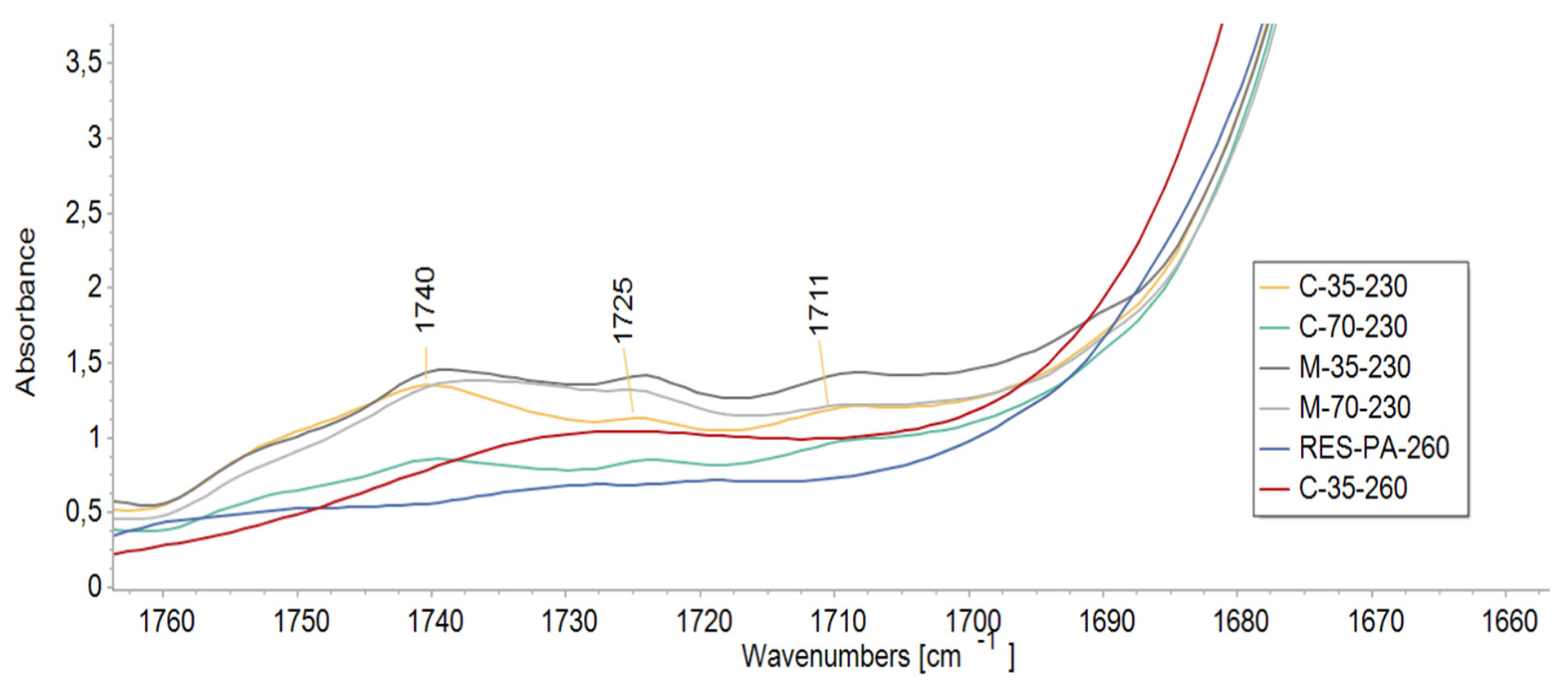
In the spectra of all the blends, the IR bands around 1740–1710 cm
−1 (
Figure 4) correspond to the stretching vibration of the C=O group in urethane units. The exact position of the band depends on whether (and how) the carbonyl is involved in hydrogen bonding. In particular, the urethane C=O bands at 1730, 1725, or 1713 cm
−1 can be attributed to free carbonyl, hydrogen-bonded to an NH group, or hydrogen-bonded to a polyether oxygen; in fact, the stronger the hydrogen bond, the further the absorption shifts to lower wavenumbers.
The 1725 cm−1 band is generally attributed to the urethane carbonyl involved in hydrogen bonding with an NH group. In the literature, this is usually discussed as a urethane–urethane interaction. However, any NH donor can induce this shift; therefore, if instead of a urethane NH, the donor were an amide NH from a polyamide, the result would be similar. A possible difference is that amide NH groups form stronger hydrogen bonds than urethane NH groups, so the exact band could appear slightly lower in frequency (e.g., closer to 1720 cm−1), and the band shape may broaden due to stronger interactions.
Samples processed at 230 °C show slightly stronger absorption near 1720–1725 cm−1, consistent with hydrogen-bonded C=O groups and good interfacial interactions with PA. At 260 °C, the density of hydrogen bonds both within the EL phase and at the EL–PA interface seems to be decreased; probably the melting of the hard segments and the partial EL chain scission reduce them.
4. Discussion
The combined thermal, morphological, and mechanical results provide a consistent overview of how processing conditions influence the structure–property relationship in the PA/EL blends. DSC analysis indicates that the melting and crystallization behaviour of PA is only slightly affected by the screw geometry or rotation speed, with Tm (≈220–225 °C) and Tc (≈180–185 °C) remaining substantially unchanged. A modest increase in melting temperature and enthalpy is observed for samples processed at 260 °C, likely related to a slight occurrence of thermal degradation of PA.
The thermal transitions of the EL phase show more noticeable yet still moderate variations depending on the processing conditions. The weak endothermic peak at 10–20 °C corresponds to the melting of the soft segments, whereas no distinct transition associated with the hard domains is detected within the investigated range. The sample processed with the C screw at 260 °C exhibits slightly higher melting temperatures and enthalpy values. This behaviour can be attributed to partial thermal degradation of the EL, involving limited cleavage of urethane linkages and partial separation of soft and hard segments, rather than to a genuine increase in structural order.
At 230 °C, all samples exhibit a biphasic morphology with discrete EL inclusions distributed within the PA matrix. The domains show irregular and partially elongated shapes, consistent with the partial melting of the soft segments and the retention of cohesive hard domains. During processing, the EL fibres are mechanically broken by the screws, and the melting of the soft segments allows interdiffusion and/or entanglement between EL and PA macromolecules at the “surface” of the former EL fibres. This mechanism does not lead to the formation of a typical spherical dispersion of one phase within the other but instead gives rise to a fibrillated morphology that contributes to impact properties [
32,
33]. The molten soft segments can establish hydrogen bonds with the PA chains of the matrix, thereby stabilizing the interface even after cooling and acting as an interfacial “adhesive” between the micrometric EL domains and the surrounding PA matrix.
Processing at 260 °C results in a more evident morphological modification: the EL loses its elongated, fibrous character and forms a finer and more homogeneous dispersion of small spheroidal inclusions. At this temperature, even the hard segments are molten, which allows a more “classical” type of dispersion to occur, characterized by the formation of rounded domains typical of immiscible polymer blends. The ATR-FTIR spectra further support this interpretation: samples processed at 230 °C show a relatively intense and broad absorption near 1720–1725 cm−1, consistent with strong hydrogen bonding between urethane carbonyls and PA amide groups, confirming good interfacial compatibility. In contrast, at 260 °C the carbonyl band shifts toward higher wavenumbers (~1730 cm−1) and slightly narrows, indicating a reduced fraction of hydrogen-bonded carbonyls. Although differences in EL dispersion may partly influence this behaviour, the shift observed can also be explained by partial cleavage and rearrangement of urethane linkages.
The mechanical data mirror these morphological trends. The incorporation of EL reduces the stiffness of PA while improving ductility and impact strength, confirming its role as a toughening agent.
The toughening mechanism is complex, probably involving crack bridging by the elastomeric elongated domains, cavitation within the fibres or at fibre-matrix interface, and enhanced stress dissipation through shear yielding in the PA matrix.
The blends processed at 230 °C with the M screw show the best balance of properties, combining high elongation at break (≈18%) and impact strength (~46 J/m) with acceptable stiffness. Under harsher conditions (C screw, 260 °C), a moderate reduction in ductility and impact strength occurs, reflecting the onset of degradation.
Processing temperature and screw design primarily control the degree of EL integrity and dispersion, and thus the final balance between stiffness and toughness in the PA/EL system.
5. Conclusions
Extruded blends based on polyamide 6 and elastane were prepared by extrusion, considering different processing parameters: the shape of the mixing elements, temperature, and shear rate of the screw. The processing features, especially the adopted temperature, were demonstrated to affect melt viscosity, morphology, and final thermo-mechanical properties.
Morphological and thermal analyses suggest that EL behaves as a partially molten viscoelastic dispersed phase within the PA matrix. By adopting a temperature of 230 °C, the solid hard segments preserve the structural integrity of the EL domains, while the molten soft segments allow deformation under stress that results in elongation, giving rise to a fibrillated composite, where the pull-out mechanism reasonably maximizes the impact properties. On the other hand, at 260 °C, all the EL phase melts and collapses into an almost spherical micrometric dispersed phase, typical of immiscible polymer blends.
This dual behaviour enables the EL to act as an impact-modifying phase, like the rubber particles in ABS systems. Upon mechanical loading, the EL inclusions can deform, cavitate, or bridge cracks, dissipating impact energy and enhancing ductility without a substantial loss of stiffness.
Given their balanced mechanical performance and good processability, the recycled PA/EL blends may be suitable for several applications, such as injection-moulded technical parts, 3D-printed components, and non-critical accessories. Potential end uses include small consumer goods (e.g., stationery items, cosmetic holders), multi-compartment organizers, and various fashion or office accessories, offering viable routes for the valorisation of PA/EL waste streams within circular supply chains.
This approach, offering the opportunity to valorise PA/EL textile waste without the need for prior separation, provides a more energy-efficient alternative to solvent-based methods and enables processing through standard melt technologies already available in recycling facilities. However, while the resulting blends show enhanced toughness, the reduction in stiffness may limit their use in structural applications, and the presence of dispersed elastane domains prevents fibre-to-fibre recycling, confining their reuse to open-loop routes.




 ,
,