Article

Visible-Light-Responsive PrFeTiO3 Perovskite Photocatalyst for Pollutant Degradation and Antibacterial Applications


Department of Environmental Engineering, Sunchon National University, 255 Jungangro, Suncheon 57922, Republic of Korea
*
Author to whom correspondence should be addressed.
AppliedChem 2026, 6(1), 18; https://doi.org/10.3390/appliedchem6010018
Submission received: 12 December 2025 / Revised: 20 February 2026 / Accepted: 22 February 2026 / Published: 5 March 2026

Abstract

PrFeTiO3 perovskite composite was synthesized, and its structural, morphological, chemical, and optical properties were comprehensively characterized. X-ray diffraction (XRD) and a selected area electron diffraction (SAED) confirm the formation of an orthorhombic distorted perovskite phase with no secondary impurities. Transmission electron microscope (TEM) observations show aggregated nanocrystalline domains, while EDS mapping reveals homogeneous cation distribution (Pr, Fe, Ti, O), confirming successful incorporation of Fe and Ti into the perovskite lattice. X-ray photoelectron spectroscopy (XPS) analysis identifies Pr3+, Fe3+, and Ti4+ as the dominant oxidation states, supporting charge-compensated B-site substitution. Optical analysis reveals a bandgap of ~2.0 eV, significantly narrower than pristine titanates, indicating enhanced visible-light absorption. This multi-modal characterization verifies the successful formation of PrFeTiO3 and highlights its potential as a visible-light-active photocatalyst. Although PrTiO3 showed little reactivity to visible light, PrFeTiO3 showed excellent efficiency in visible light photocatalytic reactions. PrFeTiO3 showed more than 20 times better performance than PrTiO3 in the photodegradation of methylene blue in the liquid phase and formaldehyde in the gas phase. Furthermore, PrFeTiO3 showed more than 95% superior bactericidal activity against the pathogenic bacterium Staphylococcus aureus than PrTiO3. Its high photocatalytic efficiency can be attributed to its strong photosensitivity to visible light and small band gap energy.

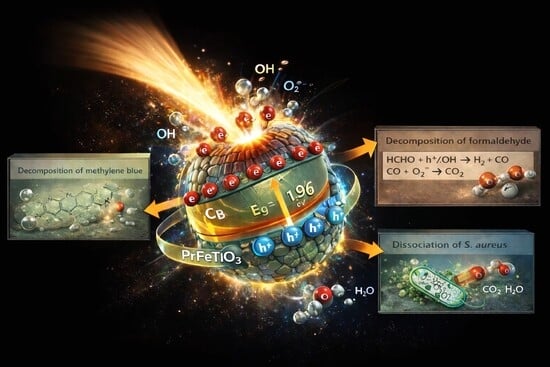
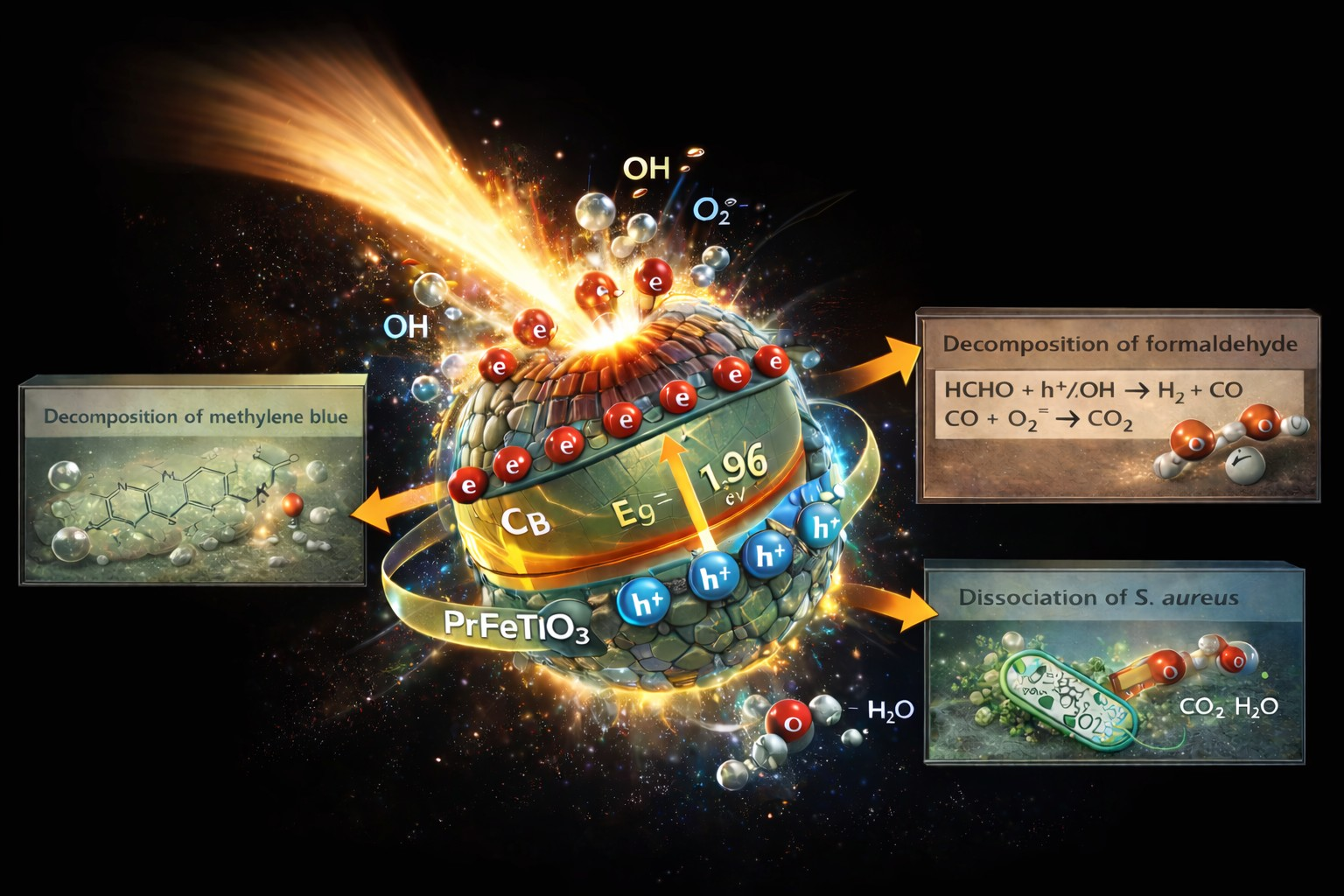
Graphical Abstract

1. Introduction

Perovskite materials, generally represented by the formula ABX3, consist of a large A-site cation, a transition-metal B-site cation, and an anion X. By tailoring the chemical composition and coordination environment of these constituents, a wide variety of perovskite derivatives can be constructed, including oxide perovskites (ABO3), metal halide perovskites (APbX3; X = Cl, Br, I), as well as double, layered, and defect-engineered structures [1,2]. Among them, oxide perovskites exhibit excellent thermal and chemical stability, rendering them suitable for catalytic and photocatalytic applications under harsh reaction environments [3].
In contrast, metal halide perovskites have attracted considerable attention due to their strong visible-light absorption, long carrier diffusion lengths, and high defect tolerance, which enable efficient photochemical reactions under low light intensities [4,5]. However, their poor resistance to moisture, thermal stress, and oxidative environments severely restrict their applicability in aqueous-phase photocatalysis and long-term environmental remediation processes [6]. These intrinsic limitations have motivated extensive efforts to develop stable oxide-based perovskites capable of visible-light-driven photocatalytic reactions.
A key advantage of oxide perovskites lies in their highly tunable electronic structures. Through A-site or B-site substitution, bandgap engineering and modulation of conduction and valence band positions can be achieved, allowing visible-light activation while preserving structural robustness [7,8,9]. Recent studies have demonstrated that the introduction of transition-metal dopants or multivalent cations can effectively narrow the bandgap and promote charge separation by inducing lattice distortion and defect states [10,11,12]. In particular, oxygen vacancy engineering has emerged as a powerful strategy to enhance visible-light absorption and surface redox activity in perovskite photocatalysts [13].
Ferrite-based perovskites have received increasing attention due to their narrow bandgaps, strong electronic conductivity, and broad spectral absorption extending from UV to visible wavelengths [14]. Fe-containing perovskites can introduce Fe2+/Fe3+ redox couples that facilitate interfacial electron transfer and suppress charge recombination [15]. Nevertheless, excessive Fe incorporation often leads to structural instability, secondary phase formation, or increased carrier recombination, thereby limiting photocatalytic efficiency [16]. Consequently, achieving a balanced combination of Fe-induced electronic modulation and lattice stability remains a significant challenge.
Rare-earth-based perovskites, particularly Pr-based titanates, provide an attractive platform for addressing this issue. Pr3+ ions possess flexible coordination environments and variable electronic interactions with B-site cations, which can stabilize distorted perovskite lattices and promote defect formation without severe structural collapse [17,18]. Previous studies on PrTiO3 and PrFeO3 systems have reported improved electrical conductivity and catalytic activity; however, most investigations have focused on single B-site compositions, while the simultaneous regulation of multivalent B-site cations and oxygen vacancy chemistry has remained largely unexplored [19,20,21].
Recently, mixed B-site perovskites incorporating two transition metals have been proposed as an effective strategy to synergistically modulate band structure, redox activity, and defect density [22,23]. Despite these advances, systematic studies on Pr-based Fe–Ti dual B-site perovskites are still scarce, particularly with respect to their visible-light photocatalytic behavior, defect-driven charge-transfer mechanisms, and multifunctional environmental applications.
In this study, we report the synthesis of a defect-engineered PrFeTiO3 perovskite composite designed to integrate the structural stability of titanates with the redox activity of ferrites. By coupling Fe and Ti within the Pr-based perovskite lattice, we aim to simultaneously regulate lattice distortion, multivalent redox centers, and oxygen vacancy concentration to optimize visible-light-driven photocatalytic performance. The physicochemical, electronic, and optical properties of the synthesized PrFeTiO3 were systematically characterized. Its photocatalytic activity was evaluated through liquid-phase degradation of methylene blue, vapor-phase oxidation of formaldehyde, and antibacterial inactivation of Staphylococcus aureus under visible-light irradiation. Furthermore, the reaction pathways and underlying photocatalytic mechanisms were elucidated to clarify the structure–activity relationships governing this multifunctional perovskite system.

2. Materials and Methods

2.1. Preparation of PrFeTiO3 Perovskite Catalysts

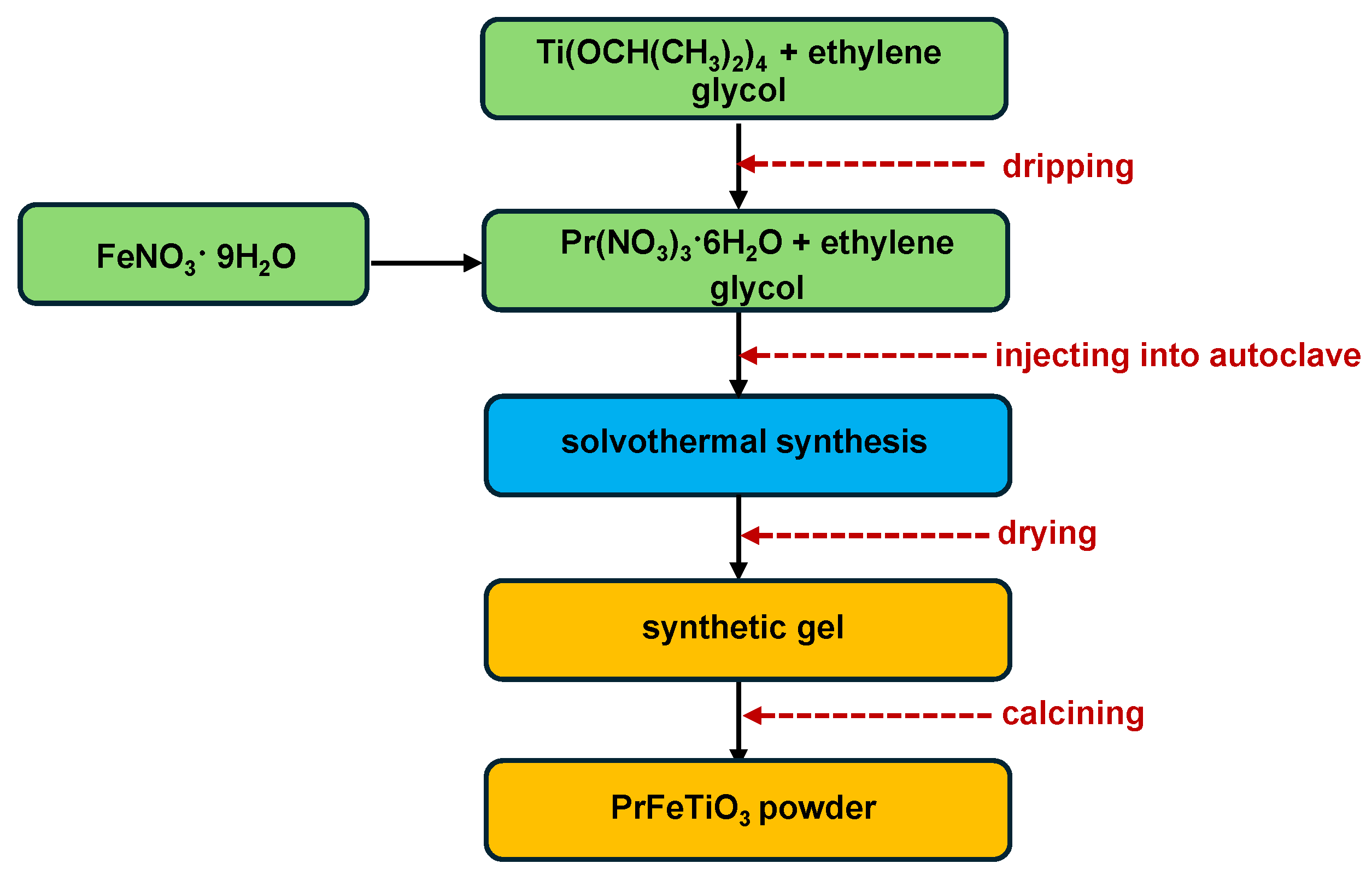
PrFeTiO3 (PFTO), a praseodymium (Pr)-iron (Fe)-titanate (TiO3) complex, was synthesized using a solvothermal synthesis process combined via a sol–gel method. The raw materials for the synthesis of PFTO were 1 M of praseodymium(III) nitrate hydrate (Pr(NO3)3·H2O, REO, 99.9%), 1 M iron nitrate nonahydrate (Fe(NO3)3·9H2O, Duksan, 98%), and 1 M of titanium isopropoxide (Ti[OCH(CH3)2]4, Duksan, 99%). The composition was adjusted so that the molar ratio of these three reagents was 1:1:1. First, 200 mL of ethylene glycol was prepared, and praseodymium(III) nitrate hydrate was added and dissolved. Iron nitrate hexahydrate was added to this solution and stirred to prepare a Pr-Fe solution. Meanwhile, 100 mL of ethylene glycol was separately prepared, titanium isopropoxide was added, and the solution was stirred to prepare a Ti solution. The two solutions were stirred separately at room temperature for 3 h. Afterwards, the Ti solution was slowly added to the Pr-Fe solution and stirred vigorously for 5 h. The mixed reaction solution was stirred vigorously in a reactor maintained at 80 °C for another 10 h. The reaction solution was then dried in a desiccator at 120 °C for 24 h. After drying, the solid was pulverized into powder, which was then calcined in an electric muffle furnace at 900 °C for 10 h. The calcination temperature was gradually increased at a rate of 5 °C/min until it reached 900 °C. Upon completion of the calcination, PFTO powder was obtained. Figure 1 schematically shows the manufacturing process of PFTO perovskite.
To compare the photocatalytic activity of the newly synthesized PFTO, PrTiO3 (PTO) was synthesized. The starting materials for PTO synthesis consisted of 1 M of praseodymium(III) nitrate hydrate and 1 M of titanium isopropoxide (Duksan 99%). First, a Pr solution was prepared by dissolving 1 mol of praseodymium(III) nitrate hydrate in 200 mL of ethylene glycol. Meanwhile, a Ti solution was prepared by adding and dissolving 1 M of titanium isopropoxide in another 100 mL of ethylene glycol. The two solutions were stirred at room temperature for 3 h to ensure complete dissolution. The Ti solution was slowly added to the Pr solution and stirred for 12 h. The mixed solution was then dried in a desiccator at 120 °C for 24 h. The dried powder was calcined in an electric furnace at 900 °C for 10 h to obtain the final PTO powder. The calcination temperature was gradually increased at a rate of 5 °C/min to reach 900 °C.

2.2. Evaluation of Visible-Light Photocatalytic Activity

2.2.1. Liquid-Phase Photocatalytic Degradation Reaction

An experiment was conducted to evaluate the photocatalytic degradation of methylene blue (MB) by irradiating a photocatalyst-infused MB solution with visible light. A 100 mL solution of MB at a concentration of 10 mg/L was injected into a cylindrical reactor, and 1.0 g of the catalyst was added. The reactant was gently stirred and maintained at a temperature of 20 °C throughout the experiment. An LED lamp kit, consisting of a 590 nm and a 620 nm LED lamp, was installed 2 cm above the top of the reactor to serve as the Vis light source. The lamp kit emitted light with a wavelength range of approximately 580–640 nm, with the most sensitive wavelength being 610 nm.
The initial concentration (C0) of the MB solution was 10 mg/L. Before initiating the decomposition reaction, the decrease in MB concentration due to adsorption was measured and subtracted from the total decrease in MB concentration. The decomposition reaction commenced once the LED lamp was turned on. To monitor changes in MB concentration over time during the photocatalytic reaction, samples were collected at regular intervals, and their absorbance was measured. The concentration of MB (Ci) was reported as a value corrected for the decrease due to adsorption. Absorbance was measured at 464 nm using a UV-Vis spectrophotometer, and the sample concentration was calculated by substituting the absorbance at this wavelength into the calibration curve for the MB solution. The removal rate of MB by photocatalytic reaction is defined by Equation (1).
d e g r a d a t i o n   p e r c e n t   % = C 0 C i C 0 × 100

2.2.2. Gas-Phase Photocatalytic Degradation Reaction

The characteristics of gas-phase photocatalytic reactions using the synthesized perovskite-based photocatalysts were evaluated. The degradation of formaldehyde in gas phase was conducted in a chamber measuring 60 × 50 × 50 cm, equipped with an LED lamp kit and a formaldehyde concentration analyzer. A total of 3.0 g of photocatalyst powder was evenly spread in a Petri dish inside the chamber, with the lamp set positioned above it. Additionally, a small fan was installed within the chamber to facilitate gas circulation. After injecting a consistent concentration of formaldehyde vapor into the chamber containing the photocatalyst, the initial formaldehyde concentration (C0) was measured using a formaldehyde detector. Once the reaction commenced, the formaldehyde concentration (Ci) was monitored at regular intervals. The same LED lamp kit used for the methylene blue photodegradation reaction served as the light source for this photocatalytic reaction.

2.2.3. Photocatalytic Bacterial Sterilization Experiments

Staphylococcus aureus (S. aureus; KCTC 1928), used in the bacterial sterilization experiments, was obtained from the Korea Culture Research Institute (KCTC). The S. aureus cells were cultured in a nutrient medium at 36 °C for 6 h. The culture medium consisted of beef extract (0.5 g), peptone (0.5 g), and agar (2 g) dissolved in distilled water (120 mL), and was maintained at 36 °C with stirring. A suspension of S. aureus (1 × 10⁸ CFU/mL) was prepared in 100 mL of nutrient medium, to which 1.0 g of each catalyst was added. The photocatalyst was mixed into the S. aureus culture, which was stirred slowly at 200 rpm. An LED lamp was positioned 2 cm above the lid of the quartz reactor. Cell growth was assessed by taking samples of the culture at regular intervals and measuring the absorbance at 600 nm using a UV-Vis spectrophotometer. Cell growth was further evaluated by determining the dry cell weight (DCW). The bactericidal rate was expressed as a percentage (%), calculated as the ratio of the S. aureus concentration after 5 h to its initial concentration.

2.3. Analysis of Physicochemical Properties of the Perovskites

The physicochemical and optical properties of the perovskite photocatalysts utilized in the experiments were analyzed using various instrumental techniques. A summary of the analytical equipment, including names, specifications, and manufacturer details, can be found in Table S1 of the Supplementary Material.
The crystallite size of the synthesized sample was estimated using the Scherrer equation [23], expressed as:
D =   K λ β cos θ
where D means the crystallite size, K represents the shape factor (taken as 0.9), λ represents the X-ray wavelength (Cu Kα = 1.5406 Å), β represents the FWHM of the diffraction peak (in radians), and θ represents the Bragg angle. Using the measured FWHM values of the major reflections, the crystallite sizes were calculated to be approximately 46 nm for the peak located at 2θ ≈ 32.5° and 40 nm for the peak at 2θ ≈ 35.8°. These values confirm that the material consists of nanoscale crystallites with a moderate degree of structural ordering, consistent with the relatively sharp diffraction features observed in the XRD pattern.

3. Results and Discussion

3.1. Physicochemical and Optical Properties of the Perovskites

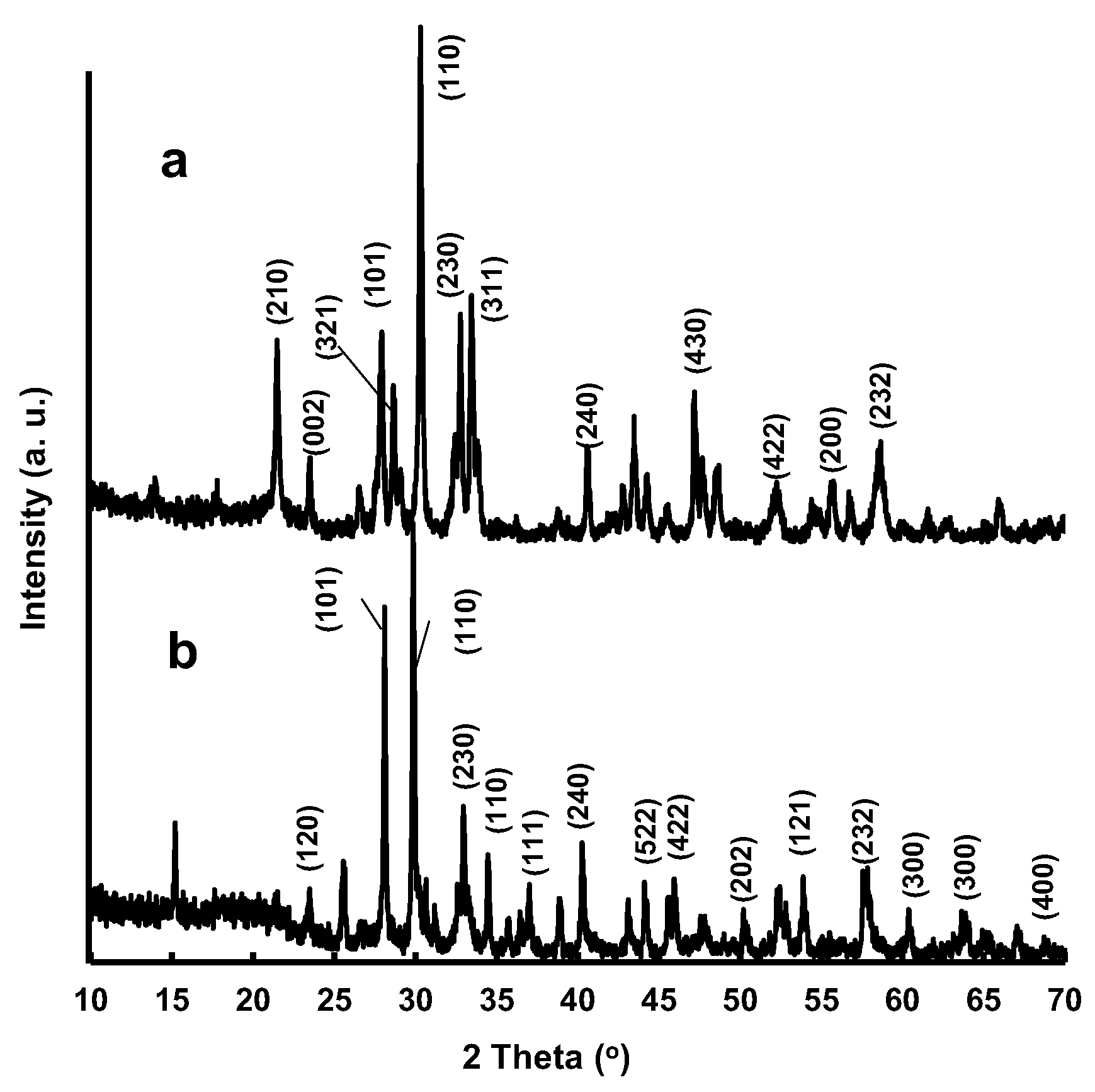
Figure 2 presents the X-ray diffraction (XRD) results of PTO and the PFTO perovskite composite. The main XRD peaks of PFTO were located at 2θ values of approximately 1.5°, 6.0°, 10.9°, 20.6°, 28.5°, 30.3°, 33.2°, 34.7°, 53.7°, 57.3°, 59.6°, and 69.3°. The strongest peak was located at approximately 30.3° (2θ). The grain size, calculated using the Scherrer equation (assuming Cu Kα, K = 0.9, and no instrument width correction), is estimated to be in the range of approximately 13–22 nm. The representative value was determined to be ~16 nm. The XRD pattern of the PFTO sample shares the main diffraction peak of PTO, but a slight left shift in the main peak and an increase in peak width are observed, suggesting lattice expansion and microstructural distortion due to partial Fe B-site substitution. The XRD patterns of the PTO and Pr–Fe–Ti–O (PrFeTiO3) samples share the same main diffraction peak (approximately 2θ ≈ 30.3°), suggesting the common presence of a perovskite-type crystal phase. However, the PFTO sample exhibited a smaller full width at half maximum (FWHM) of the same peak, indicating relatively larger grains. Differences in the relative intensities and additional peak distributions of some peaks suggest lattice distortion due to Fe introduction or the presence of a small amount of secondary phase. The XRD pattern of the synthesized PFTO shows a well-defined orthorhombic perovskite phase without traces of secondary impurities such as Pr2O3, Fe2O3, or TiO2. The diffraction peaks match well with reflections typically seen in rare-earth titanate-ferrite systems. The peaks are moderately broadened, indicating the nanocrystallinity of the particles, and the small but systematic peak shift compared to the reference pattern of PTO indicates that Fe has been successfully incorporated into the lattice, resulting in a slight distortion of the octahedral structure around the B site.
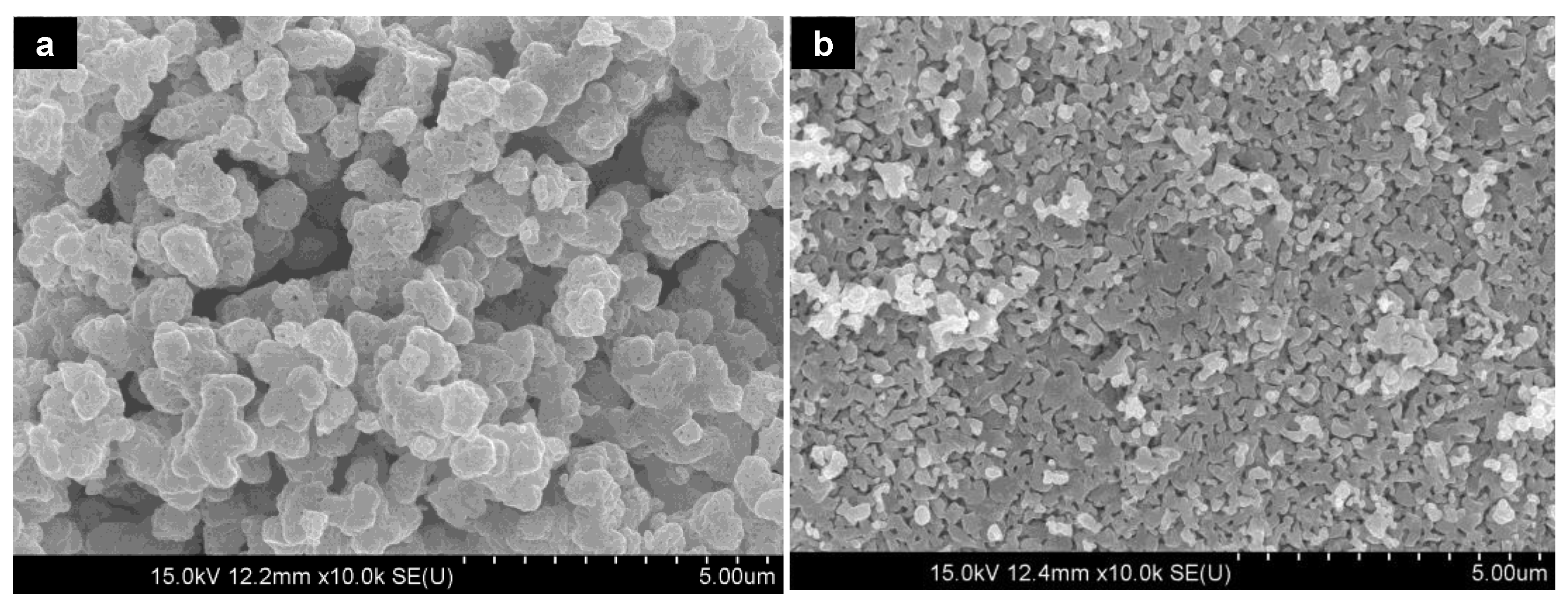
SEM images of PTO and PFTO are presented in Figure 3. The SEM images show PTO particles clustered together, exhibiting a well-developed petal-like or cauliflower-like structure. Individual PTO particles appear to be secondary aggregates measuring approximately 200–400 nm in size, with a somewhat smooth and rounded surface. Typical grain aggregation characteristics observed after high-temperature sintering are observed. The SEM images reveal that PFTO exhibits an overall finer and more homogeneously distributed particle structure. The particle size is clearly smaller, with primary particles ranging from several tens of nm to less than 100 nm distributed widely. The surface density is higher, and the aggregate size is much smaller than that of PTO, exhibiting a compact granular morphology. It is believed that Fe bonding suppresses grain growth and forms micro-grain characteristics.
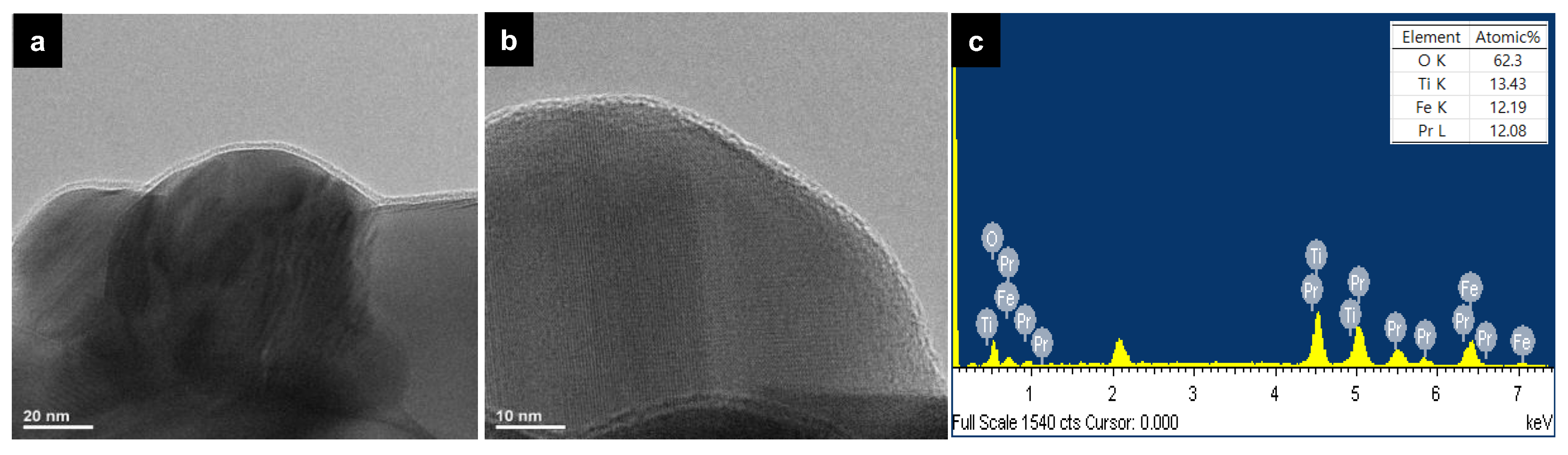
Transmission electron microscope (TEM) images of PFTO observed at various magnifications are shown in Figure 4. TEM observations at various magnifications revealed that PFTO consists of nanoscale grains (approximately 10–30 nm) aggregated into submicron-sized clusters. High-resolution images reveal a well-defined lattice pattern with a thin, disordered surface layer, suggesting high crystallinity combined with the disordered surface structure. The PFTO grains consist of crystallites measuring 10–20 nm in size, similar to the crystallite size determined by XRD. The interior of the crystal appears to be an aggregate of nanocrystalline domains, rather than a complete single crystal. PFTO maintains a well-ordered perovskite lattice structure.
The transmission electron microscopy-energy dispersive spectroscopy (TEM-EDS) results of PFTO are shown in Figure 4c. According to the atomic% values in the table, considering only the metal elements, the metal atom ratio is approximately Ti:Fe:Pr ≈ 13.43:12.19:12.08. Converting this to the relative metal ratio, the ratio becomes approximately Ti:Fe:Pr ≈ 1.11:1.01:1.00. Therefore, Pr, Fe, and Ti can be considered to exist in a nearly identical atomic ratio (1:1:1). Considering the limitations of TEM-EDS measurement errors (particularly oxygen content measurement, surface/probe depth variation), and absorption and fluorescence correction, this result is largely consistent with the synthetic target (Pr:Fe:Ti ≈ 1:1:1).
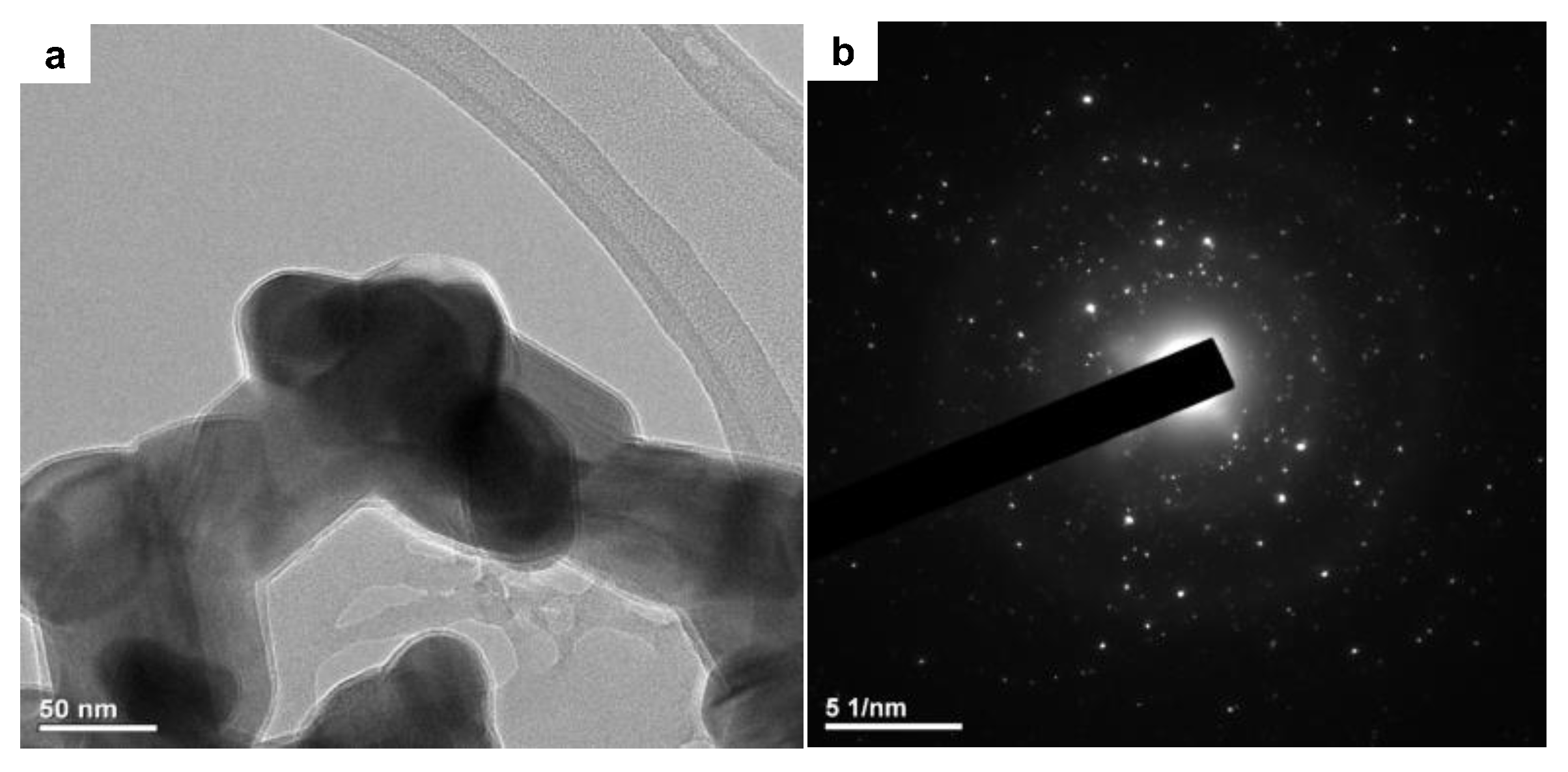
Figure 5 presents TEM image and a selected area electron diffraction (SAED) image of PFTO measured using TEM. The SAED image shows numerous spotty rings and haze patterns. Continuous circular rings indicate complete randomness (polycrystalline/microcrystalline). Distinct spots indicate some degree of single-crystalline component (or large nanocrystals), resulting in point-like diffraction patterns. The image shows numerous individual spots distributed along the rings, suggesting that although nanocrystals, the size distribution is mixed (some relatively large grains exist) and that some may have a complete texture (specific orientation). The bright central circle and diffuse background may indicate a thick/amorphous component or a scattering background. The d-spacings calculated from the radii of the rings (scale bar: 5 1/nm) are consistent with the major d values observed in XRD (e.g., the main peak d ≈ 0.295 nm in XRD), which provides direct evidence that the diffraction rings in SAED are the same crystalline phase (perovskite system) in the XRD image. That is, the SAED results of PFT confirm that the sample is a typical nanocrystalline sample and that there are many locally regular lattice crystalline phases. This is also consistent with the regular diffraction peaks observed in XRD.
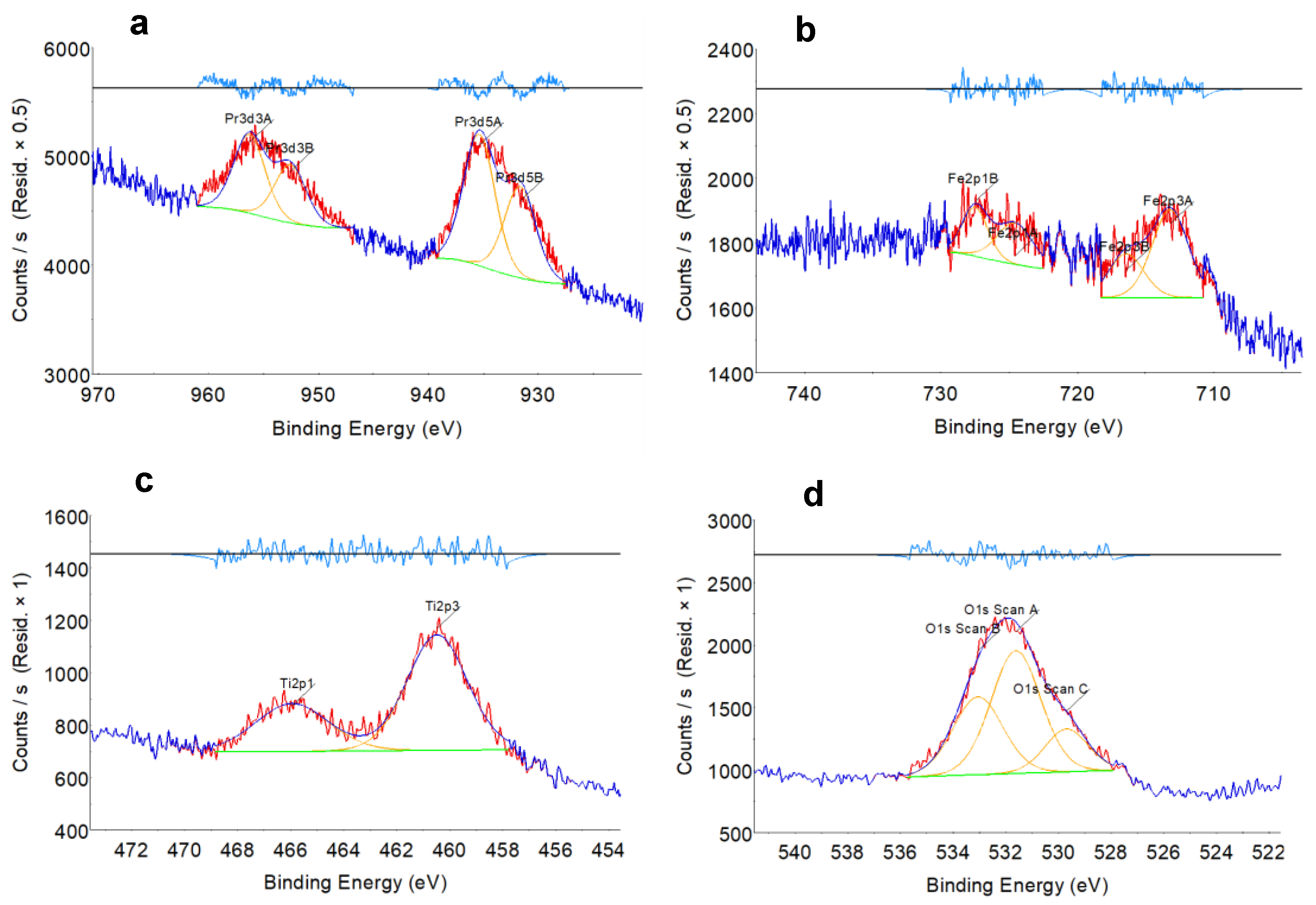
The chemical states of Pr, Fe, Ti, and O in the PFTO perovskite were investigated using high-resolution X-ray photoelectron spectroscopy (XPS) analysis, and the results are presented in Figure 6. The Pr 3d spectrum exhibits two well-defined doublets with characteristic satellite features (Pr 3d5/2 at 933–934 eV and its corresponding satellite at 949–950 eV), consistent with Pr3+ species in an oxide environment. The Fe 2p region is dominated by the Fe 2p3/2 peak centered at 710.8–711.2 eV, and a strong shakeup satellite peak at 718–719 eV, confirming that Fe exists primarily in the Fe3+ oxidation state, with a minimal contribution from Fe2+. Meanwhile, the Ti 2p spectrum exhibits two distinct peaks at ~458.0 eV (Ti 2p3/2) and ~463.5 eV (Ti 2p1/2), which are characteristic of Ti4+ in perovskite titanates. O 1s can be separated into three components: lattice oxygen (O2−) at ~530.0 eV, defect-related oxygen species associated with oxygen vacancies at 531.3–531.8 eV, and surface-adsorbed hydroxyl or carbonate groups at 532.5–533.0 eV. The presence of defect-related O 1s components suggests a significant amount of oxygen vacancies [24], which are likely induced by the coexistence of Fe3+/Ti4+ cations in the perovskite lattice. The XPS results showed that the synthesized material had a typical oxidation state configuration of mixed B-site perovskite, i.e., Pr3+–Fe3+–Ti4+–O2−, and had many oxygen defects on the surface and lattice, which could help improve the catalytic performance [25]. XPS confirms a perovskite formula of Pr3+(Fe3+,Ti4+)O3 with intrinsic oxygen defects.
Overall, the integrated XRD–SAED–XPS analysis confirms that the synthesized PFTO possesses (i) a crystalline orthorhombic perovskite framework, (ii) mixed-valence transition-metal centers at the B-site, and (iii) appreciable oxygen vacancy concentrations. Such a synergistic combination of crystallinity, mixed-valence redox centers, and oxygen defects is expected to enhance electronic conductivity, facilitate oxygen ion mobility, and improve catalytic or photocatalytic activity in redox-driven reactions.
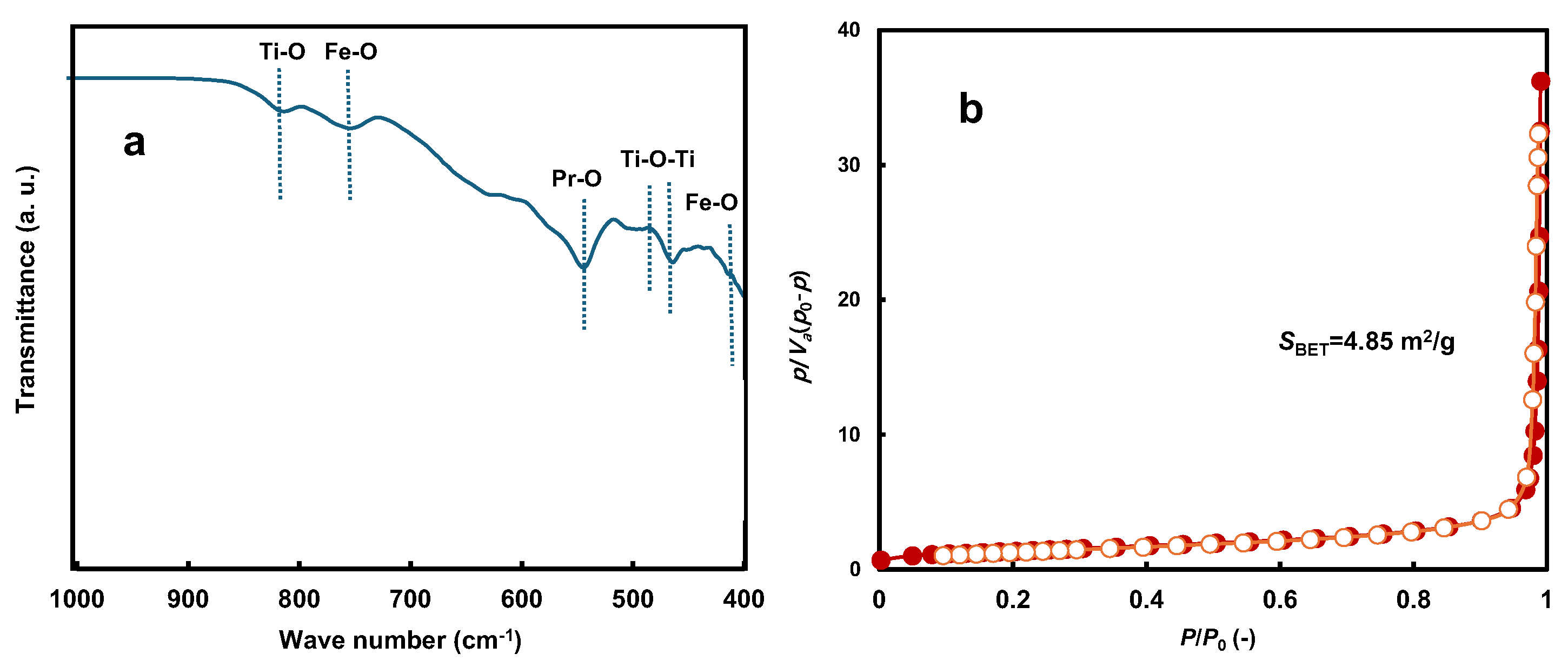
The Fourier Transform-Infrared spectroscopy (FT-IR) spectra of PFTO is shown in Figure 7a. The FT-IR spectrum of PFTO closely resembles the vibrational modes of typical ABO3 perovskite oxides, with peaks appearing primarily in the low-frequency region due to Ti–O lattice vibrations. Ti–O–Ti bending vibrations were observed around 400–450 cm−1, attributable to the low-frequency lattice modes of the perovskite structure. Ti–O stretching vibrations, due to the symmetric and asymmetric stretching of the TiO6 octahedron, were observed in the 500–600 cm−1 range (main peak). Additionally, a peak attributable to Pr–O bond vibrations (A-site metal–oxygen vibrations) was observed at 600–700 cm−1. The intensity was weaker than the Ti–O peak. Figure 7b shows the N2 isotherm of PFTO. The isotherm curve is typical of the adsorption–desorption phenomenon of non-porous fine particulates. The equilibrium adsorption amount was also small. The surface area of PFTO, measured based on BET theory [26], was small at 4.85 m2/g.
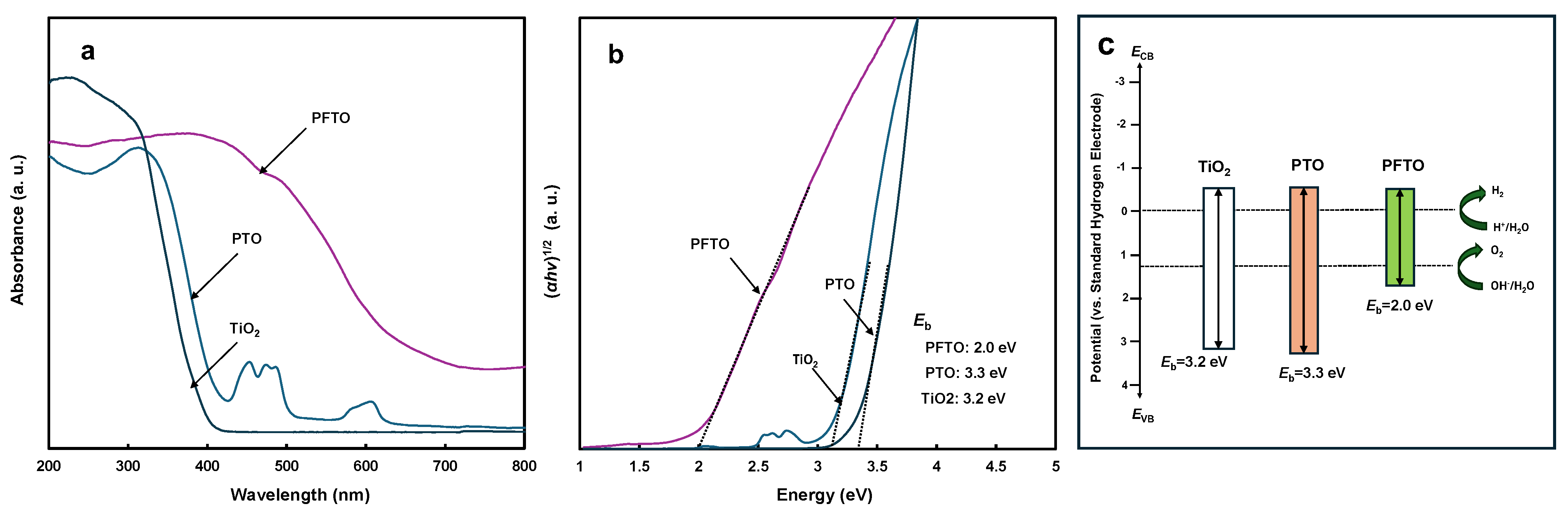
The UV-Visible Diffuse Reflectance Spectroscopy (DRS) analysis graph of PFTO and the resulting Tauc plot are presented in Figure 8a,b. The DRS spectrum of PFTO exhibits strong absorption across the visible spectrum (approximately 400–700 nm), with a significantly shifted absorption edge toward lower energies. The spectral shape is smooth and has a broad Urbach tail and a shoulder due to intermediate energy. The band gap energy, which is the x-intercept obtained from the linear extrapolation of the Tauc plot (dashed line), was approximately 2.0 eV [27]. The optical transitions in PFTO are predominantly indirect in nature, originating from O 2p to Ti/Fe 3d electronic transitions, which is consistent with previously reported titanate-based perovskite systems [28].
The DRS absorption spectrum of PTO is predominantly concentrated in the UV region, with minimal visible absorption. The band gap energy (Eb) obtained by extrapolation from the Tauc plot was approximately 3.3 eV. The band gap energy of TiO2, determined from the Tauc plot, was approximately 3.2 eV. The broad absorption across the 400–700 nm DRS of PFTO is likely a result of a combination of Fe-induced transitions (e.g., O 2p → Fe 3d charge transfer, Fe 3d ←→ Ti 3d hybridization) and defect-based absorption. The broad and smooth linear region of the Tauc plot likely includes multiple offset transitions. PFTO exhibits significantly stronger visible light absorption than PTO or TiO2, resulting in a significantly smaller band gap energy. These characteristics are expected to be advantageous for visible-light-activated photocatalysts/photoelectrodes.
Additionally, a schematic diagram of the energy bands for these photocatalysts is presented in Figure 8c. The energy of conduction band (ECB) and energy of valence band (EVB) of the photocatalysts were obtained using Equations (3) and (4). These energies can be determined according to Mulliken’s theory as follows [29].
E C B   = χ p E e 0.5 E b
E V B = E C B + E b
where χp represents the electronegativity of the photocatalyst and Ee represents the free electron energy (~4.5 eV) on the H2 scale. χp is calculated by determining the geometric mean of the electronegativities [30]. Among the investigated catalysts, PFTO exhibited the narrowest band gap, while TiO2 exhibited the widest. Due to its narrow band gap, PFTO exhibits higher efficiency in visible-light photodegradation. This narrow band gap allows PFTO to be activated even at the low light energy provided by Vis-light LEDs, generating reactive oxygen species (ROS; •O2−, HO2•, •OH, etc.). Consequently, these OH radicals decompose chemicals such as formaldehyde and sterilize pathogenic bacteria.

3.2. Photocatalytic Activity of the Perovskites

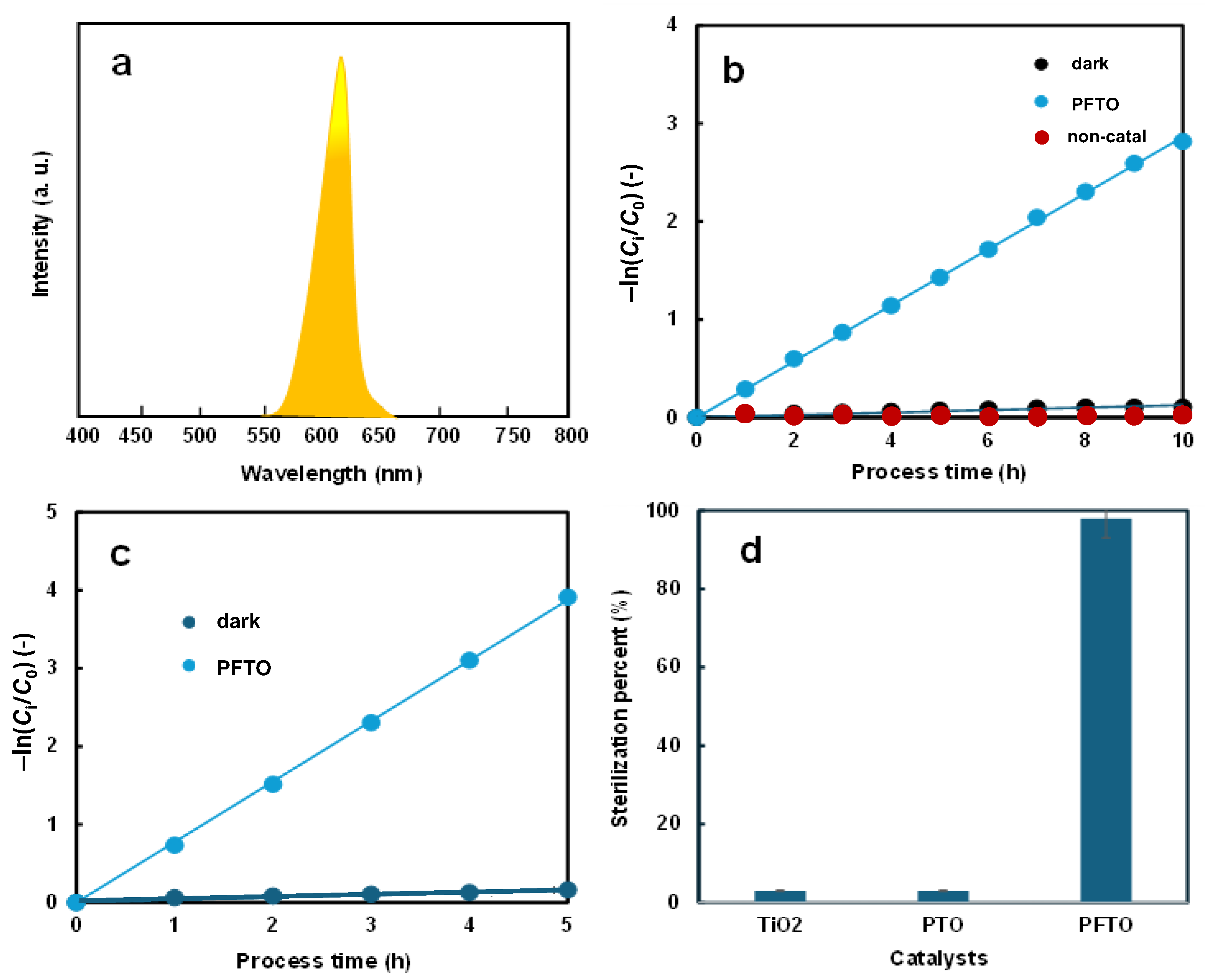
Figure 9a presents the emission spectrum of the Vis-light LED lamp used to assess photocatalytic activity under Vis light. The lamp emitted light within a wavelength range of approximately 580 nm to 640 nm, with the peak emission around 610 nm. Figure 9b displays the results of the photocatalytic decomposition and removal of methylene blue (MB). The degradation curve illustrates a linear relationship between the concentration change (−ln(Ci/C0)) and reaction time, indicating that this reaction follows first-order kinetics. The decrease in MB concentration was significantly higher in PFTO. In contrast, PTO or TiO2 did not decompose MB under visible light. PFTO demonstrates superior photocatalytic activity due to its optimal light absorption for visible light and the lowest Eb among the catalysts. A control experiment was performed to evaluate the possibility of self-sensitized degradation of MB under visible-light irradiation. In the absence of the photocatalyst, no significant change in MB concentration was observed over the irradiation period, indicating that direct photolysis or singlet oxygen generation from MB itself is negligible under the present conditions. MB is a known photosensitizer capable of generating singlet oxygen (1O2) via intersystem crossing under visible-light irradiation [31]. The generated 1O2 can subsequently react with MB molecules, contributing to self-sensitized photo-oxidation pathways. Such MB–1O2 interactions have been reported, where MB both produces and undergoes degradation via singlet oxygen-mediated oxidation reactions [32]. However, control experiments confirmed negligible self-degradation of MB under the present irradiation conditions, indicating that the dominant degradation pathway arises from photocatalyst-driven ROS generation rather than MB self-sensitization. Therefore, the observed degradation of MB in the presence of PFTO can be attributed to photocatalytically generated reactive species.
Figure 9c shows the degradation results for formaldehyde gas with each photocatalyst. Similarly to MB, the decomposition reaction revealed a linear concentration change (−ln(Ci/C0)) over time, confirming that both MB and formaldehyde degradation via visible light photocatalysis are first-order reactions. PFTO again exhibited a high photocatalytic degradation activity. Figure 9d illustrates the bactericidal rates of S. aureus after 5 h in an experiment utilizing perovskites. Under the tested conditions, the sterilization rates of PTO and TiO2 were extremely low, at less than 5%. In contrast, PFTO exhibited sterilization activity close to 100%. The effectiveness of a photocatalyst in decomposing organic compounds or sterilizing pathogenic bacteria through visible light photocatalysis is largely dependent on its ability to absorb visible light. PFTO stands out for its excellent photocatalytic activity, attributed to its wide range of visible light absorption and high absorption capacity.
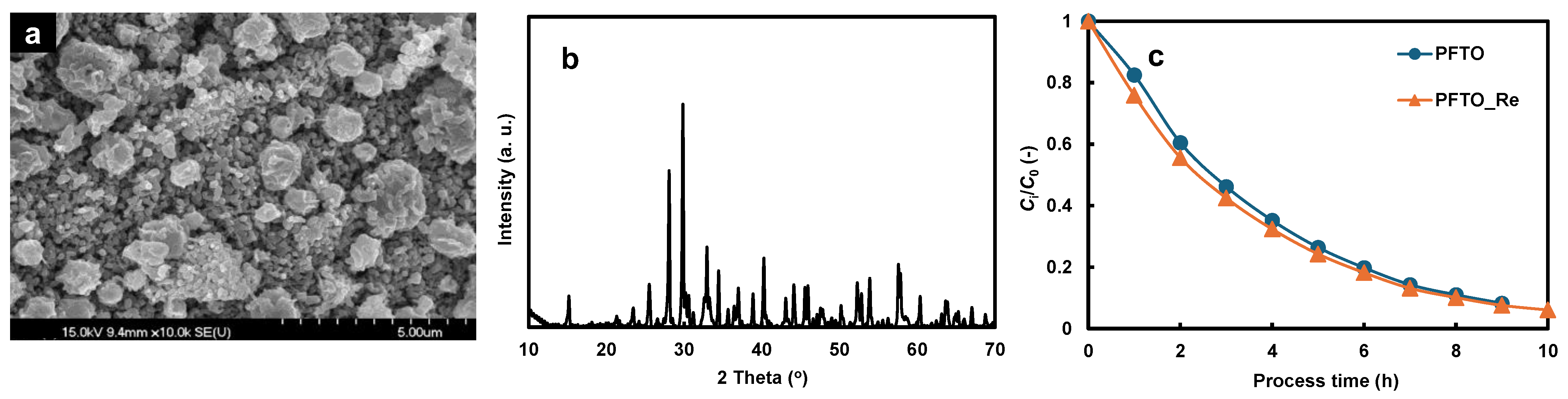
The reusability and structural stability of the PFTO photocatalyst were evaluated through repeated methylene blue degradation experiments under visible-light irradiation. After each reaction cycle, the catalyst was recovered, washed with deionized water, and thermally regenerated at 400 °C for 5 h. Figure 10a shows the SEM image of PFTO regenerated after performing MB decomposition experiments three times. Although some crystals can be seen to be clumped together, the crystal shape and size did not change from the initial state. Figure 10b shows the XRD pattern of the regenerated PFTO. To further examine the structural integrity of PFTO after repeated use, XRD patterns of the regenerated catalyst were compared with those of the fresh sample. No additional diffraction peaks, peak shifts, or intensity variations were detected, confirming the preservation of the perovskite crystal structure after photocatalytic operation and thermal regeneration. Figure 10c shows the MB degradation curves for the original PFTO and the regenerated PFTO. PFTO exhibited nearly unchanged photocatalytic performance over three consecutive cycles, indicating excellent durability and resistance to deactivation. The slight variation observed in degradation efficiency is within experimental error, suggesting negligible photocorrosion or surface poisoning during the reaction. These results demonstrate that PFTO possesses outstanding structural robustness and reusability, which can be attributed to the intrinsic stability of the oxide perovskite framework and its resistance to metal leaching under visible-light irradiation. The ability to recover photocatalytic activity through mild thermal treatment highlights the practical applicability of PFTO for long-term environmental remediation processes.

3.3. Photocatalytic Decomposition Reaction Pathway

3.3.1. Photocatalytic Decomposition Reaction Pathway of MB

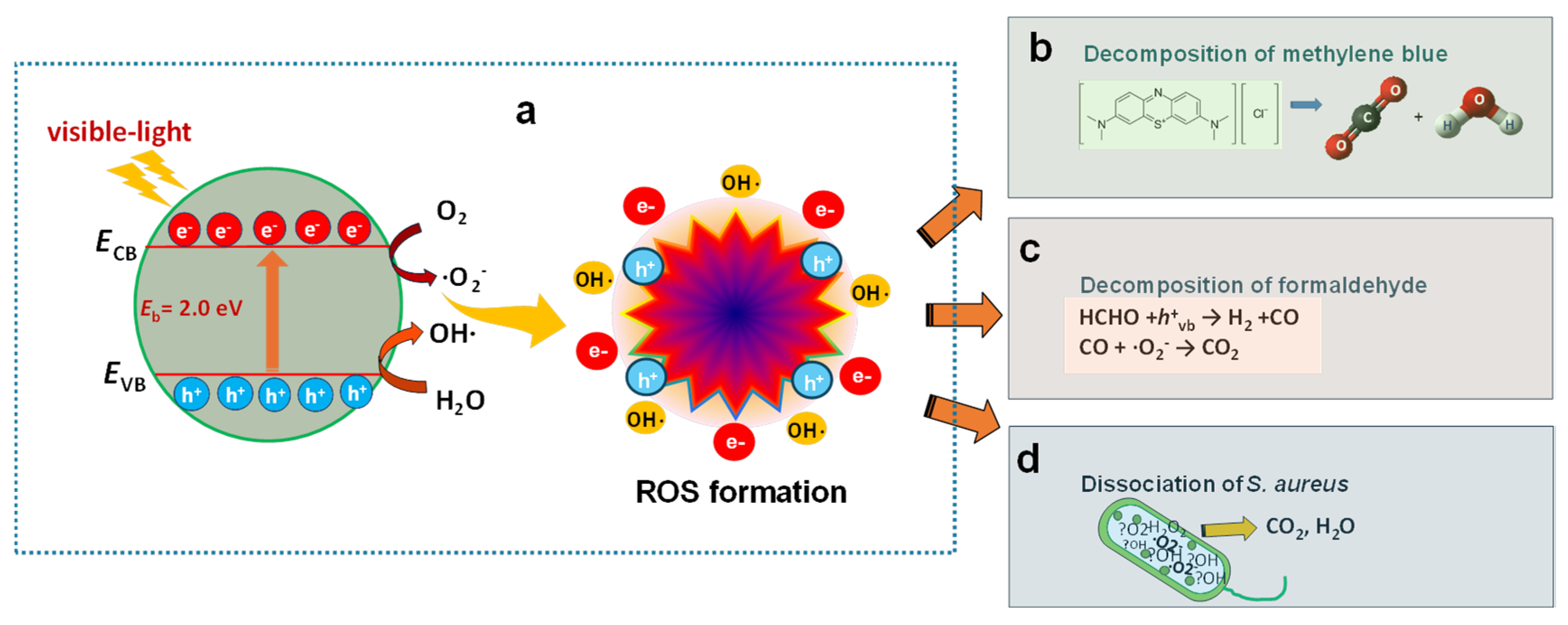
A schematic diagram of the reaction pathways of the decomposition of MB, the decomposition of formaldehyde, and the bactericidal action of S. aureus in the visible light photocatalytic reaction is presented in Figure 11. The decomposition reaction pathway of MB in the visible light photocatalytic reaction is inferred as follows. As shown in Figure 11b, when the photocatalyst absorbs visible light, electrons (e) are excited to the conduction band and holes (h+) remain in the valence band, as in Equation (5).
p h o t o c a t a l y s t + h ν v i s e C B + h V B +
At the same time, MB itself can be photosensitized in visible light as in Equation (6).
MB* → electron transfer or 1O2 formation
These two pathways can operate in parallel or complementary ways [33]. As shown in Figure 11c electrons and holes formed in the photocatalyst react with dissolved oxygen and water to produce various ROS. Representative production pathways are shown in Equations (7)–(10).
e + O2 → •O2 (superoxide anion)
•O2 + H+ → HO2• → H2O2 → •OH
h+ + H2O (or OH) → •OH (hydroxyl radical)
MB* + O21O2 (singlet oxygen)
These ROS are the primary oxidizing species in MB decomposition [34]. Singlet oxygen (1O2) may also participate in the degradation process under visible-light irradiation, particularly via photosensitization pathways. However, its contribution is considered secondary and is mainly inferred from literature [35]. The first chemical change in MB is N-demethylation, which removes some of the four methyl groups (N-CH3) of MB, as shown in Equation (11). ROS (mainly •OH, 1O2, or h+) oxidize the methyl groups of MB, removing them as methanol (CH3OH) or methyl group transfer/desorption [36,37]. This sequentially produces intermediates such as Azure B, Azure A, Azure C, and Thionine [38]. When electrons are transferred to MB in the photocatalyst, MB can be reduced to leucomethylene blue (LMB, a colorless reduced product). LMB can be oxidized back to MB, but it can also undergo irreversible oxidative decomposition upon interaction with the photocatalyst surface/ROS [39]. After (or simultaneously with) N-demethylation, ROS attack the central backbone of MB (the aromatic ring of the phenothiazine series), causing oxidative cleavage at a position of high electron density. In this step, the ring is opened by oxidation of the ring containing sulfur (S) and nitrogen (N) (e.g., formation of sulfoxide or sulfone derivatives), as shown in Equation (12), and is broken down into small, low-molecular-weight aromatic fragments (benzene derivatives, aminobenzenes, sulfonic acid group-containing compounds, etc.), and these low-molecular-weight fragments are then approached to oxidative fragmentation (mineralization) through further oxidation. This process has been reported to proceed in the following order: ring cleavage → low-molecular-weight compound → CO2, NO3/NH4+, SO42− [40]. With continued oxidation, the carbon skeleton is converted to carbon dioxide (CO2), nitrogen to ammonium (NH4+) or nitrate (NO3), and sulfur to sulfate (SO42−).
N-demethylation: MB + •OH → Azure B + CH3OH
Azure B + •OH/1O2 → CO2 + NH4+ + SO42−

3.3.2. Photocatalytic Decomposition Reaction Pathway of Formaldehyde

A schematic reaction pathway for formaldehyde decomposition by visible light photocatalysis is shown in Figure 11c. When a visible-light-sensitive catalyst is activated by visible light, photogeneration occurs. When a photon from a visible-light LED is absorbed by the catalyst bandgap, a reaction as shown in Equation (13) occurs [41].
Photocatalyst + h ν v i s e C B + h V B +
Electrons (e) in CB and h+ in the VB are generated, which induce reduction reactions (electron donation) and oxidation reactions (electron acceptance), respectively. The generated e and h+ react with oxygen and moisture on the surface to form various ROS [42]. Here, the generated •OH, •O2, and surface h+ play a key role in the oxidative decomposition of formaldehyde [43]. Formaldehyde is adsorbed on the catalyst surface (especially the surface rich in hydroxyl groups –•OH) in the gas phase as shown in Equation (14) and exists as formaldolate species or gem-diol (H2C(OH)2) [44].
H C H O + H 2 O H 2 C ( O H ) 2
The initial oxidation reaction is oxidized to formic acid (HCOOH) or formate (HCOO) as in Equation (15). That is, HCHO is gradually completely oxidized via formic acid (or formate ion) [45,46].
H 2 C ( O H ) 2 + h + ( or O H ) H C O O H + H 2 O
The produced formic acid is oxidized again by •OH or •O2 and converted into the final product.
H C O O H + O H C O 2 + H 2 O
This step is the final photomineralization step, resulting in the complete conversion of formaldehyde to CO2 + H2O [47,48].

3.3.3. S. aureus Sterilization Mechanism

A schematic reaction pathway for the bactericidal action of S. aureus by visible light photocatalysis is shown in Figure 11d. Photocatalysts sensitive to visible light undergo charge separation as shown in Equation (17) [49,50].
Photocatalyst + h ν v i s e C B + h V B +
The generated e, h+ react with dissolved oxygen and water molecules to create various ROS [51]. These ROS react with the bacterial surface and intracellular components to induce death. S. aureus is a Gram-positive bacterium with a structure with a thick peptidoglycan layer. This structure becomes the first target of ROS attack [52]. In the early stage of the reaction, ROS adsorption and attack occur. ROS approach the cell wall surface and oxidize the polysaccharide-peptide bonds (C–N, C–O, amide bond) of the peptidoglycan, partially destroying the cell wall, increasing membrane permeability and causing leakage of cell contents. •OH acts on the unsaturated fatty acids of the cell membrane phospholipids to induce the following lipid peroxidation. As a result, cell membrane fluidity decreases, permeability increases, and the cell membrane collapses, resulting in death [53,54]. Ultimately, cellular debris is photo-oxidized to CO2, H2O, and inorganic salts [55,56].
R H + O H R +   H 2 O
R +   O 2 R O O R O O H m e m b r a n e   s t r u c t u r e   d e s t r u c t i o n

4. Conclusions

This study provides a comprehensive characterization of PFTO synthesized by the sol–gel technique. The structural, chemical, and optical analyses collectively reveal a single-phase perovskite with uniform cation distribution, stable oxidation states, and a significantly narrowed bandgap. The PFTO perovskite composite was confirmed to be a single-phase Pr(Fe,Ti)O3 solid solution with a nanocrystalline structure. This crystalline perovskite contains mixed-valence Fe2+/Fe3+ and Ti3+/Ti4+ centers, along with a significant number of oxygen vacancies. XPS validates Pr3+–Fe3+–Ti4+ oxidation states. PFTO demonstrated photosensitivity across a broad spectrum of light, from UV to visible. Its Eb was measured at approximately 2.0 eV. The PFTO exhibited superior photocatalytic efficiency in the liquid-phase photodecomposition of MB and the vapor-phase photodecomposition of formaldehyde, outperforming single perovskite photocatalysts like PTO and TiO2. Additionally, it displayed excellent bactericidal activity against the pathogenic bacteria S. aureus. The enhanced catalytic and photocatalytic reactivity of PFTO can be attributed to the synergistic effects of structural distortions, multivalent redox sites, and a defect-rich oxygen environment. As a result, PFTO shows remarkable photosensitivity to visible light and a low Eb, allowing for effective photochemical reactions even at low light energies, which contributes to its high photocatalytic efficiency.

Supplementary Materials

The following supporting information can be downloaded at https://www.mdpi.com/article/10.3390/appliedchem6010018/s1, Table S1: Information and use of analysis equipment used in this study.

Author Contributions

H.J.: Conceptualization, Methodology, Project administration, Funding acquisition, Writing—original draft, Investigation. K.-H.C.: Conceptualization, Resources, Writing—review and editing, Methodology, Formal analysis, Investigation, Funding acquisition, Supervision. All authors have read and agreed to the published version of the manuscript.

Funding

This research was funded by Basic Science Research Program through the National Research Program Foundation of Korea (NRF) funded by the Ministry of Education (NRF-2022R111A3069740).

Institutional Review Board Statement

Not applicable.

Informed Consent Statement

Not applicable.

Data Availability Statement

Data will be made available on request.

Conflicts of Interest

The authors declare no conflicts of interest.

References

  1. Luo, M.; Hao, R.; Xu, Z.; Qin, Z.; Qian, Z.; Yuan, B. Advances in perovskite oxide catalysts for gaseous pollutant abatement: Design strategies, practical applications, and reaction mechanisms. J. Environ. Chem. Eng. 2025, 13, 119599. [Google Scholar] [CrossRef]
  2. Noor, N.A.; Iqbal, M.W.; Zelai, T.; Mahmood, A.; Shaikh, H.M.; Ramay, S.M.; Al-Masry, W. Analysis of direct band gap A2ScInI6 (A = Rb, Cs) double perovskite halides using DFT approach for renewable energy devices. J. Mater. Res. Technol. 2021, 13, 2491–2500. [Google Scholar] [CrossRef]
  3. Cho, J.; Kim, M.; Jung, J.C. A review on surface oxygen species in perovskite oxide catalysts for oxidation reactions: Toward rational catalyst design. J. Environ. Chem. Eng. 2025, 13, 119349. [Google Scholar] [CrossRef]
  4. Ali, M.; Ahmed, F.; Shahzad, H.N. Investigation of structural, electronic, optical and thermoelectric properties of hallide double perovskite Rb2AlAgX6 (X = Cl, I): A first-principles DFT study. J. Phys. Chem. Solids 2024, 192, 112097. [Google Scholar] [CrossRef]
  5. Dar, S.A.; Want, B.; Khandy, S.A. Computer based predictions of structural stability and systematic study of magneto-electronic and optical properties of lead free halide double perovskites: Cs2KXCl6 : X = Co and Ni. J. Magn. Magn. Mater. 2022, 545, 168603. [Google Scholar] [CrossRef]
  6. Small, T.D.; Hamza, M.A.; Shen, Y.; Shearer, C.J.; Metha, G.F. Systematic investigation of ABO3 perovskite synthesis to generalise a La and Rh co-doping strategy for visible light photocatalysis. Nanoscale Adv. 2025, 7, 4313–4324. [Google Scholar] [CrossRef]
  7. Qiu, Z.; Duan, K.; Kang, Y. Visible light-induced modification of perovskite AlFeO3: Construction of Z-scheme heterojunction and hierarchical microstructure for enhanced photocatalytic degradation of dye wastewater. Colloids Surf. A Physicochem. Eng. Asp. 2026, 728, 138407. [Google Scholar] [CrossRef]
  8. Chen, M.; Nie, X.; Gao, W.; Shang, N.; Zhou, X.; Gao, S. Visible-light-driven selective C-H single bond oxidation using a lead-free Cs2AgBiBr6/g-C3N4 perovskite composite. Inorg. Chem. Comm. 2025, 182, 115445. [Google Scholar] [CrossRef]
  9. Tarbi, A.; Erguig, H.; Sellam, M.A.; Zawadzka, A.; Marjanowska, A.; Migalska-Zalas, A.; Goncharova, E.I.; Myronchuk, G.; Kityk, A.V.; Sahraoui, B. Diagnostics of the stability of CsPbX3 (X = I, Br, and Cl) inorganic halide perovskites for photovoltaic applications: An in-depth review with an original contribution on impedance characterization. Renew. Sustain. Energy Rev. 2026, 226, 116234. [Google Scholar] [CrossRef]
  10. Hossain, S.A.; Sarkar, S.; Bose, S.; Das, P. Synthesis, characterization, and application of delafossites as catalysts for degrading organic pollutants and degradation mechanisms: A detailed insight. Surf. Interf. 2023, 42, 103281. [Google Scholar] [CrossRef]
  11. Sultana, J.; Noureen, S.; Rani, M.; Ahmad, I.; Wang, C.; Li, C.; Alhodaib, A.; Waseem, A. Visible-light-driven perovskite carbonaceous photocatalyst using LaNiO3/rGO composite for environmental remediation. Catal. Today 2025, 451, 115238. [Google Scholar] [CrossRef]
  12. Chen, T.; Jia, P.; Zhang, X.; Wang, C.; Yu, W.; Huang, H. Layered perovskite photocatalysts: Classification, synthesis, theoretical analysis and solar fuel production. Coord. Chem. Rev. 2026, 549, 217265. [Google Scholar] [CrossRef]
  13. Kadkhodayan, H.; Alizadeh, T. Manufacturing visible-light-driven heterojunction photocatalyst based on MOFs/Bi2WZnTiO9 triple perovskite/carbonous materials for efficient removal of poisons, antibiotics, and inorganic pollutants. J. Phys. Chem. Solids 2023, 183, 111620. [Google Scholar] [CrossRef]
  14. Jung, S.-C.; Chung, K.-H. Assessment of photocatalytic activity of novel PrBiFeO3 perovskite composites in visible-light photocatalytic decomposition reaction. J. Environ. Sci. 2025, 156, 549–561. [Google Scholar] [CrossRef] [PubMed]
  15. Raza, M.A.; Li, F.; Que, M.; Zhu, L.; Chen, X. Photocatalytic reduction of CO2 by halide perovskites: Recent advances and future perspectives. Mater. Adv. 2021, 2, 7187. [Google Scholar] [CrossRef]
  16. Chang, Y.K.; Chen, N.-W.; Chen, T.Y.; Shuang, Y.M.; Ten, Y.-S. Enhancing efficiency and stability in perovskite solar cells through blended hole transporting materials incorporating benzo[g]quinoxaline-conjugated small molecules. ACS Appl. Energy Mater. 2024, 7, 1287–1297. [Google Scholar] [CrossRef]
  17. Al-Shujaa, S.; Zhao, P.; He, D.; Al-Anesi, B.; Feng, Y.; Xia, J.; Zhang, B.; Zhang, Y. Improving the efficiency and stability of perovskite solar cells by refining the perovskite-electron transport layer interface and shielding the absorber from UV effects. ACS Appl. Mater. Interf. 2024, 16, 28493–28504. [Google Scholar] [CrossRef]
  18. Humayun, M.; Ullah, H.; Usman, M.; Habibi-Yangjeh, A.; Tahir, A.A.; Wang, C.; Luo, W. Perovskite-type lanthanum ferrite based photocatalysts: Preparation, properties, and applications. J. Energy Chem. 2022, 66, 314–338. [Google Scholar] [CrossRef]
  19. Temerov, F.; Baghdadi, Y.; Rattner, E.; Eslava, S. A review on halide perovskite-based photocatalysts. ACS Appl. Energy Mater. 2022, 5, 14605–14637. [Google Scholar] [CrossRef]
  20. Cheng, R.; Jin, H.; Roeffaers, M.B.J.; Hofkens, J.; Debroye, E. Incorporation of cesium lead halide perovskites into g-C3N4 for photocatalytic CO2 reduction. ACS Omega 2020, 5, 24495–24503. [Google Scholar] [CrossRef]
  21. Huang, H.; Pradhan, B.; Hofkens, J.; Roeffaers, M.B.J.; Steele, J.A. Solar-driven metal halide perovskite photocatalysis: Design principles and opportunities. ACS Energy Lett. 2020, 5, 1107–1123. [Google Scholar] [CrossRef]
  22. Zhong, T.; Zhu, H.; Zheng, Y.; Ren, G.; Xie, X.; Fan, Q.; Xie, Z.; Le, G.-Z. Lead-free Cs2AgBiBr6 double perovskite microcrystals for visible-light photocatalytic C-3 thio/selenocyanation of indoles. Chem. Commun. 2024, 60, 4230–4233. [Google Scholar] [CrossRef]
  23. Cullity, B.D.; Stock, S.R. Elements of X-Ray Diffraction, 3rd ed.; Prentice-Hall Inc.: Hoboken, NJ, USA, 2001; pp. 96–102. [Google Scholar]
  24. Dupin, J.; Gonbeau, D.; Vinatire, P.; Levasseur, A. Systematic XPS studies of metal oxides, hydroxides and peroxides. Phys. Chem. Chem. Phys. 2000, 2, 1319. [Google Scholar] [CrossRef]
  25. Li, W.; Zhang, K.; Yao, R.; Li, W.; Li, J.; Liu, G. Synergistic oxygen-defect/carrier engineering in IrO2-x/CeO2 catalyst for high performance acidic oxygen evolution. Fuel 2026, 406, 137074. [Google Scholar] [CrossRef]
  26. Ladavos, A.K.; Katsoulidis, A.P.; Iosifidis, A.; Triantafyllidis, K.S.; Pinnavaia, T.J.; Pomonis, P.J. The BET equation, the inflection points of N2 adsorption isotherms and the estimation of specific surface area of porous solids. Micropor. Mesopor. Mater. 2012, 151, 126–133. [Google Scholar] [CrossRef]
  27. Makula, P.; Pacia, M.; Macyk, W. How to correctly determine the band gap energy of modified semiconductor photocatalysts based on UV-Vis spectra. J. Phys. Chem. Lett. 2018, 9, 6814–6817. [Google Scholar] [CrossRef]
  28. Jung, S.-C.; Chung, K.-H. Enhanced hydrogen production through cracking of ammonia water using liquid plasma on titanate-based perovskite catalysts. Energy Conver. Manag. 2024, 311, 118509. [Google Scholar] [CrossRef]
  29. Xu, Y.; Schoonen, M.A.A. The absolute energy positions of conduction and valence bands of selected semiconducting minerals. Am. Mineral 2000, 85, 543–556. [Google Scholar] [CrossRef]
  30. Sanderson, R.T. Chemical Periodicity; Reinhold: New York, NY, USA, 1961. [Google Scholar]
  31. Usui, Y. Determination of quantum yield of singlet oxygen formation by photosensitization. Chem. Lett. 1973, 2, 743–744. [Google Scholar] [CrossRef]
  32. Chen, C.; Ma, W.; Zhao, J. Semiconductor-mediated photodegradation of pollutants under visible-light irradiation. Chem. Soc. Rev. 2010, 39, 4206–4219. [Google Scholar] [CrossRef]
  33. Hoa, D.T.N.; Tu, N.T.T.; Thinh, H.Q.A.; Son, L.V.T.; Son, L.V.T.; Quyen, N.D.V.; Son, L.L.; Tuyen, T.N.; Thong, P.L.M.; Diem, L.H.; et al. TiO2/g-C3N4 visible-light-driven photocatalyst for methylene blue decomposition. J. Nanomater. 2023, 2023, 9967890. [Google Scholar] [CrossRef]
  34. Pan, G.; Xu, M.; Zhou, K.; Meng, Y.; Chen, H.; Guo, Y.; Wu, T. Photocatalytic degradation of methylene blue over layered double hydroxides using various divalent metal ions. Clays Clay Miner. 2019, 67, 340–347. [Google Scholar] [CrossRef]
  35. Li, X.; Xie, J.; Jiang, C.; Yu, J.; Zhang, P. Review on design and evaluation of environmental photocatalysts. Front. Environ. Sci. Eng. 2018, 12, 14. [Google Scholar] [CrossRef]
  36. Chen, C.; Shenoy, S.; Chuaicham, C.; Trakulmututa, J.; Tian, Q.; Zhang, H.; Sasak, K. Enhancing photocatalytic efficiency: Geopolymer-supported TiO2 composites for sustainable organic pollutant degradation. Opt. Mater 2024, 150, 115165. [Google Scholar] [CrossRef]
  37. Mhalshekar, K.; Selvam, S.; Sahoo, A.; Illa, M.P.; Gaydhane, M.; Sontakke, S. Efficient photocatalytic degradation of malachite green and Cr(VI) using Co-MOF and bacterial cellulose@Co-MOF biocomposite: A green approach. ACS Omega 2025, 10, 45965–45981. [Google Scholar] [CrossRef] [PubMed]
  38. Khan, I.; Saeed, K.; Zekker, I.; Zhang, B.; Hendi, A.H.; Ahmad, A.; Ahmad, S.; Zada, N.; Ahmad, H.; Shah, L.A.; et al. Review on methylene blue: Its properties, uses, toxicity and photodegradation. Water 2022, 14, 242. [Google Scholar] [CrossRef]
  39. Cabello, G.; Davoglio, R.A.; Cuadrado, L.G. The role of small nanoparticles on the formation of hot spots under microwave-assisted hydrothermal heating. Inorg. Chem. 2018, 57, 7252–7258. [Google Scholar] [CrossRef] [PubMed]
  40. Houas, A.; Lachheb, H.; Ksibi, M.; Elaloui, E.; Guillard, C.; Herrmann, J.-M. Photocatalytic degradation pathway of methylene blue in water. Appl. Catal. B Environ. 2001, 31, 145–157. [Google Scholar] [CrossRef]
  41. Chen, X.; Mao, S.S. Titanium dioxide nanomaterials: Synthesis, properties, modifications, and applications. Chem. Rev. 2007, 107, 2891–2959. [Google Scholar] [CrossRef]
  42. Yin, W.; Wang, W.; Zhou, L.; Sun, S.; Zhang, L. CTAB-assisted synthesis of monoclinic BiVO4 photpcatalyst and its highly efficient degradation of organic dye under visible light irradiation. J. Hazard. Mater. 2010, 173, 194–199. [Google Scholar] [CrossRef]
  43. Maitlo, H.A.; Younis, S.A.; Kim, K.-H. Understanding oxidation potential and degradation mechanism of acid-treated TiO2 coupled g-C3N4 S-scheme heterojunction photocatalyst for the removal of gaseous formaldehyde. Sep. Purif. Technol. 2025, 356, 129862. [Google Scholar] [CrossRef]
  44. Passalia, C.; Retamar, M.E.M.; Alfano, O.M.; Brandi, R.J. Photocatalytic degradation of formaldehyde in gas phase on TiO2 films: A kinetic study. Int. J. Chem. Reactor Eng. 2010, 8, A161. [Google Scholar] [CrossRef]
  45. Guo, Y.; Gao, P.; Han, Q.; Feng, L.; Zhang, I. Enhancing visible light degradation of gaseous formaldehyde with CuOx/OVs-TiO2 photocatalyst loaded wallpaper: Preparation, efficacy and mechanism. Chemosphere 2025, 371, 144051. [Google Scholar] [CrossRef]
  46. Sun, S.; Ding, J.; Bao, J.; Gao, C.; Qi, Z.; Li, C. Photocatalytic oxidation of gaseous formaldehyde on TiO2: An in situ DRIFTS Study. Catal. Lett. 2010, 137, 239–246. [Google Scholar] [CrossRef]
  47. Lin, Y.; Chen, C.-C.; Hsieh, C.-T.; Liou, J.-R. Photocatalytic degradation of formaldehyde by nitrogen-doped graphene quantum dots under various light conditions. J. Taiwan Institute Chem. Eng. 2025, 176, 106262. [Google Scholar] [CrossRef]
  48. Yuan, F.; Yang, R.; Li, C.; Tan, Y.; Zhang, X.; Zheng, S.; Sun, Z. Enhanced visible-light degradation performance toward gaseous formaldehyde using oxygen vacancy-rich TiO2-x/TiO2 supported by natural diatomite. Build. Environ. 2022, 219, 109216. [Google Scholar] [CrossRef]
  49. Dalrymple, O.K.; Stefanakos, E.; Trotz, M.A.; Goswanmi, D.Y. A review of the mechanisms and modeling of photocatalytic disinfection. Appl. Catal. B Environ. Energy 2010, 98, 27–38. [Google Scholar] [CrossRef]
  50. Jiang, Y.; Wang, Z.; Huang, J.; Yan, F.; Du, Y.; He, C.; Liu, Y.; Yao, G.; Lail, B. A singlet oxygen dominated process through photocatalysis of CuS-modified MIL-101(Fe) assisted by peroxymonosulfate for efficient water disinfection. Chem. Eng. J. 2022, 439, 135788. [Google Scholar] [CrossRef]
  51. Kozak, M.; Mazierski, P.; Żebrowska, J.; Klimczuk, T.; Lisowski, W.; Żak, A.M.; Skowron, P.M.; Kozak, A.Z.-M. Detailed insight into photocatalytic inactivation of pathogenic bacteria in the presence of visible-light-active multicomponent photocatalysts. Nanomaterials 2024, 14, 409. [Google Scholar] [CrossRef]
  52. Nosaka, Y.; Nosaka, A.Y. Generation and detection of reactive oxygen species in photocatalysis. Chem. Rev. 2017, 117, 11302–11336. [Google Scholar] [CrossRef]
  53. Foster, H.A.; Ditta, I.B.; Varghese, S.; Steele, A. Photocatalytic disinfection using titanium dioxide: Spectrum and mechanism of antimicrobial activity. Appl. Microbiol. Biotec. 2011, 90, 1847–1868. [Google Scholar] [CrossRef] [PubMed]
  54. Liu, L.; Shen, Z.; Wang, C. Highly efficient visible-light-driven photocatalytic disinfection of flowing bioaerosol using mono/multilayer MXene based catalysts. Chem. Eng. J. 2023, 457, 141327. [Google Scholar] [CrossRef]
  55. Bonetta, S.; Bonetta, S.; Motta, F.; Strini, A.; Cattaro, E. Photocatalytic bacterial inactivation by TiO2-coated surfaces. AMB Express 2013, 3, 59. [Google Scholar] [CrossRef] [PubMed]
  56. Hu, C.; Guo, J.; Qu, J.; Hu, X. Photocatalytic degradation of pathogenic bacteria with AgI/TiO2 under visible light irradiation. Langmuir 2007, 23, 4982–4987. [Google Scholar] [CrossRef]
Figure 1. Schematic flow diagram for preparation process of PFTO perovskite.
Appliedchem 06 00018 g001
Figure 2. XRD patterns of (a) PTO and (b) PFTO perovskites.
Appliedchem 06 00018 g002
Figure 3. SEM image of (a) PTO and (b) PFTO perovskites.
Appliedchem 06 00018 g003
Figure 4. (a,b) TEM images and (c) EDS result of PFTO perovskite.
Appliedchem 06 00018 g004
Figure 5. (a) TEM image and (b) SAED image of PFTO perovskite.
Appliedchem 06 00018 g005
Figure 6. XPS spectra of PFTO perovskite: (a) Pr 3d scan. (b) Fe 2p scan, (c) Ti 2p scan, (d) O 1s scan.
Appliedchem 06 00018 g006
Figure 7. (a) FT-IR spectrum and (b) N2 isotherm of PFTO perovskite.
Appliedchem 06 00018 g007
Figure 8. (a) UV-Vis DRS of the perovskites, (b) Tauc plot of the perovskites, and (c) configuration of bandgap energies of the catalysts.
Appliedchem 06 00018 g008
Figure 9. This (a) Emission spectrum of LED lamp, (b) MB degradation curves, (c) degradation of formaldehyde, and (d) sterilization rate of S. aureus on the perovskites.
Appliedchem 06 00018 g009
Figure 10. (a) SEM image, (b) XRD pattern, and (c) MB degradation curve of the regenerated PFTO perovskite.
Appliedchem 06 00018 g010
Figure 11. Schematic diagram of visible-light photocatalytic decomposition reaction: (a) ROS formation, (b) decomposition of MB, (c) decomposition of formaldehyde, (d) dissociation of S. aureus.
Appliedchem 06 00018 g011
Disclaimer/Publisher’s Note: The statements, opinions and data contained in all publications are solely those of the individual author(s) and contributor(s) and not of MDPI and/or the editor(s). MDPI and/or the editor(s) disclaim responsibility for any injury to people or property resulting from any ideas, methods, instructions or products referred to in the content.