Article

Optimization of Solvent Extraction Method for Stilbenoid and Phenanthrene Compounds in Orchidaceae Species


by
David J. Machate
1,*,
Teresinha Gonçalves da Silva
2,
António B. Mapossa
3,* and
Maria A. M. Maciel
4
1
Institute of Chemistry, Federal University of Mato Grosso do Sul, Campo Grande 79074-460, Brazil
2
Department of Antibiotics, Federal University of Pernambuco (UFPE), Recife 50670-901, Brazil
3
Department of Chemical and Petroleum Engineering, University of Calgary, 2500 University Drive NW, Calgary, AB T2N 1N4, Canada
4
Post-Graduate Program of Biotechnology (RENORBIO), Department of Biochemistry, Federal University of Rio Grande do Norte (UFRN), Natal 59072-970, Brazil
*
Authors to whom correspondence should be addressed.
AppliedChem 2026, 6(1), 1; https://doi.org/10.3390/appliedchem6010001
Submission received: 20 August 2025 / Revised: 20 November 2025 / Accepted: 23 December 2025 / Published: 29 December 2025

Abstract

This study introduces an optimized and selective extraction methodology using dichloromethane/methanol (DCM/MeOH, 95:5, v/v) in combination with accelerated solvent extraction (ASE) for the targeted stilbenoid and phenanthrene derivatives from five orchid species: Cattleya nobilior (root), Cymbidium defoliatum (root and bulb), Dendrobium phalaenopsis (stem), Encyclia linearifolioides (leaf), and Phalaenopsis aphrodite (root). Sequential extraction was performed with hexane, followed by DCM/MeOH (95:5 and 1:1, v/v) under controlled temperatures (70 °C for hexane, 100 °C for DCM/MeOH), using three static cycles per stage. Chemical profiling by high-performance liquid chromatography with a diode-array-detector and tandem mass spectrometry (HPLC-DAD-MS/MS) enabled the identification of twenty specialized metabolites—seven stilbenoids and thirteen phenanthrenes—several reported here for the first time, including crepidatuol B, dendrosinen D, and coeloginanthridin. The analytical method showed excellent separation of structurally related phenolic compounds, demonstrating the efficiency of the extraction protocol and the selectivity of the solvent system. Many of the identification metabolites are known for cytotoxic, antioxidant, anti-inflammatory, and metabolic regulatory properties, while newly detected compounds remain unexplored and present promising candidates for future biological evaluation. The broad distribution of these metabolites across the studied orchids enhances the current understanding of their phytochemical diversity and suggests chemotaxonomic relevance within the Orchidaceae family. Importantly, the extraction strategy requires minimal plant material, offering ecological advantages when working with rare or endangered species. Overall, this environmentally conscious extraction approach provides a robust platform for metabolic discovery and supports future research in natural products chemistry, plant ecology, drug discovery, structure–activity relationships studies and biotechnological applications.

1. Introduction

Orchidaceae is the second largest family of angiosperms, comprising approximately 30,000 species distributed across more than 760 genera [1]. Most species in this family are epiphytic, while a smaller proportion are terrestrial. Many orchids possess significant medicinal value, particularly species belonging to genera such as Acriopsis, Anoectochilus, Ansellia, Bletilla, Bulbophyllum, Catasetum, Cattleya, Cremastra, Cymbidium, Cyrtorchis, Dendrobium, Epidendrum, Epipactis, Eria, Eulophia, Flickingeria, Habenaria, Gastrodia, Microstylis, Nervilia, Paphiopedilum, and Vanda, among others [2,3]. Various parts of these orchids—including the whole plant, leaves, stems, bulbs, rhizomes, and roots—are traditionally used for medicinal purposes. Their bioactive compounds are typically obtained through boiling, decoction, grinding into powder, or preparation as pastes and other formulations [3].
Several methodologies have been employed in with stilbenoid and phenanthrene derivatives have been extracted independently using a wide range of solvents and solvent mixtures, including methanol, ethanol, ethyl acetate, acetone, hexane, cyclo-hexane, chloroform, and dichloromethane [4,5,6,7,8,9,10,11,12,13,14,15,16,17,18]. However, other studies have reported the simultaneous extraction of both compound classes, albeit with varying levels of selectivity [19,20,21,22,23,24,25,26,27,28,29,30,31,32,33,34].
In general, the studies mentioned above reported the use of large quantities of botanical raw material (0.1–12 kg) and solvents (0.15–50 L), as well as prolonged extraction times ranging from 2 to 216 h. Moreover, the dried extracts obtained were resuspended and partitioned into different solvents, resulting in several collected phases that were identified as containing stilbenoid and phenanthrene derivatives.
Therefore, recognizing the pharmacological and medicinal benefits of stilbenoid and phenanthrene derivatives from Orchidaceae species, their potential effects have been associated with various biological activities, including anticancer and antimetastatic effects [19,35], antitumor activity [14,15,36], induction of apoptosis [35], antimitotic effects [37], anti-inflammatory activity [38], inhibition of nitric oxide (NO) production [39], antinociceptive [40] and neuroprotective effects [35], antioxidant activity [15,38,39], suppressive of protein kinase B (Akt) activation leading to reduced stemness and stem cell-like phenotypes in human lung cancer cells [41], antimigratory effects of lusianthridin and dendroflorin against human lung cancer cell lines [42], vasorelaxant activity [43], antiproliferative effects [44], and anti-angiogenic properties [45].
The extraction of active compounds from plant materials is a critical step in developing analytical and industrial applications in phytochemistry. Several extraction techniques are commonly employed, including Ultrasound-Assisted Extraction (UAE), Microwave-Assisted Extraction (MAE), Supercritical Fluid Extraction (SFE), and Accelerated Solvent Extraction (ASE) [46]. Ideally, extraction methods should be efficient, safe, reproducible, cost-effective, and easily scalable for industrial use. In this study, ASE was selected among these methods due to its numerous advantages. ASE enables rapid extraction and allows optimization of selectivity toward specific groups of compounds through controlled adjustment of operating parameters [47]. The use of high pressure in ASE keeps the solvent in a liquid state even at elevated temperatures, facilitating high-temperature extraction. These conditions significantly improve the solubility of target molecules in the solvent and enhance desorption kinetics from plant matrices. Additionally, since ASE is carried out in a closed system, oxidation reactions are minimized [47]. For comparison, Ultrasound-Assisted Extraction (UAE) efficiency depends on parameters such as extraction time and the ratio between the liquid and solid phases. Bajkacz et al. [48] demonstrated that longer extraction times (2–5 h) improved polyphenol recovery from plant matrices. However, excessive sonication (>40 min) at frequencies above 20 kHz can lead to free radical formation, potentially degrading sensitive compounds [46]. The degradation may result from oxidative pyrolysis caused by hydroxyl (OH) radicals generated during cavitation [49]. Similarly, Microwave-Assisted Extraction (MAE) faces challenges in achieving high yields without damaging the molecular structure of the extracted compounds. The main difficulty lies in balancing efficient cell wall disruption with the preservation of active natural compounds. Supercritical Fluid Extraction (SFE), particularly using supercritical carbon dioxide (SC-CO2), is another promising technique known for its selectivity and environmental friendliness [50,51]. However, the non-polar nature of SC-CO2 makes it more suitable for extracting non-polar or weakly polar compounds. Since polyphenols are largely polar, their solubility in SC-CO2 is limited, resulting in comparatively low extraction yields [50].
Therefore, the aim of this study was to optimize an ASE method for the selective extraction of stilbenoid and phenanthrene derivatives. HPLC-DAD-MS/MS enables the identification of compounds. The detection of their light absorption characteristics using diode array detection provides structural information, while tandem mass spectrometry offers accurate mass and fragmentation data for definitive compound identification.
This study describes a novel three stage sequential extraction method for obtaining stilbenoid and phenanthrene derivatives from botanical raw material. The process employs hexane followed by DCM/MeOH mixtures at two different ratios (95:5 and 1:1) under controlled temperatures and extraction cycles. The method utilizes 1 mg of raw material, with the initial extraction performed using hexane at 70 °C, followed by two successive DCM/MeOH extractions at 100 °C. The entire extraction sequence consists of three combined static cycles, each comprising a 4 min static period, a 40 s purge, and an 80% rinse volume.

2. Material and Methods

2.1. Plant Materials and Sample Preparation

Samples of Cattleya nobilior Rchb.f., Encyclia linearifolioides (Kraenzl.) Hoehne, Cymbidium defoliatum Y.S. Wu & S.C. Chen, Dendrobium phalaenopsis Fitzgerald, and Phalaenopsis aphrodite Rchb.f. were purchased from local markets in Campo Grande, Mato Grosso do Sul, Brazil. The fresh plant materials were separated into roots, bulbs, stems, and leaves for each species (C. nobilior, C. defoliatum, D. phalaenopsis, E. linearifolioides, and P. aphrodite). Dichloromethane [CAS No. 75-09-2, purity ≥99.8%] and methanol [CAS No. 67-56-1, purity ≥ 99.9%] were obtained from Sigma-Aldrich (St. Louis, MO, USA). All reagents were used as received, without further purification. All parts of each orchid species were separated into individual trays, labeled, and washed with deionized water. Each sample was then chopped using sterilized knives and then was cleaned with deionized water and dried with paper towels. The samples were dehydrated in an oven at a controlled temperature of 40 °C with air circulation for 48 h. After drying, the samples were cooled and ground at room temperature into a fine powder using a laboratory mill equipped with a chamber and a stainless-steel knife (Ika® A11 Basic Analytical Mill). The resulting powder was sieved through a 50 mesh (300 µm) sieve. Finally, all samples were individually placed into amber, hermetically sealed glass bottles, properly labeled, and stored at −20 °C for further analysis.

2.2. HPLC-DAD-MS/MS Analysis

Screening was performed by weighing 1 mg of powdered plant material (roots, bulbs, stems, and leaves) on an analytical balance (Shimadzu, Tokyo, Japan; five decimal places) into an Eppendorf tube. To each tube, 1 mL of 70% methanol containing 0.1% formic acid was added, and the samples were sonicated in an ultrasonic bath for 15 min. The samples were then centrifuged at 10,000 rpm (RCF) with an acceleration/deceleration setting of 9 at 25 °C for 5 min. Approximately 1 mL of the resulting supernatant was collected using a graduated syringe with a needle, filtered through a 0.22 μm PVDF filter, and transferred into a vial for analysis. The samples were analyzed using high-performance liquid chromatography equipped with a diode-array-detector and tandem mass spectrometry (HPLC-DAD-MS/MS, Prominence UPLC, Shimadzu, Kyoto, Japan). A Shimadzu UFLC system equipped with a diode-array detector (DAD) and a MicrOTOF-QIII mass spectrometer (Bruker Daltonics, Billerica, MA, USA) with an electrospray ionization (ESI) source, quadrupole, and time-of-flight analyzers was employed. Chromatographic separation was carried out on a Kinetex C18 column (2.6 μm, 100 Å, 150 × 2.1 mm, Phenomenex, Torrance, CA, USA). Samples were prepared at a concentration of 1 mg mL−1, filtered through PTFE syringe filters (0.22 μm × 13 mm, Millipore), and 1 μL was injected into the system via an autosampler. The mobile phase consisted of acetonitrile (B) and deionized water (A), both containing 0.1% (v/v) formic acid. The gradient program was set as follows: 0–2 min, 3% B; 2–25 min, 3–25% B; 25–40 min, 25–80% B; 40–43 min, 80% B. The column temperature was maintained at 50 °C throughout the analysis. Nitrogen was used as the nebulizer gas (4 bar), drying gas (9 L min−1), and collision gas. DAD data were recorded over a wavelength range of 220–800 nm. Mass spectrometry data were collected in both positive and negative ion modes over an m/z range of 120–1200, applying a capillary voltage of 2500 kV. MS/MS spectra were obtained automatically using a collision energy between 45 and 65 eV, with nitrogen as the collision gas.

2.3. Accelerated Solvent Extraction (ASE)

Accelerated solvent extraction was performed by a Dionex ASE 150 instrument with an accelerated flow solvent controller system (The Thermo ScientificTM DionexTM AseTM 150, Waltham, MA, USA). Plant sample materials and silica gel (particles 0.040~0.063 flash silica, Merck, grade 9385, 230–400 mesh, 602 Darmstadt, Germany) were used in 1:2 ratio. Then, these plant sample materials were placed between the silica gel covered with filter paper at the top and bottom sides of the 100 mL stainless-steel extraction cell. The methodology was applied sequentially in three stages of extraction from plant material using solvents, following these steps: (i) the solvents used were hexane–water (C6H14–H2O) and dichloromethane–methanol (DCM/MeOH) in two different ratios, 95:5 and 1:1; (ii) the ASE system was automatically programmed to operate at 70 °C for the hexane extraction and 100 °C for the DCM/MeOH extractions; and (iii) the ASE was set to perform three consecutive static cycles, with a static time of 4 min, a purge time of 40 s, and a rinse volume of 80%, identical for all extractions. The extracts were collected and labeled according to their solvent extraction type and the plant materials used. Subsequently, all extracts were dried using a rotary evaporator under controlled temperature and pressure. The dried extracts were then transferred into amber, hermetically sealed glass bottles, and the drying process was continued in a laboratory drying hood with airflow until the samples were completely dry. Afterward, all dried plant extracts were stored in a freezer at −20 °C for further analysis. For analysis, 1 mg of each extract was accurately weighed using an analytical balance (Shimadzu Tokyo, Japan; five decimal places) into an Eppendorf tube. Then, 1 mL of 60% methanol (MeOH) was added, and the sample was redissolved using an ultrasonic bath. The solution was filtered through a PVDF 0.22 µm filter into a vial and subsequently injected into the HPLC-DAD-MS/MS system.

3. Results and Discussion

This study provides, for the first time, an extensive extraction methodology using the polar solvent system dichloromethane/methanol (DCM/MeOH, 95:5, v/v) combined with accelerated solvent extraction (ASE) to obtain phenolic metabolites from distinct anatomical parts of five orchid species—C. nobilior (root), C. defoliatum (root and bulb), D. phalaenopsis (stem), E. linearifolioides (leaf), and P. aphrodite (root). This approach yielded highly promising results, enabling the identification of twenty metabolites, including seven stilbenoid and thirteen phenanthrene derivatives. Several of these compounds—such as crepidatuol B, dendrosinen D, and coeloginanthridin—are reported here for the first time as profiled using HPLC-DAD-MS/MS.
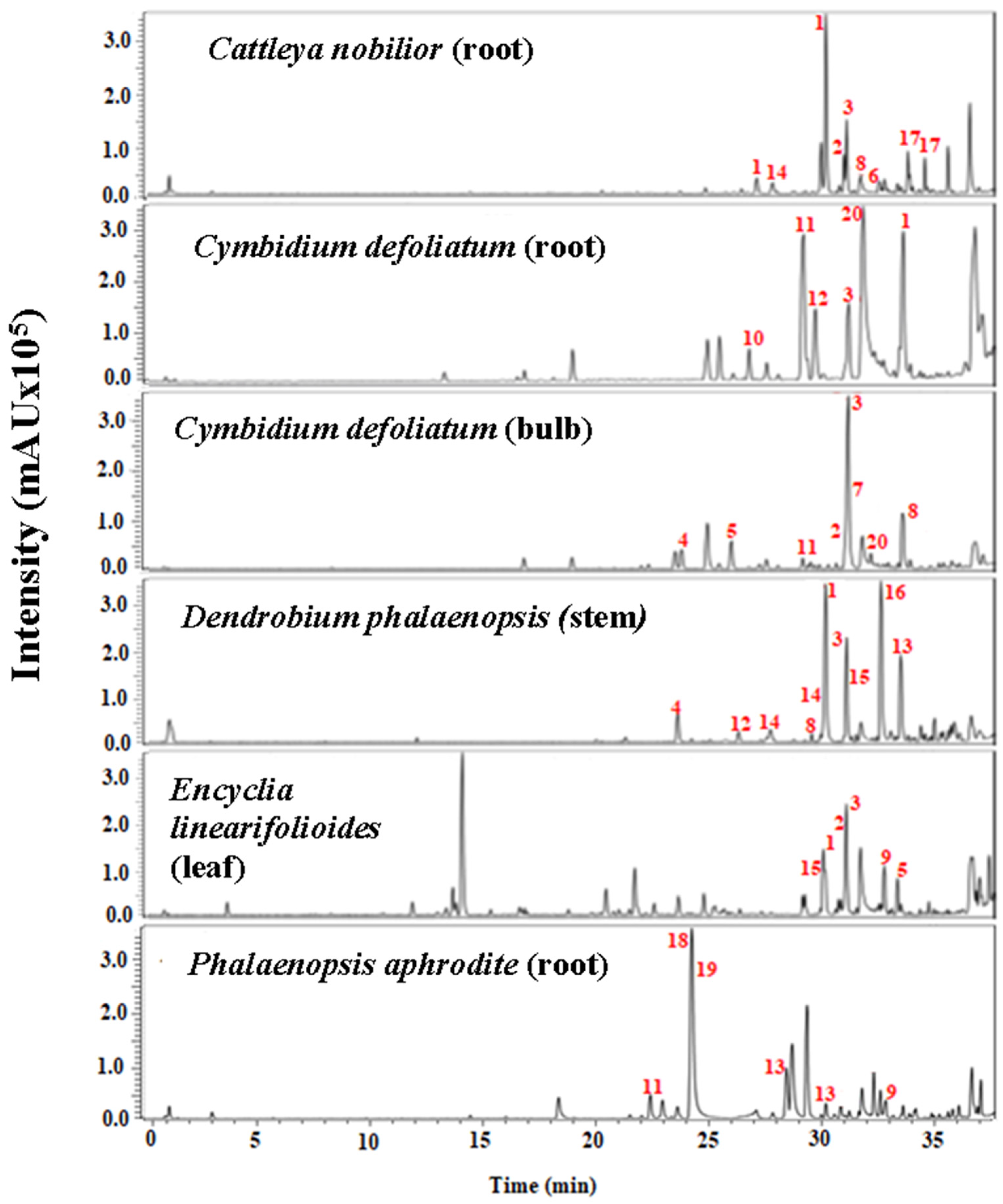
Figure 1 and Table 1 summarize the chromatographic and spectral data obtained. The optimized HPL-DAD-MS/MS method allowed clear separation and detection of twenty distinct peaks, each identified based on UV absorption characteristics and MS/MS fragmentation pattern. The analytical performance highlights the method’s strong capability to distinguish structurally related phenolic compounds and further confirms the suitability of the DCM/MeOH solvent system for selectively enriching specialized metabolites with close structural similarity. These findings reinforce the remarkable chemical diversity present in the investigated orchids and establish a robust methodological platform for future metabolite discovery and chemotaxonomic studies.
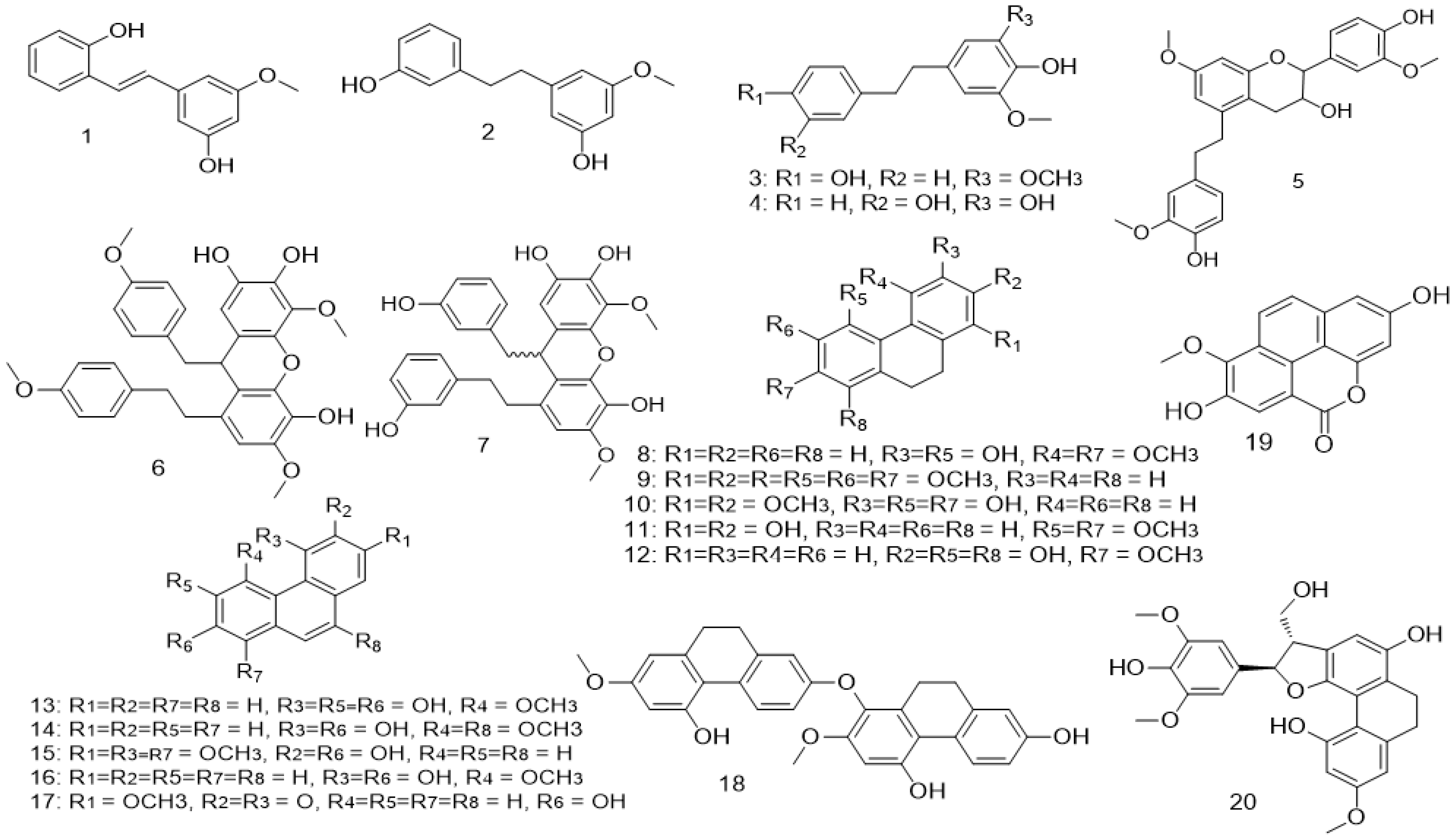
Figure 2 illustrates the chemical structures of the identified secondary metabolites, comprising seven (7) stilbenoid and thirteen (13) phenanthrene derivatives. The presence of these compounds across the surveyed orchid taxa significantly expands current knowledge of their phytochemical profiles and underscores the diversity within the Orchidaceae family. Stilbenoids and phenanthrenes are known to contribute to plant defense mechanisms against pathogens and herbivores; thus, their occurrence may serve as potential chemotaxonomic markers and indicate ecological adaptations of these orchid genera. The novelty and breadth of the compounds detected emphasize the importance of further phytochemical investigations of underexplored orchid lineages, which may harbor additional bioactive constituents of pharmacological or biotechnological significance.
Among the stilbenoid identified—2,3′-dihydroxy-5′-methoxystilbene (compound 1), batatasin III (compound 2), 4,4′-dihydroxy-3,5-dimethoxybibenzyl (compound 3), dendrosinen B (compound 4), and dendrocandin F (compound 6)—several have been previously associated with noteworthy biological activities. Reported activities include inhibition of key metabolic enzymes such as α-glucosidase and pancreatic lipase, both relevant to glucose and lipid homeostasis. Moreover, some of these compounds have demonstrated anticancer potential via diverse mechanisms, including suppression of metastasis in lung cancer models, induction of apoptosis, and inhibition of proliferation in breast cancer cell lines [63,64]. Their antioxidant capacity, largely attributable to hydroxyl substituents capable of neutralizing reactive oxygen species, further enhances their pharmacological importance. Collectively, these activities support the dual relevance of stilbenoids in metabolic regulation and cancer chemoprevention, while also reflecting their functional role in plant ecological defense.
Similarly, several the phenanthrene derivatives identified in this study—such as calanphenanthrene A (compound 8), 1,2,5,6,7-pentamethoxy-9,10-dihydrophenanthrene (compound 9), 1,4,7-trihydroxy-2-methoxy-9,10-dihydrophenanthrene (compound 12), 4,9-dimethoxyphenanthrene-2,5-diol (compound 13), fimbriol-B (compound 14), moscatin (also referred to as plicatol B, compound 16), 7-hydroxy-2-methoxy-phenanthrene-3,4-dione (compound 18), and 2,7-dihydroxy-8-methoxyphenanthro[4,5-bcd]pyran-5(5H)-one (compound 19)—are well documented for their cytotoxic effects across a range of tumor cell lines, including breast, colon, lung, and hepatocellular carcinomas. Several display antimetastatic activity through platelet aggregation inhibition, while others suppress nitric oxide production, suggesting additional anti-inflammatory potential.
The convergence of anticancer, anti-metastatic, and anti-inflammatory properties positions these metabolites as valuable molecular scaffolds for future medicinal chemistry and drug development efforts [65,66].
Notable, several compounds detected here—crepidatuol B (compound 5), dendrosinen D (compound 7), coeloginanthridin (compound 10), arundigramin (compound 11), 1,5,7-trimethoxyphenanthrene-2,6-diol (compound 15), phoyunnanin B (compound 17), and 3-hydroxymethyl-9-methoxy-2-(4′-hydroxy-3,5′-dimethoxyphenyl)-2,3,6,7-tetrahydrophenanthro[3,4-b]furan-5,11-diol (compound 20)—have not yet been characterized with respect to biological activity. Their structural resemblance to other bioactive stilbenoids and phenanthrenes suggests that they may possess relevant pharmacological properties awaiting discovery. The presence of diverse functional groups, including hydroxyl, methoxy, and furan moieties, indicates potential for a wide range of biological effects, warranting further biochemical screening and structure-activity relationship evaluations.
The extraction strategy applied in this study demonstrates a highly selective and efficient means of isolating stilbenoid and phenanthrene derivatives from orchid tissues. This approach offers particular advantages when working with rare or conservation-sensitive species, as it requires only small amounts of plant material to obtain metabolite-rich extracts, thereby reducing environmental impact. Beyond its ecological benefits, the methodology accelerates natural products research by facilitating the discovery, characterization, and structural elucidation of novel specialized metabolites. Together, these findings underscore the value of the developed method as a powerful tool for phytochemical, ecological, and pharmacological studies involving Orchidaceae and other metabolite-rich plant families.

4. Conclusions

This study reports, for the first time, an effective extraction strategy the combines the dichloromethane/methanol (DCM/MeOH, 95:5, v/v) solvent system with accelerated solvent extraction (ASE) for the selective isolation of stilbenoid and phenanthrene derivatives from multiple orchid species. This integrated approach enabled the identification of twenty specialized metabolites—seven stilbenoids and thirteen phenanthrenes—including crepidatuol B, dendrosinen D, and coeloginanthridin, which are reported here for the first time through HPLC-DAD-MS/MS profiling. The optimized analytical methodology demonstrated strong selectivity and efficiency in resolving structurally related phenolic molecules, reinforcing its suitability for natural products research.
The diverse array of metabolites identified expands the current understanding of the phytochemical composition of Cattleya nobilior, Cymbidium defoliatum, Dendrobium phalaenopsis, Encyclia linearifolioides, and Phalaenopsis aphrodite. Many of these compounds are associated with antioxidant, anticancer, and anti-inflammatory, or metabolic regulatory activities, while several newly detected metabolites remain unexplored and represent promising candidates for future biological investigation. Their distribution highlights the remarkable chemical richness of the Orchidaceae family and underscores the potential chemotaxonomic relevance of these metabolites.
Overall, the findings demonstrate that the combined ASE and DCM/MeOH extraction protocol is a robust and environmentally conscious tool for investigating bioactive secondary metabolites from orchids, particularly when dealing with scarce or sensitive plant material. This methodological framework provides a strong foundation for future studies aimed at discovering novel natural products, elucidating ecological functions, and advancing chemotaxonomic and pharmacological research involving orchid-derived phenolic compounds.
Future work will focus on quantitative analyses, method standardization, and recovery trials of stilbenoid and phenanthrene compounds from Orchidaceae species using this solvent-extraction methodology.

Author Contributions

D.J.M.: conceptualization, methodology, research, formal analysis, investigation, writing—original draft preparation; T.G.d.S., A.B.M. and M.A.M.M.: writing—review and editing. All authors have read and agreed to the published version of the manuscript.

Funding

This research was funded by Coordination of Higher Education Personnel Improvement (CAPES, grant number 001), and the National Council for Scientific and Technological Development, FUNDECT-MS (grant numbers 184/2023 and 342/2022).

Institutional Review Board Statement

Not applicable.

Informed Consent Statement

Not applicable.

Data Availability Statement

The original contributions presented in this study are included in the article. Further inquiries can be directed to the corresponding authors.

Acknowledgments

The authors acknowledge the Institute of Chemistry and the Post-graduate Program in Chemistry at the Federal University of Mato Grosso do Sul for their support. We also thank CNPq for the PQ-1D scholarships.

Conflicts of Interest

The authors declare no conflicts of interest.

References

  1. Zhang, L.; Huang, C.-H.; Zhang, G.; Zhang, C.; Zhao, Y.; Huang, J.; Guo, J.; Cheng, L.; Zhang, T.; Ma, H. Nuclear Phylogenomics of Angiosperms and Evolutionary Implications. Diversity 2025, 17, 136. [Google Scholar] [CrossRef]
  2. Thompson, J.B.; Davis, K.E.; Dodd, H.O.; Will, M.A.; Priest, N.K. Speciation across the Earth driven by global cooling in terrestrial orchids. Proc. Natl. Acad. Sci. USA 2023, 120, e2102408120. [Google Scholar] [CrossRef]
  3. Hossain, M.M. Therapeutic orchids: Traditional uses and recent advances—An overview. Fitoterapia 2011, 82, 102–140. [Google Scholar] [CrossRef]
  4. Majumder, P.L.; Basak, M. Two stilbenoids from the orchid Cirrhoprtalum andersonii. Phytochemistry 1991, 30, 3429–3432. [Google Scholar] [CrossRef]
  5. Yang, L.; Liu, S.-J.; Luo, H.-R.; Zhou, J.; Wang, X.-J.; Sheng, J.; Hu, J.-M. Two new dendrocandins with neuritr outgrowth-promoting activity from Dendrobium officinale. J. Asian Nat. Prod. Res. 2015, 17, 125–131. [Google Scholar] [CrossRef] [PubMed]
  6. Garo, E.; Hu, J.F.; Goering, M.; Hough, G.; O’Neil-Johnson, M.; Eldridge, G. Stilbenes from the Orchid Phragmipedium sp. J. Nat. Prod. 2007, 70, 968–973. [Google Scholar] [CrossRef]
  7. Honda, C.; Yamaki, M. Phenanthrenes from Dendrobium plicatile. Phytochemistry 2000, 53, 987–990. [Google Scholar] [CrossRef]
  8. Savaris, C.R.; Ghiraldi, D.M.B.; Chiavelli, L.U.R.; Santin, S.M.O.; Milaneze-Gutierre, M.A.; Kischkel, B.; Negri, M.; Scariot, D.B.; Garcia, F.P.; Nakamura, C.V.; et al. Phytochemical and biological studies of Gomesa recurva R. Br. (Orchidaceae): Chematoxonomic significance of the presence of phenanthrenoids. Biochem. Syst. Ecol. 2018, 80, 11–13. [Google Scholar] [CrossRef]
  9. Yang, H.; Sung, S.H.; Kim, Y.C. Antifibrotic phenanthrenes of Dendrobium nobile stems. J. Nat. Prod. 2007, 70, 1925–1929. [Google Scholar] [CrossRef]
  10. Liu, L.; Li, J.; Zeng, Y.; Tu, P.-F. Five new biphenanthrenes from Cremastra appendiculata. Molecules 2016, 21, 1089. [Google Scholar] [CrossRef] [PubMed]
  11. Guo, X.-Y.; Wang, J.; Wang, N.-L.; Kitanaka, S.; Yao, X.-S. 9,10-Dihydrophenanthrene derivatives from Pholidota yunnanensis and scavenging activity on DPPH free radical. J. Asian Nat. Prod. Res. 2007, 9, 165–174. [Google Scholar] [CrossRef] [PubMed]
  12. Schuster, R.; Zeindl, L.; Holzer, W.; Khumpirapang, N.; Okonongi, S.; Viernstein, H.; Mueller, M. Eulophia macrobulbon—An orchid with significant anti-inflammatory and antioxidant effect and anticancerogenic potential exerted by its root extract. Phytomedicine 2017, 24, 157–165. [Google Scholar] [CrossRef]
  13. Veerraju, P.; Rao, N.S.P.; Rao, L.J.; Rao, K.V.J.; Rao, P.R.M. Bibenzyls and phenanthrenoides of some species of Orchidaceae. Phytochemistry 1989, 28, 3031–3034. [Google Scholar] [CrossRef]
  14. Yang, M.H.; Cai, L.; Li, M.H.; Zeng, X.H.; Yang, Y.; Ding, Z.T. Three new phenanthrenes from Monomeria barbata Lindl. Chin. Chem. Lett. 2010, 21, 325–328. [Google Scholar] [CrossRef]
  15. Yang, M.; Cai, L.; Tai, Z.; Zeng, X.; Ding, Z. Four new phenanthrenes from Monomeria barbata Lindl. Fitoterapia 2010, 81, 992–997. [Google Scholar] [CrossRef]
  16. Yan, X.; Tang, B.; Liu, M. Phenanthrenes from Arundina graminifolia and in vitro evaluation of their antibacterial and anti-haemolytic properties. Nat. Prod. Res. 2018, 32, 707–710. [Google Scholar] [CrossRef]
  17. Leong, Y.W.; Harrison, L.J. A biphenanthrene and a phenanthro [4,3-b] furan from the orchid Bulbophyllum vaginatum. J. Nat. Prod. 2004, 67, 1601–1603. [Google Scholar] [CrossRef]
  18. Auberon, F.; Olatunji, O.J.; Raminoson, D.; Muller, C.D.; Soengas, B.; Bonté, F.; Lobstein, A. Isolation of novel stilbenoids from the roots of Cyrtopodium paniculatum (Orchidaceae). Fitoterapia 2017, 116, 99–105. [Google Scholar] [CrossRef] [PubMed]
  19. Tanagornmeatar, K.; Chaotham, C.; Sritulrak, B.; Likhitwitayawuid, K.; Chanvorachote, P. Cytotoxic and anti-metastatic activity of phenolic compounds from Dendrobium ellipsophyllum. Anticancer Res. 2014, 34, 6573–6580. [Google Scholar]
  20. Monteiro, J.A.; Schuquel, I.T.A.; de Almeida, T.L.; Santin, S.M.O.; da Silva, C.C.; Chiavelli, L.U.R.; Ruiz, A.L.T.G.; Carvalho, J.E.; Vendramini-Costa, D.B.; Nakamura, C.V.; et al. Oncibauerins A and B, new flavanones from Oncidium baueri (Orchidaceae). Phytochem. Lett. 2014, 9, 141–148. [Google Scholar] [CrossRef]
  21. Chen, Y.-G.; Yu, H.; Liu, Y. Chemical constituents from Dendrobium brymerianum Rchb. f. Biochem. Syst. Ecol. 2014, 57, 175–177. [Google Scholar] [CrossRef]
  22. Chen, X.-J.; Mei, W.-L.; Cai, C.-H.; Guo, Z.-K.; Song, X.-Q. Four new bibenzyl derivatives from Dendrobium sinense. Phytochem. Lett. 2014, 9, 107–112. [Google Scholar] [CrossRef]
  23. Wu, L.; Lu, Y.; Ding, Y.; Zhao, J.; Xu, H.; Chou, G. Four new compounds from Dendrobium devonianum. Nat. Prod. Res. 2018, 33, 2160–2168. [Google Scholar] [CrossRef] [PubMed]
  24. Zhang, G.; Liu, S.-J.; Yang, L.; Yuan, M.-Y.; Li, J.-Y.; Hou, B.; Li, H.-M.; Yang, X.-Z.; Ding, C.-C.; Hu, J.-M. Sesquiterpene amino ether and cytotoxic phenols from Dendrobium wardianum Warner. Fitoterapia 2017, 122, 76–79. [Google Scholar] [CrossRef]
  25. Li, B.; Ali, Z.; Chan, M.; Li, J.; Wang, M.; Abe, N.; Wu, C.-R.; Khan, I.A.; Wang, W.; Li, S.-X. Chemical constituents of Pholidota cantonensis. Phytochemistry 2017, 137, 132–138. [Google Scholar] [CrossRef] [PubMed]
  26. Zhou, X.-M.; Zheng, C.-J.; Gan, L.-S.; Chen, G.-Y.; Zhang, X.-P.; Song, X.-P.; Li, G.-N.; Sun, C.-G. Bioactive phenanthrene and bibenzyl derivatives from the stems of Dendrobium nobile. J. Nat. Prod. 2016, 79, 1791–1797. [Google Scholar] [CrossRef] [PubMed]
  27. Wang, J.; Wang, T.; Xie, P.; Yin, G.; Li, X. New phenanthrene derivatives with nitric oxide inhibitory and radical-scavengind activities from Pholidota imbricate Hook. Nat. Prod. Res. 2014, 28, 251–256. [Google Scholar] [CrossRef]
  28. Tuchinda, P.; Udchachon, J.; Khumtaveeporn, K.; Taylor, W.C. Benzylated phenanthrenes from Eulophia nuda. Phytochemistry 1989, 28, 2463–2466. [Google Scholar] [CrossRef]
  29. Yang, J.; Jiang, J.; Huang, G.; Liu, Y.; Chen, Y. Phenthrenes from Eria stricta Lindl. Biochem. Syst. Ecol. 2014, 54, 333–336. [Google Scholar] [CrossRef]
  30. Chen, Y.; Shi, X.; Liu, Y.; Li, Y.; Zhang, Y. Aromatic compounds from Coelogyne longipes. Biochem. Syst. Ecol. 2013, 50, 72–74. [Google Scholar] [CrossRef]
  31. Tovar-Gijo’n, C.E.; Hernández-Carlos, B.; Burgueño-Tapia, E.; Cedillo-Portugal, E.; Joseph-Nathan, P. A new C-Glycosylflavone from Encyclia michuacana. J. Mol. Struct. 2006, 783, 96–100. [Google Scholar] [CrossRef]
  32. Déciga-Campos, M.; Palacios-Espinosa, J.F.; Reyes-Ramírez, A.; Mata, R. Antinociceptive and anti-inflammatory effects of compounds isolated from Scaphyglottis livida and Maxillaria densa. J. Ethnopharmacol. 2007, 114, 161–168. [Google Scholar] [CrossRef]
  33. Ranong, S.N.; Likhitwitayawuid, K.; Mekboonsonglarp, W. New dihydrophenanthrenes from Dendrobium infundibulum. Nat. Prod. Res. 2018, 33, 420–426. [Google Scholar] [CrossRef]
  34. Wu, Y.-P.; Liu, W.-J.; Zhong, W.-J.; Chen, Y.-J.; Chen, D.-N.; He, F.; Liang, L. Phenolic compounds from the stems of Flickingeria fimbriata. Nat. Prod. Res. 2017, 31, 1518–1522. [Google Scholar] [CrossRef]
  35. Song, J.; Kang, Y.J.; Yong, H.Y.; Kim, Y.C.; Moon, A. Denbinobin, a phenanthrene from Dendrobium nobile, inhibits invasion and induces apoptosis in SNU-484 human gastric cancer cells. Oncol. Rep. 2012, 27, 813–818. [Google Scholar] [CrossRef]
  36. Xue, Z.; Li, S.; Wang, S.; Wang, Y.; Yang, Y.; Shi, J.; Lan, H. Mono-, bi-, and triphenanthrenes from the tubers of Cremastra appendiculata. J. Nat. Prod. 2006, 69, 907–913. [Google Scholar] [CrossRef]
  37. Morita, H.; Koyama, K.; Sugimoto, Y.; Kobayashi, J. Antimitotic activity and reversal of breast cancer resistance protein-mediated drug resistance by stilbenoids from Bletilla striata. Bioorg. Med. Chem. Lett. 2005, 15, 1051–1054. [Google Scholar] [CrossRef]
  38. Chinsamy, M.; Finnie, J.F.; Staden, J.V. Anti-inflammatory, antioxidant, anti-cholinesterase activity and mutagenicity of South African medicinal orchids. S. Afr. J. Bot. 2013, 91, 88–98. [Google Scholar] [CrossRef]
  39. Zhang, X.; Xu, J.K.; Wang, J.; Wang, N.L.; Kurihara, H.; Kitanaka, S.; Yao, X.S. Bioactive bibenzyl derivatives and fluorenones from Dendrobium nobile. J. Nat. Prod. 2007, 70, 24–28. [Google Scholar] [CrossRef] [PubMed]
  40. Morales-Sánchez, V.; Rivero-Cruz, I.; Laguna-Hernández, G.; Salazar-Chávez, G.; Mata, R. Chemical composition, potential toxicity, and quality control procedures of the crude drug of Cyrtopodium macrobulbon. J. Ethnopharmacol. 2014, 154, 790–797. [Google Scholar] [CrossRef] [PubMed]
  41. Bhummaphan, N.; Chanvorachote, P. Gigantol suppresses cancer stem cell-like phenotypes in lung cancer cells. Evid. Based Complement. Alternat. Med. 2015, 2015, 836564. [Google Scholar] [CrossRef]
  42. Klongkumnuankarn, P.; Busaranon, K.; Chanvorachote, P.; Sritularak, B.; Jongbunprasert, V.; Likhitwitayawuid, K. Cytotoxic and antimigratory activities of phenolic compounds from Dendrobium brymerianum. Evid. Based Complement. Altern. Med. 2015, 2015, 350410. [Google Scholar] [CrossRef]
  43. Estrada-Soto, S.; López-Guerrero, J.J.; Villalobos-Molina, R.; Mata, R. Endothelium independent relaxation of aorta rings by two stilbenoids from the orchids Scaphyglottis livida. Fitoterapia 2006, 77, 236–239. [Google Scholar] [CrossRef]
  44. Almeida, T.L.; Monteiro, J.A.; Lopes, G.K.P.; Chiavelli, L.U.R.; Santin, S.M.O.; Silva, C.C.; Kaplum, V.; Scariot, D.B.; Nakamura, C.V.; Ruiz, A.L.T.G.; et al. Estudo químico e atividades antiproliferativa, tripanocida e leishmanicida de Maxillaria picta. Quím. Nova 2014, 37, 1151–1157. [Google Scholar] [CrossRef]
  45. Tsai, A.C.; Pan, S.L.; Liao, C.H.; Guh, J.H.; Wang, S.W.; Sun, H.L.; Liu, Y.N.; Chen, C.C.; Shen, C.C.; Chang, Y.L.; et al. Moscatilin, a bibenzyl derivative from the India orchid Dendrobrium loddigesii, suppresses tumor angiogenesis and growth in vitro and in vivo. Cancer Lett. 2010, 292, 163–170. [Google Scholar] [CrossRef] [PubMed]
  46. Chiriac, E.R.; Chiţescu, C.L.; Geana, E.-I.; Gird, C.E.; Socoteanu, R.P.; Boscencu, R. Advanced Analytical Approaches for the Analysis of Polyphenols in Plants Matrices—A Review. Separations 2021, 8, 65. [Google Scholar] [CrossRef]
  47. Oreopoulou, A.; Tsimogiannis, D.; Oreopoulou, V. Chapter 15 – Extraction of polyphenols from aromatic and medicinal plants: An overview of the methods and the effect of extraction parameters. In Polyphen. Plants, 2nd ed.; Watson, R.R., Ed.; Academic Press: Cambridge, MA, USA, 2019; pp. 243–259. ISBN 978-0-12-813768-0. [Google Scholar] [CrossRef]
  48. Bajkacz, S.; Baranowska, I.; Buszewski, B.; Kowalski, B.; Ligor, M. Determination of Flavonoids and Phenolic Acids in Plant Materials Using SLE-SPE-UHPLC-MS/MS Method. Food Anal. Methods 2018, 11, 3563–3575. [Google Scholar] [CrossRef]
  49. Ameer, K.; Shahbaz, H.M.; Kwon, J.H. Green extraction methods for polyphenols from plant matrices and their byproducts: A review. Compr. Rev. Food Sci. Food Saf. 2017, 16, 295–315. [Google Scholar] [CrossRef]
  50. Da Silva, R.P.F.F.; Rocha-Santos, T.A.P.; Duarte, A.C. Supercritical fluid extraction of bioactive compounds. TrAC Trends Anal. Chem. 2016, 76, 40–51. [Google Scholar] [CrossRef]
  51. King, J.W. Modern supercritical fluid technology for food applications. Annu. Rev. Food Sci. Technol. 2014, 5, 215–238. [Google Scholar] [CrossRef]
  52. Li, C.B.; Wang, C.; Fan, W.W.; Dong, F.W.; Xu, F.Q.; Wan, Q.L.; Luo, H.R.; Liu, Y.Q.; Hu, J.M.; Zhou, J. Chemical componentes of Dendrobium crepidatum and their neurite outgrowth enhancing activities. Nat. Prod. Bioprospect. 2013, 3, 70–73. [Google Scholar] [CrossRef]
  53. Li, Y.; Wang, C.L.; Wang, Y.J.; Wang, F.F.; Guo, S.X.; Yang, J.S.; Xiao, P.G. Four new bibenzyl derivatives from Dendrobium candidum. Chem. Pharm. Bull. 2009, 57, 997–999. [Google Scholar] [CrossRef]
  54. Majumder, P.L.; Sen, S.; Majumder, S. Phenanthrene derivatives from the orchid Coelogyne cristata. Phytochemistry 2001, 58, 581–586. [Google Scholar] [CrossRef] [PubMed]
  55. Auberon, F.; Olatunji, O.J.; Krisa, S.; Autheaume, C.; Herbette, G.; Bonté, F.; Mérillon, J.M.; Lobstein, A. Two new stilbenoids from the aerial parts of Arundina graminifolia (Orchidaceae). Molecules 2016, 21, 1430. [Google Scholar] [CrossRef]
  56. Leong, Y.W.; Kang, C.C.; Harison, L.J.; Powell, A.D. Phenanthrenes, dihydrophenanthrenes and bibenzyls from the orchid Bulbophyllum vaginatum. Phytochemistry 1997, 44, 157–165. [Google Scholar] [CrossRef]
  57. Tezuka, Y.; Yoshida, Y.; Kikuchi, T.; Xu, G.J. Constituents of Ephemerantha fimbiata. Isolation and structure elucidation of two new phenanthrenes, Fimbriol-A and Fimbriol-B, and a newdihydrophenanthrene, Ephemeranthol-C. Chem. Pharm. Bull. 1993, 41, 1346–1349. [Google Scholar] [CrossRef]
  58. Tuchinda, P.; Udchachon, J.; Khumtaveeporn, K.; Taylor, W.C.; Engelhardt, L.M.; White, A.H. Phenanthrenes of Eulophia nuda. Phytochemistry 1988, 22, 3267–3271. [Google Scholar] [CrossRef]
  59. Wang, Y.H. Traditional Uses and Pharmacologically Active Constituents of Dendrobium Plants for Dermatological Disorders: A Review. Nat. Prod. Bioprospect. 2021, 11, 465–487. [Google Scholar] [CrossRef]
  60. Guo, X.Y.; Wang, J.; Wang, N.L.; Kitanaka, S.; Liu, H.W.; Yao, X.S. New stilbenoides from Pholidota yunnanensis and their inhibitory effects on Nitric Oxide production. Chem. Pharm. Bull. 2006, 54, 21–25. [Google Scholar] [CrossRef]
  61. Sun, A.; Liu, J.; Pang, S.; Lin, J.; Xu, R. Two novel phenanthraquinones with anti-cancer activity isolated from Bletilla striata. Bioorg. Med. Chem. Lett. 2016, 26, 2375–2379. [Google Scholar] [CrossRef]
  62. Yang, H.; Chou, G.X.; Wang, Z.T.; Guo, Y.W.; Hu, Z.B.; Xu, L.S. Two new compounds from Dendrobium chrysotoxum. Helv. Chim. Acta 2004, 87, 394–399. [Google Scholar] [CrossRef]
  63. Pinkhien, T.; Petpiroon, N.; Sritularak, B.; Chanvorachote, P. Batatasin III Inhibits Migration of Human Lung Cancer Cells by Suppressing Epithelial to Mesenchymal Transition and FAK-AKT Signals. Anticancer Res. 2017, 37, 6281–6289. [Google Scholar] [CrossRef] [PubMed]
  64. Lam, Y.; Ng, T.B.; Yao, R.M.; Shi, J.; Xu, K.; Sze, S.C.W.; Zhang, K.Y. Evaluation of Chemical Constituents and Important Mechanism of Pharmacological Biology in Dendrobium Plants. Evid.-Based Complement. Altern. Med. 2015, 2015, 841752. [Google Scholar] [CrossRef] [PubMed]
  65. Suyal, R.; Rawat, S.; Rawal, R.S.; Bhatt, I.D. A Review on Phytochemistry, Nutritional Potential, Pharmacology, and Conservation of Malaxis acuminata: An Orchid with Rejuvenating and Vitality Strengthening Properties. In Orchids Phytochemistry, Biology and Horticulture, Reference Series in Phytochemistry; Merillon, J.M., Kodja, H., Eds.; Springer: Cham, Switzerland, 2020. [Google Scholar] [CrossRef]
  66. Gutiérrez, R.M.P. Orchids: A review of uses in traditional medicine, its phytochemistry and pharmacology. J. Med. Plants Res. 2010, 4, 592–638. [Google Scholar] [CrossRef]
Figure 1. HPLC-DAD-MS/MS analyses of the polar extraction DCM/MeOH (95:5, v/v) of orchid species.
Appliedchem 06 00001 g001
Figure 2. Stilbenoid (1–7) and phenanthrene (8–20) derivative compounds.
Appliedchem 06 00001 g002
Table 1. The stilbenoid and phenanthrene substances identified in the Orchidaceae species identified by comparison with literature data.
Classes of CompoundsPeakUV (nm)[M-H]- m/zMolecular FormulaMS/MS m/z [M-H]-
Compound NameC. nobilior (root)C. defoliatum (root)C. defoliatum (bulb)D. phalaenopsis (stem)E. linearifolioides (leaf)P. aphrodite (root)Reference
Stilbenoid1278, sh: 293241.0892C15H14O3227.0656 (C14H11O3)
197.0577 (C13H9O2)
2,3′-dihydroxy-5′-methoxystilbene +++++[6]
2280, sh: 330243.1039C15H16O3227.0708 (C14H11O3)
185.0676 (C5H13O7)
183.0817 (C13H11O)
Batatasin-III+++[13]
3281273.1338C16H18O4Fragmentation not presented4,4′-dihydroxy-3,5-dimethoxybibenzyl+++++[19]
4282, sh: 284259.0976C15H16O4Fragmentation not presentedDendrosinen B++[21]
5277, sh: 305, 315, 322451.1385C26H23O7Fragmentation not presentedCrepidatuol B++[52]
6281, sh: 295543.2030C32H32O8405.1268 (C31H17O)
391.1190 (C23H19O6)
377.1043 (C22H17O6)
239.0702 (C15H11O3)
Dendrocandin F +[53]
7284, sh: 288515.1700C30H28O8379.0847 (C21H15O7)
377.0980 (C29H13O)
347.0950 (C21H15O5)
345.0750 (C21H13O5)
Dendrosinen D+[22]
Phenanthrene8282, sh: 309271.0989C16H16O4241.0525 (C14H9O4)
213.0614 (C6H13O8)
Calanphenanthrene A+++[35]
9230.5, sh: 285329.1378C19H16O5179.0753 (C10H11O3)
165.0630 (C9H9O3)
1,2,5,6,7-pentamethoxy-9,10-dihydrophenanthrene+[34]
10274, sh: 275, 277, 300, 304, 307, 310, 315287.0942C16H16O5Fragmentation not presentedCoeloginanthridin+[54]
11228, sh: 248, 304, 400, 422283.0619C16H12O5225.0240 (C6H9O9)
197.0315 (C5H9O8)
169.0287 (C11H5O2)
Arundigramin+++[55]
12281257.0804C15H14O4243.0489 (C10H11O7)
241.0573 (C7H13O9)
1,4,7-trihydroxy-2-methoxy-9,10-dihydrophenanthrene++[14]
13259, sh: 282, 294, 303269.0805C16H14O4211.0377 (C13H7O3)
183.0432 (C12H7O2)
4,9-dimethoxyphenantrene-2,5-diol++[56]
14330, sh: 335, 344255.0674C15H12O4239.0352 (C14H7O4)
211.0399 (C13H7O3)
167.0515 (C12H7O)
Fimbriol-B++[57]
15330, sh: 337299.0578C17H16O5269.0515 (C8H13O10)
255.0314 (C14H7O5)
253.0033 (C3H9O13)
1,5,7-trimethoxyphenanthrene-2,6-diol++[58]
16256, sh, 283, 315239.0701C15H12O3223.0396 (C14H7O3)
167.0505 (C12H7O)
Moscatin (synonims: plicatol B)++[7,59]
17280, sh: 299481.1674C30H26O6241.0531 (C14H9O4)
213.0548 (C13H9O3)
Phoyunnanin B+[60]
18303253.0511C15H10O4237.0188 (C14H5O4)
213.0187 (C12H5O4)
211.0384 (C13H7O3)
197.0247 (C12H5O3)
169.0334 (C11H5O2)
7-hydroxy-2-methoxy-phenanthrene-3,4-dione++[61]
19268, sh: 301, 357, 375281.0457C16H10O5237.0188 (C14H5O4)2,7-dihydroxy-8-methoxyphenanthro [4,5-bcd]pyran-5(5H)-one+[62]
20282, sh: 316, 322, 329465.1556C26H26O8401.1049 (C24H17O6)
399.1097 (C21H19O8)
387.0966 (C16H19O11)
3-hydroxymethyl-9-methoxy-2-(4′-hydroxy-3′,5′-dimethoxyphenyl)-2,3,6,7-tetrahydrophenanthro[4,3-b]furan-5,11-diol++[17]
+ Compound detected by LC-DAD-MS; − Compound not detected by LC-DAD-MS. Note—Orchidaceae species in full scientific name: 1. Cattleya nobilior; 2. Cymbidium defoliatum; 3. Dendrobium phalaenopsis; 4. Encyclia linearifolioides; 5. Phalaenopsis aphrodite.
Disclaimer/Publisher’s Note: The statements, opinions and data contained in all publications are solely those of the individual author(s) and contributor(s) and not of MDPI and/or the editor(s). MDPI and/or the editor(s) disclaim responsibility for any injury to people or property resulting from any ideas, methods, instructions or products referred to in the content.