Article

Regional and Income-Based Disparities in Health and Hygiene: Evidence from the Travel & Tourism Development Index


by
Petra Vašaničová
* and
Kateryna Melnyk
Faculty of Management and Business, University of Prešov, 080 01 Prešov, Slovakia
*
Author to whom correspondence should be addressed.
Hygiene 2026, 6(1), 11; https://doi.org/10.3390/hygiene6010011
Submission received: 30 September 2025 / Revised: 16 February 2026 / Accepted: 19 February 2026 / Published: 21 February 2026

Abstract

Health and hygiene are critical components of sustainable travel and tourism development, particularly in the post-emergency phase of the COVID-19 pandemic when traveler confidence is closely tied to the resilience of the destination. This paper examines global health and hygiene conditions using data from the Travel & Tourism Development Index (TTDI) 2024, with a focus on disparities across regions and income groups. Five key indicators—physician density, basic sanitation, basic drinking water, hospital bed density, and communicable disease incidence—are analyzed to assess healthcare infrastructure, accessibility, and public health resilience. By comparing data from 2021 and 2024, the study evaluates changes during and after the peak period of the COVID-19 crisis, highlighting progress and persistent inequalities relevant to sustainable travel and tourism development. Using descriptive statistics and Spearman’s rank correlation analysis, the study also investigates the associations between key health and hygiene indicators, specifically (i) basic sanitation and basic drinking water coverage and (ii) physician density and hospital bed density, at the global, regional, and income group levels. The results reveal pronounced regional and income-related disparities. Europe and Eurasia consistently outperform other regions, with high healthcare capacity and near-universal sanitation and water access, while Sub-Saharan Africa continues to face systemic deficits in all indicators. High-income countries have well-developed healthcare systems, whereas low-income countries struggle with limited physician availability, poor sanitation coverage, and high communicable disease incidence. Associations between key indicators are also evident: countries with strong sanitation infrastructure almost always achieve high drinking water coverage, and those with higher physician density typically maintain higher hospital bed capacity. These findings highlight the uneven pace of global recovery and emphasize that health and hygiene are not only public health priorities but also fundamental drivers of tourism competitiveness.

1. Introduction

Travelers face a variety of health risks while traveling, which can depend on their health status, the type of trip, and the destination. These risks may arise from changes in temperature and humidity, air pollution, safety and security concerns, limited access to medical and dental care, exposure to infectious diseases, unsafe food and water, inadequate hygiene and sanitation standards, a lack of facilities for people with disabilities, and local laws and customs [1].
The World Economic Forum identifies health and hygiene as one of the fourteen pillars of travel and tourism development [2]. Health and hygiene are prerequisites for maintaining public health, providing tourists with a sense of security, and improving destination competitiveness [3]. Within this pillar, key indicators include physician density, use of basic sanitation, use of basic drinking water, hospital bed density, and communicable disease incidence [4].
Despite global progress, more than 2.5 billion people—nearly 40% of the world’s population—still lack access to adequate sanitation facilities, such as clean water for washing or proper toilets [5]. Poor housing, inadequate hygiene infrastructure, limited healthcare services, and insufficient access to clean water significantly increase health risks, particularly in vulnerable regions [5]. Unsafe drinking water remains one of the main causes of health problems for travelers [6]. Inadequate sanitation and hygiene not only compromise public health but also reduce traveler satisfaction, potentially discouraging tourism and undermining destination competitiveness [7].
Therefore, safety and hygiene issues are critical to tourism development. Threats to safety and health damage the image of a destination and cause direct economic losses [8]. Protecting travelers from infectious diseases and ensuring safe health conditions, particularly in remote areas where information is limited, is vital to sustainable tourism growth [5]. Pre-travel health measures are also essential, highlighting the shared responsibility of both tourists and destinations in maintaining health standards [9]. As a result, promoting destinations as safe and healthy places has become a key priority for the tourism industry [10].
Research has consistently highlighted the crucial role that health and hygiene play in making destinations more competitive and aiding their development. For example, Al-Saad et al. [3] identified a positive link between this pillar and overall competitiveness. Empirical studies have investigated health and hygiene conditions in various tourism contexts, including Serbia and Southeastern Europe [11], Mauritius and Egypt [2], Bangladesh [5], Nepal [6], India [9], the Visegrad group countries [12], Indonesia [13], and Bulgaria [14].
Even before the onset of COVID-19, health and hygiene were recognized as fundamental determinants of tourism sustainability and destination competitiveness [15,16]. The pandemic, however, brought these issues into unprecedented focus, revealing how deeply public health is intertwined with economic stability and mobility [17]. It not only disrupted international travel but also reshaped perceptions of safety, trust, and preparedness within the tourism sector. As a result, health resilience and system capacity have become central components of both national recovery strategies and the long-term sustainability of tourism development. The relevance of addressing COVID-19 lies in its wide-ranging negative impacts across all levels of society [18]. Globally, the COVID-19 pandemic revealed deep structural vulnerabilities in infrastructure, supply chains, governance capacity, workforce resilience, and public health systems [19]. Health systems, particularly those already overstretched, experienced the greatest strain, underscoring the critical importance of building resilient and sustainable health systems. Achieving this requires substantial investment in healthcare infrastructure, including workforce development, improved working conditions, adequate training, and the provision of essential equipment [20].
The COVID-19 pandemic further emphasized the importance of health and hygiene in tourism. Beginning in 2020, it became one of the most significant pandemics in modern history, severely disrupting global travel and tourism [21]. The crisis exposed the vulnerability of the tourism sector and emphasized the need for comprehensive and coordinated responses [22]. It also accelerated the adoption of enhanced cleanliness, safety, and health protocols, which became essential for restoring traveler confidence and controlling the spread of infection [22,23].
Tourists’ perceptions of hygiene and safety strongly influence their behavior and decision-making during crises. The shock caused by COVID-19 differed from previous disruptions in both its intensity and its potential for structural change [24]. Studies show that hygiene and safety concerns increased pandemic-related travel anxiety, which negatively affected travelers’ intention to travel [25]. This demonstrates the critical link between health, hygiene, and tourism demand, reinforcing the necessity of robust health infrastructure for sustainable tourism recovery.
To better understand these dynamics on a global scale, this paper examines global health and hygiene conditions using data from the Travel & Tourism Development Index (TTDI) 2024, with a focus on disparities across regions and income groups. Five key indicators—physician density, basic sanitation, basic drinking water, hospital bed density, and communicable disease incidence—are analyzed to assess healthcare infrastructure, accessibility, and public health resilience. By comparing data from 2021 and 2024, the study evaluates changes during and after the peak period of the COVID-19 crisis, highlighting progress and persistent inequalities relevant to sustainable travel and tourism development. The study also investigates the associations between key health and hygiene indicators, specifically (i) basic sanitation and basic drinking water coverage and (ii) physician density and hospital bed density, at global, regional, and income group levels.
Although the TTDI indicators analyzed in this study do not directly capture disease-specific sequelae such as long COVID (post-COVID condition), it is important to acknowledge this ongoing public health issue. Long COVID has affected millions of individuals worldwide and may have contributed to increased healthcare demand and workforce strain [26,27,28]. Nevertheless, the indicators examined in this analysis—physician density, hospital bed density, access to basic sanitation, access to basic drinking water, and communicable disease incidence—reflect broader systemic aspects of health infrastructure and public health capacity rather than disease-specific outcomes. Therefore, while long COVID represents a major contemporary health challenge, it is unlikely to have directly influenced the TTDI metrics considered in this study; however, its potential impacts on such indicators need to be better elucidated in future research.

2. Literature Review

2.1. Health and Hygiene in Tourism Development

This subsection reviews existing empirical research on the role of health and hygiene in tourism development. By examining studies conducted across various countries and regions, it highlights how indicators such as sanitation, access to drinking water, physician density, and hospital capacity influence both destination competitiveness and visitor perceptions. The overview provides a foundation for understanding global and regional disparities, as well as the implications for sustainable tourism.
Table 1 provides an overview of empirical studies examining the role of health and hygiene in tourism development across different countries and regions. These studies demonstrate how health and hygiene conditions—measured through various components of the Travel & Tourism Competitiveness Index [2,5,11,12] or related approaches [9]—influence tourism performance, destination competitiveness, and visitor perceptions. The reviewed works span diverse contexts, from Africa [2] and South Asia [5,9] to Central and Eastern Europe [11,12], and illustrate both common patterns (e.g., the importance of sanitation and water access) and country-specific challenges (e.g., the central role of physician density in Southeastern Europe [11], or sanitation-related vulnerabilities in India [9]). By summarizing these contributions, Table 1 situates the current research within a broader comparative framework, emphasizing the multidimensional nature of health and hygiene in sustainable tourism development. Across these studies, several common trends emerge. First, access to basic sanitation, safe drinking water, and sufficient healthcare infrastructure consistently appears as a key determinant of tourism performance and visitor satisfaction. Second, physician density and hospital capacity are particularly important in some regions, such as Southeastern Europe, highlighting country-specific health infrastructure challenges. Third, while most studies focus on correlations between health conditions and tourism outcomes, few examine temporal changes or global disparities across regions and income groups. These gaps underscore the need for a comprehensive, cross-country analysis of health and hygiene indicators, as undertaken in the present study, to better understand their role in sustainable tourism development.
Building on this literature, the present study adopts a tourism competitiveness and resilience perspective by focusing on the Health and Hygiene pillar of the TTDI as an enabling condition for sustainable tourism systems. Rather than examining tourism performance outcomes directly, the analysis treats health and hygiene indicators as foundational capacities that shape destination readiness, visitor safety perceptions, and the ability of tourism systems to absorb and recover from health-related shocks. From this perspective, internal coherence among indicators such as sanitation, drinking water access, physician density, and hospital capacity is not merely a statistical property, but a prerequisite for tourism resilience and long-term competitiveness. By providing a cross-country, regionally disaggregated, and time-sensitive assessment of these relationships during the COVID-19 period (2021) and the post-emergency recovery phase (2024), the study extends existing research beyond country-specific correlations and contributes a comparative diagnostic framework for evaluating health and hygiene conditions relevant to tourism development.

2.2. Hypothesis Development

Health and hygiene indicators represent enabling conditions for tourism competitiveness and resilience rather than direct demand drivers. Adequate sanitation, safe drinking water, and health system capacity shape destination readiness, visitor safety perceptions, and the ability to absorb and recover from health-related shocks. From this perspective, the analysis does not seek to model tourism performance outcomes directly, but to assess the foundational capacities upon which sustainable and resilient tourism development depends.
Access to basic sanitation services and basic drinking water services are closely related dimensions of public health and development [29]. While each indicator captures a different aspect of water, sanitation, and hygiene (WASH) systems [30], they are complementary, and progress in one area often depends on improvements in the other. Basic sanitation services ensure that human waste is safely contained and managed, preventing environmental contamination and reducing potential exposure to pathogens [31]. Basic drinking water services, in turn, provide households with water from improved sources within a reasonable collection time, thereby lowering the risk of consuming contaminated water [32,33]. The relationship between these two indicators arises because inadequate sanitation can directly compromise drinking water quality [34,35]. Poorly managed human waste often contaminates surface water and groundwater sources, undermining the benefits of improved water infrastructure [36,37]. Conversely, the availability of safe water is essential for maintaining hygiene practices—such as handwashing—that maximize the health benefits of sanitation [38]. In this sense, water and sanitation are mutually reinforcing as neither alone is sufficient to achieve substantial reductions in disease burden. Beyond this functional interdependence, access to both services is influenced by similar socio-economic and infrastructural factors. Regions with higher investment in public utilities, stronger governance, and better urban planning tend to make simultaneous progress in sanitation and drinking water access [39,40]. Household wealth and inequality also influence access, as wealthier households are more likely to have private sanitation facilities and piped water connections, whereas poorer households are often excluded from both [41,42]. The global monitoring framework further reflects this interconnection through the Sustainable Development Goals [43]. Goal 6 calls for universal access to both clean water and sanitation [44,45], with progress measured using these indicators together [46]. Improvements in one domain without corresponding advances in the other are considered incomplete since sustainable health and development outcomes require balanced progress across both areas [47].
Countries with higher standardized scores for basic sanitation services are generally expected to also exhibit higher standardized scores for basic drinking water services. This association arises because progress in sanitation and water access typically depends on shared infrastructural, governance, and socio-economic conditions [48]. In addition, improved sanitation reduces the risk of fecal contamination and reflects broader development capacities that support the provision of safe drinking water. Based on this rationale, we propose the following hypothesis:
Hypothesis 1:
Countries with higher standardized scores for basic sanitation services tend to have higher standardized scores for basic drinking water services.
Physician density and hospital bed density are both widely used indicators of health system capacity, but they capture different aspects of service provision. Physician density reflects the availability of trained medical professionals to deliver diagnostic, preventive, and therapeutic care to the population [49,50], whereas hospital bed density represents the physical infrastructure available for inpatient treatment and long-term care [51,52]. A relationship between the two indicators is expected, as effective healthcare delivery requires a balance between human resources and infrastructure [53]. A health system with a high number of hospital beds but insufficient physicians may be unable to provide adequate medical care for admitted patients, resulting in underutilized facilities or compromised quality of care. Conversely, a system with many physicians but limited inpatient capacity may struggle to treat patients requiring hospitalization, reducing the effectiveness of the medical workforce [54]. In this context, physician density and hospital bed density are complementary indicators of health system readiness: one captures the capacity of healthcare personnel, while the other reflects the capacity of healthcare infrastructure [55]. Both indicators are also influenced by broader socio-economic and policy factors. Wealthier countries typically invest simultaneously in medical workforce training and hospital infrastructure, producing a positive association between physician and hospital bed density [56]. Nevertheless, variations in health system models can affect the strength of this relationship. For example, countries that emphasize primary and community-based care may exhibit high physician density but relatively lower bed capacity [57], whereas hospital-oriented systems may prioritize bed availability alongside medical staff [58]. Monitoring both physician density and hospital bed density together provides a more comprehensive view of health system capacity than either measure alone [59,60,61,62,63,64,65]. Their relationship highlights the need for a balanced approach: adequate infrastructure must be matched with sufficient human resources to ensure that populations have both access to facilities and access to qualified professionals to deliver care within those facilities [66].
Countries with higher standardized scores for physician density are also expected to exhibit higher standardized scores for hospital bed density, as both dimensions reflect the broader development of health system capacity. Human resources (physicians) and physical infrastructure (hospital beds) are complementary components of effective health systems [55], and investments in one are typically accompanied by corresponding investments in the other. Consequently, countries that expand health infrastructure generally also develop the workforce needed to operate it [67], resulting in a positive association between these standardized indicators. Based on this rationale, we propose the following hypothesis:
Hypothesis 2:
Countries with higher standardized scores for physician density tend to have higher standardized scores for hospital bed density.
Although theoretically expected, systematically testing the sanitation–drinking water relationship (Hypothesis 1) and the physician–hospital bed density relationship (Hypothesis 2) across regions, income groups, and time periods offers an empirical check on the internal coherence and cross-context robustness of the TTDI Health and Hygiene pillar.
While regional and income-based disparities in health and hygiene are well documented, this study’s contribution lies in examining the internal coherence and distributional consistency of the TTDI Health and Hygiene pillar across development contexts and over time. By comparing the pandemic period (2021) with the post-emergency recovery phase (2024), the analysis provides a diagnostic perspective on how health and hygiene capacities relevant to tourism systems have evolved, rather than merely documenting static inequalities.

3. Material and Methods

This study uses secondary data from the TTDI 2024 Insight Report, published by the World Economic Forum in May 2024 [4]. The analysis specifically examines the Health and Hygiene pillar of the TTDI, which includes five indicators: physician density, use of basic sanitation, use of basic drinking water, hospital bed density, and communicable disease incidence. According to [4], these indicators together reflect important aspects of healthcare infrastructure, accessibility, and public health security.
  • The first indicator, physician density, measures the number of physicians per 1000 people as of 2021. This includes both general practitioners and specialists, with data sourced from the World Health Organization’s Global Health Observatory [4].
  • The second indicator, use of basic sanitation, shows the percentage of the population using at least basic sanitation services in 2022. These services include improved sanitation facilities that are not shared with other households, such as flush or pour-flush toilets connected to a piped sewer system or septic tank, ventilated improved pit latrines, composting toilets, or pit latrines with slabs. The data for this indicator come from the WHO/UNICEF Joint Monitoring Programme [4].
  • The use of basic drinking water is a closely related indicator, measuring the percentage of the population with access to at least basic drinking water services in 2022. Basic drinking water is defined as water sourced from an improved facility, as long as collection time does not exceed 30 min for a round trip. Improved sources include piped water, boreholes or tubewells, protected dug wells, protected springs, and packaged or delivered water. This indicator is also based on data from the WHO/UNICEF Joint Monitoring Programme [4].
  • Another important aspect of health infrastructure is hospital bed density, which is measured as the number of hospital beds per 10,000 people in 2019. This figure includes inpatient beds available in both public and private facilities, general and specialized hospitals, as well as rehabilitation centres. The data for this indicator are sourced from the World Bank’s World Development Indicators [4].
  • Finally, the pillar also includes communicable disease incidence, measured as the rate of selected communicable diseases per 100,000 people in 2019. This indicator covers diseases such as HIV/AIDS and other sexually transmitted infections, lower respiratory infections, tuberculosis, malaria, and neglected tropical diseases, but excludes enteric and upper respiratory infections. The data for this are obtained from the Institute for Health Metrics and Evaluation’s Global Burden of Disease Results Tool [4].
To ensure comparability across indicators with different scales and units, the TTDI uses a standardization process that converts raw values into scores ranging from 1 (lowest performance) to 7 (highest performance). These standardized scores are then combined to produce each country’s final Health and Hygiene pillar score. The pillar scores are a key part of the overall TTDI, which ranks countries according to their ability to support sustainable and resilient travel and tourism development.
The analysis compares data from 2021, which corresponds to the COVID-19 pandemic period, with data from 2024, representing the post-emergency phase when global health conditions had largely stabilized. This time frame was intentionally chosen because the TTDI 2024 database offers consistent and comparable data for both years, making it possible to examine changes in health and hygiene conditions within the broader context of travel and tourism development. We focus on the years 2021 and 2024 because these are the time points provided by the TTDI dataset for the indicators analyzed. While some underlying data, such as hospital bed density and communicable disease incidence, originate from pre-2020 sources, the TTDI methodology standardizes and aggregates these inputs to produce comparable scores for each reported year. Using 2021 and 2024 thus ensures consistency across all indicators and aligns with the TTDI framework.
The dataset includes 119 countries, categorized by two main criteria: geographical region (Asia–Pacific, Europe and Eurasia, Middle East and North Africa, Sub-Saharan Africa, and the Americas) and economic development level (high-income, upper-middle-income, lower-middle-income, and low-income economies). These classifications are consistent with the structure used in the TTDI database. A detailed overview of which countries fall into each regional and income category is provided in Appendix A (Table A1).
To assess the distribution and disparities of health and hygiene indicators, the study uses descriptive statistics (such as mean, standard deviation (S.D.), minimum, maximum, and first and third quartiles (Q1 and Q3)) for each indicator, broken down by region and income group. In addition, boxplots are used to visually represent the distribution, spread, and potential outliers in the data.
Descriptive statistics provide a clear summary of the central tendency, dispersion, and overall distribution for each health and hygiene indicator, enabling straightforward comparisons across regions and income groups. Boxplots complement these statistics by visually showing the range, quartiles, and potential outliers, which help highlight disparities and variability within groups. Together, these methods offer a robust and easy-to-interpret way to assess both average conditions and distributional differences. This makes them especially useful for analyzing inequalities and trends in global health and hygiene as they relate to travel and tourism development.
All analyses compare values for 2021 (representing the COVID-19 pandemic period) and 2024 (reflecting the post-emergency recovery phase), to assess how these indicators have changed over time.
To explore the relationship between pairs of health and hygiene indicators, specifically (i) basic sanitation and basic drinking water coverage (Hypothesis 1) and (ii) physician density and hospital bed density (Hypothesis 2), Spearman’s rank correlation coefficient was used. This non-parametric measure was chosen because the indicators are standardized on a 1–7 scale and may not follow a normal distribution. Spearman’s correlation assesses the strength and direction of monotonic relationships without assuming linearity or normality. Correlations were calculated for all countries globally and also broken down by region and income group, for both 2021 and 2024.
Given the standardized nature of the TTDI indicators, which are expressed on a bounded 1–7 scale and designed for cross-country comparability rather than causal inference, the analysis deliberately focuses on descriptive statistics and non-parametric correlation methods. Descriptive statistics and boxplots are particularly suited to assessing distributional patterns, inequalities, and heterogeneity across regions and income groups, which are central to the study’s objectives. Spearman’s rank correlation coefficient is employed to evaluate the consistency and direction of monotonic relationships without imposing assumptions of normality or linearity. Rather than estimating causal effects, the methodological approach is intended to provide a diagnostic assessment of indicator coherence and variation within the TTDI Health and Hygiene pillar across time and development contexts.
Data processing and analysis were performed using RStudio 2024.09.1 and R packages ggplot2, dplyr, scales, and ggExtra.

4. Results and Discussion

This section presents and discusses the main findings derived from the analysis of the TTDI’s Health and Hygiene pillar. The results are organized to highlight how different health and hygiene indicators vary across regions and across income groups. In addition, this section examines the relationships between selected pairs of health and hygiene indicators, specifically (i) basic sanitation and basic drinking water coverage (Hypothesis 1) and (ii) physician density and hospital bed density (Hypothesis 2). The discussion interprets these patterns and associations within the context of existing literature.

4.1. Analysis of Health and Hygiene Indicators Across Regions

This subsection examines the regional distribution of the Health and Hygiene indicators included in the TTDI. By analyzing data across different regions, it seeks to uncover spatial patterns and regional disparities in the level of health and hygiene infrastructure. The analysis focuses on five key indicators: physician density, use of basic sanitation, use of basic drinking water, hospital bed density, and communicable disease incidence. Each indicator is examined separately in Section 4.1.1, Section 4.1.2, Section 4.1.3, Section 4.1.4 and Section 4.1.5 to provide a detailed understanding of regional differences. Section 4.1.6 offers an aggregated analysis of the Health and Hygiene pillar as a whole.

4.1.1. Physician Density Across Regions

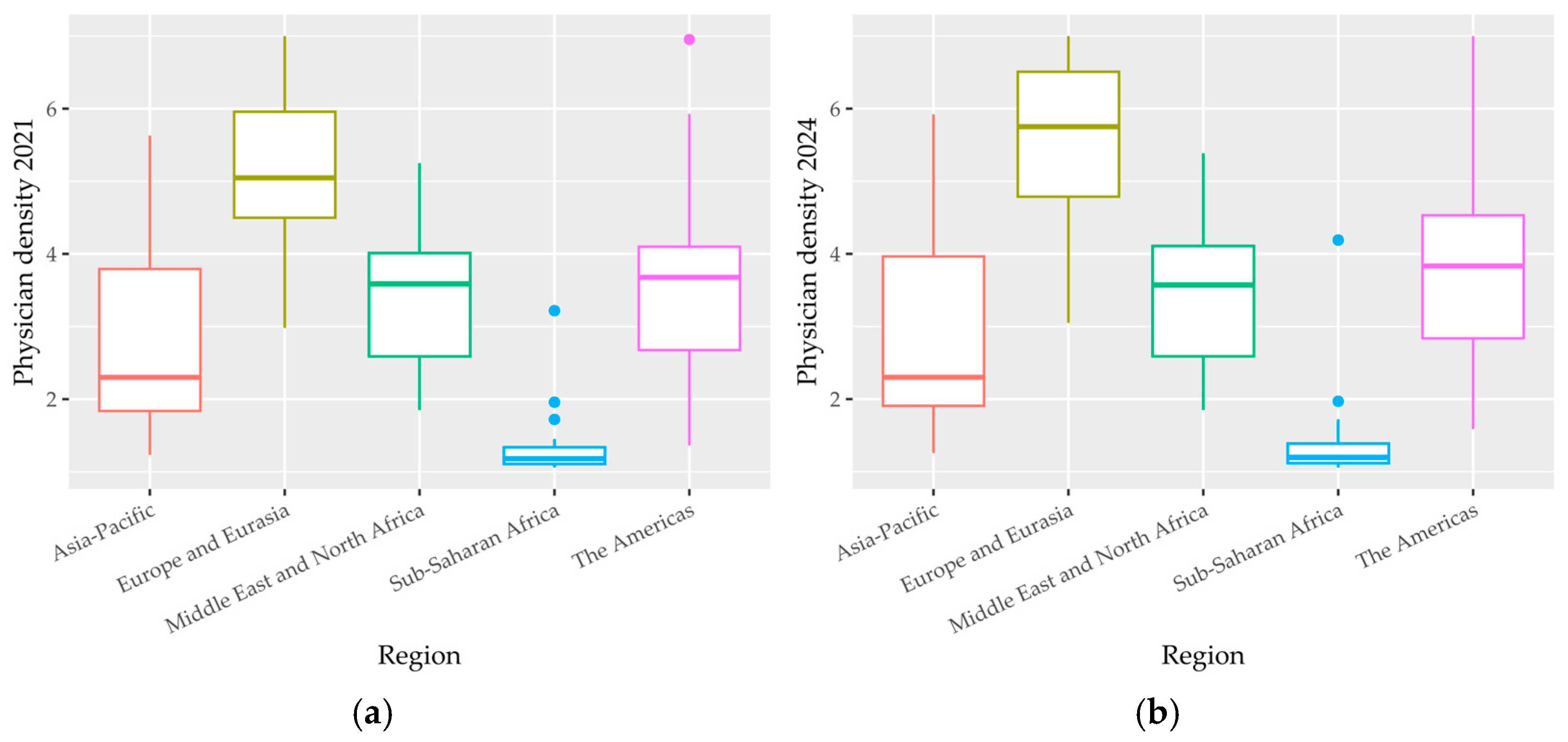
The average physician density differs significantly across regions (see Table 2 and Figure A1 in Appendix B). Europe and Eurasia have the highest mean physician density, which reflects strong healthcare capacity. The Americas follow with moderate means. Asia–Pacific and the Middle East & North Africa display intermediate levels, with modest increases over the period. Sub-Saharan Africa has the lowest physician density, although it saw a small rise, highlighting ongoing challenges in healthcare availability. The variability within regions, measured by the standard deviation, is greatest in Asia–Pacific and the Americas, indicating significant differences between countries in these areas. Sub-Saharan Africa shows relatively low variation, suggesting that low physician density is common across most countries there. Median values generally align with the means, which implies that distributions are fairly symmetrical in most regions. Maximum values show the presence of outliers everywhere, with Europe and Eurasia consistently reaching the TTDI score’s upper cap of 7.0 in 2024, and Sub-Saharan Africa showing a marked increase, evidence that a few countries are significantly improving despite the region’s overall low average.
From 2021 to 2024, physician density showed modest but consistent improvements across all regions, although the gap between Europe and Eurasia [67,68,69] and Sub-Saharan Africa remains particularly pronounced. In the Asia–Pacific region, Cambodia had the lowest physician density in both years [70], while Mongolia recorded the highest in 2021 and Australia reached the maximum in 2024, suggesting improvements in healthcare workforce capacity in several countries. In Europe and Eurasia, Albania [71,72] and Tajikistan represented the minimum values for 2021 and 2024, respectively. Countries such as Austria, Belgium, Czech Republic, Cyprus, Georgia, Greece, Malta, Portugal, and Sweden reported the highest densities, revealing a concentration of physicians in parts of Western and Central Europe [68,73]. In the Middle East and North Africa, Egypt [74] registered the lowest physician density for both years, while Israel consistently had the highest, highlighting notable disparities in healthcare workforce availability within the region. In Sub-Saharan Africa, Tanzania and Malawi [75] had the lowest physician density in 2021 and 2024, respectively. Outliers in physician density were observed in Mauritius, South Africa, and Namibia, indicating that physician availability is unevenly distributed across countries in the region. Lastly, in the Americas, Honduras consistently had the lowest physician density, while Uruguay held the top spot in both 2021 (outlier) and 2024, indicating relatively better coverage in that country.

4.1.2. Use of Basic Sanitation Across Regions

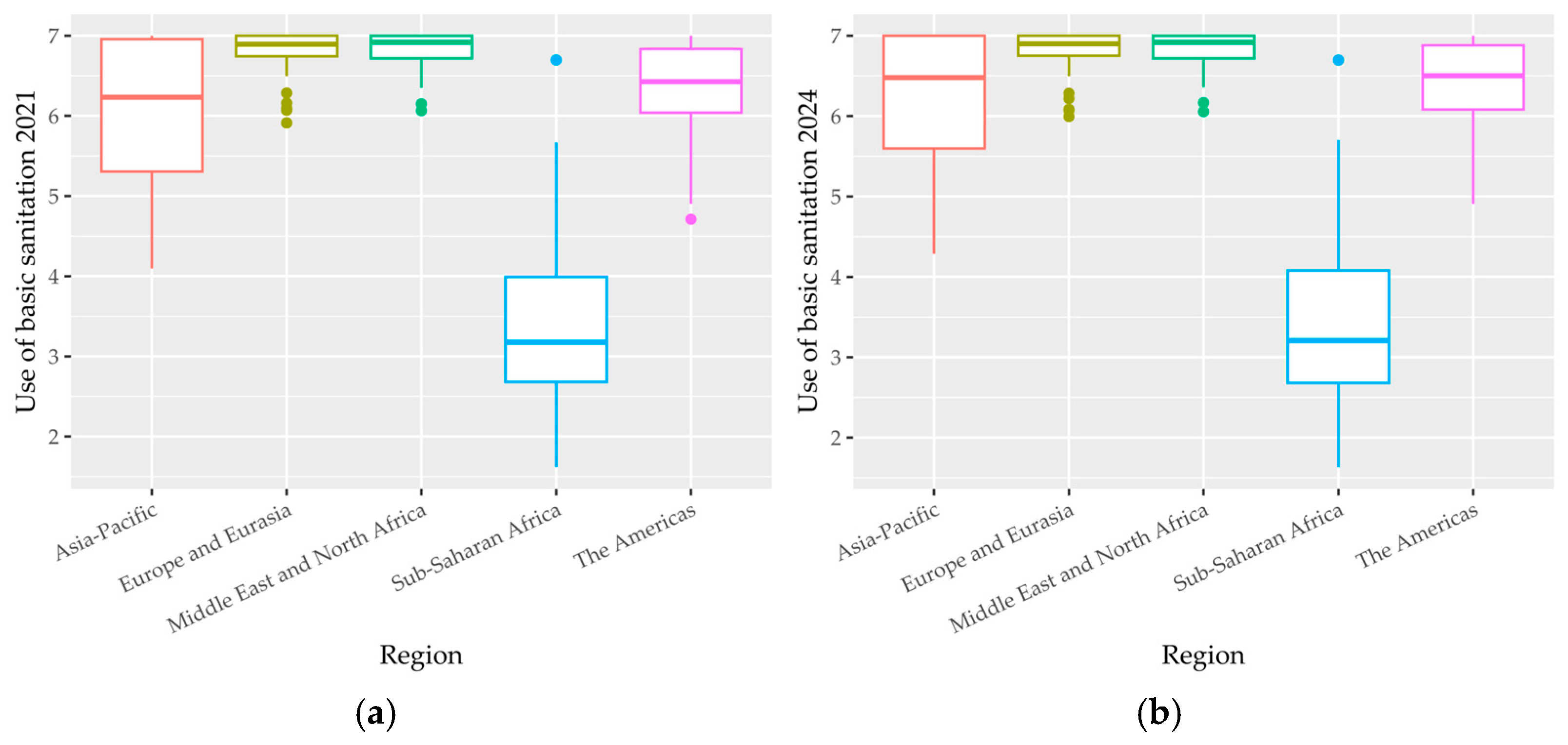
The availability and use of basic sanitation is generally high across most regions, with notable regional differences between them [76] (see Table 3 and Figure A2 in Appendix B). Europe and Eurasia, as well as the Middle East & North Africa, have the highest mean values, reflecting near-universal access. The Americas also demonstrate high sanitation coverage. The Asia–Pacific shows slightly lower but still strong coverage. In contrast, Sub-Saharan Africa has much lower mean sanitation scores, indicating that access to basic sanitation services is still a significant challenge in this region. Variability within regions, as indicated by standard deviation, is greatest in Sub-Saharan Africa, reflecting substantial disparities among countries. Other regions show low variability, suggesting more uniform access across countries. Median values closely match the means, pointing to relatively symmetrical distributions in most regions. Maximum values reach the TTDI cap of 7.0 in all regions except Sub-Saharan Africa, highlighting that some countries in every region achieve near-universal basic sanitation.
Between 2021 and 2024, all regions saw small improvements in basic sanitation coverage, though progress was slowest in Sub-Saharan Africa, which continues to be the most disadvantaged. In the Asia–Pacific region, Bangladesh had the lowest coverage in both years, while countries such as Singapore, Thailand, Korea (Rep.), Japan, New Zealand, and Australia consistently ranked among those with the highest sanitation coverage, reflecting their well-developed infrastructure [77]. In Europe and Eurasia, Moldova recorded the lowest coverage in both years. By contrast, countries including Albania, Greece, Türkiye, Cyprus, Malta, the United Kingdom, Belgium, Finland, Estonia, Spain, Italy, Czech Republic, Denmark, Germany, Switzerland, Austria, and Portugal consistently appeared at the top, indicating generally high levels of sanitation service in Western and Southern Europe. In the Middle East and North Africa, Algeria had the lowest coverage in both years, while Bahrain, Oman, Lebanon, Qatar, Kuwait, Israel, and the United Arab Emirates stood out for having the highest coverage, highlighting substantial disparities within the region. In Sub-Saharan Africa, Benin remained at the lowest end for sanitation coverage, while Mauritius consistently had the highest, underscoring uneven access to sanitation services in the region. In the Americas, Bolivia had the lowest coverage, whereas the United States and Chile recorded the highest levels, reflecting significant differences in infrastructure development across the continent. This topic is examined further in research by Rejapakse et al. [78].

4.1.3. Use of Basic Drinking Water Across Regions

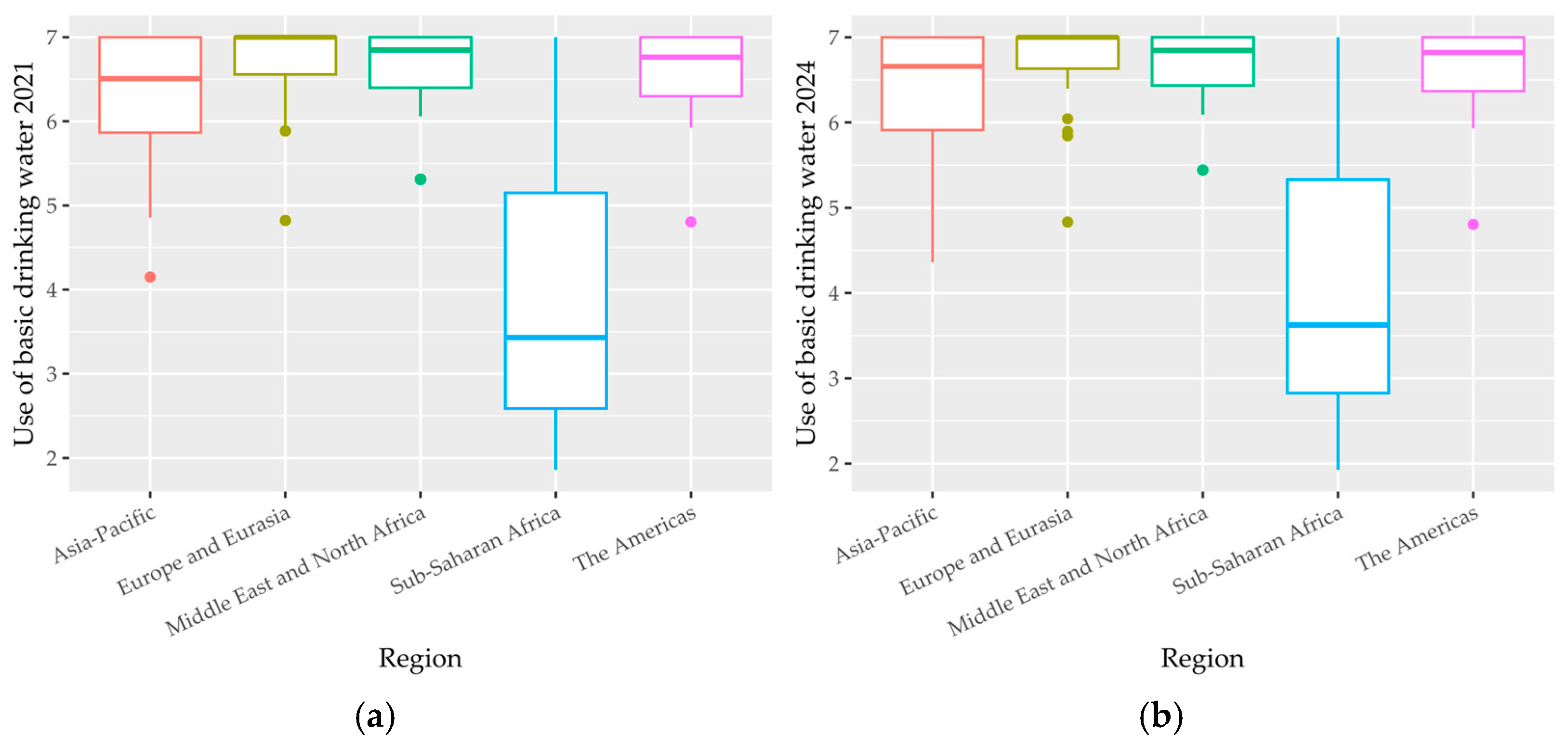
Access to basic drinking water remains high across most regions, with Europe and Eurasia, the Americas, and the Middle East & North Africa showing the highest mean scores (see Table 4 and Figure A3 in Appendix B). Europe and Eurasia experienced a slight increase in mean score, while the Americas stayed nearly stable, and the Middle East & North Africa improved. The Asia–Pacific region also maintains a high coverage. Sub-Saharan Africa, however, continues to lag behind the other regions, though its mean score increased modestly, indicating ongoing challenges in access to drinking water. The standard deviation is highest in Sub-Saharan Africa, reflecting considerable variation in access between countries in the region. Other regions show lower variability, indicating more uniform access across countries. Median values generally track the mean, suggesting fairly symmetric distributions in most regions. Maximum values reach the TTDI cap of 7.0 in all regions, indicating that several countries have achieved universal access to basic drinking water.
Between 2021 and 2024, all regions saw slight improvements in access to basic drinking water, though Sub-Saharan Africa continues to have the most room for progress [79,80,81,82,83,84,85], while Europe [86], the Americas, and the Middle East & North Africa [87] maintain near-universal access. In the Asia–Pacific region, Cambodia had the lowest drinking water coverage in both years, whereas Thailand, Singapore, Korea (Rep.), Japan, New Zealand, and Australia consistently ranked among those with the highest coverage, indicating well-developed water infrastructure in various parts of the region. In Europe and Eurasia, Tajikistan maintained the lowest coverage in both years, with countries such as the Kyrgyz Republic, Moldova, and Poland also showing relatively lower scores. By contrast, Bulgaria, Romania, Armenia, Slovak Republic, Luxembourg, Netherlands, Hungary, Slovenia, France, Iceland, Sweden, Greece, Cyprus, Malta, United Kingdom, Belgium, Finland, Estonia, Spain, Italy, Czech Republic, Denmark, Germany, Switzerland, Austria, and Portugal were at the upper end of the scale, highlighting a general trend of high access to in Western and Northern Europe [86], with lower levels in parts of Eastern Europe and Central Asia. In the Middle East and North Africa region, Morocco had the lowest coverage in both years, while Bahrain, Qatar, Kuwait, United Arab Emirates, and Israel recorded the highest coverage, indicating significant intra-regional disparities in access to safe water. In Sub-Saharan Africa, Angola recorded the lowest drinking water coverage in both years, while Mauritius attained the maximum score of 7 in both 2021 and 2024, reflecting uneven provision of water service across the region. Finally, in the Americas, Nicaragua consistently recorded the lowest coverage, whereas Brazil, Mexico, Paraguay, Argentina, Uruguay, Costa Rica, Canada, United States, and Chile achieved the highest coverage, illustrating substantial differences in infrastructure development and service provision within the region.

4.1.4. Hospital Bed Density Across Regions

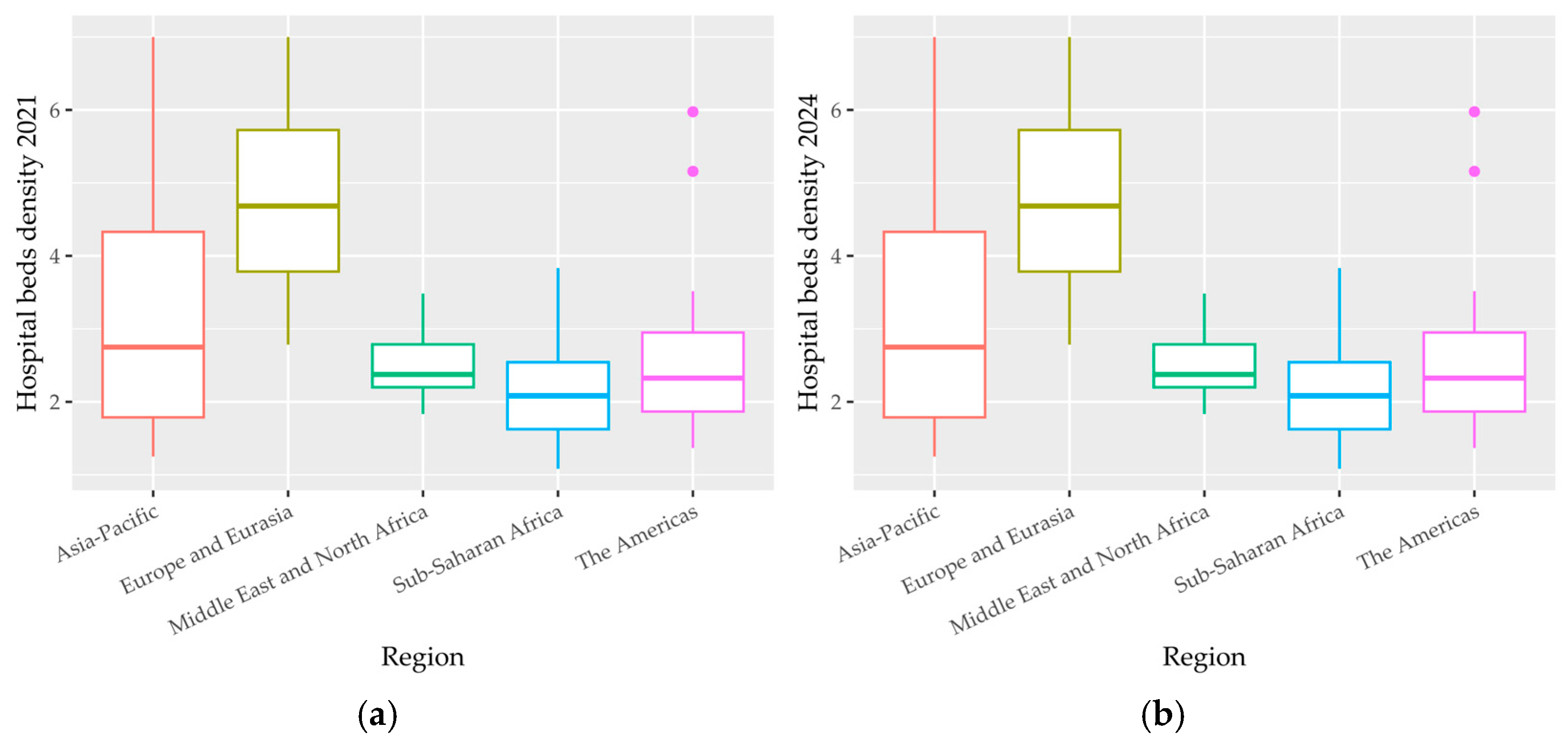
For consistency, hospital bed density is reported for both 2021 and 2024 (see Table 5 and Figure A4 in Appendix B). However, the underlying database provides identical values for these years, so no variation is observed in Table 5 and Figure A4.
Hospital bed density varies significantly across regions. Europe and Eurasia has the highest mean density, reflecting a well-developed healthcare infrastructure. Asia–Pacific follows with a mean of 3.29. The Americas and Middle East & North Africa have lower averages, while Sub-Saharan Africa has the lowest mean, highlighting limited hospital infrastructure in this region. Variability also differs across regions. Asia–Pacific has the highest standard deviation, suggesting substantial differences between countries. Europe and Eurasia is relatively consistent, while Sub-Saharan Africa has moderate variability, reflecting that most countries in the region have similarly low hospital bed availability. Median values generally match the means, indicating symmetric distributions except in regions with higher variability, such as Asia–Pacific. Maximum values reach the TTDI score cap of 7.0 in Asia–Pacific and Europe, demonstrating that some countries achieve excellent hospital bed coverage despite lower regional averages.
Regional disparities in hospital bed density remain pronounced, with Europe and Eurasia leading [56], Sub-Saharan Africa lagging [88], and the Americas, Middle East & North Africa, and Asia–Pacific occupying intermediate positions. In the Asia–Pacific region, Nepal recorded the lowest hospital bed density, while Mongolia, Korea (Rep.), and Japan had the highest values [89], reflecting disparities in healthcare infrastructure across the region. In Europe and Eurasia, Sweden had the lowest bed density, whereas Bulgaria, Germany, and Austria were among the countries with the highest density, indicating a concentration of inpatient capacity in Central and Western Europe. For the Middle East and North Africa, Morocco exhibited the lowest hospital bed density, while Israel had the highest, demonstrating substantial intra-regional variation in healthcare infrastructure. In Sub-Saharan Africa, Mali recorded the lowest density, while Mauritius reached the maximum value, highlighting notable differences in hospital capacity across countries within the region. In the Americas, Guatemala had the lowest hospital bed density (1.4), while Argentina (5.2) and Barbados (6.0) represented the highest values. This illustrates significant disparities in inpatient healthcare infrastructure across the continent.
Data on hospital bed density were unavailable for four Sub-Saharan African countries—Angola, Sierra Leone, Senegal, and Namibia—which were, therefore, excluded from the analysis.

4.1.5. Communicable Disease Incidence Across Regions

To maintain consistency, communicable disease incidence is reported for both 2021 and 2024; however, the database records identical values for these years, resulting in no observed changes in Table 6 and Figure A5 in Appendix B.
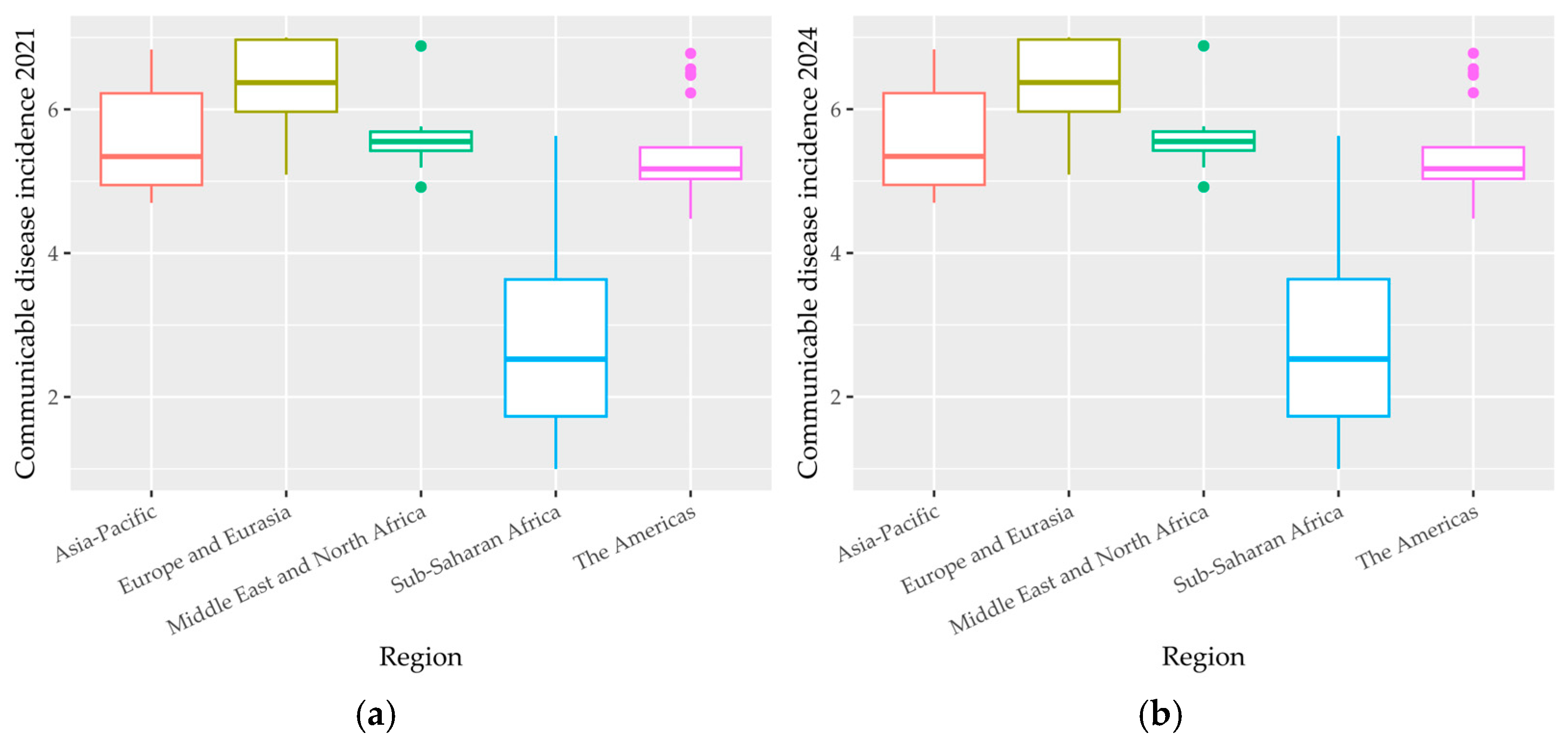
Communicable disease incidence shows substantial regional differences. Europe and Eurasia reports the highest mean scores, indicating relatively low incidence rates, followed by the Middle East & North Africa and Asia–Pacific. The Americas have a similar mean to Asia–Pacific. Sub-Saharan Africa has the lowest mean, reflecting the highest burden of communicable diseases among the regions analyzed. Variability, as measured by standard deviation, is greatest in Sub-Saharan Africa, suggesting considerable differences among countries in the region. Other regions display moderate to low variation, indicating more uniform incidence rates. Median values closely track the means across all regions, suggesting fairly symmetric distributions. Maximum values reach the TTDI cap of 7.0 in Europe and Eurasia, illustrating that some countries in this region achieve very low incidence rates, whereas Sub-Saharan Africa’s maximum of 5.63 reflects limited improvement even among its best-performing countries.
While Europe, the Middle East & North Africa, Asia–Pacific, and the Americas maintain relatively low incidence rates, Sub-Saharan Africa continues to experience the highest communicable disease burden, underscoring persistent regional health disparities. In the Asia–Pacific region, Pakistan recorded the lowest incidence, while Korea (Rep.) had the highest value, illustrating significant differences in public health outcomes within the region. In Europe and Eurasia, Tajikistan had the lowest incidence, whereas countries such as the Netherlands, Cyprus, Finland, Luxembourg, Switzerland, Germany, and Austria recorded the highest values, reflecting differences in disease surveillance, reporting practices, and exposure risk across Europe. Within the Middle East and North Africa, Egypt had the lowest incidence score (4.9), while Israel reported the highest (6.9), highlighting substantial intra-regional variation in communicable disease burden. In Sub-Saharan Africa, Côte d’Ivoire, Benin, and Sierra Leone had the lowest scores (1.0), whereas Mauritius achieved the highest value (5.6), indicating uneven distribution of communicable disease risk and health system capacity across the region. In the Americas, Venezuela recorded the lowest incidence, whereas Argentina (6.2), Uruguay (6.5), Chile (6.5), the United States (6.6), and Canada (6.8) were at the upper end of the scale, revealing substantial disparities in communicable disease occurrence within in the region. Regional differences in communicable disease incidence—particularly in relation to HIV and AIDS—have been explored in numerous studies (see, e.g., [90,91,92]).

4.1.6. Health and Hygiene Pillar Across Regions

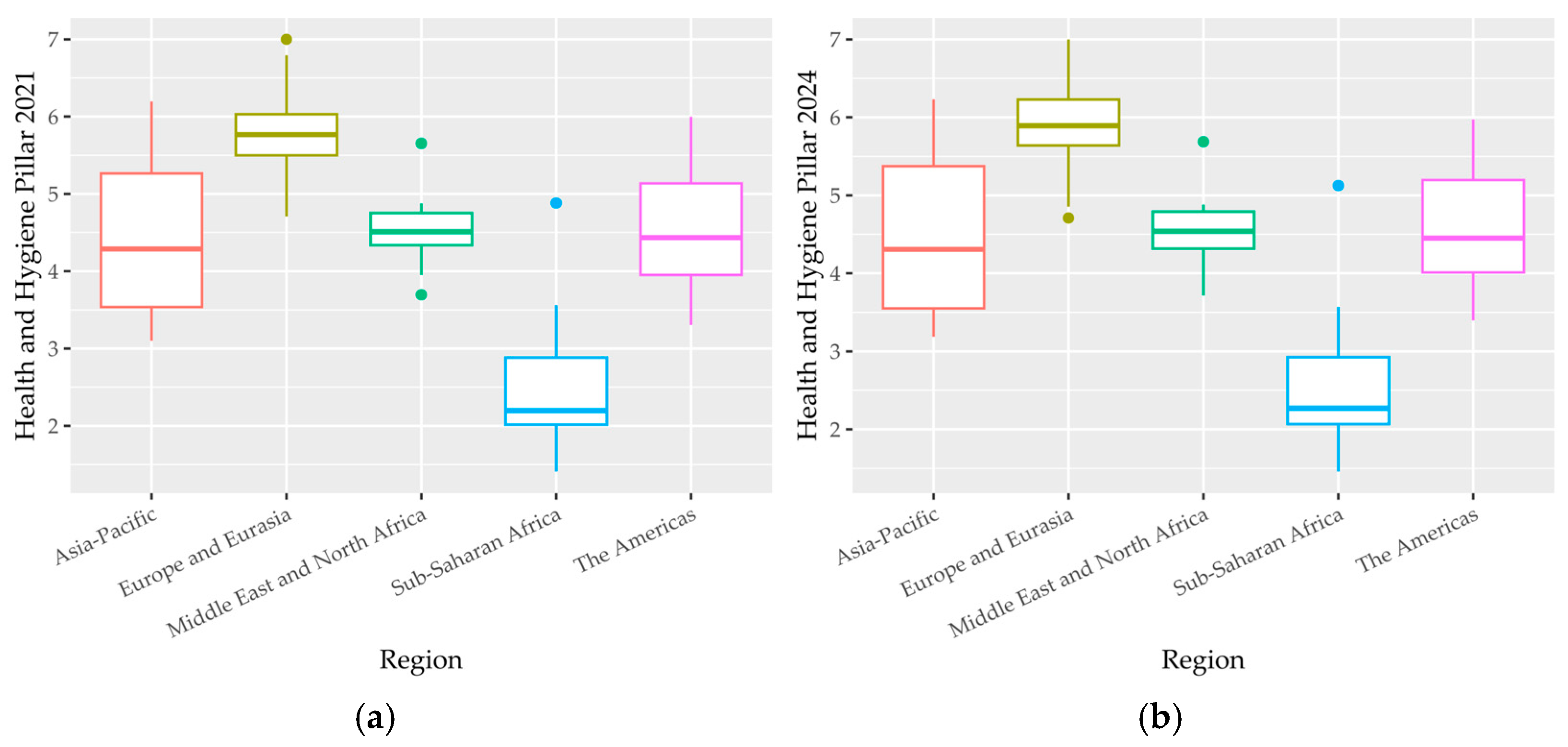
The Health and Hygiene pillar, which aggregates all five indicators, highlights pronounced regional disparities and modest improvements over the 2021–2024 period (see Table 7 and Figure A6 in Appendix B).
Europe and Eurasia consistently achieves the highest mean scores, reflecting strong healthcare infrastructure, widespread sanitation, and low communicable disease incidence. Asia–Pacific and the Americas demonstrate intermediate performance, while the Middle East & North Africa shows similar scores to Asia–Pacific. Sub-Saharan Africa has the lowest mean score, indicating persistent health and hygiene challenges across the region. Variability, as measured by standard deviation, is highest in Sub-Saharan Africa, reflecting significant disparities between countries. Asia–Pacific also exhibits notable variability, while Europe and Eurasia display more consistent performance across countries. Median values closely track the means in all regions, suggesting relatively symmetric distributions. Maximum values reach or approach the TTDI cap of 7.0 in Europe and Eurasia, while Sub-Saharan Africa’s maximum remains substantially lower, highlighting limited high-end performance within the region.
The Health and Hygiene pillar shows modest improvements across all regions between 2021 and 2024, driven primarily by slight increases in physician density, sanitation, and drinking water access. However, Sub-Saharan Africa continues to lag significantly behind, emphasizing persistent inequalities in global health infrastructure and public health resilience.
In the Asia–Pacific region, Cambodia recorded the lowest scores in both 2021 and 2024, reflecting limited health and hygiene infrastructure, while Japan consistently achieved the highest scores (6.2), indicating well-developed healthcare and hygiene systems. In Europe and Eurasia, Tajikistan had the lowest scores (4.7) for both years, whereas Austria maintained the highest scores (7.0), highlighting disparities in health and hygiene infrastructure across the region. For the Middle East and North Africa, Morocco had the minimum scores (3.7) in both 2021 and 2024, while Israel consistently registered the highest scores (5.7), reflecting significant intra-regional differences in healthcare and sanitation systems. In Sub-Saharan Africa, Sierra Leone recorded the lowest scores (1.4 and 1.5), while Mauritius achieved the maximum values (4.9 and 5.1), indicating uneven access to healthcare and hygiene facilities across the region. Finally, in the Americas, Guatemala (3.3 and 3.6) and Nicaragua (3.4) were at the lower extreme, while Argentina consistently recorded the highest scores (6.0), illustrating differences in health and hygiene infrastructure and service provision across countries in the region.
The Health and Hygiene pillar reveals consistent regional disparities. Europe and Eurasia consistently demonstrate the strongest healthcare indicators across all dimensions, while Sub-Saharan Africa lags behind in physician availability, sanitation, drinking water access, hospital infrastructure, and disease prevention. Between 2021 and 2024, modest improvements are seen in physician density, sanitation, and drinking water, particularly in Asia–Pacific and Sub-Saharan Africa, whereas hospital bed density and communicable disease incidence remain largely unchanged. These results highlight both progress and persistent inequalities in global health infrastructure, which are highly relevant to travel and tourism resilience.
The persistent lag in Sub-Saharan Africa underscores deeper structural constraints. These constraints include chronic underfunding of health systems, institutional weaknesses, poor governance and procurement practices, and a shortage of trained health professionals—particularly in rural and underserved areas [93,94]. Moreover, even when water and sanitation infrastructure is installed, sustainability remains problematic: maintenance is often neglected, local capacity for managing WASH systems is weak, and rapid urbanization or environmental stress (e.g., droughts, flooding) may overwhelm systems [95]. These limitations are compounded by a rapidly increasing burden of non-communicable diseases. Recent evidence shows that chronic non-communicable diseases are a leading cause of mortality in Sub-Saharan Africa and that even healthcare workers are highly affected by hypertension and other chronic diseases, indicating widespread systemic strain [96,97]. Consequently, the modest aggregate improvements observed may mask persistent subnational and intra-country inequalities (urban vs. rural, formal vs. informal settlements, socio-economic groups), meaning that any gains in physician density or water access do not automatically translate into equitable health resilience or tourism-ready environments. This suggests that policy strategies aiming to support tourism-dependent economies in Sub-Saharan Africa must go beyond infrastructure investment: they should address governance, capacity-building, health financing, maintenance, and equitable access—aligning with the spirit of the SDGs and promoting long-term sustainability rather than short-lived improvements.
The onset of COVID-19 further exposed and amplified these structural and governance-related vulnerabilities in Sub-Saharan Africa’s health and WASH infrastructure. Even before the pandemic, many health facilities did not meet basic standards for safe water, sanitation, and hygiene, especially in rural and publicly managed facilities, limiting their capacity to implement proper infection-prevention and control measures [98]. During the pandemic, inequalities in access to hygiene services (e.g., handwashing facilities, clean water) constrained the ability of vulnerable populations to follow prevention guidelines, undermining public-health responses [99]. At the same time, health care access deteriorated. Many routine and specialty services were interrupted, and already fragile systems struggled to respond, thereby exacerbating inequities and weakening gains [100]. Moreover, the economic shock from COVID-19 (through GDP contractions, reduced public revenues and increased fiscal strain) constrained public health spending across many African countries, limiting further investments into WASH or health system upgrades that had been planned pre-pandemic [101]. As a result, the modest aggregate improvements you observed between 2021 and 2024 may partly reflect a post-pandemic recovery baseline, rather than robust, sustained structural catch-up. These dynamics suggest that any interpretation of recent improvements must be cautious. Without stronger governance, stable financing, and equitable investment, especially targeting rural and underserved areas, gains remain fragile and may not translate into genuine health resilience or tourist-ready health environments.
The results underscore stark contrasts between Europe and Eurasia and Sub-Saharan Africa. Europe consistently demonstrates the highest physician density [67,68,69] and hospital bed density [60], near-universal access to sanitation and drinking water [102], and low communicable disease incidence. In contrast, Sub-Saharan Africa lags significantly on all indicators [79,80,81,82,83,84,85], with widespread shortages in healthcare personnel, inadequate hospital capacity [49,88,103], and high disease burdens. These findings suggest that, although incremental improvements occurred between 2021 and 2024 (such as modest increases in physician density, sanitation, and drinking water coverage), they were insufficient to close the gap between high- and low-performing regions.
Asia–Pacific [104,105] and the Middle East & North Africa [49,78] occupy an intermediate position, with strong infrastructure in a few countries (such as Israel, Japan, and Singapore) but substantial intra-regional disparities. The Americas show similar contrasts, with countries like the United States and Uruguay [106] performing well, while others (including Honduras, Nicaragua, and Bolivia) [107] remain significantly behind.

4.2. Analysis of Health and Hygiene Indicators Across Income Groups

In this subsection, the Health and Hygiene pillar of the TTDI is analyzed from an economic perspective, comparing outcomes across countries grouped by income level. As in the regional analysis, five indicators—physician density, use of basic sanitation, use of basic drinking water, hospital bed density, and communicable disease incidence—are examined in Section 4.2.1, Section 4.2.2, Section 4.2.3, Section 4.2.4 and Section 4.2.5, respectively. Section 4.2.6 then provides an integrated analysis of the Health and Hygiene pillar, offering a comprehensive view of the relationships between income level and overall pillar performance.

4.2.1. Physician Density Across Income Groups

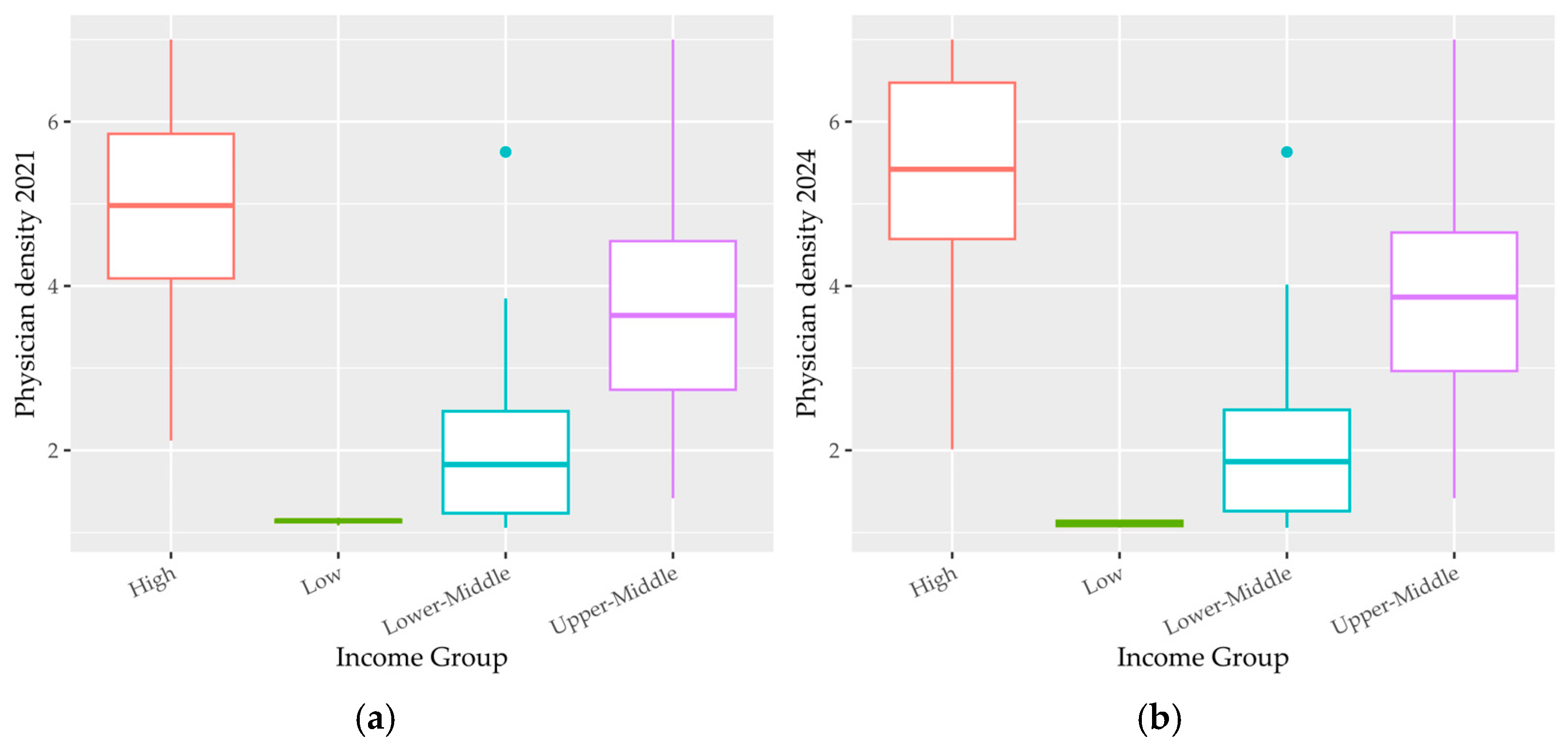
Physician density shows a clear gradient across countries grouped by income level [49] (see Table 8 and Figure A7 in Appendix B). High-income countries have the highest mean density, reflecting well-developed healthcare systems. Upper-middle-income countries display intermediate values, followed by lower-middle-income countries, where averages rise only slightly. Low-income countries remain at the bottom of the distribution, with physician density changing very little (from 1.14 to 1.11). Variability within income groups is highest in the upper-middle and high-income groups, reflecting substantial heterogeneity among countries at these income levels. Low-income countries exhibit minimal variability, showing that very low physician density is common across this group. Median values closely track the means, suggesting approximately symmetric distributions in all groups. Maximum values reach the TTDI cap of 7.0 in both high- and upper-middle-income countries, whereas low- and lower-middle-income countries remain well below this threshold, underscoring constraints at the upper end of performance.
Physician density increases modestly with income level [49]. High- and upper-middle-income countries show slight improvements between 2021 and 2024, whereas low-income countries remain largely stagnant. These patterns underscore the persistent inequalities in healthcare workforce availability across income groups.

4.2.2. Use of Basic Sanitation Across Income Groups

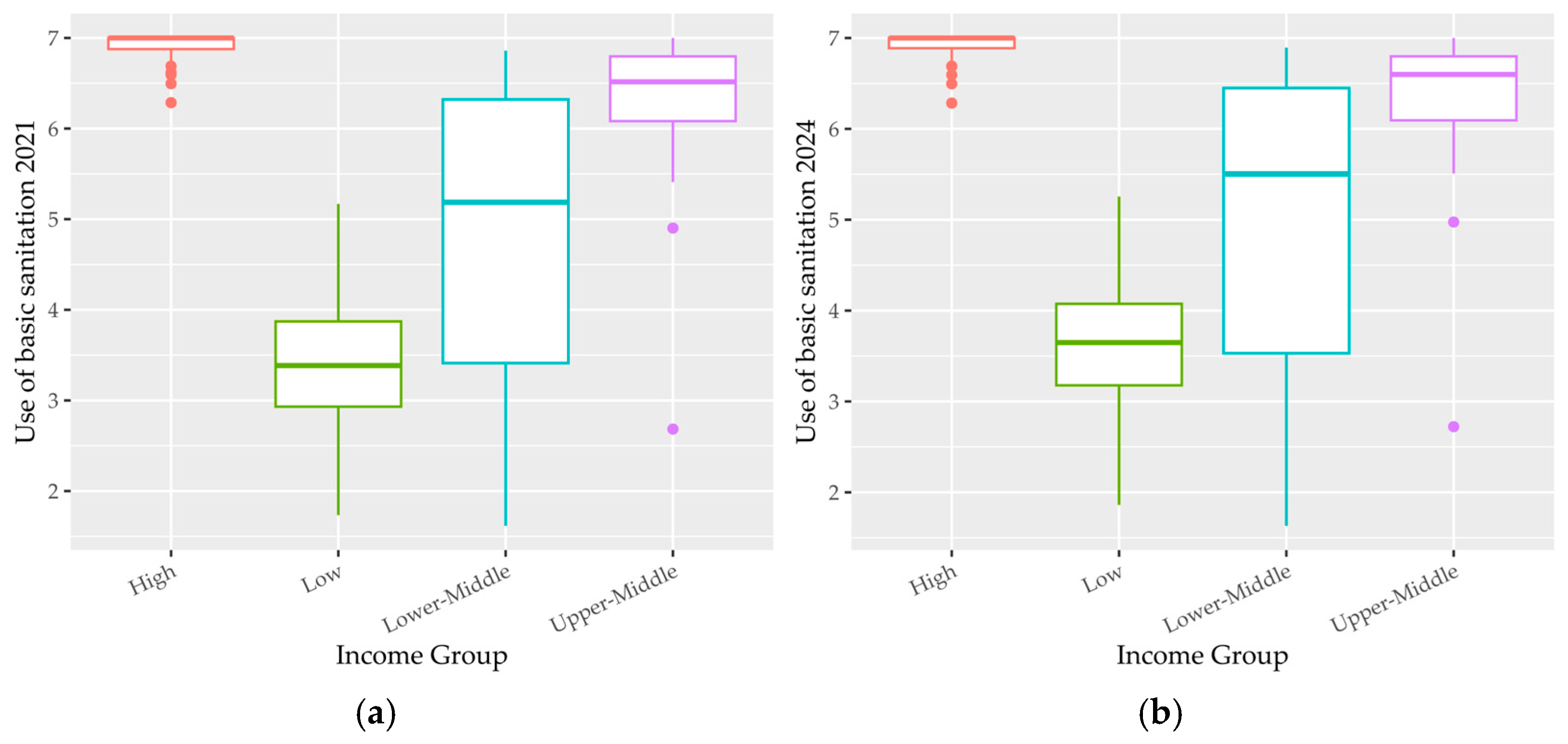
Access to basic sanitation is strongly associated with income level [77,108] (see Table 9 and Figure A8 in Appendix B). High-income countries demonstrate near-universal coverage. Upper-middle-income countries also show high levels of access. Lower-middle-income countries have moderate coverage. Low-income countries remain the most disadvantages, although their average access rises slightly. Variability is highest in lower-middle- and low-income countries, reflecting large disparities between countries within these groups. By contrast, high- and upper-middle-income countries show minimal variability, indicating that access to basic sanitation is relatively uniform within these groups. Median values closely follow the means, and maximum values in high- and upper-middle-income countries reach the TTDI cap of 7.0, reflecting universal coverage in the best-performing countries. Low-income countries have maximum values far below 7, emphasizing persistent sanitation gaps.
The data show a clear positive relationship between income level and access to basic sanitation. High- and upper-middle-income countries are close to achieving universal coverage, whereas lower- and low-income countries [78] continue to face substantial deficits. Between 2021 and 2024, modest improvements occur across all income groups, with the most notable gains observed in lower- and low-income countries.

4.2.3. Use of Basic Drinking Water Across Income Groups

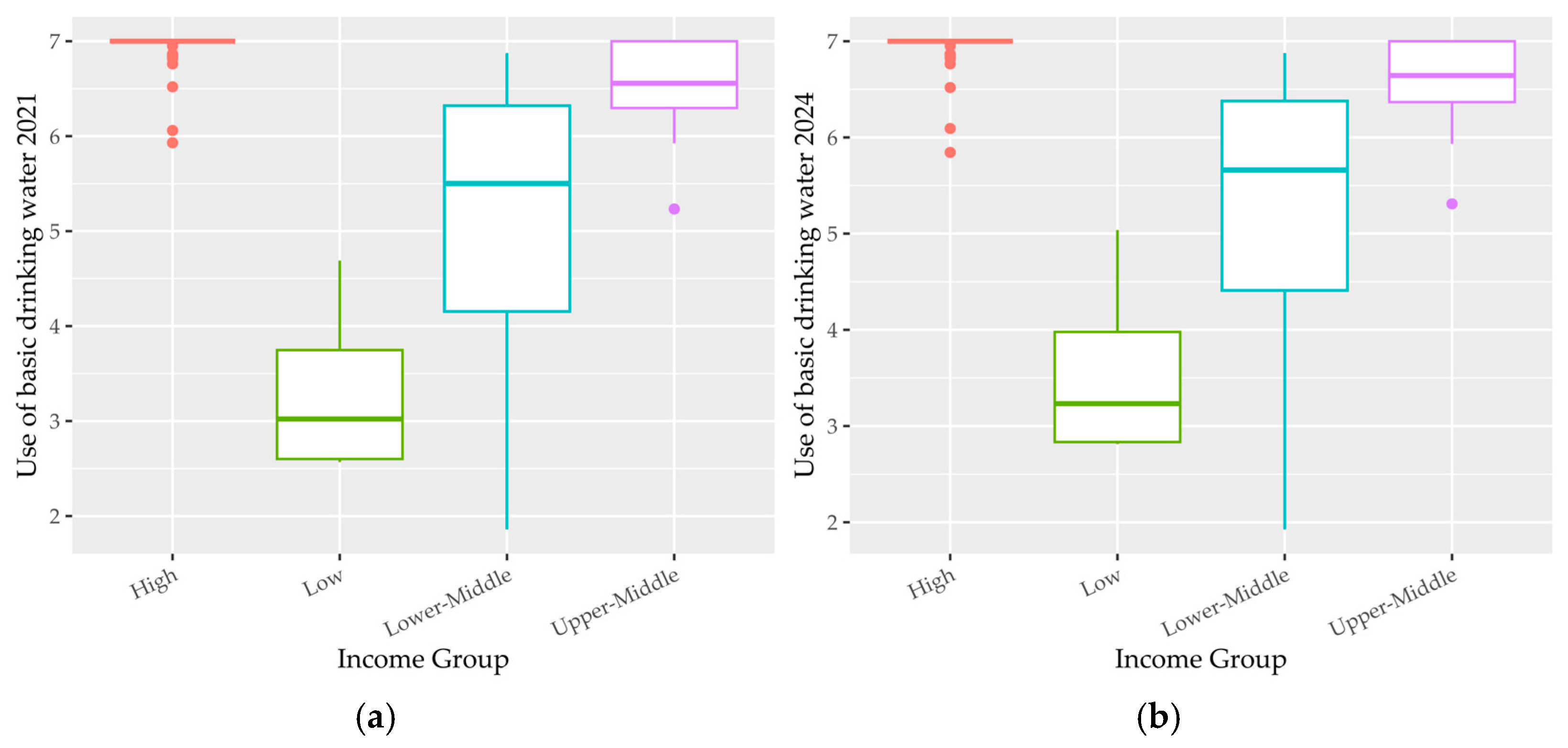
Access to basic drinking water increases with income [77,108] (see Table 10 and Figure A9 in Appendix B).
High-income countries maintain near-universal access, with mean values remaining stable. Upper-middle-income countries also show very high coverage. Lower-middle-income countries have moderate access, while low-income countries remain the most disadvantaged. Variability is largest in lower- and low-income groups, reflecting significant differences between countries within these categories. By contrast, high- and upper-middle-income countries display minimal variability, indicating uniformly high access. Median values closely follow the means, while maximum values in high- and upper-middle-income countries reach the TTDI cap of 7.0, reflecting near-universal access in the best-performing countries. Low-income countries remain well below this maximum, emphasizing persistent disparities in access to safe drinking water.
Access to basic drinking water is strongly associated with income level. High- and upper-middle-income countries have achieved near-universal coverage, whereas lower- and low-income [78,79] countries show slower progress. Between 2021 and 2024, modest gains are observed across all groups, with the most notable improvements occurring among low- and lower-middle-income countries.

4.2.4. Hospital Bed Density Across Income Groups

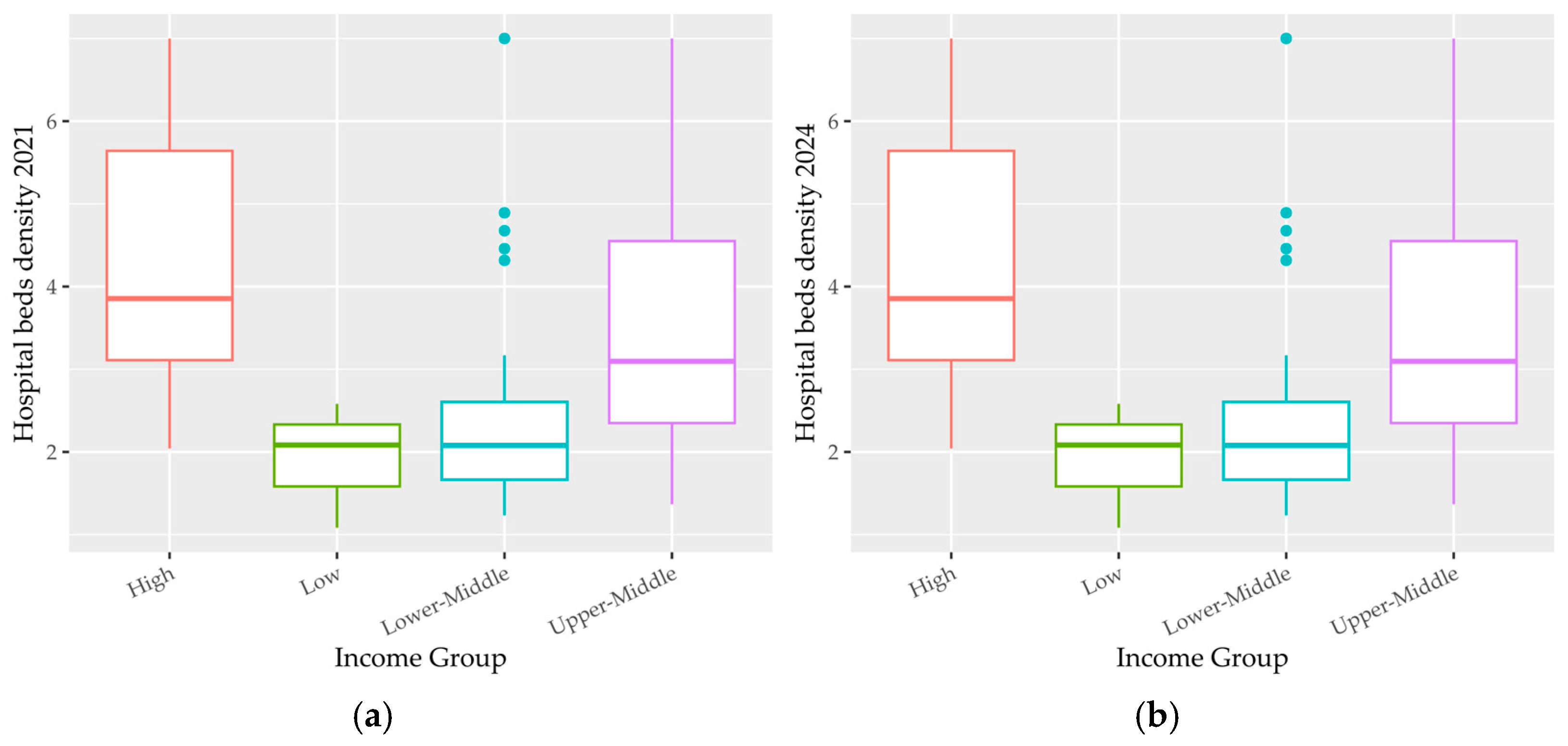
For consistency, hospital bed density is reported for both 2021 and 2024 (see Table 11 and Figure A10 in Appendix B). However, the underlying database provides identical values for these years, so no changes are observed in Table 11 and Figure A10. Hospital bed density increases with income [109], reflecting differences in healthcare infrastructure. High-income countries have the highest mean density, followed by upper-middle-income countries and lower-middle-income countries. Low-income countries show the lowest availability. Variability is moderate across most income groups. High- and upper-middle-income countries show relatively high variation, indicating differences between countries with stronger and weaker hospital infrastructure. Low-income countries show lower variability, reflecting consistently limited hospital bed density. Median values closely track the means. Maximum values reach the TTDI cap of 7.0 in high-, upper-middle-, and lower-middle-income countries, whereas low-income countries remain far below this level, highlighting constraints at the upper end of performance.
Hospital bed density is strongly associated with income [109]. High- and upper-middle-income countries generally have more developed infrastructure, lower-middle-income countries exhibit moderate capacity, and low-income countries remain the most constrained.

4.2.5. Communicable Disease Incidence Across Income Groups

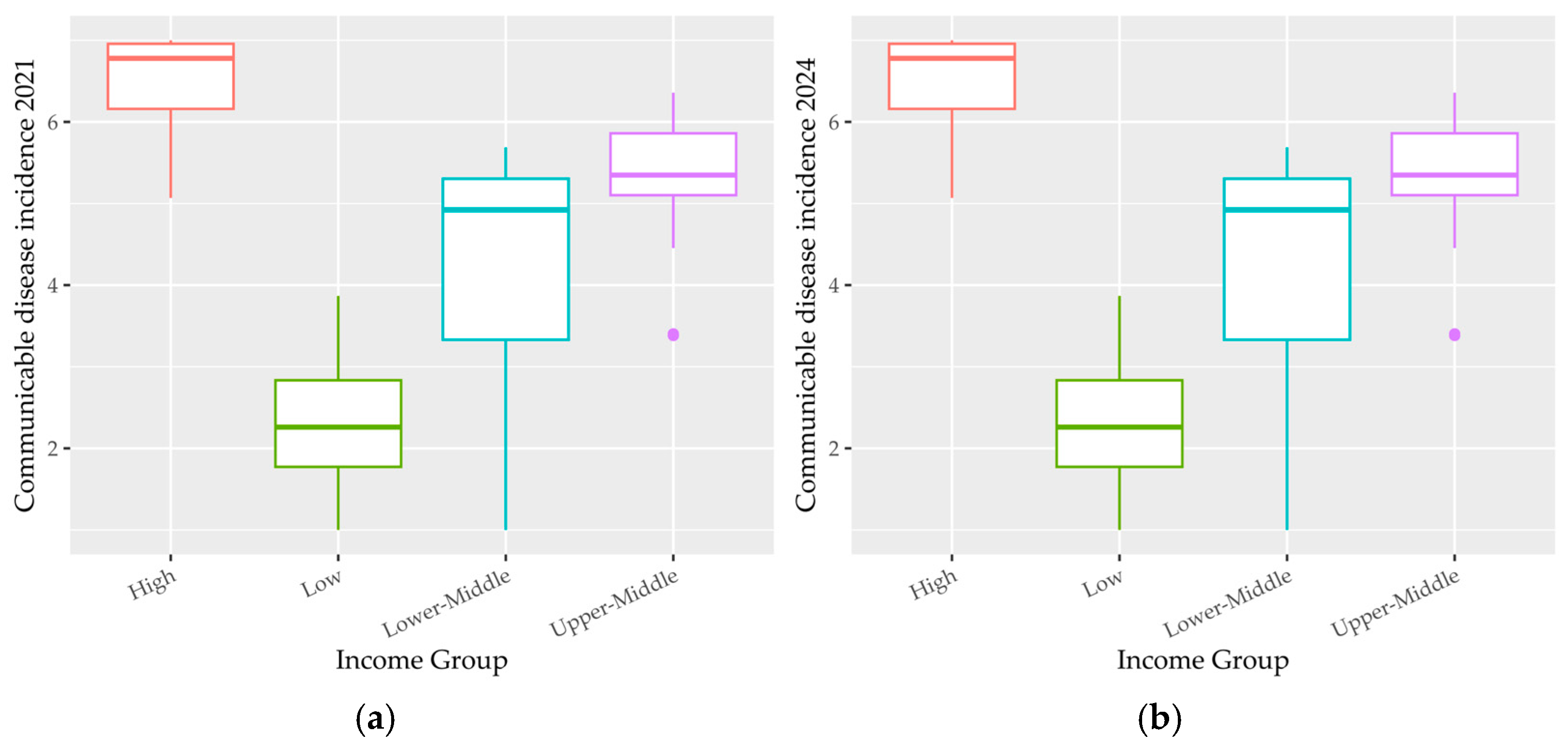
To maintain consistency, communicable disease incidence is presented for both 2021 and 2024; however, the database records identical values for these years, resulting in no observed changes in Table 12 and Figure A11 in Appendix B. Communicable disease incidence is clearly associated with income. High-income countries report the lowest disease burden, indicating low incidence. Upper-middle-income countries also exhibit relatively low incidence. Lower-middle-income countries show moderate incidence, while low-income countries face the highest burden. Variability is greatest in the lower- and low-income groups, reflecting substantial differences between countries within these categories. High- and upper-middle-income countries show low variability, indicating relatively uniform low incidence. Median values closely track the means, and maximum values in high- and upper-middle-income countries approach the TTDI cap of 7.0, reflecting very low disease incidence in the best-performing countries. Low-income countries remain well below this cap, emphasizing persistent public health challenges.
Communicable disease incidence declines as income increases. High- and upper-middle-income countries exhibit low and stable incidence, lower-middle-income countries show moderate levels, and low-income countries remain the most vulnerable. Income-related disparities in communicable disease incidence—particularly for HIV and AIDS—have been analyzed in numerous studies (e.g., [91,110]).

4.2.6. Health and Hygiene Pillar Across Income Groups

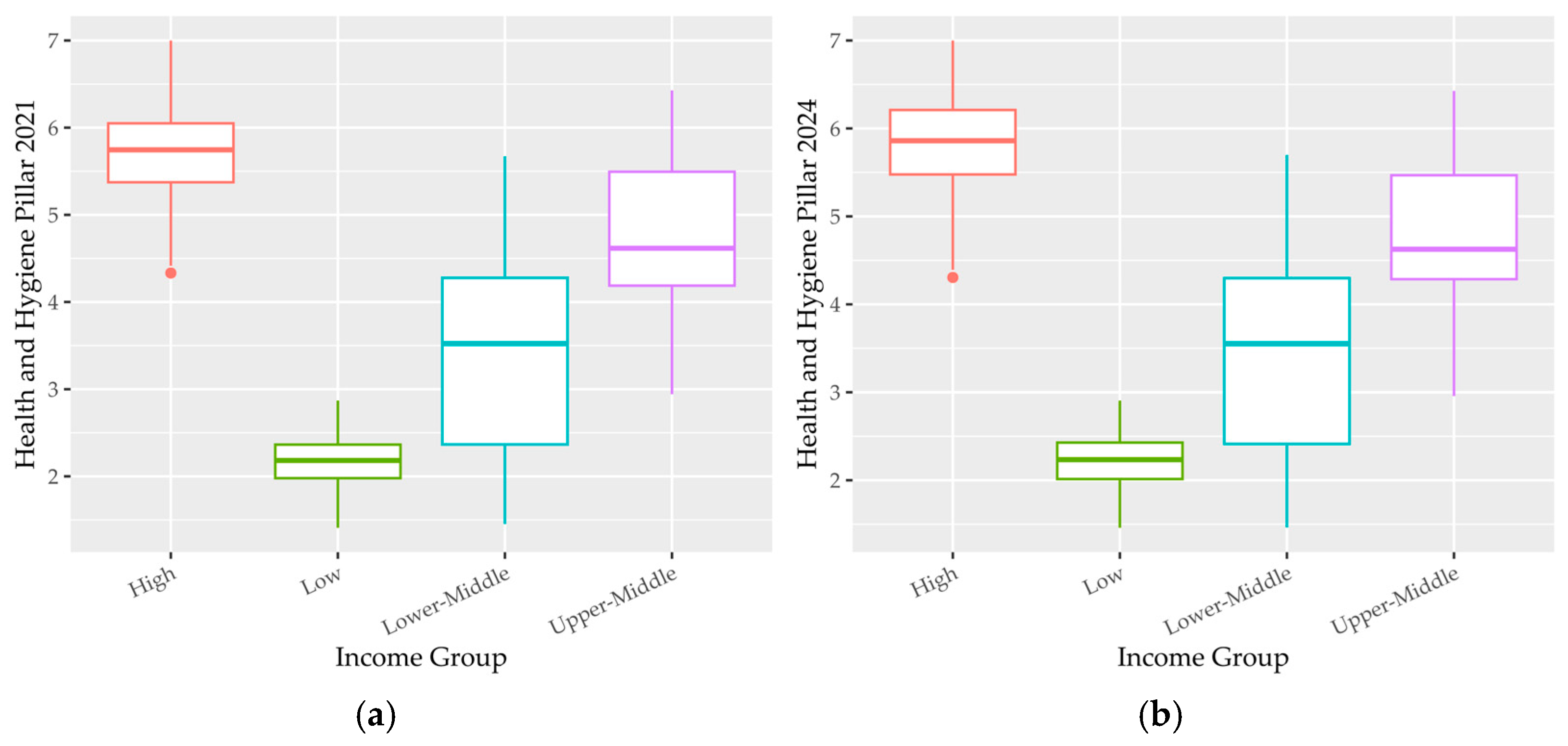
The Health and Hygiene pillar shows clear disparities across income levels, with higher-income countries consistently outperforming lower-income ones (see Table 13 and Figure A12 in Appendix B). High-income countries have the highest mean score, reflecting robust healthcare infrastructure, near-universal access to sanitation and drinking water, and low communicable disease incidence. Upper-middle-income countries show intermediate performance, while lower-middle-income countries score lower. Low-income countries lag significantly, highlighting persistent health and hygiene challenges. Variability is highest among lower- and upper-middle-income groups, indicating differences between countries within these categories. High-income countries are more consistent, whereas low-income countries exhibit moderate variability. Median values closely align with the means, suggesting relatively symmetric distributions. Maximum values reach the TTDI cap of 7.0 in high-income countries, while low-income countries remain well below this threshold, highlighting constraints at the upper end of performance.
The Health and Hygiene pillar shows slight improvements across all income groups between 2021 and 2024. The results emphasize the strong influence of income on health and hygiene outcomes: high-income countries benefit from near-universal access to healthcare and public health services, whereas low-income countries continue to face substantial structural challenges.
Among high-income countries, Bahrain recorded the lowest scores (4.3) in both 2021 and 2024, whereas Austria consistently achieved the highest scores (7.0). This pattern reflects generally strong health and hygiene infrastructure in this income group, while still indicating some internal variation. In low-income countries, Sierra Leone had the minimum scores in both years (1.4 and 1.5), whereas Rwanda achieved the highest (2.9), demonstrating that some low-income countries have made notable progress despite limited resources. Within the lower-middle-income group, Benin recorded the lowest scores (1.5), while Mongolia reached the maximum values (5.7), indicating considerable heterogeneity in health and hygiene performance in this category. Among upper-middle-income countries, Namibia had the lowest scores (2.9 and 3.0), while Bulgaria consistently held the highest values (6.4), highlighting substantial variation in infrastructure and service quality within this income group.
The Health and Hygiene pillar highlights the strong influence of income on healthcare infrastructure, sanitation, water access, and disease prevention. High- and upper-middle-income countries consistently demonstrate strong performance and near-universal access to essential services, whereas lower- and low-income countries continue to face persistent challenges.
Analysis by income groups demonstrates a clear socioeconomic gradient. High-income countries [111] have well-established healthcare systems, while low-income countries [112,113] remain limited in physician availability, sanitation, and water access, leading to higher communicable disease incidence. Lower-middle-income countries [112,113] show moderate capacity but high variability, indicating both opportunities for progress and risks of stagnation. These findings underscore the central role of national income in shaping health infrastructure and outcomes [114].

4.3. Cross-Regional and Income-Based Patterns in Basic Sanitation and Basic Drinking Water

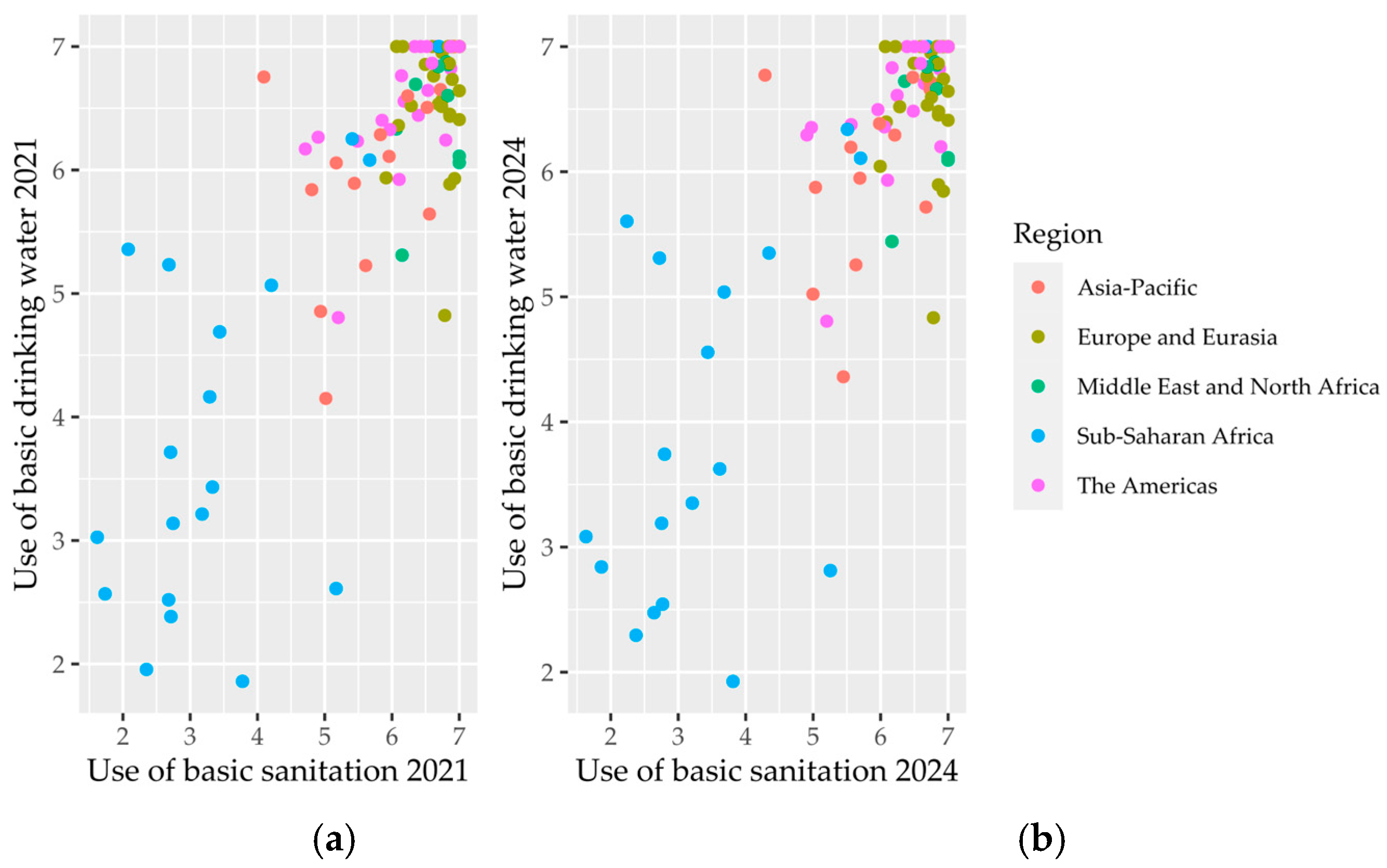
Figure 1 presents scatterplots showing the relationship between the use of basic sanitation and the use of basic drinking water across countries in five world regions for 2021 and 2024. Both variables are standardized on a one-to-seven scale, with higher values indicating greater access.
In both years, there is a clear positive association: countries with better access to basic sanitation also tend to have higher access to safe drinking water. Most countries in Europe and Eurasia, the Middle East and North Africa, and the Americas cluster in the upper-right corner of the plots, with values between six and seven for both indicators, reflecting near-universal coverage. The Asia–Pacific region displays greater variation, with some countries achieving similarly high values while others remain in the mid-range. By contrast, Sub-Saharan African countries consistently occupy the lower part of the distributions, with many scoring between two and four for both sanitation and drinking water. This indicates that, despite some progress, large gaps persist between this region and the rest of the world. Comparing the two time points, the general pattern of regional inequality remains unchanged. Countries already close to universal coverage show little change, while modest improvements are visible in Sub-Saharan Africa and parts of Asia–Pacific. A few African countries moved slightly upward from 2021 to 2024, suggesting incremental progress, but the distance separating them from higher-performing regions remains substantial. Taken together, these results underscore both the interdependence of sanitation and drinking water access and the persistent global disparities. While many regions have consolidated high levels of coverage, progress in Sub-Saharan Africa remains slow, and the widening gap highlights the need for intensified investment and targeted policy efforts if global equity targets are to be achieved.
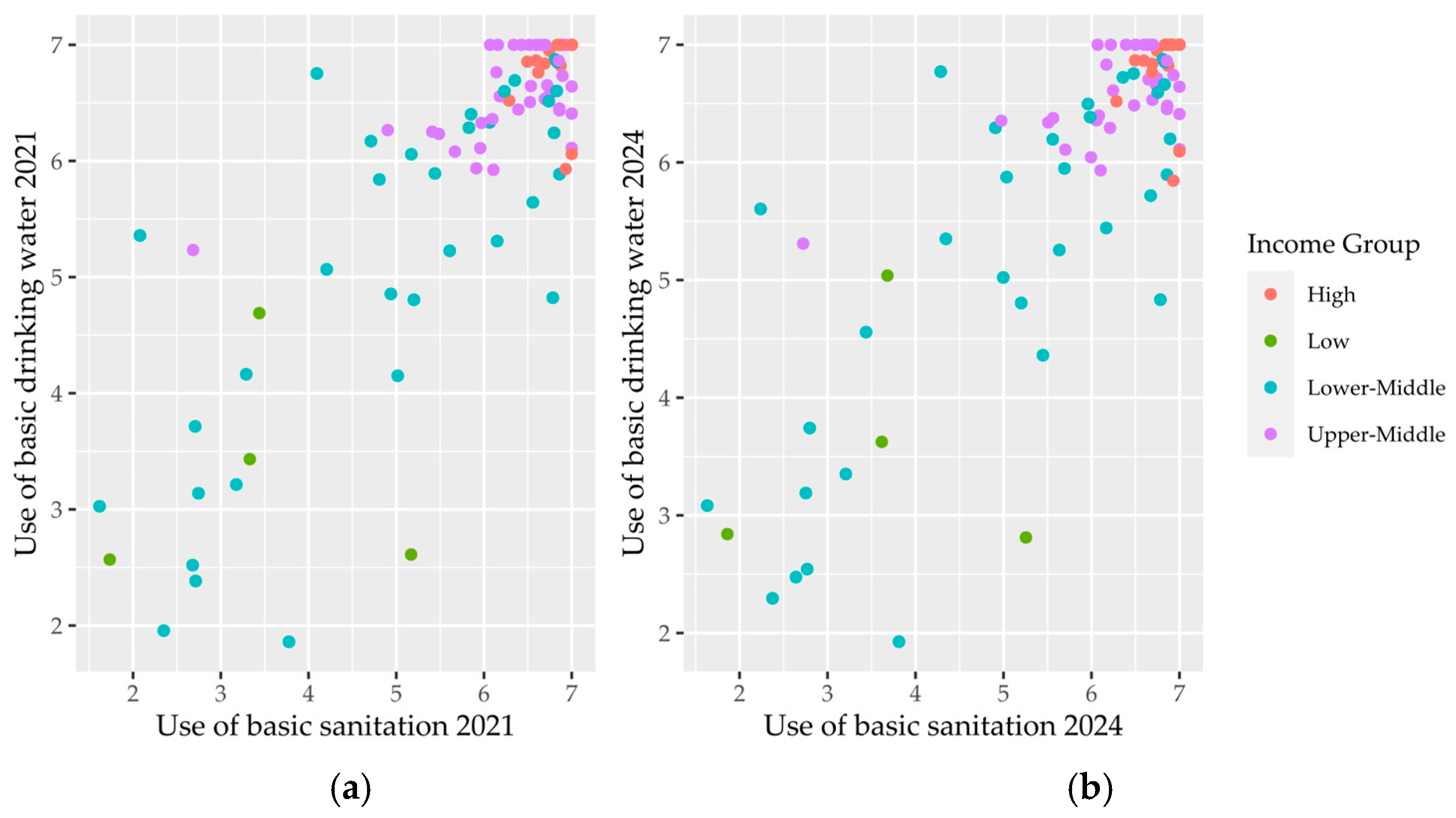
In Figure 2, the second set of scatterplots again illustrates the relationship between the use of basic sanitation and the use of basic drinking water in 2021 and 2024, but this time countries are classified by income group. The four categories—low, lower-middle, upper-middle, and high income—reveal a clear socioeconomic gradient in access. In both years, high-income countries are clustered almost exclusively in the upper-right corner, with values between six and seven for both sanitation and drinking water, reflecting near-universal coverage. Upper-middle income countries are also strongly concentrated at high levels, though with slightly greater variation than the high-income group. Lower-middle income countries show a much wider spread, with some approaching high coverage, while many others occupy the mid-range between four and six. Low-income countries stand apart, concentrated in the lower portion of the plots, with values often between two and four, indicating limited access to both services. Comparing the two years, the overall patterns remain consistent. Countries in the high- and upper-middle income groups show little visible change, as their access is already near the maximum. The greatest variation and potential for improvement is observed among low- and lower-middle income groups. From 2021 to 2024, some upward shifts are apparent in these groups, suggesting incremental progress, though the gap relative to higher-income countries remains substantial. These results emphasize the strong link between national income level and access to basic water and sanitation. Wealthier countries enjoy universal or near-universal access, while poorer countries lag behind, with only gradual improvements over time. The findings reinforce the critical role of economic capacity in achieving universal access targets.
Considering all countries together, without distinction by region or income group, the scatterplots reveal a strong overall correlation between the use of basic sanitation and the use of basic drinking water (e.g., [29]). In both 2021 and 2024, the data points follow a clear upward trend, indicating that higher access to sanitation is generally associated with higher access to safe drinking water.
The clustering of many countries near the upper-right corner suggests that when one service approaches near-universal coverage, the other typically does as well. Conversely, countries with low sanitation coverage almost always show low access to drinking water, highlighting the interdependence of these two dimensions of basic services.
Although the correlation is strong, its strength appears slightly attenuated by countries at the lower end of the scale. These countries, mainly clustered in the lower-left quadrant, display greater dispersion, indicating that in contexts with generally weak infrastructure, the relationship between sanitation and drinking water access may be less tightly coupled.
Comparing 2021 to 2024, the global pattern of correlation remains stable, but there are indications of incremental improvement among countries with lower values. Several points in the lower range shift upward and to the right, reflecting simultaneous progress in both indicators.
Table 14 presents the correlation coefficients between basic sanitation and basic drinking water coverage for all countries, as well as by region and income group, for 2021 and 2024. Correlation coefficients are not reported for the low-income group due to the very small sample size (n = 4), which would render any estimates statistically unreliable and unsuitable for interpretation. For all countries, the correlation was strong and positive in both years (r = 0.7766 in 2021; r = 0.7631 in 2024), indicating that countries with higher sanitation coverage generally also exhibit higher access to basic drinking water. The slight decrease in 2024 suggests a minor weakening of this relationship, though it remains robust. Regional analysis shows some variation in the strength of the correlation, while analysis by income group indicates moderate positive correlations across all categories. Regional variations in the correlation between basic sanitation and basic drinking water coverage likely reflect differences in baseline infrastructure and coverage levels. Europe and Eurasia show weaker correlations, possibly due to a ceiling effect, as most countries in the region already have high coverage for both indicators, leaving little variability to strengthen the relationship. In contrast, regions with greater disparities in sanitation and water access, such as Asia–Pacific and Sub-Saharan Africa, exhibit stronger correlations, as improvements in one indicator tend to coincide with improvements in the other. These patterns highlight how structural and developmental factors shape the relationships between key health and hygiene indicators.
The data suggest that improvements in sanitation and drinking water tend to move in tandem, reflecting shared drivers such as infrastructure investment, governance capacity, and resource availability [48].
The results reveal a strong association between access to basic sanitation and basic drinking water [34,35]. Countries that have achieved near-universal sanitation coverage almost always report similarly high levels of access to safe drinking water. This pattern suggests shared infrastructure systems and policy frameworks that support parallel improvements in both areas. However, these relationships vary considerably by region and income level: high- and upper-middle-income countries cluster at the upper end of both measures, while Sub-Saharan Africa and low-income groups remain at the lower end, reflecting persistent inequalities in access to essential public health services.

4.4. Cross-Regional and Income-Based Patterns in Physician Density and Hospital Bed Density

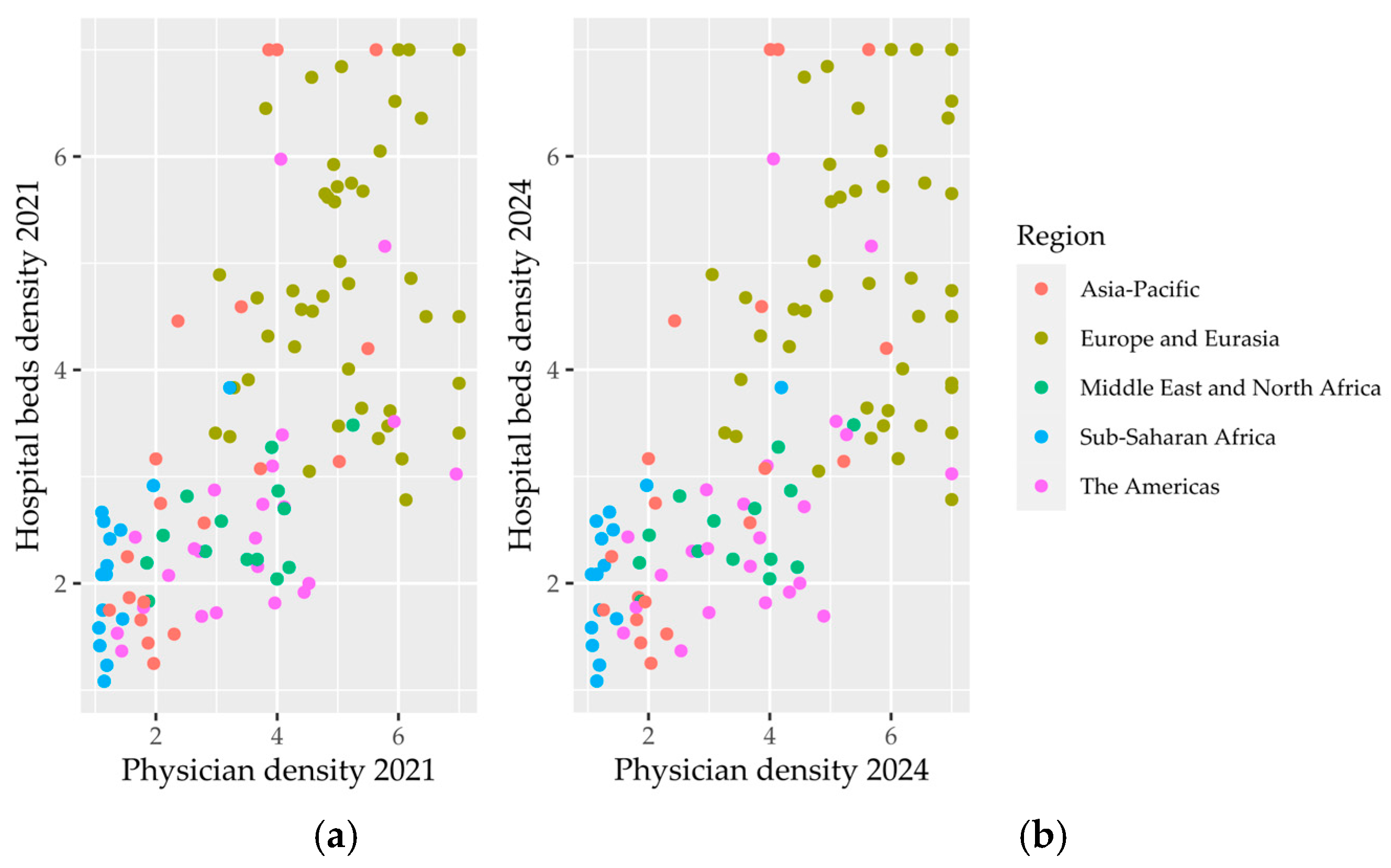
Figure 3 shows a clear positive association between physician density and hospital bed density in both 2021 and 2024. Countries with more physicians per population also tend to have more hospital beds, reflecting the shared health system resources required for both indicators. However, this relationship is not uniform across regions. Europe and Eurasia stand out, with countries clustering in the upper-right quadrant and both physician and hospital bed densities above five or six, indicative of well-developed health infrastructure with abundant medical staff and hospital capacity. In contrast, Sub-Saharan Africa lies at the opposite end of the distribution, with most countries clustered between one and three on both axes, underscoring persistent shortages of both physicians and hospital beds. The Americas, Asia–Pacific, and the Middle East and North Africa fall in between these two extremes, though with notable variation within each group. Some countries in these regions achieve relatively high physician densities but have fewer hospital beds, or vice versa, suggesting differences in health system structure and investment priorities.
Comparing 2021 with 2024, the overall relationship between physician density and hospital bed density remains largely stable, with little change among countries already at high levels, particularly in Europe and Eurasia. Some upward shifts are observed among middle-range countries, especially in Asia–Pacific region and the Middle East and North Africa, indicating gradual improvements in health resources. Sub-Saharan Africa, while still lagging significantly behind other regions, shows modest progress in both physician and hospital bed densities, although the gap with higher-performing regions remains substantial.
The results highlight a strong global correlation between physician and hospital bed densities [55], while also revealing pronounced regional disparities. Europe and Eurasia consistently demonstrate high resource availability, while Sub-Saharan Africa continues to face critical shortages. Incremental improvements are apparent in some middle-performing regions, but the unequal distribution of health infrastructure remains a defining feature of the global health landscape.
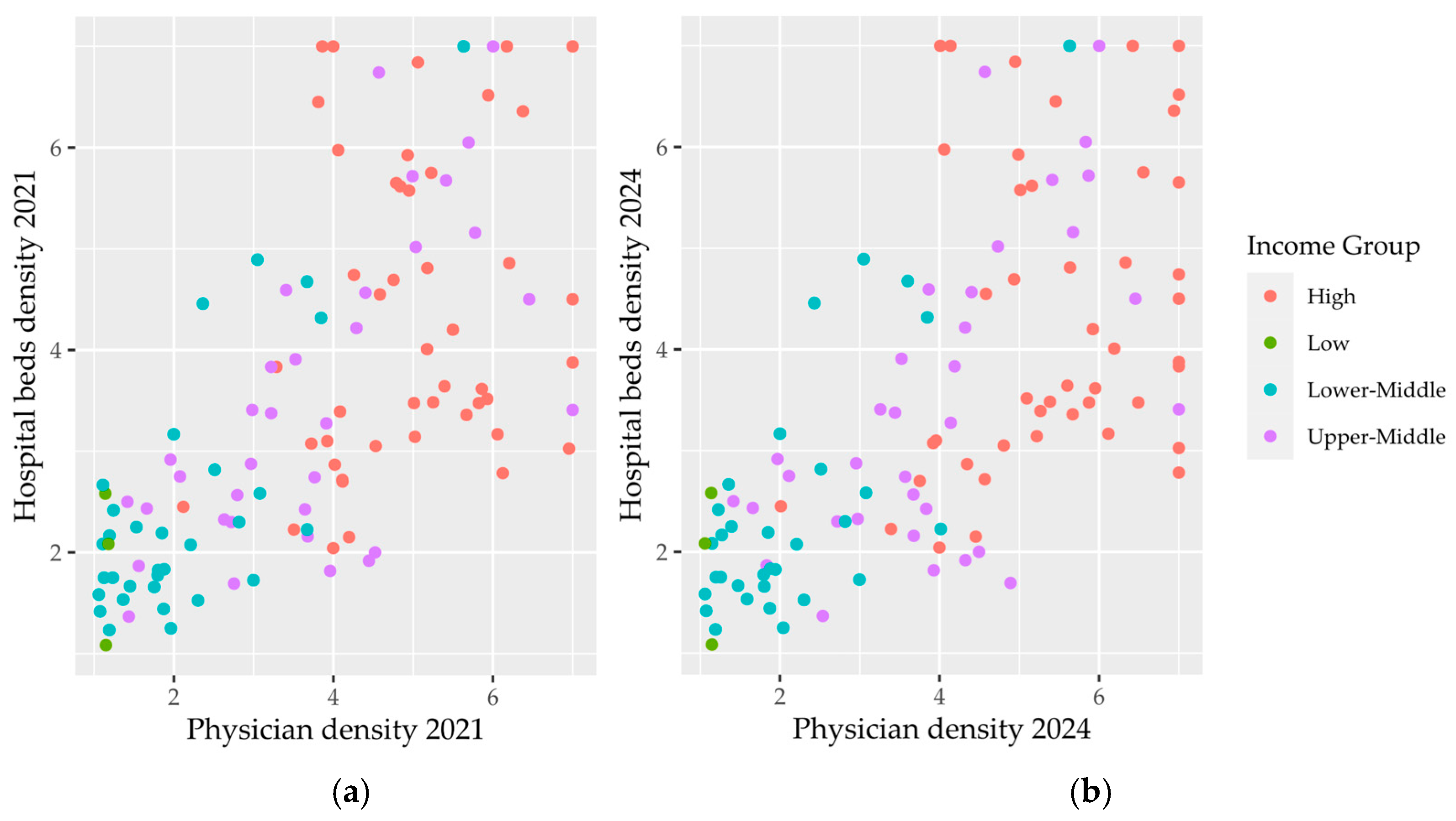
Figure 4 reveals a pronounced income gradient. High-income countries are concentrated in the upper-right quadrant, with values above five or six for both physician and hospital bed densities. This reflects well-resourced health systems with abundant staff and infrastructure. Upper-middle-income countries also tend to score relatively high, though with greater variation, and some fall in the mid-range of both indicators. Lower-middle-income countries are more dispersed across the middle and lower parts of the plots, with many clustered around values between two and four, reflecting moderate but insufficient resources. Low-income countries stand out as the most constrained group, concentrated at the bottom of the plots with densities around one to three for both indicators.
Comparing 2021 and 2024, the overall distribution of income groups remains largely unchanged, with little movement among high- and upper-middle-income countries, which already occupy the upper end of the scale. Some improvements are visible among lower-middle-income countries, with a few moving upward and to the right, suggesting increases in both physician and hospital bed densities. Low-income countries show modest gains as well, but they remain far below other income groups, underscoring persistent structural inequalities.
The results show a strong positive correlation between physician density and hospital bed density [55], and this relationship is strongly stratified by income level. High- and upper-middle-income countries exhibit both high physician availability and hospital capacity, whereas low-income countries face systemic shortages in both. These findings point to the crucial role of economic resources in shaping health system capacity and highlight the enduring challenge of reducing global inequalities in healthcare infrastructure.
In both 2021 and 2024, countries with higher availability of physicians also tend to have higher availability of hospital beds. This pattern suggests that investments in one dimension of healthcare capacity are often accompanied by improvements in the other, reflecting broader patterns of health system development.
The clustering of points in the upper-right corner demonstrates that many countries maintain simultaneously high levels of both indicators, whereas those in the lower-left quadrant reveal compounded shortages of medical staff and infrastructure. The overall pattern is similar across the two years, though a slight upward shift among some middle- and lower-scoring countries suggests gradual progress.
Table 15 presents the correlation coefficients between physician density and hospital bed density for all countries, as well as by region and income group, for 2021 and 2024.
Correlation coefficients for the low-income group are not reported due to the very small sample size (n = 4), which would render any estimates statistically unreliable and unsuitable for meaningful interpretation. For all countries, the correlation was strong and positive in both years (r = 0.7160 in 2021; r = 0.7126 in 2024), indicating that countries with higher physician density generally also have higher hospital bed density. The correlation remains largely stable over time. Regional analysis reveals substantial variation in the strength of the relationship, and analysis by income group shows distinct patterns across categories.
In summary, the overall correlation is strong and stable over time: physician density and hospital bed density tend to increase together, and countries rarely exhibit high levels of one without the other. This reinforces the idea that these indicators are complementary components of health system capacity, and improvements tend to occur in tandem.
The analysis demonstrates a close relationship between physician density and hospital bed density [53,56]. Countries with higher physician density typically have greater hospital bed availability, reflecting broader health system capacity and investment in healthcare infrastructure. These associations are likewise stratified by region and income level, with high- and upper-middle-income countries concentrated at the upper end of both distributions, whereas Sub-Saharan Africa and low-income groups remain at the lower end, highlighting enduring structural limitations in healthcare system resources.
For policymakers and tourism stakeholders, these findings indicate that sustainable tourism development is inseparable from health and hygiene infrastructure. However, the policy implications differ across contexts. In low-income countries, especially in Sub-Saharan Africa, priority should be given to foundational health system strengthening, including investments in primary healthcare, health workforce retention, water-sanitation infrastructure, and basic disease surveillance systems, which directly support public health resilience and tourism safety [115,116]. Lower-middle-income countries would benefit from public–private partnerships to expand hospital capacity in major tourist destinations, targeted training of mid-level health workers, and improved health risk communication within tourism promotion strategies. In upper-middle-income settings, policies should emphasize quality upgrades (such as accreditation, infection-control systems, and digital health tools) as well as regional coordination to manage cross-border tourism flows. High-income, tourism-dependent economies should maintain surge capacity for seasonal tourist influxes, adopt advanced health security measures, and integrate hygiene and food-safety standards into tourism certification programs. Diversified high-income economies, meanwhile, can focus on embedding health system resilience into broader economic planning and investing in data systems that link tourism activity to epidemiological monitoring. Destinations with strong healthcare capacity and public health resilience are more attractive to international travelers [3,6,7], particularly in a post-pandemic context. Investments in sanitation, safe water provision, and disease prevention are critical not only for health outcomes but also for maintaining global tourism competitiveness [5,8].
International organizations and development agencies should tailor their support to these differentiated needs rather than applying uniform approaches. Concessional financing for WASH and primary care expansion is particularly crucial for low-income tourism-reliant countries, while technical assistance for surveillance systems, workforce management, and tourism health standards can bolster resilience across all income groups. Cross-sectoral cooperation among governments, tourism authorities, and private investors remains essential to align health system strengthening with sustainable tourism development.

5. Conclusions

This study examined global health and hygiene conditions using TTDI indicators for 2021 and 2024, and highlighted persistent inequalities across regions and income groups despite modest improvements over time. The results show that health system capacity and basic service provision remain unevenly distributed worldwide. Europe and Eurasia continue to lead, with consolidated healthcare resources and low disease burdens, reflected in the highest mean values across all analyzed indicators. In contrast, Sub-Saharan Africa faces systemic deficits in sanitation, access to safe drinking water, healthcare workforce, and disease prevention, as evidenced by the lowest mean values. Income remains a key determinant of health outcomes, with high- and upper-middle-income countries approaching near-universal access to healthcare, while lower- and low-income countries continue to experience structural and systemic barriers. This pattern is also reflected in the mean values of the analyzed indicators.
Addressing these disparities requires targeted investment, international cooperation, and policy frameworks that integrate health and tourism planning. Although some progress is evident in low- and lower-middle-income countries, it remains too slow to close global gaps. A sustained commitment to equitable health system strengthening is essential for achieving both global health equity and resilient, sustainable tourism development.
Strong positive associations between sanitation and drinking water and between physician and hospital bed density highlight the interdependence of healthcare and infrastructure investments. These results emphasize that strengthening health systems is not only a public health priority but also a key factor in sustainable travel and tourism development.
Several limitations must be acknowledged. First, the TTDI dataset relies on standardized scores capped at 7.0, which may obscure finer variations at high levels of performance. Second, some indicators, such as hospital bed density and communicable disease incidence, did not change between 2021 and 2024 due to data availability constraints, limiting temporal analysis. Therefore, the comparisons between these years should be interpreted cautiously, with emphasis on cross-country patterns and trends rather than strong longitudinal conclusions. Third, the use of aggregate regional and income-group averages may mask significant within-group disparities. Fourth, the small number of low-income countries in the dataset prevented reliable estimation of correlation coefficients for this group. Consequently, correlations for low-income countries were not reported, and the findings for regional and income-group analyses should be interpreted with caution, particularly regarding the generalizability to low-income contexts.
Future research should extend the analysis beyond 2024, and investigate the relationship between health and hygiene indicators and the broader TTDI. The current study is limited to two time points (2021 and 2024), which constrains the ability to capture longer-term trends in health system capacity and public health resilience. A longitudinal approach would help determine whether the modest improvements observed represent sustained progress, short-term fluctuations, or post-pandemic rebounds. Furthermore, examining how health and hygiene indicators interact with the broader TTDI is crucial, as health security, sanitation, and disease prevention underpin tourism competitiveness, traveler confidence, and destination resilience. By quantifying these linkages, future studies could provide policymakers and industry stakeholders with evidence to prioritize health investments not only as social goods but also as drivers of sustainable tourism growth.

Author Contributions

Conceptualization, P.V. and K.M.; methodology, P.V.; software, P.V.; validation, P.V. and K.M.; formal analysis, P.V. and K.M.; investigation, P.V. and K.M.; resources, P.V. and K.M.; data curation, P.V.; writing—original draft preparation, P.V. and K.M.; writing—review and editing, P.V. and K.M.; visualization, P.V.; supervision, P.V.; project administration, P.V.; funding acquisition, P.V. All authors have read and agreed to the published version of the manuscript.

Funding

This research was funded by the Scientific Grant Agency of the Ministry of Education, Research, Development and Youth of the Slovak Republic and the Slovak Academy of Sciences (grant no. 1/0241/25–VEGA).

Institutional Review Board Statement

Not applicable.

Informed Consent Statement

Not applicable.

Data Availability Statement

The data presented in this study are available on request from the corresponding author.

Conflicts of Interest

The authors declare no conflicts of interest.

Abbreviations

The following abbreviations are used in this manuscript:
AIDSAcquired Immune Deficiency Syndrome
HIVHuman Immunodeficiency Virus
Q1First quartile
Q3Third quartile
rCorrelation coefficient
S.D.Standard Deviation
TTDITravel & Tourism Development Index
UNICEFUnited Nations International Children’s Emergency Fund
WASHWater, Sanitation, and Hygiene systems
WHOWorld Health Organization

Appendix A

Table A1. Countries according to region and income group.
ClassificationGroupsCountries
RegionAsia–PacificAUS, BGD, KHM, CHN, IND, IDN, JPN, KOR, LAO, MYS, MNG, NPL, NZL, PAK, PHL, SGP, LKA, THA, VNM
Europe and EurasiaALB, ARM, AUT, AZE, BEL, BIH, BGR, HRV, CYP, CZE, DNK, EST, FIN, FRA, GEO, DEU, GRC, HUN, ISL, IRL, ITA, KAZ, KGZ, LVA, LTU, LUX, MLT, MDA, MNE, NLD, MKD, POL, PRT, ROU, SRB, SVK, SVN, ESP, SWE, CHE, TJK, TUR, GBR, UZB
Middle East and North AfricaDZA, BHR, EGY, IRN, ISR, JOR, KWT, LBN, MAR, OMN, QAT, SAU, TUN, ARE
Sub-Saharan AfricaAGO, BEN, BWA, CMR, CIV, GHA, KEN, MWI, MLI, MUS, NAM, NGA, RWA, SEN, SLE, ZAF, TZA, ZMB, ZWE
The AmericasARG, BRB, BOL, BRA, CAN, COL, CRI, DOM, ECU, SLV, GTM, HND, CHL, JAM, MEX, NIC, PAN, PRY, PER, TTO, USA, URY, VEN
Income groupHighAUS, AUT, BHR, BRB, BEL, CAN, HRV, CYP, CZE, DNK, EST, FIN, FRA, DEU, GRC, HUN, CHL, ISL, IRL, ISR, ITA, JPN, KOR, KWT, LVA, LTU, LUX, MLT, NLD, NZL, OMN, POL, PRT, QAT, SAU, SGP, SVK, SVN, ESP, SWE, CHE, TTO, ARE, GBR, USA, URY
Upper-MiddleALB, ARG, ARM, AZE, BIH, BWA, BRA, BGR, COL, CRI, DOM, ECU, SLV, GEO, GTM, CHN, IDN, JAM, KAZ, LBN, MYS, MUS, MEX, MDA, MNE, NAM, MKD, PAN, PRY, PER, ROU, SRB, ZAF, THA, TUR
Lower-MiddleDZA, AGO, BGD, BEN, BOL, KHM, CMR, CIV, EGY, GHA, HND, IND, IRN, JOR, KEN, KGZ, LAO, MNG, MAR, NPL, NIC, NGA, PAK, PHL, SEN, LKA, TJK, TZA, TUN, UZB, VEN, VNM, ZMB, ZWE
LowMWI, MLI, RWA, SLE
Source: own processing. Note: countries’ codes are according to Alpha-3.

Appendix B

Figure A1. Boxplots of the Physician density according to region in: (a) 2021 and (b) 2024. Source: own processing using R.
Hygiene 06 00011 g0a1
Figure A2. Boxplots of the Use of basic sanitation according to region in: (a) 2021 and (b) 2024. Source: own processing using R.
Hygiene 06 00011 g0a2
Figure A3. Boxplots of the Use of basic drinking water according to region in: (a) 2021 and (b) 2024. Source: own processing using R.
Hygiene 06 00011 g0a3
Figure A4. Boxplots of the hospital bed density according to region in: (a) 2021 and (b) 2024. Source: own processing using R. Note: The database records identical values for 2021 and 2024, resulting in no observed changes. To maintain consistency within this research, hospital bed density is reported for both 2021 and 2024.
Hygiene 06 00011 g0a4
Figure A5. Boxplots of the Communicable disease incidence according to region in: (a) 2021 and (b) 2024. Source: own processing using R. Note: The database records identical values for 2021 and 2024, resulting in no observed changes. To maintain consistency within this research, Communicable disease incidence is reported for both 2021 and 2024.
Hygiene 06 00011 g0a5
Figure A6. Boxplots of the Health and Hygiene Pillar according to region in: (a) 2021 and (b) 2024. Source: own processing using R.
Hygiene 06 00011 g0a6
Figure A7. Boxplots of the Physician density according to income group in: (a) 2021 and (b) 2024. Source: own processing using R.
Hygiene 06 00011 g0a7
Figure A8. Boxplots of the Use of basic sanitation according to income group in: (a) 2021 and (b) 2024. Source: own processing using R.
Hygiene 06 00011 g0a8
Figure A9. Boxplots of the Use of drinking water according to income group in: (a) 2021 and (b) 2024. Source: own processing using R.
Hygiene 06 00011 g0a9
Figure A10. Boxplots of the hospital bed density according to income group in: (a) 2021 and (b). Source: own processing using R. Note: The database records identical values for 2021 and 2024, resulting in no observed changes. To maintain consistency within this research, hospital beds density is reported for both 2021 and 2024.
Hygiene 06 00011 g0a10
Figure A11. Boxplots of the Communicable disease incidence according to income group in: (a) 2021 and (b) 2024. Source: own processing using R. Note: The database records identical values for 2021 and 2024, resulting in no observed changes. To maintain consistency within this research, Communicable disease incidence is reported for both 2021 and 2024.
Hygiene 06 00011 g0a11
Figure A12. Boxplots of the Health and Hygiene Pillar according to income group in: (a) 2021 and (b) 2024. Source: own processing using R.
Hygiene 06 00011 g0a12

References

  1. WHO. Travel and Health. Available online: https://www.who.int/health-topics/travel-and-health#tab=tab_1 (accessed on 17 September 2025).
  2. Rasethuntsa, B.C. Health and Hygiene Strategies for Tourism Promotion: Guidelines for Africa. J. Tour. Leis. Hosp. 2022, 4, 158–164. [Google Scholar] [CrossRef]
  3. Al-Saad, S.; AlWohoush, O.; Kozak, M.; AlMasri, R. Health and Hygiene as a Factor of Destination Competitiveness: A Comparative Study Using Synchronic and Diachronic Data. Tour. Plan. Dev. 2023, 20, 317–335. [Google Scholar] [CrossRef]
  4. Moore, A.; Phillips, C. Travel & Tourism Development Index 2024; World Economic Forum: Geneva, Switzerland, 2024. [Google Scholar]
  5. Kamruzzaman, M.D.; Fariha, M.S. Efectiveness of Proper Health and Hygiene Practices: A Study on Ensuring Hygienic Environment in Bangladeshi Tourist Destinations. In Proceedings of the International Conference on Industrial Engineering and Operations Management, Washington, DC, USA, 27–29 September 2018. [Google Scholar]
  6. Bhatta, R.; Aryal, K.; Thapa, P.; Joshi, K.D.; Bhatta, C.R. Water, Sanitation and Hygiene in Nepal and International Travellers’ Travel-Health Experiences. J. Nepal. Health Res. Counc. 2023, 20, 611–616. [Google Scholar] [CrossRef] [PubMed]
  7. Mathur, S. Report: India to be 3rd Largest Tourism Economy in 10 Years. Times India. 2018. Available online: https://timesofindia.indiatimes.com/india/report-india-to-be-3rd-largest-tourism-economy-in-10-years/articleshow/63421777.cms (accessed on 18 September 2025).
  8. Boakye, K.A. Tourist’s views on safety and vulnerability: A study of some selected towns in Ghana. Tour. Manag. 2012, 33, 327–333. [Google Scholar] [CrossRef]
  9. Chandra, R.; Supehia, S.; Nath, B.; Chhetri, C.; Kumari, R.; Joshi, K.D.; Sharma, R.; Chaudary, J.; Joshi, K.; Bhatta, R.; et al. Effects of sanitation and hygiene perceptions on international travelers’ health, travel plans and trip experiences in India. Front. Public Health 2022, 10, 1042880. [Google Scholar] [CrossRef] [PubMed]
  10. Robina-Ramírez, R.; Ravina-Ripoll, R.; Castellano-Álvarez, F.J. The trinomial health, safety and happiness promote rural tourism. BMC Public Health 2023, 23, 1177. [Google Scholar] [CrossRef]
  11. Jovanović, S.; Janković-Milić, V.; Ilić, I. Health and Hygiene Importance for the Improvement of Tourism Sector Competitiveness in Serbia and the South-Eastern Europe Countries. Procedia Econ. Financ. 2015, 19, 373–382. [Google Scholar] [CrossRef]
  12. Vašaničová, P.; Litavcová, E.; Jenčová, S. Evaluation of Health and Hygiene Subindex of Travel and Tourism Competitiveness Index within V4 Countries. In Proceedings of the 5th International Multidisciplinary Scientific Conference on Social Sciences and Arts SGEM 2018, Albena, Bolgaria, 26 August–1 September 2018. [Google Scholar]
  13. Sandhubaya, G.; Hidayatullah, S.; Roedjinandari, N. Study of Influence of Cleanliness, Health, Safety & Environment Sustainability on Tourist to Revisit the Beaches of Indonesia. Int. J. Adv. Sci. Res. Eng. 2021, 7, 36–47. [Google Scholar] [CrossRef]
  14. Naumov, N.; Varadzhakova, D.; Naydenov, A. Sanitation and hygiene as factors for choosing a place to stay: Perceptions of the Bulgarian tourists. Anatolia 2021, 32, 144–147. [Google Scholar] [CrossRef]
  15. Kayar, Ç.H.; Kozak, N. Measuring destination competitiveness: An application of the travel and tourism competitiveness index (2007). J. Hosp. Mark. Manag. 2010, 19, 203–216. [Google Scholar] [CrossRef]
  16. Rodríguez-Díaz, B.; Pulido-Fernández, J.I. Sustainability as a key factor in tourism competitiveness: A global analysis. Sustainability 2019, 12, 51. [Google Scholar] [CrossRef]
  17. Panneer, S.; Kantamaneni, K.; Palaniswamy, U.; Bhat, L.; Pushparaj, R.R.B.; Nayar, K.R.; Manuel, H.S.; Flower, F.X.L.L.; Rice, L. Health, economic and social development challenges of the COVID-19 pandemic: Strategies for multiple and interconnected issues. Healthcare 2022, 10, 770. [Google Scholar] [CrossRef] [PubMed]
  18. Lupu, D.; Tiganasu, R. COVID-19 and the efficiency of health systems in Europe. Health Econ. Rev. 2022, 12, 14. [Google Scholar] [CrossRef]
  19. Filip, R.; Gheorghita Puscaselu, R.; Anchidin-Norocel, L.; Dimian, M.; Savage, W.K. Global challenges to public health care systems during the COVID-19 pandemic: A review of pandemic measures and problems. J. Pers. Med. 2022, 12, 1295. [Google Scholar] [CrossRef]
  20. Haileamlak, A. The impact of COVID-19 on health and health systems. Ethiop. J. Health Sci. 2021, 31, 1073. [Google Scholar]
  21. Statista. Coronavirus (COVID-19): Impact on Health and Hygiene in the Tourism Industry Worldwide—Statistics & Facts. Available online: https://www.statista.com/topics/8848/health-and-hygiene-in-the-tourism-industry-worldwide/?srsltid=AfmBOorLPlKsyHfDTSHG4IUOEU61_GR0MyvG_9sG43XMGu89SElmIhPD#topicOverview (accessed on 18 September 2025).
  22. Tarmizi, H.B.; Lubis, A.; Siregal, F.J.M.; Muda, I.; Atmanegara, A.W. The Importance of Hygiene, Safety and Health Protocols In Improving Tourism. Nat. Volatiles Essent. Oils J. 2021, 8, 10884–10889. [Google Scholar]
  23. Wilks, J. Tourist Health, Safety and Wellbeing in the New Normal; Springer: Singapore, 2021; pp. 1–22. [Google Scholar]
  24. Vaz Serra, P.; Seabra, C. Chapter 11: Hygiene and Health in Tourism, in a Post-Pandemic Context: From Expected Requirement to Mandatory Criterion. In Safety and Tourism: A Global Industry with Global Risks; Seabra, C., Korstanje, M.E., Eds.; Emerald Publishing Limited: Bingley, UK, 2023; pp. 195–216. [Google Scholar]
  25. Konak, S. The impact of tourist’s hygiene-safety perception on their intention to travel during the COVID-19 pandemic in Turkey. J. Tour. Theory Res. 2021, 8, 5–13. [Google Scholar] [CrossRef]
  26. Chen, C.; Haupert, S.R.; Zimmermann, L.; Shi, X.; Fritsche, L.G.; Mukherjee, B. Global prevalence of post-coronavirus disease 2019 (COVID-19) condition or long COVID: A meta-analysis and systematic review. J. Infect. Dis. 2022, 226, 1593–1607. [Google Scholar] [CrossRef]
  27. Altmann, D.M.; Whettlock, E.M.; Liu, S.; Arachchillage, D.J.; Boyton, R.J. The immunology of long COVID. Nat. Rev. Immunol. 2023, 23, 618–634. [Google Scholar] [CrossRef]
  28. Al-Aly, Z.; Davis, H.; McCorkell, L.; Soares, L.; Wulf-Hanson, S.; Iwasaki, A.; Topol, E.J. Long COVID science, research and policy. Nat. Med. 2024, 30, 2148–2164. [Google Scholar] [CrossRef]
  29. Souza, G.; Santos, C.; Lisboa, É. Water, Sanitation, and Hygiene in Urban Areas: A Review. Water 2025, 17, 2634. [Google Scholar] [CrossRef]
  30. Anthonj, C.; Fleming, L.; Godfrey, S.; Ambelu, A.; Bevan, J.; Cronk, R.; Bartram, J. Health risk perceptions are associated with domestic use of basic water and sanitation services—Evidence from rural Ethiopia. Int. J. Environ. Res. Public Health 2018, 15, 2112. [Google Scholar] [CrossRef] [PubMed]
  31. Ali, R.K.; Ndunguru, E.M. Assessment of Sanitation Services and Practices among Local Community in West B Municipality in Zanzibar Island, United Republic of Tanzania. J. Appl. Sci. Environ. Manag. 2024, 28, 2659–2669. [Google Scholar] [CrossRef]
  32. Gizaw, Z.; Gebrehiwot, M.; Destaw, B.; Nigusie, A. Access to basic drinking water services, safe water storage, and household water treatment practice in rural communities of northwest Ethiopia. Sci. Rep. 2022, 12, 20623. [Google Scholar] [CrossRef]
  33. Huttmanová, E.; Chovancová, J.; Rovňák, M.; Minďaš, M.; Kotulič, R.; Jenčová, S.; Ali-Taha, V. Innovative Environmental Management Approaches to Reduce Pollution of Water Resources. In Proceedings of the 8th International Scientific Conference of the Economics, Management & Business, Nový Smokovec, Slovakia, 28–29 September 2023. [Google Scholar]
  34. Liu, Q.; Liu, M.; Liu, J. Global associations between the use of basic drinking water and sanitation services with diarrhoeal disease incidence in 200 countries and territories from 2000 to 2019. Public Health 2024, 235, 202–210. [Google Scholar] [CrossRef]
  35. Balasooriya, B.K.; Rajapakse, J.; Gallage, C. A review of drinking water quality issues in remote and indigenous communities in rich nations with special emphasis on Australia. Sci. Total Environ. 2023, 903, 166559. [Google Scholar] [CrossRef]
  36. Okesanya, O.J.; Eshun, G.; Ukoaka, B.M.; Manirambona, E.; Olabode, O.N.; Adesola, R.O.; Okon, I.I.; Jamil, S.; Singh, A.; Lucero-Prisno, D.E., III; et al. Water, sanitation, and hygiene (WASH) practices in Africa: Exploring the effects on public health and sustainable development plans. Trop. Med. Health 2024, 52, 68. [Google Scholar] [CrossRef]
  37. Lewoyehu, M. Evaluation of drinking water quality in rural area of Amhara region, Ethiopia: The case of Mecha district. J. Chem. 2021, 2021, 9911838. [Google Scholar] [CrossRef]
  38. Krishan, A.; Yadav, S.; Srivastava, A. Water pollution’s global threat to public health: A mini-review. Int. J. Sci. Res. Sci. Eng. Technol. 2023, 10, 321–334. [Google Scholar] [CrossRef]
  39. Gqomfa, B.; Maphanga, T.; Shale, K. The impact of informal settlement on water quality of Diep River in Dunoon. Sustain. Water Resour. Manag. 2022, 8, 27. [Google Scholar] [CrossRef]
  40. Benito, B.; Faura, U.; Guillamón, M.D.; Ríos, A.M. The efficiency of public services in small municipalities: The case of drinking water supply. Cities 2019, 93, 95–103. [Google Scholar] [CrossRef]
  41. Abubakar, I.R. Factors influencing household access to drinking water in Nigeria. Util. Policy 2019, 58, 40–51. [Google Scholar] [CrossRef]
  42. Mukherjee, S.; Sundberg, T.; Schütt, B. Assessment of water security in socially excluded areas in Kolkata, India: An approach focusing on water, sanitation and hygiene. Water 2020, 12, 746. [Google Scholar] [CrossRef]
  43. Bain, R.; Johnston, R.; Mitis, F.; Chatterley, C.; Slaymaker, T. Establishing sustainable development goal baselines for household drinking water, sanitation and hygiene services. Water 2018, 10, 1711. [Google Scholar] [CrossRef]
  44. Salama, M. Achieving SDG 6: Remote Sensing Applications in Sustainable Water Management. Front. Remote Sens. 2025, 6, 1659681. [Google Scholar] [CrossRef]
  45. Stoler, J.; Guzmán, D.B.; Adams, E.A. Measuring transformative WASH: A new paradigm for evaluating water, sanitation, and hygiene interventions. Wiley Interdiscip. Rev. Water 2023, 10, e1674. [Google Scholar] [CrossRef]
  46. Workman, C.L.; Stoler, J.; Harris, A.; Ercumen, A.; Kearns, J.; Mapunda, K.M. Food, water, and sanitation insecurities: Complex linkages and implications for achieving WASH security. Glob. Public Health 2022, 17, 3060–3075. [Google Scholar] [CrossRef]
  47. Gaffan, N.; Kpozèhouen, A.; Dégbey, C.; Glèlè Ahanhanzo, Y.; Glèlè Kakaï, R.; Salamon, R. Household access to basic drinking water, sanitation and hygiene facilities: Secondary analysis of data from the demographic and health survey V, 2017–2018. BMC Public Health 2022, 22, 1345. [Google Scholar] [CrossRef]
  48. Nguea, S.M. Uncovering the linkage between sustainable development goals for access to electricity and access to safely managed drinking water and sanitation services. Soc. Sci. Med. 2024, 345, 116687. [Google Scholar] [CrossRef]
  49. Ferretti, F.; Mariani, M.; Sarti, E. Physician density: Will we ever close the gap? BMC Res. Notes 2023, 16, 84. [Google Scholar] [CrossRef]
  50. Yu, X.; Zhang, W.; Liang, J. Physician distribution across China’s cities: Regional variations. Int. J. Equity Health 2021, 20, 162. [Google Scholar] [CrossRef] [PubMed]
  51. Kim, J.N.; Oh, I.H. Optimizing hospital bed capacity and resource allocation using inflow and outflow indices for effective healthcare management. Inq. J. Health Care Organ. Provis. Financ. 2024, 61, 00469580241304244. [Google Scholar] [CrossRef]
  52. Sarif, N.; Kumar, A.; Dubey, U.S.; Dubey, B.; Sarwardi, S. Impact of hospital bed availability on infectious disease management: A stochastic and optimal control approach. Eur. Phys. J. Plus 2025, 140, 372. [Google Scholar] [CrossRef]
  53. Stolarchuk, C.; Kumar, P.; Lionis, C.; Anastasaki, M.; Conde, M.G.; Chowdhury, M.; Andoko, D.; Gauchan, B.; Awankem, B. Optimizing Healthcare Delivery: Strategies for Workforce Retention and Resource Allocation. J. Surg. Spec. Rural. Pract. 2025, 6, 3–8. [Google Scholar] [CrossRef]
  54. Hu, H.; Jian, W.; Fu, H.; Zhang, H.; Pan, J.; Yip, W. Health service underutilization and its associated factors for chronic diseases patients in poverty-stricken areas in China: A multilevel analysis. BMC Health Serv. Res. 2021, 21, 707. [Google Scholar] [CrossRef]
  55. Yan, X.; He, S.; Webster, C.; Yu, M. Divergent distributions of physicians and healthcare beds in China: Changing patterns, driving forces, and policy implications. Appl. Geogr. 2022, 138, 102626. [Google Scholar] [CrossRef]
  56. Elmer, D.; Endrei, D.; Németh, N.; Horváth, L.; Pónusz, R.; Kívés, Z.; Danku, N.; Csákvári, T.; Ágostan, I.; Boncz, I. Changes in the number of physicians and hospital bed capacity in Europe. Value Health Reg. Issues 2022, 32, 102–108. [Google Scholar] [CrossRef] [PubMed]
  57. Noda, S.; Hernandez, P.M.R.; Sudo, K.; Takahashi, K.; Woo, N.E.; Chen, H.; Inaoka, K.; Tateishi, E.; Affarah, W.S.; Kadriyan, H.; et al. Service delivery reforms for Asian ageing societies: A cross-country study between Japan, South Korea, China, Thailand, Indonesia, and the Philippines. Int. J. Integr. Care 2021, 21, 1. [Google Scholar] [CrossRef]
  58. Müller, D.; Akmatov, M.K.; von Stillfried, D.G. Lower ambulatory care availability and greater hospital capacity are associated with higher hospital case volumes. Res. Health Serv. Reg. 2025, 4, 7. [Google Scholar] [CrossRef] [PubMed]
  59. Zhen, X.; Chen, J.; Sun, X.; Sun, Q.; Guo, S.; Stålsby Lundborg, C. Socioeconomic factors contributing to antibiotic resistance in China: A panel data analysis. Antibiotics 2021, 10, 994. [Google Scholar] [CrossRef]
  60. Roffia, P.; Bucciol, A.; Hashlamoun, S. Determinants of life expectancy at birth: A longitudinal study on OECD countries. Int. J. Health Econ. Manag. 2023, 23, 189–212. [Google Scholar] [CrossRef]
  61. Tian, F.; Pan, J. Hospital bed supply and inequality as determinants of maternal mortality in China between 2004 and 2016. Int. J. Equity Health 2021, 20, 51. [Google Scholar] [CrossRef] [PubMed]
  62. Qin, A.; Qin, W.; Hu, F.; Wang, M.; Yang, H.; Li, L.; Chen, C.; Bao, B.; Xin, T.; Xu, L. Does unequal economic development contribute to the inequitable distribution of healthcare resources? Evidence from China spanning 2001–2020. Glob. Health 2024, 20, 20. [Google Scholar] [CrossRef] [PubMed]
  63. Jebeli, S.S.H.; Hadian, M.; Souresrafil, A. Study of health resource and health outcomes: Organization of economic corporation and development panel data analysis. J. Educ. Health Promot. 2019, 8, 70. [Google Scholar]
  64. Constantopoulos, A.; Yfantopoulos, J.; Xenos, P.; Vozikis, A. Cluster shifts based on healthcare factors: The case of Greece in an OECD background 2009–2014. Adv. Manag. Appl. Econ. 2019, 9, 29–50. [Google Scholar]
  65. Wendelboe, A.M.; McCumber, M.; Erb-Alvarez, J.; Mould, N.; Childs, R.W.; Regens, J.L. Managing emerging transnational public health security threats: Lessons learned from the 2014 West African Ebola outbreak. Glob. Health 2018, 14, 75. [Google Scholar] [CrossRef]
  66. Al Saffer, Q.; Al-Ghaith, T.; Alshehri, A.; Al-Mohammed, R.; Al Homidi, S.; Hamza, M.M.; Herbst, C.H.; Alazemi, N. The capacity of primary health care facilities in Saudi Arabia: Infrastructure, services, drug availability, and human resources. BMC Health Serv. Res. 2021, 21, 365. [Google Scholar] [CrossRef]
  67. Winkelmann, J.; Webb, E.; Williams, G.A.; Hernández-Quevedo, C.; Maier, C.B.; Panteli, D. European countries’ responses in ensuring sufficient physical infrastructure and workforce capacity during the first COVID-19 wave. Health Policy 2022, 126, 362–372. [Google Scholar] [CrossRef]
  68. Pál, V.; Lados, G.; Ilcsikné Makra, Z.; Boros, L.; Uzzoli, A.; Fabula, S. Concentration and inequality in the geographic distribution of physicians in the European Union, 2006–2018. Reg. Stat. 2021, 11, 3–28. [Google Scholar] [CrossRef]
  69. Klimek, P.; Ledebur, K.; Gyimesi, M.; Ostermann, H.; Thurner, S. Forecasting the early impact of COVID-19 on physician supply in EU countries. Int. J. Health Policy Manag. 2024, 13, 7555. [Google Scholar] [CrossRef]
  70. Yi, V.; Duong, K.; Prom, V.; Thao, T.; Tran, L.; Vu, M.P.; Vuong, L.N.; Duong, D.B.; Gottlieb, B. Strengthening Faculty Development through Regional and Global Collaboration: An Innovative Virtual Program in Cambodia. Ann. Glob. Health 2025, 91, 29. [Google Scholar] [CrossRef] [PubMed]
  71. Gëdeshi, I.; King, R.; Ceka, A. The Emigration of Medical Doctors from Albania: Brain Drain vs Return and Cooperation. Cent. East. Eur. Migr. Rev. 2024, 13, 5–25. [Google Scholar] [CrossRef]
  72. Mustafaj, S.; Tola, A.; Dishmema, E.; Muca, E. Efficiency Evaluation of the Healthcare System in Albania. Econ. Altern. 2025, 3, 909–926. [Google Scholar] [CrossRef]
  73. Pindelski, M. Inequalities in Healthcare Access: Central & Eastern Europe vs. Western EU Countries. In Socioeconomic Inequality in Central and Eastern Europe; Wędrowska, E., Goliński, M., Doligalski, T., Ignasiak-Szulc, A., Eds.; Routledge: Oxfordshire, UK, 2025; pp. 81–92. [Google Scholar]
  74. Ismail, H.A.; Chun, S. The Brain Drain of Egyptian Physicians and Its Driving Factors: A Cross-Sectional Study. Soc. Sci. 2025, 14, 295. [Google Scholar] [CrossRef]
  75. Gajewski, J.; Pittalis, C.; Borgstein, E.; Bijlmakers, L.; Mwapasa, G.; Cheelo, M.; Juma, A.; Sardana, M.; Brugha, R. Critical shortage of capacity to deliver safe paediatric surgery in sub-Saharan Africa: Evidence from 67 hospitals in Malawi, Zambia, and Tanzania. Front. Pediatr. 2023, 11, 1189676. [Google Scholar] [CrossRef]
  76. Biswas, S.; Adhikary, M.; Alam, A.; Islam, N.; Roy, R. Disparities in access to water, sanitation, and hygiene (WASH) services and the status of SDG-6 implementation across districts and states in India. Heliyon 2024, 10, e37646. [Google Scholar] [CrossRef]
  77. World Health Organization; United Nations Children’s Fund. Progress on Household Drinking Water, Sanitation and Hygiene 2000–2024: Special Focus on Inequalities; World Health Organization, United Nations Children’s Fund: Geneva, Switzerland, 2025. [Google Scholar]
  78. Rajapakse, J.; Otoo, M.; Danso, G. Progress in delivering SDG6: Safe water and sanitation. Camb. Prism. Water 2023, 1, e6. [Google Scholar] [CrossRef]
  79. Zhai, C.; Bretthauer, K.; Mejia, J.; Pedraza-Martinez, A. Improving drinking water access and equity in rural sub-Saharan Africa. Prod. Oper. Manag. 2023, 32, 2921–2939. [Google Scholar] [CrossRef]
  80. Wydra, K.; Becker, P.; Aulich, H. Sustainable solutions for solar energy driven drinking water supply for rural settings in Sub-Saharan Africa: A case study of Nigeria. J. Photonics Energy 2019, 9, 043106. [Google Scholar] [CrossRef]
  81. Szopińska, M.; Artichowicz, W.; Szumińska, D.; Kasprowicz, D.; Polkowska, Ż.; Fudala-Ksiazek, S.; Luczkiewicz, A. Drinking water safety evaluation in the selected sub-saharan African countries: A case study of Madagascar, Uganda and Rwanda. Sci. Total Environ. 2024, 947, 174496. [Google Scholar] [CrossRef]
  82. Aklilu, T.; Sahilu, G.; Ambelu, A. Public health risks associated with drinking water consumption in the upper Awash River sub-basin, Ethiopia, sub-Saharan Africa. Heliyon 2024, 10, e24790. [Google Scholar] [CrossRef]
  83. Nkiaka, E.; Bryant, R.G.; Okumah, M.; Gomo, F.F. Water security in sub-Saharan Africa: Understanding the status of sustainable development goal 6. Wiley Interdiscip. Rev. Water 2021, 8, e1552. [Google Scholar] [CrossRef]
  84. Armah, F.A.; Ekumah, B.; Yawson, D.O.; Odoi, J.O.; Afitiri, A.R.; Nyieku, F.E. Access to improved water and sanitation in sub-Saharan Africa in a quarter century. Heliyon 2018, 4, e00931. [Google Scholar] [CrossRef]
  85. Ohwo, O.; Agusomu, T.D. Assessment of water, sanitation and hygiene services in sub-Saharan Africa. Eur. Sci. J. 2018, 14, 308–326. [Google Scholar] [CrossRef]
  86. Huber, L.; Rickert, B.; Schmoll, O.; Vargha, M. Equitable access to drinking-water: Focus on European Union member states. J. Water Sanit. Hyg. Dev. 2024, 14, 1169–1181. [Google Scholar] [CrossRef]
  87. Akram, W.; Hussain, Z.; Adeel, S. Water and food security in the Middle Eastern and Northern African countries. In The Water, Climate, and Food Nexus: Linkages, Challenges and Emerging Solutions; Behnassi, M., Al-Shaikh, A.A., Gurib-Fakim, A., Barjees Baig, M., Bahir, M., Eds.; Springer International Publishing: Cham, Switzerland, 2024; pp. 35–58. [Google Scholar]
  88. Onywera, H.; Mwapagha, L.M.; Hsiao, N.Y. The need for a balanced hospital-based care (HBC) and home-and community-based care (HCBC) approach for mitigating COVID-19 pandemic in sub-Saharan Africa. Pan Afr. Med. J. 2021, 38, 196. [Google Scholar] [CrossRef] [PubMed]
  89. Kumar, S.; Afifa, U.; Reddy, S.; Kumar, A.; Choudhary, S.; Kumar, A.; Singh, S. Analysing health conditions and economic influence on healthcare infrastructure: A comparative analysis of India, China, Japan, and South Korea. J. Fam. Med. Prim. Care 2025, 14, 2729–2738. [Google Scholar] [CrossRef] [PubMed]
  90. Govender, R.D.; Hashim, M.J.; Khan, M.A.; Mustafa, H.; Khan, G. Global epidemiology of HIV/AIDS: A resurgence in North America and Europe. J. Epidemiol. Glob. Health 2021, 11, 296–301. [Google Scholar] [CrossRef]
  91. Deng, P.; Chen, M.; Si, L. Temporal trends in inequalities of the burden of HIV/AIDS across 186 countries and territories. BMC Public Health 2023, 23, 981. [Google Scholar] [CrossRef]
  92. Obeagu, E.I.; Alum, E.U.; Obeagu, G.U. Factors associated with prevalence of HIV among youths: A review of Africa perspective. Madonna Univ. J. Med. Health Sci. 2023, 3, 13–18. [Google Scholar]
  93. Mooketsane, K.S.; Phirinyane, M.B. Health governance in sub-Saharan Africa. Glob. Soc. Policy 2015, 15, 345–348. [Google Scholar] [CrossRef]
  94. Agyei, E.; Kumah, E. Navigating the complex terrain of healthcare systems in Sub-Saharan Africa: Challenges and opportunities for progress. Discov. Health Syst. 2024, 3, 39. [Google Scholar] [CrossRef]
  95. Nyika, J.; Dinka, M.O. Water Challenges in Rural and Urban Sub-Saharan Africa and Their Management; Springer: Cham, Switzerland, 2023. [Google Scholar]
  96. Moyo-Chilufya, M.; Maluleke, K.; Kgarosi, K.; Muyoyeta, M.; Hongoro, C.; Musekiwa, A. The burden of non-communicable diseases among people living with HIV in Sub-Saharan Africa: A systematic review and meta-analysis. eClinicalMedicine 2023, 65, 102255. [Google Scholar] [CrossRef] [PubMed]
  97. Amu, H.; Brinsley, T.Y.; Kwafo, F.O.; Amu, S.; Bain, L.E. Improving investment in chronic disease care in Sub-Saharan Africa is crucial for the achievement of SDG 3.4: Application of the chronic care model. Arch. Public Health 2023, 81, 169. [Google Scholar] [CrossRef] [PubMed]
  98. Kanyangarara, M.; Allen, S.; Jiwani, S.S.; Fuente, D. Access to water, sanitation and hygiene services in health facilities in sub-Saharan Africa 2013–2018: Results of health facility surveys and implications for COVID-19 transmission. BMC Health Serv. Res. 2021, 21, 601. [Google Scholar] [CrossRef]
  99. Okoi, O.; Bwawa, T. How health inequality affect responses to the COVID-19 pandemic in Sub-Saharan Africa. World Dev. 2020, 135, 105067. [Google Scholar] [CrossRef]
  100. Chippaux, J.P. COVID-19 impacts on healthcare access in sub-Saharan Africa: An overview. J. Venom. Anim. Toxins Incl. Trop. Dis. 2023, 29, e20230002. [Google Scholar] [CrossRef]
  101. Sirag, A.; Gebrail, M. Public Health Spending in Africa: Cyclicality, Asymmetries, and COVID-19. Economies 2025, 13, 284. [Google Scholar] [CrossRef]
  102. Obradović, S.; Obradović, D. Importance of Water Supply System for Public Health. Eur. J. Sustain. Dev. Res. 2023, 7, 89–99. [Google Scholar]
  103. Juran, S.; Broer, P.N.; Klug, S.J.; Snow, R.C.; Okiro, E.A.; Ouma, P.O.; Snow, R.W.; Tatem, A.J.; Meara, J.G.; Alegana, V.A. Geospatial mapping of access to timely essential surgery in sub-Saharan Africa. BMJ Glob. Health 2018, 3, e000875. [Google Scholar] [CrossRef]
  104. Foster, T.; Priadi, C.; Kotra, K.K.; Odagiri, M.; Rand, E.C.; Willetts, J. Self-supplied drinking water in low-and middle-income countries in the Asia-Pacific. npj Clean Water 2021, 4, 37. [Google Scholar] [CrossRef]
  105. Kumpel, E.; Delaire, C.; Peletz, R.; Kisiangani, J.; Rinehold, A.; De France, J.; Sutherland, D.; Khush, R. Measuring the impacts of water safety plans in the Asia-Pacific region. Int. J. Environ. Res. Public Health 2018, 15, 1223. [Google Scholar] [CrossRef] [PubMed]
  106. Matus-López, M.; Fernández Pérez, P. Transformations in Latin American healthcare: A retrospective analysis of hospital beds, medical doctors, and nurses from 1960 to 2022. J. Evol. Stud. Bus. 2023, 8, 248–288. [Google Scholar] [CrossRef]
  107. Cénat, J.M. US deportation policies in the time of COVID-19: A public health threat to the Americas. Public Health 2020, 185, 4. [Google Scholar] [CrossRef]
  108. Acheampong, A.O.; Opoku, E.E.O.; Tetteh, G.K. Unveiling the effect of income inequality on safe drinking water, sanitation and hygiene (WASH): Does financial inclusion matter? World Dev. 2024, 178, 106573. [Google Scholar] [CrossRef]
  109. Yesilaydin, G.; Bayin Donar, G.; Alpaslan Takan, M. Efficiency of countries in terms of healthcare access and quality: Shannon entropy based data envelopment analysis and logistic regression modelling. Psychol. Health Med. 2025; in press. 1–21. [Google Scholar] [CrossRef]
  110. Yang, F.; Li, Z.; Subramanian, S.V.; Lu, C. Assessment of knowledge of HIV/AIDS and association with socioeconomic disparities among young women in low-and middle-income countries, 2003 to 2018. JAMA Netw. Open 2021, 4, e2035000. [Google Scholar] [CrossRef] [PubMed]
  111. Lee, D.; Gibson, J.M.; Brown, J.; Habtewold, J.; Murphy, H.M. Burden of disease from contaminated drinking water in countries with high access to safely managed water: A systematic review. Water Res. 2023, 242, 120244. [Google Scholar] [CrossRef]
  112. McMichael, C. Water, sanitation and hygiene (WASH) in schools in low-income countries: A review of evidence of impact. Int. J. Environ. Res. Public Health 2019, 16, 359. [Google Scholar] [CrossRef] [PubMed]
  113. Greenwood, E.E.; Lauber, T.; van den Hoogen, J.; Donmez, A.; Bain, R.E.; Johnston, R.; Crowther, T.W.; Julian, T.R. Mapping safe drinking water use in low-and middle-income countries. Science 2024, 385, 784–790. [Google Scholar] [CrossRef]
  114. Grossi, V.; Shinee, E.; Schmoll, O.; Kistemann, T. Water, sanitation and hygiene in health facilities and how they affect health in European countries. Eur. J. Public Health 2020, 30, ckaa166.720. [Google Scholar] [CrossRef]
  115. Goma, F.M.; Ngwakum, P.A.; Phiri-Chibawe, C. Enhancing Harmonization to Ensure Alignment of Partners, Implementation and Priorities for Provision of Quality Primary Healthcare to Communities in Rural Zambia. World Health Popul. 2017, 17, 18–30. [Google Scholar] [CrossRef] [PubMed]
  116. Hernandez, M.L. Challenges in Global Healthcare: Addressing Health Disparities. Physicians’ Rev. 2025, 2, 1–10. [Google Scholar]
Figure 1. Relationship between basic sanitation and basic drinking water according to region in: (a) 2021 and (b) 2024. Source: own processing using R.
Hygiene 06 00011 g001
Figure 2. Relationship between basic sanitation and basic drinking water according to income group in: (a) 2021 and (b) 2024. Source: own processing using R.
Hygiene 06 00011 g002
Figure 3. Relationship between physician density and hospital bed density according to region in: (a) 2021 and (b) 2024. Source: own processing using R.
Hygiene 06 00011 g003
Figure 4. Relationship between physician density and hospital bed density according to income group in: (a) 2021 and (b) 2024. Source: own processing using R.
Hygiene 06 00011 g004
Table 1. Overview of empirical studies on health and hygiene in tourism.
ReferencesCountryShort Summary
Rasethuntsa [2]Mauritius and Egypt (Africa)The government’s role in ensuring health and hygiene in tourism lies in developing policies that support and promote a healthy tourism sector. Findings also show that both countries largely apply similar strategies to promote health and hygiene, which has a positive impact on the tourism industry.
Kamruzzaman and Fariha [5]BangladeshThe analysis shows a strong correlation between health and hygiene conditions and tourist arrivals in Bangladesh.
Jovanović et al. [11]Serbia and
Southeastern
European countries
Overall analysis indicates that the density of doctors per 1000 inhabitants, access to improved sanitation, access to safe drinking water, and the number of hospital beds per 10,000 inhabitants have varying impacts on the health and hygiene pillar. Among these, physician density has the greatest influence.
Chandra et al. [9]IndiaNegative perceptions of hygiene and sanitation, and their adverse effects on the overall travel experience, render India’s tourism sector vulnerable.
Vašaničová et al. [12]The Visegrad group countriesThe analysis indicates that the Visegrad group countries offer a safe and healthy environment for tourism, providing favorable conditions for its development. In terms of both healthcare and environmental health, visitors can travel without major health concerns. These countries also have high levels of access to improved sanitation and safe drinking water.
Table 2. Descriptive statistics of the physician density according to region in 2021 and 2024.
Asia–Pacific
(19)
Europe and
Eurasia (44)
Middle East and
North Africa (14)
Sub-Saharan
Africa (19)
The Americas
(23)
2021202420212024202120242021202420212024
Mean2.863.025.125.573.353.401.361.433.543.73
S.D.1.391.471.101.191.011.080.510.711.441.37
Min1.231.262.983.051.851.851.061.061.361.59
Q11.841.914.504.792.592.591.111.122.682.84
Median2.302.305.055.753.593.571.181.203.683.83
Q33.793.975.966.514.014.111.341.394.104.53
Max5.635.927.007.005.255.383.224.196.957.00
Source: own processing using R. Note: S.D. denotes standard deviation; Q1 and Q3 denote the first and third quartiles, respectively.
Table 3. Descriptive statistics of the use of basic sanitation according to region in 2021 and 2024.
Asia–Pacific
(19)
Europe and
Eurasia (44)
Middle East and
North Africa (14)
Sub-Saharan
Africa (19)
The Americas
(23)
2021202420212024202120242021202420212024
Mean6.046.186.806.816.776.773.453.536.286.33
S.D.0.920.840.280.270.330.331.401.400.660.64
Min4.104.295.915.996.066.061.621.634.714.91
Q15.315.606.746.756.726.722.682.686.046.08
Median6.236.486.896.906.926.923.183.216.436.50
Q36.967.007.007.007.007.003.994.086.836.88
Max7.007.007.007.007.007.006.706.707.007.00
Source: own processing using R. Note: S.D. denotes standard deviation; Q1 and Q3 denote the first and third quartiles, respectively.
Table 4. Descriptive statistics of the use of basic drinking water according to region in 2021 and 2024.
Asia–Pacific
(19)
Europe and
Eurasia (44)
Middle East and
North Africa (14)
Sub-Saharan
Africa (19)
The Americas
(23)
2021202420212024202120242021202420212024
Mean6.246.316.756.766.626.643.914.066.596.61
S.D.0.820.780.440.430.500.471.551.540.520.51
Min4.154.364.824.835.315.441.861.934.814.81
Q15.875.916.566.636.406.432.592.836.306.37
Median6.516.667.007.006.856.853.433.626.766.82
Q37.007.007.007.007.007.005.155.337.007.00
Max7.007.007.007.007.007.007.007.007.007.00
Source: own processing using R. Note: S.D. denotes standard deviation; Q1 and Q3 denote the first and third quartiles, respectively.
Table 5. Descriptive statistics of the hospital bed density according to region in 2021 and 2024.
Asia–Pacific
(19)
Europe and
Eurasia (44)
Middle East and
North Africa (14)
Sub-Saharan
Africa (15)
The Americas
(23)
2021202420212024202120242021202420212024
Mean3.293.294.834.832.512.512.132.132.612.61
S.D.1.931.931.241.240.470.470.720.721.111.11
Min1.251.252.782.781.831.831.081.081.371.37
Q11.791.793.793.792.202.201.631.631.871.87
Median2.752.754.684.682.382.382.082.082.332.33
Q34.334.335.735.732.792.792.542.542.952.95
Max7.007.007.007.003.483.483.833.835.985.98
Source: own processing using R. Note: S.D. denotes standard deviation; Q1 and Q3 denote the first and third quartiles, respectively. The database records identical values for 2021 and 2024, resulting in no observed changes. To maintain consistency within this research, hospital bed density is reported for both 2021 and 2024.
Table 6. Descriptive statistics of the communicable disease incidence according to region in 2021 and 2024.
Asia–Pacific
(19)
Europe and
Eurasia (44)
Middle East and
North Africa (14)
Sub-Saharan
Africa (19)
The Americas
(23)
2021202420212024202120242021202420212024
Mean5.545.546.366.365.605.602.692.695.395.39
S.D.0.770.770.610.610.430.431.311.310.650.65
Min4.704.705.095.094.924.921.001.004.484.48
Q14.954.955.975.975.435.431.731.735.035.03
Median5.345.346.376.375.555.552.532.535.175.17
Q36.226.226.976.975.695.693.633.635.475.47
Max6.836.837.007.006.886.885.635.636.786.78
Source: own processing using R. Note: S.D. denotes standard deviation; Q1 and Q3 denote the first and third quartiles, respectively. The database records identical values for 2021 and 2024, resulting in no observed changes. To maintain consistency within this research, Communicable disease incidence is reported for both 2021 and 2024.
Table 7. Descriptive statistics of the health and hygiene pillar according to region in 2021 and 2024.
Asia–Pacific
(19)
Europe and
Eurasia (44)
Middle East and
North Africa (14)
Sub-Saharan
Africa (19)
The Americas
(23)
2021202420212024202120242021202420212024
Mean4.464.535.775.894.544.552.462.514.494.55
S.D.1.041.040.500.530.460.470.840.870.760.74
Min3.103.194.714.713.703.711.411.463.303.40
Q13.543.555.505.644.344.322.022.073.954.01
Median4.294.315.775.894.514.542.202.274.434.45
Q35.275.376.036.234.754.792.882.935.145.20
Max6.206.237.007.005.655.694.885.136.005.97
Source: own processing using R. Note: S.D. denotes standard deviation; Q1 and Q3 denote the first and third quartiles, respectively.
Table 8. Descriptive statistics of the physician density according to income group in 2021 and 2024.
High (46)Low (4)Lower-Middle (34)Upper-Middle (35)
20212024202120242021202420212024
Mean4.995.441.141.112.062.103.703.91
S.D.1.101.210.040.041.041.041.491.43
Min2.122.011.091.061.061.061.421.42
Q14.094.571.131.081.231.262.742.96
Median4.985.421.141.111.831.863.643.86
Q35.856.471.161.142.482.494.554.65
Max7.007.001.181.155.635.637.007.00
Source: own processing using R. Note: S.D. denotes standard deviation; Q1 and Q3 denote the first and third quartiles, respectively.
Table 9. Descriptive statistics of the use of basic sanitation according to income group in 2021 and 2024.
High (46)Low (4)Lower-Middle (34)Upper-Middle (35)
20212024202120242021202420212024
Mean6.916.923.423.604.915.016.286.33
S.D.0.150.151.401.391.651.650.800.79
Min6.296.281.731.861.621.632.682.72
Q16.886.892.933.183.413.536.086.09
Median7.007.003.383.655.195.506.526.60
Q37.007.003.874.076.326.456.806.80
Max7.007.005.175.266.866.897.007.00
Source: own processing using R. Note: S.D. denotes standard deviation; Q1 and Q3 denote the first and third quartiles, respectively.
Table 10. Descriptive statistics of the use of basic drinking water according to income group in 2021 and 2024.
High (46)Low (4)Lower-Middle (34)Upper-Middle (35)
20212024202120242021202420212024
Mean6.936.933.333.585.095.196.546.58
S.D.0.220.230.991.041.541.510.410.39
Min5.935.842.572.811.861.935.235.31
Q17.007.002.602.834.154.416.306.37
Median7.007.003.023.235.505.666.566.64
Q37.007.003.753.986.326.387.007.00
Max7.007.004.695.046.886.887.007.00
Source: own processing using R. Note: S.D. denotes standard deviation; Q1 and Q3 denote the first and third quartiles, respectively.
Table 11. Descriptive statistics of the hospital bed density according to income group in 2021 and 2024.
High (46)Low (3)Lower-Middle (32)Upper-Middle (34)
20212024202120242021202420212024
Mean4.334.331.921.922.452.453.503.50
S.D.1.521.520.760.761.291.291.531.53
Min2.042.041.081.081.231.231.371.37
Q13.113.111.581.581.661.662.352.35
Median3.853.852.082.082.082.083.103.10
Q35.645.642.332.332.602.604.554.55
Max7.007.002.582.587.007.007.007.00
Source: own processing using R. Note: S.D. denotes standard deviation; Q1 and Q3 denote the first and third quartiles, respectively. The database records identical values for 2021 and 2024, resulting in no observed changes. To maintain consistency within this research, hospital bed density is reported for both 2021 and 2024.
Table 12. Descriptive statistics of the communicable disease incidence according to income group in 2021 and 2024.
High (46)Low (4)Lower-Middle (34)Upper-Middle (35)
20212024202120242021202420212024
Mean6.486.482.352.354.214.215.385.38
S.D.0.560.561.191.191.511.510.710.71
Min5.075.071.001.001.001.003.383.38
Q16.166.161.771.773.333.335.105.10
Median6.786.782.262.264.924.925.355.35
Q36.966.962.832.835.305.305.865.86
Max7.007.003.873.875.695.696.366.36
Source: own processing using R. Note: S.D. denotes standard deviation; Q1 and Q3 denote the first and third quartiles, respectively. The database records identical values for 2021 and 2024, resulting in no observed changes. To maintain consistency within this research, Communicable disease incidence is reported for both 2021 and 2024.
Table 13. Descriptive statistics of the health and hygiene pillar according to income group in 2021 and 2024.
High (46)Low (4)Lower-Middle (34)Upper-Middle (35)
20212024202120242021202420212024
Mean5.685.792.162.213.433.464.744.81
S.D.0.580.620.600.591.091.080.880.85
Min4.334.311.411.461.451.462.942.96
Q15.375.481.982.012.372.414.194.29
Median5.755.862.182.233.523.554.624.63
Q36.056.212.362.434.284.305.495.47
Max7.007.002.872.915.675.706.436.43
Source: own processing using R. Note: S.D. denotes standard deviation; Q1 and Q3 denote the first and third quartiles, respectively.
Table 14. Correlation between basic sanitation and basic drinking water in 2021 and 2024.
20212024
All countries0.77660.7631
Region
Asia–Pacific0.76680.7864
Europe and Eurasia0.45230.4443
Middle East and North Africa0.53050.5305
Sub-Saharan Africa0.45610.4632
The Americas0.75210.6787
Income group
High0.55770.5731
Upper-Middle0.62750.5612
Lower-Middle 0.54460.5433
Table 15. Correlation between physician density and hospital bed density in 2021 and 2024.
20212024
All countries0.71600.7126
Region
Asia–Pacific0.74170.7258
Europe and Eurasia0.10560.0640
Middle East and North Africa0.36080.3916
Sub-Saharan Africa0.46290.5916
The Americas0.59390.5128
Income group
High0.24250.3378
Upper-Middle0.43840.4048
Lower-Middle 0.71890.7094
Disclaimer/Publisher’s Note: The statements, opinions and data contained in all publications are solely those of the individual author(s) and contributor(s) and not of MDPI and/or the editor(s). MDPI and/or the editor(s) disclaim responsibility for any injury to people or property resulting from any ideas, methods, instructions or products referred to in the content.