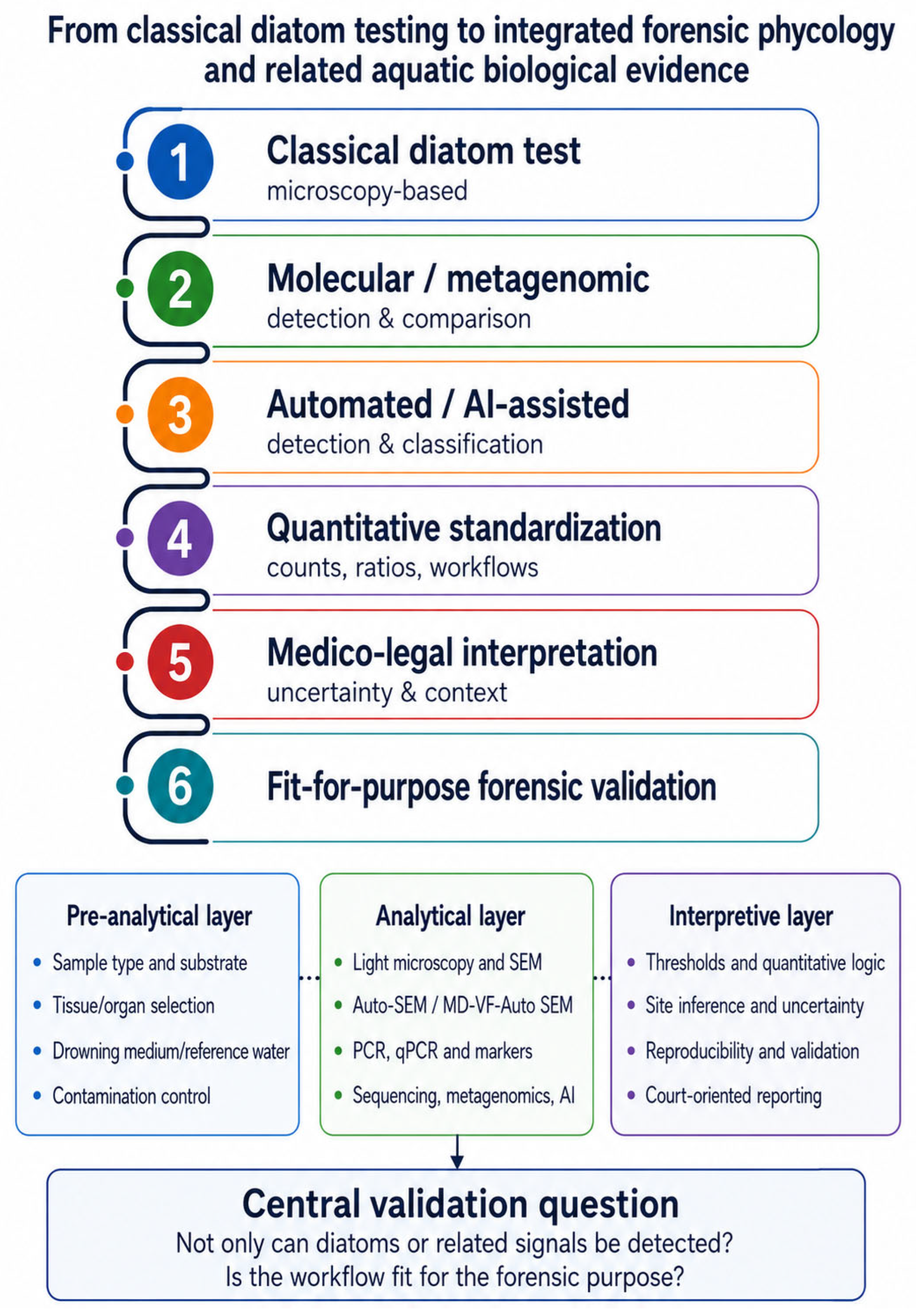

Beyond the Diatom Test: Emerging Diatom-Based Approaches and Medico-Legal Validation in Forensic Drowning Investigation—A PRISMA-ScR Scoping Review

 , , , ,
Abstract
1. Introduction
2. Materials and Methods
2.1. Review Design
2.2. Review Questions
- Which emerging diatom-based, molecular, metagenomic, automated, AI-assisted, quantitative, and standardized approaches have been proposed beyond the classical diatom test?
- Which forensic functions do these approaches address, including drowning diagnosis, drowning-medium comparison, site inference, detection/classification, standardization, contamination control, and medico-legal interpretation?
- Which methodological, interpretive, and validation gaps limit operational or court-oriented use?
2.3. Information Sources and Search Strategy
2.4. Eligibility Criteria
2.5. Selection Process
2.6. Data Charting
2.7. Synthesis of Results
3. Results
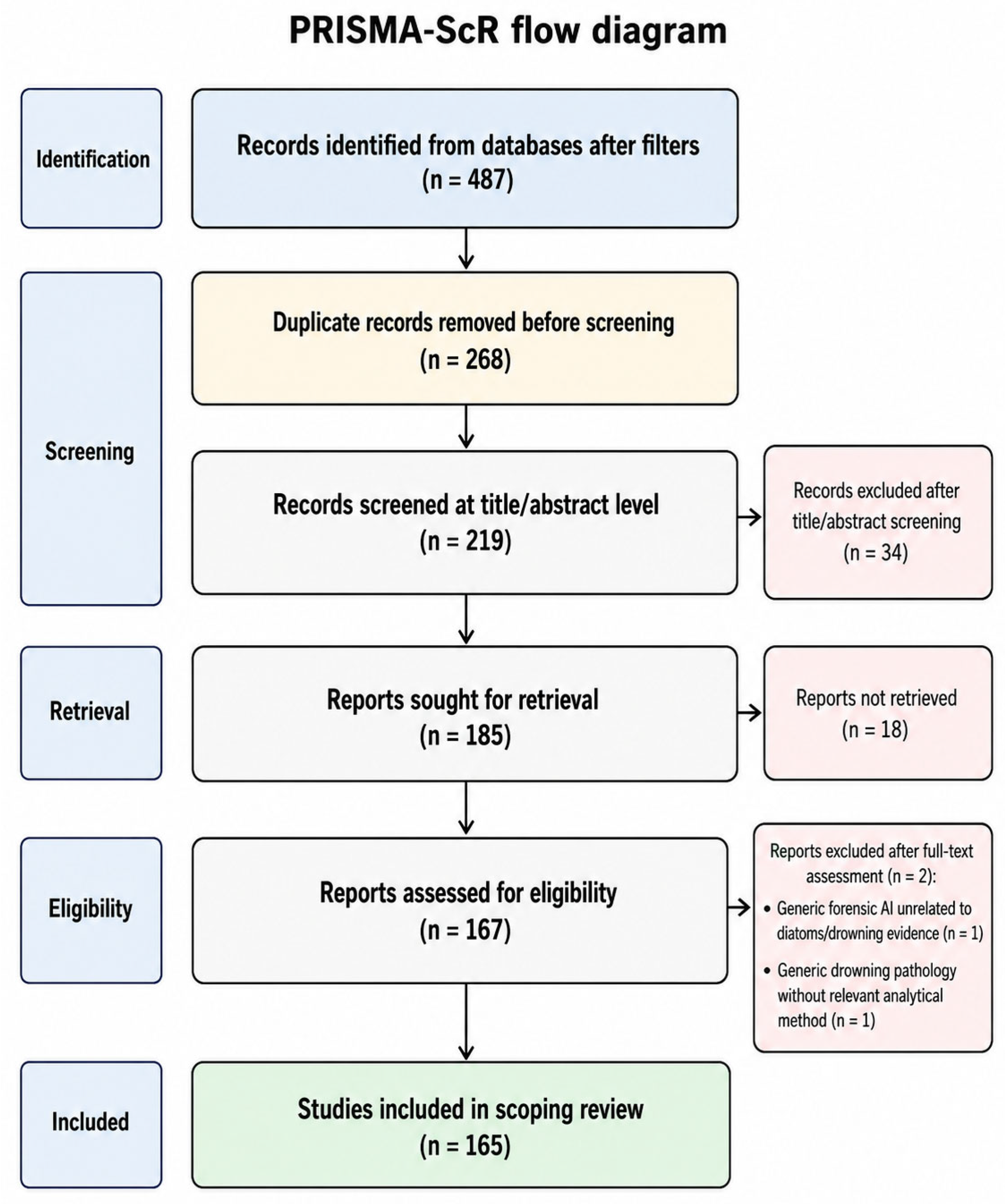
3.1. Study Selection
3.2. General Characteristics of Included Studies
3.3. Thematic Distribution of Included Studies
3.4. Molecular, Microbial, Environmental-Mapping, and Site-Inference Approaches
3.5. Automation, Image Analysis, and AI-Assisted Detection/Classification
3.6. Quantitative and Standardized Indicators
3.7. Medico-Legal Interpretation, Contamination, and Validation
3.8. Validation Level and Forensic Applicability
4. Discussion
4.1. Principal Findings
4.2. Methodological Advances Beyond the Classical Diatom Test
4.2.1. Molecular, eDNA, Metagenomic, and Microbial Approaches
4.2.2. Light Microscopy, SEM/Auto-SEM, and AI-Assisted Image Analysis
4.2.3. Quantitative Comparison and Standardization
4.2.4. Alternative Matrices and Trace-Transfer Contexts
4.2.5. Cross-Cutting Standardization Requirements
4.3. Standardization, Validation, and Medico-Legal Interpretation
4.4. Implications for Forensic Phycology, Related Aquatic Biological Evidence, and Future Research
4.5. Strengths and Limitations
5. Conclusions
Supplementary Materials
Author Contributions
Funding
Institutional Review Board Statement
Informed Consent Statement
Data Availability Statement
Conflicts of Interest
Abbreviations
| AI | artificial intelligence |
| AUC | area under the curve |
| Auto-SEM | automated scanning electron microscopy |
| DiatomNet | automated diatom detection/classification system |
| eDNA | environmental DNA |
| EN | European Standard |
| L/D | lung-to-drowning-medium ratio |
| MD-VF-Auto SEM | microwave digestion-vacuum filtration-automated scanning electron microscopy |
| OPLS-DA | orthogonal partial least squares discriminant analysis |
| PCR | polymerase chain reaction |
| qPCR | quantitative polymerase chain reaction |
| rbcL | ribulose-1,5-bisphosphate carboxylase/oxygenase large-subunit gene |
| rDNA | ribosomal deoxyribonucleic acid |
| rRNA | ribosomal ribonucleic acid |
| SEM | scanning electron microscopy |
| YOLO | You Only Look Once |
| 16S rRNA | 16S ribosomal ribonucleic acid |
| 18S rRNA/rDNA | 18S ribosomal ribonucleic acid/deoxyribonucleic acid |
References
- World Health Organization. Global Status Report on Drowning Prevention 2024; World Health Organization: Geneva, Switzerland, 2024. [Google Scholar]
- Tyr, A.; Heldring, N.; Winskog, C.; Zilg, B. Diagnosing fatal drownings: A review of the postmortem findings. Forensic Sci. Int. 2024, 364, 112251. [Google Scholar] [CrossRef] [Scilit] [PubMed]
- Zhu, W.; He, X.; San, R.; Chen, N.; Han, T.; Zhang, S.; Xu, Y.; Jin, S.; Xu, Y.; Jiang, Y. Global, regional, and national drowning trends from 1990 to 2021: Results from the 2021 Global Burden of Disease Study. Acad. Emerg. Med. 2024, 31, 1212–1222. [Google Scholar] [CrossRef] [Scilit] [PubMed]
- Tambuzzi, S.; Gentile, G.; Zoia, R. Forensic Diatom Analysis: Where Do We Stand and What Are the Latest Diagnostic Advances? Diagnostics 2024, 14, 2302. [Google Scholar] [CrossRef] [Scilit] [PubMed]
- Ludes, B.P.; Chambre, A.; Delabarde, T. The diatom test in the field of forensic medicine: A review of a long-standing question. Int. J. Leg. Med. 2025, 139, 597–605. [Google Scholar] [CrossRef] [Scilit] [PubMed]
- Tyr, A.; Lunetta, P.; Zilg, B.; Winskog, C.; Heldring, N. The medico-legal interpretation of diatom findings for the diagnosis of fatal drowning: A systematic review. Int. J. Leg. Med. 2025, 139, 729–746. [Google Scholar] [CrossRef] [Scilit] [PubMed]
- Zhou, Y.Y.; Cao, Y.J.; Huang, J.; Deng, K.F.; Ma, K.J.; Zhang, T.Y.; Chen, L.Q.; Zhang, J.; Huang, P. Research advances in forensic diatom testing. Forensic Sci. Res. 2020, 5, 98–105. [Google Scholar] [CrossRef] [Scilit] [PubMed]
- Shen, X.F.; Liu, Y.; Xiao, C.; Zheng, C.; Huang, J.F.; Shi, H.; Xu, Q.Y.; Cheng, J.D.; Liu, C.; Zhao, J. Analysis of false-positive results of diatom test in the diagnosis of drowning—Would not be an impediment. Int. J. Leg. Med. 2019, 133, 1819–1824. [Google Scholar] [CrossRef] [Scilit] [PubMed]
- Dahiya, P.; Makwana, M.D.; Chaniyara, P.; Bhatia, A. A comprehensive review of forensic diatomology: Contemporary developments and future trajectories. Egypt. J. Forensic Sci. 2024, 14, 2. [Google Scholar] [CrossRef] [Scilit]
- Al-Najjar, A.S.; Shata, F.N.; Ba Mhel, O.; Gutob, Y.; Alhazmi, M.; Alharbi, Z.; Choghari, R.A.; Qashar, A.A.; Basudan, B.; Aljohani, N.; et al. Diatom Analysis in Drowning: A Critical Review of Reliability, Contamination, and Medico-Legal Interpretation. Cureus 2026, 18, e100870. [Google Scholar] [CrossRef] [Scilit] [PubMed]
- Yu, Z.; Liu, C.; Hu, S.; Zhao, J.; Wang, H.; Zhou, Y.; Chen, L.; Xie, W.; Wang, H. PCR—Capillary electrophoresis is a new method for forensic diatom testing. J. Pure Appl. Microbiol. 2014, 8, 1467–1474. [Google Scholar]
- Jiang, L.; Xiao, C.; Zhao, J.; Jiang, T.; Lin, J.; Xu, Q.Y.; Liu, C.; Cai, W.W. Development of 18S rRNA gene arrays for forensic detection of diatoms. Forensic Sci. Int. 2020, 317, 110482. [Google Scholar] [CrossRef] [Scilit] [PubMed]
- Fang, T.; Liao, S.P.; Chen, X.G.; Zhao, Y.C.; Zhu, Q.; Cao, Y.Y.; Wang, Q.Y.; Zhang, S.; Gao, Z.H.; Yang, Y.W.; et al. Forensic drowning site inference employing mixed pyrosequencing profile of DNA barcode gene (rbcL). Int. J. Leg. Med. 2019, 133, 1351–1360. [Google Scholar] [CrossRef] [Scilit] [PubMed]
- Nakanishi, H.; Takada, A.; Yoneyama, K.; Kodama, S.; Sakai, K.; Saito, K. The utility of drowning site inference through metagenomic diatom analysis. Leg. Med. 2024, 71, 102548. [Google Scholar] [CrossRef] [Scilit] [PubMed]
- Zhang, X.F.; Chen, L.; Chen, X.H.; Zhao, J.; Lin, T.C.; Gu, D.E.; Wang, F.; Liu, Z.Y.; Meng, S.Y.; Yang, X.Y.; et al. Diagnosis of Drowning by qPCR Detection of Plankton DNA in Cardiac Blood of Cadavers. J. Forensic Med. 2025, 41, 477–481. [Google Scholar] [CrossRef] [Scilit] [PubMed]
- Yu, Z.H.; Xu, Q.Y.; Xiao, C.; Li, H.; Wu, W.B.; Du, W.A.; Zhao, J.; Liu, H.; Wang, H.J.; Liu, C. SYBR Green real-time qPCR method: Diagnose drowning more rapidly and accurately. Forensic Sci. Int. 2021, 321, 110720. [Google Scholar] [CrossRef] [Scilit] [PubMed]
- Zhou, Y.Y.; Zhang, J.; Huang, J.; Deng, K.F.; Zhang, J.H.; Qin, Z.Q.; Wang, Z.Y.; Zhang, X.F.; Tuo, Y.; Chen, L.Q.; et al. Digital whole-slide image analysis for automated diatom test in forensic cases of drowning using a convolutional neural network algorithm. Forensic Sci. Int. 2019, 302, 109922. [Google Scholar] [CrossRef] [Scilit] [PubMed]
- Gu, G.S.; Gan, S.W.; Deng, J.H.; Du, Y.K.; Qiu, Z.W.; Liu, J.J.; Liu, C.; Zhao, J. Automated diatom detection in forensic drowning diagnosis using a single shot multibox detector with plump receptive field. Appl. Soft Comput. 2022, 122, 108885. [Google Scholar] [CrossRef] [Scilit]
- Yu, W.M.; Xiang, Q.Q.; Hu, Y.C.; Du, Y.K.; Kang, X.D.; Zheng, D.Y.; Shi, H.; Xu, Q.Y.; Li, Z.G.; Niu, Y.; et al. An improved automated diatom detection method based on YOLOv5 framework and its preliminary study for taxonomy recognition in the forensic diatom test. Front. Microbiol. 2022, 13, 963059. [Google Scholar] [CrossRef] [Scilit] [PubMed]
- Zhang, J.; Vieira, D.N.; Cheng, Q.; Zhu, Y.Z.; Deng, K.F.; Zhang, J.H.; Qin, Z.Q.; Sun, Q.R.; Zhang, T.Y.; Ma, K.J.; et al. DiatomNet v1.0: A novel approach for automatic diatom testing for drowning diagnosis in forensically biomedical application. Comput. Methods Programs Biomed. 2023, 232, 107434. [Google Scholar] [CrossRef] [Scilit] [PubMed]
- Zhao, J.; Wang, Y.Z.; Wang, G.P.; Ma, Y.B.; Shi, H.; Wen, J.F.; Li, X.Y.; Hu, S.L.; Chen, F.; Liu, C. Application of the microwave digestion-vacuum filtration-automated scanning electron microscopy method for diatom detection in the diagnosis of drowning. J. Forensic Leg. Med. 2015, 33, 125–128. [Google Scholar] [CrossRef] [Scilit] [PubMed]
- Hu, S.L.; Chen, L.; Ma, J.; Li, L.G.; Ming, Y.; Wu, J.J.; Liu, Y.; Guo, S.Y.; Zhou, Y.C. Technical note MD-VF-Auto SEM: A method of the forensic diatom test that may help end the longstanding “war-on-diatoms”. Forensic Sci. Int. 2026, 380, 112803. [Google Scholar] [CrossRef] [Scilit] [PubMed]
- Zhu, Y.Z.; Zhang, J.; Cheng, Q.; Yu, H.X.; Deng, K.F.; Zhang, J.H.; Qin, Z.Q.; Zhao, J.; Sun, J.H.; Huang, P. Comparison among Four Deep Learning Image Classification Algorithms in AI-based Diatom Test. J. Forensic Med. 2022, 38, 31–39. [Google Scholar] [CrossRef] [Scilit] [PubMed]
- Hagen, D.; Obermayer, A.; Stoiber, W.; Steinbacher, P.; Zhao, J.; Monticelli, F.C.; Pittner, S. Quantitative investigation of diatom dispersion in lung tissue of confirmed drowning incidents. Int. J. Leg. Med. 2025, 139, 1597–1607. [Google Scholar] [CrossRef] [Scilit] [PubMed]
- Du, Y.K.; Zhang, T.Y.; Liu, J.J.; Liu, C.; Kang, X.D.; Zheng, D.Y.; Shi, H.; Xu, Q.Y.; Ma, K.J.; Zhao, J. Application of Diatoms Quantitative Analysis in the Diagnosis of Drowning. J. Forensic Med. 2022, 38, 110–113. [Google Scholar] [CrossRef] [Scilit] [PubMed]
- Zhao, J.; Ma, Y.B.; Liu, C.; Wen, J.F.; Hu, S.L.; Shi, H.; Zhu, L.Y. A quantitative comparison analysis of diatoms in the lung tissues and the drowning medium as an indicator of drowning. J. Forensic Leg. Med. 2016, 42, 75–78. [Google Scholar] [CrossRef] [Scilit] [PubMed]
- Du, Y.K.; Liu, J.J.; Li, Q.; Li, H.; Kang, X.D.; Zheng, D.Y.; Shi, H.; Xu, Q.Y.; Liu, C.; Wang, H.J.; et al. Concordance analysis of diatom types and patterns in lung tissue and drowning medium in laboratory animal model. Int. J. Leg. Med. 2022, 136, 911–917. [Google Scholar] [CrossRef] [Scilit] [PubMed]
- Ren, L.; Chen, Y.Q.; Zhou, Q.L.; Liu, Z.Z.; Li, Y.; Liu, Q. Relationships between Diatom Abundances in Rat Organs and in Environmental Waters. Curr. Med. Sci. 2021, 41, 981–986. [Google Scholar] [CrossRef] [Scilit] [PubMed]
- Tricco, A.C.; Lillie, E.; Zarin, W.; O’Brien, K.K.; Colquhoun, H.; Levac, D.; Moher, D.; Peters, M.D.J.; Horsley, T.; Weeks, L.; et al. PRISMA Extension for Scoping Reviews (PRISMA-ScR): Checklist and Explanation. Ann. Intern. Med. 2018, 169, 467–473. [Google Scholar] [CrossRef] [Scilit] [PubMed]
- Seo, Y.; Ichida, D.; Sato, S.; Kuroki, K.; Kishida, T. An improved method for the diatom test utilizing DNA binding ability of silica. J. Forensic Sci. 2014, 59, 779–784. [Google Scholar] [CrossRef] [Scilit] [PubMed]
- Pierucci, G.; Merlano, F.; Chen, Y.; Sturini, M.; Maraschi, F.; Profumo, A. Haematic silicon in drowning. J. Forensic Leg. Med. 2016, 39, 22–26. [Google Scholar] [CrossRef] [Scilit] [PubMed]
- Piegari, G.; De Biase, D.; d’Aquino, I.; Prisco, F.; Fico, R.; Ilsami, R.; Pozzato, N.; Genovese, A.; Paciello, O. Diagnosis of Drowning and the Value of the Diatom Test in Veterinary Forensic Pathology. Front. Vet. Sci. 2019, 6, 404. [Google Scholar] [CrossRef] [Scilit] [PubMed]
- Liu, Q.; Chen, Y.Q.; Ren, L. Forensic analysis of diatom in the spleen and heart in Sprague-Dawley rats. Aust. J. Forensic Sci. 2019, 51, 466–475. [Google Scholar] [CrossRef] [Scilit]
- Zhang, P.P.; Kang, X.D.; Zhang, S.R.; Xiao, C.; Ma, Y.B.; Shi, H.; Xu, Q.Y.; Zhao, J.; Chen, L.F.; Liu, C. The length and width of diatoms in drowning cases as the evidence of diatoms penetrating the alveoli-capillary barrier. Int. J. Leg. Med. 2020, 134, 1037–1042. [Google Scholar] [CrossRef] [Scilit] [PubMed]
- Zhao, J.; Zhang, P.P.; Xue, Y.; Kang, X.D.; Zhang, S.R.; Ma, Y.B.; Shi, H.; Cheng, J.D.; Liu, Y.Z.; Liu, C.; et al. Correlation analysis of diatom content in the organs and drowning mediums for the drowning death cases. Aust. J. Forensic Sci. 2021, 53, 191–198. [Google Scholar] [CrossRef] [Scilit]
- Zhang, J.-M.; Lin, T.-C.; Liao, Z.-Y.; Du, Y.-K.; Yu, Z.-H.; Liu, J.-J.; Wu, S.-Q.; Kang, X.-D.; Xu, Q.-Y.; Shi, H.; et al. Comparison of Application of MD-VF-Auto SEM Method and Plankton Gene Multiplex PCR System in the Diagnosis of Drowning. J. Forensic Med. 2022, 38, 114–118. [Google Scholar] [CrossRef] [Scilit] [PubMed]
- Liu, J.-J.; Du, Y.-K.; Zhao, J.; Kang, X.-D.; Yu, Z.-H.; Zheng, D.-Y.; Shi, H.; Xu, Q.-Y.; Chen, L.-F.; Liu, C. Effects of Digestive Temperature and Time on Diatom Test. J. Forensic Med. 2022, 38, 77–81. [Google Scholar] [CrossRef] [Scilit] [PubMed]
- Cai, J.; Wang, B.; Hu, S.-L.; Qu, Y.-H.; Song, T.; Chen, J.-H.; Deng, J.-Q. Improved Glass Bead-Vortex Oscillation Method for DNA Extraction from Diatom. J. Forensic Med. 2022, 38, 119–126. [Google Scholar] [CrossRef] [Scilit] [PubMed]
- Tsuneya, S.; Yoshida, M.; Hoshioka, Y.; Chiba, F.; Inokuchi, G.; Torimitsu, S.; Iwase, H. Relevance of diatom testing on closed organs of a drowned cadaver who died after receiving treatment for 10 days: A case report. Leg. Med. 2023, 60, 102168. [Google Scholar] [CrossRef] [Scilit] [PubMed]
- Tsuneya, S.; Nakajima, M.; Yoshida, M.; Hoshioka, Y.; Chiba, F.; Inokuchi, G.; Torimitsu, S.; Iwase, H. Detection of diatoms in a case of mud aspiration at a coastal area. Leg. Med. 2024, 66, 102354. [Google Scholar] [CrossRef] [Scilit] [PubMed]
- Szűcs, D.; Fejes, V.; Sipos, K.; Simon, G.; Poór, V.S. Combined use of microscopic and molecular techniques to detect aquatic microorganisms in drowning-related cases and exploring the risk factors over a 6-year period (2018–2023) in Hungary. Leg. Med. 2025, 76, 102663. [Google Scholar] [CrossRef] [Scilit] [PubMed]
- Tsuneya, S.; Nakajima, M.; Uemura, Y.; Torimitsu, S.; Takahagi, Y.; Inokuchi, G.; Iwase, H.; Makino, Y. Diatom testing for closed organs should be carefully performed and interpreted: The effect of post-mortem change and resuscitation. Leg. Med. 2025, 79, 102735. [Google Scholar] [CrossRef] [Scilit] [PubMed]
- Badu, I.K.; Asante, D.; Agyemang, E.D.; Kwaku Duah, K.; Adokoh, C.K.; Girela-Lopez, E. Diatoms in maggots; a potential tool for drowning diagnosis—A preliminary study. Med. Sci. Law. 2025, 65, 36–43. [Google Scholar] [CrossRef] [Scilit] [PubMed]
- Rutty, G.N.; Bradley, C.J.; Biggs, M.J.P.; Hollingbury, F.E.; Hamilton, S.J.; Malcomson, R.D.G.; Holmes, C.W. Detection of bacterioplankton using PCR probes as a diagnostic indicator for drowning; the Leicester experience. Leg. Med. 2015, 17, 401–408. [Google Scholar] [CrossRef] [Scilit] [PubMed]
- Lee, S.Y.; Woo, S.K.; Lee, S.M.; Ha, E.J.; Lim, K.H.; Choi, K.H.; Roh, Y.H.; Eom, Y.B. Microbiota Composition and Pulmonary Surfactant Protein Expression as Markers of Death by Drowning. J. Forensic Sci. 2017, 62, 1080–1088. [Google Scholar] [CrossRef] [Scilit] [PubMed]
- Kakizaki, E.; Sonoda, A.; Sakai, M.; Yukawa, N. Simple detection of bacterioplankton using a loop-mediated isothermal amplification (LAMP) assay: First practical approach to 72 cases of suspected drowning. Forensic Sci. Int. 2018, 289, 289–303. [Google Scholar] [CrossRef] [Scilit] [PubMed]
- Li, P.; Xu, Q.-Y.; Chen, L.; Liu, C.; Zhao, J.; Wang, Y.-Z.; Yu, Z.-L.; Hu, S.-L.; Wang, H.-J. Value of specific 16S rDNA fragment of algae in diagnosis of drowning: An experiment with rabbits. Nan Fang Yi Ke Da Xue Xue Bao = J. South. Med. Univ. 2015, 35, 1215–1218. [Google Scholar]
- Uchigasaki, S.; Tie, J.; Haseba, T.; Cui, F.L.; Ohno, Y.; Isobe, E.; Isahai, I.; Tsutsumi, H. Real-time PCR assay for the detection of picoplankton DNA distribution in the tissues of drowned rabbits. Leg. Med. 2016, 20, 33–36. [Google Scholar] [CrossRef] [Scilit] [PubMed]
- Fucci, N.; Campobasso, C.P.; Mastrogiuseppe, L.; Puccinelli, C.; Marcheggiani, S.; Mancini, L.; Marino, L.; Pascali, V.L. Diatoms in drowning cases in forensic veterinary context: A preliminary study. Int. J. Leg. Med. 2017, 131, 1573–1580. [Google Scholar] [CrossRef] [Scilit] [PubMed]
- Nakanishi, M.; Nakayama, A.; Kasuda, S.; Kudo, R.; Yuui, K.; Ishitani, A.; Hatake, K. A sensitive and time-saving method for the diagnosis of drowning by multiplex PCR. J. Nara Med. Assoc. 2018, 69, 77–85. [Google Scholar]
- Yuan, W.-Y.; Tang, X.-H.; Zhou, S.-P.; Yu, W.-D. Application of Specific Fragment Length Polymorphism of Algae rDNA in Identification of Drowning Cases. J. Forensic Med. 2018, 34, 516–519. [Google Scholar] [CrossRef] [PubMed]
- Vinayak, V. Chloroplast gene markers detect diatom DNA in a drowned mice establishing drowning as a cause of death. Electrophoresis 2020, 41, 2144–2148. [Google Scholar] [CrossRef] [Scilit] [PubMed]
- Li, H.; Xu, Q.-Y.; Liu, C.; Xiao, C.; Zhao, J.; Yu, Z.-H.; Yang, X.-Y.; Li, Y.; Wan, L.-H. Application of Chlorophyte ChlB Gene and Cyanophyte NIES Gene in the Detection of Drowning-Related Plankton. J. Forensic Med. 2021, 37, 58–64. [Google Scholar] [CrossRef] [PubMed]
- Xiao, C.; Xu, Q.Y.; Li, H.; Zhu, X.L.; Yu, Z.H.; Zhao, J.; Li, Y.; Liu, H.; Shi, H.; Liu, C. Development and application of a multiplex PCR system for drowning diagnosis. Electrophoresis 2021, 42, 1270–1278. [Google Scholar] [CrossRef] [Scilit] [PubMed]
- Liu, M.Y.; Zhao, Y.; Sun, Y.Z.; Wu, P.; Zhou, S.L.; Ren, L. Diatom DNA barcodes for forensic discrimination of drowning incidents. FEMS Microbiol. Lett. 2021, 367, fnaa145. [Google Scholar] [CrossRef] [Scilit] [PubMed]
- Kakizaki, E.; Shinkawa, N.; Sonoda, A.; Yukawa, N. Conventional diatom testing using strong acid: Notable false-positive results caused by an underestimated contamination source (blind spot). Forensic Sci. Int. 2022, 330, 111131. [Google Scholar] [CrossRef] [Scilit] [PubMed]
- Szűcs, D.; Fejes, V.; Kozma, Z.; Poór, V.S.; Sipos, K. Sternal aspirate sampling of Bacillariophyceae (diatoms) and Cyanobacteria in suspected drowning cases. J. Forensic Leg. Med. 2022, 85, 102298. [Google Scholar] [CrossRef] [Scilit] [PubMed]
- Zhou, Y.-C.; Wang, B.; Cai, J.; Xu, Y.-Z.; Qin, X.-S.; Ha, S.; Cong, B.; Chen, J.-H.; Deng, J.-Q. Extraction of Diatom DNA from Water Samples and Tissues. J. Vis. Exp. 2023, 201, e65792. [Google Scholar] [CrossRef] [Scilit] [PubMed]
- Zhang, X.-F.; Su, Q.; Chen, X.-H.; Wu, W.-B.; Zheng, D.-Y.; Zhao, J.; Chen, L.; Xu, Q.-Y.; Liu, C. Comparison of Three Drowning-related Plankton Testing Methods in Drowning Diagnosis. J. Forensic Med. 2025, 41, 244–251. [Google Scholar] [CrossRef] [Scilit] [PubMed]
- Su, Q.; Zhang, X.F.; Chen, X.H.; Yu, Z.H.; Wu, W.B.; Xiang, Q.Q.; Yang, C.L.; Zhao, J.; Chen, L.; Xu, Q.Y.; et al. Microbial community profiling for forensic drowning diagnosis across locations and submersion times. BMC Microbiol. 2025, 25, 244. [Google Scholar] [CrossRef] [Scilit] [PubMed]
- Lin, C.Y.; Yen, W.C.; Hsieh, H.M.; Tsai, L.C.; Huang, T.Y.; Huang, C.C.; Yu, Y.J.; Shun, C.T.; Wu, J.T.; Chou, C.L.; et al. Diatomological investigation in sphenoid sinus fluid and lung tissue from cases of suspected drowning. Forensic Sci. Int. 2014, 244, 111–115. [Google Scholar] [CrossRef] [Scilit] [PubMed]
- Sasidharan, A.; Umadethan, B.; Resmi, S.; Sundaram, K.R.; Pillay, V.V.; Ajay, B. Diatoms—A study on its temporo-spatial variations with special reference to temperature and salinity. J. South India Medicolegal Assoc. 2014, 6, 14–21. [Google Scholar] [CrossRef] [Scilit]
- Badu, I.K.; Girela, E.; Beltrán, C.M.; Ruz-Caracuel, I.; Jimena, I. Diatoms in forensic analysis: A practical approach in rats. Med. Sci. Law. 2015, 55, 228–235. [Google Scholar] [CrossRef] [Scilit] [PubMed]
- Zhuo, L.; Lin, S.; Song, P. A Future Perspective in Forensic Medicine in China: Diatomological Mapping of Water Bodies. J. Forensic Sci. Med. 2016, 2, 107–110. [Google Scholar] [CrossRef] [Scilit]
- Singh, R.; Zolawmsangi; Jasuja, O.P. A preliminary study on the diatom flora of various drowning sites in Mizoram rivers. Anil Aggrawal’s Internet J. Forensic Med. Toxicol. 2016, 17. [Google Scholar]
- Coelho, S.; Ramos, P.; Ribeiro, C.; Marques, J.; Santos, A. Contribution to the determination of the place of death by drowning—A study of diatoms’ biodiversity in Douro river estuary. J. Forensic Leg. Med. 2016, 41, 58–64. [Google Scholar] [CrossRef] [Scilit] [PubMed]
- Rácz, E.; Könczöl, F.; Tóth, D.; Patonai, Z.; Porpáczy, Z.; Kozma, Z.; Poór, V.S.; Sipos, K. PCR-based identification of drowning: Four case reports. Int. J. Leg. Med. 2016, 130, 1303–1307. [Google Scholar] [CrossRef] [Scilit] [PubMed]
- Kaushik, N.; Pal, K.S.; Sharma, A.; Thakur, G. Role of Diatoms in Diagnosis of Death Due to Drowning: Case Studies. Int. J. Med. Toxicol. Forensic Med. 2017, 7, 59–65. [Google Scholar] [CrossRef] [Scilit]
- Idota, N.; Tsuboi, H.; Takaso, M.; Tojo, M.; Kinebuchi, T.; Nakamura, M.; Ichioka, H.; Shintani-Ishida, K.; Ikegaya, H. Comparison between Temperature Gradient Gel Electrophoresis of Bacterial 16S rDNA and Diatom Test for Diagnosis of Drowning. J. Forensic Sci. 2018, 63, 752–757. [Google Scholar] [CrossRef] [Scilit] [PubMed]
- Kaur, A.; Jasuja, O.P.; Singh, R. Diatomological mapping of Renuka lake in Himachal Pradesh: Significant in forensic investigation of drowning deaths. Anil Aggrawals Internet J. Forensic Med. Toxicol. 2018, 19, 1. [Google Scholar]
- Bak, M.; Witkowski, A.; Dobosz, S.; Kociolek, J.P.; Pietras, L. Diatoms and drowning: Can diatoms enter the lungs after the initial drowning event? Rom. J. Leg. Med. 2018, 26, 29–36. [Google Scholar] [CrossRef] [Scilit]
- Zhao, Y.C.; Chen, X.G.; Yang, Y.W.; Zhao, X.H.; Zhang, S.; Gao, Z.H.; Fang, T.; Wang, Y.F.; Zhang, J. Potential forensic biogeographic application of diatom colony consistency analysis employing pyrosequencing profiles of the 18S rDNA V7 region. Int. J. Leg. Med. 2018, 132, 1611–1620. [Google Scholar] [CrossRef] [Scilit] [PubMed]
- Hu, D.; Pi, Z.-Y.; Zhang, Z.-R.; Chen, Y.-X.; Xing, Y.-M.; Cheng, B.-W. Application of 18S rDNA Clone Library to Detect Diatom Population Diversity in Dianchi. J. Forensic Med. 2019, 35, 444–447. [Google Scholar] [CrossRef] [PubMed]
- Li, Z.; Liu, X.R.; Yu, Y.F.; Huang, H.J.; Li, X.L.; Ji, Q.; Li, K.; Yu, Y.J.; Li, D.; Mao, Z.S.; et al. Barcoding for diatoms in the Yangtze River from the morphological observation and 18S rDNA polymorphic analysis. Forensic Sci. Int. 2019, 297, 81–89. [Google Scholar] [CrossRef] [Scilit] [PubMed]
- Voloshynovych, V.M.; Kasala, R.O.; Stambulska, U.Y.; Voloshynovych, M.S. Determination the presence of amplification products of 16s rRNA microcystis aeruginosa as a biomarker of drowning. Rom. J. Leg. Med. 2019, 27, 16–21. [Google Scholar] [CrossRef] [Scilit]
- Liu, M.Y.; Zhao, Y.; Sun, Y.Z.; Li, Y.A.; Wu, P.; Zhou, S.L.; Ren, L. Comparative study on diatom morphology and molecular identification in drowning cases. Forensic Sci. Int. 2020, 317, 110552. [Google Scholar] [CrossRef] [Scilit] [PubMed]
- Zhang, L.; Nie, Q.Y.; Dai, Y.L.; Zhu, S.S.; Wang, J.B.; Wang, W.; Tan, X.B.; Zhang, P.; Li, J.B. Diatomological mapping of water bodies in Chongqing section of the Yangtze River and Jialing River. Int. J. Leg. Med. 2020, 134, 1375–1385. [Google Scholar] [CrossRef] [Scilit] [PubMed]
- Zhang, J.; Zhou, Y.Y.; Vieira, D.N.; Cao, Y.J.; Deng, K.F.; Cheng, Q.; Zhu, Y.Z.; Zhang, J.H.; Qin, Z.Q.; Ma, K.J.; et al. An efficient method for building a database of diatom populations for drowning site inference using a deep learning algorithm. Int. J. Leg. Med. 2021, 135, 817–827. [Google Scholar] [CrossRef] [Scilit] [PubMed]
- Bhati, K.; Walia, M.; Gullaiya, J. Diatoms databank of Delhi, India: Forensic identification of diatoms based on morphology. J. Forensic Med. Toxicol. 2021, 38, 43–47. [Google Scholar] [CrossRef] [Scilit]
- Bhagyalakshmi, R.; Kumar, P.; Rai, S.; Nanda, A.; Cimba, S.N.; Singh, J. Forensic Database Management of Diatoms: A Tool for Comparison. Indian J. Forensic Med. Pathol. 2021, 14, 575–582. [Google Scholar]
- Cai, J.; Wang, B.; Chen, J.H.; Deng, J.Q. Application Progress of High-Throughput Sequencing Technology in Forensic Diatom Detection. Fa Yi Xue Za Zhi 2022, 38, 20–30. [Google Scholar] [CrossRef] [Scilit] [PubMed]
- Li, H.; Kang, X.D.; Zheng, D.Y.; Zhang, P.P.; Xiao, C.; Yu, Z.H.; Shi, H.; Xu, Q.Y.; Zhao, J.; Liu, C.; et al. Are diatom types or patterns in the organs and water samples of drowning cases always consistent? Aust. J. Forensic Sci. 2022, 54, 376–385. [Google Scholar] [CrossRef] [Scilit]
- Yu, H.-X.; Zhang, J.; Zhu, Y.-Z.; Cheng, Q.; Yu, X.-T.; Huang, P.; Dang, Y.-H.; Shi, G.-F. Bibliometrics Analysis in English and Chinese Literature on Drowning in Forensic Medicine from 1991 to 2020. J. Forensic Med. 2022, 38, 98–109. [Google Scholar] [CrossRef] [Scilit] [PubMed]
- Voloshynovych, V.M.; Kozan, N.M.; Voloshynovych, V.M.; Kotsyubynska, J.Z.; Voloshynovych, M.S.; Zelenchuk, G.M.; Chadiuk, V.O. Current State and Prospects of Forensic-Medical Diagnosis of Drowning: A Review of the Literature. [Obecny stan i perspektywy sądowo-lekarskiej diagnostyki utonięć. Przegląd literatury]. Probl. Forensic Sci. 2022, 129, 49–73. [Google Scholar] [CrossRef] [Scilit]
- Abhishek, A.; Kumar, R.; Rani, S.; Chauhan, S. Forensic Study of Diatoms in Freshwater Sample Around Patna Region, Bihar, India. Indian J. Forensic Med. Pathol. 2021, 14, 240–245. [Google Scholar]
- Li, P.; Wang, P.; Zhang, Y.G.; Hu, K.; Yuan, M.J.; Zhang, L.L. Change Rule of Diatom in Zhangweixin River in Dezhou. Fa Yi Xue Za Zhi 2022, 38, 92–97. [Google Scholar] [CrossRef] [Scilit] [PubMed]
- Kaur, A.; Singh, R. Diatomological mapping of eight waterbodies of Himachal Pradesh by using Scanning Electron Microscopy- A forensic perspective. Anil Aggrawals Internet J. Forensic Med. Toxicol. 2022, 23, 1. [Google Scholar]
- Wu, J.L.; Xu, G.J.; Wei, X.X.; Yu, Y.J.; Wang, S.J.; Ren, W.L.; Cui, W.; Su, X.N. Distribution of Diatoms in the Navigable Sections of Beijing-Hangzhou Grand Canal. Fa Yi Xue Za Zhi 2022, 38, 86–91. [Google Scholar] [CrossRef] [Scilit] [PubMed]
- Chakraborty, S.; Rajan, S. Forensic Characterization of Waterbodies in Malnad Region by Diatomological Mapping. J. Forensic Med. Sci. Law. 2022, 31, 65–70. [Google Scholar]
- Sharma, T.; Rai, J. Forensic Study of Diatoms Distribution in Gomti River, Lucknow and Effect of Seasonal Variation on Diatomological Mapping. Ann. Agri Bio Res. 2022, 27, 249–251. [Google Scholar]
- Zhu, Y.-Z.; Zhang, J.; Cheng, Q.; Deng, K.-F.; Ma, K.-J.; Zhang, J.-H.; Zhao, J.; Sun, J.-H.; Huang, P.; Qin, Z.-Q. Research Progress of Automatic Diatom Test by Artificial Intelligence. J. Forensic Med. 2022, 38, 14–19. [Google Scholar] [CrossRef] [Scilit] [PubMed]
- Liu, C.; Cong, B. Review and Prospect of Diagnosis of Drowning Deaths in Water. J. Forensic Med. 2022, 38, 3–13. [Google Scholar] [CrossRef] [Scilit] [PubMed]
- Zehra, A.; Kaloo, Z.A.; Sachdeva, M.P. Diversity and distribution of diatoms in aquatic ecosystems of Kashmir Himalaya: Future implications for forensic science. J. Punjab Acad. Forensic Med. Toxicol. 2023, 23, 93–98. [Google Scholar] [CrossRef] [Scilit]
- Su, Q.; Yang, C.L.; Chen, L.; She, Y.Q.; Xu, Q.Y.; Zhao, J.; Liu, C.; Sun, H.Y. Inference of drowning sites using bacterial composition and random forest algorithm. Front. Microbiol. 2023, 14, 1213271. [Google Scholar] [CrossRef] [Scilit] [PubMed]
- Bhardwaj, N.; Ahluwalia, A.S.; Pal, S.K.; Mandotra, S.K. Potential of photoautotrophic microbial organisms in deciphering forensic issues. Leg. Med. 2023, 62, 102223. [Google Scholar] [CrossRef] [Scilit] [PubMed]
- Tournois, L.; Hatsch, D.; Ludes, B.; Delabarde, T. Automatic detection and identification of diatoms in complex background for suspected drowning cases through object detection models. Int. J. Leg. Med. 2024, 138, 659–670. [Google Scholar] [CrossRef] [Scilit] [PubMed]
- Ma, A.; Chen, M.; Yu, Q.H.; Chen, L.Q.; Huang, P.; Zhang, J. A simple optical microscopy-based diatom classification approach for forensic drowning site inference: A pilot study. Int. J. Leg. Med. 2025, 139, 2207–2218. [Google Scholar] [CrossRef] [Scilit] [PubMed]
- Nurdin, J.; Dufan, M.; Nofrita. Diatom Colonization on Cowhide Substrate in Batang Kuranji River, Padang City, for Forensic Drowning Diagnosis. Pak. J. Biol. Sci. 2025, 28, 649–659. [Google Scholar] [CrossRef] [Scilit] [PubMed]
- Su, Q.; Zhang, X.F.; Chen, X.H.; Yu, Z.H.; Wu, W.B.; Xiang, Q.Q.; Yang, C.L.; Zhao, J.; Chen, L.; Xu, Q.Y.; et al. Integrating microbial profiling and machine learning for inference of drowning sites: A forensic investigation in the Northwest River. Microbiol. Spectr. 2025, 13, e01321-24. [Google Scholar] [CrossRef] [Scilit] [PubMed]
- Rana, A.S.; Verma, P.; Mahajan, M. Forensic diatomology of Pong dam reservoir: Implications for drowning diagnosis and site identification. J. Forensic Leg. Med. 2026, 118, 103094. [Google Scholar] [CrossRef] [Scilit] [PubMed]
- Zhang, X.F.; Su, Q.; Chen, X.H.; Wang, S.J.; Du, J.Y.; Chen, L.; Xu, Q.Y.; Liu, C.; Zhao, J. Inference of drowning sites of cases in the Pearl river based on microbial community profiling and random forest algorithm. Int. J. Leg. Med. 2026, 140, 2463–2477. [Google Scholar] [CrossRef] [Scilit] [PubMed]
- Ju, Y.F.; Xu, N.; Liang, X.W.; Ding, J.; Yu, T.; Jiang, M. Using aquatic microbial communities for forensic site identification: Insights from phytoplankton and diatom studies. Appl. Ecol. Environ. Res. 2026, 24, 2939–2968. [Google Scholar] [CrossRef] [Scilit]
- Wang, Y.; Zhao, J.; Li, P.; Hu, S.; Wang, H.; Wang, H.; Liu, C. Evaluation of three methods for forensic diatom test. Nan Fang Yi Ke Da Xue Xue Bao = J. South. Med. Univ. 2015, 35, 427–431. [Google Scholar]
- Zhao, J.; Wang, Y.Z.; Zhang, Y.J.; Hu, S.L.; Liu, C. Types of diatoms in China’s three major rivers and the possible application for an automatic forensic diatom test. Aust. J. Forensic Sci. 2015, 47, 268–274. [Google Scholar] [CrossRef] [Scilit]
- Zhao, J.; Liu, C.; Bardeesi, A.S.A.; Wu, Y.D.; Ma, Y.B.; Hu, S.L.; Shi, H.; Cheng, J.D. The Diagnostic Value of Quantitative Assessment of Diatom Test for Drowning: An Analysis of 128 Water-related Death Cases using Microwave Digestion-Vacuum Filtration-Automated Scanning Electron Microscopy. J. Forensic Sci. 2017, 62, 1638–1642. [Google Scholar] [CrossRef] [Scilit] [PubMed]
- Zhou, Y.Y.; Cao, Y.J.; Yang, Y.; Wang, Y.L.; Deng, K.F.; Ma, K.J.; Chen, Y.J.; Qin, Z.Q.; Zhang, J.H.; Huang, P.; et al. Application of Artificial Intelligence Automatic Diatom Identification System in Practical Cases. Fa Yi Xue Za Zhi 2020, 36, 239–242. [Google Scholar] [CrossRef] [PubMed]
- Yu, W.M.; Xue, Y.; Knoops, R.; Yu, D.Y.; Balmashnova, E.; Kang, X.D.; Falgari, P.; Zheng, D.Y.; Liu, P.F.; Chen, H.; et al. Automated diatom searching in the digital scanning electron microscopy images of drowning cases using the deep neural networks. Int. J. Leg. Med. 2021, 135, 497–508. [Google Scholar] [CrossRef] [Scilit] [PubMed]
- Deng, J.H.; Guo, W.Q.; Zhao, Y.W.; Liu, J.J.; Lai, R.H.; Gu, G.S.; Zhang, Y.L.; Li, Q.; Liu, C.; Zhao, J. Identification of diatom taxonomy by a combination of region-based full convolutional network, online hard example mining, and shape priors of diatoms. Int. J. Leg. Med. 2021, 135, 2519–2530. [Google Scholar] [CrossRef] [Scilit] [PubMed]
- Chen, J.; Liu, X.R.; Yang, J.W.; Chen, Y.Q.; Wang, C.; Ou, M.Y.; Wu, J.Y.; Yu, Y.J.; Li, K.; Chen, P.; et al. Construction and Application of YOLOv3-Based Diatom Identification Model of Scanning Electron Microscope Images. J. Forensic Med. 2022, 38, 46–52. [Google Scholar] [CrossRef] [Scilit] [PubMed]
- Yu, D.-Y.; Liu, J.-J.; Liu, C.; Du, Y.-K.; Huang, P.; Zhang, J.; Yu, W.-M.; Hu, Y.-C.; Zhao, J.; Cheng, J.-D. Evaluation of Inspection Efficiency of Diatom Artificial Intelligence Search System Based on Scanning Electron Microscope. J. Forensic Med. 2022, 38, 40–45. [Google Scholar] [CrossRef] [Scilit] [PubMed]
- Yu, H.-X.; Zhu, Y.-Z.; Zhao, T.-Q.; Cheng, Q.; Li, Z.-R.; Yin, W.-J.; Chen, M.; Cai, H.-X. Enzymatic Digestion Method Coupled with Artificial Intelligence Techniques in Forensic Drowning Diatom Detection. J. Sun Yat-Sen. Univ. (Med. Sci.) 2023, 44, 430–438. [Google Scholar] [CrossRef]
- Hagen, D.; Pittner, S.; Zhao, J.; Obermayer, A.; Stoiber, W.; Steinbacher, P.; Monticelli, F.C.; Gotsmy, W. Validation and optimization of the diatom L/D ratio as a diagnostic marker for drowning. Int. J. Leg. Med. 2023, 137, 939–948. [Google Scholar] [CrossRef] [Scilit] [PubMed]
- Wu, Y.H.; Luo, L.S.T.; Li, Y.Y.; Sun, Y.T.; Huang, X.Y.; Zhou, Y.C.; Wang, Y.; Wang, Y.Q.; Zeng, D.B.; Yun, L.B. A comparative assessment of time-consuming and laborious diatom analysis: Brief experimentation with suggestion of automatic identification. Forensic Sci. Int. 2024, 355, 111939. [Google Scholar] [CrossRef] [Scilit] [PubMed]
- Deng, J.H.; Yang, J.F.; Wei, H.M.; Gu, G.S.; Xiang, Q.Q.; Du, Y.K.; Liu, C.; Chen, Z.Q.; Fei, L.K.; Zhao, J. A high-efficiency local and global detector for diatom-based drowning diagnosis. Eng. Appl. Artif. Intell. 2024, 138, 109296. [Google Scholar] [CrossRef] [Scilit]
- Du, Y.K.; Xiang, Q.Q.; Niu, Y.; Liu, L.; Liu, J.J.; Su, Q.; Li, Z.G.; Shi, H.; Xu, Q.Y.; Wang, H.J.; et al. Diatoms pass through the gastrointestinal barrier and lead to false-positive: An animal experiment. Forensic Sci. Med. Pathol. 2024, 20, 351–359. [Google Scholar] [CrossRef] [Scilit] [PubMed]
- Deng, J.H.; Yang, J.F.; Gu, G.S.; Liu, C.; Kang, X.D.; Zheng, D.Y.; Shi, H.; Zhao, J. DiaDet-R: A lightweight and accurate rotated detector for diatom detection in drowning diagnostics. Expert Syst. Appl. 2025, 265, 125958. [Google Scholar] [CrossRef] [Scilit]
- Xu, Q.Y.; Liu, C.; Zhao, J.; Li, Y.; Wang, Y.Z.; Li, P.; Han, Y.L. Comparison of digestion methods complied with two nanofiltration membranes on the efficiency of diatoms recovery. J. Nanosci. Nanotechnol. 2016, 16, 7129–7133. [Google Scholar] [CrossRef] [Scilit]
- Kakizaki, E.; Sonoda, A.; Shinkawa, N.; Yukawa, N. A new enzymatic method for extracting diatoms from organs of suspected drowning cases using papain: Optimal digestion and first practical application. Forensic Sci. Int. 2019, 297, 204–216. [Google Scholar] [CrossRef] [Scilit] [PubMed]
- Tsuneya, S.; Nakajima, M.; Makino, Y.; Torimitsu, S.; Yamaguchi, R.; Iwase, H. A quantitative comparison between using sodium hypochlorite as a digestion method for the diatom test and the conventional method using fuming nitric acid. Forensic Sci. Int. 2021, 329, 111086. [Google Scholar] [CrossRef] [Scilit] [PubMed]
- Marezza, F.; Marchetti, C.; Lanzi, G.; Lusetti, A.; Bertani, A.; Cecchi, R. Diatom extraction: A new technique with heated H2O2. A technical note. Leg. Med. 2021, 50, 101861. [Google Scholar] [CrossRef] [Scilit] [PubMed]
- Tsuneya, S.; Nakajima, M.; Makino, Y.; Torimitsu, S.; Yamaguchi, R.; Iwase, H. The effect of ethanol or long-time reaction on the diatom test in water samples using sodium hypochlorite. Leg. Med. 2022, 57, 102054. [Google Scholar] [CrossRef] [Scilit] [PubMed]
- Tsuneya, S.; Nakajima, M.; Makino, Y.; Torimitsu, S.; Yamaguchi, R.; Iwase, H. Effect of ethanol on the diatom test using nitric acid or sodium hypochlorite. Leg. Med. 2023, 61, 102190. [Google Scholar] [CrossRef] [Scilit] [PubMed]
- Guo, W.Q.; Chen, M.; Ma, A.; Huang, P.; Zhang, J. Application of Protease-Hydrogen Peroxide Digestion Method in Forensic Diatom Examination. Fa Yi Xue Za Zhi 2024, 40, 317–323. [Google Scholar] [CrossRef] [Scilit] [PubMed]
- Zhao, J.; Luo, Y.Z.; Wang, Y.Z.; Xiao, C.; Shi, H.; Hu, S.L.; Kang, X.D.; Xu, Q.Y.; Cheng, J.D.; Liu, C. Application of Quantitative Analysis of Diatoms in Lung Tissue for the Diagnosis of Drowning of Experimental Animals. Fa Yi Xue Za Zhi 2019, 35, 706–709. [Google Scholar] [CrossRef] [PubMed]
- Kalashnikov, D.P.; Polukhin, N.V.; Zakharov, S.N.; Kislov, M.A.; Syrova, D.A.; Zolotenkova, G.V. Quantitative Assessment of the Diagnostic Value of Drowning Signs Based on a Retrospective Analysis of Drowning Cases. Russ. J. Forensic Med. 2025, 11, 210–222. [Google Scholar] [CrossRef] [Scilit]
- Pal, S.K.; Sharma, A.; Sehgal, A.; Kumar, V. Individualisation of the biological remains from anthropological perspective-A case study. Med.-Leg. Update 2014, 14, 41–45. [Google Scholar] [CrossRef] [Scilit]
- Myskowiak, J.-B.; Saccardy, C. Diatoms. Utility of the research and limits of the method. Investigations from medicolegal institutes and laboratories. IRCGN statement of accounts 2014–2016. Rev. DE Med. Leg. 2017, 8, 143–152. [Google Scholar] [CrossRef] [Scilit]
- More, S.; Bera, S. Role of fresh water diatoms in linking victim, suspect and object with aquatic crime scene using physical evidences: First experimental study from India. Anil Aggrawal’s Internet J. Forensic Med. Toxicol. 2018, 19, e2. [Google Scholar]
- Marella, G.L.; Feola, A.; Marsella, L.T.; Mauriello, S.; Giugliano, P.; Arcudi, G. Diagnosis of Drowning, an Everlasting Challenge in Forensic Medicine: Review of the Literature and Proposal of a Diagnostic Algorithm. Acta Medica Mediterr. 2019, 35, 919–927. [Google Scholar]
- Wang, Z.Q.; Ma, K.J.; Zou, D.H.; Liu, N.G.; Li, Z.D.; Shao, Y.; Chen, Y.J. Diagnosis of drowning using postmortem computed tomography combined with endoscopic autopsy: A case report. Medicine 2020, 99, 19182. [Google Scholar] [CrossRef] [Scilit] [PubMed]
- Khurshid, A.; Shah, M.U.; Khurshid, M.; Sohail, A.; Ali, G. Diatom-Positive Cadaver: Drowning or Homicide? Cureus 2021, 13, e18312. [Google Scholar] [CrossRef] [Scilit] [PubMed]
- Dervisevic, E.; Camdzic, N.; Masic, E.; Katica, M.; Suta, N.; Spahic, E.; Lazovic, E.; Besic, A. Biological markers as an additional method of determining drowning. Open Vet. J. 2024, 14, 3047–3054. [Google Scholar] [CrossRef] [Scilit] [PubMed]
- Lee, D.Y.; Kim, H.; Kim, G.E.; Jung, E.-B.; Lee, S.D.; Kim, M.-Y. Immersion Deaths in Seoul: Implications of Decomposition for Postmortem Diagnosis of Drowning. J. Korean Med. Sci. 2026, 41, e112. [Google Scholar] [CrossRef] [Scilit] [PubMed]
- Carlie, A.; Arcini, C.; Druid, H.; Risberg, J. Archaeology, forensics and the death of a child in Late Neolithic Sweden. Antiquity 2014, 88, 1148–1163. [Google Scholar] [CrossRef] [Scilit]
- Sitthiwong, N.; Ruangyuttikarn, W.; Vongvivach, S.; Peerapornpisal, Y. Detection and identification of diatoms in tissue samples of drowning victims. Chiang Mai J. Sci. 2014, 41, 1020–1031. [Google Scholar]
- Rubio, L.; Martín-Cazorla, F.; Gaitán, M.J.; Ramos, V.; Santos, I. Influence of postmortem findings on lung weight of drowning victims. Rom. J. Leg. Med. 2014, 22, 89–96. [Google Scholar] [CrossRef] [Scilit]
- Jakhar, P.; Saini, E.; Kadian, A.; Verma, K. Diatoms as cardinal key to drowning case studies. J. Forensic Med. Toxicol. 2015, 32, 17–19. [Google Scholar]
- Pal, S.K.; Sharma, A.; Sehgal, A.; Rana, A. Diagnosing Death with Diatoms: A Retrospective Study of Forensic Cases in Himachal Pradesh, India. Int. J. Med. Toxicol. Forensic Med. 2017, 7, 124–137. [Google Scholar] [CrossRef] [Scilit]
- Andrade, P.; Goff, J.; Pearce, R.; Cundy, A.; Sear, D.; Castro, V. Evidence for a mid-Holocene drowning from the Atacama Desert coast of Chile. J. Archaeol. Sci. 2022, 140, 105565. [Google Scholar] [CrossRef] [Scilit]
- Wang, H.P.; Liu, Y.; Zhao, J.; Hu, S.L.; Wang, Y.Z.; Liu, C.; Zhang, Y.J. A simple digestion method with a Lefort aqua regia solution for diatom extraction. J. Forensic Sci. 2015, 60, S227–S230. [Google Scholar] [CrossRef] [Scilit] [PubMed]
- Fucci, N.; Pascali, V.L.; Puccinelli, C.; Marcheggiani, S.; Mancini, L.; Marchetti, D. Evaluation of two methods for the use of diatoms in drowning cases. Forensic Sci. Med. Pathol. 2015, 11, 601–605. [Google Scholar] [CrossRef] [Scilit] [PubMed]
- Kakizaki, E.; Yukawa, N. Simple protocol for extracting diatoms from lung tissues of suspected drowning cases within 3 h: First practical application. Forensic Sci. Int. 2015, 251, 179–185. [Google Scholar] [CrossRef] [Scilit] [PubMed]
- Zhao, J.; Wang, Y.Z.; Liu, C.; Hu, S.L.; Shi, H.; Wen, J.F. Detection of Diatoms by a Combination of Membrane Filtration and Transparentness. J. Forensic Sci. 2016, 61, 1643–1646. [Google Scholar] [CrossRef] [Scilit] [PubMed]
- Niu, Y.; Zhao, J.; Li, X.; Shi, H.; Liu, C.; Hu, S.L.; Wen, J.F.; Dai, W.L.; Zheng, D.Y.; Cheng, J.D.; et al. Separation of diatoms from digestive solution: A combination of membrane filtering and vacuum pumping. Aust. J. Forensic Sci. 2018, 50, 361–370. [Google Scholar] [CrossRef] [Scilit]
- Besta, T.; Hamrová, H.; Tomásek, P.; Dohnalová, P.; Markvartová, J.; Hauer, T.; Svejdová, T.; Zubícková, K.; Zagatová, I.; Lefnar, R.; et al. HNO3-PCF: A new lossless light microscopy method for forensic diatom drowning analysis. Forensic Sci. Int. 2025, 370, 112449. [Google Scholar] [CrossRef] [Scilit] [PubMed]
- Saini, P.; Kushwaha, K.P.S. Morphological Study of Diatoms in 24 Different Water Bodies of Haryana, India. Anil Aggrawal’s Internet J. Forensic Med. Toxicol. 2016, 17. [Google Scholar] [CrossRef] [Scilit]
- Saini, E.; Khanagwal, V.P.; Singh, R. A systematic databasing of diatoms from different geographical localities and sites of Haryana for advancing validation of forensic diatomology. Data Brief. 2017, 10, 63–68. [Google Scholar] [CrossRef] [Scilit] [PubMed]
- Carballeira, R.; Vieira, D.N.; Febrero-Bande, M.; Muñoz Barús, J.I. A valid method to determine the site of drowning. Int. J. Leg. Med. 2018, 132, 487–497. [Google Scholar] [CrossRef] [Scilit] [PubMed]
- Thakar, M.K.; Luthra, D.; Khattar, J.S. Forensic studies of phytoplankton ecology of two water bodies of Kurukshetra area of Haryana, State in India. Egypt. J. Forensic Sci. 2018, 8, 38. [Google Scholar] [CrossRef] [Scilit]
- Zalat, A.A.; El-Sheekh, M.M.; El-Shenody, R.A.; El-Hashash, M.S. Role of Diatom Flora in the Forensic Diagnosis of Drowning Cases from some Water Bodies in the Delta Region. Egypt. J. Aquat. Biol. Fish. 2023, 27, 421–442. [Google Scholar] [CrossRef] [Scilit]
- Bogusz, M.; Bogusz, I.; Zelazna-Wieczorek, J. The possibilities and limitations of comparative diatomaceous analysis for confirming or excluding the site of an incident—Case studies. Forensic Sci. Int. 2023, 346, 111644. [Google Scholar] [CrossRef] [Scilit] [PubMed]
- Rubini, S.; Frisoni, P.; Russotto, C.; Pedriali, N.; Mignone, W.; Grattarola, C.; Giorda, F.; Pautasso, A.; Barbieri, S.; Cozzi, B.; et al. The diatoms test in veterinary medicine: A pilot study on cetaceans and sea turtles. Forensic Sci. Int. 2018, 290, e19–e23. [Google Scholar] [CrossRef] [Scilit] [PubMed]
- Magni, P.A.; Mohan, M.; Vadiveloo, A.; Moheimani, N.R. Transferability of Australian diatoms to clothing: Assessment of several extraction methods on different fabric types under laboratory conditions. Forensic Sci. Int. 2020, 312, 110297. [Google Scholar] [CrossRef] [Scilit] [PubMed]
- Kihara, Y.; Makino, Y.; Nakajima, M.; Tsuneya, S.; Tanaka, A.; Yamaguchi, R.; Torimitsu, S.; Hayama, S.; Iwase, H. Experimental water injection into lungs using an animal model: Verification of the diatom concentration test to diagnose drowning. Forensic Sci. Int. 2021, 327, 110983. [Google Scholar] [CrossRef] [Scilit] [PubMed]
- Sonoda, A.; Kakizaki, E.; Shinkawa, N.; Matsuda, H.; Yukawa, N. Conventional diatom testing using strong acid: (II) Number and types of diatoms detected in closed organs and lungs of 80 autopsy cases using only new Kjeldahl flasks. Forensic Sci. Int. 2022, 341, 111510. [Google Scholar] [CrossRef] [Scilit] [PubMed]
- Tambuzzi, S.; Gentile, G.; Bailo, P.; Andreola, S.; Zoja, R. Use of cadaveric vitreous humor as an innovative substrate for diatoms research and forensic diagnosis of drowning. Int. J. Leg. Med. 2022, 136, 1745–1754. [Google Scholar] [CrossRef] [Scilit] [PubMed]
- Marshall, M.; Chraibi, V.; Morgan, R. A method for bone marrow extraction of diatoms for forensic science applications. J. Forensic Sci. 2023, 68, 1343–1351. [Google Scholar] [CrossRef] [Scilit] [PubMed]
- Marshall, M.; Chraibi, V.; Morgan, R. Colonization of diatoms in and on porcine bone substrate and considerations of diatom ecology for forensic science. J. Forensic Sci. 2023, 68, 1237–1244. [Google Scholar] [CrossRef] [Scilit] [PubMed]
- Bogusz, I.; Bogusz, M.; Borowska, B.; Szleszkowski, L.; Zelazna-Wieczorek, J. A critical assessment of the diatom test of rib bone marrow as a supporting procedure in the case of drowning. J. Forensic Leg. Med. 2024, 107, 102753. [Google Scholar] [CrossRef] [Scilit] [PubMed]
- Dervišević, E.; Katica, M.; Mašić, E.; Čamdžić, N.; Ajanović, Z.; Dervišević, L.; Salihbegović, A.; Sarajlić, N. Bone and Tooth: Substrates for determining Drowning: A new diagnostic procedure in forensic medicine Practice? Leg. Med. 2024, 66, 102366. [Google Scholar] [CrossRef] [Scilit] [PubMed]
- Tambuzzi, S.; Gentile, G.; Bailo, P.; Primavera, R.; Andreola, S.; Zoja, R. Could synovial fluid be a useful substrate for the forensic analysis of diatoms? J. Forensic Sci. 2024, 69, 1926–1931. [Google Scholar] [CrossRef] [Scilit] [PubMed]
- Kihara, Y.; Tsuneya, S.; Nakajima, M.; Torimitsu, S.; Chiba, F.; Tanaka, A.; Tanaka, H.; Osada, K.; Saka, K.; Noritake, K.; et al. Technical note: Quantitative and qualitative analysis of diatom testing in methomyl poisoning case. Int. J. Leg. Med. 2026, 140, 837–843. [Google Scholar] [CrossRef] [Scilit] [PubMed]
- Lunetta, P.; Virri, J.; Weckström, J. The diatom test for drowning: An unreported source of diatom contamination. Int. J. Leg. Med. 2025, 139, 2815–2818. [Google Scholar] [CrossRef] [Scilit] [PubMed]
- Muccino, E.; Crudele, G.D.L.; Gentile, G.; Marchesi, M.; Rancati, A.; Zoja, R. Suicide drowning in the non-coastal territory of Milan. Int. J. Leg. Med. 2015, 129, 777–784. [Google Scholar] [CrossRef] [Scilit] [PubMed]
- Du, Y.K.; Liu, J.J.; Kang, X.D.; Yu, Z.H.; Zheng, D.Y.; Shi, H.; Xu, Q.Y.; Ren, J.J.; Liu, C.; Zhao, J. Pathway of Diatoms Enter Experimental Rabbits through the Lymphatic System of the Digestive Tract. Fa Yi Xue Za Zhi 2022, 38, 67–70. [Google Scholar] [CrossRef] [Scilit] [PubMed]
- Torres-Portugal, M.; Madureira-Carvalho, A.; Leal, S.; Sousa, A.; Ribeiro, C.; Couto, C. Freshwater and estuarine diatom composition and seasonal variation: The influence of environmental factors in supporting forensic applications. Aust. J. Forensic Sci. 2026. [Google Scholar] [CrossRef] [Scilit]
- Ishikawa, N.; Miake, Y.; Kitamura, K.; Yamamoto, H. A new method for estimating time since death by analysis of substances deposited on the surface of dental enamel in a body immersed in seawater. Int. J. Leg. Med. 2019, 133, 1421–1427. [Google Scholar] [CrossRef] [Scilit] [PubMed]
- Poulain, C.; Mathieu, O.; Gouetta, V.; Baccino, É.; Peyron, P.A. Influence of the toxicological status on the diagnosis of fatal drowning. Int. J. Leg. Med. 2023, 137, 1471–1479. [Google Scholar] [CrossRef] [Scilit] [PubMed]
- Handlos, P.; Handlosová, K.; Dokoupil, M.; Gebauerová, V.; Uvíra, M. Drowning during methamphetamine intoxication precipitated by improper fluid administration: Medico-legal case analysis. Forensic Sci. Med. Pathol. 2025, 22, 779–783. [Google Scholar] [CrossRef] [Scilit] [PubMed]
- EN 13946:2014; Water Quality—Guidance for the Routine Sampling and Preparation of Benthic Diatoms from Rivers and Lakes. European Committee for Standardization: Brussels, Belgium, 2014.
- EN 14407:2014; Water Quality—Guidance for the Identification and Enumeration of Benthic Diatom Samples from Rivers and Lakes. European Committee for Standardization: Brussels, Belgium, 2014.
- Elmsjö, A.; Helander, A.; Druid, H.; Kugelberg, F.C. Machine learning and metabolic signatures of drowning: A pathway to uncovering cause of death in aquatic environments. Forensic Sci. Int. 2026, 383, 112894. [Google Scholar] [CrossRef] [Scilit] [PubMed]


| Domain/Combination | Label | n | % |
|---|---|---|---|
| A | Molecular/metagenomic/DNA-based/site inference | 83 | 50.3 |
| B | Automation/image analysis/AI-assisted detection or classification | 51 | 30.9 |
| C | Quantitative/standardized indicators beyond simple presence/absence | 148 | 89.7 |
| D | Medico-legal interpretation/validation/contamination/reliability | 133 | 80.6 |
| E | Unclear/other | 0 | 0.0 |
| Most frequent domain combinations | |||
| C; D | Quantitative/standardized indicators + medico-legal interpretation/validation | 40 | 24.2 |
| A; C; D | Molecular/site-inference + quantitative/standardized + medico-legal interpretation | 37 | 22.4 |
| B; C; D | Automation/image analysis/AI + quantitative/standardized + medico-legal interpretation | 23 | 13.9 |
| A; B; C; D | All four thematic domains | 19 | 11.5 |
| Methodological Family | n (%) | Representative Techniques | Main Forensic Applications | Main Caveats/Validation Gaps |
|---|---|---|---|---|
| Morphological microscopy/digestion-filtration workflows | 88 (53.3%) | Light microscopy, tissue digestion, filtration, conventional diatom counting | Drowning diagnosis; tissue/drowning-medium comparison; method optimization | Highly dependent on sampling, digestion/filtration workflow, taxonomic expertise, and contamination control. |
| SEM/Auto-SEM workflows | 78 (47.3%) | SEM, Auto-SEM, MD-VF-Auto SEM, vacuum filtration | Higher-resolution detection; automated or semi-automated workflows; standardized counting | Requires expensive, specialized equipment; trained operation, maintenance, and calibration; validated cleaning or single-use digestion/filtration components; procedural blanks, recovery controls, and contamination controls; assessment of digestion-induced frustule fragmentation; harmonized rules for counting intact frustules versus fragments; independent replication, multicenter evidence, inter-laboratory reproducibility, and evaluation of routine-laboratory generalizability. |
| Contamination/false positives/medico-legal interpretation | 50 (30.3%) | Contamination studies, false-positive analysis, review/interpretive papers | Court-oriented interpretation; reliability; evidentiary caution | Findings support adjunctive rather than standalone use until stronger validation standards exist. |
| Quantitative indicators/standardized comparisons | 40 (24.2%) | L/D ratio, tissue-to-medium comparisons, counts, dispersion, standardized sampling | Beyond presence/absence; reproducibility and diagnostic support | Cut-offs and comparability differ across organs, media, digestion protocols, and case contexts. |
| Site inference/environmental mapping/forensic databases | 38 (23%) | Diatomological mapping, waterbody databases, site comparison, distribution studies | Drowning site inference; source attribution; environmental reference sampling | Environmental heterogeneity and temporal variation limit portability across regions and seasons. |
| Molecular PCR/qPCR/microarray assays | 36 (21.8%) | PCR, qPCR, multiplex PCR-capillary electrophoresis, microarray, 18S/rbcL markers | Molecular detection of diatoms/plankton and support for drowning diagnosis | Marker selection, inhibition, degradation, and interpretation thresholds require validation. |
| Automation/image analysis/AI-assisted classification | 31 (18.8%) | Deep learning, YOLO, DiatomNet, automated image analysis | Automated detection and classification of diatoms; reduced observer dependence | Dataset annotation, taxonomic uncertainty, external validation, model transparency, and deployment across laboratories remain key barriers. |
| Sequencing/metabarcoding/metagenomics/microbial profiling | 14 (8.5%) | DNA sequencing, metabarcoding, metagenomic profiling, microbial community analysis | Site inference; environmental comparison; differentiation of drowning media | Promising for broad environmental discrimination, but precise geographic attribution remains limited by temporal/spatial heterogeneity and transferability. |
| Trace transfer/clothing/alternative substrates | 10 (6.1%) | Clothing/fabrics, maggots, bone, tooth, vitreous, synovial fluid, closed organs | Alternative matrices; trace evidence; postmortem/submersion context | Often preliminary and matrix-specific; transfer/persistence and diagnostic meaning need further validation. |
| Validation Level/Category | Meaning | n | % | Main Medico-Legal Limitation |
|---|---|---|---|---|
| 1 = conceptual/narrative | Conceptual, review, or narrative synthesis | 14 | 8.5 | Useful for identifying interpretive issues and research directions, but not sufficient for operational adoption. |
| 2 = proof-of-concept | Early technical or feasibility work | 5 | 3 | Analytical promise but limited case realism, sample size, and external validation. |
| 3 = experimental controlled validation | Controlled experimental or comparative validation | 110 | 66.7 | Dominant evidence level; controlled design helps method comparison but may not reproduce real-case heterogeneity. |
| 4 = case-based forensic application | Case report, case series, or applied forensic use | 36 | 21.8 | Forensic realism is higher, but evidence is often non-comparative and context-dependent. |
| 5 = multicenter/externally validated/operationally mature | Multicenter/external validation or operational implementation | 0 | 0 | Absent in the mapped dataset; this remains the main barrier to court-ready standardization. |
| Relevance category | ||||
| High | 72 | 43.6 | ||
| Moderate | 69 | 41.8 | ||
| Low | 24 | 14.5 |
Disclaimer/Publisher’s Note: The statements, opinions and data contained in all publications are solely those of the individual author(s) and contributor(s) and not of MDPI and/or the editor(s). MDPI and/or the editor(s) disclaim responsibility for any injury to people or property resulting from any ideas, methods, instructions or products referred to in the content. |
© 2026 by the authors. Licensee MDPI, Basel, Switzerland. This article is an open access article distributed under the terms and conditions of the Creative Commons Attribution (CC BY) license.
Share and Cite
Bailo, P.; Carsana, C.; Garreffa, M.; Tambuzzi, S.; Marchesi, M.; Primignani, P.; Piccinini, A.; Zoja, R.; Gentile, G. Beyond the Diatom Test: Emerging Diatom-Based Approaches and Medico-Legal Validation in Forensic Drowning Investigation—A PRISMA-ScR Scoping Review. Phycology 2026, 6, 79. https://doi.org/10.3390/phycology6030079
Bailo P, Carsana C, Garreffa M, Tambuzzi S, Marchesi M, Primignani P, Piccinini A, Zoja R, Gentile G. Beyond the Diatom Test: Emerging Diatom-Based Approaches and Medico-Legal Validation in Forensic Drowning Investigation—A PRISMA-ScR Scoping Review. Phycology. 2026; 6(3):79. https://doi.org/10.3390/phycology6030079
Chicago/Turabian StyleBailo, Paolo, Chiara Carsana, Maria Garreffa, Stefano Tambuzzi, Matteo Marchesi, Paola Primignani, Andrea Piccinini, Riccardo Zoja, and Guendalina Gentile. 2026. "Beyond the Diatom Test: Emerging Diatom-Based Approaches and Medico-Legal Validation in Forensic Drowning Investigation—A PRISMA-ScR Scoping Review" Phycology 6, no. 3: 79. https://doi.org/10.3390/phycology6030079
APA StyleBailo, P., Carsana, C., Garreffa, M., Tambuzzi, S., Marchesi, M., Primignani, P., Piccinini, A., Zoja, R., & Gentile, G. (2026). Beyond the Diatom Test: Emerging Diatom-Based Approaches and Medico-Legal Validation in Forensic Drowning Investigation—A PRISMA-ScR Scoping Review. Phycology, 6(3), 79. https://doi.org/10.3390/phycology6030079