
Cyanobacteria in Waterbodies of the Biggest Anthropogenic Agglomeration: Combined DNA Metabarcoding, Microscopy, and Culture Analysis
 , , ,
, , ,  , and
, and 
Abstract
1. Introduction
2. Materials and Methods
2.1. Study Area and Sample Collection
2.2. Analysis of Environmental Parameters
2.3. Microscopy, Morphological Identification, and Quantitative Analysis
2.4. DNA Extraction, PCR Amplification, and High-Throughput Sequencing
2.5. Bioinformatic Processing
2.6. Phylogenetic Analysis
3. Results
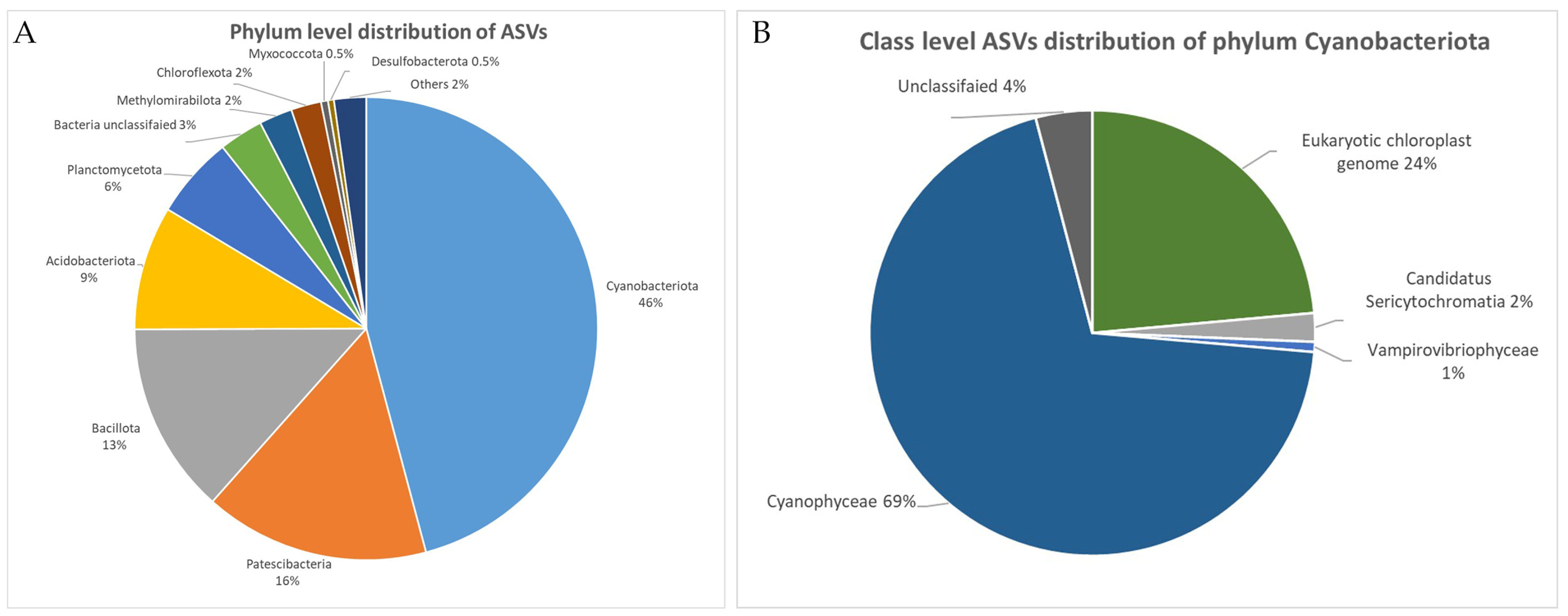
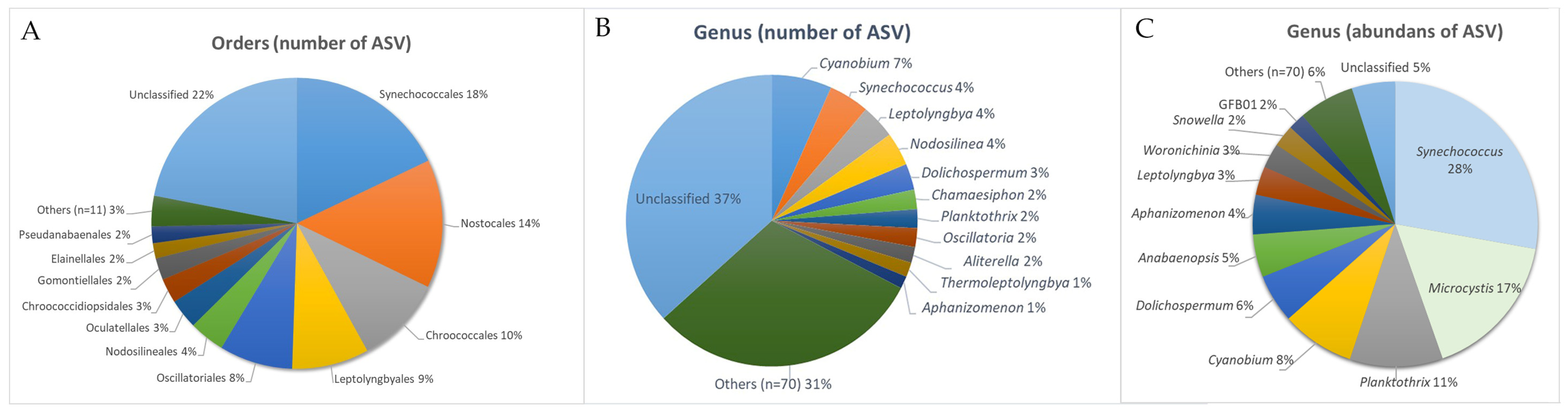
3.1. Taxonomic Composition of Cyanobacteria Community Based on 16S rRNA Gene Metabarcoding
3.2. Phylogenetic Analysis of ASV
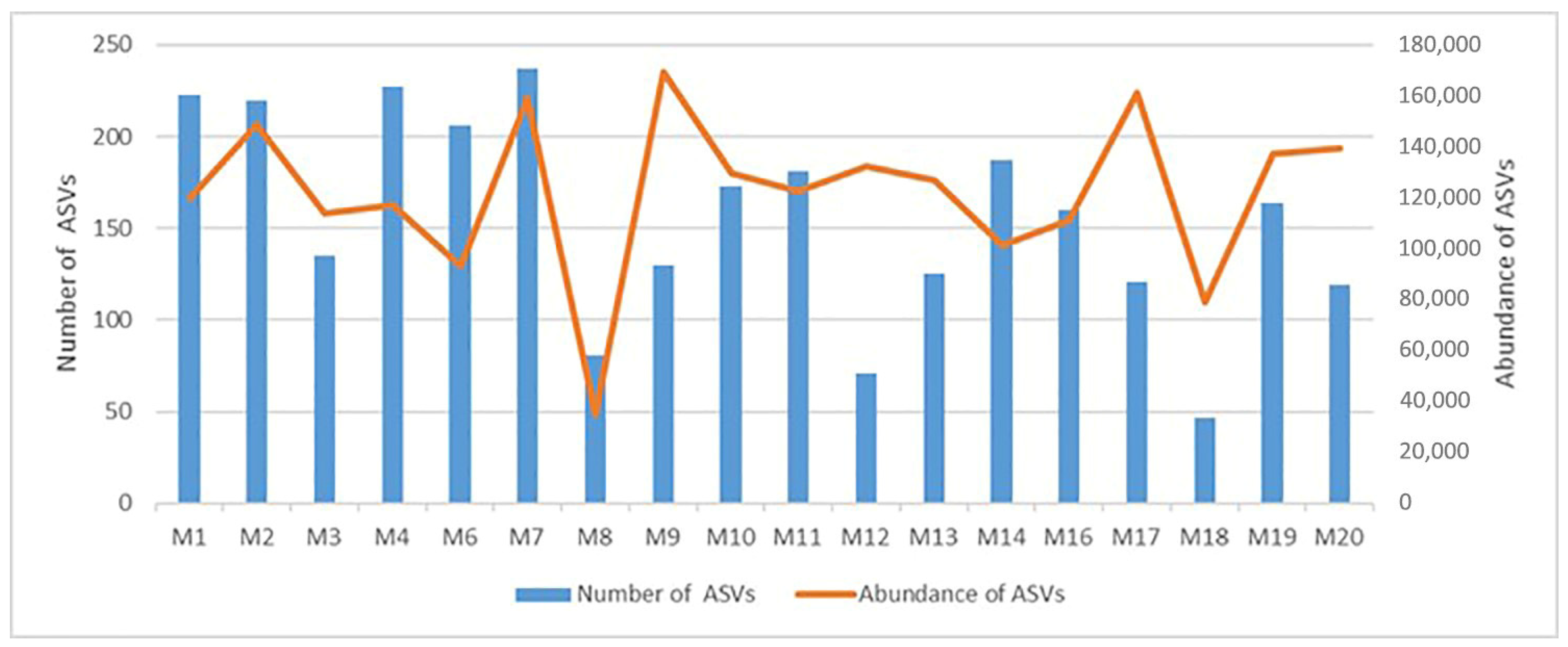
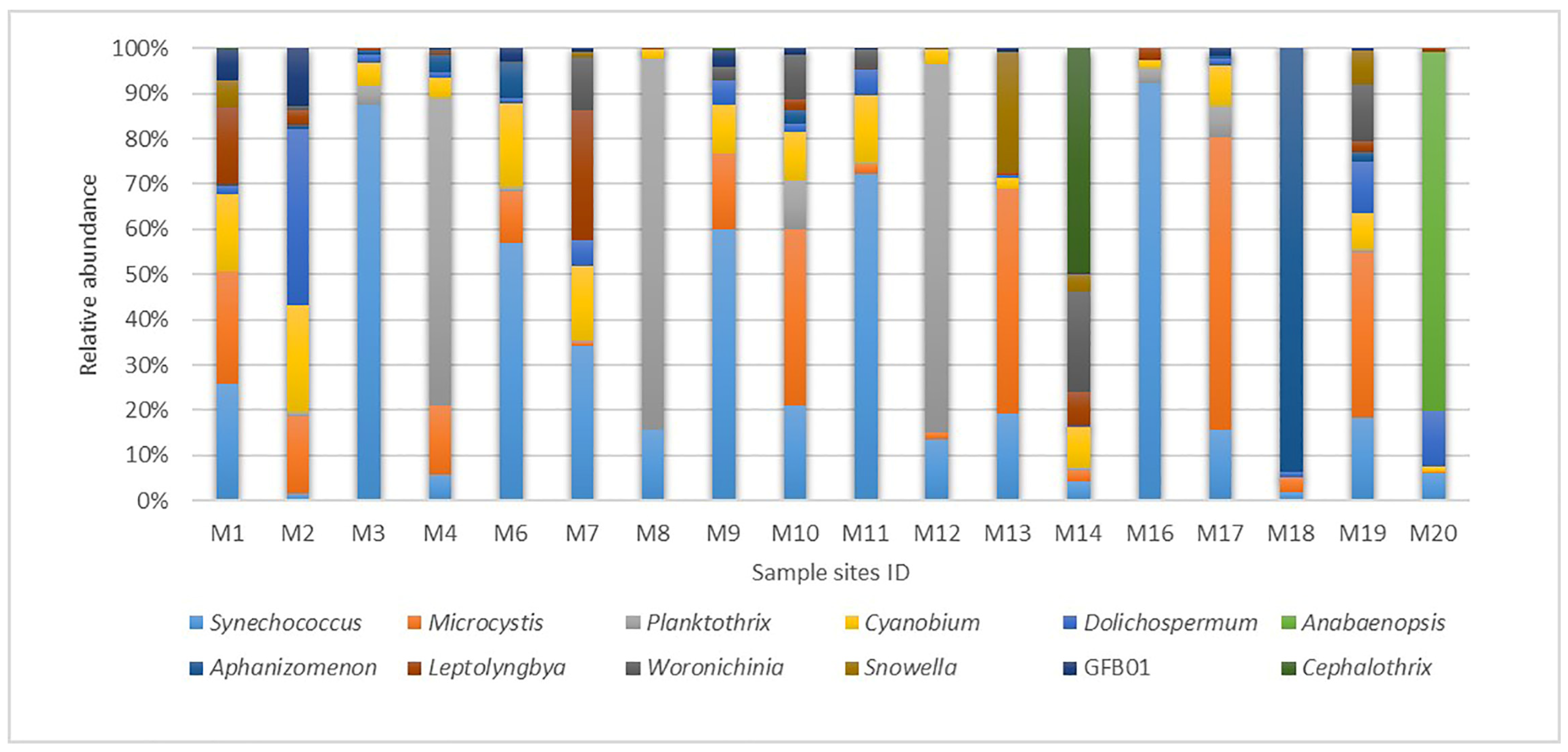
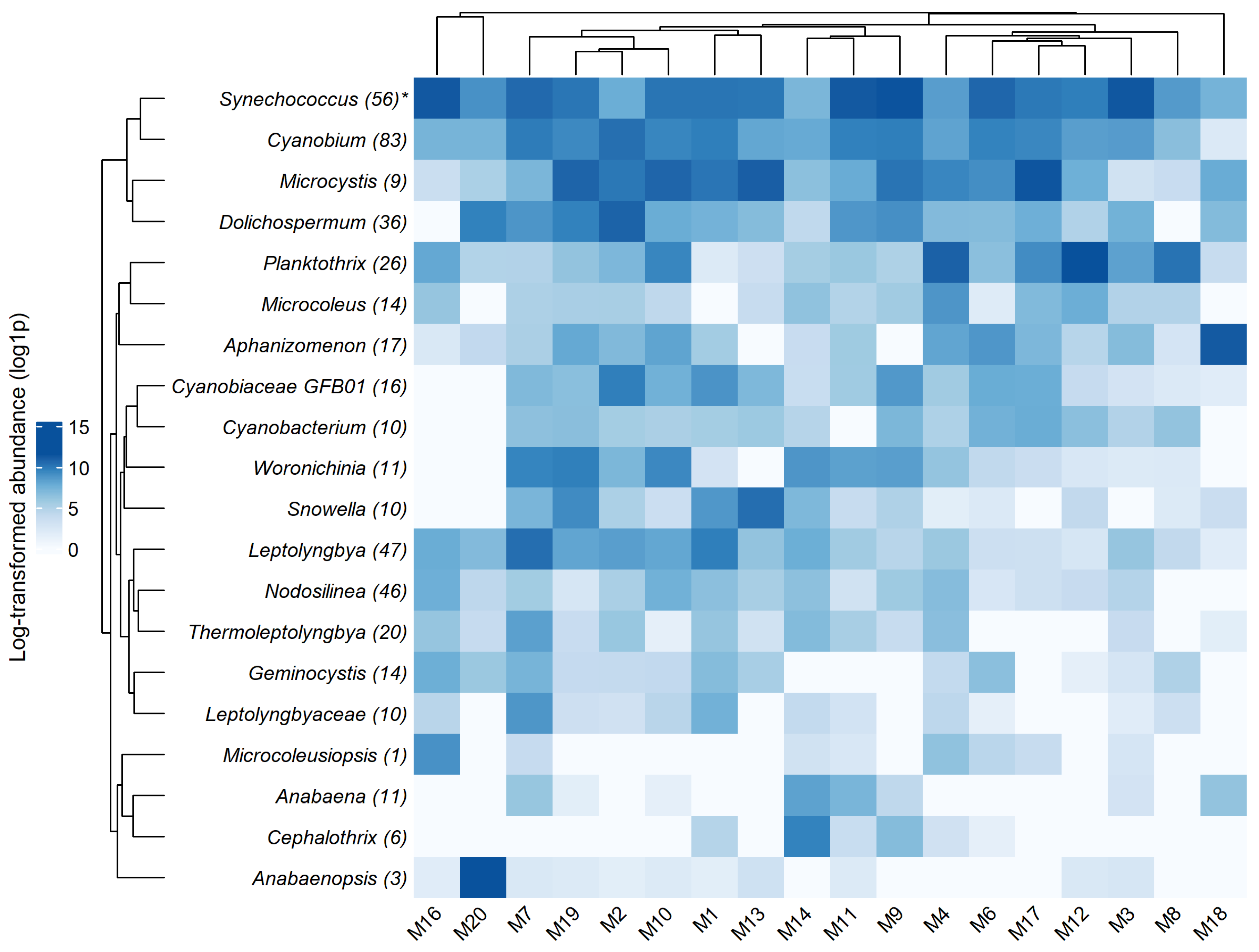
3.3. Distribution and Abundance Cyanobacteria Based on 16S rRNA Gene Metabarcoding
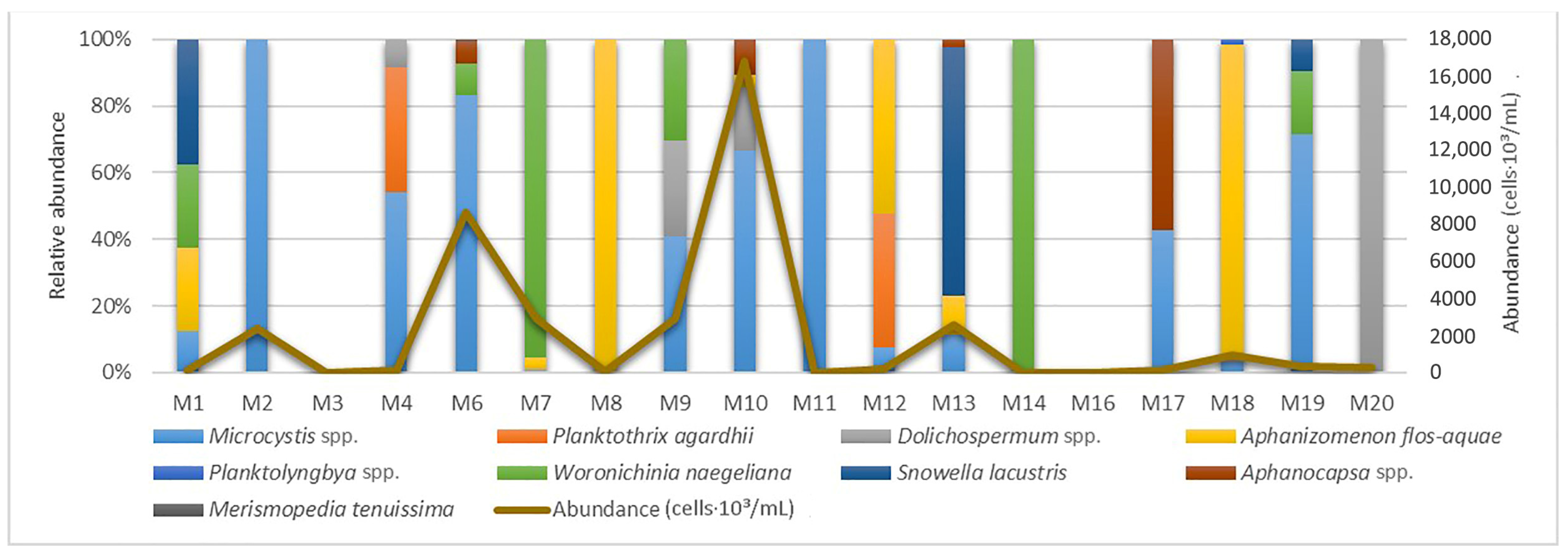
3.4. Morphological Analysis: Taxonomic Composition, Distribution, and Abundance
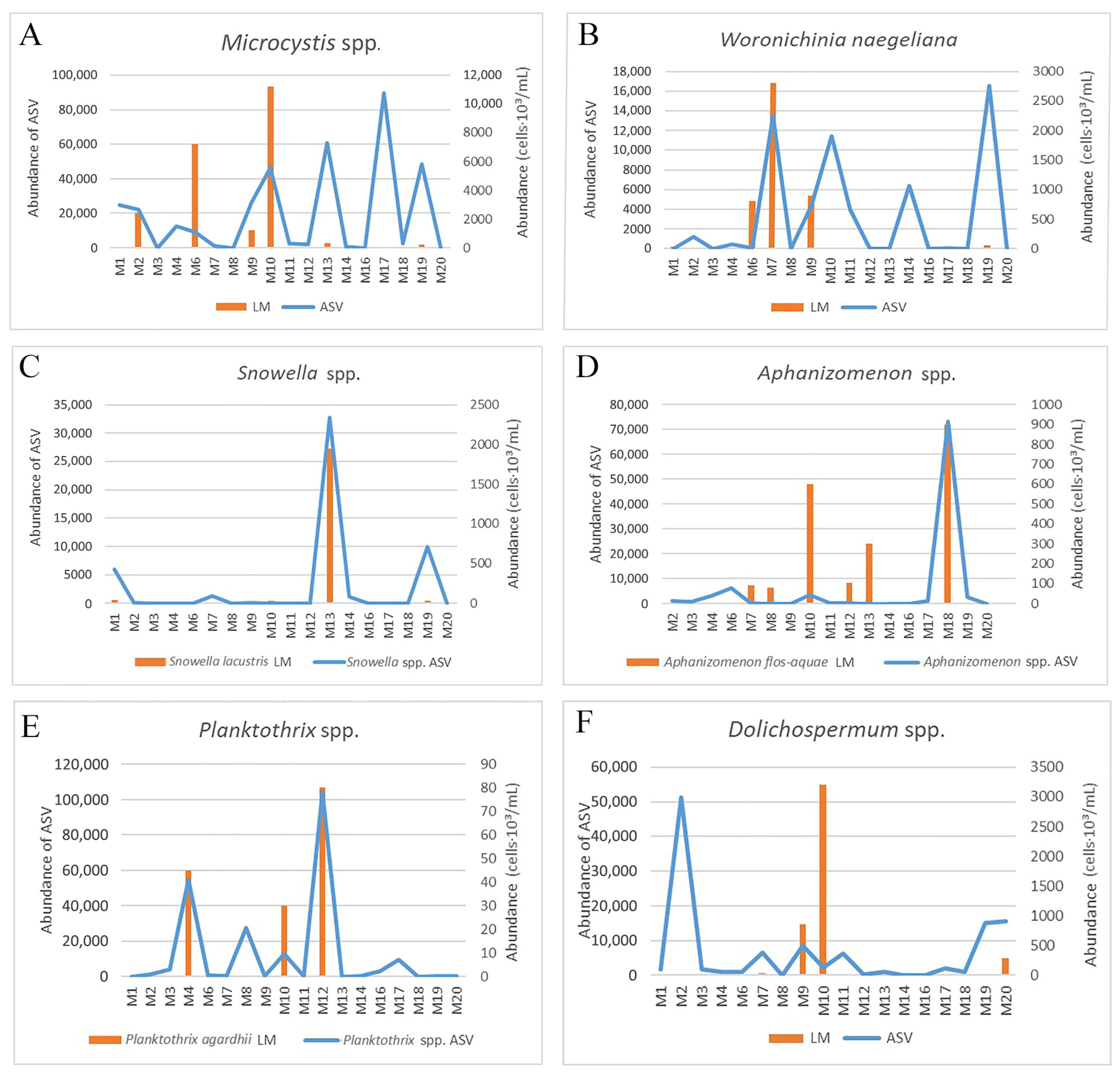
3.5. Comparison of Metabarcoding and Microscopy Data for the Analysis of Diversity and Distribution of Cyanobacteria
3.6. Detection of Strain Sequences in Metabarcoding Data
3.6.1. Argonema galeatum, Skoupý & Dvořák
3.6.2. Anabaena sp.
3.6.3. Aphanizomenon sp.
3.6.4. Dolichospermum sp.
3.6.5. Microcystis aeruginosa (Kützing) Kützing
3.6.6. Woronichinia naegeliana (Unger) Elenkin
4. Discussion
4.1. Comparison Between the Microscopic and Metabarcoding Datasets
4.2. Distribution of Toxigenic and Potentially Toxigenic Species of in the Studied Waterbodies According to Microscopy and Metabarcoding
5. Conclusions
- Repeated sequence verification in NCBI improves the taxonomic assignment of ASVs.
- The databases of cyanobacterial sequences should be further supplemented with securely identified and well-documented gene data.
- The short barcode region V3–V4 16S rRNA often does not provide accurate resolution for the species of many cyanobacteria, including the widespread and potentially toxigenic representatives of Microcystis, Planktothrix, Dolichospermum, and Aphanizomenon. Using additional genetic markers (e.g., rbcL, cpcBA or toxin genes) might improve resolution for the cyanobacteria species and toxic genotypes in future studies.
- As yet, it is impossible to unambiguously identify toxic and non-toxic forms of species based on this genetic marker. We agree with the opinion of Casero et al. [4], who pointed out the need to develop accurate methods for determining toxic/non-toxic genotypes within populations using integrative approaches—coupling genomics, transcriptomics, proteomics, and metabalomics in combination with field research.
- Using the example of the Argonema galeatum, which is rare for the studied waterbodies, the presence of the taxon at different locations was proved with minimal abundance values of ASV (<0.01%). Due to the very low abundance, the species was not detected during microscopy of the samples, while the Argonema galeatum strain CBMC475m was isolated from the M9 sample [26]. The 16S rRNA sequence region totally matched ASV416 identified as Argonema galeatum and detected in the same sample (M9). This indicates that low abundance sequences should not be neglected during the analysis of metabarcoding data.
- Our data on the analysis of cyanobacteria based on microscopy confirm the effectiveness of metabarcoding for the monitoring of CyanoHABs in urban waterbodies. Metabarcoding makes it possible to quickly assess the diversity of cyanobacteria, identify reservoirs with a high abundance of potentially toxigenic species, and detect the priority reservoirs with a high probability of toxic blooms.
Supplementary Materials
Author Contributions
Funding
Institutional Review Board Statement
Informed Consent Statement
Data Availability Statement
Conflicts of Interest
Abbreviations
| ASV | Amplicon Sequence Variants |
| BI | Bayesian inference |
| CyanoHAB | Cyanobacterial Harmful Algal Bloom |
| DIC | Differential Interference Contrast |
| DIN | Dissolved Inorganic Nitrogen |
| DIP | Dissolved Inorganic Phosphorus |
| DSi | Dissolved Silica |
| HPLC-HRMS | High-Performance Liquid Chromatography–High-Resolution Mass Spectrometry |
| LM | Light microscopy |
| PCR | Polymerase Chain Reaction |
| RAxML | Randomized Axelerated Maximum Likelihood |
References
- Salmaso, N.; Bernabei, S.; Boscaini, A.; Capelli, C.; Cerasino, L.; Domaizon, I.; Elersek, T.; Greco, C.; Klemenčič, A.; Tomassetti, P.; et al. Biodiversity patterns of cyanobacterial oligotypes in lakes and rivers: Results of a large-scale metabarcoding survey in the Alpine region. Hydrobiologia 2024, 851, 1035–1062. [Google Scholar] [CrossRef]
- Li, X.C.; Huo, S.; Zhang, J.; Ma, C.; Xiao, Z.; Zhang, H.; Xi, B.; Xia, X. Metabarcoding reveals a more complex cyanobacterial community than morphological identification. Ecol. Indic. 2019, 107, 105653. [Google Scholar] [CrossRef]
- Li, H.; Alsanea, A.; Barber, M.; Goel, R. High-throughput DNA sequencing reveals the dominance of pico- and other filamentous cyanobacteria in an urban freshwater Lake. Sci. Total Environ. 2019, 661, 465–480. [Google Scholar] [CrossRef]
- Casero, M.C.; Velázquez, D.; Medina-Cobo, M.; Quesada, A.; Cirés, S. Unmasking the identity of toxigenic cyanobacteria driving a multi-toxin bloom by high-throughput sequencing of cyanotoxins genes and 16S rRNA metabarcoding. Sci. Total Environ. 2019, 665, 367–378. [Google Scholar] [CrossRef]
- MacKeigan, P.W.; Garner, R.E.; Monchamp, M.È.; Walsh, D.A.; Onana, V.E.; Kraemer, S.A.; Pick, F.R.; Beisner, B.E.; Agbeti, M.D.; da Costa, N.B.; et al. Comparing microscopy and DNA metabarcoding techniques for identifying cyanobacteria assemblages across hundreds of lakes. Harmful Algae 2022, 113, 102187. [Google Scholar] [CrossRef]
- Fabrin, T.M.C.; Stabile, B.H.M.; da Silva, M.V.; Jati, S.; Rodrigues, L.; de Oliveira, A.V. Cyanobacteria in an urban lake: Hidden diversity revealed by metabarcoding. Aquat. Ecol. 2020, 54, 671–675. [Google Scholar] [CrossRef]
- Harke, M.J.; Steffen, M.M.; Gobler, C.J.; Otten, T.G.; Wilhelm, S.W.; Wood, S.A.; Paerl, H.W. A review of the global ecology, genomics, and biogeography of the toxic cyanobacterium, Microcystis spp. Harmful Algae 2016, 54, 4–20. [Google Scholar] [CrossRef]
- Jiang, Y.; Xiao, P.; Liu, Y.; Wang, J.; Li, R. Targeted deep sequencing reveals high diversity and variable dominance of bloom-forming cyanobacteria in eutrophic lakes. Harmful Algae 2017, 64, 42–50. [Google Scholar] [CrossRef]
- Jackim, E.; Gentile, J. Toxins of a blue-green alga: Similarity to saxitoxin. Science 1968, 162, 915–916. [Google Scholar] [CrossRef]
- Evans, M.H. Mechanism of saxitoxin and tetrodotoxin poisoning. Br. Med. Bull. 1969, 25, 263–267. [Google Scholar] [CrossRef] [PubMed]
- Chernova, E.; Sidelev, S.; Russkikh, I.; Voyakina, E.; Babanazarova, O.; Romanov, R.; Kotovshchikov, A.; Mazur-Marzec, H. Dolichospermum and Aphanizomenon as neurotoxins producers in some Russian freshwaters. Toxicon 2017, 130, 47–55. [Google Scholar] [CrossRef]
- Bernard, C.; Ballot, A.; Thomazeau, S.; Maloufi, S.; Furey, A.; Mankiewicz-Boczek, J.; Pawlik Skowrońska, B.; Capelli, C.; Salmaso, N. Appendix 2: Cyanobacteria associated with the production of cyanotoxins. In Handbook of Cyanobacterial Monitoring and Cyanotoxin Analysis; Meriluoto, J., Spoof, L., Codd, G.A., Eds.; John Wiley & Sons: Hoboken, NJ, USA, 2017; pp. 501–525. [Google Scholar]
- Voloshko, L.N.; Pinevich, A.V.; Kopecky, I.; Titova, N.N.; Hrouzek, P.; Zelic, P. Water blooms and toxins produced by cyanobacteria in the lower Suzdalskoe Lake (Saint-Petersburg, Russia). Algology 2010, 12, 210–223. [Google Scholar]
- Voyakina, E.Y.; Russkikh, Y.V.; Chernova, E.N.; Zhakovskaya, Z.A. Toxic cyanobacteria and their metabolites in the water bodies of North West of Russia. Theor. Appl. Ecol. 2020, 1, 124–129. [Google Scholar] [CrossRef]
- Sorokovikova, E.; Tikhonova, I.; Fedorova, G.; Chebunina, N.; Kuzmin, A.; Suslova, M.; Naidanova, Y.; Potapov, S.; Krasnopeev, A.; Gladkikh, A.; et al. Two New Strains of Microcystis Cyanobacteria from Lake Baikal, Russia: Ecology and Toxigenic Potential. Limnol. Rev. 2025, 25, 31. [Google Scholar] [CrossRef]
- Belykh, O.I.; Tikhonova, I.V.; Kuzmin, A.V.; Sorokovikova, E.G.; Fedorova, G.A.; Khanaev, I.V.; Sherbakova, T.; Timoshkin, O.A. First detection of benthic cyanobacteria in Lake Baikal producing paralytic shellfish toxins. Toxicon 2016, 121, 36–40. [Google Scholar] [CrossRef] [PubMed]
- Belykh, O.I.; Tikhonova, I.V.; Kuzmin, A.V.; Sorokovikova, E.G.; Potapov, S.A.; Galkin, A.V.; Fedorova, G.A. Toxin-producung cyanobacteria in Lake Baikal and the water bodies of Baikal region. Theor. Appl. Ecol. 2020, 1, 21–27. [Google Scholar] [CrossRef]
- Sidelev, S.I. Molecular genetic identification and seasonal succession of toxigenic cyanobacteria in phytoplankton of the Rybinsk Reservoir (Russia). Inland Water Biol. 2016, 9, 368–374. [Google Scholar] [CrossRef]
- Chernova, E.; Sidelev, S.; Russkikh, I.; Korneva, L.; Solovyova, V.; Mineeva, N.; Stepanova, I.; Zhakov-skaya, Z. Spatial distribution of cyanotoxins and ratios of microcystin to biomass indicators in the reservoirs of the Volga, Kama and Don rivers, the European part of Russia. Limnologica 2020, 84, 125819. [Google Scholar] [CrossRef]
- Belykh, O.I.; Gladkikh, A.S.; Sorokovikova, E.G.; Tikhonova, I.V.; Potapov, S.A.; Butina, T.V. Saxitoxin-producing cyanobacteria in Lake Baikal. Contemp. Probl. Ecol. 2015, 8, 186–192. [Google Scholar] [CrossRef]
- Mikhailov, I.S.; Zakharova, Y.R.; Bukin, Y.S.; Galachyants, Y.; Petrova, D.; Sakirko, M.; Likhoshway, Y. Co-occurrence Networks Among Bacteria and Microbial Eukaryotes of Lake Baikal During a Spring Phytoplankton Bloom. Microb. Ecol. 2019, 77, 96–109. [Google Scholar] [CrossRef]
- Mikhailov, I.S.; Galachyants, Y.P.; Bukin, Y.S.; Petrova, D.; Bashenkhaeva, M.; Sakirko, M.; Blinov, V.; Titova, L.; Zakharova, Y.; Likhoshway, Y. Seasonal Succession and Coherence Among Bacteria and Microeukaryotes in Lake Baikal. Microb. Ecol. 2022, 84, 404–422. [Google Scholar] [CrossRef] [PubMed]
- Sorokovikova, E.; Belykh, O.; Krasnopeev, A.; Potapov, S.; Tikhonova, I.; Khanaev, I.; Kabilov, M.; Baturina, O.; Podlesnaya, G.; Timoshkin, O. First data on cyanobacterial biodiversity in benthic biofilms during mass mortality of endemic sponges in Lake Baikal. J. Great Lakes Res. 2020, 46, 75–84. [Google Scholar] [CrossRef]
- Belykh, O.I.; Krasnopeev, A.Y.; Potapov, S.A.; Gutnik, D.I.; Sorokovikova, E.G.; Butina, T.V.; Tikhonova, I.V. Ultramicrobacteria and filterable bacteria in the plankton of Lake Baikal. Limnol. Freshw. Biol. 2024, 4, 795–820. [Google Scholar] [CrossRef]
- Prokhorov, A.M. (Ed.) Moscow (capital of the USSR). In Great Soviet Encyclopedia: [In 30 tons], 3rd ed.; Soviet Encyclopedia: Moscow, Russia, 1969–1978. (In Russian) [Google Scholar]
- Kezlya, E.; Mironova, E.; Chernova, E.; Gololobova, M.; Mironov, A.; Voyakina, E.; Maltsev, Y.; Snarskaya, D.; Kulikovskiy, M. Comprehensive Study of Some Cyanobacteria in Moscow Waterbodies (Russia), Including Characteristics of the Toxigenic Microcystis aeruginosa Strains. Toxins 2025, 17, 506. [Google Scholar] [CrossRef]
- Komárek, J.; Anagnostidis, K. Cyanoprokaryota. 1. Chroococcales. In Süßwasserflora von Mitteleuropa; Begründet von A. Pascher. Band 19/1; Ettl, H., Gärtner, G., Heynig, H., Mollenhauer, D., Eds.; Spektrum, Akademischer Verlag: Berlin/Heidelberg, Germany, 1999; pp. 1–548. [Google Scholar]
- Komárek, J. Cyanoprokaryota: Heterocystous Genera (Nostocales, Stigonematales). In Süßwasserflora von Mitteleuropa; Springer Spektrum: Berlin/Heidelberg, Germany, 2013; Volume 19/3, pp. 1–1130. [Google Scholar]
- Abakumov, V.A.; Bubnova, N.P.; Kholikova, N.I.; Goridchenko, T.P.; Liepa, R.A.; Svirskaya, N.L.; Ganshina, L.A.; Semin, V.A.; Khromov, V.M.; Nikitin, D.I.; et al. Guide to Methods of Hydrobiological Analysis of Surface Waters and Bottom Sediments; Gidrometeoizdat: Leningrad, Russia, 1983; 239p. (In Russian) [Google Scholar]
- Nübel, U.; Garcia-Pichel, F.; Muyzer, G. PCR primers to amplify 16S rRNA genes from cyanobacteria. Appl. Environ. Microbiol. 1997, 63, 3327–3332. [Google Scholar] [CrossRef]
- Kang, J.; Mohamed, H.F.; Liu, X.; Pei, L.; Huang, S.; Lin, X.; Zheng, X.; Luo, Z. Combined Culture and DNA Metabarcoding Analysis of Cyanobacterial Community Structure in Response to Coral Reef Health Status in the South China Sea. J. Mar. Sci. Eng. 2022, 10, 1984. [Google Scholar] [CrossRef]
- Gelis, M.M.N.; Canino, A.; Bouchez, A.; Domaizon, I.; Laplace-Treyture, C.; Rimet, F.; Alric, B. Assessing the relevance of DNA metabarcoding compared to morphological identification for lake phytoplankton monitoring. Sci. Total Environ. 2024, 914, 169774. [Google Scholar] [CrossRef]
- Guiry, M.D.; Guiry, G.M. AlgaeBase. World-Wide Electronic Publication, University of Galway. Available online: https://www.algaebase.org (accessed on 25 October 2025).
- Herdman, M.; Rippka, R. CYANOBACTERIOTA: Phylogeny and Taxonomy. 2024. Available online: https://cyanophylogeny.scienceontheweb.net (accessed on 25 October 2025).
- Katoh, K.; Toh, H. Parallelization of the MAFFT multiple sequence alignment program. Bioinformatics 2010, 26, 1899–1900. [Google Scholar] [CrossRef]
- Kumar, S.; Stecher, G.; Tamura, K. MEGA7: Molecular evolutionary genetics analysis version 7.0 for bigger datasets. Mol. Biol. Evol. 2016, 33, 1870–1874. [Google Scholar] [CrossRef] [PubMed]
- Drummond, A.J.; Rambaut, A. BEAST: Bayesian evolutionary analysis by sampling trees. BMC Evol. Biol. 2007, 7, 214. [Google Scholar] [CrossRef] [PubMed]
- Edler, D.; Klein, J.; Antonelli, A.; Silvestro, D. raxmlGUI 2.0: A graphical interface and toolkit for phylogenetic analyses using RAxML. Methods Ecol. Evol. 2021, 12, 373–377. [Google Scholar] [CrossRef]
- Skoupý, S.; Stanojkovi’c, A.; Pavlíková, M.; Poulĩcková, A.; Dvŏrák, P. New cyanobacterial genus Argonema is hiding in soil crusts around the world. Sci. Rep. 2022, 12, 7203. [Google Scholar] [CrossRef]
- Albrecht, M.; Pröschold, T.; Schumann, R. Identification of cyanobacteria in a eutrophic coastal lagoon on the Southern Baltic coast. Front. Microbiol. 2017, 8, 923. [Google Scholar] [CrossRef]
- Tukhtaboeva, Y.A.; Redkina, V.V.; Bukin, Y.S.; Temraleeva, A.D. Diversity of Cyanobacteria and Algae in Erodited Soils of the Fergana Valley (Uzbekistan) According to Light Microscopy Data and High-Throughput Sequencing. Arid Ecosyst. 2025, 15, 232–245. [Google Scholar] [CrossRef]
- Patova, E.; Novakovskaya, I.; Gusev, E.; Martynenko, N. Diversity of Cyanobacteria and Algae in Biological Soil Crusts of the Northern Ural Mountain Region Assessed through Morphological and Metabarcoding Approaches. Diversity 2023, 15, 1080. [Google Scholar] [CrossRef]
- Eiler, A.; Drakare, S.; Bertilsson, S.; Pernthaler, J.; Peura, S.; Rofner, C.; Simek, K.; Yang, Y.; Znachor, P.; Lindstr¨om, E.S. Unveiling distribution patterns of freshwater phytoplankton by a next generation sequencing based approach. PLoS ONE 2013, 8, e53516. [Google Scholar] [CrossRef]
- Bradley, I.M.; Pinto, A.J.; Guest, J.S. Design and evaluation of Illumina MiSeq-compatible, 18S rRNA gene-specific primers for improved characterization of mixed phototrophic communities. Appl. Environ. Microbiol. 2016, 82, 5878–5891. [Google Scholar] [CrossRef]
- Ballot, A.; Swe, T.; Mjelde, M.; Cerasino, L.; Hostyeva, V.; Miles, C.O. Cylindrospermopsin- and Deoxycylindrospermopsin-Producing Raphidiopsis raciborskii and Microcystin-Producing Microcystis spp. in Meiktila Lake, Myanmar. Toxins 2020, 12, 232. [Google Scholar] [CrossRef] [PubMed]
- Berry, M.A.; White, J.D.; Davis, T.W.; Jain, S.; Johengen, T.H.; Dick, G.J.; Sarnelle, O.; Denef, V.J. Are Oligotypes Meaningful Ecological and Phylogenetic Units? A Case Study of Microcystis in Freshwater Lakes. Front. Microbiol. 2017, 8, 365. [Google Scholar] [CrossRef] [PubMed]
- Ernst, B.; Hitzfeld, B.; Dietrich, D.R. Presence of Planktothrix sp. and cyanobac terial toxins in lake Ammersee, Germany and their impact on whitefish (Coregonus lavaretus L.). Environ. Toxicol. 2001, 16, 483–488. [Google Scholar] [CrossRef]
- Kurmayer, R.; Deng, L.; Entfellner, E. Role of toxic and bioactive secondary metabolites in colonization and bloom formation by filamentous cyanobacteria Planktothrix. Harmful Algae 2016, 54, 69–86. [Google Scholar] [CrossRef]
- Lenard, T.; Poniewozik, M. Planktothrix agardhii versus Planktothrix rubescens: Separation of Ecological Niches and Consequences of Cyanobacterial Dominance in Freshwater. Int. J. Environ. Res. Public Health 2022, 19, 14897. [Google Scholar] [CrossRef] [PubMed]
- Melnikova, A.A.; Komova, A.V.; Namsaraev, Z.B. Trends and Driving Forces of Cyanobacterial Blooms in Russia in the 20th and Early 21st Centuries. Microbiology 2022, 91, 649–661. [Google Scholar] [CrossRef]
- Li, X.; Dreher, T.W.; Li, R. An overview of diversity, occurrence, genetics and toxin production of bloom-forming Dolichospermum (Anabaena) species. Harmful Algae 2016, 54, 54–68. [Google Scholar] [CrossRef] [PubMed]



| Sample Site ID | Watercourse or Reservoir | Coordinates | Recreational Use | Hydrological Parameters | ||
|---|---|---|---|---|---|---|
| Temperature (°C) | pH | Conductivity (mV) | ||||
| M1 | Bolshoy Krylatsky Pond | 55.763134, 37.435047 | Yes | 23.4 | 8.09 | 134 |
| M2 | Krylatskoye Rowing Canal | 55.766868, 37.442611 | Yes | 24.8 | 8.89 | 148 |
| M3 | Unnamed pond to the east of the rowing canal | 55.765066, 37.446576 | No | 25.1 | 8.5 | 154 |
| M4 | Moskva River, Krylatskoye district | 55.753740, 37.448831 | Yes | 22.1 | 7.78 | 165 |
| M6 | Bolshoy Sadovy Pond | 55.834221, 37.539308 | Yes | 23.6 | 8.77 | 103 |
| M7 | Nizhny Fermsky Pond | 55.835205, 37.559273 | Yes | 21.5 | 8.93 | 100 |
| M8 | Chachenka River | 55.734546, 37.335521 | No | 25.4 | 7.85 | 42 |
| M9 | Unnamed pond in Odintsovsky district | 55.765066, 37.446576 | No | 25.1 | 8.50 | 154 |
| M10 | Meshchersky Pond | 55.674680, 37.410679 | Yes | 28.1 | 9.50 | 111 |
| M11 | Unnamed pond | 55.668461, 37.385979 | No | 27.1 | 8.51 | 152 |
| M12 | Setun River | 55.679703, 37.365388 | No | 24.1 | 7.88 | 112 |
| M13 | Unnamed pond in Marfino district #1 | 55.689277, 37.365546 | No | 27.6 | 9.02 | 103 |
| M14 | Unnamed pond in Marfino district #2 | 55.668461, 37.385979 | No | 27.1 | 8.51 | 152 |
| M15 | Tributary of the Likhoborka River | 55.843815, 37.616566 | No | 26.1 | 7.96 | 171 |
| M16 | Pervy Kamensky Pond | 55.833901, 37.608266 | Yes | 28.1 | 8.41 | 172 |
| M17 | Yauza River | 55.841615, 37.631375 | No | 26,8 | 7.95 | 167 |
| M18 | Patriarshiy Pond | 55.763396, 37.592456 | Yes | 25.5 | 9.37 | 95 |
| M19 | Clean Pond | 55.761603, 37.644501 | Yes | 25.6 | 8.81 | 131 |
| M20 | Bolshoy Ekaterininsky Pond | 55.843815, 37.616566 | Yes | 22.9 | 8.42 | 87 |
| Taxa | Sample Site ID/Abundance (Cells·103/mL) | |||||||||||||||||
|---|---|---|---|---|---|---|---|---|---|---|---|---|---|---|---|---|---|---|
| M1 | M2 | M3 | M4 | M6 | M7 | M8 | M9 | M10 | M11 | M12 | M13 | M14 | M16 | M17 | M18 | M19 | M20 | |
| Aphanizomenon flos-aquae | 30 | 90 | 80 | 600 | 105 | 300 | 900 | |||||||||||
| Microcystis aeruginosa | 15 | 2400 | 65 | 7200 | 1200 | 6400 | 15 | 15 | 300 | 45 | 30 | 225 | ||||||
| Microcystis wesenbergii | 4800 | 0 | ||||||||||||||||
| Snowella lacustris | 45 | 30 | 1950 | 30 | ||||||||||||||
| Woronichinia naegeliana | 30 | 800 | 2800 | 900 | 0 | 15 | 60 | |||||||||||
| Dolichospermum crassum | 7.5 | 550 | 3200 | |||||||||||||||
| Dolichospermum planctonicum | 125 | 140 | ||||||||||||||||
| Dolichospermum spiroides | 4 | 30 | 175 | 4.5 | 150 | |||||||||||||
| Planktothrix agardhii | 45 | 30 | 80 | |||||||||||||||
| Aphanocapsa spp. | 600 | 1800 | 60 | 60 | ||||||||||||||
| Merismopedia tenuissima | 32 | |||||||||||||||||
| Planktolyngbya spp. | 15 | |||||||||||||||||
| Total abundance (cells·103/mL) | 120 | 2400 | 0 | 110 | 8636 | 2928 | 80 | 2950 | 16,860 | 15 | 200 | 2610 | 15 | 0 | 105 | 950 | 315 | 290 |
Disclaimer/Publisher’s Note: The statements, opinions and data contained in all publications are solely those of the individual author(s) and contributor(s) and not of MDPI and/or the editor(s). MDPI and/or the editor(s) disclaim responsibility for any injury to people or property resulting from any ideas, methods, instructions or products referred to in the content. |
© 2025 by the authors. Licensee MDPI, Basel, Switzerland. This article is an open access article distributed under the terms and conditions of the Creative Commons Attribution (CC BY) license (https://creativecommons.org/licenses/by/4.0/).
Share and Cite
Kezlya, E.; Mironova, E.; Voyakina, E.; Kravchenko, S.; Mironov, A.; Kuzmin, V.; Chernova, E.; Iurmanov, A.; Maltsev, Y.; Kulikovskiy, M. Cyanobacteria in Waterbodies of the Biggest Anthropogenic Agglomeration: Combined DNA Metabarcoding, Microscopy, and Culture Analysis. Phycology 2025, 5, 88. https://doi.org/10.3390/phycology5040088
Kezlya E, Mironova E, Voyakina E, Kravchenko S, Mironov A, Kuzmin V, Chernova E, Iurmanov A, Maltsev Y, Kulikovskiy M. Cyanobacteria in Waterbodies of the Biggest Anthropogenic Agglomeration: Combined DNA Metabarcoding, Microscopy, and Culture Analysis. Phycology. 2025; 5(4):88. https://doi.org/10.3390/phycology5040088
Chicago/Turabian StyleKezlya, Elena, Elina Mironova, Ekaterina Voyakina, Sergey Kravchenko, Andrei Mironov, Vasilii Kuzmin, Ekaterina Chernova, Anton Iurmanov, Yevhen Maltsev, and Maxim Kulikovskiy. 2025. "Cyanobacteria in Waterbodies of the Biggest Anthropogenic Agglomeration: Combined DNA Metabarcoding, Microscopy, and Culture Analysis" Phycology 5, no. 4: 88. https://doi.org/10.3390/phycology5040088
APA StyleKezlya, E., Mironova, E., Voyakina, E., Kravchenko, S., Mironov, A., Kuzmin, V., Chernova, E., Iurmanov, A., Maltsev, Y., & Kulikovskiy, M. (2025). Cyanobacteria in Waterbodies of the Biggest Anthropogenic Agglomeration: Combined DNA Metabarcoding, Microscopy, and Culture Analysis. Phycology, 5(4), 88. https://doi.org/10.3390/phycology5040088