Article

Environmental Degradation in the Italian Mediterranean Coastal Lagoons Shown by Satellite Imagery


by
Viola Pagliani
1,
Elena Arnau-López
2,
Noelia Campillo-Tamarit
2,
Manuel Muñoz-Colmenares
2,
Juan Miguel Soria
2 and
Juan Víctor Molner
2,*
1
Department of Ecology, Environment and Plant Sciences (DEEP), Stockholm University, Svante Arrhenius Väg 20 A, 114 18 Stockholm, Sweden
2
Cavanilles Institute of Biodiversity and Evolutionary Biology (ICBiBE), Universitat de València, Catedrátic José Beltrán Martinez, 2, 46980 Valencia, Spain
*
Author to whom correspondence should be addressed.
Phycology 2025, 5(4), 87; https://doi.org/10.3390/phycology5040087
Submission received: 20 October 2025 / Revised: 18 November 2025 / Accepted: 10 December 2025 / Published: 12 December 2025

Abstract

Coastal lagoons are recent geological formations, crucial biodiversity hot-spots, and fragile ecosystems which provide several ecosystem services. These areas are strongly affected by nutrient inputs, which can lead to eutrophication and algal blooms. We identified nine Italian coastal lagoons with a surface area greater than 10 km2. Most of them were previously classified in a poor ecological condition. Therefore, we used remote sensing, in particular Sentinel-2 images, to assess the trophic state of these areas over time from 2015 until 2025. Automatic products of chlorophyll-a (Chl-a), total suspended matter (TSM), and water transparency (kd_z90max) were derived. Chl-a concentrations indicated predominantly eutrophic conditions, ranging from 0.44 (Mare Piccolo) to 80.81 mg·m−3 (Comacchio). Comacchio and Cabras showed persistently high Chl-a values and low transparency, while Mare Piccolo was characterized by high transparency and oligotrophic conditions. Varano and Cabras showed a significant increase in Chl-a (p < 0.05) coupled with an increase in TSM (p < 0.01) and decline in transparency in Varano (p < 0.05). Most other lagoons showed no long-term trends but remained in eutrophic–hypereutrophic states. Therefore, the Italian coastal lagoons studied are vulnerable areas to environmental degradation. Many of the lagoons showed persistent eutrophic conditions and no long-term recovery trends. However, among the lagoons, there were heterogeneous ecological conditions, ranging from oligotrophic (Mare Piccolo) to chronically hypereutrophic (Comacchio, Cabras). Water clarity was mainly affected by suspended solids; however, in some cases, there was a key role in primary production (algal blooms). Sentinel-2 data proved effective for monitoring spatial and temporal variability in coastal lagoon water quality, offering a valuable tool for environmental management and early detection of degradation trends.

1. Introduction

Coastal lagoons are shallow water bodies located close to the sea. In most cases, they are formed by the accumulation of sediments or sand. They are the result of several factors, which include the balance between the contribution and its basin, its vicinity, and the strength of the contributions [1]. These peculiar areas are often subject to intermittent or permanent seawater influxes, due to high tides and storms, as well as freshwater inputs from runoff and stream discharges. These characteristics strongly influence their high variability between annual cycles due to unpredictable inputs [2]. They are characterized by slow water renewal due to the low freshwater inputs and their limited connection with the sea. In most cases, they are brackish water basins, but the salinity levels may change abruptly due to storms, which alter the connection between the lagoon and the sea. However, in some cases, they can be hypersaline due to high evaporation [3]. Coastal lagoons are found on the coasts of the Mediterranean Sea, in the Baltic Sea, and in some areas of the Atlantic Ocean. The Mediterranean coastal lagoons are all from the Holocene period [1,4].
The Mediterranean Sea originates from the Tethys Sea; in fact, seven million years ago, the movement of the tectonic plates closed the Rifian and Betic corridors (the Gibraltar Strait at the time), resulting in the “Miocene Saline Crisis”. During this period, the interruption of the connection with the Atlantic Ocean caused an important drop in sea level due to evaporation, and this water basin was left as an inland sea. After the reopening of the current Gibraltar corridor, around five million years ago, the recovery of the water level led to the creation of the coastline, which changed at some times during glaciations and is presently nearly the same it was 10.000 years ago [1,4]. Therefore, coastal lagoons are generally recently formed and are dynamic systems: they can be created in a few thousand years but can also disappear quickly due to erosion of the sand bar or siltation of the sediments [5].
These areas are crucial hotspots for biodiversity and provide several ecosystem services; for this reason, the European Union in the “Habitats Directive” has declared them as a Priority Habitat due to their unique biological communities with several aquatic species of interest [6]. Recent studies have highlighted that the different groups found in coastal lagoons (microbial organisms, zooplankton, mollusks, crustaceans, fish, birds, and so on) contribute crucially to different ecosystem processes [7]. Moreover, coastal lagoons are complex social–ecological systems [8] that play a pivotal role in supporting human health and well-being. They contribute to food security and freshwater storage, while mitigating climate change impacts through the regulation of hydrological balance, climate moderation, and flood control. Furthermore, they provide essential ecosystem services such as water purification, oxygen production, nutrient cycling, and opportunities for recreation and ecotourism [8]. However, they are largely understudied. These water bodies are part of the cultural heritage of the Mediterranean region as they have been used as fishing grounds since ancient times. In fact, among the various traditional uses of lagoons, aquaculture has played a particularly important role in preserving these ecosystems, many of which have been threatened by land reclamation and other anthropogenic activities [9].
These habitats are exposed to several threats, which include land-based pollution inputs [10], water contamination, and habitat disruption [11]. In fact, these areas are often under more frequent disturbances and exposed to chronic stressors [10]. Species loss strongly affects the ecosystem functioning, affecting the ecosystem services provided by the lagoons [7].
Eutrophication is one of the crucial issues affecting coastal marine ecosystems, particularly coastal lagoons [12]. In some cases, it may become chronic, leading to hypoxia events, toxic algal blooms, foam events, and death of benthic animals, which may result in an alteration of the community structure [13]. These negative effects, once they show up, are hard to reverse or to stop [14,15,16]. Several pressures contribute to eutrophication in these areas, the main one being agriculture, followed by extractive and touristic activities, shore modifications, and coastal works. This may result in an alteration of energy inputs, particularly nutrients and organic matter inputs, which together with other types of disturbances (resuspension of sediments, hydrodynamic modifications, disturbance of water balances and physical–chemical gradients) may facilitate eutrophication processes in these delicate environments [12].
Besides eutrophication, coastal lagoons are subject to other threats, such as ship wakes, which can affect the resuspension of sediments in the water [17]. The wake generated by the vessels in open sea tends to have a negligible impact on the seabed, while in vulnerable areas, such as tidal creeks, microtidal estuaries, lakes, or wetlands might cause significant damage [17]. Additionally, invasive species represent another threat to these peculiar ecosystems: for instance, the proliferation of invasive toxic dinoflagellates, like in the case described by Ligorini et al. [18], can have a negative cascade effect on the lagoon ecosystems. These events have been linked to a decrease in zooplankton biomass, which has impacted local commercial fisheries as well [18]. Moreover, another threat to coastal lagoons is climate change: due to their geomorphological characteristics, these areas respond quickly to ocean inputs, which may affect their overall hydrodynamics as well as their salinity and temperature changes [19]. Local populations have a deep connection to these habitats, which have been used as fishing grounds since ancient times; therefore, the loss of coastal lagoons is not only an ecological loss but has strong socio-economic implications [9].
The most fundamental response to these degradation processes is consistent temporal and spatial monitoring, for which satellite remote sensing has established itself as a valuable tool. In the study by Soria et al. [1], they evaluated the trophic state of the main 37 Mediterranean lagoons in the summer of 2020 using Sentinel-2 images. The methodology comprised the utilization of automatic products (C2RCC/C2X-Nets), which have been validated in numerous studies, for the determination of the concentration of chlorophyll-a (Chl-a), total suspended matter (TSM) and kd_z90max, the depth at which 90% of the incident light has been absorbed, as measures of the transparency. In this regard, recent work in the field of underwater computer vision has offered robust methodologies to improve the accuracy of aquatic image processing. For instance, studies such as that by Wang et al. [20] have proposed methodologies to rectify colour disparities in both the Lab and RGB colour spaces, with the objective of aligning aquatic images with natural colour consistency. Furthermore, the development of advanced frameworks such as WaterCycleDiffusion [21]—which uses visual–textual fusion powered by diffusion models (Stable Diffusion Turbo)—facilitates efficient enhancement and generalization of image quality.
In the context of Mediterranean Coastal Lagoons studied by remote sensing, the findings of Soria et al. [1] confirmed that the majority of these lagoons were classified as eutrophic or worse in the summer of 2020, with only six in good ecological status. These results are of particular relevance to Italian coastal lagoons, the majority of which have been categorized as exhibiting poor trophic status. However, despite the extensive documentation of the poor trophic status, existing studies are deficient in continuous, long-term data series, which are necessary to determine whether there is persistent degradation or recovery.
Following this line of research, the aim of this study is to assess the temporal changes (2015–2025) in the Chl-a concentration value, the TSM and the kd_z90max in the nine Italian coastal lagoons with a surface area greater than 10 km2 from the start of Sentinel-2 operations to the present day. We aim to identify eventual patterns and trends in water quality that may indicate degradation or recovery processes over time. Where possible, we will qualitatively relate these trends to anthropogenic pressures and environmental changes.

2. Materials and Methods

2.1. Study Site

We identified nine Italian coastal lagoons with a surface superior of 10 Km2 for this study: Marano−Grado, Venezia, Comacchio, Lesina, Varano, Mare Piccolo, Orbetello, Orbetello−Levante, and Cabras. Even though Soria et al. [1] considered Orbetello as a single lagoon, it was decided that Orbetello (western part) and Orbetello-Levante (eastern part) should be considered as separate lagoons. This decision was made on the basis that they meet the criterion of having an area greater than 10 km2 and that, despite being connected and sharing an outlet to the sea, their distinctive “butterfly” shape, as if they were two halves, could influence their spatial heterogeneity and different components. It was determined that this course of action would circumvent the potential for spatial variations to impact the mean value. In Table 1, the main geographical information is shown for each one.
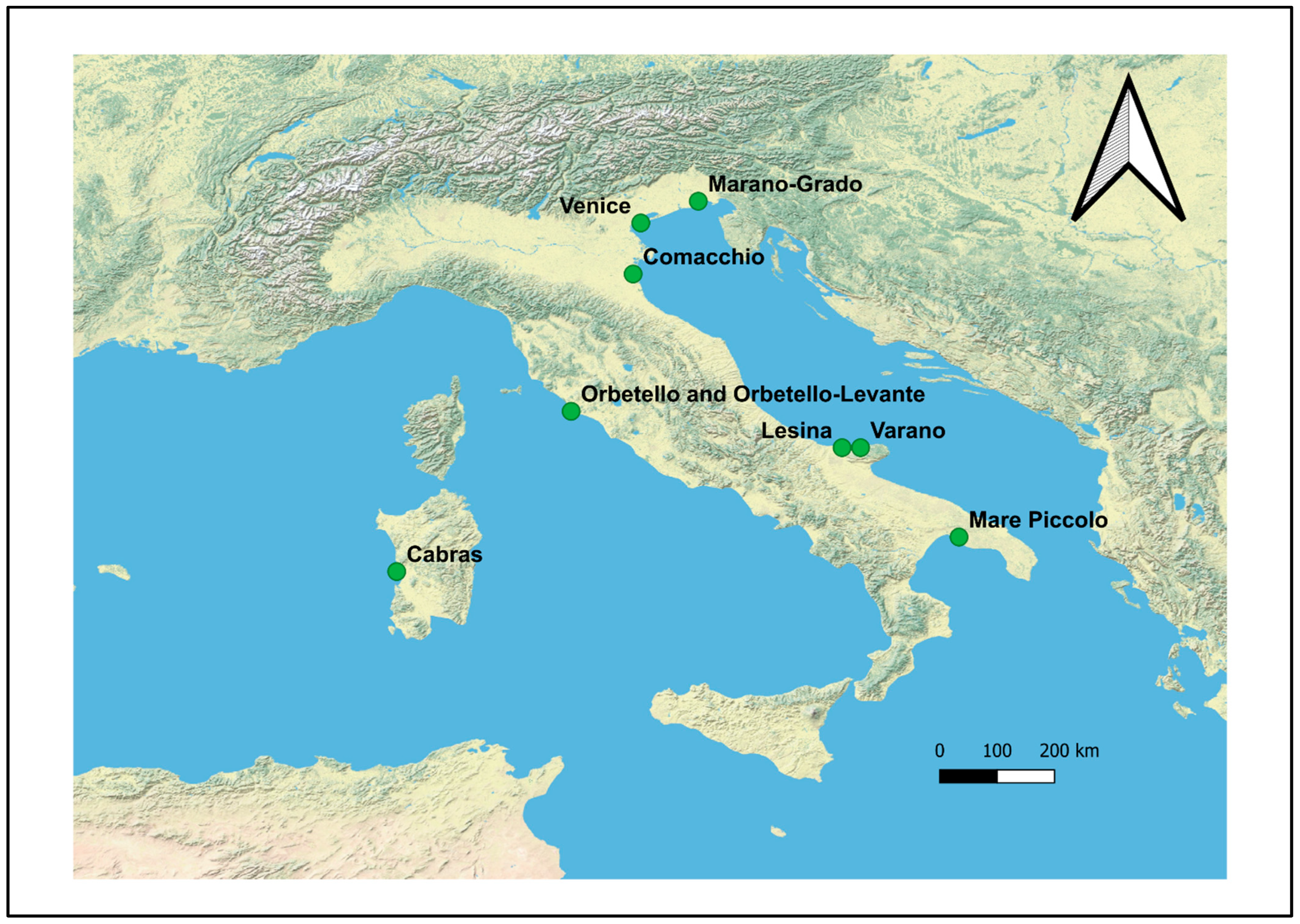
Figure 1 shows the location of these nine lagoons of study in the central Mediterranean Sea. The Marano−Grado lagoon, located in Friuli Venezia Giulia region (Figure 1), is a diverse microtidal system composed of salt marshes, intertidal flats, and several channels. This area is notorious for traditional aquaculture practices, including clam and mussel cultivation, and it is a crucial biodiversity hotspot that contributed to its recognition as a Ramsar Wetland of International Importance [22]. The Venezia lagoon, located in the Veneto region (Figure 1), with a cover of approximately 550 km2, represents the largest Italian coastal lagoon. This lagoon, similarly to the Marano−Grado lagoon, is a complex system of canals and flats. However, in this case, it includes islands as well. Historically, it has been subject to several anthropogenic impacts. Venezia and its lagoon are a UNESCO World Heritage Site and show the delicate balance between urban development and natural processes in coastal ecosystems [23,24].
In the Emilia Romagna region, we can find the Comacchio lagoon (Figure 1), which is constituted by salt pans, and it is influenced by the Po River Delta. This area is crucial for bird migration and biodiversity conservation as well as anthropogenic activities such as salt production and eel fishing [25].
In the Puglia region, we can find three of the coastal lagoons studied: Lesina, Varano, and Mare Piccolo. Lesina lagoon (Figure 1) is located close to the Adriatic Sea, separated from it by a sandy barrier. This non-tidal lentic system is important both from the ecological and biogeochemical point of view, as it is characterized by hydrological heterogeneity which supports a diverse fish population [26]. The second coastal lagoon we can find in Puglia is the Varano lagoon (Figure 1). It is a shallow and narrow lagoon covering an area of around 65 km2. Aquaculture is broadly practiced in these areas, particularly mussel farming [27]. The last coastal lagoon located in Puglia is Mare Piccolo (Figure 1), this system is divided into two inlets, and it is characterized by unique ecological conditions. In fact, it is a semi-enclosed marine basin that hosts several freshwater springs [28]. Moving to the Tuscany region, we can find the Orbetello−Levante lagoon. A shallow brackish water system of around 27 km2, several restoration efforts have been put in place to mitigate the effects of ecological degradation in this area since the 1990s [29]. The last coastal lagoon studied is Cabras (Figure 1), located in the Sardinia region. A shallow (average depth of 1.6 m) transitional system is often affected by dystrophic events due to the accumulation of organic matter and sulfur compounds, which can cause significant losses of biological resources [30].

2.2. Data Acquisition and Processing

The data regarding these nine lagoons were collected from the Satellite Sentinel-2, they were acquired using the Copernicus server browser, powered by ESA. The study covered a range of time of approximately ten years, from 2015 to 2025. Suitable pictures, acquired from the satellite, were selected based on the seasonality and on the atmospheric conditions. Dates with cloud cover of less than 10% were selected to ensure that the study area was clear and for avoiding atmospheric correction issues. More specifically, two pictures per year were collected: one in spring−summer (between May and August) and one in winter (between December and February), in order to assess eventual seasonality trends. Due to the favourable climatic conditions, this process was straightforward, with only minor complications encountered in the Venezia and Marano-Grado areas. Moreover, given the 5−day revisit time of these satellites, data acquisition did not present any significant challenges. The images were resampled to 20 m (60 m in Venezia and Marano-Grado due to their bigger size. The images were preprocessed and the atmospheric correction was conducted applying the algorithm Case 2 Regional Coastal Color (C2RCC) together with the Case 2 Extreme neural networks for complex waters (C2X-Nets) were used for the atmospheric correction using SNAP 12.0 software (Brockmann Consult, Hamburg, Germany).
The C2X application allows us to obtain estimated values of the concentration of Chl-a (conc_chl), the concentration of TSM (conc_tsm), and water transparency measured as the coefficient kd_z90max. For each site, the mean value was calculated within a polygon restricted to the central area, minimizing edge effects and thereby reducing boundary-related biases.

2.3. Data Analysis

For each lagoon and each variable (Chl-a, TSM, kd_z90max), we performed a test of temporal trends and autocorrelation, in addition to Pearson’s correlation test between the three variables for each lagoon. The trophic state was assessed using the classification by Carlson [31] and OECD [32] which based on the Chl-a concentration allowed us to classify the lagoons as response to the nutrient inputs as ultraoligotrophic (chlorophyll concentration < 1 mg·m−3), oligotrophic (chlorophyll concentration between 1 and 2.5 mg·m−3), mesotrophic (chlorophyll concentration between 2.51 and 8 mg·m−3), eutrophic (chlorophyll concentration between 8.01 and 25 mg·m−3) and hypertrophic (chlorophyll concentration > 25 mg·m−3). This provides insights into the eventual temporal changes in the trophic state of these lagoons. Correlation analyses were conducted to assess an eventual correlation among the kd_z90max, the Chl-a, and the TSM concentrations, over time. Firstly, a normality test was conducted; when necessary, the data was log-transformed. If data normality could not be achieved through logarithmic transformation, a rank-based approach was applied. Several statistical tests were conducted to compare the water quality among the different lagoons, identifying similarities and differences among them. These analyses were performed using the free statistical software PAST 4.05. Maps are created using QGIS 3.34.3.

3. Results

3.1. General Characteristics of Optical Parameters During the Study Period

A total of 175 images from Sentinel-2A, 2B and 2C satellites with a cloud cover of less than 10% were processed and following the acquisition of the automatic products (conc_tsm, conc_chl, and kd_z90max), the statistics presented in Table 2 were obtained. A total of 181 observations were obtained for each variable in the nine lagoons studied.
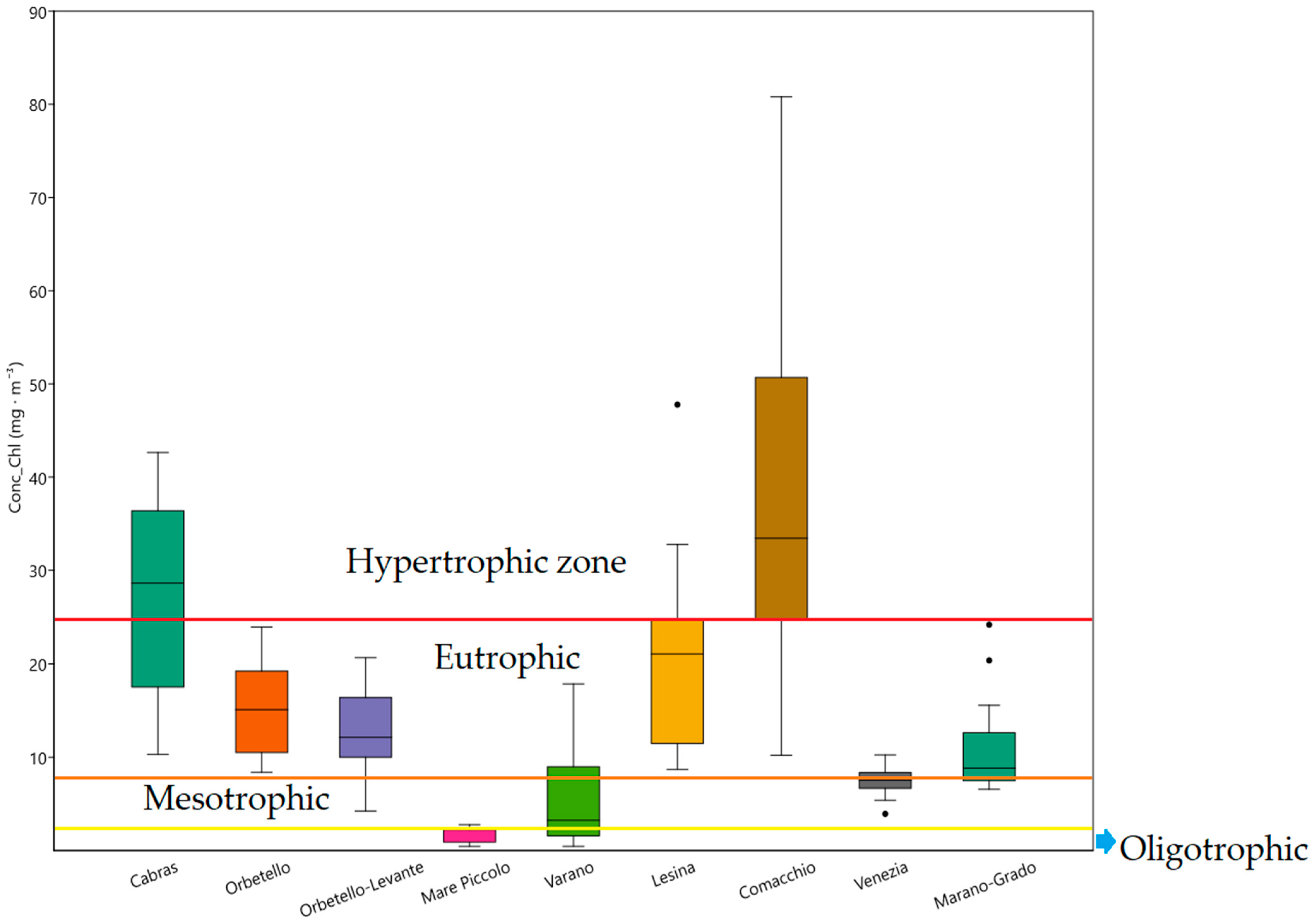
The maximum concentration of Chl-a was observed in Comacchio on 5 July 2019, with a value of 80.81 mg·m−3, while the minimum was observed in Mare Piccolo on 3 June 2022, with 0.44 mg·m−3. The mean value obtained was 15.41 mg·m−3, indicative of a eutrophic state. As illustrated in Figure 2, the box plot indicates a clear separation between the lagoons, with Comacchio showing the highest Chl-a concentrations, though it should be observed that there is considerable variability, ranging from 10.20 mg·m−3 on 28 February 2019 to the previously mentioned 80.81 mg·m−3. However, Mare Piccolo exhibits the lowest phytoplankton biomass in its waters, with Chl-a concentrations ranging from 0.45 mg·m−3 to 2.77 mg·m−3.
For a better understanding of differences between lagoons regarding Chl-a, Table 3 shows descriptive statistics about Chl-a for each lagoon.
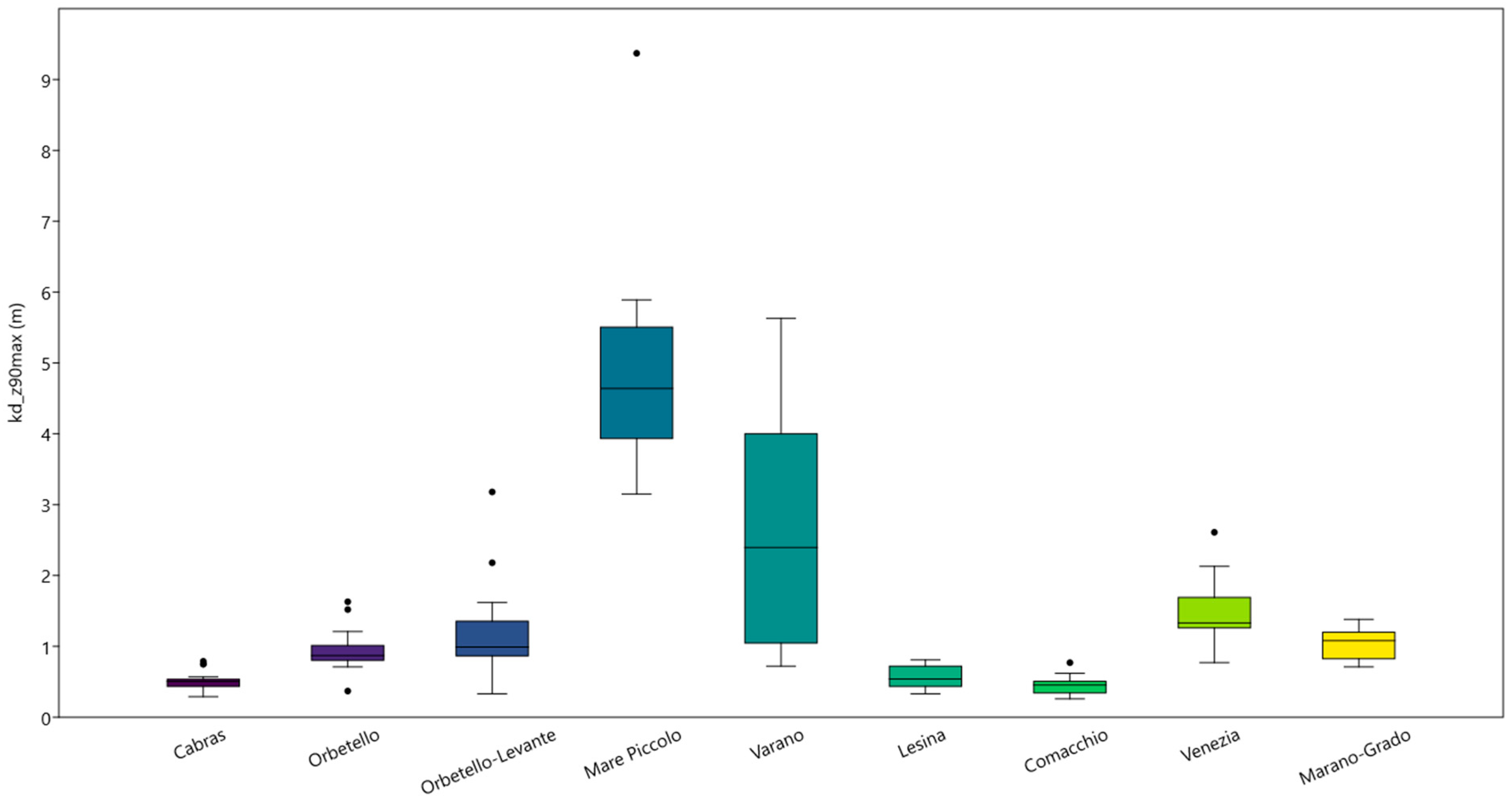
Mare Piccolo was observed to reach a maximum transparency of 9.37 m on 2 July 2025, while Comacchio was identified as the lagoon in the poorest condition, with a minimum transparency of 0.26 m. This finding is further supported by Figure 3, which illustrates the distribution of transparency across the lagoons. Additionally, Varano Lagoon proved to be the most variable during the study period, exhibiting transparency levels ranging from 0.72 m on 11 July 2023 to 5.63 m on 2 July 2018.
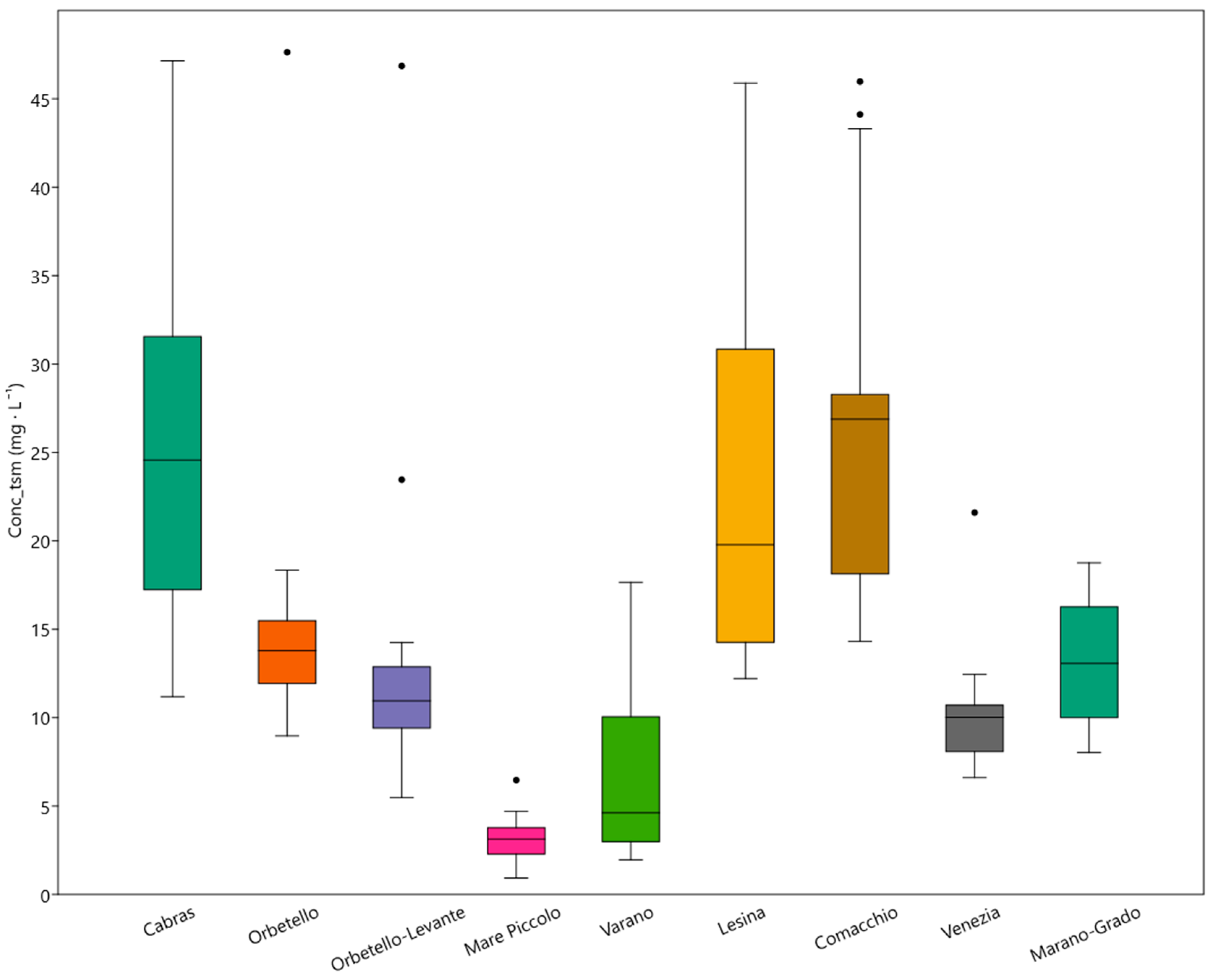
Regarding TSM, the maximum value was detected in Orbetello on 28 February 2020 at 47.64 mg·L−1. However, this value is considered an anomalous result, possibly attributable to a substantial influx of sediments resulting from riverine activity. It is important to note that the lagoon typically maintains suspended matter concentrations within the range of 9 to 18 mg·L−1, as illustrated in Figure 4. In contrast, the minimum value was obtained in Mare Piccolo on 2 July 2025 at 0.93 mg·L−1. Mare Piccolo was found to be the lagoon with the highest kd_z90max and the lowest Chl-a and TSM values.

3.2. Temporary Trends in Water Quality by Lagoon

Trend analysis using the Mann–Kendall test revealed heterogeneous patterns among the different Italian coastal lagoons (Table 4). Significant upward trends in Chl-a were detected in Cabras and Varano, suggesting a progressive increase in phytoplankton biomass in these lagoons. In comparison, no significant long-term changes were observed in the other systems. Regarding TSM, only Varano showed a significant increase (p < 0.01). For kd_z90max, no relevant trends were found except for a slight decrease in Varano (p < 0.05). These results highlight particularly active dynamics in Varano, where increases in Chl-a and TSM coincide with a deterioration in kd_z90max.
Autocorrelation analysis revealed clear differences in seasonal patterns between the studied lagoons. Marano-Grado and Varano exhibited the most consistent signals, showing positive correlations at a lag of around 1 year (lag 2, r ≈ 0.32–0.42) and alternating negative values at adjacent lags. This indicates a clear annual periodicity. In Orbetello, a maximum was detected at lag 4 (r ≈ 0.55), suggesting a biennial cycle. In contrast, in Cabras and Lesina, larger-scale oscillations appeared at lags 5 and 6, respectively, with values of r of approximately 0.65 and 0.61. By contrast, the correlations were generally low (|r| < 0.30) in Mare Piccolo, Orbetello-Levante, Comacchio, and Venezia, with no evidence of regular seasonal patterns. However, a weak echo close to the annual cycle was observed in Venezia (lag 2, r ≈ 0.32).
The Chl-a series shows that most lagoons remain eutrophic–hypereutrophic on a recurring basis (Table 5). In some cases, there are seasonal fluctuations, but no sustained trends towards less productive states. The lagoons in the worst condition (Comacchio and Cabras) show high values throughout most of the series, with frequent hypertrophic episodes, confirming chronic poor condition. Lesina follows, showing recurrent changes between mild eutrophication (approximately 10 mg·m−3) and more severe eutrophication (>20 mg·m−3), with hyper-eutrophic peaks from 2022 to the present. Orbetello and Orbetello-Levante, on the other hand, are eutrophic most of the time. Venezia is usually in the mesotrophic range, with some eutrophic peaks, while Marano-Grado alternates between mesotrophic and eutrophic phases seasonally.
The cases of Mare Piccolo and Varano are unique because they are the only ones with Chl-a concentrations remaining below the mesotrophic range throughout the series. Mare Piccolo is in the best condition, usually fluctuating between oligotrophy and ultra-oligotrophy, with a minimum value of 0.44 mg·m−3 recorded in summer 2022.
Varano, however, requires greater attention. This lagoon shows a mild seasonal pattern in Chl-a concentration, which tends to increase over time. Oligotrophy is most common in the first half of the time series, but from 2022 onwards, periods of sustained eutrophy become increasingly common.

3.3. Relationship Between Transparency and Water Components

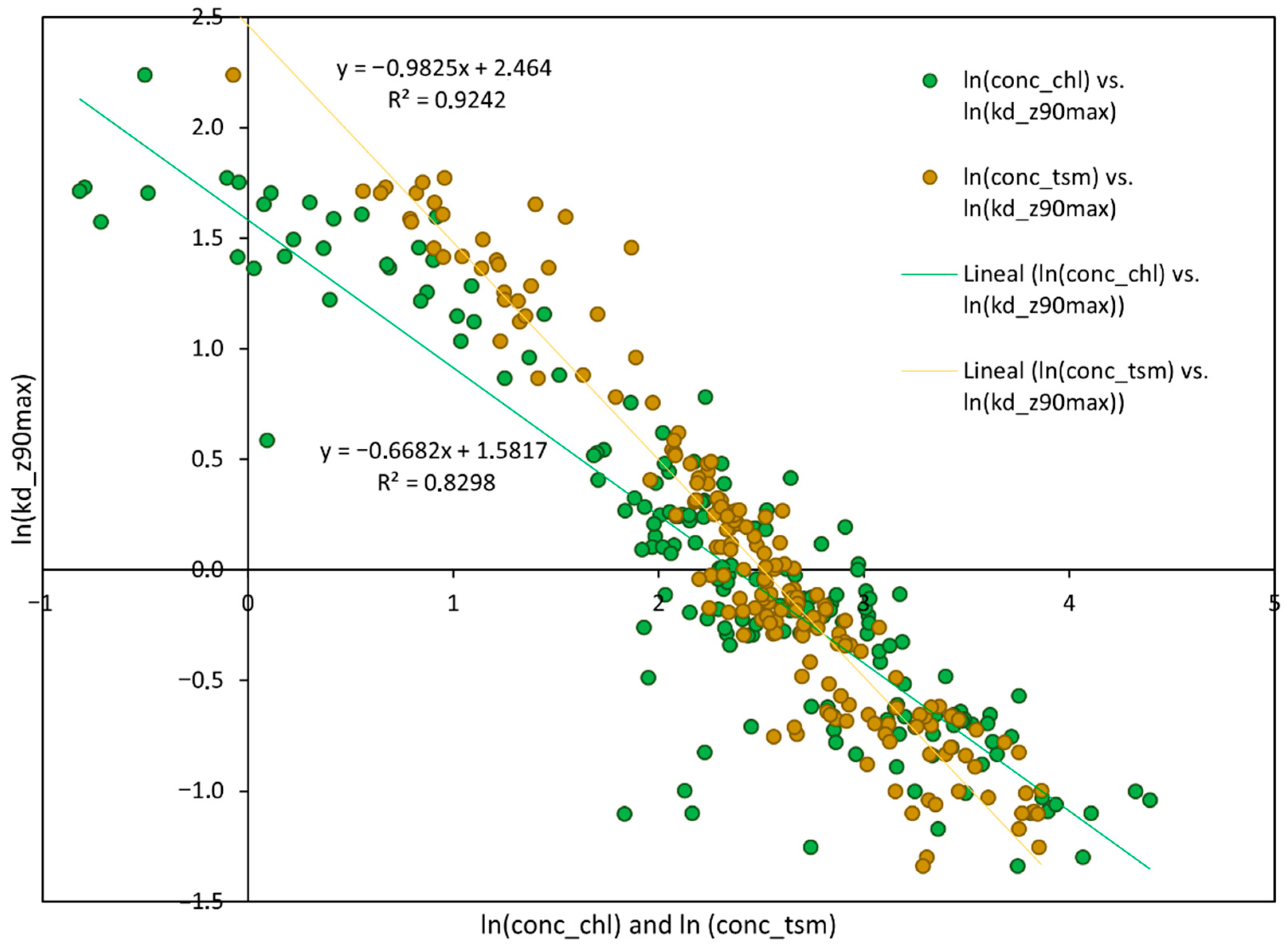
As illustrated by Figure 5 (ln-ln graph), upon plotting the natural logarithm (ln) of water transparency against the natural logarithms (ln) of Chl-a and TSM concentrations, a significant negative linear relationship (p < 0.001) is observed. This negative linear regression, whereby water transparency diminishes as algal biomass or suspended solids concentration rises, mirrors an enhancement in the light extinction coefficient (k) within the lagoons examined. This outcome aligns with the prevailing principle that diminished transparency signifies heightened turbidity (whether attributable to phytoplankton or inorganic/mineral detritus).
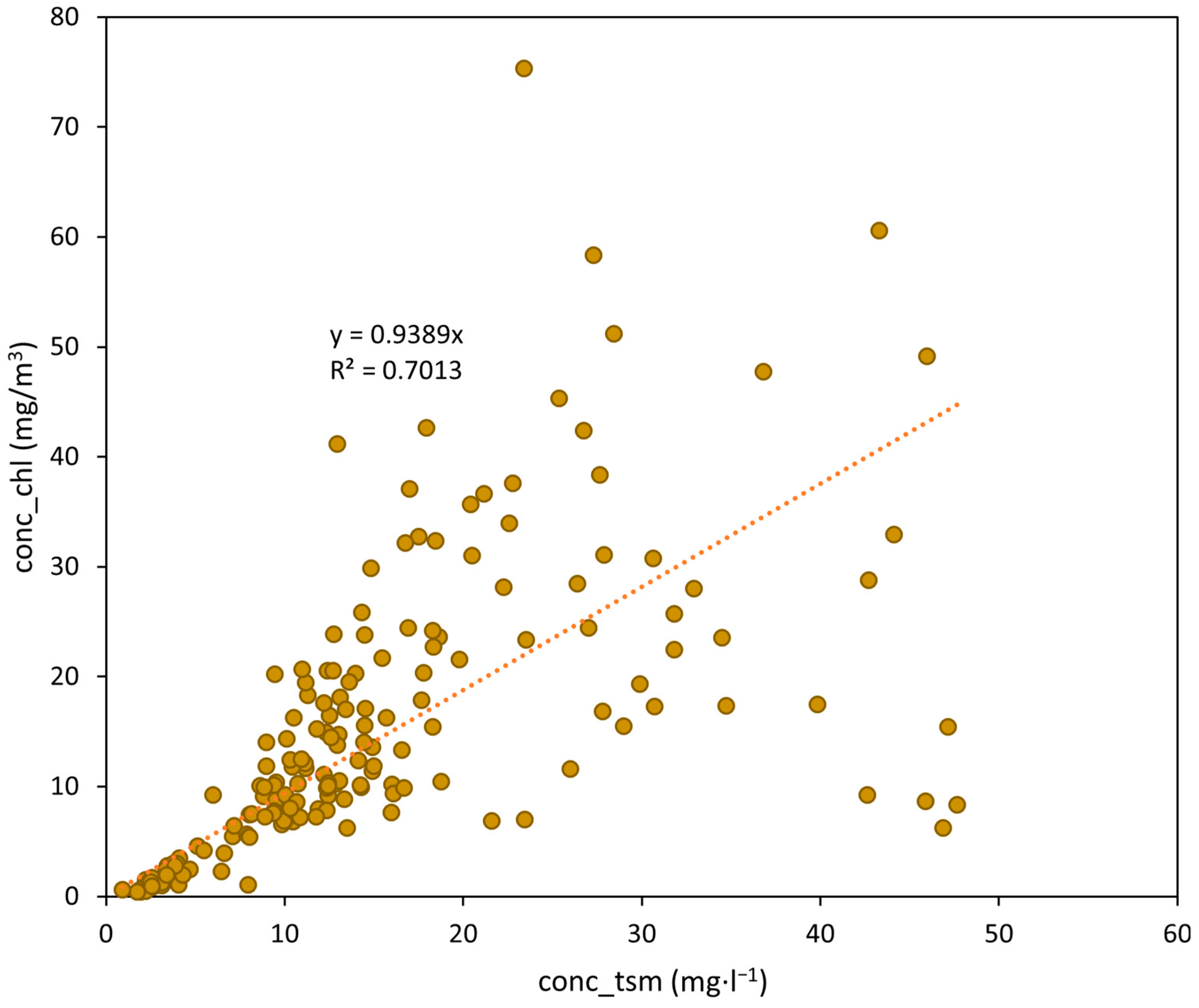
As demonstrated in Figure 6, a significant linear regression is observed between TSM and Chl-a concentrations (p < 0.001). It is evident that the ratio approaches 1:1 (1000 mg·L−1 of solids per 1 mg m−3 of Chl-a) in most cases with concentrations below 20 mg·m−3 of chlorophyll and 20 mg·L−1 of solids. Beyond this threshold, there is greater variability, with lagoons exhibiting significant algal biomass being more susceptible to fluctuations in suspended matter composition (e.g., Comacchio) and those with less significant algal biomass demonstrating an increase in inorganic sediments (a phenomenon observed in meso-eutrophic situations such as those found in Cabras and Lesina).
A detailed analysis of these relationships for individual lagoons reveals a considerable degree of variability.
In Comacchio, a significant negative relationship was identified between water transparency and two key variables: Chl-a (r = −0.71, p < 0.001) and TSM (−0.52, p = 0.014), indicating that most of turbidity is induced by the phytoplankton biomass. However, no correlation was found between suspended solids and chlorophyll (r = 0.22, p = 0.34).
In Mare Piccolo, water transparency (kd_z90max) evidenced a substantial negative correlation with chlorophyll-a (r = −0.64, p = 0.002) and with suspended solids (r = −0.58, p = 0.008). This finding suggests that an increase in phytoplankton biomass and particulate matter significantly reduces light penetration in the water column. In contrast to other systems, suspended solids and chlorophyll revealed a highly significant positive correlation (r = 0.74, p < 0.001), indicating that a substantial proportion of the observed turbidity is associated with organic matter of algal origin.
In Venezia, the rank transformation was applied to the suspended solids parameter in order to normalize the data and apply correlation analyses more reliably. The transparency of water was found to have a significant negative relationship with chlorophyll-a (r = −0.65, p = 0.001) and with suspended solids (r = −0.89, p < 0.001). Furthermore, a significant positive correlation was observed between chlorophyll-a and suspended solids (r = 0.68, p < 0.001). These results suggest that a significant fraction of the suspended material is associated with phytoplankton and, therefore, with biological processes rather than purely sedimentary ones. Turbidity is the result of two main factors: firstly, the presence of inorganic solids, which reduce water clarity, and secondly, phytoplankton growth, which further increases turbidity.
In Cabras, a statistically significant correlation between water transparency and chlorophyll was not observed (r = −0.17, p = 0.23). However, a strong negative correlation was identified between transparency and suspended solids (r = −0.81, p < 0.001), indicating that the transparency of the lake is associated with variations in its solids. In this instance, the distribution of transparency was found to be non-normal, a situation which required the application of a logarithmic transformation for the purpose of normalization.
In Marano-Grado, the rank category was applied to the chlorophyll parameter in order to normalize the data. The transparency of water is indicative of a significant negative correlation with both chlorophyll-a (r = −0.78, p < 0.001) and suspended solids (r = −0.91, p < 0.001). This suggests that a considerable proportion of the suspended material is associated with phytoplankton. The strong negative relationship with suspended solids indicates that this parameter has a significant impact on turbidity levels in the lagoon.
In Orbetello, a highly significant negative correlation between water transparency (kd_z90max) and suspended solids (r = −0.81, p < 0.001) is evident. This correlation reflects the marked limitation of light penetration in the water column consequent to an increase in particles. However, the relationship between transparency and chlorophyll-a is practically nil and insignificant (r = 0.03, p = 0.90), indicating that phytoplankton is not a relevant factor in light attenuation in this system. The relationship between chlorophyll-a and suspended solids exhibited a very weak and statistically insignificant negative correlation (r = −0.09, p = 0.69). This finding suggests that the observed turbidity is predominantly associated with suspended inorganic material rather than phytoplankton biomass. In this instance, both transparency and suspended solids had non-normal distributions. Initially, a logarithmic transformation was applied in order to normalize them, but satisfactory results were not obtained. Consequently, the decision was taken to implement a rank transformation, a method that enabled the acquisition of values following a normal distribution for both variables.
In Orbetello-Levante, a highly significant negative correlation was detected between water transparency and suspended solids (r = −0.83, p < 0.001). This indicates that an increase in particles in the water column markedly reduces light penetration. By contrast, the relationship between transparency and chlorophyll-a is negative but weak and not significant (r = −0.23, p = 0.32), indicating that phytoplankton biomass is not a determining factor in light attenuation in the system. The findings indicate that chlorophyll-a and suspended solids, which are commonly used as indicators of algal biomass, display a remarkably low and non-significant positive correlation (r = 0.11, p = 0.66). This observation suggests that the observed turbidity is predominantly caused by inorganic components rather than by algal production. With regard to the normality of the data, both transparency and suspended solids were found to be non-normal. In order to normalize the data, a logarithmic transformation was applied, thereby obtaining results exclusively for transparency. In order to achieve normality for solids, a rank transformation was applied, a process which enabled the acquisition of values with a normal distribution for this specific variable.
In Lesina lagoon, the correlation between chlorophyll-a (Conc_chl) and the concentration of TSM is insignificant (r = −0.03, p = 0.91), indicating that phytoplankton biomass is not directly associated with the load of particulate matter in the water column. Nevertheless, the transparency of the water column, measured as the light attenuation coefficient (kd_z90max), displays a modest negative correlation with chlorophyll-a (r = −0.27, p = 0.29), indicating that the impact of phytoplankton on the attenuation of light is limited. However, the relationship between kd_z90max and suspended solids is negative and very strong (r = −0.86, p < 0.001), indicating that the increase in particles is the determining factor in the increase in turbidity and light attenuation within the system. The findings of this study indicate that the variability of transparency in Lesina is predominantly influenced by inorganic particulate matter, as evidenced by the absence of a correlation with phytoplankton biomass.
In Varano, a highly significant negative correlation was revealed between water transparency (kd_z90max) and suspended solids (r = −0.95, p < 0.001). This finding indicates that an increase in particulate matter in the water column significantly reduces light penetration. In a similar analysis, the relationship between transparency and chlorophyll-a was found to be negative, significant and high (r = −0.88, p < 0.001), indicating that phytoplankton contributes significantly to light attenuation in this system. On the other hand, chlorophyll-a and suspended solids have been shown to display a strong and highly significant positive correlation (r = 0.85, p < 0.001), suggesting that the observed turbidity is associated with both suspended inorganic material and phytoplankton biomass. In this instance, logarithmic transformation was required to normalize chlorophyll-a and suspended solids.

4. Discussion

Despite different seasonal fluctuations, most lagoons show no long-term recovery trends, indicating persistent eutrophic-hypereutrophic conditions. Overall, the lagoons showed a heterogeneous pattern. Comacchio was identified as the lagoon in the poorest condition, with minimum transparency and highest chlorophyll-a levels. Meanwhile, Mare Piccolo had the best trophic state, showing the lowest values of suspended solids, the highest transparency values and the lowest chlorophyll-a values. Varano showed high seasonal fluctuations in transparency levels, with a significant increase in suspended solids (SS). Moreover, Cabras and Varano lagoons were the only ones showing an increasing trend in chlorophyll-a, no significant long-term changes were observed in the other systems. This increasing trend suggests that there is no efficient mitigation of the nutrient inputs, particularly nitrogen and phosphorus, linked to agriculture and the use of inorganic fertilizers.
Mare Piccolo and Varano stand out as the only lagoons with chlorophyll-a concentrations below the mesotrophic range for most of the study period, though Varano has shown a recent shift toward eutrophic conditions since 2022. Generally, there were strong links between water transparency, suspended solids, and chlorophyll-a, with turbidity in most cases driven by inorganic particles, except in Venezia, Mare Piccolo, and Varano, where phytoplankton plays a major role.
Specifically, Comacchio, Lesina, and Cabras lagoons were the systems in the poorest ecological status among the ones studied. In fact, the Comacchio lagoon showed stable hypertrophic conditions since the previous study conducted by Soria et al. [1]. Comacchio and Lesina showed similar concentrations of suspended matter, but Comacchio showed higher phytoplankton levels than Lesina. Cabras lagoon showed the highest chlorophyll-a (Chl a) values, with a significantly increasing eutrophic state, trending towards a hypereutrophic state. In this lagoon, there are historical records of dystrophic crises, such as the one which occurred in 1999 [33,34]. In the work by Pulina et al. [33], they notice a shift in the phytoplankton composition in favour of species which are adapted to warmer temperatures. The success of the Cyanobacteria is peculiar in areas where there is severe environmental degradation [33]. Therefore, it would be interesting to investigate if the increase in Chl-a that we observed was linked to the prevalence of this group. If this is the case it might imply a further degradation of this coastal lagoon, since this trend was recorded (2007–2008) [33] and the success of heat-adapted phytoplankton species.
In Comacchio, in 1980 there was a major eutrophication event, as well, which reshaped its food web. In fact, it shifted to a cyanobacteria-dominated system, with the loss of bottom vegetation and benthic fauna [25]. These system shifts, which can be noticed in several of the lagoons studied [25,33,34] can be caused by an increase in the nutrient input, particularly nitrogen and phosphorus, by changes in coastal hydrology or by a combination of these factors. Higher nutrient loads favour cyanobacteria and/or picoplankton blooms, often resulting in dystrophy [33]. The drivers of the shift can vary depending on the morphology of the lagoon: in case of shallow lagoons, the nutrient load is the main driver. While in case of the deeper systems the main drivers are usually linked to the hydromorphological aspects. Other stressors such as strong oxygen variations, broad changes in the primary productivity and sulphide concentrations, can amplify and reinforce negative feedback resulting in an undesirable regime shift [35]. Moreover, in particularly shallow systems, such as most of the lagoons studied, the sediments can act as well as an internal source of nutrients. In fact, due to the effects of the wind mixing the water there can be a mobilization of the inorganic salts containing phosphorus within the interface water-sediment [33]. This could be one of the explanation of the increasing trend in Chl-a noticed in the Cabras and Varano lagoon.
Overall, all the lagoons studied are facing increasing stressors, particularly coming from urban and agricultural pollution [22,27,36,37,38,39,40], this is exacerbated in the lagoon of Lesina which is characterized by a slow water renewal time (50–250 days) [37]. In fact, even if Lesina lagoon showed no statistically significant trend in the Chl-a values, we could notice a substantial increasing trend in recent years which may become statistically significant in the future. Previous studies in this area reported time-related fluctuations in phytoplankton and chemical-physical variables and underlined high biomass of phytoplankton communities [37]. In particular, they noticed a gradient in the trophic state which ranged from good to poor depending on the proximity to canals, which provided freshwater inputs, improving the trophic state [37].
Orbetello and Orbetello-Levante similarly to the previously mentioned lagoons, stayed consistently eutrophic since the study conducted by Soria et al. [1]. Therefore, the anthropogenic pressures in this area might have been persistent over time. Like several other lagoons, these systems receive discharges from urban settlements and agriculture which contribute to the inputs of nitrogen and phosphorus in the lagoon. Additionally, the geomorphology of these areas affects the overall water circulation, which is characterized by limited inputs from the sea [27]. Moreover, similarly to the lagoon of Comacchio and Marano-Grado, the pressure of aquaculture in these areas significantly contributes to the input of nutrients and organic compounds [27]. Historically, in the lagoon of Orbetello and Orbetello-Levante there has been a mixture of extensive and semi-intensive fish farming practices. Primarily involving European sea bass (Dicentrarchus labrax), gilthead sea bream (Sparus aurata), grey mullets (Mugil cephalus, Chelon labrosus), and European eel (Anguilla anguilla) [41,42]. Similarly, the Comacchio lagoon, since early 1970s has been the site of an experimental intensive eel aquaculture farm. The residues from eels’ food, together with the wastewater, contributed largely to the load of organic matter released in the lagoon. Data from 1979 already showed hyper-eutrophication conditions, before the appearance of cyanobacteria blooms [36]. The effects of the stressors that the eel populations in the Comacchio lagoon undergo are several: eels are particularly sensitive to fertilizers and contaminants as they have high lipid reserves in which contaminants can accumulate. Overall, this has disruptive effects on their reproduction and physiology causing hormonal alterations and genotoxic alterations that can reflect in faster maturation rates and feminization [43]. Previous studies showed how the Comacchio eel stock became almost entirely feminized and started maturing at younger ages. These individuals were strongly affected by habitat degradation and environmental stressors, as well as other stressors such as global overfishing and reduced recruitment. These aspects led to the population collapse [44].
Similar conditions to the Comacchio lagoon are found in other Mediterranean coastal lagoons, such as the Albufera in Valencia, Spain. This shallow coastal lagoon shows similar hypertrophic conditions (with average values of Chl a of 167 mg·m−3) and poor water transparency, with a Secchi depth of around 0.31 m [45]. In both cases of these two lagoons the underlying problems are multifactorial not only linked to the nutrient inputs coming from agriculture but also to the aquaculture and other anthropogenic stressors [46].
Among all the lagoons studied, Varano is the one that showed highest seasonal variability, particularly in the transparency. Coherently with previous studies, this lagoon shows high fluctuation in different variables especially during the rainy season. This is largely influenced by the inputs of marine, freshwater and wastewater [27]. Moreover, in the same study they found that the most heterogeneous Chl-a values were found in winter and summer, affected by the rainfalls and the mixing of the water column [27]. According to our results Varano was in a good trophic state (oligo-mesotrophic), until 2021. In fact, as also shown by the literature the trophic conditions of this lagoon did not appear critical until 2016 but monitoring actions were recommended [38]. Moreover, in the study by Malcangio et al. [38] they identified that the areas with higher anthropogenic impact were in the southern parts of the lagoon and the most significant impacts in this system come from agriculture and urban wastewater [38].
The Marano-Grado lagoon, in our study, also showed a strong seasonal variability, as previously highlighted by Acquavita et al. [22]. In fact, all the physic-chemical variables were influenced by climatic conditions, precipitation, and river inflows. In this work they highlighted that the trophic state of these lagoons from 2011 to 2021 varied, but the system could have been considered mostly oligo-mesotrophic. However, since 2021 we started to notice an increasing trend in the Chl-a, suspended organic matter and a decreasing transparency trend (kd_z90max). This increasing trend could be linked to intensive agriculture and drainage channels which contribute to organic matter and nitrogen inputs on the lagoon [22]. Moreover, this system is impacted by aquaculture, particularly shellfish fisheries and fish farming, similarly to Comacchio, Orbetello and Orbetello-Levante [47].
Venezia lagoon showed high variability in all the parameters studied, as it is a salty lagoon, strongly connected to the sea. Overall, variability is an intrinsic characteristic of these transitional environments, where the chemical and physical parameters can highly fluctuate over time [22]. The most internal areas of the Venezia lagoon are also the ones with the lower water exchange which makes them more vulnerable to eutrophication [48], on the other hand the areas with higher exchange of water from the open sea show an effect of dynamic dilution which limits the nutrient enrichment [22]. This lagoon has historically been under anthropogenic stressors from rivers, agriculture and urban wastewater which often led to phytoplankton blooms. A work by Bernardi Aubry et al. [39] highlighted that from 1998 to 2017 management measures and reduced nutrient loading contributed to an overall improvement in the trophic conditions. However, this lagoon still shows highly heterogeneous trends [39].
Opposite to the rest of other Italian coastal lagoons, Mare Piccolo is the one that showed the best trophic state as all three variables have the lowest values of TSM and Chl-a and the highest of the kd_z90max. This is consistent with the findings of Soria et al. [1], as in 2020 this lagoon was the one with the best trophic state. Other studies showed that the management measures taken in this area contributed to improve the ecological status of the lagoon; factors such as increased mussel farming (bivalve grazing) and partial diversion of sewage discharges have contributed to control the phytoplankton biomass during the advanced eutrophic phase. However, still nowadays anoxic crises and harmful algal blooms persist [40]. The lagoon is partially open to the Ionian Sea, which can mitigate eutrophic pressures.
When looking at other Mediterranean Coastal lagoons similar scenarios occur. This is the case of the previously mentioned Albufera of Valencia but also of the Mar Menor (Spain). Soria et al. [1,49] and Caballero et al. [50] highlighted the poor ecological conditions and severe eutrophication events which occurred in these systems. In the case of the Albufera of Valencia, Soria et al. [49] noted Chl-a concentrations reaching up to 400 mg·m−3 as well as a decline in water transparency linked to high nutrient loads and sediment resuspension. The lake Burullus in Egypt shows similar dynamics as the ones noted in Cabras with common cyanobacteria blooms and levels of Chl-a concentrations ranging from 14 to 90 mg·m−3 [51]. Similarly, Masoud et al. [52] noticed Chl-a values exceeding 100 mg·m−3 and low water transparency during warm periods characterized by strong nutrient enrichment in the system.
Our findings show how crucial it is to enforce real efforts to protect these vulnerable habitats, crucial biodiversity hotspots and areas that provide several nature contributions to people [53,54,55]. Moreover, it is imperative to apply resource management strategies that promote the flow of high-quality water and adequate renewal with seawater to preserve its uniqueness and biodiversity. Additionally, the use of long-term satellite monitoring is an impactful and valuable resource which has been largely used to monitor coastal lagoons [56,57]. It can be used to apply informed management decisions and the implementation of restoration measures [45] to comply with the existing protection frameworks such as Ramsar or Natura 2000 network. This is because most of the lagoons studied are in eutrophic or hypertrophic states showing poor ecological conditions. These observations showed consistency with the previous research conducted by other academics which collected samples in situ. Moreover, our results showed a clear exponential negative trend among the transparency and the suspended matter concentration and with Chl-a, reinforcing the robustness of this method.
Based on the aspects discussed above, and with a view toward future policy implementation and sustainable management actions, we recommend adopting measures similar to those successfully applied in the Mare Piccolo lagoon. In this coastal system, the regulation of agricultural and residual water inputs, the introduction of bivalve aquaculture, and the partial diversion of wastewater discharges have contributed to controlling phytoplankton biomass and appear to have produced positive ecological outcomes [58,59]. Moreover, additional strategies implemented in other Mediterranean coastal lagoons could also be adapted for these environments. For example, the use of green filters, as applied in the Albufera Lagoon (Spain), has proven effective in mitigating the impacts of agricultural runoff [60,61].
Our study addresses an important research gap, as remote sensing approaches have previously not been applied comprehensively across these lagoons. It represents the first long-term, spatially consistent assessment encompassing all major Italian coastal lagoons. Moreover, the use of automated satellite-derived products ensures methodological reproducibility and facilitates the extension of this approach to other lake and lagoon systems worldwide, as well as its continued application for long-term monitoring in the future.
Although optical sensors such as Sentinel-2 provide reliable and robust observations, they are subject to several inherent limitations. These sensors are particularly sensitive to atmospheric disturbances, including cloud cover and sun glint, which can degrade data quality or result in incomplete temporal coverage. Such discontinuities in the temporal dataset, arising from atmospheric interference or a lack of available imagery, may introduce uncertainty into temporal interpretations [62]. In the present study, occasional cloud cover limited data acquisition on a few dates, particularly in the northern lagoons.
In addition, elevated turbidity levels and the presence of coloured dissolved organic matter (CDOM) can compromise the accuracy of Chl-a retrievals from optical data [63]. Moreover, errors associated with atmospheric correction represented a source of uncertainty in these types of analyses: differences among the tested atmospheric correction products can propagate through to Chl-a retrievals, resulting in variability between processors. However, the correction procedures improve data quality, and the use of robust retrieval algorithms can help mitigate associated uncertainties [64].
Even though this study provides reliable results and serves as a preliminary approximation to this line of work, in order to avoid the possible limitations of the methodology, future investigations should therefore aim to develop generalized algorithms for estimating water quality parameters, calibrated and validated using in situ measurements. Alternatively, site-specific or group-based calibration approaches may enhance algorithmic performance within particular lagoon systems.
The implementation of field campaigns would further support this objective as our study relied exclusively on automatically derived satellite products and include the measurement of physicochemical data, such as turbidity, dissolved oxygen, coloured dissolved organic matter, total nitrogen, total phosphorus, and conductivity. Such field-measurements would enable a more comprehensive study integrating field-based measurements to elucidate more precisely the types and sources of pollution influencing each system, as demonstrated, for instance, in studies of the Albufera Lagoon, such as Molner et al. [45,46,65] and included references of previous research.
Finally, future work should consider the integration of hydrodynamic–ecological modelling with remote sensing analyses, as well as the evaluation of additional environmental pressures, including aquaculture activities, invasive species, and urban development within the watershed.

5. Conclusions

The main Italian coastal lagoons are experiencing poor ecological conditions, with several systems (e.g., Cabras, Varano) displaying significant increasing trends in chlorophyll-a and suspended matter over the last decade. The majority of these systems are significantly impacted by agricultural runoffs, sewage discharges, or aquaculture, while local morphological features, including sea connectivity and depth, play a crucial role in determining water quality and ecosystem functioning. These findings carry clear implications for European environmental policy frameworks, including the EU Water Framework Directive, the Ramsar Convention, and the Natura 2000 network, as many lagoons do not meet the “good ecological status” target.
There is an urgent need for strengthened conservation and adaptive management measures, particularly in eutrophic or hypertrophic systems. Successful examples, such as nutrient load reduction and shellfish aquaculture management in Mare Piccolo, illustrate effective pathways for restoration. Continuous monitoring with Sentinel-2 imagery provides a cost-effective and scalable approach to support policy compliance, improve reporting, and enhance resilience under climate change.
Future efforts should focus on integrating calibrated remote sensing algorithms with in situ measurements (e.g., turbidity, oxygen, nutrients) and hydrodynamic–ecological modelling to assess additional pressures such as aquaculture and urbanization. It is imperative to protect and effectively manage these vulnerable and dynamic ecosystems to safeguard their biodiversity and ecosystem services in the Mediterranean context.

Author Contributions

Conceptualization, J.V.M.; methodology, V.P., N.C.-T., E.A.-L. and J.V.M.; validation, J.M.S. and J.V.M.; formal analysis, N.C.-T., J.M.S., M.M.-C. and J.V.M.; investigation, V.P. and J.V.M.; resources, J.M.S.; data curation, V.P. and J.V.M.; writing—original draft preparation, V.P.; writing—review and editing, N.C.-T., E.A.-L., M.M.-C., J.M.S. and J.V.M.; supervision, M.M.-C., J.M.S. and J.V.M.; project administration, J.M.S. All authors have read and agreed to the published version of the manuscript.

Funding

This research received funding from University of Valencia (Research Grant 70230401 Limnological monitoring of quality in aquatic ecosystems).

Institutional Review Board Statement

Not applicable.

Informed Consent Statement

Not applicable.

Data Availability Statement

Images are available through the ESA Copernicus Browser site, and the data presented is available from the corresponding author upon request because the project is still in progress and the data is being utilized for the development of other works.

Conflicts of Interest

The authors declare no conflicts of interest.

Abbreviations

The following abbreviations are used in this manuscript:
TSMTotal suspended matter concentration
Kd_z90maxWater transparency
Chl-aChlorophyll-a concentration

References

  1. Soria, J.; Pérez, R.; Sòria-Pepinyà, X. Mediterranean Coastal Lagoons Review: Sites to Visit before Disappearance. J. Mar. Sci. Eng. 2022, 10, 347. [Google Scholar] [CrossRef]
  2. Cañedo-Argüelles, M.; Rieradevall, M.; Farrés-Corell, R.; Newton, A. Annual characterisation of four Mediterranean coastal lagoons subjected to intense human activity. Estuar. Coast. Shelf Sci. 2012, 114, 59–69. [Google Scholar] [CrossRef]
  3. Kjerfve, B. Coastal Lagoons. In Coastal Lagoons Processes; Kjerfve, B., Ed.; Elsevier Oceanography Series; Elsevier Science Publishers: Amsterdam, The Netherlands, 1994; Volume 60, pp. 1–7. [Google Scholar] [CrossRef]
  4. Blanc, P.-L. Improved modelling of the Messinian Salinity Crisis and conceptual implications. Palaeogeogr. Palaeoclimatol. Palaeoecol. 2006, 238, 349–372. [Google Scholar] [CrossRef]
  5. De Wit, R. Biodiversity of coastal lagoon ecosystems and their vulnerability to global change. In Ecosystems Biodiversity; Grillo, O., Venore, G., Eds.; InTech: Rijeka, Croatia, 2011; pp. 29–40. [Google Scholar]
  6. EC. Council Directive 92/43/EEC of 21 May 1992 on the Conservation of Natural Habitats and of Wild Fauna and Flora. 1992. Available online: https://eur-lex.europa.eu/legal-content/EN/TXT/?uri=celex%3A31992L0043 (accessed on 23 September 2025).
  7. Rodrigues-Filho, J.L.; Macêdo, R.L.; Sarmento, H.; Pimenta, V.R.A.; Alonso, C.; Teixeira, C.R.; Pagliosa, P.R.; Netto, S.A.; Santos, N.C.L.; Daura-Jorge, F.G.; et al. From ecological functions to ecosystem services: Linking coastal lagoons biodiversity with human well-being. Hydrobiologia 2023, 850, 2611–2653. [Google Scholar] [CrossRef] [PubMed]
  8. Newton, A.; Brito, A.C.; Icely, J.D.; Derolez, V.; Clara, I.; Angus, S.; Schernewski, G.; Inácio, M.; Lillebø, A.I.; Sousa, A.I.; et al. Assessing, quantifying and valuing the ecosystem services of coastal lagoons. J. Nat. Conserv. 2018, 44, 50–65. [Google Scholar] [CrossRef]
  9. Cataudella, S.; Crosetti, D.; Massa, F. Mediterranean coastal lagoons: Sustainable management and interactions among aquaculture, capture fisheries and the environment. Gen. Fish. Comm. Mediterr. Stud. Rev. 2015, 95, 293. Available online: https://openknowledge.fao.org/server/api/core/bitstreams/2b9abb35-bb50-4c9d-bd7c-cbc98d21600c/content (accessed on 7 October 2025).
  10. Lewis, D.M.; Cook, G.S. Freshwater discharge disrupts linkages between the environment and estuarine fish community. Ecol. Indic. 2023, 151, 110282. [Google Scholar] [CrossRef]
  11. Boscolo Brusà, R.; Feola, A.; Cacciatore, F.; Ponis, E.; Sfriso, A.; Franzoi, P.; Lizier, M.; Peretti, P.; Matticchio, B.; Baccetti, N.; et al. Conservation actions for restoring the coastal lagoon habitats: Strategy and multidisciplinary approach of LIFE Lagoon Refresh. Front. Ecol. Evol. 2022, 10, 979415. [Google Scholar] [CrossRef]
  12. Pérez-Ruzafa, A.; Campillo, S.; Fernández-Palacios, J.M.; García-Lacunza, A.; García-Oliva, M.; Ibañez, H.; Navarro-Martínez, P.C.; Pérez-Marcos, M.; Pérez-Ruzafa, I.M.; Quispe-Becerra, J.I.; et al. Long-Term Dynamic in Nutrients, Chlorophyll a, and Water Quality Parameters in a Coastal Lagoon During a Process of Eutrophication for Decades, a Sudden Break and a Relatively Rapid Recovery. Front. Mar. Sci. 2019, 6, 26. [Google Scholar] [CrossRef]
  13. Desmit, X.; Thieu, V.; Billen, G.; Campuzano, F.; Dulière, V.; Garnier, J.; Lassaletta, L.; Ménesguen, A.; Neves, R.; Pinto, L.; et al. Reducing marine eutrophication may require a paradigmatic change. Sci. Total Environ. 2018, 635, 1444–1466. [Google Scholar] [CrossRef] [PubMed]
  14. Nienhuis, P.H. Eutrophication, Water Management, and the Functioning of Dutch Estuaries and Coastal Lagoons. Estuaries 1992, 15, 538. [Google Scholar] [CrossRef]
  15. Duarte, C.M.; Losada, I.J.; Hendriks, I.E.; Mazarrasa, I.; Marbà, N. The role of coastal plant communities for climate change mitigation and adaptation. Nat. Clim. Change 2013, 3, 961–968. [Google Scholar] [CrossRef]
  16. McCrackin, M.L.; Jones, H.P.; Jones, P.C.; Moreno-Mateos, D. Recovery of lakes and coastal marine ecosystems from eutrophication: A global meta-analysis. Limnol. Oceanogr. 2017, 62, 507–518. [Google Scholar] [CrossRef]
  17. Scarpa, G.M.; Zaggia, L.; Manfè, G.; Lorenzetti, G.; Parnell, K.; Soomere, T.; Rapaglia, J.; Molinaroli, E. The effects of ship wakes in the Venice Lagoon and implications for the sustainability of shipping in coastal waters. Sci. Rep. 2019, 9, 19014. [Google Scholar] [CrossRef]
  18. Ligorini, V.; Malet, N.; Garrido, M.; Four, B.; Etourneau, S.; Leoncini, A.S.; Dufresne, C.; Cecchi, P.; Pasqualini, V. Long-term ecological trajectories of a disturbed Mediterranean coastal lagoon (Biguglia lagoon): Ecosystem-based approach and considering its resilience for conservation? Front. Mar. Sci. 2022, 9, 937795. [Google Scholar] [CrossRef]
  19. Huang, P.; Hennig, K.; Kala, J.; Andrys, J.; Hipsey, M.R. Climate change overtakes coastal engineering as the dominant driver of hydrological change in a large shallow lagoon. Hydrol. Earth Syst. Sci. 2020, 24, 5673–5697. [Google Scholar] [CrossRef]
  20. Wang, H.; Sun, S.; Ren, P. Underwater color disparities: Cues for enhancing underwater images toward natural color consistencies. IEEE Trans. Circuits Syst. Video Technol. 2023, 34, 738–753. [Google Scholar] [CrossRef]
  21. Wang, H.; Zhang, W.; Xu, Y.; Li, J.; Chen, Q. WaterCycleDiffusion: Visual–Textual Fusion Empowered Underwater Image Enhancement. Inf. Fusion 2026, 127, 103693. [Google Scholar] [CrossRef]
  22. Acquavita, A.; Aleffi, I.F.; Benci, C.; Bettoso, N.; Crevatin, E.; Milani, L.; Tamberlich, F.; Toniatti, L.; Barbieri, P.; Licen, S.; et al. Annual characterization of the nutrients and trophic state in a Mediterranean coastal lagoon: The Marano and Grado Lagoon (northern Adriatic Sea). Reg. Stud. Mar. Sci. 2015, 2, 132–144. [Google Scholar] [CrossRef]
  23. Facca, C.; Ceoldo, S.; Pellegrino, N.; Sfriso, A. Natural recovery and planned intervention in coastal wetlands: Venice Lagoon (Northern Adriatic Sea, Italy) as a case study. Sci. World J. 2014, 2014, 968618. [Google Scholar] [CrossRef]
  24. UNESCO World Heritage Centre. Venice and Its Lagoon. Available online: https://whc.unesco.org/en/list/394/ (accessed on 19 October 2025).
  25. Patonai, K.; Lanzoni, M.; Castaldelli, G.; Jordán, F.; Gavioli, A. Eutrophication triggered changes in network structure and fluxes of the Comacchio Lagoon (Italy). PLoS ONE 2025, 20, e0313416. [Google Scholar] [CrossRef]
  26. Roselli, L.; Fabbrocini, A.; Manzo, C.; D’Adamo, R. Hydrological heterogeneity, nutrient dynamics and water quality of a non-tidal lentic ecosystem (Lesina Lagoon, Italy). Estuar. Coast. Shelf Sci. 2009, 84, 539–552. [Google Scholar] [CrossRef]
  27. Specchiulli, A.; Focardi, S.; Renzi, M.; Scirocco, T.; Cilenti, L.; Breber, P.; Bastianoni, S. Environmental heterogeneity patterns and assessment of trophic levels in two Mediterranean lagoons: Orbetello and Varano, Italy. Sci. Total Environ. 2008, 402, 285–298. [Google Scholar] [CrossRef]
  28. Kralj, M.; De Vittor, C.; Comici, C.; Relitti, F.; Auriemma, R.; Alabiso, G.; Del Negro, P. Recent evolution of the physical–chemical characteristics of a Site of National Interest—The Mar Piccolo of Taranto (Ionian Sea)—And changes over the last 20 years. Environ. Sci. Pollut. Res. 2016, 23, 12675–12690. [Google Scholar] [CrossRef] [PubMed]
  29. Romano, E.; Bergamin, L.; Croudace, I.W.; Ausili, A.; Maggi, C.; Gabellini, M. Establishing geochemical background levels of selected trace elements in areas having geochemical anomalies: The case study of the Orbetello lagoon (Tuscany, Italy). Environ. Pollut. 2015, 202, 96–103. [Google Scholar] [CrossRef] [PubMed]
  30. Magni, P.; De Falco, G.; Como, S.; Casu, D.; Floris, A.; Petrov, A.N.; Castelli, A.; Perilli, A. Distribution and ecological relevance of fine sediments in organic-enriched lagoons: The case study of the Cabras lagoon (Sardinia, Italy). Mar. Pollut. Bull. 2008, 56, 549–564. [Google Scholar] [CrossRef] [PubMed]
  31. Carlson, R.E. A trophic state index for lakes. Limnol. Oceanogr. 1977, 22, 361–369. [Google Scholar] [CrossRef]
  32. OECD. OECD Observer, Volume 1982, Issue 1; OECD Publishing: Paris, France, 1982. [Google Scholar] [CrossRef]
  33. Pulina, S.; Padedda, B.M.; Satta, C.T.; Sechi, N.; Lugliè, A. Long-term phytoplankton dynamics in a Mediterranean eutrophic lagoon (Cabras Lagoon, Italy). Plant Biosyst. 2012, 146, 259–272. [Google Scholar] [CrossRef]
  34. Padedda, B.M.; Pulina, S.; Magni, P.; Sechi, N.; Lugliè, A. Phytoplankton dynamics in relation to environmental changes in a phytoplankton-dominated Mediterranean lagoon (Cabras Lagoon, Italy). Adv. Oceanogr. Limnol. 2012, 3, 147–169. [Google Scholar] [CrossRef]
  35. Viaroli, P.; Bartoli, M.; Giordani, G.; Naldi, M.; Orfanidis, S.; Zaldivar, J.M. Community shifts, alternative stable states, biogeochemical controls and feedbacks in eutrophic coastal lagoons: A brief overview. Aquat. Conserv. Mar. Freshw. Ecosyst. 2008, 18, S105–S117. [Google Scholar] [CrossRef]
  36. Sorokin, Y.I.; Dallocchio, F.; Gelli, F.; Pregnolato, L. Phosphorus metabolism in anthropogenically transformed lagoon ecosystems: The Comacchio lagoons (Ferrara, Italy). J. Sea Res. 1996, 35, 243–250. [Google Scholar] [CrossRef]
  37. Caroppo, C.; Roselli, L.; Di Leo, A. Hydrological conditions and phytoplankton community in the Lesina lagoon (southern Adriatic Sea, Mediterranean). Environ. Sci. Pollut. Res. 2018, 25, 1784–1799. [Google Scholar] [CrossRef]
  38. Malcangio, D.; Manella, N.; Ungaro, N. Environmental quality characteristics of the Apulian transitional waters. Case study: Lagoons of Lesina and Varano (Italy). Aquat. Ecosyst. Health Manag. 2020, 23, 427–435. [Google Scholar] [CrossRef]
  39. Bernardi Aubry, F.; Acri, F.; Finotto, S.; Pugnetti, A. Phytoplankton Dynamics and Water Quality in the Venice Lagoon. Water 2021, 13, 2780. [Google Scholar] [CrossRef]
  40. Dominik, J.; Leoni, S.; Cassin, D.; Guarneri, I.; Bellucci, L.G.; Zonta, R. Eutrophication history and organic carbon burial rate recorded in sediment cores from the Mar Piccolo of Taranto (Italy). Environ. Sci. Pollut. Res. 2023, 30, 56713–56730. [Google Scholar] [CrossRef]
  41. Lenzi, M.; Palmieri, R.; Porrello, S.; Tomassetti, P. Restoration of the Orbetello lagoon (Tyrrhenian coast, Italy): Water quality management. Aquat. Conserv. Mar. Freshw. Ecosyst. 2005, 15, 29–40. [Google Scholar] [CrossRef]
  42. Focardi, S.; Mariottini, M.; Renzi, M.; Perra, G.; Focardi, S.E. Anthropogenic impacts on the Orbetello lagoon ecosystem. Toxicol. Ind. Health 2009, 25, 365–371. [Google Scholar] [CrossRef]
  43. Drouineau, H.; Durif, C.; Castonguay, M.; Mateo, M.; Rochard, E.; Verreault, G.; Yokouchi, K.; Lambert, P. Freshwater eels: A symbol of the effects of global change. Fish Fish. 2018, 19, 903–930. [Google Scholar] [CrossRef]
  44. Aschonitis, V.; Castaldelli, G.; Lanzoni, M.; Rossi, R.; Kennedy, C.; Fano, E.A. Long-term records (1781–2013) of European eel (Anguilla anguilla L.) production in the Comacchio Lagoon (Italy): Evaluation of local and global factors as causes of the population collapse. Aquat. Conserv. Mar. Freshw. Ecosyst. 2017, 27, 502–520. [Google Scholar] [CrossRef]
  45. Molner, J.V.; Soria, J.M.; Pérez-González, R.; Sòria-Perpinyà, X. Estimating Water Transparency Using Sentinel-2 Images in a Shallow Hypertrophic Lagoon (The Albufera of Valencia, Spain). Water 2023, 15, 3669. [Google Scholar] [CrossRef]
  46. Molner, J.V.; Mellinas-Coperias, I.; Canós-López, C.; Pérez-González, R.; Sendra, M.D.; Soria, J.M. Seasonal Dynamics and Environmental Drivers of Phytoplankton in the Albufera Coastal Lagoon (Valencia, Spain). Environments 2025, 12, 23. [Google Scholar] [CrossRef]
  47. De Vittor, C.; Faganeli, J.; Emili, A.; Covelli, S.; Predonzani, S.; Acquavita, A. Benthic fluxes of oxygen, carbon and nutrients in the Marano and Grado Lagoon (northern Adriatic Sea, Italy). Estuar. Coast. Shelf Sci. 2012, 113, 57–70. [Google Scholar] [CrossRef]
  48. Ponis, E.; Cacciatore, F.; Bernarello, V.; Boscolo Brusà, R.; Novello, M.; Sfriso, A.; Strazzabosco, F.; Cornello, M.; Bonometto, A. Assessment of the Trophic Status and Trend Using the Transitional Water Eutrophication Assessment Method: A Case Study from Venice Lagoon. Environments 2024, 11, 251. [Google Scholar] [CrossRef]
  49. Soria, J.; Caniego, G.; Hernández-Sáez, N.; Dominguez-Gomez, J.A.; Erena, M. Phytoplankton Distribution in Mar Menor Coastal Lagoon (SE Spain) during 2017. J. Mar. Sci. Eng. 2020, 8, 600. [Google Scholar] [CrossRef]
  50. Caballero, I.; Roca, M.; Santos-Echeandía, J.; Bernárdez, P.; Navarro, G. Use of the Sentinel-2 and Landsat-8 Satellites for Water Quality Monitoring: An Early Warning Tool in the Mar Menor Coastal Lagoon. Remote Sens. 2022, 14, 2744. [Google Scholar] [CrossRef]
  51. Nassar, M.Z.A.; Gharib, S.M. Spatial and temporal patterns of phytoplankton composition in Burullus Lagoon, Southern Mediterranean Coast, Egypt. Egypt. J. Aquat. Res. 2014, 40, 133–142. [Google Scholar] [CrossRef]
  52. Masoud, A.A.; El-Horiny, M.M.; Khairy, H.M.; El-Sheekh, M.M. Phytoplankton dynamics and renewable energy potential induced by the environmental conditions of Lake Burullus, Egypt. Environ. Sci. Pollut. Res. 2021, 28, 66043–66071. [Google Scholar] [CrossRef]
  53. Inácio, M.; Barboza, F.R.; Villoslada, M. The protection of coastal lagoons as a nature-based solution to mitigate coastal floods. Curr. Opin. Environ. Sci. Health 2023, 34, 100491. [Google Scholar] [CrossRef]
  54. Che, X.; Zhang, M.; Li, W.; Zhao, Y.; Zhao, X.; Peng, Y.; Grossi, A.A.; Pang, Z.; Zou, F. Lower reclamation of coastal lagoon conserves higher waterbird assemblage phylogenetic diversity. Glob. Ecol. Conserv. 2025, 62, e03803. [Google Scholar] [CrossRef]
  55. El Behja, H.; El M’rini, A.; Nachite, D.; Bouchkara, M.; El Khalidi, K.; Zourarah, B.; Uddin, M.G.; Abioui, M. Evaluating coastal lagoon sustainability through the driver-pressure-state-impact-response approach: A study of Khenifiss Lagoon, southern Morocco. Front. Earth Sci. 2024, 12, 1322749. [Google Scholar] [CrossRef]
  56. Hereher, M.; Salem, M.; Darwish, D. Mapping water quality of Burullus Lagoon using remote sensing and geographic information system. J. Am. Sci. 2011, 7, 138–143. [Google Scholar]
  57. Erena, M.; Domínguez, J.A.; Aguado-Giménez, F.; Soria, J.; García-Galiano, S. Monitoring coastal lagoon water quality through remote sensing: The Mar Menor as a case study. Water 2019, 11, 1468. [Google Scholar] [CrossRef]
  58. Massarelli, C.; Galeone, C.; Savino, I.; Campanale, C.; Uricchio, V.F. Towards Sustainable Management of Mussel Farming through High-Resolution Images and Open Source Software—The Taranto Case Study. Remote Sens. 2021, 13, 2985. [Google Scholar] [CrossRef]
  59. Marsico, A.; Rizzo, A.; Capolongo, D.; De Giosa, F.; Di Leo, A.; Lisco, S.; Mastronuzzi, G.; Moretti, M.; Scardino, G.; Scicchitano, G. Spatial Distribution of Trace Elements in Sub-Surficial Marine Sediments: New Insights from Bay I of the Mar Piccolo of Taranto (Southern Italy). Water 2023, 15, 3642. [Google Scholar] [CrossRef]
  60. Carabal, N.; Puche, E.; Armenta, S.; García-Atienza, P.; Rodrigo, M.A. Constructed wetlands for the mitigation of pesticide and heavy metal concentrations in a protected agrolandscape: Removal efficiencies and ecological risk assessment. Sci. Total Environ. 2025, 1001, 180466. [Google Scholar] [CrossRef]
  61. Rybak, M.; Rosińska, J.; Wejnerowski, Ł.; Rodrigo, M.A.; Joniak, T. Submerged macrophyte self-recovery potential behind restoration treatments: Sources of failure. Front. Plant Sci. 2024, 15, 1421448. [Google Scholar] [CrossRef]
  62. Li, W.; Roy, D.P.; Zhang, H.; Yan, L.; Huang, H.; Li, Z.; Wang, L. Assessing global Sentinel-2 coverage dynamics and data availability for operational Earth observation applications using the EO-Compass. Remote Sens. Environ. 2021, 260, 112438. [Google Scholar] [CrossRef]
  63. Brezonik, P.L.; Menken, K.D.; Bauer, M.E. Landsat-based remote sensing of lake water quality characteristics, including chlorophyll and colored dissolved organic matter (CDOM). Remote Sens. Environ. 2005, 94, 353–363. [Google Scholar] [CrossRef]
  64. Grendaitė, D.; Stonevičius, E. Uncertainty of atmospheric correction algorithms for chlorophyll α concentration retrieval in lakes from Sentinel-2 data. Geocarto Int. 2021, 37, 6867–6891. [Google Scholar] [CrossRef]
  65. Molner, J.V.; Pérez-González, R.; Sòria-Perpinyà, X.; Soria, J. Climatic Influence on the Carotenoids Concentration in a Mediterranean Coastal Lagoon Through Remote Sensing. Remote Sens. 2024, 16, 4067. [Google Scholar] [CrossRef]
Figure 1. Location map of the nine Italian coastal lagoons considered.
Phycology 05 00087 g001
Figure 2. Box plot of chlorophyll-a and trophic state for the study period in each of the lagoons.
Phycology 05 00087 g002
Figure 3. Boxplot of kd_z90max for the study period in each of the lagoons.
Phycology 05 00087 g003
Figure 4. Box plot of total suspended solids for the study period in each of the lagoons.
Phycology 05 00087 g004
Figure 5. Ln-ln graph of transparency versus solids and chlorophyll-a.
Phycology 05 00087 g005
Figure 6. Linear regression graph between solids and chlorophyll.
Phycology 05 00087 g006
Table 1. Study lagoons with geographic information. Modified from Soria et al. [1].
NameSea BasinLat.Long.Perim. (km)Area (km2)Depth (m)Open (m)
CabrasTyrrhenian39.948.4833.7523.662204
OrbetelloTyrrhenian42.4511.2121.4714.02170
Orbetello−LevanteTyrrhenian42.4511.2116.1910.95120
Mare PiccoloIonian40.4817.2825.1721.2013142
VaranoAdriatic41.8815.7434.9765.52156
LesinaAdriatic41.8815.4552.2351.01327
ComacchioAdriatic44.6012.1851.79147.53248
VeneziaAdriatic45.4012.30148.20563.69221730
Marano−GradoAdriatic45.7413.2080. 11160.9661788
Table 2. Descriptive statistics.
Conc_chlConc_tsmkd_z90max
N181181181
Min0.440.930.26
Max80.8147.649.37
Mean15.4115.091.51
Variance191.03112.702.30
Stand. dev13.8210.621.52
Median10.5112.440.90
25 prcntil6.908.880.54
75 prcntil20.5418.401.51
Skewness1.851.292.10
Kurtosis4.581.404.68
Coeff. var89.7270.33100.43
Table 3. Descriptive statistics of Chl-a expressed in mg·m−3 by each lagoon. Blue = ultra-oligotrophic; green = oligotrophic; yellow = mesotrophic; orange = eutrophic; red = hypertrophic.
CabrasOrbetelloOrbetello-LevanteMare PiccoloVaranoLesinaComacchioVeneziaMarano-Grado
N202020202018212121
Min10.308.384.230.440.458.6910.203.936.57
Max42.6423.9020.652.7717.8447.7880.8110.2424.17
Mean27.2315.2712.591.435.4720.7837.837.4310.66
Std. error2.221.041.030.171.082.334.190.331.03
Variance98.7521.7621.370.5623.1797.36368.182.3522.34
Stand. dev9.944.674.620.754.819.8719.191.534.73
Median28.6315.0912.141.193.2521.0632.927.538.83
25 prcntil17.5110.509.990.911.5711.4624.136.677.50
75 prcntil36.3919.2316.402.228.9824.7750.188.3612.63
Skewness−0.220.170.240.431.151.120.79−0.241.70
Kurtosis−1.13−0.87−0.59−1.210.621.980.040.402.53
Table 4. Results of the Mann–Kendall test for chlorophyll, suspended solids and transparency in the period 2015/16–2025.
Chl-aTSMkd_z90max
SZpSZpSZp
Cabras662.110.03 *140.420.67 n.s−23−0.710.48 n.s
Orbetello200.620.54 n.s−18−0.550.58 n.s−4−0.10.92 n.s
Orbetello-Levante361.140.26 n.s−48−1.520.13 n.s140.420.67 n.s
Mare Piccolo−11−0.320.75 n.s.−7−0.190.85 n.s.−19−0.580.56 n.s.
Varano762.430.01 *822.630.008 **−72−2.300.02 *
Lesina401.610.11 n.s.301.19460.23 n.s−28−1.110.27 n.s.
Comacchio40.090.93 n.s.−34−1.00.32 n.s.−19−0.540.59 n.s.
Venezia−2−0.030.97 n.s300.880.38 n.s−35−1.030.3 n.s
Marano-Grado−6−0.150.88 n.s20.030.98 n.s240.690.49 n.s
Bold text indicates a statistically significant trend. Levels of significance: n.s. (non-significant); * (p < 0.05); ** (p < 0.01).
Table 5. Trophic state by lagoon using chlorophyll a expressed in mg·m−3. Blue = ultra-oligotrophic; green = oligotrophic; yellow = mesotrophic; orange = eutrophic; red = hypertrophic.
DateCabrasOrbetelloOrbetello-
Levante
Mare PiccoloVaranoLesinaComacchioVeneziaMarano-
Grado
Summer 2015 7.5320.37
Winter 2015–201610.3013.5810.141.126.27 29.846.907.97
Summer 201617.3120.2811.822.391.44 58.367.779.92
Winter 2016–201735.679.367.030.901.2010.3832.177.267.45
Summer 201722.4816.2813.752.471.5223.6017.336.4510.46
Winter 2017–201841.1712.3510.320.963.498.6938.378.137.15
Summer 201815.5219.5312.451.490.4521.7349.157.8010.51
Winter 2018–201911.669.8714.492.505.509.2410.205.667.54
Summer 201942.6416.2910.050.612.3220.5280.817.6115.47
Winter 2019–202015.478.386.262.302.8211.1151.207.226.82
Summer 202031.1018.3310.161.031.7424.4532.929.2213.36
Winter 2020–202123.5614.9614.361.083.0016.4533.955.476.57
Summer 202118.118.784.230.492.9719.3360.5910.2415.56
Winter 2021–202228.8015.2220.231.2511.4314.7324.465.398.28
Summer 202227.9923.9019.460.444.5631.0316.838.5911.89
Winter 2022–202337.1017.1217.581.3511.8932.7728.148.587.63
Summer 202330.7614.049.270.9517.8423.3545.2910.0724.17
Winter 2023–202432.3420.5520.651.998.5925.7323.798.036.90
Summer 202428.4522.7412.502.779.1121.5942.417.299.20
Winter 2024–202536.639.8817.031.9612.1411.5825.836.887.84
Summer 202537.5914.039.970.611.1047.7875.333.938.83
Disclaimer/Publisher’s Note: The statements, opinions and data contained in all publications are solely those of the individual author(s) and contributor(s) and not of MDPI and/or the editor(s). MDPI and/or the editor(s) disclaim responsibility for any injury to people or property resulting from any ideas, methods, instructions or products referred to in the content.