Article

Phytoplankton Assemblage in the Campeche Canyon (Southern Gulf of Mexico) and Its Relationship with Hydrography During a “Nortes” Storm Season


by
Elizabeth Durán-Campos
1,*,
David Alberto Salas-de-León
2,
María Adela Monreal-Gómez
2 and
Erik Coria-Monter
2
1
Escuela Nacional de Ciencias de la Tierra, Universidad Nacional Autónoma de México, Av. Universidad 3000, Copilco, Coyoacán, Mexico City 04510, Mexico
2
Instituto de Ciencias del Mar y Limnología, Universidad Nacional Autónoma de México, Av. Universidad 3000, Copilco, Coyoacán, Mexico City 04510, Mexico
*
Author to whom correspondence should be addressed.
Phycology 2025, 5(4), 86; https://doi.org/10.3390/phycology5040086
Submission received: 20 October 2025 / Revised: 6 December 2025 / Accepted: 9 December 2025 / Published: 11 December 2025

Abstract

The Gulf of Mexico is a marginal sea recognized as one of the world’s Large Marine Ecosystems. It is characterized by significant climate variability that influences phytoplankton communities. In this paper we investigated the phytoplankton assemblages in the Campeche Canyon, located in the Southern Gulf of Mexico, during a “Nortes” storm season. Additionally, we assessed the role of hydrographic conditions and circulation patterns in species distribution. The assessment was based on in situ observations collected during a multidisciplinary research cruise conducted in February 2011. High-resolution hydrographic data were gathered using a CTD sonde, and water samples were collected at various depths for phytoplankton cell analysis. The findings revealed a deep thermocline at a depth of 90 m, with a deep chlorophyll-a maximum (DCM) occurring below 75 m. The circulation pattern in the area was dominated by a dipole eddy, consisting of both cyclonic and anticyclonic movements, which created strong currents at the edges. The species composition varied by depth; a total of 77 species were identified in the surface waters, while the DCM exhibited a richness of 81 species. In the surface waters, dinoflagellates were the most abundant group, comprising 41 species, whereas diatoms were more prevalent in the DCM, with 44 species identified. In terms of abundance, dinoflagellates were more prevalent at both depths, with concentrations reaching up to 12,000 cells L−1. The most abundant species identified included the ciliate Mesodinium rubrum, the cyanobacteria Trichodesmium hildebrandtii, the diatoms Asteromphalus cleveanus and Pseudo-nitzschia multistriata, the dinoflagellates Lingulaulax polyedra and Blepharocysta denticulata, and the silicoflagellate Dictyocha fibula. Analysis of the horizontal distribution patterns of phytoplankton species revealed that species tend to aggregate in areas with strong currents. These findings enhance our understanding of phytoplankton dynamics in the Campeche Canyon, particularly during climatic seasons when in situ observations are limited due to challenging navigation conditions caused by “Nortes” storms.

1. Introduction

Phytoplankton is a diverse group of microorganisms found in the euphotic zone of the world’s oceans. They offer numerous ecological and economic benefits [1]. Ecologically, most of these organisms are photosynthetic, absorbing approximately 4.5 billion tons of atmospheric CO2 each year [2] and releasing about 50% of the oxygen in the Earth’s atmosphere [3]. This process is essential for the functioning of the biological or carbon pump. Through photosynthesis, phytoplankton help fix and transfer carbon throughout the pelagic food web, ultimately sequestering carbon in the deep ocean [4].
Economically, phytoplankton serves as the base of the marine food chain, providing sustenance for many commercially valuable species that support global fisheries. These fisheries play a crucial role in food security and well-being for the human population [1]. Due to their short lifespan, critical role in several biogeochemical processes, and high resilience, phytoplankton are recognized as an “Essential Climate Variable” [1]. This underscores the importance of multidisciplinary research aimed at analyzing their distribution patterns—both vertical and horizontal—and their relationship with changes in hydrographic conditions within the water column.
The planktonic nature of this group means that their distribution, composition, and abundance are closely linked to climate variability in the water column. Factors such as turbulent mixing [5], internal waves [6], mesoscale eddies [7], upwellings [8], and ENSO events [9] all play a significant role in this relationship. Such connections have been documented in various environments worldwide, from tropical to temperate seas.
In the Gulf of Mexico, a large interior sea located on the North American continent, researchers have studied the ecological aspects of phytoplankton from multiple perspectives. In the southern region of the Gulf, there is a high species richness, with 38 documented species of diatoms (including only those in the genus Chaetoceros) [10] and over 200 species of dinoflagellates [11].
In the continental shelf environments of the Southern Gulf of Mexico, research has shown that phytoplankton populations respond to changes in the water column’s hydrographic conditions, influenced by freshwater discharge from the Grijalva-Usumacinta River system. This interaction creates three distinct zones: the inner shelf, where phytoplankton biomass increases near the seafloor and is related to the thermocline, the middle shelf where there is a sharp peak in phytoplankton biomass at mid-depths, and the outer shelf, above the continental slope, where deep phytoplankton biomass is observed, associated with low-light conditions. These distribution patterns are connected to the availability of nutrients and organic matter carried by the river mouth, which benefits phytoplankton populations [12].
In the coastal regions of the Southern Gulf of Mexico, particularly on the northwestern Yucatán Peninsula, the structure of phytoplankton communities is shaped by various environmental factors. Key among these are the availability of light and nutrients, as well as fluctuations in temperature and salinity. A total of 189 species have been documented, with diatoms being the predominant group [13]. Additionally, this region experiences the highest variability in the hydrographic structure of the water column during late fall and winter. During this time, strong winds help to concentrate nutrients, resulting in diatoms dominating the phytoplankton community, which constitutes more than 80% of the total [14]. Recently, significant seasonal changes in phytoplankton community structure have been observed along the coasts of Campeche. Diatoms are the most abundant group during the rainy season, while dinoflagellates are more prevalent in the dry season. These differences are attributed to variations in nutrient availability and changes in the physical properties of the water column throughout the year [15].
In the deep waters of the southern Gulf, particularly those deeper than 500 m, the physical environment and current patterns significantly influence the phytoplankton community. During spring and summer, both cyclonic and anticyclonic eddies notably affect the horizontal distribution of various taxonomic groups, ranging from picophytoplankton [16] to nanophytoplankton [17]. Specifically, the waters of the Campeche Canyon in the Southern Gulf of Mexico have been observed to contain a deep chlorophyll-a maximum (DCM) that occurs below 70 m, primarily composed of coccolithophores and dinoflagellates during the summer months. Additionally, the presence of a dipole eddy (cyclonic and anticyclonic) creates a thermal front at its boundary, which benefits the region’s phytoplankton communities [17]. Recent studies have indicated cyclonic eddies function as a fertilization mechanism, promoting the growth of phytoplankton. Furthermore, during the warmer months, dinoflagellates emerge as the most abundant phytoplankton group in the deepest parts of the southern Gulf [18].
Research conducted in the Southern Gulf of Mexico has shown that the distribution patterns of phytoplankton communities are complex and influenced by various stressors. However, a comprehensive characterization of these patterns remains incomplete. Most studies have primarily concentrated on the warmer seasons of spring and summer [15,17,18], leaving significant data gaps for the colder months, particularly from November to March. During this period, intense storms known as “Nortes” bring about a notable drop in surface temperatures and create a deep mixed layer [19].
In fact, the Gulf’s climatology is quite complex, featuring three distinct seasons: the dry season, the rainy season, and the storm season, locally known as the “Nortes”. The dry season occurs from March to May, while the rainy season lasts from June to October. The “Nortes” season, which spans from November to February, is characterized by intense winds averaging 90 km h−1, lasting from 3 to 5 days [20]. These wind events have a significant impact on the hydrographic conditions of the water column, leading to lower temperatures and a deepening of the thermocline below 80 m [19].
The mixed layer is a biologically productive region separated from the deep ocean by a strong gradient of temperature and salinity. Wind mixes the upper ocean’s temperature and salinity, deepening the mixed layer and drawing up nutrients from subsurface layers. These conditions are conducive to phytoplankton blooms; however, this phenomenon has been insufficiently studied in the Southern Gulf of Mexico.
To address these gaps, we aimed to assess the phytoplankton community in the waters of the Campeche Canyon during a “Nortes” season and evaluate how circulation patterns impact the species composition. This assessment relies on hydrographic data and water samples collected at various depths during a research cruise in February 2011 aboard the R/V Justo Sierra, operated by the National Autonomous University of Mexico.
While samples were collected from various depths, this study specifically focused on those taken at the DCM. For comparison purposes, samples collected from the surface level (specifically at 10 m) were also analyzed. Our selection of samples for phytoplankton identification at the surface and in the DCM is based on biological and scientific relevance criteria, including: (1) biogeochemical and climatic relevance due to the critical role of the DCM in ecosystem dynamics and its influence on the global climate system. As a significant center of primary production, its composition directly affects carbon fixation and energy fluxes in the water column [1,4], (2) need for seasonal characterization, previous summer studies in the Campeche Canyon have identified a phytoplankton community dominated by dinoflagellates and coccolithophores in the DCM [17]; however, the phytoplankton composition during the cold winter months remains completely unknown; then, sampling the DCM in winter is essential for establishing a comprehensive seasonal characterization and determining how the winter mixing regime impacts community structure, and (3) vertical ecological differentiation because phytoplankton in the deep-sea layer represent a distinct environmental community compared to that found in the surface layer [18]. This differentiation arises from the coexistence of limited light levels and higher nutrient availability at depth [5]. Conducting a comparative study of both layers (surface and DCM) is crucial for understanding the vertical structure of the ecosystem and species’ adaptation strategies to the environmental gradient.
We hypothesize that changes in hydrographic properties associated with regional circulation patterns will lead to variations in both the vertical and horizontal distributions of phytoplankton species. Our goal is to enhance understanding of phytoplankton dynamics during periods when in situ observations are limited, primarily due to the operational challenges of collecting samples in extreme weather conditions.
As highlights, phytoplankton play a crucial role in sequestering and capturing CO2 on the ocean floor, making multidisciplinary studies of these organisms increasingly important in the context of climate change. While several studies have documented the diversity of phytoplankton in the Gulf of Mexico, most have focused primarily on the morphological and population aspects of these species. There has been a significant lack of research examining how the physical environment influences their composition, distribution, and abundance. Additionally, studies on phytoplankton in the Southern Gulf of Mexico predominantly concentrate on the warm seasons (spring and summer), creating a gap in knowledge regarding the cold season during the “Nortes”. This work aims to address two major gaps in research: first, by providing evidence of phytoplankton assembly during a “Nortes” period, and second, by highlighting the important role that both cyclonic and anticyclonic eddies play in species distribution

2. Materials and Methods

2.1. Study Area

The Gulf of Mexico is a marginal sea situated on the North American continent, with its waters shared by the United States, Mexico, and Cuba. It has a complex bathymetry, ranging from shallow continental shelf areas with depths of less than 100 m to deeper regions that exceed 3500 m [21] (Figure 1A).
The hydrodynamics of the Gulf are complex, with various oceanic processes occurring at different spatial and temporal scales. A notable feature is the Loop Current, which enters the Gulf through the Yucatán Channel and exits via the Straits of Florida [22]. As this current flows into the Gulf, it generates a series of westward-moving eddies that transport heat, salt, nutrients, and organisms [23].
Within the Gulf, there is also a prominent cyclonic circulation in the Bay of Campeche [17], along with the presence of an eddy dipole (anticyclone-cyclone) in the Campeche Canyon. This eddy dipole affects both phytoplankton [17] and zooplankton [19] populations. Specifically, cyclonic eddies are linked to upward movements of nutrients into the euphotic layer, while the anticyclonic eddies tend to aggregate organisms, creating distinct ecological patterns.

2.2. Sampling

The hydrographic data and water samples used in this study were collected during the “CAÑON-4” cruise, which took place in Campeche Canyon from 21–28 February 2011. The cruise was conducted on the R/V Justo Sierra, operated by the National Autonomous University of Mexico.
Hydrographic data were gathered using a SeaBird (Bellevue, WA, USA) 19 plus CTD, equipped with an ECO-Wet Labs (Philomath, OR, USA) natural fluorescence sensor, at 48 stations (Figure 1B). CTD casts were performed reaching near the bottom, typically around 10 m, with the equipment set to acquire data at a rate of 24 Hz. The sensors were attached to an oceanographic rosette equipped with Niskin bottles (10 L capacity), which were used to collect water samples at various depths from six stations (Figure 1B). These stations represent a transect that crosses the main circulation features of the Campeche Canyon during the sampling period.
Finally, the water samples for phytoplankton cell determinations were immediately preserved on board using Lugol’s iodine solution [24] and stored in a cool, dark place until analyzed.

2.3. Laboratory Analyses

In the laboratory, water samples were analyzed using the Uthermöhl method [24]. This technique involves the sedimentation of a subsample of seawater containing phytoplankton. The organisms settle on the bottom due to gravity, and the sediment is then examined under an inverted microscope to identify and count the species present in each sample. For this analysis, 50 mL columns were used with a sedimentation time of 24 h. After this period, the bases of the columns were examined using a Carl Zeiss (Oberkochen, Germany) Axiovert A1 inverted microscope. All organisms were identified to the species level using specialized identification keys [25,26,27,28,29]. The identification process was conducted at various magnifications (at 20×, 40× and 100×) allowing us to observe important morphological characteristics essential for accurate identification. Finally, cell counts were standardized to abundance units (cells L−1) in accordance with standard protocols [24].

2.4. Data Analyses

The hydrographic data collected using the CTD were initially processed following the standard procedures provided by the equipment manufacturer. At this stage, filters were applied to remove any spurious or low-quality data, and the measurements were averaged to 1 dbar.
Conservative temperature and absolute salinity were calculated using algorithms proposed by IOC et al. [30]. These values were then utilized to determine relative geostrophic velocities relative to a depth of 1000 m, employing standard methods [31]. Additionally, vertical profiles of the hydrographic variables were created to identify the positions of the clines, which were confirmed through vertical gradient analysis (∂T/∂z).

2.5. Statistical Analyses

In this study, we employed different statistical techniques to analyze our data. First, we computed bivariate Pearson correlations to assess the statistical significance of the generated data. Next, we used multivariate statistical methods to understand the roles of hydrographic variables in species composition. Specifically, we utilized Canonical Correspondence Analysis (CCA), a widely recognized method in aquatic ecology, to determine how specific environmental variables influence species distribution [32]. This analysis was carried out using standard routines in Canoco v.4.5 software [33], utilizing two datasets: one comprising the most abundant species at both 10 m depth and DCM, and the other containing environmental variables such as conservative temperature, absolute salinity, dissolved oxygen and chlorophyll-a. To reduce variance, we applied a square-root transformation to the data prior to analysis [32]. Finally, we calculated ecological diversity parameters, such as the Shannon-Wiener index, using standard routines from the vegan library in R.

3. Results

3.1. Hydrography

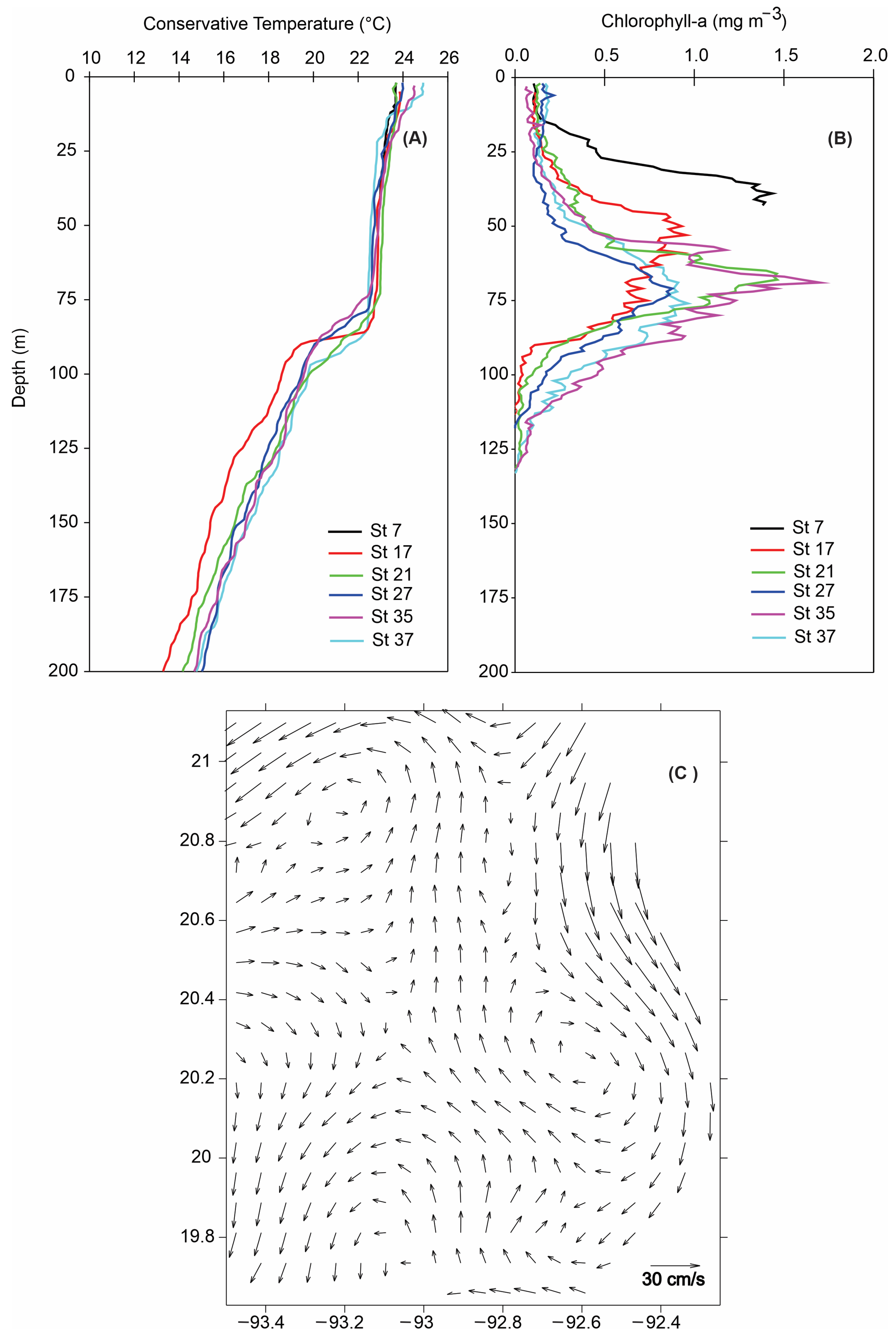
The analysis of hydrographic data obtained from CTD enabled us to identify several interesting physical structures. Surface temperatures ranged from 23.9 to 24.5 °C and decreased with increasing depth. At the stations along the A-A’ transect, the thermocline was found at a depth of 90 m (Figure 2A). This finding was corroborated by an analysis of the maximum vertical gradient, which yielded the same result. The vertical distribution of chlorophyll-a at stations along the A-A’ transect (Figure 2B) revealed several ridges, with a notable peak between depths of 70 and 75 m, reaching values of up to 1.5 mg m−3. Furthermore, the analysis of the geostrophic velocity field at the thermocline depth (90 m) indicated the presence of an eddy dipole consisting of one cyclonic and one anticyclonic. These eddies generate currents with speeds exceeding 20 cm s−1 around their peripheries.

3.2. Phytoplankton Assemblages

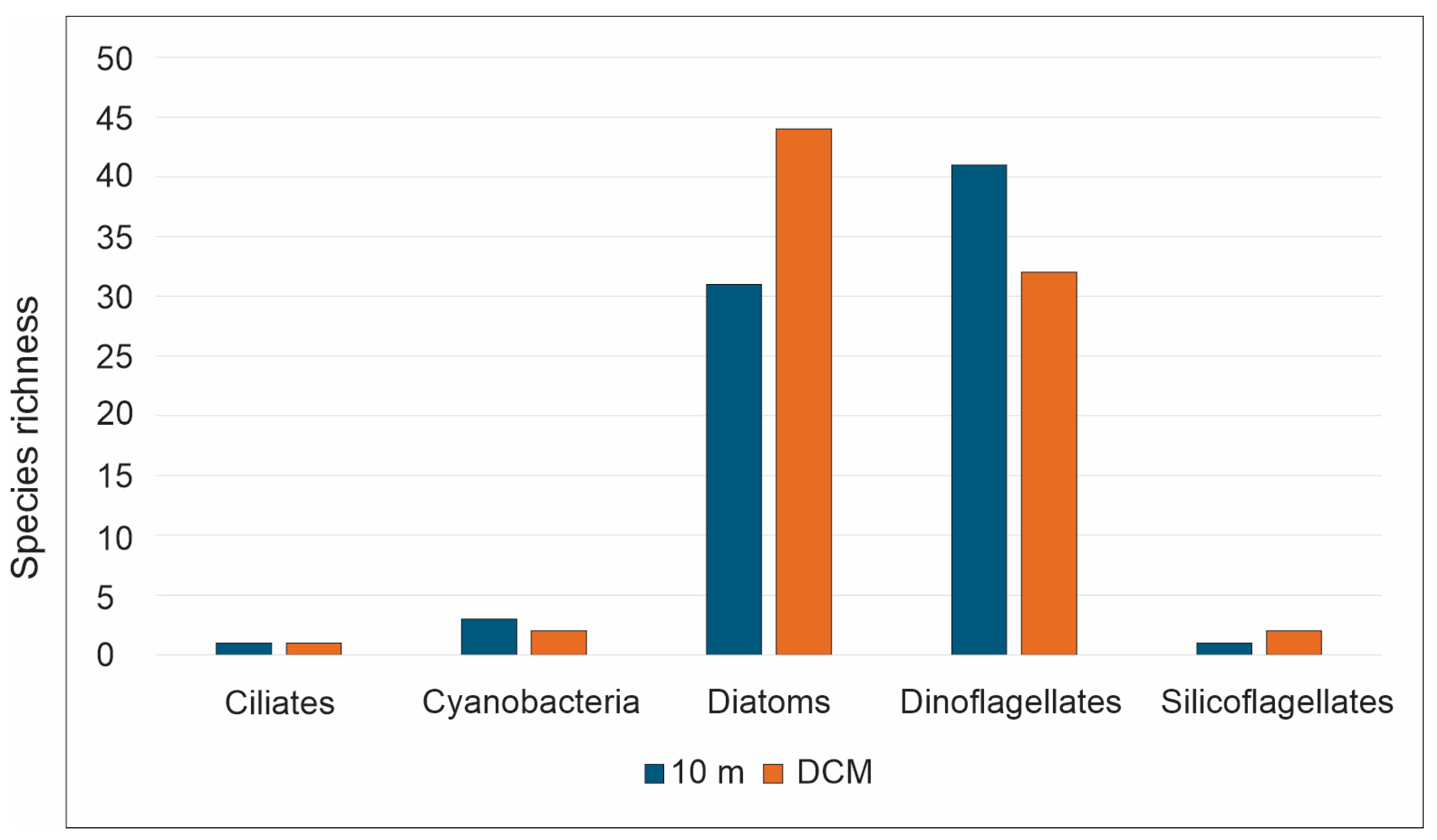
The taxonomic composition of phytoplankton observed in this study differed between the two analyzed depths. At a depth of 10 m, a total of 77 species were identified, which included one ciliate, three cyanobacteria, 31 diatoms, 41 dinoflagellates, and one silicoflagellate (Table 1; Figure 3). The most abundant species at this depth were the ciliate Mesodinium rubrum (Lohmann) Hamburger & Buddenbrock (1911), with an abundance of 1500 cells L−1; the cyanobacterium Trichodesmium hildebrandtii Gomont (1892), with 1580 cells L−1; the diatom Asteromphalus cleveanus Grunow (1876), with 2060 cells L−1; the dinoflagellate Lingulaulax polyedra (F. Stein) M.J. Head, K.N. Mertens & R.A. Fensome (2024), with 1800 cells L−1; and the silicoflagellate Dictyocha fibula Ehrenberg (1839), with 140 cells L−1 (Table 1).
At the DCM, the composition was notably different, consisting of 81 species, including one ciliate, two cyanobacteria, 44 diatoms, 32 dinoflagellates, and two silicoflagellates (Table 1; Figure 3). Species with high abundances at this depth included M. rubrum with 920 cells L−1, T. hildebrandtii with 3800 cells L−1, the diatom Pseudo-nitzschia multistriata (Takano) Takano (1995) with 1500 cells L−1, the dinoflagellate Blepharocysta denticulata D.-S. Nie (1939) with 1540 cells L−1, and D. fibula with 200 cells L−1 (Table 1). Bivariate Pearson correlations of the generated species dataset between both depths revealed a highly significant relationship (R = 0.70, p < 0.005).
The Shannon-Wiener index calculation showed, at 10 m depth, a value of 3.46, while at the DCM the value was calculated as 3.66.
After identifying the most abundant species at both depths of interest in this study, we analyzed their horizontal distribution and compared it to the documented current patterns.
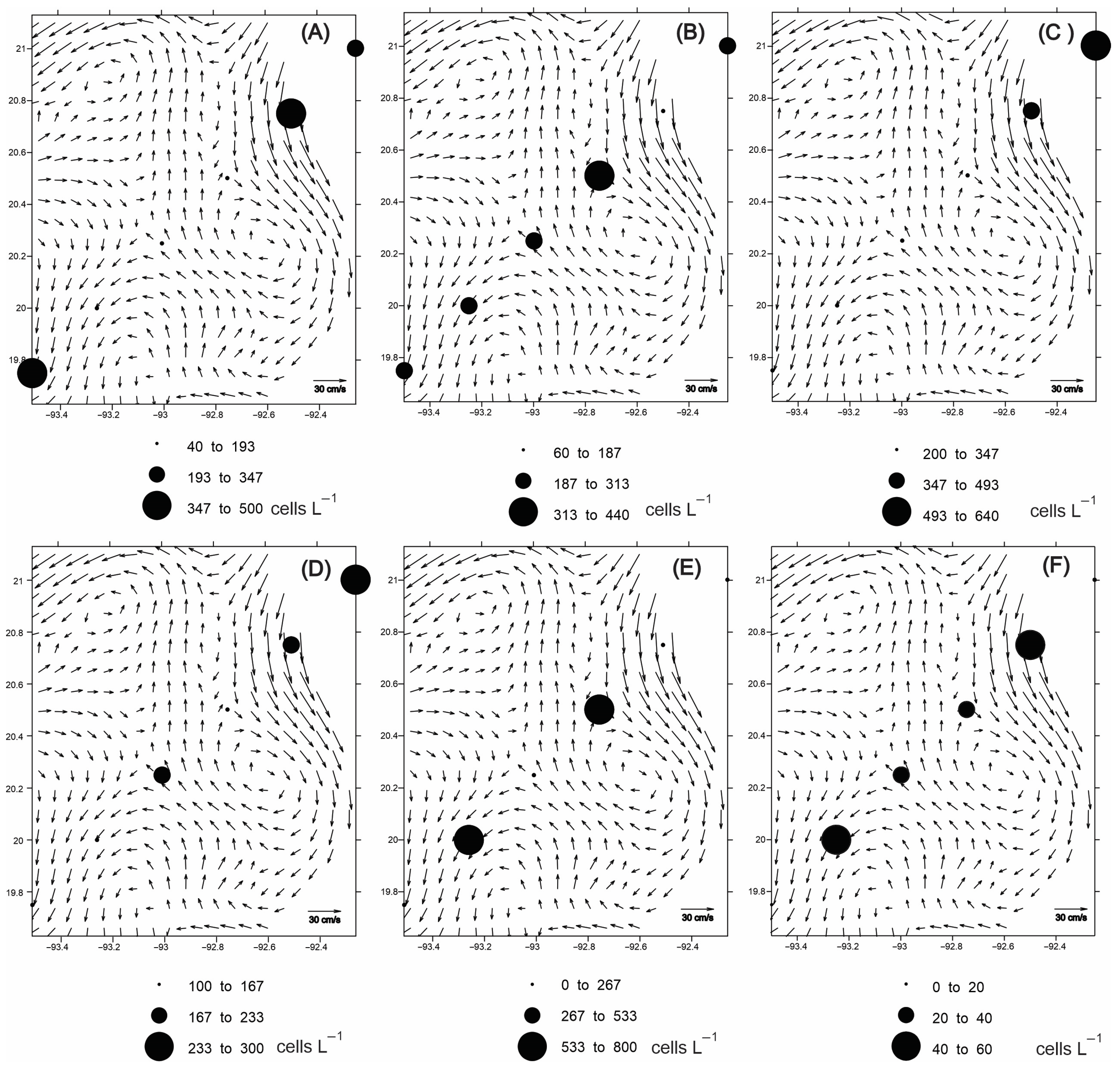
At a depth of 10 m, the horizontal distribution of M. rubrum (Figure 4A) showed that its highest abundance was in the eastern portion of the study area, where strong currents were present. A secondary peak in abundance was also observed in the southwestern portion, which was also associated with strong currents. For T. hildebrandtii (Figure 4B), high abundances were found in the periphery of the anticyclonic eddy. In the case of A. cleveanus (Figure 4C) and P. multistriata (Figure 4D), maximum abundances were recorded in the northeast region, particularly in an area of shallow depth. The maximum abundances of L. polyedra (Figure 4E) were observed in the periphery of both eddies, the anticyclonic and the cyclonic. Finally, D. fibula (Figure 4F) exhibited high abundances in two areas: one in the northeast portion, where intense currents were noted, and the other on the periphery of the cyclonic eddy.
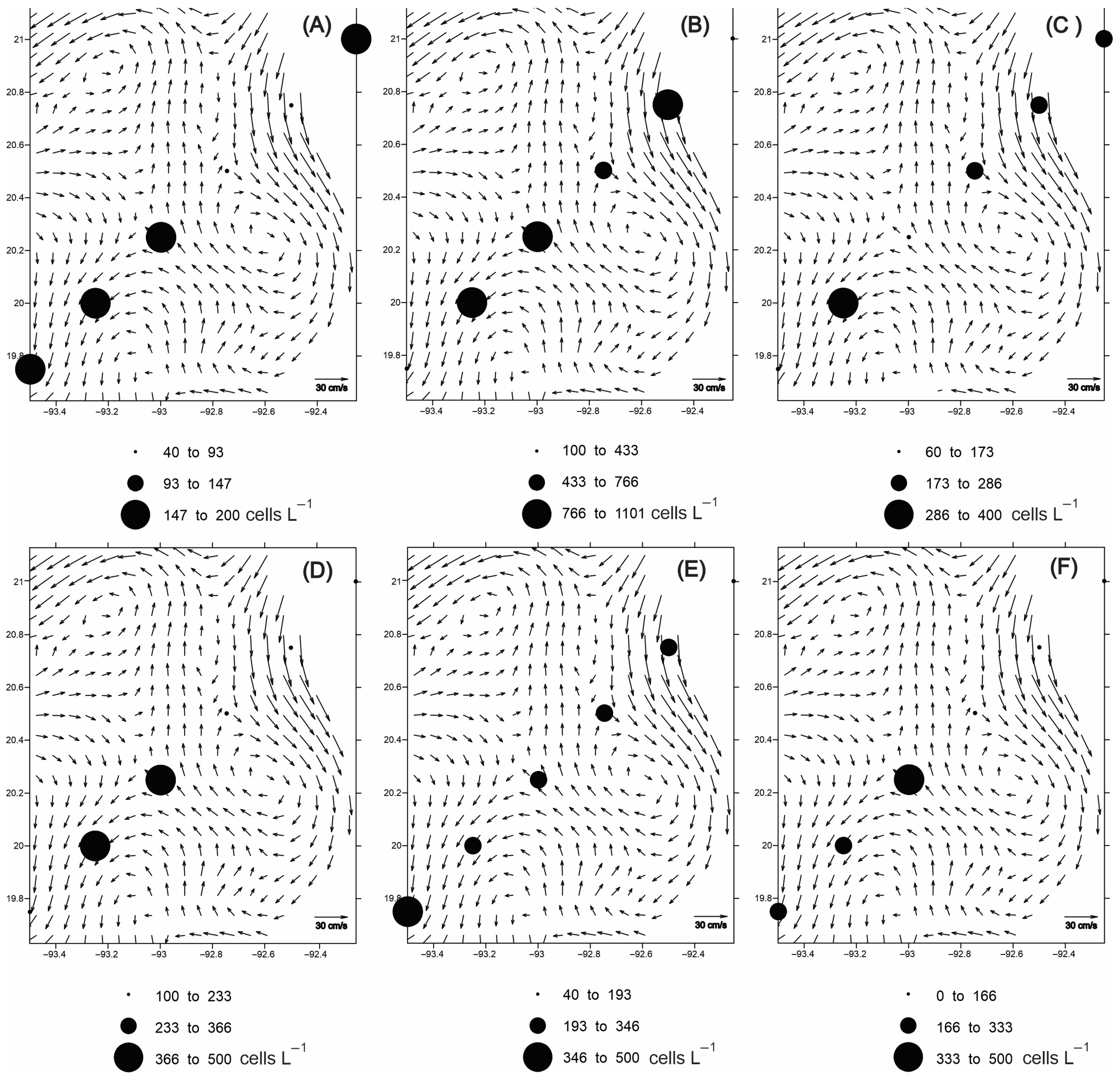
The distribution of the most abundant species at the DCM demonstrated interesting coincidences with the circulation patterns. M. rubrum (Figure 5A) was found in high abundances along the periphery of both eddies. T. hildebrandtii (Figure 5B) displayed two regions with elevated abundances: one in the eastern area, where intense currents were observed, and another at the edge of the cyclonic eddy. A similar distribution pattern was noted for A. cleveanus (Figure 5C) and P. multistriata (Figure 5D), both of which had high abundances along the periphery of the cyclonic eddy. B. denticulata (Figure 5E) showed the highest abundances in the southwestern area, characterized by strong currents. Lastly, L. polyedra (Figure 5F) exhibited its greatest abundances along the edges of the observed eddies.
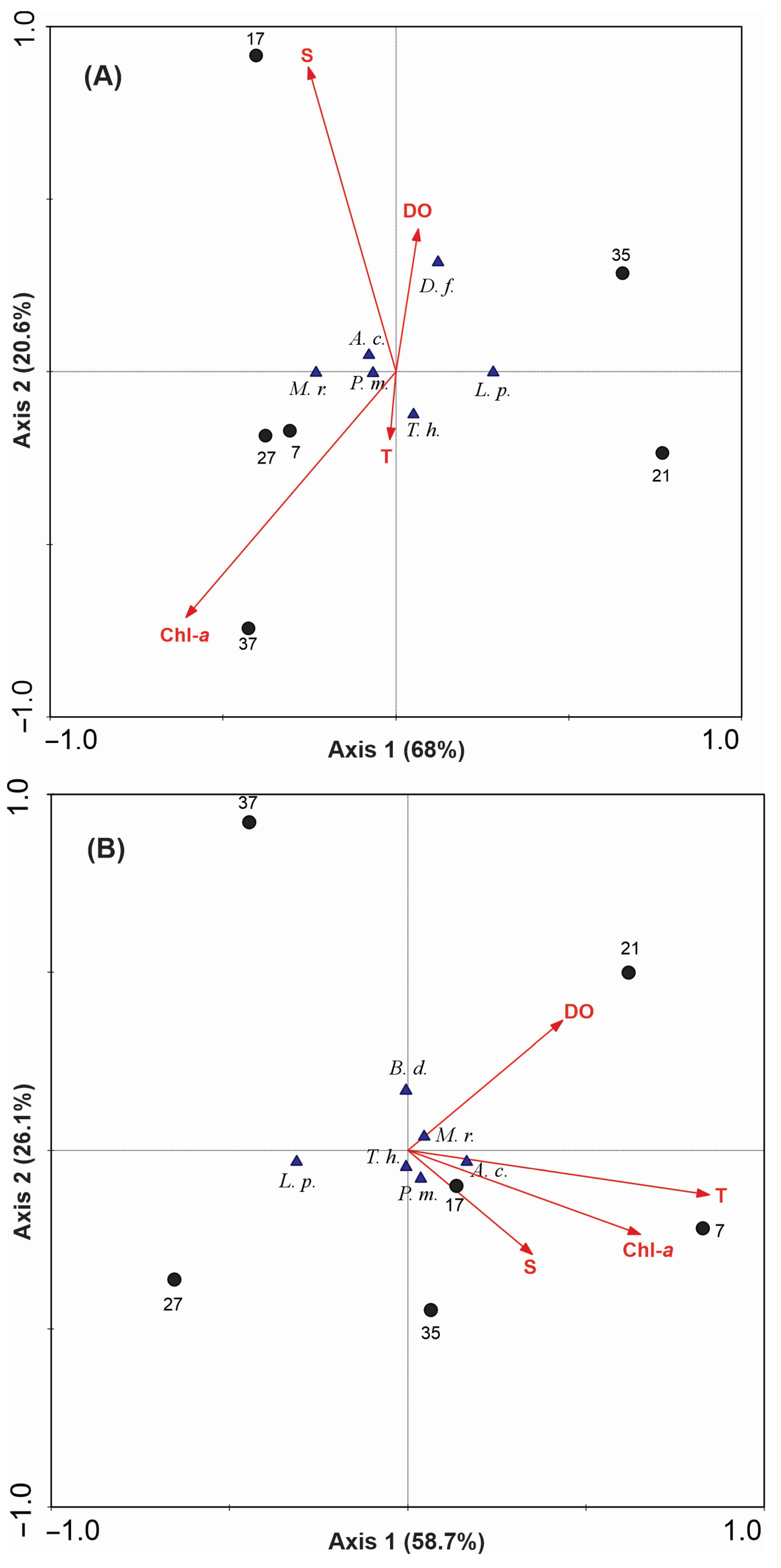
The generated CCA diagrams revealed notable differences between the two depths analyzed in this study. At a depth of 10 m (Figure 6A), certain species showed specific affinities with environmental variables. For instance, A. cleveanus was linked to absolute salinity, T. hildebrandtii showed an affinity for conservative temperatures, and both M. rubrum and P. multistriata were associated with chlorophyll-a. In contrast L. polyedra did not demonstrate a clear relationship with any specific variable, while D. fibula was positively correlated with dissolved oxygen. At this depth, the first two axes accounted for 88.6% of the total variance (Figure 6A).
The CCA diagram generated at the DCM also showed distinct patterns. Here, conservative temperature emerged as the most influential variable, correlating with A. cleveanus and P. multistriata. At this depth, M. rubrum appeared to be associated with dissolved oxygen. Similarly to the findings at 10 m depth, L. polyedra did not exhibit a clear relationship with any specific variable, a situation that echoed that of B. denticulata. T. hildebrandtii was positioned in the center of the diagram, indicating that this species does not thrive due to any single variable; rather, its distribution seems to benefit from a combination of different factors (Figure 6B). At this depth, the first two axes accounted for 84.8% of the total variance.
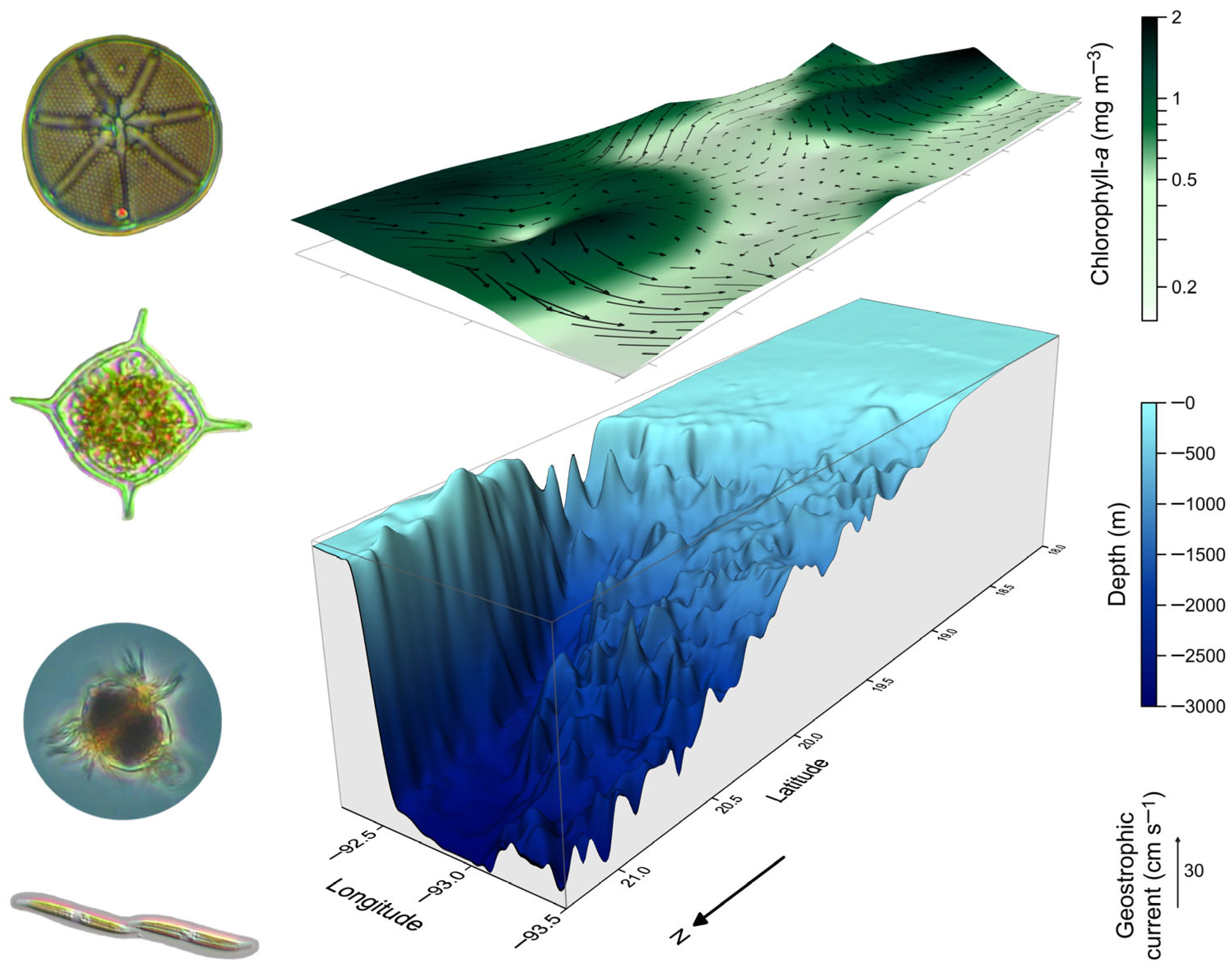
Finally, based on the results of this study, we propose a conceptual model that highlights the key aspects related to our observations (Figure 7). The significant role of the Campeche Canyon’s topography in triggering hydrodynamic processes is emphasized. Notably, the presence of an eddy dipole is crucial, as it leads to high concentrations of chlorophyll-a, especially in the areas surrounding the anticyclonic pole. This increase in chlorophyll-a concentration is associated with a high abundance of species, predominantly dinoflagellates.

4. Discussion

Analysis of hydrographic data collected during a “Nortes” storm season allowed us to identify the presence of a dipole eddy, which consists of both a cyclonic and an anticyclonic component. To date, various studies have examined the circulation patterns in the Southern Gulf of Mexico, finding that the Bay of Campeche displays a quasi-permanent cyclonic circulation [23]. Specifically, research on the Campeche Canyon has indicated the presence of a dipole eddy (comprising both a cyclone and an anticyclone) across different climatic seasons, including late spring [17] and summer [22,34]. Our observations made during the cold “Nortes” season suggest that this circulation pattern is recurrent, similar to that observed in the Bay of Campeche.
Submarine canyons are highly complex ecosystems where hydrodynamic processes significantly affect the composition, abundance, and distribution of various species. Specifically for phytoplankton, these canyons are associated with increased phytoplankton levels. For instance, in the Calvi Canyon on the NW Corsican coast, an increase in phytoplankton cell counts was observed in conjunction with nitrate-enriched waters flowing through the canyon [35]. Similarly, in the Nazaré submarine canyon (Portugal), high levels of chlorophyll-a were recorded, alongside a high abundance of dinoflagellates compared to other groups [36], which was also evident in our study.
The presence of dipole eddies—both cyclonic and anticyclonic—has been found to benefit phytoplankton populations in various environments around the world. For instance, in the Southern Gulf of California, dipole eddies create thermohaline fronts that lead to favorable conditions for phytoplankton aggregation due to increased nutrient concentrations. This effect is particularly notable for dinoflagellates and silicoflagellates [37]. In Western Australia, the fronts generated by dipole eddies disperse phytoplankton communities, which are primarily dominated by diatoms and coccolithophorids [38]. Similarly, in the Western South China Sea, dipole eddies induce fronts that contain high concentrations of nutrients, especially nitrates, which support phytoplankton communities and enhance their biomass [39]. A recent study in the Northwest Atlantic identified a population shift towards more diatoms and fewer prokaryotes at these fronts, suggesting that such fronts may act as natural refuges for diatoms [40].
In our study, we found the thermocline to be at a significant depth of 90 m. Such deep structures are typically observed during cold winter periods [41]. Additionally, strong winds often contribute to the deepening of the thermocline [42]. In our case, the “Nortes” period—characterized by winds averaging 90 km h−1—plays a role in this deepening. This phenomenon has been documented in regions like the Gulf of Tehuantepec, where “Nortes” storms also cause the thermocline to deepen [43].
Our observations of the vertical distribution of chlorophyll-a revealed a pronounced maximum just a few meters above the thermocline. Previous studies have documented the presence of these deep peaks in the Campeche Canyon region, but during different climatic periods. For instance, in situ observations conducted in late spring have recorded deep peaks below 70 m [17]. Similarly, during the summer months, maximum peaks have been observed even at depths of up to 90 m [23]. These findings suggest that deep chlorophyll-a peaks are a characteristic feature of the Campeche Canyon and may exist across different seasons. Comparable observations have also been reported in the Sargasso Sea, where phytoplankton aggregates form a deep chlorophyll maximum just above the nutricline, with concentration levels rapidly decreasing into the deeper, darker waters that are rich in nitrates [44]. Although we did not have nutrient measurements in our study, we hypothesize that nutrient levels were elevated. This assumption is based on the observed physical dynamics and the presence of a dipole eddy, which is known to elevate nutrients—particularly nitrates—into the euphotic zone. This process likely fertilizes the waters, stimulating responses from phytoplankton communities [37]. However, at this stage, we recognize that this may limit our study, and the ecological interpretations depend on nutrient measurements to support this unverified hypothesis.
In this study, while dinoflagellates were the most abundant species in surface waters, a condition previously described in the deep portion of the Gulf of Mexico [18], the diatoms predominantly characterized the DCM, which aligns with previous research documenting this phenomenon in the Gulf of Mexico [14]. Specifically, diatoms from the genus Asteromphalus have been reported with high abundances both in deep waters [45,46] and shallow waters [47] of the Gulf, similar to our findings. The prevalence of this genus varies considerably across different regions worldwide, and it often depends on the time of year. Notably, winter is the season when Asteromphalus typically dominates, as observed in Southern Brazil [48] and the Cariaco Basin in Venezuela [49]. Furthermore, species from the genus Pseudo-nitzschia have been identified as a common component of the microalgal assemblages in the Gulf of Mexico [50], particularly during the winter season [51], as was our case. Asteromphalus and Pseudo-nitzschia are genera that thrive in cold environments, including Antarctic waters [52]. Their psychrophilic nature allows them to grow optimally at temperatures below 10 °C [53]. For instance, diatoms of these genera have specialized protein functions that function effectively in cold conditions [54].
In our study, the dinoflagellate species L. polyedra was found to be the most abundant. Similar observations have been reported in other submarine canyons, such as the Biobio Submarine Canyon in Chile. In this location, the combination of ocean dynamics and canyon topography generates turbulent mixing processes that favor the proliferation of this species [55]. A similar situation may be occurring in Campeche Canyon, where the canyon’s topography, along with various hydrodynamic processes at different scales, is known to induce mixing in the water column [56]. This mixing benefits phytoplankton communities. As for B. denticulata, the second most abundant dinoflagellate species identified in our study, there are limited studies on this species in Mexican waters. However, it is known to occur in high abundances in the waters of the Southern Gulf of Mexico [57].
Another phytoplankton species found in high abundances in this study was M. rubrum. This ciliate has been documented as a blooming organism in the Gulf of Mexico [58], particularly during the winter months [59]. Winter conditions in the Gulf of Mexico lead to increased nutrient availability, a factor known to support the presence of this species [60]. Additionally, intense mixing processes occur at the edges of both cyclonic and anticyclonic eddies, which supply nutrients to the euphotic zone and benefit phytoplankton populations [17]. This may explain the high abundance of this species observed at the peripheries of the eddies in our study. However, it is important to highlight the specific trophic role of M. rubrum. As a mixotrophic ciliate that preys on phytoplankton, its high abundance may be a response to increased prey availability, as well as the direct influence of nutrients [61].
Moreover, some studies in the scientific literature have linked the dynamics of the Campeche Canyon to the composition of phytoplankton species. It is known that during the summer months, dinoflagellates and coccolithophores are more abundant than other groups [17]. Our results, collected during a winter period characterized by “Nortes” (strong northerly winds), support this finding, as they show a higher abundance of dinoflagellates compared to other groups. This suggests that dinoflagellate dominance is a recurring phenomenon. Similar observations of increased dinoflagellate abundance during summer have also been documented in the deep Gulf region [18]. However, additional sampling during different climatic periods, such as autumn, is needed to further validate this hypothesis.

5. Conclusions

As final remarks, our study identified a significant diversity of phytoplankton species, highlighting notable differences between the surface and DCM levels. We observed a greater abundance of dinoflagellates compared to other groups. The hydrographic conditions during our sampling featured a deep thermocline at a depth of 90 m and a highly dynamic circulation pattern. This pattern included a dipole eddy with both cyclonic and anticyclonic components, which caused some species to aggregate in areas with strong currents.
While many studies have investigated phytoplankton populations in the Southern Gulf of Mexico, most have concentrated on taxonomic and morphological aspects. In contrast, the influence of circulation patterns on the phytoplankton species has received limited attention. Our findings contribute to a better understanding of phytoplankton populations during a period characterized by northerly winds, which has been historically understudied. However, further observations over both annual and interannual periods are necessary to gain a deeper understanding of how large-scale processes in the Gulf impact phytoplankton populations.

Author Contributions

Conceptualization, E.D.-C., D.A.S.-d.-L., M.A.M.-G. and E.C.-M.; methodology, E.D.-C., D.A.S.-d.-L., M.A.M.-G. and E.C.-M.; software, E.D.-C., D.A.S.-d.-L., M.A.M.-G. and E.C.-M.; validation, E.D.-C., D.A.S.-d.-L., M.A.M.-G. and E.C.-M.; formal analysis, E.D.-C., D.A.S.-d.-L., M.A.M.-G. and E.C.-M.; investigation, E.D.-C., D.A.S.-d.-L., M.A.M.-G. and E.C.-M.; resources, E.D.-C., D.A.S.-d.-L., M.A.M.-G. and E.C.-M.; data curation, E.D.-C., D.A.S.-d.-L., M.A.M.-G. and E.C.-M.; writing—original draft preparation, E.D.-C., D.A.S.-d.-L., M.A.M.-G. and E.C.-M.; writing—review and editing, E.D.-C., D.A.S.-d.-L., M.A.M.-G. and E.C.-M.; supervision, E.D.-C., D.A.S.-d.-L., M.A.M.-G. and E.C.-M.; funding acquisition, E.D.-C., D.A.S.-d.-L., M.A.M.-G. and E.C.-M. All authors have read and agreed to the published version of the manuscript.

Funding

This study was supported by Instituto de Ciencias del Mar y Limnología (UNAM) (grants 144, 145, 627). The ship time for the CAÑON-IV expedition on board the R/V Justo Sierra was funded by the UNAM.

Data Availability Statement

The raw data supporting the conclusions of this article will be made available by the authors on request.

Acknowledgments

The authors thank the participants in the research cruise, including the captain and crew of the R/V Justo Sierra. Sergio Castillo Sandoval and Francisco Ponce Núñez provided technical support during analyses. Jorge Castro improved the figures.

Conflicts of Interest

The authors declare no conflicts of interest.

References

  1. Grigoratou, M.; Menden-Deuer, S.; McQuatters-Gollop, A.; Arhonditsis, G.; Artigas, L.F.; Ayata, S.D.; Bedikoğlu, D.; Beisner, B.E.; Chen, B.; Davies, C.; et al. The immeasurable value of plankton to humanity. BioScience 2025, 75, 706–721. [Google Scholar] [CrossRef]
  2. Anderson, S.I.; Barton, A.D.; Clayton, S.; Dutkiewicz, S.; Rynearson, T.A. Marine phytoplankton functional types exhibit diverse responses to thermal change. Nat. Commun. 2021, 12, 6413. [Google Scholar] [CrossRef]
  3. Moreno, A.R.; Martiny, A.C. Ecological stoichiometry of Ocean plankton. Annu. Rev. Mar. Sci. 2018, 10, 43–69. [Google Scholar] [CrossRef]
  4. Siegel, D.A.; DeVries, T.; Cetinic, I.; Bisson, K.M. Quantifying the ocean’s biological pump and its carbon cycle impacts on global scales. Ann. Rev. Mar. Sci. 2023, 15, 329–356. [Google Scholar] [CrossRef]
  5. Steinbuck, J.V.; Genin, A.; Monismith, S.G.; Koseff, J.R.; Holzman, R.; Labiosa, R.G. Turbulent mixing in fine-scale phytoplankton layers: Observations and inferences of layer dynamics. Cont. Shelf Res. 2010, 30, 442–455. [Google Scholar] [CrossRef]
  6. Coria-Monter, E.; Salas de León, D.A.; Monreal-Gómez, M.A.; Durán-Campos, E. Internal waves in the Bay of La Paz, Southern Gulf of California, Mexico. Life Environ. 2019, 69, 115–122. [Google Scholar] [CrossRef]
  7. McGillicuddy, D.J., Jr. Mechanisms of physical-biological-biogeochemical interaction at the oceanic mesoscale. Ann. Rev. Mar. Sci. 2016, 8, 125–159. [Google Scholar] [CrossRef]
  8. Durán-Campos, E.; Salas-de-Léon, D.A.; Coria-Monter, E.; Monreal-Gómez, M.A.; Aldeco-Ramírez, J.; Quiroz-Martínez, B. ENSO effects in the southern Gulf of California estimated from satellite data. Cont. Shelf Res. 2023, 266, 105084. [Google Scholar] [CrossRef]
  9. Monreal-Gómez, M.A.; Pérez-Cruz, L.; Durán-Campos, E.; Salas-de-León, D.A.; Torres-Martínez, C.M.; Coria-Monter, E. Phytoplankton Communities in the Eastern Tropical Pacific Ocean off Mexico and the Southern Gulf of California During the Strong El Niño of 2023/24. Plants 2025, 14, 1375. [Google Scholar] [CrossRef]
  10. Hernández-Becerril, D.U.; Flores-Granados, C. Species of the Diatom Genus Chaetoceros (Bacillariophyceae) in the Plankton from the Southern Gulf of Mexico. Bot. Mar. 1998, 41, 505–519. [Google Scholar] [CrossRef]
  11. Licea, S.; Zamudio, M.A.; Soto, J. Free-living dinoflagellates in the southern Gulf of Mexico: Report of data (1979–2002). Phycol. Res. 2004, 52, 419–428. [Google Scholar] [CrossRef]
  12. Signoret, M.; Monreal-Gómez, M.A.; Aldeco, J.; Salas-de-León, D.A. Hydrography, oxygen saturation, suspended particulate matter, and chlorophyll-a fluorescence in an oceanic region under freshwater influence. Estuar. Cost. Shelf Sci. 2006, 69, 153–164. [Google Scholar] [CrossRef]
  13. Álvarez-Góngora, C.; Herrera-Silveira, J.A. Variations of phytoplankton community structure related to water quality trends in a tropical karstic coastal zone. Mar. Poll. Bull. 2006, 52, 48–60. [Google Scholar] [CrossRef]
  14. Troccoli-Ghinaglia, L.; Herrera-Silveira, J.A.; Comín, F.A. Structural variations of phytoplankton in the coastal seas of Yucatan, Mexico. Hydrobiologia 2004, 519, 85–102. [Google Scholar] [CrossRef]
  15. Gómez-Figueroa, J.A.; Rendón-von Osten, J.; Poot-Delgado, C.A.; Dzul-Caamal, R.; Okolodkov, Y.B. Seasonal Response of Major Phytoplankton Groups to Environmental Variables along the Campeche Coast, Southern Gulf of Mexico. Phycology 2023, 3, 270–279. [Google Scholar] [CrossRef]
  16. Linacre, L.; Durazo, R.; Camacho-Ibar, V.F.; Selph, K.E.; Lara-Lara, J.R.; Mirabal-Gómez, U.; Bazán-Guzmán, C.; Lago-Leston, A.; Fernández-Martín, E.M.; Sidón-Ceseña, K. Picoplankton carbon biomass assessments and distribution of Prochlorococcus ecotypes linked to loop current eddies during summer in the southern Gulf of Mexico. J. Geophys. Res. Ocean. 2019, 124, 8342–8359. [Google Scholar] [CrossRef]
  17. Durán-Campos, E.; Salas-de-León, D.A.; Monreal-Gómez, M.A.; Coria-Monter, E. Patterns of chlorophyll-a distribution linked to mesoscale structures in two contrasting areas Campeche Canyon and Bank, Southern Gulf of Mexico. J. Sea Res. 2017, 123, 30–38. [Google Scholar] [CrossRef]
  18. González-Fernández, J.M.; Luna-Soria, R.; Alexánder-Valdés, H.M.; Durán-Campos, E.; Coria-Monter, E.; Gracia, A. Influence of mesoscale eddies on the spring phytoplankton groups in the Southern Gulf of Mexico. Bot. Mar. 2025, 68, 85–99. [Google Scholar] [CrossRef]
  19. López-Cabello, Z.; Coria-Monter, E.; Monreal-Gómez, M.A.; Salas-de-León, D.A.; Durán-Campos, E.; Gracia, A. Vertical assemblage of the holoplanktonic mollusks (Pteropoda and Pterotracheoidea: Carinaiidae, Pterotracheidae) in the Campeche Canyon, southern Gulf of Mexico, during a ‘‘Nortes’’ season. PeerJ 2025, 13, e19118. [Google Scholar] [CrossRef]
  20. Gómez-Ponce, M.A.; Coria-Monter, E.; Flores-Coto, C.; Canales-Delgadillo, J.C.; Cardoso-Mohedano, J.G.; Durán-Campos, E. Seasonal and interannual variability in the density of the postlarvae of Litopenaeus setiferus and Farfantepenaeus duorarum in Terminos Lagoon, Gulf of Mexico. Crustaceana 2021, 94, 1263–1281. [Google Scholar] [CrossRef]
  21. Goff, J.A.; Gulick, S.P.S.; Pérez-Cruz, L.; Stewart, H.A.; Davis, M.; Duncan, D.; Saustrup, S.; Sanford, J.; Urrutia-Fucugauchi, J. Solution pans and linear sand bedforms on the barerock limestone shelf of the Campeche Bank, Yucatán Peninsula, Mexico. Cont. Shelf Res. 2016, 117, 57–66. [Google Scholar] [CrossRef]
  22. Athié, G.; Sheinbaum, J.; Candela, J.; Ochoa, J.; Pérez-Brunius, P.; Romero-Arteaga, A. Seasonal variability of the transport through the Yucatan Channel from observations. J. Phys. Oceanogr. 2020, 50, 343–360. [Google Scholar] [CrossRef]
  23. Salas de León, D.A.; Monreal-Gómez, M.A.; Signoret, M.; Aldeco-Ramírez, J. Anticyclonic-cyclonic eddies and their impact on near-surface chlorophyll stocks and oxygen supersaturation over the Campeche Canyon, Gulf of Mexico. J. Geophys. Res. 2004, 109, C05012. [Google Scholar] [CrossRef]
  24. Edler, L.; Elbrachter, M. The Utermöhl Method for Quantitative Phytoplankton Analysis. In Microscopic and Molecular Methods for Quantitative Phytoplankton Analysis; Karlson, B., Cusack, C., Bresnan, E., Eds.; Intergovernmental Oceanographic Commission of UNESCO: Potsdam, Germany, 2010; pp. 13–20. [Google Scholar]
  25. Cupp, E.E. Marine plankton Diatoms of the West Coast of North America; University of California Press: Berkeley, CA, USA, 1943; p. 241. [Google Scholar]
  26. Komárek, J.; Anagnostidis, K. Modern approach to the classification system of cyanophytes (Croococcales). Arch. Hydrobiol. Suppl. 1986, 43, 157–226. [Google Scholar]
  27. Throndsen, J. The planktonic marine flagellates. In Identifying Marine Phytoplankton; Tomas, C.R., Ed.; Academic Press: San Diego, CA, USA, 1997; pp. 591–729. [Google Scholar]
  28. Throndsen, J.; Hasle, G.R.; Tangen, K. Norsk Kystplankton Flora; Almater Forlag As: Oslo, Norway, 2003; p. 341. [Google Scholar]
  29. Tomas, C.R. Identifying Marine Phytoplankton; Academic Press: San Diego, CA, USA, 1997; p. 858. [Google Scholar]
  30. Intergovernmental Oceanographic Commission; Scientific Committee on Oceanic Research; International Association for the Physical Sciences of the Oceans. The International Thermodynamic Equation of Seawater, 2010: Calculation and Use of Thermodynamic Properties. In Intergovernmental Oceanographic Commission, Manuals and Guides No. 56; UNESCO: Paris, France, 2010; p. 207. [Google Scholar]
  31. Pond, S.; Pickard, G.L. Introductory Dynamical Oceanography; Butterworth-Heinemann Press: Oxford, UK, 1995; p. 349. [Google Scholar]
  32. ter Braak, C.J.F. Canonical correspondence analysis: A new eigenvector technique for multivariate direct gradient analysis. Ecology 1986, 67, 1167–1179. [Google Scholar] [CrossRef]
  33. ter Braak, C.J.F.; Šmilauer, P. Canoco Reference Manual and User’s Guide: Software for Ordination; Version 5.10; Wageningen University & Research: Wageningen, The Netherlands, 2018; p. 536. [Google Scholar]
  34. Aldeco, J.; Monreal-Gómez, M.A.; Signoret, M.; Salas-de-León, D.A.; Hernández-Becerril, D.U. Occurrence of a subsurface anticyclonic eddy, fronts, and Trichodesmium spp. over the Campeche Canyon region, Gulf of Mexico. Cienc. Mar. 2009, 35, 333–344. [Google Scholar] [CrossRef]
  35. Skliris, N.; Djenidi, S. Plankton dynamics controlled by hydrodynamic processes near a submarine canyon off NW corsican coast: A numerical modelling study. Cont. Shelf Res. 2006, 26, 1336–1358. [Google Scholar] [CrossRef]
  36. Mendes, C.R.; Sá, C.; Vitorino, J.; Borges, C.; Tavano Garcia, V.M.; Brotas, V. Spatial distribution of phytoplankton assemblages in the Nazaré submarine canyon region (Portugal): HPLC-CHEMTAX approach. J. Mar. Syst. 2011, 87, 90–101. [Google Scholar] [CrossRef]
  37. Durán-Campos, E.; Monreal-Gómez, M.A.; Salas de León, D.A.; Coria-Monter, E. Impact of a dipole on the phytoplankton community in a semi-enclosed basin of the southern Gulf of California, Mexico. Oceanologia 2019, 61, 331–340. [Google Scholar] [CrossRef]
  38. Thompson, P.A.; Peasant, S.; Waite, A. Contrasting the vertical differences in the phytoplankton biology of a dipole pair of eddies in the south-eastern Indian Ocean. Deep Sea Res. II 2007, 54, 1003–1028. [Google Scholar] [CrossRef]
  39. Li, R.; Xu, J.; Cen, X.; Zhong, W.; Liao, J.; Shi, Z.; Zhou, S. Nitrate fluxes induced by turbulent mixing in dipole eddies in an oligotrophic ocean. Limnol. Oceanogr. 2021, 66, 2842–2854. [Google Scholar] [CrossRef]
  40. Lévy, M.; Haëck, C.; Mangolte, I.; Cassianides, A.; El Hourany, R. Shift in phytoplankton community composition over fronts. Commun. Earth Environ. 2025, 6, 591. [Google Scholar] [CrossRef]
  41. Liu, Q.; Chen, J.; Jin, H.; Huang, F.; Yin, K. Deepening of the thermocline increases primary production in winter vs summer in the northern South China Sea. Deep Sea Res. I 2023, 201, 104163. [Google Scholar] [CrossRef]
  42. Khan, H.; Govil, P.; Panchang, R.; Agrawal, S.; Kumar, P.; Kumar, B.; Verma, D. Surface and thermocline ocean circulation intensity changes in the western Arabian Sea during ~172 kyr. Quat. Sci. Rev. 2023, 311, 108133. [Google Scholar] [CrossRef]
  43. Trasviña, A.; Barton, E.D.; Brown, J.; Velez, H.S.; Kosro, P.M.; Smith, R.L. Offshore wind forcing in the Gulf of Tehuantepec, Mexico: The asymmetric circulation. J. Geophys. Res. Oceans 1995, 100, 20649–20663. [Google Scholar] [CrossRef]
  44. Martin, A.P.; Pondaven, P. On estimates for the vertical nitrate flux due to eddy pumping. J. Geophys. Res. 2003, 108, 3359. [Google Scholar] [CrossRef]
  45. Licea, S.; Zamudio, M.E.; Moreno-Ruiz, J.L.; Luna, R. A suggested local regions in the Southern Gulf of Mexico using a diatom database (1979–2002) and oceanic hydrographic features. J. Environ. Biol. 2011, 32, 443–453. [Google Scholar]
  46. Licea, S.; Moreno-Ruiz, J.L.; Luna, R. Checklist of Diatoms (Bacillariophyceae) from the Southern Gulf of Mexico: Data-Base (1979-2010) and New Records. J. Biodivers. Endanger. Species 2016, 4, 3. [Google Scholar] [CrossRef]
  47. Okolodkov, Y.B.; Aké-Castillo, J.A.; Gutiérrez-Quevedo, M.G.; Pérez-España, H.; Salas-Monreal, D. Annual Cycle of the Plankton Biomass in the National Park Sistema Arrefical Veracruzano, Southwestern Gulf of Mexico. In Zooplankton and Phytoplankton; Kattel, G., Ed.; Nova Science Publishers, Inc.: New York, NY, USA, 2011; pp. 63–88. [Google Scholar]
  48. Garcia, M.; Odebrecht, C. Remarks on the morphology and distribution of some rare centric diatoms in Southern Brazilian continental shelf and slope waters. Braz. J. Oceanogr. 2012, 60, 415–427. [Google Scholar] [CrossRef]
  49. Romero, O.E.; Thunell, R.C.; Astor, Y.; Varela, R. Seasonal and interannual dynamics in diatom production in the Cariaco Basin, Venezuela. Deep Sea Res. I 2009, 56, 571–581. [Google Scholar] [CrossRef]
  50. MacIntyre, H.L.; Stutes, A.L.; Smith, W.L.; Dorsey, C.P.; Abraham, A.; Dickey, R.W. Environmental correlates of community composition and toxicity during a bloom of Pseudo-nitzschia spp. in the northern Gulf of Mexico. J. Plank. Res. 2011, 33, 273–295. [Google Scholar] [CrossRef]
  51. Dortch, Q.; Robichaux, R.; Pool, S.; Milsted, D.; Mire, G.; Rabalais, N.N.; Seniat, T.M.; Fryxell, G.A.; Turner, R.E.; Parsons, M.L. Abundance and vertical flux of Pseudo-nitzschia in the northern Gulf of Mexico. Mar. Ecol. Progr. Ser. 1997, 146, 249–264. [Google Scholar] [CrossRef]
  52. Hallegraeff, G.M.; Leblanc, K. New observations on the Antarctic Asteromphalus darwinii/hookeri diatom species-complex (Asterolampraceae). Polar Biol. 2023, 46, 759–772. [Google Scholar] [CrossRef]
  53. Mock, T.; Junge, K. Psychrophilic Diatoms. In Algae and Cyanobacteria in Extreme Environments. Cellular Origin, Life in Extreme Habitats and Astrobiology; Seckbach, J., Ed.; Springer: Dordrecht, The Netherlands, 2007; pp. 343–364. [Google Scholar] [CrossRef]
  54. Fu, W.; Shu, Y.; Yi, Z.; Su, Y.; Pan, Y.; Zhang, F.; Brynjolfsson, S. Diatom morphology and adaptation: Current progress and potential for sustainable development. Sustain. Horiz. 2022, 2, 100015. [Google Scholar] [CrossRef]
  55. Rodríguez-Villegas, C.; Pérez-Santos, I.; Díaz, P.A.; Baldrich, Á.M.; Lee, M.R.; Saldías, G.S.; Mancilla-Gutiérrez, G.; Urrutia, C.; Navarro, C.R.; Varela, D.A.; et al. Deep Turbulence as a Novel Main Driver for Multi-Specific Toxic Algal Blooms: The Case of an Anoxic and Heavy Metal-Polluted Submarine Canyon That Harbors Toxic Dinoflagellate Resting Cysts. Microorganisms 2024, 12, 2015. [Google Scholar] [CrossRef]
  56. Santiago-Arce, T.; Salas-de-León, D.A. Vorticity and internal waves in the Campeche Canyon, Gulf of Mexico. In Experimental and Theoretical Advances in Fluid Dynamics; Klaap, J., Cros, A., Velasco Fuentes, O., Stern, C., Rodríguez Meza, M.A., Eds.; Springer: Berlin/Heidelberg, Germany, 2012; pp. 163–169. [Google Scholar]
  57. Gárate-Lizárraga, I.; Okolodkov, Y.B. The family Podolampadaceae (Dinoflagellata) in Mexican waters. Hidrobiológica 2022, 32, 251–263. [Google Scholar] [CrossRef]
  58. Brooke Harred, L.; Campbell, L. Predicting harmful algal blooms: A case study with Dinophysis ovum in the Gulf of Mexico. J. Plank. Res. 2014, 36, 1434–1445. [Google Scholar] [CrossRef]
  59. Parsons, M.L.; Brandt, A.L.; Turner, R.E.; Morrison, W.L.; Ralabais, N.N. Characterization of common phytoplankton on the Louisiana shelf. Mar. Poll. Bull. 2021, 168, 112458. [Google Scholar] [CrossRef]
  60. Lips, I.; Lips, U. The Importance of Mesodinium rubrum at Post-Spring Bloom Nutrient and Phytoplankton Dynamics in the Vertically Stratified Baltic Sea. Front. Mar. Sci. 2017, 4, 407. [Google Scholar] [CrossRef]
  61. Labucis, A.; Labuce, A.; Jurgensone, I.; Barda, I.; Andersone, I.; Ikauniece, A. Seasonal variation in size structure and production of autotrophic plankton community in eutrophied, low-light environment: A focus on Mesodinium rubrum. Oceanologia 2023, 65, 398–409. [Google Scholar] [CrossRef]
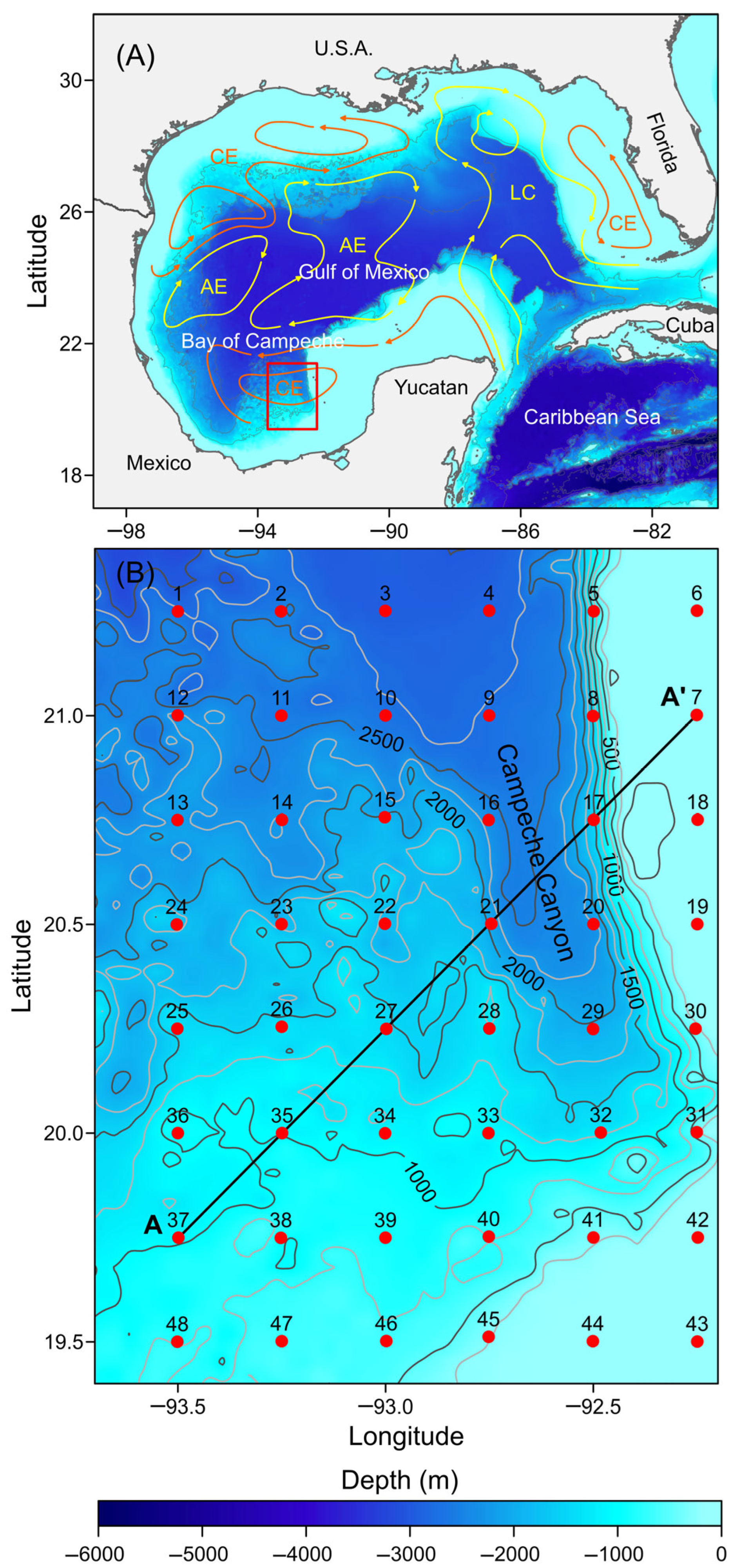
Figure 1. (A) The Gulf of Mexico, with the study area in the Campeche Canyon highlighted in red box. The main features of the Gulf of Mexico’s circulation are also shown, including cyclonic eddies (CE), anticyclonic eddies (AE), and the Loop Current (LC). (B) The red symbols indicate the locations of the hydrographic data collection stations. Water samples were taken at various depths along the A-A’ transect. Bathymetric data is presented in m.
Phycology 05 00086 g001
Figure 2. (A) Vertical profiles of conservative temperature (°C) in stations along A-A’ transect, (B) Vertical profiles of chlorophyll-a (mg m−3) in stations along A-A’ transect, (C) geostrophic circulation pattern (cm s−1) at 90 m depth.
Phycology 05 00086 g002
Figure 3. Phytoplankton species richness by groups identified in this study at the depths of 10 m and DCM.
Phycology 05 00086 g003
Figure 4. Horizontal distribution of the most abundant phytoplankton species (cells L−1) at 10 m depth: (A) M. rubrum, (B) T. hildebrandtii, (C) A. cleveanus, (D) P. multistriata, (E) L. polyedra, and (F) D. fibula. Note that the size scale was deliberately changed to make the differences clearer.
Phycology 05 00086 g004
Figure 5. Horizontal distribution of the most abundant phytoplankton species (cells L−1) at the deep chlorophyll-a maximum: (A) M. rubrum, (B) T. hildebrandtii, (C) A. cleveanus, (D) P. multistriata, (E) B. denticulata, and (F) L. polyedra. Note that the size scale was deliberately changed to make the differences clearer.
Phycology 05 00086 g005
Figure 6. Canonical Correspondence Analysis (CCA) diagram. Vectors in red represent environmental variables, triangles in blue represent phytoplankton species, and circles in black represent sampling stations (see Figure 1 for details): (A) CCA diagram at 10 m depth, (B) CCA diagram at DCM. Abbreviations are: M.r.: M. rubrum, T. h.: T. hildebrandtii, A.c.: A. cleveanus, P.m.: P. multistriata, B.d.: B. denticulata, L.p.: L. polyedra., D.f.: D. fibula, T: conservative temperature, S: absolute salinity, DO: dissolved oxygen, and Chl-a: chlorophyll-a.
Phycology 05 00086 g006
Figure 7. A conceptual model illustrating the key aspects related to the observations presented in this study. The model emphasizes the region’s bathymetry, which is associated with the presence of an eddy dipole that promotes high concentrations of chlorophyll-a and a diverse range of phytoplankton species. See main text for more details.
Phycology 05 00086 g007
Table 1. Phytoplankton species composition and their abundance (cells L−1) in the Campeche Canyon, Southern Gulf of Mexico, during a “Nortes” season at two different depths: 10 m and the deep chlorophyll-a maximum (DCM).
at 10 mat DCM
Taxa
Cilliates
Mesodinium rubrum (Lohmann) Hamburger & Buddenbrock 19111500920
Cyanobacteria
Trichodesmium hildebrandtii Gomont 189215803800
Trichodesmium tenue Wille 19045400
Trichodesmium erythraeum Ehrenberg ex Gomont 1892740340
Diatoms
Actinoptychus adriaticus Grunow 186310040
Actinocyclus octonarius Ehrenberg 1837080
Actinoptychus senarius (Ehrenberg) Ehrenberg, 1843360480
Amphora ovalis (Kützing) Kützing 1844200
Asteromphalus arachne (Brébisson) Ralfs 1861040
Asteromphalus cleveanus Grunow 187620601160
Asteromphalus elegans Greville 185938040
Azpeitia nodulifera (A.W.F.Schmidt) G.A. Fryxell & P.A. Sims 1986040
Bacteriastrum hyalinum Lauder 1864200
Cerataulina dentata Hasle 1980080
Chaetoceros brevis F. Schütt, 18956040
Chaetoceros aequatorialis Cleve 1901040
Chaetoceros messanense Castracane, 18752080
Chaetoceros peruvianus Brightwell 18564040
Chaetoceros socialis H.S. Lauder 18642080
Chaetoceros teres Cleve 189638060
Coscinodiscus asteromphalus Ehrenberg 184401000
Coscinodiscus granii L.F. Gough 19050100
Coscinodiscus wailesii Gran & Angst 1931200500
Cyclotella choctawhatcheeana Prasad 1990040
Cyclotella litoralis Lange & Syvertsen 1989200380
Cyclotella stylorum Brightwell 1860800
Dactyliosolen mediterraneus (H. Peragallo) H. Peragallo 1892040
Detonula moseleyana (Castracane) H.H. Gran 19000440
Eucampia cornuta (Cleve) Grunow 1883140140
Eupyxidicula turris (Greville) S. Blanco & C.E. Wetzel 2016040
Fragilariopsis doliolus (Wallich) Medlin & P.A. Sims 1993220480
Guinardia cylindrus (Cleve) Hasle 19960100
Guinardia striata (Stolterfoth) Hasle 1996100300
Gyrosigma spenceri (Bailey ex Quekett) Griffith & Henfrey 1856020
Haslea trompii (Cleve) Simonsen 1974280500
Hemiaulus membranaceus Cleve 18730140
Leptocylindrus danicus Cleve, 188960100
Navicula distans (W.Smith) Brébisson 185460440
Neodelphineis pelagica Takano, 19821200
Nitzschia bicapitata Cleve 1901120440
Planktoniella sol (G.C.Wallich) Schütt 189220100
Pleurosigma decorum W. Smith 18530300
Pleurosigma salinarum (Grunow) Grunow 18800100
Pseudo-nitzschia pseudodelicatissima (Hasle) Hasle 1993340880
Pseudo-nitzschia multistriata (Takano) Takano, 199510601500
Ralfsiella smithii (Ralfs) P.A. Sims, D.M. Williams & Ashworth 2018040
Rhizosolenia hyalina Ostenfeld 1901140320
Tetramphora decussata (Grunow) J.G. Štepánek & Kociolek 20164040
Thalassionema nitzschioides (Grunow) Mereschkowsky 19020240
Thalassionema frauenfeldii (Grunow) Tempère & Peragallo 1910020
Thalassiosira angustelineata (A.W.F.Schmidt) G. Fryxell & Hasle 1977200
Thalassiosira leptopus (Grunow) Hasle & G. Fryxell 1977140200
Thalassiosira tenera Proshkina-Lavrenko 1961260760
Triceratium formosum T. Brightwell, 1856200
Dinoflagellates
Achradina pulchra Lohmann 1903340140
Actiniscus pentasterias (Ehrenberg) Ehrenberg 1844200
Amphisolenia schroederi Kofoid 1907200
Azadinium caudatum (Halldal) Nézan & Chomérat 2012400
Azadinium poporum Tillmann & Elbrächter 201160260
Blepharocysta denticulata D.-S. Nie 193911601540
Ceratocorys reticulata H.W. Graham 1942400
Cochlodinium strangulatum (F.Schütt) F. Schütt, 189620320
Corythodinium biconicum (Kofoid) F.J.R. Taylor 1976200
Corythodinium mucronatum (B.Hope) F. Gómez 201720100
Dinophysis acuminata Claparède & Lachmann, 18594060
Dinophysis ovum F. Schütt 1895200
Gonyaulax fusiformis H.W. Graham 19420300
Gymnodinium catenatum H.W. Graham 194310040
Gyrodinium fusiforme Kofoid & Swezy 1921180600
Heterocapsa orientalis Iwataki, Botes & Fukuyo 2003420300
Karenia bicuneiformis Botes, Sym & Pitcher 20031000
Karenia brevisulcata (F.H.Chang) Gert Hansen & Moestrup, 2000180280
Kofoidinium velleloides Pavillard 1929200
Lingulaulax polyedra (F.Stein) M.J.Head, K.N. Mertens & R.A. Fensome, 202418001000
Ornithocercus thumii (A.W.F.Schmidt) Kofoid & Skogsberg 1928400
Oxyphysis oxytoxoides Kofoid 192628080
Oxytoxum mediterraneum Schiller 1937200
Oxytoxum sceptrum (F. Stein) Schröder 1900100320
Oxytoxum scolopax F. Stein 18832020
Podolampas elegans F. Schütt 1895800
Podolampas reticulata Kofoid 1907040
Podolampas spinifera Okamura 1912600
Pronoctiluca spinifera (Lohmann) Schiller 1932020
Prorocentrum gracile F. Schütt 189520140
Prorocentrum lenticulatum (Matzenauer) F.J.R. Taylor 1976200
Prorocentrum obtusidens J. Schiller 1928540600
Prorocentrum sigmoides Böhm 1933600
Protoperidinium cassum (Balech, 1971) Balech, 1974200
Protoperidinium cepa (Balech) Balech 1974120100
Protoperidinium compressum (T.H. Abé) Balech 1974200
Protoperidinium corniculum (Kofoid & J.R. Michener) F.J.R. Taylor & Balech 1988040
Protoperidinium crassipes (Kofoid) Balech 1974020
Protoperidinium mite (Pavillard) Balech 1974020
Protoperidinium ovum (J. Schiller) Balech 1974060
Protoperidinium punctulatum (Paulsen) Balech 19741620740
Protoperidinium robustum (Meunier) Hernández-Becerril 19911100540
Protoperidinium steinii (Jørgensen) Balech 1974200
Protoperidinium tuba (J. Schiller) Balech 1974020
Pyrocystis pseudonoctiluca Wyville-Thompson 18760240
Pyrophacus steinii (Schiller) Wall & Dale 19716040
Torquentidium helix (Lemmermann) H.H. Shin, Z. Li, K.W. Lee & K. Matsuoka 2019400
Triadinium polyedricum (Pouchet) Dodge, 198114001100
Tripos axialis (Kofoid) F. Gómez 2013600
Tripos brevis (Ostenfeld & Johannes Schmidt) F. Gómez 2021040
Tripos furca (Ehrenberg) F. Gómez 201384080
Sillicoflagellates
Dictyocha fibula Ehrenberg 1839140200
Octactis octonaria (Ehrenberg) Hovasse 19460200
Disclaimer/Publisher’s Note: The statements, opinions and data contained in all publications are solely those of the individual author(s) and contributor(s) and not of MDPI and/or the editor(s). MDPI and/or the editor(s) disclaim responsibility for any injury to people or property resulting from any ideas, methods, instructions or products referred to in the content.