Article

Charophytes (Characeae, Charophyceae) of Bosnia and Herzegovina—35 Years After the Last Systematic Overview


by
Ivana Trbojević
1,*,
Roman Romanov
2,
Vanja Milovanović
1,
Gordana Subakov Simić
1,
Mihajlo Stanković
3,
Ermin Mašić
4 and
Jelena Blaženčić
1
1
Institute of Botany and Botanical Garden “Jevremovac”, Faculty of Biology, University of Belgrade, Takovska 43, 11000 Belgrade, Serbia
2
Independent Researcher, Dobra Voda, 85356 Bar, Montenegro
3
Pokret Gorana Sremska Mitrovica (Nature Conservation Movement), Svetog Save 19, 22000 Sremska Mitrovica, Serbia
4
Faculty of Natural Sciences and Mathematics, University of Sarajevo, 71000 Sarajevo, Bosnia and Herzegovina
*
Author to whom correspondence should be addressed.
Phycology 2025, 5(4), 85; https://doi.org/10.3390/phycology5040085
Submission received: 3 November 2025 / Revised: 27 November 2025 / Accepted: 9 December 2025 / Published: 11 December 2025

Abstract

The overview of charophytes in Bosnia and Herzegovina has been updated after 35 years through a revision of existing specimens in the BEOU Charophyte Collection, verification and listing of known vouchers in other herbarium collections, and a detailed review of the available literature covering the period from 1848 to 2024. According to all available data, 18 species and three genera of charophytes are found in 122 sites in Bosnia and Herzegovina. Chara papillosa Kütz. and C. subspinosa Rupr. are newly reported species in Bosnia and Herzegovina. Chara vulgaris L., C. contraria A. Braun ex Kütz., C. globularis Thuill., C. gymnophylla (A. Braun) A. Braun, and C. squamosa Desf. are the most frequently recorded. The Dinaric Mountains mixed forests are the most representative and species-rich ecoregion. Most charophytes were recorded before 1930 and after 1980, with a clear discrepancy between the sites documented in these periods. Bosnia and Herzegovina has the lowest charophyte species richness compared to neighbouring countries. We strongly encourage further revision of available collections and continued systematic field research, which will enable the preparation of the Red List and the formal protection of species and habitats.

1. Introduction

Charophytes (Characeae, Charophyceae) are distinctive macroscopic algae, recognised as keystone ecosystem engineers that positively influence the biodiversity and water quality of the ecosystems they inhabit [1,2]. They are among the key groups involved in the calcium, carbon, and phosphorus cycles in continental aquatic ecosystems [3,4], providing sinks and storage for nutrients and carbon in both biomass and bottom sediments [5,6]. Few charophyte species have cosmopolitan or semi-cosmopolitan distribution ranges, while some appear to be narrow-ranged endemics [7,8,9,10,11,12,13]. A few non-native charophyte species reported to date have generally had little impact on aquatic ecosystems [14,15,16], except for the notable spread of Nitellopsis obtusa (Desvaux) J. + Groves in North America [17,18]. Charophytes are recognised as one of the most threatened groups of plants in Europe [19], according to the European Red Lists [20,21]. However, effective protection of charophyte species requires comprehensive and regularly updated national datasets [22]. National charophyte datasets have recently been prepared for Austria [23], Czechia [24], Estonia [25], Germany [26], Iceland [27], Lithuania [28], Norway [29], Slovakia [30], Switzerland [31], and Ukraine [32]. A regional dataset for the Balkans was prepared in 2006 [33], and since then datasets have been updated only for a few individual Balkan countries [34,35,36,37], but not for Bosnia and Herzegovina, for which the last systematic overview was provided in 1989 [38].
Charophyte research in Bosnia and Herzegovina (B&H) has a long and rich history, but with two extended periods of almost a complete lack of data. The first record of charophytes in B&H dates back to the 19th century, in 1848 [39]. Subsequently, many records were documented through the detailed and dedicated work of K. Maly and Đ. Protić, as well as others [40,41,42,43,44,45,46,47,48,49,50]. With the onset of the Second World War, research came to an abrupt halt. Only two publications [51,52] addressed the charophytes of B&H in the post-war period. However, from 1976 to 1988, Professors Jelena Blaženčić and Živojin Blaženčić conducted systematic research on the diversity and distribution of charophytes in B&H [38], which remains the last comprehensive overview of charophytes in the country. In this work, based on their own extensive fieldwork and a review of the available literature, the authors reported 11 charophyte species in B&H, including 3 Nitella C. Agardh species and 8 Chara L. species: Nitella syncarpa (Thuill.) Chev., Nitella opaca (C. Agardh ex Bruzelius) C. Agardh, Nitella flexilis (L.) C. Agardh, Chara contraria A. Braun ex Kütz., Chara strigosa A. Braun, Chara gymnophylla (A. Braun) A. Braun, Chara vulgaris L., Chara hispida L., Chara aspera Willd., Chara globularis Thuill. (C. fragilis auct. non Desv.) and Chara virgata Kütz. (C. delicatula C. Agardh). The publication presented Chara strigosa as a new taxon in the flora of former Yugoslavia [38]. Later, after analysing charophytes of the east Adriatic coast, Blaženčić et al. [53] added six new species to the flora of B&H—Nitella capillaris (Krock.) J. Groves and Bull.-Webst. and Nitella tenuissima (Desv.) Kütz. based on their own records as well as Nitellopsis obtusa, Tolypella hispanica Nordst. ex Allen, Tolypella nidifica (O.F.Müll.) A. Braun, and Chara canescens Desv. et Loisel. in Loisel., based on the work of Lovrić et al. [54]. At the end of the 20th century, the Balkan countries again experienced war, followed by the collapse of Yugoslavia, which, among many other severe consequences, led to a renewed standstill in charophyte research in B&H. The next publication to consider charophytes of B&H was the Red Data List of the Balkans [33]. This publication reported 13 species of charophytes in the country, adding only 3 species to the initial inventory [38]—N. capillaris, N. tenuissima, and C. canescens—but omitting C. gymnophylla, which was then considered a variety of C. vulgaris. The reason for the reduction from the four species described by Blaženčić et al. [53], based on a study from Lovrić et al. [54], to only one species, C. canescens, in Blaženčić et al. [33], remains unexplained. This discrepancy in the literature will be discussed further below (Section 4).
In general, there is little published data on the diversity of charophytes in B&H in the 21st century. In these publications, charophytes are mainly a secondary topic, with scarce or no details on biogeography or taxonomy [55,56,57,58,59,60,61].
The aim of this work was to compile all available and valid data on the diversity and distribution of charophytes in B&H, based on a revision of existing specimens deposited in the University of Belgrade’s (BEOU) Charophyte Collection (including new vouchers from 2008 to 2024), a listing of known vouchers in other herbarium collections, and a detailed review of the available literature. Our goal is to update the last overview of charophytes in B&H after 35 years and to stimulate contemporary systematic research in this region, which will lead to the preparation of the Red List and the formal protection of species and habitats.

2. Materials and Methods

Specimens from B&H deposited in the BEOU Charophyte Collection were subjected to systematic revision (Table S1: Dataset). In this study, 154 vouchers from the BEOU collection were revised: 87 samples from 1976 to 1988, 1 specimen collected in 2000, and 66 samples from 2008 to 2024.
Specimens deposited in the BEOU Charophyte Collection from 2008 to 2024 were collected in 2008, 2009, 2010, 2011, 2013, 2014, 2018, 2019, 2021, 2022, 2023, and 2024 (Table S1: Dataset). All specimens were collected by hand, and the coordinates of the collection sites were recorded in most cases.
Georeferencing for each sampling site was based on the voucher labels (site descriptions) and field notes, using Google Earth Pro 7.3.6.10201 [62].
Vouchers in the BEOU Charophyte Collection are all preserved in 4% formalin solution and, prior to examination, were thoroughly rinsed with tap water. The taxonomic details of each specimen were carefully examined using a Nikon SMZ 745T stereomicroscope equipped with a Dual Sight 1000 camera (Nikon, Tokyo, Japan). Identification and revision were carried out based on the relevant literature [7,63,64,65,66,67,68]. All BEOU Charophyte Collection specimens are organised under reference numbers and are available for inspection or revision upon request (Table S1: Dataset).
For a comprehensive literature search, all available sources were consulted: the library of the Institute of Botany and the Botanical Garden “Jevremovac”, the libraries of the Department of Algology and Mycology and the Department of Plant Ecology and Geography at the Faculty of Biology, University of Belgrade, as well as the authors’ personal literature collections, the bibliography of phycological research of B&H [61], and the Internet. The Table S1 dataset includes only original records with traceable collection locations linked to the relevant literature sources—both the originals and those citing them. Specimens deposited in the BEOU Charophyte Collection, published in [34,38,53], were not repeatedly listed in the Literature Review Section in the Table S1 dataset. For each extrapolated record, georeferencing was performed based on the information available in the literature source regarding the collection location, using Google Earth Pro 7.3.6.10201 [62].
The list of charophyte specimens collected in B&H and present in herbarium collections was compiled by sending polite enquiries or based on the personal records of R. Romanov. The herbaria referenced in this work are listed in Table 1. Georeferencing was carried out using the site descriptions on the herbarium sheet labels [62].
Nomenclature follows the contemporary source [69] except for Chara kokeilii A. Braun, which is accepted as a species [67,70,71,72]. Numerous varieties and forms reported from B&H (Table S1: Dataset) were referred to as synonyms of species according to the specimens studied and the comparison of their protologues and illustrations. However, certain historical records of C. gymnophylla forms described by Filarszky, namely f. longibracteata Fil., f. mucronata Fil., and f. sphagnoides Fil. [6,16,17,18], may belong to either C. gymnophylla or C. squamosa. These records are listed separately.
Species distribution maps were prepared in the context of terrain and ecoregions [73] using the online tool SimpleMappr, version 1.0 [39]. Time intervals follow Schubert et al. [74].

3. Results

There are 18 species and three genera of charophytes known from B&H, according to all available data.
All BEOU specimens from the period 1976–1988 subjected to systematic revision, except the oldest one Chara gymnophylla (BEOU 13, Table S1: Dataset), were previously published [38,53]. The record deposited in 2000 (BEOU 1961) was published due to a geographical misunderstanding in Blaženčić [34] (Table S1: Dataset).
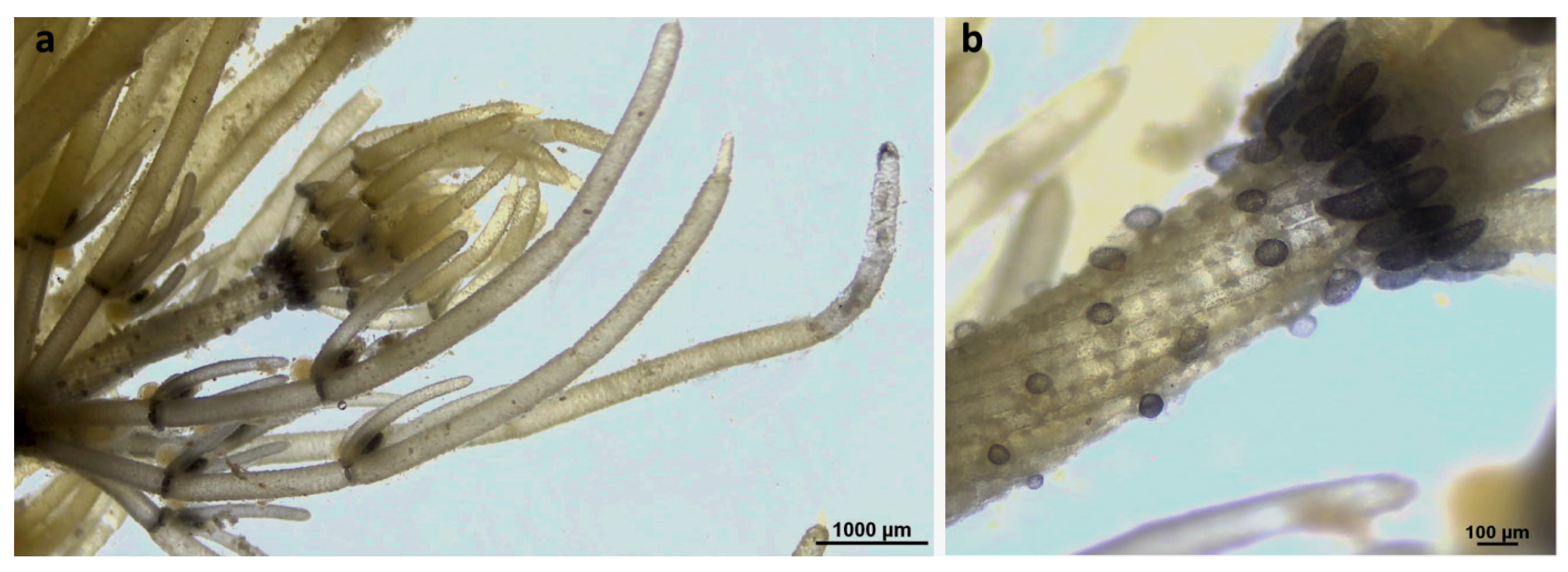
Through detailed examination of the material, we confirmed Nitellopsis obtusa specimens in samples BEOU 303 (initially identified as Chara contraria) and BEOU 612 (initially identified as Nitella syncarpa). The finding of Nitellopsis obtusa in the BEOU 303 sample represents the oldest record of this species in B&H, dating back to 1983. From the BEOU 1826 sample (initially identified as C. virgata), we extracted a few C. contraria specimens. From the BEOU 608 sample (initially identified as N. syncarpa), we also extracted N. capillaris plants and recorded the only occurrence of N. capillaris (BEOU 608) from the second half of the 20th century to the present (Figure 1) (Table S1: Dataset).
The original identification of 27 specimens was changed (at the species level) during the revision process. Most specimens originally identified as C. gymnophylla (BEOU 633, 2162, 2178, 2179, 2305, 2417, 2419, 2420, 2422–2428) were revised to C. squamosa. The same applied to several samples of C. vulgaris (BEOU 2292, 2293, 2300) and C. contraria (BEOU 2294–2296). In only a few cases, C. globularis (BEOU 296, 1893) and C. contraria (BEOU 1263) were revised to C. virgata, C. vulgaris to C. contraria (BEOU 254), and C. hispida to C. papillosa (BEOU 909) (Table S1: Dataset).
After revision, the BEOU Charophyte Collection, including both old and newly deposited samples, represents 13 species of charophytes from B&H: C. contraria, C. globularis C. gymnophylla, C. papillosa, C. squamosa, C. strigosa, C. virgata, C. vulgaris, N. capillaris, N. opaca, N. syncarpa, N. tenuissima, and Nitellopsis obtusa (Table 2).
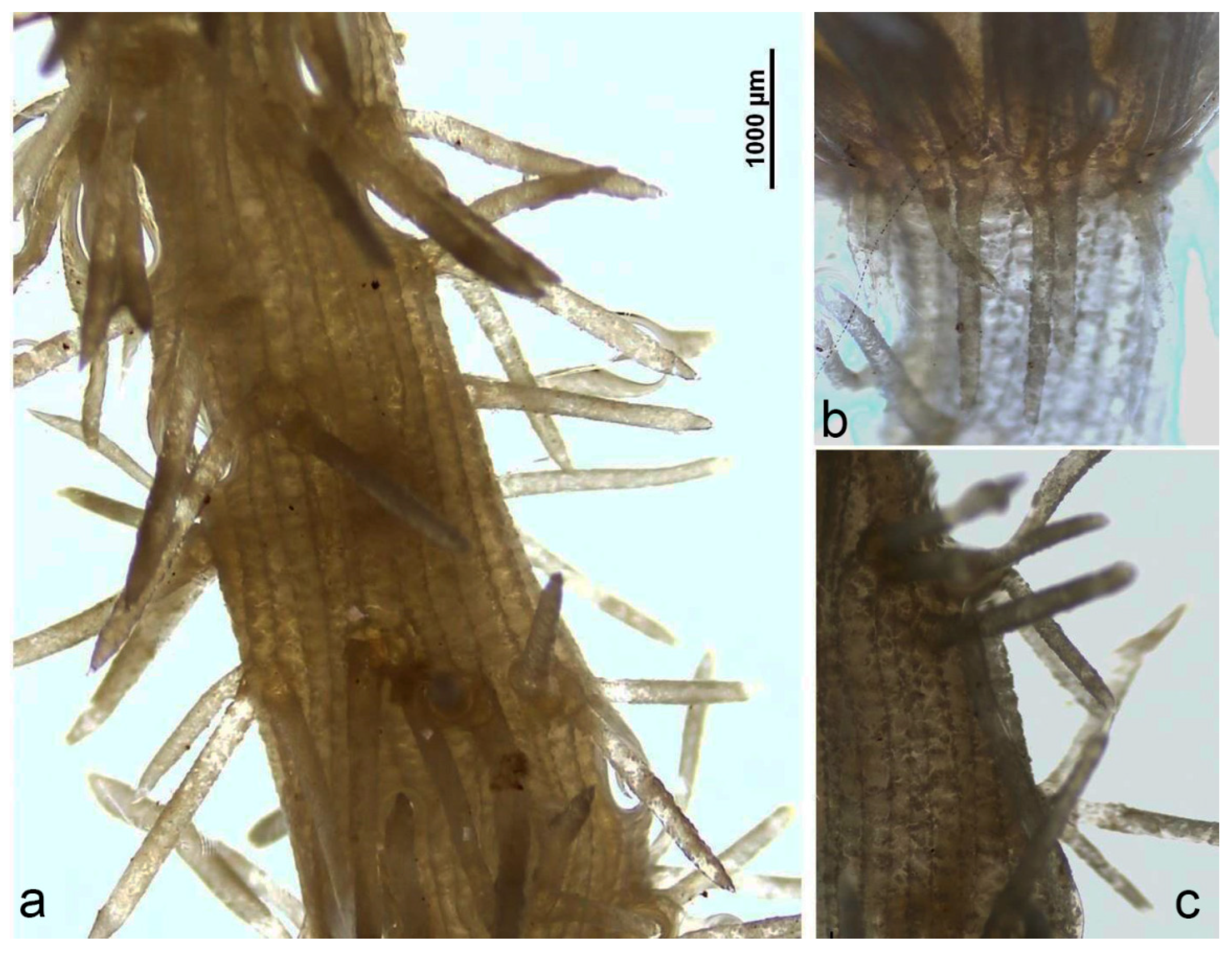
Chara papillosa is newly reported here in the flora of B&H. Chara papillosa is described as an unusually long-spined morphotype with long stipulodes (Figure 2). The commonly observed up to five spine cell clusters characteristic of C. aculeolata Kütz. in Rchb. were not seen, and mostly single spine cells or clusters of two or three were present; it was decided that the most suitable identification for the plants is C. papillosa.
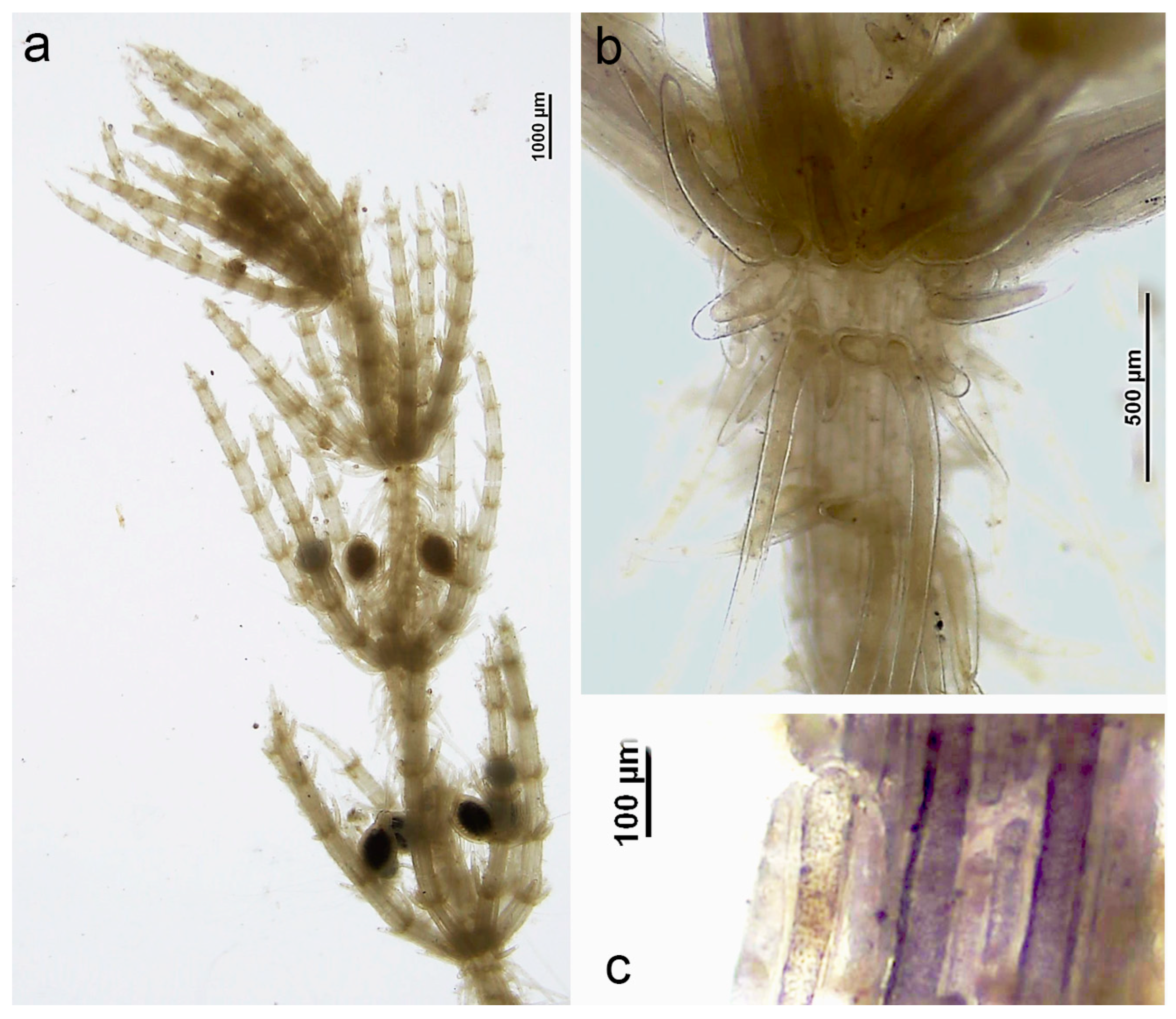
Chara squamosa, previously reported under C. gymnophylla f. fontanesiana (A. Braun) Fil. [38,52], is confirmed by the specimens studied (Figure 3).
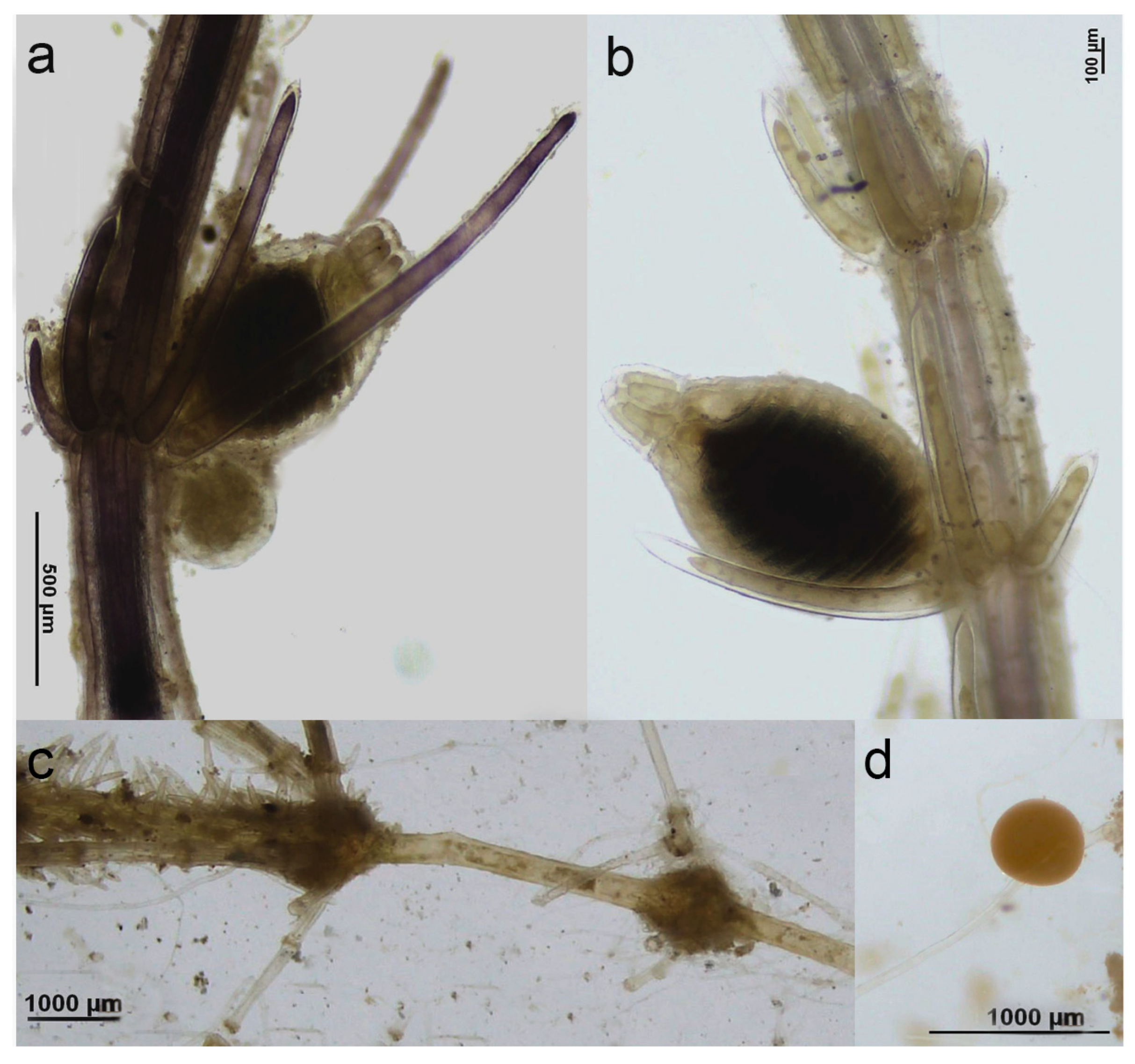
A detailed examination of C. strigosa samples (BEOU 710, 1827, 1825, 1828, 1845, 1857) confirmed the original identification (Figure 4 and Figure 5) and the presence of this species in Zelengora’s lakes, B&H, in 1988 (Table S1: Dataset).
The literature review identified 32 papers discussing charophytes of B&H in total [34,38,39,40,41,42,43,44,45,46,47,48,49,50,51,52,53,54,55,56,57,58,59,60,61,75,76,77,78,79,80,81]; however, only 21 sources reported original records with traceable collection sites and metadata (Table S1: Dataset, Literature sources column). According to a critical review of the literature, 17 taxa of charophytes are reported in the flora of B&H: C. aspera, C. contraria, C. gymnophylla, C. globularis, C. hispida, C. strigosa, C. squamosa, C. vulgaris, Chara sp., Nitella sp., N. flexilis, N. syncarpa, N. capillaris, N. mucronata, N. tenuissima, N. opaca and Nitellopsis obtusa (Table 2). Among these, C. aspera, N. flexilis, N. mucronata, Nitella sp., and Chara sp. are only known from the literature data, with no deposited specimens available for revision. For the three specimens of C. gymnophylla mentioned by Tortić-Njegovan [52], we traced deposited specimens (from Travnik, Višegradska Banja, and Bistrica, Žepče) in ZA, L, LE, MA, and SARA (Table S1: Dataset). However, only the specimens in L, LE, and MA were checked and revised (Table S1: Dataset). Twenty-three specimens (C. gymnophylla, C. foetida, C. fragilis, C. contraria, and C. hispida) reported in Filarszky [41] were related to material deposited in SARA, but these were not further revised here, leaving this issue for future research (Table S1: Dataset).
In the list of charophyte specimens from B&H held in herbarium collections, we obtained a list of 47 specimens deposited in SARA (C. contraria, C. vulgaris, C. globularis, C. gymnophylla, C. squamosa, C. hispida, N. opaca, and N. syncarpa) ZA (C. gymnophylla), L (C. gymnophylla, N. opaca), LE (C. gymnophylla), H (C. hispida, revised to C. subspinosa), and MA (C. gymnophylla) (Table 2). For this paper, the records from SARA and ZA were not further checked or revised (Table S1: Dataset). After revision, the initial identification of specimen H 5003376 was changed from C. hispida to C. subspinosa (Table S1: Dataset). Chara subspinosa is the second newly reported species for the charophyte flora of B&H.
Finally, taking into account all results—both revision results, the literature data, and herbarium data—it can be summarised that, until further revision and/or new systematic field studies, 20 taxa (18 species) of charophytes are represented in the flora of B&H: C. contraria, C. globularis, C. gymnophylla, C. papillosa, C. squamosa, C. strigosa, C. virgata, C. vulgaris, C. aspera, C. hispida, C. subspinosa, Chara sp., N. flexilis, N. mucronata, N. capillaris, N. opaca, N. syncarpa, N. tenuissima, Nitella sp., and Nitellopsis obtusa (Table 2).
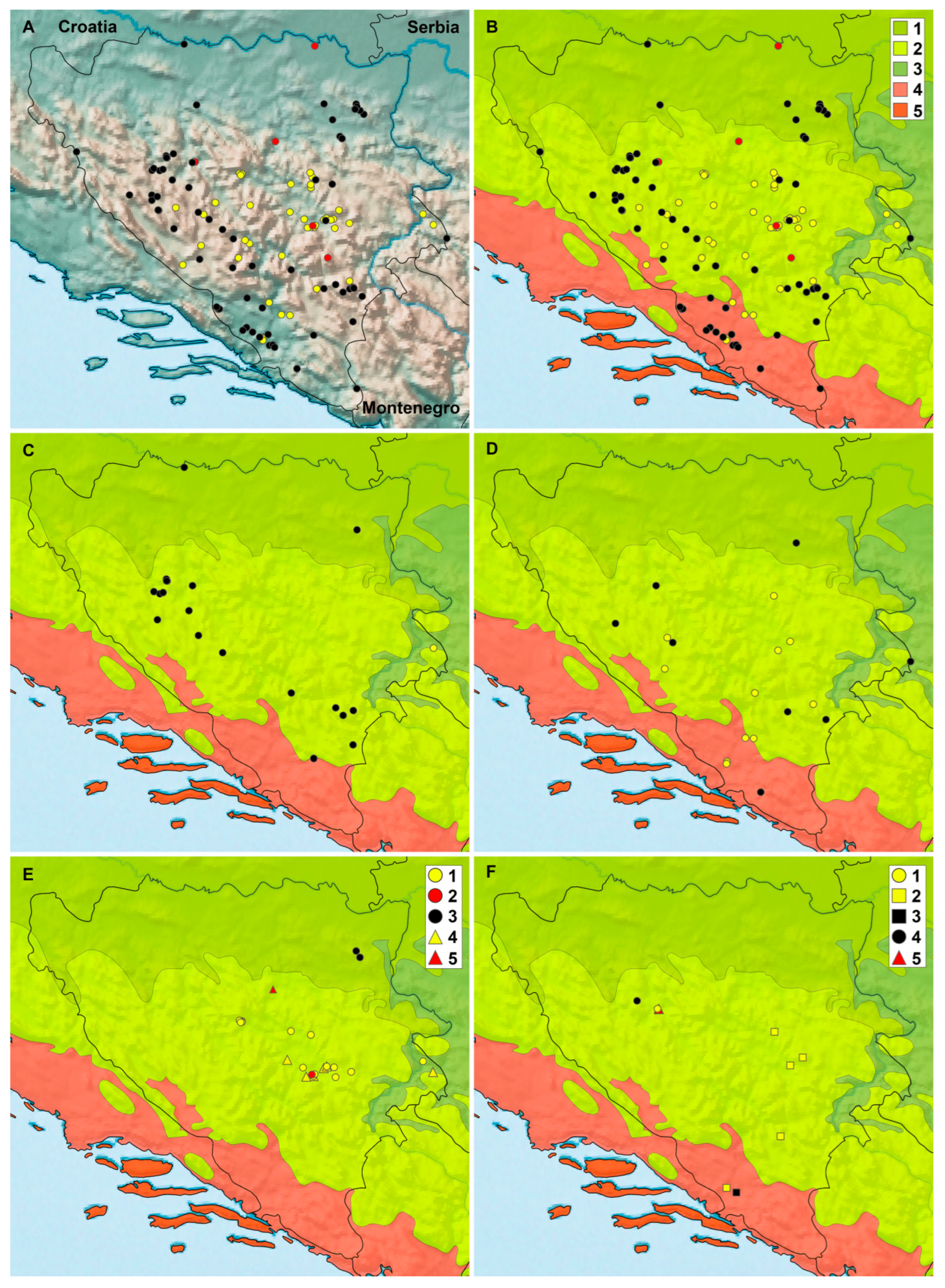
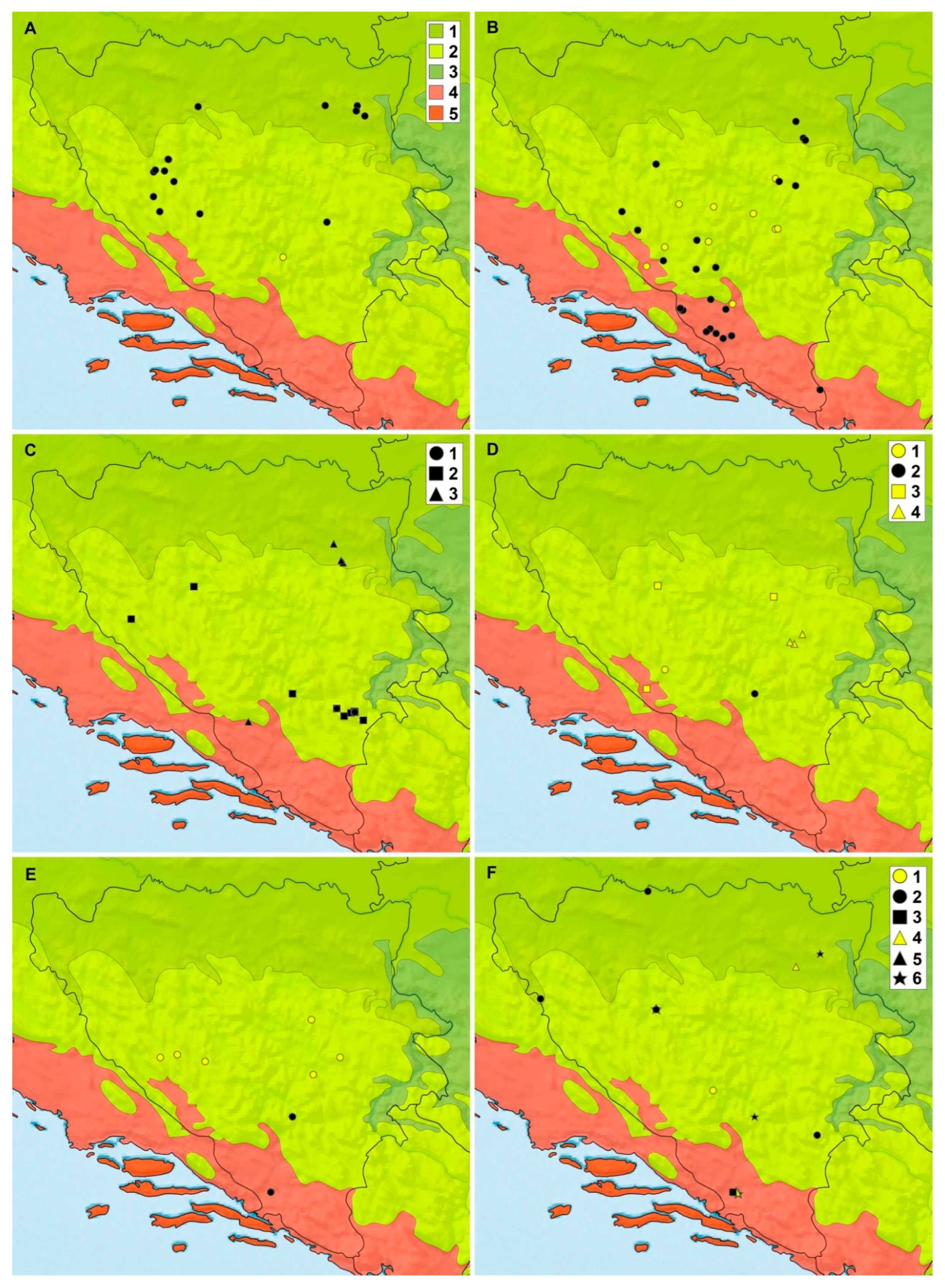
There are 122 sites of charophytes recorded in B&H according to all summarised data, including 73 from 1980 onwards, six from 1950 to 1979, and 47 before 1950. Distribution maps by time intervals and in relation to the terrestrial ecoregions for all taxa are shown in Figure 6 and Figure 7. Most records are from the Dinaric Mountains mixed forests, the largest ecoregion in B&H (Figure 6B; Table 3). The Illyrian deciduous forests and Pannonian mixed forests have fewer charophyte sites, but the most recent findings clearly predominate in these datasets. The singular historical sites of C. contraria, C. globularis, C. gymnophylla, and C. gymnophylla or C. squamosa are known from the Balkan mixed forests (Figure 6 and Figure 7).
The Dinaric Mountains mixed forests are the most representative and richest ecoregions, almost completely encompassing the charophyte flora of B&H. With the exception of N. tenuissima, all charophyte species known from the entire country were found there. Nitella tenuissima is known from a single site in the Illyrian deciduous forests. The distribution of charophyte species across different ecoregions can be seen as evidence that the entire studied territory shares the same charophyte flora. The lower numbers of species and sites probably reflect a decreased effort in searching for charophytes in those areas. However, differences in the frequency of species occurrence between ecoregions could be expected, but this is not evident in our dataset.
Considering the habitats of charophytes in B&H, after filtering comparable locations, our dataset shows the highest diversity in Veliko and Malo Plivsko lakes, where eight species were recorded (C. aspera, C. contraria, C. globularis, C. virgata, C. vulgaris, N. flexilis, N. opaca, and Nitellopsis obtusa), followed by Boračko Lake with six species (C. contraria, C. globularis, C. virgata, N. capillaris, N. syncarpa, and Nitellopsis obtusa). Hutovo Blato (nature reserve, complex of the sub-Mediterranean wetlands surrounding Deransko Lake) and its surroundings (Trebižat/Tihaljina river near Čapljina, Riječica stream near Počitelj) harbour five species (C. vulgaris, C. globularis, C. hispida, N. syncarpa, and N. tenuissima).
Chara vulgaris occurs at the highest number of sites in B&H—33% (Table 3). In addition, C. contraria, C. globularis, C. gymnophylla, and C. squamosa are among the most frequently detected species, occurring at 17%, 16%, 15%, and 14% of charophyte sites, respectively. All other species are less frequent. Chara aspera, C. papillosa, C. subspinosa, and N. tenuissima are each known from only a singular site. Chara contraria, C. squamosa, C. vulgaris, and N. opaca have more recent records (after 1980), in contrast to C. gymnophylla, C. hispida, and N. syncarpa, which are mostly recorded from older sites, i.e., in the 19th century and the beginning of the 20th century (Figure 6 and Figure 7; Table S1: Dataset). Chara aspera, C. subspinosa, N. flexilis, and N. mucronata are known only from older records, while C. papillosa, C. strigosa, C. virgata, N. tenuissima, and Nitellopsis obtusa are known only from recent sites. The datasets for C. globularis are consistent across records. Nitella capillaris was found at both old and recent sites, with only one record for each period (Figure 7D).

4. Discussion

4.1. Charophyte Flora

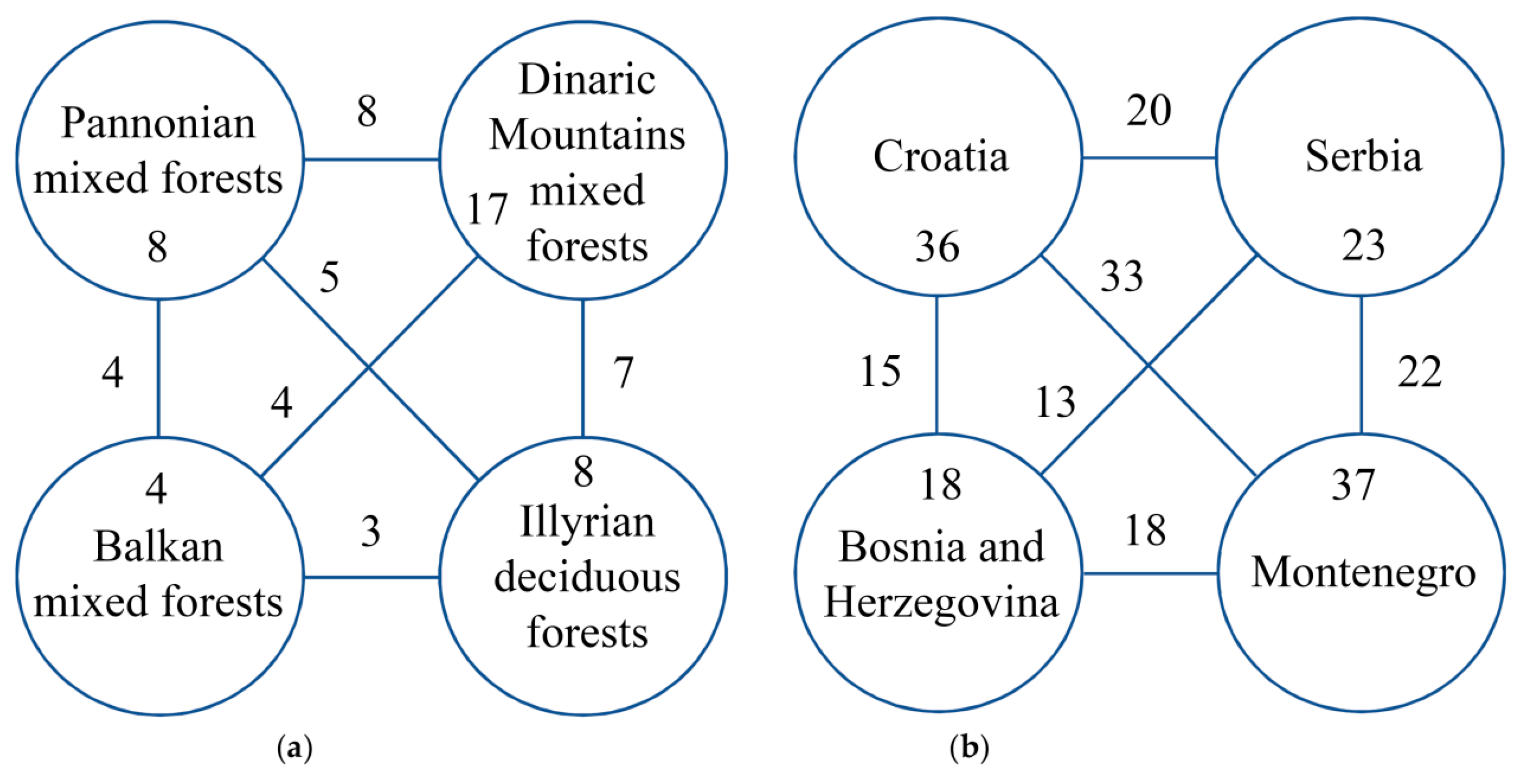
Bosnia and Herzegovina has the lowest charophyte species richness compared to neighbouring countries (Table 4; Figure 8). It shares no species that distinguish it from Montenegro. The charophyte floras of Montenegro and Croatia are the richest among those compared. Large areas of the Adriatic coast evidently increase species richness in these countries due to the presence of predominantly Mediterranean species such as C. corfuensis, C. galioides, and Tolypella hispanica, as well as brackish water species like C. canescens, Lamprothamnium papulosum, and T. nidifica. The total list of charophyte species in the four countries includes 42 species (Table 4; Figure 8). Our comparison indicates that Mediterranean and sub-Mediterranean areas have a richer, largely overlapping but not identical charophyte flora compared to neighbouring regions of Southeast Europe.
The great diversity and frequency of occurrence of Chara species, along with the lower species richness and rare occurrence of Nitella species found in B&H (Figure 6 and Figure 7; Table 3), are characteristic features of most regions in the north, west, and centre of Eurasia [82].
Table 4. Species of charophytes of B&H and neighbouring countries. Symbol “+” represented, symbol “–“ not represented.
SpeciesB&HCroatiaSerbiaMontenegro
Chara aculeolata Kütz. in Rchb.+
Chara aspera Willd.+++
Chara baueri A. Braun+
Chara braunii C.C. Gmelin+++
Chara canescens Desv. et Loisel. in Loisel.+++
Chara connivens Salzm. ex A. Braun+++
Chara contraria A. Braun ex Kütz.++++
Chara corfuensis J. Groves ex Fil.++
Chara dissoluta A. Braun ex Leonh.++
Chara galioides DC.++
Chara globularis Thuill.++++
Chara gymnophylla (A. Braun) A. Braun++++
Chara hispida L.+++
Chara kokeilii A. Braun++
Chara papillosa Kütz.++++
Chara squamosa Desf.++++
Chara strigosa A. Braun++
Chara subspinosa Rupr.+++
Chara tenuispina A. Braun+++
Chara tomentosa L.+
Chara virgata Kütz.++++
Chara vulgaris L.++++
Mediterranean Chara *+
Lamprothamnium papulosum (Wallr.) J. Groves++
Lychnothamnus barbatus (Meyen) Leonh.++
Nitella capillaris (Krock.) J. Groves et Bull.-Webst.+++
Nitella confervacea (Bréb.) A. Braun ex Leonh.+++
Nitella flexilis (L.) C. Agardh+++
Nitella gracilis (Smith) C. Agardh+++
Nitella hyalina (DC.) C. Agardh++
Nitella mucronata (A. Braun) Miq.++++
Nitella opaca (C. Agardh ex Bruzelius) C. Agardh++++
Nitella syncarpa (Thuill.) Chev.++++
Nitella tenuissima (Desv.) Kütz.+++
Nitella translucens (Pers.) C. Agardh+
Nitellopsis obtusa (Desv.) J. Groves++++
Tolypella glomerata (Desv. in Loisel.) Leonh.+++
Tolypella hispanica Nordst. ex Allen++
Tolypella nidifica (O.F.Müll.) A. Braun++
Sphaerochara intricata (Trentep. ex Roth) Feist-Castel et
N. Grambart in Riding
+++
Sphaerochara prolifera (Ziz ex A. Braun) Soulié-Märsche in Schubert et al.+++
Total number of species18362337
Note: *—taxon of uncertain affiliation [68]. Sources of data—B&H: this study; Croatia [33,41,54,83,84,85,86,87,88,89]; Serbia [34,35,86,90,91,92]; Montenegro [33,36,41,70,86,87,93,94,95,96].
Nitella brachyteles A. Braun was deliberately omitted from the lists for Croatia, Montenegro and Serbia, as this taxon is currently considered unconfirmed in Europe [86]. Although not explicitly stated by Trbojević & Schubert [86], the authors re-examined BEOU vouchers of N. brachyteles specimens collected in the Balkans (BEOU 357, 705, 714, 1940, 1941, 1949) and did not confirm the taxonomic characteristics of this species.

4.2. Update and Improvement in Published Data

Compared to the previous counts of 11, 17, and 13, respectively [33,38,53], our study identifies 18 charophyte species (20 taxa) in the flora of B&H, and reports C. papillosa and C. subspinosa for the first time. Chara squamosa, previously reported as C. gymnophylla f. fontanesiana (A. Braun) Fil. [38,52], is confirmed with the specimens studied (Figure 2).
The apparent discrepancy in the number of taxa reported in the flora of B&H in the literature [33,38,53] requires further discussion and resolution. Blaženčić & Blaženčić [38] reported 11 taxa, all of which we confirm based on our work. Subsequently, Blaženčić et al. [53], in addition to their own records—N. capillaris and N. tenuissima—also included records from Lovrić et al. [54] for Nitellopsis obtusa, T. hispanica, T. nidifica, and C. canescens in the flora of B&H. The record of N. capillaris in Blaženčić et al. [53] resulted from an unintentional transcription error, as the corresponding BEOU voucher was originally identified as N. syncarpa (Table S1: Dataset, BEOU 1302 and 1663). However, this did not affect the total number of recorded species; since N. capillaris had already been reported by Protić [46]. In the Red Data List of the Balkans [33], only C. canescens from the records of Lovrić et al. [54] appeared in the list of charophytes represented in B&H, while C. gymnophylla, reported in Blaženčić & Blaženčić [53], was omitted as the authors decided to treat this taxon as a variety of C. vulgaris. Careful examination of Lovrić et al. [54] shows that only Nitellopsis obtusa can be considered part of the flora of B&H, as Lovrić et al. [54] explicitly mention Deransko Lake (Hutovo Blato) as the habitat of this species (specifically, in the association Nitellopsido-Najadetum marinae Hart. and Seg.). However, subsequent research on Deransko Lake in 1989 did not confirm this finding [J. Blaženčić, personal communication; [53]. The other taxa listed by Lovrić et al. [54]—C. canescens, T. hispanica, and T. nidifica—appear to have been found in the Croatian part of the River Neretva delta.
Our revision of the BEOU specimens confirmed the presence of Nitellopsis obtusa in B&H since 1983, supporting the report by Lovrić et al. [54]. Revision of the BEOU collection, in line with the recent clarification of the C. gymnophylla and C. squamosa species concepts, has reinstated two previously recognised species to the list of B&H charophytes [97,98]. Both species were previously listed for B&H: C. gymnophylla as a species and C. squamosa as a form, C. gymnophylla f. fontanesiana (A. Braun) Fil. [52]. Based on our results, we have reasonable doubt that many unrevised records of C. gymnophylla in B&H may actually be C. squamosa.
We add C. subspinosa (H 5003376) and C. papillosa (BEOU 909) as new species to the flora of B&H, both resulting from the revision of specimens initially identified as C. hispida. Chara hispida in B&H is known from the literature [41,44,45,55], and only the records from Filarszky [41] are deposited in SARA and are available for revision (Table S1: Dataset). We therefore hope that all available vouchers of C. hispida and C. gymnophylla will be revised in the future, so that the uncertainty associated with old records can be resolved.
The species C. aspera, N. flexilis, and N. mucronata are known from B&H exclusively through the literature records and have been accepted here on that basis, although their presence may be debatable. Chara aspera was reported only once, from Veliko and Malo Plivsko lakes in the early 1920s, and on the same occasion, N. flexilis was described from the same habitat [49]. In their later research on Veliko Plivsko Lake, Blaženčić and Blaženčić [38] did not confirm either species. However, as their research was conducted 60 years after Protić, it would not be surprising if the species composition in the lake had changed. Nevertheless, Blaženčić and Blaženčić [38] did report N. opaca from Veliko Plivsko Lake, and during the revision process for this study, we confirmed N. opaca at the locality and subsequently recorded Nitellopsis obtusa (the first record of the species in B&H since 1983). Nitella flexilis is known to be difficult to distinguish from N. opaca, particularly when specimens are sterile [99], so it is possible that Protić in the early 20th century could not differentiate between these species. However, until it is possible to revise the deposited material (the location of which is currently unknown), there are no grounds to question Protić’s original identification. Nitella flexilis was reported from a few more locations—in pit and forest puddles (Buško Blato and Vareš-Duboštica, respectively) by Protić [44,47]—but it remains unknown whether these habitats still exist, and vouchers are also currently unavailable. Protić [45] also provided the only reports of N. mucronata in and near Sarajevo, in pits and puddles. The taxa Nitella sp. from Šićki Brod Lake, near Tuzla [57] and Chara sp. from Bijelo Lake in Zelengora [50] are also known only from the literature and have been accepted as listed until further potential revision, as it is currently not known whether the material is available.

4.3. Temporal Changes

The gap in the dataset for the period between 1950 and 1980, when only a few records of charophytes were documented (Figure 6A,B; Table S1: Dataset), restricts the ability to trace long-term changes in charophyte species occurrence. However, it is possible to compare datasets from before 1950 and after 1980. Nearly all old records date from before 1930. The apparent mismatch between sites recorded in these periods is clear, as only a few sites have data for both. Chara vulgaris was found in Mostarsko Blato (karst field and a seasonal karstic wetland) in 1895–1897 [42] and again in 2018 (this study). Chara sp. was reported in Bijelo Lake, Zelengora, in 1926 [50], whereas C. strigosa, C. virgata, and N. opaca were recorded there in 1988 [38], this study. Chara globularis was found in Boračko Lake, Konjic Municipality, in 1921–1923 [49], while C. contraria, N. capillaris, N. syncarpa, and Nitellopsis obtusa were collected there in 1984 [38], as seen in this study, and C. virgata was found in 2013 (this study). Additionally, C. vulgaris was collected in Veliko Plivsko Lake, Jajce, in 1977 [38], compared to C. contraria, C. globularis, C. virgata, C. vulgaris, N. opaca, and Nitellopsis obtusa recorded there in 1983 [38], as seen in this study, while Protić [49] reported C. aspera in both Veliko and Malo Plivsko lakes. Therefore, the difference in sites between the datasets before 1950 and after 1980 makes it nearly impossible to track real changes in the same water bodies, and the application of one of the IUCN criteria [100,101], namely a decrease in area occupied by species, does not appear possible. However, some decrease in charophyte occurrence and abundance can be expected in the area studied, as this has been observed in many other regions of Europe [19,102,103,104,105,106,107,108,109], even over a short interval between observations [110].

4.4. Species Perspective

Chara vulgaris, C. contraria, and C. globularis, found in 66% of all charophyte sites in B&H, are generalist species in many areas of the Palearctic [23,28,82,111,112,113]. Chara gymnophylla and C. squamosa can also be recognised as generalist species in the studied region based on the number of their sites. The significant number of sites for these two species makes the charophyte floras of B&H and Serbia similar [91].
The complex group of Chara species from the subsection Hartmania R.D. Wood, with species delineation still under debate [114,115,116,117,118,119], is represented in B&H by only three species: C. hispida, C. papillosa, and C. subspinosa. Each is known from only a few sites. However, more specimens from these sites should be examined in future to confirm species identity. This is particularly important for old records of C. hispida [41], as the species concept has changed over time.
The presence of C. strigosa in Zelengora’s lakes in the 1980s [38] was also confirmed during the revision process, which revealed well-developed, richly fertile specimens and both currently known types of bulbils: multicellular nodal bulbils and spherical single-celled rhizoidal bulbils of the Chara aspera type (Figure 4c). However, bulbils of the C. aspera type have so far only been reported from Norway and Sweden, while nodal bulbils are known from populations in Russia [120]. Here, we report the presence of both types of bulbils in the same population in Kladopoljsko Lake in Zelengora. This species has a distinctly disjunct northern and southern distribution, with populations in B&H, together with the Montenegrin population from Zmijinje Lake, Durmitor [36], representing the southernmost occurrences in Europe and the only ones in southern Europe. Other “southern” European populations are found in France and Switzerland. Chara strigosa populations are considered threatened by eutrophication and environmental changes related to climate change, and recent declines have been reported in Switzerland and Sweden [120] and references therein. Since 1988, the condition of C. strigosa populations in Zelengora’s lakes in B&H has been completely unknown.
Species of Tolypella (A. Braun) A. Braun and Sphaerochara Mädler, namely T. glomerata (Desv. in Loisel) Leonh. and S. prolifera (Ziz ex A. Braun) Soulié-Märsche in Schubert et al., as well as Chara braunii C.C. Gmelin and Nitella hyalina (DC.) C. Agardh, are expected in B&H based on their distribution in Europe and environmental preferences [121,122,123,124]; however, they have not yet been recorded.

5. Conclusions

Our study currently reports 18 species of charophytes in flora of B&H: Chara aspera, C. contraria, C. globularis, C. gymnophylla, C. hispida, C. papillosa, C. strigosa, C. squamosa, C. subspinosa, C. virgata, C. vulgaris, Nitella capillaris, N. flexilis, N. mucronata, N. opaca, N. syncarpa, N. tenuissima, and Nitellopsis obtusa.
In this study, the species C. papillosa and C. subspinosa are reported in B&H for the first time.
The presence of C. strigosa populations in the 1980s in the Zelengora lakes is confirmed after revision of the BEOU collection. Any later data or the current status of this species in B&H is not known.
Surveying all old sites, monitoring charophyte occurrence in recent sites, and checking specimens in European herbaria are important steps in preparing a reliable dataset for the Red List of charophytes of B&H.
Based on our results, we strongly encourage further revision of available collections and continued systematic field research, as only robust evidence and fundamental data on charophyte diversity and distribution in this region will enable effective protection of species and habitats.

Supplementary Materials

The following supporting information can be downloaded at https://www.mdpi.com/article/10.3390/phycology5040085/s1, Table S1: Dataset, contains complete data on charophyte diversity and distribution in B&H collected in this work.

Author Contributions

Conceptualisation, I.T. and R.R.; Methodology, I.T. and R.R.; Validation, I.T., R.R., V.M., G.S.S., E.M. and J.B.; Formal Analysis, I.T. and R.R.; Investigation, I.T., R.R., M.S. and J.B.; Data Curation, I.T. and R.R.; Writing—Original Draft Preparation, I.T. and R.R.; Writing—Review and Editing, I.T., R.R., V.M., G.S.S., M.S., E.M. and J.B.; Visualisation, I.T. and R.R. All authors have read and agreed to the published version of the manuscript.

Funding

This work was supported by the Ministry of Science, Technological Development and Innovation of the Republic of Serbia (grants no. 451-03-136/2025-03/200178 and 451-03-137/2025-03/200178).

Data Availability Statement

The original contributions presented in this study are included in the article and Supplementary Material Table S1: Dataset. Further inquiries can be directed to the corresponding author.

Acknowledgments

The authors are sincerely grateful to M. Petrović Ðurić for her support, expertise, and commitment in material processing and literature search. Her constructive and supportive comments and suggestions guided and shaped our research outcomes. We also extend our gratitude to Dmitar Lakušić for georeferencing part of the BEOU specimens. We are grateful to the curators of the herbaria L, LE, MA, H, and SARA for their kind help and support. Special thanks go to Antun Alegro and Vedran Šegota for providing information on specimens deposited in ZA and ZAHO, as well as for supplying scans and photographs of specimens we have not yet examined. We extend our gratitude to Nadežda Buntić for English language editing.

Conflicts of Interest

The authors declare no conflicts of interest.

References

  1. Schubert, H.; Blindow, I.; Bueno, N.C.; Casanova, M.T.; Pełechaty, M.; Pukacz, A. Ecology of Charophytes—Permanent Pioneers and Ecosystem Engineers. Perspect. Phycol. 2018, 5, 61–74. [Google Scholar] [CrossRef]
  2. Rodrigo, M.A.; Puche, E.; Segura, M.; Arnal, A.; Rojo, C. Sediment underneath Charophyte Meadows Is Enriched in Viable Ephippia and Enhances the Benthic Periphytic Biofilm. Hydrobiologia 2021, 848, 5203–5221. [Google Scholar] [CrossRef]
  3. Sand-Jensen, K.; Martinsen, K.T.; Jakobsen, A.L.; Sø, J.S.; Madsen-Østerbye, M.; Kjær, J.E.; Kristensen, E.; Kragh, T. Large Pools and Fluxes of Carbon, Calcium and Phosphorus in Dense Charophyte Stands in Ponds. Sci. Total Environ. 2021, 765, 142792. [Google Scholar] [CrossRef] [PubMed]
  4. Pełechaty, M. Charophytes: Drivers of Carbonate Sedimentation, Carbon Sequestration and Aquatic Health. Front. Freshw. Sci. 2025, 3, 1520590. [Google Scholar] [CrossRef]
  5. Schneider, S.C.; García, A.; Martín-Closas, C.; Chivas, A.R. The Role of Charophytes (Charales) in Past and Present Environments: An Overview. Aquat. Bot. 2015, 120. [Google Scholar] [CrossRef]
  6. Kufel, L.; Strzałek, M.; Biardzka, E. Site- and Species-Specific Contribution of Charophytes to Calcium and Phosphorus Cycling in Lakes. Hydrobiologia 2016, 767, 185–195. [Google Scholar] [CrossRef]
  7. Wood, R.D.; Imahori, K. A Revision of the Characeae; Richard, D.W., Imahori, K., Eds.; J. Cramer: Weinheim, Germany, 1965. [Google Scholar]
  8. Casanova, M.T. An Overview of Nitella in Australia (Characeae, Charophyta). Aust. Syst. Bot 2009, 22, 192–218. [Google Scholar] [CrossRef]
  9. Casanova, M.T.; Karol, K.G. A Revision of Chara Sect. Protochara, Comb. et Stat. Nov. (Characeae: Charophyceae). Aust. Syst. Bot 2014, 27, 23–37. [Google Scholar] [CrossRef]
  10. Casanova, M.T.; Karol, K.G. Charophytes of Australia’s Northern Territory—I. Tribe Chareae. Aust. Syst. Bot 2023, 36, 38–79. [Google Scholar] [CrossRef]
  11. Pérez, W.; Hall, J.D.; McCourt, R.M.; Karol, K.G. Phylogeny of North American Tolypella (Charophyceae, Charophyta) Based on Plastid DNA Sequences with a Description of Tolypella ramosissima sp. nov. J. Phycol 2014, 50, 776–789. [Google Scholar] [CrossRef]
  12. Karol, K.G.; Alix, M.S.; Scribailo, R.W.; Skawinski, P.M.; Sleith, R.S.; Sardina, J.A.; Hall, J.D. New Records of the Rare North American Endemic Chara brittonii (Characeae), with Comments on Its Distribution. Brittonia 2018, 70, 277–288. [Google Scholar] [CrossRef]
  13. Korsch, H. The worldwide range of the Charophyte species native to Germany. Rostock. Meeresbiolog. Beitr. 2018, 28, 45–96. [Google Scholar]
  14. Soulié-Märsche, I.; Triboit, F.; Despréaux, M.; Rey-Boissezon, A.; Laffont-Schwob, I.; Thiéry, A. Evidence of Chara fibrosa Agardh Ex Bruzelius, an Alien Species in South France. Acta Bot. Gall. 2013, 160, 157–163. [Google Scholar] [CrossRef]
  15. Abdelahad, N.; Piccoli, F. Report on Charophytes from Rice Fields in Northern Italy Including the Alien Species Chara fibrosa ssp. benthamii. Plant Biosyst. 2017, 152, 599–603. [Google Scholar] [CrossRef]
  16. Becker, R.; Schubert, H.; Nowak, P. Chara zeylanica J.G. Klein Ex Willd. (Charophyceae, Charales, Characeae): First European Record from the Island of Sardinia, Italy. Plants 2021, 10, 2069. [Google Scholar] [CrossRef] [PubMed]
  17. Glisson, W.J.; Muthukrishnan, R.; Wagner, C.K.; Larkin, D.J. Invasive Nitellopsis Obtusa (Starry Stonewort) Has Distinct Late-Season Phenology Compared to Native and Other Invasive Macrophytes in Minnesota, USA. Aquat. Bot. 2022, 176, 103452. [Google Scholar] [CrossRef]
  18. Glisson, W.J.; Nault, M.; Jurek, C.; Fischer, E.; Lund, K.; Cattoor, K.B.; Londo, A.; Kovar, N.; Hauck-Jacobs, E.; Egdell, R.; et al. Evaluation of a Decade of Management of a North American Aquatic Invasive Species (Nitellopsis obtusa) Highlights Scale-Dependent Effectiveness and Monitoring Gaps. FACETS 2025, 10, 1–14. [Google Scholar] [CrossRef]
  19. Baastrup-Spohr, L.; Iversen, L.L.; Dahl-Nielsen, J.; Sand-Jensen, K. Seventy Years of Changes in the Abundance of Danish Charophytes. Freshw. Biol. 2013, 58, 1682–1693. [Google Scholar] [CrossRef]
  20. Becker, R. Gefährdung und Schutz von Characeen. In Armleuchteralgen—Die Characeen Deutschlands/Arbeitsgruppe Characeen Deutschlands; Springer: Berlin/Heidelberg, Germany, 2016; pp. 149–191. [Google Scholar] [CrossRef]
  21. Stewart, N. Provisional Red List of European Charophytes. In Charophytes of Europe; Schubert, H., Blindow, I., Nat, E., Korsch, H., Gregor, T., Denys, L., Stewart, N., Weyer, K., Romanov, R., Casanova, M.T., Eds.; Springer Nature: Cham, Switzerland, 2024; pp. 177–199. [Google Scholar] [CrossRef]
  22. Stewart, N.F. Important Stonewort Areas of the United Kingdom; Plantlife International: Salisbury, UK, 2004. [Google Scholar]
  23. Hohla, M.; Korsch, H.; Hofbauer, M.; Bernhardt, K.-G.; Diewald, W.; Foissner, I.; Jäger, D.; Pall, K.; Prochinig, U.; Schagerl, M.; et al. Characeen Österreichs. Checkliste, Atlas und Rote Liste der Armleuchteralgen (Charophyceae). Biosyst. Ecol. 2025, 4, 154327. [Google Scholar] [CrossRef]
  24. Caisová, L.; Gąbka, M. Charophytes (Characeae, Charophyta) in the Czech Republic: Taxonomy, Autecology and Distribution. Fottea 2009, 9, 1–43. [Google Scholar] [CrossRef]
  25. Kovtun-Kante, A. Charophytes of Estonian Inland and Coastal Waters: Distribution and Environmental Preferences. Ph.D. Thesis, University of Tartu Press, Tartu, Estonia, 2015. [Google Scholar]
  26. Armleuchteralgen. Die Characeen Deutschlands. Arbeitsgruppe Characeen Deutschlands Lehrstuhl für Ökologie der Universität; Springer: Rostock, Germany; Berlin/Heidelberg, Germany, 2016. [Google Scholar] [CrossRef]
  27. Hrafnsdottir, T.; Ingimarsson, F.; Ingvason, H.R.; Stefánsson, S.M.; Þorvaldsdóttir, E.G.; Malmquist, H.J.; Langangen, A. New Finds of Charophytes in Iceland with an Update on the Distribution of the Charophyte Flora. Nord. J. Bot 2019, 37. [Google Scholar] [CrossRef]
  28. Sinkevičienė, Z.; Gudžinskas, Z. Revision of the Characeae (Charales, Charophyceae) Species and Their Distribution in Lithuania. Botanica 2021, 27, 95–124. [Google Scholar] [CrossRef]
  29. Langangen, A. List of localities for Norwegian charophytes 2021. Nor. Kransalger Hefte 2021, 13. [Google Scholar] [CrossRef]
  30. Hindáková, A.; Gąbka, M.; Hrivnák, R.C. Red List, and Distribution Pattern of Charophytes (Charophyceae, Charales) in Slovakia Based on Critical Revision of Herbarium Specimens. Diversity 2022, 14, 897. [Google Scholar] [CrossRef]
  31. Auderset Joye, D.; Schwarzer, A. Rote Liste der Armleuchteralgen. Gefährdeta Arten der Schweiz, Stand; Laboratoire d’Ecologie et de Biologie Aquatique der Universität Genf: Bern, Switzerland, 2012; p. 72. [Google Scholar]
  32. Borysova, O.V.; Palamar-Mordvintseva, G.M.; Tsarenko, P.M. Flora Algarum Ucrainicae. Charophyta; Kholodny Institute of Botany of the National Academy of Science of Ukraine: Kyiv, Ukraine, 2016; Volume 12, pp. 1–282. [Google Scholar]
  33. Blaženčić, J.; Stevanović, B.; Blaženčić, Ž.; Stevanović, V. Red Data List of Charophytes in the Balkans. Biodivers. Conserv. 2006, 15, 3445–3457. [Google Scholar] [CrossRef]
  34. Blaženčić, J. Overview of the Stoneworts (Charales) of Serbia with the Estimation of the Threat Status. Bot. Serbica 2014, 38, 121–130. [Google Scholar]
  35. Vesić, A. The Ecological Study of Charophytes (Charophyceae) of Standing and Slow Running Waters of Vojvodina. Ph.D. Thesis, Faculty of Belgrade, University of Belgrade, Belgrade, Serbia, 2016. [Google Scholar]
  36. Blaženčić, J.; Stevanović, B. Katalog Harofita (Charales) Crne Gore; Katalozi 11. Odjeljenje Prirodnih Nauka; Crnogorska Akademija Nauka i Umjetnosti: Podgorica, Montenegro, 2015; Volume 10, pp. 1–51. [Google Scholar]
  37. Temniskova, D.; Stoyneva, P.M.; Kirjakov, K.I. Red List of the Bulgarian algae. I Macroalgae. Phytol. Balc. 2008, 14, 193–206. [Google Scholar]
  38. Blaženčić, J.; Blaženčić, Ž. Florističko-horološka analiza algi razdela Charophyta u Bosni i Hercegovini. In Zbornik Radova. Presented at the Minerali, Stijene, Izumrli i Živi Svijet BiH; Zemaljski Muzej Bosne i Hercegovine: Sarajevo, Bosnia and Herzegovina, 1989; pp. 223–233. [Google Scholar]
  39. Kummer, A.; Sendtner, O. Enumeratio plantarum in itinere Sendtneriano in Bosnia lectarum, cum definitionibus novarum specierum et adumbrationibus obscurarum varietatumque. Flora Oder Allg. Bot. Ztg. 1849, 32, 1–10. [Google Scholar]
  40. Beck, G. Flora von Südbosnien und der angrenzenden Hercegovina. Nach den Ergebnissen einer dahin im Jahre 1885 unternommenen Reise und den in der Literatur vorhandenen Angaben I. Theil—Ann. Naturhistorischen Mus. Wien 1886, 1, 271–326. [Google Scholar]
  41. Fílarszky, N. Adatok Horvát-Szlavonország és a Balkán néhány más országának Chara-vegetácíójához. Magy. Bot. Lapok Bp. 1931, 30, 81–97. [Google Scholar]
  42. Protić, Đ. Prilog k poznavanju flore resina (alge) Bosne i Hercegovine s osobitim obzirom na floru resina okoline Sarajeva, Vareša i Mostarskog blata (isključivši dijatomaceje. Glas. Zemalj. Muzeja Bosni Hercegovini 1897, 9, 539–559. [Google Scholar]
  43. Protić, Đ. Treći prilog k poznavanju flore resina (alge) Bosne i Hercegovine. Glas. Zemalj. Muzeja Bosni Hercegovini 1901, 13, 201–226. [Google Scholar]
  44. Protić, Đ. Peti prilog poznavanju flore okoline Vareša u Bosni. Glas. Zemalj. Muzeja Bosni Hercegovini 1903, 15, 273–318. [Google Scholar]
  45. Protić, Đ. Prilog k poznavanju flore kriptogama (tajnocvjetaka) okoline Sarajeva. Glas. Zemalj. Muzeja Bosni Hercegovini 1904, 16, 61–90. [Google Scholar]
  46. Protić, Đ. Drugi prilog k poznavanju flore resina (alge) Bosne i Hercegovine. Glas. Zemalj. Muzeja Bosni Hercegovini 1906, 18, 5–15. [Google Scholar]
  47. Protić, Đ. Treći prilog k poznavanju flore resina (alge) Bosne i Hercegovine. Glas. Zemalj. Muzeja Bosni Hercegovini 1907, 19, 191–202. [Google Scholar]
  48. Protić, Đ. Četvrti prilog k poznavanju flore resina (alge) Bosne i Hercegovine. Glas. Zemalj. Muzeja Bosni Hercegovini 1908, 20, 513–523. [Google Scholar]
  49. Protić, Đ. Hidrobiološke i plankton-studije na jezerima Bosne i Hercegovine, prvi dio. Glas. Zemalj. Muzeja Bosni Hercegovini 1924, 36, 39–67. [Google Scholar]
  50. Protić, Đ. Hidrobiološke i plankton-studije na jezerima Bosne i Hercegovine, četvrti deo. planinska jezera. Glas. Zemalj. Muzeja Bosni Hercegovini 1927, 39, 3–42. [Google Scholar]
  51. Malý, K.; Bjelčić, Ž. Prilog poznavanju flore okoline Dobruna kod Višegrada. Godišnjak Biološkog Instituta Sarajev. 1949, 2, 3–16. [Google Scholar]
  52. Tortić-Njegovan, M. Chara gymnophylla i neke druge haraceje Jugoslavije. Acta Bot. Croat. 1956, 14–15, 145–162. [Google Scholar]
  53. Blaženčić, J.; Blaženčić, Ž.; Lakušić, D.; Ranđelović, V. Phytogeographical and Ecological Characteristics of the Charophytes of the East Adriatic Coast. Arch. Biol. Sci. 1998, 50, 119–128. [Google Scholar]
  54. Lovrić, A.Ž.; Rac, M.; Bedalov, M. Mediteranska močvarna vegetacija i florističke zanimljivosti uz Donju Neretvu od Čapljine do mora. In Zbornik Radova. Presented at the Minerali, Stijene, Izumrli i Živi Svijet BiH; Zemaljski Muzej Bosne i Hercegovine: Sarajevo, Bosnia and Herzegovina, 1989; pp. 333–340. [Google Scholar]
  55. Jasprica, N.; Carić, M. Vegetation of the natural park of Hutovo Blato (Neretva River delta, Bosnia and Herzegovina. Biologia 2002, 57, 505–516. [Google Scholar]
  56. Trožić-Borovac, S.; Hafner, D.; Antunović, M. Kvalitativno-kvantitativni sastav bentosa sliva rijeke Neretve i Cetine u Federaciji BiH. Voda Mi 2010, 71, 8–24. [Google Scholar]
  57. Kamberović, J.; Barudanovič, S. Algae and Macrophytes of Mine Pit Lakes in the Wider Area of Tuzla, B&H. Nat. Croat. 2012, 21, 101–118. [Google Scholar]
  58. Hafner, D.; Jasprica, N. The Composition of Epiphytic Diatoms (Bacillariophyta) on Charophyceae in Dinaric Karstic Ecosystems. Nat. Croat. 2013, 22, 199–204. [Google Scholar]
  59. Mašić, E.; Žero, S.; Barudanovič, S.; Memić, M. Effect of Heavy Metals on Phytobenthos Assemblages in Mine Pit Lakes of B&H. Biol. Nyssana 2018, 9, 103–118. [Google Scholar]
  60. Mašić, E. Modeli Restauracije Kopovskih Jezera u Federaciji Bosne i Hercegovine. Ph.D. Thesis, Odsjek za Biologiju, Prirodnomatematički Fakultet, Univerzitet u Sarajevu, Sarajevo, Bosnia and Herzegovina, 2018. [Google Scholar]
  61. Mašić, E. Bibliography of Phycological Research in B&H (1849–2019). Phytol. Balc. 2020, 26, 437–443. [Google Scholar]
  62. Google. Google Earth, Version 7 (3.6.10201); Google: Mountain View, CA, USA. Available online: https://www.google.com/earth/ (accessed on 1 June 2024).
  63. Migula, W. Die Characeen Deutschlands, Oesterreichs und der Schweiz; Unter Berücksichtigung aller Arten Europas. In Dr. L. Rabenhorst—Kryptogamenflora von Deutschland, Oesterreich und der Schweiz; Verlag Eduard Kummer: Leipzig, Germany, 1897; Volume VII, pp. 1–765. [Google Scholar]
  64. Hollerbach, M.M.; Krassavina, L.K. The Identification Manual of Freshwater Algae of the USSR. Iss. 14. The Charophytes—Charophyta; Nauka: Leningrad, Russia, 1983; pp. 1–190. [Google Scholar]
  65. Krause, W. Süßwasserflora von Mitteleuropa. Charales (Charophyceae), 18; Spektrum Akademischer Verlag: Heidelberg, Germany, 1997; pp. 1–202. [Google Scholar]
  66. Urbaniak, J.; Gąbka, M. Polish Charophytes. An Illustrated Guide to Identification; Wydawnictwo Uniwersytetu Przyrodniczego we Wrocławiu: Wrocław, Poland, 2014. [Google Scholar]
  67. Mouronval, J.B.; Baoudouin, S.; Borel, N.; Soulié-Märche, I.; Grillas, P. Guide des Characees de France Mediterraneenne; Office National de la Chasse et de la Faune Sauvage: Paris, France, 2015; pp. 1–211. [Google Scholar]
  68. Schubert, H.; Blindow, I.; Nat, E.; Korsch, H.; Gregor, T.; Denys, L.; Stewart, N.; Weyer, K.; Romanov, R.; Casanova, M.T. (Eds.) Charophytes of Europe; Springer Nature: Cham, Switzerland, 2024. [Google Scholar] [CrossRef]
  69. Gregor, T. Checklist of European charophytes. In Charophytes of Europe; Schubert, H., Blindow, I., Nat, E., Korsch, H., Gregor, T., Denys, L., Stewart, N., Weyer, K., Romanov, R., Casanova, M.T., Eds.; Springer Nature: Cham, Switzerland, 2024; pp. 9–12. [Google Scholar] [CrossRef]
  70. Krause, W. Zum Neufund der Chara kokeilli A. Br. Skautarisee. Carinth. 1990, 180, 705–713. [Google Scholar]
  71. Krause, W.; Grüttner, A. Über einen Fund der Chara tenuispina im Bodenseegebiet mit Blick auf die Gesamtverbreitung der Pflanze. Carolinea 1990, 48, 31–46. [Google Scholar]
  72. Koletić, N.; Rimac, A.; Šegota, V.; Vuković, N.; Blaženčić, J.; Alegro, A. Updated Distribution of Rare Stonewort Chara Kokeilii A. Braun (Charophyta) in Southeast Europe with Environmental Notes. Cryptogam. Algol. 2021, 42, 59–66. [Google Scholar] [CrossRef]
  73. Olson, D.M.; Dinerstein, E.; Wikramanayake, E.D.; Burgess, N.D.; Powell, G.V.N.; Underwood, E.C.; D’amico, J.A.; Itoua, I.; Strand, H.E.; Morrison, J.C.; et al. Terrestrial Ecoregions of the World: A New Map of Life on Earth. Bioscience 2001, 51, 933–938. [Google Scholar] [CrossRef]
  74. Shorthouse, D.P. SimpleMappr, an Online Tool to Produce Publication-Quality Point Maps. 2010. Available online: https://www.simplemappr.net (accessed on 1 September 2025).
  75. Blaženčić, J.; Blaženčić, Ž. Rare and Threatened Species of Charophytes (Charophyta) in Southeast Europe. Phytol. Balc. 2002, 8, 315–326. [Google Scholar]
  76. Blaženčić, J.; Blaženčić, Ž. An Overview of the Existing Data on Living Charophytes (Charales) of the Balkan Peninsula. Acta Micropalaeontol. Sin. 2003, 20, 103–110. [Google Scholar]
  77. Blaženčić, J.; Stevanović, B. Rediscovery of the Endemic Species Chara Rohlenae Vilh. 1912 (Characeae)—Believed Extinct—On the Balkan Peninsula. Bot. Serbica 2018, 42, 109–115. [Google Scholar] [CrossRef]
  78. Blaženčić, J.; Blaženčić, Ž.; Cvijan, M.; Stevanović, B. Systematic and Biogeographic Studies of Charophytes in Yugoslavia. Cryptogam. Algolgie 1990, 11, 249–256. [Google Scholar] [CrossRef]
  79. Gutwinski, R. O nagjenim dosele u Bosni i Hercegovini halugama (isključivši diatomacee). Glas. Zemalj. Muzeja Bosni Hercegovini 1896, 8, 367–381. [Google Scholar]
  80. Gutwinski, R. Über die bis jetzt in Bosnien und der Hercegovina entdeckten Algen (mit Ausschluss der Diatomaceen). Wiss. Mitteilungen Bosnien Herzegowina 1897, 5, 453–463. [Google Scholar]
  81. Schaarschmidt, J. Fragmenta Phycologiae Bosniaco-Serbicae. Magy. Növénytani Lapok 1883, 7, 33–39. [Google Scholar]
  82. Romanov, R.E.; Zhakova, L.V.; Efremov, A.N.; Konechnaya, G.Y.; Boldina, O.N.; Afanasyev, D.F.; Akatova, T.V.; Melnikov, D.G. The Charophytes (Characeae, Charophyceae) of the Caucasus. Plants 2025, 14, 1788. [Google Scholar] [CrossRef]
  83. Fílarszky, N. Beiträge zur Kenntnis der Charenvegetation Kroatien-Slavonien’s und einiger anderen Länder der Balkan-Halbinsel. Magy. Bot. Lapok (Ung. Bot. Blätter) 1931, 30, 81–99. [Google Scholar]
  84. Ranđelović, V.; Blaženčić, J.; Blaženčić, Ž. Hydrophilous and Hygrophilous Vegetation in Krka River. Arch. Biol. Sci. 1993, 15, 137–146. [Google Scholar]
  85. Csiky, J.; Purger, D.; Blaženčić, J. New Occurrence and Distribution of Nitella hyalina (DC.) Agardh (Characeae) and the First Report on Nitelletum Hyalinae Corillion 1957, in Croatia. Arch. Biol. Sci. 2014, 66, 203–208. [Google Scholar] [CrossRef]
  86. Trbojević, I.; Schubert, H. Nitella Brachyteles. In Charophytes of Europe; Schubert, H., Blindow, I., Nat, E., Korsch, H., Gregor, T., Denys, L., Stewart, N., Weyer, K., Romanov, R., Casanova, M.T., Eds.; Springer Nature: Cham, Switzerland, 2024; pp. 1077–1081. [Google Scholar] [CrossRef]
  87. Romanov, R.; Biberdžić, V.; Dragićević, S.; Bednár, F. New National Species Records of Charophytes (Characeae) for Montenegro, Croatia, and Cyprus: Update of Rare Species Distribution in Southeast Europe. Hacquetia 2025, 24, 159–170. [Google Scholar] [CrossRef]
  88. Allegro, A.; Stanković, I.; Šegota, V.; van der Weyer, K.; Blaženčić, J. Macrophytic Vegetation in the Oligotrophic Mediterranean Lake Vrana (Island of Cres, Northern Adriatic)—New Insight after 50 Years. Bot. Serbica 2016, 40, 137–144. [Google Scholar] [CrossRef]
  89. Stanković, I.; Alegro, A.; Rimac, A.; Vesić, A.; Blaženčić, J. Parožine (Charales, Characeae) Hrvatske. In Zbornik Sažetaka. Presented at the 13; Hrvatski Biološki Kongres, Hrvatsko Biološko Društvo: Zagreb, Croatia, 2018; p. 76. [Google Scholar]
  90. Trbojević, I.; Milovanović, V.; Subakov Simić, G. The Discovery of the Rare Chara Baueri (Charales, Charophyceae) in Serbia. Plants 2020, 9, 1606. [Google Scholar] [CrossRef]
  91. Trbojević, I.; Marković, A.; Šinžar-Sekulić, J.; Subakov-Simić, G.; Romanov, R. Chara squamosa (Characeae, Charophyceae) in Serbia—Insights from the Taxonomic Revision of the BEOU Charophyte Collection and Recent Field Records. Bot. Serbica 2024, 48, 85–92. [Google Scholar] [CrossRef]
  92. Tomović, G.; Sabovljević, M.S.; Božović, Đ.P.; Širka, P.; Palpurina, S.; Stoykov, D.; Djordjević, V.; Krdžić, S.; Jenačković Gocić, D.; Nikolić, D.; et al. New Records and Noteworthy Data of Plants, Algae and Fungi in SE Europe and Adjacent Regions, 22. Compr. Plant Biol. 2025, 49, 147–160. [Google Scholar] [CrossRef]
  93. Vilhelm, J. Ein Beitrag zur Kenntnis der Charophytenflora von Bulgarien, Montenegro und der Athos-Halbinsel. Hedwigia 1907, 47, 66–70. [Google Scholar]
  94. Vilhelm, J. Zweiter Beitrag zur Kenntnis der Charophytenflora von Montenegro und Bulgarien. Hedwigia 1913, 53, 23–35. [Google Scholar]
  95. Biberdžić, V.; Blaženčić, J. Charophytes (Charales) of Ulcinj and Velika Plaža beach (Montenegro). Nat. Montenegrina 2013, 12, 553–561. [Google Scholar]
  96. Biberdžić, V.; Marković, A.; Brzozowski, M.; Pełechaty, M. Lychnothamnus barbatus (Meyen) Leonhardi 1863, a new species to the flora of Montenegro. Aquat. Bot. 2023, 184. [Google Scholar] [CrossRef]
  97. Romanov, R.; Becker, R. Chara gymnophylla. In Charophytes of Europe; Schubert, H., Blindow, I., Nat, E., Korsch, H., Gregor, T., Denys, L., Stewart, N., Weyer, K., Romanov, R., Casanova, M.T., Eds.; Springer Nature: Cham, Switzerland, 2024; pp. 509–522. [Google Scholar] [CrossRef]
  98. Romanov, R.; Becker, R.; Iberite, M.; Barinova, S.; Gregor, T.; Mesterházy, A. Chara squamosa. In Charophytes of Europe; Schubert, H., Blindow, I., Nat, E., Korsch, H., Gregor, T., Denys, L., Stewart, N., Weyer, K., Romanov, R., Casanova, M.T., Eds.; Springer Nature: Cham, Switzerland, 2024; pp. 613–625. [Google Scholar] [CrossRef]
  99. Pall, K.; Becker, R.; Schubert, H. Nitella flexilis. In Charophytes of Europe; Schubert, H., Blindow, I., Nat, E., Korsch, H., Gregor, T., Denys, L., Stewart, N., Weyer, K., Romanov, R., Casanova, M.T., Eds.; Springer Nature: Cham, Switzerland, 2024; pp. 815–830. [Google Scholar] [CrossRef]
  100. I.U.C.N. IUCN Red List Categories and Criteria; Version 3.1; International Union for the Conservation of Nature (IUCN): Gland, Switzerland, 2012. Available online: https://portals.iucn.org/library/sites/library/files/documents/RL-2001-001-2nd.pdf (accessed on 1 September 2025).
  101. I.U.C.N. Guidelines for Using of IUCN Red List Categories and Criteria; Version 15.1; IUCN Standards and Petitions Subcommittee: Gland, Switzerland, 2022; Available online: http://www.iucnredlist.org/resources/redlistguidelines (accessed on 1 September 2025).
  102. Blindow, I. Reasons for the decline of charophytes in eutrophicated lakes in Scania (Sweden). Bull. Société Bot. France. Actual. Bot. 1991, 138, 95. [Google Scholar] [CrossRef]
  103. Auderset Joye, D.; Castella, E.; Lachavanne, J.-B. Occurrence of Characeae in Switzerland over the Last Two Centuries (1800–2000). Aquat. Bot. 2002, 72, 369–385. [Google Scholar] [CrossRef]
  104. Rodrigo, M.A.; Jose, L.; Alonso-Guillén, J.L.; Soulié-Märsche, I. Reconstruction of the Former Charophyte Community out of the Fructifications Identified in Albufera de València Lagoon Sediments. Aquat. Bot. 2010, 92, 14–22. [Google Scholar] [CrossRef]
  105. Flor-Arnau, N.; Sánchez, J.C. Biodiversity Changes of Charophytes in Lakes and Ponds of the Duero Basin (NW-Spain) over a Twenty-Year Period. Wetlands 2015, 35, 159–169. [Google Scholar] [CrossRef]
  106. Blindow, I.; Dahlke, S.; Dewart, A.; Flügge, S.; Hendreschke, M.; Kerkow, A.; Meyer, J. Long-Term and Interannual Changes of Submerged Macrophytes and Their Associated Diaspore Reservoir in a Shallow Southern Baltic Sea Bay: Influence of Eutrophication and Climate. Hydrobiologia 2016, 778, 121–136. [Google Scholar] [CrossRef]
  107. Rodrigo, M.A.; Alonso-Guillén, J.L. The Charophyte Flora in a Ramsar Mediterranean Wetland (Albufera de Valencia Natural Park, Spain) during the Period 2017–2010. Bot. Serbica 2016, 40, 205–215. [Google Scholar] [CrossRef]
  108. Langangen, A. The Disappearance of Chara Hellenica (Characeae) from the Only One Known Locality, Lake Bertonou in Corfu (Greece). Flora Mediterr. 2017, 27, 111–116. [Google Scholar] [CrossRef]
  109. Troia, A. Homage to Proserpina, or: Why Did the Charophytes of the Pergusa Lake Vanish? In Life on Islands. 1. Biodiversity in Sicily and Surrounding Islands. Studies Dedicated; Massa, B., Mantia, T., Badalamenti, E., Carapezza, A., Cascio, P.L., Troia, A., Eds.; Edizioni Danaus: Palermo, Italy, 2020; pp. 47–51. [Google Scholar]
  110. Bellino, A.; Baldantoni, D. Biodiversity, Ecology and Distribution of Mediterranean Charophytes in Southern Italy. Plants 2023, 12, 3434. [Google Scholar] [CrossRef]
  111. Korsch, H.; Raabe, U.; Weyer, K. Verbreitungskarten der Characeen Deutschlands. Rostock. Meeresbiolog. Beitr 2008, 19, 57–108. [Google Scholar]
  112. Flor-Arnau, N.D. Ecologia i Usos en Bioindicació D’algues Caràcies i Macròfits a la Península Ibèrica. Ph.D. Thesis, Universitat de Barcelona, Barcelona, Spain, 2014. [Google Scholar]
  113. Kolada, A. Charophyte Variation in Sensitivity to Eutrophication Affects Their Potential for the Trophic and Ecological Status Indication. Knowl. Manag. Aquat. Ecosyst. 2021, 422, 30. [Google Scholar] [CrossRef]
  114. Schneider, S.C.; Rodrigues, A.; Moe, T.F.; Ballot, A.; Clerck, O. DNA Barcoding the Genus Chara: Molecular Evidence Recovers Fewer Taxa than the Classical Morphological Approach. J. Phycol. 2015, 51, 367–380. [Google Scholar] [CrossRef]
  115. Schneider, S.C.; Nowak, P.; Ammon, U.V.; Ballot, A. Species Differentiation in the Genus Chara (Charophyceae): Considerable Phenotypic Plasticity Occurs within Homogenous Genetic Groups. Eur. J. Phycol. 2016, 51, 282–293. [Google Scholar] [CrossRef]
  116. Becker, R.; Blindow, I.; Doege, A.; Franke, T.; Gregor, T.; Hamann, U.; Jäger, D.; Jorda, C.; Kabus, T.; Korsch, H. Beschreibung der Characeen-Arten Deutschlands. In Armleuchteralgen. Die Characeen Deutschlands; Arbeitsgruppe Characeen Deutschlands Lehrstuhl für Ökologie der Universität Rostock; Springer: Berlin/Heidelberg, Germany, 2016; pp. 209–572. [Google Scholar] [CrossRef]
  117. Urbaniak, J.; Kwiatkowski, P. Taxonomic Studies on the Chara Section Hartmania in Poland Based on Morphological and Molecular Data. PhytoKeys 2019, 135, 71–90. [Google Scholar] [CrossRef] [PubMed]
  118. Urbaniak, J.; Sakayama, H. Taxonomical Analysis of Closely Related Species of Chara L. Section Hartmania (Streptophyta: Charales) Based on Morphological and Molecular Data. Fottea 2017, 17, 222–239. [Google Scholar] [CrossRef]
  119. Blindow, I.; Casanova, M.T.; Weyer, K. Introduction to the Hartmania Group (Chara Subsection Hartmania. In Charophytes of Europe; Schubert, H., Blindow, I., Nat, E., Korsch, H., Gregor, T., Denys, L., Stewart, N., Weyer, K., Romanov, R., Casanova, M.T., Eds.; Springer Nature: Cham, Switzerland, 2024; pp. 265–270. [Google Scholar] [CrossRef]
  120. Langangen, A. Chara strigosa. In Charophytes of Europe; Schubert, H., Blindow, I., Nat, E., Korsch, H., Gregor, T., Denys, L., Stewart, N., Weyer, K., Romanov, R., Casanova, M.T., Eds.; Springer Nature: Cham, Switzerland, 2024; pp. 627–636. [Google Scholar] [CrossRef]
  121. Casanova, M.T.; Doege, A. Chara braunii. In Charophytes of Europe; Schubert, H., Blindow, I., Nat, E., Korsch, H., Gregor, T., Denys, L., Stewart, N., Weyer, K., Romanov, R., Casanova, M.T., Eds.; Springer Nature: Cham, Switzerland, 2024; pp. 339–349. [Google Scholar] [CrossRef]
  122. Nat, E.; Becker, R. Nitella hyalina. In Charophytes of Europe; Schubert, H., Blindow, I., Nat, E., Korsch, H., Gregor, T., Denys, L., Stewart, N., Weyer, K., Romanov, R., Casanova, M.T., Eds.; Springer Nature: Cham, Switzerland, 2024; pp. 841–853. [Google Scholar] [CrossRef]
  123. Troia, A.; van de Weyer, K. Tolypella glomerata. In Charophytes of Europe; Schubert, H., Blindow, I., Nat, E., Korsch, H., Gregor, T., Denys, L., Stewart, N., Weyer, K., Romanov, R., Casanova, M.T., Eds.; Springer Nature: Cham, Switzerland, 2024; pp. 977–985. [Google Scholar] [CrossRef]
  124. van de Weyer, K. Sphaerochara prolifera. In Charophytes of Europe; Schubert, H., Blindow, I., Nat, E., Korsch, H., Gregor, T., Denys, L., Stewart, N., Weyer, K., Romanov, R., Casanova, M.T., Eds.; Springer Nature: Cham, Switzerland, 2024; pp. 967–976. [Google Scholar] [CrossRef]
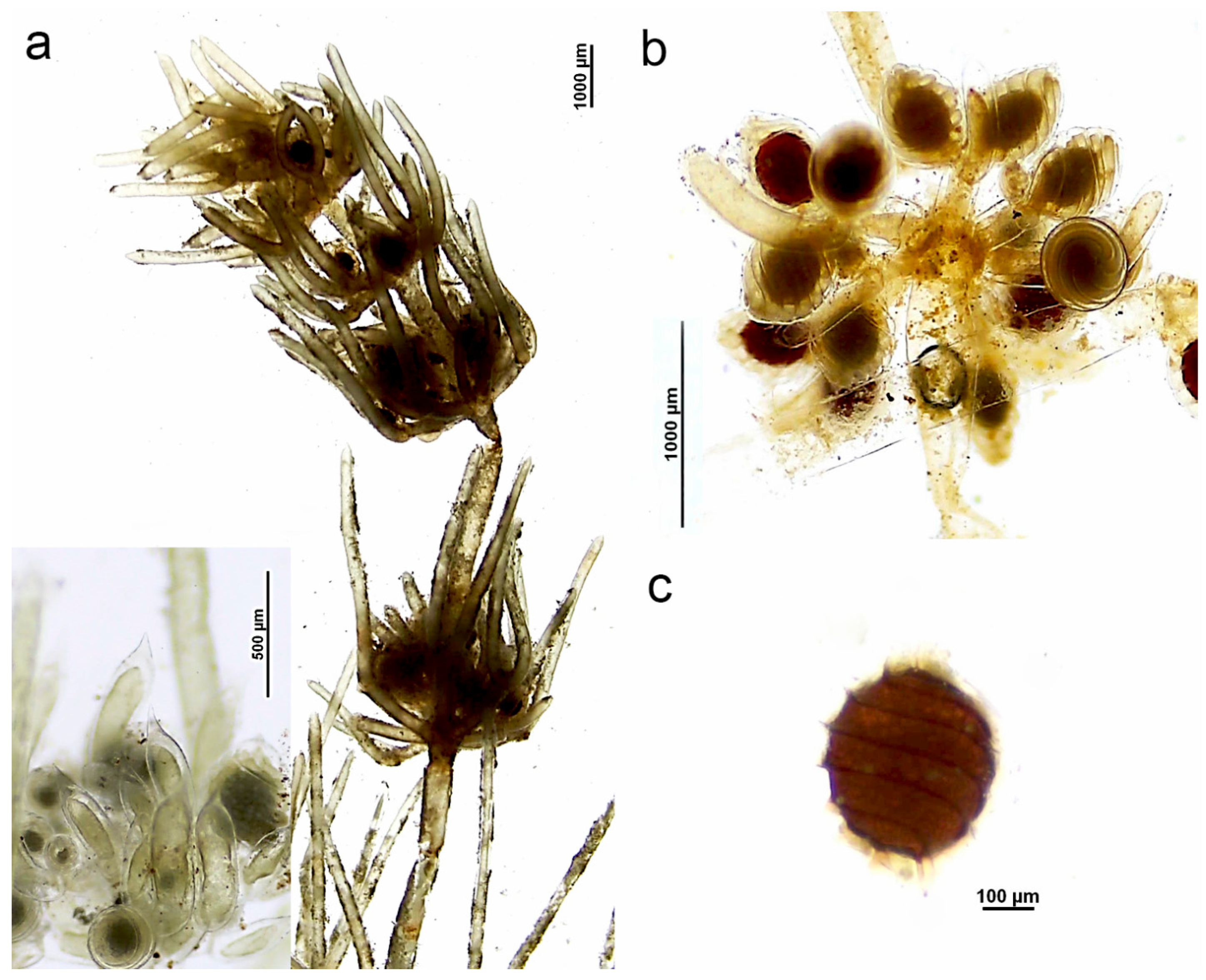
Figure 1. Morphological traits of Nitella capillaris (BEOU 608): (a) female plant top whorls with enlarged section with dactyls, (b) female plant fertile whorl with oogonia, (c) oospore with visible sharply flanged ridges. Photographs by I. Trbojević.
Phycology 05 00085 g001
Figure 2. Morphological traits of Chara papillosa (specimen BEOU 909): (a) tylacanthous cortex on main axis, spine cells in clusters of 2–3, (b) long pointed stipulodes, (c) irregular diplo-triplostichous tylacanthous axial cortex. Photographs by I. Trbojević.
Phycology 05 00085 g002
Figure 3. Morphological traits of Chara squamosa (specimen BEOU 2292): (a) fertile ecorticate branchlets with conjoined gametangia, (b) weakly tylacanthous axial cortex, solitary globular spine cells, and bluntly pointed diplostephanous stipulodes. Photographs by I. Trbojević.
Phycology 05 00085 g003
Figure 4. Morphological traits of Chara strigosa (specimen BEOU 1827): (a) general habit, (b) diplostephanous whorl of stipulodes, having unevenly developed cells in the lower row, and clustered elongated spine cells, (c) tylacanthous triplostichous axial cortex. Photographs by I. Trbojević.
Phycology 05 00085 g004
Figure 5. Morphological traits of Chara strigosa (specimens BEOU 1827 (a,b,d) and 1857 (c)): (a) conjoined gametangia-oogonium and antheridium, (b) ripe oogonium, antheridium fallen, (c) nodal starchless bulbils, (d) Chara aspera-type bulbil. Photographs by I. Trbojević.
Phycology 05 00085 g005
Figure 6. Distribution of charophyte species in B&H: (A) all charophyte sites including only genus records in the context of terrain; (B) all charophyte sites including only genus records in the context of ecoregions; (C) Chara contraria; (D) C. globularis; (E) C. gymnophylla (1–3) and C. gymnophylla or C. squamosa (4, 5); (F) C. aspera (1), C. hispida (2, 3), C. papillosa (4), and C. subspinosa (5). Black figures are records from 1980 onwards, red figures are last records from 1950 to 1979 and yellow figures are last records before 1950. Ecoregions: 1—Pannonian mixed forests, 2—Dinaric Mountains mixed forests, 3—Balkan mixed forests, 4—Illyrian deciduous forests, 5—Tyrrhenian–Adriatic sclerophyllous and mixed forests [73].
Phycology 05 00085 g006
Figure 7. Distribution of charophyte species in B&H in the context of ecoregions: (A) Chara squamosa; (B) C. vulgaris; (C) C. strigosa (1), C. virgata (2), Chara sp. (3); (D) Nitella capillaris (1, 2), N. flexilis (3), and N. mucronata (4); (E) N. syncarpa; (F) N. opaca (1, 2), N. tenuissima (3), Nitella sp. (4, 5), and Nitellopsis obtusa (6). Black figures are records from 1980 onwards, and yellow figures are last record before 1950. Ecoregions: 1—Pannonian mixed forests, 2—Dinaric Mountains mixed forests, 3—Balkan mixed forests, 4—Illyrian deciduous forests, 5—Tyrrhenian–Adriatic sclerophyllous and mixed forests [73].
Phycology 05 00085 g007
Figure 8. Similarity of charophyte floras indicated as number of species common for the compared regions: (a) ecoregions of B&H; (b) B&H and neighbouring countries. Numbers in circles are numbers of charophyte species. See Table 3 and Table 4 for species lists.
Phycology 05 00085 g008
Table 1. The herbaria to which the specimens referred to in this work belong.
InstitutionHerbarium Code
University of Belgrade, Belgrade, SerbiaBEOU
University of Helsinki, Helsinki, FinlandH *
Naturalis Biodiversity Center, Leiden, The NetherlandsL *
Komarov Botanical Institute of RAS, Saint Petersburg, RussiaLE *
Real Jardín Botánico, Madrid, SpainMA *
Zemaljski Muzej Bosne i Hercegovine, Sarajevo, B&HSARA
Herbarium Croaticum, Department of Biology Faculty of Science University of Zagreb, Zagreb, CroatiaZA
Herbarium Ivo and Marija Horvat Department of Biology Faculty of Science University of Zagreb, Zagreb, CroatiaZAHO
Note: * Specimens were checked by R. Romanov; the remaining information was obtained by sending a query.
Table 2. Comparative results of the BEOU Charophyte Collection revision, a critical review of the literature data, and other herbarium data. Symbol “+” represented, symbol “–“ not represented.
TaxaBEOU Charophyte Collection RevisionCritical Review of Literature DataOther Herbarium DataThis Study
Chara aspera Willd.++
Chara contraria A. Braun ex Kütz.++++
Chara globularis Thuill. (C. fragilis auct. non Desv.)++++
Chara gymnophylla (A. Braun) A. Braun++++
Chara hispida L.+++
Chara papillosa Kütz.++
Chara squamosa Desf.++++
Chara strigosa A. Braun+++
Chara subspinosa Rupr.++
Chara virgata Kütz. (C. delicatula C. Agardh)++
Chara vulgaris L.++++
Chara sp.++
Nitella capillaris (Krock.) J. Groves et Bull.-Webst.+++
Nitella flexilis (L.) C. Agardh++
Nitella mucronata (A. Braun) Miq.++
Nitella opaca (C. Agardh ex Bruzelius) C. Agardh++++
Nitella syncarpa (Thuill.) Chev.++++
Nitella tenuissima (Desv.) Kütz.+++
Nitella sp.++
Nitellopsis obtusa (Desv.) J. Groves+++
Total number of species1317920
Table 3. Number of sites of charophyte species and genus records in ecoregions of B&H before 1950/from 1950 to 1979/from 1980 onwards. Symbol “–“ not represented.
Species and Genus RecordsPannonian Mixed ForestsDinaric Mountains Mixed ForestsBalkan Mixed ForestsIllyrian Deciduous ForestsTotal Number of Sites
Chara aspera Willd.–/–/–1/–/––/–/––/–/–1
Chara contraria A. Braun ex Kütz.–/–/2–/–/171/–/––/–/121
Chara globularis Thuill. (C. fragilis auct. non Desv.)–/–/18/–/5–/–/13/–/119
Chara gymnophylla (A. Braun) A. Braun–/–/213/1/–1/–/––/–/–17
Chara hispida L.–/–/–4/–/––/–/–1/–/16
Chara papillosa Kütz.–/–/––/–/1–/–/––/–/–1
Chara squamosa Desf.–/–/61/–/11–/–/––/–/–18
Chara strigosa A. Braun–/–/––/–/2–/–/––/–/–2
Chara subspinosa Rupr.–/–/––/1/––/–/––/–/–1
Chara virgata Kütz. (C. delicatula C. Agardh)–/–/––/–/9–/–/––/–/–9
Chara vulgaris L.–/–/59/2/11–/–/114/–/–40
Chara gymnophylla or C. squamosa–/–/–5/1/–1/–/––/–/–7
Chara sp.–/–/31/–/––/–/––/–/15
Nitella capillaris (Krock.) J. Groves et Bull.-Webst.–/–/–1/–/1–/–/––/–/–2
Nitella flexilis (L.) C. Agardh–/–/–2/–/––/–/–1/–/–3
Nitella mucronata (A. Braun) Miq.–/–/–3/–/––/–/––/–/–3
Nitella opaca (C. Agardh ex Bruzelius) C. Agardh–/–/22/–/2–/–/––/–/–6
Nitella syncarpa (Thuill.) Chev.–/1/–6/–/1–/–/––/–/19
Nitella tenuissima (Desv.) Kütz.–/–/––/–/––/–/––/–/11
Nitella sp.–/–/1–/–/––/–/––/–/12
Nitellopsis obtusa (Desv.) J. Groves–/–/1–/–/2–/–/––/–/14
Total number of species81748
Disclaimer/Publisher’s Note: The statements, opinions and data contained in all publications are solely those of the individual author(s) and contributor(s) and not of MDPI and/or the editor(s). MDPI and/or the editor(s) disclaim responsibility for any injury to people or property resulting from any ideas, methods, instructions or products referred to in the content.