Article

Effect of Turbidity and Intermittent Sediment Deposition on the Photosynthetic Efficiency of Non-Geniculate Crustose Coralline Algae


1
Department of Aquaculture, National Taiwan Ocean University, Keelung City 202, Taiwan
2
Graduate Institute of Hydrological and Oceanic Sciences, National Central University, Taoyuan City 320, Taiwan
3
Graduate Institute of Environmental Engineering, National Central University, Taoyuan City 320, Taiwan
4
Center of Excellence for the Oceans, National Taiwan Ocean University, Keelung City 202, Taiwan
*
Authors to whom correspondence should be addressed.
Phycology 2025, 5(4), 83; https://doi.org/10.3390/phycology5040083
Submission received: 24 October 2025 / Revised: 14 November 2025 / Accepted: 2 December 2025 / Published: 3 December 2025

Abstract

Non-geniculate crustose coralline algae (NCA) are important in algal reef ecosystems, yet their physiological responses to turbidity and sediment burial remain insufficiently understood. We examined how six turbidity levels (0–300 mg L−1) and four sediment deposition depths (0–3 cm) affected two dominant species, Sporolithon sp. and Phymatolithon sp. Under turbidity treatments, for Sporolithon sp., Fv/Fm was lowest at 0 mg L−1 (0.43 ± 0.01) and highest at 250 mg L−1 (0.62 ± 0.01). ETRmax increased markedly under 150 mg L−1 (17.94 ± 0.27) but declined under 300 mg L−1 (5.33 ± 0.19). In Phymatolithon sp., turbidity levels of 150–250 mg L−1 produced consistently higher Fv/Fm values (0.58–0.60) and the lowest ETRmax occurred at 300 mg L−1 (5.71 ± 0.34). Sediment burial caused strong early reductions in photosynthetic performance. In Sporolithon sp., all burial depths except 0 cm caused significant Fv/Fm declines within five days (decrease to 0.46). After 45 days, ETRmax ranged from 9.28 ± 0.38 at 0 cm to 4.02 ± 0.11 at 3 cm, with intermediate values at 1 and 2 cm. Phymatolithon sp. showed rapid declines in Fv/Fm at all depths (1 to 3 cm) before partial recovery after 15–20 days. Overall, moderate turbidity (150–250 mg L−1) provided protective light attenuation, whereas sediment deposition imposed strong early physiological stress. The contrasting responses of the two species highlight different adaptive strategies for surviving low-light and sediment-rich environments.

1. Introduction

Non-geniculate crustose coralline algae (NCA) play a crucial role in the formation of algal reefs through calcification [1]. This process involves the conversion of calcium ions (Ca2+), bicarbonate ions (HCO3), and water (H2O) into calcium carbonate (CaCO3), formaldehyde (CH2O), and oxygen (O2) [2,3]. Calcite crystals (calcium carbonate) are deposited within cell walls of NCA to provide structural integrity and protection against wave action, herbivore grazing, and desiccation [4,5]. The NCA progressively accumulate, layer by layer, to form algal reefs. Algal reefs that reach a certain scale constitute crucial marine ecosystems that support local fish, birds, invertebrates, and other types of algae, as well as acting as substantial sources of primary productivity [6,7].
Algal reefs are found worldwide, primarily in temperate and tropical coastal intertidal and subtidal areas [6,8,9]. Within coral reef ecosystems, NCA are abundant and play a crucial role in seasonal canopy formation, reef cementation, calcium carbonate production, which providing settlement substrates for invertebrate larvae and supporting fish diversity [3,9,10,11,12]. The Taoyuan Algal Reef (TAR) ecosystem, located along Taiwan’s northwestern coast, is recognized as one of the largest intertidal algal reef systems in the world. Extending intermittently for approximately 27 km along the coastline, both living and dead NCA constitute the major structural components of the reef framework [8,13]. The genera Sporolithon, Phymatolithon, and Crustaphytum have been identified as the dominant NCA in the TAR ecosystem [13,14,15,16,17]. Global studies on algal reefs focus mainly on taxonomy, molecular biodiversity, ecological surveys, and interactions between local species [8,13], and they rarely investigate the interactions between NCA and the physical aspects of their environment [17,18,19].
Previous studies have demonstrated that several crucial factors, including temperature, irradiance, light spectrum, and herbivore presence, have a significant impact on the growth and survival of NCA in the wild [4,17,20]. Conversely, although some studies have suggested that NCA habitats often coincide with substantial sediment presence, the effects of turbidity, burial, and sediment deposition on various NCA species are not yet fully understood and require further study [21,22,23]. Turbidity refers to suspended particles of clay or silt and microscopic organisms that contribute to the cloudiness of a fluid, while sediment deposition refers to the settling and accumulation of these particles on the substrate of an aquatic system. Interestingly, multiple field studies have reported that sediment deposition can smother NCA, leading to reduced light availability, impaired gas exchange, tissue bleaching, localized necrosis, and partial thallus mortality; however, this has not yet been conclusively shown under controlled conditions in the lab, particularly in long-term experiments [24,25,26,27].
Among the main threats to which NCA are subject, both global and local, is a substantial potential threat to the TAR ecosystem: the construction of a liquefied natural gas (LNG) processing port in the Datan area. Despite concerns about its ecological implications, especially for the NCA, substantiating evidence for these claims remains elusive. The construction operations involved in the LNG project, which include activities like dredging and excavation, hold the potential to disturb sediments and give rise to turbidity in the nearby marine surroundings [23]. From both marine physical and biological perspectives, sediment not only reduces irradiance but also shifts the spectral composition towards yellow and green wavelengths, which are detrimental to the photosynthesis process [28].
Physiological observations of NCA are challenging to obtain due to their slow growth [1], rendering traditional measurement methods inappropriate. Common techniques like growth weight [29], photopigment production [30], and oxygen production [31] are thus unsuitable [1]. However, there are viable alternatives. Among these, noninvasive and microcosmic assessment methods such as oxygen microsensors and chlorophyll fluorescence measurement show promise. Microsensor-based oxygen concentration measurements offer insights into microenvironmental oxygen dynamics, aiding in estimating metabolic activity and photosynthetic performance [1]. Chlorophyll fluorescence measurement captures light-excited chlorophyll fluorescence, providing data on the photosynthetic potential and physiological status of NCA [27,32]. However, this approach still needs to be validated for these algae [33,34].
The present study aimed to examine the impact of turbidity and sediment deposition on NCA species. We conducted a laboratory experiment using chlorophyll fluorescence to examine the effect of controlled turbidity and sediment conditions on these species. By comparing the results of these experiments, we aimed to gain insights into the relationships between chlorophyll fluorescence and environmental factors, with the aim of contributing to an understanding of the responses of NCA species to environmental changes.

2. Materials and Methods

2.1. Ecological Survey, Algae Collection and Pre-Cultivation

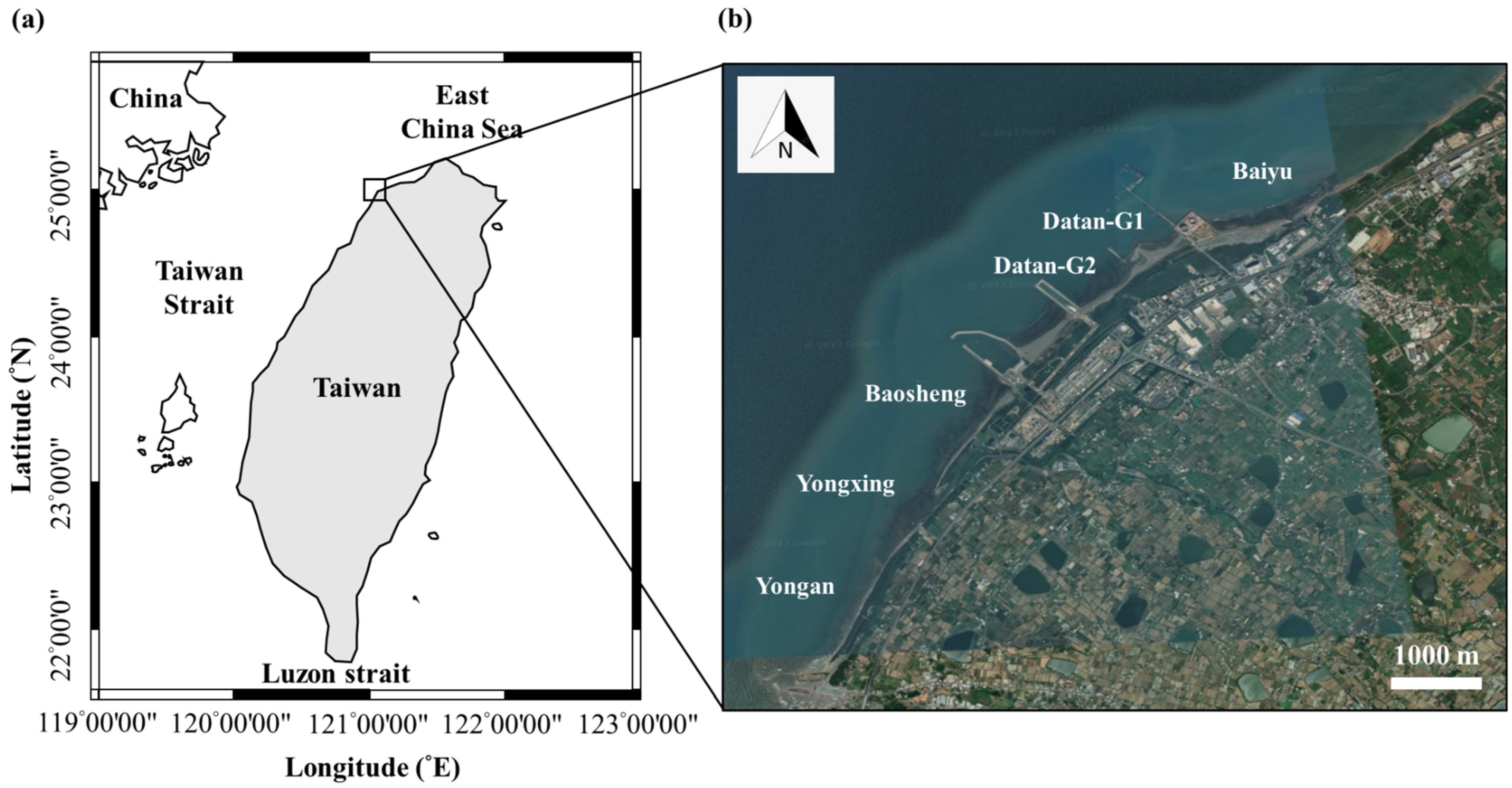
This research was conducted on the TAR coast, which can be divided into six distinct areas from north to south: Baiyu, Datan-G1, Datan-G2, Baosheng, Yongxing, and Yongan. Baiyu is a coastal recreation area. Datan-G1 and Datan-G2, which are situated at the construction site of the LNG port, are classified as industrial zones. Baosheng, Yongxing, and Yongan are designated as wildlife conservation areas where less anthropogenic disturbance occurs (Figure 1).
We conducted seven visits to these areas, which took place during February, March, May, June, July, August, and December of 2022, specifically during a low tide with a minimum tidal range of −160 cm. February and March were considered to be spring; May, June, and July were considered to be summer; August was considered autumn; and December was considered winter.
We used a line transect method with three transects lines established in each area. Three quadrats measuring 50 × 50 cm were placed at predetermined intervals along each transect. Each quadrat was subdivided into 25 smaller quadrats measuring 10 × 10 cm. Photographs were taken using a TG–5 camera (Olympus, Tokyo, Japan) to document the composition of the substrate, as well as the percentage of area covered by Phymatolithon and Sporolithon. Assessment of the percentage of crustose coralline algae coverage was conducted following the method outlined by [35]. The results of these surveys were presented in the Supplementary Materials.
A total of 45 specimens were collected in April 2022, with 15 samples obtained from each of the three low-tide zones at Baiyu (121.0748596, 25.05123329), Datan-G2 (121.0477273, 25.03852282), and Yongan (121.0180969, 24.99941254). Among these, 22 specimens were identified as Phymatolithon sp. and 23 as Sporolithon sp. Specimens were found to be firmly affixed to rocks, pebbles, and reef substrate. The extent of specimen coverage on the substrate was 2–6 cm2. Species were identified through molecular analysis according to a previous study [16]. Samples were stored at room temperature and transported to the laboratory at the National Taiwan Ocean University within three hours of collection. Any visible organisms present on the algal samples were carefully removed using a banister brush and the algae were bathed with autoclaved seawater before further processing. They were then cultured in an indoor fiberglass tank with a capacity of 1.5 m3 supplied with air and continuously filtered seawater (100 L day−1). The samples were exposed to a light intensity of 150 ± 20 μmol photons m−2 s−1, provided by 9 W 900 lumen 6500 K LED white bulbs, in a 12 h light/dark cycle. The intensity of the light was measured using a Lighting Passport (ALP-01, Asensetek, New Taipei City, Taiwan). After a two-week period of culturing, during which the algae exhibited the normal color range (red to purple-red), their physiological condition was assessed by measuring their photosynthetic activity to ensure the samples were healthy and to obtain a baseline measurement (see Section 2.4).

2.2. Analysis of Sediment Composition of the TAR Coast

Two aspects of the culture conditions were tested in two subsequent experiments. The first test focused on turbidity concentration while the second test examined sediment deposition. Two types of sediment were collected from the field for these experiments. The sediments used for the deposition experiments were collected directly from the deposited sediment in the intertidal zone of the study area. The median grain diameter, d50, of the deposited sediment was mostly in the range 200–300 μm. It is difficult to directly obtain a large amount of suspended sediment, even in coastal areas with high concentrations of suspended sediments. The sediment samples used for the turbidity experiment were collected in the adjacent harbor area. Several processes were followed to ensure that the particle size of the sediment was as close as possible to that measured in situ. The samples were first passed through a 0.0425 mm filter, to remove coarse particles, and then mixed with pure water. We waited 3 min to allow the larger particles to settle and then carefully removed the upper layer of fine particles. We chose this period (3 min) based on a pretest of the settling time for the suspended sediments we had collected. We repeated this procedure 5–10 times to make sure most of the very fine particles were removed. We also conducted an in situ measurement of the sizes of suspended particle using a laser diffraction particle size analyzer (LISST-200X, Sequoia, Bellevue, WA, USA), which showed that the d50 of the suspended sediment in the study area was mostly ~50 μm (classified as silt) and sometimes as much as 100 μm (classified as very fine sand) during high tide events. The d50 of the sediment used in the turbidity experiment was 13.86 ± 5.5 μm, which is classified as silt. Although this value is smaller, it is in the same order of magnitude as the values recorded in situ.
We used an X-ray diffractometer (D2 PHASER, Bruker, Billerica, MA, USA) to analyze the mineral composition of the sediment and a microscope (Axioscope 5, Zeiss, Oberkochen, Germany) to investigate the morphological composition of the sediment [36]. The sediments in the study area are composed mainly of quartz and rock fragments, which account for about 95% of the total mass, and a small quantity of carbonates (~5%). We estimated the proportion of organic and inorganic components in the sediments using the loss of ignition method [37]. The results showed that the sediments comprised mainly inorganic substances, which accounted for about 82% of the total mass, and that the remaining ~18% was organic substances. These tests were conducted to improve our understanding of the sediment composition, which influences the habitat conditions for algae.

2.3. Laboratory Experimental Design

All NCA specimens were selected randomly for the experiments. Due to the limited availability of specimens, we used each specimen for multiple experiments. Initially, the turbidity experiment was conducted with two concentrations, which we tested sequentially from low to high. Following each turbidity experiment, the algal specimens were placed back in the preculture tank for two weeks. We evaluated the condition of each specimen based on its normal external coloration and an Fv/Fm value of 0.60–0.65. Only specimens that met these criteria were included in subsequent experiments.
After all turbidity tests had been completed, all specimens were placed back in the preculture tank, and the sediment deposition test was conducted two weeks later. The same physiological assessment was applied before selecting specimens for this experiment as Section 2.3.1. We used a random selection process for the selection of specimens for all experiments. The photosynthetic performance was assessed using the DIVING-PAM-II pulse amplitude modulated fluorescence system, along with WinControl version 3.30 (Heinz Walz, Effeltrich, Germany), to ensure uniformity on the initial day of cultivation. Since the selection of specimens for each experiment was random, the condition of each algal body was assumed to be statistically independent for the purposes of the subsequent statistical analysis.

2.3.1. Experiment 1: Turbidity

Long-term suspended sediment concentration (SSC) monitoring has been conducted since 2019 [38]. The SSC values were in the range 0–500 mg L−1, with averages of 70 mg L−1 and 140 mg L−1 during summer and winter, respectively. Yearly SSC data for the present study period are shown in Figure S1. The SSC was measured using optical backscatter sensors (OBSs) (OBS3+, Campbell Scientific, Logan, UT, USA). The OBSs were carefully calibrated with suspended sediment collected from the field. The range of SSC values for 2022 was similar to that for the current study period. SSC is positively correlated with wave conditions [38,39]. Mean SSC was 14.16 ± 18.07 and 25.24 ± 30.21 mg L−1 at Datan-G2 and Baosheng during summer (June to August) and 101.06 ± 53.55 and 92.88 ± 52.75 mg L−1 during winter (December to February) (mean ± standard error [SE]). This information was used to determine an appropriate range of turbidity concentrations for the experiments.
Organic particles in the experimental seawater were adjusted to match in situ conditions. Suspended particles were first collected from field seawater using a settling method, in which seawater samples were allowed to settle and the settled material was recovered. The filtered seawater used in the experiments was then amended with the collected particles, and the SSC was verified using optical backscatter sensors (OBSs) to ensure that it fell within the in situ range for the corresponding sites and seasons. To prevent water pollution and maintain the integrity of the samples, the collected seawater was promptly transferred to a dark freezer set at −4 °C. The experiments were then conducted within two weeks to ensure the freshness and quality of the seawater, minimize any potential degradation or contamination of the samples, and maintain the reliability and accuracy of the experimental results.
We used a culture system to replicate the dynamic turbid outdoor environment in an indoor setting. This system had a volume of 200 L and was equipped with a vertical pump (TMD-18P, Trundean, Taoyuan City, Taiwan) capable of pulling seawater that was highly turbid with sediment up from below and recirculating it over the algal samples for 3–5 min (Figure S2). To ensure that this approach was feasible, we used a turbidity sensor (OBS3+, Campbell Scientific) for continuous monitoring. Turbidity levels were monitored for a minimum of 30 min prior to the experiments, and the pump’s working frequency was adjusted to maintain turbidity within a deviation of ±10%. The aim of this system and monitoring approach was to mimic the fluctuating turbidity levels and the role of wave activity observed in the TAR area itself, thereby allowing us to test our hypothesis in a controlled environment.
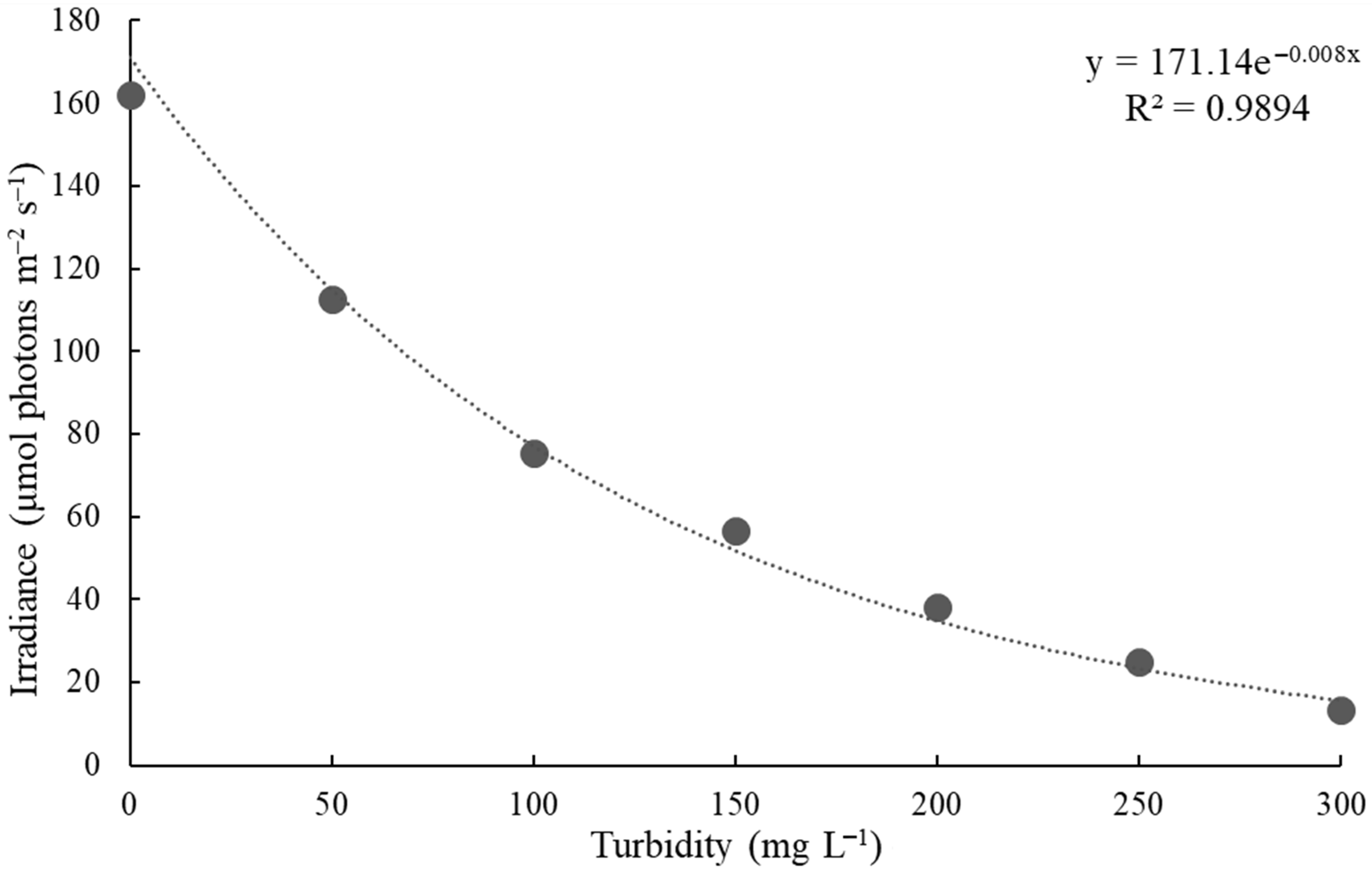
The turbidity experiments were conducted from October to November 2022. Six different turbidity levels were established: 0, 50, 100, 150, 250, and 300 mg L−1. Each turbidity treatment included five specimens each of Phymatolithon sp. and Sporolithon sp. Due to setup limitations, only two treatments could be processed at a time. In the indoor environment where the experiment was conducted, the temperature was maintained at 25 ± 2 °C during the day and 23 ± 2 °C at night. The irradiance levels (mean ± standard error [SE]) corresponding to the turbidity treatments of 0, 50, 100, 150, 200, 250, and 300 mg L−1 were measured as follows: 162.12 ± 1.50 μmol photons m−2 s−1, 112.70 ± 1.92 μmol photons m−2 s−1, 75.19 ± 2.63 μmol photons m−2 s−1, 56.64 ± 1.15 μmol photons m−2 s−1, 38.12 ± 0.59 μmol photons m−2 s−1, 24.91 ± 0.41 μmol photons m−2 s−1, and 13.47 ± 0.74 μmol photons m−2 s−1, respectively. These measurements were obtained using a temperature/light data logger (MX2202, HOBO Pendant, HOBO, Bourne, MA, USA) (Figure 2). The photoperiod was 12 h light/12 h dark. Water salinity was maintained at 35 ± 1 psu (practical salinity units) and measured using a salinity refractometer. Throughout the eight-day culture period, turbidity levels were monitored daily and adjusted as needed using autoclaved seawater and highly turbid seawater. These adjustments ensured that the desired turbidity levels were maintained consistently across the different treatments. Each turbidity treatment included five independent specimens per species, providing five biological replicates for both Phymatolithon sp. and Sporolithon sp. within a single tank system.

2.3.2. Experiment 2: Intermittent Sediment Deposition

This experiment was designed to investigate the effects of sediment deposition on the photosynthesis potential of specimens of the two species and was conducted from December 2022 to January 2023. It involved exposing the specimens to different sediment deposition depths (0, 1, 2, and 3 cm) and observing the impact on their photosynthesis. Each sediment treatment included five specimens each of Phymatolithon sp. and Sporolithon sp., which occupied 2–6 cm2 of the substrate.
We used a transparent plastic box (39 × 28 × 14 cm) as the culture container. The sediment used in the experiment was collected from the low-tide zone of the TAR coast. The procedure involved initially creating a 0.5–1 cm-deep sediment layer as a base layer in the container. The algal samples were then placed on top of this layer and covered with sediment until the desired sediment deposition level was obtained. Autoclaved seawater was then slowly added along the edges of the box until it reached a height of 3 cm below the top of the box.
The experiment was carried out under controlled environmental conditions. The temperature was maintained at 25 ± 1 °C using thermostat equipment (SS-980, Tominaga, Taipei City, Taiwan). The photoperiod was 12 h light/12 h dark. The irradiance level for the sediment deposition treatment at 0 cm was 157.29 ± 1.00 μmol photons m−2 s−1, measured using the same underwater data logger used in the turbidity experiments (MX2202, HOBO), positioned at the same relative horizontal position as the algal specimens. For the 1 cm, 2 cm, and 3 cm sediment deposition treatments the irradiance level was recorded as 0 μmol photons m−2 s−1. The cultivation period was set to 45 days, longer than the 3-day and 15-day durations used by previous studies [40,41], to allow a more comprehensive assessment of sediment deposition effects on NCA. Throughout this cultivation period, the algae were buried every day and cleaned once a day for a short period not exceeding 1 h. After being exposed to light conditions lasting 10–12 h, the algae were taken out and the particles on their surface were brushed off gently, and they were allowed to undergo dark adaptation for 20–30 min in preparation for chlorophyll fluorescence analysis, following the method described by [42]. The samples were then carefully returned to the plastic container. The original sediment was reused to cover the algae, and the depth of the sediment layer was measured using a ruler to confirm that it met the experimental requirements. During the experimental period, the seawater in the culture container was changed every five days to ensure suitable culture conditions for the study. Aeration was provided to maintain air circulation and water quality. As a result, the seawater remained clear and odorless throughout the experiment. Similar to the turbidity experiment, the sediment burial experiment was conducted using a single tank system. Each species was represented by five independent specimens, resulting in five biological replicates for both Phymatolithon sp. and Sporolithon sp.

2.4. Determination of Chlorophyll Fluorescence

Chlorophyll fluorescence measurements were taken daily at 10:00 a.m. using a DIVING-PAM-II fluorometer and the WinControl software Version 3.33 to assess the photosynthetic performance of specimens under different sediment deposition depths. To ensure consistent evaluation under illuminated conditions, measurements were conducted during the light phase of the algal photoperiod. Prior to each measurement, the thalli surfaces were gently cleaned with a soft-bristle brush to remove adhering sediment particles and debris that could interfere with the fluorescence signal. After cleaning, all samples were dark-adapted for 20–30 min before measurements were recorded. These measurements provided data for investigating the following two key parameters [42].
Photosynthesis potential (Fv/Fm): This parameter indicates the maximum quantum efficiency of photosystem II (PSII) and serves as an indicator of the photosynthetic potential of the algae. It is derived by comparing variable fluorescence (Fv) with maximum fluorescence (Fm) under dark-adapted conditions.
Fv/Fm = (Fm − F0)/Fm
where F0 is the initial fluorescence and Fm is the maximal fluorescence.
Maximum electron transport rate (ETRmax): This parameter reflects the maximum rate at which electrons are transported through the photosynthetic electron transport chain. It provides insight into the photosynthetic activity and potential of the algae, indicating their ability to use absorbed light energy for photosynthesis. Maximal fluorescence (Fm) in the samples was reached after a saturating pulse of 912 µmol photons m−2 s−1 was generated for 1 s, and it is calculated as follows:
ETR = PAR × Y(II) × 0.84 × 0.5
where PAR, measured in μmol photons m−2 s−1, is the actinic light (also called quasi-constant light) that is used to drive photosynthesis; Y(II) is the effective quantum yield of PSII; and 0.84 is the ETR factor [43].

2.5. Data Analysis

We aimed to investigate the effects of turbidity and sediment deposition on the photosynthetic parameters Fv/Fm and ETRmax of Sporolithon sp. and Phymatolithon sp. To achieve this, we first tested the data in each group for normality using the Kolmogorov–Smirnov test in IBM SPSS Statistics 22.0 (IBM, New York, USA), and then confirmed that they met the assumption of normal distribution (α > 0.05). Then, we conducted one-way analyses of variance (ANOVAs). In Section 2.3.1, which examined the impact of turbidity, Fv/Fm and ETRmax served as the dependent variables, while turbidity was the independent variable. In Section 2.3.2, sediment deposition was the independent variable, while Fv/Fm and ETRmax served as the dependent variables. These variables were also subjected to one-way ANOVAs, using the same statistical software. When ANOVAs revealed significant differences, Tukey’s honestly significant difference (HSD) test was used to conduct pairwise comparisons of means across treatment conditions. The results of the statistical analyses are presented as means ± standard error (SE). Five replicates of each experiment were conducted, ensuring robustness and reliability in the data collection process. Differences were considered statistically significant at p < 0.05.

3. Results

3.1. Effects of Turbidity on Algae

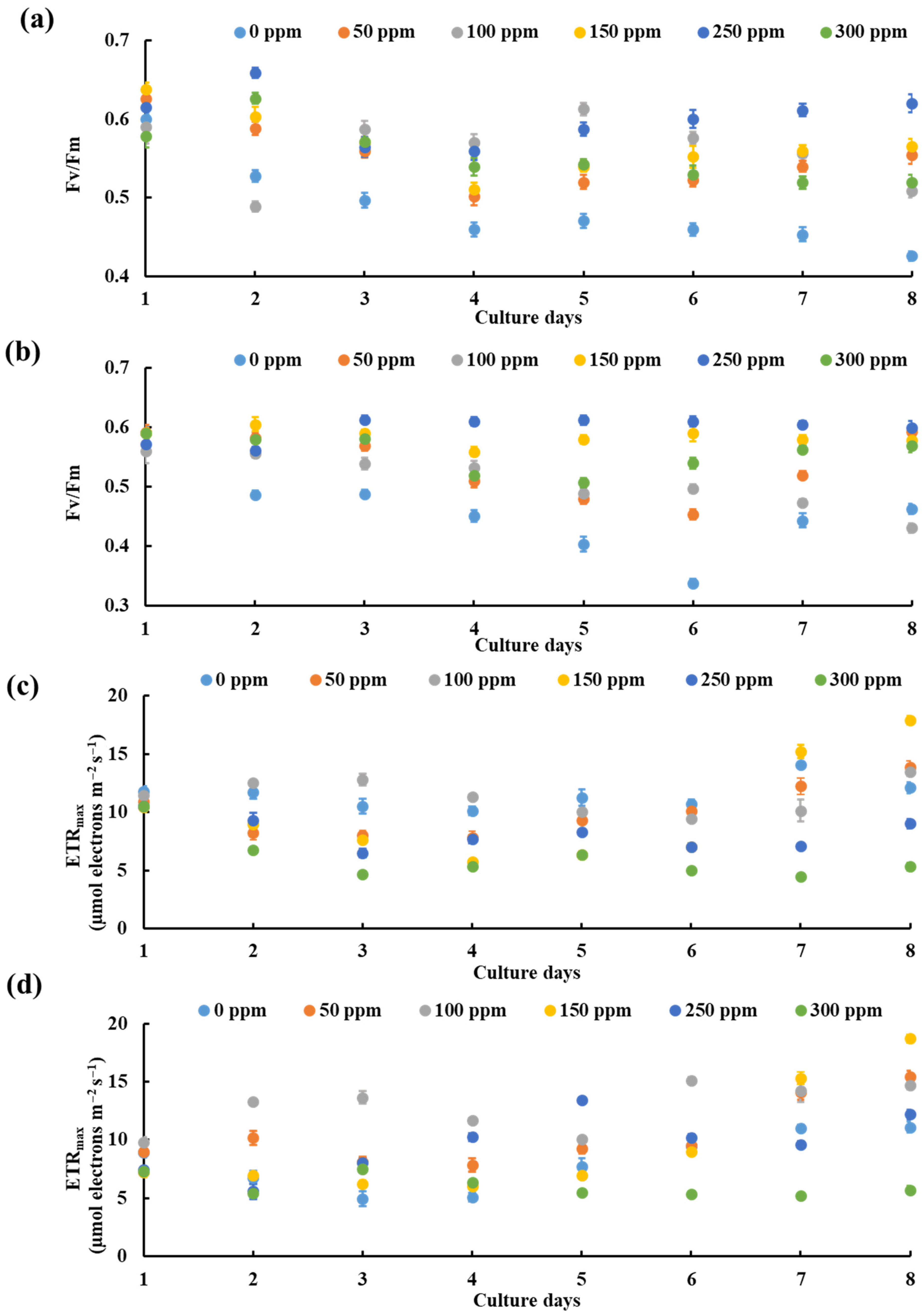
During the eight-day cultivation period, we applied various turbidity treatments and evaluated their effects on Fv/Fm and ETRmax values. For the Sporolithon algae, the treatment with 0 mg L−1 turbidity had the lowest Fv/Fm value, and Fv/Fm declined over time in this treatment (p < 0.05) (Figure 3a). The highest Fv/Fm value was observed for the 250 mg L−1 turbidity treatment (p < 0.05). All treatments exhibited similar ETRmax values before the fifth day of cultivation (p > 0.05), indicating that the ETRmax did not differ significantly between the treatments during the initial period (Figure 3c). However, after five days, the ETRmax value of the 150 mg L−1 turbidity treatment increased sharply and became the highest among all the treatments. Conversely, the 300 mg L−1 turbidity treatment resulted in the lowest ETRmax value.
For the Phymatolithon algae, both the 150 and 250 mg L−1 turbidity treatments produced higher and more stable Fv/Fm values than the other treatments throughout the culture period (Figure 3b). On the eighth day of the culture, the 0 and 100 mg L−1 turbidity treatments produced the lowest Fv/Fm values of all treatments (p < 0.05). At the end of the culture period, the 150 mg L−1 turbidity treatment resulted in the highest ETRmax value, while the 300 mg L−1 turbidity treatment produced the lowest ETRmax value of all treatments (p < 0.05) (Figure 3d).

3.2. Effect of Sediment Deposition on Algae

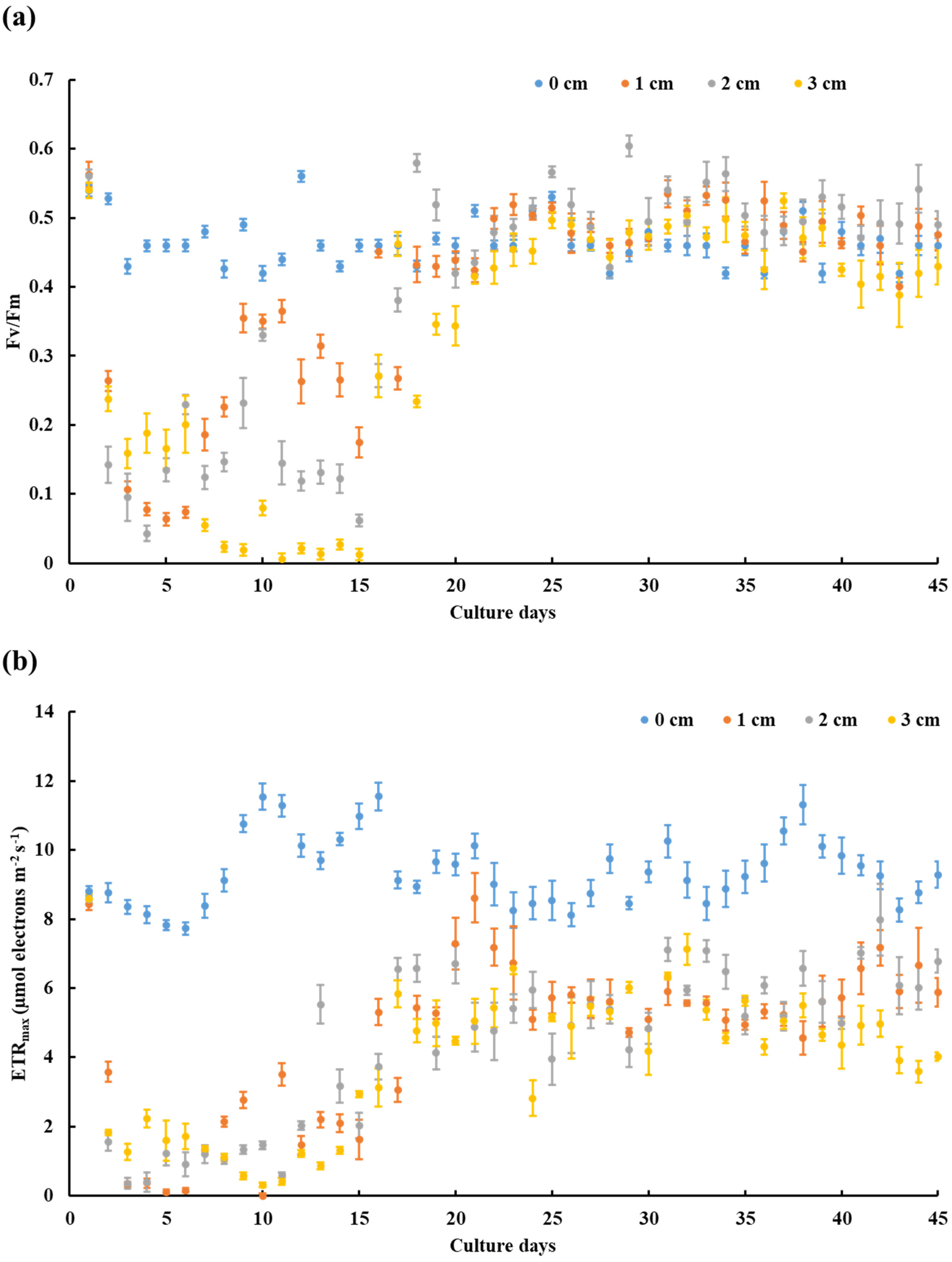
With the exception of the 0 cm sediment deposition treatment, all treatments resulted in a significant decrease in Fv/Fm values in Sporolithon sp. specimens within the first five days of cultivation (p < 0.05) (Figure 4a). From days 5–15, the Fv/Fm values were lower with increasing sediment deposition depth. After 20 days of cultivation, all treatments resulted in similar dynamic Fv/Fm curves, with no significant differences between them (p > 0.05), which suggests that the impact of sediment deposition on Fv/Fm had diminished after this time point. Similarly, the ETRmax values decreased within the first five days of cultivation (p < 0.05), followed by a gradual increase after 10 days of cultivation (Figure 4b). After 45 days of sediment deposition, the photosynthetic performance of NCA showed clear differences between treatments. The 0 cm sediment deposition treatment exhibited the highest ETRmax value (9.28 ± 0.38), whereas the 3 cm treatment showed the lowest value (4.02 ± 0.11) (p < 0.05). Intermediate values were observed under the 1 cm (5.87 ± 0.48) and 2 cm (6.78 ± 0.49) treatments.
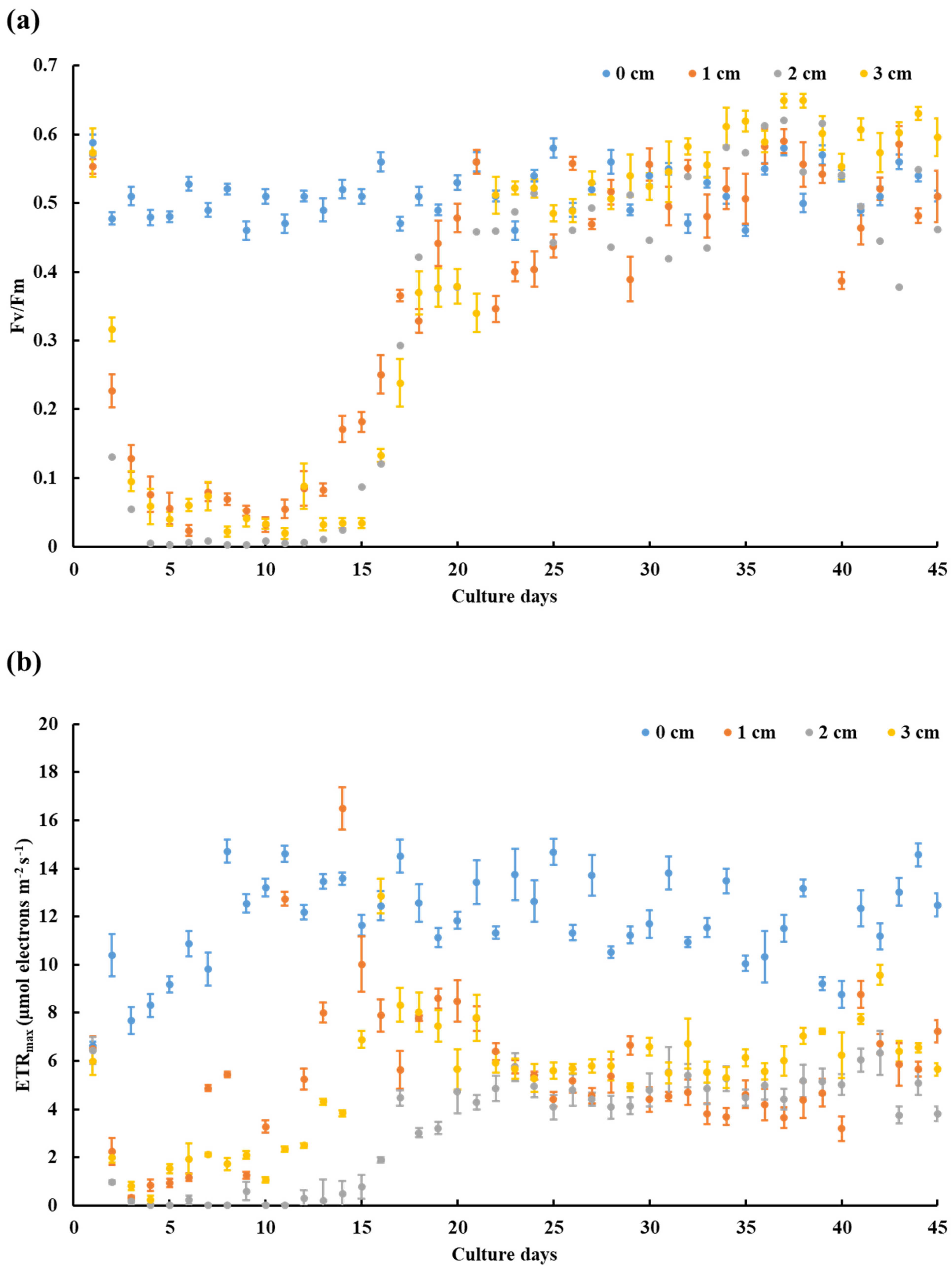
The Phymatolithon sp. specimens similarly displayed two distinct periods. In the first period (days 0–20), all treatments except the 0 cm deposition showed a rapid decline in Fv/Fm within the first five days, reaching values below 0.1. However, after 15 days, there was an increase in Fv/Fm values. Notably, at days 14 and 15 of cultivation, the greater deposition depths resulted in low Fv/Fm values (p < 0.05) (Figure 5a). This suggests that the presence of sediment with different deposition depths had a negative impact on the photosynthetic potential of the Phymatolithon sp. specimens during this period. In the second period, which started after 20 days of cultivation, Fv/Fm did not differ significantly between treatments (p > 0.05). This suggests that the impact of sediment deposition on the photosynthetic potential of the Phymatolithon sp. specimens had diminished after this point. When comparing the ETRmax values, it is evident that the 20-day cultivation period also had a significant impact (Figure 5b). During the initial 20-day phase, ETRmax values for all treatments except the 0 cm deposition declined rapidly. Thereafter, greater deposition depths resulted in lower ETRmax values. This pattern was apparent across all treatments at days 14 and 15 of cultivation (p < 0.05), but after 20 days of cultivation, ETRmax values declined gradually. By the end of the experiment, the 0 cm deposition treatment exhibited significantly higher ETRmax values than the other treatments (p < 0.05). This indicates that the absence of sediment deposition (0 cm deposition depth) positively influenced the maximum electron transport rate in Phymatolithon sp. specimens.

4. Discussion

4.1. Turbidity

Physical stress may affect the distribution and abundance of benthic macroalgae [44]. This study assessed algal physiology through chlorophyll fluorescence to evaluate the effects of turbidity and sediment burial on photosynthetic performance. An interesting finding that emerged from the turbidity investigation was that treatments with turbidity concentrations of 150–300 mg L−1 produced higher Fv/Fm values than the 0 mg L−1 turbidity treatment. This suggests that an appropriate level of turbidity can protect the photosynthesis performance of both Phymatolithon and Sporolithon species. The influence of turbidity on these algal species is likely related to the impact of turbidity on light intensity [45]. The actual irradiance results in this turbidity research ranged from 13 to 162 μmol photons m−2 s−1, while light intensity in the sediment deposition experiment varied from 0 to 157 μmol photons m−2 s−1 (Figure 2). Our findings indicated the absence of photoinhibition under the examined irradiance levels. A previous study on NCA suggested a photoinhibition threshold of 200 μmol photons m−2 s−1 and identified the optimal irradiance condition as 50 μmol photons m−2 s−1 for Hydrolithon reinboldii, Neogoniolithon fosliei, and Porolithon onkodes [27]. The results of the present study confirmed that Phymatolithon sp. and Sporolithon sp. could function normally at irradiances up to 162 μmol photons m−2 s−1. However, for conditions with turbidity ranging of 150–250 mg L−1, an irradiance of 25–38 μmol photons m−2 s−1 was found to be appropriate. In addition, increased turbidity causes a spectral shift in underwater light, reducing short-wavelength (blue) irradiance while relatively enhancing green to red wavelengths. Such red-shifted light spectra, together with decreased irradiance intensity, may protect photosystem II from photoinhibition and favor the light-harvesting efficiency of phycobiliproteins in red algae [46,47].
Sediment size has been identified as one of the factors that may affect the photosynthetic yield of NCA. Specifically, sediment particles smaller than 63 µm have a significantly greater impact than those in the range of 63–250 µm [27]. In this study, the mean sediment particle size was approximately 13.86 µm, which is smaller than in previous research but appears to have a relatively minor impact on the experimental samples used in this study. Independent of interspecies differences, fine-grained silt with a specific size range of particle sizes may obstruct the surface of NCA, leading to reduced gas exchange and nutrient supply [48,49]. Importantly, because very fine silt particles can easily become resuspended, their direct impact on NCA may be reduced. This may explain why the effect of sediment size on the NCA used in this study was limited. Notably, the resuspension potential of particulate matter also depends on its inherent properties, such as the ratio of silt, clay, and sand, which influence particle cohesiveness and settling behavior [50]. Therefore, future studies should simultaneously analyze sediment composition to evaluate how its resuspension characteristics influence the responses of NCA.
The above discussion supports the hypothesis that both species have relatively low irradiance requirements, and the shading caused by turbidity aids in their photosynthesis. This suggests that these algal species may have adapted to thrive under conditions where light penetration is reduced due to the presence of suspended particles, which, in turn, has implications for their ecological niche and distribution patterns. Additionally, these results support a previous hypothesis that light availability plays a crucial role in shaping the distribution of NCA [51]. Indeed, sediment does not manifest acute toxicity towards NCA; however, it does adversely affect the settlement of NCA spores [4]. This is primarily attributed to the fine nature of the sediment, which does not offer an optimal substrate for spore settlement, resulting in reduced coverage and abundance of NCA over an extended timeframe [4]. In essence, while this study illustrated that sediment may not directly impact existing Phymatolithon sp. and Sporolithon sp. individuals, uncertainty remains regarding their future coverage and abundance.
Members of the laboratory of one of the co-authors of this study, Dr. Zhi-Cheng Huang, conducted an analysis of the turbidity levels on the TAR coast during the LNG port building project (Supplementary Figure S1). Based on the experimental results of the present study, the turbidity concentrations on the TAR coast were deemed harmless and it is even thought that they may maintain the photosynthetic potential of the two target NCA species. The recovery of photosynthesis capacity in NCA subjected to sedimentation treatments is not a recent discovery; it has previously been observed in H. reinboldii and N. fosliei, with a relatively rapid recovery period of just 3.5 days. However, it is worth noting that in the case of P. onkodes, the recovery was limited to approximately 80% [27]. In comparison, the Sporolithon sp. and Phymatolithon sp. specimens used in this study typically required an average of 16 and 20 days, respectively, to achieve a recovery to 100% of the control. It is important to emphasize that the capacity for recovery appears to be highly dependent on the NCA species involved. In this study, the turbidity and sediment burial experiments were conducted for 8 days and 45 days, respectively. We assumed that the experimental thalli had acclimated to the altered external environment during these periods, leading to the observed variations in photosynthetic parameters. Therefore, our results can partially reflect the physiological responses of NCA under prolonged exposure in natural algal reef environments. Nevertheless, we agree that in situ measurements in the field are still necessary to validate the physiological responses observed under controlled laboratory conditions and to better capture the effects of chronic, long-term turbidity and sediment stress in coastal ecosystems.
This research addressed significant gaps in our understanding of the impact of turbidity on NCA species. The findings suggested that an appropriate level of turbidity can maintain the photosynthetic potential of Phymatolithon and Sporolithon species, possibly due to their adaptation to reduced light penetration. However, further research is required to validate these observations and to gain a deeper understanding of the complex relationship between turbidity, light availability, and algal growth. Additionally, it is essential to continue surveys of ecological and marine physical factors not only during and after the LNG port building project but also in the future. This ongoing monitoring will help to ensure the stability of local biodiversity and environmental sustainability.

4.2. Sediment Deposition

With the exception of the treatments in which no sediments were added, the sediment deposition treatments resulted in a rapid decrease in Fv/Fm values during the first five days of cultivation. Previous research also showed that a thin sediment layer may negatively affect primary production in a Lithothamnion sp. within 24 h of treatment [19]. However, the Fv/Fm values gradually increased after day 15 and ultimately reached similar values to those of the no-deposition treatment. It is worth noting that Sporolithon exhibited greater fluctuations than Phymatolithon exhibited significant fluctuations in Fv/Fm values in the 1 cm and 2 cm sediment deposition treatments during the first 15 days of the experiment. This indicates that Phymatolithon has a higher tolerance of sediment deposition conditions than Sporolithon and retains better photosynthetic potential.
Interestingly, excluding the 0 cm deposition control group, both types of algae exhibited their highest peak at a burial depth of 1 cm. Additionally, the peak of Phymatolithon occurred on day 14 of the experiment, while that of Sporolithon occurred on day 22. This difference may be related to the time it takes for the stored energy in the algae to be depleted. Based on the Fv/Fm and ETRmax results, Phymatolithon adjusts its photosynthetic conversion potential to adapt to sudden burial conditions, while Sporolithon maintains a relatively stable photosynthetic potential when buried, thus meeting its electron transfer requirements under limited light conditions. After 15 days of the experiment, both species gradually adapted to the changes in their environment and their Fv/Fm returned to normal levels. For Phymatolithon, burial may act as a stimulus for its photosynthetic potential, making it more likely to thrive in areas with high sedimentation (Figures S3 and S4).
The physiological basis underlying the contrasting responses of Phymatolithon and Sporolithon to sediment burial likely involves differences in light-use efficiency, energy storage, and pigment stability. Under such environmental stress, Phymatolithon may temporarily enhance photosynthetic electron transport and utilize stored carbon reserves to compensate for sudden light limitation, as indicated by its short-term increases in Fv/Fm and ETRmax. Conversely, Sporolithon appears to adopt a tolerance-oriented strategy, maintaining stable photochemical efficiency under prolonged burial, possibly due to higher pigment stability and a more conservative energy-use pattern. These findings regarding sediment deposition align with previous research [13,52] and provide further evidence that NCA species have different environmental tolerances and compositions due to their differing abilities to tolerate and adapt to sediment deposition [13,52]. It should be noted that these physiological interpretations are inferred from fluorescence responses rather than directly measured biochemical or structural parameters. Further studies integrating physiological and ultrastructural analyses are required to confirm the mechanisms underlying these responses.
This study showed that sediment deposition did not have a significant impact on the photosynthetic potential of either Sporolithon sp. or Phymatolithon sp. over the 1.5-month study period. However, it could be that the daily clearing of sediment from the specimens’ surfaces allowed time for them to exchange gases and recover briefly before being buried again. Despite this caveat, our findings suggest that at least over this timeframe, these algae were able to maintain their photosynthetic capabilities in spite of the presence of sediment. These findings are consistent with previous research that investigated the survival of a NCA species (Neorhodomela larix) buried in sand [53]. That study demonstrated that even when subjected to a deposition of 15 cm of fine sand for three months, this alga was able to survive. We observed similar functioning in NCA species, and out study has provided more precise observations by using chlorophyll fluorescence.
It is worth noting that the TAR study area features fluctuating intertidal zones. Thus, sedimentation in this area is likely to be transient, with sediment deposition being a temporary phenomenon. Since NCA is a group with a global distribution, the physiological characteristics and impact on the two species observed in this study can serve as a valuable reference for other locations worldwide. Notably, recent research has already shown a negative correlation between the production of calcium carbonate in NCA and coral and the proximity of these NCA and coral to ports, which is a factor that should be explored further [20]. While the precise reasons behind this correlation remain unclear, it represents important evidence that environmental factors, combined with anthropogenic activities, are currently having complex effects on marine ecology.
Balancing energy and environmental concerns has long been a challenging issue faced by countries and experts worldwide [54]. The survival risk for NCA during the LNG port construction period on the TAR coast remains unknown. However, this study suggests that the range of turbidity and sediment deposition conditions tested represent survivable conditions for both Sporolithon and Phymatolithon spp., which exhibit different mechanisms for adapting to variations in turbidity and sediment deposition.

5. Conclusions

This study used laboratory experiments to confirm that both turbidity and sediment deposition have an impact on the dominant calcareous algae, Sporolithon and Phymatolithon, in the local environment of the TAR. An optimal concentration of turbidity (150–250 mg L−1) was found to benefit the overall photosynthetic potential of the algae. The investigated species in the genera Sporolithon and Phymatolithon exhibited different adaptive mechanisms in response to the stress of sediment deposition, particularly in their photosynthetic systems. This is likely a key factor contributing to the differences in their distribution. This increased understanding of specific environmental conditions could serve as a basis for formulating protective policies to support algal reef ecology.

Supplementary Materials

The following supporting information can be downloaded from https://www.mdpi.com/article/10.3390/phycology5040083/s1: Figure S1. Suspended sediment concentration (SSC) for the year in which the present study was conducted; Figure S2. The culture facility of this study; Figure S3. The substrate composition of the low intertidal zone at (a) Baiyu, (b) Datan-G1, (c) Datan-G2, (d) Baosheng, (e) Yongxing, and (f) Yongan on the Taoyuan Algal Reef; Figure S4. Benthic cover of the two NCA species used in this study.

Author Contributions

H.-Y.Y.: Methodology, Visualization, and Writing—original draft. Y.-J.C.: Methodology, Visualization. P.-C.L.: Methodology, Visualization. J.W.-S.: Methodology, Visualization. F.-H.N.: Methodology. Z.-C.H.: Conceptualization, Methodology. M.-C.L.: Data curation, writing—review & editing, Supervision. All authors have read and agreed to the published version of the manuscript.

Funding

This research was financially supported by the National Science and Technology Council research grants (NSTC 112-2811-M-019-006, NSTC 112-2611-M-019-013, NSTC 112-2621-M-008-004); the Office of Coast Administration Construction, Taoyuan (No. 110100325 and No. 1100131547); and CPC Corporation, Taiwan (LHF1100005).

Institutional Review Board Statement

Not applicable.

Informed Consent Statement

Not applicable.

Data Availability Statement

The authors declare that the data supporting the findings of this study are available within the paper and its Supplementary Information files. Any additional raw data files needed in another format can be obtained from the corresponding author upon reasonable request.

Acknowledgments

The authors are grateful to the members of the laboratory teams led by Fan-Hua Nan, Meng-Chou Lee, and Zhi-Cheng Huang for their contributions, which were instrumental in facilitating this research.

Conflicts of Interest

The authors declare no conflicts of interest.

References

  1. Baek, J.-W.; Lee, J.S.; Kim, S.-H.; Lee, T.; Jung, S.W.; Lee, W.-C.; Kim, K.-T.; An, S.-U. Effects of Irradiance and Temperature on the Photosynthesis of the Crustose Coralline Algae Pneophyllum fragile (Corallinales, Rhodophyta) in the Coastal Waters of Korea. J. Mar. Sci. Eng. 2022, 10, 851. [Google Scholar] [CrossRef]
  2. Martin, S.; Charnoz, A.; Gattuso, J.-P. Photosynthesis, respiration and calcification in the Mediterranean crustose coralline alga Lithophyllum cabiochae (Corallinales, Rhodophyta). Eur. J. Phycol. 2013, 48, 163–172. [Google Scholar] [CrossRef]
  3. Cornwall, C.E.; Carlot, J.; Branson, O.; Courtney, T.A.; Harvey, B.P.; Perry, C.T.; Andersson, A.J.; Diaz-Pulido, G.; Johnson, M.D.; Kennedy, E.; et al. Crustose coralline algae can contribute more than corals to coral reef carbonate production. Commun. Earth Environ. 2023, 4, 105. [Google Scholar] [CrossRef]
  4. Fabricius, K.; De’ath, G. Environmental factors associated with the spatial distribution of crustose coralline algae on the Great Barrier Reef. Coral Reefs 2001, 19, 303–309. [Google Scholar] [CrossRef]
  5. Steneck, R.S. The ecology of coralline algal crusts: Convergent Patterns and Adaptative Strategies. Annu. Rev. Ecol. Syst. 1986, 17, 273–303. [Google Scholar] [CrossRef]
  6. Ballesteros, E. Mediterranean coralligenous assemblages: A synthesis of present knowledge. Oceanogr. Mar. Biol. 2006, 44, 123–195. [Google Scholar]
  7. Vermeij, M.; Dailer, M.; Smith, C. Crustose coralline algae can suppress macroalgal growth and recruitment on Hawaiian coral reefs. Mar. Ecol. Prog. Ser. 2011, 422, 1–7. [Google Scholar] [CrossRef]
  8. Liou, C.-Y.; Yang, S.-Y.; Chen, C.A. Unprecedented calcareous algal reefs in northern Taiwan merit high conservation priority. Coral Reefs 2017, 36, 1253. [Google Scholar] [CrossRef]
  9. Tebbett, S.B.; Crisp, S.K.; Evans, R.D.; Fulton, C.J.; Pessarrodona, A.; Wernberg, T.; Wilson, S.K.; Bellwood, D.R. On the Challenges of Identifying Benthic Dominance on Anthropocene Coral Reefs. BioScience 2023, 73, 220–228. [Google Scholar] [CrossRef] [PubMed]
  10. Doll, P.C.; Uthicke, S.; Caballes, C.F.; Diaz-Pulido, G.; Abdul Wahab, M.A.; Lang, B.J.; Jeong, S.Y.; Pratchett, M.S. Settlement cue selectivity by larvae of the destructive crown-of-thorns starfish. Biol. Lett. 2023, 19, 20220399. [Google Scholar] [CrossRef] [PubMed]
  11. Abdul Wahab, M.A.; Ferguson, S.; Snekkevik, V.K.; McCutchan, G.; Jeong, S.; Severati, A.; Randall, C.J.; Negri, A.P.; Diaz-Pulido, G. Hierarchical settlement behaviours of coral larvae to common coralline algae. Sci. Rep. 2023, 13, 5795. [Google Scholar] [CrossRef]
  12. Heard, J.; Tung, W.-C.; Pei, Y.-D.; Lin, T.-H.; Lin, C.-H.; Akamatsu, T.; Wen, C.K.C. Coastal development threatens Datan area supporting greatest fish diversity at Taoyuan Algal Reef, northwestern Taiwan. Aquat. Conserv. Mar. Freshw. Ecosyst. 2021, 31, 590–604. [Google Scholar] [CrossRef]
  13. Zhan, S.H.; Chen, L.; Liao, C.-P.; Chang, W.-R.; Li, C.-C.; Tang, G.-Y.; Liou, C.-Y.; Wang, W.-L.; Wang, S.-W.; Liu, S.-L. Geographic distance, sedimentation, and substrate shape cryptic crustose coralline algal assemblages in the world’s largest subtropical intertidal algal reef. Mol. Ecol. 2022, 31, 3056–3071. [Google Scholar] [CrossRef]
  14. Liu, L.-C.; Lin, S.-M. Systematic revision of the non-geniculate coralline genus Phymatolithon (Hapalidiales, Rhodophyta) from Taiwan, including three new species. Phycologia 2023, 62, 561–573. [Google Scholar] [CrossRef]
  15. Liu, L.-C.; Lin, S.-M.; Lim, P.-E. Species diversity and molecular phylogeny of Crustaphytum and Mesophyllum (Hapalidiales, Rhodophyta) from the Asian Pacific, including three new species of Crustaphytum. Phycologia 2023, 62, 608–618. [Google Scholar] [CrossRef]
  16. Liu, L.-C.; Lin, S.-M.; Caragnano, A.; Payri, C. Species diversity and molecular phylogeny of non-geniculate coralline algae (Corallinophycidae, Rhodophyta) from Taoyuan algal reefs in northern Taiwan, including Crustaphytum gen. nov. and three new species. J. Appl. Phycol. 2018, 30, 3455–3469. [Google Scholar] [CrossRef]
  17. Lai, C.-F.; Nazir, A.; Liu, T.-Y.; Tseng, Y.-C.; Iizuka, Y.; Shiao, J.-C. Growth Rate in Cultured Crustose Coralline Algae of the Genus Phymatolithon and Sporolithon From Taiwan. Mar. Ecol. 2024, 45, e12839. [Google Scholar] [CrossRef]
  18. Sissini, M.N.; Koerich, G.; de Barros-Barreto, M.B.; Coutinho, L.M.; Gomes, F.P.; Oliveira, W.; Costa, I.O.; de Castro Nunes, J.M.; Henriques, M.C.; Vieira-Pinto, T.; et al. Diversity, distribution, and environmental drivers of coralline red algae: The major reef builders in the Southwestern Atlantic. Coral Reefs 2022, 41, 711–725. [Google Scholar] [CrossRef]
  19. Riul, P.; Targino, C.H.; Farias, J.D.N.; Visscher, P.T.; Horta, P.A. Decrease in Lithothamnion sp. (Rhodophyta) primary production due to the deposition of a thin sediment layer. J. Mar. Biol. Assoc. 2008, 88, 17–19. [Google Scholar] [CrossRef]
  20. Goh, T.Z.Y.; Bauman, A.G.; Januchowski-Hartley, F.A.; Morgan, K.M.; Seah, J.C.L.; Todd, P.A. Growth and carbonate production of crustose coralline algae on a degraded turbid reef system. Mar. Pollut. Bull. 2021, 173, 113135. [Google Scholar] [CrossRef]
  21. Balata, D.; Piazzi, L.; Cecchi, E.; Cinelli, F. Variability of Mediterranean coralligenous assemblages subject to local variation in sediment deposition. Mar. Environ. Res. 2005, 60, 403–421. [Google Scholar] [CrossRef] [PubMed]
  22. Cocito, S.; Bedulli, D.; Sgorbini, S.S. Distribution patterns of the sublittoral epibenthic assemblages on a rocky shoal in the Ligurian Sea (NW Meditteranean). Sci. Mar. 2002, 66, 175–181. [Google Scholar] [CrossRef]
  23. Bessell-Browne, P.; Negri, A.P.; Fisher, R.; Clode, P.L.; Jones, R. Impacts of light limitation on corals and crustose coralline algae. Sci. Rep. 2017, 7, 11553. [Google Scholar] [CrossRef]
  24. Tâmega, F.T.S.; Figueiredo, M.A.O. Colonization, Growth and Productivity of Crustose Coralline Algae in Sunlit Reefs in the Atlantic Southernmost Coral Reef. Front. Mar. Sci. 2019, 6, 81. [Google Scholar] [CrossRef]
  25. Steneck, R.S. Crustose corallines, other algal functional groups, herbivores and sediments: Complex interactions along reef productivity gradients. In Proceedings of the 8th International Coral Reef Symposium, Balboa, Panama, 24–29 June 1997; STRI: Balboa, Panama, 1997. [Google Scholar]
  26. Kendrick, G.A. Recruitment of coralline crusts and filamentous turf algae in the Galapagos archipelago: Effect of simulated scour, erosion and accretion. J. Exp. Mar. Biol. Ecol. 1991, 147, 47–63. [Google Scholar] [CrossRef]
  27. Harrington, L.; Fabricius, K.; Eaglesham, G.; Negri, A. Synergistic effects of diuron and sedimentation on photosynthesis and survival of crustose coralline algae. Mar. Pollut. Bull. 2005, 51, 415–427. [Google Scholar] [CrossRef] [PubMed]
  28. Jones, R.; Bessell-Browne, P.; Fisher, R.; Klonowski, W.; Slivkoff, M. Assessing the impacts of sediments from dredging on corals. Mar. Pollut. Bull. 2016, 102, 9–29. [Google Scholar] [CrossRef] [PubMed]
  29. Bonomi Barufi, J.; Lopez Figueroa, F.; Plastino, E. Effects of light quality on reproduction, growth and pigment content of Gracilaria birdiae (Rhodophyta: Gracilariales). Sci. Mar. 2015, 79, 15–24. [Google Scholar] [CrossRef]
  30. Bennett, A.; Bogorad, L. Complementary chromatic adaptation in a filamentous blue-green alga. J. Cell Biol. 1973, 58, 419–435. [Google Scholar] [CrossRef]
  31. Zou, D. Effects of elevated atmospheric CO2 on growth, photosynthesis and nitrogen metabolism in the economic brown seaweed, Hizikia fusiforme (Sargassaceae, Phaeophyta). Aquaculture 2005, 250, 726–735. [Google Scholar] [CrossRef]
  32. Ricardo, G.F.; Harper, C.E.; Negri, A.P.; Luter, H.M.; Abdul Wahab, M.A.; Jones, R.J. Impacts of water quality on Acropora coral settlement: The relative importance of substrate quality and light. Sci. Total Environ. 2021, 777, 146079. [Google Scholar] [CrossRef]
  33. Green, L.A.; Neefus, C.D. Effects of temperature, light level, and photoperiod on the physiology of Porphyra umbilicalis Kützing from the Northwest Atlantic, a candidate for aquaculture. J. Appl. Phycol. 2016, 28, 1815–1826. [Google Scholar] [CrossRef]
  34. Zavafer, A.; Labeeuw, L.; Mancilla, C. Global Trends of Usage of Chlorophyll Fluorescence and Projections for the Next Decade. Plant Phenomics 2020, 2020, 6293145. [Google Scholar] [CrossRef]
  35. Saito, Y.A.S. Phytosociological study of intertidal marine algae: I. Usujiri Benten-Jima, Hokkaido. Bull. Fac. Fish. Hakkaido Univ. 1970, 21, 37–69. [Google Scholar]
  36. Kuo, L.-W.; Wu, W.-J.; Kuo, C.-W.; Smith, S.A.F.; Lin, W.-T.; Wu, W.-H.; Huang, Y.-H. Frictional strength and fluidization of water-saturated kaolinite gouges at seismic slip velocities. J. Struct. Geol. 2021, 150, 104419. [Google Scholar] [CrossRef]
  37. Santisteban, J.I.; Mediavilla, R.; Lopez-Pamo, E.; Dabrio, C.J.; Zapata, M.B.R.; García, M.J.G.; Castaño, S.; Martínez-Alfaro, P.E. Loss on ignition: A qualitative or quantitative method for organic matter and carbonate mineral content in sediments? J. Paleolimnol. 2004, 32, 287–299. [Google Scholar] [CrossRef]
  38. Ly, T.N.; Huang, Z.-C. Real-time and long-term monitoring of waves and suspended sediment concentrations over an intertidal algal reef. Environ. Monit. Assess. 2022, 194, 839. [Google Scholar] [CrossRef] [PubMed]
  39. Pomeroy, A.W.M.; Lowe, R.J.; Ghisalberti, M.; Winter, G.; Storlazzi, C.; Cuttler, M. Spatial Variability of Sediment Transport Processes Over Intratidal and Subtidal Timescales Within a Fringing Coral Reef System. J. Geophys. Res. Earth Surf. 2018, 123, 1013–1034. [Google Scholar] [CrossRef]
  40. Puccini, A.; Kaleb, S.; Ceccherelli, G.; Porrelli, D.; Stipcich, P.; Falace, A. An ex-situ approach for cultivating coralline algae in a restoration perspective. Mar. Biol. 2025, 172, 180. [Google Scholar] [CrossRef]
  41. Villas-Boas, A.; Tâmega, F.; Andrade, M.; Coutinho, R.; Figueiredo, M. Experimental Effects of Sediment Burial and Light Attenuation on Two Coralline Algae of a Deep Water Rhodolith Bed in Rio de Janeiro, Brazil. Cryptogam. Algol. 2014, 35, 67–76. [Google Scholar] [CrossRef]
  42. Yeh, H.-Y.; Wang, W.-L.; Nan, F.-H.; Lee, M.-C. Enhanced Colaconema formosanum biomass and phycoerythrin yield after manipulating inorganic carbon, irradiance, and photoperiod. Bioresour. Technol. 2022, 352, 127073. [Google Scholar] [CrossRef]
  43. Yue, F.; Gao, G.; Ma, J.; Wu, H.; Li, X.; Xu, J. Future CO2-induced seawater acidification mediates the physiological performance of a green alga Ulva linza in different photoperiods. PeerJ 2019, 7, e7048. [Google Scholar] [CrossRef]
  44. Paine, R.T.R. Benthic macroalgal competition: Complications and consequences. J. Phycol. 1990, 26, 12–17. [Google Scholar] [CrossRef]
  45. Brown, R.T. Relationships between suspended solids, turbidity, light attenuation, and algal productivity. Lake Reserv. Manag. 1984, 1, 198–205. [Google Scholar] [CrossRef]
  46. Vásquez-Elizondo, R.M.; Enríquez, S. Light Absorption in Coralline Algae (Rhodophyta): A Morphological and Functional Approach to Understanding Species Distribution in a Coral Reef Lagoon. Front. Mar. Sci. 2017, 4, 297. [Google Scholar] [CrossRef]
  47. Song, H.; Mehdi, S.R.; Li, Z.; Wang, M.; Wu, C.; Venediktov, V.Y.; Huang, H. Investigating the rate of turbidity impact on underwater spectral reflectance detection. Front. Mar. Sci. 2023, 10, 1031869. [Google Scholar] [CrossRef]
  48. Kookana, R.S.; Baskaran, S.; Naidu, R. Pesticide fate and behaviour in Australian soils in relation to contamination and management of soil and water: A review. Soil Res. 1998, 36, 715–764. [Google Scholar] [CrossRef]
  49. Lobban, C.S.; Harrison, P.J. Seaweed Ecology and Physiology; Cambridge University Press: Cambridge, UK, 1994. [Google Scholar]
  50. Seelen, E.A.; Massey, G.M.; Mason, R.P. Role of Sediment Resuspension on Estuarine Suspended Particulate Mercury Dynamics. Environ. Sci. Technol. 2018, 52, 7736–7744. [Google Scholar] [CrossRef]
  51. McCoy, S.J.; Kamenos, N.A. Coralline algae (Rhodophyta) in a changing world: Integrating ecological, physiological, and geochemical responses to global change. J. Phycol. 2015, 51, 6–24. [Google Scholar] [CrossRef]
  52. Airoldi, L. The effects of sedimentation on rocky coast assemblages. Oceanogr. Mar. Biol. 2003, 41, 169–171. [Google Scholar]
  53. D’Antonio, C. Role of sand in the domination of hard substrata by the intertidal alga Rhodomela larix. Mar. Ecol. Prog. Ser. 1986, 27, 263–275. [Google Scholar] [CrossRef]
  54. Tamburino, L.; Bravo, G. Reconciling a positive ecological balance with human development: A quantitative assessment. Ecol. Indic. 2021, 129, 107973. [Google Scholar] [CrossRef]
Figure 1. Location of the study area in northwestern Taiwan, indicated by the square in (a), which is enlarged to show the Taoyuan Algal Reef in (b). Research for this study was conducted at Baiyu, Datan-G1, Datan-G2, Baosheng, Yongxing, and Yongan.
Phycology 05 00083 g001
Figure 2. The relationship between turbidity and irradiance.
Phycology 05 00083 g002
Figure 3. The effect of turbidity (0, 50, 100, 150, 250, and 300 mg L−1) on the photosynthetic potential (Fv/Fm), and the maximum electron transport rate (ETRmax) of Sporolithon sp. specimens (a,c) and Phymatolithon sp. specimens (b,d) after eight days of cultivation in a laboratory system. All experiments were replicated five times, and data are presented as mean ± standard error.
Phycology 05 00083 g003
Figure 4. The effect of sediment deposition depths of 0 cm (blue line), 1 cm (orange line), 2 cm (grey line), and 3 cm (yellow line) on photosynthetic potential (Fv/Fm) (a) and the maximum electron transport rate (ETRmax) (b) of Sporolithon sp. specimens after 45 days of cultivation in a laboratory system. All experiments were replicated five times, and data are presented as mean ± standard errors.
Phycology 05 00083 g004
Figure 5. The effect of sediment deposition depths 0 cm (blue line), 1 cm (orange line), 2 cm (grey line), and 3 cm (yellow line) on photosynthesis potential (Fv/Fm) (a), and the maximum electron transport rate (ETRmax) (b) of Phymatolithon sp. specimens after 45 days of cultivation in a laboratory system. All experiments were replicated five times, and data are presented as mean ± standard error.
Phycology 05 00083 g005
Disclaimer/Publisher’s Note: The statements, opinions and data contained in all publications are solely those of the individual author(s) and contributor(s) and not of MDPI and/or the editor(s). MDPI and/or the editor(s) disclaim responsibility for any injury to people or property resulting from any ideas, methods, instructions or products referred to in the content.