

Systematic Review

Genome-Wide Association Studies on Litter Size in Sheep: A Systematic Review and Gene Prioritization Analysis

1
Shandong Provincial Key Laboratory for Livestock Germplasm Innovation & Utilization, College of Animal Science and Technology, Shandong Agricultural University, Tai’an 271018, China
2
Key Laboratory of Efficient Utilization of Non-Grain Feed Resources (Co-Construction by Ministry and Province), Ministry of Agriculture and Rural Affairs, College of Animal Science and Technology, Shandong Agricultural University, Tai’an 271018, China
3
Tai’an Animal Husbandry and Veterinary Service Center, Tai’an 271018, China
*
Author to whom correspondence should be addressed.
These authors contributed equally to this work.
Ruminants 2026, 6(2), 36; https://doi.org/10.3390/ruminants6020036

Submission received: 8 April 2026 / Revised: 25 May 2026 / Accepted: 26 May 2026 / Published: 27 May 2026

Simple Summary

Sheep are economically important animals raised worldwide for meat and wool, and how many lambs a ewe gives birth to at one time greatly affects farm profitability. Improving this trait through selective breeding is a major goal for farmers and scientists alike, but it is challenging because the number of offspring a ewe produces is influenced by many genes working together and by the environment. In this study, we systematically reviewed 24 scientific studies that scanned the complete genetic information of sheep from 98 different breeds across nine countries to find the specific genes responsible for litter size. After collecting and standardizing data from over 7600 sheep, we identified 316 genes potentially linked to litter size and used a sophisticated ranking tool to narrow these down to 96 high-priority genes, 10 of which we consider most critical. These 10 core genes work through four biological systems: brain signaling that controls reproductive hormones, follicle development and hormone communication. Our findings provide a clearer genetic roadmap for sheep litter size and offer breeders a set of reliable gene targets to develop more precise and efficient breeding tools, ultimately supporting greater livestock productivity to meet growing global food demands.

Abstract

Sheep litter size is of major economic importance, yet its polygenic nature and low heritability limit the effectiveness of traditional selection methods. Following PRISMA guidelines, this systematic review integrated genome-wide association study (GWAS) evidence for sheep litter size and prioritized candidate genes. Four databases were searched, yielding 24 eligible studies comprising a total effective analytical sample of 7618 animals from 98 breeds/populations across nine countries. Following standardized re-annotation of genomic coordinates, 245 significant variations and 316 candidate genes were extracted. Gene prioritization using ToppGene identified 96 high-priority genes, including 10 core genes: GRIN2A, DLG2, FLT4, ESR2, AMH, ALK, INHBB, NF1, CAMK2D, and ERCC2. These genes collectively operate through four functional axes: the gonadal axis regulation, follicular development, hormonal signal transduction, and DNA damage repair. Functional enrichment analysis revealed significant involvement in protein binding and metal ion binding. Marked breed-specificity was observed, with only the BMPR1B (FecB) locus replicated across three studies. Key limitations include restriction to English-language publications, small median sample sizes in the included studies, and the inherent bias of ToppGene training genes toward previously reported loci. These findings clarify the molecular genetic architecture of sheep litter size and provide a validated candidate gene framework to support precision genomic breeding strategies.

1. Introduction

As a globally important livestock species, sheep reproductive efficiency—particularly litter size and ovulation rate—directly determines the economic returns of meat and wool production and represents one of the core objectives of genetic improvement [1]. Several interrelated but biologically distinct reproductive traits are routinely studied in sheep, including litter size, ovulation rate, prolificacy, fertility, and lambing rate. These traits are not biologically identical and may involve partially distinct genetic architectures: for example, ovulation rate is a primary determinant of litter size but is regulated partly by different loci (e.g., BMPR1B, BMP15, GDF9 acting on ovarian folliculogenesis), whereas fertility and lambing rate additionally capture implantation success and prenatal survival, which involve placentation and maternal immune tolerance genes. This review focuses specifically on litter size and the directly associated traits (twinning rate, lambing rate) as defined by the original GWAS studies, while acknowledging their biological inter-relationships. With the continued rise in global protein demand, the urgency of enhancing sheep reproductive performance through genetic means has intensified. However, litter size, as a quantitative trait jointly influenced by multiple genes, environmental factors, and their interactions, exhibits relatively low heritability—published estimates typically range from h2 = 0.05 to 0.19 across breeds [2,3,4,5,6]—both because litter size can only be measured after ewes reach reproductive maturity and complete one or more parities and because repeated measurements across parities are required to improve phenotypic accuracy, thus resulting in an inability meet the precision requirements of modern breeding [7,8]. Therefore, elucidating the molecular basis governing genetic variation in litter size is a critical prerequisite for achieving efficient marker-assisted selection (MAS) and genomic selection (GS).
Over the past two decades, several landmark studies have established the molecular genetic foundation of high prolificacy in sheep. The Booroola (FecB) locus was mapped to the BMPR1B gene: a specific missense mutation (Q249R amino acid substitution) in this gene is significantly associated with elevated ovulation rates in Booroola Merino ewes, representing the first gene mutation marker directly linked to high prolificacy [9]. Mutations in the oocyte-secreted factors GDF9 and BMP15 exhibit a “dosage-sensitive” effect—heterozygous carriers show increased ovulation rate, while homozygous individuals are sterile, characterized by the concurrent elevation of ovulation rate and homozygous sterility—which has been validated in multiple breeds, revealing the central role of oocyte-derived factors in folliculogenesis [10]. Notably, multiple FecX alleles in BMP15 have been identified across European breeds (including FecXR, FecXGR, and FecXRA), underscoring the allelic diversity of this locus across populations [11,12,13]. Together, these classical genes and markers established a biological framework whereby sheep reproductive traits are regulated by the TGF-β/BMP signaling axis, providing a functional reference for subsequent GWAS investigations [14,15].
Genome-wide association studies (GWASs) systematically scan single-nucleotide polymorphism (SNP) markers across the entire genome for trait associations. They have become a powerful tool for dissecting the genetic architecture of polygenic traits [16,17]. However, the application of GWASs to livestock populations entails well-recognized limitations that are particularly salient in sheep: (1) sample sizes in most published sheep GWASs are small (typically 100–800 animals), substantially reducing the statistical power to detect loci of small-to-moderate effect; (2) breed-specific population structure and varying degrees of linkage disequilibrium (LD) across breeds mean that significant loci identified in one breed frequently fail to replicate in others; (3) population stratification, if inadequately controlled, can inflate false-positive rates; (4) the low replication rate across studies suggests that many reported loci may be false positives or highly population-specific; and (5) the use of heterogeneous SNP array platforms and reference genome versions complicates cross-study integration. These limitations must be borne in mind when interpreting the candidate gene pool assembled in this review. Despite these constraints, multiple studies have successfully mapped significant quantitative trait loci (QTL) and candidate genes associated with litter size in diverse sheep breeds [1]. For example, in Lori-Bakhtiari sheep, LHCGR was identified as a novel candidate gene involved in ovarian steroidogenesis and ovulation rate, while the well-known prolificacy genes BMPR1B, BMP15, and GDF9 showed no significant association in this breed, corroborating genetic heterogeneity among breeds [18]. In Polish Mountain sheep, a SNP near EPHA6 reached genome-wide significance, potentially influencing embryonic development through MAPK/ERK and Slit-Robo signaling pathways [7]. In Iranian Baluchi sheep, NTRK2 was confirmed as a novel candidate gene, with its gene product playing a key role in follicle assembly, early follicular growth, and oocyte survival [19]. Multi-breed and cross-population GWASs and meta-analyses have further revealed the polygenic nature and breed-specific characteristics of litter size [1,20].
Beyond SNPs, copy number variations (CNVs) are also recognized as an important class of genetic variation influencing complex traits in sheep [21]. Genome-wide CNV detection studies in global sheep populations have identified CNV regions (CNVRs) and overlapping functional genes associated with litter size across breeds such as Wadi, Hu, and Icelandic sheep, including genes such as NOS3 and FILIP1 [21]. Comparative genome-wide CNV analyses of Tibetan sheep and White Suffolk sheep further indicated that CTNNB1 within CNVRs is associated with traits including energy metabolism, seasonal reproduction, and litter size via the thyroid hormone signaling pathway [22]. Additionally, runs of homozygosity (ROH) analyses have revealed that inbreeding-associated regions may also influence litter size through reduced heterozygosity at key reproductive loci, providing a complementary perspective to SNP-based GWASs [23,24].
Despite the substantial body of research available, several challenges persist. Significant variations identified across different studies often lack cross-breed validation, and the extent to which these results can be applied in various breeding applications warrants further evaluation [1,20]. Furthermore, functional validation of most candidate genes remains lacking, leaving their precise roles in reproductive biology poorly understood. A synthesis of accumulated evidence via systematic review and meta-analysis is thus critically warranted to pinpoint the most credible candidates and elucidate their functional significance. The rationale for integrating evidence from all types of variations into a unified candidate-gene framework is that these different classes of genomic variation are complementary: SNPs capture common single-base substitutions, CNVs reflect copy-number dosage effects, ROH capture autozygous segments enriched by selection or inbreeding, and SVs detect large-scale rearrangements. Individually, each signal type has distinct false-positive profiles and population specificity. By pooling candidates derived from all variant types and subjecting them to a common prioritization framework (ToppGene), we aimed to identify genes consistently implicated across multiple forms of evidence while acknowledging that this integration also risks compounding false-positive rates from heterogeneous methodologies.
Despite a growing body of GWAS evidence, no prior study has systematically integrated multi-breed GWAS findings on sheep litter size using standardized genomic re-annotation and gene prioritization methods. Accordingly, this review systematically synthesizes recent GWAS findings on sheep litter size. We summarize the significant genetic markers and genomic regions validated across diverse sheep populations and identify and prioritize candidate genes using uniform criteria. We further perform functional annotation and pathway enrichment analysis to elucidate the underlying biological mechanisms and provide a theoretical basis for precision molecular breeding strategies. This review addresses the identified gap by applying ToppGene prioritization to a unified candidate gene list re-annotated to a common reference genome (ARS-UI_Ramb_v2.0), enabling cross-study comparisons that were previously not possible.

2. Materials and Methods

2.1. Search Strategy and Source Selection

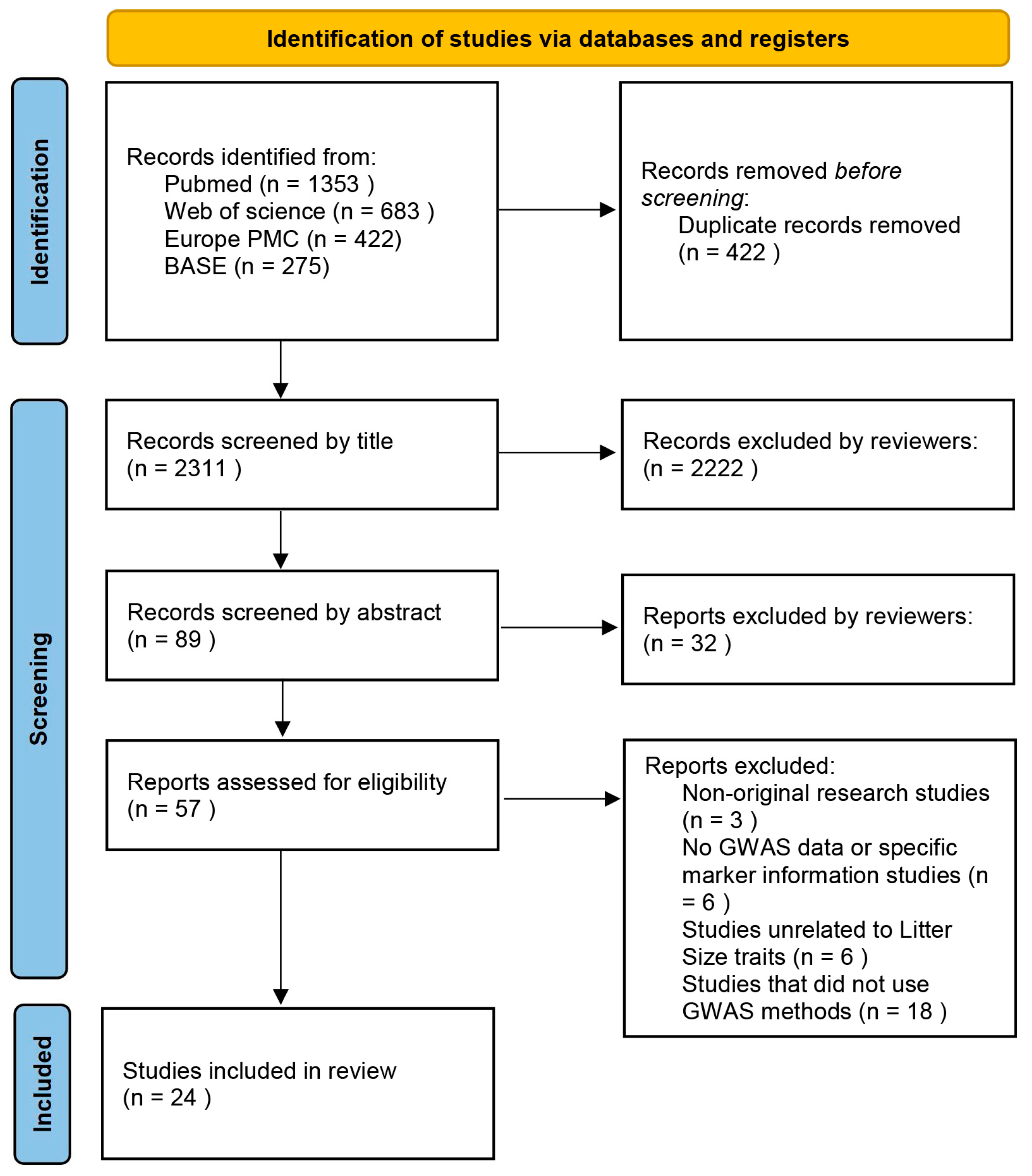
Compliance with the PRISMA reporting guidelines (Table S1) [25] underpinned the entire review process, which was conducted according to a pre-registered protocol and is summarized in Figure 1. The relevant literature was retrieved through comprehensive searches of both online academic databases and conference proceedings, encompassing NCBI-PubMed, Web of Science, Europe PMC, and the Bielefeld Academic Search Engine (BASE), from database inception to 31 August 2025, restricted to publications in English.
The NCBI-PubMed database was queried using “((sheep OR ovine OR ewe)) AND ((litter size OR prolificacy OR prolific OR fecundity OR hyperprolific OR lambing rate OR lambing percentage OR multiple birth OR twinning OR ovulation rate OR ovarian activity OR fertility OR reproductive trait OR reproductive performance)) AND ((genome-wide association OR GWAS OR genomic selection OR genetic marker OR SNP OR single nucleotide polymorphism OR QTL OR quantitative trait loc OR candidate gene OR polymorphism)) AND (“1 January 1900” [Date—Publication]: “31 August 2025” [Date—Publication])”. This search returned 1353 candidate records.
The Web of Science database was queried using: “TS=((sheep OR ovine OR ewe*) AND ((“litter size” OR prolificacy OR prolific OR fecundity OR hyperprolific* OR “lambing rate” OR “lambing percentage” OR “multiple birth*” OR twinning OR “ovulation rate” OR “ovarian activity” OR fertility OR “reproductive trait*” OR “reproductive performance”) AND ((“genome-wide association” OR GWAS OR “genomic selection” OR “genetic marker*” OR SNP* OR “single nucleotide polymorphism*” OR QTL OR “quantitative trait loc*” OR “candidate gene*” OR polymorphism*))))”, with publication dates ranging from 1 January 1900 to 31 August 2025. This search returned 683 candidate records.
The Europe PMC database was queried using “((sheep OR ovine OR ewe)) AND ((litter size OR prolificacy OR prolific OR fecundity OR hyperprolific OR lambing rate OR lambing percentage OR multiple birth OR twinning OR ovulation rate OR ovarian activity OR fertility OR reproductive trait OR reproductive performance)) AND ((genome-wide association OR GWAS OR genomic selection OR genetic marker OR SNP OR single nucleotide polymorphism OR QTL OR quantitative trait loc OR candidate gene OR polymorphism))”, with publication dates ranging from 1 January 1900 to 31 August 2025. This search returned 422 candidate records.
The Bielefeld Academic Search Engine (BASE) database was queried using “(“sheep” OR “ovine” OR “ewe”) AND (“litter size” OR “lambing rate” OR “lambing percentage” OR “multiple birth” OR “twinning” OR “reproductive performance”) AND (“genome-wide association” OR “GWAS” OR “genomic selection”)”, with additional word forms and publication dates ranging from 1 January 1900 to 31 August 2025. This search returned 275 candidate records.

2.2. Literature Inclusion and Screening Procedure

Zhao Rui, Chen Siqi, and Jiao Qingjie independently screened each abstract. Abstract screening was conducted according to the following criteria (Table 1): (1) original research articles; (2) the focal species must be sheep; (3) the study must report mutation loci identified by GWAS (e.g., SNPs, indels, copy number variations, or haplotypes) or candidate genes; (4) the study must focus on litter size or related traits. During full-text review, articles were excluded if they (1) did not employ GWAS methodology or (2) did not define phenotypes encompassing traits related to litter size. Any discrepancies in abstract or full-text inclusion among the three reviewers (Zhao Rui, Chen Siqi, and Jiao Qingjie) were resolved through discussion. Reference lists of all included studies were manually checked to locate any additional relevant publications. For each eligible full-text article, key information was recorded in a standardized Microsoft Excel table. Three reviewers carried out this process independently, with each person blinded to the others’ results at the initial stage. The completed records were then compared across reviewers, and any disagreements were discussed; unresolved conflicts were referred to a fourth reviewer (Chao Tianle) for a final decision.

2.3. Assessment of Study Rigor and Potential Bias

Quality assessment of included GWAS studies was performed using a structured eight-domain scoring framework (Table 2) encompassing (1) Population Structure Control, (2) Sample Size Adequacy, (3) Phenotype Definition and Measurement, (4) Genotyping Platform and Coverage, (5) Quality Control Procedures, (6) Multiple Testing Correction, (7) Replication and Validation, and (8) Reference Genome Version. Each domain was scored independently by two reviewers. Domain scores were summed into a total quality score; studies achieving a total score ≥8 points were classified as high quality, and those scoring <8 points were classified as low quality. Following evaluation, 23 of the 24 included publications met high-quality criteria; only one met low-quality criteria (Table S2). Importantly, the single low-quality study did not provide specific locus information sufficient for re-annotation under our criteria and therefore did not contribute genes to the final 316-gene candidate list. Excluding this study from downstream analyses did not materially change the candidate gene pool, strengthening confidence in the robustness of our results.

2.4. Variant Re-Annotation and Candidate Gene Extraction

For studies providing specific variant locus information, we defined a gene-centric window of ±100 kb flanking each variant coordinate—a window size consistent with reported linkage disequilibrium (LD) decay patterns in sheep, where LD typically extends 50–200 kb in outbred populations [17,24,26,27], and aligning with common practice in livestock GWAS gene annotation studies. We acknowledge that this window size may introduce false positives in regions of high gene density, noted as a limitation, and the LiftOver of the Ruminant Genome Database (RGD) was applied for data conversion to the reference genome assembly ARS-UI_Ramb_v2.0 [28]. For studies that did not explicitly specify a reference genome version, candidate genes were extracted using the Ensembl bioinformatics database with reference genome version v114 Ramb_v2.0. Given that 23 of the 24 included publications met high-quality criteria, all extracted candidate genes were classified as highly reliable.

2.5. Gene Prioritization Analysis

The Sheep Quantitative Trait Loci database (Sheep QTLdb) [29] was searched using the following keyword: “offspring number”. Genes that meet the requirements are classified as “training genes”. The candidate genes obtained from the studies included in this review were used as “test genes”.
ToppGene [30] was used for gene prioritization analysis with default parameters. ToppGene computes a composite prioritization score that integrates functional similarity between test genes and training genes across multiple evidence dimensions: Gene Ontology (GO) annotations (molecular function, biological process, cellular component), human and mouse phenotype data (from OMIM, MGI, and ORPHANET), pathway information (KEGG, Reactome, BioCarta), PubMed co-citation, transcription factor binding sites, microRNA associations, and disease association data. The score reflects the overall functional similarity of each test gene to the training gene set; higher-scoring test genes are predicted to be more biologically relevant to the trait of interest. However, a key limitation—circularity—must be explicitly acknowledged: because training genes were derived from Sheep QTLdb, which itself is populated from previously published studies on sheep reproductive traits, test genes that share functional annotations with well-characterized loci (e.g., in the TGF-β/BMP pathway) may be ranked higher not because of novel biological evidence but because of shared annotations with known genes. Genes overlapping between candidate and training sets were removed prior to analysis (37 genes removed), which partially mitigates but does not eliminate this circularity. Readers should therefore interpret the prioritization scores as reflecting consistency with prior knowledge rather than independent validation. Prior to analysis, genes overlapping between the “test genes” and “training genes” were removed. Specifically, the stepwise procedure was as follows: (i) A total of 316 candidate genes were obtained after removal of duplicate results from all 24 included studies. (ii) Then, 51 training genes from Sheep QTLdb were identified. (iii) The 37 genes overlapping between candidate and training gene sets were removed, leaving 279 test genes. (iv) ToppGene computed a composite prioritization score integrating Gene Ontology (GO) annotations for molecular function (MF), biological process (BP), and cellular component (CC); human and mouse phenotype data; pathway information; PubMed literature; transcription factor binding sites; microRNA; and disease association data. (v) Calculating the false discovery rate (FDR) based on the overall p-value [31], 96 high-priority genes were filtered using a threshold of FDR ≤ 0.05. (vi) The top 10% of these high-priority genes were designated core genes based on ranking by ToppGene score.

2.6. Gene Functional Enrichment Analysis

GO term and KEGG pathway enrichment analyses were performed using DAVID v2025_2 (31 December 2025) [32], with a threshold of FDR < 0.05.

3. Results

3.1. Systematic Review

This review evaluated 2311 studies, of which 2222 were excluded following title screening, leaving 89 records. Of these, 32 were excluded following abstract review. Among the remaining 57 studies, three were excluded as non-original research, two because no GWAS data source could be identified, two because no specific genomic position information for any genetic marker was provided, two because no significant markers were identified for total ewe reproductive performance traits, six because they did not investigate litter size-related traits in sheep, and 18 because they did not employ a GWAS strategy. Ultimately, 24 studies were preliminarily confirmed for inclusion (Table 3 and Table S2). The specific inclusion and exclusion process is shown in the Figure 1. Inclusion studies originated predominantly from nine countries; China contributed the most (12 studies, 50.0%), followed by Iran (four studies, 16.7%). Experimental animals encompassed 98 breeds/populations, with a total of 7618 samples included.
Among the 24 included studies (Table S2), 19 employed SNP array platforms for genotyping, four used whole-genome sequencing strategies, and one used the simplified genome sequencing technology SLAF-seq. Twenty-three studies conducted association analyses between SNPs and litter size and related phenotypes, of which 22 explicitly specified call rate and minor allele frequency (MAF) thresholds, 23 specified methods for multiple testing correction, and 17 established Hardy–Weinberg equilibrium (HWE) thresholds. Only two studies used CNVs as association markers (of which, one used a combined CNV and SNP approach), two used combined ROH and SNP markers, and one used combined SV and SNP markers. With respect to reference genome versions used for annotation of variant sites, two studies used ARS-UI_Ramb_v2.0, 12 used Oar v4.0, seven used Oar v3.1, one used Oar v2.0, one used Ovis aries v1.0, and one study did not specify a reference genome version.

3.2. Variant Re-Annotation and Candidate Gene Extraction

Quality assessment showed that the studies included in the research exhibited heterogeneity in methodological rigor. Among them, 23 studies met high-quality criteria, while the remaining one met low-quality criteria, potentially exhibiting notable methodological limitations (Table S2).
Among the 23 high-quality studies, 19 provided sufficiently detailed locus information for extraction. Based on Ramb_v2.0, a total of 245 variations (Table S3) were successfully converted, including 229 SNPs and 16 CNVs. Among them, all 16 CNVs were significantly associated only in one breed, while 128 SNPs were significantly associated only in one breed, and another 101 SNPs were significantly associated in at least two breeds (Table S3). It is worth noting that almost all loci showed significant associations in only one GWAS study, with only the FECB locus (chr6: 30050621) showing significant associations in three studies. The corresponding genomic windows (Table S4) based on variations were successfully extracted.

3.3. Gene Prioritization Analysis Results

Following extraction and removal of duplicate results, 316 candidate genes associated with sheep litter size were obtained from the included literature. Fifty-one annotated genes from litter size-related QTL regions in sheep were retrieved from the Sheep QTLdb (Table S5) and classified as “training genes” for further use in ToppGene prioritization analysis as a training set. After removing overlapping genes between the 316 candidate genes and the training genes, the 279 remaining genes were classified as “test genes” for prioritization analysis. FDR values were calculated based on the overall p-values from ToppGene, and 96 high-priority genes were selected for subsequent analysis using a threshold of FDR ≤ 0.05 (Table S6). Among all high-priority genes, the top 10% (10 genes) were in the top 5% and were identified as core genes: GRIN2A, DLG2, FLT4, ESR2, AMH, ALK, INHBB, NF1, CAMK2D, and ERCC2.

3.4. Functional Enrichment of Candidate Genes

All the 96 high-priority candidate genes were applied for functional enrichment using DAVID 2025. Finally, 36 genes were significantly enriched in two GO molecular function (MF) terms: protein binding (FDR = 0.00548) and metal ion binding (FDR = 0.0436). No other genes achieved significant enrichment in GO terms and KEGG pathways. The limited enrichment signal likely reflects several interacting factors: (1) the 96-gene set is itself heterogeneous in origin, derived from diverse breeds and genomic contexts, which dilutes any single pathway signal; (2) the polygenic, breed-distributed nature of litter size means that no single canonical pathway captures a majority of the genetic variance—genes act through multiple partially redundant regulatory axes; and (3) small individual effect sizes typical of livestock GWASs may preclude detection of coherent pathway signals. These factors collectively limit the biological interpretive power of enrichment analysis in this context, and results should be considered hypothesis-generating rather than confirmatory. We paid special attention to the functional annotation of 10 key genes (Figure S1, Table S7). Although we did not obtain more significant enrichment results, their enrichment results are indeed relevant to reproduction, including gonadal axis regulation, follicular development, hormonal signal transduction, and DNA damage repair.

4. Discussion

4.1. Main Findings and Significance of the Systematic Review

Following PRISMA guidelines, we selected 24 GWAS studies from 2311 initially retrieved publications. These studies encompassed 7618 sheep from 98 breeds/populations across nine countries. Together, they characterize the current state of research on the genetic markers and candidate genes associated with sheep litter size. Overall, the methodological quality of the included literature was high, with 23 publications (95.8%) meeting high-quality criteria, indicating significant advances in study design and statistical methodology in this field in recent years. Nevertheless, considerable heterogeneity persisted across included studies with respect to population stratification control, genotyping platforms, and reference genome versions, suggesting that cross-study integration and the comparison of results must be approached with caution. This heterogeneity represents a source of potential bias that should be acknowledged when interpreting the candidate gene pool. Compared with the most relevant prior meta-analysis by Gholizadeh and Esmaeili-Fard [1], which analyzed a subset of the studies included here but did not perform functional gene prioritization or unified genomic re-annotation, this systematic review represents an advance in both scope (more eligible studies, unified Ramb_v2.0 coordinates) and analytical depth (ToppGene gene prioritization, four-axis functional framework for the 10 core genes).
The 245 significant variations and 316 candidate genes span diverse sheep breeds across multiple continents, reflecting the polygenic and breed-specific nature of the genetic architecture underlying litter size. The study sources were predominantly from China (50.0%) and Iran (16.7%), reflecting the sustained investment of East and West Asian researchers in the genetic study of highly prolific sheep breeds such as Hu sheep, Small Tail Han sheep, and Lori-Bakhtiari sheep. This geographic concentration also means that identified candidate genes may not fully represent the genetic architecture of litter size in breeds common to North American or Australian production systems.
The studies included in this review were predominantly based on SNP association analyses (19 studies), although several also investigated other forms of genetic variation, including CNVs (two studies), runs of homozygosity (ROH; two studies), and structural variants (SV; one study). This pattern reflects the current dominance of SNP array genotyping as the mainstream technological approach in sheep reproductive genetics research, with the study of genomic structural variation remaining comparatively limited. Nonetheless, existing studies have demonstrated a non-negligible contribution of CNVs to litter size-associated loci in sheep—for instance, copy number variations in the NOS3 and FILIP1 gene regions are associated with prolificacy traits, and CNVRs harboring CTNNB1 are linked to seasonal reproduction via the thyroid hormone signaling pathway. As the cost of third-generation long-read sequencing continues to decline, future studies should more systematically incorporate CNV, SV, and other variant types to achieve a more comprehensive understanding of the genetic architecture of litter size.

4.2. Breed Specificity and Cross-Breed Heterogeneity of Genetic Markers

Notably, there was limited overlap between the significant association loci identified across the different included studies, further highlighting the issue of genetic heterogeneity. Among all significant loci, only the FecB mutation in the BMPR1B gene was replicated across three studies [24,38,39]; all other loci yielded significant association results in only one of the included GWAS publications. The core candidate genes annotated from loci reported across different studies also differed markedly. The function of the classical prolificacy gene BMPR1B has been well established in Booroola Merino and other known highly prolific breeds; however, in this review, it was identified as a significant association locus only in the Sunite, Qira black, Small Tail Han, Hu, and Tibetan breeds [24,38,39]. GDF9 achieved a significant association annotation in only one study involving the Norwegian White breed [33]. BMP15 received valid annotations in only three studies spanning five breeds (Grivette, Olkuska, Noire du Velay, Blanche du Massif Central, and Rasa aragonesa) [11,12,13]. This phenomenon suggests that different sheep breeds, under long-term natural selection and artificial selection pressure, may have evolved distinct genetic mechanisms regulating litter size, underscoring the irreplaceable value of conducting breed-specific GWAS investigations.

4.3. Mechanistic Interpretation of Core Candidate Genes

Through ToppGene prioritization analysis, 96 high-priority genes (FDR ≤ 0.05) were selected from 316 candidate genes, with 10 core genes identified: GRIN2A, DLG2, FLT4, ESR2, AMH, ALK, INHBB, NF1, CAMK2D, and ERCC2. These genes operate across four functional axes relevant to litter size.
ESR2 and AMH are among the most extensively studied candidate genes in mammalian reproductive biology. ESR2 mediates estrogenic regulation of follicular development and ovulation in granulosa cells [43,44], while AMH is widely used as a biomarker of ovarian reserve function [45,46,47]. A functional interaction between AMH and ESR2 has been directly demonstrated in sheep: AMH negatively regulates ESR2 expression in granulosa cells via the AMHR2-p38-MAPK signaling pathway [48], providing internal validation of the systematic review methodology.
INHBB, as a member of the TGF-β superfamily, regulates follicle recruitment by suppressing pituitary FSH secretion. An SNP in exon 2 of INHBB (276A>G) was associated with significantly higher litter sizes in Hu sheep ewes with the BB genotype (p < 0.01) [49].
ALK is a receptor tyrosine kinase that participates in neuronal proliferation and differentiation via RAS/MAPK, JAK/STAT, and PI3K/Akt pathways [50]. Mouse loss-of-function studies demonstrated hypogonadotropic hypogonadism with markedly reduced hypothalamic GnRH-positive neurons, supporting a role upstream of the HPG axis [50].
GRIN2A, CAMK2D, and DLG2 suggest a role for the neuroendocrine signaling axis in sheep reproduction. Glutamatergic signaling via GRIN2A (NMDA receptor subunit) can modulate GnRH/LH release [51,52,53], and direct evidence from goat models demonstrates that intravenous glutamate supplementation approximately doubled the ovulation rate and significantly increased LH pulse frequency [54]. DLG2 participates in synaptic anchoring of NMDA receptors; loss-of-function variants reduce Gnrh1 expression in GnRH neuronal cell lines [55].
FLT4 (VEGFR-3) mediates lymphangiogenesis and vascular remodeling of the ovulatory follicle. During follicular development, granulosa-cell-derived VEGFC and VEGFD activate AKT signaling via FLT4 in ovarian microvascular endothelial cells, promoting capillary sprouting and contributing to early follicle vascular remodeling [56,57,58].
The 10 core genes and associated SNPs identified in this review could potentially serve as markers in genomic selection indices. However, most identified loci have small individual effects and have been reported in single breeds; they should not be directly implemented in commercial genomic selection without validation in independent, large-scale, multi-breed populations. Recommended next steps include (1) multi-breed GWASs with harmonized phenotypic definitions (distinguishing ovulation rate from litter size); (2) integration of eQTL data from reproductive tissues (ovary, hypothalamus, pituitary) for functional prioritization of candidate variants; (3) systematic CNV/SV genotyping using long-read sequencing; and (4) functional validation experiments, including CRISPR-based gene editing and tissue-specific expression profiling in sheep reproductive organs.

4.4. Limitations of the Present Study

Despite the rigorous systematic review methodology employed, the following limitations should be acknowledged:
Literature searches and inclusion were restricted to English-language publications, which may have resulted in the omission of important studies published in other languages, leading to relative underrepresentation of genetic data from sheep breeds in certain countries and regions (e.g., Small Tail Han sheep and Hu sheep); sample sizes in the included studies were generally small (median of approximately 200–400 animals), and the resulting limitations in statistical power may have led to the failure to detect QTL with small effect sizes, adversely affecting the replicability of loci across studies; annotation databases used for GO and KEGG enrichment analyses are primarily based on human and model organisms, and the completeness of sheep-specific gene functional annotations remains insufficient, potentially affecting the accuracy of enrichment analysis results; the training genes derived from Sheep QTLdb may harbor bias toward previously reported loci, potentially undervaluing novel candidates not yet annotated in QTLdb and inflating prioritization scores for genes sharing annotations with well-characterized reproductive pathways.
We acknowledge that the ±100 kb window size may introduce false-positive gene assignments, particularly in gene-dense regions of the sheep genome. To assess this risk, we noted that gene density in the sheep genome averages approximately five to eight genes per Mb; thus, a 200 kb window (±100 kb) may span on average one to two additional flanking genes beyond the peak-associated variant. In regions of exceptionally high gene density (>15 genes/Mb), the false-positive rate per window could be substantially elevated. We therefore caution that genes extracted from such regions should be interpreted with greater uncertainty, and independent functional or eQTL evidence is especially important for their validation.
Publication bias—the tendency for GWAS studies to preferentially report genome-wide significant associations—may inflate the apparent importance of large-effect loci; a formal SNP-level meta-analysis was not feasible due to the heterogeneity of genotyping platforms, different statistical models, inconsistent effect size reporting, and non-overlapping breed compositions, and this absence of formal quantitative meta-analysis limits the strength of evidence for individual loci. With 50% of studies from China, results may be biased toward the genetic architecture of breeds such as Hu sheep and Small Tail Han sheep, and may not fully represent litter size genetics in breeds common to North American or Australian production systems.

5. Conclusions

This systematic review comprehensively integrated what is currently the most extensive body of GWAS-derived genetic evidence pertaining to sheep litter size, identifying 96 high-priority candidate genes and 10 core genes and revealing the polygenic nature and breed-specific characteristics of the genetic architecture of sheep litter size. These 10 core genes—operating through four functional dimensions: the neuroendocrine GnRH regulatory axis (GRIN2A, DLG2, NF1), the follicular development–hormonal signaling axis (ESR2, AMH, INHBB, ALK), the oocyte quality assurance axis (CAMK2D, ERCC2), and ovarian vascular microenvironment regulation (FLT4)—collectively constitute a multi-layered, synergistic regulatory network that our findings suggest governs sheep litter size. These candidate genes warrant further experimental validation; the associations reported here do not imply direct causation. These findings not only deepen our understanding of the molecular genetic mechanisms underlying sheep reproductive traits but also provide a solid theoretical foundation and candidate targets for future multi-breed joint validation studies, functional investigations of candidate genes, and genomics-informed precision breeding.

Supplementary Materials

The following supporting information can be downloaded at: https://www.mdpi.com/article/10.3390/ruminants6020036/s1, Figure S1: The 10 core genes are classified into four functional axes based on their functionally enriched GO terms and KEGG pathways; Table S1: PRISMA checklist; Table S2: Specific information and quality assessment of included studies; Table S3: SNP and CNV locus information extracted from the included study and liftover conversion results; Table S4: Candidate gene information extracted from the genomic windows; Table S5: Sheep litter size trait-related genes from SheepQTLdb; Table S6: Ranking of candidate genes based on ToppGene gene prioritization analysis; Table S7: Supporting mutation sites and source research of 10 core genes and their functional enrichment annotation information.

Author Contributions

Conceptualization, R.Z., S.C., Q.J. and T.C.; methodology, T.C., R.Z., S.C., Q.J. and X.Z.; resources, H.J., L.H., D.W., T.C. and X.Z.; writing—original draft preparation, R.Z., S.C., Q.J. and T.C.; writing—review and editing, T.C.; supervision, T.C.; project administration, L.H., J.H. and T.C.; funding acquisition, T.C. and J.W. All authors have read and agreed to the published version of the manuscript.

Funding

This research was funded by the Natural Science Foundation project of Shandong Province (grant number ZR2023QC044), the National Natural Science Foundation of China (32402725), the Project of Improved Agricultural Varieties in Shandong Province (grant number 2021LZGC010), and the Shandong Provincial Sheep and Goat Industry Technology System (grant number SDAIT-10-01).

Institutional Review Board Statement

Not applicable.

Informed Consent Statement

Not applicable.

Data Availability Statement

The original contributions presented in this review are included in the article within the text; further inquiries can be directed to the corresponding author.

Acknowledgments

The author Tianle Chao wishes to express his sincere gratitude to Wenping Liu for her unwavering care and support over the years. Her encouragement and guidance have been invaluable throughout this academic journey.

Conflicts of Interest

The authors declare no conflicts of interest.

References

  1. Gholizadeh, M.; Esmaeili-Fard, S.M. Meta-analysis of genome-wide association studies for litter size in sheep. Theriogenology 2022, 180, 103–112. [Google Scholar] [CrossRef] [PubMed]
  2. Waldron, D.F.; Thomas, D.L. Increased litter size in Rambouillet sheep: I. Estimation of genetic parameters. J. Anim. Sci. 1992, 70, 3333–3344. [Google Scholar] [CrossRef]
  3. Janssens, S.; Vandepitte, W.; Bodin, L. Genetic parameters for litter size in sheep: Natural versus hormone-induced oestrus. Genet. Sel. Evol. 2004, 36, 543–562. [Google Scholar] [CrossRef]
  4. Yazdi, M.H.; Johansson, K.; Gates, P.; Näsholm, A.; Jorjani, H.; Liljedahl, L.E. Bayesian analysis of birth weight and litter size in Baluchi sheep using Gibbs sampling. J. Anim. Sci. 1999, 77, 533–540. [Google Scholar] [CrossRef]
  5. Notter, D.R. Genetic aspects of reproduction in sheep. Reprod. Domest. Anim. 2008, 43, 122–128. [Google Scholar] [CrossRef]
  6. Gaur, P.; Malik, Z.S.; Bangar, Y.C.; Magotra, A.; Yadav, A.S. Genetic and non-genetic effects associated with ewe productivity in Harnali sheep. Zygote 2022, 30, 386–390. [Google Scholar] [CrossRef]
  7. Smołucha, G.; Gurgul, A.; Jasielczuk, I.; Kawęcka, A.; Miksza-Cybulska, A. A genome-wide association study for prolificacy in three Polish sheep breeds. J. Appl. Genet. 2021, 62, 323–326. [Google Scholar] [CrossRef]
  8. Tsartsianidou, V.; Pavlidis, A.; Tosiou, E.; Arsenos, G.; Banos, G.; Triantafyllidis, A. Novel genomic markers and genes related to reproduction in prolific Chios dairy sheep: A genome-wide association study. Animal 2023, 17, 100723. [Google Scholar] [CrossRef] [PubMed]
  9. Mulsant, P.; Lecerf, F.; Fabre, S.; Schibler, L.; Monget, P.; Lanneluc, I.; Pisselet, C.; Riquet, J.; Monniaux, D.; Callebaut, I.; et al. Mutation in bone morphogenetic protein receptor-IB is associated with increased ovulation rate in Booroola Mérino ewes. Proc. Natl. Acad. Sci. USA 2001, 98, 5104–5109. [Google Scholar] [CrossRef]
  10. Hanrahan, J.P.; Gregan, S.M.; Mulsant, P.; Mullen, M.; Davis, G.H.; Powell, R.; Galloway, S.M. Mutations in the genes for oocyte-derived growth factors GDF9 and BMP15 are associated with both increased ovulation rate and sterility in Cambridge and Belclare sheep (Ovis aries). Biol. Reprod. 2004, 70, 900–909. [Google Scholar] [CrossRef] [PubMed]
  11. Demars, J.; Fabre, S.; Sarry, J.; Rossetti, R.; Gilbert, H.; Persani, L.; Tosser-Klopp, G.; Mulsant, P.; Nowak, Z.; Drobik, W.; et al. Genome-wide association studies identify two novel BMP15 mutations responsible for an atypical hyperprolificacy phenotype in sheep. PLoS Genet. 2013, 9, e1003482. [Google Scholar] [CrossRef]
  12. Chantepie, L.; Bodin, L.; Sarry, J.; Woloszyn, F.; Plisson-Petit, F.; Ruesche, J.; Drouilhet, L.; Fabre, S. Genome-wide identification of a regulatory mutation in BMP15 controlling prolificacy in sheep. Front. Genet. 2020, 11, 585. [Google Scholar] [CrossRef] [PubMed]
  13. Calvo, J.H.; Chantepie, L.; Serrano, M.; Sarto, M.P.; Iguacel, L.P.; Jiménez, M.Á.; Alabart, J.L.; Folch, J.; Fabre, S.; Lahoz, B. A new allele in the BMP15 gene (FecXRA) that affects prolificacy co-segregates with FecXR and FecXGR in Rasa aragonesa sheep. Theriogenology 2020, 144, 107–111. [Google Scholar] [CrossRef]
  14. Wang, W.; La, Y.; Zhou, X.; Zhang, X.; Li, F.; Liu, B. The genetic polymorphisms of TGFβ superfamily genes are associated with litter size in a Chinese indigenous sheep breed (Hu sheep). Anim. Reprod. Sci. 2018, 189, 19–29. [Google Scholar] [CrossRef]
  15. Wang, W.; Liu, S.; Li, F.; Pan, X.; Li, C.; Zhang, X.; Ma, Y.; La, Y.; Xi, R.; Li, T. Polymorphisms of the ovine BMPR-IB, BMP-15 and FSHR and their associations with litter size in two Chinese indigenous sheep breeds. Int. J. Mol. Sci. 2015, 16, 11385–11397. [Google Scholar] [CrossRef]
  16. Ma, H.; Fang, C.; Liu, L.; Wang, Q.; Aniwashi, J.; Sulaiman, Y.; Abudilaheman, K.; Liu, W. Identification of novel genes associated with litter size of indigenous sheep population in Xinjiang, China using specific-locus amplified fragment sequencing technology. PeerJ 2019, 7, e8079. [Google Scholar] [CrossRef]
  17. Muhetapa, M.; Zhu, M.; Qi, A.; Yiming, S. Identification of genomic variants and candidate genes for reproductive traits and growth traits in Pishan Red sheep using whole-genome resequencing. Biology 2025, 14, 636. [Google Scholar] [CrossRef] [PubMed]
  18. Abdoli, R.; Mirhoseini, S.Z.; Ghavi Hossein-Zadeh, N.; Zamani, P.; Gondro, C. Genome-wide association study to identify genomic regions affecting prolificacy in Lori-Bakhtiari sheep. Anim. Genet. 2018, 49, 488–491. [Google Scholar] [CrossRef]
  19. Esmaeili-Fard, S.M.; Gholizadeh, M.; Hafezian, S.H.; Abdollahi-Arpanahi, R. Genome-wide association study and pathway analysis identify NTRK2 as a novel candidate gene for litter size in sheep. PLoS ONE 2021, 16, e0244408. [Google Scholar] [CrossRef]
  20. Xu, S.S.; Gao, L.; Xie, X.L.; Ren, Y.L.; Shen, Z.Q.; Wang, F.; Shen, M.; Eyþórsdóttir, E.; Hallsson, J.H.; Kiseleva, T.; et al. Genome-wide association analyses highlight the potential for different genetic mechanisms for litter size among sheep breeds. Front. Genet. 2018, 9, 118. [Google Scholar] [CrossRef] [PubMed]
  21. Salehian-Dehkordi, H.; Xu, Y.X.; Xu, S.S.; Li, X.; Luo, L.Y.; Liu, Y.J.; Wang, D.F.; Cao, Y.H.; Shen, M.; Gao, L.; et al. Genome-wide detection of copy number variations and their association with distinct phenotypes in the world’s sheep. Front. Genet. 2021, 12, 670582. [Google Scholar] [CrossRef] [PubMed]
  22. Yang, P.; Wang, G.; Jiang, S.; Chen, M.; Zeng, J.; Pang, Q.; Du, D.; Zhou, M. Comparative analysis of genome-wide copy number variations between Tibetan sheep and White Suffolk sheep. Anim. Biotechnol. 2023, 34, 986–993. [Google Scholar] [CrossRef]
  23. Tao, L.; He, X.Y.; Wang, F.Y.; Pan, L.X.; Wang, X.Y.; Gan, S.Q.; Di, R.; Chu, M.X. Identification of genes associated with litter size combining genomic approaches in Luzhong mutton sheep. Anim. Genet. 2021, 52, 545–549. [Google Scholar] [CrossRef] [PubMed]
  24. Tao, L.; Wang, X.; Zhong, Y.; Liu, Q.; Xia, Q.; Chen, S.; He, X.; Di, R.; Chu, M. Combined approaches identify known and novel genes associated with sheep litter size and non-seasonal breeding. Anim. Genet. 2021, 52, 857–867. [Google Scholar] [CrossRef]
  25. Page, M.J.; McKenzie, J.E.; Bossuyt, P.M.; Boutron, I.; Hoffmann, T.C.; Mulrow, C.D.; Shamseer, L.; Tetzlaff, J.M.; Akl, E.A.; Brennan, S.E.; et al. The PRISMA 2020 statement: An updated guideline for reporting systematic reviews. BMJ 2021, 372, n71. [Google Scholar] [CrossRef] [PubMed]
  26. Liu, Z.; Fu, S.; He, X.; Liu, X.; Shi, C.; Dai, L.; Wang, B.; Chai, Y.; Liu, Y.; Zhang, W. Estimates of genomic heritability and the marker-derived gene for re(production) traits in Xinggao sheep. Genes 2023, 14, 579. [Google Scholar] [CrossRef]
  27. Smitchger, J.A.; Taylor, J.B.; Mousel, M.R.; Schaub, D.; Thorne, J.W.; Becker, G.M.; Murdoch, B.M. Genome-wide associations with longevity and reproductive traits in U.S. rangeland ewes. Front. Genet. 2024, 15, 1398123. [Google Scholar] [CrossRef]
  28. Fu, W.; Wang, R.; Nanaei, H.A.; Wang, J.; Hu, D.; Jiang, Y. RGD v2.0: A major update of the ruminant functional and evolutionary genomics database. Nucleic Acids Res. 2022, 50, D1091–D1099. [Google Scholar] [CrossRef]
  29. Hu, Z.L.; Park, C.A.; Reecy, J.M. Bringing the Animal QTLdb and CorrDB into the future: Meeting new challenges and providing updated services. Nucleic Acids Res. 2022, 50, D956–D961. [Google Scholar] [CrossRef]
  30. Chen, J.; Bardes, E.E.; Aronow, B.J.; Jegga, A.G. ToppGene Suite for gene list enrichment analysis and candidate gene prioritization. Nucleic Acids Res. 2009, 37, W305–W311. [Google Scholar] [CrossRef]
  31. Benjamini, Y.; Hochberg, Y. Controlling the false discovery rate: A practical and powerful approach to multiple testing. J. R. Stat. Soc. Ser. B Methodol. 1995, 57, 289–300. [Google Scholar] [CrossRef]
  32. Sherman, B.T.; Panzade, G.; Imamichi, T.; Chang, W. DAVID ortholog: An integrative tool to enhance functional analysis through orthologs. Bioinformatics 2024, 40, btae615. [Google Scholar] [CrossRef] [PubMed]
  33. Våge, D.I.; Husdal, M.; Kent, M.P.; Klemetsdal, G.; Boman, I.A. A missense mutation in growth differentiation factor 9 (GDF9) is strongly associated with litter size in sheep. BMC Genet. 2013, 14, 1. [Google Scholar] [CrossRef]
  34. Gholizadeh, M.; Rahimi-Mianji, G.; Nejati-Javaremi, A.; De Koning, D.J.; Jonas, E. Genome-wide association study to detect QTL for twinning rate in Baluchi sheep. J. Genet. 2014, 93, 489–493. [Google Scholar] [CrossRef] [PubMed]
  35. Amorim, S.T.; Kluska, S.; Berton, M.P.; de Lemos, M.V.A.; Peripolli, E.; Stafuzza, N.B.; Fernandez Martin, J.; Saura Álvarez, M.; Villanueva Gaviña, B.; Toro, M.A.; et al. Genomic study for maternal related traits in Santa Inês sheep breed. Livest. Sci. 2018, 217, 76–84. [Google Scholar] [CrossRef]
  36. Hernández-Montiel, W.; Martínez-Núñez, M.A.; Ramón-Ugalde, J.P.; Román-Ponce, S.I.; Calderón-Chagoya, R.; Zamora-Bustillos, R. Genome-wide association study reveals candidate genes for litter size traits in Pelibuey sheep. Animals 2020, 10, 434. [Google Scholar] [CrossRef]
  37. Li, X.; Yang, J.; Shen, M.; Xie, X.L.; Liu, G.J.; Xu, Y.X.; Lv, F.H.; Yang, H.; Yang, Y.L.; Liu, C.B.; et al. Whole-genome resequencing of wild and domestic sheep identifies genes associated with morphological and agronomic traits. Nat. Commun. 2020, 11, 2815. [Google Scholar] [CrossRef]
  38. Bao, J.; Xiong, J.; Huang, J.; Yang, P.; Shang, M.; Zhang, L. Genetic diversity, selection signatures, and genome-wide association study identify candidate genes related to litter size in Hu sheep. Int. J. Mol. Sci. 2024, 25, 9397. [Google Scholar] [CrossRef]
  39. Han, B.; Tian, D.; Li, X.; Liu, S.; Tian, F.; Liu, D.; Wang, S.; Zhao, K. Multiomics analyses provide new insight into genetic variation of reproductive adaptability in Tibetan sheep. Mol. Biol. Evol. 2024, 41, msae058. [Google Scholar] [CrossRef]
  40. Li, J.; Sun, L.; Sun, J.; Jiang, H. Genome-wide association research on the reproductive traits of Qianhua Mutton Merino sheep. Anim. Biosci. 2024, 37, 1535–1547. [Google Scholar] [CrossRef] [PubMed]
  41. Caraballo, L.A.S.; Filho, L.A.S.F.; Sena, L.S.; Biagiotti, D.; de Moura, J.D.S.; de Sousa Júnior, A.; Rocha, A.O.; de Sousa, F.C.B.; da Silva Santos, N.P.; Sarmento, J.L.R. Genome-wide association study applied to prolificacy in Santa Inês sheep. Trop. Anim. Health Prod. 2025, 57, 169. [Google Scholar] [CrossRef] [PubMed]
  42. Chen, K.; Zhang, Y.; Pan, Y.; Xiang, X.; Peng, C.; He, J.; Huang, G.; Wang, Z.; Zhao, P. Genomic insights into demographic history, structural variation landscape, and complex traits from 514 Hu sheep genomes. J. Genet. Genom. 2025, 52, 245–257. [Google Scholar] [CrossRef]
  43. Khristi, V.; Chakravarthi, V.P.; Singh, P.; Ghosh, S.; Pramanik, A.; Ratri, A.; Borosha, S.; Roby, K.F.; Wolfe, M.W.; Rumi, M.A.K. ESR2 regulates granulosa cell genes essential for follicle maturation and ovulation. Mol. Cell. Endocrinol. 2018, 474, 214–226. [Google Scholar] [CrossRef] [PubMed]
  44. Bondesson, M.; Hao, R.; Lin, C.Y.; Williams, C.; Gustafsson, J.Å. Estrogen receptor signaling during vertebrate development. Biochim. Biophys. Acta 2015, 1849, 142–151. [Google Scholar] [CrossRef]
  45. La Marca, A.; Volpe, A. Anti-Müllerian hormone (AMH) in female reproduction: Is measurement of circulating AMH a useful tool? Clin. Endocrinol. 2006, 64, 603–610. [Google Scholar] [CrossRef]
  46. Cetin, N.; Koca, D. Anti-Müllerian hormone concentrations can be reliably determined by a single measurement, irrespective of cycle, in synchronised ewes during non-breeding season. Reprod. Domest. Anim. 2025, 60, e70010. [Google Scholar] [CrossRef]
  47. Lahoz, B.; Alabart, J.L.; Cocero, M.J.; Monniaux, D.; Echegoyen, E.; Sánchez, P.; Folch, J. Anti-Müllerian hormone concentration in sheep and its dependence of age and independence of BMP15 genotype: An endocrine predictor to select the best donors for embryo biotechnologies. Theriogenology 2014, 81, 347–357. [Google Scholar] [CrossRef]
  48. Xu, H.; Cai, Y.; Yang, H.; Zhang, C.; Liu, W.; Zhao, B.; Wang, F.; Zhang, Y. AMH regulates granulosa cell function via ESR2/p38-MAPK signaling pathway in sheep. Commun. Biol. 2025, 8, 824. [Google Scholar] [CrossRef] [PubMed]
  49. Chu, M.; Zhuang, H.; Zhang, Y.; Jin, M.; Li, X.; Di, R.; Cao, G.; Feng, T.; Fang, L. Polymorphism of inhibin βB gene and its relationship with litter size in sheep. Anim. Sci. J. 2011, 82, 57–61. [Google Scholar] [CrossRef]
  50. Witek, B.; El Wakil, A.; Nord, C.; Ahlgren, U.; Eriksson, M.; Vernersson-Lindahl, E.; Helland, Å.; Alexeyev, O.A.; Hallberg, B.; Palmer, R.H. Targeted disruption of ALK reveals a potential role in hypogonadotropic hypogonadism. PLoS ONE 2015, 10, e0123542. [Google Scholar] [CrossRef] [PubMed]
  51. Dhandapani, K.M.; Brann, D.W. The role of glutamate and nitric oxide in the reproductive neuroendocrine system. Biochem. Cell Biol. 2000, 78, 165–179. [Google Scholar] [CrossRef] [PubMed]
  52. Ottem, E.N.; Godwin, J.G.; Petersen, S.L. Glutamatergic signaling through the N-methyl-D-aspartate receptor directly activates medial subpopulations of luteinizing hormone-releasing hormone (LHRH) neurons, but does not appear to mediate the effects of estradiol on LHRH gene expression. Endocrinology 2002, 143, 4837–4845. [Google Scholar] [CrossRef][Green Version]
  53. Iremonger, K.J.; Constantin, S.; Liu, X.; Herbison, A.E. Glutamate regulation of GnRH neuron excitability. Brain Res. 2010, 1364, 35–43. [Google Scholar] [CrossRef] [PubMed]
  54. Luna-García, L.A.; Meza-Herrera, C.A.; Pérez-Marín, C.C.; Corona, R.; Luna-Orozco, J.R.; Véliz-Deras, F.G.; Delgado-Gonzalez, R.; Rodriguez-Venegas, R.; Rosales-Nieto, C.A.; Bustamante-Andrade, J.A.; et al. Goats as valuable animal model to test the targeted glutamate supplementation upon antral follicle number, ovulation rate, and LH-pulsatility. Biology 2022, 11, 1015. [Google Scholar] [CrossRef]
  55. Jee, Y.H.; Won, S.; Lui, J.C.; Jennings, M.; Whalen, P.; Yue, S.; Temnycky, A.G.; Barnes, K.M.; Cheetham, T.; Boden, M.G.; et al. DLG2 variants in patients with pubertal disorders. Genet. Med. 2020, 22, 1329–1337. [Google Scholar] [CrossRef]
  56. Jerafi-Vider, A.; Bassi, I.; Moshe, N.; Tevet, Y.; Hen, G.; Splittstoesser, D.; Shin, M.; Lawson, N.D.; Yaniv, K. VEGFC/FLT4-induced cell-cycle arrest mediates sprouting and differentiation of venous and lymphatic endothelial cells. Cell Rep. 2021, 35, 109255. [Google Scholar] [CrossRef]
  57. Rutkowski, J.M.; Ihm, J.E.; Lee, S.T.; Kilarski, W.W.; Greenwood, V.I.; Pasquier, M.C.; Quazzola, A.; Trono, D.; Hubbell, J.A.; Swartz, M.A. VEGFR-3 neutralization inhibits ovarian lymphangiogenesis, follicle maturation, and murine pregnancy. Am. J. Pathol. 2013, 183, 1596–1607. [Google Scholar] [CrossRef] [PubMed]
  58. Kim, S.O.; Trau, H.A.; Duffy, D.M. Vascular endothelial growth factors C and D may promote angiogenesis in the primate ovulatory follicle. Biol. Reprod. 2017, 96, 389–400. [Google Scholar] [CrossRef]
Figure 1. Flowchart of the literature search strategy and study selection.
Ruminants 06 00036 g001
Table 1. Inclusion/exclusion criteria and key search parameters.
Filter TypeLimit Range
DatabaseNCBI PubMed, Web of Science, Europe PMC, BASE
Date range1 January 1900 to 31 August 2025
LanguageEnglish only
Inclusion(1) Original research articles; (2) focal species = sheep; (3) reports GWAS-derived mutation loci (SNPs, indels, CNVs, or haplotypes) or candidate genes; (4) focuses on litter size or related traits (ovulation rate, twinning rate, lambing rate, fertility rate)
Exclusion(1) Does not employ GWAS methodology; (2) does not define phenotypes encompassing litter size-related traits; (3) non-original research (reviews, conference abstracts without data)
Table 2. Quality assessment and bias risk evaluation scoring criteria for the included literature.
Assessment Indicators0 Marks1 Marks2 Marks3 Marks
Population Structure ControlNot specifiedSingle methodPCA + genomic control——
Sample SizeLess than 200Between 200–500Over 500——
Definition and Measurement of PhenotypesPoorlyStandardized protocols————
Genotyping PlatformLess than 20K SNPsBetween 20–50K SNPs50K SNPs or whole-genome sequencing——
Quality Control ProceduresMinimal or unclearBasicComprehensive QC——
Multiple Testing CorrectionNot specifiedClearly applied————
Reported BreedsSingleMultiple————
Reference GenomeUnknownExplained but cannot convertConvertible——
Data AvailabilityNon-extractableDifficult to extract or accurately locateGenomic location or surrounding sequence can be extractedExtremely easy to extract and with detailed information
Table 3. Specific information of the 24 included studies.
ResearchSample SizeCountryBreed
Våge DI. et al., 2013 [33]378NorwayNorwegian White
Demars J. et al., 2013 [11]102France, PolandFrench Grivette, Polish Olkuska
Gholizadeh M. et al., 2014 [34]96IranBaluchi
Abdoli, R. et al., 2018 [18]122IranLori-Bakhtiari
Xu SS. et al., 2018 [20]331China, Iceland, Finland, RussiaWadi, Hu, Icelandic, Finnsheep, Romanov, Texel
Amorim, S.T. et al., 2018 [35]574BrazilSanta Inês
Ma H. et al., 2019 [16]126ChinaHetian, Bashbay
Hernández-Montiel W. et al., 2020 [36]47MexicoPelibuey
Chantepie L. et al., 2020 [12]79FranceNoire du Velay, Blanche du Massif Central
Calvo JH. et al., 2020 [13]158SpainRasa aragonesa
Li X. et al., 2020 [37]248China, Iran, Turkey, Azerbaijan, Cyprus, Afghanistan, Iraq, South Africa, Ethiopia, Burkina Faso, Niger, Nigeria, Chad, Cameroon, Germany, Spain, UK, Finland, France, Scotland, Sweden, The Netherlands1 wild (Asiatic mouflon); 42 domestic
Esmaeili-Fard SM. et al., 2021 [19]84IranBaluchi
Salehian-Dehkordi H. et al., 2021 [21]1768China, The Netherlands, Iran, USA, Iceland, Russia, UK, etc. (covering Eastern-Central Asia, Western Asia, Africa, Europe)67 populations
Smołucha G. et al., 2021 [7]155PolandPodhale Zackel, Polish Mountain, Colored Mountain
Tao L. et al., 2021 [23]47ChinaLuzhong mutton
Tao L. et al., 2021 [24]821ChinaSunite, Qira black, Small Tail Han
Liu Z. et al., 2023 [26]95ChinaXinggao
Bao J. et al., 2023 [38]830ChinaHu
Han B. et al., 2023 [39]1130ChinaTibetan
Li J. et al., 2024 [40]200ChinaQianhua Mutton Merino
Smitchger JA. et al., 2024 [27]1130USARambouillet, Polypay, Suffolk, Columbia
Caraballo LAS. et al., 2025 [41]388BrazilSanta Inês
Chen K. et al., 2025 [42]380ChinaHu
Muhetapa M. et al., 2025 [17]219ChinaPishan Red
Disclaimer/Publisher’s Note: The statements, opinions and data contained in all publications are solely those of the individual author(s) and contributor(s) and not of MDPI and/or the editor(s). MDPI and/or the editor(s) disclaim responsibility for any injury to people or property resulting from any ideas, methods, instructions or products referred to in the content.