1. Introduction
Seasonality in forage production impacts livestock systems in Central Brazil, especially between autumn and winter. This effect is particularly evident in the Cerrado (savanna), where it extends into early spring and lasts about four to six months. Regionally, it includes a dry period from the second half of autumn through winter, a rainy period during late spring and summer, and transition phases—early autumn marks the start of the dry season, and early spring signals the beginning of the rainy season.
Some livestock producers use irrigation to offset the impacts of forage production seasonality during dry periods. The Cerrado region of Minas Gerais has the largest irrigated area in Brazil, mainly within the São Francisco River basin [
1]. However, temperatures below 19 °C and the short photoperiod during winter may restrict the growth of tropical grasses, even with irrigation [
2].
Overseeding winter forages into irrigated and fertilized tropical pastures is a technique that can boost the productivity of these pastures during winter [
3]. This method involves planting temperate-climate crops such as
Oats,
Ryegrass, and
Clover during the transition from winter to spring [
4]. It results in a significant increase in both the quantity and quality of forage without harming the existing pasture [
5]. Additionally, it can alter the distribution of forage production throughout the year, promote higher animal weight gain, and reduce the need for supplementary feeding during this period. Successful overseeding requires selecting species that do not impede the growth of the existing pasture in terms of light or nutrients and that optimize the productivity of the mixture [
6].
When using the over-seeding technique, it is important to consider factors such as the choice of winter forage species, sowing time, seed-to-soil contact, water and nutrient requirements and competition with invasive plants [
5]. The success of over-seeding is closely related to the influence of one species on another [
7].
Overseeding winter forages is a common practice in southern Brazil [
8,
9,
10], but it is not widely used elsewhere in the country. This is due to water deficits in the South-east and Central-West during autumn and winter [
11]. However, agricultural areas of the Cerrado biome in these two regions have stood out for the production of wheat (
Triticum aestivum) and the use of
Oats (
Avena spp.) as a cover crop [
12,
13].
Perennial
Marandu grass pastures are a crucial part of cattle production in the Brazilian Cerrado region [
14]. This forage grass has excellent regrowth capacity, drought tolerance, high acceptability, and high forage production [
15]. However, it is characterized by seasonality, with forage production decreasing during the winter in the Cerrado, which is marked by the dry season with milder temperatures, little precipitation, and a short photoperiod [
16]. This directly affects animal performance in pasture systems [
17], requiring the use of seasonal management strategies [
16,
18].
Some livestock systems use irrigation in conjunction with fertilization to intensify production and thus avoid pasture seasonality [
19]. However, in higher-altitude areas with cold winters, tropical grasses may not respond well to irrigation [
20,
21]. This study aimed to evaluate the productivity and structural characteristics of pastures and the performance of
F1 Holstein ×
Gyr heifers (
Bos taurus taurus L. ×
Bos taurus indicus L.) grazing exclusively on
Marandu grass (
Urochloa brizantha syn.
Brachiaria brizantha) or on
Marandu grass overseeded with combinations of winter forages during the dry-to-wet transition period.
2. Materials and Methods
The experiment was carried out at the Empresa de Pesquisa Agropecuária de Minas Gerais (EPAMIG), in the Felixlândia Experimental Field, Minas Gerais, Brazil (18°04′04″ S, 44°58′48″ W, 616 m above sea level). According to the Köppen–Geiger climate classification, the area has an Aw (tropical savanna) climate, with four to six dry months mostly during autumn and winter [
22]. Rainfall is concentrated in spring, summer, and early autumn; autumn marks the transition from the wet to the dry season, while spring indicates the shift from the dry to the wet season. The average annual rainfall is 1126 mm, and the rainfall and temperature data collected during the experiment are shown in
Table 1 [
23]. The region is considered marginal for winter forage cultivation and falls within the zone designated for wheat cultivation [
4,
12].
The experimental period lasted roughly 150 days, from June to October 2016, including a 90-day grazing phase. The experiment was conducted on a 3.68-ha
Marandu grass pasture divided into 9 paddocks of 0.298 ha each. A net-sprinkler irrigation system with buried PVC pipes was installed across the area. The field capacity and water depth were measured using the Irrigâmetro
® (Departamento de Engenharia Agrícola, Universidade Federal de Viçosa, Viçosa, Brazil) device installed in the site, following Oliveira and Ramos [
24]. Irrigation was applied twice a week to support forage growth during the dry season, in accordance with regional management practices.
Before the establishment of winter forage plants, soil samples were collected at a depth of 0–20 cm, at 20 points per hectare [
25]. The average values obtained from the chemical analysis of the soil, carried out according to Ribeiro et al. [
25], were as follows: pH-H
2O (4.8); P (2.8 mg/dm
3); K (61.5 mg/dm
3); Ca (1.4 cmolc/dm
3); Mg (0.6 cmolc/dm
3); Al (0.6 cmolc/dm
3); H + Al (4.7 cmolc/dm
3); OM (2.86 dag/kg); base saturation—BS (2.16 cmolc/dm
3); t (2.76 cmolc/dm
3); T (6.86 cmolc/dm
3); V (31.5%); m (21.5%); P-rem (7.45 mg/L). Based on these analysis results and the requirements of
Marandu grass, liming was carried out 30 days before overseeding the winter forage. The liming aimed to raise the base saturation to 50%, and 1575 kg/ha of dolomitic limestone (PRNT 80%) was applied according to Ribeiro et al. [
25].
The paddocks were evaluated across three grazing cycles (August, September, and October), capturing the transition from dry to wet seasons and enabling the assessment of changes in pasture characteristics and animal performance over time. The treatments included three pasture systems: Marandu grass pasture; Marandu grass pasture overseeded with a mix of White oats (Avena sativa L.) cv. IPR 126, Black oats (Avena strigosa Schreb.), and Ryegrass (Lolium multiflorum Lam.) (MOR); and Marandu grass pasture overseeded with a mix of White oats and the Legumes White clover (Trifolium repens L.) and Red clover (Trifolium pratense L.) (MOC).
The introduction of winter forage was carried out following the recommendations of Fontaneli et al. [
5], after the animals had grazed the
Marandu grass down to a 15 cm residue, achieved by mechanical mowing with a tractor-mounted front brush cutter. Thirty days after overseeding the winter forage plants, top dressing was applied to all the paddocks at 70 kg/ha of N using the 20-10-10 N-P-K formula to stimulate plant growth.
Winter forage seeds were broadcast and sown in early June using the following seeding rates: Black oat (80 kg/ha), IPR 126 oat (80 kg/ha), Ryegrass (50 kg/ha), White clover (4 kg/ha), and Red clover (10 kg/ha). Seeding rates for the mixtures were calculated proportionally based on the size of each paddock (2976.75 m2), the seed’s cultural value, and the broadcast sowing conditions, including a 50% increase.
Sixty days after sowing the winter forages, each paddock was subdivided into five strips (595.35 m
2 each) using an electrified fence and managed under rotational grazing with variable stocking rates. Animals stayed for two consecutive days in each strip before moving to the next, resulting in a 30-day grazing cycle (2 days of occupation and 28 days of rest per strip). The strips were used solely for grazing management and were not considered experimental units for statistical analysis. Grazing was conducted using
F1 Holstein ×
Gyr heifers as test animals, with an average age of nine months and an initial body weight of 225.42 kg. The animals were randomly divided into three groups of eight animals each, and treatments were assigned based on average body weight. Animals were managed in groups within paddocks. Therefore, the paddock was considered the experimental unit, and animal performance data were averaged per paddock. Pasture management aimed to maintain post-grazing residue according to Trindade et al. [
26]. Pasture height was monitored every two days and measured randomly in each grazing strip with a ruler marked in 1 cm increments.
To adjust and achieve the desired post-grazing height residue, a variable number of
F1 Holstein ×
Gyr cows were used as regulators. When necessary, they were added to or removed from the pasture, and their number was factored into the animal stocking rate.
Table 2 shows the actual post-grazing height values of the
Marandu grass pasture observed under the treatments, as well as the stocking density and stocking rate within the grazing cycles. After the grazing period in each grazing strip, a top dressing was carried out with a dose of 100 kg/ha of N, distributed proportionally to the size of each strip, using a fertilizer with a formula composed of N-P-K 20-10-10.
Samples of forage were gathered from each paddock (experimental unit) both before and after grazing at three points along each grazing strip, using a 0.25 m2 metal square placed randomly within the paddocks. All forage inside the square was weighed, homogenized, and divided into three subsamples: one for measuring total forage dry matter (TFDM), another for separating the botanical components (Marandu grass, Black oats plus White oats, Ryegrass, and White clover plus Red clover), and a third for distinguishing leaf blades, stems, and dead material.
All samples were processed according to the procedures recommended by the Instituto Nacional de Ciência e Tecnologia—Ciência Animal [
27]. Samples were placed in paper bags, weighed, labeled, and pre-dried in a forced-air circulation oven at 55 °C for 72 h. After pre-drying, the samples were ground in a Willey-type mill using a 1.0 mm sieve. Subsequently, the samples were sent to the Bromatology Analysis Laboratory of the Department of Agricultural Sciences at Universidade Estadual de Montes Claros to determine final dry matter (DM) in an oven at 105 °C for 16 h [
27]. With this information, it was possible to determine the total FM,
Marandu grass FM, winter FM, and the percentage of winter forage (%WF).
In the Bromatology Laboratory, samples from each pasture system were analyzed following the procedures recommended by the Instituto Nacional de Ciência e Tecnologia—Ciência Animal [
27] to determine the concentrations of crude protein (CP), neutral detergent fiber (NDF), and acid detergent fiber (ADF) in the forage (
Table 3).
Leaf mass production was calculated by summing the dry mass of the leaf blades of the grasses (Marandu grass, White oats, Black oats, and Ryegrass) and the leaves of the Legumes (White clover and Red clover). Stem mass production was calculated by summing the dry mass of grass stems and legume stalks. The mass of dead material was calculated by separating all harvested dead material. The leaf/stem ratio (L/S) was obtained as the ratio of leaf DM production to stem DM production.
Forage accumulation was calculated by subtracting the pre-grazing FM from the post-grazing FM measured after the previous grazing cycle. In the first grazing cycle, it was treated the same as the total FM. Forage accumulation rates were calculated by dividing forage accumulation by the number of regrowth days.
Every 30 days, heifers were weighed after a 16 h fast to determine body weight (BW). Total weight gain (TWG) was calculated as the difference between the current and previous weights, and average daily gain (ADG) was derived by dividing TWG by the 30-day interval between weighings. Forage allowance was calculated as the ratio of total FM per unit area per 100 kg BW at a specific time.
A fully randomized design with repeated measures over time was used, including three treatments (grazing systems) and three replicates (paddocks), totaling nine experimental units. The data were analyzed using a 3 × 3 factorial design (three grazing systems × three grazing cycles) with repeated measures over time. The statistical model applied was:
where
is the observation of the response variable,
is the overall mean,
is the fixed effect of the
-th grazing system
,
is the fixed effect of the
-th grazing cycle
,
is the interaction effect between grazing system and grazing cycle,
is the effect of the
-th paddock within each grazing system
, and
is the experimental error. Grazing cycles were considered repeated measures over time, since the evaluations were conducted in the same paddocks throughout the experimental periods.
The analyses of variance were performed using the PROC GLM procedure in SAS University Edition (SAS Institute Inc., Cary, NC, USA), and means were compared with Tukey’s test at a 5% significance level. For the animal performance variables, initial body weight was included as a covariate in the model.
3. Results
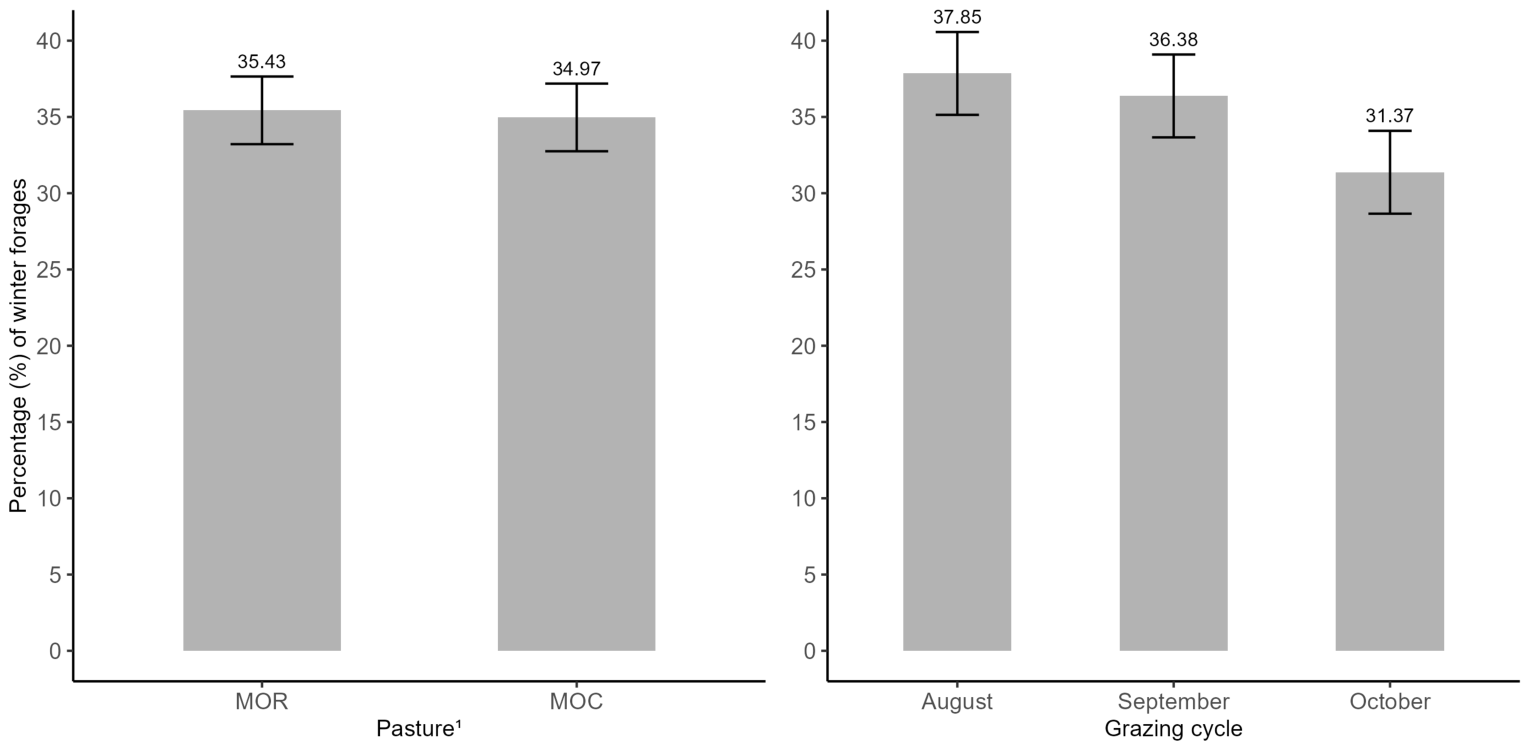
There was no significant interaction between grazing systems and grazing cycles (
p > 0.05) during the pre-grazing period for total FM, Marandu FM, winter FM (
Table 4), and % of winter forage (
Figure 1). There was no significant difference in total FM (
p > 0.05) between the grazing systems during pre-grazing. However, the highest total FM in pre-grazing (
p < 0.05) was observed in October compared to the other months.
There was a significant effect of the isolated factors, pasture type (
p < 0.05) and grazing cycles (
p < 0.05), on the Marandu FM variable (
Table 4). The exclusive
Marandu grass pasture and the October grazing cycle exhibited the highest Marandu FM.
The MOR and MOC grazing systems showed no significant differences in winter MF and %WF (
Table 3,
Figure 1). The average proportion of winter plants in the
Marandu grass consortium was 35.21% for both grazing systems (
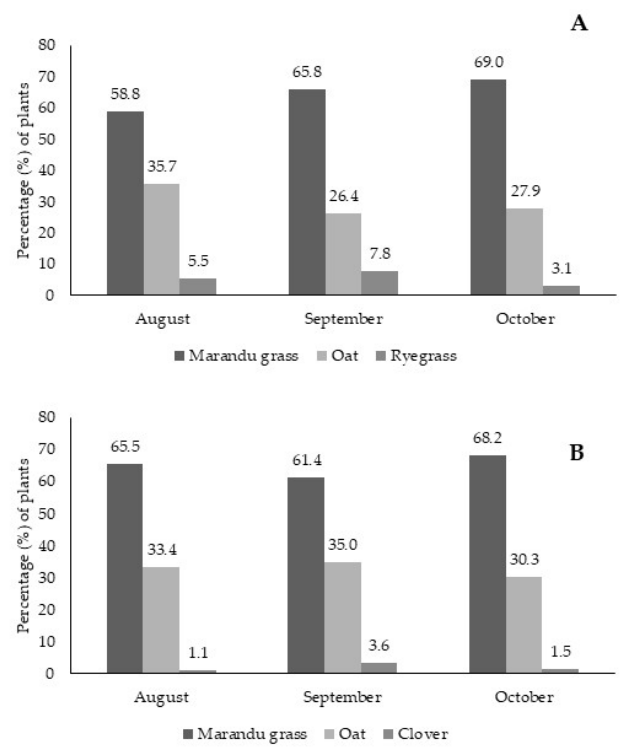
Figure 1). In both systems,
Oats had a higher share (29.98% and 32.91% for MOR and MOC, respectively), and
Ryegrass had a larger share than
Clover (5.45% vs. 2.06%, respectively;
Figure 2).
There was a significant interaction between grazing systems and grazing cycles (
p < 0.05) for total forage mass, Marandu forage mass, and winter forage mass measured after grazing (
Table 5).
Total forage mass and post-grazing Marandu forage mass were higher in October than in August in the
Marandu grass pasture (
Table 5). In contrast, the MOR pasture showed the opposite pattern, with a reduction in post-grazing winter forage mass from August to October.
Total forage mass and post-grazing Marandu grass forage mass showed no difference between grazing systems in August. However, in September and October, the monoculture Marandu grass pasture had higher total forage mass and post-grazing Marandu grass forage mass than the MOR and MOC pasture systems. Regarding post-grazing winter forage mass, the MOR pasture produced more in August and was not surpassed by the MOC pasture in September and October.
There was a significant interaction between grazing systems and grazing cycle (
p < 0.05) for leaf mass production (
Table 6). The highest leaf mass production (
p < 0.05) was observed in the October grazing cycle, and there was no significant difference (
p > 0.05) between grazing systems (
Table 5).
There was no significant interaction between grazing systems and grazing cycles (
p > 0.05) for stem mass production, dead material mass, or the L/S ratio (
Table 6). Stem mass production did not differ between grazing systems (
p > 0.05), but the October grazing cycle showed higher stem mass production (
p < 0.05,
Table 6). There was no significant difference (
p > 0.05) in dead material mass between grazing systems and grazing cycles (
Table 6). Similarly, there was no significant difference (
p > 0.05) in the L/S ratio between the individual factors, grazing systems and grazing cycles (
Table 6).
There was no significant interaction between grazing systems and grazing cycles (
p > 0.05) for forage accumulation, forage accumulation rate, and forage allowance (
Table 7). However, grazing cycles had a significant effect (
p < 0.05) on forage accumulation and forage accumulation rate, while grazing systems did not (
Table 6). There was no significant effect (
p > 0.05) on forage allowance between grazing cycles, but there was a trend (
p = 0.05) for grazing systems, with MOR systems tending to have higher forage allowance in August and the
Marandu grass system showing higher forage allowance in September and October (
Table 7).
There was no significant interaction between grazing systems and grazing cycles (
p > 0.05) for the animal performance variables (BW, TWG, and ADG;
Table 8). The grazing systems also did not differ significantly (
p > 0.05) in BW, TWG, and ADG of the
F1 Holstein ×
Gyr heifers. However, within grazing cycles, BW increased linearly (
p < 0.05), reaching a higher weight by the end of October. The first grazing cycle (August) showed the lowest TWG and ADG (
p > 0.05) compared to the September and October cycles, respectively (
Table 8).
4. Discussion
The highest total forage mass (6186.52 kg DM/ha;
Table 4) observed in October can be attributed to more favorable climatic conditions during this period, especially the increase in precipitation (98 mm) and temperatures (
Table 1). Although irrigation was applied throughout the experimental period, the lower irrigation depth used in October suggests that forage accumulation was mainly driven by natural climatic factors. The approximately 36% increase in forage mass compared to August highlights the strong response of
Marandu grass to favorable environmental conditions, as increases in temperature and water availability stimulate photosynthesis and tillering of C4 grasses, leading to greater forage production.
During the third grazing cycle, which occurs in early spring during the transition between dry and wet seasons, there was an increased presence of
Marandu grass, while
Oats remained the most prominent winter forage species (
Figure 2). These findings differ from those reported by Olivo et al. [
28], who observed higher total forage mass in September in overseeded Bermudagrass systems under a humid subtropical climate (Cfa) due to
Ryegrass’s peak production in early spring. This discrepancy shows that winter forage productivity heavily depends on thermal conditions and is generally less favorable in tropical regions, where temperatures quickly rise at the start of spring during the dry-wet transition.
The average dry matter production of
Marandu grass was higher in monoculture compared to overseeded pastures (
Table 4). The dry-wet transition (late winter/early spring), along with rising temperatures, longer photoperiods, and irrigation, promoted the growth of
Marandu grass in all grazing cycles, reducing seasonal effects [
20,
21,
29]. Conversely, the lower production of this grass in overseeded systems (3499.21—MOR; 3159.30—MOC vs. 5629.00 kg/ha in monoculture;
Table 4) suggests interspecific competition for light, water, and nutrients. Nonetheless, no difference was found in total forage mass, indicating a substitution effect among species within the canopy. Unlike Silva et al. [
30], who reported higher production in overseeded pastures with Bermudagrass cv. Tifton 85, the present study’s results show that, under irrigated Cerrado conditions, overseeding does not increase total production but instead redistributes it among species with different physiological strategies.
The lower productivity of winter forages can be attributed to the physiological traits of C3 species and the climatic conditions of the Cerrado. The Cerrado region of Minas Gerais is a major wheat-producing area, featuring a C3 species adapted to tropical climates [
12,
31], making it a valuable model for understanding winter forage behavior. C3 species have higher photosynthetic efficiency at milder temperatures (15–25 °C), which supports their growth under specific conditions [
12,
32]. However, in the Cerrado, the rapid increase in temperature at the start of spring during the dry–rainy transition favors C4 species like
Marandu grass, which are more efficient at using radiation and water at higher temperatures, leading to increased competition and a reduction in C3 species within the system [
33].
Additionally, wheat studies show that sowing time directly affects the performance of C3 species, with better results when plants experience milder temperatures during reproductive development [
12,
32]. This pattern can also be seen in the winter forages examined in this study, which explains their lower productivity. Unlike humid subtropical regions (Cfa), where cooler temperatures extend the growth of temperate species [
30], the tropical savanna climate (Aw) promotes quick replacement of these species by tropical grasses.
This dynamic is shown by the decrease in winter forage participation from about 40% in winter to 30% at the start of spring (
Figure 1). The rise in temperature and daylight duration encouraged the growth of C4 grasses during this period [
34], a pattern also observed by Silva et al. [
30], who noted increased presence of tropical grasses in early spring.
Although an initial balance between C3 and C4 plants was observed, this pattern was not maintained throughout the grazing cycles, indicating low stability of the mixture under tropical conditions. The participation of
Legumes was lower than the range considered ideal (30–40%) for stable mixtures [
35], suggesting environmental and management limitations. The lower optimal temperatures for
Clovers (20–25 °C) [
4], combined with the high temperatures recorded (
Table 1), likely limited their persistence. Additionally, the residual height of 15 cm and the increase in stocking rate (4.8 to 7.7 AU/ha;
Table 2) may have intensified grazing pressure, reducing regrowth capacity, particularly for
Red clover, which is less tolerant of intense grazing [
4]. These results indicate low functional compatibility between
Clovers and
Marandu grass under the evaluated conditions.
On the other hand,
Oats showed greater participation in the mixture (30–35%;
Figure 2), demonstrating better adaptation to the system. Their quick germination and longer vegetative period compared with
Ryegrass and
Clovers [
4] support their use in overseeding systems with
Urochloa brizantha cv.
Marandu. Unlike
Legumes,
Oats were not significantly affected by grazing intensity or canopy structure.
After grazing, an increase in
Marandu grass forage mass from winter to spring was observed in the monoculture system (
Table 5), while in the MOR system, there was a reduction in winter forage mass across grazing cycles. This pattern reflects the physiology of the species, as C4 grasses show optimized growth at temperatures above 19 °C [
36], whereas C3 species have their growth limited at temperatures above 25 °C [
4].
The increase in leaf and stem production in October is linked to greater forage accumulation in early spring. A leaf:stem ratio greater than 1.0 indicates maintenance of forage quality and effective management in promoting a higher proportion of leaves. The absence of differences in dead material among systems and grazing cycles may be due to grazing management and irrigation, which encouraged the decomposition of senescent material [
37].
The higher forage accumulation values observed in August should be interpreted with caution, as they were calculated based on pre-grazing mass, unlike the other cycles. Still, the average accumulation rates exceeded those reported by Gerdes et al. [
38] and Bones et al. [
39], possibly due to differences in management, climate, and irrigation practices.
The forage allowance values were lower than those reported by Rocha et al. [
7], which may be due to differences in production systems and experimental conditions. Despite this, animal performance remained similar across systems. The observed average daily gains aligned with the recommended values for
Holstein ×
Gir heifers grazing during the rainy season [
40] and were higher than those typically seen during the dry season. The lack of differences among systems, despite higher crude protein and lower neutral detergent fiber in overseeded pastures (
Table 3), suggests that animal performance was not limited by diet quality but possibly by genetic potential or intake capacity. This indicates that improvements in forage nutritional quality alone were not enough to produce additional gains.
Overall, the climate conditions of the Cerrado region of Minas Gerais during the dry–rainy transition did not restrict the growth of Marandu grass, especially with irrigation. Overseeding with winter forages did not increase total forage yield or animal performance but caused changes in botanical composition and pasture quality. Among the evaluated species, Oats showed better adaptation and potential for use, while Legumes had low persistence, indicating limitations for their use in tropical systems under the conditions studied.




 ,
,