1. Introduction
Historically, calf rope-and-tie (also referred to as calf-roping) was used to capture calves for husbandry procedures, such as castration or dehorning, particularly in North and South America. Today, calf-roping has developed into a competitive sporting event held in Australia and other countries, including Canada, New Zealand, and the United States of America (USA), to showcase rural skills [
1]. Since the 1990s, ranchers managing cattle in extensive systems have adopted safer, more efficient and humane techniques such as the use of calf tables or squeeze chutes to restrain calves instead of ropes [
2]. Similarly, public perceptions of these practices have changed, with one study reporting that the use of a tilt table was favoured over roping and wrestling, as the former was considered to be more humane and does not involve dragging the calf [
3].
Calf-roping has drawn criticism due to concerns for the welfare of the calves used [
4,
5,
6,
7,
8,
9,
10]. Specifically, concerns relate to the potential for stress, pain and injury caused by the abrupt halt of the running calf by the rope, and the subsequent handling of the calf when dropped or forced to the ground and having three of their legs tied together [
11,
12,
13]. A study involving post mortem examination of three calves used in calf-roping events found that these animals had physical injuries such as damage to the trachea and the soft tissues of the neck, including bruised laryngeal cartilage [
14]. Although rodeo rules have been introduced to minimise these injuries (e.g., penalties for abrupt neck jerking and compulsory use of recommended roping devices) [
15], no formal assessment has been made to determine their effectiveness. It has been argued that the negative impacts of calf-roping on calf welfare are outweighed by the cultural and economic benefits of rodeos [
8]. Professional rodeo association rules describe requirements for minimising injuries to calves, including preventing calves from being dragged [
15].
Within Australia, there are disparities in the regulation of calf-roping between different states and territories [
8]. For example, all rodeo events are prohibited under animal welfare legislation in the Australian Capital Territory, while calf-roping is effectively prohibited in Victoria and South Australia by enforcing a minimum weight requirement of 200 kg for rodeo cattle [
8]. In contrast, regulations in Queensland, New South Wales, the Northern Territory, Western Australia and Tasmania, in general, permit calves weighing between 100 kg and 135 kg to be used in calf-roping events [
8]. In some states where calf-roping is legal, rules state that calves must not be used more than three times in a day during rodeo competitions [
15]. However, calves can be used at multiple rodeos throughout a season. Furthermore, calves are used in rodeo training schools where, in many regions, there are no regulations limiting the frequency of their usage, which means that they may be used repeatedly [
11]. In addition to the legislation, several jurisdictions have adopted animal welfare codes of practice for rodeos, which contain details of how animals should be used [
9]. In some jurisdictions, compliance with the code of practice is voluntary. Handling of calves in the chute is permitted under the rodeo event rules [
16], but may be aversive to calves. Given concerns about calf-roping events, it is important to understand their impact on calves.
Conclusions drawn from different studies investigating physiological responses of calves during different phases of calf-roping are equivocal, with one study showing elevated levels of serum cortisol, epinephrine and norepinephrine in both experienced and naïve calves after calf-roping events [
12]. Another study, concluded that calf-roping did not stimulate a significant increase in cortisol in pre-conditioned calves [
17]. Although cortisol levels may be informative regarding stress in animals, levels may be impacted by contextual factors including physical activity or social interaction [
18]. As venepuncture is invasive and requires restraint, the collection of blood samples from animals can be a stressor in itself, which can confound the assessment of adrenocortical responses [
19,
20].
Studies focusing on behavioural indicators of stress suggest that calf-roping affects the behaviour, and has adverse impacts on the emotional wellbeing, of calves. A study using a Qualitative Behaviour Assessment (QBA) found that calves being chased by the rider on horseback expressed behaviours consistent with agitation, anxiety, confusion, fear and stress, compared to behaviours consistent with being calm, contented, exhausted, inquisitive and relieved while exiting the arena after release of the leg rope [
13]. A retrospective study utilised video footage from rodeos to develop an ethogram of behaviours exhibited by rodeo calves during different phases of calf-roping [
11]. The authors concluded that calves experienced fear and distress in all phases of the event, evidenced by behaviours associated with negative affective states, such as attempts to escape from the horse and rider, vocalisation and exposure of the eye white. These behaviours have previously been identified as evidence of fear and stress [
21]. An observational study of bucking bulls being loaded into and held in the chute prior to rodeo performances found that some of the bulls showed multiple behavioural indicators of distress (for example, escape or agonistic behaviours), mainly coinciding with proximity to human activities [
22]. The authors suggested that limiting human behaviours, including being present at the head of the bull when in the chute, could reduce baulking. Usually, three handlers are present: one near the head of the calf, one at the rear, and one at the outside of the chute where the horse and rider are positioned. Handlers have been observed pushing and shoving the calves to ensure that they are positioned in a manner that will allow them to run out of the chute as quickly as possible [
11]. Such handling is permitted under the rodeo event rules [
16], but may be aversive to calves.
To the knowledge of the authors, there have been no published studies investigating the behaviour of calves while they are confined in the chute before being released for calf-roping.
The aims of this study were to assess (a) whether calves confined in chutes in rodeo events express signs indicative of fear and stress and (b) if there is any difference in the behaviour of calves restrained in the chute for a short duration compared to a longer duration. We hypothesised that (a) calves in chutes would express signs of fear and stress and (b) behaviours indicating signs of fear and stress would occur with a higher frequency during longer periods of restraint.
3. Results
In total, 637 and 541 behaviours were observed in SD and LD clips, respectively. We initially compared the data for SD and LD clips for individual calves and found a strong correlation in the frequency of behaviours recorded between the two groups using Spearman rank correlation coefficients of 0.86 (p < 0.001) for SD and 0.97 (p < 0.001) for LD. Consequently, average counts for each group were used as the outcome measure.
Descriptive statistics were used to record behaviour frequencies (
Table 2). For SD (
n = 17), the median behaviour frequency was 18.7 (IQR 15.6–24.7). In comparison, for LD (
n = 14), the median behaviour frequency was 19.3 (IQR 14.7–22.2). In addition, “red flag” behaviours were compared between SD and LD clips. For SD, the median behaviour frequency was 3.5 (IQR 0.5–12.5). In comparison, LD had a median behaviour frequency of 8 (IQR 3–11.5).
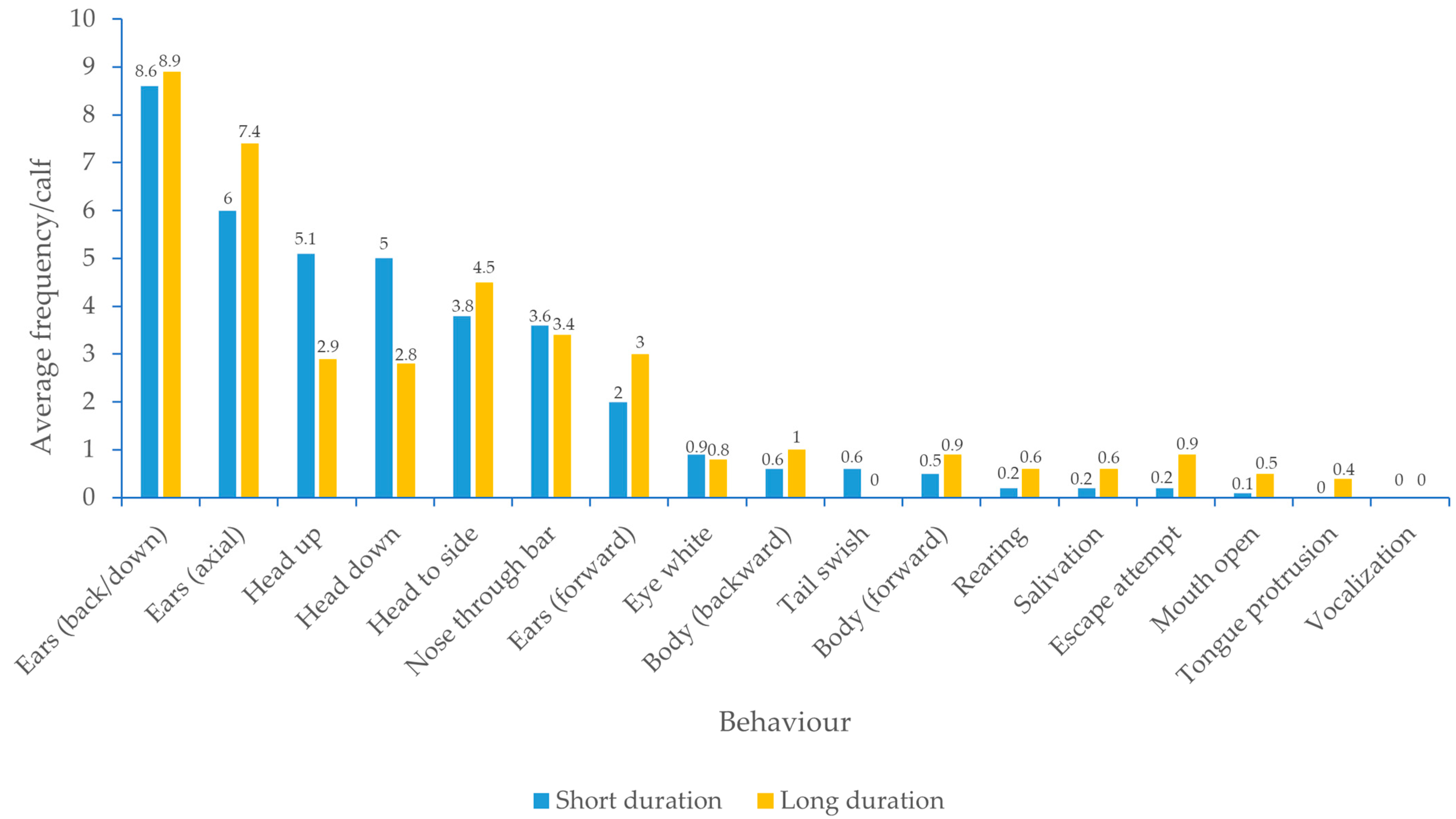
Overall, the frequencies of behaviours observed in short- and long-duration videos were similar (
Figure 1). The numbers of behaviours observed between short- and long-duration videos were highly correlated (Spearman rank correlation 0.875,
p < 0.001) and median frequencies were not significantly different (Mann–Whitney U test
p = 0.812). Behaviours associated with ear and head movements were present at higher frequencies than the other behaviours. In the SD group, calves exhibited these behaviours at an average frequency of 28.5 out of 37.4 total behaviours per calf, while in the LD group, the average was 26.5 out of 38.6 total behaviours per calf. “Ears back/down” was recorded at an average of 8.6 counts per calf (SD) and 8.9 counts per calf (LD), while “ears axial” was observed six times per calf (SD) and 7.4 times per calf (LD). Both occurred more frequently than “ears forward,” which averaged two counts per calf (SD) and three counts per calf (LD). Compared to other behaviours expressed as combined scores for SD and LD groups, “ears axial” was relatively infrequent, and in comparison, different head movements were displayed more frequently. The next most observed behaviour was head movement (“head down”, “head to side”, and “head up”) recorded at an average of 13.9 counts per calf (SD) and 10.2 counts per calf (LD). Notably, “vocalisation” and “tongue protrusion” were absent in SD clips, while “vocalisation” and “tail swish” were not observed in LD clips.
The numbers of “red flag” behaviours observed between SD and LD clips were moderately correlated (Spearman rank correlation 0.5), but this was not statistically significant (
p = 0.253), and median frequencies were not significantly different (Mann–Whitney U test
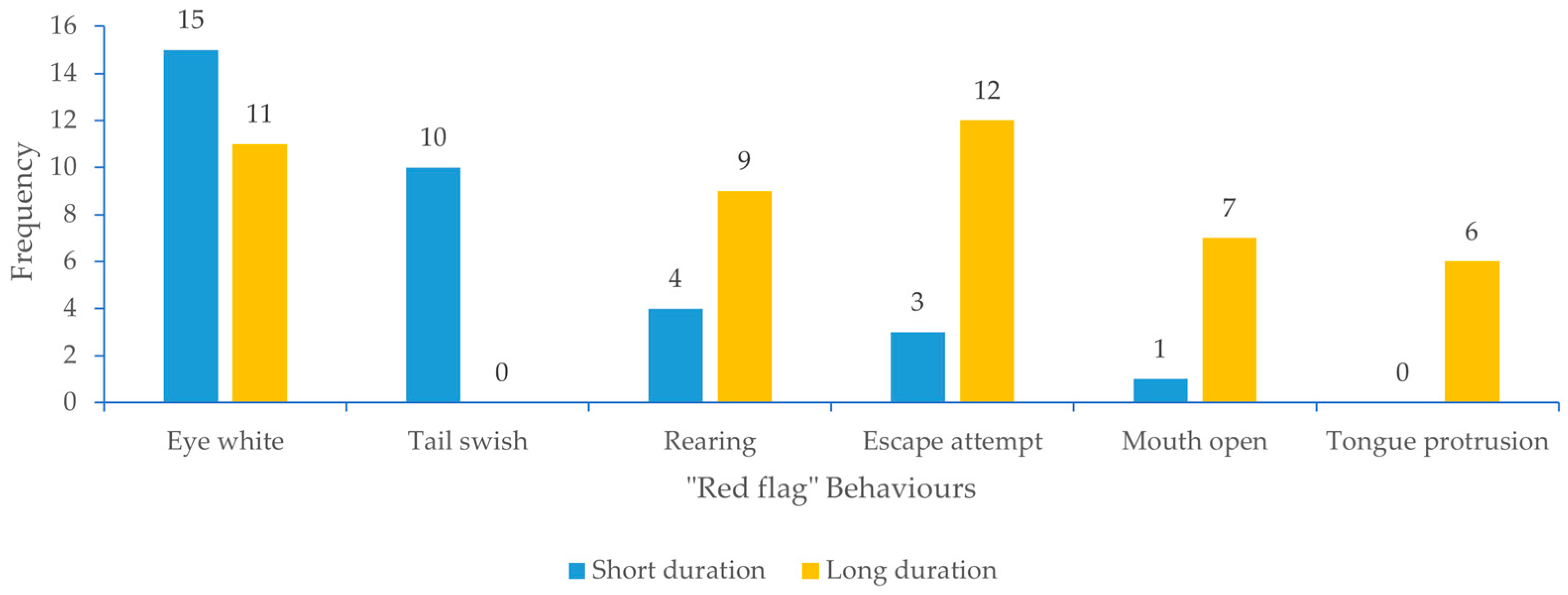
p = 0.485). There were some key differences in the expression of “red flag” behaviours between SD and LD clips. A total of 33 “red flag” behaviours were recorded in SD, compared to 45 in LD. Calves in SD showed more “eye white” (15 occurrences) compared to LD (11 occurrences), along with increased “tail swish” (10 occurrences), a behaviour that was absent in LD calves (
Figure 2). In contrast, calves in LD clips exhibited a higher frequency of “mouth open” (seven occurrences compared to one occurrence in SD), “tongue protrusion” (six occurrences, with none in SD), “rearing” (nine occurrences compared to four occurrences in SD) and “escape attempt” (12 occurrences compared to three occurrences in SD) (
Figure 2).
There were notable differences in the frequency and distribution of “red flag” behaviours exhibited by calves in the SD and LD groups. A subset of calves in both groups expressed “red flag” behaviours: 10/17 (59%) in SD and 7/14 (50%) in LD.
In the SD group, the maximum frequency of “red flag” behaviours for a single calf was seven, compared to 13 in the LD group. The total frequency of “red flag” behaviours in the SD group was 34, with the three highest scoring calves accounting for 18 instances (53%). Similarly, in the LD group, the total frequency was 45, and the three highest scoring calves accounted for 30 occurrences (66%).
Notable observations for individual calves in relation to aversive handling are summarised in
Table 3. Of the four clips selected for analysis, three were from the long-duration (LD) group. Calves in two of the clips displayed no “red flag” behaviours (Clips 14 and 28), while the calf in the clip with the highest recorded frequency of “red flag” behaviours (Clip 18), which exhibited 13 counts, was included in this table. Additionally, in Clip 24, the calf exhibited relatively few “red flag” behaviours, but made an escape attempt and pushed their nose under the chute gate. Immediately after, a handler stepped on the calf’s face for 21 s.
A chi-square test was conducted to compare the frequency of “red flag” behaviours between SD and LD clips. There was a statistically significant association between longer video length and an increased frequency of “red flag” behaviours (chi-square statistic = 27.2, p < 0.001).
4. Discussion
Analysis of video footage from calves used in two rodeo events on successive days found that all calves confined in the chute prior to release for calf-roping displayed at least one behaviour associated with negative affective states (fear or stress).
Ear and head position changes were among the most frequently observed behaviours exhibited by calves. Specific ear positions can provide information about a calf’s emotional state. Cattle tend to increase ear position changes during situations requiring vigilance [
31]. “Ears forward” indicates a state of high arousal in calves, but its valence—whether the arousal is positive (e.g., expressing attention to the surroundings) or negative (e.g., indicating fear or stress)—depends on the context in which it is expressed [
25]. “Ears axial” was associated with frustration in cows presented with inedible woodchips after being conditioned to expect concentrated feed following a cue [
32]. “Ears back/down” may indicate negative emotional states or pain in some situations [
33], but in others—such as when animals are brushed by a mechanical rotating brush—it may reflect positive, low-arousal mental states [
35].
Head movements may indicate negative affective states in the context of stressors. In an observational study on the effects of changes in shadow contrast and noise on cattle movement in a small abattoir, baulking (described as cattle stopping, putting their head down and backing up) was associated with sharp shadow contrast on the floor and noise from trucks [
28]. The authors of that study concluded that noise and human activity associated with a rendering truck near the lairage reduced the ease of handling and led to increased tail twisting and electric prod use. Rodeos are noisy environments, with loud-speaker commentary and music, gates being continuously opened and closed, handler shouts and whistles, and crowd noise. Reduced noise levels may reduce the impact of this potential stressor on calves, though may be logistically challenging to implement.
A high frequency of ear and head movements was noted during the negatively valanced scenario of cow–calf separation [
30]. Calves, particularly males, exhibited higher frequencies of ear, head, and body movements during separation compared to calves being reunited with cows [
30]. When ear and head movements are considered within the context of calf-roping—where the calf is confined in a chute, separated from groupmates, and potentially experiencing aversive handling—it is reasonable to hypothesise that these behaviours reflect negative affective states.
A key finding of this study was that the frequency of “red flag” behaviours was significantly higher in LD clips compared to SD clips (
p < 0.001). Studies have shown that prolonged restraint in dairy cows was associated with heightened aggression and negative arousal, reflected in elevated serum cortisol levels [
36]. Although the calves in the current study were restrained without head or neck confinement and for relatively short periods, our results suggest that behaviours reflecting negative emotional states increase with longer confinement. These findings may also be explained by calves in LD clips potentially having an increased likelihood of experiencing a higher frequency of aversive handling actions than calves in SD clips, or calves experiencing more fear and stress as their escape attempts fail. Research has shown that behaviours indicating fear and stress are more common in animals subjected to frequent handling by stockpersons, including actions such as touching, patting, pushing, and the use of electric goads [
37]. Calves in this study experienced frequent direct contact by handlers attempting to position them so that they would leave the chute quickly. For example, calves had their heads pulled back by their ears, their faces slapped, and, in one particularly aversive incident, a calf’s face was stepped on for 21 s after an escape attempt (see
Table 2). Aversive handling of animals in the chute at rodeo events has been reported previously; for example, Goldhawk and colleagues observed handlers hitting bulls while they were restrained in the chute [
22]. Avoiding aversive handling and minimising the time spent by calves in the chute prior to release is likely to improve calf welfare.
Research has shown that handlers’ and stockperson’s beliefs and attitudes towards animals influence their behaviour, which in turn impacts animal welfare [
37,
38,
39,
40]. Poor handler attitudes resulting in aversive interactions may increase calf fear and stress in subsequent interactions with handlers and stockpersons. This could lead to lower productivity and product quality, as well as increased labour costs and potential for worker injuries or accidents [
38,
41,
42]. However, in the context of a rodeo where the aim is to ensure that the calf leaves the chute at speed, aversive handling may be perceived by some handlers as advantageous.
Some “red flag” behaviours were expressed more often during different periods of restraint. In SD clips, the most frequently observed “red flag” behaviour was “eye white”. In contrast, in LD, “escape attempt” was the most common (
Figure 2). Studies have shown that the eye white:iris ratio significantly increases during high-arousal situations with either negative valence (e.g., exposure to a suddenly opened umbrella [
43] or cow-calf separation [
24,
44]), or positive valence (e.g., being stroked or brushed [
25]). A systematic review of animal-based welfare indicators for calves and cattle found that the eye white:iris ratio could indicate a neutral, positive or negative affective state [
45]. Increased eye white:iris ratio in the context of calf-roping is likely to reflect a negative affective state. Negative affective states including fear may be indicated by jumping, reversing, baulking and other agonistic behaviours [
45]. Escape attempts suggest the calves are experiencing fear and/or stress while confined in the chute, and inability to escape may lead to feelings of frustration and helplessness [
29]. A study of the behaviour of bucking bulls in the race and chute found that only 2 out of 14 of bulls showed no behavioural indicators of stress while in the chute [
22]. The remaining bulls displayed one or more of the following: tail swishing, bucking, kicking, pawing the ground or head tossing. However, the authors noted that the study design was not conducive to identifying non-reactive coping behaviours and thus there may have been an underestimation of the display of learned helplessness as a fear response [
22]. A review of animal-based welfare indicators for calves and cattle found that freezing was associated with negative affective states, indicating poor welfare [
45].
Other “red flag” behaviours observed in our study included “mouth open”, “tongue protrusion”, “rearing” and “tail swish”. Calves have been observed exhibiting tongue protrusion and mouth gaping during the roping and restraining phases at calf-roping events [
11]. Similar behaviours, such as tongue rolling and oral stereotypies, have been documented in cattle who are intensively housed and unable to display highly motivated grazing behaviours [
46]. Behaviours observed in calves within the chute may similarly represent a response to frustration. Mouth open has been associated with discomfort, pain or frustration in horses, as well as rearing with escape attempts and agonistic behaviour in bucking bulls [
22] and horses [
26,
27,
47]. Tail swishing has been observed as a frequent defensive behaviour in cattle towards irritating stimuli, such as flies [
48], and was associated with negative affective states in calves in a review of animal-based welfare indicators [
45]. In the context of rodeos, this behaviour may be exacerbated by being in an unfamiliar, crowded, noisy environment and subjected to aversive handling [
28].
Calves from three clips in SD (Clips 1–3) and LD (Clips 18–20) accounted for 53% and 66% of the “red flag” behaviours observed, respectively. Differences in behaviour and affective states among individuals can be influenced by several factors. For instance, in this study, not all calves were handled by the same handler, and the duration and nature of handling likely influenced each calf’s experience in the chute. Additionally, a calf’s temperament and their previous experiences being used for roping plays a significant role in shaping their emotional responses [
49,
50]. Venue-specific factors such as noise levels, transport conditions and duration of separation from groupmates may account for some behaviours exhibited by the calves.
At least half of the calves in this study displayed “red flag” behaviours strongly indicative of negative affective states, while 45% did not. For example, calves from two clips (Clips 18 and 28) in the LD group scored the same for the frequency for overall behaviours (16.5). In Clip 28, the calf showed no “red flag” behaviours, whilst the calf in Clip 18 showed a high score of 13 (
Table 3). One possible explanation for this discrepancy is the brief duration of video analysis (28 s), which may have precluded the observation of some behaviours. Some calves might have exhibited more passive stress responses, such as freezing, which could have been overlooked due to the study’s emphasis on identifying proactive behaviours [
22]. Alternatively, it is possible that some calves had habituated to being handled in the chute.
Habituation, the reduction in response to a frequently repeated stimulus, is a key process through which animals learn to adapt to novel stimuli and experiences [
51]. Whether an animal habituates or becomes sensitised (where fear increases with repeated exposure) depends on numerous factors, including the intensity of the stimulus, genetics, arousal levels during exposure, and the individual’s age, sex, and past experiences [
41]. Positive or neutral handling can promote habituation and reduce aggressive behaviours, while harsh or aversive handling may lead to sensitisation and increased fearfulness [
52]. For instance, highly reactive animals subjected to forced handling and restraint often become more fearful, making future handling more challenging [
53]. Conversely, calves introduced to a chute for brief periods under positive conditions, such as gentle petting, can habituate to restraint, reducing their risk of dangerous flight responses. A randomised, controlled study evaluating habituation of crossbred beef calves to corral handling found that habituation was associated with reduced reactivity and improved performance [
54]. A randomised, controlled study evaluating the habituation of Angus, Simmental, Hereford and Charolais beef cattle in a university teaching herd found that heifers, in particular, showed the strongest improvement in chute entering and exiting behaviour, and animals were calmer during student–animal interactions (leading animals through a working chute into a squeeze chute, placing a halter, scratching the animal with a show stick, and leading onto pasture) [
55]. However, the success of habituation hinges on the predictability and controllability of the stressor, as aversive handling or unpredictable environments can impede habituation. Furthermore, habituation is context-specific; an animal trained to tolerate one stimulus, such as the sudden opening of a blue and white umbrella, may still react fearfully to a novel stimulus like a flapping orange tarpaulin [
56]. In the context of rodeos, while calves may adapt to restraint in a chute, this habituation is unlikely to extend to more negative experiences, such as aversive handling or being roped in the arena [
57]. Additionally, as competitors are rewarded for their speed in calf-roping events, the habituation of calves—while leading to better calf welfare—may be seen as detrimental if a habituated calf exits the chute less rapidly than a non-habituated calf. Nonetheless, we found that the longer a calf is held, the more likely they are to display behaviours indicative of negative affective states. This suggests that minimising the time calves are held would reduce the duration of these negative experiences.
The importance of considering affective states is increasingly recognised in assessing animal welfare [
29,
58,
59]. Animal-based indicators, including behavioural, physical and physiological indicators, allow researchers and others to assess the affective states of animals. As stated by Harris and colleagues, “the aim of many animal welfare assessments is to determine the likely affective states of an animal to infer or make inferences on their potential welfare status” [
45]. These can help guide legislative reform aimed not only at minimising unnecessary suffering but also promoting positive welfare states. However, research on assessing animal welfare through mental experiences presents challenges, as it involves subjective interpretations and lacks direct, measurable indicators [
60]. The emerging concept of agency offers a promising avenue for assessing animal welfare by enabling us to explore how animals can engage in voluntary, self-generated, and goal-directed behaviour that aligns with their motivations [
60].
The Five Domains Model provides a framework for evaluating animal welfare. The model centres animal welfare assessment on affective states [
29]. Experiences of rodeo calves (Domains 1–3) may include anticipating physical harm, separation from other calves, exposure to novel environments, and exposure to multiple stimuli, such as loud noises and sudden, unpredictable movements from both people and horses. Due to being restrained in the chute, calves do not have the capacity to avoid such stressors, which is likely to create a state of negative welfare [
61]. Domain 4, “Behavioural Interactions”, has been updated to reflect “an animal’s ability to exercise agency in their interactions with the environment, other animals, and humans” [
60]. Specifically, it represents agency-driven behaviours animals exhibit in response to changing and often unpredictable external events and conditions [
29]. Affective states associated with behavioural interactions impact overall animal welfare (mental experiences) in Domain 5 (Mental State) of this model. For example, in the chute, physical confinement and inescapable sensory impositions may be associated with negative affective states such as anxiety, fear, panic, frustration and helplessness [
62]. The calf’s inability to avoid threats or to escape may evoke states of fear, anxiety and panic. Aversive handling or interactions, such as slapping, hitting, grabbing, pulling, poking, or shouting, can lead to calves experiencing physical discomfort, pain, anxiety, fear and panic [
62].
High levels of stress and arousal, particularly when associated with fear, can activate the amygdala, inhibiting cognitive function and learning capacity [
63]. This may impair the calves’ ability to learn appropriate coping behaviours or form positive associations. Training for performance using non-aversive techniques can reduce negative experiences, thus improving animal welfare. Horses trained using positive reinforcement being loaded onto a float showed less discomfort and less stress compared to horses trained using negative reinforcement methods [
64]. For calf-roping events, calves need to be as still as possible, facing towards the front of the chute ready to exit quickly. At rodeo events, calves appear to know how to exit the arena, yet during this phase of the roping event, calves are not restrained nor subjected to aversive human interactions [
13]. Thus, at the end of the performance, calves do what is required by exiting the arena directly and promptly. However, our study shows that many calves are not settled whilst restrained in the chute. Explanations for this include that being restrained in the chute is aversive and/or the calf anticipates negative experiences associated with being chased, roped and forced to the ground. Another possibility is that these calves were naïve and therefore reactive to being constrained in the chute. However, industry rules require stock contractors who supply the calves to ensure that they are familiar with the surroundings through appropriate preparation prior to being used for competition [
16]. Thus, while we were not aware of individual calf history, we believe that the calves in this study were appropriately prepared, to the extent that they had been “…pre-run, pretied, pre-thrown off horseback replicating each event as it would occur during the rodeo or chute handled for rough stock until they become familiar with the surroundings”, as per rodeo association rules [
16].
Although appropriate training may be considered a possible solution, it is unlikely that training approaches focusing only on positive reinforcement would successfully increase calmness and readiness in calves to exit the chute, unless aversive experiences were also reduced or eliminated. To promote positive welfare, it is crucial to use handling techniques that minimise distress and maximise positive affective states, especially during early life stages [
57]. This can help calves develop resilience and adaptive responses to stressors. There is no evidence that calves used for roping events are offered agency or positive experiences. Instead, these animals are exposed to negative stressors repeatedly across rodeo events and rodeo school training sessions. Previous studies have shown increased levels of serum cortisol in calves following their use in rodeo events [
12]. Ethological and QBA studies have shown that calves subjected to real and simulated calf-roping showed signs of agitation, fear, and stress [
11,
13].
Our study contributes to the expanding evidence base regarding the experiences of calves used in calf-roping events. Specifically, our findings suggest that calves experience stress while in the chute prior to their release into the arena, and that prolonged periods of restraint may cause more stress than shorter ones.
5. Limitations and Future Directions
We used a retrospective dataset and thus did not have control over the footage quantity or quality, including sample size, duration of video clips, audio–visual quality and clarity. Many clips were not suitable for analysis and were therefore excluded from the study, reducing the number of clips available for analysis. Control over these elements would require a prospective study. However, a prospective study on the welfare of calves in calf-roping events would be difficult to justify to an Animal Ethics Committee given the known negative impacts on calf welfare [
11,
12].
Nonetheless, analysis of video footage is a non-invasive and cost-effective tool that provides an opportunity to help assess calf welfare at rodeos. Behavioural observations can be spontaneous and immediate, whereas physiological measures may require invasive testing, or may require equipment to be fitted and habituated to before measures can be taken [
31].
The video footage was taken from rodeo events held over two days at a single venue. It is possible that venue- or event-specific factors influenced our results. For example, different rodeo events and venues may be associated with a varying duration of transport to the venue, noise levels, handler attitudes, behaviours and skills, and/or duration of separation from other calves, any of which may influence calf arousal and behaviour. Future studies evaluating larger numbers of calves at different rodeos are required to determine if there is any association between venues and negative behaviours in calves or higher prevalence of “red flag” behaviours.
The counts of “tail swish” were relatively low, which may be partly attributed to visual obstruction of the calf by the chute and/or handlers. Additionally, “vocalisation” was not detected, likely due to the background noise during the rodeo events and the microphone not being close enough to the chute to capture calf vocalisations. Vocalisations have been recorded in calves who have an open mouth [
65]. For these reasons, it is likely that the frequencies of these behaviours were underestimated. To improve future studies, analysis of footage taken using higher-quality video and audio recording equipment could improve visual clarity and minimise background noise.
Calf behaviour can be influenced by the handler’s behaviour, the duration and nature of handling, and the animals’ previous experiences. As the retrospective methodology precluded obtaining consent from human handlers, we focused on calf behaviour. In a study of bucking bulls prior to rodeo performances, Goldhawk and colleagues suggested that baulking during loading and head tossing while in the chute could be reduced by relocating humans to minimise visibility within the animals’ line of movement, and minimising human presence at the animal’s heads while restrained in the chute [
22]. Furthermore, they argue that it is important to avoid aversive handling experiences such as hitting animals during loading to decrease the incidence of negative behaviours. Correlating handler interactions with calf behaviours could provide a deeper understanding of how different types of handling impact calves’ experiences. Considering key stress-associated behaviours, particularly the frequently observed changes in ear position identified in this study, in relation to the nature or absence of handling and handler behaviour, could yield valuable insights regarding the impact of handling on rodeo calf welfare in future studies.
A limitation of our study’s focus on proactive calf behaviours is that it may have overlooked passive responses, such as learned helplessness or freezing, which can be important indicators of fear [
22,
45]. These behaviours can be difficult to detect, which may explain why past research has prioritised more visible fight-or-flight responses over freezing behaviours. The freeze state, characterised by immobility, is defined by parasympathetic dominance and bradycardia, unlike the fight-or-flight response, which is marked by sympathetic dominance and tachycardia [
66]. Despite outward immobility, freezing involves increased muscle tone, which can be measured using electromyography (EMG) [
66]. Including objective measures of the freeze state as an indicator of fear in future studies may facilitate the assessment of the emotional state of calves in experimental settings but may not be feasible in the setting of a real-world rodeo. Future studies could determine if calves who display fewer “active” behaviours indicative of negative mental state are habituated or experiencing learned helplessness.
While a review identified 170 animal-based welfare indicators in cattle, only 42 of these were behavioural, and fewer indicators have been established for calves [
45]. Few have been validated, and some indicators such as increased eye white:iris ratio can indicate positive, neutral and negative welfare in cattle, though interpretation may be aided by the context in which the behaviour is observed. The use of wearable sensors such as accelerometers may aid in the assessment of some behaviours, while the use of artificial intelligence (AI) to analyse video footage could facilitate detailed analysis of behaviour and eliminate inter-observer variability [
45]. In one study, machine learning models achieved high accuracy in pain classification (pain/no pain) in bulls, and outperformed veterinarians in both consistency and predictive performance [
67]. AI-driven models were 24.5% and 8.8% more accurate at scoring pain and behaviour, respectively, than human experts. The authors argue that AI-driven models can analyse video footage, detecting pain-related movements, postures and expressions with greater precision than humans.
Further research is required to investigate the behaviour of calves restrained in holding pens and being moved through races prior to entering the chute, as well as after they leave the arena, to help identify the possible effect of cumulative stressors. This information could help determine whether improvements in calf handling and management are required to safeguard the welfare of all calves used at rodeos. Confidence in findings could be increased by standardising the length of time calves are held, capturing footage from different locations, and assessing handler behaviour. In addition, relatively non-invasive measures could be considered, including heart rate, heart rate variability and faecal cortisol, as indirect indicators of stress [
68]. Given the negative impacts of aversive handling on cattle productivity and product quality, it could be useful to compare the productivity of calves that have participated in rodeos with those that have not. Finally, together with previous studies indicating that calves exhibit signs of fear and distress prior to release into the arena and during calf-roping, consideration should be given to reforming animal welfare legislation across Australia to prevent unnecessary harm to calves used in roping events.