Article

The Behaviour of Sheep Around a Natural Waterway and the Impact on Water Quality During Summer in New Zealand: A Case Study


1
College of Veterinary Medicine and Biomedical Sciences, Sokoine University of Agriculture, Morogoro P.O. Box 3020, Tanzania
2
School of Agriculture and Environment, Massey University, Palmerston North Private Bag 11-222, New Zealand
*
Author to whom correspondence should be addressed.
Ruminants 2026, 6(1), 14; https://doi.org/10.3390/ruminants6010014
Submission received: 6 November 2025 / Revised: 14 January 2026 / Accepted: 3 February 2026 / Published: 11 February 2026

Simple Summary

The interaction of sheep with waterways has the potential to impact water quality, particularly during summer when sheep are likely to have greater motivation to drink. There is little information available on the behaviour of sheep around a natural waterway and whether there is any association with the provision of a reticulated trough. When access to the water trough was restricted, there was an observed increase in the amount of time ewes spent grazing and drinking in the stream zone (3 m buffer around the stream). Access to the trough, however, had little impact on the concentrations of nutrients, except for ammonium-N, in the waterway. Stream loads of E. coli, ammonium-N, and total P at the outflow monitoring site were higher compared to the inflow site, regardless of whether ewes had access to the water trough. Paddock slope, the location of the trough, and stream crossings influenced the movement of sheep within the paddock. Sheep were observed within the stream zone most commonly during daylight hours and least at night. The results of the current study provide evidence that sheep interacted with the stream zone and that this had an impact on some measures of water quality.

Abstract

The behaviour of ewes within the vicinity of a natural stream and the impact on stream water quality in New Zealand hill country in summer has not been studied previously. Adult ewes (n = 40) were managed in a 1.7 ha paddock. Ewes were given access to a reticulated water trough for one week, then the trough was covered in the second week, resulting in the stream being the only source of free water available to the ewes. Ewe behaviour was monitored by video surveillance, GPS and Accelerometers. Ewes spent more time grazing and drinking within the stream zone (3 m buffer around the stream) during the restricted vs. unrestricted period (p < 0.05). Restricting water trough access had little impact on nutrient concentrations, except for ammonium-N, which increased (p < 0.05). Increased stream loads of E. coli, ammonium-N, and TP in the outflow from the paddock were evident. The spatial distribution of ewes was influenced by the slope and location of the trough and stream crossings. Ewes were least observed near the stream at night, with the highest activity in daylight. Ewes travelled greater distances as the slope increased, except at very steep slopes. While water trough access had no effect on the time ewes spent within the stream zone, there was a high density of ewe location fixes near the trough that was not seen when access was restricted. The water quality results suggest that the presence of sheep in the paddock had some impact on ammonium-N and E. coli.

1. Introduction

In hot environments where sheep are managed under extensive conditions, they appear to prefer to graze close to water sources and therefore spend most of their time near watering points [1,2]. The duration that sheep spend grazing, however, depends on a number of factors, including the availability of feed, hours of daylight, and flock size [3,4]. Sheep have been reported to spend approximately eight to nine hours per day grazing, which can increase to up to 13 h per day if the feed supply is limited [3].
In New Zealand during summer (maximum daytime air temperatures of ~20–28 °C), the moisture contained within pastures can be up to 50% compared to 80% in spring (maximum daytime air temperatures of ~15–20 °C) [2,5,6,7]. The moisture content of pasture can directly influence how much sheep drink [8,9,10]. The dry matter intake of sheep is positively related to water consumption [11,12]. Therefore, during summer in New Zealand, the higher dry matter content of pasture and increased air temperatures suggest that sheep will likely require more free water to drink than in other seasons. Typically, in New Zealand, sheep can access drinking water from reticulated water troughs or natural sources such as streams. If water trough access is restricted in summer, sheep may be more motivated to drink from streams than in other seasons.
Farming activities in New Zealand can affect water quality via losses of phosphorus (P), nitrogen (N), and faecal matter to waterways, which can make water unsafe to swim in and can lead to unwanted biological growth such as algae [13,14,15,16,17]. In particular, cattle can have a significant influence on the water quality of streams and rivers [18,19]. Cattle crossing waterways have been reported to cause water contamination due to the deposition of urine and faeces directly into the water [20]. Bagshaw [21] reported that beef cattle spent up to 6.7% of their day in or within 2 m of a stream and deposited 4% of their faeces in these areas, which then impacted water quality. However, our understanding of how sheep behave around natural waterways and how this influences water quality is very limited.
Previously, access to a water trough in winter was found to have no effect on the proportion of time that ewes were observed to graze, walk, rest, or drink within 3 m of the stream [22]. In winter, ewes showed minimal interaction with the stream, which was partly explained by the high moisture content of the pasture (77%). In winter, when trough access was restricted, there were higher concentrations of total P in the stream but no difference in nitrate-N and E. coli compared to when the trough was accessible. There is currently no data available to determine if the same trends occur during summer weather conditions.
The current study aims to investigate ewe behaviour and interaction around a natural waterway during summer to determine any potential impacts on water quality. In addition, the impact of providing access to a reticulated water trough on sheep behaviour was also investigated. It was hypothesised that the absence of a reticulated water source would result in greater sheep interaction with the natural waterway, which would negatively influence the concentration and load of nutrients and pathogens in the waterway.

2. Materials and Methods

Procedures in this study were carried out with the approval of the Massey University Animal Ethics Committee (MUAEC 19/102, approved on 18 October 2019). This study was conducted over two weeks from 15 February (D1) to 28 February 2020 (D14) at Massey University’s Tuapaka farm, located approximately 15 km north-east of Palmerston North, New Zealand (40.3345° S, 175.7390° E). The two-week period was based on the battery life of the GPS collars and was considered an adequate period to intensively monitor animal behaviour.

2.1. Animals and Study Design

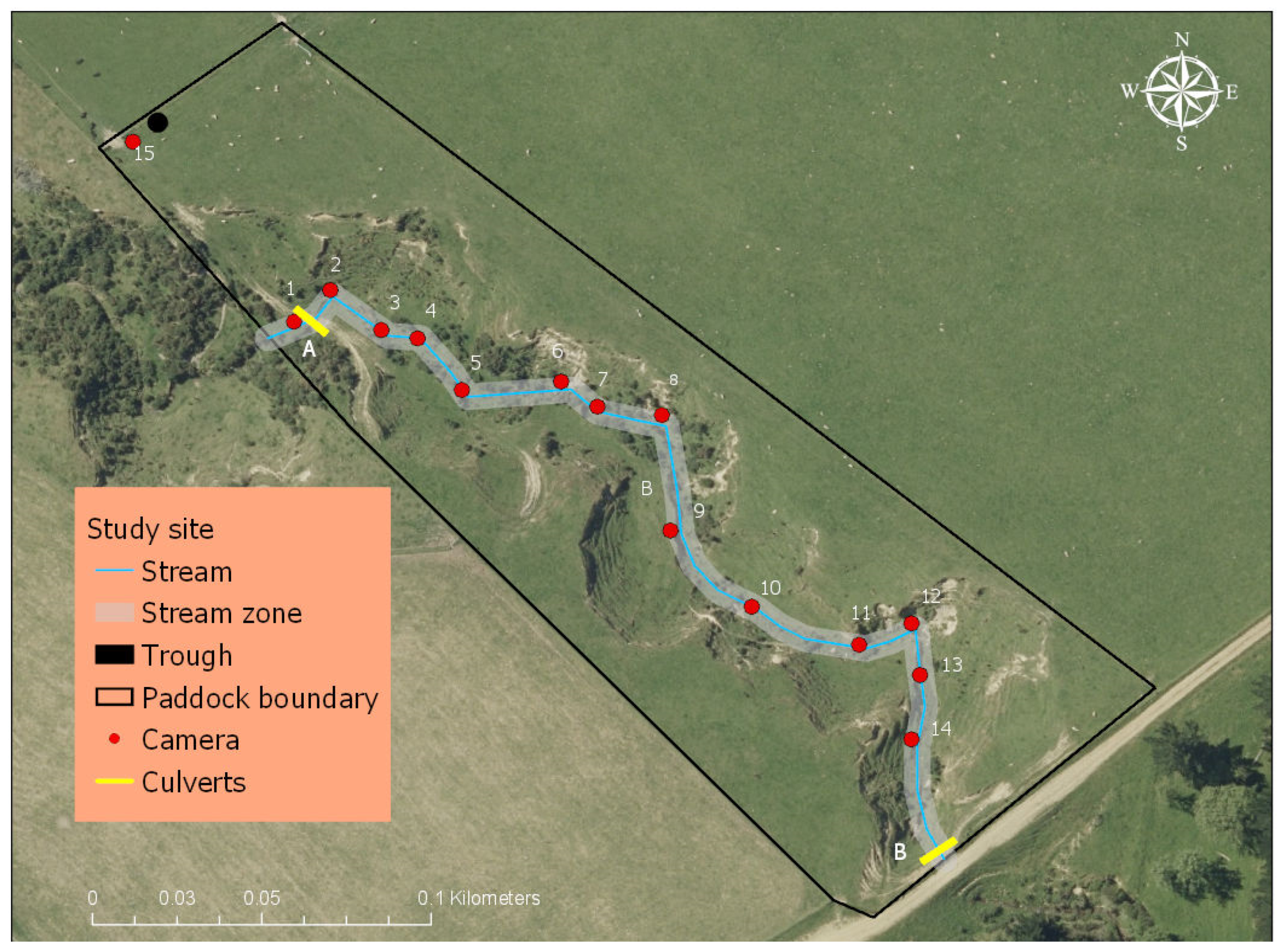
This study used mature (3 to 5 years of age, which represented farm stock ages) Romney ewes (n = 40). Briefly, a crossover study was conducted, whereby ewes grazed the study paddock for one week with full access to reticulated water from a water trough, then in the second week, the trough was covered, resulting in the stream being the only free water access within the paddock (Figure 1). This study was undertaken in a 1.7 ha fenced paddock (249.0 m × 249.4 m × 85.0 m × 50.2 m) that contained a natural stream, which was 233 m in length, <30 cm deep, <1 m wide, and positioned ~3–5 m lower than the surrounding pasture (Figure 1). The catchment area collecting water from the surrounding landscape and contributing to the stream between the two culverts (Figure 1) was calculated to be 4.1 ha in size using ArcGIS Pro. This paddock was a familiar part of the ewes’ normal grazing rotation. During the study period, ewes were grazing predominantly on perennial ryegrass pasture (Lolium perenne), with pasture masses greater than 1000 kg DM/ha and an average moisture content of 56%. Ewes’ movement within the paddock and their interaction with the waterway were monitored using GPS, accelerometer, and video surveillance footage, and their impact on water quality was measured.

Sheep Behavioural Observations

Ewe behaviour was recorded 24 h/day for two weeks from D1 to D14. Fifteen motion-activated video surveillance cameras (Moultrie® model MCG-13297, Birmingham, AL, USA (n = 7), TechView model QC8027, TechView, Kaki Bukit, Singapore (n = 4) and Bushnell © model 119736, Overland Park, KS, USA (n = 4)) were used to record ewe movement and behaviour around the waterway. Cameras were located at spacings of 14 to 18 m along the stream, and the clear recording distance was up to 15 m (Figure 1). An additional camera was placed approximately 7 m from the reticulated water trough (Figure 1). When ewes’ presence triggered the camera, the camera recorded for 30 s, then another 10 s of non-recording period. If the ewe was still within the 15 m range and moving after this period, an extra 30 s of recording took place. It was possible to record during darkness using the camera’s infrared LED flash. Each ewe had a plastic collar labelled with a unique number, and they also had large numbers marked on their flanks using stock spray (Sprayline, Donaghys, Christchurch, New Zealand).
Behaviours were coded from video recordings using the ethogram described by Bunyaga et al. [22] and using BORIS software (version 7.8.2; Friard et al. [23]). The behaviours recorded included grazing, walking, stationary, drinking, sniffing, walking in the stream, and out of view.

2.2. GPS and Accelerometers

All ewes (n = 40) wore a collar, which was attached to a triaxial accelerometer weighing 19 g (wGT3X-BT, Ametris, Pensacola, FL, USA) and a custom-built GPS unit weighing ~100 g (DataCarter Ltd., Feilding, New Zealand). The GPS monitors allowed continuous tracking of satellites, recording animal position when ewes moved distances of ≥5 m or if stationary, every 60 s. GPS units used a 3.6 volt battery (Tadiran lithium Inorganic battery, Tadiran, Lake Success, New York, USA) with a battery life under continuous operation of 15 to 25 days. The GPS and the battery were protected by a plastic case, which was weatherproof. GPS units recorded latitude, longitude, date and time (GMT), horizontal dilution of precision (HDOP), and satellites detected. Excel VBA using macros calculated from the Vincenty inverse formula for ellipsoids [24] was used to calculate the distance between two latitude/longitude points (in numeric [decimal] degrees). Triaxial accelerometers and GPS units were attached for fourteen days from D1 to D14. Sheep locations were determined from data recorded from more than four satellites. Distance travelled and time spent by sheep in the paddock were calculated from GPS and accelerometer data, respectively. Time of day was classified as either early morning (0600 to 0859), day (0900 to 1659), evening (1700 to 1959), or night (2000 to 0559).
The triaxial accelerometers were programmed to record all three axes (x, y, and z) at 30 hertz. Accelerometers were attached to the collar of each ewe and to the post that each camera was attached to. The devices attached to the ewes had the Bluetooth proximity function set to be a beacon, and the devices attached to the camera locations were set as a receiver. The devices had a built-in rechargeable battery that had a life cycle of 16 to 21 days. Data from the devices was downloaded using proprietary software (ActiLife 6, Amertis, Pensacola, FL, USA). Proximity to the camera locations was estimated based on the received signal strength indicator as described by Sohi et al. [25].

2.3. Ewe and Pasture Measures

At D1 and D14, all ewes were weighed (Tru-Test weigh scale, Tru-Test, Auckland, New Zealand), with body condition scored by an experienced technician (scale 1–5; Jefferies [26]). All ewes were weighed within an hour of being removed from the pasture.
The percentage of moisture contained in the pasture was determined from samples collected at approximately 1 pm on D1, D8, and D13. Six pasture samples of approximately 50 g were collected by hand plucking the herbage present to simulate ewe grazing. Samples were dried for 48 h at 80 °C to calculate dry matter and moisture content.

2.4. Weather Data, Water Sampling, and Analysis

Hourly and daily weather data were obtained from a nearby (800 m) weather station. Parameters recorded included rainfall (mm), air temperature (°C), relative humidity (%), wind speed (m/s), and solar radiation (MJ/mÂ2).
Three replicated stream water flow measurements were taken every hour on the hour and averaged for each hour between 8 am and 3 pm on D5, D6, D12, and D13 (Figure 2). Measurements were taken at the exit of each of the two culverts located at the stream inflow and the outflow of the paddock (Figure 2). Due to the low flow rate, stream flow rate was measured manually using a 30 L bucket, a graduated jug, and a stopwatch, as per the bucket and stopwatch method described by Othman et al. [27].
In addition, on D5, D6, D12, and D13, water samples were collected every hour on the hour from 8 am to 3 pm from both the inflow and outflow culverts to determine the concentrations of nitrate-N, ammonium-N, total P (TP), and Escherichia (E. coli). Samples for E. coli were collected using a sterile technique to avoid sample contamination and couriered to the laboratory on the same day. Water nutrient samples were kept cool until they could be transported to the laboratory within 8 h. Samples to be analysed for nitrate-N and ammonium-N were sub-sampled and filtered to <0.45 µm for subsequent analysis. A second unfiltered sub-sample was frozen for subsequent total P analysis. Due to a laboratory error, the concentration of suspended sediment was not measured in the current study.
The colorimetric method was used to determine nitrate-N and ammonium-N concentrations [28] using an autoanalyzer (Pulse International Ltd., Saskatoon, Sask., Canada). Total P concentrations were determined by Hill Laboratory (Hamilton, New Zealand) using the total P digestion and the automated ascorbic acid colorimetry method (APHA 4500-PH method) and analysed via flow injection analysis [29].
E. coli concentrations were determined by Eurofins Laboratory (Wellington, New Zealand). Samples were analysed within 24 h of collection using a membrane filtration procedure (Standard Method APHA 9222G [29]).
Nutrient and E. coli loads (mg/s) in inflow and outflow were calculated as per Equations (1) and (2):
Nutrient load (mg/s) = Concentration (mg/L) × flowrate (l/s)
E. coli load (cfu/s) = Concentration (cfu/100 mL) × flowrate (l/s)

2.5. Statistical Analysis

GPS results were analysed using ArcGIS (ArcGIS Pro 2.2.4, 2018). An optimised hot spot analysis (z-score) was undertaken within ArcGIS to identify ewe GPS locations, which were spatially clustered and statistically significant. A hot spot was identified if ewe locations were higher in contrast to the expected number under random distribution. A cold spot was defined as an area that had a lower concentration of ewe locations compared to the expected number, given a random distribution of ewes. In determining if ewes were interacting with the waterway, a ‘stream zone’ was defined, which included both the stream and a buffer of 3 m on either side.
Data on the distance travelled by ewes was cleaned and then analysed using Microsoft Excel macros. Water quality and ewe behaviour data were first checked using the Kolmogorov–Smirnov and Shapiro–Wilk tests for normality, and the Levene’s test and Tukey transformation were used for homogeneity of variances (Tukey’s Ladder of Powers transformation) where appropriate [30]. The drinking, grazing, and walking analyses were undertaken using R 3.6.0 (26 April 2019; R Core Team (2019)). The effect of water trough access on ewe behaviour (e.g., % grazing and drinking) was analysed using a one-factor ANOVA. Analysis of ewe behaviour association with time of day or environmental temperature was undertaken using linear regression.
The concentration of E. coli, nitrate-N, and ammonium-N were analysed using parametric analysis, and that of TP using non-parametric analysis in R 3.6.0. E. coli, nitrate-N, ammonium-N, and TP loads were analysed using one-way ANOVA, then if significant, a post hoc test (Tukey test p < 0.05); otherwise, a non-parametric ANOVA model was used (Kruskal–Wallis) to determine differences between mean ranks.

3. Results

3.1. Weather and Streamflow Rate

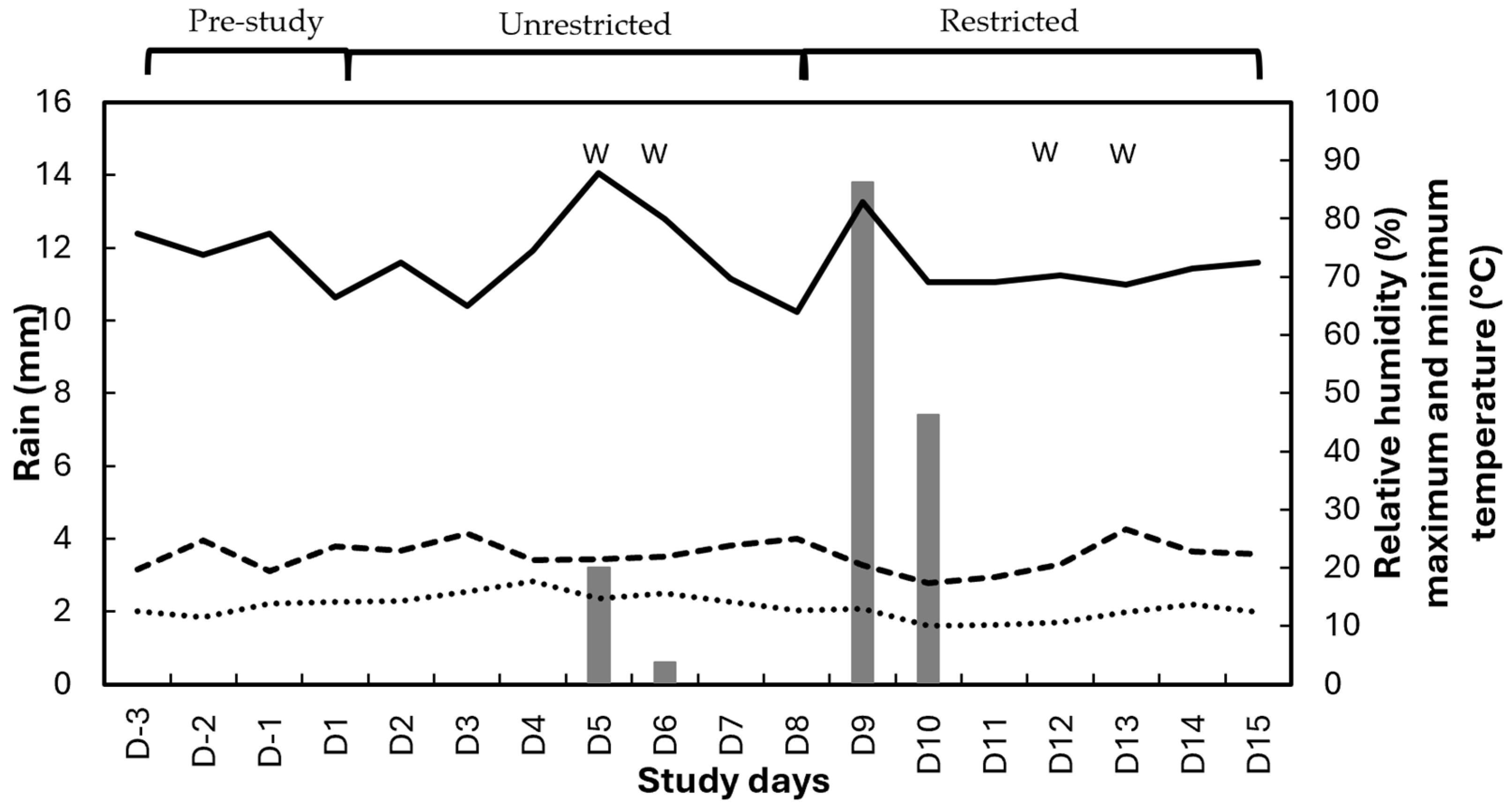
Weather data were recorded from three days prior (D-1 to D-3) to the start of the study and during the two-week study period (D1-D14, Figure 2). Rainfall was measured on 4 days of the study period and ranged from 0.6 to 13.8 mm/day. There were 3 and 0.6 mm/day of rainfall recorded on the water sampling days D5 and D6, respectively, within the unrestricted water trough period. Minimum daily air temperatures ranged from 10 to 18.6 °C, whereas maximum air temperatures varied from 17.4 to 26.6 °C. The air relative humidity ranged from 63.9% to 87.9%. Average wind speed over the study period was 5.0 m/s and ranged from 2.8 to 10.1 m/s, and average solar radiation was 16.5 MJ/mÂ2 and ranged from 4.1 to 22.7 MJ/mÂ2.
The stream flow rate measured from the inflow and outflow sites ranged from 0.05 to 1.07 L/s. Median flow rate was higher in the unrestricted water access period (0.61, 0.51–0.70 L/s) than in the restricted periods (0.18 (0.13–0.21) L/s; p < 0.05; Table 1). Flow rate was positively correlated with both rainfall (r = 0.5, p< 0.05) and daily average humidity (r = 0.1, p< 0.05) and negatively correlated with wind speed (r = 0.1, p < 0.05). On three of the four sampling days (D5, D12, and D13), flow rates were greater at the outflow than at the inflow monitoring sites, while the opposite was unexpectedly measured on D5 (p < 0.05, data not presented).

3.2. Water Quality

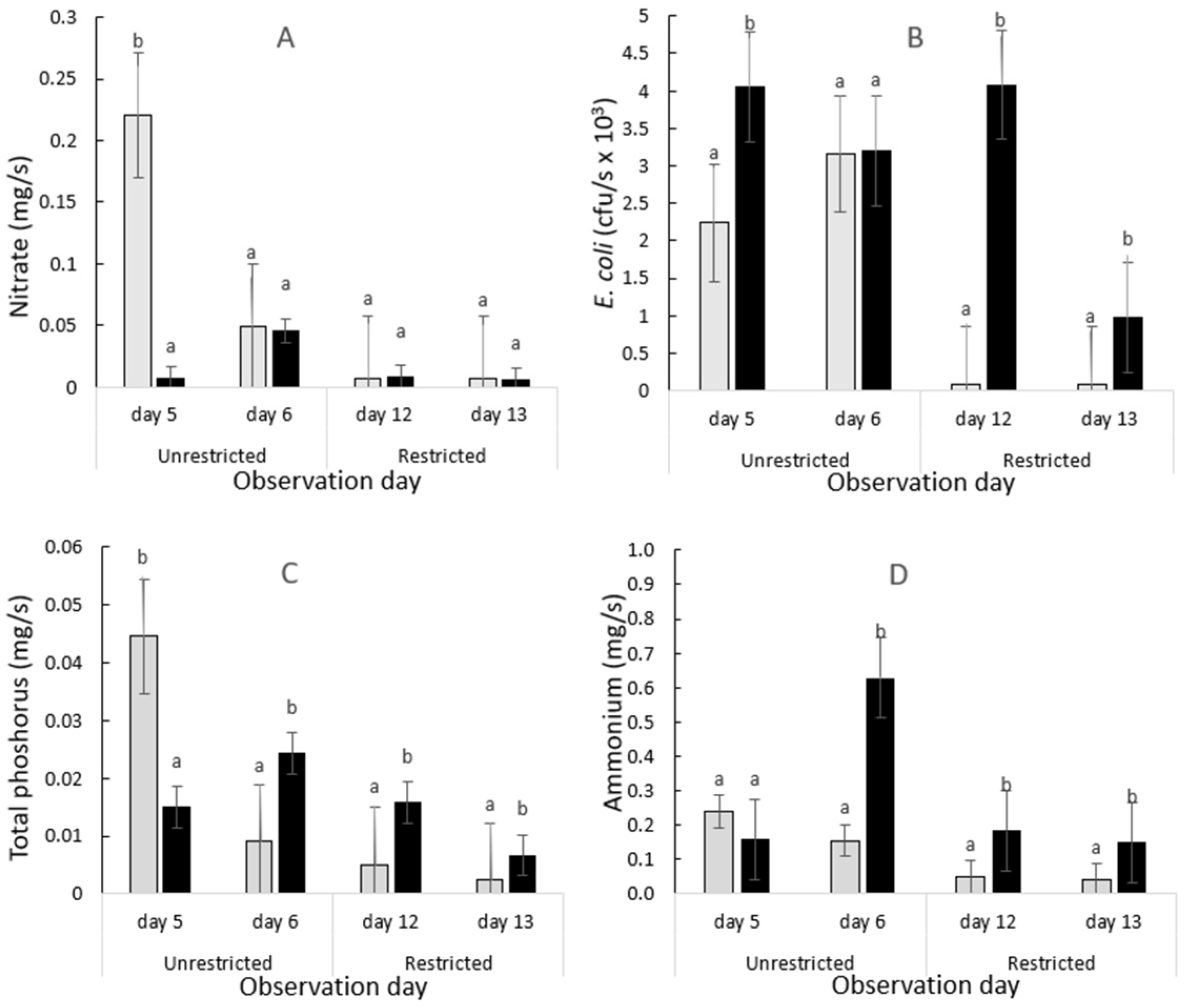
Water analyses showed that ammonium-N concentrations were higher (p < 0.05) during the water trough restricted period compared to the unrestricted period (Table 1). Ammonium loads measured in the outflow were also higher than those in the inflow on D6, D12, and D13 (p < 0.05, Figure 3D). E. coli concentrations, however, were higher (p < 0.05) during the water trough unrestricted period compared to the water trough restricted period. The load of E. coli in outflow water samples was higher than that in inflow samples on D5, D12, and D13 (p < 0.05, Figure 3B). There was, however, no difference in Nitrate-N and TP concentrations between the treatments (p > 0.05). Nitrate-N and TP loads were higher in inflow than in outflow on D5 (p < 0.05, Figure 3A,C), which is consistent with the higher inflow stream flow rates measured on D5. Total P loads measured in the outflow were higher compared to the inflow on D6, D12, and D13 (p < 0.05, Figure 3C). Nitrate-N, ammonium-N, E. coli, and TP loads did not vary across the hours of the day (p > 0.05, data not presented) on any of the study days.

3.3. Pasture, Ewe Liveweight, Animal Density, and Spatial Distribution

The average moisture content of pasture during the study period was 56%. The ewes in this study had a mean live weight (±SEM) of 63.5 ± 1.4 kg and a BCS of 2.9 ± 0.1.
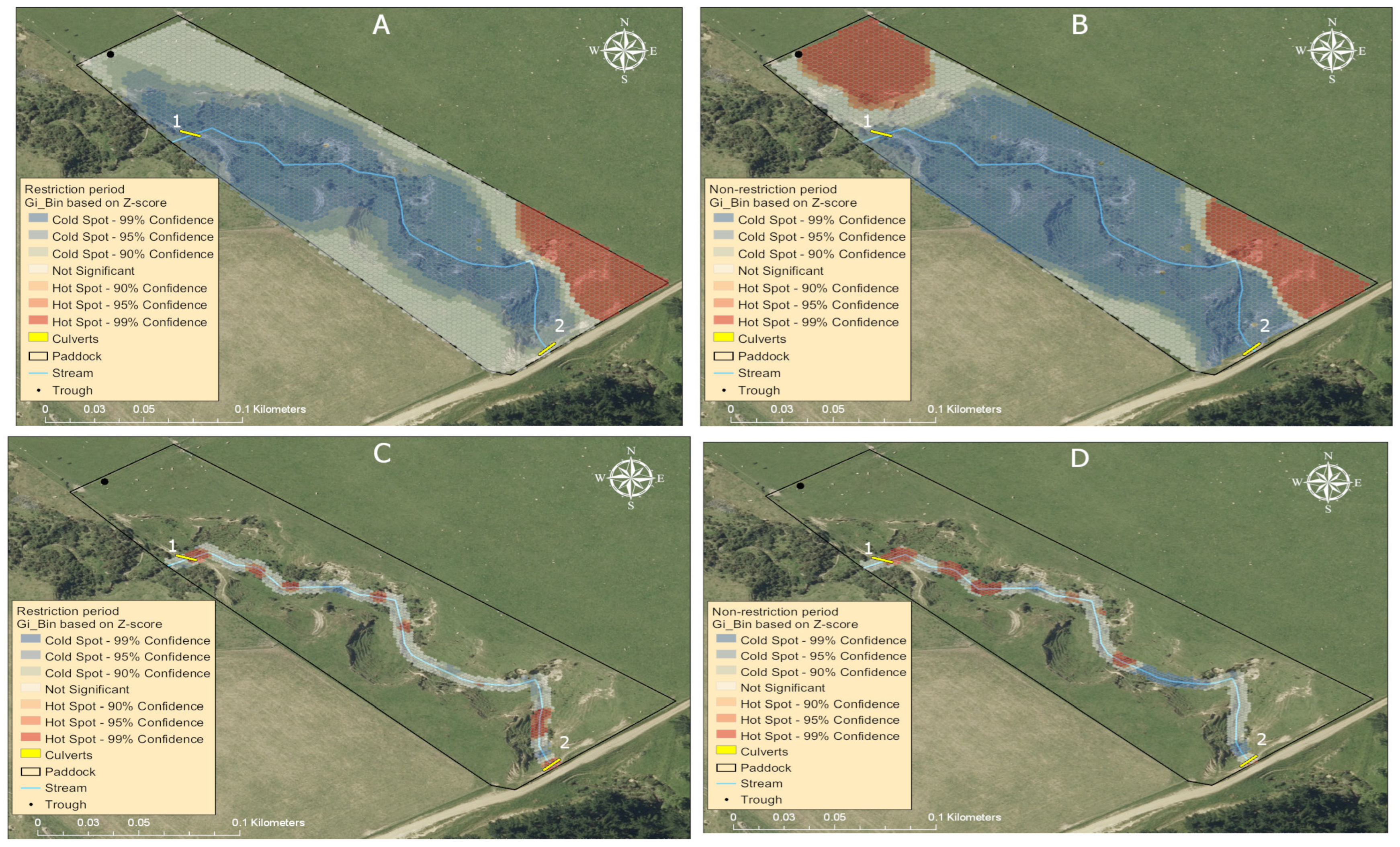
Significant spatial clustering of ewe GPS location fixes when ewes had restricted access to the water trough was identified using the optimised hot spot analysis i (Figure 4A). When water trough access was restricted, a hot spot was measured (p < 0.05) in the eastern corner of the paddock, and this area measured 46% of all ewe GPS fixes. When the trough was unrestricted, there were two hot spot areas in the northern and eastern areas, which contained 61% of location fixes (Figure 4B). The northern hot spot identified in the unrestricted period was located close to the water trough, which was not seen in the restricted period. Cold spots in both treatment periods were identified in the mid-portion of the paddock and along the stream zone (Figure 4A,B).
Of the ewe GPS locations identified in the study paddock, although the stream zone represented only 9% of the study paddock area, it contained 4.3 and 4.6% of fixes during restricted and unrestricted water trough access, respectively. When the hot spot analysis was conducted for the stream zone in isolation, during the restricted period, there were seven statistically significant hot spots (p < 0.05, Figure 4C), which contained 40% of all the GPS fixes within the stream zone. During the unrestricted period, there were six significant hot spots (p < 0.05, Figure 4D), which contained 42% of all ewe fixes. During both the unrestricted and restricted periods, there were three cold spots identified within the stream zone.

3.4. Effect of Slope

During the entire study period, 32% of sheep locations were measured where slopes were <15° (flat to rolling, Table 2). The majority of GPS fixes were recorded where slopes were between 16° and 35° (strong rolling to steep, 65.8% in the water trough restricted period and 65.9% in the unrestricted period, Table 2). In both the restricted and unrestricted periods, few GPS fixes were detected in very steep areas with a slope > 35°. The area that each slope class contributed to the study site and the number of included location fixes that were recorded within each slope class in summer are shown in Table 2.

3.5. Distance Travelled

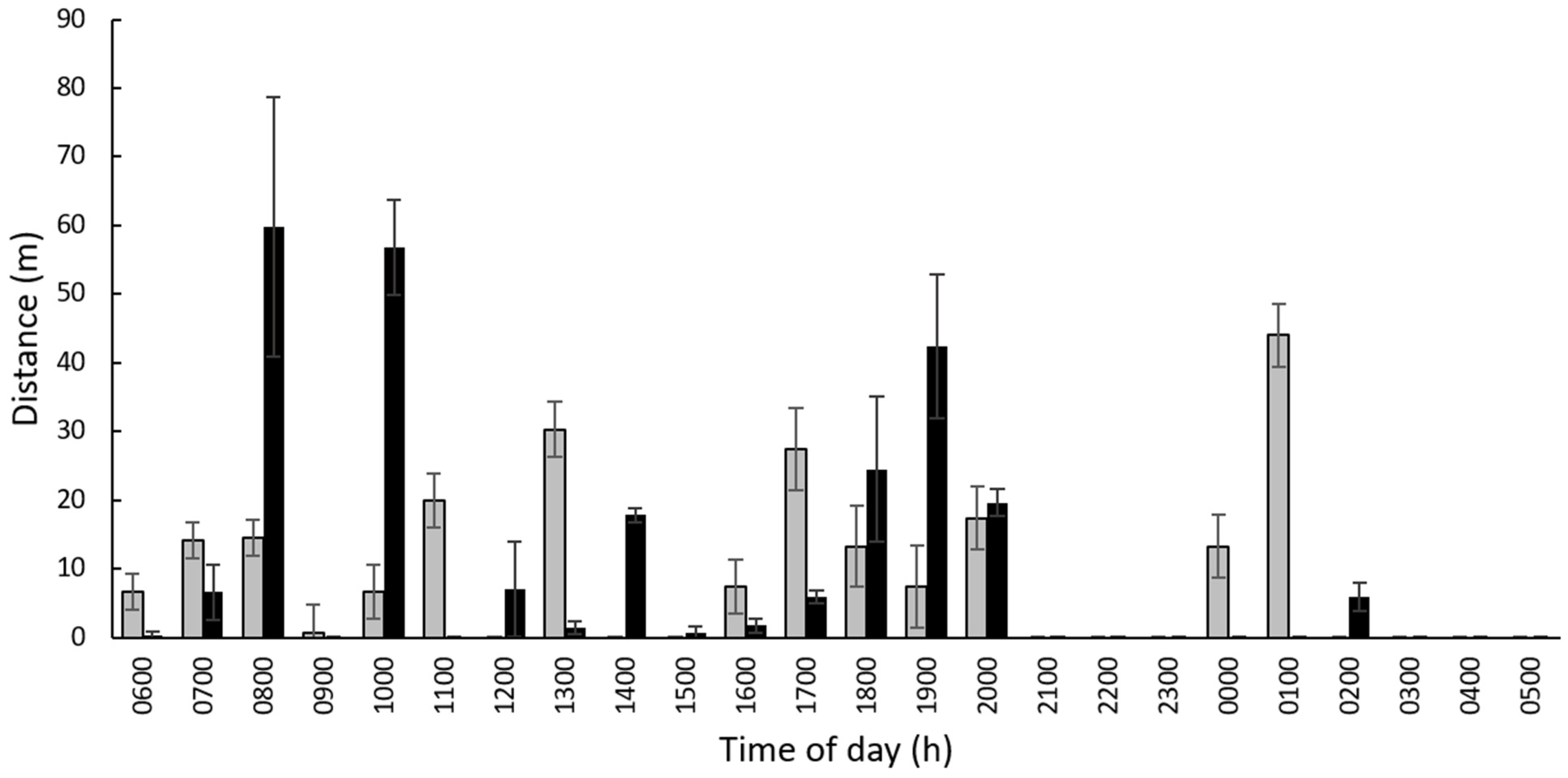
The mean total distance travelled (m) varied throughout the day (Figure 5). Peaks in the distances travelled were observed at 0800, 1000, and between 1700 and 2000 h. Ewes travelled negligible distances in the late evening (2100 to 2300) and early morning hours (0300 to 0500). During the study period, ewes travelled less (p < 0.05) during the night (5 ± 2.7 m) than either evening (20 ± 2.5 m), early morning (17 ± 10.3 m), or day (9 ± 3.7 m). Furthermore, ewes travelled greater distances during the evening than during the day. No differences were observed in the distance travelled between morning and day (p < 0.05) or morning and evening (p < 0.05). Ewes tended to travel greater distances (p = 0.72) during the water trough restricted period (10.4 ± 3.7 m) than during the unrestricted period (9.3 ± 2.4 m; Figure 5).
Paddock slope classes influenced ewe hourly distance travelled (m/h), with greater distances travelled as the slope increased up to steep slopes, with a decrease for very steep slopes. The hourly distance travelled by sheep in each slope class did not differ between the treatment periods (p > 0.05; Table 3).

3.6. Time Spent in the Stream Zones

During the study period, the duration ewes were detected within 3 m of each camera differed based on camera location (p = 0.001, Table 4). Ewes preferred spending more time near camera 11 (47.6 ± 6.0 min/ewe/day) and spent the least time near camera 6 (10.0 ± 1.6 min/ewe/day; Table 4, Figure 5).
The duration that ewes’ proximity was estimated to be within 3 m of each camera differed between time-of-day (p < 0.05; Table 5). Higher durations were detected during daylight periods (22.7 ± 1.0 min/ewe/day), followed by the evening (17.3 ± 1.4 min/ewe/day) and night (6.6 ± 1.1 min/ewe/day; Table 5). Time spent within 3 m of any camera location did not differ (p = 0.81) between the period the trough was restricted (13.3 ± 4.4 min/ewe/day) and unrestricted (10.3 ± 2.0 min/ewe/day).

3.7. Behaviour Within the Stream Zone

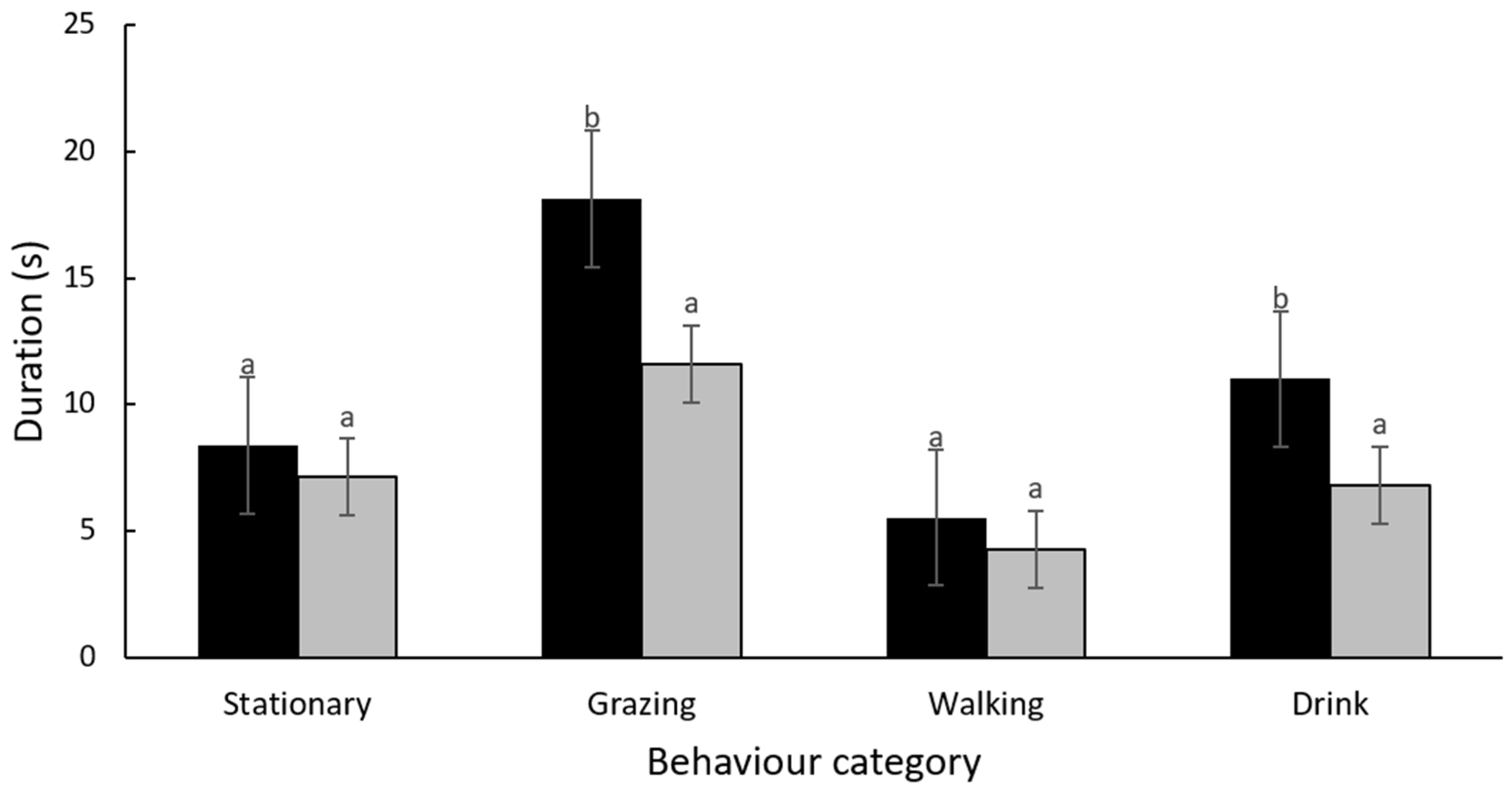
Ewes were observed to spend more time drinking and grazing when water trough access was restricted compared to when it was unrestricted (p < 0.05, Figure 6). There was no difference (p > 0.05) in the frequency of stationary and walking behaviours when the water trough was restricted or unrestricted. Camera footage showed that ewes spent 41.9% of their time grazing (n = 2304 of 5496 occasions), 26.9% stationary (n = 1476), 21.0% walking (n = 1152), and 7.2% drinking from the stream (n = 396) when they were within the stream zone. Ewes also sniffed the water on 72 occasions (1.3%) and walked in the stream on 12 occasions (0.2%).

4. Discussion

Ewes were more frequently observed to graze and drink in the stream zone during the water trough restricted period compared to unrestricted access, in contrast to previous findings in the same study area in winter. In this summer study, ewes spent 41.9% of the time in the stream zone grazing. This finding was in agreement with that of Filipčík et al. [31], who reported that the dominant behaviour of sheep at pasture was grazing (49.5% of their observed time). While in the stream zone, ewes were observed to spend 7.2% of the time drinking from the stream, which was contrary to the finding of Paranhos da Costa et al. [32], who reported that ewes spent 0.2–0.3% drinking. This greater percentage of time spent drinking in the current study was likely due to the difference in the behavioural observations between the studies. In the current study, behavioural observations were only made while ewes were within the stream zone, so it cannot be taken as a reflection of the animals’ behaviour in the remainder of the paddock.
In the current study, although there was no difference in the time ewes spent in the stream zone during the period of unrestricted access to the water trough, a hot spot near the trough was identified, which was not observed during the restricted period (Figure 4A,B). This suggests that the ewes utilised the water trough when it was accessible. Pasture in the current study had a moisture content of 56%, which was likely to necessitate sheep to seek sources of free water. Macfarlane et al. [9] demonstrated that when pasture contained a minimum of 60 to 70% water, sheep water requirements could be met through the pasture consumed, and thus, there was no need to drink water.
Water quality analyses showed that ammonium-N concentrations were higher during the water trough restricted period, compared to the unrestricted period. Ammonium-N loads were also higher in samples collected at the outflow than at the inflow sampling sites on D6, D12, and D13. The presence of ammonium-N is indicative of urine deposition from grazing animals, suggesting that an increase in ewes in the stream zone when water trough access was restricted may have been the source of this increased ammonium-N. The mean ammonium-N concentration in the current study was 0.56 mg/L, which exceeded the recommended concentration guidelines for cool wet hill waterways of 0.006 mg/L [33]. The current study’s findings support previous research showing higher ammonium-N concentrations and greater exceedances during the summer months in streams and rivers [34,35].
Total P loads were higher in the outflow than in the inflow water samples collected on D6, D12, and D13, suggesting that ewes grazing within the stream zone may have mobilised sediment containing P. The mean TP concentration measured in the current study was 0.04 mg/L, which exceeds the guidelines of 0.016 mg/L for cool wet hill waterways [33]. In general, the concentrations of TP were similar to those reported previously in winter from the same site by Bunyaga et al. [22]. Due to a laboratory error, the concentration of suspended sediment was not measured in the current study, which might have helped explain TP concentrations.
E. coli concentrations were higher during the water trough unrestricted period compared to the water trough restricted period. The majority of these higher concentrations of E. coli were observed on D5 and D6 when rain was recorded. The likely source of the E. coli was from sheep faeces that were washed into the stream from the stream zone or from elsewhere in the paddock by overland flow as a result of the rainfall [36]. Sheep as a source of E. coli was supported in the current study, which showed that more than 74% of ewe GPS fixes in the stream zone were measured in the hot spot areas (Figure 4C,D). The E. coli loads in outflow water samples were higher than those in inflow samples on D5, D12, and D13, further supporting that the source of E. coli was from within the paddock. Interestingly, the E. coli concentrations measured in summer were higher than the concentrations previously measured [22]; however, this could be explained by the lower stream flows over summer and less opportunity for dilution.
The spatial distribution of ewes in the current study was affected by paddock features such as the location of the trough and paddock slope. The northern hot spot (statistically significant spatial clusters of high values for ewes) was close to the trough during the periods of unrestricted access to the water trough, indicating a greater spatial preference for this location. In warmer months (22–35 °C), Arnold and Bush [37] reported that there is usually a greater frequency of crowding and urine patches in sheep and cattle closer to the water trough [37,38,39]. Similarly, Betteridge et al. [40] reported that urine patches were concentrated in areas where sheep camp, which suggests that the trough may be an area of preference in the current study.
In summer, ewes showed a preference for strong rolling to steep areas (16 to 35°) rather than the flat to rolling areas (0 to 15°) that were preferred in winter and spring. A number of studies have reported that sheep prefer to graze areas with slopes of <25° [41,42,43]. It is unclear the reason for this difference between seasons, as it is thought that sheep prefer flatter areas due to the greater pasture mass in these areas [44]. Flatter areas generally have higher soil fertility [44], which retains water longer in drought conditions [45].
In the current study, an increase in the slope of the paddock resulted in an increase in the distance travelled. This is in agreement with the findings of Loridas et al. [46], who reported that in lowland pastures, sheep travelled shorter distances than on mountainous pastures. It is possible that the steeper areas of the paddock had less nutrients and lower pasture mass [47,48], thus requiring ewes in these areas to move greater distances to access enough pasture. In the current study, ewes may have moved shorter distances in lowlands as a result of spending more time feeding due to greater pasture mass as a result of increased soil moisture content [49].
The pattern of activity of the ewes in the current study was similar to that reported by McGranahan et al. [50] and Filipčík et al. [31], with peaks in distance travelled at 0800, 1000, and between 1700 and 2000 h, and little movement during the night. Ehrlenbruch et al. [51] reported that grazing behaviour was greater in the early morning and evening than during daylight hours. This is not surprising as sheep have been observed to travel long distances when feeding or searching for water [52,53].
In summer, the duration ewes spent near any camera position was higher during periods of daylight than evening, and lowest at night. Based on previous findings, fewer ewes were expected to be observed in daylight hours since sheep are generally less active and avoid grazing during the hottest times of the day [54,55]. This finding was contrary to that of McGranahan et al. [50] and Filipčík et al. [31], who found most of the activities in the mid-day and evening. In the current study, maximum daily temperatures were lower than reported by McGranahan et al. [50] and Filipčík et al. [31], ranging from 10 to 26.6 °C, which may explain the lack of influence of daylight periods on the grazing behaviour of sheep. The night results in the current study were in agreement with those of Penning et al. [56], who reported little night-time grazing for sheep at pasture.
The short period of animal behaviour and water quality monitoring was a limitation in this study. With the advent of solar-powered GPS collars, future studies could be run over a longer period of time and utilise high-frequency stream flow monitoring and flow-based water quality sampling to improve our understanding of the diurnal and seasonal impact of animal behaviour on stream water quality. The small amount of rainfall that occurred on the water sampling days 5 and 6 during the water trough restricted period may have also influenced the results of this study, and again, longer-term monitoring would provide a more reliable assessment of weather-related impacts on water quality.

5. Conclusions

Ewes spent more time grazing and drinking in the stream zone when they were unable to access a water trough in summer; however, in general, this had minimal impact on water quality, with ammonium-N concentrations, likely derived from urine deposits, being the only parameter to clearly increase in response to water trough restriction. There was stronger evidence, however, that the presence of ewes grazing in the paddock, regardless of water trough access, increased the stream loads of E. coli, ammonium-N, and TP leaving the paddock. From a management perspective, these results suggest that minimising sheep interaction with streams in summer will improve water quality, but that, in general, sheep interaction with these hill country streams was minimal. GPS data indicated that the ewes showed a spatial preference for strong rolling to steep slopes (between 16° and 35°) of the paddock, with greater distances travelled by sheep as the slope increased, except at very steep slopes. Further long-term studies are required to verify these results.

Author Contributions

Conceptualization, methodology, document review and editing, A.B. and R.C.-T. Methodology, validation, GPS analysis, I.D. and A.B. Methodology, experimental design development, R.C.-T. and A.B. Investigation, water quality analysis, L.B. and A.B. Conception, writing—review and editing, P.K. Conception, methodology, formal analysis, validation, writing—original draft, A.B., R.C.-T., P.K., L.B. and I.D. Preparation of manuscript draft, L.B., A.B., R.C.-T., P.K. and I.D. All authors have read and agreed to the published version of the manuscript.

Funding

C. Alma Baker Trust (NZ) Ltd. and Massey University Doctoral Scholarship.

Institutional Review Board Statement

The animal study protocol was approved by the Animal Ethics Committee (protocol number; MUEC 19/102, approved on 18 October 2019) of the Massey University, New Zealand.

Informed Consent Statement

Not applicable.

Data Availability Statement

The original contributions presented in this study are included in the article. Further inquiries can be directed to the corresponding author.

Acknowledgments

Many thanks to all staff at Tuapaka farm for technical assistance and to Varthani Susruthan for help with manuscript formatting.

Conflicts of Interest

The authors declare no conflicts of interest and no commercial interests.

References

  1. Lynch, J.J. Merino sheep: Some factors affecting their distribution in very large paddocks. In The Behaviour of Ungulates and Its Relation to Management; Geist, V., Walther, F., Eds.; International Union for the Conservation of Nature: Morges, Switzerland, 1974; pp. 697–707. [Google Scholar]
  2. Lynch, J.J. Movement of some rangeland herbivores in relation to their feed and water supply. In The Impact of Herbivores on Arid and Semi-Arid Rangelands, Proceedings of the 2nd United States/Australia Rangeland Panel, Adelaide, Australia, 1972; Australian Rangeland Society: Perth, Australia, 1977; pp. 163–172. [Google Scholar]
  3. Lynch, J.J.; Hinch, G.N.; Adams, D.B. The Behaviour of Sheep: Biological Principles and Implications for Production; CSIRO Publications: Clayton, Australia, 1992. [Google Scholar]
  4. Penning, P.D.; Parsons, A.J.; Newman, J.A.; Orr, R.J.; Harvey, A. The effects of group size on grazing time in sheep. Appl. Anim. Behav. Sci. 1993, 37, 101–109. [Google Scholar] [CrossRef]
  5. Brown, G.D.; Lynch, J.J. Some aspects of the water balance of sheep at pasture when deprived of drinking water. Aust. J. Agric. Res. 1972, 23, 669–684. [Google Scholar] [CrossRef]
  6. de Ruiter, J.M.; Dalley, D.E.; Hughes, T.P.; Fraser, T.J.; Dewhurst, R.J. Types of supplements: Their nutritive value and use. In Pasture and Supplements for Grazing Animals; Rattray, P.V., Brooks, I.M., Nicol, A.M., Eds.; New Zealand Society of Animal Production: Cambridge, New Zealand, 2017; Occassional Publication No. 14. [Google Scholar]
  7. Woodward, S.L.; Waugh, C.D.; Roach, C.G.; Fynn, D.; Phillips, J. Are diverse species mixtures better pastures for dairy farming? In Proceedings of the New Zealand Grassland Association, Tauranga, New Zealand, 7 November 2013; Volume 75, pp. 79–84. [Google Scholar] [CrossRef]
  8. Macfarlane, W.; Morris, R.; Howard, B. Heat and water in tropical Merino sheep. Aust. J. Agric. Res. 1958, 9, 217–228. [Google Scholar] [CrossRef]
  9. Macfarlane, W.; Howard, B.; Morris, R. Water metabolism of Merino sheep shorn during summer. Aust. J. Agric. Res. 1966, 17, 219–225. [Google Scholar] [CrossRef]
  10. Forbes, J.M. The water intake of ewes. Br. J. Nutr. 2007, 22, 33–43. [Google Scholar] [CrossRef]
  11. Calder, F.; Nicholson, J.; Cunningham, H. Water restriction for sheep on pasture and rate of consumption with other feeds. Can. J. Anim. Sci. 1964, 44, 266–271. [Google Scholar] [CrossRef]
  12. Jaber, L.S.; Habre, A.; Rawda, N.; Said, M.A.; Barbour, E.K.; Hamadeh, S. The effect of water restriction on certain physiological parameters in Awassi sheep. Small Rumin. Res. 2004, 54, 115–120. [Google Scholar] [CrossRef]
  13. Abell, J.M.; Özkundakci, D.; Hamilton, D.; Miller, S. Relationships between land use and nitrogen and phosphorus in New Zealand lakes. Mar. Freshw. Res. 2011, 62, 162–175. [Google Scholar] [CrossRef]
  14. Gillingham, A.G.; Thorrold, B.S. A Review of New Zealand Research Measuring Phosphorus in Runoff from Pasture. J. Environ. Qual. 2000, 29, 88–96. [Google Scholar] [CrossRef]
  15. Ledgard, S.F.; Thom, E.R.; Singleton, P.L.; Thorrold, B.S.; Edmeades, D.C. Environmental impacts of dairy systems. In 48th Ruakura Farmers’ Conference; Lomas, J., Ed.; AgResearch: Ruakura, New Zealand, 1997; pp. 26–33. [Google Scholar]
  16. Monaghan, R.M.; Paton, R.J.; Smith, L.C.; Drewry, J.J.; Littlejohn, R.P. The impacts of nitrogen fertilisation and increased stocking rate on pasture yield, soil physical condition and nutrient losses in drainage from a cattle-grazed pasture. N. Z. J. Agric. Res. 2005, 48, 227–240. [Google Scholar] [CrossRef]
  17. Scholefield, D.; Tyson, K.C.; Garwood, E.A.; Armstrong, A.C.; Hawkins, J.; Stone, A.C. Nitrate leaching from grazed grassland lysimeters: Effects of fertilizer input, field drainage, age of sward and patterns of weather. J. Soil Sci. 1993, 44, 601–613. [Google Scholar] [CrossRef]
  18. Cournane, F.C.; McDowell, R.; Littlejohn, R.; Condron, L. Effects of cattle, sheep and deer grazing on soil physical quality and losses of phosphorus and suspended sediment losses in surface runoff. Agric. Ecosyst. Environ. 2011, 140, 264–272. [Google Scholar] [CrossRef]
  19. O’Callaghan, P.; Kelly-Quinn, M.; Jennings, E.; Antunes, P.; O’Sullivan, M.; Fenton, O.; hUallachain, D.O. The environmental impact of cattle access to watercourses: A Review. J. Environ. Qual. 2018, 48, 340–351. [Google Scholar] [CrossRef]
  20. Davies-Colley, R.J.; Nagels, J.W.; Smith, R.A.; Young, R.G.; Phillips, C.J. Water quality impact of a dairy cow herd crossing a stream. N. Z. J. Mar. Freshw. Res. 2004, 38, 569–576. [Google Scholar] [CrossRef]
  21. Bagshaw, C.S. Factors Influencing Direct Deposition of Cattle Faecal Material in Riparian Zones; Ministry of Agriculture and Forestry: Wellington, New Zealand, 2002. Available online: https://www.waterboards.ca.gov/losangeles/board_decisions/basin_plan_amendments/technical_documents/80_New/CommentLettersReceived/References%20to%20Attached%20Files%20for%20Flow%20Science/Bagshaw%202002.pdf (accessed on 2 February 2026).
  22. Bunyaga, A.; Corner-Thomas, R.; Draganova, I.; Kenyon, P.; Burkitt, L. The Behaviour of Sheep around a Natural Waterway and Impact on Water Quality during Winter in New Zealand. Animals 2023, 13, 1461. [Google Scholar] [CrossRef]
  23. Friard, O.; Gamba, M.; Fitzjohn, R. BORIS: A free, versatile open-source event-logging software for video/audio coding and live observations. Methods Ecol. Evol. 2016, 7, 1325–1330. [Google Scholar] [CrossRef]
  24. Vincenty, T. Direct and inverse solutions of geodesics on the ellipsoid with application of nested equations. Surv. Rev. 1975, 23, 88–93. [Google Scholar] [CrossRef]
  25. Sohi, R.; Trompf, J.; Marriott, H.; Bervan, A.; Godoy, B.I.; Weerasinghe, M.; Desai, A.; Jois, M. Determination of maternal pedigree and ewe-lamb spatial relationships by application of bluetooth technology in extensive farming systems. J. Anim. Sci. 2017, 95, 5145–5151. [Google Scholar] [CrossRef]
  26. Jefferies, B. Body condition scoring and its use in management. Tasman. J. Agric. 1961, 32, 19–21. [Google Scholar]
  27. Othman, A.; Khairudin, W.M.; Othman, J.; Ghani, M.A.; Saudi, A.S.M. Water flow measuring methods in small hydropower for streams and rivers—A study. Int. J. Appl. Eng. Res. 2017, 12, 14484–14489. [Google Scholar]
  28. Blakemore, L.C.; Searle, P.L.; Daly, B.K. Methods for Chemical Analysis of Soils; NZ Soil Bureau Scientific Report 10A; Department of Scientific and Industrial Research: Auckland, New Zealand, 1981. [Google Scholar] [CrossRef]
  29. Rice, E.W.; Baird, R.B.; Eaton, A.D.; Clesceri, L.S.; Bridgewater, L. Standard Methods for the Examination of Water and Wastewater; American Public Health Association American Water Works Association Water Environment Federation: Washington, DC, USA, 2012; Available online: https://www.sidalc.net/search/Record/KOHA-OAI-ECOSUR:53329/Description (accessed on 2 February 2026).
  30. Gotelli, N.J.; Ellison, A.M. A Primer of Ecological Statistics; Sinauer Associates, Inc.: Sunderland, MA, USA, 2013. [Google Scholar]
  31. Filipčík, R.; Hanzlikova, K.; Reckova, Z.; Hosek, M.; Pesan, V.; Kopec, T. Assessment of some behavioural patterns of a sheep flock on pasture. Anim. Welf. Ethol. Hous. Syst. 2020, 16, 8–14. [Google Scholar] [CrossRef]
  32. Paranhos da Costa, M.J.; da Silva, R.G.; de Souza, R.C. Effect of air temperature and humidity on ingestive behaviour of sheep. Int. J. Biometeorolgy 1992, 36, 218–222. [Google Scholar] [CrossRef]
  33. ANZECC. Australian and New Zealand Guidelines for Fresh and Marine Water Quality. 2019. Available online: https://www.waterquality.gov.au/anz-guidelines/your-location/new-zealand (accessed on 3 November 2025).
  34. Larned, S.T.; Scarsbrook, M.R.; Snelder, T.H.; Norton, N.J.; Biggs, B.J.F. Water quality in low-elevation streams and rivers of New Zealand: Recent state and trends in contrasting land-cover classes. N. Z. J. Mar. Freshwat. Res. 2004, 38, 347–366. [Google Scholar] [CrossRef]
  35. Muirhead, R.W.; Meenken, E.D. Variability of Escherichia coli concentrations in rivers during base-flow conditions in New Zealand. J. Environ. Qual. 2018, 47, 967–973. [Google Scholar] [CrossRef] [PubMed]
  36. Whitman, R.L.; Przybyla-Kelly, K.; Shively, D.A.; Nevers, M.B.; Byappanahalli, M.N. Sunlight, season, snowmelt, storm, and source affect E. coli populations in an artificially ponded stream. Sci. Total Environ. 2008, 390, 448–455. [Google Scholar] [CrossRef]
  37. Arnold, G.; Bush, I. Observations on non-feeding in groups of hand-fed sheep. CSIRO Div. Plant Ind. Field Stn. Rec. 1968, 7, 47–568. [Google Scholar]
  38. White, S.L.; Sheffield, R.E.; Washburn, S.P.; King, L.D.; Green, J.T., Jr. Spatial and time distribution of dairy cattle excreta in an intensive pasture system. J. Environ. Qual. 2001, 30, 2180–2187. [Google Scholar] [CrossRef]
  39. Graz, F.P.; Westbrooke, M.E.; Florentine, S.K. Modelling the effects of water-point closure and fencing removal: A GIS approach. J. Environ. Man. 2012, 104, 186–194. [Google Scholar] [CrossRef]
  40. Betteridge, K.; Hoogendoorn, C.; Costall, D.; Carter, M.; Griffiths, W. Sensors for detecting and logging spatial distribution of urine patches of grazing female sheep and cattle. Comput. Electron. Agric. 2010, 73, 66–73. [Google Scholar] [CrossRef]
  41. Sheath, G. Some Effects of Grazing Duration and Sub-Division on Pasture Utilization in Hill Country. In Proceedings of the New Zealand Grassland Association, Bleinheim, New Zealand, 1 November 1982; Volume 43, pp. 215–222. [Google Scholar]
  42. Haddon, S.E. Habitat Utilisation by GPS-Collared Sheep, Otematata Station. Bachelor’s Thesis, University of Canterbury, Christchurch, New Zealand, 2008. [Google Scholar]
  43. Steer, Z. Merino Sheep Habitat Use in Canterbury High Country Tall Tussock Grasslands. Master’s Thesis, University of Canterbury, Christchurch, New Zealand, 2012. [Google Scholar]
  44. Saggar, S.; Mackay, A.D.; Hedley, M.J.; Lambert, M.G.; Clark, D.A. A nutrient-transfer model to explain the fate of phosphorus and sulphur in a grazed hill-country pasture. Agric. Ecosyst. Environ. 1990, 30, 295–315. [Google Scholar] [CrossRef]
  45. Lambert, M.G.; Clark, D.A.; Grant, D.A.; Costall, D.A.; Fletcher, R.H. Influence of fertiliser and grazing management on North Island moist hill country. N. Z. J. Agric. Res. 1983, 26, 95–108. [Google Scholar] [CrossRef]
  46. Loridas, A.; Mountousis, I.; Roukos, C.; Yiakoulaki, M.; Papanikolaou, K. Grazing behavior of the greek breed of sheep Serres in lowland and mountainous pastures. Arch. Anim. Breed. 2011, 54, 165–176. [Google Scholar] [CrossRef][Green Version]
  47. Aldezabal, A.; Garin, I.; García-González, R. Activity rhythms and the influence of some environmental variables on summer ungulate behaviour in Ordesa-monte Perdido National Park. Pirineos 1999, 153, 145–157. [Google Scholar] [CrossRef]
  48. García-González, R.; Reiné, R.; Pérez-Domingo, S.; Gartzia, M.; Gómez García, D. Comportamiento de Ovinos en Pastoreo Libre y Guiado por Pastor en un Puerto Pirenaico; Sociedad Española para el Estudio de los Pastos: A Coruña, Spain, 2007; pp. 400–407. [Google Scholar]
  49. Lalampaa, P.K.; Wasonga, O.V.; Rubenstein, D.I.; Njoka, J.T. Effects of holistic grazing management on milk production, weight gain, and visitation to grazing areas by livestock and wildlife in Laikipia County, Kenya. Ecol. Process. 2016, 5, 17. [Google Scholar] [CrossRef]
  50. McGranahan, D.A.; Geaumont, B.; Spiess, J.W. Assessment of a livestock GPS collar based on an open-source datalogger informs best practices for logging intensity. Ecol. Evol. 2018, 8, 5649–5660. [Google Scholar] [CrossRef]
  51. Ehrlenbruch, R.; Pollen, T.; Andersen, I.L.; Bøe, K.E. Competition for water at feeding time—The effect of increasing number of individuals per water dispenser. Appl. Anim. Behav. Sci. 2010, 126, 105–108. [Google Scholar] [CrossRef]
  52. Osuji, P. The physiology of eating and the energy expenditure of the ruminant at pasture. J. Range Manag. 1974, 27, 437–443. [Google Scholar] [CrossRef]
  53. Schlecht, E.; Hiernaux, P.; Kadaouré, I.; Hülsebusch, C.; Mahler, F. A spatio-temporal analysis of forage availability and grazing and excretion behaviour of herded and free grazing cattle, sheep and goats in Western Niger. Agric. Ecosyst. Environ. 2006, 113, 226–242. [Google Scholar] [CrossRef]
  54. Shinde, A.K.; Karim, S.A.; Patnayak, B.C.; Mann, J.S. Dietary preference and grazing behaviour of sheep on Cenchrus ciliaris pasture in a semi-arid region of India. Small Rum. Res. 1997, 26, 119–122. [Google Scholar] [CrossRef]
  55. Evangelou, C.; Yiakoulaki, M.D.; Papanastasis, V.P. Seasonal changes in grazing behavior of sheep and goats in communal Mediterranean rangelands of northern Greece. In Proceedings of the Grassland Farming and Land Management Systems in Mountainous Regions, Gumpenstein, Austria, 29–31 August 2011; pp. 341–343. [Google Scholar]
  56. Penning, P.D.; Rook, A.J.; Orr, R.J. Patterns and ingestive behaviour of sheep continuously stocked on monocultures of ryegrass or white clover. Appl. Anim. Behav. Sci. 1991, 31, 237–250. [Google Scholar] [CrossRef]
Figure 1. Map of the study paddock showing the paddock boundary (black line), stream (blue line), position of the trough (black dot), culverts [yellow bars (letters A and B)], camera locations with their number (red dots), and the stream zone (3 m). A and B indicate the outflow and inflow water sampling sites, respectively.
Ruminants 06 00014 g001
Figure 2. Mean daily rainfall (mm, bar), relative humidity (%, solid line), minimum temperature (°C, dotted line), and maximum temperature (°C, dashed line) during the study period. Pre-study days D-3 to D-1 (12–14 February 2020), water trough unrestricted days D1 to D7 (15–21 February 2020), and water trough restricted days D7 to D14 (22–28 February 2020). Stream flow rate and water samples (W) were measured on D5, D6, D12, and D13.
Ruminants 06 00014 g002
Figure 3. Mean (±SEM) loads of (A) nitrate-N (mg/s), (B) E. coli (cfu/s × 103), (C) total phosphorus (mg/s), and (D) ammonium-N (mg/s) measured from the stream inflow (grey bars) and outflow (black bars) on study days D5 and D6 (unrestricted access to trough) and D12 and D13 (restricted access to trough). Bars with differing letters within each day were significantly different (p < 0.05).
Ruminants 06 00014 g003
Figure 4. Optimised hot spot analysis showing the distribution (magnitude per unit area) of ewes in the study paddock (A,B) and stream zone ((C,D), within 3 m of the stream) during the period of restricted (A,C) and unrestricted water trough access (B,D). Low ewe density (coldspot) is represented in blue, while high ewe density (hotspot) is represented in red. Hot spots represent significant (p < 0.05) clusters of high values (larger positive z-score), while cold spots represent significant (p < 0.05) clusters of low values (smaller negative z-score), and white indicates no spatial clustering. The yellow bars numbered 1 and 2 indicate the outflow and inflow water sampling sites respectively.
Ruminants 06 00014 g004
Figure 5. Mean total distance (m) travelled per ewe (mean ± SEM) throughout the day that water trough access was restricted (black bars) or unrestricted (grey bars).
Ruminants 06 00014 g005
Figure 6. The average time (seconds ± SE) that ewes were stationary, grazing, walking, or drinking within the stream zone when access to the water trough was restricted (black bars) or unrestricted (grey bars). Different letters represent means which are significantly different (p < 0.05) within each behaviour.
Ruminants 06 00014 g006
Table 1. Arithmetic mean (±SEM) of the concentration of nitrate-N (mg/L), and the median (with interquartile range in parentheses) of E. coli (cfu/100 mL), total phosphorus (mg/L), suspended sediment (mg/L), ammonium-N (mg/L), and flow rate (L/s) in periods of unrestricted and restricted access to the water trough.
ParameterNTreatmentMedian (IQR)p-Value
Nitrate-N (mg/L)32Unrestricted0.10 (0.09–0.18)0.06
32Restricted0.06 (0.05–0.08)
Ammonium-N (mg/L)32Unrestricted0.49 (0.41–0.55) 0.013
32Restricted0.63 (0.59–0.65)
Total phosphorus (mg/L)32Unrestricted0.30 (0.04–0.05)0.746
32Restricted0.30 (0.03–0.07)
E. coli (cfu/100 mL)32Unrestricted360 (382–987)0.005
32Restricted190 (239–802)
Flow rate (L/s) 32Unrestricted0.61 (0.51–0.70)0.001
32Restricted0.18 (0.13–0.21)
Table 2. The mean number (±SEM) and percentage (%) of ewe GPS location fixes within each slope class when the water trough was restricted and unrestricted.
GPS Location Fix Number (±SEM)
n%
Slope Class (Degrees)UnrestrictedRestrictedUnrestrictedRestricted
Flat (0–3)1438 ± 11 ab1786 ± 13 ab4.34.2
Undulating (4–7)3295 ± 27 abc4282 ± 34 abc9.810.1
Rolling (8–15)6121 ± 42 bcd77543 ± 52 bcd18.217.9
Strong rolling (16–20)6545 ± 48 cd8159 ± 58 cd19.519.3
Moderately steep (21–25)6993 ± 51 cd8715 ± 62 cd20.820.7
Steep (26–35)8576 ± 67 d10880 ± 80 d25.625.8
Very steep (36–75)594 ± 6 a831 ± 8 a1.82.0
a, b, c, d Different letters represent means which are significantly different (p < 0.05) within a treatment group.
Table 3. Total distance (m) ewes travelled (mean ± SE) in each slope class showing the number of data points (n) when water trough access was unrestricted or restricted.
Slope Class (Degrees)nDistance Travelled (m)
UnrestrictedRestricted
Flat (0–3°)30865.7 ± 1.24 a7.3 ± 1.78 ab
Undulating (4–7°)328113.2 ± 3.10 b18.0 ± 4.93 bc
Rolling (8–15°)194526.3 ± 4.96 c33.1 ± 7.66 cd
Strong rolling (16–20°)103026.8 ± 5.56 c34.46 ± 8.37 cd
Moderately steep (21–25°)86828.4 ± 5.97 c36.6 ± 8.90 d
Steep (26–35°)128834.3 ± 7.90 c44.5 ± 11.51 d
Very steep (35–90°)22722.5 ± 0.67 a3.6 ± 1.18 a
a, b, c, d Different letters represent means which are significantly different (p < 0.05), within a treatment group. N represents the number of location fixes (mean) that were recorded within each slope class.
Table 4. The daily mean number of ewes (min and max in parentheses) within 3 m of each camera location and the daily median and interquartile range (IQR) in parentheses of the total duration (min) each ewe spent within 3 m of each camera per day when water trough access was unrestricted or restricted.
UnrestrictedRestricted
Camera NumbernDaily Duration (min)nDaily Duration (min)
135 (28–38)27.1 (16.3–31.4)35 (33–39)26.3 (15.7–31.0)
232 (16–39)27 (13.7–31.6)30 (10–35)22.1 (9.0–27.8)
333 (18–39)20.1 (15.1–26.0)31 (16–37)20.3 (14.0–24.5)
431 (14–39)16.6 (14.5–23.9)29 (5–37)18.1 (11.4–22.08)
528 (13–36)14.5 (11.9–15.7)32 (28–35)15.1 (7.9–19.4)
624 (9–33)8.9 (5.4–13.7)22 (1–30)9.1 (4.6–15.3)
718 (6–27)11.7 (8.0–27.1)18 (0–27)9.2 (8.0–32.3)
825 (9–36)13.5 (7.7–25.3)31 (22–39)16.1 (10.9–38.2)
924 (10–36)12.5 (7.0–18.5)25 (4–35)10.6 (7.7–14.9)
1027 (14–35)10.7 (3.7–16.6)27 (13–36)10.6 (8.0–23.7)
1135 (18–40)48.0 (20.0–70.8)33 (17–39)53.4 (31.9–58.0)
1225 (8–38)17.2 (4.1–27.0)23 (4–37)14.2 (3.6–17.5)
1325 (7–36)11.2 (3.0–19.1)21 (2–34)18.7 (6.0–24.6)
1425 (7–36)13.7 (3.5–14.4)21 (4–37)10.5 (2.1–28.4)
See Figure 1 for camera positions.
Table 5. The duration (min/ewe/day mean ± SEM) ewes spent within 3 m of a camera location with respect to time-of-day class.
Time of the Day ClassnDuration (min/ewe/day)
Night1266.6 ± 1.11 a
Morning8411.8 ± 0.90 b
Day7022.7 ± 1.02 d
Evening5617.3 ± 1.38 c
a, b, c, d Different letters represent means which are significantly different (p < 0.05). Night = 2000 to 0559 h, morning = 0600 to 0859, daylight = 0900 to 1659, and evening = 1700 to 1959.
Disclaimer/Publisher’s Note: The statements, opinions and data contained in all publications are solely those of the individual author(s) and contributor(s) and not of MDPI and/or the editor(s). MDPI and/or the editor(s) disclaim responsibility for any injury to people or property resulting from any ideas, methods, instructions or products referred to in the content.