Article

Evaluation of the Immunocrit Technique as an On-Farm Method to Evaluate Immune Passive Transfer in Katahdin-Easycare Crossbreed Lambs


by
Hunter G. Perez
1,2,†,
Alyssa Lancaster
1,†,
Andrew Byron
1,
Tayla Lubinsky
1,
Sunday O. Peters
1,
Amy N. Abrams
1 and
Aridany Suarez-Trujillo
1,*
1
Department of Animal Science, Berry College, Mount Berry, GA 30149, USA
2
Department of Animal and Dairy Science, University of Georgia, Athens, GA 30602, USA
*
Author to whom correspondence should be addressed.
These authors contributed equally to this work.
Ruminants 2026, 6(1), 10; https://doi.org/10.3390/ruminants6010010
Submission received: 23 December 2025 / Revised: 24 January 2026 / Accepted: 28 January 2026 / Published: 31 January 2026

Simple Summary

Newborn lambs depend on the consumption of colostrum and the transfer of immunity for their survival. Assessing immune passive transfer is essential for evaluating management practices, but the most common methods, ELISA and radial immunodiffusion, are costly and require specialized facilities. The immunocrit is a cost-effective method for assessing immunoglobulin concentration in blood. This study evaluated the immunocrit method in newborn lambs compared to radial immunodiffusion, ELISA, and serum protein. The immunocrit method showed high correlation with radial immunodiffusion, good correlation with serum protein, and moderate correlation with ELISA. Findings indicate that immunocrit is a reliable, practical, and inexpensive method for evaluating immune transfer in newborn lambs.

Abstract

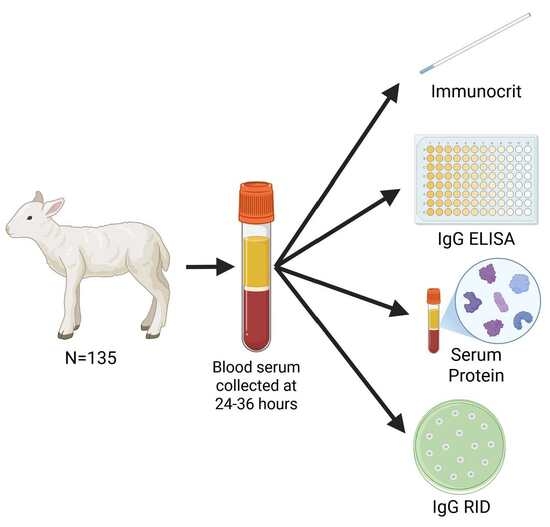
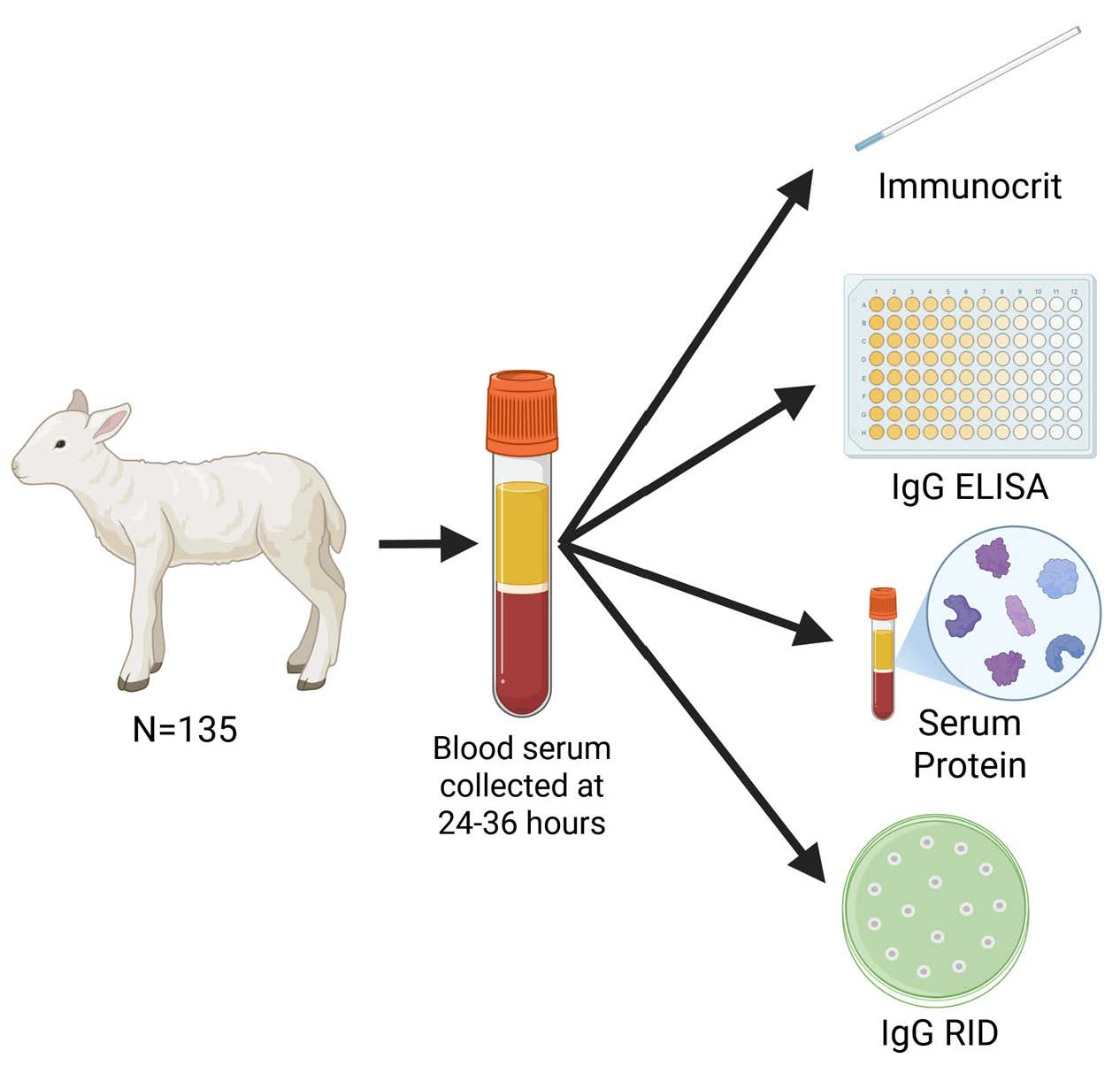
Small ruminants, such as newborn lambs, rely on timely colostrum intake to acquire passive immunity through the absorption of immunoglobulin (Ig). Evaluating Ig transfer is important for ensuring lamb health and survival. However, current methods such as enzyme-linked immunosorbent assay (ELISA) and radial immunodiffusion (RID) are widely used but remain costly and require specialized facilities. The immunocrit assay has been proposed as a lower-cost alternative for evaluating serum Ig concentrations. This study aimed to evaluate the immunocrit method in lambs by comparing it with ELISA, RID, and total serum protein. Serum was collected from 135 Katahdin-Easycare lambs 24–36 h after birth. Samples were analyzed using sheep immunoglobulin G ELISA, Sheep immunoglobulin G RID, serum protein, and the immunocrit method. Pearson’s correlation was used to assess linear relationships between the methods, and Receiver Operating Characteristics (ROC) analysis was used to evaluate test accuracy, with RID as the gold standard (15 mg/mL cutoff). The immunocrit showed a high correlation with RID (r = 0.870), moderate correlation with serum protein (r = 0.725), and good correlation with ELISA (r = 0.607). The ROC analysis showed that the immunocrit had a sensitivity of 100% at a cutoff of 4.34%. These results indicate that the immunocrit method provides comparable accuracy to RID and serum protein, and could serve as a reliable, practical, and inexpensive tool for on-farm evaluation of passive transfer in Katahdin-Easycare crossbred lambs between 24 and 36 h after birth.

Graphical Abstract

1. Introduction

Lambs, like other ruminants, are born agammaglobulinemic because the synepitheliochorial placenta prevents the transfer of maternal immunoglobulins during gestation [1]. Therefore, lambs must consume colostrum immediately after parturition, as it provides essential antibodies from the dam to protect them against disease until their immune system becomes functionally competent. Inadequate colostrum management and consumption lead to reduced immunoglobulin transfer, leaving lambs susceptible to microbial infections. Immunoglobulins G, M, and A have been described in the colostrum of ruminant species [2,3]. However, Immunoglobulin G is present in the greatest concentration in colostrum [4], and it is commonly used as an indicator of colostrum quality in ewes and of proper immune passive transfer (IPT) in lambs [5,6]. IgG is actively transferred into the colostrum from maternal circulation by neonatal Fc receptors in the mammary gland epithelium [7], compared with M and A classes that are synthesized at the mammary gland level [3,8].
Inadequate antibody transfer remains a major challenge in the lamb industry, as reflected by lamb mortality rates that have remained high over the past decades at approximately 8–20% [9,10,11]. Given these challenges, the lambs’ health and survival can be improved by evaluating the effectiveness of the antibody transfer from colostrum to lambs using on-farm diagnostic methods. Enzyme-linked Immunosorbent Assay (ELISA) and Radial Immunodiffusion (RID) are standardized methods widely used in research to evaluate IgG transfer. RID is generally considered the gold standard for antibody measurement in multiple species because it directly measures IgG concentration and requires minimal dilution compared to ELISA [12]. However, these techniques remain too costly for most farm owners and require specialized equipment and personnel. Previous studies have demonstrated strong associations between serum IgG concentrations and the adequacy of passive antibody transfer from ewes to lambs [13,14,15]. Consequently, ELISA and RID are widely accepted as accurate and standardized methods for quantifying immunoglobulin concentrations in the blood of newborn lambs after colostrum consumption [13,14,15].
Initially validated in piglets, the immunocrit method measures the precipitation of immunoglobulins upon exposure to a high concentration of ammonium sulfate [16]. This study developed the immunocrit method by mixing piglet serum with a 40% ammonium sulfate solution, centrifuging the mixture in hematocrit microcapillary tubes, and calculating the immunocrit value by dividing the length of the precipitated immunoglobulin layer by the total length of the sample column within the tube. Protein techniques were then used to analyze the precipitate formed and confirmed that it reliably indicated the quantity of IgG in the blood. After the development of the immunocrit technique in piglets, this technique was validated in foals [17], dairy calves [18], and non-domestic ruminant newborns [19]. Additionally, the immunocrit has been used in research evaluating the influence of multiple sow- and piglet-related traits on passive immune transfer in early development. Studies have examined traits such as litter of origin and colostrum intake to better understand their effects on offspring’s immune status and health outcomes [20,21]. Recently, immunocrit and brix refractometry were evaluated in lambs compared with total serum protein [22]. Although the study demonstrates the correlation and reliability of immunocrit as a field-based method, it was conducted with 13 lambs, and, in addition, total serum protein is not a direct measure of immunoglobulins and is not the standard method for evaluating IPT.
Given previous research, we hypothesized that the immunocrit method is an accurate means of measuring immunoglobulin concentration in Katahdin-Easycare crossbreed lambs during the first 24–36 h after birth, following colostrum intake. The objective of this study was to collect serum samples from one-day-old lambs and to validate the immunocrit method by comparing its effectiveness with commercial ELISA and RID kits, as well as total serum protein measurements, for assessing immunoglobulin concentration and passive immune transfer in the serum of newborn Katahdin-Easycare crossbreed lambs.

2. Materials and Methods

2.1. Ewes and Lambs

All animals and procedures were approved by the Berry College Institutional Animal Care and Use Committee (Protocol # 010-2021). For this study, lambs born from Katahdin-Easycare ewes in Berry College’s flock were utilized. Ewes delivered the lambs naturally without any induction, and once a new birth was located, each ewe and lamb(s) were moved to individual pens to ensure the intake of colostrum. All lambs were naturally reared by their birth ewe without any assistance. Blood samples were collected from a total of 135 lambs (N = 135) within 24–36 h after birth. Out of the 135 lambs sampled, 25.9% (35 lambs) were born of primiparous ewes, and the other 74.1% (100 lambs) were born of multiparous ewes. Moreover, 23.7% (32 lambs) of the lambs were single, 74.1% (100 lambs) were twins, and 0.02% (3 lambs) were triplets at the time of sampling. At the time of the blood sampling, the lambs weighed 8.81 ± 1.75 kg. The number of lambs sampled for this study falls within the smallest and largest sample sizes previously used to validate the immunocrit method in non-domestic ruminants (N = 100; [19]), and in dairy calves (N = 249, [18]), respectively.

2.2. Sample Collection

One 3 mL blood tube (Vacutainer #367981, BD, Franklin Lakes, NJ, USA) was collected from the jugular vein of each lamb 24–36 h after parturition, along with body weights. Blood tubes were allowed to coagulate at room temperature for at least 30 min following collection. Once coagulated, blood was centrifuged at 3500× g for 15 min at 4 °C to ensure proper separation of serum. The serum was then transferred and evenly distributed into two aliquots for the immunocrit, ELISA (ALPCO® Ovine IgG ELISA Kit, Catalog #41-IGGOV-E01, Salem, NH, USA), RID plates (Sheep IgG RID plates, Triple J Farms, Bellingham, WA, USA), and total serum protein. The serum tubes were then stored at −80 °C for further analysis. Each aliquot was thawed once. One aliquot was used simultaneously for ELISA and immunocrit procedures, and the second for serum protein and RID determinations.

2.3. Immunocrit Procedure

The serum samples were thawed at room temperature, and a 40% ammonium sulfate [(NH4)2SO4] solution was prepared following Vallet et al. [7]. Equal parts of serum sample and ammonium sulfate were mixed at 100 µL each to form a precipitate of immunoglobulins. The samples with ammonium sulfate were loaded into non-heparinized capillary tubes (Fisher Scientific, Hampton, NH, USA) in triplicate and centrifuged in a micro-hematocrit (MX12 micro-combo centrifuge, LW Scientific, Lawrenceville, GA, USA) for 15 min at 12,000× g. Once centrifuged, a digital caliper was used to measure the total length of the solution as well as the length of the precipitate. The data from the triplicate measurements were recorded for statistical analysis. Intra-assay coefficient of variation (CV) was calculated for each triplicate data, and the average CV was 3.62%.

2.4. Serum Protein

All samples were allowed to reach room temperature, and 1–2 drops of serum were placed on a refractometer to measure the concentration of serum proteins. Data was measured in triplicates and recorded for statistical analysis. Intra-assay CV were calculated for each triplicate data, and the average CV was 2.86%.

2.5. ELISA Procedure

An initial immunoglobulin G ELISA (ALPCO® Ovine IgG ELISA kit Catalog #41-IGGOV-E01, Salem, NH, USA) was performed to confirm that the manufacturer’s dilution factor of 1:400,000 was optimal for the study serum samples. The kit plates were pre-coated with anti-ovine IgG antibodies, and reagents, including the 1× diluent and wash solution, were prepared according to the manufacturer’s instructions. For each plate run, 39 individual serum samples and one pooled control were thawed and diluted to 1:400,000 using a two-step serial dilution process. Standards were prepared according to the provided Certificate of Analysis, and 100 µL of each standard and diluted sample were pipetted in duplicate into the wells based on a pre-assigned layout. Following incubation at room temperature for 30 min, wells were washed four times and treated with 100 µL of the enzyme-antibody conjugate (horseradish peroxidase), then incubated in the dark for 10 min. After six subsequent washes, 100 µL of TMB substrate was added to each well, and the plate was incubated again in the dark for 10 min. The reaction was stopped with 100 µL of 0.3 M sulfuric acid, and absorbance was measured at 450 nm using a plate reader. The average intra-assay CV was 3.36%, and the inter-assay CV was 13.19%.

2.6. RID Procedure

Radial immunodiffusion (RID) plates and serum samples were brought to room temperature before analysis. Each serum sample was diluted 1:2 with saline, and 5 µL of diluted serum, along with three provided standards, were pipetted into the wells. Plates were then covered and incubated overnight at room temperature on a flat, undisturbed surface. Following incubation, the radius of each precipitate ring was measured using a caliper. For each sample, the radius was measured in triplicate by changing the angle around the RID halo, and the data were recorded for analysis. The three radii per sample were used to calculate the intra-assay CV. The average intra-assay CV was 3.37%.

2.7. Statistical Analysis

The accuracy of the immunocrit method for measuring immunoglobulin levels in one-day-old lambs was investigated by estimating the Pearson’s correlation coefficients ( r y i , y j ) between the pairwise observations ( y i = y i m m u n o c r i t , y s e r u m   p r o t e i n , y E L I S A , y R I D and y j y i ) from the immunocrit, serum protein, ELISA, and RID methods.
r y i , y j = S y i , y j S y i 2 S y j 2
where S y i , y j is the covariance between the pairwise observations ( y i = y i m m u n o c r i t , y s e r u m   p r o t e i n , y E L I S A , y R I D and y j y i ) from the immunocrit, serum protein, ELISA and RID methods, S y i 2 and S y j 2 are the variances for the pairwise observations from the i and j methods, respectively. The Pearson’s correlation coefficient ( r y i , y j ) was interpreted according to Steel et al. [23] and Mukaka [24]: 1.00–0.70 strong biological association; 0.40–0.69 moderate biological meaningful; 0.10–0.39 weak but potentially meaningful; <0.10 negligible or not linear association.
The extent of measurement bias can be judged by comparing the regression of measurements from the serum protein, ELISA, or RID method on measurements from the immunocrit method, with an expected value of 1. Hence, the regression coefficients were calculated using a simple linear regression model:
y i = β 0 + β 1 X i + e i
y i : the measurements from immunocrit method, X i : the measurements from serum protein, ELISA or RID method, β 0 : intercept, β 1 : regression coefficient and e i : the normally distributed residual with the null mean and residual variance of σ e 2 .
The Receiver Operating Characteristics (ROC) analysis was performed to evaluate the classification of samples as sufficient IPT or not by immunocrit, ELISA, and Serum Protein, compared with the gold standard method, RID. The cutoff for the RID was set at 15 g/L of IgG as described by previous authors [5,13,25]. The ROC analysis calculated the cutoff concentration, sensitivity, and area under the curve (AUC) for all the methods. These analyses were performed using R-project software 4.5.2 [26].

3. Results and Discussion

3.1. Lamb Serum Evaluation

A total of 135 lambs were sampled once between 24 and 36 h after birth. All 135 samples were analyzed using immunocrit and serum protein spectroscopy. The immunocrit readings averaged 15.58 ± 4.97% and ranged from 1.19 to 22.75%. The average was similar to that previously reported in 24 h-old lambs (12.5 ± 4.97%; [22]); however, they did not describe the immunocrit range. The range of immunocrit values was slightly higher than that reported in foals, which ranged from 4 to 19%, likely reflecting species differences and the later sampling window used in lambs compared with the 10 to 14 h post-suckling window described in foals [17]. The serum protein averaged 6.81 ± 1.40 g/dL and ranged from 3.60 to 10.20 g/dL. Of the 135 total samples, IgG was measured in 125 using the ELISA method. The average IgG concentration was 54.78 ± 30.07 mg/mL, with a range of 1.14 to 125.34 mg/mL. All 10 missing data points showed a color signal above the highest standards in the ELISA. A total of 131 samples were measured with the RID method. The IgG RID results averaged 45.82 ± 12.71 mg/mL, ranging from 4.30 to 67.96 mg/mL. All four missing samples lacked a visible ring. Those samples were also low in the three other methods (<1.95% in the immunocrit, <4.41 g/dL in the serum protein, <8.69 mg/mL in the ELISA). Compared to RID, the immunocrit method has a wider dynamic range, especially for low-concentration samples. In a non-domestic ruminant neonate study, similarities were observed. RID could not quantify IgG concentrations below 196 mg/dL (1.96 mg/mL), while immunocrit values continued to vary numerically in those same samples [19].

3.2. Correlation Analysis

The correlation analysis showed a strong association between the immunocrit and the RID (r = 0.870; Table 1), and the immunocrit with the serum protein (r = 0.725); meanwhile, the immunocrit was moderately associated with ELISA results (r = 0.607). The RID data were strongly associated with the serum protein data (r = 0.829). Furthermore, the ELISA data were only moderately associated with the RID (r = 0.489) and with serum protein data (r = 0.486). The correlation between immunocrit and RID in lambs was greater than the correlations found in dairy calves (r = 0.71; [18]). Moreover, the immunocrit-RID correlation closely aligned with the correlation between immunocrit and agarose gel electrophoresis reported in foals (r = 0.871; [17]). Comparable diagnostic performance was also observed in non-domestic ruminants, further emphasizing the utility of immunocrit across species in evaluating immunoglobulin concentration in serum. IgG is specifically precipitated by ammonium sulfate; however, when used for IgG purification, previous authors have reported that other proteins from the sample matrix are trapped within the IgG precipitate [27]. The trapped proteins could introduce variability in immunocrit pellet size, which explains why the correlation coefficient between immunocrit and RID was lower than 1.00. In addition, Martins and Raimondo [22] found a high correlation (r = 0.893) between the serum protein concentrations and immunocrit values in a sample of 13 lambs.
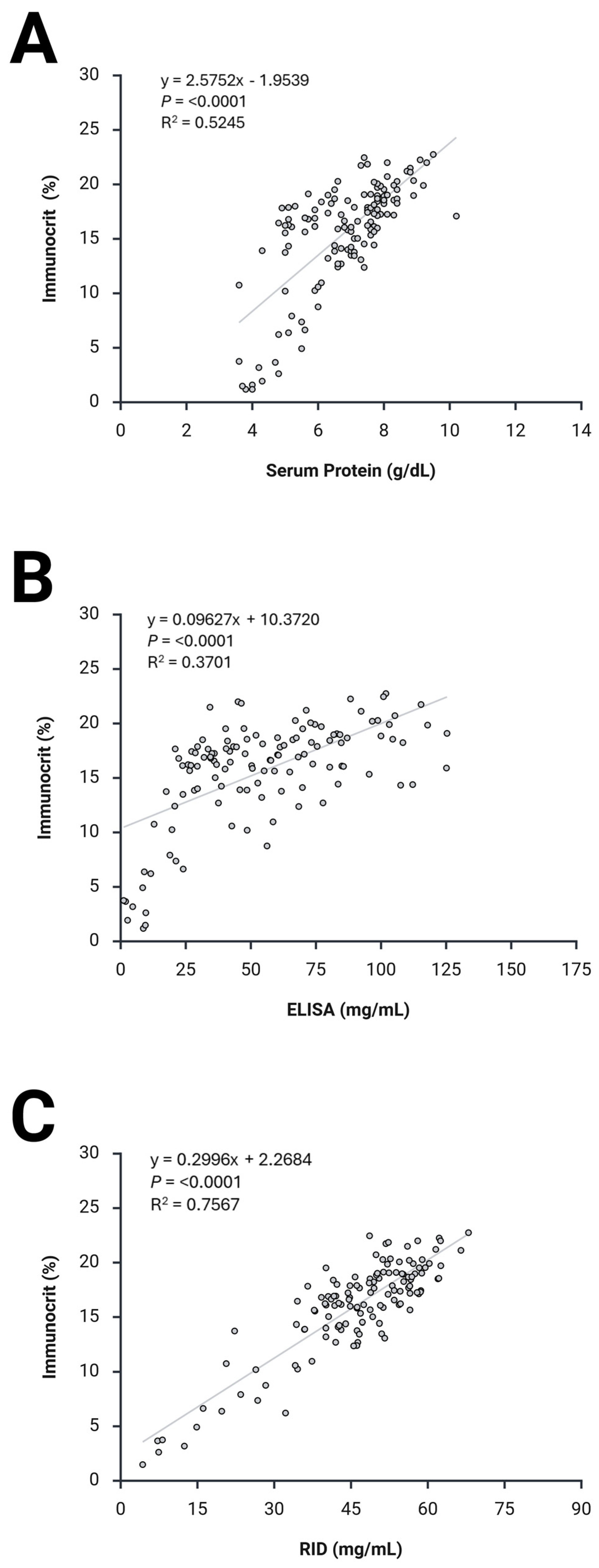
The linear regression plots show a good regression coefficient (r2) when immunocrit data are compared with the serum protein (r2 = 0.525, Figure 1A) and RID (r2 = 0.757, Figure 1C). However, the immunocrit-ELISA plot (Figure 1B) shows a weak fit to the linear model (r2 = 0.370). Most ELISA data at higher concentrations did not match the highest immunocrit values, and the scatter plot distribution showed a polynomial shape. Direct ELISAs have a limited dynamic range or a range in which results remain linearly distributed [28]. This reality is a disadvantage when the target has a wide range of concentrations, such as IgG in lamb serum. For this ELISA, the samples were diluted 1:400,000 times. This dilution factor was the manufacturer’s recommended dilution, corroborated by testing a series of pooled samples in a serial dilution and observing that the optical density values fell within the standard curve optical density. Even after this initial troubleshooting, 10 of the samples were more concentrated than the highest standard concentration. These out-of-range samples were not retested at higher dilutions to minimize the added variability introduced by results from samples at different dilutions. However, the authors are aware that excluding high-concentration IgG values contributes to this technique’s lower performance compared to the other three.

3.3. ROC Analysis

The ROC analysis identified an immunocrit cutoff of 4.34%, corresponding to 15.48 g/L determined by RID (Table 2). At this cutoff, the immunocrit achieved a sensitivity and AUC of 1.00 when compared with RID, indicating excellent discriminatory performance within the present dataset. Sensitivity measures how well a technique identifies true positives, i.e., correctly identifies animals with proper immunoglobulin uptake. In the case of IPT, the high sensitivity means the immunocrit can accurately identify lambs with proper immunoglobulin uptake, thereby reducing the risk of misdiagnosing IPT failure. In dairy calves, the immunocrit cutoff was determined to be 11% based on a serum IgG concentration of 10 mg/mL, measured by RID, with a sensitivity of 88% at this cutoff [18]. In non-domestic ruminants, the immunocrit was compared to RID, and the cutoff was set at 14% immunocrit with a maximum sensitivity of 88.6% [19]. Finally, in foals, the immunocrit cutoff was set at 9.5%; however, this cutoff was determined based on an 8 g/L reference cutoff using immunoglobulin gel agarose electrophoresis rather than RID [17]. In this same species, the immunocrit sensitivity was 94%. In the present research, the cutoffs for the serum protein and ELISA were 5.40 g/dL and 9.57 g/L, respectively. These two methods showed lower sensitivity and AUC than the immunocrit (Table 2). Based on our results and previous authors’ work with other species, the immunocrit method is a reliable and accurate method for measuring immunoglobulins in lamb serum.

3.4. Method Application and Study Limitations

The essential instrument for the immunocrit method is a centrifuge capable of holding hematocrit tubes at 12,000× g. These types of centrifuges are accessible and do not require any prior technical training for use. Veterinarians, consultants, and operations managers should be able to replicate the conditions described in this study and even train others in the procedure. For this study, a digital caliper was used to increase measurement accuracy; however, this instrument is not strictly required, and any conventional caliper or hematocrit ruler can be used. The benefits of the immunocrit compared to the ELISA or RID include its cost-effectiveness, the small sample volume required, and its fast turnaround [18]. The centrifuge and the instrument for measuring the precipitate length are the only initial investments required to perform the immunocrit procedure.
The current study was conducted on Katahdin-Easycare crossbred lambs, and samples were collected between 24 and 36 h after birth. The 12 h window selected for this study could help with the application of the findings to real-world practice. This time frame could count for lambs born during the absence of the operation’s personnel. If lambing is monitored every 8 to 12 h, all lambs should be able to be sampled within 24–36 h after birth, and the proposed immunocrit cutoff could be used to evaluate IPT.
In the present study, we propose an immunocrit cutoff of 4.34% to evaluate IPT in one-day-old Katahdin-Easycare crossbred lambs. The immunocrit technique has been studied across species and shown to be highly correlated with other methods that measure immunoglobulin G, such as RID, SDS-PAGE, and agarose gel electrophoresis [16,17,18,19]. Based on species and sampling time, different cutoffs have been determined. However, no study has examined differences in immunocrit cutoffs between breeds within the same species or between samples at various time points after birth. Consequently, when evaluating IPT in a herd, these two factors should be considered. Moreover, this study does not explore the relationship between immunocrit and health, morbidity, or survival indicators in newborn lambs. Future studies should expand the application of the immunocrit across different sheep breeds and at multiple time points after birth, and correlate immunocrit levels with health indicators.

4. Conclusions

This study demonstrates that the immunocrit is a reliable and practical method for evaluating IPT in Katahdin-Easycare lambs sampled between 24 and 36 h after birth. The immunocrit showed a strong agreement with the RID, the reference method for IgG quantification in serum, and had a slightly better association than the serum protein, another on-farm method used to evaluate IPT. The ELISA method did not perform as well as expected when compared to the other three methods. The immunocrit’s wide dynamic range, particularly at low IgG concentrations, allows discrimination of lambs with inadequate immunoglobulin uptake.
Beyond diagnostic performance, the immunocrit offers several practical advantages, such as rapid turnaround and minimal technical requirements. The features make it well suited for on-farm use by veterinarians, consultants, or flock managers, where timely assessment of passive transfer of immunity in lambs is critical for early interventions to improve lamb health and survivability.

Author Contributions

Conceptualization, A.L. and A.S.-T.; Methodology, A.L., A.B., T.L. and A.S.-T.; Investigation, A.L., A.B., T.L. and A.S.-T.; Data Curation, A.L., H.G.P., S.O.P. and A.S.-T.; Writing—Original Draft Preparation, A.L., H.G.P. and A.S.-T.; Writing—Review and Editing, A.L., H.G.P., A.B., T.L., S.O.P., A.N.A. and A.S.-T.; Visualization, H.G.P., S.O.P. and A.S.-T.; Supervision, A.N.A. and A.S.-T.; Funding Acquisition, A.L. and A.S.-T. All authors have read and agreed to the published version of the manuscript.

Funding

This work was funded by the Richards Undergraduate Research Grant (RUG 21-22-03) awarded by Berry College’s Office of Undergraduate Research.

Institutional Review Board Statement

The animal study protocol was approved by the Institutional Animal Care and Use Committee of Berry College (010-2021, approved on 28 November 2021).

Informed Consent Statement

Not applicable.

Data Availability Statement

Dataset available on request from the authors.

Acknowledgments

The authors acknowledge the support of Berry College’s Sheep Unit in providing the space and animals used in the study.

Conflicts of Interest

The authors declare no conflicts of interest.

Abbreviations

The following abbreviations are used in this manuscript:
ELISAEnzyme-Linked Immunosorbent Assay
IPTImmune Passive Transfer
IgGImmunoglobulin G
RIDRadial Immunodiffusion
ROCReceiver Operating Characteristics

References

  1. Hernández-Castellano, L.E.; Suárez-Trujillo, A.; Martell-Jaizme, D.; Cugno, G.; Argüello, A.; Castro, N. The effect of colostrum period management on BW and immune system in lambs: From birth to weaning. Animal 2015, 10, 1672–1679. [Google Scholar] [CrossRef]
  2. Castro, N.; Capote, J.; Bruckmaier, R.M.; Argüello, A. Management effects on colostrogenesis in small ruminants: A review. J. Appl. Anim. Res. 2011, 39, 85–93. [Google Scholar] [CrossRef]
  3. Butler, J.E. Bovine Immunoglobulins: A Review. J. Dairy Sci. 1969, 52, 1895–1909. [Google Scholar] [CrossRef]
  4. Geiger, A.J. Colostrum: Back to basics with immunoglobulins. J. Anim. Sci. 2020, 18, S126–S132. [Google Scholar] [CrossRef]
  5. Hamer, K.; Bellingham, M.; Evans, N.P.; Jones, R.O.; Denholm, K.S. Defining optimal thresholds for digital Brix refractometry to determine IgG concentration in ewe colostrum and lamb serum in Scottish lowland sheep flocks. Prev. Vet. Med. 2023, 218, 105988. [Google Scholar] [CrossRef] [PubMed]
  6. Akköse, M.; Özbeyaz, C.; Buczinski, S.; Gündoğar, U.; Ünal, N. Determination of the Reliability and Accuracy of the Brix Refractometer for the Detection of Colostrum Quality in Sheep. Vet. Med. Sci. 2025, 11, e70433. [Google Scholar] [CrossRef] [PubMed]
  7. Farooq, U.; Ahmed, S.; Liu, G.; Jiang, X.; Yang, H.; Ding, J.; Ali, M. Biochemical properties of sheep colostrum and its potential benefits for lamb survival: A review. Anim. Biotechnol. 2023, 35, 2320726. [Google Scholar] [CrossRef]
  8. Larson, B.L.; Heary, H.L.; Devery, J.E. Immunoglobulin production and transport by the mammary gland. J. Dairy Sci. 1980, 63, 665–671. [Google Scholar] [CrossRef]
  9. Flinn, T.; Kleemann, D.O.; Swinbourne, A.M.; Kelly, J.M.; Weaver, A.C.; Walker, S.K.; Gatford, K.L.; Kind, K.L.; van Wettere, W.H.E.J. Neonatal lamb mortality: Major risk factors and the potential ameliorative role of melatonin. J. Anim. Sci. Biotechnol. 2020, 11, 107. [Google Scholar] [CrossRef]
  10. Rowland, J.P.; Salman, M.D.; Kimberling, C.V.; Schweitzer, D.J.; Keefe, T.J. Epidemiologic factors involved in perinatal lamb mortality on four range sheep operations. Am. J. Vet. Res. 1992, 53, 262–267. [Google Scholar] [CrossRef]
  11. Binns, S.H.; Cox, I.J.; Rizvi, S.; Green, L.E. Risk factors for lamb mortality on UK sheep farms. Prev. Vet. Med. 2002, 52, 287–303. [Google Scholar] [CrossRef] [PubMed]
  12. de Souza, R.S.; Dos Santos, L.B.C.; Melo, I.O.; Cerqueira, D.M.; Dumas, J.V.; Leme, F.O.P.; Moreira, T.F.; Meneses, R.M.; de Carvalho, A.U.; Facury-Filho, E.J. Current Diagnostic Methods for Assessing Transfer of Passive Immunity in Calves and Possible Improvements: A Literature Review. Animals 2021, 11, 2963. [Google Scholar] [CrossRef]
  13. Alves, A.C.; Alves, N.G.; Ascari, I.J.; Junqueira, F.B.; Coutinho, A.S.; Lima, R.R.; Pérez, J.R.O.; De Paula, S.O.; Furusho-Garcia, I.F.; Abreu, L.R. Colostrum composition of Santa Inês sheep and passive transfer of immunity to lambs. J Dairy Sci. 2015, 98, 3706–3716. [Google Scholar] [CrossRef]
  14. Maden, M.; Altunok, V.; Birdane, F.M.; Aslan, V.; Nizamlioglu, M. Blood and colostrum/milk serum γ-glutamyltransferase activity as a predictor of passive transfer status in Lambs. J. Vet. Med. 2003, 50, 128–131. [Google Scholar] [CrossRef]
  15. Britti, D.; Massimini, G.; Peli, A.; Luciani, A.; Boari, A. Evaluation of serum enzyme activities as predictors of passive transfer status in Lambs. J. Am. Vet. Med. Assoc. 2005, 226, 951–955. [Google Scholar] [CrossRef]
  16. Vallet, J.L.; Miles, J.R.; Rempel, L.A. A simple novel measure of passive transfer of maternal immunoglobulin is predictive of preweaning mortality in piglets. Vet. J. 2013, 195, 91–97. [Google Scholar] [CrossRef]
  17. Mortola, E.; Miceli, G.; Alarcon, L.; Azcurra, M.; Larsen, A. Assessment of the immunocrit method to detect failure of passive immunity in newborn foals. Equine Vet. J. 2020, 52, 760–764. [Google Scholar] [CrossRef]
  18. Thompson, K.A.; Rayburn, M.C.; Chigerwe, M. Evaluation of the immunocrit method to detect failure of passively acquired immunity in dairy calves. J. Am. Vet. Med. Assoc. 2017, 251, 702–705. [Google Scholar] [CrossRef]
  19. Thompson, K.A.; Lamberski, N.; Rayburn, M.; Chigerwe, M. Validation of immunocrit as a diagnostic test to detect failure of passive transfer of immunity in hand-reared non-domestic ruminant neonates. J. Zoo Wildl. Med. 2019, 50, 627–633. [Google Scholar] [CrossRef] [PubMed]
  20. Vallet, J.L.; Miles, J.R.; Rempel, L.A.; Nonneman, D.J.; Lents, C.A. Relationships between day one piglet serum immunoglobulin immunocrit and subsequent growth, puberty attainment, litter size, and lactation performance. J. Anim. Sci. 2015, 93, 2722–2729. [Google Scholar] [CrossRef] [PubMed]
  21. Vallet, J.L.; Calderón-Díaz, J.A.; Stalder, K.J.; Phillips, C.; Cushman, R.A.; Miles, J.R.; Rempel, L.A.; Rohrer, G.A.; Lents, C.A.; Freking, B.A.; et al. Litter-of-origin trait effects on gilt development. J. Anim. Sci. 2016, 94, 96–105. [Google Scholar] [CrossRef] [PubMed]
  22. Martins, A.L.; Raimondo, R.F.E.S. Evaluation of field-based diagnostic methods for assessing passive immune transfer in neonatal lambs. Vet. Immunol. Immunopathol. 2026, 291, 111034. [Google Scholar] [CrossRef] [PubMed]
  23. Steel, R.G.D.; Torrie, J.H.; Dickey, D.A. Principles and Procedures of Statistics: A Biometrical Approach, 3rd ed.; McGraw-Hill: New York, NY, USA, 1997. [Google Scholar]
  24. Mukaka, M.M. Statistics corner: A guide to appropriate use of correlation coefficient in medical research. Malawi Med. J. 2012, 24, 69–71. [Google Scholar] [PubMed]
  25. Sjoberg, A.; Van Suan, R. Assessment of lamb passive transfer. Am. Assoc. Bov. Pract. Conf. Proc. 2021, 54, 274. [Google Scholar]
  26. R Core Team. R: A Language and Environment for Statistical Computing; R Foundation for Statistical Computing: Vienna, Austria, 2022; Available online: https://www.R-project.org/ (accessed on 27 October 2025).
  27. Fishman, J.B.; Berg, E.A. Ammonium Sulfate Fractionation of Antibodies. Cold Spring Harb. Protoc. 2018, 2018, 472–474. [Google Scholar] [CrossRef]
  28. Aydin, S.; Emre, E.; Ugur, K.; Aydin, M.A.; Sahin, İ.; Cinar, V.; Akbulut, T. An overview of ELISA: A review and update on best laboratory practices for quantifying peptides and proteins in biological fluids. J. Int. Med. Res. 2025, 53, 3000605251315913. [Google Scholar] [CrossRef]
Figure 1. Scatter plot representation of the regression analysis between immunocrit method and Serum Protein (A), ELISA (B), and RID (C).
Ruminants 06 00010 g001
Table 1. Correlation analysis comparing all four methods to evaluate the immune passive transfer in one-day old lambs.
Test Result Variable(s)ImmunocritSerum ProteinELISARID
Immunocritr10.7250.6070.87
p-value<0.001<0.001<0.001<0.001
n135135125131
Serum Proteinr0.72510.4860.829
p-value<0.001<0.001<0.001<0.001
n135135125131
ELISAr0.6070.48610.489
p-value<0.001<0.001<0.001<0.001
n125125125123
RIDr0.870.8290.4891
p-value<0.001<0.001<0.001<0.001
n131131123131
Table 2. ROC analysis results, including the test thresholds corresponding to a proper Immune passive transfer, and the sensitivity and specificity of the tests.
Test Result Variable(s)CutoffUnitsSensitivitySpecificityAUC
Immunocrit4.34%10.8331
Serum Protein5.4g/dL0.8530.8330.964
ELISA9.57g/L0.9910.8330.997
RID15.48g/L111
Disclaimer/Publisher’s Note: The statements, opinions and data contained in all publications are solely those of the individual author(s) and contributor(s) and not of MDPI and/or the editor(s). MDPI and/or the editor(s) disclaim responsibility for any injury to people or property resulting from any ideas, methods, instructions or products referred to in the content.