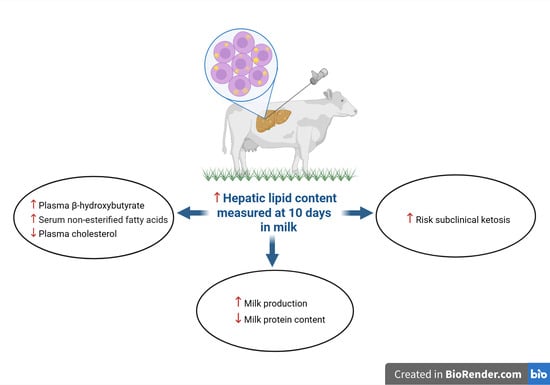
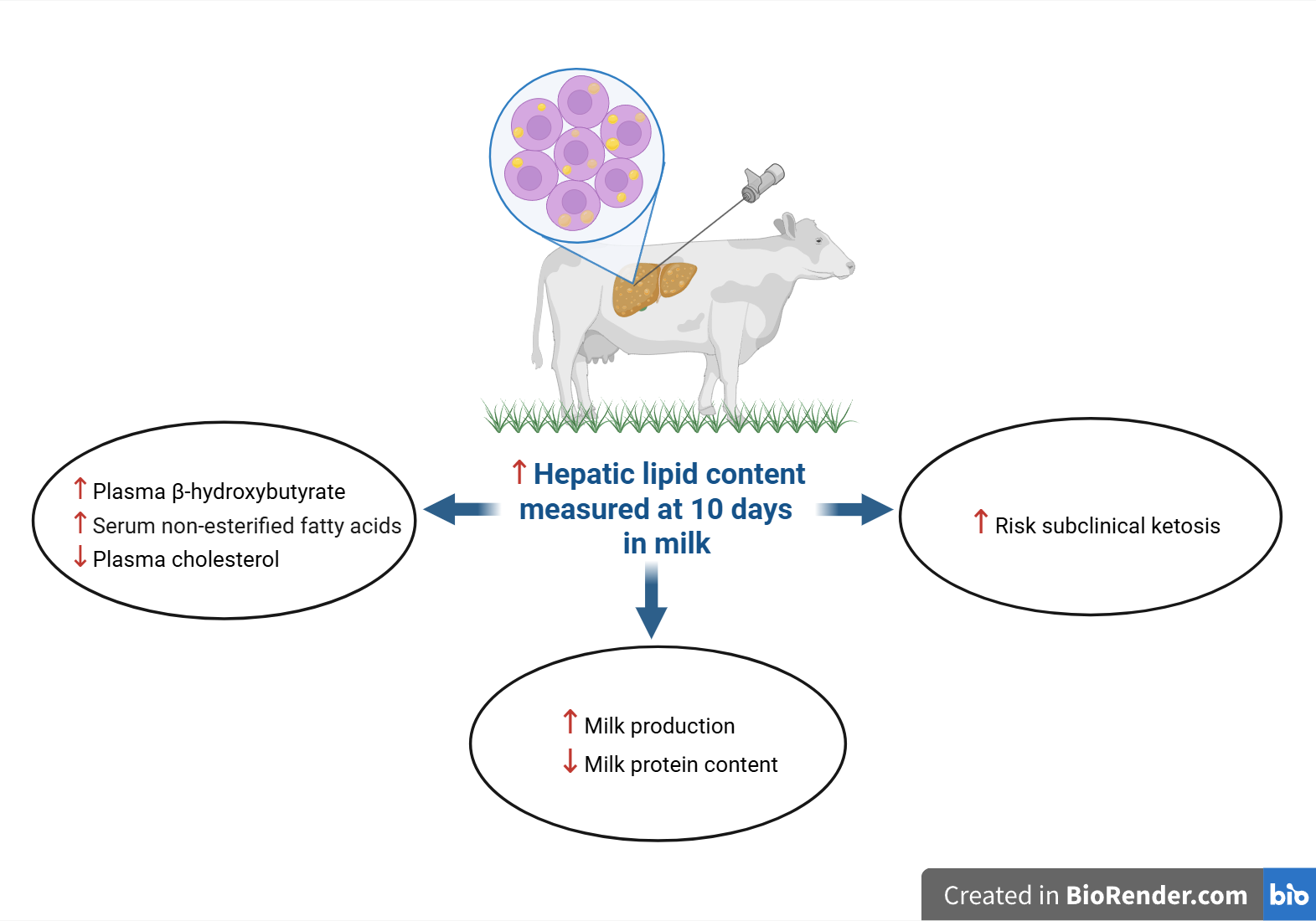
This longitudinal study was conducted during two consecutive spring calving seasons at the Austral Agricultural Research Station, at Universidad Austral de Chile, in the city of Valdivia (39°47046″ S, 73°13013″ W). The experiment was approved by the Animal Care and Use Committee of the Universidad Austral de Chile (Protocol N° 459, 23 May 2022), and all procedures were performed in accordance with the farm’s management. The dairy herd was managed under standard grazing conditions in Southern Chile over two calving seasons: autumn (February to April) and spring (July to September).
2.1. Animal Handling and Study Design
This study was an extension of our previous work supporting fine needle biopsy (FNB) cytology as a practical, minimally invasive addition to the diagnostic toolkit for herd management [
16]. Because the study objective was to evaluate the relationship between HLC at 10 DIM and a spectrum of clinicoeconomically relevant outcomes (metabolic status, health, production), we enrolled the maximum possible number of cows from our grazing herd, instead of calculating the number of samples required to demonstrate a statistically significant difference for a particular metric. The assumptions considering the hypotheses α (two-tailed) = 0.05, β = 0.20, r = 0.27 were used.
A total of 105 Holstein Friesian primiparous (PP) and multiparous (MP) cows were included in this study, corresponding to two cohorts from 2022 (12 PP and 48 MP; year 1) and 2023 (17 PP and 28 MP; year 2), which calved during the spring calving season. Parity was 3 [
1,
2,
3,
4,
5], and body condition score was 3.5 [3.25–3.5] (median [interquartile range; IQR]) at calving. Body weight was 497 ± 71.6 kg (mean ± standard deviation; SD) at 10 days in milk (DIM). A clinical examination of each cow was conducted at the time of enrollment, three weeks prior to the expected calving date. Only clinically healthy cows were included.
Pre-partum cows were housed in a paddock without pasture (i.e., a bare soil surface paddock) with 8.2 cows/ha as the stocking rate. The study subject received grass silage, commercial concentrate with anionic salts (
Table 1), and fresh water supplied
ad libitum from a water trough. Cows were calved in the same place where they were managed and, subsequently, transferred to the lactation group. Cows were milked twice a day, at 05:00 and 14:00 h, in a milking parlor, at which time they were fed 5 kg/cow/day of commercial concentrate. After milking, cows were moved to a feedyard and fed 16 kg DM/cow/day of grass silage (
Table 1) when the pasture was not available. Afterward, cows were moved to a pasture in a rotational grazing system and remained there until the next milking. In months when the pasture was abundant (September), cows grazed over an area of 2 ha/day of pasture with a fresh grass intake composed of mixed species of grasses (mainly
Lolium perenne,
Bromus sp., and
Dactylis glomerata L.) and legumes (
Trifolium repens and
Trifolium pratense) at a rate of approximately 12.5 kg DM/day.
2.2. Liver Fine Needle Biopsy Procedure, Sample Processing, and Cytological Analysis
Each cow was positioned in a cattle handling chute and maintained in a partially immobilized state through a head-locking mechanism. A liver FNB was performed in the right eleventh intercostal space [
17,
18]. First, a trichotomy was carried out within a radius of three to five cm from the estimated puncture site, followed by an ultrasound confirmation using a 2.5 MHz micro-linear transducer to pinpoint the exact location of the puncture. The image with the fewest blood vessels was considered adequate. Second, a surgical antisepsis was performed, involving alternating three applications of 70° alcohol and three applications of povidone–iodine. Then, local anesthesia was induced via subcutaneous injection of 1 mL of Bupivacaine hydrochloride (Richmond Vet Pharma, Buenos Aires, Aregentina) administered above the FNB site. Later, a small incision of less than 1 cm was carefully made through the skin with a scalpel to reach the subcutaneous space. An 18G × 3.5″ spinal needle (NIPRO
®, Osaka, Japan) was inserted toward the left scapulohumeral joint, passing through intercostal muscles and peritoneum until reaching the liver (2.5″ of the needle). A stylet was subsequently removed to allow for complete needle insertion, which was then partially withdrawn and slightly redirected to obtain tissue from a different area, and the needle was fully reinserted a maximum of 3 times to obtain the sample. After the needle was removed, the incision was treated with a topical antiseptic. Two trained veterinarians carried out all procedures, which took a mean of 3′54″(±0.02) min per cow.
After completing the FNB, the needle was connected to a syringe containing at least 5 mL of air to gently eject the sample onto a glass slide. The sample was then smoothly spread between two slides, dried at room temperature, and identified using the last four digits of each cow’s official individual identification device. Later, it was stained using Hemacolor (Merck Chemicals, Darmstadt, Germany) and evaluated via cytological analysis by a trained observer to determine the HLC. The HLC was scored from 0 to 4 according to an ordinal scale proposed by Fry et al. [
16]. This scoring system considers the estimated percentage of hepatocytes with cytoplasmic vacuolation and the mean percentage of the cytoplasm occupied by the lipid vacuoles. For the present study, HLC was categorized as mild (score ≤ 1), moderate (score = 2), or severe (score ≥ 3).
2.3. Blood Sampling and Analysis
The pre-partum sampling scheme was established according to the estimated calving date. During the pre-partum period (3 weeks before calving), blood samples were obtained from each cow once a week, on days −18 (±2), −11 (±2), and −4 (±2) relative to calving. Blood samples were collected within 24 h after calving and then at 6 or 7, 10 (±2), and 19 (±1) days after calving. Samples were obtained via coccygeal venipuncture between 08:00 and 09:00 h using sterile vacuum tubes with heparin and without additives. Serum and plasma were extracted within the next hours and later stored in microtubes at −20 °C for subsequent analysis. Commercial reagents were used for metabolite analysis. The serum NEFA concentration (NEFA, Randox Laboratories, Crumlin, Ireland), plasma BHB concentration (RANBUT, Randox Laboratories), cholesterol (Cholesterol liquicolor, Human Laboratories, Wiesbaden, Germany), and total calcium concentration (Ca-Color Arsenazo III AA, Wiener Lab, Rosario, Argentina) were measured using a Metrolab 2300 autoanalyzer (Metrolab S.A., Rosario, Argentina). The magnesium concentration was determined at 285.2 nm using an atomic absorption spectrophotometer (Thermo®, Series AA Solaar, Whaltam, MA, USA). All analyses were performed at the Veterinary Clinical Pathology Laboratory of Universidad Austral de Chile.
2.4. Health Status Assessment
On the day of calving and the day after, each cow was monitored for retained fetal membranes and clinical hypocalcemia. Then, from day 3 to day 14 after calving, with an interval of 3 to 4 days between visits, each animal was clinically examined for the diagnosis of metritis and lameness. In addition, blood concentrations of total calcium, magnesium, and BHB, obtained from the four blood samples per animal in the postpartum period, were used for the diagnosis of hypocalcemia, hypomagnesemia, and subclinical ketosis. All health checks were performed by two trained veterinarians. To monitor clinical mastitis cases, the milker assessed each cow twice daily at the beginning of each milking from calving to 21 DIM.
Clinical and puerperal metritis, defined according to Sheldon et al. [
19], were determined via vaginal examination with the metricheck
® (Hamilton, New Zealand) device and rectal temperature evaluation according to Huzzey et al. [
20]. After cleaning and disinfection of the vulva with 10% iodine solution, the device was introduced into the vaginal cavity up to the cervix to collect vaginal discharge (VD), which was evaluated and classified according to appearance and odor into 5 categories: VD= 0 with clear mucus or no discharge; VD = 1 with bloody mucus or pus foci; VD = 2 with <50% pus, plus foul odor with or without fever; VD = 3 with >50% pus, plus foul odor with or without fever; and VD = 4 with a brownish/reddish discharge, plus putrid foul odor. The absence of metritis was considered when a cow presented a VD ≤ 1; clinical metritis when a cow presented a VD = 2 or 3 at least once but never a VD of 4, and puerperal metritis when a cow presented a VD = 4 at least once.
Lameness was evaluated according to the 0 to 3 ordinal scoring system for mobility described by Reader et al. [
21]. Mobility scores 0, 1, 2 and 3 were considered sound, imperfect, impaired, and severely impaired, respectively. For data analysis, each cow was assigned to the highest mobility score it received during the evaluation period.
Retained fetal membranes was described as the incapacity to expel fetal membranes within 12 to 24 h after delivery [
22]. Furthermore, clinical puerperal hypocalcemia was defined as any cow in recumbency whose serum calcium concentration was less than 2.0 mmol/L after calving [
23]. Finally, clinical mastitis was determined as the presence of clinical signs, such as abnormal milk or swelling in 1 or more quarters [
24], detected and recorded at milking.
Subclinical hypocalcemia was defined as a serum calcium concentration < 2.15 mmol/L within the first 24 h postpartum [
25], while subclinical hypomagnesemia and subclinical ketosis were defined as a magnesium concentration ≤ 0.65 mmol/L [
26] and a BHB concentration ≥ 1.2 mmol/L [
27], respectively, in at least 1 of the 3 postpartum blood samples. The diagnosis of each of these conditions was based on the absence of clinical signs.
2.7. Statistical Analysis
Two cows, both MP, were removed from this study due to insufficient hepatocytes in the FNB sample for cytologic evaluation. Therefore, the final sample amount was 103 animals (29 PP, 74 MP). However, data on blood metabolites during the pre-partum period were incomplete for all animals. At week −3, −2, and −1, 77, 95, and 97 cows were sampled, respectively. In the case of repeated measurements, only those cows for which all the requisite measures were available were included in the analysis for each variable.
Linear mixed models (2) were employed to ascertain the relationship between HLC and the response variables: BHB (postpartum, n = 103), NEFAs (pre-partum, n = 102; postpartum, n = 103), cholesterol (pre-partum, n = 102; postpartum, n = 103), milk protein percentage (n = 95), milk fat percentage (n = 95), and cumulative milk production (n = 96). The full model considered the degree of HLC (mild, moderate, and severe; G), year (1 and 2; Ye), parity (primiparous and multiparous; Par), month of calving (July, August, and September; MC), sampling (Samp), and body condition score at calving (5-point scale, [
29]; BCSC). Three interaction terms were also included: HLC × parity (G × Par), HLC × month of calving (G × MC), and HLC × week of sampling (G × Samp). All fixed effects were fitted, with cow nested within HLC group included as a random effect. Additionally, the presence of ketosis during the postpartum transition period was incorporated into the milk fat model.
The models were submitted to stepwise backward elimination, with non-significant factors removed. The final model was selected based on the lowest Akaike information criterion. The distribution of the residuals was then assessed through histograms and Q-Q plots. Since the residuals for the NEFAs, NEFA/cholesterol ratio, cholesterol, and BHB variables did not follow a normal distribution, a natural logarithmic transformation was applied. However, this transformation did not alter the significance of the estimated effects or the interpretation of the results. Therefore, to preserve the original scale of the estimates (β coefficients), the results were reported using the untransformed data. Lactation Wilmink curve parameters (n = 82), days at peak (n = 82), and milk yield at peak (n = 82) were analyzed using linear regression models, considering HLC degree, parity, and month of calving as fixed factors.
Regarding the health status-related analysis, the data were transformed into binary responses of “presence = 1” and “absence= 0” for clinical and subclinical disease. Due to the low frequency of clinical diseases, such as retained fetal membranes, mastitis, hypocalcemia, and severe lameness, they were not subjected to statistical evaluation. The presentation of clinical (clinical and puerperal metritis, n = 103 each) and subclinical diseases (hypomagnesemia, n = 103; ketosis, n = 103; and hypocalcemia, n = 102) was analyzed using logistic regression models, in which year, parity, body condition score at calving, month of calving, and HLC were included as explanatory variables. Model selection was performed using the backward elimination method, comparing the models using the likelihood ratio test.
p-values < 0.05 were considered statistically significant. All analyses were performed using the latest version of RStudio (RStudio 4.4.1 ver. R Foundation for Statistical Computing.
www.r-project.org. Vienna, Austria).



 ,
,