

Evaluating AI Integration Maturity in Architectural Practices in the Kurdistan Region, Iraq: A Comparative Benchmark Study


Abstract
1. Introduction
2. Literature Review
2.1. Architectural Practice and Digital Change in the Kurdistan Region
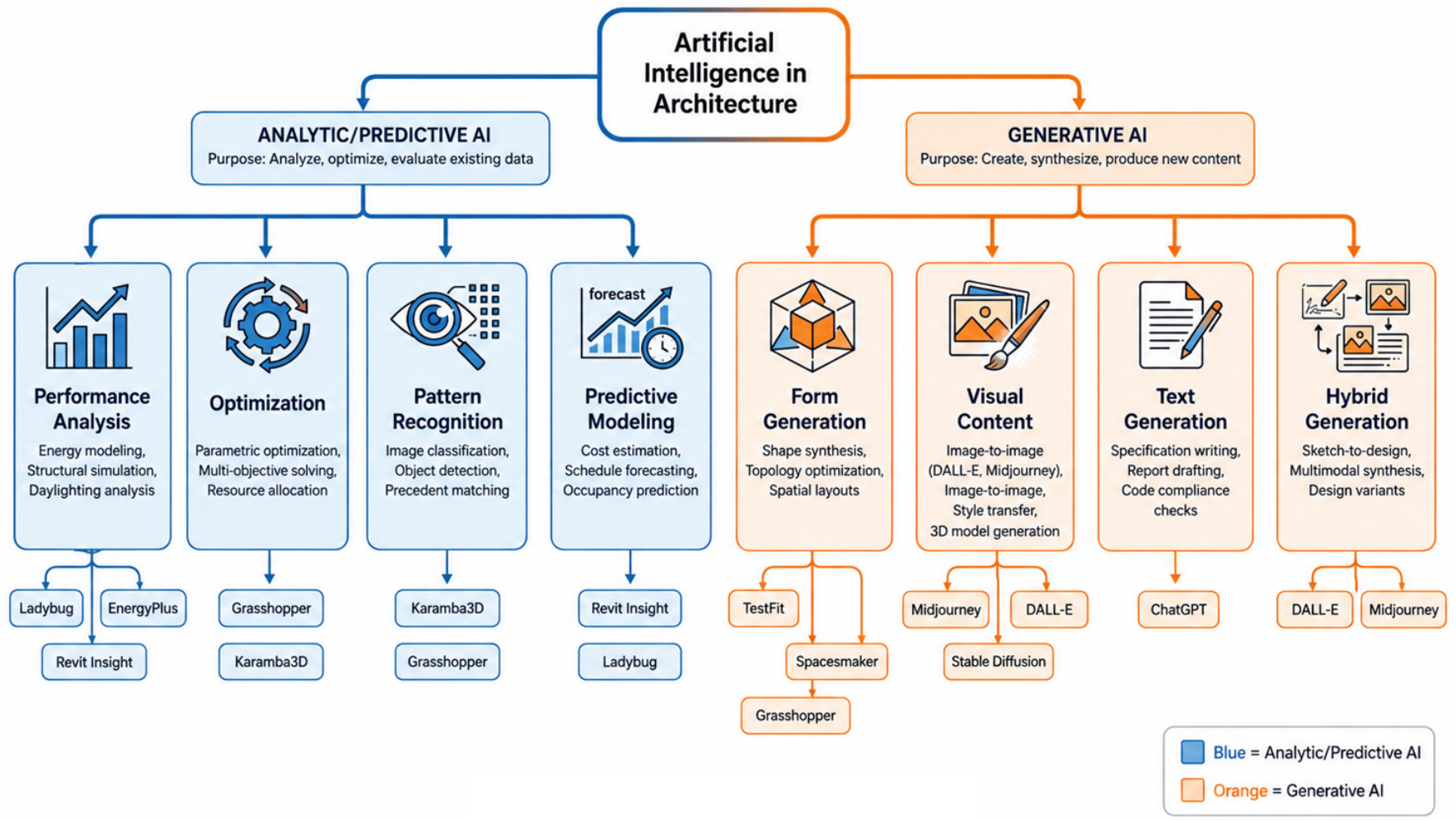
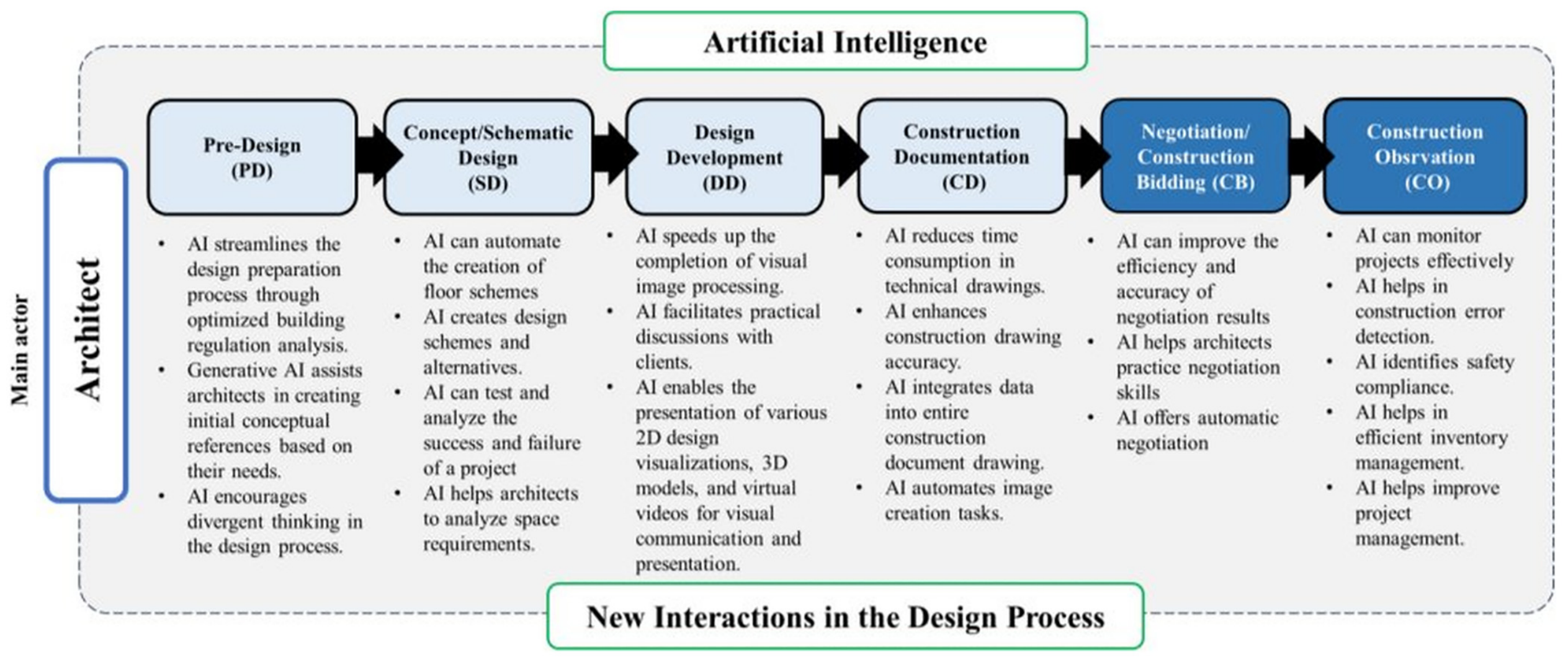
2.2. AI and Generative AI in Architectural Practice
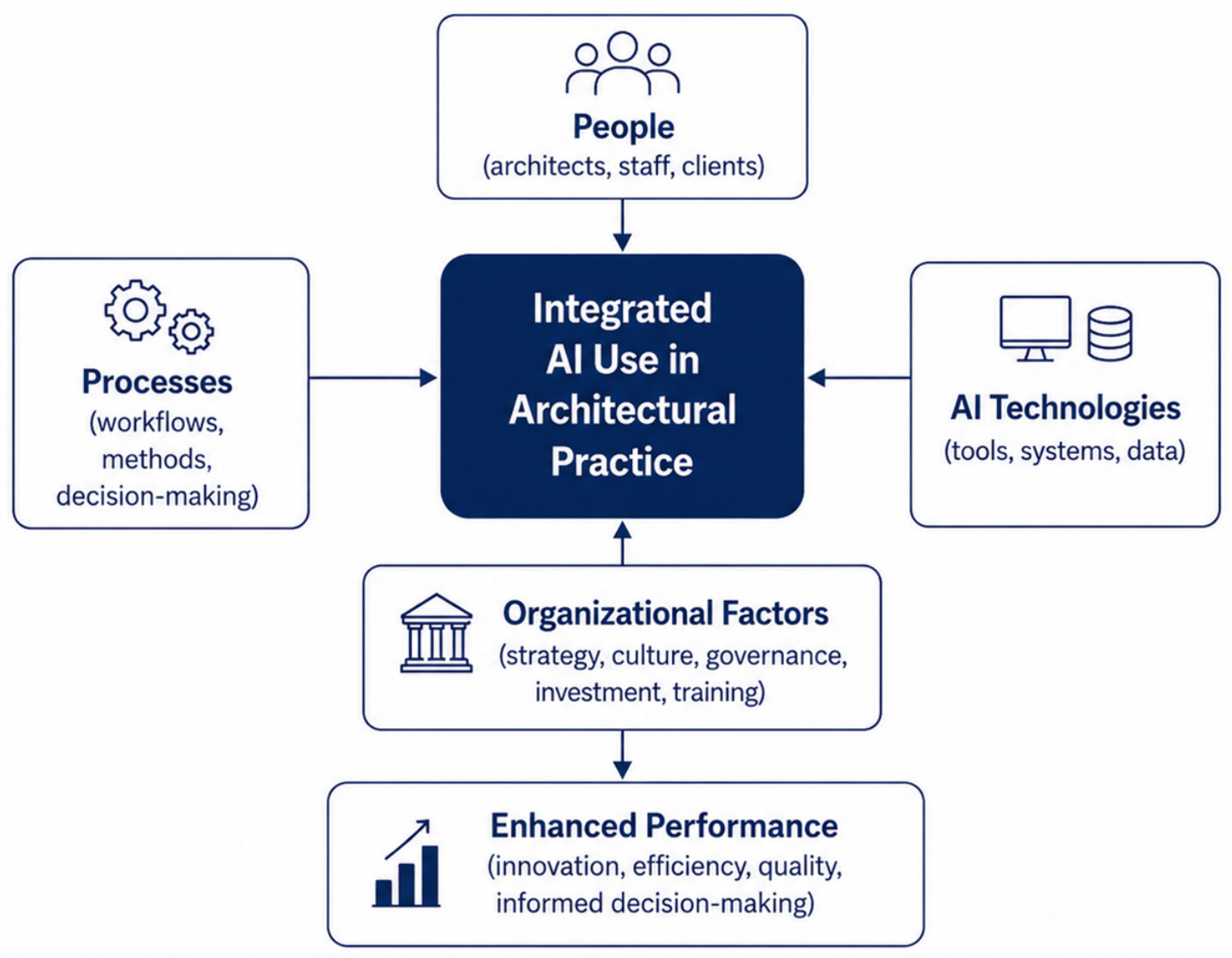
2.3. Adoption, Integration, Maturity, and Socio-Technical Readiness

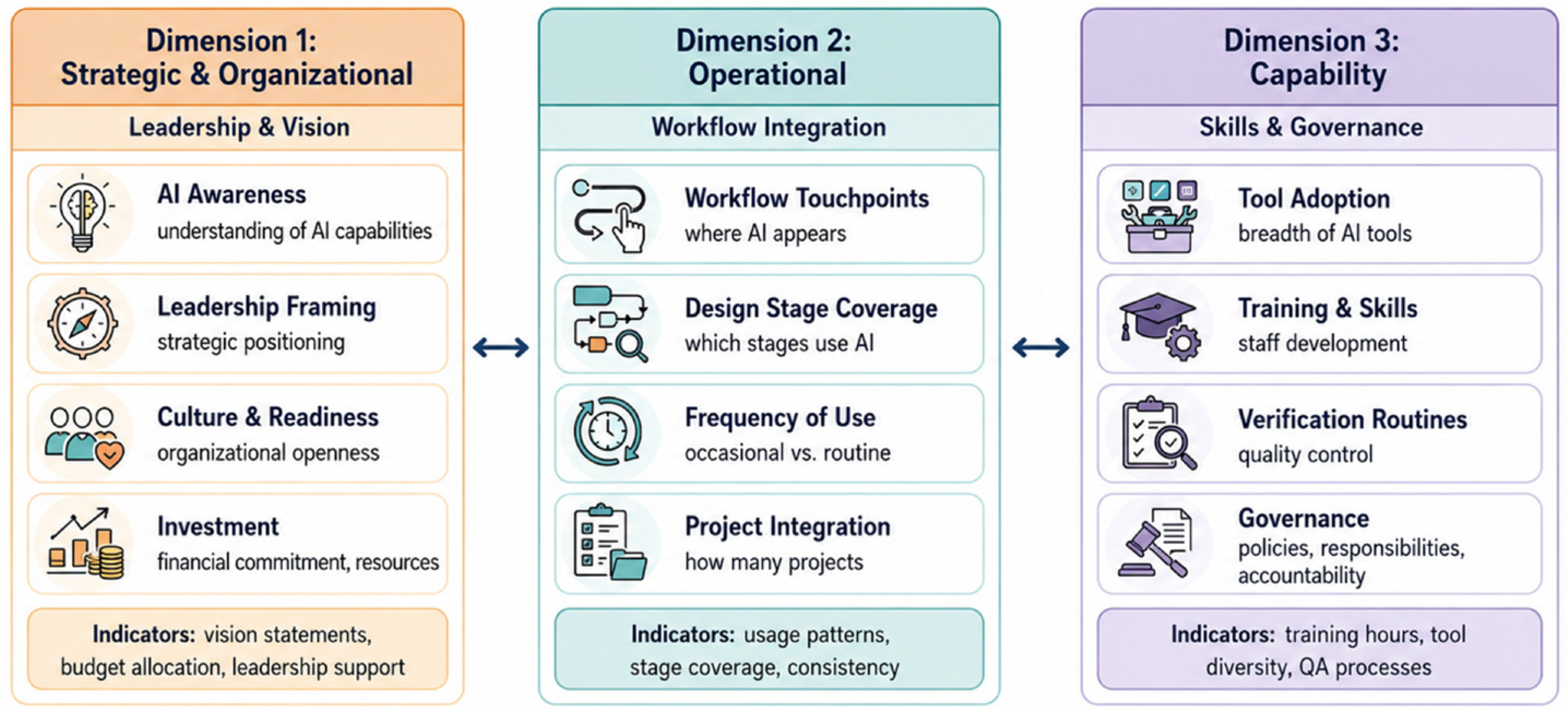
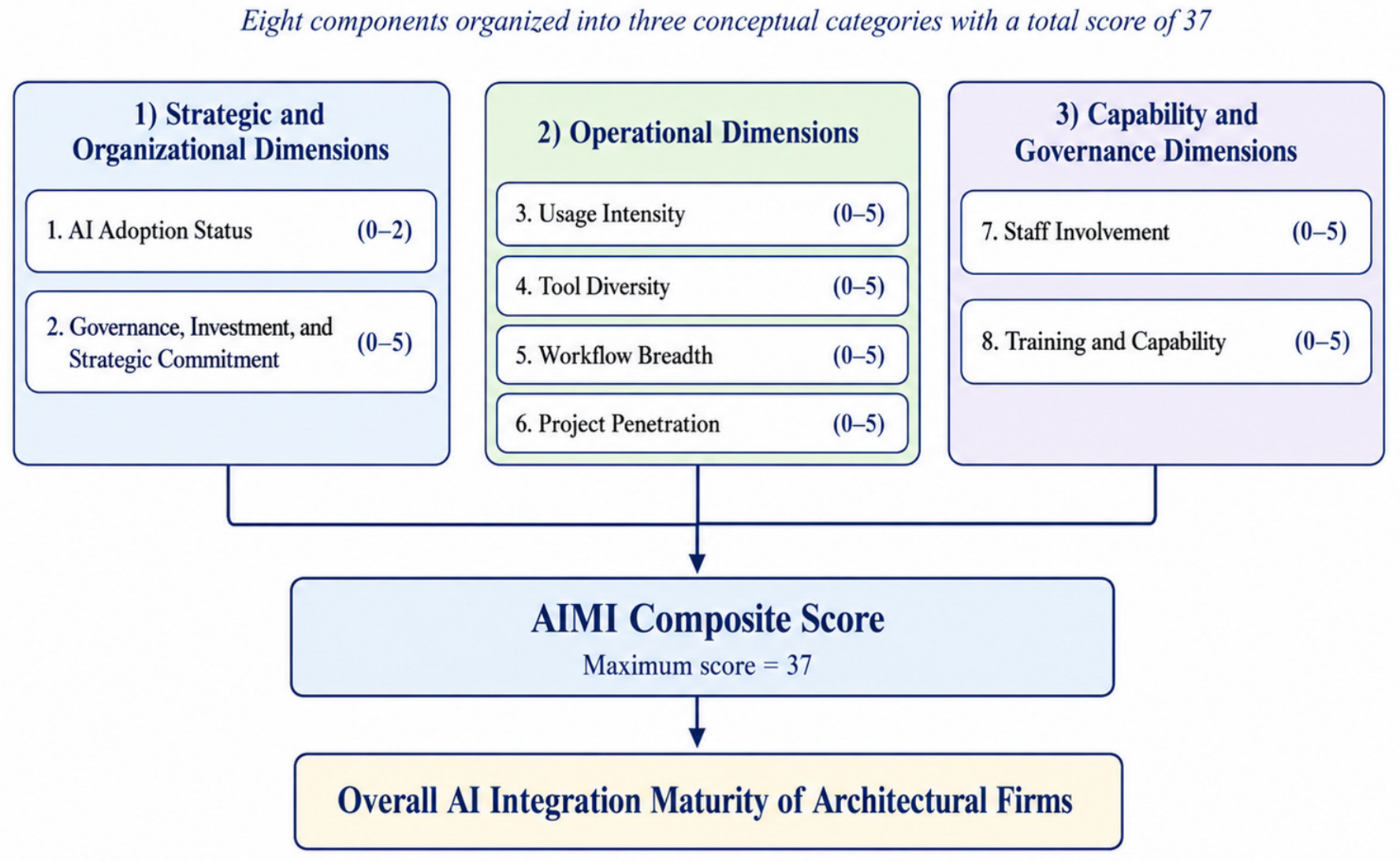
| Dimension | Purpose | Typical Evidence in a Firm | Main Literature Link |
|---|---|---|---|
| Adoption | Whether AI is used at all and at what status | Regular use, occasional use, discontinued use, non-use | [1,4,11,41] |
| Usage intensity | How often are AI tools used in real work | Daily, weekly, monthly, and rare use | [9,10,24] |
| Tool diversity | Range of AI tool families in active use | Text, image, rendering, BIM, parametric, custom tools | [3,12,13] |
| Workflow breadth | Number of task domains where AI appears | Design, visualisation, documentation, analysis | [2,15,23] |
| Staff involvement | Distribution of AI use across the office | One user, a small group, several role groups, and most staff | [9,11,17] |
| Capability | Training and learning arrangements | Self-learning, peer sharing, workshops, structured training | [11,17,37,41] |
| Project application | Share of real projects in which AI is used | Limited project use, routine project use, broad portfolio use | [10,28,40] |
| Commitment and governance | Rules, checking, spending, custom workflows, and strategic support | Policies, review sign-off, budget, internal tools, and records | [29,42,43] |
2.4. Benchmarking and Transferability
2.5. Literature-Based Analytical Dimensions
2.6. AI Failures, Risks, and Limitations in Architectural Practice
3. Methodology
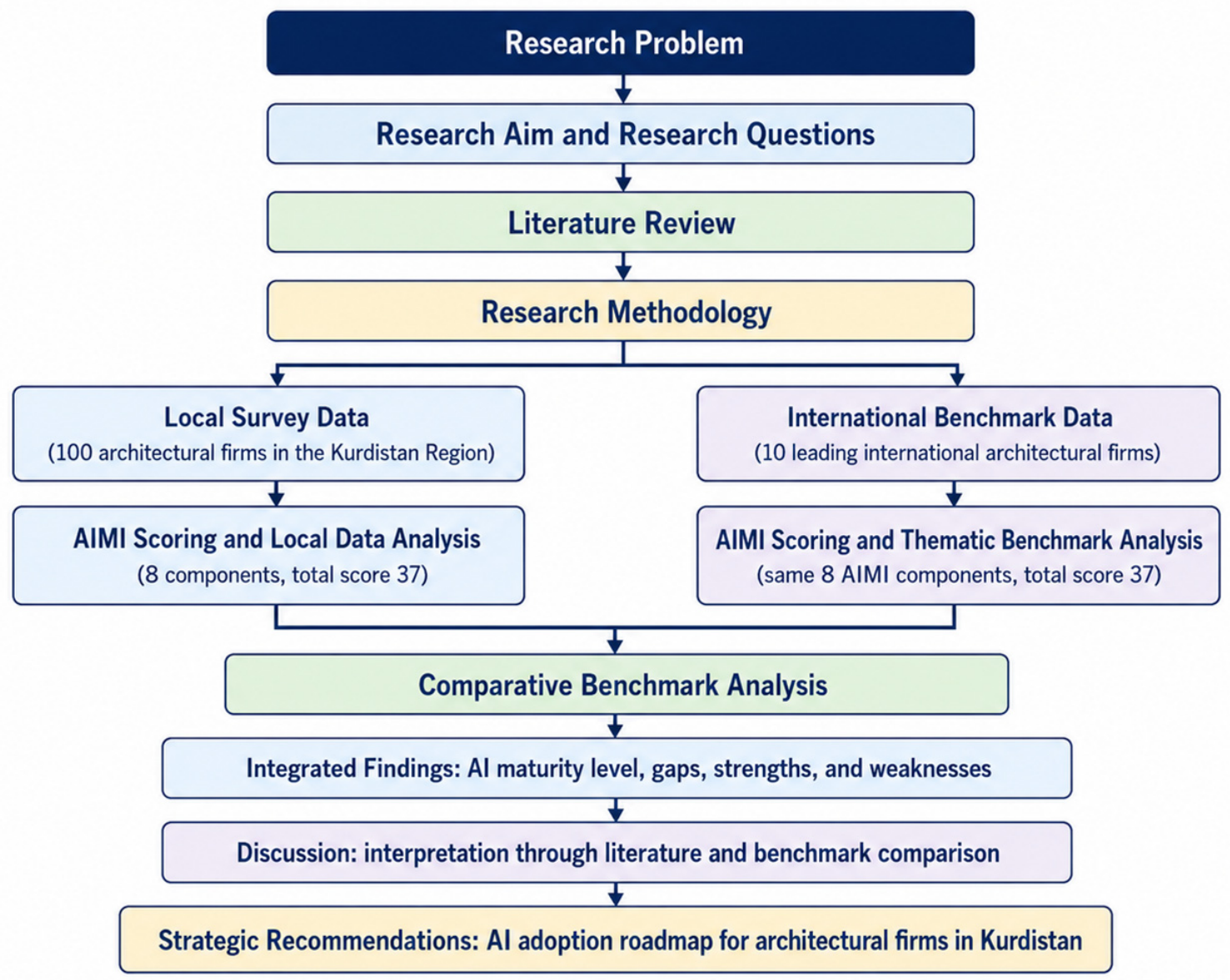
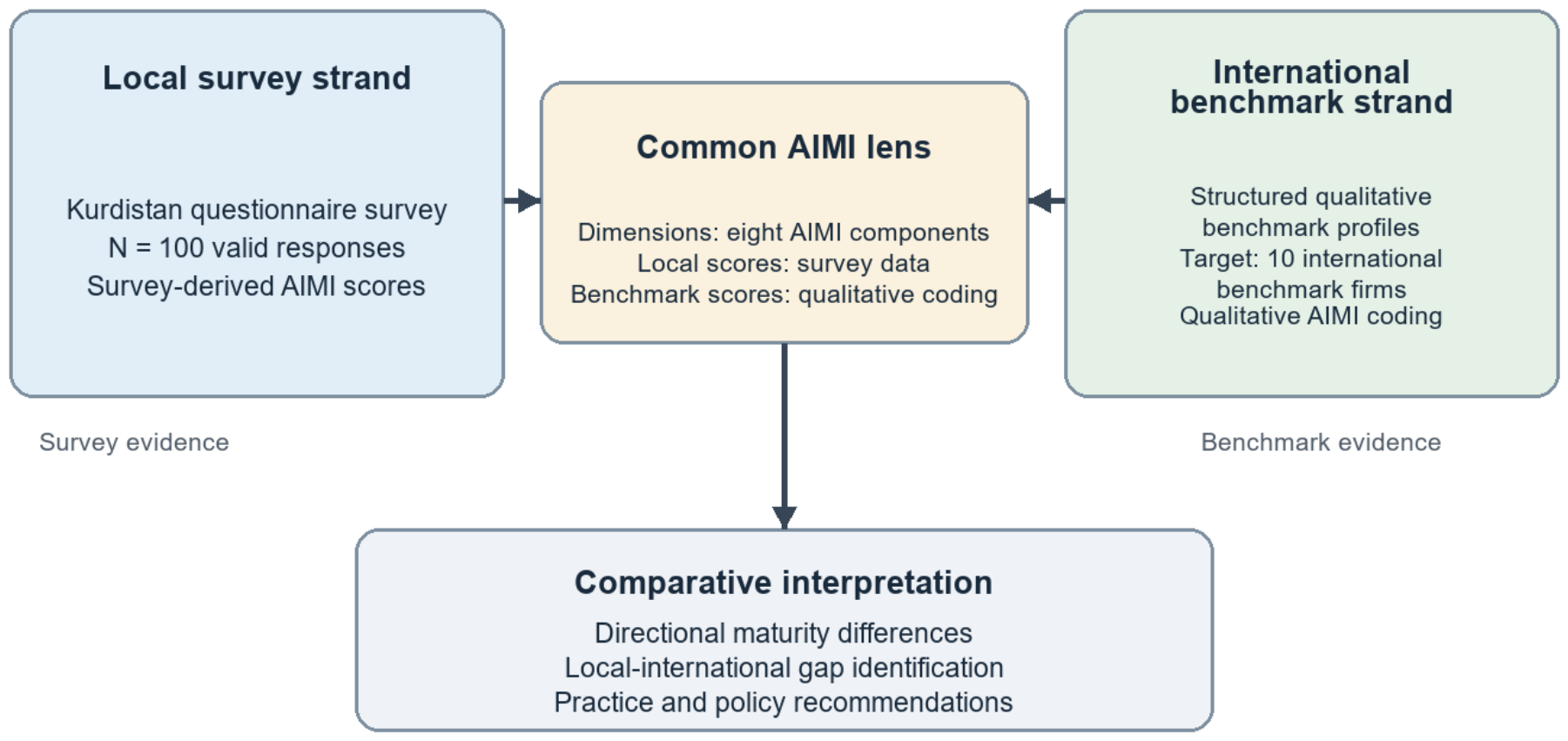
3.1. Research Design
3.2. Population, Sampling, and Participants
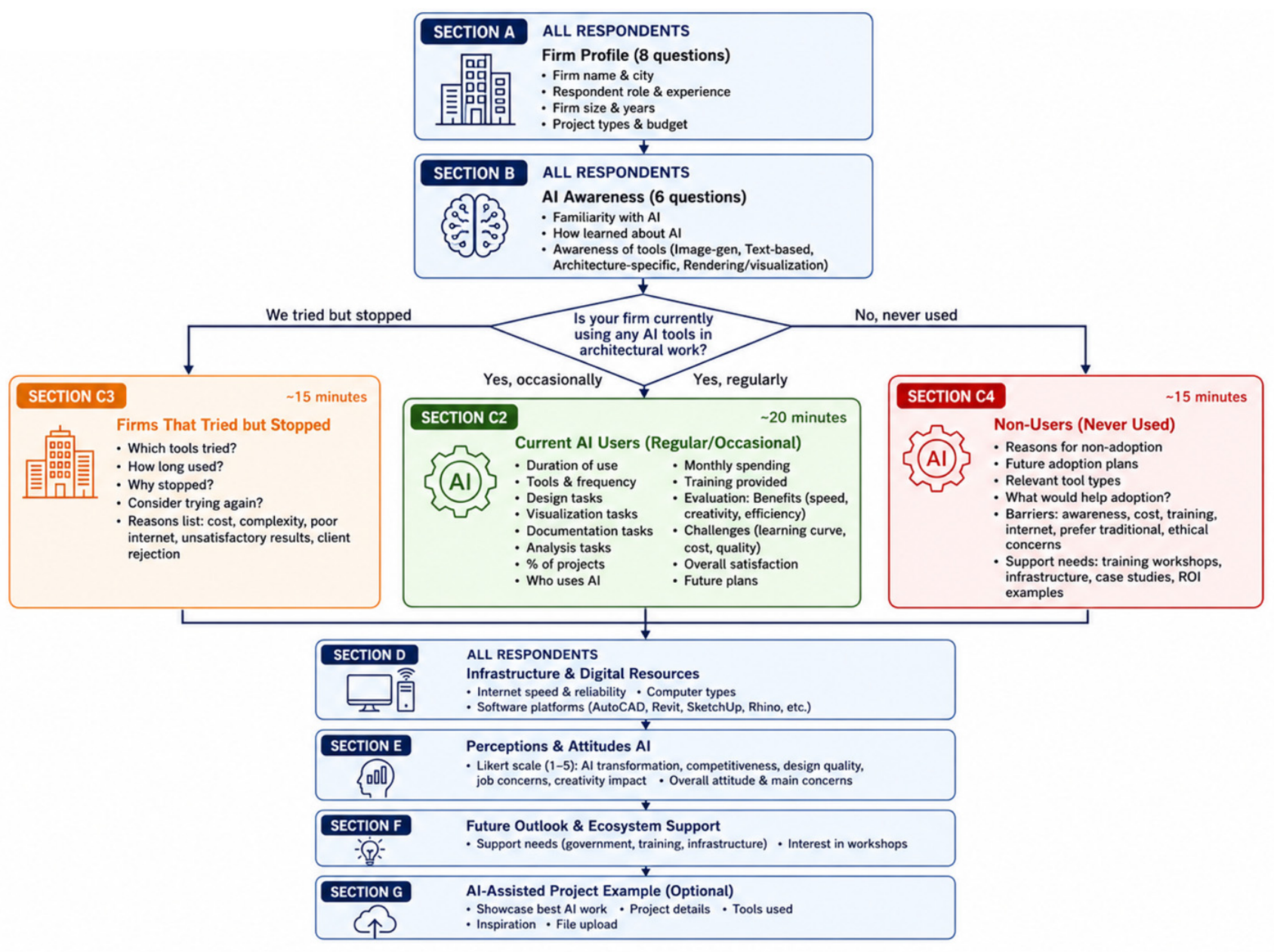
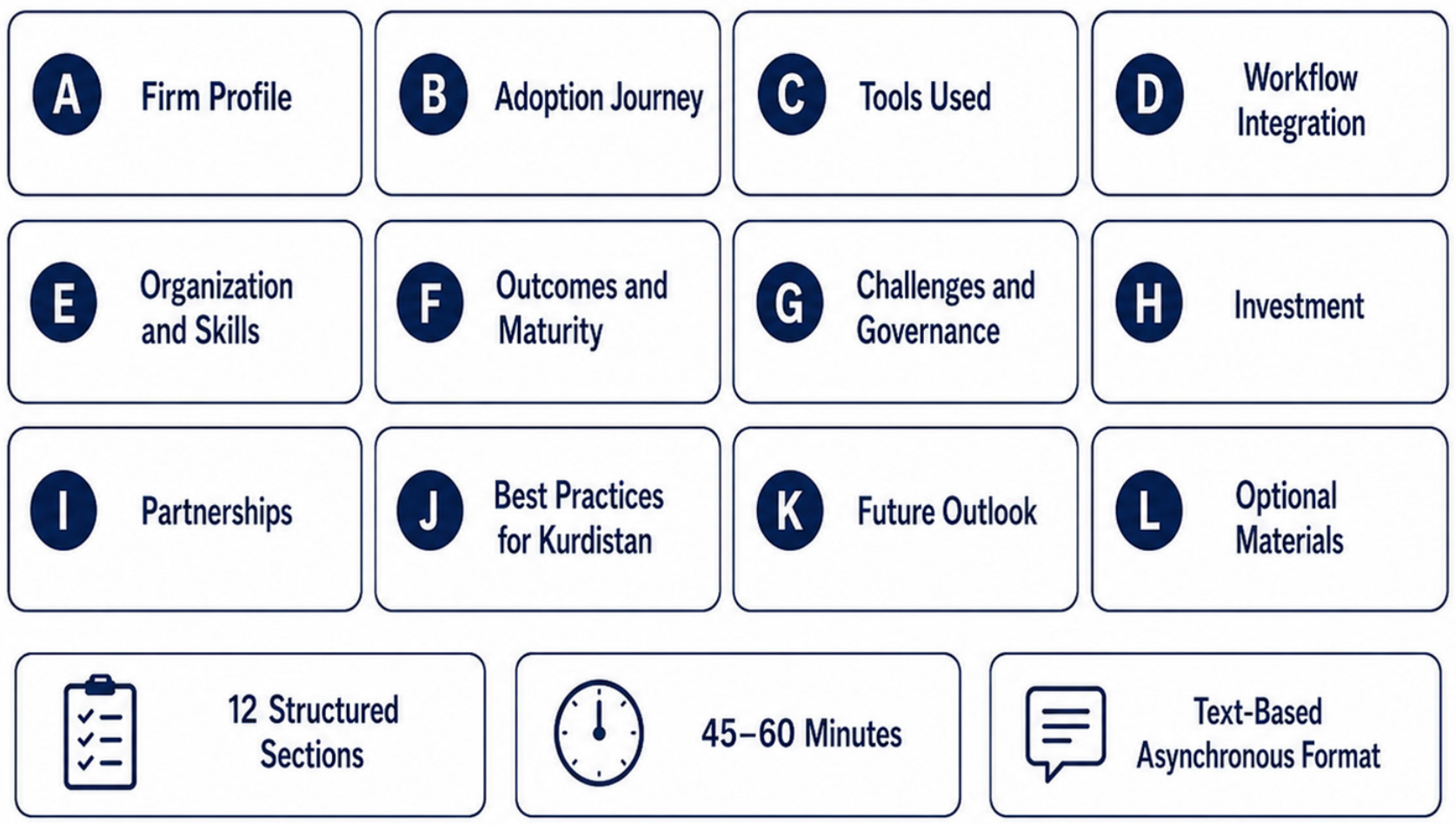
3.3. Instruments and Measurements
3.4. Data Analysis and Ethics
4. Results and Discussion
4.1. Local Survey Data Analysis
4.1.1. Local Sample Profile
4.1.2. Local AI Awareness and Adoption
4.1.3. Tool Ecology and Workflow Integration
4.1.4. Capability, Investment, Benefits, Challenges, and Readiness
4.1.5. Local AIMI Results and Internal Structure
4.2. International Interview Data Analysis
4.3. Local-International Comparison and Gap Identification
Comparison with the RIBA AI Report 2025
4.4. Benefits, Challenges, Readiness, and Practical Recommendations
4.4.1. Benefits
4.4.2. Challenges
4.4.3. Readiness
4.4.4. Practical Recommendations
4.5. Limitations of the Study and Future Directions
5. Conclusions
Supplementary Materials
Author Contributions
Funding
Institutional Review Board Statement
Informed Consent Statement
Data Availability Statement
Acknowledgments
Conflicts of Interest
Abbreviations
| AEC | Architecture, Engineering, and Construction |
| AI | Artificial Intelligence |
| AIA | American Institute of Architects |
| AIMI | AI Integration Maturity Index |
| BIM | Building Information Modelling |
| CAD | Computer-Aided Design |
| CMMI | Capability Maturity Model Integration |
| IP | Intellectual Property |
| LLM | Large Language Model |
| R&D | Research and Development |
| RIBA | Royal Institute of British Architects |
| QMS | Quality Management System |
| ML | Machine Learning |
Appendix A
| Firm | C1 | C2 | C3 | C4 | C5 | C6 | C7 | C8 | Total | Band |
|---|---|---|---|---|---|---|---|---|---|---|
| Local Firm 001 to Local Firm 025 | ||||||||||
| Local Firm 001 | 2 | 5 | 5 | 5 | 5 | 4 | 3 | 3 | 32 | Advanced strategic |
| Local Firm 002 | 1 | 5 | 2 | 5 | 2 | 2 | 2 | 3 | 22 | Occasional |
| Local Firm 003 | 1 | 2 | 2 | 5 | 2 | 2 | 2 | 4 | 20 | Occasional |
| Local Firm 004 | 2 | 2 | 4 | 5 | 5 | 2 | 5 | 5 | 30 | Advanced strategic |
| Local Firm 005 | 2 | 2 | 2 | 5 | 2 | 2 | 4 | 4 | 23 | Integrated |
| Local Firm 006 | 2 | 5 | 5 | 5 | 3 | 2 | 4 | 3 | 29 | Advanced strategic |
| Local Firm 007 | 1 | 2 | 1 | 3 | 2 | 2 | 2 | 4 | 17 | Occasional |
| Local Firm 008 | 1 | 2 | 2 | 5 | 3 | 2 | 1 | 2 | 18 | Occasional |
| Local Firm 009 | 1 | 2 | 3 | 5 | 2 | 2 | 3 | 4 | 22 | Occasional |
| Local Firm 010 | 1 | 2 | 3 | 3 | 2 | 1 | 1 | 1 | 14 | Exploratory |
| Local Firm 011 | 2 | 5 | 4 | 5 | 2 | 2 | 5 | 3 | 28 | Integrated |
| Local Firm 012 | 1 | 2 | 4 | 2 | 2 | 2 | 1 | 2 | 16 | Exploratory |
| Local Firm 013 | 2 | 5 | 3 | 5 | 5 | 4 | 3 | 4 | 31 | Advanced strategic |
| Local Firm 014 | 2 | 5 | 5 | 5 | 5 | 4 | 4 | 4 | 34 | Advanced strategic |
| Local Firm 015 | 0 | 0 | 0 | 0 | 0 | 0 | 0 | 0 | 0 | Non-adopter |
| Local Firm 016 | 1 | 5 | 3 | 5 | 5 | 4 | 2 | 2 | 27 | Integrated |
| Local Firm 017 | 0 | 0 | 0 | 0 | 0 | 0 | 0 | 0 | 0 | Non-adopter |
| Local Firm 018 | 1 | 5 | 3 | 5 | 3 | 2 | 3 | 1 | 23 | Integrated |
| Local Firm 019 | 0 | 0 | 0 | 0 | 0 | 0 | 0 | 0 | 0 | Non-adopter |
| Local Firm 020 | 0 | 0 | 0 | 0 | 0 | 0 | 0 | 0 | 0 | Non-adopter |
| Local Firm 021 | 1 | 5 | 4 | 5 | 2 | 2 | 3 | 2 | 24 | Integrated |
| Local Firm 022 | 0 | 0 | 0 | 0 | 0 | 0 | 0 | 0 | 0 | Non-adopter |
| Local Firm 023 | 1 | 4 | 2 | 5 | 2 | 1 | 2 | 2 | 19 | Occasional |
| Local Firm 024 | 1 | 1 | 2 | 5 | 1 | 2 | 1 | 1 | 14 | Exploratory |
| Local Firm 025 | 0 | 0 | 0 | 0 | 0 | 0 | 0 | 0 | 0 | Non-adopter |
| Local Firm 026 to Local Firm 050 | ||||||||||
| Local Firm 026 | 1 | 1 | 3 | 5 | 2 | 2 | 1 | 2 | 17 | Occasional |
| Local Firm 027 | 1 | 5 | 5 | 5 | 2 | 2 | 2 | 3 | 25 | Integrated |
| Local Firm 028 | 0 | 0 | 0 | 0 | 0 | 0 | 0 | 0 | 0 | Non-adopter |
| Local Firm 029 | 0 | 0 | 0 | 0 | 0 | 0 | 0 | 0 | 0 | Non-adopter |
| Local Firm 030 | 1 | 5 | 5 | 5 | 1 | 2 | 3 | 3 | 25 | Integrated |
| Local Firm 031 | 1 | 1 | 2 | 5 | 2 | 2 | 2 | 2 | 17 | Occasional |
| Local Firm 032 | 1 | 1 | 1 | 3 | 2 | 2 | 1 | 2 | 13 | Exploratory |
| Local Firm 033 | 1 | 1 | 1 | 5 | 1 | 5 | 1 | 1 | 16 | Exploratory |
| Local Firm 034 | 1 | 5 | 3 | 5 | 4 | 2 | 2 | 2 | 24 | Integrated |
| Local Firm 035 | 1 | 5 | 5 | 5 | 3 | 2 | 2 | 2 | 25 | Integrated |
| Local Firm 036 | 1 | 2 | 2 | 5 | 3 | 2 | 4 | 4 | 23 | Integrated |
| Local Firm 037 | 1 | 5 | 5 | 5 | 3 | 3 | 3 | 4 | 29 | Advanced strategic |
| Local Firm 038 | 1 | 5 | 5 | 5 | 2 | 4 | 2 | 5 | 29 | Advanced strategic |
| Local Firm 039 | 1 | 1 | 2 | 5 | 2 | 4 | 2 | 3 | 20 | Occasional |
| Local Firm 040 | 1 | 1 | 2 | 5 | 2 | 4 | 3 | 5 | 23 | Integrated |
| Local Firm 041 | 1 | 5 | 4 | 2 | 1 | 2 | 3 | 2 | 20 | Occasional |
| Local Firm 042 | 1 | 4 | 2 | 5 | 2 | 2 | 2 | 2 | 20 | Occasional |
| Local Firm 043 | 1 | 4 | 2 | 3 | 5 | 2 | 2 | 2 | 21 | Occasional |
| Local Firm 044 | 2 | 4 | 3 | 5 | 2 | 2 | 3 | 1 | 22 | Occasional |
| Local Firm 045 | 1 | 1 | 2 | 5 | 1 | 2 | 3 | 2 | 17 | Occasional |
| Local Firm 046 | 1 | 5 | 3 | 5 | 2 | 2 | 1 | 3 | 22 | Occasional |
| Local Firm 047 | 2 | 5 | 5 | 5 | 3 | 4 | 4 | 4 | 32 | Advanced strategic |
| Local Firm 048 | 1 | 4 | 3 | 5 | 3 | 2 | 2 | 2 | 22 | Occasional |
| Local Firm 049 | 1 | 2 | 3 | 5 | 3 | 2 | 2 | 2 | 20 | Occasional |
| Local Firm 050 | 1 | 4 | 4 | 5 | 5 | 2 | 1 | 2 | 24 | Integrated |
| Local Firm 051 to Local Firm 075 | ||||||||||
| Local Firm 051 | 1 | 1 | 1 | 5 | 2 | 2 | 2 | 2 | 16 | Exploratory |
| Local Firm 052 | 1 | 1 | 2 | 5 | 2 | 1 | 2 | 2 | 16 | Exploratory |
| Local Firm 053 | 2 | 5 | 4 | 5 | 2 | 2 | 2 | 3 | 25 | Integrated |
| Local Firm 054 | 1 | 4 | 2 | 5 | 2 | 2 | 3 | 2 | 21 | Occasional |
| Local Firm 055 | 1 | 2 | 2 | 5 | 2 | 4 | 3 | 2 | 21 | Occasional |
| Local Firm 056 | 1 | 2 | 1 | 5 | 2 | 4 | 3 | 2 | 20 | Occasional |
| Local Firm 057 | 1 | 2 | 2 | 5 | 2 | 2 | 1 | 2 | 17 | Occasional |
| Local Firm 058 | 0 | 0 | 0 | 0 | 0 | 0 | 0 | 0 | 0 | Non-adopter |
| Local Firm 059 | 0 | 0 | 0 | 0 | 0 | 0 | 0 | 0 | 0 | Non-adopter |
| Local Firm 060 | 1 | 0 | 0 | 5 | 2 | 5 | 2 | 3 | 18 | Occasional |
| Local Firm 061 | 0 | 0 | 0 | 0 | 0 | 0 | 0 | 0 | 0 | Non-adopter |
| Local Firm 062 | 0 | 0 | 0 | 0 | 0 | 0 | 0 | 0 | 0 | Non-adopter |
| Local Firm 063 | 2 | 5 | 3 | 5 | 2 | 4 | 2 | 2 | 25 | Integrated |
| Local Firm 064 | 0 | 0 | 0 | 0 | 0 | 0 | 0 | 0 | 0 | Non-adopter |
| Local Firm 065 | 2 | 5 | 2 | 5 | 4 | 3 | 2 | 2 | 25 | Integrated |
| Local Firm 066 | 1 | 2 | 4 | 5 | 2 | 3 | 3 | 3 | 23 | Integrated |
| Local Firm 067 | 0 | 0 | 0 | 0 | 0 | 0 | 0 | 0 | 0 | Non-adopter |
| Local Firm 068 | 2 | 5 | 2 | 5 | 1 | 2 | 2 | 3 | 22 | Occasional |
| Local Firm 069 | 1 | 5 | 3 | 5 | 2 | 2 | 3 | 2 | 23 | Integrated |
| Local Firm 070 | 0 | 0 | 0 | 0 | 0 | 0 | 0 | 0 | 0 | Non-adopter |
| Local Firm 071 | 1 | 5 | 5 | 5 | 5 | 4 | 5 | 4 | 34 | Advanced strategic |
| Local Firm 072 | 1 | 1 | 2 | 5 | 1 | 1 | 1 | 3 | 15 | Exploratory |
| Local Firm 073 | 2 | 4 | 5 | 5 | 2 | 2 | 4 | 4 | 28 | Integrated |
| Local Firm 074 | 1 | 1 | 2 | 5 | 2 | 4 | 2 | 5 | 22 | Occasional |
| Local Firm 075 | 0 | 0 | 0 | 0 | 0 | 0 | 0 | 0 | 0 | Non-adopter |
| Local Firm 076 to Local Firm 100 | ||||||||||
| Local Firm 076 | 1 | 1 | 1 | 5 | 2 | 2 | 2 | 1 | 15 | Exploratory |
| Local Firm 077 | 2 | 5 | 3 | 5 | 3 | 5 | 3 | 3 | 29 | Advanced strategic |
| Local Firm 078 | 1 | 2 | 1 | 3 | 1 | 3 | 3 | 1 | 15 | Exploratory |
| Local Firm 079 | 1 | 0 | 0 | 3 | 5 | 2 | 1 | 1 | 13 | Exploratory |
| Local Firm 080 | 2 | 5 | 5 | 5 | 3 | 5 | 4 | 5 | 34 | Advanced strategic |
| Local Firm 081 | 1 | 2 | 5 | 5 | 2 | 2 | 1 | 2 | 20 | Occasional |
| Local Firm 082 | 2 | 5 | 5 | 5 | 2 | 3 | 2 | 5 | 29 | Advanced strategic |
| Local Firm 083 | 2 | 2 | 5 | 5 | 5 | 4 | 2 | 4 | 29 | Advanced strategic |
| Local Firm 084 | 1 | 1 | 4 | 5 | 1 | 2 | 3 | 2 | 19 | Occasional |
| Local Firm 085 | 2 | 4 | 1 | 5 | 3 | 4 | 4 | 2 | 25 | Integrated |
| Local Firm 086 | 1 | 2 | 1 | 5 | 1 | 2 | 1 | 2 | 15 | Exploratory |
| Local Firm 087 | 1 | 1 | 3 | 3 | 2 | 2 | 2 | 2 | 16 | Exploratory |
| Local Firm 088 | 1 | 4 | 2 | 5 | 2 | 2 | 2 | 3 | 21 | Occasional |
| Local Firm 089 | 1 | 1 | 1 | 5 | 2 | 2 | 1 | 1 | 14 | Exploratory |
| Local Firm 090 | 0 | 0 | 0 | 0 | 0 | 0 | 0 | 0 | 0 | Non-adopter |
| Local Firm 091 | 1 | 4 | 2 | 3 | 3 | 2 | 3 | 1 | 19 | Occasional |
| Local Firm 092 | 1 | 4 | 5 | 5 | 2 | 4 | 3 | 4 | 28 | Integrated |
| Local Firm 093 | 1 | 2 | 5 | 5 | 2 | 4 | 3 | 3 | 25 | Integrated |
| Local Firm 094 | 1 | 4 | 5 | 5 | 3 | 4 | 2 | 4 | 28 | Integrated |
| Local Firm 095 | 1 | 2 | 3 | 3 | 2 | 2 | 1 | 3 | 17 | Occasional |
| Local Firm 096 | 0 | 0 | 0 | 0 | 0 | 0 | 0 | 0 | 0 | Non-adopter |
| Local Firm 097 | 2 | 5 | 1 | 5 | 3 | 3 | 4 | 4 | 27 | Integrated |
| Local Firm 098 | 1 | 5 | 5 | 5 | 2 | 2 | 2 | 1 | 23 | Integrated |
| Local Firm 099 | 1 | 1 | 1 | 5 | 2 | 2 | 2 | 2 | 16 | Exploratory |
| Local Firm 100 | 1 | 2 | 3 | 3 | 3 | 2 | 1 | 2 | 17 | Occasional |
Appendix B
| Firm | AIMI Component | Score | Matched Keywords/Evidence Phrases | Coding Interpretation |
|---|---|---|---|---|
| Firm A | C1 AI adoption | 2/2 | Broader AI tool adoption accelerated around 2022; AI is used routinely | Active use, not just awareness. |
| Firm A | C2 Usage intensity | 5/5 | Used routinely in early design and visualisation; ongoing internal R&D | Routine and repeated use in multiple workflows. |
| Firm A | C3 Tool diversity | 5/5 | Generative image tools; large language models; parametric and optimisation workflows; environmental simulation; internal automation scripts | Very broad AI and computational tool ecosystem. |
| Firm A | C4 Workflow breadth | 5/5 | Concept design; pre-competition visualisation; environmental optimisation; research synthesis | AI covers concept, visualisation, analysis, and research/documentation support. |
| Firm A | C5 Staff involvement | 5/5 | Dedicated computational design teams; embedded digital specialists; distributed AI literacy | AI capability is distributed with specialist support. |
| Firm A | C6 Capability/training | 5/5 | Internal workshops; peer-to-peer knowledge sharing; R&D time allocation | Structured and informal learning both exist. |
| Firm A | C7 Project application | 5/5 | Large-scale mixed-use competition projects; AI-assisted visualisation was used | Clear real project and competition use. |
| Firm A | C8 Commitment/governance | 5/5 | IP and confidentiality compliance; approved platforms only; senior architect review mandatory | Strong governance, review, and responsible-use culture. |
| Firm B | C1 AI adoption | 2/2 | Advanced integration with custom tools and active R&D; used across studios on live projects | Fully active AI integration. |
| Firm B | C2 Usage intensity | 5/5 | Well beyond early experimentation; used across studios on live projects | Routine and multi-studio use. |
| Firm B | C3 Tool diversity | 5/5 | In-house image generation platform; LLM-based tools; documentation support; business development; project knowledge retrieval | Multiple AI types and internal systems. |
| Firm B | C4 Workflow breadth | 5/5 | Concept; client presentations; business development; documentation support | AI is applied across several workflow stages. |
| Firm B | C5 Staff involvement | 5/5 | Tools are used by staff across studios, roles, and seniority levels | Broadly distributed use across roles and studios. |
| Firm B | C6 Capability/training | 5/5 | Internal workshops; lunch-and-learn sessions; prompt libraries; workflow guides | Strong structured training and knowledge sharing. |
| Firm B | C7 Project application | 5/5 | Dallas International Airport competition; live projects; competition workflow | Clear real project and competition application. |
| Firm B | C8 Commitment/governance | 5/5 | All project data remains on internal infrastructure, an approved internal platform, and senior designers review | Very strong governance and internal infrastructure. |
| Firm C | C1 AI adoption | 2/2 | Almost everyone is using AI; AI is a very helpful tool for all of us now | Active AI use. |
| Firm C | C2 Usage intensity | 5/5 | Use it for almost everything; almost everyone | Very frequent use. |
| Firm C | C3 Tool diversity | 5/5 | ChatGPT; Sora; Google AI; Xfigura; Midjourney | Strong range, mainly generative visual/text tools. |
| Firm C | C4 Workflow breadth | 5/5 | Basic visualisations; understand the design brief; concept iterations; structure; facades | Broad design-stage use. |
| Firm C | C5 Staff involvement | 5/5 | Everyone, almost every team | Very high staff involvement. |
| Firm C | C6 Capability/training | 4/5 | Training workshops from time to time; self-training | Training exists, but evidence is less formal than the strongest cases. |
| Firm C | C7 Project application | 5/5 | Competition bids; most stages of the project | Strong project-facing use. |
| Firm C | C8 Commitment/governance | 4/5 | Pilot testing team; leadership advocacy | Good organisational support, with less explicit evidence of formal governance. |
| Firm D | C1 AI adoption | 2/2 | AI-native practice; part of the studio DNA from day one | Very strong adoption. |
| Firm D | C2 Usage intensity | 5/5 | Part of the standard design process; Google Gemini is the most frequently used tool | Routine use. |
| Firm D | C3 Tool diversity | 4/5 | Midjourney; Google Gemini; proprietary in-house tools; LLMs | Strong tool range, but less broad than Firm A/Firm B. |
| Firm D | C4 Workflow breadth | 5/5 | Concept; design development; presentation; visual refinement | Several design and presentation stages. |
| Firm D | C5 Staff involvement | 5/5 | Designers use AI most frequently; standard design process | Broad use within the design team. |
| Firm D | C6 Capability/training | 4/5 | Self-directed learning; peer sharing; internal onboarding | Practical internal learning, though less formal. |
| Firm D | C7 Project application | 5/5 | Confidential residential project; client session; live projects | Clear real project use. |
| Firm D | C8 Commitment/governance | 5/5 | Proprietary in-house tools; not experimental; embedded in standard workflow; confidentiality caution | Strong commitment through embedded workflows and internal tools. |
| Firm E | C1 AI adoption | 2/2 | Actively exploring since 2022; AI tools are most frequently used | AI is actively used. |
| Firm E | C2 Usage intensity | 5/5 | Most frequently used for option exploration and visualisation support; experimental stage | Strong use, but still described as experimental. |
| Firm E | C3 Tool diversity | 5/5 | Midjourney; Stable Diffusion; Krea; Xfigura; ChatGPT; D5 Render | Broad tool ecosystem. |
| Firm E | C4 Workflow breadth | 4/5 | Concept exploration; imagery post-production; visualisation workflows | Mainly concept and visualisation workflows. |
| Firm E | C5 Staff involvement | 4/5 | Design Technology team; visual specialists are the primary users | Strong specialist-led use. |
| Firm E | C6 Capability/training | 5/5 | Internal training called internal school-style training | Strong training evidence. |
| Firm E | C7 Project application | 3/5 | AI has not yet played a meaningful role in shaping design outcomes; it is valuable in saving time. | Project-adjacent use, but limited impact on design outcomes. |
| Firm E | C8 Commitment/governance | 5/5 | Design Technology team: test, evaluate, and integrate AI tools | Good organisational support, less formal governance than top cases. |
| Firm F | C1 AI adoption | 2/2 | Moved beyond a pure testing phase; used in production on real projects | Active use. |
| Firm F | C2 Usage intensity | 5/5 | Routine use for recurring concept tasks | Routine but concentrated use. |
| Firm F | C3 Tool diversity | 4/5 | Midjourney; SUAPP; Gemini; ChatGPT; Copilot; Revit + Dynamo; Rhino + Grasshopper; Raven | Strong diversity across visual, text, BIM, and computational tools. |
| Firm F | C4 Workflow breadth | 4/5 | Concept; design development; presentation; analysis; documentation limited | Broad but not fully technical across all project phases. |
| Firm F | C5 Staff involvement | 4/5 | Embedded champions; Concept section; computational specialists support | Strong team-level use. |
| Firm F | C6 Capability/training | 4/5 | Mini-workshops; prompt templates; internal guides; mentorship | Good practical training. |
| Firm F | C7 Project application | 5/5 | Production on real projects; a residential tower project example | Strong but selective project use. |
| Firm F | C8 Commitment/governance | 3/5 | Guidelines gradually being documented; approved platforms; limited custom tools/R&D | Governance exists but is still emerging. |
| Firm G | C1 AI adoption | 2/2 | Selective but meaningful integration; part of real project work | Active adoption. |
| Firm G | C2 Usage intensity | 4/5 | Tools we use most often; day-to-day role | Frequent but not universal use. |
| Firm G | C3 Tool diversity | 4/5 | ChatGPT; AI image-generation; AI-assisted rendering; Rhino/Grasshopper; environmental analysis | Strong variety of tool categories. |
| Firm G | C4 Workflow breadth | 4/5 | Concept; option exploration; environmental studies; presentation | Multiple stages. |
| Firm G | C5 Staff involvement | 4/5 | Hybrid model; specialist roles plus broader team use | Strong but specialist-led staff involvement. |
| Firm G | C6 Capability/training | 3/5 | Internal sharing; workflow demonstrations; peer-to-peer learning; independent experimentation | Capability exists but is mostly informal. |
| Firm G | C7 Project application | 4/5 | A recent airport project in the Middle East, AI played a meaningful role | Clear project use. |
| Firm G | C8 Commitment/governance | 3/5 | Human control; final decisions grounded in architectural judgement | Some review discipline, limited formal governance evidence. |
| Firm H | C1 AI adoption | 2/2 | AI is used on all current projects; early testing | AI is used, although still immature. |
| Firm H | C2 Usage intensity | 3/5 | All current projects; no clear workflow | Moderate use. |
| Firm H | C3 Tool diversity | 3/5 | ChatGPT, Gemini; text and visualisation | Limited to moderate tool diversity. |
| Firm H | C4 Workflow breadth | 3/5 | Concept design; presentation; final render fine-tuning | Mainly visual, concept, and presentation tasks. |
| Firm H | C5 Staff involvement | 3/5 | Everyone is interested: the design team and the visualisation team | Small-team distributed use. |
| Firm H | C6 Capability/training | 2/5 | Self-learning; AI chatting group | Informal learning only. |
| Firm H | C7 Project application | 3/5 | Residential project; interior project; facade iterations | Some real project use. |
| Firm H | C8 Commitment/governance | 2/5 | No dedicated team; limited formal structure | Low formal commitment. |
| Firm I | C1 AI adoption | 1/2 | Within the last 2 years; testing tool; depends on the project | Limited/selective adoption. |
| Firm I | C2 Usage intensity | 2/5 | Smaller-scale projects; not heavy involvement | Low to moderate use. |
| Firm I | C3 Tool diversity | 2/5 | Text; early-stage rendering/visualisation | Limited tool families. |
| Firm I | C4 Workflow breadth | 2/5 | Design development; colour and material options | Narrow workflow use. |
| Firm I | C5 Staff involvement | 2/5 | Team leader involved; visualisation team | Small group use. |
| Firm I | C6 Capability/training | 2/5 | Not integrated enough; possible future workshops/self-learning | Weak training evidence. |
| Firm I | C7 Project application | 2/5 | Client privacy; test preliminary renders | Some project-related use, but limited. |
| Firm I | C8 Commitment/governance | 2/5 | Quality threshold; integration with existing programmes; no custom systems | Basic evaluation but no formal governance. |
| Firm J | C1 AI adoption | 1/2 | Early testing; not officially adopted | Limited adoption. |
| Firm J | C2 Usage intensity | 2/5 | Very limited; not for client work yet | Low use. |
| Firm J | C3 Tool diversity | 2/5 | Image generation; rendering tests; some analysis tools; meeting minutes | Some range, but limited application. |
| Firm J | C4 Workflow breadth | 2/5 | Visualisation; summarisation; not official client work | Narrow workflow use. |
| Firm J | C5 Staff involvement | 2/5 | Individual designers; designers, visualisation team, project managers | Scattered users. |
| Firm J | C6 Capability/training | 2/5 | N/A for training | Minimal training evidence. |
| Firm J | C7 Project application | 1/5 | Not for client work yet; N/A project example | Very weak real-project application. |
| Firm J | C8 Commitment/governance | 2/5 | Approved tools; do not use them yet for client production work | Basic caution but limited strategic commitment. |
References
- Albukhari, I.N. The role of artificial intelligence (AI) in architectural design: A systematic review of emerging technologies and applications. J. Umm Al-Qura Univ. Eng. Archit. 2025, 16, 1457–1476. [Google Scholar] [CrossRef] [Scilit]
- Bölek, B.; Tutal, O.; Özbaşaran, H. A systematic review on artificial intelligence applications in architecture. J. Des. Resil. Archit. Plan. 2023, 4, 91–104. [Google Scholar] [CrossRef] [Scilit]
- Memon, S.A.; Shehata, W.; Rowlinson, S.; Sunindijo, R.Y. Generative artificial intelligence in architecture, engineering, construction, and operations: A systematic review. Buildings 2025, 15, 2270. [Google Scholar] [CrossRef] [Scilit]
- Yiannoudes, S. Shaping architecture with generative artificial intelligence: Deep learning models in architectural design workflow. Architecture 2025, 5, 94. [Google Scholar] [CrossRef] [Scilit]
- Ahmed, J.A.; Yusoff, W.F.M.; Mohamed, M.F. The impact of traditional architectonic characters on the environmental and thermal condition of houses: A case study of Erbil, Kurdistan, Iraq. Int. J. Heat Technol. 2024, 42, 1969–1982. [Google Scholar] [CrossRef] [Scilit]
- Yahya, N.I. Beyond efficiency: A conceptual design framework for sustainable housing in Erbil. Cihan Univ.-Erbil Sci. J. 2025, 9, 80–91. [Google Scholar] [CrossRef] [Scilit]
- Hassan, M.F.; Al-Kindy, S.K. Exploring the challenges and opportunities of BIM implementation in major architectural projects in Iraq. Int. J. Sustain. Dev. Plan. 2023, 18, 1841–1849. [Google Scholar] [CrossRef] [Scilit]
- Mohammed, H.S.; Hilal, M.A. Improving Building Information Modeling (BIM) implementation throughout the construction industry. J. Eng. 2024, 30, 85–104. [Google Scholar] [CrossRef] [Scilit]
- Yu, C.; Zheng, P.; Peng, T.; Xu, X.; Vos, S.; Ren, X. Design meets AI: Challenges and opportunities. J. Eng. Des. 2025, 36, 637–641. [Google Scholar] [CrossRef] [Scilit]
- Patel, K.; Beeram, D.; Ramamurthy, P.; Garg, P.; Kumar, S. AI-enhanced design: Revolutionizing methodologies and workflows. Int. J. Adv. Innov. Res. Dev. 2024, 2, 135–157. [Google Scholar] [CrossRef] [Scilit]
- Onatayo, D.; Onososen, A.; Oyediran, A.O.; Oyediran, H.; Arowoiya, V.; Onatayo, E. Generative AI applications in architecture, engineering, and construction: Trends, implications for practice, education, and imperatives for upskilling, a review. Architecture 2024, 4, 877–902. [Google Scholar] [CrossRef] [Scilit]
- Salem, A.A.; Mansour, Y.; Eldaly, H. Generative vs. non-generative AI: Analyzing the effects of AI on the architectural design process. Eng. Res. J. 2024, 53, 119–128. [Google Scholar] [CrossRef] [Scilit]
- Li, C.; Zhang, T.; Du, X.; Zhang, Y.; Xie, H. Generative AI models for different steps in architectural design: A literature review. Front. Archit. Res. 2025, 14, 759–783. [Google Scholar] [CrossRef] [Scilit]
- Gulay, E.; Lucero, A. Integrated workflows: Generating feedback between digital and physical realms. In Proceedings of the 2019 CHI Conference on Human Factors in Computing Systems, Glasgow, UK, 4–9 May 2019; Association for Computing Machinery: New York, NY, USA, 2019; pp. 1–15. [Google Scholar] [CrossRef] [Scilit]
- Dai, S.; Li, Y.; Grace, K.; Globa, A. Towards human-AI collaborative architectural concept design via semantic AI. In Computer-Aided Architectural Design Futures; Springer Nature: Singapore, 2023; pp. 68–82. [Google Scholar] [CrossRef] [Scilit]
- Rane, N. Potential role and challenges of ChatGPT and similar generative artificial intelligence in architectural engineering. Int. J. Artif. Intell. Mach. Learn. 2024, 4, 22–47. [Google Scholar] [CrossRef] [Scilit]
- Weber, S.; Klein, H.C.; Siemon, D.; Kordyaka, B.; Niehaves, B. Designing successful human-AI collaboration for creative-problem solving in architectural design. In Proceedings of the ICIS 2024, Bangkok, Thailand, 15–18 December 2024. [Google Scholar]
- Ko, J.; Ajibefun, J.; Yan, W. Experiments on generative AI-powered parametric modeling and BIM for architectural design. arXiv 2023, arXiv:2308.00227. [Google Scholar] [CrossRef] [Scilit]
- Matter, N.M.; Gado, N.G. Artificial intelligence in architecture: Integration into architectural design process. Eng. Res. J. 2024, 181, 1–16. [Google Scholar] [CrossRef] [Scilit]
- Hakimshafaei, M. Survey of Generative AI in Architecture and Design. Master’s Thesis, University of California, Santa Cruz, CA, USA, 2023. [Google Scholar]
- Kumar, R. Generative AI in software architecture: Transforming design and development processes. Int. J. Sci. Technol. 2025, 16, 1–15. [Google Scholar] [CrossRef] [Scilit]
- Agri, M.E.; Le, A.; Phung, Q. AI integration in architectural design and management: Professionals’ perspectives. Archit. Eng. Des. Manag. 2025, 22, 67–82. [Google Scholar] [CrossRef] [Scilit]
- Shi, M.; Seo, J.; Cha, S.H.; Xiao, B.; Chi, H.L. Generative AI-powered architectural exterior conceptual design based on the design intent. J. Comput. Des. Eng. 2024, 11, 125–142. [Google Scholar] [CrossRef] [Scilit]
- Li, P.; Li, B.; Li, Z. Sketch-to-architecture: Generative AI-aided architectural design. arXiv 2024, arXiv:2403.20186. [Google Scholar] [CrossRef] [Scilit]
- Cortiços, N.D.; Zheng, X.; Duarte, C.C. The impact of artificial intelligence on architecture: A comprehensive analysis of AI software tools and their global adoption. Preprints 2024, 2024101513. [Google Scholar] [CrossRef] [Scilit]
- Alana, H.; Fikry, M.; Hasan, A. Human–AI collaborative design in architectural studios: Evaluating paradigm shifts across the six stages of the design process. Buildings 2026, 16, 1445. [Google Scholar] [CrossRef] [Scilit]
- Khan, M.; Khan, A. Accelerating innovation through AI-assisted design tools: Productivity and capability implications. Int. Multidiscip. J. Sci. Technol. Bus. 2025, 4, 9–16. [Google Scholar]
- Li, Y.; Chen, H.; Yu, P.; Yang, L. A review of artificial intelligence in enhancing architectural design efficiency. Appl. Sci. 2025, 15, 1476. [Google Scholar] [CrossRef] [Scilit]
- Rane, N.; Choudhary, S.; Rane, J. Integrating ChatGPT, Bard, and leading-edge generative artificial intelligence in architectural design and engineering: Applications, framework, and challenges. Int. J. Archit. Plan. 2023, 3, 92–124. [Google Scholar] [CrossRef] [Scilit]
- Elrawy, S.; Wagdy, B. Perceptions of generative AI in the architectural profession in Egypt: Opportunities, threats, concerns for the future, and steps to improve. AI Soc. 2025, 40, 4235–4263. [Google Scholar] [CrossRef] [Scilit]
- Lee, H.P.; Sarkar, A.; Tankelevitch, L.; Drosos, I.; Rintel, S.; Banks, R.; Wilson, N. The impact of generative AI on critical thinking: Self-reported reductions in cognitive effort and confidence effects from a survey of knowledge workers. In Proceedings of the 2025 CHI Conference on Human Factors in Computing Systems, Yokohama, Japan, 26 April–1 May 2025; Association for Computing Machinery: New York, NY, USA, 2025; pp. 1–22. [Google Scholar] [CrossRef] [Scilit]
- Sabono, F. A review: Exploring AI’s role in architecture: Redefining new design interactions. DIMENSI J. Archit. Built Environ. 2025, 52, 27–43. [Google Scholar] [CrossRef] [Scilit]
- Ghazvini, K.; Zandieh, M.; Vafamehr, M. Exploring KPIs utilization effects on decision making for the architectural design process in industrial buildings. Civ. Environ. Eng. 2020, 16, 198–209. [Google Scholar] [CrossRef] [Scilit]
- Polster, L.; Bilgram, V.; Görtz, S. AI-augmented design thinking: Potentials, challenges, and mitigation strategies of integrating artificial intelligence in human-centered innovation processes. IEEE Eng. Manag. Rev. 2024, 53, 193–214. [Google Scholar] [CrossRef] [Scilit]
- Leavitt, H.J. Managerial Psychology: An Introduction to Individuals, Pairs and Groups in Organizations; University of Chicago Press: Chicago, IL, USA, 1964. [Google Scholar]
- Algassim, H.; Sepasgozar, S.M.E.; Ostwald, M.J.; Davis, S. Developing a novel architectural technology adoption model incorporating organizational factors and client satisfaction. Buildings 2025, 15, 1668. [Google Scholar] [CrossRef] [Scilit]
- Takva, F.G.; Demirel, B.B.Ç.; Ayçam, İ. Integration of artificial intelligence into the architectural design process: Architectural studio experience. Black Sea J. Eng. Sci. 2025, 8, 1874–1882. [Google Scholar] [CrossRef] [Scilit]
- Hettithanthri, U.; Hansen, P.; Munasinghe, H. Exploring the architectural design process assisted in conventional design studio: A systematic literature review. Int. J. Technol. Des. Educ. 2023, 33, 1835–1859. [Google Scholar] [CrossRef] [Scilit]
- Rodriguez, J.D.S.; Joyce, S.C. Using customized GPT to develop prompting proficiency in architectural AI-generated images. arXiv 2025, arXiv:2504.13948. [Google Scholar] [CrossRef] [Scilit]
- Saliu, N.; Elezi, K. The transformative integration of artificial intelligence in architectural practice: From generative design to sustainable building performance. Eur. Chron. 2025, 10, 66–73. [Google Scholar] [CrossRef] [Scilit]
- Alymani, A.; Alsofiani, M.; Mandou, S.; Alubaidan, Z.; Al Tuwaijri, N. Artificial intelligence and machine learning implementation patterns in architecture: A cross-sectional analysis of academic and industry sectors in Saudi Arabia. Architecture 2026, 6, 57. [Google Scholar] [CrossRef] [Scilit]
- Royal Institute of British Architects. RIBA AI Report 2025; RIBA: London, UK, 2025. [Google Scholar]
- American Institute of Architects. Architects’ Journey to Specification, Q4 2024; AIA: Washington, DC, USA, 2024. [Google Scholar]
- Succar, B. Building Information Modelling Maturity Matrix. In Handbook of Research on Building Information Modeling; Underwood, J., Isikdag, U., Eds.; IGI Global: Hershey, PA, USA, 2010; pp. 65–103. [Google Scholar] [CrossRef] [Scilit]
- Lichtenthaler, U. Five Maturity Levels of Managing AI: From Isolated Ignorance to Integrated Intelligence. J. Innov. Manag. 2020, 8, 1–19. [Google Scholar] [CrossRef] [Scilit]
- Landis, J.R.; Koch, G.G. The measurement of observer agreement for categorical data. Biometrics 1977, 33, 159–174. [Google Scholar] [CrossRef] [Scilit]


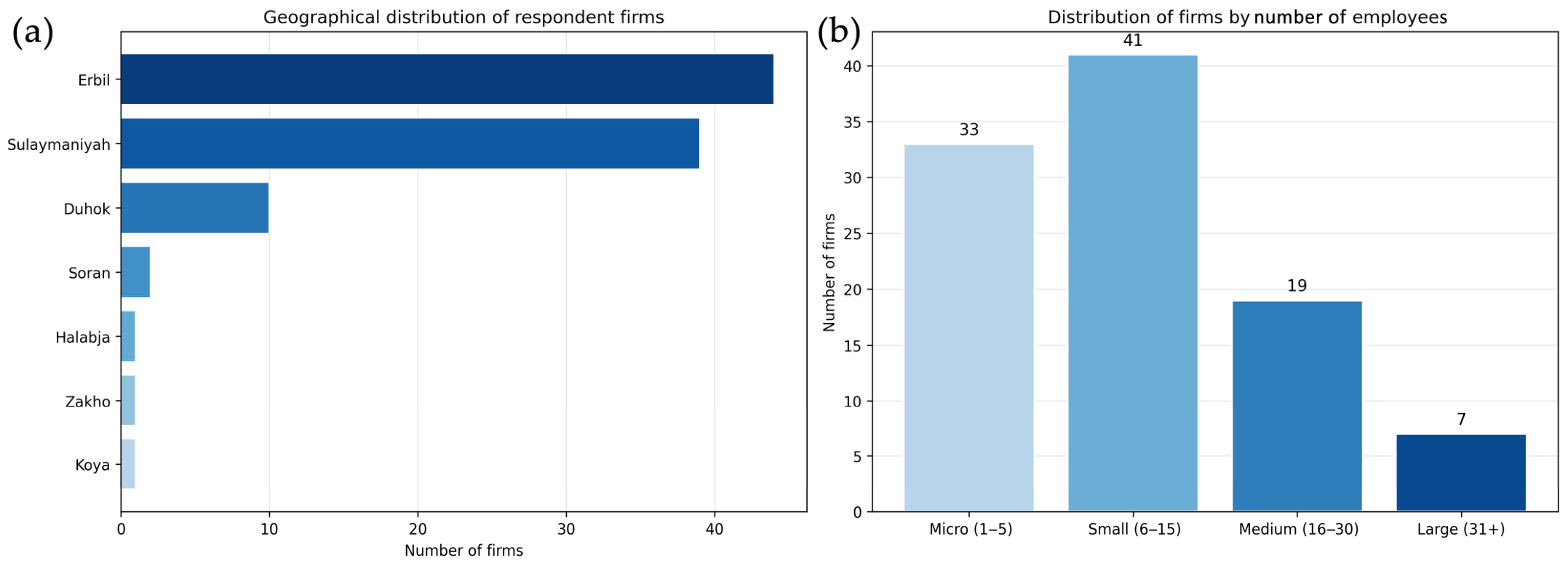


| Variable | Category | n | % |
|---|---|---|---|
| City | Erbil | 44 | 44.0 |
| Sulaymaniyah | 39 | 39.0 | |
| Duhok | 10 | 10.0 | |
| Soran | 2 | 2.0 | |
| Halabja | 1 | 1.0 | |
| Other | 1 | 1.0 | |
| Zakho | 1 | 1.0 | |
| Rania | 1 | 1.0 | |
| Koya | 1 | 1.0 | |
| Role | Principal/Partner | 55 | 55.0 |
| Senior Architect | 23 | 23.0 | |
| Junior Architect | 10 | 10.0 | |
| Visualisation specialist | 6 | 6.0 | |
| Project Manager | 3 | 3.0 | |
| Administrative | 2 | 2.0 | |
| Other | 1 | 1.0 | |
| Experience | >15 yrs | 28 | 28.0 |
| 6–10 yrs | 25 | 25.0 | |
| 11–15 yrs | 24 | 24.0 | |
| 3–5 yrs | 14 | 14.0 | |
| <3 yrs | 9 | 9.0 | |
| Firm size | Small (6–15) | 41 | 41.0 |
| Micro (1–5) | 33 | 33.0 | |
| Medium (16–30) | 19 | 19.0 | |
| Large (31+) | 7 | 7.0 | |
| Years in practice | 5–10 yrs | 41 | 41.0 |
| <5 yrs | 36 | 36.0 | |
| 11–20 yrs | 19 | 19.0 | |
| >20 yrs | 4 | 4.0 | |
| Annual project volume | 6–10 projects | 28 | 28.0 |
| Prefer not to answer | 23 | 23.0 | |
| More than 20 projects | 18 | 18.0 | |
| 11–20 projects | 17 | 17.0 | |
| 1–5 projects | 14 | 14.0 | |
| Project budget | Prefer not to answer | 42 | 42.0 |
| $100,000–$500,000 | 21 | 21.0 | |
| Under $100,000 | 17 | 17.0 | |
| $500,000–$1 million | 13 | 13.0 | |
| Over $5 million | 4 | 4.0 | |
| $1 million–$5 million | 2 | 2.0 | |
| Missing | 1 | 1.0 | |
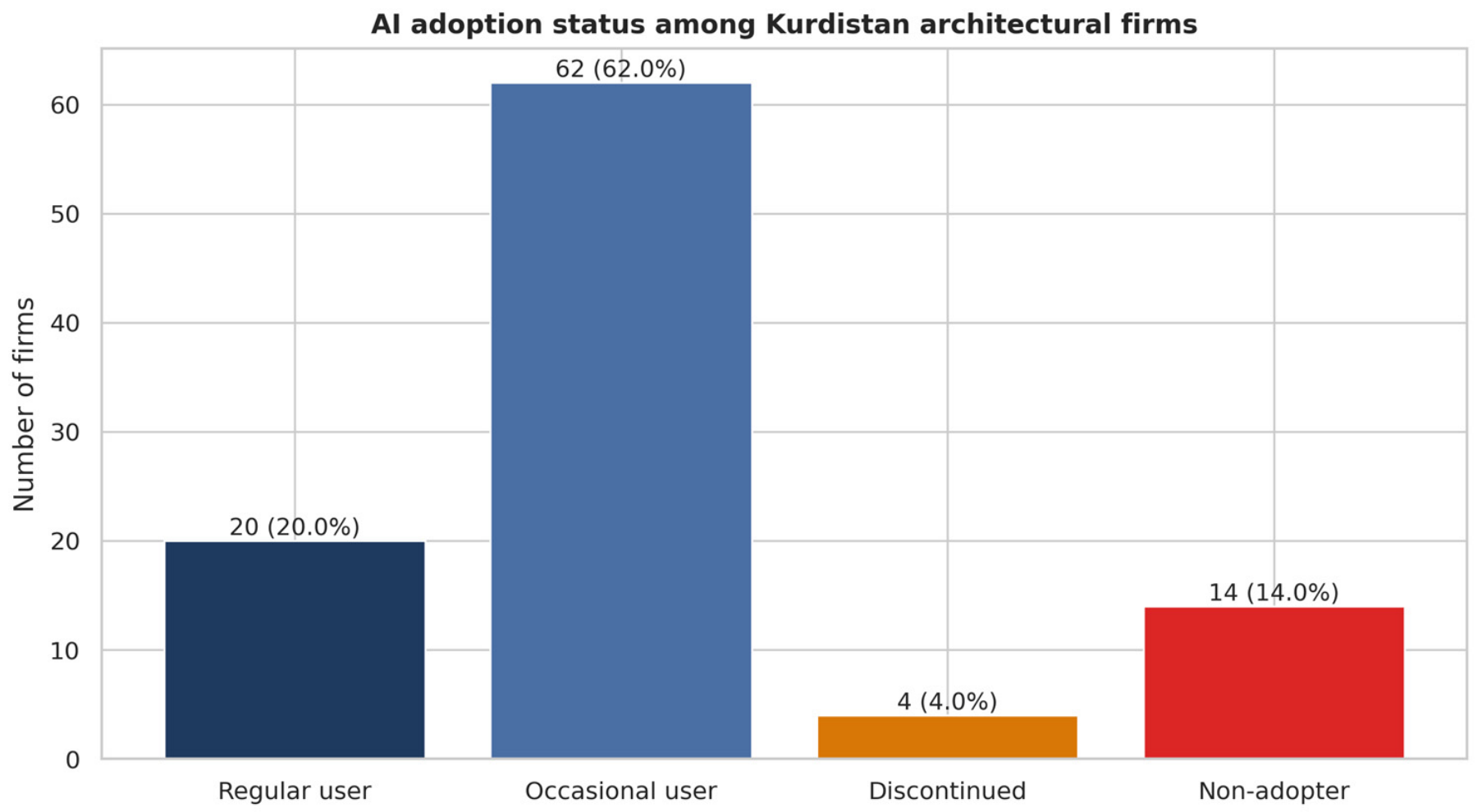
| AI use status | Occasional user | 62 | 62.0 |
| Regular user | 20 | 20.0 | |
| Non-adopter | 14 | 14.0 | |
| Discontinued | 4 | 4.0 |
| Firm | Location | Size (Staff) | Years in Business | Primary Specialisation | AI Use Since | AI Capability History (in Detail) | AIMI (Band) |
|---|---|---|---|---|---|---|---|
| A | London, UK | Large (~1700+) | 59 (est. 1967) | Architecture, engineering, master planning | ~2010s (early adopter) | Long-standing in-house applied-R&D group developing internal machine-learning tools for design optimisation, environmental-performance evaluation and generative form-finding; dedicated computational-design team and structured staff training | 37 (Advanced strategic) |
| B | London, UK | Large (~600) | 46 (est. 1980) | Engineering-led architecture and computational design | Recent (long BIM/parametric history; AI tools added recently) | BIM/parametric foundation; AI-assisted tools embedded in design and delivery for environmental-performance analysis, structural optimisation and visualisation | 37 (Advanced strategic) |
| C | Copenhagen, Denmark | Large (~700) | 21 (est. 2005) | Architecture, urban design and design technology | 2010s (early/consistent adopter) | Data-driven, iterative computational design; dedicated in-house research/innovation unit working on generative AI, parametric design and environmental simulation; AI used in massing, environmental analysis, façade optimisation, visualisation and client presentation | 35 (Advanced strategic) |
| D | London, UK | Large (~500) | 47 (est. 1979) | Architecture and computational design | 2010s (long computational history) | Dedicated computation-and-design research group developing machine-learning tools for form-finding, structural optimisation and material testing, with active ML research | 35 (Advanced strategic) |
| E | London, UK | Small | 3 (est. 2023) | Computational and generative design | 2023 (AI-native from inception) | AI-native studio applying AI from concept generation through detailed design and visualisation; operates a dedicated research lab building proprietary in-house AI tools | 33 (Advanced strategic) |
| F | Dubai, UAE | Large (~5000–6000) | 62 (est. 1964) | Architecture, engineering and planning | Recent (BIM/parametric base; moving toward AI) | Very large multidisciplinary consultancy; BIM, parametric design and performance simulation embedded; progressing to AI-assisted structural analysis, environmental simulation and visualisation in project delivery | 31 (Advanced strategic) |
| G | Dubai and London | Small (~9) | 3 (est. 2023) | Experimental design and material research | 2023 (AI/XR-native from founding) | Small AI/XR-native studio at the intersection of architecture, research and art; AI for material-behaviour study, generative design and spatial exploration; highly experimental and creatively driven | 28 (Integrated) |
| H | Budapest, Hungary | Small-Medium | ~20 (est. ~2006) | Research-led computational design | Recent (research-led experimentation) | Research-led practice bridging academia and professional design; AI-assisted tools across design, fabrication and visualisation within a culture of experimentation; occasional, research-driven use | 21 (Occasional) |
| I | Australia | Small-Medium | 15 (est. 2011) | Contemporary design and visualisation | Recent (exploratory; expanding) | Uses AI for idea generation, layout planning and client presentation; progressively expanding AI use and building staff capability | 15 (Exploratory) |
| J | United States | Mid-sized | 106 (est. 1920) | Healthcare, education and workplace design | Recent (early/exploratory stage) | Early BIM/digital adopter beginning to explore AI for space planning, visualisation and documentation; AI not yet embedded or supported by formal training or governance | 14 (Exploratory) |
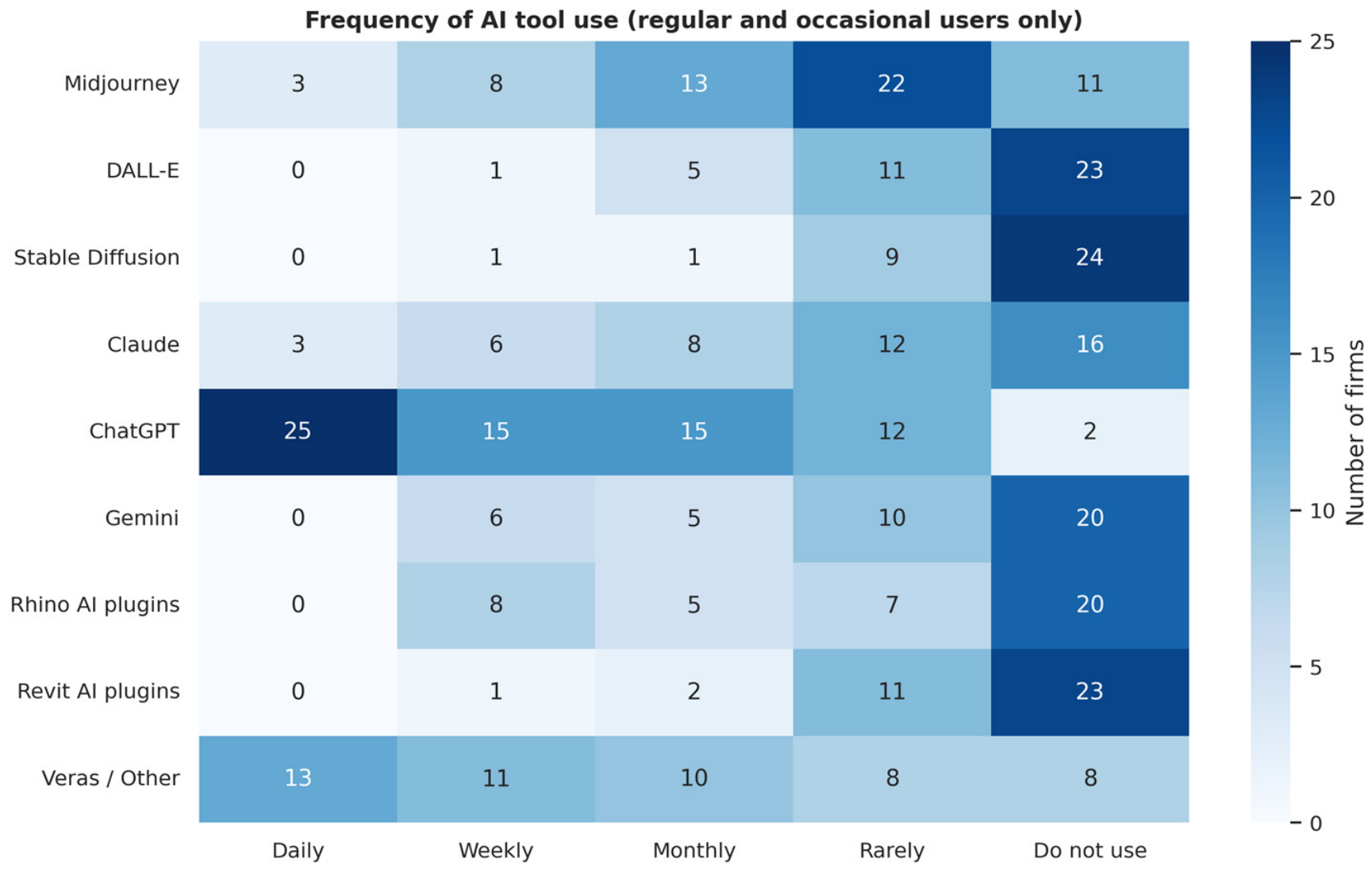
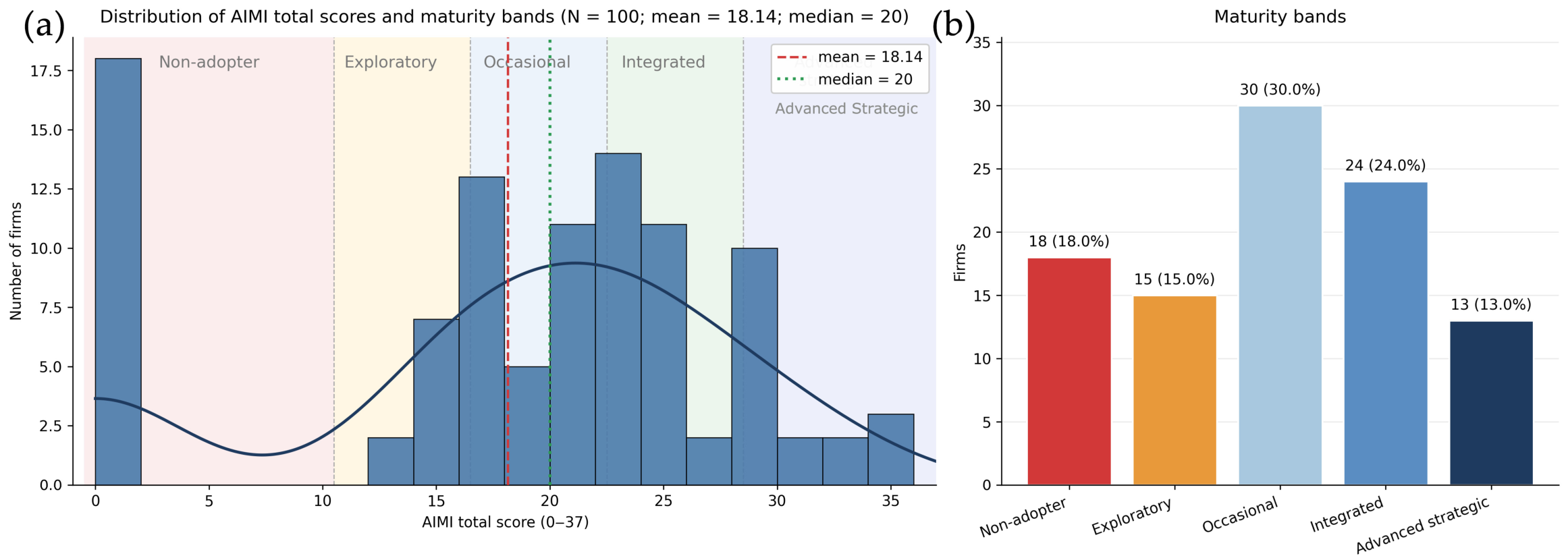
| AIMI Score Range | Maturity Band | Interpretation |
|---|---|---|
| 0–10 | Non-adopter | No current AI use or only very weak/very early use |
| 11–16 | Exploratory | Basic experimentation, informal use, limited structure |
| 17–22 | Occasional | AI is used, but not deeply embedded |
| 23–28 | Integrated | AI is used across several workflows and projects |
| 29–37 | Advanced strategic | AI is embedded, trained, supported, governed, and strategically used |
| AIMI Component | What Is Coded | Keyword/Evidence Examples | Score Logic |
|---|---|---|---|
| C1 AI adoption | Whether the firm currently uses AI. Score: 0 = no use, 1 = limited/testing, 2 = active/embedded. | routine use; active use; early testing; not officially adopted; embedded | 0 = no use; 1 = limited/testing; 2 = active/routine/embedded |
| C2 Usage intensity | How frequently is AI used? Score: 0 = none, 1 = rare, 2 = low, 3 = moderate, 4 = regular, 5 = routine/embedded. | daily; routinely; across studios; all current projects; selective; limited | 0 = no evidence; 1 = very weak; 2 = limited; 3 = moderate; 4 = strong; 5 = advanced/embedded |
| C3 Tool diversity | Breadth of AI tool categories: LLMs, image generation, rendering, BIM/parametric, analysis, in-house/custom systems. | ChatGPT; Gemini; Midjourney; Stable Diffusion; D5; Rhino/Revit; in-house tools | 0 = no evidence; 1 = very weak; 2 = limited; 3 = moderate; 4 = strong; 5 = advanced/embedded |
| C4 Workflow breadth | Number of workflow stages using AI: concept, visualisation, presentation, documentation, analysis, BIM, business development, etc. | concept; visualisation; presentation; documentation; analysis; BIM; business development | 0 = no evidence; 1 = very weak; 2 = limited; 3 = moderate; 4 = strong; 5 = advanced/embedded |
| C5 Staff involvement | How widely AI use is distributed among staff, specialists, teams, and studios. | everyone; design technology team; specialists; across studios; individual designers | 0 = no evidence; 1 = very weak; 2 = limited; 3 = moderate; 4 = strong; 5 = advanced/embedded |
| C6 Capability/training | Training, workshops, internal guides, peer learning, prompt libraries, or formal capability building. | workshops; internal school-style training; lunch-and-learn; prompt libraries; self-learning; guides | 0 = no evidence; 1 = very weak; 2 = limited; 3 = moderate; 4 = strong; 5 = advanced/embedded |
| C7 Project application | Whether AI is used in real projects, live projects, competitions, client work, or only experiments. | live projects; real projects; competition entry; client work; not for client work yet | 0 = no evidence; 1 = very weak; 2 = limited; 3 = moderate; 4 = strong; 5 = advanced/embedded |
| C8 Commitment/governance | Investment, in-house tools, senior review, approved tools, data security, IP/confidentiality policy, and strategic support. | approved tools; data security; IP; senior review; internal servers; custom platform; R&D | 0 = no evidence; 1 = very weak; 2 = limited; 3 = moderate; 4 = strong; 5 = advanced/embedded |
| Mean | Median | SD | % Rating ≥ 4 | |
|---|---|---|---|---|
| Time savings in repetitive tasks | 3.79 | 4.0 | 1.12 | 63.4 |
| Better visualisation quality | 3.49 | 3.5 | 1.15 | 50.0 |
| Improved client presentations | 3.35 | 3.0 | 1.1 | 48.8 |
| Enhanced creativity/idea exploration | 3.29 | 3.0 | 1.06 | 40.2 |
| More design alternatives in less time | 3.28 | 3.0 | 1.3 | 41.5 |
| Increased client satisfaction | 3.27 | 3.0 | 1.12 | 39.0 |
| Faster design process | 3.24 | 3.0 | 1.26 | 45.1 |
| Cost savings/resource efficiency | 3.07 | 3.0 | 1.16 | 32.9 |
| Better design communication | 2.98 | 3.0 | 1.07 | 29.3 |
| Competitive advantage | 2.93 | 3.0 | 1.18 | 32.9 |
| Mean | Median | SD | % Rating ≥ 4 | |
|---|---|---|---|---|
| Output quality inconsistency | 3.57 | 4.0 | 1.08 | 53.7 |
| Lack of control over results | 3.39 | 3.0 | 1.03 | 47.6 |
| Cost of subscriptions | 3.06 | 3.0 | 1.19 | 32.9 |
| Integration with existing software/workflow | 2.95 | 3.0 | 1.0 | 30.5 |
| Client scepticism | 2.62 | 2.0 | 1.15 | 28.0 |
| Internet speed/connectivity | 2.62 | 3.0 | 1.23 | 23.2 |
| Copyright/IP concerns | 2.56 | 2.0 | 1.34 | 24.4 |
| Ethical concerns | 2.41 | 2.0 | 1.26 | 19.5 |
| Hardware limitations | 2.38 | 2.0 | 1.22 | 18.3 |
| Learning curve/complexity | 2.29 | 2.0 | 0.99 | 13.4 |
| Test | Result |
|---|---|
| Chi-square: Firm size × adoption status | χ2 = 14.79, df = 9, p = 0.097 |
| Chi-square: Experience × adoption status | χ2 = 7.47, df = 12, p = 0.825 |
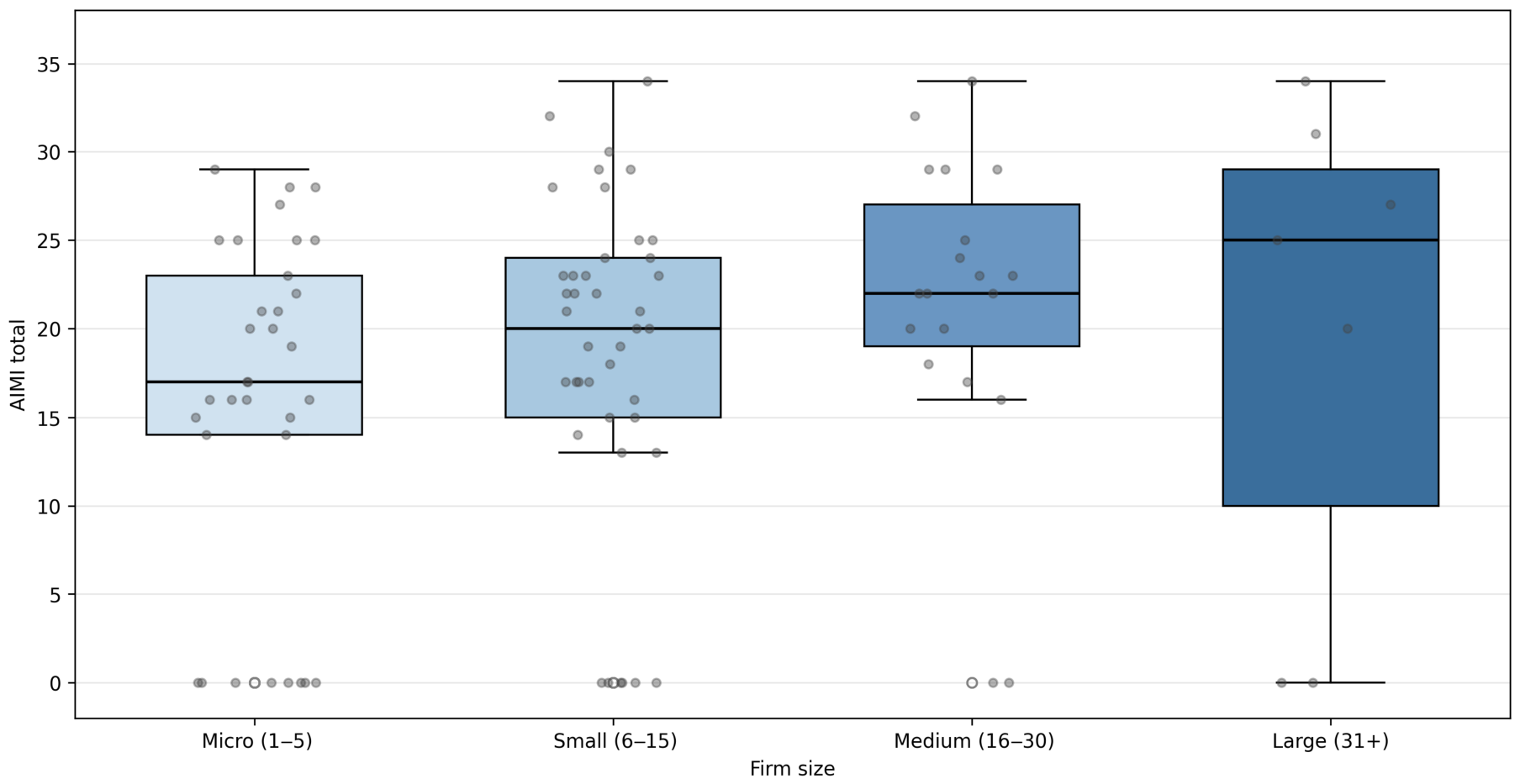
| Kruskal–Wallis: AIMI across firm size | H = 5.85, p = 0.119, epsilon-squared = 0.03 |
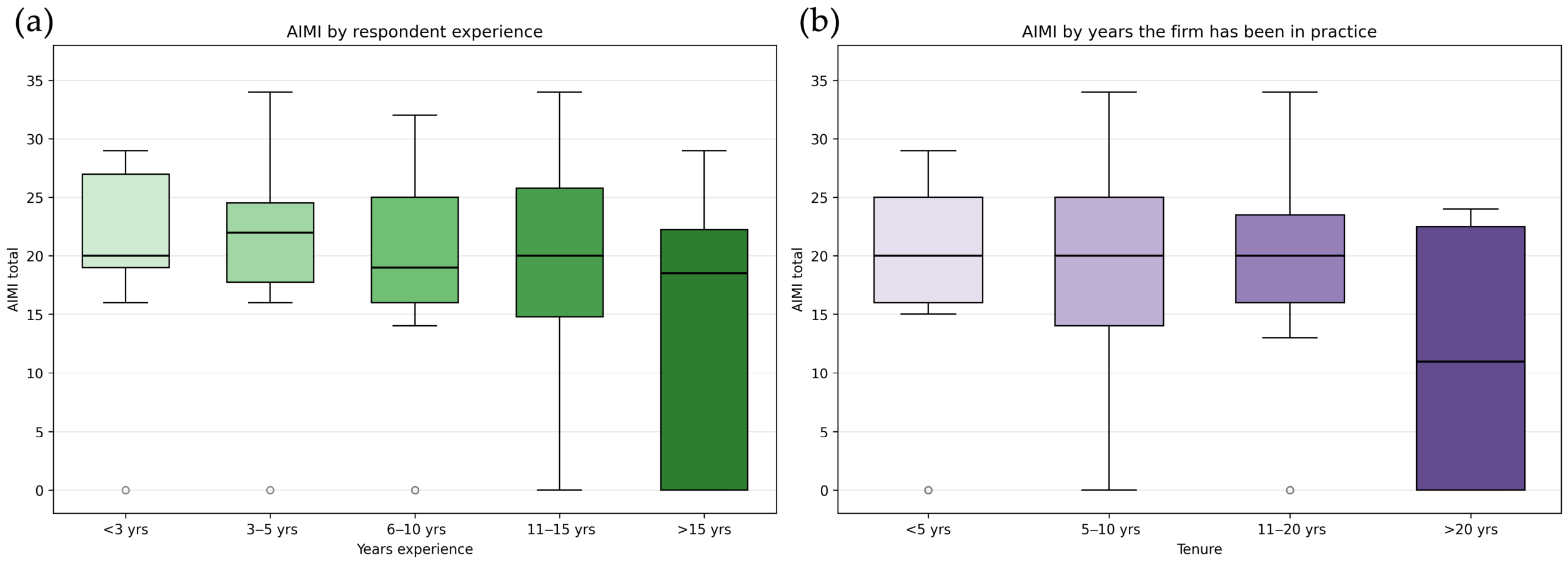
| Kruskal–Wallis: AIMI across experience bands | H = 4.50, p = 0.342, epsilon-squared = 0.01 |
| Kruskal–Wallis: AIMI across firm tenure | H = 0.61, p = 0.895, epsilon-squared = 0.00 |
| Spearman: AIMI ↔ mean perceived benefit | ρ = 0.41, p = 0.000156 |
| Spearman: AIMI ↔ mean perceived challenge | ρ = −0.05, p = 0.673 |
| Spearman: AIMI ↔ pro-AI Likert composite | ρ = 0.28, p = 0.0046 |
| Mann–Whitney: AIMI by training status | U = 882, p < 0.001 (two-tailed) |
| Cronbach’s α: AIMI (8 components) | 0.922 (internal-structure check; formative index—see Section 4.1.5) |
| Cronbach’s α: Benefits scale (10 items) | 0.858 |
| Cronbach’s α: Challenges scale (10 items) | 0.785 |
| Cronbach’s α: Likert attitudes scale (10 items) | 0.777 |
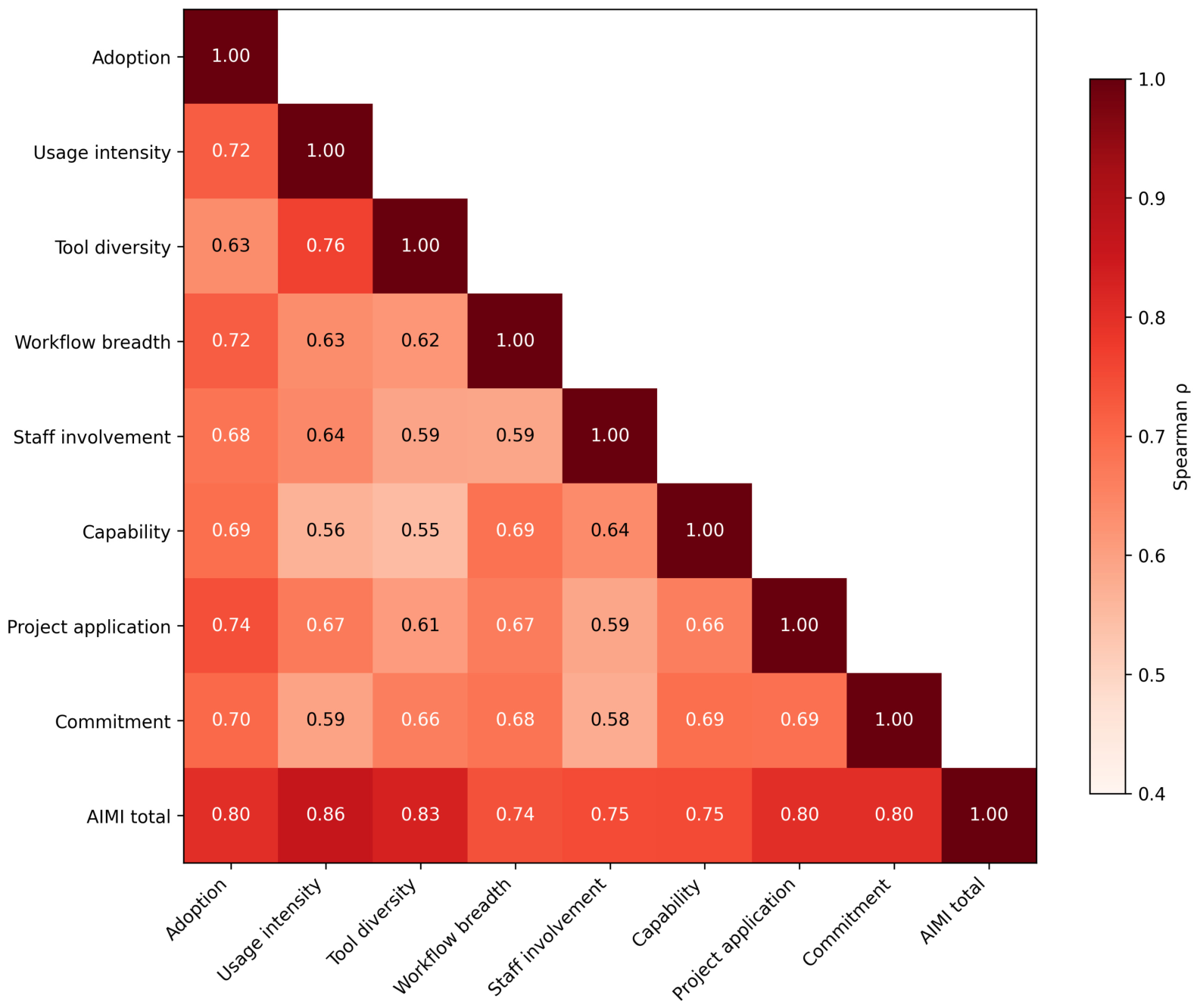
| Item-rest correlation: each component vs. sum of the others | 0.67–0.78 (all p < 0.001) |
| Component independence: maximum inter-component correlation | <0.90 (range 0.55–0.77); no redundant pair |
| Effect size: AIMI by training status (rank-biserial) | r = 0.60 (large) |
| Bootstrap 95% CI: AIMI mean (10,000 resamples) | 16.2–20.0 |
| Firm | AIMI Total | Maturity Band | Strongest Coded Evidence | Interpretation |
|---|---|---|---|---|
| Firm A | 37 | Advanced strategic | Routine multi-tool use, Applied R&D capacity, governance, internal ecosystem | Advanced benchmark for organizationally embedded AI |
| Firm B | 37 | Advanced strategic | In-house AI platform, Rhino/Revit integration, data security, live project deployment | Advanced benchmark for secure project-linked tooling |
| Firm C | 35 | Advanced strategic | Design-technology-led experimentation, broad tool use, structured learning routines | Advanced benchmark for design-technology culture |
| Firm D | 35 | Advanced strategic | Computational design culture, pervasive AI-supported design exploration | Advanced benchmark with strong design and computation alignment |
| Firm E | 33 | Advanced strategic | AI-native practice identity, proprietary systems, routine concept and presentation use | Advanced benchmark for AI-first studio practice |
| Firm F | 31 | Advanced strategic | Routine but selective use, embedded power users, prompt libraries and custom workflows | Lower advanced benchmark with transferable hybrid model |
| Firm G | 28 | Integrated | AI image generation linked to environmental and computational analysis | Integrated benchmark with competition-oriented AI use |
| Firm H | 21 | Occasional | Gemini and ChatGPT are mainly for visualisation and presentation iteration. | Occasional benchmark with limited formal structure |
| Firm I | 15 | Exploratory | Cautious use of consumer tools by individual designers | Exploratory benchmark |
| Firm J | 14 | Exploratory | Partial individual use, no formal training or dedicated AI staff | Exploratory benchmark |
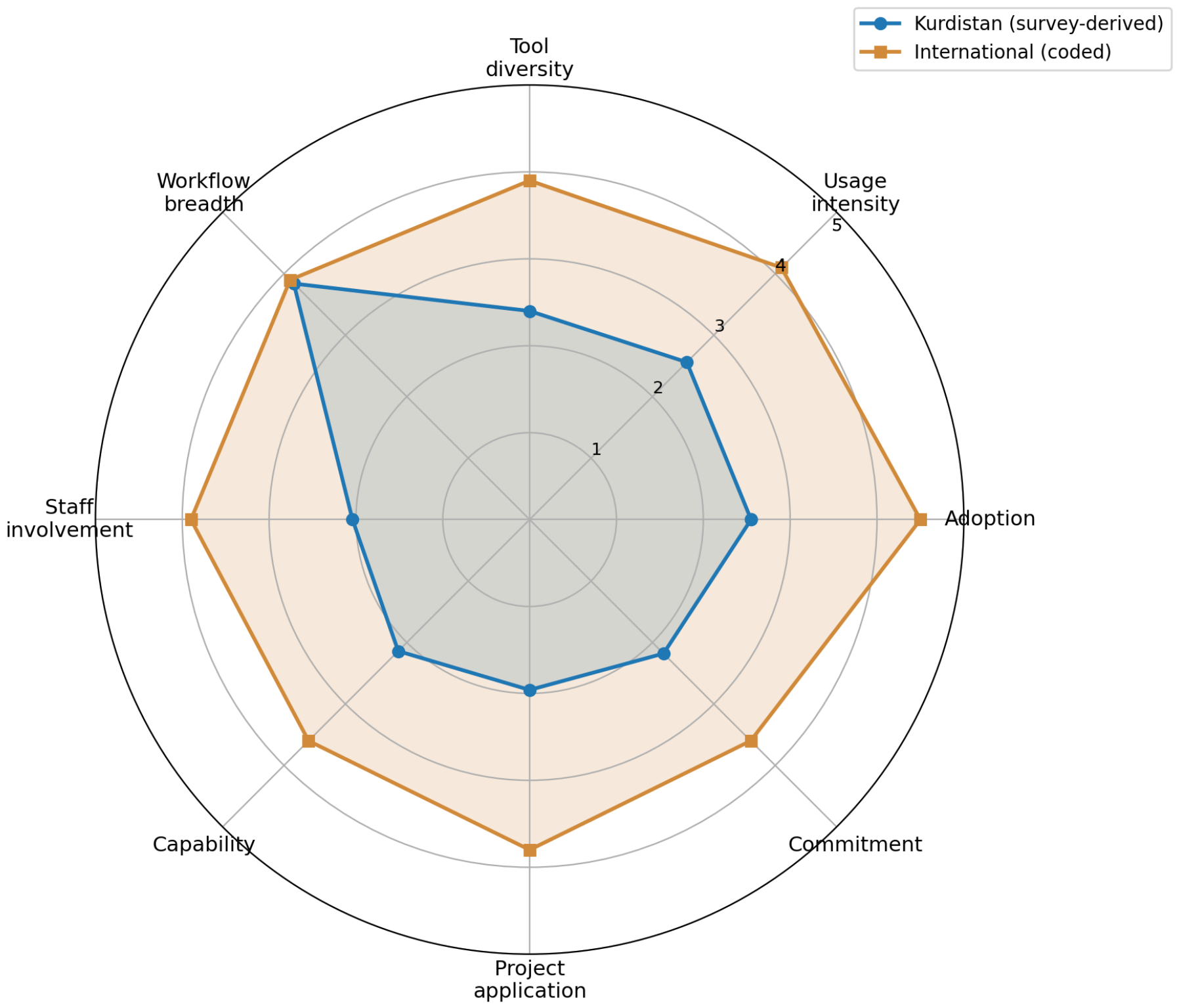
| The Kurdistan Region Survey Means | International Coded Mean | Benchmark Gap | |
|---|---|---|---|
| Adoption | 1.02 | 1.8 | 0.78 |
| Usage intensity | 2.56 | 4.1 | 1.54 |
| Tool diversity | 2.40 | 3.9 | 1.50 |
| Workflow breadth | 3.84 | 3.9 | 0.06 |
| Staff involvement | 2.04 | 3.9 | 1.86 |
| Training/Capability | 2.14 | 3.6 | 1.46 |
| Project application | 1.96 | 3.8 | 1.84 |
| Governance/Commitment | 2.18 | 3.6 | 1.42 |
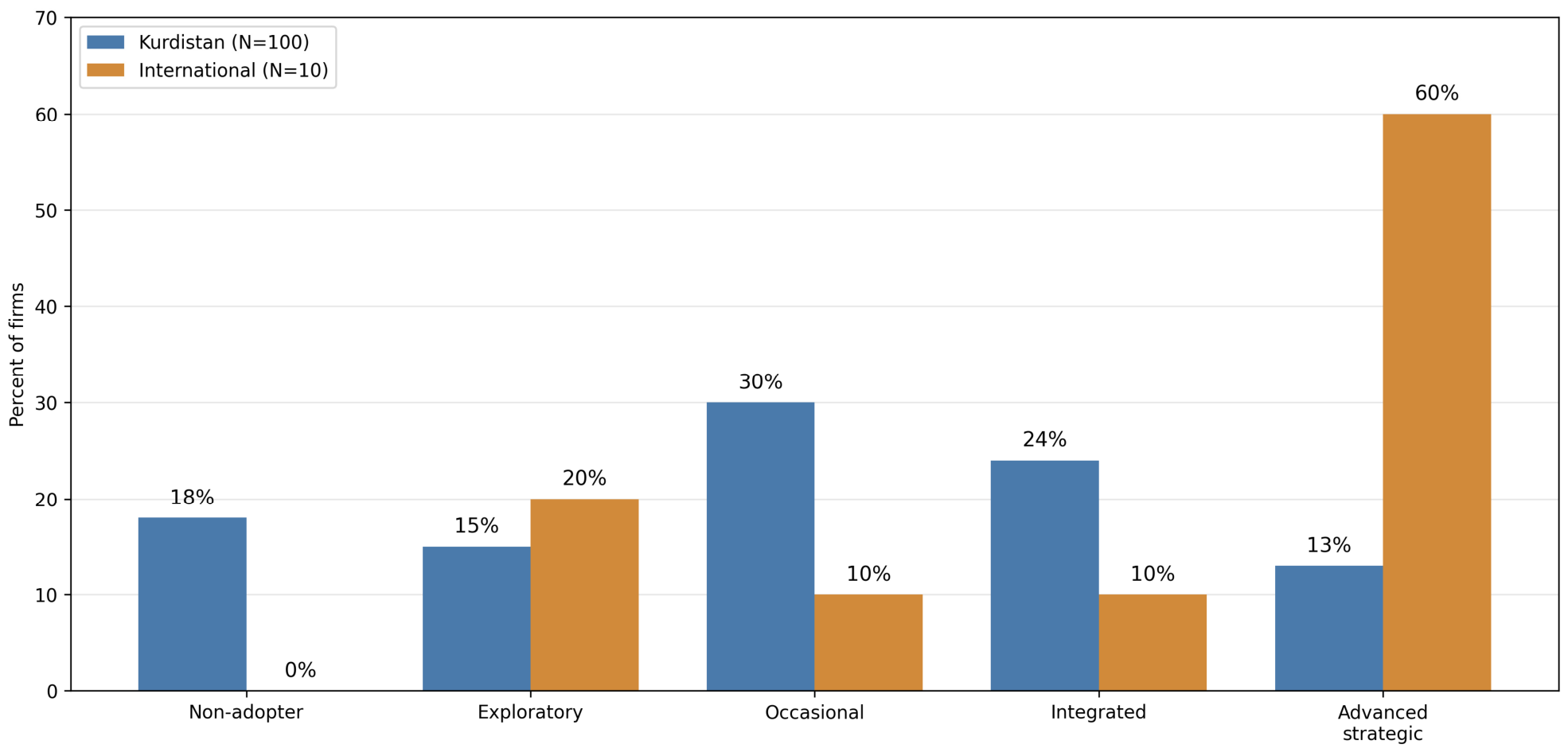
| Maturity Band | Kurdistan n | Kurdistan % | Benchmark n | Benchmark % |
|---|---|---|---|---|
| Non-adopter | 18 | 18.0 | 0 | 0.0 |
| Exploratory | 15 | 15.0 | 2 | 20.0 |
| Occasional | 30 | 30.0 | 1 | 10.0 |
| Integrated | 24 | 24.0 | 1 | 10.0 |
| Advanced strategic | 13 | 13.0 | 6 | 60.0 |
Disclaimer/Publisher’s Note: The statements, opinions and data contained in all publications are solely those of the individual author(s) and contributor(s) and not of MDPI and/or the editor(s). MDPI and/or the editor(s) disclaim responsibility for any injury to people or property resulting from any ideas, methods, instructions or products referred to in the content. |
© 2026 by the authors. Licensee MDPI, Basel, Switzerland. This article is an open access article distributed under the terms and conditions of the Creative Commons Attribution (CC BY) license.
Share and Cite
MohammedAmin, R.A.; Abdullah, H.K. Evaluating AI Integration Maturity in Architectural Practices in the Kurdistan Region, Iraq: A Comparative Benchmark Study. Architecture 2026, 6, 123. https://doi.org/10.3390/architecture6030123
MohammedAmin RA, Abdullah HK. Evaluating AI Integration Maturity in Architectural Practices in the Kurdistan Region, Iraq: A Comparative Benchmark Study. Architecture. 2026; 6(3):123. https://doi.org/10.3390/architecture6030123
Chicago/Turabian StyleMohammedAmin, Rawand A., and Hardi K. Abdullah. 2026. "Evaluating AI Integration Maturity in Architectural Practices in the Kurdistan Region, Iraq: A Comparative Benchmark Study" Architecture 6, no. 3: 123. https://doi.org/10.3390/architecture6030123
APA StyleMohammedAmin, R. A., & Abdullah, H. K. (2026). Evaluating AI Integration Maturity in Architectural Practices in the Kurdistan Region, Iraq: A Comparative Benchmark Study. Architecture, 6(3), 123. https://doi.org/10.3390/architecture6030123