1. Introduction. Impact Assessment and the Architectural Conservation Process
Heritage Impact Assessments (HIA) have become a fundamental tool in the management and safeguarding of World Heritage (WH) sites [
1], establishing themselves in the cultural heritage landscape as a key instrument for the inclusion of sustainable development in heritage management [
2] and, specifically, for the control of architectural action. The growing demand for HIAs by the World Heritage Committee (WHC) in response to the State of Conservation Reports [
3] submitted by States Parties proves this. This has happened gradually, incorporating the production of these documents into good practice for heritage conservation, based on the studies of Environmental Impact Assessments (EIA) that had been applied in the field of natural habitats of community interest since the 1990s [
4], as a natural evolution of the impact assessments (IA) that appeared in the North American sphere in the early 1970s.
Following the Convention on Environmental Impact Assessment in a Transboundary Context [
5]—the Espoo Convention—a whole framework of protocols, bodies and international directives, still in force today, has been developed, gradually introducing planning as an essential component of conservation, resulting in Strategic Environmental Assessments (SEA) [
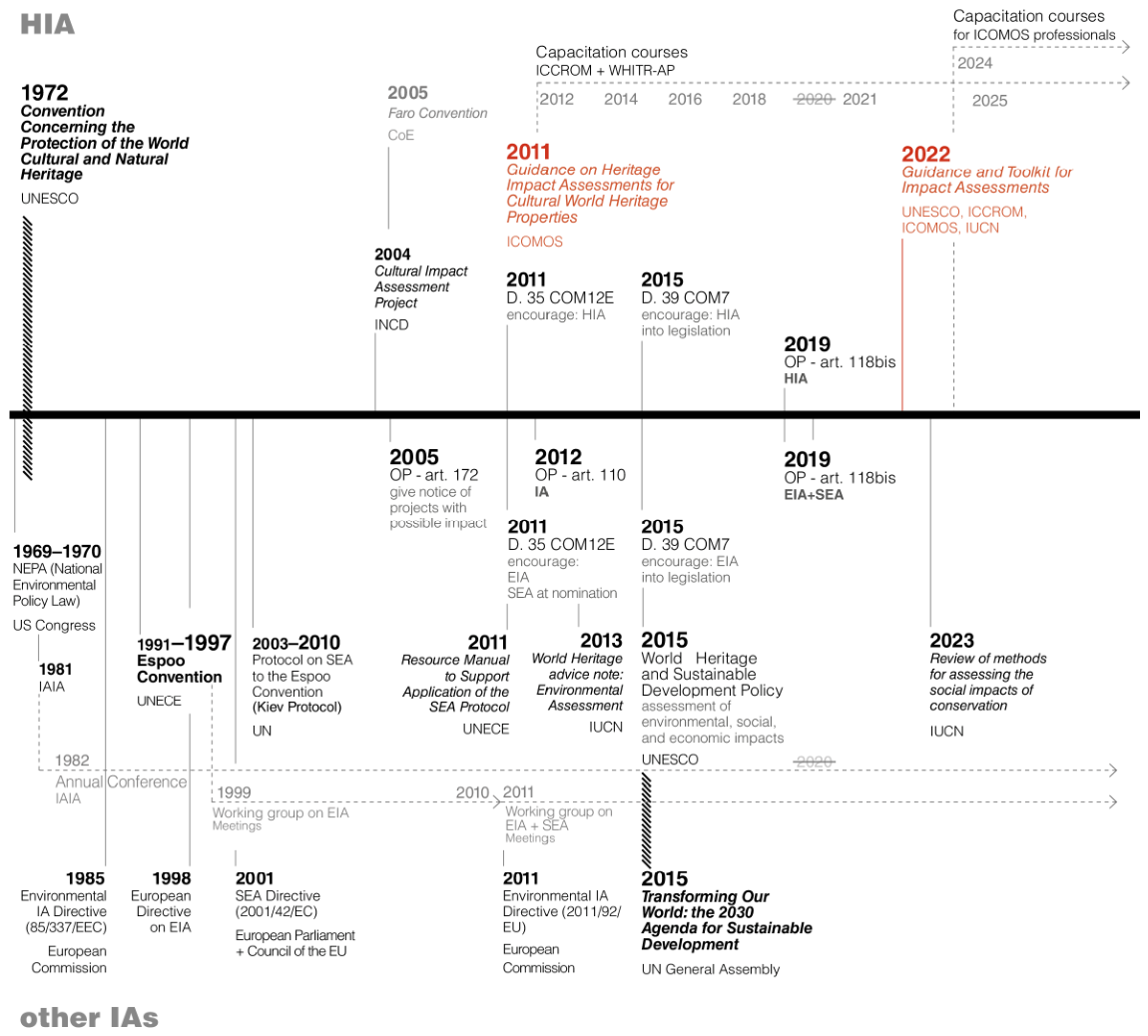
6]. These are particularly useful tools for monitoring the management of alterations to WH sites, primarily introduced through architectural intervention or urban development and planning actions. HIA complements this process from a heritage perspective (
Figure 1).
The precedents can be found in the 2001 SEA directive [
7], which promoted this methodology and encouraged the inclusion of heritage as a factor in EIA procedures, incorporating it as one of a long series of factors in relevant cases and assigning it weighted attention according to the importance given to it. However, it soon became clear that adequate guidelines were needed to better consider cultural heritage within the EIAs process [
8], focusing on the specific development of assessments centred on heritage impact.
The emergence of specific IA processes for heritage has been developed methodologically in the first quarter of the 21st century under the influence of the guidelines set out in the Faro Convention on the value of heritage for society (2005) [
9]. This approach initially focused on the field of World Heritage, aiming to preserve the integrity and authenticity of the Outstanding Universal Value (OUV) of its properties [
10], and introducing concepts that go beyond the scope of a conventional EIA [
11].
After an initial advance in a specific methodology for conducting HIAs published by the International Network for Cultural Diversity [
12], the international community began a gradual process of assimilating IA processes for WH, with the appearance of reference documents for working with WH developed by UNESCO’s Advisory Bodies. First, in 2011, the ICOMOS’ Guidance for Heritage Impact Assessments for Cultural Heritage Properties [
11] was published, followed in 2013 by the IUCN’s World Heritage Advice Note: Environmental Assessments [
13]. Both documents represent a landmark in the definition of a specific methodology for assessing the impact of projects on heritage assets—and specifically WH—so that the assessment takes into account the criteria that express the OUV of these assets. At the same time, training activities for their application have been launched, led by ICCROM, and are still ongoing today.
Following this development, in 2012 the Operational Guidelines for the Implementation of the World Heritage Convention mentioned these documents for the first time, describing HIAs as “essential for all World Heritage properties” (updated in 2025 [
1]) in relation to the effectiveness of WH management systems. The publication in 2015 of the 2030 Agenda [
14] provided the definitive impetus for these processes, encouraging the adoption of new decisions and policies surrounding its final adoption. The WHC establishes, through its Decision 39COM7, the recommendation to use HIAs as “useful tools to support decision making at the property level rather than documents that need to be assessed by the Advisory Bodies” [
15], encouraging States Parties to include these processes in their regulatory framework, as well as giving new impetus to the development of a common methodological tool. The inclusion of paragraph 118bis in the 2019 Operational Guidelines [
1], setting HIA, EIA and SEA as prerequisites for the development of any project or activity in the environment of WH properties [
1] marks the beginning of the integration of IAs into the preliminary phases and land-use planning tools [
16]. Following this decision, the efforts of the WHC and the Advisory Bodies are focused on developing the methodological proposal already outlined in 2011 and on creating a practical tool for applying HIAs to the WH context.
A decade after the publications by ICOMOS and IUCN, UNESCO published the Guidance and Toolkit for Impact Assessments in a World Heritage context in 2022 [
17] in conjunction with its advisory bodies. This document compiles the results of a continuous update of procedures, reflecting the evolution of WH management itself.
Based on the guidelines established to assess the impact on WH assets and aiming to follow in the footsteps of international charters and texts such as the Faro Convention [
9], the sectoral administrations of the states that have signed up to UNESCO resolutions continue to implement these principles in their legal, regulatory, and advisory texts. In the case of Spain, regional Law 4/2026, of 24 March, on the Cultural Heritage of Andalusia [
18] included the need to assess impacts on the cultural values of the most protected assets (including the WH) in the event of direct intervention on them or their recognised contexts. This example highlights the importance of monitoring parameters as a key factor in the conservation of heritage properties (art. 53). However, this has not been implemented due to a lack of regulatory development of the conservation plan that must be drawn up to carry out the work.
Beyond this practice, the recently passed Law on Cultural Heritage of Andalusia, [
18] delves deeper into the subject with a chapter dedicated to UNESCO heritage, which explicitly states that projects and activities to be carried out on a WH asset will be subject, when applicable, to the dispositions of the World Heritage Convention and its implementing guidelines (art. 43.2), including those of IA. In addition, the new regulation makes it mandatory to have a single manager for each asset on the list, which will facilitate dialogue with UNESCO and the implementation of these measures.
However, for these measures to be effective in intervention projects on WH, it will be essential that the criteria and values align between those that make them worthy of their universal status according to UNESCO and those provided for in the regulations, which are often previous or obsolete.
2. Objectives and Methodology. Understanding to Intervene, Identifying Values to Assess Impacts
Aware of the importance of implementing HIAs in WH properties, the main aim of this study is to analyse the development of the concepts and tools that have been developed since the publication in 2011 of the Guidance on Heritage Impact Assessments for Cultural World Heritage Properties [
11] up to the publication in 2022 of the Guidance and Toolkit for Impact Assessments in a World Heritage Context [
17]. Complementarily, this study aims to identify the main methodological contributions provided by these published guidelines as well as to assess their practical application in daily professional WH practice.
The methodology used in this research is based on the intervention criteria defined by the Andalusian Historical Heritage Institute (IAPH), the regional cultural administration in Andalusia, through its axiom ‘Knowing to intervene’, later updated within the framework of the “WHATS-UP, World Heritage: an Approach To Social Sustainability while Upgrading Cultural Values” research project. It also draws on the Faro Convention (2005) [
9] and its key issues on the importance of value and citizen participation, which inform any recent approach to heritage intervention.
To analyse the conceptual evolution between the 2011 and 2022 texts, a methodology inspired by comparative literature studies and the scientific evaluation process of peer review has been established. To this end, the authors of this study have carried out comprehensive analyses of both documents in parallel, and then, through joint working sessions, established common criteria and reached consensus conclusions to shape this study.
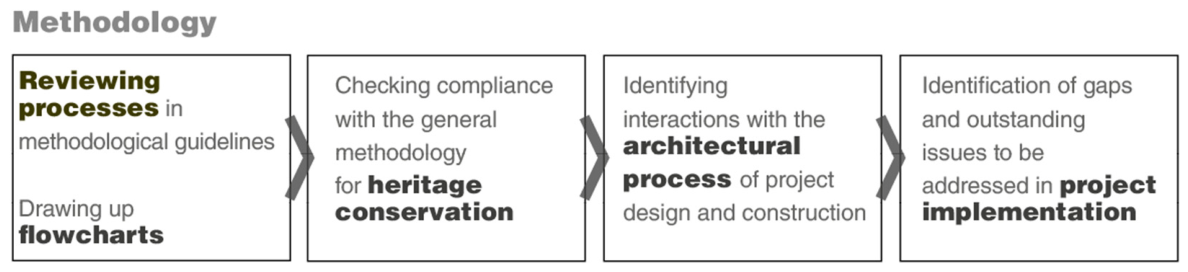
In this way, the key considerations to characterise the analytical framework are outlined in four steps (
Figure 2):
Reviewing processes in methodological guidelines and drawing up flowcharts. A quantitative comparison in terms of scope, procedures and tools highlights the qualitative leap between the two documents.
Checking compliance with the general methodology for heritage conservation: heritage management (integrated and transdisciplinary), documentation, identification of values, participatory governance, architectural intervention and impact assessments.
Identifying interactions with the architectural process of project design and construction.
Identification of gaps and outstanding issues to be addressed in project implementation.
Based on these methodologically defined actions, an analysis will be carried out of the two main guidelines that have shaped the development of HIAs from an international perspective. The table below has been designed to help compare the stages involved in heritage conservation. Each stage is characterised by a colour code: heritage management, documentation, values, Participatory Heritage Governance, architectural intervention and impact assessment (
Table 1).
Table 1.
Main stages of the general methodology for heritage conservation, as derived from IAPH criteria, WHATS-UP research project and the Faro Convention. Assignment of colour codes to check the methodological process when comparing the two guidelines in
Table 2. Produced by the authors.
Table 1.
Main stages of the general methodology for heritage conservation, as derived from IAPH criteria, WHATS-UP research project and the Faro Convention. Assignment of colour codes to check the methodological process when comparing the two guidelines in
Table 2. Produced by the authors.
| Main Stages of the General Methodology for Heritage Conservation |
|---|
HERITAGE MANAGEMENT
Integrated and transdisciplinary |
DOCUMENTATION
Summary/Introduction/Methodology/Database of consulted documentary sources/Bibliography/Concepts and glossary |
VALUES
Values identification |
PARTICIPATORY HERITAGE GOVERNANCE
Agents map/working tools |
ARCHITECTURAL INTERVENTION
Cultural Project |
IMPACTS ASSESSMENT
Impacts assessment
Mitigation measures/recommendations |
Table 2.
A comparison of the Heritage Impact Assessment stages in both guidelines in relation to the overall heritage conservation process (step 2) following the methodology defined in
Table 2 using colours to facilitate it. Produced by authors.
Table 2.
A comparison of the Heritage Impact Assessment stages in both guidelines in relation to the overall heritage conservation process (step 2) following the methodology defined in
Table 2 using colours to facilitate it. Produced by authors.
| Guidance on HIA for Cultural WH Properties | Guidance and Toolkit for IA in a WH Context |
|---|
| ICOMOS 2011 | UNESCO, ICCROM, ICOMOS, IUCN 2022 |
| 1. | Initial development and design | 1. | Screening (Tool 1) | Participation | Proactive problem solving |
| 2. | Early consultation | 2. | Scoping (Tool 2) |
| 3. | Identify and recruit sustainable organisations to undertake work |
| 4. | Establish study area |
| 5. | Establish scope of work |
| 6. | Collect data | 3. | Baseline
(Tool 1) | 4. | The proposed action and alternatives |
| 7. | Collate data |
| 8. | Characterise the heritage resource, especially in identifying attributes that convey OUV | Baseline |
| 9. | Model and assess impacts, direct and indirect | 5. | Identifying and predicting impacts. (Tool 2) |
| 6. | Evaluating impacts. (Tool 3) |
| 10. | Draft mitigation-avoid, reduce, rehabilitate or compensate | 7. | Mitigation and enhancement |
| 11. | Draft report | 8. | Reporting |
| 12. | Consultation | 9. | Reviewing the report |
| 13. | Moderate the assessment results and mitigation |
| 14. | Final reporting and illustration-to inform decisions |
| 15. | Mitigation | 10. | Decision-making |
| 16. | Dissemination of results and knowledge gained | 11. | Follow-up |
This research bases its argument on an extensive review of the literature on EIA and HIA processes, considering both scientific publications and international conventions and documents developed within the programmatic corpus of UNESCO itself, leading to the application of impact assessment methodologies to WH assets, in order to analyse the two tools that have shaped the methodology for preparing HIA reports. Following an analysis of the main repositories of scientific articles, such as WOS and SCOPUS at an international level and others within the national context of this research, numerous studies have been identified that cite both guidelines, albeit only tangentially. Some offer a methodological interpretation of the HIA processes proposed by both guidelines, but always from the perspective of specific topics or cases rather than from the theoretical and methodological perspective proposed in this paper [
19,
20,
21,
22].
As an illustration of this scientific literature review, the data provided by the searches carried out in SCOPUS are certainly revealing. A large number of studies were identified that cite the 2011 and 2022 guidance separately: specifically, 166 for the 2011 guidance and 68 for the 2022 guidance. The search for articles citing both guidelines is reduced to 17 documents.
It should be noted that these searches were carried out in January 2026 using the ‘search within = references’ field and entering the title of each guideline in English within quotation marks for individual searches, and both titles for the combined search. This allows us to identify texts that cite the guidelines by their full name, excluding incorrect or partial references. Texts that refer to them without citing them are also excluded.
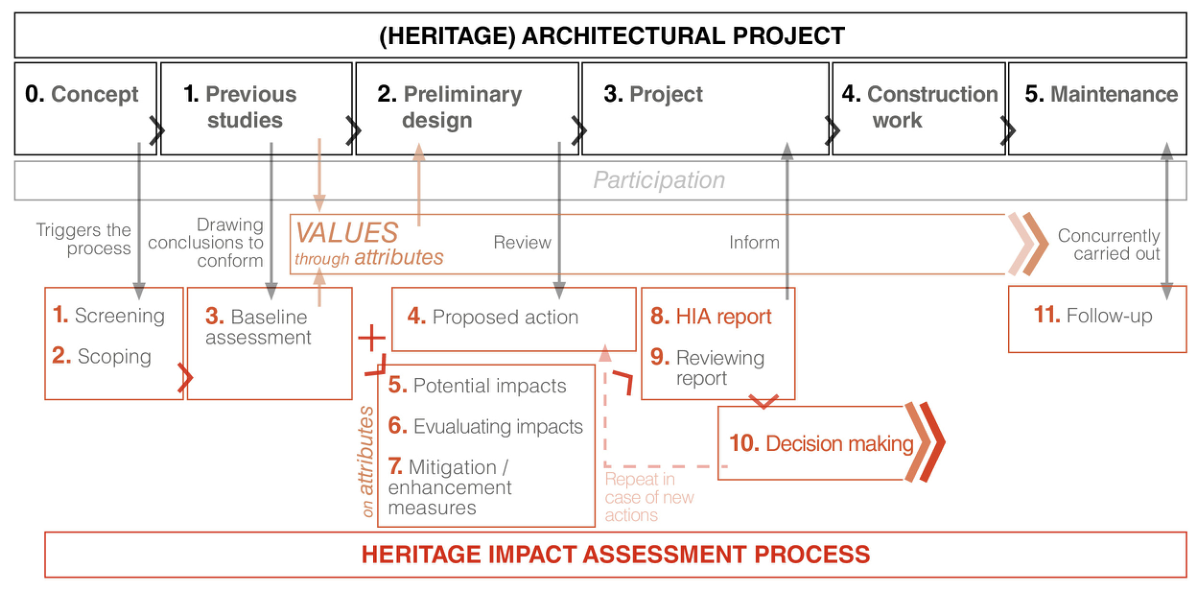
Given that both guides are the product of different moments in the same ongoing process of methodological development, a comparative analysis of their contents is proposed, placing both documents in their context. The aim is to identify the evolution in the contents and tools proposed, as well as the questions to be answered, confirming along the way the consistency of the approach to defining a methodology for assessing the impact on cultural heritage assets. This is a task that can only be achieved by integrating the heritage assessment process into architectural practice. To this end, it is necessary to establish a general, streamlined process for the implementation of architectural projects in heritage buildings (
Figure 3).
3. The Guidance on Heritage Impact Assessments for Cultural World Heritage Properties, 2011
The Guidance on Heritage Impact Assessments for Cultural World Heritage Properties [
11] was written in a context where it was necessary to outline a specific methodology that placed consideration of the impact on heritage attributes at the centre of these processes for heritage assets, as opposed to the methodology used until then, which was derived from EA, in which these attributes occupied secondary or peripheral positions. That is why the methodological approach of this guide is based on the clarification of two key concepts: the OUV contained in the declaration of each WH asset and the attributes through which it is reflected.
At a time when OUV Statements were already being drafted retrospectively for previously inscribed properties -after being included in the Operational Guidelines for the Implementation of the World Heritage Convention since 2005- the methodology proposed for HIAs follows the same direction, proposing a strategy based on the effective protection of the attributes that constitute the OUV as a means for its effective conservation.
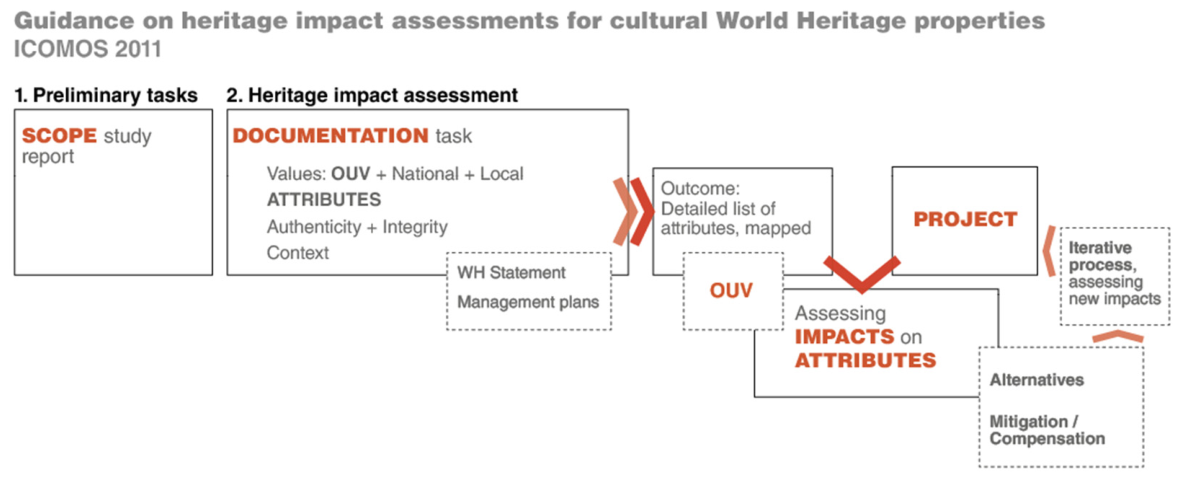
It was an initial guidance document that provided suggestions to WH asset managers and responsible parties on the procedures to be followed for assessing the impact of action projects on these assets, with a proposed methodology divided into a preliminary phase (delineating the scope of the work and the professional profiles required) and an assessment work phase (
Figure 4).
The preliminary phase highlighted the cooperation between the parties involved in the asset in order to establish the intended scope of the assessment, by first conducting a scope study report. Therefore, the first methodological proposal for HIAs already suggested the assessment to be carried out at a sufficiently early stage of the architectural process so that it could inform the project being assessed and its conclusions could contribute to informing its planning.
The work phase comprised an initial stage of data collection and aggregation, seeking to characterise the heritage resource through a proper understanding of the asset, the importance of its attributes and its context. In addition to the OUV declaration itself, management plans contribute an important source of information, incorporating data on the state of conservation.
The methodology for developing this heritage characterisation is based on the specialisation of the agents involved, whilst remaining open as to the specific approach taken. Years of experience in interpreting the guidelines revealed matrices of values and attributes for these assets to be a frequently used approach. Such is the case of the heritage characterisation tables produced for the area of the northern slope of the Sabika hill in Granada, on which the Alhambra is located, for the purpose of drafting a report on the heritage values of the San Pedro’s gorge, developed by members of the University of Seville and the Andalusian Heritage Institute in 2023 [
23].
The heritage characterisation resulting from this phase was heavily focused on differentiating the attributes that constitute the OUV. As this was a document on HIA for WH properties, the assessment remains based on the impact that the actions included in the project under analysis may have on these attributes. To assess these impacts, the guide proposed a classification scale based on variables such as the importance assigned to each attribute—in which those that constitute the OUV are differentiated—as well as the severity of the impact, obtaining an importance rating for the proposal’s effect on the attributes that will aid in decision-making. Ultimately, identifying alternatives to the project under evaluation is a standard part of any assessment process, here incorporated into the HIA, and may lead to new assessments being carried out as the architectural proposal responds to the results of the HIA.
4. The Guidance and Toolkit for Impact Assessments in a World Heritage Context, 2022
The publication in 2022 of the Guidance and Toolkit for Impact Assessments in a World Heritage context [
17] represents an update of the methodology developed around HIAs over the previous decade, incorporating experiences and bringing together in a single adaptable framework a methodological proposal for all types of WH assets—cultural, natural or mixed—but also for other forms of heritage beyond those inscribed on the World Heritage List (WHL).
The context in which this document is published has evolved compared to the previous one: while in 2011 there was hardly any legislation supporting the application of impact assessments of any kind, in 2022, with the HIA model now assimilated into the international heritage scene, these assessments already have regulatory support in some states.
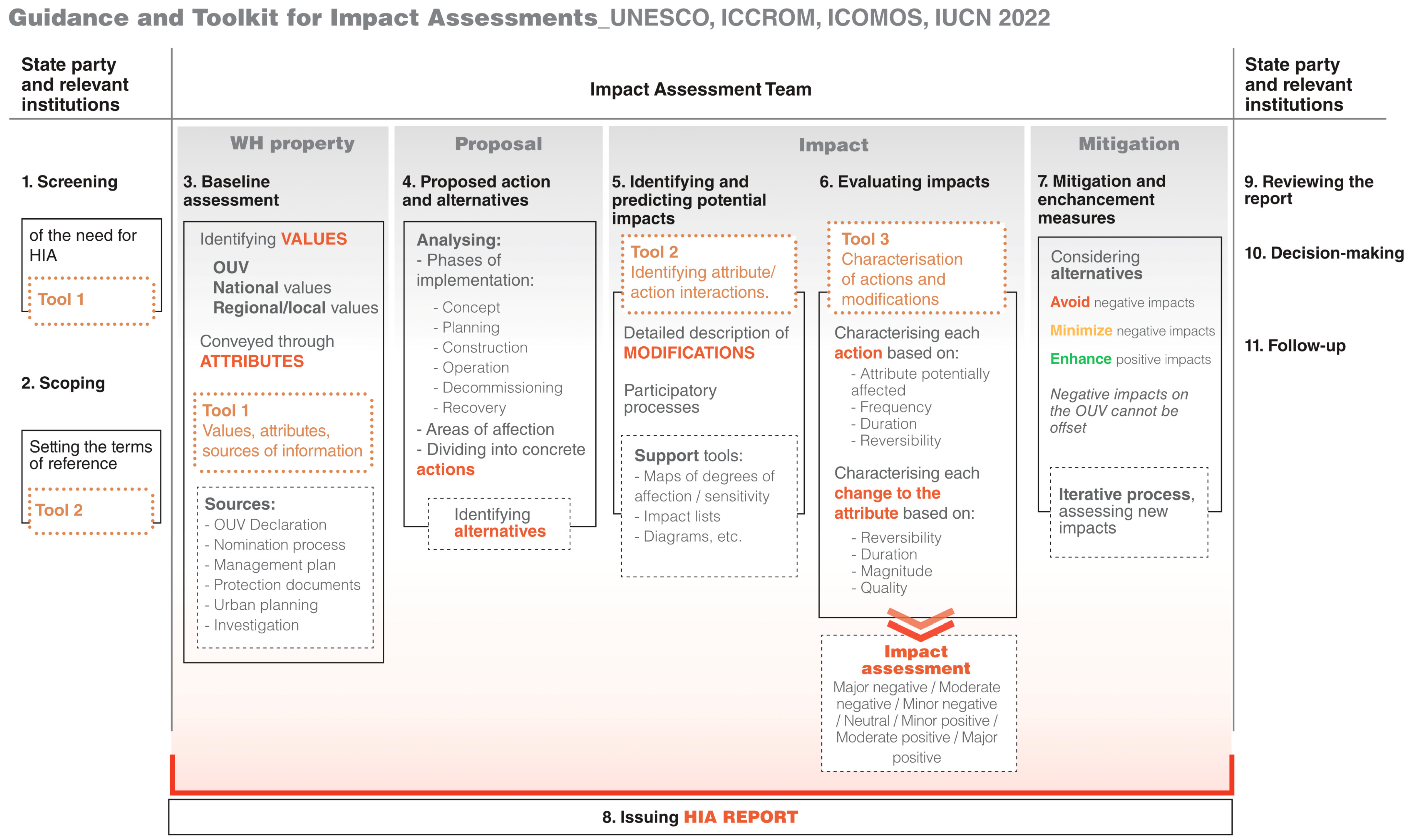
The methodological procedure proposed draws on previous developments, unifying processes and formulating a new 11-step methodology, which is divided into three phases, depending on the entity responsible for carrying it out: stages 1 and 2 correspond to the preliminary tasks to be carried out by the State Party through the competent institutions; during stages 3 to 8, the working team develops the impact assessment report; and finally, stages 9 to 11 correspond to the receipt and application of the results by the State Party (
Figure 5).
The introduction of three support tools for the direct application of the methodology marks a significant innovation compared to the 2011 guide. These take the form of model tables for use at key stages, providing a common generic basis for IA that can be adjusted to accommodate the specific characteristics of each individual case.
Tool 1 is a matrix for identifying the values and attributes of the asset, drawing directly on the 2011 Guide and proposing a common basis for the preparation of tables such as those already being used on the basis of ICOMOS recommendations. The OUV statement remains considered as the main source of reference, prioritising the attributes that inform it for the IA, although in order to carry out a complete characterisation of the asset, protection or planning documents at different scales must also be consulted, as well as conservation status reports and public consultation procedures, among others.
Tool 2, included in the guideline, now helps achieve the next methodological stage. Thus, it provides a framework for mapping the impact of every action in the architectural project on the identified attributes, which could lead to a change in any of them. A series of ranges are proposed for the assessment of each impact, on the basis of which each action in the proposal for which a potential impact is identified can be characterised, as well as the modification that would result.
5. Implementing HIA in the Architectural Process for Heritage Conservation
Ten years have passed between the first guideline published by ICOMOS in 2011 and the second, more developed one drafted in collaboration with UNESCO, ICCROM, ICOMOS and IUCN. This has been a process of evolution and maturation of a methodology that has marked the transition from initial general guidelines to a comprehensive and structured guide for HIA in WH assets. These work processes have been described in varying degrees of detail depending on the document.
While the 2022 guide bases its development on the description of an 11-step process and its step-by-step explanation accompanied by examples and ready-to-use tools, in 2011 the approach to the phases for conducting an HIA did not appear until “Annex 1: Process for studying the impact on heritage”, which provided a list of 16 actions simply listed as a summary following the presentation of the key ideas that inform the process throughout the body of the document. However, the apparent brevity of this approach does not prevent us from having sufficient knowledge of the nature of the actions that would constitute each of the stages listed, based on the analysis carried out in the guide and the professional experience accumulated since its publication.
The findings of this analytical and comparative review can be summarised as follows:
- -
Both documents adhere to the operational guidelines for implementing the World Heritage Convention, incorporating requirements based on expertise in World Heritage management within a constantly evolving methodology.
- -
Both documents open a parallel process to the architectural conservation project, carried out by an interdisciplinary team, and identify the different agents involved. In this sense, the 2022 guidance further assists the impact assessment team, the state party, and the relevant institutions with their respective tasks.
- -
The first guidance provided an advance in the methodology developed in the second one, more than a decade later: the almost 90 pages compared to 30 have enabled a more detailed layout of a step-by-step process. In 2022, the 11-stage methodology came with a step-by-step explanation, examples and ready-to-use tools. This was a big step up from the 2011 approach, where the phases for conducting an HIA were not presented until Annex 1, which just gave a list of 16 actions.
- -
The 2022 guidance also introduces three tools to facilitate the assessment:
Tool 1. Values, attributes, and sources of information.
Tool 2. Identifying attribute/action interactions.
Tool 3. Characterisation of actions and modification.
- -
Neither document contains any references to architectural projects or the processes involved, justifying our approach to the next steps of the methodology (
Figure 2): (3) Identifying interactions within the architectural process of project design and construction and (4) Identification of gaps and outstanding issues to be addressed in project implementation.
A comparison of the HIA processes according to both guides reveals the overlap of the intervention criteria defined through the axiom “Know to Intervene,” as well as the importance of citizen value and participation in heritage processes. This comparison homogenises both processes and reveals the essence of the actions composing each phase’s approach while adding a cross-cutting consideration that links to the spirit of the heritage project (
Table 2).
Stemming from approaches in the environmental field, the HIA was always regarded as a process to be integrated into the drafting of the project affecting the site, informing and shaping decisions aimed at protecting existing values. The 2022 Guide [
17] incorporates a general timeframe for carrying out an HIA with sufficient capacity to influence the process. However, the relationship between the different phases of planning and implementation of an architectural proposal and the IA methodology has not been sufficiently addressed by the guidelines analysed; therefore, it is not explicitly covered, as can be seen from
Table 2, which contains no references to the architectural intervention phase. The methodological review of the two guidelines allows us to make progress in establishing a framework for a common procedure to develop architectural projects in the heritage field consensually, including impact assessments.
This interpretation of HIA methodology through the conceptual lens of architectural intervention on heritage makes it possible to identify an overlap between the processes of architectural design and those of the HIA. Taking as a reference the most developed phases of the latest guide, the approach entails the automatic triggering of an HIA following the initial architectural conceptualisation, to guide decision-making throughout the entire process of drafting, execution and maintenance of the proposal. The HIA must deploy its full apparatus of iterative assessment and proposal of alternatives with greater intensity during the project drafting phase in order to exert a greater degree of influence. To this end, architectural projects must incorporate the identification of values and justify decision-making based on them, to implement the assessments subsequently. The HIA also has a role to play in planning for subsequent maintenance, contributing to the forecasting of future actions, reflecting the iterative nature of the process itself (
Figure 6). This is a process that extends over time, in which public participation must be guaranteed.
While the general HIA procedure shows a natural evolution of the process, fuelled by professional practice over the 10 years separating the two guides, it is in the methodology they propose for their IA phases that a more profound transformation of their founding concept appears. The 2011 ICOMOS guide [
11] proposed an assessment of the severity of modifications to the attributes that inform heritage values, establishing a gradation of impact firmly based on the importance of the value affected, even establishing a separate category for the values that constitute the OUV for WH assets. However, in the 2022 guide [
17], although OUV is never contested in its protection against any negative impact, a quantification based on the characterisation of the project is proposed for IAs on the attributes of the asset. The value of the asset is reflected through its attributes, and it is these attributes that must not suffer irreversible or negative effects as a result of architectural action.
6. Conclusions. Continuous Improvement Processes to Identify and Assess Impacts in Architectural Interventions
Built Heritage conservation management encompasses a range of tasks, primarily architectural, based on a methodology that is both well-established and constantly evolving. Particularly since the 1972 WH Convention [
10], we have witnessed continuous improvement in the processes involved in conserving heritage recognised with an OUV. This is an ongoing task that has now reached sufficient maturity, as evidenced by the 2022 publication of the Guidance and Toolkit for Impact Assessments in a World Heritage Context [
17]. Building on the 2011 guidelines [
11], this new document draws on the monument conservation and restoration practices that characterised the end of the 20th century and the beginning of the 21st century to propose an updated methodology.
The development of methodologies for drafting Heritage Impact Assessments for World Heritage Properties must be understood in the context of UNESCO’s 2015 decision DO 39 COM 7 [
15], which committed to the systematisation of HIA with the aim of making them more effective tools for minimising risks associated with proposed actions on World Heritage Properties and their associated buffer zones.
In this regard, this paper seeks to address a research question concerning the advances made in the methodology of Heritage Impact Assessments since the publication of the first Guidelines in 2011 and the subsequent guidance in 2022, and the potential impact this may have on the standard process of architectural intervention.
The methodological basis for this decision was the guidelines published by ICOMOS in 2011, which served as a guide until 2022, when more comprehensive guidance was published, providing an exhaustive and detailed outline of the various steps to be followed. This is a working process perfectly aligned with the general methodology for heritage conservation, focused on the monitoring of values and public participation as set out in the Faro Convention, but which has shortcomings when considered in relation to architectural processes, as evidenced by the comparison made between the two guidelines with regard to the main phases of heritage conservation management.
Heritage Impact Assessments on World Heritage sites involve processes that run parallel with architectural conservation projects: an external interdisciplinary team identifies heritage values, prioritises them in relation to the project, evaluates them according to a pre-established scale, and analyses the impacts from a critical perspective.
To facilitate the use of this process monitoring tool, the architectural design must ensure that values are more clearly identified to justify design decisions by demonstrating their impacts. The driving force behind this new requirement is to raise awareness that architectural processes form part of a value chain that guarantees the quality of the proposed transformations, particularly in the case of WH sites.
Intervention in architectural heritage requires increasingly complex processes, in which management must be effective and coordinated, facilitating the completion of some tasks so that others can begin. This management is related to the contribution of science and technology, but also to the efficient management of the participation of technical agents from both the many disciplines that contribute knowledge today and social agents, who will determine the (re)vision and impact on the identified heritage values. The management of the documentation throughout the entire process also becomes crucial. During the proposal and architectural intervention, it will support maintaining value and afterwards, the documentation will be the witness to how or why those values were recognised and perpetuated by the intervention carried out at that specific moment. Participatory processes, which are insufficiently described in both guides, are understood as working tools that guarantee the participation of the agents involved.
Change management is understood as a cross-cutting process that must accompany decision-making from the planning stage, through the drafting of projects and their execution, and including maintenance as a guarantee of the preservation of values in the future. The relationship between the evaluation process and the architectural intervention process highlights the need to carry out interim evaluations during the process. It is not, therefore, a one-off process, but quite the opposite: it paves the way for the implementation of a quality control process for interventions on World Heritage sites, focusing on the monitoring and tracking of values as well as the assessment of impacts. A long-term line of research is being launched to facilitate the link between the evaluation process and the process of designing and implementing heritage architectural projects in WH contexts.




 ,
,