

Co-Designing for Wellbeing in the Hybrid Smart Workplace


Abstract
1. Introduction
1.1. Background
1.1.1. Hybrid Workplace and Research Gaps
1.1.2. HCI/HBI Research for Workplace Wellbeing
1.1.3. Integrated Wellbeing and Models of Wellbeing Assessment
2. Materials and Methods
2.1. Co-Design, Participatory Research and Speculative Design
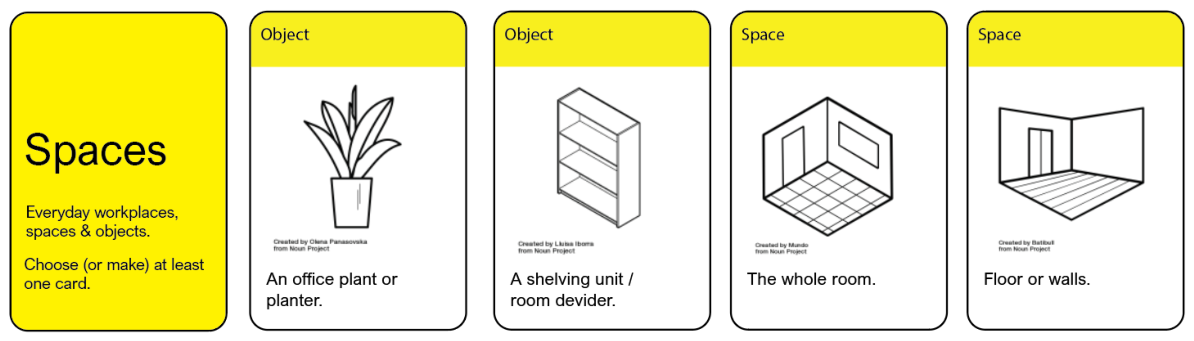
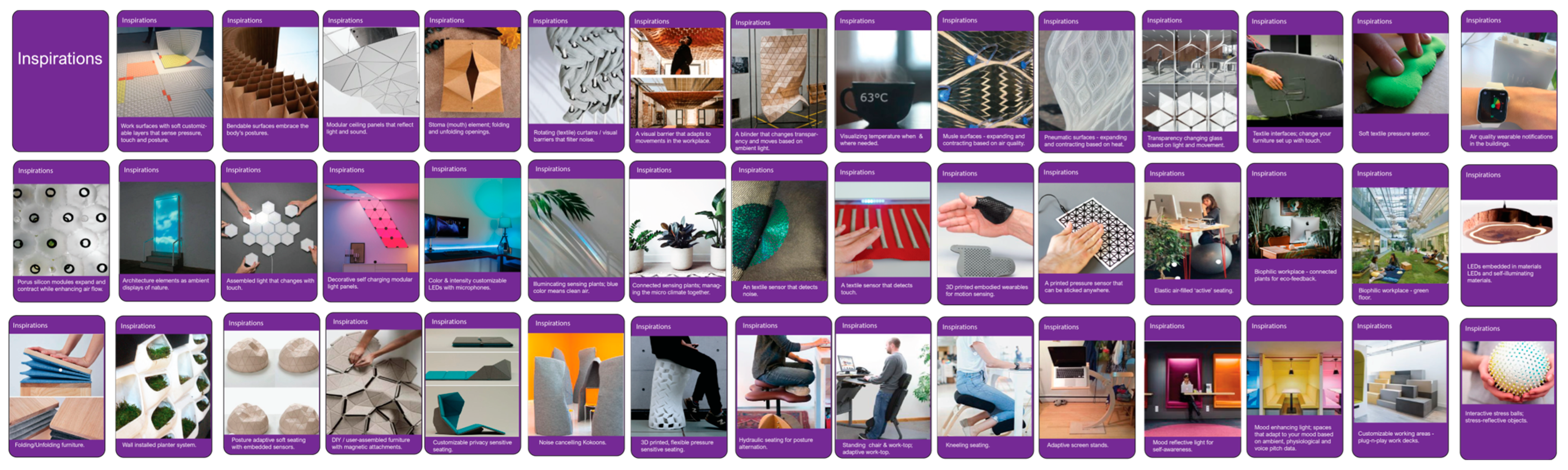
2.2. The Custom Card-Deck
2.3. Study Description

2.4. Participants
2.5. Data Analysis
3. Results
3.1. Augmenting Nature and Human Intervention
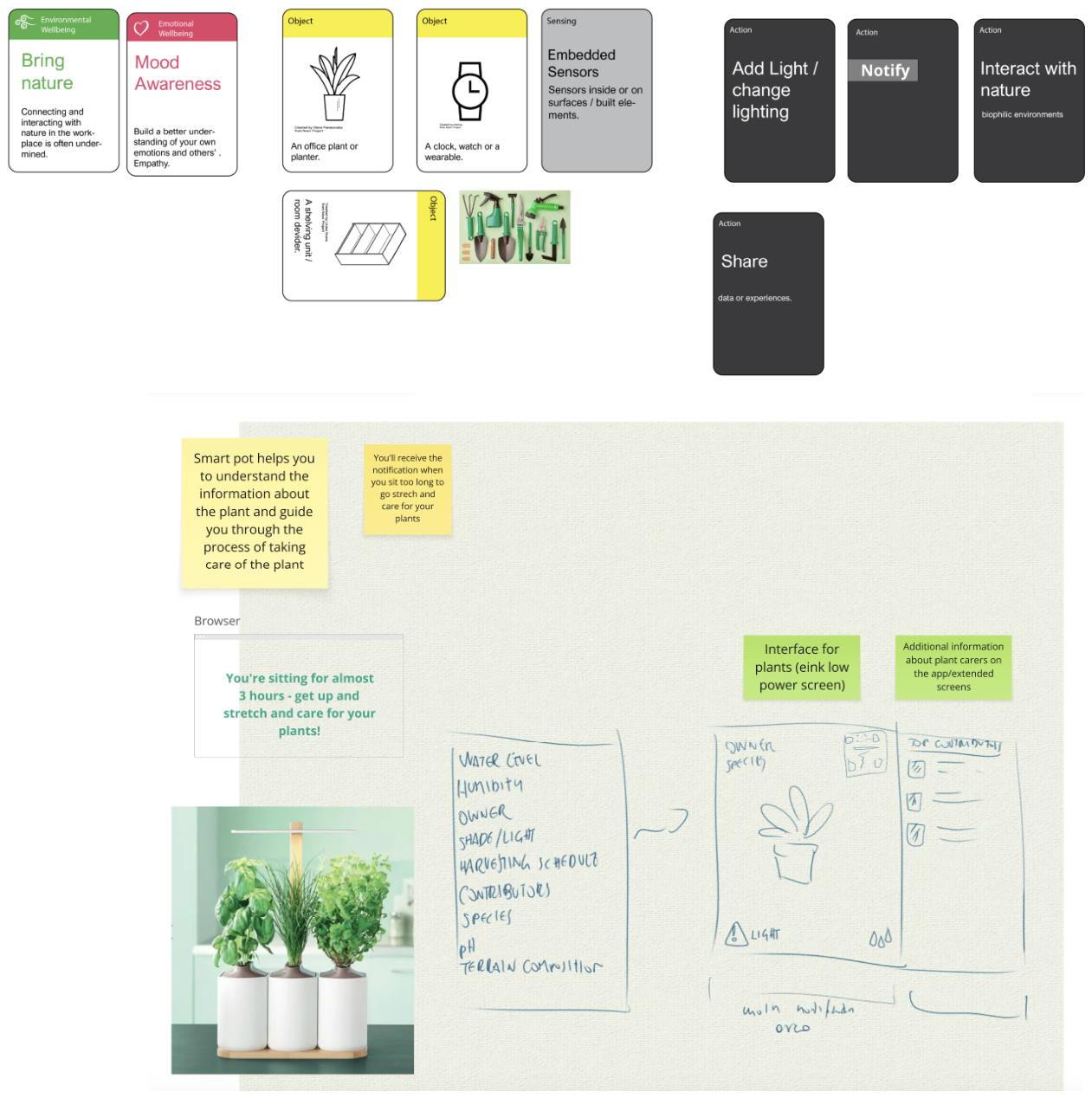
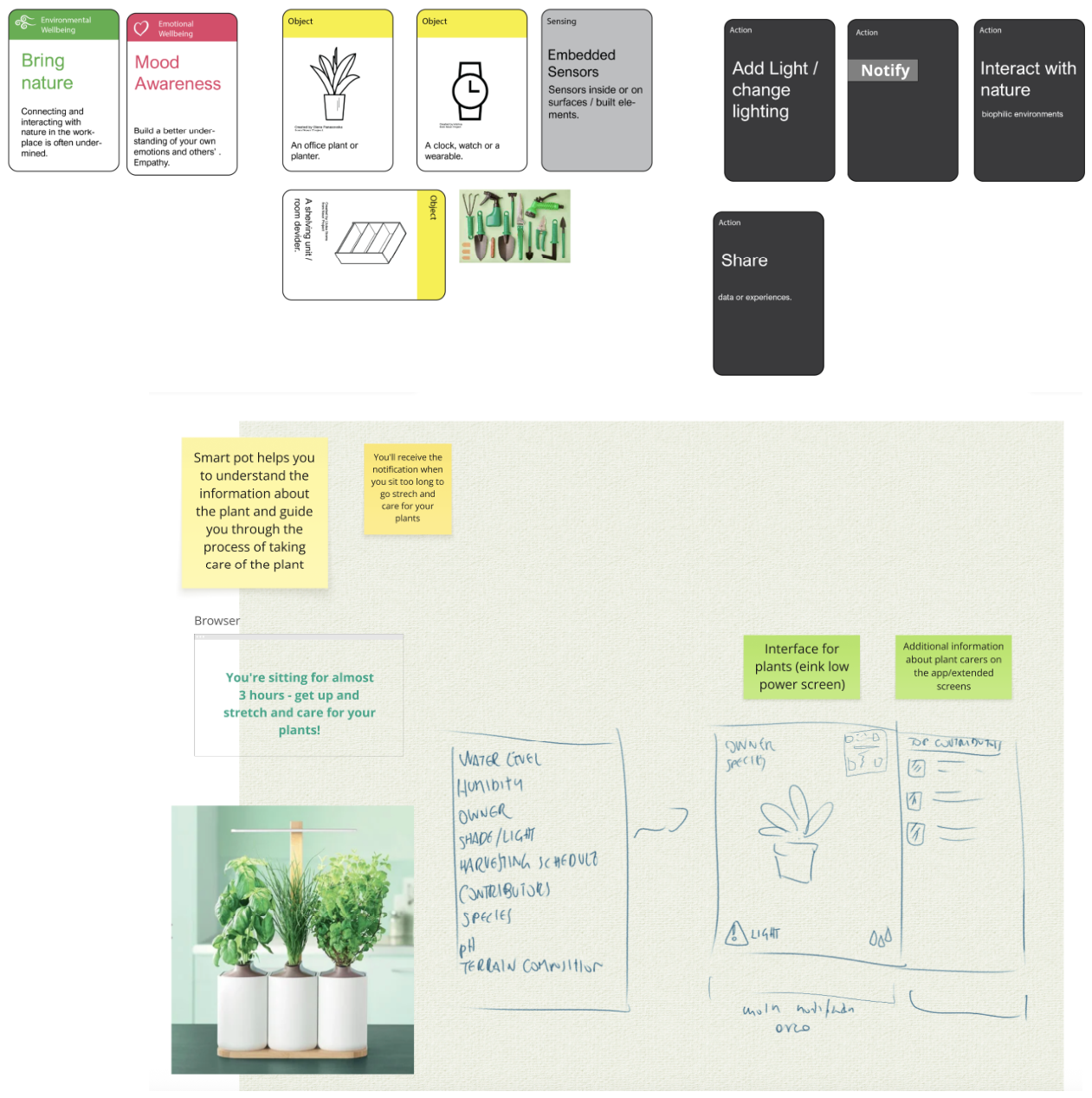
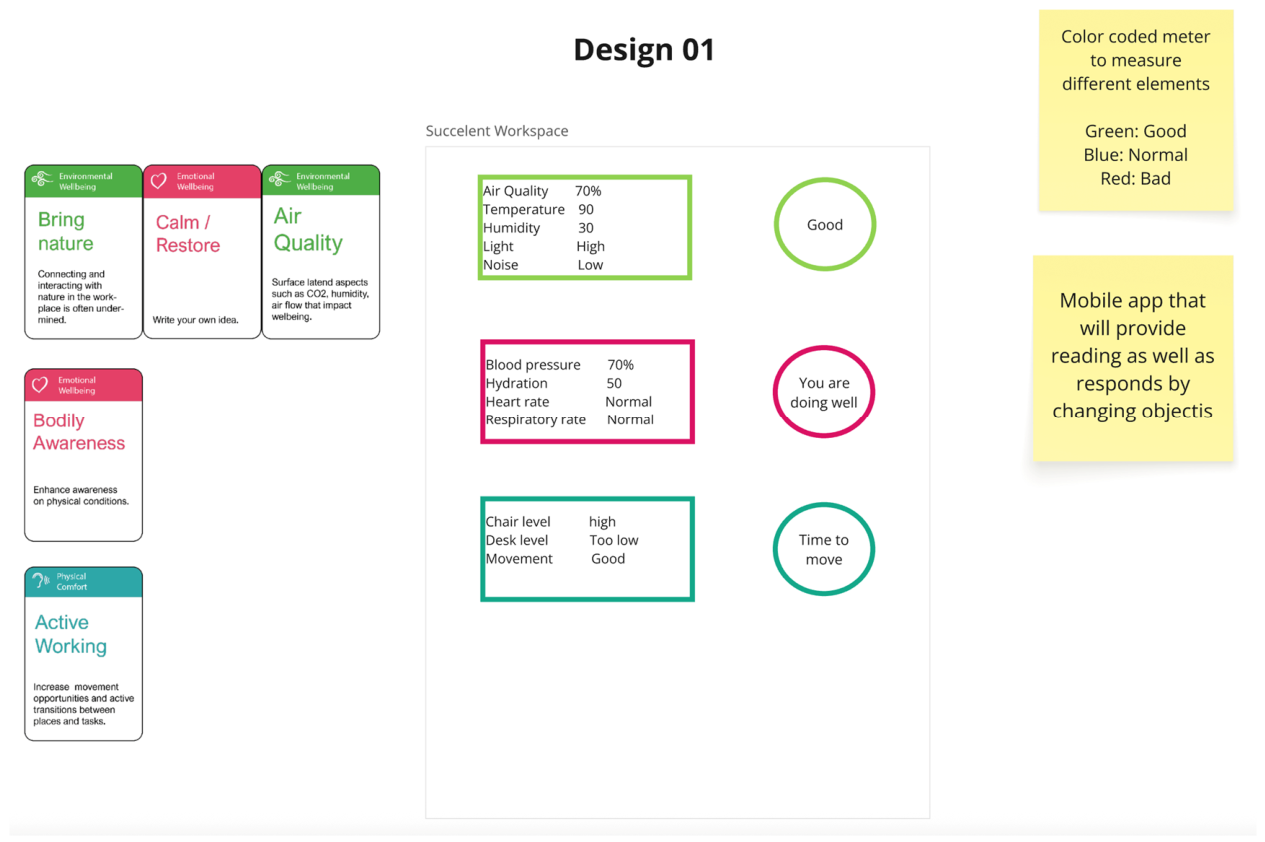
“[…] you have reminders to just go take a walk and care about the plants […] These plants exist also in virtual reality, so that you can actually have the same plant in real life as tokens to your virtual space. […] If you see a plant (belonging to anyone) which is going to die, you can give it water and your name will be written and get rewarded (tokens) virtually […] You will also have access to information about the plant species, about the owner, and all the kind of environmental conditions which are needed for that plan to grow well. There are sensors placed in the plants which are going to help you knowing if water is enough, if light is too much, etc. (P01)”P01 and P06 group scenario and sketch.
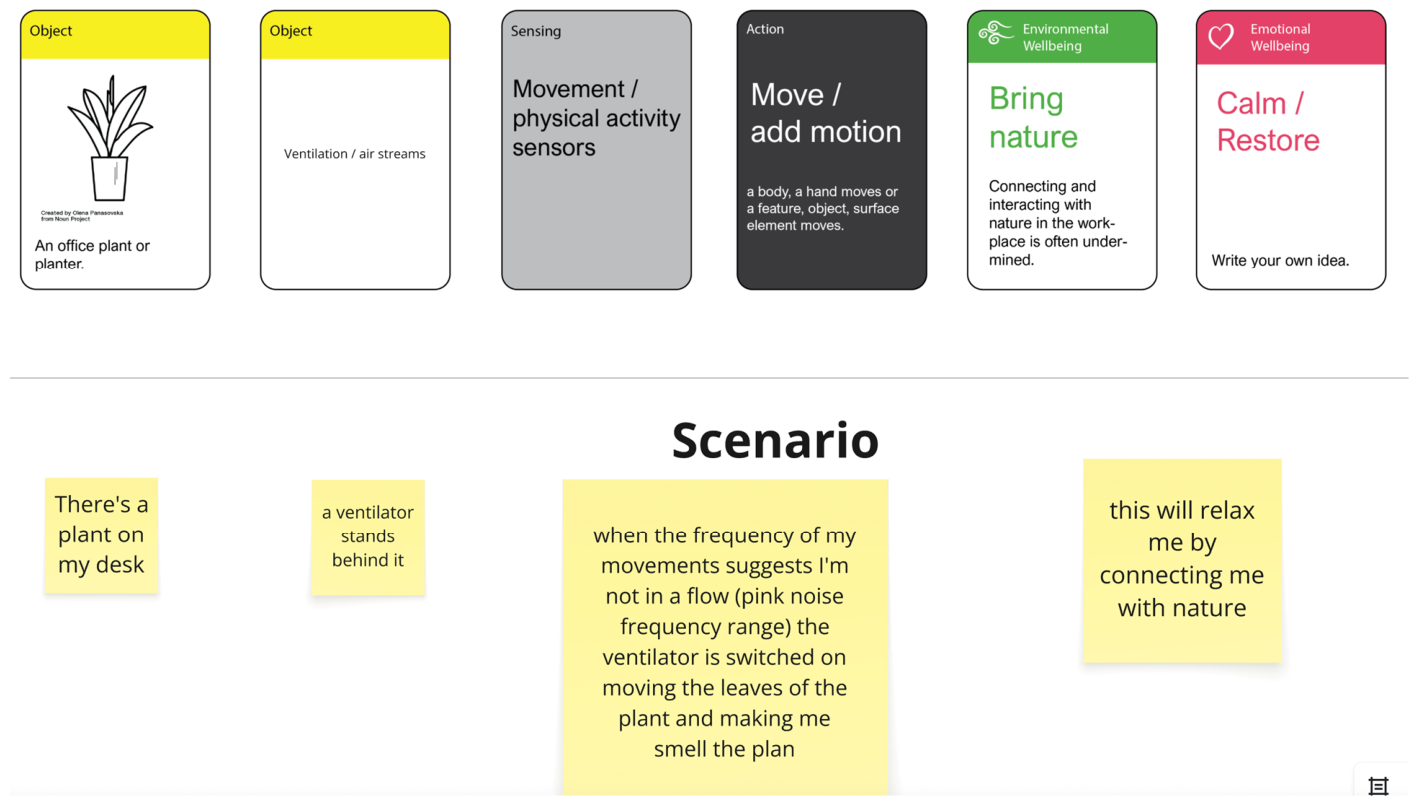
“The idea of augmenting nature with actuation: putting a ventilator behind the plants in the office that would activate specific moments based on data and create some movements around the plants, have ambient movement created and get the smell of the plant… a green wall that can move (in the same way) and create a sense of motions with plants. (P02).”
3.2. Active and Social Dimensions of Biophilic Design
3.3. Reflecting on Data Collection and Sharing: Health, Automation and Privacy
4. Discussion
4.1. Novel Directions for Biophilic and Biomimetic Design for the (Hybrid) Workplace
4.2. Data Collection and Use in the Hybrid Workplace—Views and Perspectives
- The prioritization of environmental data—see scenarios by P02, P03, P01, P04, and P05 where air quality, humidity, and temperature are mentioned in the context of enhancing environmental wellbeing and foster plant growth in the buildings, also mentioned in context of air quality awareness by P01, and broader wellbeing considerations by P05 and P06.
- Use of occupancy data, in scenarios that address social wellbeing complementary to biophilia (P02, P03, P01, P05), broadly seen as privacy friendly data.
- Use of movement and physical activity data (P02, P03, P04) with caution. Such data carry double connotation; many participants’ scenarios pointing towards the use of such data to promote physical activity in the workplace, on the other hand, results from workshop 01 suggest that sharing such data should be done with caution and using it publicly is not favored (P05, P06).
- Use of physiological data collected through wearables is mentioned in some scenarios as a way to assess emotional wellbeing (P02, P04, P06), though privacy concerns emphasize personal use only, or in aggregated manner (P04 and P05).
4.3. Framing Design Implications/Future Design Directions
- Emphasis on physical and tangible design dimensions of awareness technology, with the purpose of bringing latent environmental aspects into the experience such as smell of nature or air flow.
- Exploring collective and collaborative aspects of technology, creating communities of users to support and care for nature and wellbeing in the built environment across the shared and domestic workplace, potentially utilizing gamification elements.
- Exploring active dimensions of biophilic design, i.e., how physical activity and movement in the workplace can be encouraged through biophilic/biomimetic design.
5. Limitations
6. Conclusions
Author Contributions
Funding
Institutional Review Board Statement
Informed Consent Statement
Data Availability Statement
Conflicts of Interest
| 1 | See https://leniamarga.github.io/Workplace-Wellbeing-Toolkit/ (accessed on 2 February 2026). |
| 2 | https://www.innovativeworkplaceinstitute.org/workplace-wellbeing-prowell.php (accessed on 2 February 2026). |
| 3 | The process for on-site assessments and testing is called Performance Verification. On-site measurements are taken for various air and water quality parameters, as well as sound and light levels. It is a distinct process from traditional building commissioning and assures that the building performs as intended, according to WELL requirements. |
| 4 | See https://www.innovativeworkplaceinstitute.org/workplace-wellbeing-prowell.php (accessed on 2 February 2026). |
| 5 | Emerging in 1970s–80s Scandinavia, participatory design is strongly related to workplace democracy, labor rights, and power redistribution; hence having a strong political and ethical emphasis on power, agency and voice. |
| 6 | Co-design stems from a design/service design practice and, with its popularity peaking in the 2000s, is less political than PD. Co-design is often workshop-based and shorter-term/more narrow in focus, with an emsphasis on shared authorship and creative collaboration rather than power-distribution. |
| 7 | https://www.positivecomputing.org/blog/wellbeing-supportive-design-toolkit (accessed on 2 February 2026). |
| 8 | See Home Life Insight Cards at https://repository.lboro.ac.uk/articles/journal_contribution/Home_Life_Insight_Cards/4996541 (accessed on 2 February 2026). |
| 9 | https://www.designheuristics.com/the-cards (accessed on 2 February 2026). |
| 10 | The card-kit can be found at: https://leniamarga.github.io/Workplace-Wellbeing-Toolkit/index.html (accessed on 2 February 2026) and in supplementing materials. |
| 11 | The card kit can be found at: https://leniamarga.github.io/Workplace-Wellbeing-Toolkit/index.html (accessed on 2 February 2026). |
| 12 | Collaborating into groups of two made it easier for participants to maturate their scenarios, and during sketching artifacts (as some might have felt intimidated doing this activity individually). |
| 13 | All icons for spaces and objects were obtained from the thenounproject.com under a free license, requiring an author attribution for use in public domain. The name of the creator of each of the icons is mentioned under the icon in small letters. |
References
- Margariti, E.; Rintel, S.; Murphy, B.; Sellen, A. Automated mapping of competitive and collaborative overlapping talk in video meetings. In Proceedings of the CHI Conference on Human Factors in Computing Systems Extended Abstracts, New Orleans, LA, USA, 29 April–5 May 2022; ACM: New York, NY, USA, 2022; pp. 1–8. [Google Scholar] [CrossRef]
- Neumayr, T.; Saatçi, B.; Rintel, S.; Klokmose, C.N.; Augstein, M. Hybrid Collaboration and Hybrid Meetings—A Systematic Literature Review. arXiv 2022. [Google Scholar] [CrossRef]
- Duckert, M.; Barkhuus, L.; Bjørn, P. Collocated Distance: A Fundamental Challenge for the Design of Hybrid Work Technologies. In Proceedings of the 2023 CHI Conference on Human Factors in Computing Systems, Hamburg, Germany, 23–28 April 2023; pp. 1–16. [Google Scholar] [CrossRef]
- Rosset, L.; Alavi, H.; Zhong, S.; Lalanne, D. Already It Was Hard to Tell Who’s Speaking Over There, and Now Face Masks! Can Binaural Audio Help Remote Participation in Hybrid Meetings? In Proceedings of the Extended Abstracts of the 2021 CHI Conference on Human Factors in Computing Systems, Yokohama, Japan, 8–13 May 2021; pp. 1–7. [Google Scholar] [CrossRef]
- Buckman, A.H.; Mayfield, M.; Beck, S.B.M. What is a Smart Building? Smart Sustain. Built Environ. 2014, 3, 92–109. [Google Scholar] [CrossRef]
- Fan, W.; Moen, P. Ongoing Remote Work, Returning to Working at Work, or in between during COVID-19: What Promotes Subjective Well-Being? J. Health Soc. Behav. 2023, 64, 152–171. [Google Scholar] [CrossRef] [PubMed]
- Khazan, O. Work From Home Is Here to Stay. Available online: https://www.theatlantic.com/health/archive/2020/05/work-from-home-pandemic/611098/ (accessed on 2 February 2026).
- Margariti, E.K.; Ali, R.; Benthem de Grave, R.; Verweij, D.; Smeddinck, J.; Kirk, D. Understanding the Experiences of Remote Workers: Opportunities for Ambient Workspaces at Home. Front. Comput. Sci. 2021, 3, 673585. [Google Scholar] [CrossRef]
- Augstein, M.; Neumayr, T.; Schönböck, J.; Kovacs, C. Remote Persons Are Closer Than They Appear: Home, Team and a Lockdown. In Proceedings of the 2023 CHI Conference on Human Factors in Computing Systems, Hamburg, Germany, 23–28 April 2023; pp. 1–25. [Google Scholar] [CrossRef]
- Fan Ng, C. Teleworker’s home office: An extension of corporate office? Facilities 2010, 28, 137–155. [Google Scholar] [CrossRef]
- Stawarz, K.; Cox, A.L.; Bird, J.; Benedyk, R. I’d sit at home and do work emails”: How tablets affect the work-life balance of office workers. In Proceedings of the CHI’13 Extended Abstracts on Human Factors in Computing Systems, Paris, France, 27 April–2 May 2013. [Google Scholar]
- Cutler, R.; Hosseinkashi, Y.; Pool, J.; Filipi, S.; Aichner, R.; Tu, Y.; Gehrke, J. Meeting Effectiveness and Inclusiveness in Remote Collaboration. Proc. ACM Hum. Comput. Interact. 2021, 5, 1–29. [Google Scholar] [CrossRef]
- Toch, E.; Chassidim, H.; Hatuka, T. Can you Turn it Off?: The Spatial and Social Context of Mobile Disturbance. Proc. ACM Hum. Comput. Interact. 2020, 4, 1–18. [Google Scholar] [CrossRef]
- Alonso, M.B.; Keyson, D.V.; Hummels, C.C.M. Squeeze, rock, and roll; can tangible interaction with affective products support stress reduction? In Proceedings of the 2nd International Conference on Tangible and Embedded Interaction—TEI ’08, Bonn, Germany, 18–20 February 2008; p. 105. [Google Scholar] [CrossRef]
- Chodan, W.; Krause, S.; Meza-Cuevas, M.A.; Kadner, M.; Rockstroh, J.; König, C.; Aehnelt, M.; Urban, B.; Bieber, G. The SEBA system: A novel approach for assessing psychological stress continuously at the workplace. In Proceedings of the 6th International Workshop on Sensor-Based Activity Recognition and Interaction, Rostock, Germany, 16–17 September 2019; pp. 1–6. [Google Scholar] [CrossRef]
- Epstein, D.A.; Avrahami, D.; Biehl, J.T. Taking 5: Work-Breaks, Productivity, and Opportunities for Personal Informatics for Knowledge Workers. In Proceedings of the 2016 CHI Conference on Human Factors in Computing Systems, San Jose, CA, USA, 7–12 May 2016; pp. 673–684. [Google Scholar] [CrossRef]
- Mark, G.; Iqbal, S.; Czerwinski, M.; Johns, P. Capturing the mood: Facebook and face-to-face encounters in the workplace. In Proceedings of the 17th ACM Conference on Computer Supported Cooperative Work & Social Computing—CSCW ’14, Baltimore, MD, USA, 15–19 February 2014; pp. 1082–1094. [Google Scholar] [CrossRef]
- Grønbæk, J.E.; Saatçi, B.; Griggio, C.F.; Klokmose, C.N. MirrorBlender: Supporting Hybrid Meetings with a Malleable Video-Conferencing System. In Proceedings of the 2021 CHI Conference on Human Factors in Computing Systems, Yokohama, Japan, 8–13 May 2021; pp. 1–13. [Google Scholar] [CrossRef]
- Kuzminykh, A.; Rintel, S. Low Engagement As a Deliberate Practice of Remote Participants in Video Meetings. In Proceedings of the Extended Abstracts of the 2020 CHI Conference on Human Factors in Computing Systems, Honolulu, HI, USA, 25–30 April 2020; pp. 1–9. [Google Scholar] [CrossRef]
- Bales, E.; Nikzad, N.; Quick, N.; Ziftci, C.; Patrick, K.; Griswold, W.G. Personal pollution monitoring: Mobile real-time air quality in daily life. Pers. Ubiquitous Comput. 2019, 23, 309–328. [Google Scholar] [CrossRef]
- Snow, S.; Oakley, M.; Schraefel, M.C. Performance by Design: Supporting Decisions Around Indoor Air Quality in Offices. In Proceedings of the 2019 on Designing Interactive Systems Conference, San Diego, CA, USA, 23–28 June 2019; pp. 99–111. [Google Scholar] [CrossRef]
- Rassia, S.T. Workplace Environmental Design in Architecture for Public Health: Impacts on Occupant Space Use and Physical Activity; Springer International Publishing: Cham, Switzerland, 2017. [Google Scholar] [CrossRef]
- Srinivasan, K.; Ram, S. Indoor Environmental Effects on Individual Wellbeing. In Proceedings of the 6th International Conference on Digital Health Conference, Montréal, QC, Canada, 11–13 April 2016; pp. 167–168. [Google Scholar] [CrossRef]
- Fortmann, J.; Stratmann, T.C.; Boll, S.; Poppinga, B.; Heuten, W. Make Me Move at Work! An Ambient Light Display to Increase Physical Activity. In Proceedings of the 2013 7th International Conference on Pervasive Computing Technologies for Healthcare and Workshops, Venice, Italy, 5–8 May 2013; p. 4. [Google Scholar] [CrossRef]
- Hu, Q.; Tang, X.; Tang, W. A Smart Chair Sitting Posture Recognition System Using Flex Sensors and FPGA Implemented Artificial Neural Network. IEEE Sens. J. 2020, 20, 8007–8016. [Google Scholar] [CrossRef]
- Papanikolaou, D.; Brush, A.J.B.; Roseway, A. BodyPods: Designing Posture Sensing Chairs for Capturing and Sharing Implicit Interactions. In Proceedings of the Ninth International Conference on Tangible, Embedded, and Embodied Interaction, Stanford, CA, USA, 15–19 January 2015; pp. 375–382. [Google Scholar] [CrossRef]
- Boschi, H.; Trenoweth, S.; Sheppard, Z.A. Stress at work: Factors associated with cognitive disorganisation among private sector professionals. Health Psychol. Open 2017, 4, 205510291771837. [Google Scholar] [CrossRef]
- Sussman, A.; Hollander, J.B. Cognitive Architecture: Designing for How We Respond to the Built Environment; Routledge, Taylor & Francis Group: London, UK, 2015. [Google Scholar]
- Alavi, H.S.; Verma, H.; Mlynar, J.; Lalanne, D. The Hide and Seek of Workspace: Towards Human-Centric Sustainable Architecture. In Proceedings of the 2018 CHI Conference on Human Factors in Computing Systems—CHI’ 18, Montreal, QC, Canada, 21–26 April 2018; pp. 1–12. [Google Scholar]
- Norhidayah, A.; Chia-Kuang, L.; Azhar, M.K.; Nurulwahida, S. Indoor Air Quality and Sick Building Syndrome in Three Selected Buildings. Procedia Eng. 2013, 53, 93–98. [Google Scholar] [CrossRef]
- Zhong, W.; Schröder, T.; Bekkering, J. Biophilic design in architecture and its contributions to health, well-being, and sustainability: A critical review. Front. Archit. Res. 2022, 11, 114–141. [Google Scholar] [CrossRef]
- Sternberg, E.M. Healing Spaces: The Science of Place and Well-Being; Harvard University Press: Cambridge, MA, USA, 2009. [Google Scholar] [CrossRef]
- Verma, H.; Alavi, H.S.; Lalanne, D. Studying Space Use: Bringing HCI Tools to Architectural Projects. In Proceedings of the 2017 CHI Conference on Human Factors in Computing Systems—CHI’ 17, Denver, CO, USA, 6–11 May 2017; pp. 3856–3866. [Google Scholar] [CrossRef]
- Aryal, A.; Anselmo, F.; Becerik-Gerber, B. Smart IoT desk for personalizing indoor environmental conditions. In Proceedings of the 8th International Conference on the Internet of Things, Santa Barbara, CA, USA, 15–18 October 2018; pp. 1–6. [Google Scholar] [CrossRef]
- Sun, S.; Zheng, X.; Villalba-Díez, J.; Ordieres-Meré, J. Indoor Air-Quality Data-Monitoring System: Long-Term Monitoring Benefits. Sensors 2019, 19, 4157. [Google Scholar] [CrossRef] [PubMed]
- Alavi, H.S.; Verma, H.; Papinutto, M.; Lalanne, D. Comfort: A Coordinate of User Experience in Interactive Built Environments. In Human-Computer Interaction—INTERACT 2017; Bernhaupt, R., Dalvi, G., Joshi, A., Balkrishan, D.K., O’Neill, J., Winckler, M., Eds.; Springer International Publishing: Cham, Switzerland, 2017; Volume 10515, pp. 247–257. [Google Scholar] [CrossRef]
- Clear, A.K.; Mitchell Finnigan, S.; Olivier, P.; Comber, R. ThermoKiosk: Investigating Roles for Digital Surveys of Thermal Experience in Workplace Comfort Management. In Proceedings of the 2018 CHI Conference on Human Factors in Computing Systems—CHI’ 18, Montreal, QC, Canada, 21–26 April 2018; pp. 1–12. [Google Scholar] [CrossRef]
- Houben, S.; Golsteijn, C.; Gallacher, S.; Johnson, R.; Bakker, S.; Marquardt, N.; Capra, L.; Rogers, Y. Physikit: Data Engagement Through Physical Ambient Visualizations in the Home. In Proceedings of the 2016 CHI Conference on Human Factors in Computing Systems, San Jose, CA, USA, 7–12 May 2016; pp. 1608–1619. [Google Scholar] [CrossRef]
- Dang, C.T.; Aslan, I.; Seiderer, A.; André, E. Exploring Ambient Air Quality Notifications for Smart Rooms. In Proceedings of the 6th EAI International Conference on Smart Objects and Technologies for Social Good, Antwerp, Belgium, 14–16 September 2020; pp. 102–107. [Google Scholar] [CrossRef]
- Kim, S.; Li, M. Awareness, Understanding, and Action: A Conceptual Framework of User Experiences and Expectations about Indoor Air Quality Visualizations. In Proceedings of the 2020 CHI Conference on Human Factors in Computing Systems, Honolulu, HI, USA, 25–30 April 2020; pp. 1–12. [Google Scholar] [CrossRef]
- Mata, T.M.; Oliveira, G.M.; Monteiro, H.; Silva, G.V.; Caetano, N.S.; Martins, A.A. Indoor Air Quality Improvement Using Nature-Based Solutions: Design Proposals to Greener Cities. Int. J. Environ. Res. Public Health 2021, 18, 8472. [Google Scholar] [CrossRef] [PubMed]
- Zhong, S.; Alavi, H.S.; Lalanne, D. Hilo-wear: Exploring Wearable Interaction with Indoor Air Quality Forecast. In Proceedings of the Extended Abstracts of the 2020 CHI Conference on Human Factors in Computing Systems, Honolulu, HI, USA, 25–30 April 2020; pp. 1–8. [Google Scholar] [CrossRef]
- Makram, A. Nature-Based Framework for Sustainable Architectural Design—Biomimetic Design and Biophilic Design. Archit. Res. 2019, 9, 74–81. [Google Scholar]
- Hubalek, S.; Brink, M.; Schierz, C. Office workers’ daily exposure to light and its influence on sleep quality and mood. Light. Res. Technol. 2010, 42, 33–50. [Google Scholar] [CrossRef]
- Magielse, R.; Ross, P.R. A design approach to socially adaptive lighting environments. In Proceedings of the 9th ACM SIGCHI Italian Chapter International Conference on Computer-Human Interaction: Facing Complexity, Alghero, Italy, 13–16 September 2011; pp. 171–176. [Google Scholar] [CrossRef]
- Turan, S.G.; Ozaltin, S.R.; Yantac, A.E. Designing calmworklight: Signaling Focus with a Desk Light. In Proceedings of the Companion Publication of the 2019 on Designing Interactive Systems Conference 2019 Companion, San Diego, CA, USA, 23–28 June 2019; pp. 301–305. [Google Scholar] [CrossRef]
- Van De Werff, T.; Van Lotringen, C.; Van Essen, H.; Eggen, B. Design Considerations for Interactive Office Lighting: Interface Characteristics, Shared and Hybrid Control. In Proceedings of the 2019 CHI Conference on Human Factors in Computing Systems, Glasgow, UK, 4–9 May 2019; pp. 1–14. [Google Scholar] [CrossRef]
- Côté, M.-È.; Bergeron, T.; Juteau, V.; Lavigne-Bourque, K.; Tousignant, P.; Francillette, Y.; Dupas, F.-X. Lux: A Game to Promote Good Lighting Practices among the General Public. In Proceedings of the Companion Proceedings of the Annual Symposium on Computer-Human Interaction in Play, Stratford, ON, Canada, 13–16 October 2025; pp. 298–305. [Google Scholar] [CrossRef]
- Pereira, E.; Kolb, S.; Schäfers, K.; Schreiber, S.; Weckbach, V.; Goodwin, W.; Smith, C.; Kaiser, P.; Kohler, K. STARS: Enlightenment in the office space for behavioral change. In Proceedings of the 2016 ACM International Joint Conference on Pervasive and Ubiquitous Computing: Adjunct, Heidelberg, Germany, 12–16 September 2016; pp. 1640–1645. [Google Scholar] [CrossRef]
- Rogers, Y.; Hazlewood, W.R.; Marshall, P.; Dalton, N.; Hertrich, S. Ambient influence: Can twinkly lights lure and abstract representations trigger behavioral change? In Proceedings of the 12th ACM International Conference on Ubiquitous Computing, Copenhagen, Denmark, 26–29 September 2010; pp. 261–270. [Google Scholar] [CrossRef]
- Pavlovic, M.; Colombo, S.; Lim, Y.; Casalegno, F. Designing for Ambient UX: Case Study of a Dynamic Lighting System for a Work Space. In Proceedings of the 2018 ACM International Conference on Interactive Surfaces and Spaces, Tokyo, Japan, 25–28 November 2018; pp. 351–356. [Google Scholar] [CrossRef]
- Snyder, J.; Matthews, M.; Chien, J.; Chang, P.F.; Sun, E.; Abdullah, S.; Gay, G. MoodLight: Exploring Personal and Social Implications of Ambient Display of Biosensor Data. In Proceedings of the 18th ACM Conference on Computer Supported Cooperative Work & Social Computing, Vancouver, BC, Canada, 14–18 March 2015; p. 11. [Google Scholar]
- Yu, B.; Hu, J.; Funk, M.; Feijs, L. DeLight: Biofeedback through ambient light for stress intervention and relaxation assistance. Pers. Ubiquitous Comput. 2018, 22, 787–805. [Google Scholar] [CrossRef]
- Leithinger, D.; Follmer, S.; Olwal, A.; Ishii, H. Shape Displays: Spatial Interaction with Dynamic Physical Form. IEEE Comput. Graph. Appl. 2015, 35, 5–11. [Google Scholar] [CrossRef]
- Nakagaki, K.; Vink, L.; Counts, J.; Windham, D.; Leithinger, D.; Follmer, S.; Ishii, H. Materiable: Rendering Dynamic Material Properties in Response to Direct Physical Touch with Shape Changing Interfaces. In Proceedings of the 2016 CHI Conference on Human Factors in Computing Systems, San Jose, CA, USA, 7–12 May 2016; pp. 2764–2772. [Google Scholar] [CrossRef]
- Takashima, K.; Aida, N.; Yokoyama, H.; Kitamura, Y. TransformTable: A self-actuated shape-changing digital table. In Proceedings of the 2013 ACM International Conference on Interactive Tabletops and Surfaces, St. Andrews, UK, 6–9 October 2013; pp. 179–188. [Google Scholar] [CrossRef]
- Takashima, K.; Oyama, T.; Asari, Y.; Sharlin, E.; Greenberg, S.; Kitamura, Y. Study and Design of a Shape-Shifting Wall Display. In Proceedings of the 2016 ACM Conference on Designing Interactive Systems, Brisbane, QLD, Australia, 4–8 June 2016; pp. 796–806. [Google Scholar] [CrossRef]
- Bader, P.; Voit, A.; Le, H.V.; Woźniak, P.W.; Henze, N.; Schmidt, A. WindowWall: Towards Adaptive Buildings with Interactive Windows as Ubiquitous Displays. ACM Trans. Comput. Hum. Interact. (TOCHI) 2019, 26, 1–42. [Google Scholar] [CrossRef]
- Yildiz, M.; Coikun, A. Wwall: A Public Water Dispenser System to Motivate Regular Water Intake in the Office Environment. In Proceedings of the Companion Publication of the 2019 on Designing Interactive Systems Conference 2019 Companion—DIS ’19 Companion, San Diego, CA, USA, 23–28 June 2019; pp. 347–352. [Google Scholar] [CrossRef]
- Grønbæk, J.E.; Korsgaard, H.; Petersen, M.G.; Birk, M.H.; Krogh, P.G. Proxemic Transitions: Designing Shape-Changing Furniture for Informal Meetings. In Proceedings of the 2017 CHI Conference on Human Factors in Computing Systems, Denver, CO, USA, 6–11 May 2017; pp. 7029–7041. [Google Scholar] [CrossRef]
- Grønbæk, J.E.; Rasmussen, M.K.; Halskov, K.; Petersen, M.G. KirigamiTable: Designing for Proxemic Transitions with a Shape-Changing Tabletop. In Proceedings of the CHI Conference on Human Factors in Computing Systems, Honolulu, HI, USA, 25–30 April 2020; pp. 1–15. [Google Scholar] [CrossRef]
- Gaissmaier, M.; Karlsson, A.; Aschan Eriksson, S.; Kosmack Vaara, E.; Komazec, K.; Fernaeus, Y. Designing for Workplace Safety: Exploring Interactive Textiles as Personal Alert Systems. In Proceedings of the Fourteenth International Conference on Tangible, Embedded, and Embodied Interaction, Sydney, NSW, Australia, 9–12 February 2020; pp. 53–65. [Google Scholar] [CrossRef]
- Onishi, Y.; Takashima, K.; Higashiyama, S.; Fujita, K.; Kitamura, Y. WaddleWalls: Room-scale Interactive Partitioning System using a Swarm of Robotic Partitions. In Proceedings of the 35th Annual ACM Symposium on User Interface Software and Technology, Bend, OR, USA, 29 October–2 November 2022; pp. 1–15. [Google Scholar] [CrossRef]
- Arakawa, Y. Augmented Workplace: Human-Sensor Interaction for Improving the Work Environment. In Proceedings of the Augmented Humans International Conference, Kaiserslautern, Germany, 16–17 March 2020; pp. 1–2. [Google Scholar] [CrossRef]
- Lee, H.; Je, S.; Kim, R.; Verma, H.; Alavi, H.; Bianchi, A. Partitioning open-plan workspaces via augmented reality. Pers. Ubiquitous Comput. 2019, 26, 609–624. [Google Scholar] [CrossRef]
- Rogers, Y. Is remote the new normal?: Reflections on COVID-19, technology, and humankind. Interactions 2020, 27, 42–46. [Google Scholar] [CrossRef] [PubMed]
- Engineer, A.; Gualano, R.J.; Crocker, R.L.; Smith, J.L.; Maizes, V.; Weil, A.; Sternberg, E.M. An integrative health framework for wellbeing in the built environment. Build. Environ. 2021, 205, 108253. [Google Scholar] [CrossRef]
- Calvo, R.A.; Peters, D. Introduction to Positive Computing: Technology that Fosters Wellbeing. In Proceedings of the 33rd Annual ACM Conference Extended Abstracts on Human Factors in Computing Systems, Seoul, Republic of Korea, 18–23 April 2015; pp. 2499–2500. [Google Scholar] [CrossRef]
- Joyce, K.; Pabayo, R.; Critchley, J.A.; Bambra, C. Flexible working conditions and their effects on employee health and wellbeing. Cochrane Database Syst. Rev. 2010, 2010, CD008009. [Google Scholar] [CrossRef] [PubMed]
- Pakanen, M.; Lovén, L.; Alavesa, P.; Gilman, E.; Terken, J.; Eggen, B.; Pirttikangas, S. Design Challenges of Wellbeing Supporting Smart Environment in Collaborative Use Situations. In Proceedings of the 2018 ACM International Joint Conference and 2018 International Symposium on Pervasive and Ubiquitous Computing and Wearable Computers, Singapore, 8–12 October 2018; pp. 688–692. [Google Scholar] [CrossRef]
- Petermans, A.; Cain, R. Design for Wellbeing: An Applied Approach, 1st ed.; Routledge: London, UK, 2019. [Google Scholar] [CrossRef]
- Lee, Y.; Aletta, F. Acoustical planning for workplace health and well-being: A case study in four open-plan offices. Build. Acoust. 2019, 26, 207–220. [Google Scholar] [CrossRef]
- Khan, A.H. Participatory Design Tools: Exploring the Value of Design through Materiality. In Proceedings of the Extended Abstracts of the 2020 CHI Conference on Human Factors in Computing Systems, Honolulu, HI, USA, 25–30 April 2020; pp. 1–8. [Google Scholar] [CrossRef]
- Mora, S.; Divitini, M.; Kurze, A.; Berger, A.; Mazzarello, M.; De Roeck, D. Virtual and in-person co-design workshops: From alternative to complementary approaches. In Creativity and Cognition; ACM: Venice, Italy, 2022; pp. 466–469. [Google Scholar] [CrossRef]
- Schuler, D.; Namioka, A. Participatory Design: Principles and Practices; CRC Press: Boca Raton, FL, USA, 1993. [Google Scholar]
- Vines, J.; Clarke, R.; Wright, P.; McCarthy, J.; Olivier, P. Configuring participation: On how we involve people in design. In Proceedings of the SIGCHI Conference on Human Factors in Computing Systems, Paris, France, 27 April–2 May 2013; pp. 429–438. [Google Scholar] [CrossRef]
- Berger, A.; Ambe, A.H.; Soro, A.; De Roeck, D.; Brereton, M. The Stories People Tell About The Home Through IoT Toolkits. In Proceedings of the 2019 on Designing Interactive Systems Conference, San Diego, CA, USA, 23–28 June 2019; pp. 7–19. [Google Scholar] [CrossRef]
- Hildén, E.; Ojala, J.; Väänänen, K. Development of context cards: A bus-specific ideation tool for co-design workshops. In Proceedings of the 21st International Academic Mindtrek Conference, Tampere, Finland, 20–21 September 2017; pp. 137–146. [Google Scholar] [CrossRef]
- Golembewski, M.; Selby, M. Ideation decks: A card-based design ideation tool. In Proceedings of the 8th ACM Conference on Designing Interactive Systems—DIS ’10, Aarhus, Denmark, 16–20 August 2010; p. 89. [Google Scholar] [CrossRef]
- Roy, R. Card-based design tools: A review and analysis of 155 card decks for designers and designing. Des. Stud. 2019, 63, 125–154. [Google Scholar] [CrossRef]
- Logler, N.; Yoo, D.; Friedman, B. Metaphor Cards: A How-to-Guide for Making and Using a Generative Metaphorical Design Toolkit. In Proceedings of the 2018 Designing Interactive Systems Conference, Hong Kong, China, 9–13 June 2018; pp. 1373–1386. [Google Scholar] [CrossRef]
- Li, H.; Khan, A.H.; Hurtig, K.M.; Jarusriboonchai, P.; Häkkilä, J. Flexi Card Game: A Design Toolkit for Unconventional Communication Systems for Long-Distance Relationships. In Proceedings of the Fifteenth International Conference on Tangible, Embedded, and Embodied Interaction, Salzburg, Austria, 14–17 February 2021; pp. 1–16. [Google Scholar] [CrossRef]
- Peters, D.; Ahmadpour, N. Digital wellbeing through design: Evaluation of a professional development workshop on wellbeing-supportive design. In Proceedings of the 32nd Australian Conference on Human-Computer Interaction, Sydney, NSW, Australia, 2–4 December 2020; p. 10. [Google Scholar]
- Lobunets, O.; Prinz, W. Evaluating a smart working environment with a digital card game prototype. In Proceedings of the ACM 2011 Conference on Computer Supported Cooperative Work—CSCW ’11, Hangzhou, China, 19–23 March 2011; p. 673. [Google Scholar] [CrossRef]
- Elsayed-Ali, S.; Berger, S.E.; Santana, V.F.D.; Becerra Sandoval, J.C. Responsible & Inclusive Cards: An Online Card Tool to Promote Critical Reflection in Technology Industry Work Practices. In Proceedings of the 2023 CHI Conference on Human Factors in Computing Systems, Hamburg, Germany, 23–28 April 2023; pp. 1–14. [Google Scholar] [CrossRef]
- De Roeck, D.; Tanghe, J.; Jacoby, A.; Moons, I.; Slegers, K. Ideas of Things: The IOT Design Kit. In Proceedings of the Companion Publication of the 2019 on Designing Interactive Systems Conference 2019 Companion, San Diego, CA, USA, 23–28 June 2019; pp. 159–163. [Google Scholar] [CrossRef]
- Kurze, A.; Totzauer, S.; Deschamps-Sonsino, A.; Berger, A. A Collaborative Landscaping Exercise of IoT Design Methods. In Proceedings of the 31st Australian Conference on Human-Computer-Interaction, Fremantle, WA, Australia, 2–5 December 2019; pp. 307–311. [Google Scholar] [CrossRef]
- Mitchell, V.; Wilson, G.; Mackley, K.L.; Pink, S.; Buswell, R.; Bhamra, T. Home Life Insight Cards; Loughborough University: Loughborough, UK, 2017. [Google Scholar] [CrossRef]
- Tang, Y.; Brockman, M.L.; Patil, S. Promoting Privacy Considerations in Real-World Projects in Capstone Courses with Ideation Cards. ACM Trans. Comput. Educ. 2021, 21, 1–28. [Google Scholar] [CrossRef]
- Petersen, M.G.; Rasmussen, M.K.; Trettvik, J. Affordances of Shape-Changing Interfaces: An Information Perspective on Transformability and Movement. In Proceedings of the 2020 ACM Designing Interactive Systems Conference, Eindhoven, The Netherlands, 6–10 July 2020; pp. 1959–1971. [Google Scholar] [CrossRef]
- Qamar, I.P.S.; Stawarz, K.; Robinson, S.; Goguey, A.; Coutrix, C.; Roudaut, A. Morphino: A Nature-Inspired Tool for the Design of Shape-Changing Interfaces. In Proceedings of the 2020 ACM Designing Interactive Systems Conference, Eindhoven, The Netherlands, 6–10 July 2020; pp. 1943–1958. [Google Scholar] [CrossRef]
- Dunne, A.; Raby, F. Speculative Everything: Design, Fiction, and Social Dreaming; The MIT Press: Cambridge, MA, USA, 2013. [Google Scholar]
- Gough, P.; Forman, J.; Pataranutaporn, P.; Hepburn, L.-A.; Ramirez-Figueroa, C.; Cooper, C.; Vujic, A.; Kong, D.S.; Kim, R.; Maes, P.; et al. Speculating on Biodesign in the Future Home. In Proceedings of the Extended Abstracts of the 2021 CHI Conference on Human Factors in Computing Systems, Yokohama, Japan, 8–13 May 2021; pp. 1–5. [Google Scholar] [CrossRef]
- Tanenbaum, J. Design fictional interactions: Why HCI should care about stories. Interactions 2014, 21, 22–23. [Google Scholar] [CrossRef]
- Buruk, O.O.; Hamari, J. Towards the Next Generation of Extended Reality Wearables. In Proceedings of the Extended Abstracts of the 2021 CHI Conference on Human Factors in Computing Systems, Yokohama, Japan, 8–13 May 2021; pp. 1–7. [Google Scholar] [CrossRef]
- Nowell, L.S.; Norris, J.M.; White, D.E.; Moules, N.J. Thematic Analysis: Striving to Meet the Trustworthiness Criteria. Int. J. Qual. Methods 2017, 16, 160940691773384. [Google Scholar] [CrossRef]
- Coelho, M.; Maes, P. Shutters: A permeable surface for environmental control and communication. In Proceedings of the 3rd International Conference on Tangible and Embedded Interaction—TEI ’09, Cambridge, UK, 16–18 February 2009; p. 13. [Google Scholar] [CrossRef]
- Fabrizi, E. Fiori in aria: Air quality indicator. In Proceedings of the 2014 ACM International Symposium on Wearable Computers Adjunct Program—ISWC ’14 Adjunct, Seattle, WA, USA, 13–17 September 2014; pp. 39–42. [Google Scholar] [CrossRef]
- Davis, K.; Feijs, L.; Hu, J.; Marcenaro, L.; Regazzoni, C. Improving Awareness and Social Connectedness through the Social Hue: Insights and Perspectives. In Proceedings of the International Symposium on Interactive Technology and Ageing Populations—ITAP ’16, Kochi, Japan, 20–22 October 2016; pp. 12–23. [Google Scholar] [CrossRef]
- Damen, I.; Lallemand, C.; Brankaert, R.; Brombacher, A.; van Wesemael, P.; Vos, S. Understanding Walking Meetings: Drivers and Barriers. In Proceedings of the 2020 CHI Conference on Human Factors in Computing Systems, Honolulu, HI, USA, 25–30 April 2020; pp. 1–14. [Google Scholar] [CrossRef]
- Dubois, E.; Pittarello, F. Designing Eco-Feedback Systems for a University Campus. In Proceedings of the 4th EAI International Conference on Smart Objects and Technologies for Social Good, Bologna, Italy, 28–30 November 2018; pp. 49–54. [Google Scholar] [CrossRef]
- Kellert, S. Biophilia and biomimicry: Evolutionary adaptation of human versus nonhuman nature. Intell. Build. Int. 2016, 8, 51–56. [Google Scholar] [CrossRef]
- Zari, M.P. An architectural love of the living: Bio-inspired design in the pursuit of ecological regeneration and psychological wellbeing. WIT Trans. Ecol. Environ. 2009, 120, 293–302. [Google Scholar] [CrossRef]
- Wohn, D.Y.; Kum-Biocca, H.H.; Sharma, A.; Khandakar, A. A Room With a “Fake” View: Installing Digital Windows in Windowless Offices. In Proceedings of the ACM International Conference on Interactive Media Experiences, Barcelona, Spain, 17–19 June 2020; pp. 180–184. [Google Scholar] [CrossRef]
- Brocker, A.; Afsar, O.K.; Barreiros, J.A.; Shtarbanov, A.; Gohlke, K.; Schröder, S. Actuated Materials and Soft Robotics Strategies for Human-Computer Interaction Design. In Proceedings of the CHI Conference on Human Factors in Computing Systems Extended Abstracts, New Orleans, LA, USA, 29 April–5 May 2022; p. 7. [Google Scholar]
- Schmitt, F.; Piccin, O.; Barbé, L.; Bayle, B. Soft Robots Manufacturing: A Review. Front. Robot. AI 2018, 5, 84. [Google Scholar] [CrossRef]
- Youn, H.J.; Shtarbanov, A. PneuBots: Modular Inflatables for Playful Exploration of Soft Robotics. In Proceedings of the CHI Conference on Human Factors in Computing Systems Extended Abstracts, New Orleans, LA, USA, 29 April–5 May 2022; pp. 1–6. [Google Scholar] [CrossRef]
- Callejas, M.A.; Calero, J.I.P. Nitinol Based Actuator for Architectural Technology in Hot Climate Countries. In Proceedings of the Actuator 2014 International Conference and Exhibition on New Actuators and Drive Systems, Bremen, Germany, 23–25 June 2014. [Google Scholar] [CrossRef]
- Nabil, S.; Everitt, A.; Sturdee, M.; Alexander, J.; Bowen, S.; Wright, P.; Kirk, D. ActuEating: Designing, Studying and Exploring Actuating Decorative Artefacts. In Proceedings of the 2018 Designing Interactive Systems Conference, Hong Kong, China, 9–13 June 2018; pp. 327–339. [Google Scholar] [CrossRef]
- Nabil, S.; Kirk, D.S.; Plötz, T.; Trueman, J.; Chatting, D.; Dereshev, D.; Olivier, P. Interioractive: Smart Materials in the Hands of Designers and Architects for Designing Interactive Interiors. In Proceedings of the 2017 Conference on Designing Interactive Systems, Edinburgh, UK, 10–14 June 2017; pp. 379–390. [Google Scholar] [CrossRef]
- Adhitya, S.; Davis, B.; Frankjaer, R.; Flanagan, P.; Mahony, Z. The BIOdress: A Body-worn Interface for Environmental Embodiment. In Proceedings of the TEI ’16: Tenth International Conference on Tangible, Embedded, and Embodied Interaction, Eindhoven, The Netherlands, 14–17 February 2016; pp. 627–634. [Google Scholar] [CrossRef]
- Gómez-González, A.; Neila, J.; Monjo, J. Pneumatic Skins in Architecture. Sustainable Trends in Low Positive Pressure Inflatable Systems. Procedia Eng. 2011, 21, 125–132. [Google Scholar] [CrossRef][Green Version]
- Emami-Naeini, P.; Bhagavatula, S.; Habib, H.; Degeling, M.; Bauer, L.; Cranor, L.F.; Sadeh, N. Privacy Expectations and Preferences in an IoT World. In Proceedings of the Thirteenth Symposium on Usable Privacy and Security (SOUPS 2017), Santa Clara, CA, USA, 12–14 July 2017; pp. 399–412. Available online: https://www.usenix.org/system/files/conference/soups2017/soups2017-naeini.pdf (accessed on 2 February 2026).
- Langheinrich, M. Privacy by Design—Principles of Privacy-Aware Ubiquitous Systems. In Ubicomp 2001: Ubiquitous Computing; Abowd, G.D., Brumitt, B., Shafer, S., Eds.; Lecture Notes in Computer Science; Springer: Berlin/Heidelberg, Germany, 2001; Volume 2201, pp. 273–291. [Google Scholar] [CrossRef]
- Zheng, S.; Apthorpe, N.; Chetty, M.; Feamster, N. User Perceptions of Smart Home IoT Privacy. Proc. ACM Hum. Comput. Interact. 2018, 2, 1–20. [Google Scholar] [CrossRef]
- Margariti, E. Understanding occupants’ experiences in quantified buildings: Results from a series of exploratory studies. In Proceedings of the 2023 CHI Conference on Human Factors in Computing Systems, Hamburg, Germany, 23–28 April 2023. [Google Scholar]
- Alavi, H.S.; Churchill, E.; Kirk, D.; Nembrini, J.; Lalanne, D. Deconstructing Human-Building Interaction. Interactions 2016, 23, 60–62. [Google Scholar] [CrossRef]
- Alavi, H.S.; Churchill, E.F.; Wiberg, M.; Lalanne, D.; Dalsgaard, P.; Fatah gen Schieck, A.; Rogers, Y. Introduction to Human-Building Interaction (HBI): Interfacing HCI with Architecture and Urban Design. ACM Trans. Comput. Hum. Interact. 2019, 26, 6. [Google Scholar] [CrossRef]
- Lundgaard, S.S.; Kjeldskov, J.; Skov, M.B. Temporal Constraints in Human--Building Interaction. ACM Trans. Comput. Hum. Interact. 2019, 26, 1–29. [Google Scholar] [CrossRef]
- Gohlke, K. Exploring Bio-Inspired Soft Fluidic Actuators and Sensors for the Design of Shape Changing Tangible User Interfaces. In Proceedings of the Eleventh International Conference on Tangible, Embedded, and Embodied Interaction, Yokohama, Japan, 20–23 March 2017; pp. 703–706. [Google Scholar] [CrossRef]
- Onal, C.D.; Rus, D. A modular approach to soft robots. In Proceedings of the 2012 4th IEEE RAS & EMBS International Conference on Biomedical Robotics and Biomechatronics (BioRob), Rome, Italy, 24–27 June 2012; pp. 1038–1045. [Google Scholar] [CrossRef]
- Ooide, Y.; Kawaguchi, H.; Nojima, T. An assembly of soft actuators for an organic user interface. In Proceedings of the Adjunct Publication of the 26th Annual ACM Symposium on User Interface Software and Technology—UIST ’13 Adjunct, St. Andrews, UK, 8–11 October 2013; pp. 87–88. [Google Scholar] [CrossRef]
- Trivedi, D.; Rahn, C.D.; Kier, W.M.; Walker, I.D. Soft robotics: Biological inspiration, state of the art, and future research. Appl. Bionics Biomech. 2008, 5, 99–117. [Google Scholar] [CrossRef]
- Yamaoka, J.; Niiyama, R.; Kakehi, Y. BlowFab: Rapid Prototyping for Rigid and Reusable Objects using Inflation of Laser-cut Surfaces. In Proceedings of the 30th Annual ACM Symposium on User Interface Software and Technology, Québec City, QC, Canada, 22–25 October 2017; pp. 461–469. [Google Scholar] [CrossRef]
- Zhao, Y.; Shen, Y.; Wang, X.; Cao, J.; Xia, S.; Ying, F.; Wang, G. PneuMat: Pneumatic Interaction System for Infant Sleep Safety Using Shape-Changing Interfaces. In Proceedings of the Extended Abstracts of the 2021 CHI Conference on Human Factors in Computing Systems, Yokohama, Japan, 8–13 May 2021; pp. 1–7. [Google Scholar] [CrossRef]
- Nabil, S.; Plötz, T.; Kirk, D.S. Interactive Architecture: Exploring and Unwrapping the Potentials of Organic User Interfaces. In Proceedings of the Tenth International Conference on Tangible, Embedded, and Embodied Interaction—TEI ’17, Yokohama, Japan, 20–23 March 2017; pp. 89–100. [Google Scholar] [CrossRef]
- Rotzetter, A.C.C.; Schumacher, C.M.; Bubenhofer, S.B.; Grass, R.N.; Gerber, L.C.; Zeltner, M.; Stark, W.J. Thermoresponsive Polymer Induced Sweating Surfaces as an Efficient Way to Passively Cool Buildings. Adv. Mater. 2012, 24, 5352–5356. [Google Scholar] [CrossRef]
- Song, M.; Vega, K. HeartMe: Thermochromic Display as An Expression of Heart Health. In Proceedings of the 2018 ACM Conference Companion Publication on Designing Interactive Systems, Hong Kong, China, 9–13 June 2018; pp. 311–314. [Google Scholar] [CrossRef]




| Participant Number | Expertise | Gender | Age | Ethnicity |
|---|---|---|---|---|
| P01 | Computer Scientist | M | <30 | White (Western Europe) |
| P02 | HCI/Behavioral Scientist | M | 30–40 | White (Western Europe) |
| P03 | HCI/Digital Democracy | M | 30–40 | White (British) |
| P04 | HCI/Education | F | >40 | Asian (West Asia) |
| P05 | HCI | F | <30 | Asian (East Asia) |
| P06 | HCI | F | <30 | White (Western Europe) |
Disclaimer/Publisher’s Note: The statements, opinions and data contained in all publications are solely those of the individual author(s) and contributor(s) and not of MDPI and/or the editor(s). MDPI and/or the editor(s) disclaim responsibility for any injury to people or property resulting from any ideas, methods, instructions or products referred to in the content. |
© 2026 by the authors. Licensee MDPI, Basel, Switzerland. This article is an open access article distributed under the terms and conditions of the Creative Commons Attribution (CC BY) license.
Share and Cite
Margariti, E.; Vlachokyriakos, V.; Durrant, A.; Kirk, D. Co-Designing for Wellbeing in the Hybrid Smart Workplace. Architecture 2026, 6, 77. https://doi.org/10.3390/architecture6020077
Margariti E, Vlachokyriakos V, Durrant A, Kirk D. Co-Designing for Wellbeing in the Hybrid Smart Workplace. Architecture. 2026; 6(2):77. https://doi.org/10.3390/architecture6020077
Chicago/Turabian StyleMargariti, Eleni, Vasilis Vlachokyriakos, Abigail Durrant, and David Kirk. 2026. "Co-Designing for Wellbeing in the Hybrid Smart Workplace" Architecture 6, no. 2: 77. https://doi.org/10.3390/architecture6020077
APA StyleMargariti, E., Vlachokyriakos, V., Durrant, A., & Kirk, D. (2026). Co-Designing for Wellbeing in the Hybrid Smart Workplace. Architecture, 6(2), 77. https://doi.org/10.3390/architecture6020077