1. Introduction
Architectural floor plans describe the spatial organisation of buildings and play a central role in design communication, decision-making, and performance evaluation. The arrangement of rooms, corridors, openings, and circulation elements directly influences movement patterns, visibility, accessibility, spatial hierarchy, and overall user experience. For this reason, spatial analysis methods have long been used to evaluate architectural layouts and to support a more systematic understanding of how spaces relate to one another.
Graph-based spatial analysis methods, particularly space syntax, have provided a well-established theoretical and computational basis for examining architectural configuration [
1]. Measures such as connectivity, integration, betweenness centrality, step depth, shortest path distance, and isovist properties allow researchers and designers to quantify spatial relationships and interpret how layouts may influence movement, navigation, visibility, and use [
2,
3]. These methods have become an important part of computational spatial analysis in architecture.
At the same time, Building Information Modelling (BIM) has become a standard digital environment in architectural practice. BIM platforms provide structured representations of buildings that combine geometry with semantic and relational data [
4]. These environments support coordination, documentation, and performance evaluation workflows across the project lifecycle. However, spatial graph analysis is still often conducted outside BIM environments using standalone tools and separate analytical models. This separation can introduce additional data preparation steps, create inconsistencies between the design and analytical models, and delay spatial feedback during design development [
5].
Several studies have explored BIM-linked, rule-based, or design-integrated approaches to spatial analysis [
6,
7,
8,
9]. These studies demonstrate the potential of connecting spatial reasoning to digital design environments. However, many existing approaches focus on specific aspects of spatial analysis, such as spatial topology, topological depth, circulation assessment, or selected space syntax measures, rather than documenting a broader sequence of graph construction, metric configuration, spatial analysis, and visual feedback within the same BIM environment.
In previous work, the authors developed a BIM-based computational workflow for evaluating emergency department layouts using Revit, Dynamo, Python scripting, and the AVA package; selected outputs were compared with DepthmapX to support methodological validation and verification [
10]. While that earlier study focused on healthcare-specific performance criteria, the present study is positioned as a broader workflow documentation paper. It uses a two-storey residential model to demonstrate how the same BIM-embedded environment can support a wider set of spatial graph and visibility-based analyses, including centrality measures, visual step depth, shortest path analysis, activity-based origin–destination analysis, isovist field and path-based isovist analysis, object visibility, and selected cross-level accessibility relationships through vertical circulation connections.
The issue becomes more complex in buildings with more than one level, where stairs, ramps, lifts, and level-to-level transitions need to be represented as part of the spatial network. Conventional analytical tools can represent such relationships through abstracted or manually prepared links, but these representations are often separated from the BIM model and may not remain consistent when design changes occur. A BIM-embedded workflow offers an opportunity to link graph construction, building levels, vertical circulation connections, metric configuration, and visual feedback within the same modelling environment.
This paper presents a BIM-embedded computational workflow for the spatial graph analysis of architectural floor plans. The workflow is implemented in Autodesk Revit using Dynamo, Python scripting, and the AVA package. It enables accessibility, visibility, connectivity, integration, betweenness centrality, visual step depth, shortest path, isovist, object visibility, and activity-based origin–destination analyses to be configured, computed, and visualised within the BIM environment. A two-storey residential case study is used as a controlled methodological demonstration to show how the workflow can support both level-based analysis and selected cross-level movement analysis through vertical circulation connections.
The contribution of this study is not the development of new graph algorithms or new spatial metrics. Rather, the contribution lies in documenting a reproducible workflow that sequences existing tools, node connections, parameter settings, graph construction procedures, metric computation, and 2D/3D visualisation methods within a BIM environment. In this sense, the study focuses on workflow transparency, reproducibility, and design-oriented implementation rather than algorithmic innovation.
The study is guided by the following research questions:
How can graph-based spatial analysis measures be configured and computed within a BIM environment using Revit, Dynamo, Python scripting, and the AVA package?
How can level-based accessibility graphs incorporate vertical circulation connections to support selected cross-level movement analysis?
What methodological scope, limitations, and scalability considerations emerge when the workflow is demonstrated through a controlled two-storey case study?
The remainder of the paper is structured as follows.
Section 2 reviews related work on graph-based spatial analysis, BIM-based computational workflows, standalone spatial analysis tools, and multi-level spatial representation.
Section 3 describes the proposed BIM-embedded computational workflow and its implementation using a two-storey residential case study.
Section 4 presents the analytical outputs as results and workflow demonstration.
Section 5 discusses the methodological contribution, design implications, validation scope, limitations, and future work.
Section 6 concludes the paper.
2. Background
2.1. Graph-Based Spatial Analysis in Architecture
Graph-based spatial analysis provides a quantitative approach for examining the configurational properties of architectural layouts. In these methods, buildings are represented as spatial systems composed of nodes, edges, visual fields, or navigable regions. This allows spatial relationships to be analysed in terms of accessibility, visibility, centrality, depth, and movement potential.
Space syntax is one of the most established approaches in this field. It conceptualises architectural and urban layouts as networks of spatial relationships and provides measures such as connectivity, integration, choice or betweenness centrality, and step depth [
1,
2]. Connectivity describes the number of directly connected spaces or nodes, while integration reflects how easily a location can reach the rest of the spatial system. Betweenness centrality identifies locations that lie on shortest paths between other parts of the network, and step depth measures the number of topological transitions required to reach spaces from a selected origin.
Visibility-based methods extend this configurational understanding by focusing on visual relationships. Visibility graph analysis represents spatial visibility as a network of intervisible points, enabling the calculation of visual connectivity, visual integration, and visual depth [
11]. Isovist analysis evaluates the visible area from a given observation point and provides geometric measures such as isovist area, perimeter, compactness, and field of view [
12]. These methods are particularly relevant for assessing spatial perception, wayfinding, surveillance, and visual accessibility in architectural layouts.
Digital tools such as DepthmapX have played an important role in making space syntax and visibility graph analysis accessible to researchers and designers [
13]. They provide established workflows for axial, segment, visibility graph, and isovist-based analyses. However, these tools generally require a separate analytical representation of the building layout, which is often prepared independently from the original design model.
2.2. BIM-Based and Design-Integrated Spatial Analysis
Building Information Modelling (BIM) provides a data-rich environment in which architectural geometry, semantic information, and relational data can be managed within a coordinated digital model [
4]. This makes BIM a potentially valuable platform for integrating spatial analysis into the design process. Rather than treating spatial evaluation as a separate post-processing activity, BIM-based workflows can support closer links between the architectural model and analytical feedback.
Several studies have explored the integration of spatial analysis into BIM or computational design environments. Li et al. [
6] proposed an early BIM-based system that automatically generated spatial topology and supported space syntax analysis during the early design process. Jeong and Ban [
7] developed computational algorithms for evaluating design solutions using space syntax measures. Al Sayed et al. [
8] examined how dependency networks and spatial reasoning could inform BIM and smart city data structures. Ugliotti and Shahriari [
9] explored a computational BIM design approach for supporting spatial analysis in healthcare facilities.
These studies demonstrate the potential of linking spatial analysis with digital design environments. However, many earlier BIM-linked or design-integrated approaches focus on specific aspects of spatial analysis, such as spatial topology, depth, circulation, or selected syntax measures. In addition, several workflows remain primarily plan-based or are applied to specific building types and performance criteria. As a result, there remains a need for transparent and reproducible workflows that clarify how BIM geometry, graph construction parameters, metric computation, result visualisation, and design feedback can be connected within the modelling environment.
More recently, in previous work, Bayraktar Sari and Jabi [
10] developed a BIM-based computational workflow for evaluating emergency department layouts using Revit, Dynamo, Python scripting, and the AVA package. That study applied the workflow to two UK-based emergency department floor plans and assessed healthcare-specific performance criteria, including wayfinding, emergency access, privacy, accessibility, and visibility. Selected outputs were compared with DepthmapX to support methodological validation and verification of the BIM-based workflow.
The present study builds on that earlier work but shifts the emphasis from a healthcare-specific application toward broader workflow documentation for architectural floor plans. It demonstrates how the same BIM-embedded environment can support a wider set of spatial graph and visibility-based analyses, including centrality measures, visual step depth, shortest path analysis, activity-based origin–destination analysis, isovist field analysis, path-based isovist analysis, object visibility, and selected cross-level accessibility relationships through vertical circulation connections.
2.3. Standalone Tools, Interoperability, and Prior Verification
Standalone spatial analysis tools remain valuable because they provide robust and widely recognised methods for graph-based evaluation. DepthmapX, for example, is frequently used for visibility graph analysis, axial analysis, and related space syntax methods [
13]. It offers an important reference point for comparing spatial analysis outputs and checking whether alternative computational workflows produce consistent spatial patterns.
Nevertheless, the use of standalone tools introduces several workflow challenges. Architectural geometry often needs to be exported from BIM or CAD environments, simplified, cleaned, redrawn, or converted before it can be analysed. Analytical results are then interpreted separately from the original design model and may need to be manually compared or reintroduced into the architectural workflow. These steps can increase preparation time, introduce inconsistencies, and reduce the usefulness of spatial feedback during active design development.
This limitation is especially important when design changes occur. If the BIM model is modified, the external analytical model may no longer correspond to the current design state. Therefore, maintaining consistency between the design model and the analytical representation becomes a major concern. A BIM-embedded workflow can address part of this problem by keeping geometry preparation, graph generation, metric computation, and visualisation closer to the modelling environment.
In the context of the present study, DepthmapX is not used as a new comparative analysis stage. Instead, the paper builds on the authors’ earlier work, where selected outputs from a related Revit–Dynamo–AVA workflow were compared with DepthmapX [
10]. This prior validation and verification provides methodological support for the use of AVA-based outputs, while the present paper focuses on workflow transparency, reproducibility, and the extension of the workflow to selected cross-level accessibility relationships.
2.4. Multi-Level Spatial Representation and Vertical Connections
Most graph-based floor plan analyses are developed from plan-based representations. This is appropriate for many architectural layout studies because circulation, accessibility, visibility, and wayfinding are often evaluated through horizontal relationships between spaces. However, many buildings are multi-level, and spatial experience is not limited to a single floor. Stairs, ramps, lifts, landings, and level-to-level transitions shape accessibility and movement across the whole building.
Conventional spatial analysis tools can represent multi-level relationships through abstracted links or manually defined connections between floor plans. However, these connections are often created separately from the main architectural model. As a result, the relationship between the modelled stair or ramp geometry, the analytical graph, the calculated metric distance, and the visualised route may not remain consistent when the building model changes.
A BIM-embedded workflow provides an opportunity to represent vertical circulation connections more directly within the modelling environment. In this context, building levels, stair or ramp connections, and graph weights can be linked to BIM geometry and used to support selected cross-level accessibility analysis. This does not mean that all analyses in the workflow are fully multi-level or volumetric. Rather, movement-related analyses such as accessibility, shortest path, integration, betweenness centrality, and activity-based origin–destination relationships can be extended across floors when vertical circulation connections are included in the graph. Visibility graph and isovist-based analyses remain level-based or view-height-based in the present study, although their outputs can be visualised within the 3D BIM model.
This distinction clarifies the analytical scope of the workflow. The study focuses on configuring existing spatial graph and visibility-based analyses within a BIM environment, while extending selected movement-related measures through vertical circulation connections. It therefore supports model-based multi-level accessibility analysis without claiming to provide a new three-dimensional graph algorithm or a fully volumetric simulation of spatial behaviour.
2.5. Positioning of the Present Study
The present study builds on established graph-based spatial analysis methods and BIM-based computational workflows. Its aim is not to replace existing tools such as DepthmapX or to develop new graph-theoretic measures. Instead, the study documents a reproducible workflow for configuring existing spatial analysis measures within a BIM environment.
The contribution is methodological and procedural. It lies in showing how Revit, Dynamo, Python scripting, and the AVA package can be sequenced to support geometry preparation, tagging, grid generation, accessibility and visibility graph construction, weight matrix configuration, spatial measure computation, activity-based distance extraction, isovist-based analysis, object visibility evaluation, and 2D/3D visual feedback. The originality therefore lies in workflow integration, transparency, and reproducibility rather than in the invention of new spatial metrics or algorithms.
The two-storey residential case study is used as a controlled methodological demonstration. It allows the workflow to be explained clearly while showing how vertical circulation can be incorporated into accessibility-based graph analysis for selected cross-level routes. However, the case study is not presented as evidence of general performance across all building types. Further testing is needed in larger and more complex multi-level buildings, particularly those with multiple vertical circulation systems, split levels, larger circulation networks, or higher computational demands.
3. Methods and Computational Workflow
The proposed workflow embeds spatial graph analysis within a BIM environment by linking model geometry, graph construction settings, spatial metric configuration, computation, and result visualisation. The implementation was carried out in Autodesk Revit (version 2025.4) using Dynamo (version 3.3.0) for visual programming, the AVA package (Grafit GitHub version 1.72.1017.1075) for accessibility, visibility, and isovist-based analysis, and Python (version 3.13.1) scripting for activity-based origin–destination output extraction.
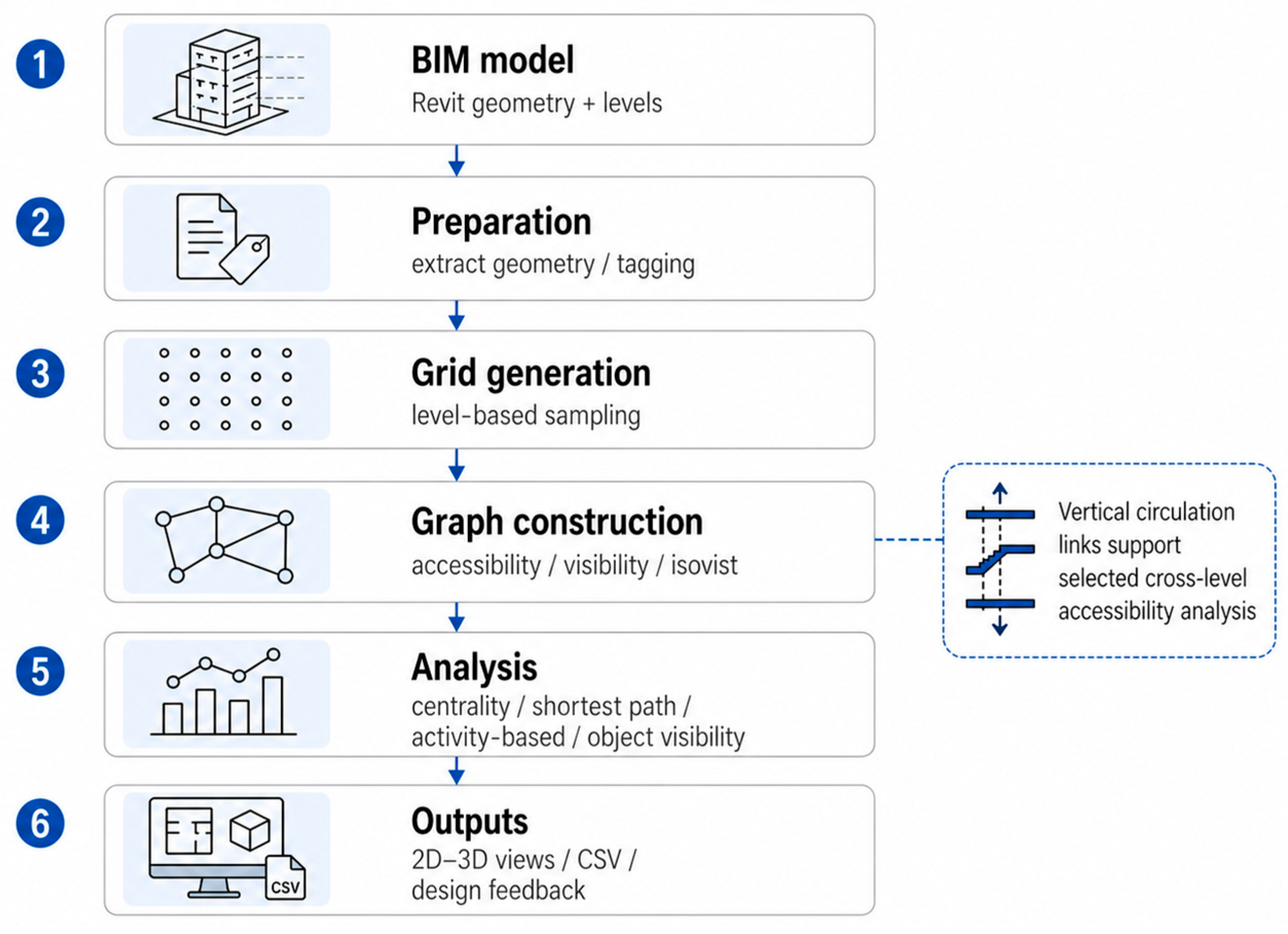
Figure 1 summarises the overall workflow. The process begins with the Revit model and proceeds through geometry preparation, tagging, level-based grid generation, graph construction, spatial analysis computation, and output visualisation. The workflow supports both level-based analyses and selected cross-level accessibility analysis when vertical circulation connections are incorporated into the accessibility graph.
The workflow consists of six main stages:
BIM model preparation and level definition;
geometry extraction and tagging;
level-based grid generation;
construction of accessibility and visibility graphs, with vertical circulation connections incorporated into the accessibility graph for selected cross-level analyses;
computation of spatial measures;
visualisation and export of results, including 2D/3D views, Comma-Separated Values (CSV)-based origin–destination outputs, and design feedback.
A two-storey residential building model was used as a controlled methodological demonstration. The purpose of the case study is not to generalise findings across all building types, but to demonstrate how graph-based spatial analyses can be configured, computed, visualised, and exported within a BIM environment. It also illustrates how selected movement-related analyses can incorporate cross-level accessibility relationships through vertical circulation connections.
3.1. Analytical Scope of the Workflow
The analytical scope of the workflow is defined by the distinction between movement-related graph analysis and visibility-related analysis. Movement-related measures are primarily computed from the accessibility graph, which represents navigable relationships between grid nodes. When vertical circulation connections are included, this graph can represent horizontal movement within each floor as well as selected cross-level relationships between floors.
Visibility-related analyses are configured differently. Visibility graphs are generated at a defined view height and are therefore interpreted as view-height-based analytical layers. Isovist-based analyses evaluate visibility from selected observation points, multiple grid points, or points along a predefined path. These analyses support the assessment of visual fields, visual accessibility, and sequential visibility conditions within the BIM model.
This distinction clarifies the methodological scope of the study. The workflow configures existing spatial graph and visibility-based analyses within a BIM environment and extends selected movement-related measures through vertical circulation connections. It therefore supports model-based cross-level accessibility analysis, while visibility and isovist outputs are treated as level-based or viewpoint-specific rather than as full volumetric simulations.
3.2. Case Study Model and BIM Preparation
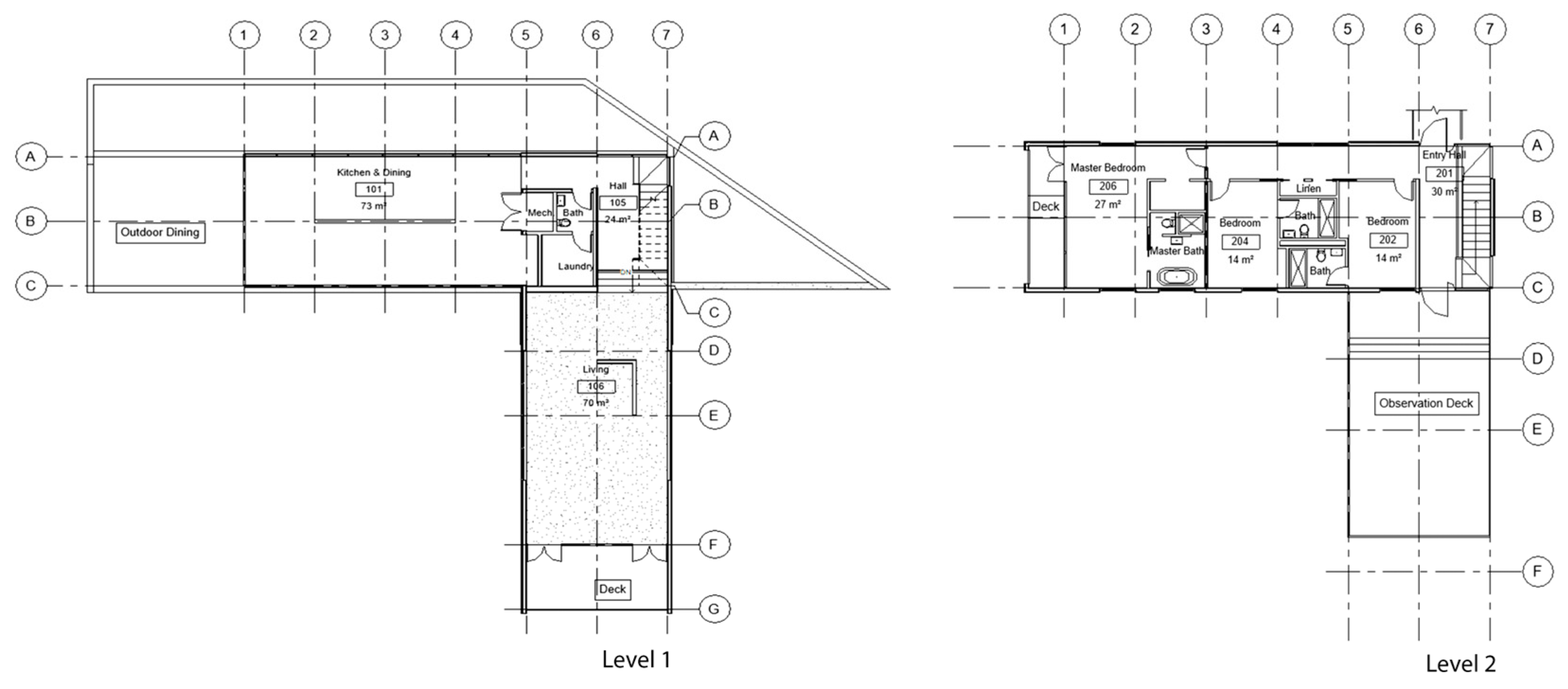
A two-storey residential building model in Revit was selected as the case study for demonstrating the proposed workflow (
Figure 2). The model provides a controlled context in which the relationship between BIM geometry, graph construction, level-based analysis, vertical circulation, and spatial analysis outputs can be tested. Its two-storey configuration allows the workflow to be explained clearly while still including more than one building level and a vertical circulation element.
Architectural elements such as walls, floors, doors, openings, stairs, and level boundaries formed the geometric basis for graph construction. Before running the analysis, the model geometry was reviewed to ensure that relevant elements were correctly represented and that analytical assumptions were consistent across the workflow. Elements that affect movement or visibility, such as walls and closed barriers, were treated as obstacles. Elements that should not obstruct analysis could be excluded through tagging. This preparation stage is important because the accuracy of graph-based outputs depends on how the architectural model is translated into analytical geometry.
3.3. Geometry Extraction, Tagging, and Grid Generation
Geometry preparation and grid generation were performed within the Revit–Dynamo environment using the AVA package [
14]. The first step involved extracting relevant building geometry from the BIM model and defining which elements should be included in the spatial analysis.
The analytical configuration was controlled through tagging strategies applied to model elements. Elements marked as #NonGrid were excluded from grid creation. Elements marked as #NonObstacle were excluded from obstruction calculations. Doors and windows could be tagged as #IsObstacle when closed conditions needed to be simulated. This tagging strategy allows the analytical model to be adjusted without modifying the architectural geometry itself.
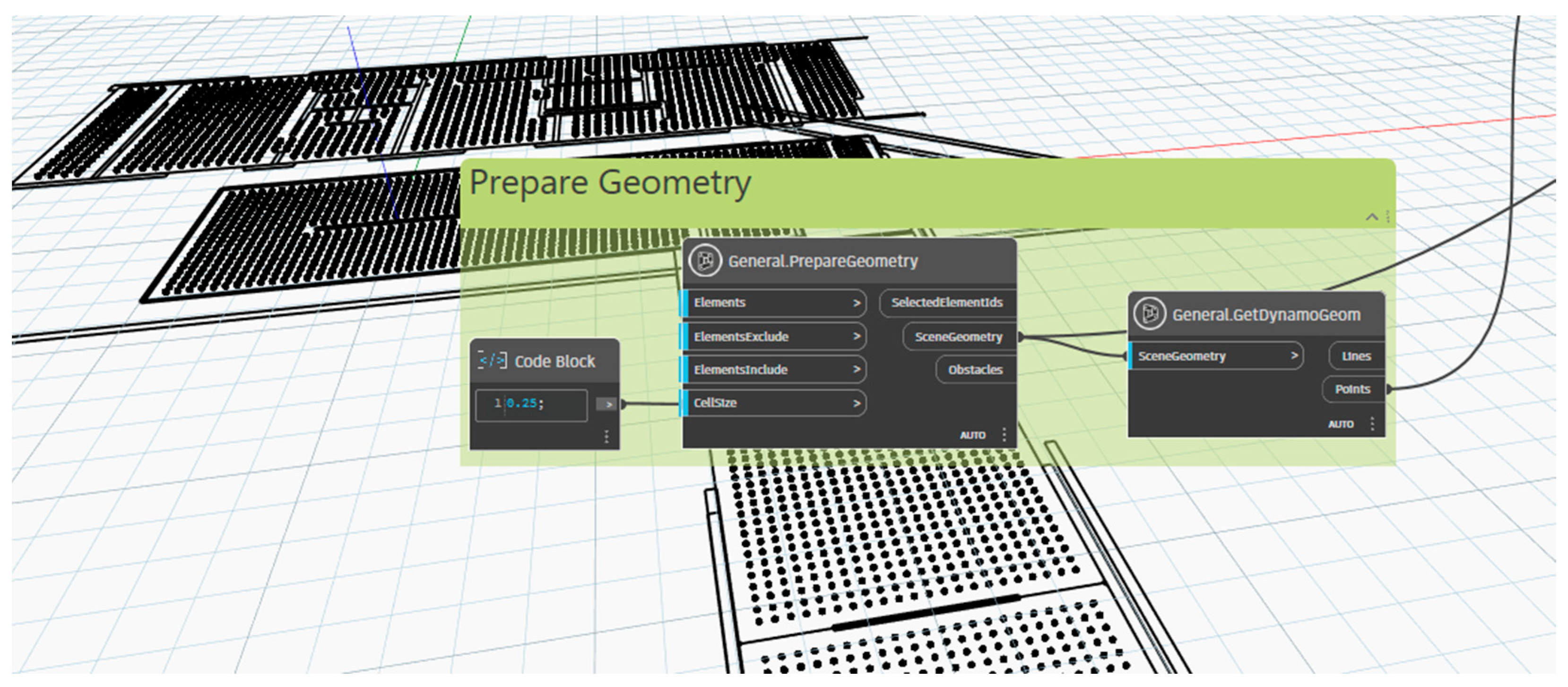
After geometry preparation, a grid-based sampling system was generated from the BIM geometry (
Figure 3). Grid points represent potential node locations for accessibility and visibility graph construction. The grid resolution can be adjusted depending on the required level of analytical detail. A finer grid produces a denser graph and more detailed spatial outputs, while a coarser grid reduces computational load.
For buildings with more than one level, grid generation is organised in relation to the relevant floor levels. Each level can be analysed as an individual spatial layer, while vertical circulation connections can be incorporated into the accessibility graph where cross-level movement relationships need to be evaluated.
3.4. Accessibility and Visibility Graph Construction
Following geometry preparation and grid generation, spatial graphs were constructed within the BIM environment. Two primary graph types were used in the workflow: accessibility graphs and visibility graphs. These graph types represent different spatial relationships and support different analytical purposes.
Accessibility graphs represent navigable connections between grid nodes. Nodes are connected when movement paths are unobstructed by defined obstacles and when they belong to the same accessible spatial domain. Accessibility calculations were performed at a low height, approximately 0.03 m above the floor surface, representing ground-level movement across floor areas. In a single-level analysis, accessibility relationships are constructed within one floor level. Where vertical circulation connections are included, the accessibility graph can also support selected cross-level movement analysis.
Visibility graphs represent unobstructed lines of sight between grid nodes. A connection between two nodes is established only when no obstacle intersects the line segment between them. Visibility analysis is performed at a specified view height, which acts as a sectional plane during connection calculations. Elements intersecting this height are treated as visual obstacles. In this study, visibility graph analysis is therefore interpreted as a level-based and view-height-based analytical layer.
The distinction between accessibility and visibility graphs is important for interpreting the workflow. Accessibility graphs can incorporate vertical circulation links and support selected cross-level movement analysis. Visibility graphs, by contrast, evaluate visual relationships at defined view heights and are used for level-based visibility assessment.
Weight Matrices and Optimisation
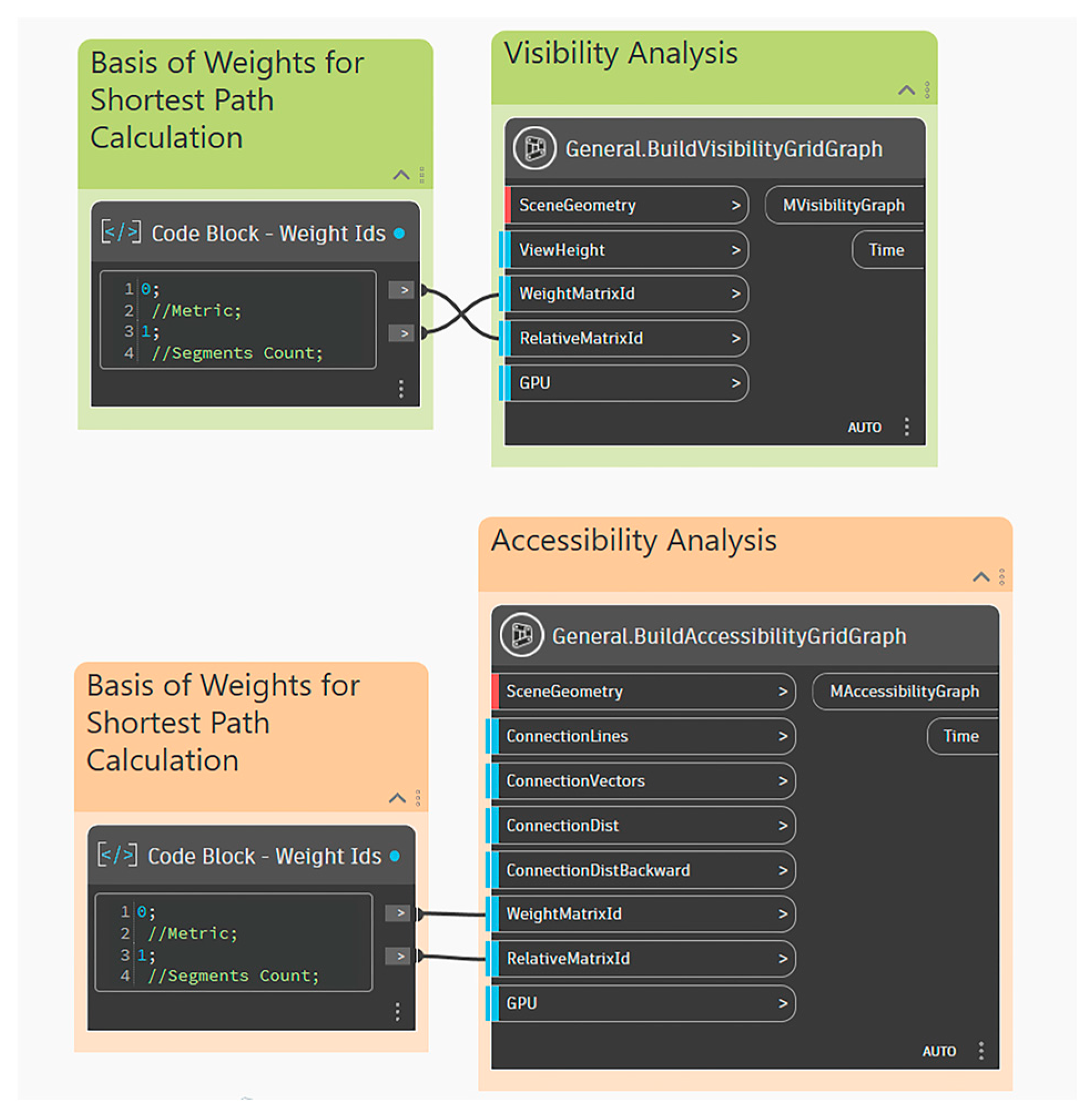
The AVA package allows shortest path calculations to be configured using weight matrices (
Figure 4). The WeightMatrixId parameter defines the primary optimisation criterion:
WeightMatrixId = 0: metric distance minimisation
WeightMatrixId = 1: segment or topological minimisation
The RelativeMatrixId parameter introduces a secondary optimisation criterion, allowing a balance between metric length and segment count. This enables the same graph structure to support both metric and topological interpretations of spatial relationships.
In the case study, accessibility graphs were configured with WeightMatrixId = 0 and RelativeMatrixId = 1, prioritising metric distance while considering segment count as a secondary criterion. This configuration is appropriate for movement-related analysis because it identifies spatial routes based primarily on physical travel distance while also accounting for the number of directional or segment-based transitions.
Visibility graphs were configured with WeightMatrixId = 1 and RelativeMatrixId = 0, prioritising topological segment minimisation while treating metric distance as a secondary factor. This configuration supports visual step depth and visual integration analysis by emphasising the number of visual or configurational transitions required within the spatial system.
Together, these graph construction and weighting settings allow the workflow to evaluate both per-level visibility relationships and multi-level accessibility relationships within the BIM environment.
3.5. Incorporating Vertical Circulation into the Accessibility Graph
Vertical circulation is important for extending movement-related analysis beyond a single floor. Stairs, ramps, lifts, and other level-to-level circulation elements are not remodelled separately; they are already part of the Revit model. The methodological step is to incorporate these existing BIM elements into the analytical graph as connections between building levels.
In the workflow, stairs and ramps can be represented as connection lines linking the grid structures of different floors. These links allow separate level-based accessibility graphs to operate as a connected accessibility network. Their weights can be defined according to the analytical purpose: as approximate travel length for metric analysis, or as transition cost for topological analysis. Where the default representation is insufficient, custom vertical connections can be defined, for example using Revit adaptive families to represent lifts, restricted staircases, or alternative circulation routes.
Including vertical circulation affects movement-related measures. Shortest path analysis can calculate routes between origins and destinations located on different floors; distance-based and step-based calculations can include level-to-level transitions; and integration or betweenness centrality can be interpreted in relation to the wider accessibility network. This enables staircases, landings, and other transition points to be understood as part of the building-wide accessibility structure.
This step should therefore be understood as the analytical incorporation of existing vertical circulation elements into the accessibility graph, rather than separate geometric modelling. Its purpose is to keep selected cross-level movement analysis linked to the BIM model while enabling vertical circulation to be represented within the graph structure.
3.6. Spatial Measures and Analytical Applicability
The workflow supports several spatial measures within the BIM environment. These measures are computed from accessibility graphs, visibility graphs, and isovist-based analytical components. The measures differ in terms of their analytical scope and how they can be interpreted within the workflow.
Movement-related measures are primarily computed from the accessibility graph. These include connectivity, integration, betweenness centrality, shortest path distance, and activity-based origin–destination relationships. When vertical circulation connections are included, selected movement-related measures can be interpreted across connected levels.
Visibility-related measures are computed from visibility graphs and isovist-based components. Visual degree centrality, visual closeness, and visual step depth are calculated at defined view heights. Isovist field analysis, single vantage-point isovists, path-based isovists, and object visibility analysis are used to evaluate visibility conditions from selected points, multiple grid points, or predefined routes.
Table 1 summarises the spatial measures used in the workflow and clarifies their analytical applicability.
3.7. Reproducibility and Relationship to Prior Verification
The workflow was structured to support reproducibility through explicit parameter settings, graph construction rules, and documented analysis steps. The use of Dynamo node sequences, AVA components, and Python scripting allows the workflow to be repeated and adapted for different BIM models. The activity-based Python script provided in
Appendix A further supports reproducibility by showing how graph-based outputs can be organised into origin–destination distance matrices.
The present paper does not introduce a new comparative DepthmapX analysis. Instead, it builds on the authors’ previous BIM-based spatial analysis work, in which selected outputs from a related Revit–Dynamo–AVA workflow were compared with DepthmapX to support methodological validation and verification [
10]. In the present study, this prior validation provides methodological context, while the focus is on documenting the broader BIM-embedded workflow and demonstrating how selected cross-level accessibility relationships can be represented through vertical circulation connections.
The case study demonstrates technical feasibility, workflow transparency, and reproducibility within a controlled two-storey model. It does not provide full validation of the workflow across all building types, nor does it assess scalability under highly complex conditions. These issues are addressed in the discussion and future work sections.
4. Results and Workflow Demonstration
This section presents the analytical outputs generated through the proposed BIM-embedded workflow. The results are interpreted as a workflow demonstration rather than as a general performance evaluation of residential buildings. The purpose is to show how spatial graph measures, visual analysis outputs, shortest paths, activity-based origin–destination matrices, and isovist-based results can be configured, computed, and visualised within the Revit–Dynamo environment.
The results are organised according to the main outputs of the workflow: connectivity, integration, visual step depth, multi-level shortest path analysis, activity-based origin–destination analysis, and isovist-based spatial analysis. Particular attention is given to the distinction between movement-related outputs derived from the accessibility graph and visibility-related outputs derived from visibility graphs or isovist-based components.
4.1. Connectivity (Degree Centrality)
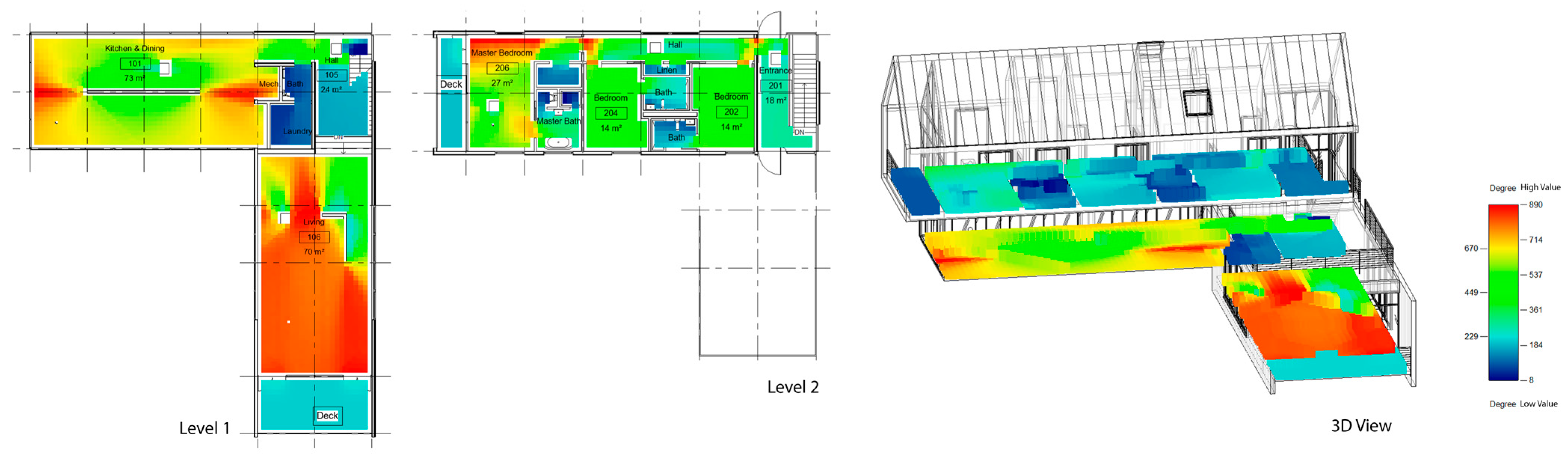
Connectivity, equivalent to degree centrality, measures the number of directly connected neighbouring nodes within the graph [
15]. It represents a local property of spatial configuration, indicating how many immediate movement options are available from a given location.
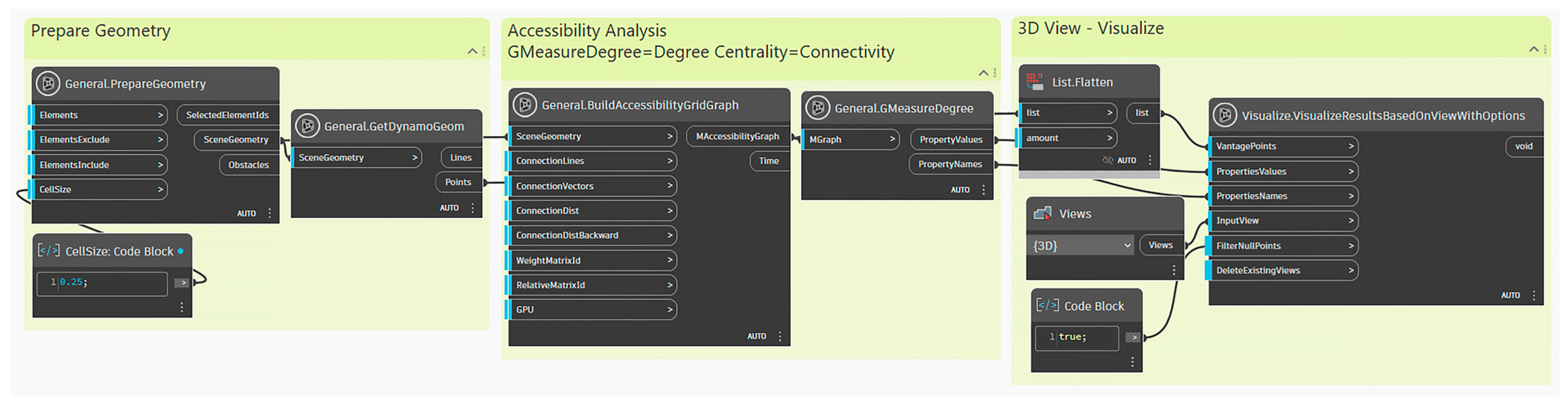
In this workflow, connectivity values were computed from the accessibility graph using the GMeasureDegree node in the AVA Dynamo package (
Figure 5). The results were visualised directly within the Revit environment as colour-coded analysis outputs in both plan and 3D model views (
Figure 6). Higher connectivity values indicate locations with a greater number of immediately accessible neighbouring nodes, while lower values indicate more spatially constrained or peripheral areas.
When vertical circulation links are included in the accessibility graph, connectivity can be interpreted not only within individual levels but also in relation to transition points between levels. Nodes located near stairs, ramps, or other circulation links can therefore be interpreted as locally important because they connect movement relationships across the building.
4.2. Integration (Closeness Centrality)
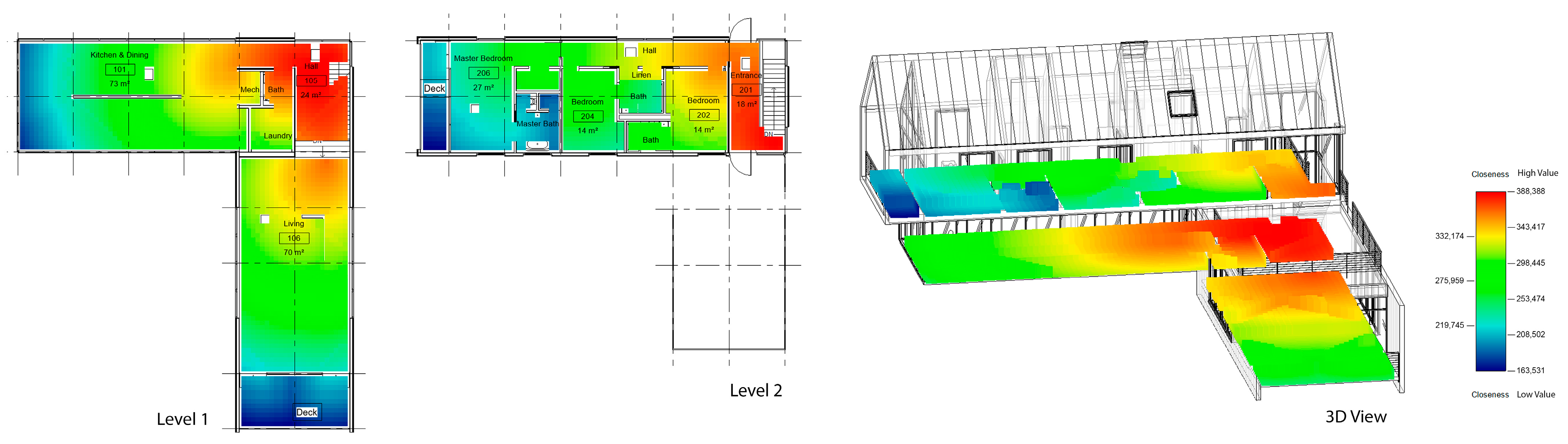
Integration (closeness centrality) is a global measure that evaluates how easily a node can reach all other nodes in the network, reflecting its overall accessibility within the spatial system [
15]. Traditionally, closeness centrality is defined as the reciprocal of the sum of the shortest path distances from a node to all others. However, according to the Grafit documentation [
14], the implemented CalculateCC method computes integration by summing the shortest path distances directly, without taking their reciprocal. In this formulation, lower aggregate distance values indicate higher spatial integration.
The integration (closeness centrality) for a node
i is expressed as Equation (1):
where
represents the shortest path distance between nodes
and j, calculated according to the specified WeightMatrixId, and
denotes the weight associated with the origin–destination pair.
For edges, the method computes path distances by identifying the initial directed edge from node i and summing the corresponding edge distances.
In the case study, integration was computed from the accessibility graph using the General.GMeasureClosenessCentrality node in the AVA Dynamo package. The results were visualised in Revit, illustrating global accessibility patterns on the floor plan (
Figure 7). The analysis outputs can also be examined in 3D views. Since lower aggregate distance values indicate higher spatial integration in this implementation, the visualisation was interpreted accordingly.
In addition to connectivity and integration measures, betweenness centrality can be computed from the accessibility graph to identify spaces that function as intermediary nodes within the spatial network. The measure quantifies the extent to which a node lies on the shortest paths between other node pairs, reflecting its potential to mediate movement flows and spatial transitions [
16]. Within the developed BIM-based workflow, betweenness centrality can be calculated using the General.GMeasureBetweennessCentrality node in the AVA Dynamo package. The computation is based on shortest paths defined according to the selected weight matrix configuration (metric or topological), and the results can be visualised directly in the Revit environment.
4.3. Visual Step Depth
Visual step depth measures the shortest topological distance from a selected reference node to all other nodes in the spatial network [
13]. Unlike metric distance, step depth reflects the number of transitions required to reach other locations, emphasizing the structural hierarchy of the spatial configuration.
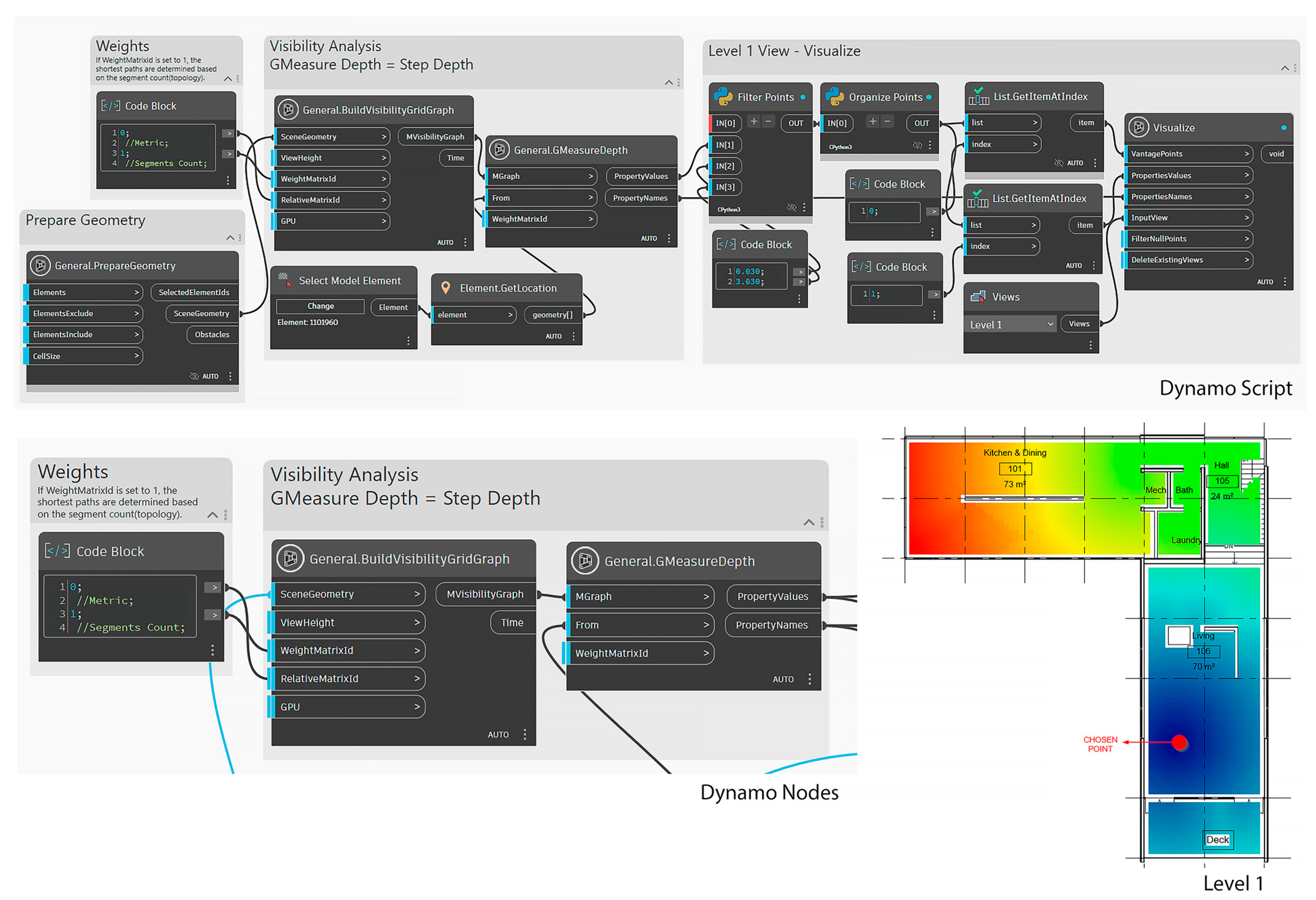
In this study, visual step depth was derived from the visibility graph using the GMeasureDepth node in the AVA Dynamo package. The computation is governed by the WeightMatrixId parameter, which determines whether shortest paths are calculated based on metric distance (value = 0) or topological segment count (value = 1). When topological weighting is applied, the measure corresponds to visual step depth. The RelativeMatrixId parameter enables secondary optimization by balancing metric distance and segment minimization within the path calculation.
For the case study, visual step depth was computed from a selected reference node and visualised directly within Revit (
Figure 8). Lower values indicate areas that can be reached through fewer visual or configurational transitions from the selected origin, while higher values indicate areas requiring more turns or visual steps.
When the visibility graph is configured with topological weighting (WeightMatrixId = 1), the GMeasureDegree function is used to compute visual degree centrality, representing visual connectivity within the spatial configuration. Using the same topological weighting, the GMeasureClosenessCentrality function is applied to calculate visual closeness, corresponding to visual integration and reflecting global visual accessibility relationships.
4.4. Multi-Level Shortest Path Analysis
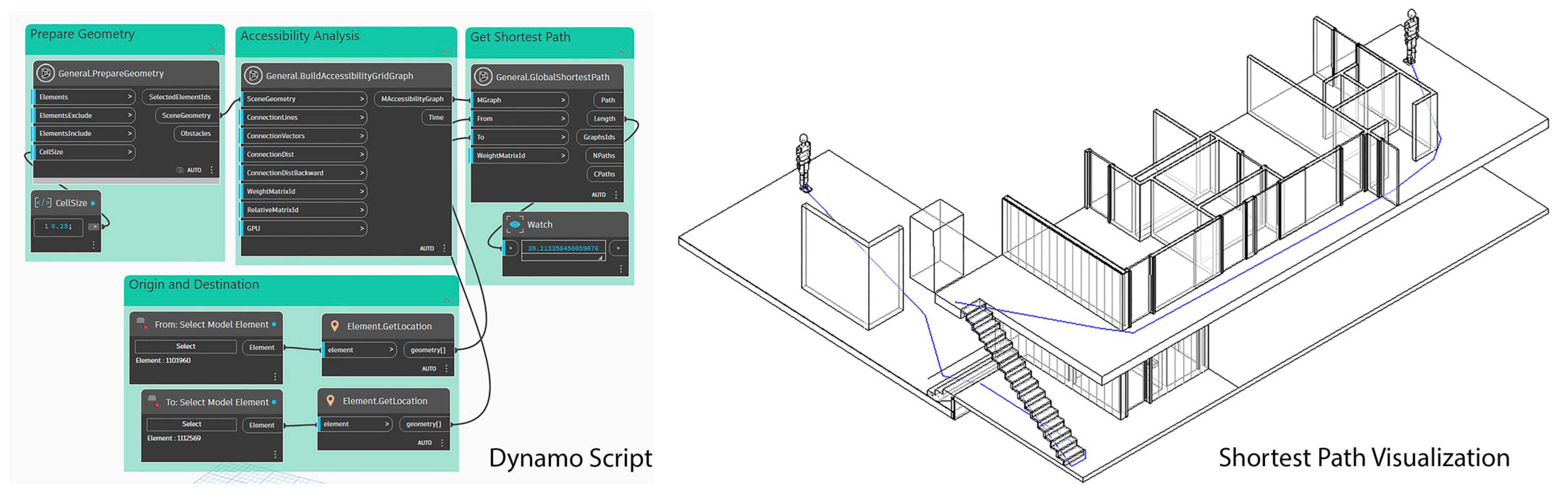
Shortest path analysis was performed using the accessibility graph to identify the most efficient route between selected origin and destination points. The analysis can be computed either within a single level or across multiple levels when vertical circulation connections are included in the graph. In the multi-level workflow, stair, ramp, or lift connections allow the path to pass between floors, enabling cross-level movement relationships to be evaluated within the BIM environment.
The calculation produces both the geometric path and its associated metric or topological length, depending on the selected weight configuration. When metric weighting is applied, the shortest path prioritises physical travel distance. When topological weighting is applied, the path prioritises the minimum number of graph-based transitions or segments. This allows the same accessibility graph to support both metric and configurational interpretations of movement.
In the case study, shortest path analysis was used to generate a route between an origin on Level 1 and a destination on Level 2. The resulting path passes through the stair connection, demonstrating how vertical circulation is incorporated into the accessibility graph.
Figure 9 presents the shortest path workflow in Dynamo and the corresponding cross-level route visualisation in Revit. The output demonstrates how the BIM-embedded workflow can generate and display multi-level route information without exporting the model to a separate analytical environment.
4.5. Activity-Based Analysis with Average Paths Python Script
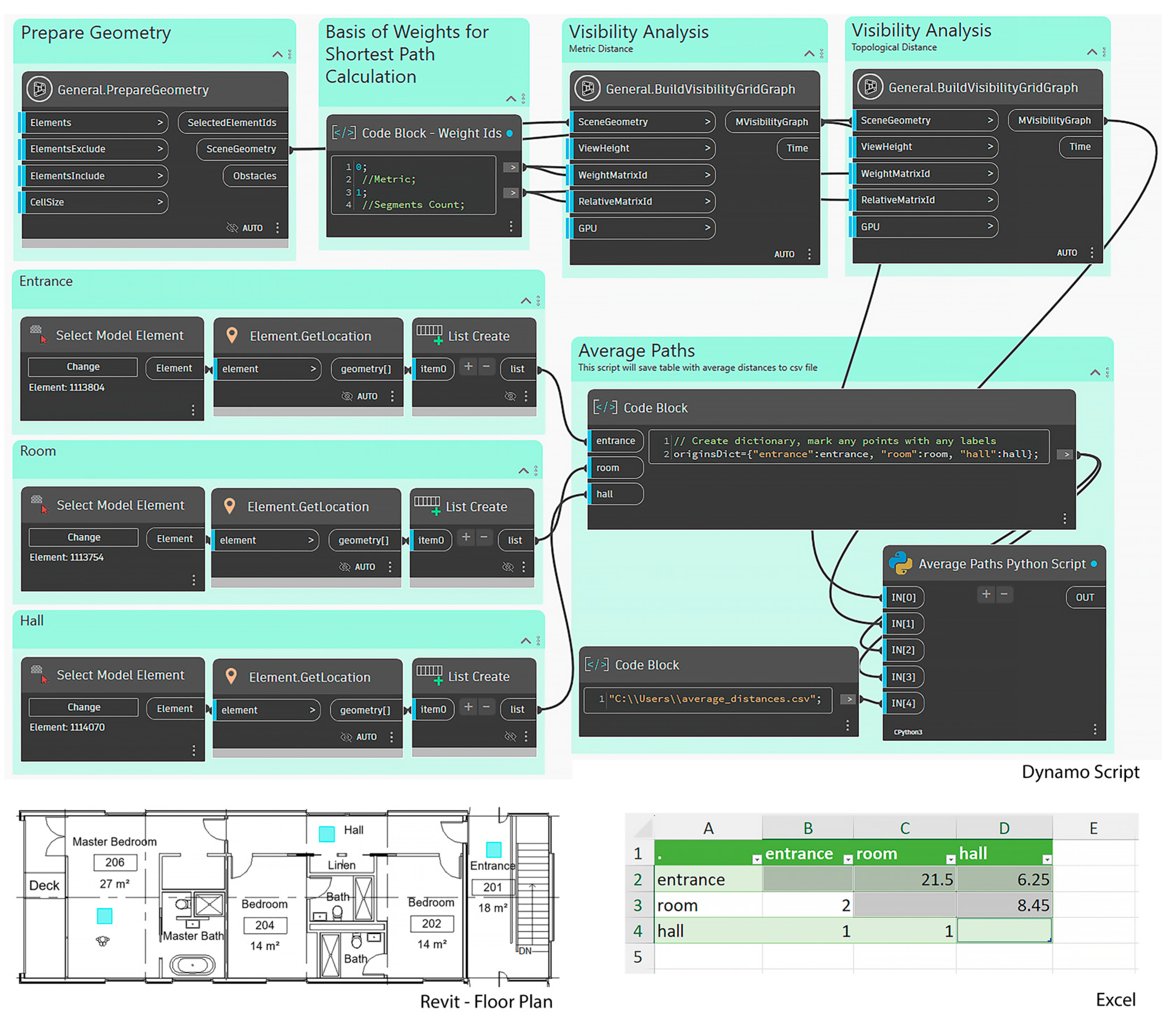
An activity-based origin–destination analysis was performed to evaluate spatial relationships between predefined functional or activity-related locations within the case study model. The analysis was implemented within the Dynamo–Revit environment using the AVA package and a custom Python script provided in
Appendix A. The purpose of this step was not to introduce a new graph algorithm, but to organise graph-based shortest path outputs into a reproducible activity-based distance matrix.
In the case study, selected activity nodes, such as entrance, circulation, living, working/study, and bedroom-related locations, were defined as origin and destination groups. Multiple spatial instances could be assigned to the same activity type, allowing the script to calculate average values across all corresponding origin–destination combinations. This makes the workflow suitable for evaluating functional relationships where one activity type may be represented by more than one location in the model.
The analysis uses graph outputs generated within the AVA workflow. Depending on the selected graph and weight configuration, the resulting matrix can represent metric path distances or topological step distances between activity groups. When applied to the visibility graph, the metric values represent visibility-based path distances, while the step values indicate the number of visual or configurational transitions. When applied to the accessibility graph, the same logic can be adapted to movement-related origin–destination analysis.
The output is exported as a CSV-formatted origin–destination matrix. In the matrix, upper triangular cells report average metric distances, while lower triangular cells report average topological step distances. This dual representation allows metric separation and configurational depth between activity groups to be examined together. Where activity points are distributed across different floors and the underlying graph includes vertical circulation connections, the same structure can support selected cross-level functional relationship analysis.
Figure 10 presents the activity-based workflow and the resulting origin–destination matrix. The full Python script is provided in
Appendix A. Since Grafit and the underlying AVA components operate in Revit’s internal units, the script converts Dynamo input points from metres to feet before graph querying and converts the resulting distances back to metres for the CSV output.
4.6. Isovist-Based Spatial Analysis
An isovist represents the visible area from a specific observation point within a spatial configuration, considering physical obstructions such as walls and partitions [
12]. It provides a quantitative description of visual fields and is commonly used to evaluate visibility structure, spatial perception, and wayfinding potential.
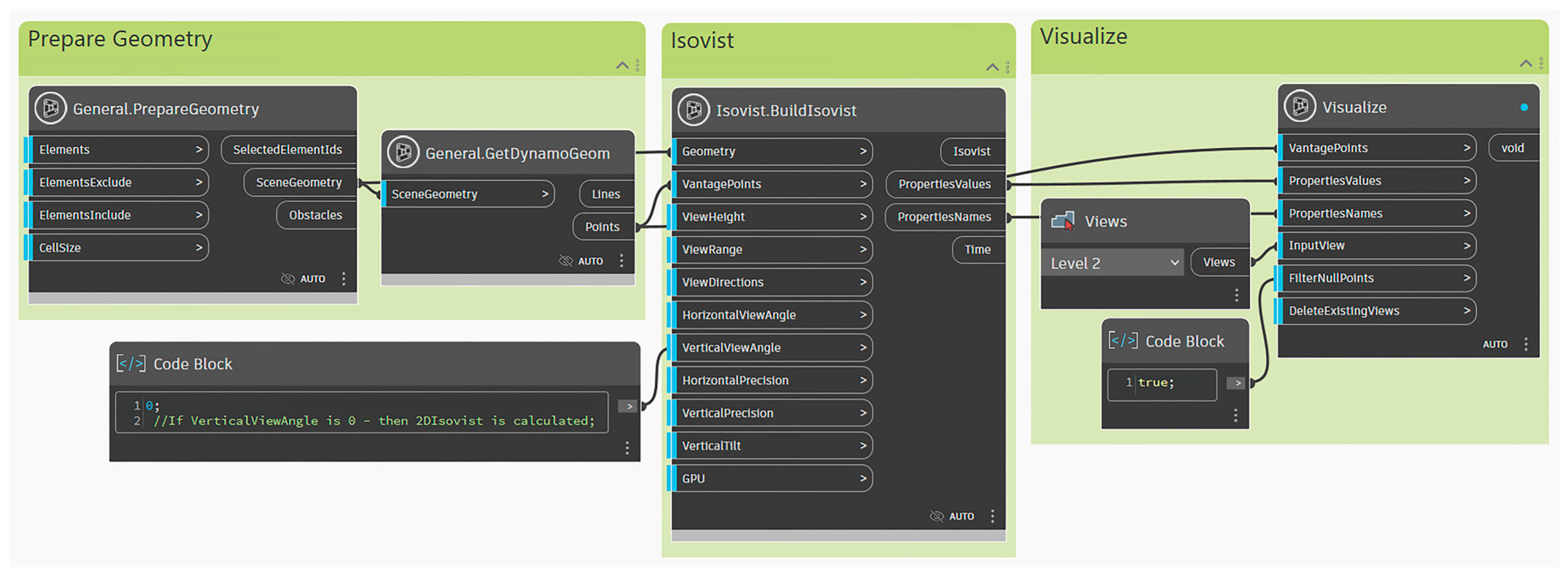
In this study, isovist analysis was conducted within the BIM environment using the AVA package in Dynamo (
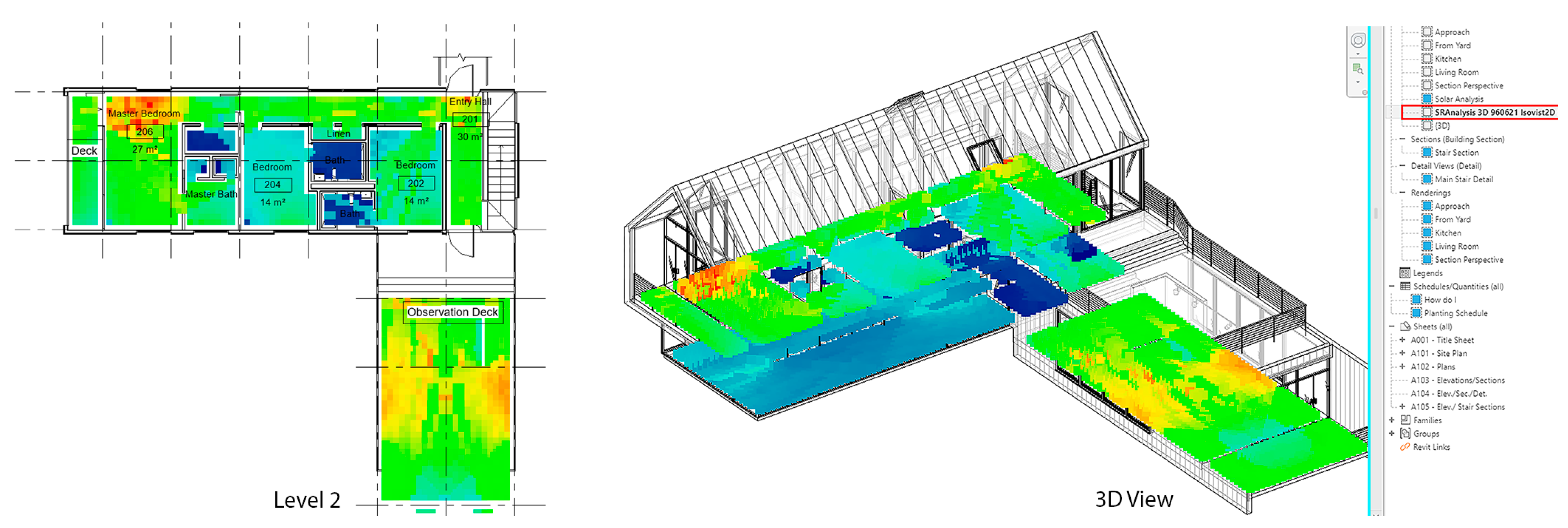
Figure 11). A grid-based approach was first applied by computing isovist properties at grid nodes derived from the BIM model. The results were visualised directly in Revit, enabling the distribution of visibility values to be examined in plan and model-based views (
Figure 12).
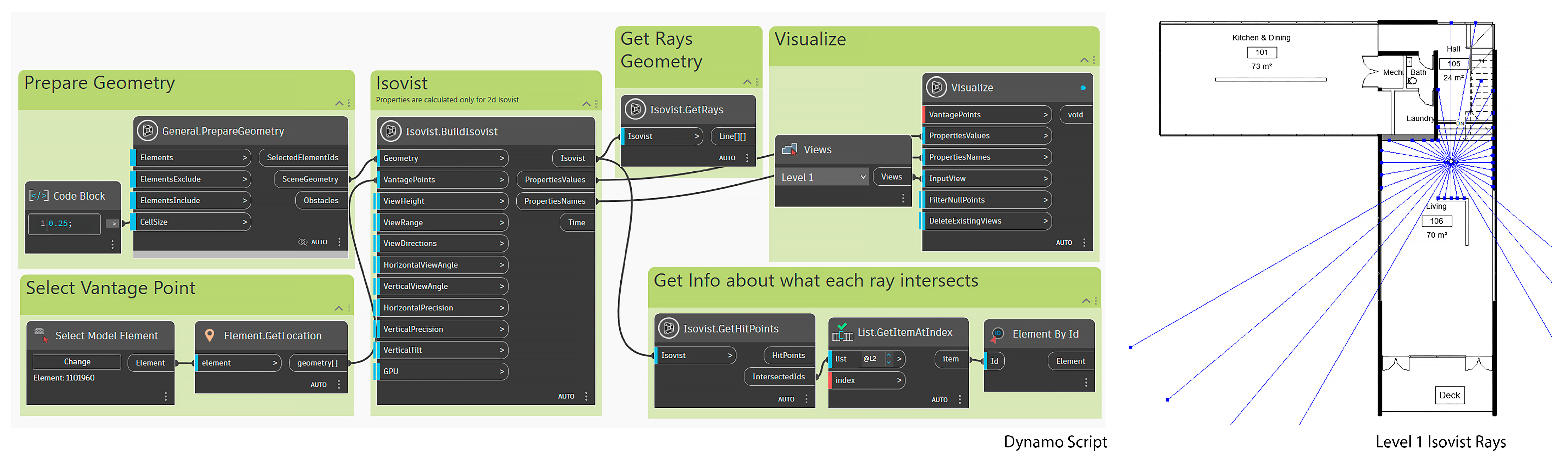
In addition to the grid-based isovist field, single vantage-point isovists were calculated to assess local visibility conditions from selected observation points (
Figure 13). For each vantage point, geometric properties such as area, perimeter, compactness, and circularity were computed. Analytical parameters including view height, view range, directionality, view angle, and precision can be adjusted to simulate different visual scenarios within the BIM model. These settings allow the direction, extent, and resolution of the generated isovist rays to be controlled according to the analytical purpose.
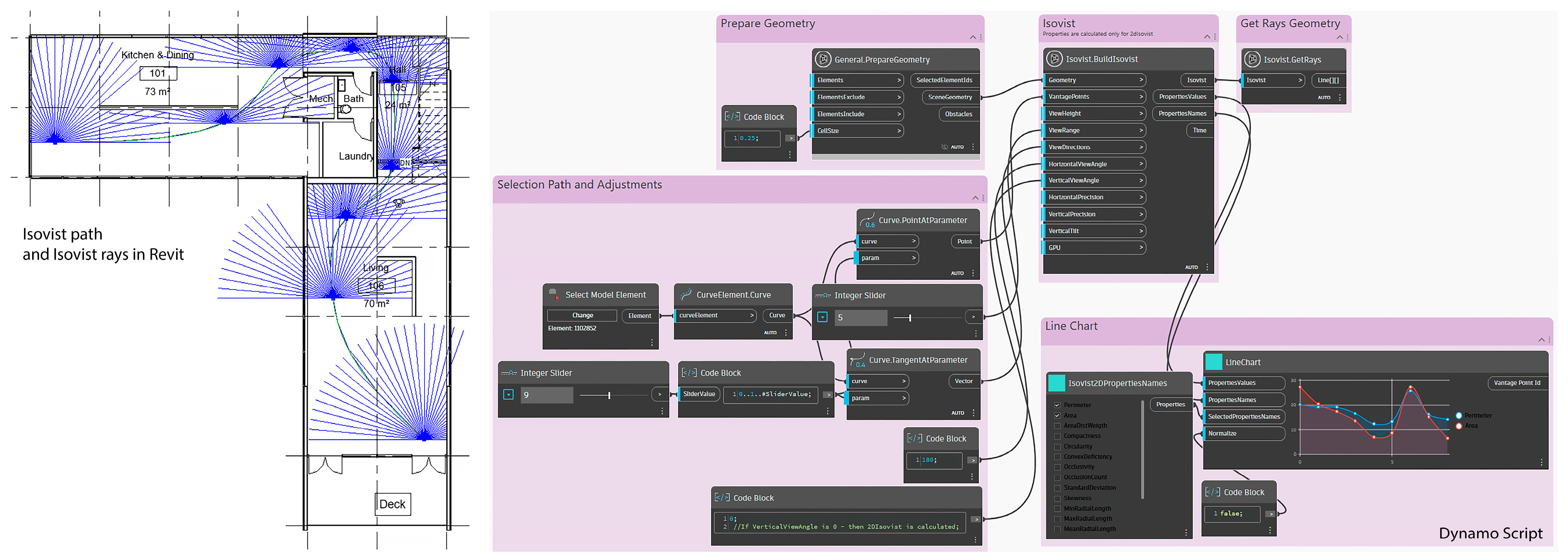
Beyond point-based analysis, isovist computation was extended along predefined circulation paths (
Figure 14). A path created in Revit was discretised into sequential observation points, and isovist properties were calculated along the trajectory. This method enables the assessment of visibility variation along movement routes and supports the analysis of sequential visual experience. The results can be represented both numerically and graphically, facilitating comparative evaluation of visibility performance across different circulation paths.
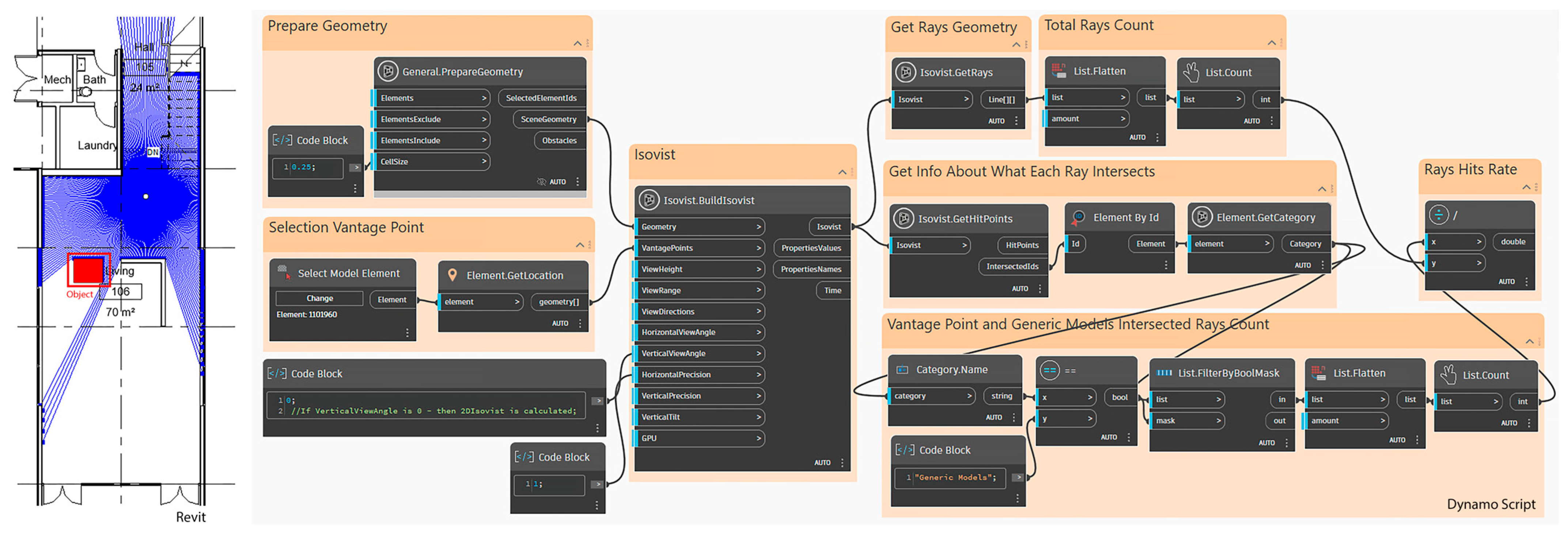
Targeted visibility analysis was performed to quantify the visibility of specific objects from selected vantage points (
Figure 15). In the Revit visualisation, the red box indicates the selected target object used for the visibility calculation. Dynamo nodes were used in combination with the AVA package to define geometry and observation points. Ray-casting techniques were applied to calculate intersections between sight lines and designated objects. The proportion of intersecting rays was then computed to determine the relative visibility of each object within the spatial configuration.
Conducting isovist-based analyses within the BIM environment supports integrated visibility evaluation during the design process. The analysis remains linked to the Revit model, allowing visibility outputs to be inspected alongside the architectural geometry and reducing the need for repeated export–import procedures. This complements the accessibility-based graph analyses by adding visibility-oriented assessment to the same Revit–Dynamo workflow. The 3D Revit view is used to visualise and interpret the analysis outputs within the BIM model context.
5. Discussion
The results demonstrate how graph-based spatial analysis can be configured, computed, and visualised within a BIM environment using existing computational tools. The study does not introduce new graph-theoretic measures or algorithms. Instead, its contribution lies in documenting a reproducible workflow that links BIM geometry, Dynamo-based graph construction, AVA spatial analysis components, Python-based output extraction, and Revit-based visual feedback.
This discussion evaluates the methodological contribution of the workflow, its implications for design-oriented spatial analysis, the role of vertical circulation in selected cross-level accessibility analysis, and the limitations that define the scope of the present study.
5.1. Methodological Contribution: Workflow Integration and Reproducibility
The main contribution of the study is methodological and procedural. It shows how existing spatial analysis tools and components can be sequenced within a BIM environment to support reproducible spatial graph analysis. This includes geometry preparation, tagging, grid generation, graph construction, weight matrix configuration, spatial measure computation, isovist-based analysis, object visibility assessment, and output visualisation.
This positioning is important because the study does not claim to develop new spatial metrics. Measures such as connectivity, integration, betweenness centrality, step depth, shortest path distance, and isovist properties are established methods in graph-based spatial analysis. The value of the workflow lies instead in making their configuration and implementation explicit within a design modelling environment.
The workflow also contributes to reproducibility by documenting the parameter settings and computational sequence used to generate the outputs. The inclusion of the activity-based Python script in
Appendix A further supports reproducibility by showing how graph-based results can be organised into origin–destination matrices. This is particularly relevant for design research and teaching contexts, where transparent workflow documentation can support adaptation to different building models and analytical scenarios.
5.2. BIM-Embedded Feedback and Spatial Design Evaluation
Embedding spatial analysis within Revit allows analytical outputs to be inspected alongside the architectural model. This supports a closer relationship between modelling decisions and spatial performance feedback. Instead of exporting geometry to a separate analytical environment for every design iteration, the workflow keeps graph construction, metric computation, and visualisation within the BIM-based process.
The visualisation of connectivity, integration, visual step depth, shortest paths, isovist fields, and object visibility within Revit enables designers to interpret spatial measures in relation to architectural elements such as walls, openings, circulation spaces, stairs, and rooms. This can support iterative design evaluation by making the consequences of spatial configuration more visible during the modelling process.
However, BIM-embedded analysis should not be understood as a replacement for established spatial analysis tools. Rather, it offers a complementary workflow that reduces the distance between the design model and analytical feedback. Standalone tools such as DepthmapX remain important reference environments for comparison and validation, while BIM-embedded workflows offer advantages for design iteration, model consistency, and visual feedback.
5.3. Cross-Level Accessibility and Vertical Circulation
The incorporation of vertical circulation into the accessibility graph is one of the main extensions demonstrated in this study. In many graph-based floor plan analyses, each level is treated as a separate analytical layer. This is suitable for plan-based evaluation but limits the ability to examine movement relationships between spaces located on different floors.
In the proposed workflow, stairs, ramps, lifts, and other vertical circulation elements can be incorporated as graph connections between levels. This allows selected movement-related measures, particularly shortest path analysis, to represent cross-level routes within the BIM environment. The case study demonstrates this through a route connecting an origin on Level 1 to a destination on Level 2 via the stair connection.
This approach is useful because vertical circulation elements are not treated as detached analytical abstractions. They remain associated with the BIM model and can be interpreted together with the architectural geometry. As a result, cross-level accessibility relationships can be examined in relation to the actual location of stairs, landings, corridors, and connected spaces.
At the same time, the workflow should be interpreted as a graph-based abstraction of accessibility rather than as a behavioural simulation of movement. It does not model walking speed, congestion, user preferences, lift waiting times, or detailed stair movement behaviour. These aspects would require additional behavioural, operational, or simulation-based data.
5.4. Limitations and Validation Scope
Several limitations should be acknowledged. First, the case study is a controlled two-storey residential model. This is useful for demonstrating the workflow clearly, but it does not represent the complexity of larger buildings with multiple vertical circulation cores, split levels, atria, complex access restrictions, or dense circulation networks. Further testing is needed to evaluate how the workflow performs in larger and more complex multi-level buildings.
Second, the results depend on modelling assumptions and graph construction settings. Decisions about which elements are treated as obstacles, how doors or windows are represented, what grid resolution is used, and which weight matrix configuration is selected can affect the resulting measures. A finer grid can provide more detailed outputs but increases computational demand. A coarser grid may be faster but can reduce spatial precision.
Third, the validation scope of the present paper is limited. The study builds on the authors’ previous BIM-based spatial analysis work, in which selected AVA-based outputs were compared with DepthmapX to support methodological validation and verification. However, the present paper does not provide a separate validation for every analysis demonstrated here. In particular, cross-level accessibility relationships, vertical circulation representation, activity-based origin–destination outputs, and isovist-based workflows require further testing across additional case studies and comparison conditions.
Fourth, the visibility and isovist analyses presented here are interpreted as view-height-based or viewpoint-specific outputs. Although these results can be visualised in 3D Revit views, they should not be interpreted as full volumetric visibility simulations. This distinction is important for avoiding overstatement of the analytical scope.
5.5. Future Work
Future work should test the workflow in larger and more complex building types, particularly those with multiple vertical circulation systems, split levels, larger circulation networks, or more complex spatial configurations. Such studies would help assess the scalability, computational performance, and robustness of the workflow under more demanding modelling conditions.
Further research should extend validation beyond the plan-based DepthmapX comparisons conducted in the authors’ previous work. In particular, cross-level accessibility and vertical circulation representation should be tested using manual benchmark routes, independent graph implementations, sensitivity analysis of vertical connection weights, and larger multi-level case studies. This would help assess how assumptions about stairs, lifts, ramps, restricted access, or transition costs affect shortest paths and other accessibility-based measures.
Future work may also investigate how BIM-embedded spatial graph analysis can be linked with additional forms of evidence, such as observed movement data, wayfinding tasks, expert route-choice assessments, or movement simulation outputs. These comparisons would strengthen the interpretation of spatial metrics in relation to user behaviour and design performance.
Finally, the workflow could be extended by linking spatial graph measures with additional performance criteria, such as environmental comfort, energy performance, occupancy patterns, or operational requirements. This would support more comprehensive spatial performance evaluation within BIM-based design workflows.
6. Conclusions
This study presented a BIM-embedded computational workflow for configuring, computing, and visualising graph-based spatial analysis measures within the architectural modelling environment. By integrating Revit, Dynamo, the AVA package, and Python scripting, the workflow demonstrates how accessibility, visibility, centrality, shortest path, visual step depth, activity-based origin–destination, isovist-based, and object visibility analyses can be organised within a consistent BIM-based process.
The contribution of the study is methodological rather than algorithmic. The workflow does not introduce new graph-theoretic measures, but documents how existing spatial analysis components can be sequenced, configured, and visualised in relation to BIM geometry. In this sense, the study contributes to workflow transparency, reproducibility, and design-oriented implementation of spatial graph analysis within a modelling environment.
The two-storey residential case study demonstrated how level-based graph construction and vertical circulation connections can support selected cross-level accessibility analysis. In particular, the shortest path example showed how a route between different floors can be generated and visualised within Revit through the incorporation of a stair connection into the accessibility graph. Visibility graph and isovist-based outputs were also demonstrated as level-based or viewpoint-specific analyses that complement the movement-related graph measures.
The study builds on the authors’ previous BIM-based spatial analysis work, in which selected outputs were compared with DepthmapX to support methodological validation and verification. In the present paper, the emphasis was placed on broader workflow documentation, BIM-embedded implementation, and the representation of vertical circulation in accessibility-based analysis.
The findings indicate that BIM-embedded spatial graph analysis can support iterative, performance-informed design evaluation by keeping analytical feedback close to the architectural model. However, further testing is needed in larger and more complex multi-level buildings, particularly those with multiple vertical circulation systems, split levels, or more complex spatial configurations. Future work should also extend validation of cross-level accessibility relationships through benchmark routes, independent graph implementations, sensitivity analysis of vertical connection weights, and comparison with behavioural or simulation-based evidence.