1. Introduction: Architecture, Education, and Professional Instability
Architecture exists at a moment of instability: economic, epistemic and ethical. The traditional institutional systems that have historically formed architectural practice, including professional associations, accreditation bodies, fee structures, and normative models of authorship, now appear increasingly fragile. Economic forces have narrowed the profession’s agency, as private capital dictates project financing, construction timelines, design scope, and return-on-investment calculations, confining architects between cost-driven standardisation and high-profile formal spectacle [
1,
2].
Simultaneously, the epistemic boundaries of architectural expertise have become porous. Knowledge domains that were once peripheral to architecture, such as computational design, climate science, behavioural economics, data analytics, and synthetic biology, now compete for authority over spatial production [
3,
4]. These are not simply tools architects might adopt; they represent alternative logics, methods, and epistemologies that challenge architecture’s jurisdictional claims [
5,
6,
7]. At the same time, ethical demands challenge primary assumptions about whose knowledge counts and whom architecture serves. Calls for decolonisation interrogate architecture’s complicity in colonialism and displacement [
8,
9], while climate breakdown demands accountability for environmental destruction beyond technical compliance.
Architectural education occupies a strategic position within these dynamics. Schools mediate between inherited models of pedagogy and emerging demands; they negotiate the boundaries of architectural knowledge; they prepare graduates for labour markets characterised by precarity and fragmentation [
10,
11,
12]. Through curriculum design, pedagogical innovation, research agendas, and institutional partnerships, schools actively shape what architectural expertise means, who can claim it, and how it operates in relation to other disciplines and domains [
13,
14].
This article examines contemporary architectural education through a global empirical lens, drawing on a survey of 345 architecture schools across 159 countries commissioned and funded by the UIA Architectural Education Commission [
15]. Its primary contribution is systematic, large-scale mapping of what schools are actually doing either institutionally, as a part of the curriculum or thematically, rather than what they aspire to do or are theorising to do. It investigates how institutions respond to the pressures reshaping architectural practice, including economic constraints, interdisciplinary competition, technological transformation, labour precarity, and calls for decolonisation and ecological responsibility [
13]. The survey maps global patterns in curriculum structure, institutional priorities, faculty expertise, student outcomes, and engagement with practice and society.
1.1. Three Intersecting Problem Domains
Three intersecting domains confront the discipline and the profession; each of which poses distinct challenges.
First, economic and institutional pressures have fundamentally altered the conditions of architectural work. The financialisation of real estate, unbundling of design services, and systematic devaluation of architectural labour create precarious employment conditions that schools must acknowledge and address [
1]. Education inherits these conditions directly, operating under resource constraints while preparing graduates for precarious careers [
16].
Second, the expanding universe of knowledge domains competing for design authority challenges architecture’s jurisdictional claims. Fields such as public health, data science, artificial intelligence, and environmental engineering increasingly shape built environments, often employing methods and epistemologies distinct from those of traditional architectural practice [
17,
18]. This raises existential questions: What remains distinctly architectural when other disciplines claim design expertise? Should architects lead interdisciplinary collaborations, participate as equals, or accept subordinate roles? How does the integration of artificial intelligence, which is capable of generating designs, optimising performance, and automating documentation, transform the nature of architectural authorship and professional identity [
19,
20]?
Third, demands for decolonisation, sustainability, and social responsibility require epistemological and ethical reorientation. Decolonisation challenges Eurocentric canons, advocates for indigenous and Global South knowledge systems, and interrogates architecture’s historical complicity in colonialism and displacement [
8,
9]. Climate breakdown and ecological collapse demand pedagogies centred on sustainability, resilience, and environmental justice that go beyond technical compliance to address systemic transformation [
21,
22]. The United Nations’ Sustainable Development Goals offer a normative framework increasingly adopted by universities globally, yet questions remain about whether such commitments drive genuine transformation or function primarily as institutional branding [
23,
24,
25]. These demands are not simply additive; they require rethinking foundational assumptions about authorship, expertise, and responsibility.
Within each domain, educational institutions face choices about curriculum, resources, partnerships, and pedagogy, options that reveal broader assumptions about the future of architecture. These are not separate challenges but interconnected pressures that collectively destabilise inherited professional models.
1.2. Research Objectives and Contributions
The contribution of this article is threefold. First, it provides evidence-based insight into how architectural education anticipates and mediates professional futures, moving beyond speculative or prescriptive accounts to examine what schools are actually doing at global scale. The dataset of 345 schools across 159 countries, representing diverse geographic, economic, and institutional contexts, enables the identification of convergent trends and divergent trajectories that localised studies cannot reveal.
Second, it interprets these trends through conceptual frameworks drawn from the sociology of professions, the political economy of knowledge, and critical scholarship on architectural education, elucidating how educational choices reflect broader struggles over expertise, authority, and agency. The interpretive questions of whether schools reproduce existing professional models or prefigure alternative futures, whether interdisciplinarity dilutes or enriches architectural authority, and whether ethical imperatives drive or merely perform transformation are addressed in
Section 5.
Third, it positions education not as a separate concern but as a critical site for understanding architecture’s capacity, or incapacity, to design its own future. If architectural education functions as a mediating institution that actively constructs professional knowledge, legitimacy, and boundaries, then examining educational patterns reveals the terms on which transformation is occurring and the degree to which architects retain agency in shaping those terms.
2. Conceptual Framework: Education and Expertise at the Centre of Professional Change
Architectural education does not simply transmit professional skills; it actively constructs, legitimates, and transforms what counts as architectural knowledge. Therefore, the conceptual framework draws on three intersecting bodies of scholarship: studies of professional boundary-work and expertise, critical analyses of architecture’s political economy, and research on education as a mediating institution. These three perspectives establish the theoretical foundation upon which the interpretation of the empirical patterns that follow is undertaken.
2.1. Architecture, Professionalisation, and the Negotiation of Expertise
Professions are not stable categories but contested jurisdictions. As Abbott argues, professional authority depends on the ability to claim exclusive expertise over particular problems and to defend that claim against competing groups [
5]. This process of “boundary-work” is continuous and strategic: professions must articulate what makes their knowledge unique and establish institutional mechanisms (credentialing, accreditation, codes of practice) to enforce boundaries [
26]. Professional expertise is therefore negotiated; its content, scope, and authority are continuously redefined in response to economic, technological, and social pressures.
Architecture has historically occupied an ambiguous position within this framework. Unlike medicine or law, where expertise rests on formalised knowledge and regulatory protection, architectural authority has been more diffuse, anchored to aesthetic judgement, technical coordination, and cultural legitimacy [
11]. Cuff’s ethnographies of practice unveil architecture as a collaborative and often subordinate activity, where architects negotiate authority with clients, contractors, engineers, and developers rather than commanding it [
11]. Stevens demonstrates how architectural education reproduces social hierarchies and aesthetic dispositions that sustain the profession’s cultural capital even as its economic and technical power diminishes [
25].
Contemporary scholarship extends this analysis into pedagogy itself. It argues that architectural education is not merely preparatory but constitutive; it shapes not only what architects know but how they understand their role, their methods, and their relationships to society [
13,
27]. His work on transformative pedagogy emphasises that schools reproduce or challenge professional norms through curriculum structure, studio culture, and assessment practices [
27]. Critically, architectural education is positioned as a site where architecture’s public purpose and ethical commitments are either reinforced or eroded. His framework reveals that choices about what to teach, how to teach it, and who teaches are political acts that define architecture’s boundaries and aspirations [
28].
This literature establishes three key insights for the present study. First, architectural expertise is negotiated rather than fixed; its content, scope, and authority are continuously redefined in response to economic, technological, and social pressures. Second, education is a primary mechanism through which professional boundaries are maintained, adjusted, or dissolved. Schools function as gatekeeping institutions that certify who can claim architectural expertise and what forms that expertise takes. Third, understanding architecture’s trajectory requires examining what schools teach and how curricula, accreditation, faculty composition, and institutional partnerships encode claims about what architecture is and should be. Within the survey framework, these insights are operationalised through Dimension 2 (Accreditation), Dimension 3 (Faculty Profiles), and Theme 6 (Allied Disciplines), each of which provides evidence on how professional boundaries are institutionally maintained or renegotiated. It should be noted that Foucauldian discourse analysis, including examining how uncertainty is not merely experienced but produced and normalised through institutional language and knowledge regimes, offers a complementary theoretical perspective. However, this falls outside the epistemological scope of the present documentary survey and is identified as a productive direction for future theoretical work.
2.2. Political Economy of Architectural Knowledge and Labour
Architecture’s jurisdictional struggles are inseparable from its economic conditions. The built environment is not shaped entirely by design intent but by capital flows, speculative development, and global supply chains [
29]. As Deamer and others have argued, architects operate within a political economy where their labour is systematically devalued, their intellectual contributions commodified, and their agency circumscribed by financial logics that treat buildings as investment vehicles, but rarely as social or cultural artefacts [
1,
2].
Within traditional practice, architectural services are increasingly unbundled, with design separated from project management, technical coordination outsourced to engineering firms, and decision-making on form reduced to branding exercises [
30]. Simultaneously, alternative procurement models that combine design and construction services under single contracts shift authority away from architects toward contractors and developers. In both cases, whether through fragmentation or consolidation, architects lose control. Meanwhile, the financialisation of real estate limits architectural work to return-on-investment calculations, compressing timelines, standardising solutions, and privileging quantifiable metrics over qualitative judgement. Architects, as Easterling observes, become “clerks of capital”, managing spatial logistics for economic regimes they did not design and cannot fundamentally alter [
16].
Labour precarity compounds these pressures. Architectural work is characterised by low entry salaries, long hours, credential inflation (where master’s degrees are increasingly required for positions once accessible with bachelor’s qualifications), and limited pathways to ownership or economic security [
12,
31]. The profession’s reliance on unpaid internships, portfolio competitions, and exploitative studio culture uses passion to justify underpayment [
6]. As COVID-19 and subsequent economic shocks demonstrated, architectural employment is volatile, with layoffs concentrated among younger and less established practitioners [
32]. This precarity is gendered and racialised, reproducing structural inequalities within a profession that claims commitments to equity and inclusion [
20,
33].
These economic realities shape architectural education in direct and indirect ways. Schools must prepare graduates for precarious labour markets while maintaining accreditation standards tied to traditional practice models. They face pressure to adopt industry-relevant technologies (BIM, parametric design, project management software) while preserving critical and speculative dimensions of architectural thought [
34]. Faculty themselves navigate precarious employment, with increasing reliance on adjuncts and contingent or non-tenure track appointments that mirror broader trends in higher education [
35]. Moreover, the financialisation of universities, including tuition inflation, corporatised governance, and research driven by funding imperatives, means schools operate under the same economic logics that constrain practice [
36].
This body of work establishes that understanding architectural education requires attention to economic and institutional pressures that shape its content and resources. It suggests that examining how schools are resourced, how they engage with industry, and what outcomes characterise their graduates can provide evidence on how education positions itself within, or against, capitalist logics of architectural production. Within the survey framework, this political economy lens is operationalised through Dimensions 5 (Facilities and Resources), 7 (Industry Engagement), and 4 (Student Outcomes and Graduate Employment), providing the empirical evidence base through which economic positioning is assessed.
2.3. Education as Mediating Institution: Anticipation, Reproduction, and Transformation
If architectural expertise is negotiated and architectural labour is precarious, what role does education play in these dynamics? Scholarship on professional education suggests that schools function as mediating institutions; they do not simply reflect existing conditions but actively translate, anticipate, and at times contest the terms of professional practice [
37,
38].
Ockman’s work on architectural pedagogy demonstrates that a curriculum is always ideological, encoding assumptions about what architecture is for, whose interests it serves, and what capacities architects need [
12]. Studios, lectures, and design exercises teach not only technical skills but dispositions, values, and framings [
39]. Schools reproduce professional culture through implicit norms (critique culture, charrette expectations, aesthetic hierarchies) as much as through explicit content [
40]. Yet education is also a space where essential alternatives must be imagined. Experimental studios, community-engaged pedagogy, and research-by-design practices offer modes of architectural work that differ from conventional fee-for-service practice [
6,
7].
The recent literature emphasises education’s anticipatory function. Schools do not only prepare students for existing practice but shape what practice might become [
41]. This is visible in the proliferation of new curricular themes over the past two decades, including sustainability and climate resilience, computational design and artificial intelligence, health and well-being, social justice and decolonisation, and participatory and community-based design [
21,
22,
42]. These themes reflect attempts to reposition architectural expertise in response to societal demands and disciplinary competition. Whether these shifts represent genuine transformation or symbolic gestures depends on how deeply they are integrated into design studio teaching practices and the overall institutional culture.
The concept of transdisciplinarity is central to this anticipatory dimension. As the boundaries of architectural expertise become porous, schools face choices about how to engage other disciplines. Some institutions pursue additive models, such as offering electives in engineering, public health, or data science, while others develop integrative frameworks in which architecture and allied fields co-produce knowledge [
43,
44]. Scholarship on boundary-spanning reveals that transdisciplinarity can strengthen or weaken professional identity depending on whether architects retain definitional authority or become subordinate partners in collaborations led by others [
10,
45]. This question—what to retain, what to cede, and on what terms—is as urgent in education as in practice.
Decolonisation and epistemic justice add another dimension to the mediating role of education. Calls to decentre Eurocentric canons, recognise indigenous and Global South knowledge systems, and address architecture’s complicity in colonialism and environmental destruction challenge foundational assumptions about what counts as architectural knowledge and who is authorised to produce it [
8,
9,
46]. Contemporary efforts to decolonise curricula through case study selection, historiographical revision, and partnerships with marginalised communities represent attempts to reconstruct architecture’s epistemological foundations [
47,
48]. Yet these efforts face institutional resistance, resource constraints, and the risk of tokenism, where diverse content is added without challenging underlying power structures [
49,
50].
Finally, the integration of technology and artificial intelligence forces schools to confront questions about the nature of design expertise itself. If AI can generate spatial configurations, optimise structural systems, and analyse building performance, what remains distinctly architectural [
19]? Some educators argue that the value of architecture lies in synthesis, judgement, and ethical framing, capacities that machines cannot replicate. Others suggest that architects must become fluent in AI as a design collaborator, requiring fundamental shifts in pedagogy [
20]. How schools navigate this terrain, whether AI appears in specialised electives, permeates design studios, or is critically interrogated, signals broader assumptions about architecture’s future.
This literature establishes that education is not passively shaped by external forces but actively mediates between inherited models and emergent demands. It reveals that pedagogical choices, about curriculum structure, faculty expertise, assessment methods, and institutional partnerships, are strategic decisions about what architectural expertise should be, how it should be legitimised, and how it should relate to other disciplines and societal needs. Within the survey framework, this mediating role is tracked through Themes 1–6 (Health and Well-Being, Transdisciplinarity, Decolonisation, SDG Integration, AI, and Allied Disciplines) and through Dimension 6 (Pedagogical Approaches and Assessment), which together reveal how schools translate, resist, or selectively adopt emergent demands.
2.4. Toward an Integrated Analytical Framework
Given these insights, examining contemporary architectural education requires an approach that captures both structural conditions and emergent orientations. Structural dimensions reveal how schools are resourced, governed, and positioned within higher education and professional systems, providing a baseline understanding of institutional capacity, priorities, and constraints. These include how programmes are structured, what accreditation frameworks govern them, how faculty are composed and deployed, what outcomes characterise students, what facilities and resources are available, what pedagogical approaches predominate, how schools engage with industry and community, what sustainability commitments they make, and how they pursue internationalisation.
Emergent orientations reveal how schools respond to specific pressures and opportunities identified in the three problem domains. These include addressing health and well-being as an expanding area of architectural concern; fostering transdisciplinary collaboration that potentially strengthens or dilutes professional boundaries; integrating decolonial approaches that challenge Western epistemic dominance; aligning with UN Sustainable Development Goals as normative frameworks for global responsibility; incorporating artificial intelligence in ways that reconceptualise design expertise; and partnering with allied disciplines in engineering, public health, data science, and environmental science.
The preceding structural dimensions and emergent orientations constitute an integrated analytical framework for mapping global patterns in architectural education. This framework provides a systematic method for understanding what schools are doing and why, and the implications for their professional futures. The following analysis operationalises this framework through a global survey that translates conceptual insights into empirical questions, data collection strategies, and interpretive methods.
3. Methodological Approach and Survey Design
Understanding the role of architectural education in navigating professional futures requires systematic comparison across diverse institutional and geographic contexts. Employing a comprehensive global survey as its primary research method, the study examines 345 architecture schools across 159 countries through a multi-dimensional analytical framework as outlined in this section.
3.1. Rationale and Methodological Positioning
The choice to conduct a global survey responds to three imperatives:
First, understanding how schools respond to shared pressures requires comparative analysis at scale. Existing scholarship tends toward either localised case studies or theoretical generalisations without sufficient empirical foundation [
51]. While case studies provide contextual depth, they cannot reveal whether observed phenomena are exceptional or widespread. The survey enables identification of global patterns while maintaining sensitivity to regional variations [
52].
Second, the research questions demand multi-dimensional data that capture both structural conditions (resources, accreditation, faculty) and curricular orientations (thematic emphases, pedagogical approaches). Educational institutions are complex organisations whose current efforts manifest across multiple domains simultaneously. The survey’s nine dimensions and six themes enable integrated analysis, connecting, for example, resource patterns with sustainability commitments or accreditation requirements with decolonisation efforts [
53].
Third, understanding education as anticipatory practice requires examining what institutions actually implement rather than what they claim. Documentary analysis of publicly available institutional materials provides verifiable evidence of implemented curricula and serves as a methodological alternative to ethnographic approaches, which, while capturing lived experiences, cannot systematically map structural patterns across 345 institutions at a global scale [
54].
Drawing on methodological traditions from comparative education, professional studies, and institutional analysis [
5,
52,
55], the study adopts a critical realist epistemology, acknowledging that observable patterns exist independently while recognising that interpretation depends on theoretical frameworks [
56]. Therefore, the approach adopted is diagnostic rather than prescriptive, mapping what schools do and interpreting implications for professional trajectories without advocating specific models or contents.
3.2. Approach to Investigation
This study examines contemporary architectural education through a comprehensive global survey of 345 architecture schools across 159 countries, conducted by the UIA Architectural Education Commission. The methodology operationalises the conceptual framework developed in
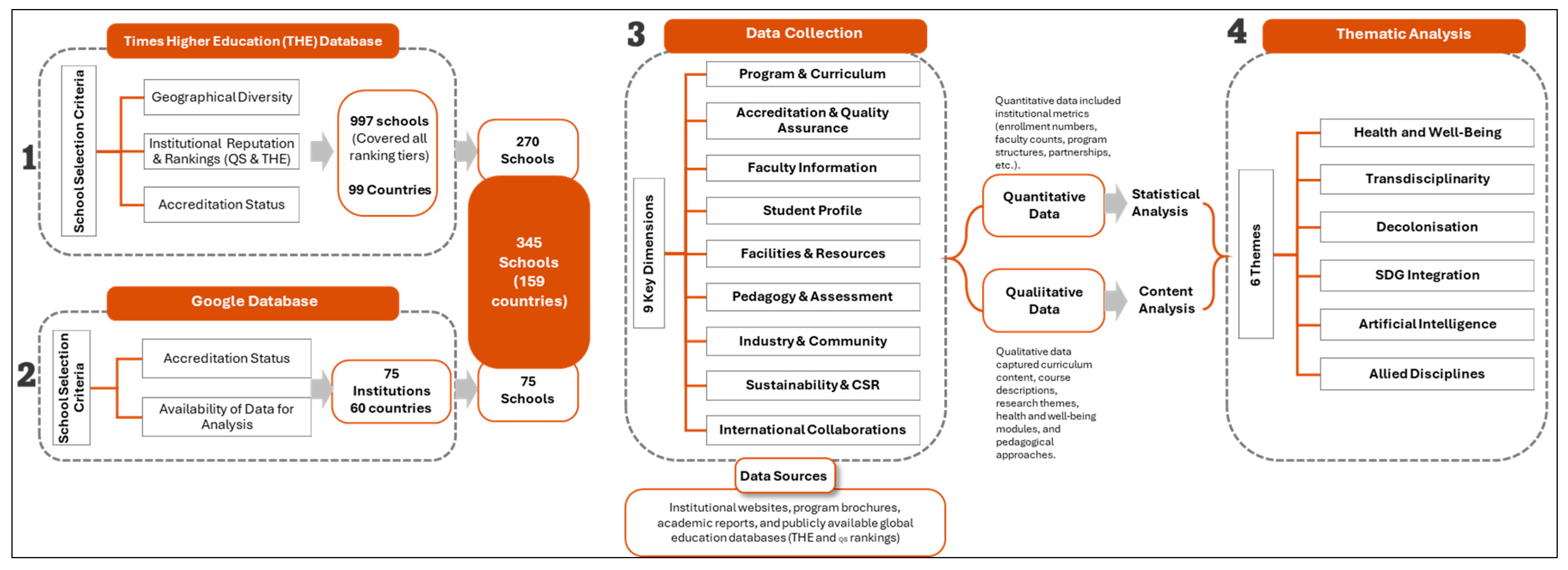
Section 2 through a four-stage process: (1) school selection using multiple criteria, (2) school selection through dual pathways, (3) systematic data collection across nine dimensions, and (4) integrated thematic analysis combining quantitative and qualitative approaches (
Figure 1). This section explains each stage, articulates the study’s epistemological commitments, and acknowledges inherent limitations.
Stage 1: School Selection Criteria: The survey employed three criteria to identify institutions: geographic diversity across five UIA regions (Western Europe, Central and Eastern Europe, the Americas, Asia and Oceania, Africa); institutional reputation based on presence in QS (QS) and Times Higher Education (THE) databases (997 schools across 99 countries); and accreditation status, prioritising nationally or professionally accredited programmes with publicly accessible information.
Stage 2: School Selection Process: School selection proceeded through dual pathways.
Step 1: The THE Database identified 270 schools from 997 institutions across 99 countries, ensuring representation across ranking tiers (top 50, 51–200, 201–1000) and geographic regions. Two to five schools per country were selected based on data availability, with exceptions for high-density countries (United States, United Kingdom, China).
Step 2: The Google Database added 75 schools from 60 countries through systematic searches of global accreditation databases, addressing the underrepresentation of Global South institutions outside major ranking systems.
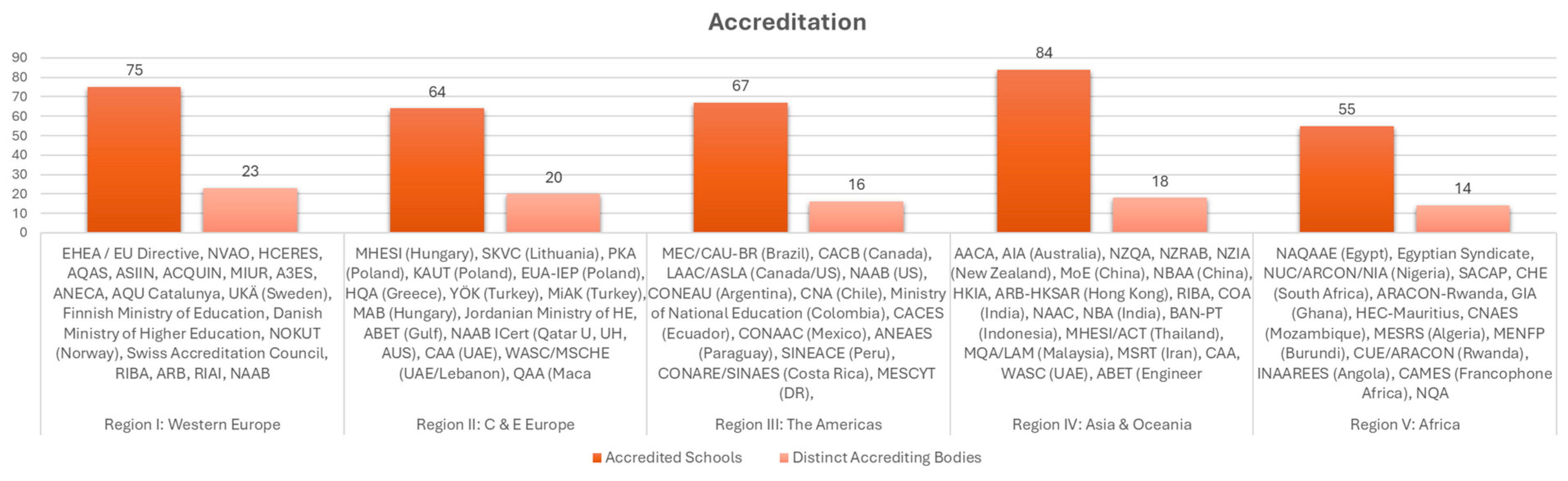
This dual-pathway approach yielded 345 schools across 159 countries, encompassing public and private universities, specialised architecture academies, polytechnics, and comprehensive research universities. The sample represents: Western Europe (75 schools, 23%), Central and Eastern Europe (64 schools, 18%), the Americas (67 schools, 22%), Asia and Oceania (84 schools, 28%), and Africa (55 schools, 9%).
Stage 3: Nine-Dimensional Analytical Framework: Data collection was structured around nine dimensions derived from the conceptual framework, each capturing distinct but interrelated aspects of institutional structure, pedagogical practice, and external engagement. Data sources included institutional websites, programme brochures, academic reports, and publicly available global education databases (THE and global rankings), ensuring methodological clarity and ethical compliance by using only publicly accessible information.
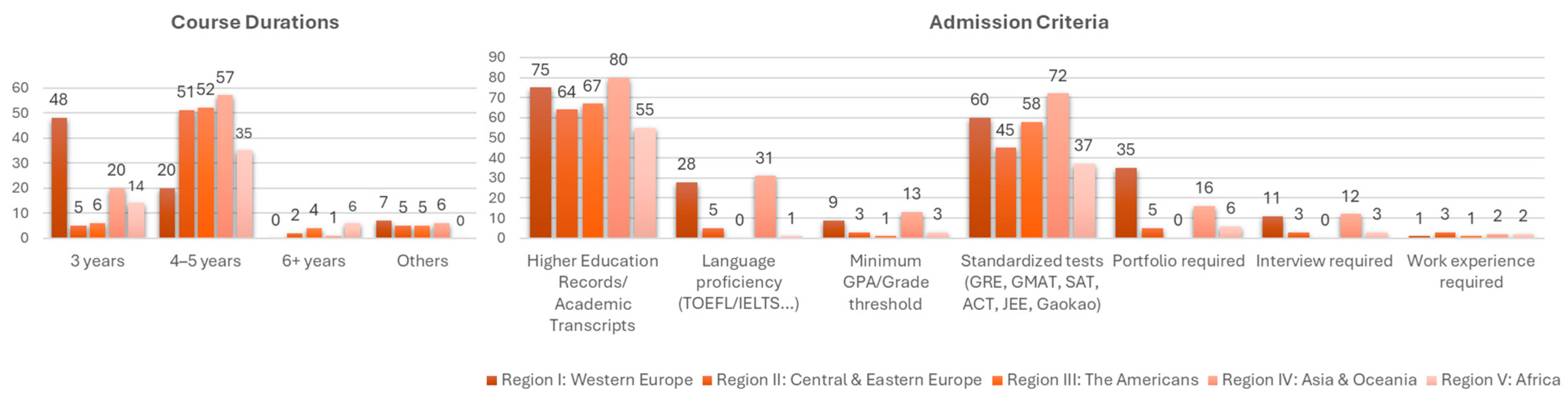
Dimension 1: Programme and Curriculum Structure: Degree types, programme duration, admission criteria, curriculum components (studio-to-lecture ratios), and declared learning outcomes reveal how programmes balance design intensity with technical and theoretical content.
Dimension 2: Accreditation and Quality Assurance: Accreditation status, governing bodies (NAAB, RIBA, national agencies), validity periods, and compliance documentation identify patterns in quality assurance and transparency [
57,
58].
Dimension 3: Faculty Information: Faculty profiles, including specialisation areas, full-time/adjunct ratios, PhD qualifications, and research output, enable assessment of teaching capacity, research intensity, and intellectual orientations.
Dimension 4: Student Profile and Outcomes: Enrolment numbers, international student percentages, gender balance, graduation rates, and employment outcomes track diversity, completion patterns, and career trajectories [
40].
Dimension 5: Facilities and Resources: Infrastructure data covering studios, workshops, digital fabrication labs, libraries, and research centres map resource availability across regions.
Dimension 6: Pedagogical Approach and Assessment: Teaching modes (studio-based, lecture-based, hybrid), assessment methods (critiques, juries, portfolios), and pedagogical innovations capture dominant cultures and emerging practices [
27,
59].
Dimension 7: Industry and Community Engagement: Internship requirements, industry partnerships, sponsored studios, collaborative research, and community-engaged projects measure engagement depth [
41].
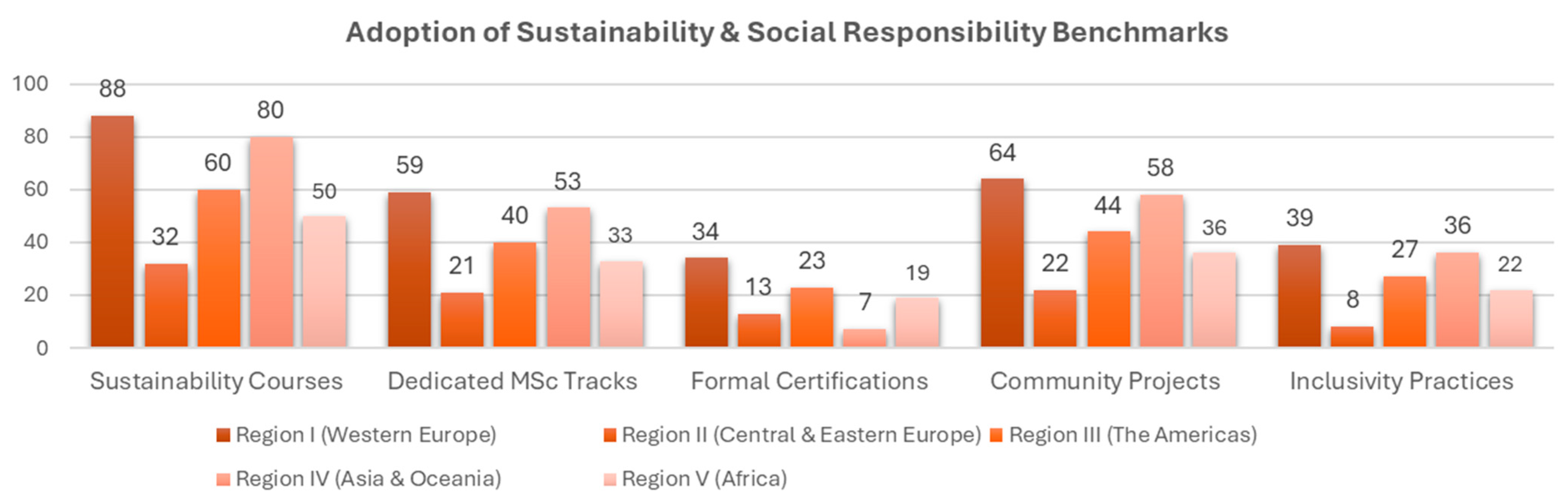
Dimension 8: Sustainability and Social Responsibility: Curriculum content on sustainability, climate resilience, green building certifications, community design studios, and institutional environmental commitments assess integration depth [
21,
22].
Dimension 9: Internationalisation and Global Perspective: Exchange programmes, international faculty composition, multicultural curricula, and global case studies track international exposure patterns [
60,
61].
Stage 4: Thematic Analysis—Integrating Quantitative and Qualitative Data: Thematic analysis was conducted across nine dimensions, examining how six emergent themes manifest across institutions through integrated quantitative and qualitative approaches. Quantitative data included institutional metrics such as enrolment numbers, faculty counts, programme structures, partnerships, etc. Statistical analysis employed bar charts, scatter plots, and maps to visualise emerging patterns, while content analysis utilised tables and matrices to organise categorical data systematically. Qualitative data captured curriculum content, course descriptions, research themes, health and well-being modules, and pedagogical approaches. Content analysis of institutional documents employed keyword frequency analysis and qualitative coding to identify integration patterns and pedagogical framings.
Coding proceeded at two levels. ‘Presence’ was coded when a theme appeared in institutional documents through keyword identification in course titles, programme descriptors, or strategic statements. ‘Depth’ was coded along a three-level scale: (a) elective or supplementary module only; (b) integration across two or more curriculum components (e.g., studio and core course); (c) structural embedding through dedicated programmes, co-supervised research, or faculty specialisation. For decolonisation specifically, the coding distinguished between token representation; the addition of Global South case studies without restructuring epistemic authority; and substantive integration, defined as indigenous faculty appointments, community co-design of curricula, or explicit epistemological critique of Eurocentric canons. For AI, the coding distinguished tool-focused approaches (software proficiency) from collaborative framing (AI as design partner) and critical interrogation (AI ethics, authorship implications). For SDG alignment, the scale ranged from declarative institutional statements to embedded studio briefs and dedicated research programmes. This tiered approach underpins the distinction between declared and enacted that the analysis develops.
Six Thematic Lenses
Theme 1: Health and Well-Being: Captures curriculum content on biophilic design, neuroarchitecture, universal design, and public health frameworks [
42].
Theme 2: Transdisciplinarity: Examines structural integration through joint degrees, co-taught courses, and systems thinking pedagogies, distinguishing superficial from structural integration [
43,
44].
Theme 3: Decolonisation: Tracks engagement with indigenous knowledge systems, Global South pedagogies, non-Western design traditions, and critical interrogation of Eurocentric canons [
47,
48].
Theme 4: SDG Integration: Measures alignment with UN Sustainable Development Goals through dedicated courses, research projects, and studio briefs [
23,
24].
Theme 5: Artificial Intelligence: Examines AI integration through computational design courses, machine learning applications, algorithmic design studios, and AI ethics modules [
19,
20].
Theme 6: Allied Disciplines: Maps partnerships with engineering, urban planning, public health, data science, and environmental science [
17,
18].
3.3. Limitations and Boundaries
The strengths, breadth, systematic comparison, and multi-dimensional analysis of the survey method entail inherent limitations. The survey captures structural over experiential knowledge, documenting institutional arrangements but not the lived experiences of students or faculty. It prioritises breadth over depth, accepting that examining 345 schools necessitates trade-offs with contextual richness.
Most critically, the study analyses declared rather than enacted curricula. The study relies entirely on publicly available institutional documentation, including websites, programme brochures, accreditation reports, and academic publications. It therefore cannot verify whether declared courses are taught as outlined, whether faculty listed as specialists integrate those orientations into their teaching, or whether thematic commitments translate into genuine epistemological change in student learning. All findings should be read as statements about institutional declarations and structural arrangements, not about lived pedagogical practices. The declared-versus-enacted gap is used as an analytical concept grounded in survey-verified structural patterns, such as accreditation rates, assessment methods, and programme structures, rather than as a direct claim about classroom or studio reality. Qualitative methods, including ethnographic observation and longitudinal case studies, are identified as priorities for future research that can address this limitation (
Section 6.1).
Data completeness varied significantly across dimensions and regions. While curriculum structures were available for over 95% of schools, detailed faculty profiles existed for only 68%, student outcome data for 52%, and quality assurance metrics for 31%. European and North American institutions generally provided more comprehensive information than schools in Africa, Central Asia, and parts of Latin America. This uneven transparency reflects differential institutional capacity and digital infrastructure.
Despite these limitations, the survey provides systematic global-scale mapping that establishes foundations for future complementary methods. Case studies can pursue depth where the survey identifies notable phenomena; ethnographies can examine experiences within profiled contexts; longitudinal studies can track documented changes. This methodological complementarity reflects recognition that different questions require different tools.
5. Discussion: Education, Professional Futures, and the Politics of Transformation
The empirical patterns documented reveal architectural education navigating tensions between institutional reproduction and transformative aspirations. The discussion interprets these patterns through the conceptual framework, examining architecture’s jurisdictional struggles, responses to economic capture, capacity for epistemic reorientation, and evolving professional identity.
5.1. Interdisciplinarity and the Contested Boundaries of Architectural Expertise
The near-universal engagement with allied disciplines (99%, 343 schools) signals architecture’s confident embrace of transdisciplinary collaboration. Yet through Abbott’s framework of jurisdictional competition, the question becomes not whether architecture collaborates, but on what terms and with what consequences for professional authority [
5].
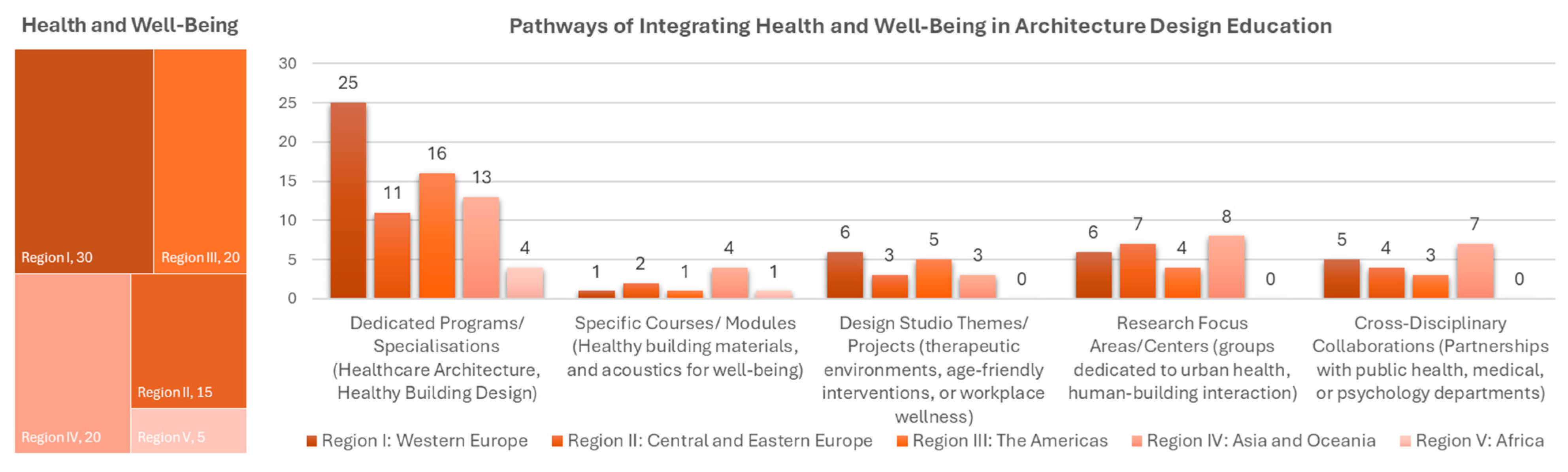
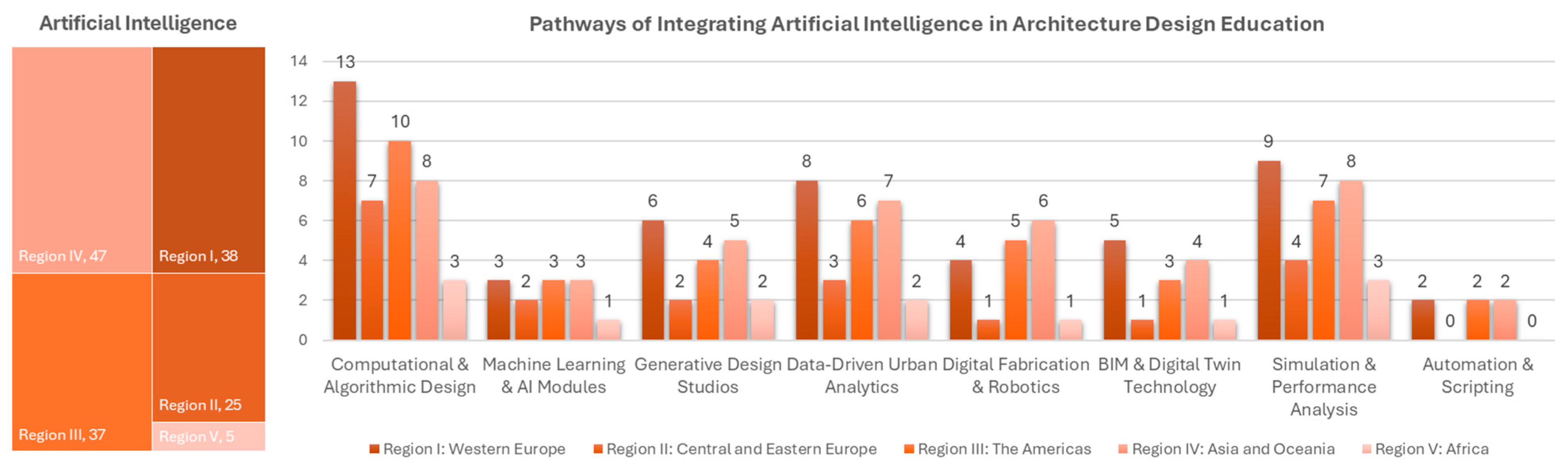
Three patterns suggest that interdisciplinary engagement may integrate architecture into broader frameworks rather than enhance its distinctive capacities. First, allied-discipline integration is concentrated in areas where architecture has traditionally lacked strong claims, such as public health (26%, 90 schools), data analytics, and policy literacy. Meanwhile, computational design and AI integration (44%, 152 schools) often position architects as tool users rather than methodological innovators [
19,
20]. Integration pathways reveal tool-centric dominance: computational and algorithmic design lead (Western Europe 13 schools, Asia–Oceania 8 schools), while critical engagement through machine learning modules (2–3 schools per region) and automation ethics (entirely absent in Central–Eastern Europe and Africa) remains marginal. The survey reveals limited evidence that schools explicitly address AI’s implications for architectural authorship, suggesting that technology adoption proceeds without sustained reflection on the consequences for professional jurisdiction. Second, the assessment monoculture, with 76% relying on individual portfolios and 78% on juries, persists despite transdisciplinary rhetoric (45%, 156 schools) [
27,
59]. Third, resource stratification means Global South institutions engage interdisciplinarity from positions of infrastructural weakness. Africa’s 55 schools (16% of allied-discipline engagement) with minimal AI integration (5 schools, 3%) contrast sharply with Western Europe’s 50 AI implementations and Asia–Oceania’s 43 implementations.
This recalls Larson’s [
62] analysis of architecture’s compromised professionalisation: lacking monopolistic control over building production, architects must negotiate authority through cultural capital and collaborative positioning. Yet successful boundary-work requires retention of definitional authority, such as the capacity to frame problems, set methodological standards, and determine what constitutes legitimate knowledge [
5,
26]. The survey suggests architecture increasingly provides spatial intelligence within interdisciplinary frameworks led by engineers, public health experts, or data scientists.
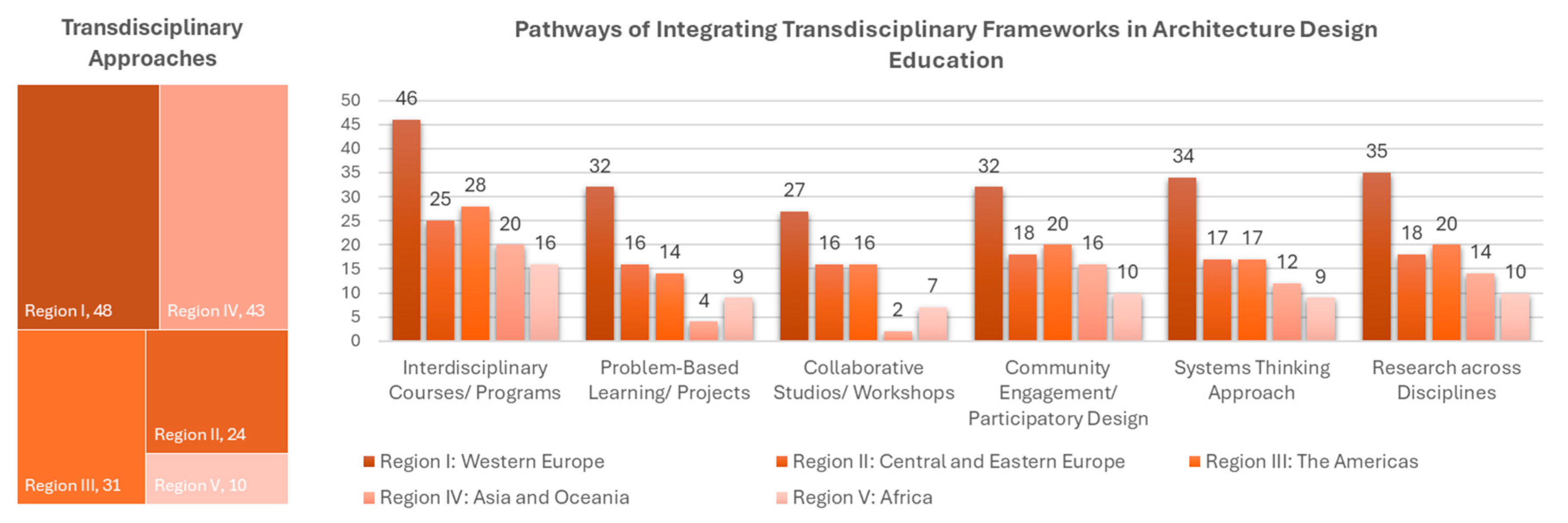
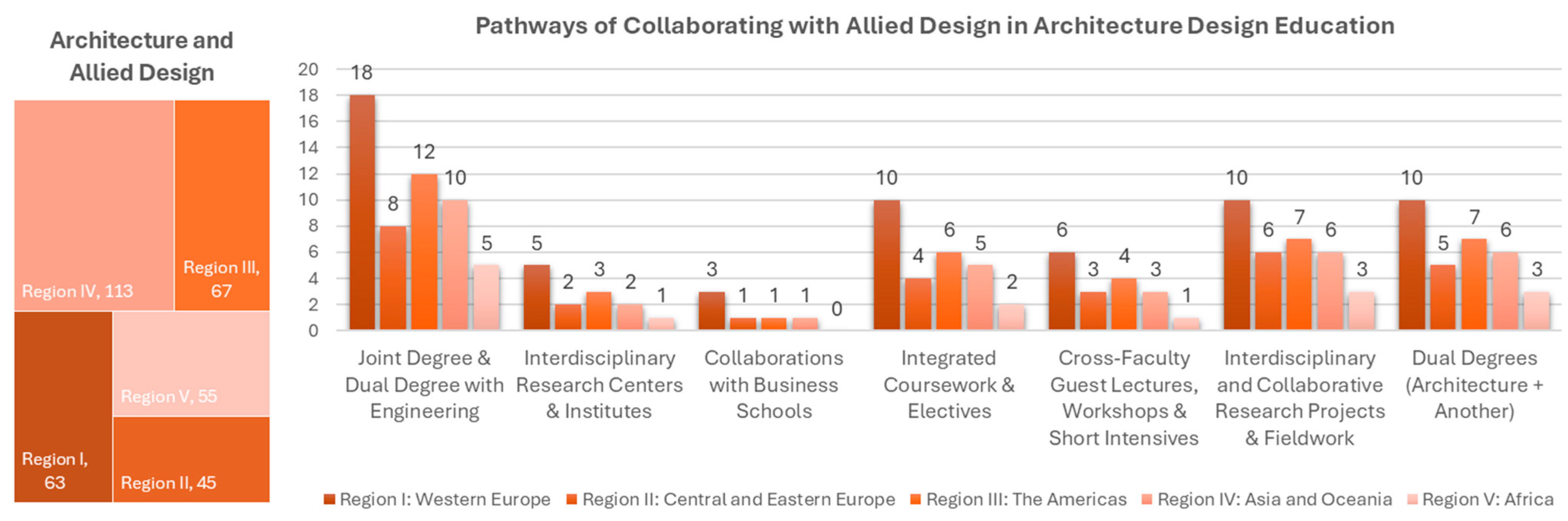
However, the 45% of schools embedding structural transdisciplinarity (156 schools), through joint degrees with engineering (Western Europe, 18; the Americas, 12; Asia–Oceania, 10), co-supervised research, and systems thinking studios, suggest possibilities for genuine epistemological integration [
43,
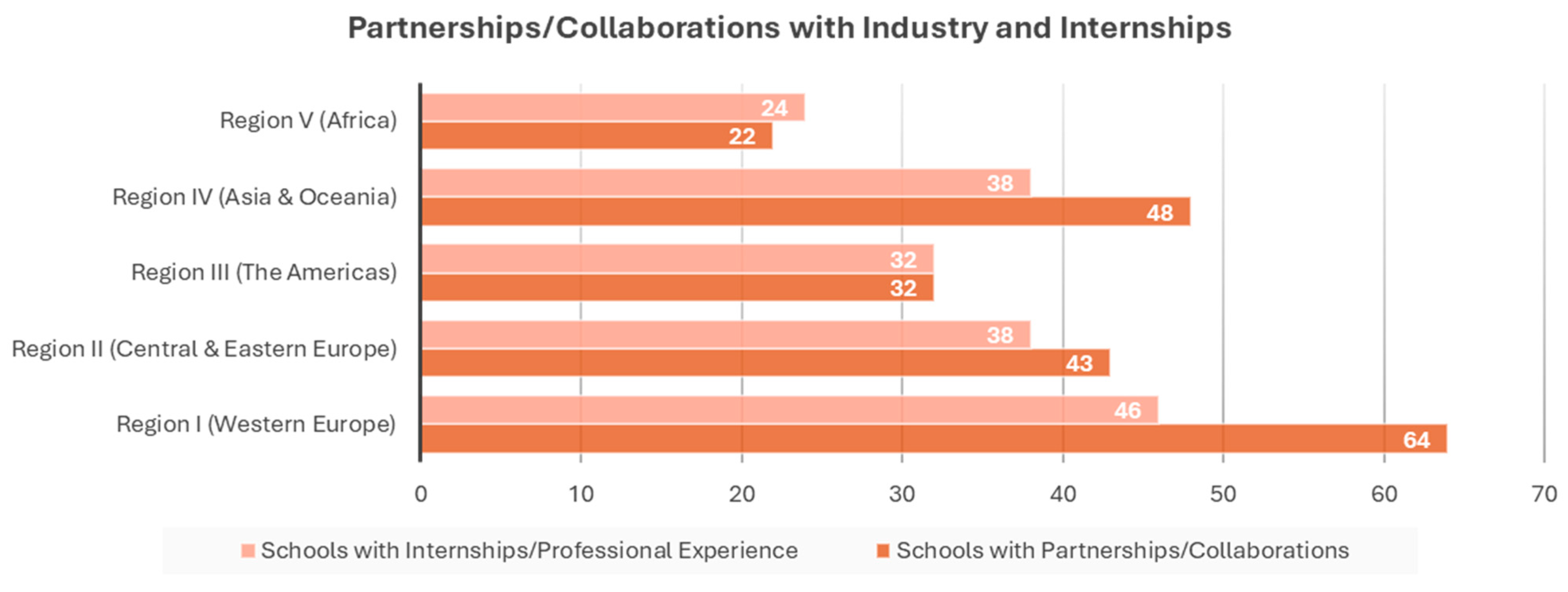
44]. Western Europe demonstrates the most comprehensive engagement (206 total implementations) across interdisciplinary courses (46 schools), research collaborations (35 schools), and systems thinking (34 schools). Whether these models strengthen or dilute architectural authority depends on whether curricula cultivate capacities that other disciplines cannot replicate. The challenge is that industry connections concentrate in conventional firms rather than extending to community organisations, public agencies, and alternative practice contexts: Western Europe shows the strongest presence of formal partnerships (64 schools), while Africa reports the lowest partnership count (22 schools) [
6,
41]. This may narrow students’ conception of the architect’s evolving role beyond fee-for-service arrangements.
5.2. Economic Realities, Pedagogical Conservatism, and Professional Formation
The survey’s employment data (85–98% employed within six months) initially appears to contradict documented labour precarity [
1,
12,
31]. Yet this obscures questions about employment quality, compensation, contract types, and whether graduates achieve economic security. Industry engagement patterns reveal education’s complicity in reproducing precarious labour: partnerships predominantly connect students to conventional firms, with limited exposure to alternative practice models such as community design centres, public-interest design, and design–build cooperatives [
8,
35]. The survey finds no documented evidence that fee structures, intellectual property regulations, or contractual arrangements are subjects of explicit curricular interrogation as a pattern consistent with broader accommodation of market logics [
1,
2].
Credential inflation, evident in programme structures (62% offering four-to-five-year professional degrees, 215 schools; 27% offering three-year pre-professional foundations, 93 schools, typically requiring subsequent master’s degrees), extends educational investment without corresponding economic returns [
12,
31]. Architecture extracts what Deamer calls “passion subsidies” from practitioners willing to accept under-compensation for cultural prestige [
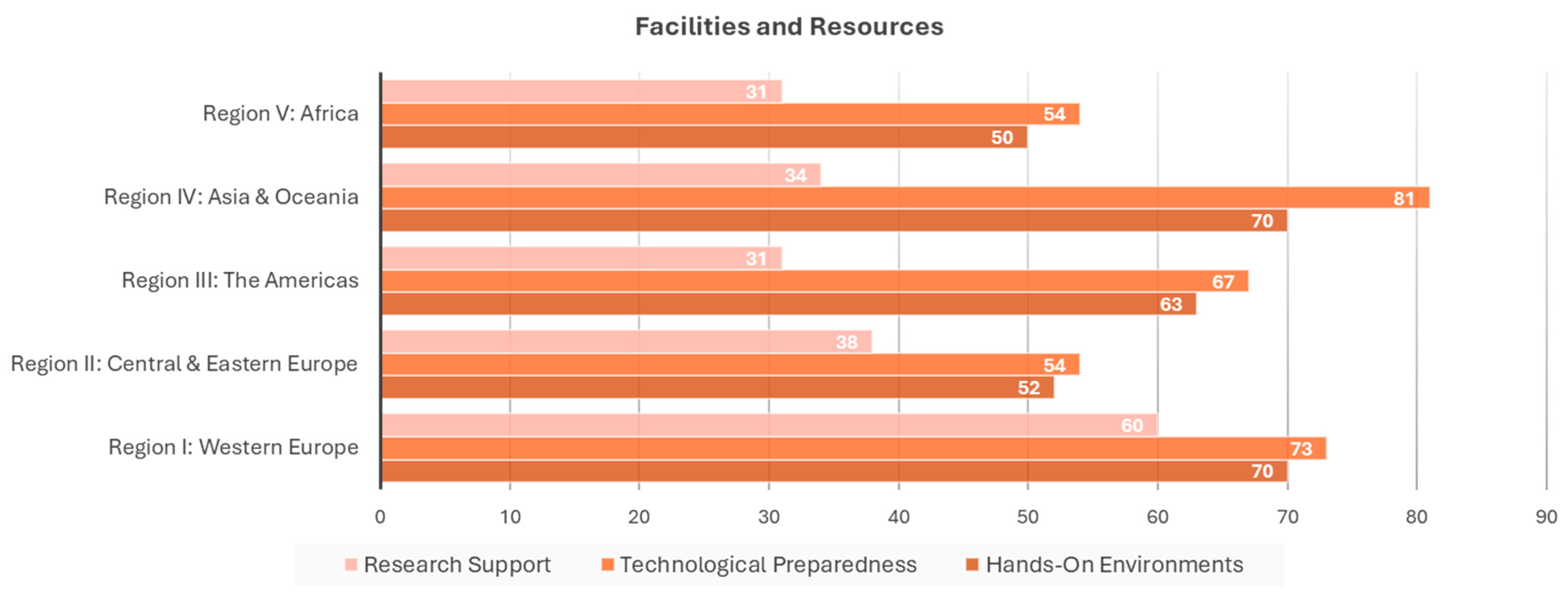
1]. Education amplifies this dynamic: expanding degree requirements increase debt burdens while market saturation depresses wages, creating conditions where only economically privileged graduates can sustain careers. Resource stratification also exists, with European schools commanding 60 schools with research infrastructure versus 31 schools in Africa. This maps onto global divisions of architectural labour, reproducing colonial patterns in which the Global North defines knowledge standards and the Global South provides implementation capacity [
8,
9].
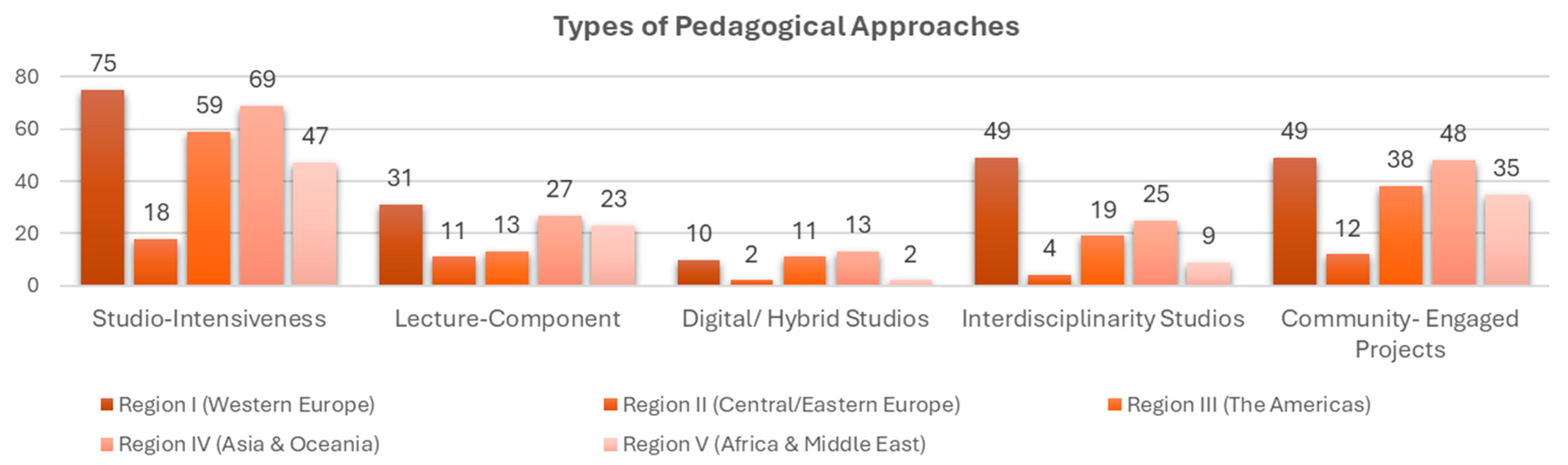
The most revealing finding concerns pedagogical inertia despite curricular innovation. The dominance of studio-based learning (78%) persists with the strongest concentration in Western Europe (75 schools) and Asia–Oceania (69 schools), with digital/hybrid studios adopted by only 11% post-pandemic [
27,
59]. The assessment monoculture, 79% employing studio reviews, 76% portfolios, 78% juries, reinforces individual authorship even as schools claim commitments to community engagement (53%), transdisciplinarity (45%, 156 schools), and social responsibility (88%, 304 schools). This misalignment exemplifies what Ahmed terms “non-performativity”, defined as institutional commitments that do not translate into transformed practices [
49]. Schools celebrate participatory design and collaborative studios as supplementary exercises while maintaining conventional assessment practices, thereby privileging heroic individual designers.
This reveals how emerging pedagogies such as participatory design, community-engaged studios, and design–build projects remain marginal despite their potential to reorient architecture’s relationship to society [
6,
41,
43]. The 53% reporting community engagement and 31% pursuing interdisciplinary learning suggest an interest, but pedagogical structures that encode individual authorship, hierarchical critique culture, and formal experimentation remain fundamentally unchanged. The studio’s function as a socialisation mechanism, transmitting professional dispositions, aesthetic hierarchies, and social networks, resists transformation [
39].
The persistence of pedagogical conservatism raises critical questions about education’s transformative capacity. If schools integrate sustainability content, decolonial theory, and transdisciplinary partnerships while maintaining assessment and pedagogical structures encoding contrary values, what professional identities do graduates actually internalise? The evidence suggests surface adaptation; schools perform transformation through curricular additions while preserving core practices that reproduce conventional professional formation. Graduates may learn the rhetoric of collaboration, sustainability, and social engagement. Yet their professional identity formation occurs through individualised portfolio development, competitive jury critiques, and aesthetic judgement, preparing them for traditional architectural careers rather than alternative roles as community organisers, policy advocates, cooperative practitioners, or public-interest designers.
5.3. Selective Ethics: Sustainability, Decolonisation, and Epistemic Hierarchies
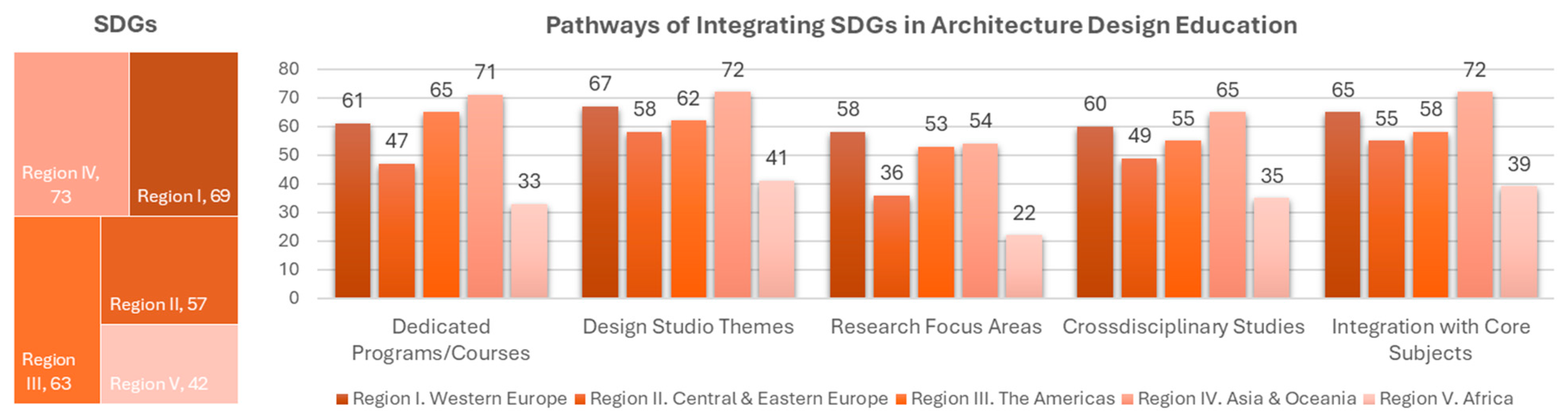
The dramatic contrast between SDG integration (88%, 304 schools) and decolonisation engagement (29%, 100 schools) illuminates how schools selectively adopt ethical imperatives [
23,
47]. Both ostensibly demand epistemological reorientation—questioning architecture’s foundational assumptions, centring marginalised knowledge systems, and confronting complicity in environmental destruction and colonial violence [
8,
21,
48]. Yet their differential uptake reveals what counts as legitimate versus threatening transformation.
SDGs achieve widespread adoption because they can be framed as technical optimisation, energy modelling, green certifications, and circular economy metrics, compatible with existing professional paradigms [
23,
24]. Asia–Oceania demonstrates the most comprehensive engagement (334 implementations, 73 schools) across design studios, core subjects, and dedicated programmes, while Western Europe (311 implementations, 69 schools) and the Americas (293 implementations, 63 schools) maintain balanced integration. However, near-universal adoption and standardised implementation raise questions about whether SDGs function as transformative frameworks or primarily as institutional branding. As Cole argues, this represents “greening” rather than regenerative transformation—adjusting practices within capitalist development logics rather than questioning whether architecture should serve perpetual growth [
21].
Decolonisation, by contrast, directly challenges Western modernism’s epistemic dominance, professional hierarchies, and Northern institutions’ authority to define architectural knowledge [
47,
48,
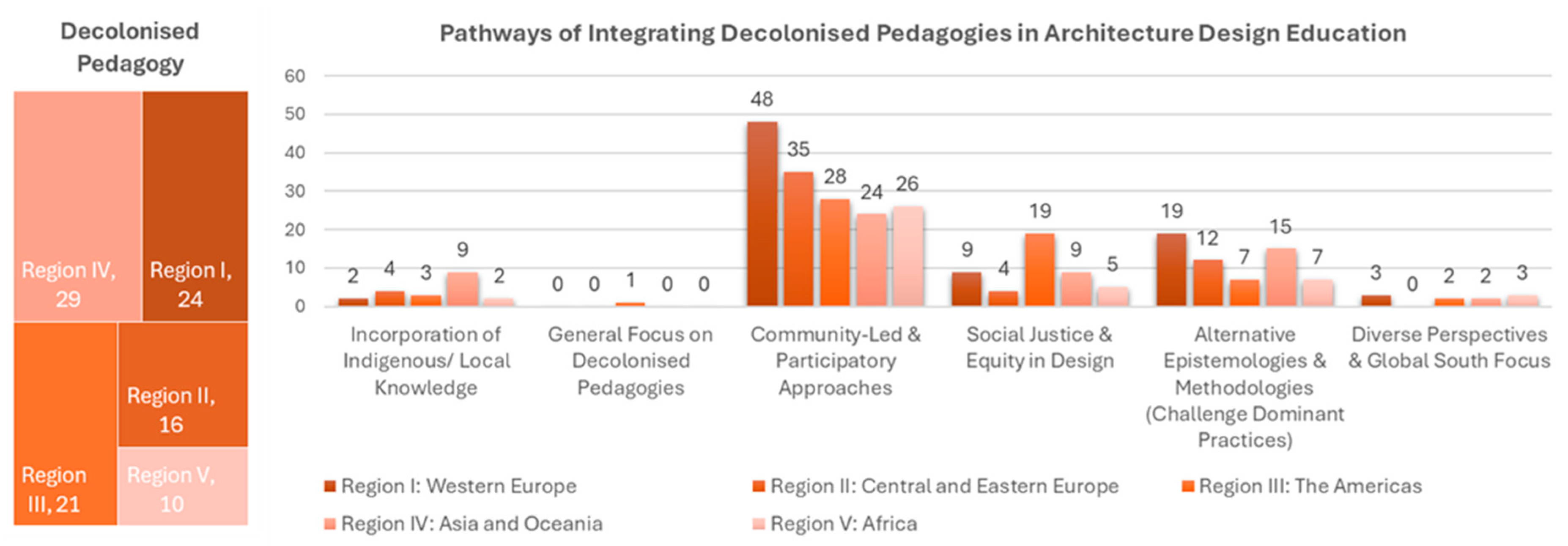
50]. Its limited adoption (29%, 100 schools) is consistent with a pattern of institutional constraint, in which transformation that directly challenges established power structures faces higher barriers to integration. Regional distribution reveals unexpected patterns: Asia–Oceania leads (29 schools, 29%), followed by Western Europe (24 schools, 24%), the Americas (21 schools, 21%), Central–Eastern Europe (16 schools, 16%), and Africa (10 schools, 10%). Integration pathways reveal gaps between rhetoric and practice: community-led approaches dominate across regions (Western Europe, 48; Central–Eastern Europe, 35; the Americas, 28; Asia–Oceania, 24; and Africa, 26), yet direct incorporation of indigenous/local knowledge remains minimal (2–9 schools per region). Explicit decolonised pedagogies appear in only one institution globally. Even where present, decolonisation risks tokenism: adding Global South case studies without redistributing curricular authority, hiring diverse faculty without restructuring governance, and celebrating vernacular traditions while maintaining Eurocentric assessment criteria [
49,
50].
Several structural factors correlate with limited decolonial engagement and plausibly contribute to it, though causal determination lies beyond the scope of documentary survey methodology. Resource constraints are evident: Africa’s research infrastructure (31 schools with research support) contrasts sharply with Western Europe’s (60 schools), limiting the institutional capacity required for epistemological innovation. Accreditation frameworks create structural disincentives for curricular departures. The persistence of the portfolio–jury assessment monoculture (76–78%) across all regions suggests that pedagogical structures encoding individual, formal design expertise resist transformation regardless of declared thematic commitments. The most productive explanations of why decolonisation remains at 29% will require qualitative investigation of faculty culture, governance structures, and accreditation pressures, identified as a priority for future research in
Section 6.1.
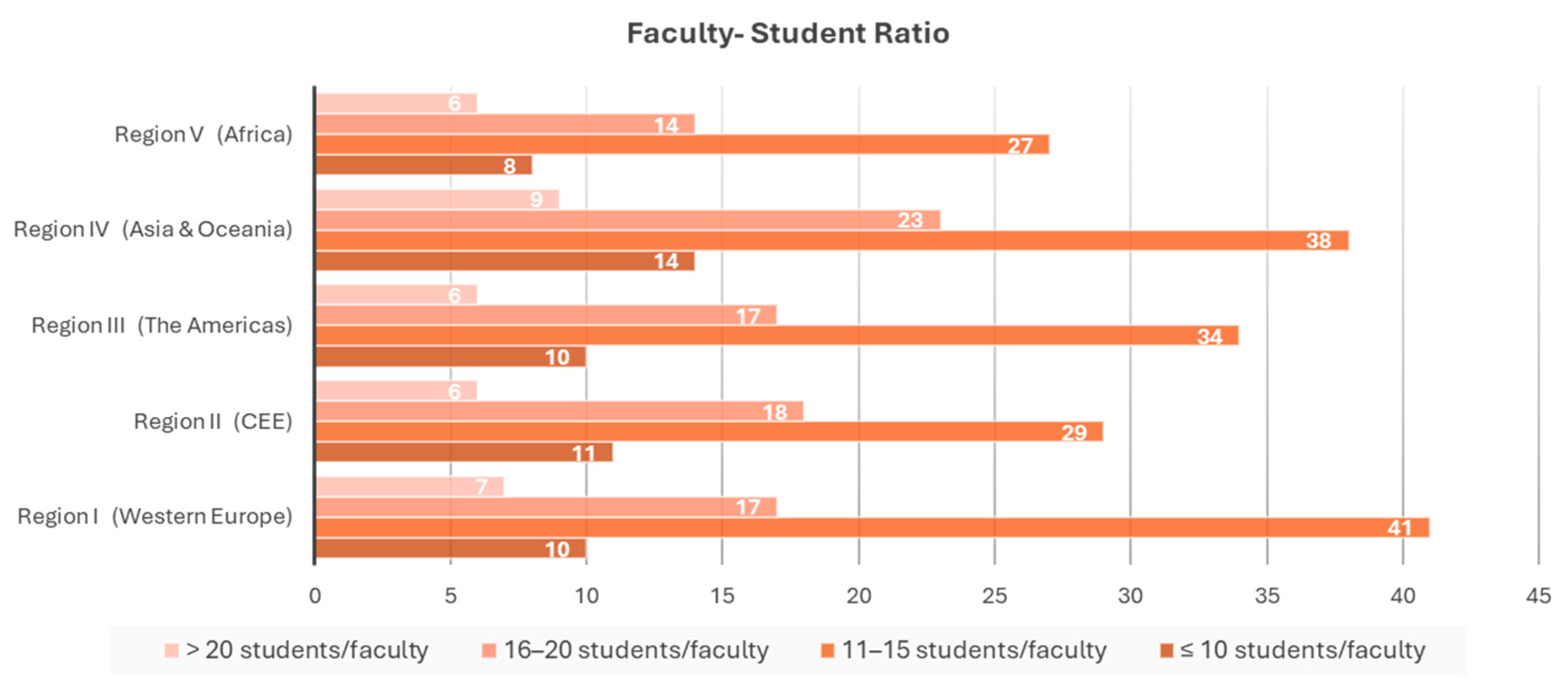
Africa’s lower engagement (10 schools, 10%) despite colonial legacies suggests institutional constraints, preventing substantive decolonial work where the imperative is strongest. Asia–Oceania’s leadership (29 schools) reflects institutional capacity: 17% maintain research-intensive faculty ratios below 10:1, 81 schools demonstrate technological preparedness, and substantial research infrastructure enables epistemological innovation. This pattern illuminates how resource disparities shape not only curricular content but what forms of pedagogical transformation remain institutionally feasible. Western Europe’s research infrastructure dominance (60 versus 31 schools in Africa) reflects colonial legacies determining what counts as architectural knowledge and who possesses the authority to produce it.
This stratification operates through multiple mechanisms. Global ranking systems, which privilege research output and English-language publication, systematically advantage Northern institutions while marginalising Southern innovations [
53,
64]. Accreditation frameworks standardise curricula around Northern professional models. Western Europe operates the most layered system (75 schools, 23 accrediting bodies), while Africa achieves universal national accreditation through only 14 bodies (55 schools, 3.9:1 institution-to-accreditor ratio), creating the highest oversight burden with limited transparency [
57,
58]. Internationalisation advances primarily through Northern-to-Southern student mobility (exchange programmes: Western Europe, 56, and the Americas, 49 schools, but only 25% integrate multicultural curricula as core content) rather than genuine multi-directional exchange [
60,
61].
Yet regional patterns reveal distinctive strengths. Asia–Oceania’s AI integration leadership (47 schools, 31%, versus Africa’s 5 schools, 3%) and technological preparedness (81 schools) position regional architects as computational innovators [
19,
20]. Western Europe’s comprehensive transdisciplinary engagement (206 implementations across 35 schools in research collaborations and 34 in systems thinking) demonstrates its capacity for structural integration. The Americas’ community-engaged design emphasis (53%) builds on participatory practice traditions [
6,
41]. These regional distinctives represent not deficits requiring Northern correction but alternative epistemologies from which global architectural education could learn.
5.4. Architecture’s Constrained Agency and the Question of Transformation
The central question framing this study—can architects shape the terms of their transformation, or will these terms be dictated by external forces?—finds no simple answer in the evidence. The survey reveals a discipline that is simultaneously adaptive and constrained, innovative yet inertial, and globally connected yet hierarchically stratified.
Education demonstrates remarkable responsiveness: 88% SDG integration (304 schools), 99% allied discipline collaboration (343 schools), and 44% AI adoption (152 schools) reveal schools tracking contemporary demands [
17,
19,
23]. Industry engagement, internationalisation (exchange programmes are strongest in Western Europe at 56 schools and the Americas at 49 schools), and community engagement (53%) position graduates for diverse careers [
6,
41,
60]. Schools experiment with transdisciplinary structures (45%, 156 schools) and alternative pedagogies, suggesting capacity for innovation [
43]. Yet this responsiveness operates largely within rather than against constraining structures.
Schools adapt curricula to market demands but rarely challenge the political economy devaluing architectural labour [
1,
2,
16]. They employ interdisciplinary methods but struggle to articulate distinctive architectural contributions that justify professional autonomy [
5,
10]. They embrace sustainability rhetoric (88% SDG integration, 304 schools) but implement technical rather than systemic transformation [
21,
22]. They celebrate diversity while reproducing Northern epistemic dominance: decolonisation remains limited (29%, 100 schools) with performative community engagement (Western Europe 48 schools) vastly exceeding indigenous knowledge incorporation (2–9 schools per region) [
47,
48]. The declared-versus-enacted curriculum gap crystallises this dynamic [
49,
65,
66]. High adoption rates mask shallow integration, a pattern consistent with institutions adopting similar forms to secure external legitimacy without changing underlying practices. The evidence suggests schools adopt progressive commitments partly to satisfy external legitimacy demands, while internal pedagogical operations show limited corresponding change.
The findings reveal several critical implications. First, interdisciplinarity is not inherently expansive; outcomes depend on whether architecture retains definitional authority or becomes a service provider to other disciplines’ agendas [
5,
10]. Monitoring not merely collaboration rates (99%, 343 schools) but governance structures, methodological contributions, and assessment practices reveals whether boundary-work strengthens or weakens jurisdictional claims. Second, economic transformation requires more than curricular innovation: preparing graduates for precarious markets without challenging the political economy producing precarity merely reproduces exploitation [
1,
12]. Third, ethical commitments demand structural rather than additive change: sustainability (88%, 304 schools), decolonisation (29%, 100 schools), and social responsibility cannot be achieved through supplementary modules while maintaining pedagogical structures (76% portfolio/78% jury monoculture) encoding contrary values [
21,
47,
49]. Fourth, regional epistemic pluralism remains aspirational: Northern dominance in research infrastructure (Western Europe 60 versus Africa 31 schools), ranking systems, and accreditation frameworks (Western Europe’s 23 bodies versus Africa’s 14 managing larger populations) continues reproducing colonial knowledge hierarchies despite Southern institutions’ distinctive strengths [
60,
61].
Yet evidence of genuine experimentation persists. The 29% pursuing decolonial pedagogy (100 schools) despite institutional resistance, the regional distinctives centring local knowledge systems, and the community-engaged approaches challenging conventional practice demonstrate that transformative education remains possible [
41,
47]. Whether these innovations prefigure broader restructuring or remain marginal experiments depends on coordination between schools, professional associations, accrediting bodies, and practitioners. Education can prepare graduates for alternative futures such as cooperative practice and public-interest design, but transformation requires restructuring professional pathways, compensation models, and regulatory frameworks that currently make such alternatives economically unsustainable [
1,
6,
16]. Without systemic coordination, even radical pedagogical experiments risk preparing students for professional realities that never materialise.
The evolving role of the architect remains contested terrain. Schools integrate content addressing entrepreneurship, public advocacy, and expanded professional identities, but pedagogical structures continue forming graduates primarily as individual designers competing in conventional practice markets. The question is whether architecture’s agency is constrained but not eliminated; whether education retains the capacity to cultivate critical consciousness, experimental practice, and alternative professional imaginaries; or whether the convergence–divergence paradox reveals institutions fundamentally unable to transform themselves.
6. Conclusions: Education and Architecture’s Capacity for Self-Design
The global survey of 345 architecture schools across 159 countries reveals a profession caught between rhetorical transformation and structural reproduction. While schools demonstrate remarkable responsiveness to contemporary pressures, such as integrating SDGs, engaging allied disciplines, and adopting AI, this adaptation operates largely within rather than against constraining structures. The declared-versus-enacted curriculum gap persists across all regions: high adoption percentages mask shallow implementation, unchanged assessment methods, and pedagogical conservatism that privileges individual authorship despite stated commitments to collaboration, sustainability, and social responsibility.
Three critical findings emerge. First, near-universal interdisciplinary engagement (99%) coexists with an assessment monoculture (76–78% portfolios and juries) that encodes individual authorship, suggesting collaboration remains supplementary rather than structurally formative. Second, selective thematic adoption, embracing SDGs (88%) and allied disciplines while limiting decolonisation (29%) and health (26%), reveals that schools prioritise themes enhancing institutional credibility over those requiring redistribution of epistemic authority. Third, regional stratification suggests transformative engagement concentrated precisely where institutional capacity already exists, meaning the schools with the greatest imperative for change face the greatest structural barriers to achieving it.
The evidence suggests architecture’s agency is constrained but not eliminated. Genuine experimentation persists: 29% pursue decolonial pedagogy despite institutional resistance, regional distinctives centre local knowledge systems, and community-engaged approaches challenge conventional practice models. Yet these innovations risk remaining marginal without systemic coordination. Education can prepare graduates for cooperative practice, public-interest design, and community development, but transformation requires restructuring professional pathways, compensation models, and regulatory frameworks coordinated across schools, professional associations, and accrediting bodies. Without this coordination, even radical pedagogical experiments prepare students for professional realities that never materialise.
The evidence grounds three concrete recommendations. For accreditation bodies: Evaluation criteria should assess integration depth, not merely the presence of ethical imperatives such as decolonisation and sustainability; the current 29% decolonisation figure and the assessment monoculture suggest that existing frameworks do not incentivise structural embedding. For schools: Assessment practices must be realigned with stated commitments; if 45% of schools claim structural transdisciplinarity and 88% claim SDG alignment, then jury briefs and portfolio criteria should explicitly evaluate collaborative process and sustainability outcomes, not only individual formal design. For researchers: This dataset of 345 schools should serve as a comparative baseline; paired studies examining schools with high versus low decolonisation engagement, or contrasting strong versus weak research infrastructure contexts, would begin to explain the patterns this survey identifies.
6.1. Future Trajectories and Research Directions
The scope and methods of this study entail limitations that future research should address. First, the survey captures declared curricula and institutional structures but not lived pedagogical experiences. Ethnographic studies examining how students and faculty navigate tensions between progressive rhetoric and traditional studio culture would reveal whether declared commitments translate into transformed professional formation. Such studies should examine how different actors, including programme directors, students, professional bodies, and accreditation officers, experience and reproduce the structural barriers that this survey identifies at the institutional level. Second, the cross-sectional design provides a snapshot without tracking longitudinal change. Monitoring how institutions evolve, whether experimental pedagogies restructure mainstream practice, whether resource gaps narrow or widen, and whether sustainability commitments deepen or remain performative would illuminate trajectories of transformation or reproduction.
Third, while the study identifies patterns across 345 schools, it cannot capture local institutional contexts, such as specific political economies, cultural conditions, and regulatory environments, that shape educational possibilities. Comparative case studies examining how schools in different contexts navigate similar pressures would provide depth that complements this study’s breadth, revealing strategies for institutional transformation under diverse constraints. Fourth, the analysis focuses on schools rather than graduates, leaving questions about professional outcomes unresolved. Do graduates from transdisciplinary programmes secure different employment? Do students trained in decolonial methods challenge professional norms or assimilate to conventional practice? Do sustainability-focused curricula produce practitioners advancing climate justice or competent only in green certifications? Tracking graduate trajectories would illuminate education’s long-term impact on professional transformation.
Future research should also examine the coordination mechanisms between schools, professional associations, and accrediting bodies that enable or constrain pedagogical innovations from translating into professional restructuring.
6.2. Final Reflections
Architecture’s capacity for self-design ultimately depends on collective willingness to challenge existing structures rather than accommodate them. This requires acknowledging complicity in labour exploitation, colonial knowledge production, and environmental destruction, not as historical legacies but as ongoing practices that education actively reproduces. It demands redistributing epistemic authority from North to South, from elite to marginalised institutions, from established to emerging pedagogies. It necessitates restructuring professional pathways so alternative practices become economically viable rather than passion projects subsidised by privilege.
Most fundamentally, transformation requires recognising that education is not separate from practice but constitutive of it. Schools produce the capacities, dispositions, blind spots, and aspirations that shape buildings, cities, and environments for decades. Educational choices are not merely pedagogical but political, encoding assumptions about whose expertise matters, what problems deserve attention, and what futures remain imaginable. If architecture is to design its transformation rather than have transformation imposed upon it, education must become a site not merely of professional reproduction but of disciplinary reimagination.
This study provides empirical foundations for such reimagination: documenting what schools are doing globally, revealing contradictions between aspirations and practices, identifying innovations warranting wider adoption, and exposing structural barriers requiring collective action. The convergence–divergence paradox, schools adopting similar forms while diverging in substance, suggests that institutional isomorphism operates at the level of rhetoric while deeper commitments remain contested. Whether progressive declarations catalyse genuine transformation or function as legitimacy performances depends on choices made in classrooms, studios, and accreditation boardrooms where architectural expertise is daily constructed, contested, and transmitted.
The question is not whether architecture is undergoing transformation; economic pressures, technological change, and ecological collapse ensure that transformation is inevitable. The question is whether architects will shape the terms of that transformation or have those terms dictated by forces indifferent to architecture’s distinctive capacities, social purposes, and professional aspirations. The survey evidence suggests the answer currently tilts toward accommodation. Schools perform transformation rhetorically while reproducing it structurally, adopting the language of decolonisation, collaboration, and ecological responsibility without restructuring the pedagogical mechanisms that would make these commitments real. Whether this changes depends on collective choices made in studios, accreditation committees, and faculty governance, or in spaces where architecture’s capacity for self-determination is daily constructed or foreclosed.