
Article

Architectural Archaeology Through Reverse Engineering: A Constructivist Perspective from Jordan

by
Rama Ibrahim Al Rabady
1,2
1
Department of Digital Architecture Engineering, Al-Ahliyya Amman University, P.O. Box 19111, Amman 19328, Jordan
2
Department of Architecture Engineering, The Hashemite University, P.O. Box 330127, Zarqa 13133, Jordan
Architecture 2026, 6(1), 42; https://doi.org/10.3390/architecture6010042
Submission received: 30 December 2025 / Revised: 26 February 2026 / Accepted: 3 March 2026 / Published: 9 March 2026

Abstract

Jordan’s masonry archaeology across limestone, sandstone, and basalt faces escalating threats from a disconnect between conservation and architectural education. Though Jordanian archaeology has evolved into a multidisciplinary field, architecture curricula prioritize technical training over the engineering complexities of endangered sites. This study argues that engaging future architects with ancient engineering as recoverable technical knowledge, rather than as objects for specialist intervention, is essential for cultivating advocates of archaeology. It aims to develop a constructivist framework for architectural archaeology that reorients education from mere intervention toward knowledge transfer through reverse engineering. A mixed-methods experiment with architecture students at Hashemite University engaged participants in deconstructing ancient techniques through digital documentation and structural simulation and then reconstructing this knowledge for contemporary applications. A four-domain framework operationalized object-laden epistemology (technical acquisition) and value-laden ontology (constructed advocacy). Findings revealed four transformative outcomes: science-making (recovering ancient engineering as legitimate knowledge); heritage-making (sites becoming living practice); temporality-making (past–present dialogue within presentism and futurism); and advocacy-making (students as ‘custodian-transmitters’ assuming professional stewardship). By integrating architectural archaeology into core curricula, this framework reaches future architects beyond specialized programs, addressing regional gaps in community support for endangered heritage while maintaining critical reflexivity regarding power and selection in archaeological discourse.

1. Introduction—Jordan’s Archaeology Beyond Historicism

1.1. From Biblical Archaeology to Multidisciplinary Inquiry

European archaeology shifted from viewing cultural evolution as natural to aligning it with history. It is established as a culture-historical archaeology that traced the development of material culture and provided foundations for evolutionary generalizations about change [1]. This approach spread globally during colonization, reaching Jordan, where early research emerged through Christian pilgrims and Western tourists with political and theological interests, laying the groundwork for later formalized methods [2]. These explorers documented sites through anthropological observations rather than systematic excavation. The establishment of Western archaeological institutes in late 19th-century Palestine further shaped Jordanian archaeology, promoting a culture-historical or ‘biblical archaeology’ stance seeking to validate biblical narratives. Hamilakis et al. [3] characterized these initial waves as driven by ‘moral relativism.’ During the 1960s, Jordanian archaeologists addressed concerns that moral relativism need not entail epistemic or ontological relativism. Al-Ghoul [2] also notes that biblical archaeology has been criticized for lacking objectivity, particularly as competing religious interpretations have challenged Old Testament narratives. Scholars proposed alternative hypotheses, including social revolution models, prompting a new generation of local academics to broaden research beyond biblical stories [4,5,6].
Following independence in the 1960s, Jordanian archaeology experienced two transformative changes driven by academic institutions. First, it transitioned from historical particularism to a multidisciplinary approach. The University of Jordan’s founding in 1962, with its Department of History and Archaeology, fused academic knowledge with practical experience, expanding the cultural-historical scope beyond Bronze and Iron Ages [2,7,8,9]. According to Al-Ghoul [2], this enabled archaeologists to construct comprehensive accounts of Jordan’s past for national collective consciousness. Second, applied sciences advanced significantly at Yarmouk University in the late 1990s, including the introduction of radiocarbon dating, artifact provenance analysis, drones, ground-penetrating radar, GIS, satellite imagery, and electronic archives. These innovations integrated archaeology with applied sciences, emphasizing objective analysis over descriptive approaches. These advancements positioned Jordanian archaeology at the intersection of scientific analysis and cultural inquiry, creating fertile ground for architecture programs to integrate archaeological perspectives into their curricula through new pedagogical approaches.

1.2. Archaeology in Architectural Education: Two Precedents for Two Approaches

Al-Ghoul [2] advocates a multidisciplinary approach to Jordanian archaeology that integrates history, cultural anthropology, and related disciplines. Over the past two decades, architecture departments have begun incorporating archaeology into their curricula to ground design education in a cultural context. At Hashemite University, faculty members piloted an experiment that promoted value-based, interpretive engagement with archaeology and community interaction [10]. Drawing on postmodern archaeological theory from the 1970s, this approach introduced humanistic and philosophical methods for interpreting the past, expanding archaeology beyond material objects to encompass ‘objects of cultural value’ [11]. It explored parallels between constructivist educational theory and post-processual archaeology1, positioning students as active learners who construct meaning from archaeological remains by questioning and evaluating competing interpretations. A parallel initiative emerged as scholars recognized the need for conservation training to protect endangered antiquities. Professor Ignacio Arce at German Jordan University presented an ‘archaeology of architecture’ approach combining excavation, interpretation, restoration, and conservation [14]. Arce emphasized monuments as reliable historical sources and the critical role of training stonecutters, masons, architects, and archaeologists. However, this object-laden, positivist approach has yet to demonstrate applicability to local Jordanian academia, interdisciplinary research, or practical restoration initiatives.
While Jordanian archaeology has successfully integrated applied sciences and advanced technologies, architecture programs have also experimented with postmodern interpretive approaches to heritage. However, no pedagogical framework yet bridges the engineering-epistemological dimension of ancient construction with constructivist learning theory to position students as active agents in archaeological conservation. This gap calls for a distinct framework—architectural archaeology—reorienting heritage education from passive reception or specialist intervention toward active knowledge transfer through reverse engineering. This study’s primary contribution would be twofold: first, to provide a rigorous theoretical delineation of architectural archaeology as a knowledge-transfer framework distinguished from conservation, pure archaeology, and European building archaeology; and second, to demonstrate through a detailed pedagogical case study how this framework positions architecture students as critically reflexive ‘custodian-transmitters’ of endangered heritage. The theoretical work constitutes the principal contribution, with the Hashemite University experiment serving as illustrative evidence of its practical application and transformative potential.

1.3. Distinguishing Architectural Archaeology

Architectural archaeology, as introduced in this study, is distinguished from adjacent fields by its focus on recovering ancient engineering knowledge for contemporary pedagogical and design applications—a knowledge-transfer framework. Unlike architectural conservation, which prioritises physical intervention to preserve historic fabric [15,16], architectural archaeology treats the building as a source of recoverable technical knowledge rather than an object requiring treatment [17]. Unlike pure archaeology (e.g., Islamic, Classical, or Prehistoric Archaeology), which seeks historical reconstruction through excavation and typological analysis [1,18], architectural archaeology employs reverse engineering and structural simulation to reconstruct not what happened, but how builders understood and resolved technical problems [19,20]. Unlike European building archaeology, which emphasises stratigraphic reading and chronological seriation of masonry fabrics [21,22,23], architectural archaeology deploys digital documentation and finite element modelling to render ancient engineering epistemologies legible and usable for present and future architectural challenges [24,25]. These distinctions delineate a complementary, cross-cutting analytical framework oriented toward knowledge transfer rather than intervention, documentation, or historical reconstruction alone.
This study’s architectural archaeology approach integrates engineering analysis with archaeological investigation, drawing on established European traditions of building analysis. For example, Italian archeologia dell’architettura [26,27] treats standing structures as vertical archaeological deposits, using stratigraphic units to establish chronological frameworks. French archéologie du bâti [28] shares this methodology while emphasising construction’s socio-economic dimensions, with Dessales’s ‘archaeology of construction’ encompassing project conception through finishing operations, reconstructing labour organisation and material supply networks. Germany’s Bauforschung tradition (DAI projects at Bosra and Ephesus) combines architectural recording with structural analysis, treating monuments as historical documents revealing technical knowledge and cultural priorities. Spain’s Arqueología de la Arquitectura has fostered methodological exchange and research on Islamic construction techniques. Collectively, these European traditions demonstrate that detailed analysis of standing structures yields insights into construction methods, worksite organisation, and material procurement. Building upon this analytical foundation, architectural archaeology reorients these insights from historical reconstruction toward forward-looking pedagogical application—deploying digital documentation and reverse engineering to render ancient engineering epistemologies legible and usable for contemporary architectural challenges.
This distinction has important implications. Where specialized conservation programs emphasize technical training in intervention techniques, the Jordanian framework emphasises knowledge transfer to extract structural principles, material intelligence, and environmental adaptation strategies for new intervention works. This addresses a critical regional gap. For instance, the Egyptian model2, while technically sophisticated, remains ‘state-dominated’ with limited local engagement, achieving conservation outcomes but struggling to cultivate broad community support [29]. By integrating heritage education into the core architecture curriculum and positioning students as custodian-transmitters [31], the Jordanian framework distributes responsibility for heritage advocacy beyond official authorities, fostering young architects who understand archaeology as a living resource requiring ongoing interpretation rather than as protected objects requiring specialist intervention. With architectural archaeology established as a knowledge-transfer framework, we now examine how it navigates the tension between empirical evidence and interpretive freedom—the core of its constructivist foundation. Having established architectural archaeology as a knowledge-transfer framework that distributes heritage advocacy beyond official authorities, we now examine its epistemological and ontological commitments.

1.4. Architectural Archaeology: The Knowledge-Transfer Framework as Epistemology and Ontology

A critical distinction must be drawn between productive interpretive lenses—feminist archaeology, dream narratives, eschatological frameworks, postcolonial critique—and the epistemological paralysis induced by extreme relativism. Trigger [1] acknowledges that archaeological interpretation is situated within social, personal, and disciplinary contexts, yet insists on archaeological capacity to constrain meaning through empirical evidence. This study adopts that position. The constructivist architectural archaeology framework embraces methodological pluralism: feminist critiques reveal gendered divisions of labor in ancient Jordanian masonry workshops; eschatological readings illuminate Byzantine ecclesiastical structures; dream narratives offer insights into indigenous understandings of ruin landscapes. These are disciplined interpretive positions grounded in archaeological evidence and theoretical coherence. By contrast, extreme relativism—proposing that a single architectural feature may signify contradictory meanings solely by virtue of viewer perspective—would have been unrecognizable to ancient builders whose technical rationality this study reconstructs. Hauranian masons who devised corbelled basalt roofing systems operated within shared technical grammar, material constraints, and structural logics. Their engineering choices, while culturally situated, were neither infinitely malleable nor detached from stone’s physical properties, load paths, and statics. Our reverse-engineering methodology respects what Schiffer [17] terms the ‘science of useful knowledge’: reconstructing ancient engineering epistemologies while acknowledging that contemporary interpreters bring legitimate but constrained analytical frameworks.
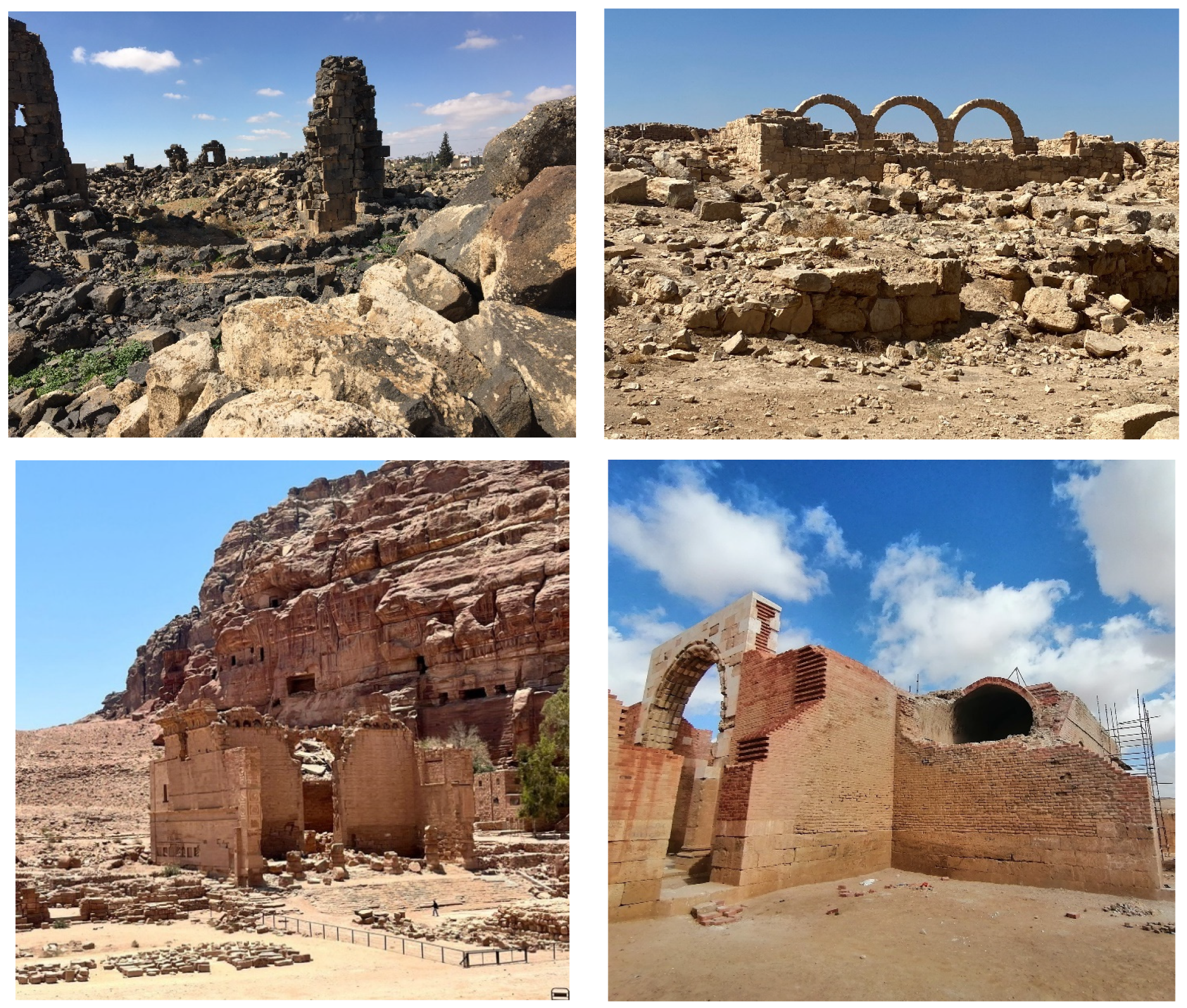
The study argues that archaeology must be recognized as an overlapping epistemological and ontological field. Epistemologically, many conservation initiatives prioritize community-based and interpretive approaches yet fail to account for engineering-related complexity. Structural materiality should promote integration between architectural engineering and archaeology. The proposed architectural archaeology integrates rigorous scientific methodologies from engineering—materials science, structural analysis, and environmental impact evaluations—moving beyond descriptive methods toward engineering-informed solutions that extend the life of archaeological sites facing contemporary challenges (See examples in Figure 1). Ontologically, archaeology has broadened to encompass endangerment, preservation of the past, and future care.

1.5. Article Structure

Addressing the dual epistemological and ontological role of archaeology and its relevance to today’s youth, this study explores an alternative pedagogical framework for teaching architectural archaeology in Jordan. It engages the knowledge-transfer framework through theories of reverse engineering3. Given Jordan’s abundance of archaeological sites that document the legacy of ancient engineering schools and theories [32,33,34,35]4, the study develops an integrative pedagogical framework that combines reverse engineering with constructivist learning in architecture programs. This framework embraces the structural complexity of endangered sites and archaeology’s evolving cultural significance—spanning historicism, presentism, and futurism. It draws on the author’s nineteen years of experience delivering scientifically oriented, practice-based courses on ancient architectural engineering and conservation to third-year architecture students at various Jordanian universities.
The article is organized into seven interconnected sections. The introduction establishes disciplinary context, reviews precedents in Jordanian architectural education, and defines architectural archaeology as a form of knowledge transfer. The literature review traces the shift from typological readings to process-oriented ‘archaeology of construction,’ establishing reverse engineering as a constructivist pedagogy. The research design operationalizes the two-fold path of object-laden epistemology and value-laden ontology through a four-domain mixed-methods evaluation. The results detail Phase One (digital documentation and structural simulation) and Phase Two (critical engagement with neotraditional builders). The findings present four transformative outcomes: science-making, heritage-making, temporality-making, and advocacy-making. The discussion theorizes these as an epistemology–ontology continuum engaging Harrison’s [36] ‘archaeology in and of the present and future.’ The conclusion synthesizes the outcomes, acknowledges limitations, and proposes directions for future research.

2. Literature Review: Reverse Engineering as Constructivist Pedagogy

2.1. Archaeology of Architecture Engineering: From Typology to Process

Hélène Dessales [19] proposes a ‘technological history of architecture’ that moves beyond typological readings by distinguishing between the ‘archaeology of buildings’ and the ‘archaeology of construction.’ She rejects the former for relying solely on documentation methods to establish typochronology at the building scale (p. 71). Instead, the archaeology of construction analyzes stratigraphy, stonecutting techniques, building materials, and the organization of construction processes. It ‘studies the material traces of all implemented construction processes, from the production cycles of materials to the conception and realization of a monument, thus making it possible to reconstruct the functional organization of a worksite in its social, cultural, and economic aspects’ [19] (p. 74). Extending this approach, Beiersdorf [20] argues that integrating building archaeology with construction history, engineering science, and archaeology yields synergies. Studying construction history illuminates the social context of structures, their design processes, constructional systems, and material processing (p. 44). This integration is termed ‘reverse engineering’- a scientific inquiry that examines design ethos to recover lost or unavailable knowledge [37]. Reverse engineering is widely discussed in archaeology [38,39,40] and architecture [20,24,41]. It is described by Schiffer [17] (p. 13) as pushing inquiries into ancient engineering practices to illuminate the underlying science of the archaeology produced—the ‘archaeology of science.’ Drawing on Schiffer [17], this study approaches archaeology as an inquiry into ancient engineering practices that illuminate the underlying science of the archaeological record—an ‘archaeology of science’ addressing the processes, products, and comparative study of scientific activities across societies (p. 13).

2.2. Relevance to Jordan’s Stone-Building Traditions

Reverse engineering is particularly relevant to Jordan, given its abundant stone architecture across limestone, sandstone, and basalt, which produced entirely stone-built cities and settlements. Prominent examples include the World Heritage Sites of Petra, Jerash, Umm al-Rasas, and Umm el-Jimal. Scholars have increasingly explored regional stone cultures; for example, Jäger et al. [42]. examined the historical and contemporary use of stone in Jordan and Syria, emphasizing its aesthetic and technical architectural potential. The University of Siena’s building archaeology project at Umm al-Surab (2009–2012) developed a preliminary atlas of masonry techniques spanning the late Roman to early Islamic periods, demonstrating the capacity of building archaeology to yield rich historical, social, and anthropological insights [23]. Jordanian scholars have further investigated ancient masonry structures in the Hauran region, highlighting the critical role of building materials, geometry, and construction techniques in structural stability and equilibrium [25,43]. Their studies document innovative Hauranian techniques, including reinforced flat structural designs using basalt stone beams supported by corbelling, vaulted roofs constructed from lightweight scoria, and bearing walls incorporating headers, stretchers, mortar-laid courses, lintel relieving, interlocking, and tie courses—systems unique to the basaltic region. These investigations underscore the importance of developing structural engineering theories for Jordanian stone archaeology, emphasizing how understanding material properties reveals the ingenuity of ancient builders in creating aesthetically pleasing, environmentally responsive, and structurally sound architecture. Building on this foundation, the pedagogical constructivist framework was articulated in two phases: first, establishing architectural archaeology as a scientific epistemology, then as a relevant ontology. Two sequential courses were designed by the Department of Architecture at Hashemite University: Ancient Construction Technologies and Conservation of Architectural Heritage. These investigations into the structural ingenuity of ancient Jordanian masonry laid the essential groundwork for translating archaeological analysis into a pedagogical framework—one that would operationalize this knowledge through the twin concepts of object-laden epistemology and value-laden ontology.

2.3. Research Design: The Knowledge-Transfer Framework for a Constructivist Architectural Archaeology Module

A constructivist approach recognizes that how we study the past (epistemology) shapes what we understand the past to be (ontology). For example, when students model Nabataean vaults in structural analysis software rather than treating them as ‘primitive’ precursors to Roman concrete, they construct a narrative of legitimate engineering knowledge rather than one of evolutionary inferiority. The theoretical debate within architectural archaeology must remain productive by respecting scientific principles while acknowledging the ontological turn, which emphasizes the fundamental categories and interactions that constitute various ‘worlds’ [44]. The framework addresses dialectical relations between people and things—people’s dependence on the material world and, crucially, things’ effects on people as living practices. As Čapek [45] argues, bridging the gap between people and things can radically transform traditional archaeological concepts. Accordingly, this constructivist framework (as presented in Table 1) deconstructs architectural archaeology into two foundational concepts: object-laden epistemology and value-laden ontology.
Hence, the methodological approach is also theoretically grounded in a knowledge-transfer framework that requires attention to two interrelated dimensions: object-laden epistemology (technical knowledge) and value-laden ontology (constructed worldview) [46,47]. Object-laden epistemology—how students verify facts about the material world—was addressed through structured quantitative data collection. Pre- and post-course surveys used a five-point Likert scale to measure self-reported confidence in understanding ancient construction, using structural analysis software, interpreting archaeological remains as engineering artefacts, and advocating for heritage conservation. This quantitative strand provided measurable indicators of change in perceived mastery of disciplinary knowledge and skills [48].
Concurrently, value-laden ontology—students’ beliefs, interpretations, and ascribed meanings—was investigated through qualitative methods. Focus group interviews (five groups, six to eight students) were conducted after final grades were assigned, transcribed verbatim, and thematically coded using NVivo. This approach acknowledges that knowledge is actively and subjectively reconstructed by learners, best captured by methods that explore lived experience and sense-making [49]. The two-fold design aligns distinct research paradigms with different learning facets, capturing both measurable technical competence and less tangible shifts in student identity and perspective [50].
The cohort comprised 42 third-year undergraduate architecture students at Hashemite University (2021/2022). By the third year, students complete foundational courses in architectural design studio (four semesters), history of architecture (two semesters), Islamic architecture, building construction, and structural mechanics. All 42 students had satisfied the prerequisites (History of Architecture I and II and Islamic Architecture) before enrolling. The mixed-gender cohort (23 women, 19 men) reflects typical demographics at Jordanian public universities. Students were informed at the first lecture that coursework would be studied for research purposes; written informed consent was obtained from all participants, with no opt-outs and no academic penalties for non-participation. The study received institutional ethics approval (IRB: 5-4-2020/2021).

3. Results: The Knowledge-Transfer Framework in Practice—The Twofold Path of Object-Laden Epistemology and Value-Laden Ontology

3.1. Phase One—Object-Laden Epistemology

3.1.1. Operationalizing Object-Laden Epistemology: The Rational

Constructivism posits that all knowledge—including scientific and archaeological understanding—is actively constructed by individuals through engagement with teaching materials and the application of prior knowledge, attitudes, and beliefs [51]. In engineering education, this manifests as the integration of new information with prior experience, the use of information technologies as knowledge management systems, and the fostering of active social learning [52]. Accordingly, the initial phase of architectural archaeology learning adopts an object-oriented approach to positivist analysis of material culture, viewing ancient structures as access points to historical building engineering and construction processes. This phase prioritizes developing learning skills for successful knowledge construction and employability and using learning technologies to support student success.
The Ancient Building Technologies course combines theoretical and practical components to engage students with ancient engineering methods. The theoretical component examines the factors that have driven the evolution of masonry technology in Jordan from antiquity to the present, emphasizing environmental influences, including geographical conditions, geology, and climate adaptation. Architectural archaeology is framed as an integrated four-component system encompassing building materials, structural systems, construction processes, and the built environment. The course begins with Jordan’s building materials and structural systems, noting that masonry—predominantly stone with occasional brick (e.g., Qasr Tuba, Qasr Al-Mushatta)—constitutes the oldest building material, and that its applications have influenced diverse engineering styles. It then traces the historical development of masonry structures, focusing on arches, vaults, and lintels across the Nabataean, classical, Islamic, and modern periods. Buildings are analyzed as environmental systems, examining the effects of temperature and humidity, earthquake-damage history, and seismic-protection measures.
While the theoretical component establishes foundational knowledge, the practical component develops professional skills for scientifically based design evaluation and for extracting methodology through documentation and analysis.
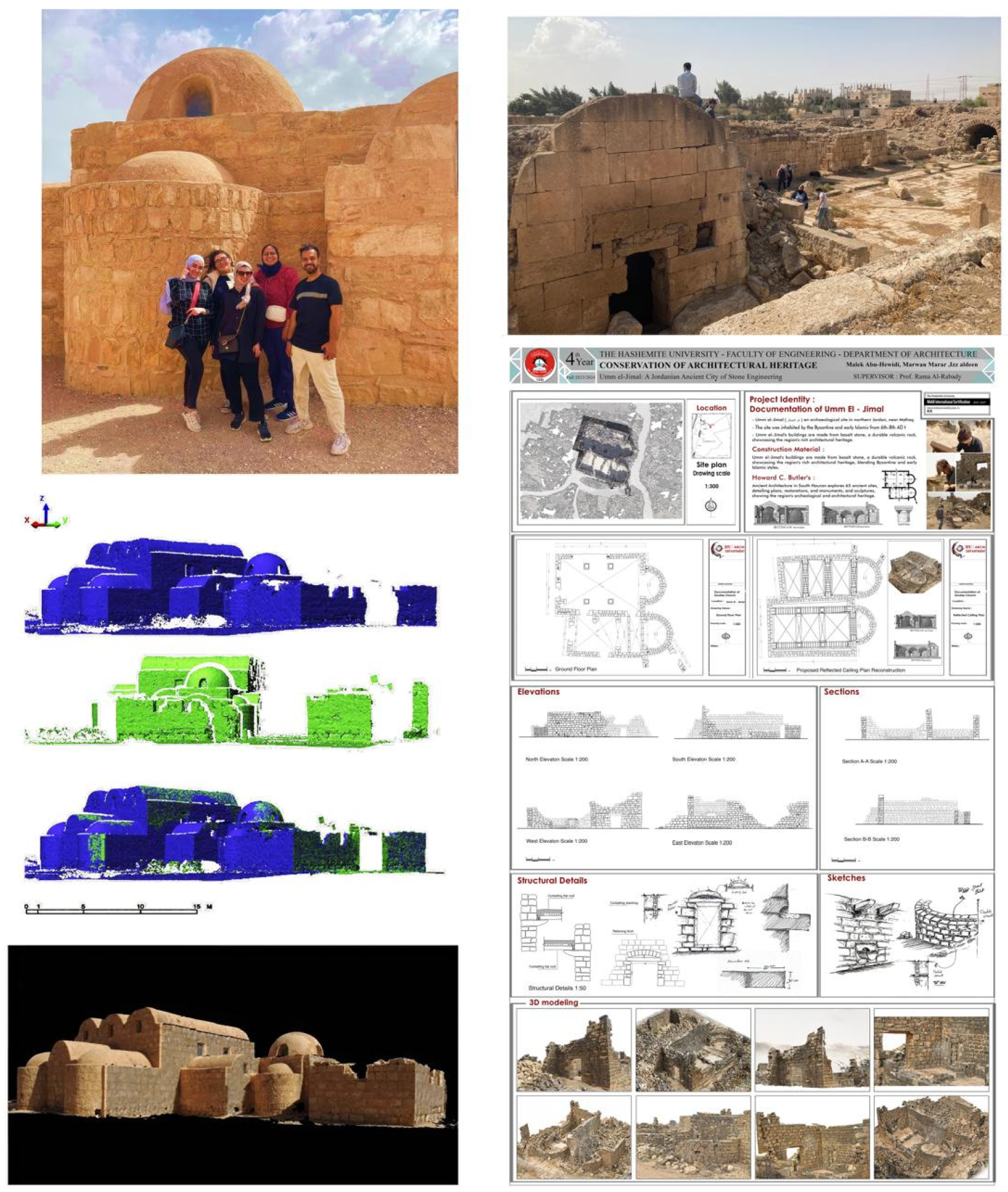
Documentation: During the six-week documentation phase, student groups selected one archaeological case study from twelve Jordanian sites representing diverse periods, materials, and structural systems. Examples included the Nabataean Temple in Umm el-Jimal (flat corbelled basalt roof), the Roman West Bath in Jerash (stone dome on pendentive), Byzantine churches in Umm el-Jimal (apsidal scoria dome), Ottoman buildings (Amman Railway Station, Hisban Village), Umayyad palaces (Qusair Amra’s stone barrel vaults, Qasr Mushatta’s brick vaults), and contemporary structures like Wasfi al-Tal House (groin-vaulted). The objective was to document archaeological assets and identify critical engineering challenges—including construction materials, techniques, tools, structural systems, and architectural configurations—that ancient builders confronted (Figure 2).
In weeks 1–2, students conducted on-site fieldwork or high-resolution photogrammetry using professional equipment and Agisoft Metashape software 1.6.x. Weeks 3–4 involved 2D CAD production (AutoCAD 2020) and 3D modelling (SketchUp 2020, Rhino 6). Weeks 5–6 consisted of preliminary structural interpretation and peer-critique sessions. Weeks 7–10 introduced Abaqus CAE through three progressive workshops: (1) basic geometry and meshing, (2) material property assignment based on published petrographic data for Jordanian stone types, and (3) self-load analysis with interpretation of principal stress vectors. Teaching assistants with backgrounds in structural engineering provided weekly laboratory support. Weeks 11–14 required students to prepare a 20-min presentation juxtaposing their ancient case study with a contemporary or neotraditional building employing similar structural principles, followed by a 15-min critique session with faculty and peers.
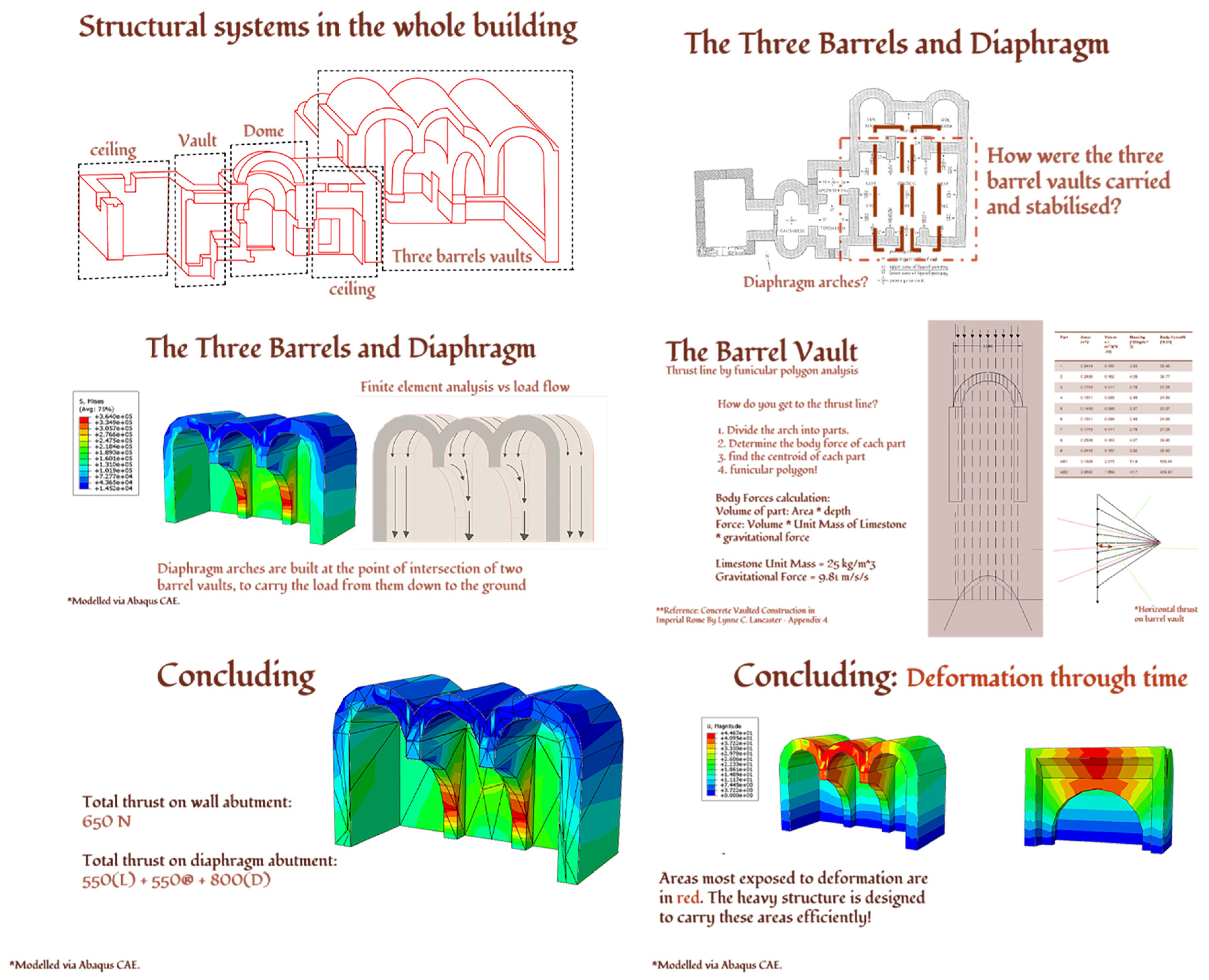
Analysis: The analysis phase employed reverse engineering to examine structural, constructional, and environmental systems. Students used their documented models to conduct numerical investigations of structural behavior and load-carrying capacity in Abaqus CAE, following three progressive workshops on geometry and meshing, material property assignment based on published petrographic data for Jordanian stone types, and self-load analysis with principal-stress interpretation. Structural behavior was evaluated under in-plane loads (self-load analysis) to assess stability. This phase reconstructed ancient engineering conceptions and construction rhythms by investigating materials, structural systems, and techniques, elucidating master builders’ methods (lifting apparatus, scaffolding, vault centering, and tool traces), and examining how structural characteristics were integrated into unified systems. It also enabled students to understand the environmental performance of these buildings. Figure 3 presents the analysis of one group for the Umayyad Amra Palace (730–740 CE) using Abaqus CAE.

3.1.2. Operationalizing Object-Laden Epistemology: The Learning Outcome

This object-oriented approach proved essential to the learning process. Rather than reading about ancient construction in textbooks, students directly investigated how material properties shaped engineering decisions. They asked: Why did Nabataean builders use sandstone for ashlar blocks but reserve limestone for decorative carving? How did Byzantine masons in Umm el-Jimal exploit scoria’s lightness to construct domes that would not overload bearing walls? What structural logic allowed basalt corbelling to span interior spaces without mortar? By treating buildings as integrated systems—structural, material, environmental, and constructional—students discovered that ancient engineering was responsive, adaptive, and often ingenious. One group, analysing Qasr Amra’s vaulted chambers, used finite element modelling to demonstrate how the construction sequence distributed stresses, thereby minimizing the need for centring. Another study of Umm el-Jimal’s flat roofs documented how header-stretcher coursing created seismic continuity—now recognized as a sophisticated form of earthquake resistance. This work transformed students’ understanding of ancient engineering. It was no longer a fixed body of historical facts to be memorized, but a set of problems and solutions to be analyzed, evaluated, and learned from. Buildings became evidence not only of what was built, but of how and why—and ultimately, of what contemporary architects might still adapt and apply.

3.2. Phase Two—Value-Laden Ontology

3.2.1. Operationalizing Value-Laden Epistemology: The Rational

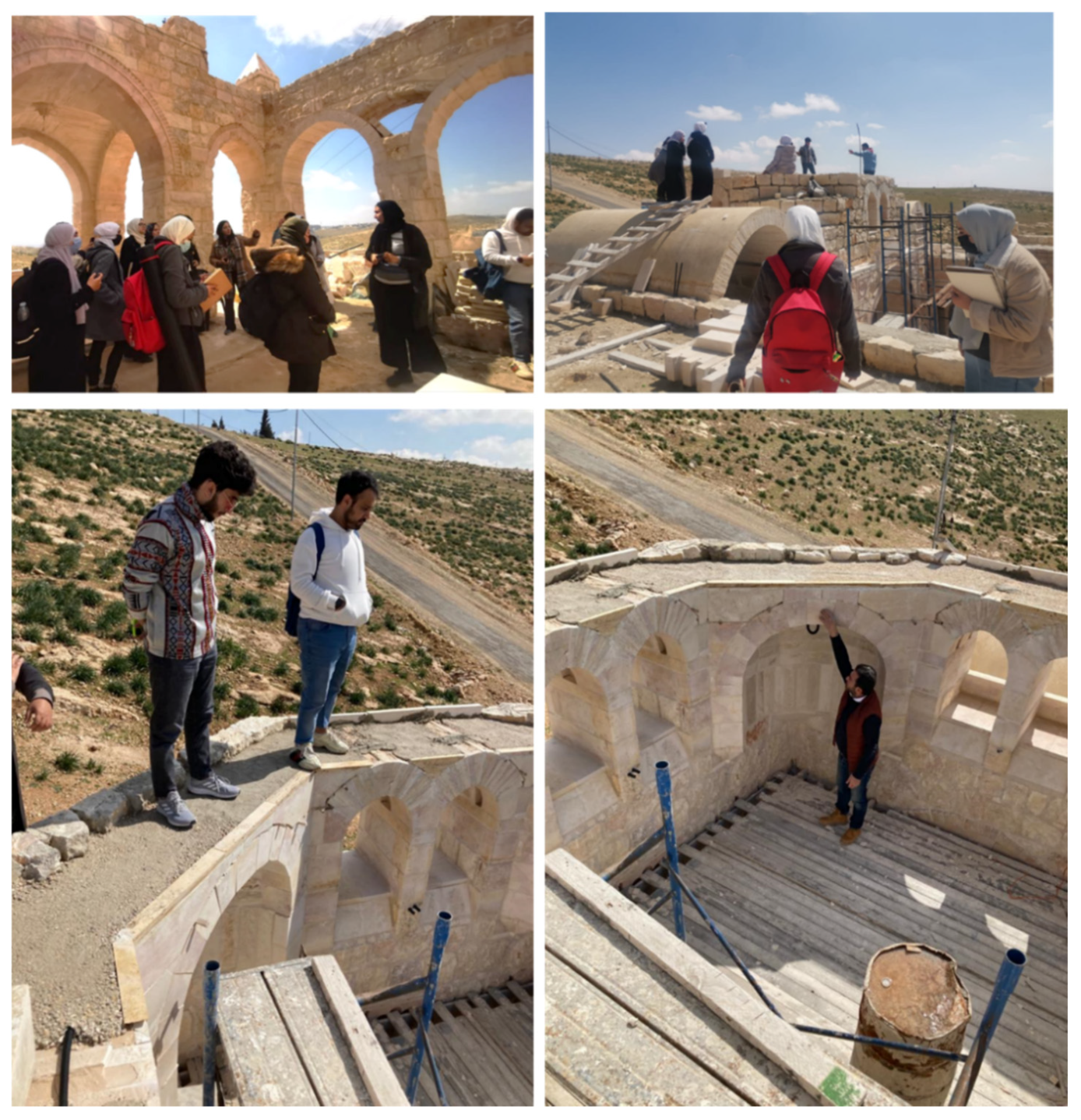
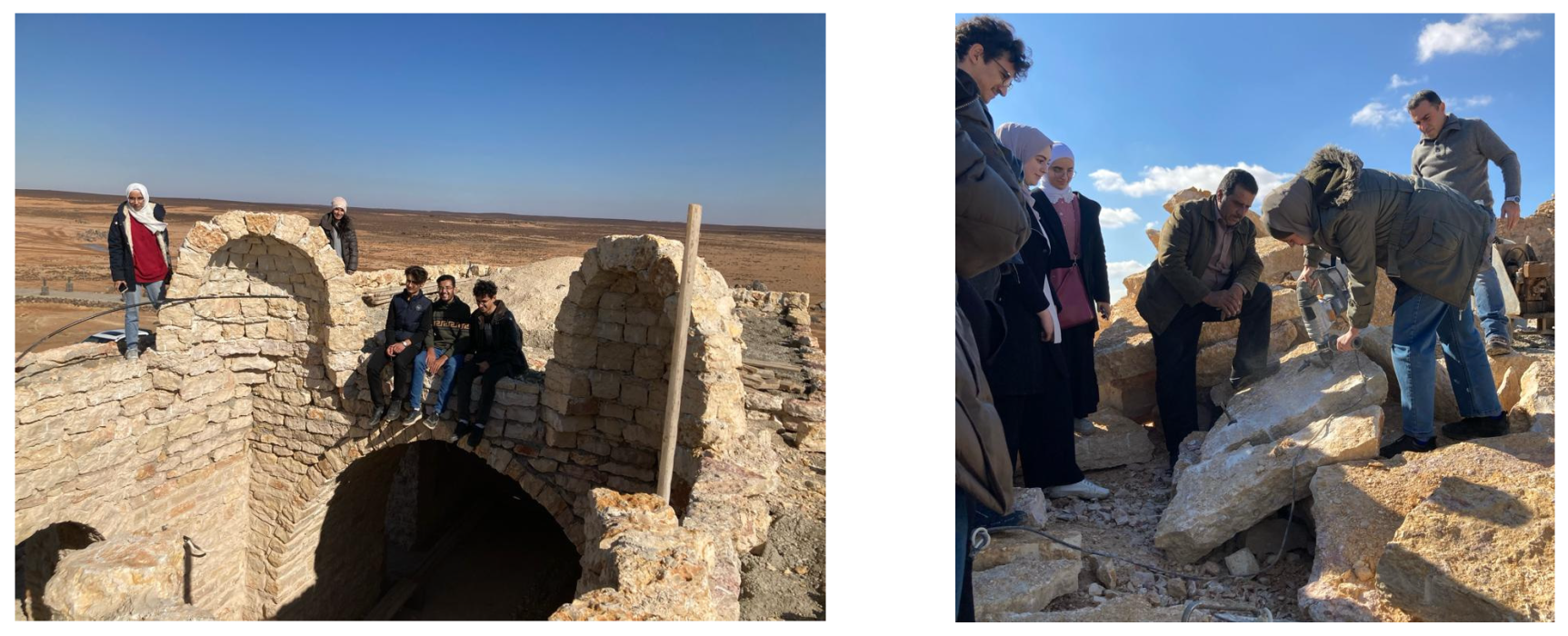
Recent archaeological theory has shifted from viewing objects as passive evidence to understanding them as active participants shaping human experience—a Roman milestone not only marks distance but organizes movement, asserts imperial presence, and outlasts the empire that erected it. For architecture students, this becomes tangible when visiting buildings under construction, such as Maher Abu-Samra’s Dar Al-Oqoud, where contemporary masons cut stone using millennia-old techniques, revealing ancient engineering as living practice rather than closed history. To move beyond treating ancient buildings as static documentation, the course prioritized direct, analytical engagement with the archaeological fabric and with contemporary builders practicing traditional techniques. This approach rests on the conviction that students learn more by handling stone, measuring tool marks, modeling load paths, and observing masons cut vault voussoirs than through textbook descriptions alone. Jordan’s recent revival of stone construction provided an ideal laboratory: architects Ekrimah Gharaibeh and Maher Abu-Samra have constructed buildings with load-bearing stone walls and arcuated roofs using techniques directly descended from Umayyad palaces and Byzantine churches. Students critically compared ancient and under-construction cases during visits to Abu-Samra’s Dar Al-Oqoud (House of Vaults) and the Mosque of the Blessed Tree in Al-Safawi (Figure 4 and Figure 5).

3.2.2. Operationalizing Value-Laden Epistemology: The Learning Outcome

The pedagogical encounter with neotraditional builders reframed students’ understanding of living ontology, moving beyond abstract theory to confront the material, political, and cultural dimensions of heritage revival. Students compared historical and contemporary construction methods, investigating how architects such as Maher Abu-Samra and Ekrimah Gharaibeh engage with ancient techniques. This encounter offered rare opportunities to observe live stone construction—block dressing, vault cantering, corbelling sequencing—making visible the embodied technical knowledge that reverse engineering seeks to recover. Crucially, this pedagogical engagement does not endorse neo-traditionalism as heritage policy or architectural prescription. These projects function as experimental field sites rather than exemplary models for Jordan’s architectural future. A critical heritage perspective [33] interrogates such revivalist practices for their potential entanglement with nationalist narratives, tourism economies, or class-based aesthetic preferences. Students are encouraged to ask: Whose past is being revived? For whom? At whose expense? What alternative construction traditions—vernacular, modernist, informal—are marginalized by this focus on monumental stone masonry? Thus, site visits are framed not as celebrations of neo-traditionalism but as critical case studies in how archaeological knowledge is mobilized in the present—a process always laden with power, selectivity, and cultural politics.

4. Findings: The Knowledge-Transfer Framework—Four Dimensions of Transformation

The constructivist framework’s first phase—object-laden epistemology—involved the positivistic deconstruction of architectural archaeology’s engineering principles through digital documentation and structural simulation. This enabled students to perceive and reconstruct the ontological relevance of ancient construction, transforming their understanding from passive historical reception to active analytical engagement. The subsequent course, Conservation of Architectural Heritage, advanced this foundation by engaging students in planning conservation interventions. It facilitated group discussions on architectural restoration and urban regeneration, integrating theoretical, practical, and strategic dimensions of archaeological conservation. Through this two-course sequence—Ancient Building Technologies and Conservation of Architectural Heritage—students engaged with architectural archaeology as a dynamic process encompassing science, heritage, temporality, and advocacy.

4.1. Science-Making: Ancient Engineering as Reconstructed Knowledge

The architecture students understood the ‘archaeology of construction,’ which involves buildings (as completed material objects) and construction (as an active process). We were surprised by the students’ growing concern, as they had previously expressed only theoretical interest in ancient architecture, that is, only insofar as it supported their architectural studies6. Ancient archaeology is now regarded as a significant scientific legacy, though it may also have scientific benefits in addition to cultural ones. For instance, a student explains the scientific understanding of ancient engineering he gained from a course on ancient building techniques. His words are [53]:
“I still needed to learn how difficult it was to develop and build. However, after taking this course, my perspective shifted dramatically. First, I learned about building mechanisms and how each building incorporates tools, materials, and a design suited to the environment and available materials. After inspecting the construction materials, dressing and fracturing are performed. The builders then moved it to the site by any means possible, and I have always wondered how they transported it to high altitudes. As it turned out, there are various lifting methods. Furthermore, the stones are not placed randomly but rather according to their characteristics, bearing capacity, and methods used to make them earthquake-resistant and heat-insulated, employing various techniques”.
The students developed a more critical relationship with archaeology. They no longer approached Jordan’s ancient sites as distant relics to be admired from afar. Instead, they engaged with them as engineers: measuring, modeling, testing hypotheses about how particular vaults stood or why certain walls failed. This analytical engagement deepened their sense of investment. Heritage ceased to be something ‘out there’ to be protected by specialists and became something they had the knowledge—and therefore the responsibility—to advocate for. While some students see this experience as an opportunity to learn about and care for historical sites, others are interested in Jordan’s ancient history. One student says [54]:
“I have developed a new appreciation for the research and documentation of historical sites, particularly as I have become more aware of the need for proper care and construction. By examining this knowledge and its techniques and methods, one can see how easily many of our building problems today can be solved by methods now considered old and outdated, even though each piece holds its own importance”.
Relating archaeology to engineering through architecture helped students uncover innovative and sustainable building techniques, especially in the old masonry structures that characterized ancient engineering practices in Jordan and across the Mediterranean region. More importantly, equating these activities with modern examples (such as neotraditional structures) demonstrates that archaeological science is not a single process but rather a collection of processes. According to Michael Schiffer, people create new knowledge in many ways for diverse purposes across diverse societal contexts, so there is no single scientific method [15] (pp. 3–4). Results from ancient knowledge could be creatively advanced and furthered in the present and the future. Reverse engineering is thus a progressive process that enables students to recognize the scientific imperative of archaeology in their understanding of modern architecture. This is affirmed by a student who states [55]:
“Based on my research, a deeper analysis of each case study’s social, architectural, and geological layers enabled me to reconstruct a comprehensive account of people and places through the building and the ideas that followed its construction. It emphasized the ingenious ideas and innovative solutions that ancient builders devised to construct structurally sound buildings using technologies far more advanced than ours. On the other hand, buildings serve humans just as much, if not more…This motivates me to examine Jordan, and I need to sketch additional structures that more accurately reflect its materials and environment. I also learned more about new structural analysis and heritage documentation software technologies, which deepened my understanding of the elements that constitute a structure in ancient techniques and those that constitute our structures today, given differences in techniques and how these create different spaces for humans and evoke different feelings. Today, for example, a concrete slab feels ‘heavier,’ drawing a line in the sky. On the other hand, the arcuated structures have a ‘lighter’ feel, as if they are more connected to the sky. In the coming years of my studies, I hope to conclude with techniques that sit between the old and the new, highlighting both”.

4.2. Heritage-Making: From Distant Relics to Living Practice

Dar Al-Oqoud’s practical experience offered architecture students a reflective awareness of archaeology’s place in the contemporary world. The students develop knowledge by exploring the world’s reality and situating it within their cultural context, and by articulating their knowledge of ancient archaeology. Establishing a deeper understanding of ancient engineering practices enhances recognition of past communities as highly developed cultures. Meanwhile, they could relate their knowledge of archaeology to their living experience. Archaeology is thus located in their minds as part of heritage-making. Such an idea extends beyond Jordan to the broader cultural context of the Near East and the MENA region, which once encompassed diverse cultures and civilizations. One student described how her understanding of Hagia Sophia in Turkey has shifted from a romantic fondness to a realistic, substantial, and convincing sense of relevance and attachment. She uttered [56]:
“I will examine buildings from both cultural and epistemological, as well as scientific, standpoints, as in the case of Hagia Sophia. If I had not taken the [Ancient Building Techniques] course, I would have dismissed Hagia Sophia as merely a beautiful mosque from the inside and outside. However, I could no longer see it just as a mosque. First, I intend to read about it before seeing it. I plan to devote significant time to studying the structure, particularly its dome, and to examining why it remains standing. It is a large structure, but the pendentive dome makes it appear lighter. I will concentrate on the materials and how they convey a ‘lighter’ structure”.
Students’ approach to archaeological sites has fundamentally changed. For example, architecture students did not approach structures as ‘ontological achievements’ [57] (p. 7) and ‘material objects’ [58] represented through recording, documentation, and archaeological plans. Buildings are records of process rather than static compositions. Thus, the understanding of archaeological engineering is situated within scientific, technological, and cultural contexts that enable it to locate itself within the cultural contexts of the physical object and to understand the potential effects that engineering innovations may have on their contemporary cultures.

4.3. Temporality-Making: Past and Present in Dialogue

Employing methods of reverse engineering, material analysis, structural analysis, construction analysis, and environmental analysis was instrumental in bringing ancient building technologies of architectural archaeology to the present, creating a dialogue between past and present and framing temporality as an essential dimension of learning architectural archaeology. Students came to see architectural archaeology not as frozen in time but as dynamically connected to the present. The basalt corbelling systems of Umm el-Jimal, they realized, were not merely historical curiosities but sophisticated structural solutions that anticipated principles still relevant to contemporary masonry construction. This recognition reframed ancient buildings as participants in an ongoing conversation about materials, structure, and place—not silent witnesses to a finished past. By linking historic buildings with contemporary conceptions of engineering, scientific technology, and cultural identity, this temporality-making process (i.e., the dynamic connection between past and present) demonstrates the dynamic character of architectural archaeology and its function in forming a legacy that urges advocacy and custodianship. A student expressed her respect for Umm el-Jimal’s ancient construction methods and their continued relevance today, noting the innovative use of local materials, distinctive flat-roof structures, structural diversity and adaptability, and the influence of these methods on modern multi-story construction. In her words [59]:
“The distinctive building techniques used by the builders of Umm el-Jimal, and the utilization of locally available materials whose qualities they could and should benefit from, are what cause them to stand out today. For instance, the basaltic flat roofs still visible today were a defining feature of Umm el-Jimal. Builders developed a corbeling system for constructing flat roofs. We now use concrete to make flat roofs. Umm el-Jimal’s architecture offers unique architectural and structural features. While contemporary concrete buildings are uniform, Umm el-Jimal was constructed with flat, corbelled basalt stones. These roofs can be considered precedents for contemporary concrete roofs, as they employed the structural system to construct multi-story buildings. We are currently constructing high-rise buildings and towers”.
Some students find architectural archaeology temporally significant because it reaffirms the value of ancient building knowledge in addressing contemporary architectural challenges, particularly using digital tools, educational initiatives, and materials science to enable a comprehensive approach to integrating stone-built practices into present and future architecture. According to her [60]:
“Further knowledge of material science can be gained by using structural analysis programs on Umm el-Jimal’s structures, digitally recording and modeling them, and then incorporating the knowledge and science into future construction projects… [it is essential to] teach. Instruct architecture students on stone-built architecture and its implementation as future approaches to stone-built structures”.

4.4. Advocacy-Making: Students as Custodian-Transmitters

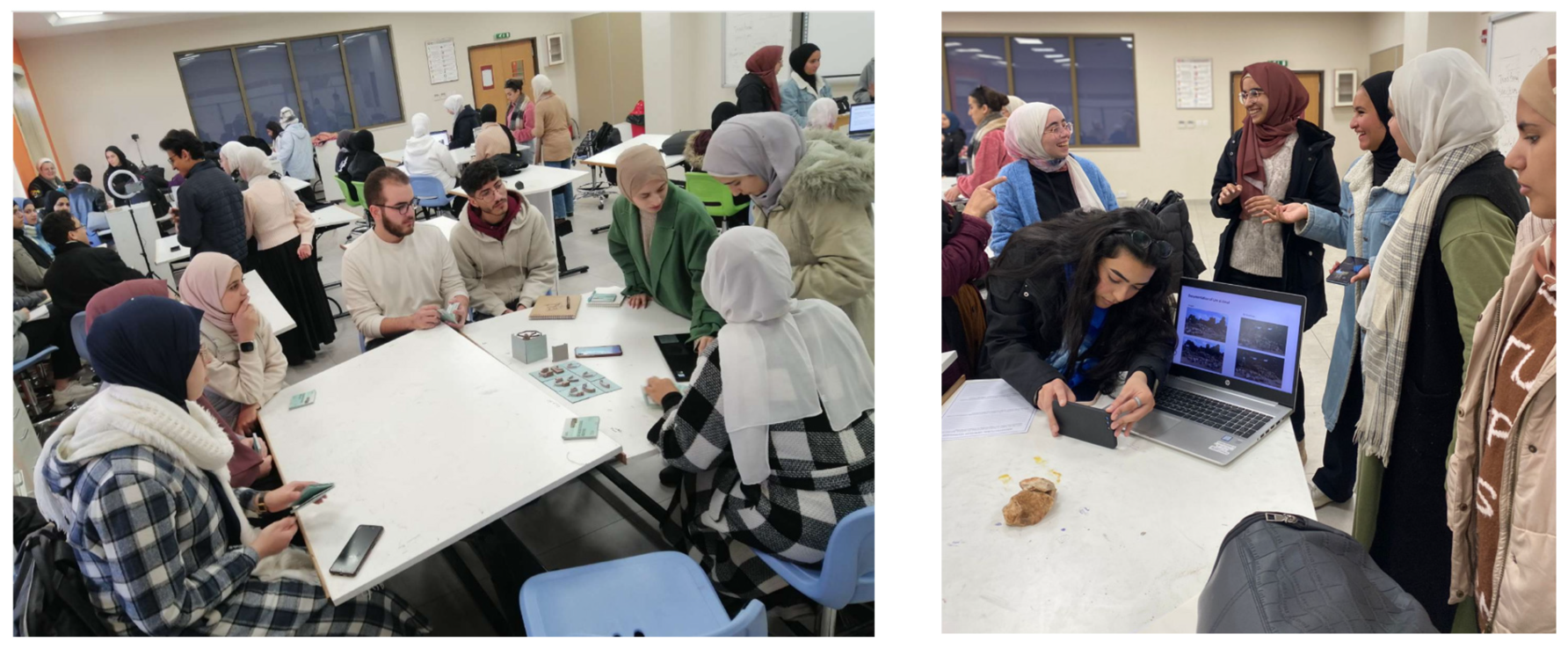
The triangulation between the epistemological stance for learning from historical engineering sciences, the conservation of cultural heritage as a ‘culture of relevance,’ and the ontological stance of architecture students as responsible for continuing the legacy of architectural archaeology for future generations not only influences architecture students’ academic experiences but also positions them as accountable advocates of cultural heritage in their professional lives. The constructivist pedagogical framework was designed to integrate historical knowledge into contemporary architectural education, ensuring that the legacy of architectural history is preserved and advanced for future generations. As the Ancient Building Technologies course concluded, the students were trained to conduct independent workshops for younger architecture students at the university’s studios (Figure 6). Using this platform, they deepened their understanding of their role in campaigning to preserve Jordan’s architectural archaeology and to raise awareness of it. This approach demonstrates that learning architectural archaeology constructively can be a potent means of advocacy and public engagement in archaeological conservation. One of the students who participated in organizing a workshop said [61]:
“The collaborative learning environment in the studio was stimulating, and the experience [of leading the workshop] has been both a privilege and a great responsibility. A rich tapestry of ideas emerged from facilitating conversations among people with diverse backgrounds and viewpoints. I appreciate the opportunity to help develop a new generation of preservationists, as I consider my responsibilities as an ‘instructor’ in this workshop on the protection of architectural archaeology. My experience in this course [the Conservation of Architectural Heritage course] has been transformative, reminding me that the real legacy of conservation lies in the structures we preserve, the knowledge we impart, and the enthusiasm we inspire in those who will continue the tradition”.
Another student stated [62]:
“It has been rewarding to lead a workshop [with second-year architecture students] because of the collaborative environment and our shared interest in the architectural archaeology of Jordan. The experience is gratifying because we, the ‘instructors’ and the recipients, are of similar ages. The students understood the subject, and we captured the spark of creativity and confidence that comes with newfound knowledge. Giving a workshop is a rewarding experience because of the constructive interactions, engaging conversations, and noticeable improvements in participants’ comprehension, further demonstrating the inspiring and empowering potential of learning about the architectural archaeology of Jordan”.
The constructive architectural archaeology approach is intended to introduce young architects to Jordan’s historical engineering through advanced scientific and pedagogical perspectives, fostering a dynamic understanding of archaeology and moving beyond conventional frameworks in anthropology and history. A shift toward architectural perspectives can advance the transformation of archaeology education (See, for example, [4]) through pragmatic and experiential constructivism, enabling the deconstruction of engineering epistemology in architectural archaeology and the reconstruction of its ontological relevance for young architects. Through this process, students are not passively receiving knowledge but actively restructuring their scientific epistemology and ontological conceptions to better align with their responsibilities in architectural archaeology as young architects. In this case, pragmatic constructivism, as described by Mrozowski [63], allowed the students to play a more active role as ‘archaeological advocates’ while rejecting the ‘spectator’s theory of knowledge’—the idea that knowledge can be detached and merely objective. Instead, this experience demonstrates that archaeological epistemology is an active process that helps shape knowledge, cultural relevance, temporality, and advocacy. It unites the past and present while motivating future architects to conserve and advance Jordan’s architectural archeology.

5. Discussion: The Knowledge Transfer Framework—Toward a ‘Continuum’ of Epistemology and Ontology

5.1. A Continuum of Engineering Knowledge in Architectural Archaeology Epistemology

The call for an archaeology oriented toward the present and future emerges from a critical tradition challenging how heritage serves political agendas. Harrison [36] advocates shifting from an ‘archaeology of the contemporary past’ to an ‘archaeology in and of the present and future’—not merely temporal expansion but a critical intervention against what Smith [64] terms ‘authorized heritage discourse’ (AHD): state-sanctioned, often Western-derived frameworks determining which pasts matter and who may interpret them. Harrison’s project democratizes heritage, surfacing alternative narratives and recognizing heritage-making as an ongoing, contested political process. His archaeology of the present is thus a critical heritage practice, not an invitation to aesthetic revivalism or uncritical neo-traditionalism. This distinction is essential because our pedagogical framework risks being misread as endorsing neo-traditional architecture as a direct solution to Jordan’s archaeological endangerment. This is not our position. Students’ engagement with neotraditional builders such as Maher Abu-Samra served a critical, comparative, and heuristic purpose: rendering visible engineering epistemologies embedded in stone construction—load paths, material behaviour, construction sequencing—that remain abstract when studied only through texts or ruins. The neotraditional building site functioned as a pedagogical laboratory, making ancient techniques materially present for empirical investigation. Our framework seeks to reconstruct and transmit ancient engineering knowledge, rather than merely imitate its style.
Where neo-traditionalism risks romanticizing the past or uncritically reproducing detached forms, our constructivist framework employs reverse engineering as a critical-analytical tool to interrogate how technical knowledge was produced, constrained, and transmitted. The goal is not to build new Umayyad palaces or Byzantine churches, but to equip students with analytical skills to recognize sustainable structural principles, material intelligence, and environmental adaptation strategies that may inform contemporary architectural challenges. This aligns with Harrison’s vision: a reflexive, pluralizing heritage practice oriented toward social justice and future-making, rather than the literal replication of the past. Establishing architectural archaeology as a knowledge-transfer paradigm is crucial in Jordan, where archaeological sites—including World Heritage Sites—face severe demolition and irreversible loss. Despite escalating threats, Jordanian archaeology’s educational and practical structures remain influenced by culture-historical object-based approaches and value-laden management strategies. However, this conventional focus fails to expand archaeology toward domains of endangerment, presenting the past, and caring for the future. Archaeology can address contemporary issues by reorienting toward creative engagement with the present and considering the role of past traces within it. Harrison [36] argues that engaging with the emergent present and its potential futures requires fundamentally reworking archaeological methodologies, moving from ‘archaeology of the contemporary past’ to ‘archaeology in and of the present and future.’

5.2. A Continuum of Custodianship and Agency in Architectural Archaeology Ontology

This study introduces architectural archaeology as an alternative pedagogical approach for teaching archaeology in Jordan, moving beyond conventional frameworks of history and anthropology. Investigating Jordan’s rich yet endangered masonry heritage across diverse civilizations, the framework rejects traditional pedagogy that treats the past as separate from the present. Instead, it positions Jordan’s architectural heritage as living—capable of teaching contemporary builders, relevant to current design challenges, and open to reinterpretation by each new generation of architects. The constructivist module thus advances architectural archaeology as both a legacy and dynamic field, situating it within the temporality of ‘presentism’ and ‘futurism.’
Presentism interprets architectural archaeology through contemporary technologies, needs, and value systems. Students and instructors imposed presentist viewpoints on historical interpretations, thereby uncovering engineering methods that continue to influence Jordan’s stone architecture. Through digital modeling and engagement with local architects advancing revival movements, they brought architectural archaeology into contact with futurism—examining how ancient building technologies could inform structures that endure as reminders of our time. They recognized that load-bearing stone construction with arcuated roofing systems, climate-resilient practices, and ancient techniques contribute to sustainable architecture with lasting significance.
According to this constructivist module, new generations of architects play a critical role in architectural archaeology for two reasons. First, they acknowledge presentism by reviving traditional stone engineering and local materials, demonstrating sustainable practices rooted in regional history. Second, they engage with futurism by envisioning what may become archaeologically significant, fostering forward-thinking stewardship of legacy. When archaeology is refocused as a process that promotes collective agency and local engagement, it empowers future generations to be agents of change rather than mere stewards. They operate beyond conventional guardianship as custodians responsible for transmitting cultural heritage without appropriating it—safeguarding experiences rather than possessing objects.
Borrowing from Menozzi [31], they become ‘custodian-transmitters’ who appropriate authority from their cultural-geographical provenance. These future engineers, architects, and academics embrace temporality as a dynamic continuum, envisioning Jordan’s architectural legacy within an evolving historical narrative. Crucially, this custodianship must remain critically reflexive. Harrison’s [36] archaeology of the present reminds us that heritage is continuously remade through contemporary struggles over identity, resources, and belonging. Our students’ role is therefore not to replicate the past but to negotiate its meanings in dialogue with diverse communities, question which narratives have been silenced, and imagine plural, just, and inclusive futures. The proposed continuum is not a smooth line from antiquity to tomorrow, but a contested terrain of interpretation, conflict, and creative reappropriation.

6. Conclusions: Architectural Archaeology as a Constructivist Pedagogy of Transmission and Transformation

This study proposed a constructivist architectural archaeology framework that reorients heritage education from intervention toward knowledge transfer. By engaging students in reverse engineering—deconstructing ancient techniques through digital documentation and structural simulation, then reconstructing knowledge for contemporary application—the framework positions them as active interpreters and advocates for Jordan’s archaeological heritage. Importantly, this approach avoids extreme relativism: while diverse interpretive lenses remain valuable, engagement with structural analysis, material testing, and construction documentation disciplines interprets interpretive freedom. Engineering epistemology establishes constraints on meaning even as it opens reinterpretation, maintaining the productive tension between methodological pluralism and epistemic rigor.
The Hashemite University experiment yielded transformative outcomes across four dimensions: science-making (recovering ancient engineering as legitimate knowledge); heritage-making (sites shifting from relics to living practice); temporality-making (past–present dialogue); and advocacy-making (students as custodian-transmitters). By integrating heritage into core curricula, this framework reaches future architects beyond specialized conservation programs, addressing regional gaps where technically sophisticated conservation struggles to cultivate community support. Nevertheless, this study has limitations: its pedagogical focus on conceptual validation made long-term professional impact measurement unfeasible; the 42-student cohort, while appropriate for analytical generalization, cannot support statistical inference; and the Jordanian focus limits claims of transferability. Future research should pursue longitudinal studies tracking graduate engagement with heritage, comparative studies across regional institutions, stakeholder research with heritage authorities and restoration firms, and the development of quantitative instruments to complement this study’s qualitative depth.

Funding

This research received no external funding.

Institutional Review Board Statement

This study adhered to the 1964 Declaration of Helsinki and its revisions, as well as institutional research committee ethics guidelines. Ethical approval was received by Al-Ahliyya Amman University’s Scientific Research Committee, the Institutional Review Board for human participant research (IRB: 5-4-2020/2021; Approval Date: 18 January 2021).

Informed Consent Statement

All study participants gave informed consent. The study included students who were informed of the study’s goal and the use of their data for research and publication. Voluntary written consent preceded data collection. Informed consent for publication was obtained from all identifiable human participants.

Data Availability Statement

The data presented in this study are available upon reasonable request from the corresponding author due to privacy and ethical restrictions. The study involved third-year undergraduate architecture students, and the qualitative data consists of interviews, reflective journal entries, focus group transcripts, and educational materials (e.g., CAD drawings, structural analysis reports, project proposals) generated as part of their coursework. Protecting participant confidentiality, as approved by the Institutional Review Board (IRB: 5-4-2020/2021), and adhering to agreements regarding the use of student work prevent the public archiving of raw data.

Conflicts of Interest

The author declares no conflict of interest.

Notes

1
Despite their shared rejection of objectivist knowledge transfer, constructivism in education and archaeology operate differently across fields. Constructivism holds that students actively construct knowledge through experience, prior knowledge, and social interaction [12,13]. Constructivism, especially in post-processual archaeology, holds that past interpretations are actively constructed in the present by contemporary social, cultural, and political contexts rather than neutral discoveries of objective facts. This study intentionally blends both meanings: students reverse-engineer knowledge while acknowledging that archaeological knowledge is epistemologically generated through situated interpretation.
2
In Egypt and Saudi Arabia, heritage education is embedded at the undergraduate level (Cairo, Luxor, King Saud Universities), integrating conservation science with practical skills like Saudi Arabia’s Traditional Building Apprenticeship [29,30].
3
Scholars emphasize the importance of employing diverse theoretical perspectives to uncover overlooked or underappreciated aspects of the archaeological record [1].
4
See some published works that tackle the engineering and technological advancements that are experienced in Jordan’s stone archaeology, such as [33,34,35].
5
Each of the four competency domains in this module was assessed through multiple graded deliverables. Technical documentation and accuracy were evaluated from CAD drawings and photogrammetric models using a 0–4 scale to assess completeness, dimensional accuracy, layer organization, and annotation clarity. Structural & Material Analysis was evaluated based on Abaqus simulation reports; the correctness of boundary conditions, the appropriate assignment of material properties, and the logical interpretation of stress plots were weighted equally. Interpretive & Contextual Rigor was assessed through the critical comparison presentation, with separate scores for historical accuracy, quality of structural reasoning, and reflexivity about the limits of reverse engineering. Synthesis & Advocacy was evaluated through the final conservation proposal and peer workshop facilitation. Two instructors independently scored all submissions, and inter-rater reliability exceeded 0.85 across all domains.
6
Students take courses on the History of Architecture I and II and Islamic architecture as part of their curricula. Ancient Building Technologies requires completion of these courses in the order listed. The architectural archaeology of ancient civilizations is typically introduced to students in these courses only conceptually, with most examples not occurring in the relevant geographic context of Jordan.

References

  1. Trigger, B.G. A History of Archaeological Thought, 2nd ed.; Cambridge University Press: Cambridge, UK, 2006. [Google Scholar]
  2. Al-Ghoul, O. Archeological Approaches in Jordan From 1800 Until Now. Jordan J. Hist. Archeol. 2022, 16, 243–261. [Google Scholar] [CrossRef]
  3. Hamilakis, Y.; Shanks, M.; Holtorf, C.; Tarlow, S.; Tierney, M. Relativism, objectivity and the politics of the past—The case of post-processual archaeology. Archaeol. Dialogues 1997, 7, 164–184. [Google Scholar]
  4. Amro, D. The Role of University Education in Directing Architects Towards Conserving the Sustainability of the Urban Cultural Heritage (Comparative Study) (Vol. 21); Al-Balqa Journal for Research and Studies: Amman, Jordan, 2018. [Google Scholar]
  5. Amro, D.; Sukkar, A.; Yahia, M.; Abukeshek, M. Evaluating the Cultural Sustainability of the Adaptive Reuse of Al-Nabulsi Traditional House into a Cultural Center in Irbid, Jordan. Sustainability 2023, 15, 13198. [Google Scholar] [CrossRef]
  6. Amro, D.; Abu Nasser, M. Post-Adaptive Reuse Evaluation of Heritage Spaces: A Case Study of Dar Al Saraya in Madaba, Jordan. Architecture 2025, 6, 1. [Google Scholar] [CrossRef]
  7. Prag, K. The Third Millennium in Jordan: A Perspective, Past and Future. Stud. Hist. Archaeol. Jordan 2001, 7, 179–190. [Google Scholar]
  8. Steen, E.J. The Archaeology of Jordan: A Condensed History. J. East. Mediterr. Archaeol. Herit. Stud. 2019, 7, 149–164. [Google Scholar]
  9. Yassine, K. The Archaeology of Jordan: Achievements and Charting the Future. Stud. Hist. Archaeol. Jordan 2001, 7, 27–31. [Google Scholar]
  10. Abu-Khafajah, S.; Al-Rabady, R.; Rababeh, S.; Tammoni, F. Hands-On Heritage! Establishing Soft Authority over Heritage through Architectural Experiment: A Case Study from Jordan. Public Archaeol. 2015, 14, 191–213. [Google Scholar] [CrossRef]
  11. Kolesnik, A.S.; Rusanov, A.V. Heritage-As-Process and its Agency: Perspectives of (Critical) Heritage Studies; Poletaev Institute for Theoretical and Historical Studies in the Humanities (IGITI): Moscow, Russia, 2020. [Google Scholar]
  12. Smith, L. Uses of Heritage; Routledge: London, UK, 2006. [Google Scholar]
  13. Piaget, J. The Psychology of Intelligence; Routledge & Kegan Paul: London, UK, 1950. [Google Scholar]
  14. Rawashdeh, S. Lecture Delves into Archaeology of Architecture. Jordan Times, 12 April 2023. Available online: https://jordantimes.com/news/local/lecture-delves-archaeology-architecture (accessed on 3 April 2020).
  15. ICOMOS. International Charter for the Conservation and Restoration of Monuments and Sites (The Venice Charter); ICOMOS: Paris, France, 1964. [Google Scholar]
  16. Feilden, B.M. Conservation of Historic Buildings, 3rd ed.; Architectural Press: London, UK, 2003. [Google Scholar]
  17. Schiffer, M.B. The Archaeology of Science: Studying the Creation of Useful Knowledge; Springer: Berin/Heidelberg, Germany, 2013. [Google Scholar]
  18. Renfrew, C.; Bahn, P. Archaeology: Theories, Methods and Practice, 8th ed.; Thames & Hudson: London, UK, 2020. [Google Scholar]
  19. Dessales, H. The Archaeology of Construction: A New Approach to Roman Architecture. Annales. Hist. Sci. Soc. 2017, 72, 69–86. [Google Scholar] [CrossRef]
  20. Beiersdorf, M.J. (Re)constructing History—How Building Archaeology can profit from the Knowledge of Engineering. Struct. Eng. Doc. 2017, 15, 41–45. [Google Scholar]
  21. Brogiolo, G.P. Archeologia Dell’architettura: Metodi e Interpretazioni; All’Insegna del Giglio: Sesto Fiorentino, Italy, 1996. [Google Scholar]
  22. Parenti, R. Dalla stratigrafia all’archeologia dell’architettura: Alcune recenti esperienze. Arqueol. Arquit. 2002, 1, 25–34. [Google Scholar]
  23. Anastasio, S.; Gilento, P.; Parenti, R. Ancient Buildings and Masonry Techniques in the Southern Hauran, Jordan. J. East. Mediterr. Archaeol. Herit. Stud. 2016, 4, 299–320. [Google Scholar] [CrossRef]
  24. De Luca, L.; Veron, P.; Florenzano, M. Reverse engineering of architectural buildings based on a hybrid modeling approach. Comput. Graph. 2006, 30, 160–176. [Google Scholar] [CrossRef]
  25. Al Rabady, R. Ancient masonry structures within an integrated approach: The reinforced corbelled flat roofs of Umm el-Jimal. Int. J. Hist. Eng. Technol. 2020, 89, 122–141. [Google Scholar] [CrossRef]
  26. Mannoni, T. Metodi di datazione dell’edilizia storica. In Archeologia Medievale, XI; All’Insegna del Giglio: Sesto Fiorentino, Italy, 1984. [Google Scholar]
  27. Mannoni, T.; Milanese, M. Mensiocronologia. In Archeologia e Restauro dei Monumenti; Francovich, R., Parenti, R., Eds.; All’Insegna del Giglio: Florence, Italy, 1988; pp. 383–402. [Google Scholar]
  28. Sapin, C. The archaeology of buildings: Assessment and perspectives. Les Nouv. De L’archéologie 1999, 75, 5–11. [Google Scholar]
  29. Osman, K.A.A. Heritage conservation management in Egypt: A review of the current and proposed situation to amend it. Ain Shams Eng. J. 2018, 9, 2907–2916. [Google Scholar] [CrossRef]
  30. Vygotsky, L. Interaction between learning and development. In Readings on the Development of Children; Gauvain, M., Cole, M., Eds.; Scientific American Books: New York, NY, USA, 1978; pp. 34–40. [Google Scholar]
  31. Menozzi, F. Postcolonial Custodianship: Cultural and Literary Inheritance; Routledge: New York, NY, USA, 2014. [Google Scholar]
  32. Rababeh, S. How Petra Was Built: An Analysis of the Construction Techniques of the Nabataean Freestanding Buildings and Rock-Cut Monuments in Petra, Jordan; British Archaeological Reports: Oxford, UK, 2005. [Google Scholar]
  33. Rababeh, S. Technical utilization of lifting devices for construction purposes in ancient Gerasa, Jordan. Int. J. Archit. Herit. 2015, 9, 1023–1036. [Google Scholar] [CrossRef]
  34. Rababeh, S.; Al Qablan, H.; El-Mashaleh, M. Utilization of tie-beams for strengthening stone masonry arches in Nabataean construction. J. Archit. Conserv. 2013, 19, 118–130. [Google Scholar] [CrossRef]
  35. Arce, I. From the diaphragm arches to the ribbed vaults. A hypothesis for the birth and development of a building technique. In Proceedings of the First International Congress on Construction History, Madrid, Spain, 20–24 January 2003; Reverte: Madrid, Spain, 2003; pp. 225–241. [Google Scholar]
  36. Arce, I. Umayyad Arches, Vaults & Domes: Merging and Re-creation. In Contributions to Early Islamic Construction History, 2nd ed.; International Congress on Construction History; Cambridge University Press: Cambridge, UK, 2006; pp. 195–220. [Google Scholar]
  37. Harrison, R. Surface assemblages: Towards an archaeology in and of the present. Archaeol. Dialogues 2011, 18, 141–161. [Google Scholar] [CrossRef]
  38. Eilam, E. Reversing: Secrets of Reverse Engineering; Wiley Publishing, Inc.: Indianapolis, IN, USA, 2005. [Google Scholar]
  39. Neamţu, C.; Popescu, S.; Popescu, D.; Mateescu, R. Using Reverse Engineering In Archaeology: Ceramic Pottery Reconstruction. J. Autom. Mob. Robot. Intell. Syst. 2012, 6, 55–59. [Google Scholar]
  40. Moshenska, G. Reverse engineering and the archaeology of the modern world. Forum Krit. Archäologie 2016, 5, 16–28. [Google Scholar]
  41. Catalano, A. Engineering how support of archaeology: Instrumental and safeguard technologies for interdisciplinary integration. Vitr. Int. J. Archit. Technol. Sustain. 2019, 1, 41–47. [Google Scholar] [CrossRef]
  42. Karoglou, M.; Bakolas, A.; Kouloumbi, N.; Moropoulou, A. Reverse engineering methodology for studying historic buildings coatings: The case study of the Hellenic Parliament neoclassical building. Prog. Org. Coat. 2011, 72, 202–209. [Google Scholar] [CrossRef]
  43. Jäger, J.; Helmedag, I.; Weber, T.M.; Abu-Jaber, N.; Suleiman, A.; Burkhardt, B.; Khammash, A. Stone and Architecture in the Mountainous Regions of Jordan and Syria; DAAD: Amman, Jordan; Damascus, Syria; Berlin, Germany, 2012. [Google Scholar]
  44. Al Rabady, R.; Rababeh, S. Engineering the reconstruction of Hawrān’s Ecclesiae during late antiquity: Case of Julianos church in Umm el-Jimal, Jordan. Herit. Sci. 2022, 10, 81. [Google Scholar] [CrossRef]
  45. Palecek, M.; Risjord, M. Relativism and the Ontological Turn within Anthropology. Philos. Soc. Sci. 2012, 34, 3–23. [Google Scholar] [CrossRef]
  46. Čapek, L. Ontological turns in archaeology and material culture studies: Archaeology as a discipline about ‘things’. Trop. Rev. 2023, 75, 68–98. [Google Scholar] [CrossRef]
  47. Meyer, J.H.F.; Land, R. Threshold concepts and troublesome knowledge (2): Epistemological considerations and a conceptual framework for teaching and learning. High. Educ. 2005, 49, 373–388. [Google Scholar] [CrossRef]
  48. Shulman, L.S. Signature pedagogies in the professions. Daedalus 2005, 134, 52–59. [Google Scholar] [CrossRef]
  49. Creswell, J.W.; Plano Clark, V.L. Designing and Conducting Mixed Methods Research, 3rd ed.; SAGE Publications: Thousand Oaks, CA, USA, 2017. [Google Scholar]
  50. Lincoln, Y.S.; Guba, E.G. Naturalistic Inquiry; SAGE Publications: Thousand Oaks, CA, USA, 1985. [Google Scholar]
  51. Mertens, D.M. Research and Evaluation in Education and Psychology: Integrating Diversity with Quantitative, Qualitative, and Mixed Methods, 4th ed.; SAGE Publications: Thousand Oaks, CA, USA, 2014. [Google Scholar]
  52. Henson, D. Constructivism in archaeology education. In Encyclopedia of Global Archaeology; Smith, C., Ed.; Springer: New York, NY, USA, 2014; pp. 1675–1679. [Google Scholar]
  53. Briede, B. A Constructivist Approach in Engineering Education. Eng. Rural. Dev. 2013, 23, 584–589. [Google Scholar]
  54. Abu Alsuod, N. (Department of Architecture Engineering, Hashemite University, Zarqa, Jordan). Interview on the Archaeology of Architecture; Interview by R. Rabady, 15 June 2022. [Unpublished interview].
  55. Abu Karki, R. (Department of Architecture Engineering, Hashemite University, Zarqa, Jordan). Interview on the Archaeology of Architecture; Interview by R. Rabady, 3 April 2021. [Unpublished interview].
  56. Al-Hamshari, R. (Department of Architecture Engineering, Hashemite University, Zarqa, Jordan). Interview on the Archaeology of Architecture; Interview by R. Rabady, 5 April 2021. [Unpublished interview].
  57. Allabadi, N. (Department of Architecture Engineering, Hashemite University, Zarqa, Jordan). Interview on the Archaeology of Architecture; Interview by R. Rabady, 20 June 2022. [Unpublished interview].
  58. Al-Qalawi, J. (Department of Architecture Engineering, Hashemite University, Zarqa, Jordan). Interview on the Archaeology of Architecture; Interview by R. Rabady, 15 June 2022. [Unpublished interview].
  59. Alrefaie, A. (Department of Architecture Engineering, Hashemite University, Zarqa, Jordan). Interview on the Archaeology of Architecture; Interview by R. Rabady, 26 June 2022. [Unpublished interview].
  60. Arabyat, H. (Department of Architecture Engineering, Hashemite University, Zarqa, Jordan). Interview on the Archaeology of Architecture; Interview by R. Rabady, 12 June 2022. [Unpublished interview].
  61. Khwais, N. (Department of Architecture Engineering, Hashemite University, Zarqa, Jordan). Interview on the Archaeology of Architecture; Interview by R. Rabady, 16 June 2022. [Unpublished interview].
  62. Bille, M.; Sørensen, T.F. Into the fog of architecture. In Elements of Architecture: Assembling Archaeology, Atmosphere and the Performance of Building Spaces; Bille, M., Sørensen, T.F., Eds.; Routledge: Oxon, UK, 2016; pp. 1–29. [Google Scholar]
  63. Westphalen, L.; Knight, J. Archaeology and engineering: What can engineers learn from the material cultures of the past? In Proceedings of the 20th Annual Conference for the Australasian Association for Engineering Education, Adelaide, Australia, 6–9 December 2009; Engineering the Curriculum. Engineers Australia: Canberra, Australia, 2009; pp. 783–788. [Google Scholar]
  64. Mrozowski, S.A. Pragmatism and the Relevancy of Archaeology for Contemporary Society. In Archaeology in Society: Its Relevance in the Modern World; Rockman, M., Flatman, J., Eds.; Springer: New York, NY, USA, 2012; pp. 239–256. [Google Scholar]
Figure 1. Examples of destroyed ancient masonry architectural archaeology in Jordan featuring three main stone typologies: Roman Umm el-Jimal (hard basalt-stone engineering, top left); Byzantine Umm-Rassas (limestone engineering, top right); Nabataean Qasr el-Bint in Petra (soft sandstone engineering, bottom left); and Qasr Al-Mushatta’s brick engineering with unfinished restorative works for roofing systems (bottom right). Source: The author’s private archives.
Architecture 06 00042 g001
Figure 2. Teaching students how to document archaeological evidence using two- and three-dimensional drawings and cutting-edge technologies for data collection, processing, and presentation. Documentary images of the WHS of Amra Palace (left) and the Qastal Palace (right). Source: The author’s private archives.
Architecture 06 00042 g002
Figure 3. Analyses by one student group using Abaqus CAE to examine the structural system, its intricate composition, and structural behavior under self-load. The Umayyad Amra Palace was constructed in 730–740 CE. Source: The author’s private archives.
Architecture 06 00042 g003
Figure 4. During a spring 2021 site visit to Dar Al-Oqoud while under construction, third-year architecture students observed various arcuated treatments, including domes on squinches, barrel vaults, and groin vaults. Architect and owner Maher Abu-Samra demonstrated dome construction techniques directly to students. Source: The author’s private archives.
Architecture 06 00042 g004
Figure 5. During spring 2023, third-year architecture students visited the Mosque of the Blessed Tree in Al-Safawi, Jordan, while it was under construction. The mosque featured squinches to support its dome, providing a rare opportunity to observe traditional arcuated construction techniques in progress. Students tested the newly constructed stone barrel vault’s load capacity under both live loads (their own weight) and static loads (self-load), thereby gaining direct empirical experience with structural behavior (left). Under the supervision of architect Maher Abu-Samra, several students experimented with ancient stone-cutting methods using metal wedges (right). This hands-on engagement with traditional techniques—splitting and dressing stone using methods documented in archaeological contexts—enabled students to connect theoretical knowledge from ancient construction with living practice, bridging the gap between historical texts and embodied craft. Source: The author’s private archives.
Architecture 06 00042 g005
Figure 6. In an on-campus workshop, third-year architecture students use reverse engineering, scientific methods, and demonstrative structural models to educate their second-year peers on ancient building materials, arcuated structural systems, construction methods, and environmental systems (left image). The right picture shows students teaching their peers how to digitally document a stone composition sample using advanced software (Agisoft Metashape 1.6.x). Source: The author’s private archives.
Architecture 06 00042 g006
Table 1. ‘Design and Evaluation’ framework for the constructivist architectural archaeology module5.
Competency DomainOperationalization of Reverse Engineering & ConstructivismAssessment Rubric CriteriaData Source for Evaluation
1. Technical Documentation & AccuracyDeconstructing existing structures via measurement, digital scanning, and accurate representationCompleteness of survey data; Precision of 2D/3D CAD models; Correct identification of structural elements and materialsCAD drawings; Agisoft/RealityCapture models; Assignment grades
2. Structural & Material AnalysisApplying reverse engineering to deduce load paths, material behaviour, and construction logic through numerical and comparative analysisCorrect application of analysis software (e.g., Abaqus); Validity of conclusions about stability, load-bearing capacity, and construction techniquesStructural analysis reports; Numerical models; Reflective journal entries on analytical challenges
3. Interpretive & Contextual RigorConstructing meaning by connecting engineering analysis to historical, cultural, and environmental contextDepth of argument linking form/technique to context; Quality of critical comparison between ancient and contemporary casesFinal project reports; Focus group transcripts; Workshop presentation content
4. Synthesis & AdvocacyReconstructing knowledge to propose conservation strategies or contemporary applications, demonstrating constructed understanding and professional agencyCreativity and feasibility of conservation proposals; Clarity and persuasiveness in peer workshops; Evidence of changed attitudes in surveys/interviewsConservation project proposals; Workshop feedback; Pre/post survey scores; Interview quotes on advocacy
Disclaimer/Publisher’s Note: The statements, opinions and data contained in all publications are solely those of the individual author(s) and contributor(s) and not of MDPI and/or the editor(s). MDPI and/or the editor(s) disclaim responsibility for any injury to people or property resulting from any ideas, methods, instructions or products referred to in the content.