
Architectural Archaeology Through Reverse Engineering: A Constructivist Perspective from Jordan
Abstract
1. Introduction—Jordan’s Archaeology Beyond Historicism
1.1. From Biblical Archaeology to Multidisciplinary Inquiry
1.2. Archaeology in Architectural Education: Two Precedents for Two Approaches
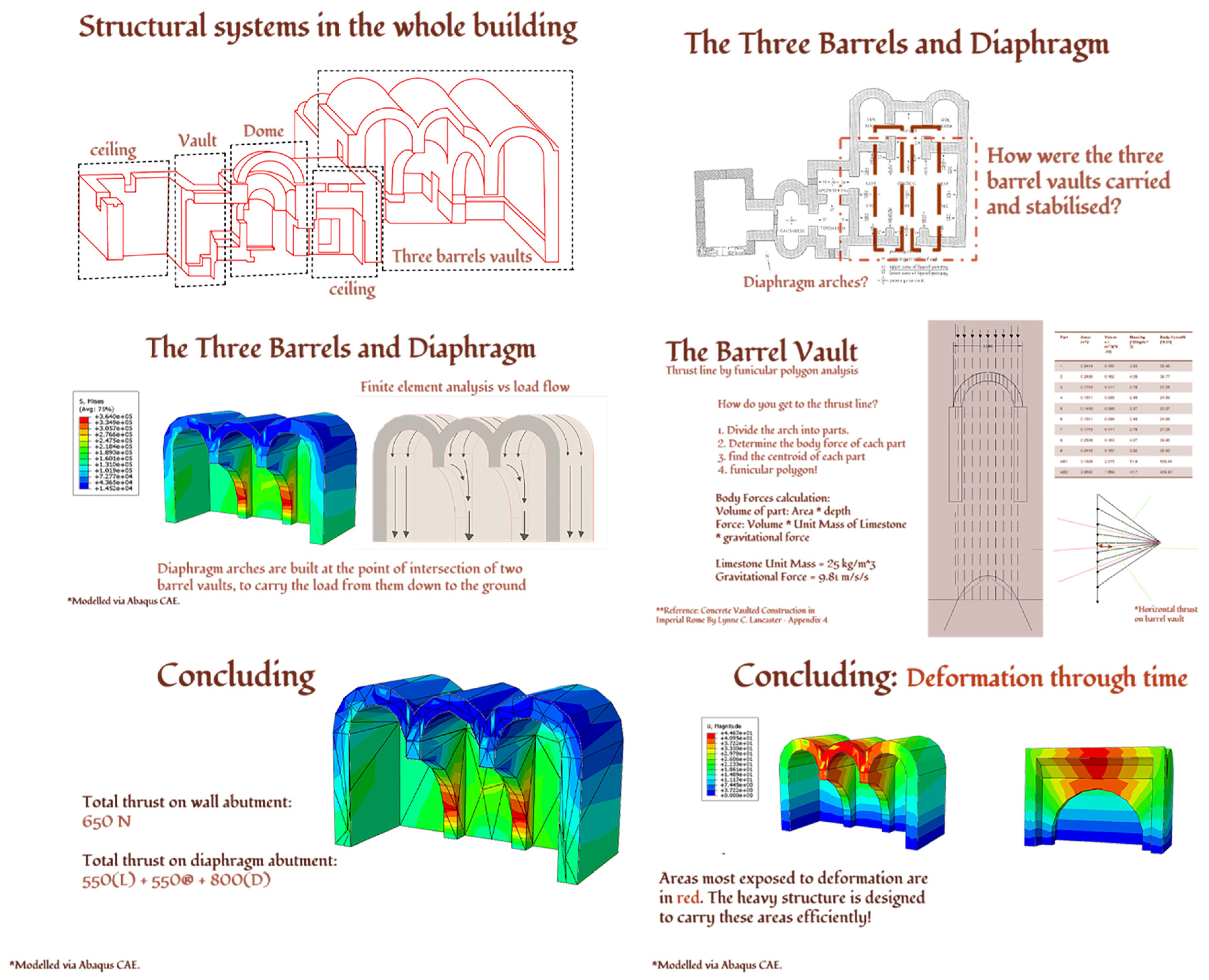
1.3. Distinguishing Architectural Archaeology
1.4. Architectural Archaeology: The Knowledge-Transfer Framework as Epistemology and Ontology
1.5. Article Structure
2. Literature Review: Reverse Engineering as Constructivist Pedagogy
2.1. Archaeology of Architecture Engineering: From Typology to Process
2.2. Relevance to Jordan’s Stone-Building Traditions
2.3. Research Design: The Knowledge-Transfer Framework for a Constructivist Architectural Archaeology Module
3. Results: The Knowledge-Transfer Framework in Practice—The Twofold Path of Object-Laden Epistemology and Value-Laden Ontology
3.1. Phase One—Object-Laden Epistemology
3.1.1. Operationalizing Object-Laden Epistemology: The Rational
3.1.2. Operationalizing Object-Laden Epistemology: The Learning Outcome
3.2. Phase Two—Value-Laden Ontology
3.2.1. Operationalizing Value-Laden Epistemology: The Rational
3.2.2. Operationalizing Value-Laden Epistemology: The Learning Outcome
4. Findings: The Knowledge-Transfer Framework—Four Dimensions of Transformation
4.1. Science-Making: Ancient Engineering as Reconstructed Knowledge
“I still needed to learn how difficult it was to develop and build. However, after taking this course, my perspective shifted dramatically. First, I learned about building mechanisms and how each building incorporates tools, materials, and a design suited to the environment and available materials. After inspecting the construction materials, dressing and fracturing are performed. The builders then moved it to the site by any means possible, and I have always wondered how they transported it to high altitudes. As it turned out, there are various lifting methods. Furthermore, the stones are not placed randomly but rather according to their characteristics, bearing capacity, and methods used to make them earthquake-resistant and heat-insulated, employing various techniques”.
“I have developed a new appreciation for the research and documentation of historical sites, particularly as I have become more aware of the need for proper care and construction. By examining this knowledge and its techniques and methods, one can see how easily many of our building problems today can be solved by methods now considered old and outdated, even though each piece holds its own importance”.
“Based on my research, a deeper analysis of each case study’s social, architectural, and geological layers enabled me to reconstruct a comprehensive account of people and places through the building and the ideas that followed its construction. It emphasized the ingenious ideas and innovative solutions that ancient builders devised to construct structurally sound buildings using technologies far more advanced than ours. On the other hand, buildings serve humans just as much, if not more…This motivates me to examine Jordan, and I need to sketch additional structures that more accurately reflect its materials and environment. I also learned more about new structural analysis and heritage documentation software technologies, which deepened my understanding of the elements that constitute a structure in ancient techniques and those that constitute our structures today, given differences in techniques and how these create different spaces for humans and evoke different feelings. Today, for example, a concrete slab feels ‘heavier,’ drawing a line in the sky. On the other hand, the arcuated structures have a ‘lighter’ feel, as if they are more connected to the sky. In the coming years of my studies, I hope to conclude with techniques that sit between the old and the new, highlighting both”.
4.2. Heritage-Making: From Distant Relics to Living Practice
“I will examine buildings from both cultural and epistemological, as well as scientific, standpoints, as in the case of Hagia Sophia. If I had not taken the [Ancient Building Techniques] course, I would have dismissed Hagia Sophia as merely a beautiful mosque from the inside and outside. However, I could no longer see it just as a mosque. First, I intend to read about it before seeing it. I plan to devote significant time to studying the structure, particularly its dome, and to examining why it remains standing. It is a large structure, but the pendentive dome makes it appear lighter. I will concentrate on the materials and how they convey a ‘lighter’ structure”.
4.3. Temporality-Making: Past and Present in Dialogue
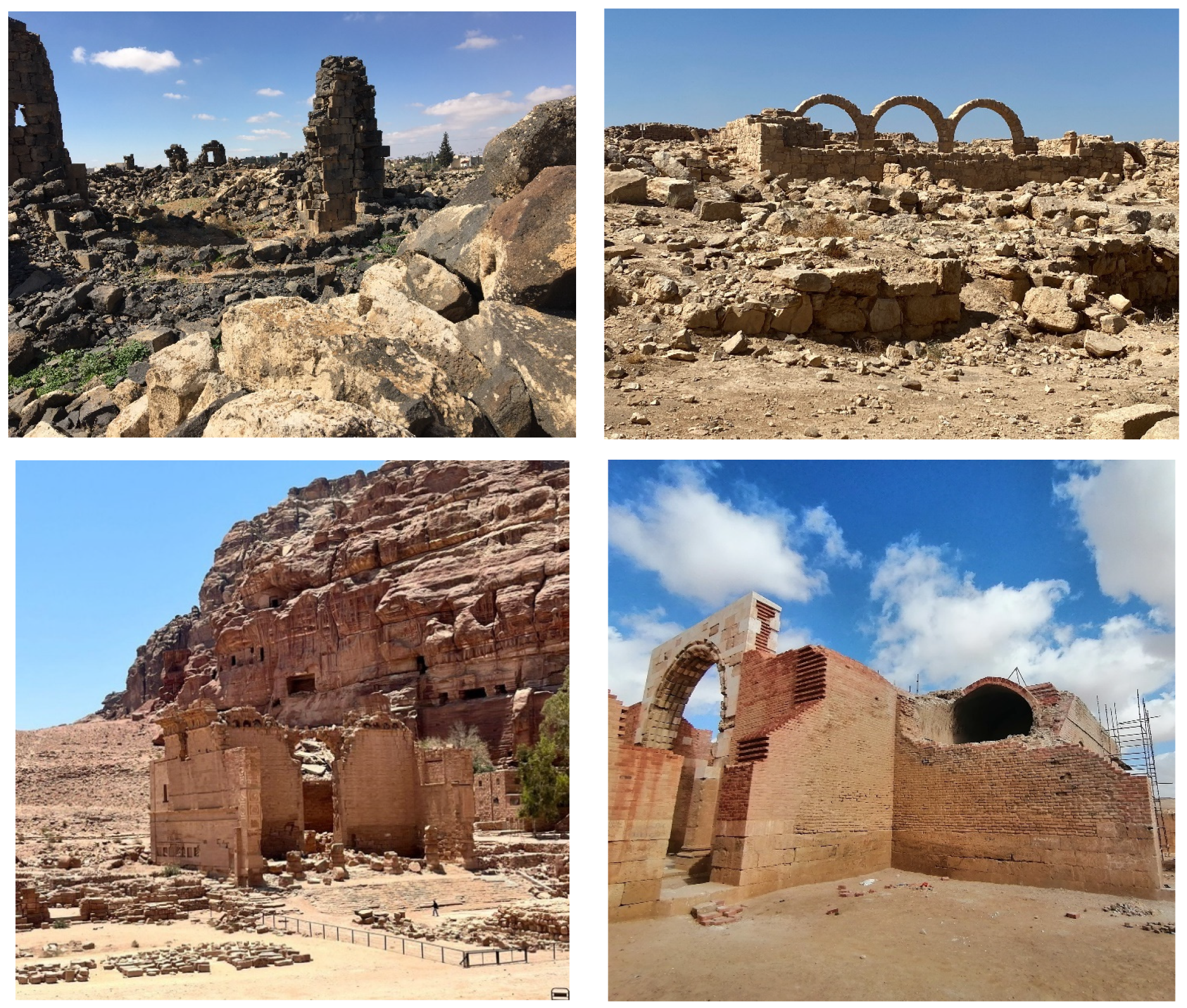
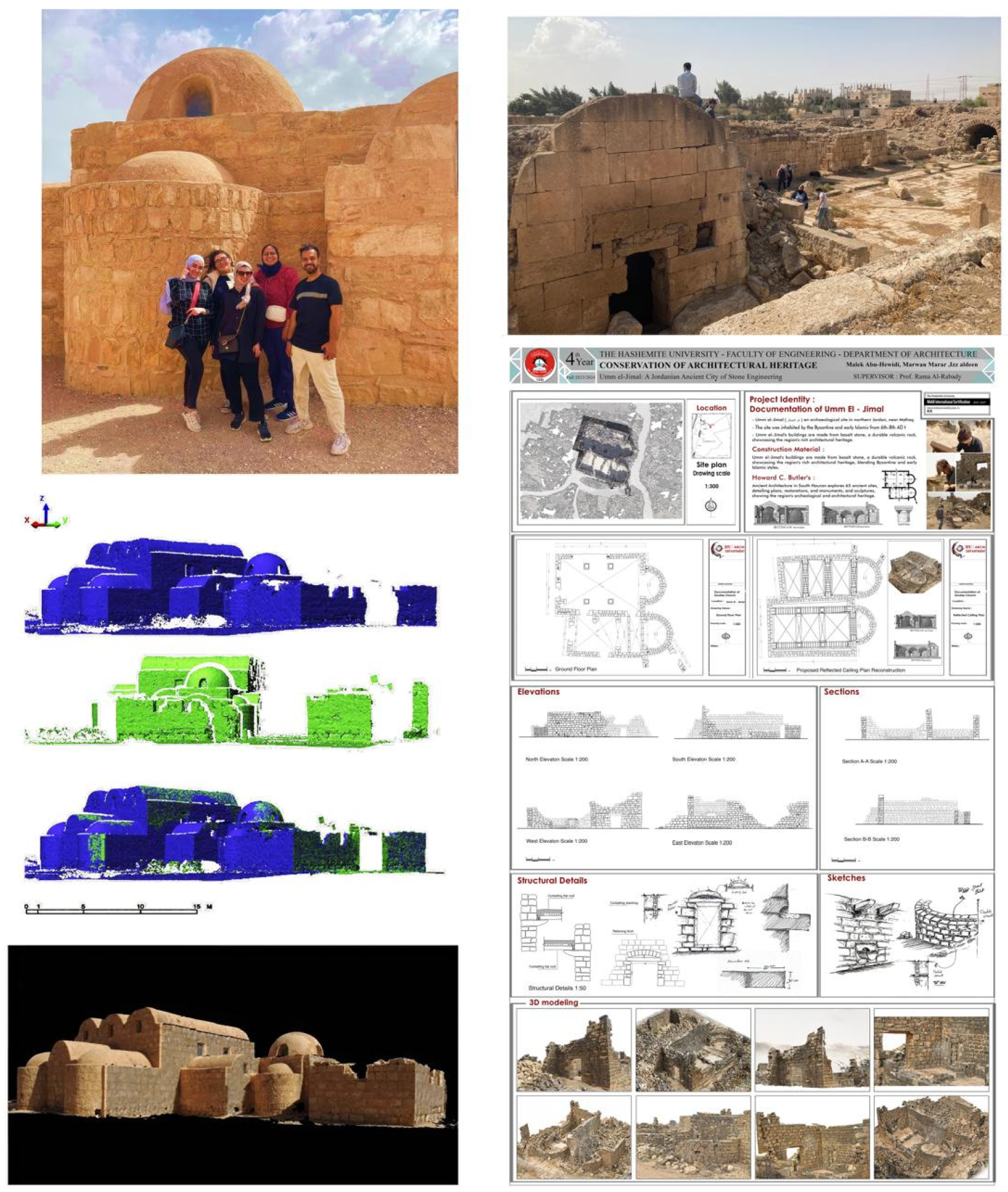
“The distinctive building techniques used by the builders of Umm el-Jimal, and the utilization of locally available materials whose qualities they could and should benefit from, are what cause them to stand out today. For instance, the basaltic flat roofs still visible today were a defining feature of Umm el-Jimal. Builders developed a corbeling system for constructing flat roofs. We now use concrete to make flat roofs. Umm el-Jimal’s architecture offers unique architectural and structural features. While contemporary concrete buildings are uniform, Umm el-Jimal was constructed with flat, corbelled basalt stones. These roofs can be considered precedents for contemporary concrete roofs, as they employed the structural system to construct multi-story buildings. We are currently constructing high-rise buildings and towers”.
“Further knowledge of material science can be gained by using structural analysis programs on Umm el-Jimal’s structures, digitally recording and modeling them, and then incorporating the knowledge and science into future construction projects… [it is essential to] teach. Instruct architecture students on stone-built architecture and its implementation as future approaches to stone-built structures”.
4.4. Advocacy-Making: Students as Custodian-Transmitters
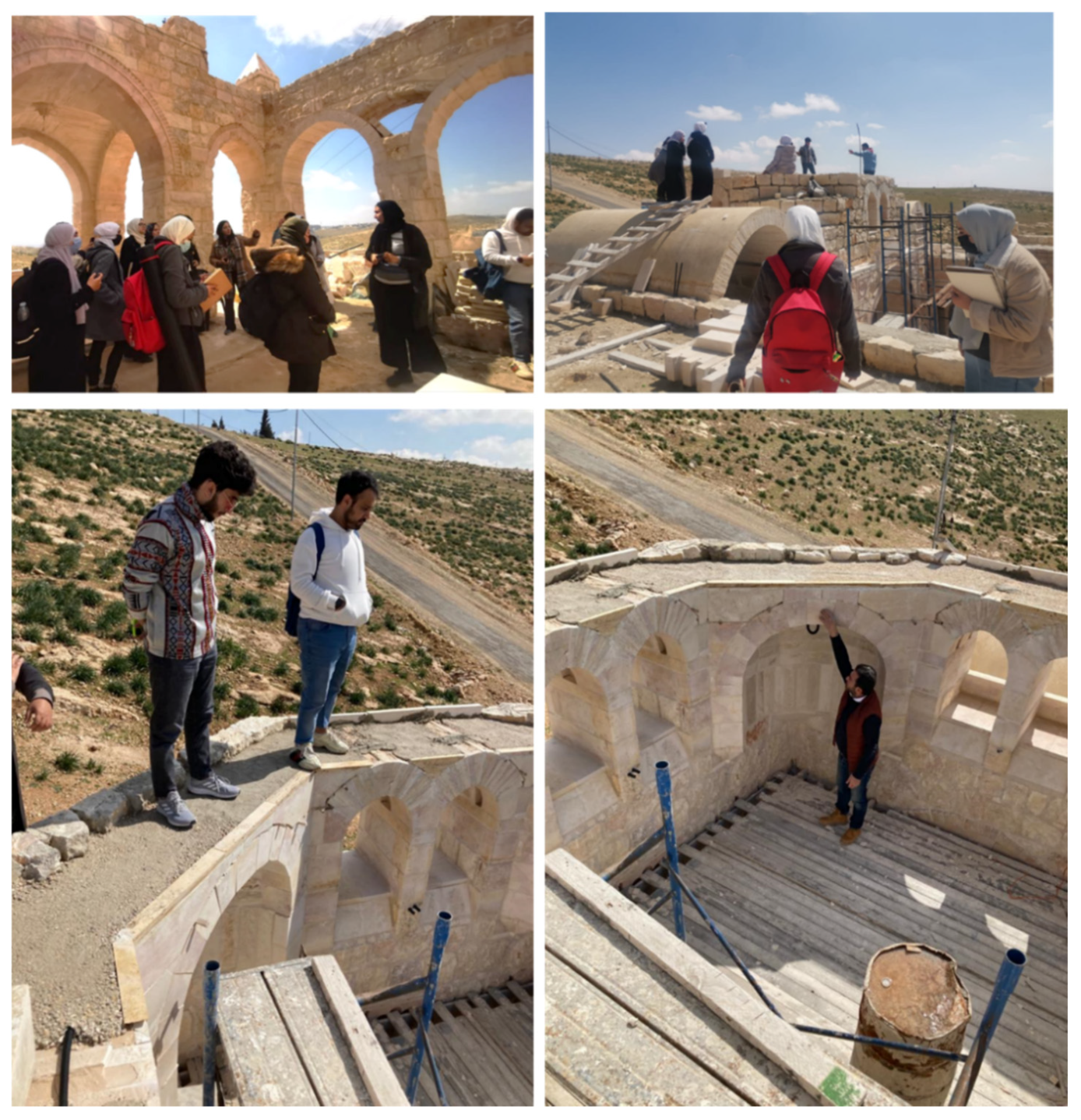
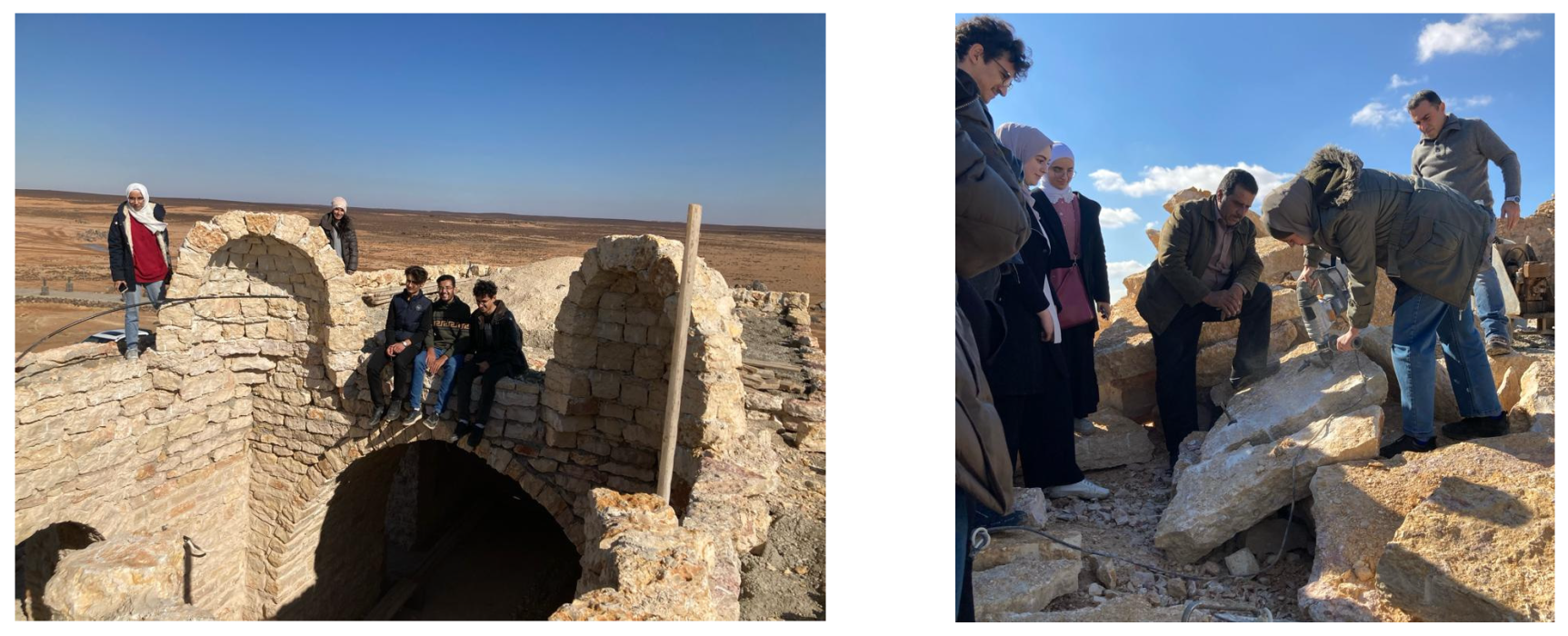
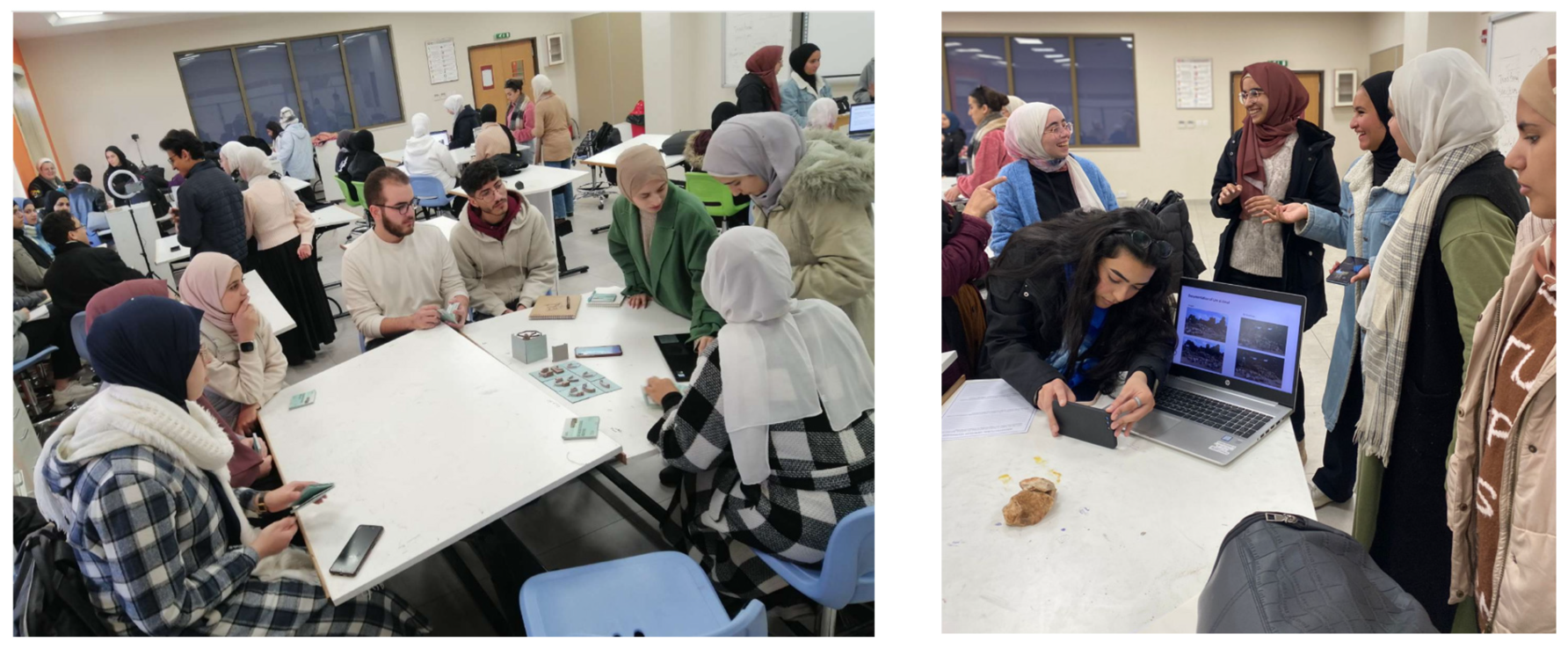
“The collaborative learning environment in the studio was stimulating, and the experience [of leading the workshop] has been both a privilege and a great responsibility. A rich tapestry of ideas emerged from facilitating conversations among people with diverse backgrounds and viewpoints. I appreciate the opportunity to help develop a new generation of preservationists, as I consider my responsibilities as an ‘instructor’ in this workshop on the protection of architectural archaeology. My experience in this course [the Conservation of Architectural Heritage course] has been transformative, reminding me that the real legacy of conservation lies in the structures we preserve, the knowledge we impart, and the enthusiasm we inspire in those who will continue the tradition”.
“It has been rewarding to lead a workshop [with second-year architecture students] because of the collaborative environment and our shared interest in the architectural archaeology of Jordan. The experience is gratifying because we, the ‘instructors’ and the recipients, are of similar ages. The students understood the subject, and we captured the spark of creativity and confidence that comes with newfound knowledge. Giving a workshop is a rewarding experience because of the constructive interactions, engaging conversations, and noticeable improvements in participants’ comprehension, further demonstrating the inspiring and empowering potential of learning about the architectural archaeology of Jordan”.
5. Discussion: The Knowledge Transfer Framework—Toward a ‘Continuum’ of Epistemology and Ontology
5.1. A Continuum of Engineering Knowledge in Architectural Archaeology Epistemology
5.2. A Continuum of Custodianship and Agency in Architectural Archaeology Ontology
6. Conclusions: Architectural Archaeology as a Constructivist Pedagogy of Transmission and Transformation
Funding
Institutional Review Board Statement
Informed Consent Statement
Data Availability Statement
Conflicts of Interest
| 1 | Despite their shared rejection of objectivist knowledge transfer, constructivism in education and archaeology operate differently across fields. Constructivism holds that students actively construct knowledge through experience, prior knowledge, and social interaction [12,13]. Constructivism, especially in post-processual archaeology, holds that past interpretations are actively constructed in the present by contemporary social, cultural, and political contexts rather than neutral discoveries of objective facts. This study intentionally blends both meanings: students reverse-engineer knowledge while acknowledging that archaeological knowledge is epistemologically generated through situated interpretation. |
| 2 | |
| 3 | Scholars emphasize the importance of employing diverse theoretical perspectives to uncover overlooked or underappreciated aspects of the archaeological record [1]. |
| 4 | |
| 5 | Each of the four competency domains in this module was assessed through multiple graded deliverables. Technical documentation and accuracy were evaluated from CAD drawings and photogrammetric models using a 0–4 scale to assess completeness, dimensional accuracy, layer organization, and annotation clarity. Structural & Material Analysis was evaluated based on Abaqus simulation reports; the correctness of boundary conditions, the appropriate assignment of material properties, and the logical interpretation of stress plots were weighted equally. Interpretive & Contextual Rigor was assessed through the critical comparison presentation, with separate scores for historical accuracy, quality of structural reasoning, and reflexivity about the limits of reverse engineering. Synthesis & Advocacy was evaluated through the final conservation proposal and peer workshop facilitation. Two instructors independently scored all submissions, and inter-rater reliability exceeded 0.85 across all domains. |
| 6 | Students take courses on the History of Architecture I and II and Islamic architecture as part of their curricula. Ancient Building Technologies requires completion of these courses in the order listed. The architectural archaeology of ancient civilizations is typically introduced to students in these courses only conceptually, with most examples not occurring in the relevant geographic context of Jordan. |
References
- Trigger, B.G. A History of Archaeological Thought, 2nd ed.; Cambridge University Press: Cambridge, UK, 2006. [Google Scholar]
- Al-Ghoul, O. Archeological Approaches in Jordan From 1800 Until Now. Jordan J. Hist. Archeol. 2022, 16, 243–261. [Google Scholar] [CrossRef]
- Hamilakis, Y.; Shanks, M.; Holtorf, C.; Tarlow, S.; Tierney, M. Relativism, objectivity and the politics of the past—The case of post-processual archaeology. Archaeol. Dialogues 1997, 7, 164–184. [Google Scholar]
- Amro, D. The Role of University Education in Directing Architects Towards Conserving the Sustainability of the Urban Cultural Heritage (Comparative Study) (Vol. 21); Al-Balqa Journal for Research and Studies: Amman, Jordan, 2018. [Google Scholar]
- Amro, D.; Sukkar, A.; Yahia, M.; Abukeshek, M. Evaluating the Cultural Sustainability of the Adaptive Reuse of Al-Nabulsi Traditional House into a Cultural Center in Irbid, Jordan. Sustainability 2023, 15, 13198. [Google Scholar] [CrossRef]
- Amro, D.; Abu Nasser, M. Post-Adaptive Reuse Evaluation of Heritage Spaces: A Case Study of Dar Al Saraya in Madaba, Jordan. Architecture 2025, 6, 1. [Google Scholar] [CrossRef]
- Prag, K. The Third Millennium in Jordan: A Perspective, Past and Future. Stud. Hist. Archaeol. Jordan 2001, 7, 179–190. [Google Scholar]
- Steen, E.J. The Archaeology of Jordan: A Condensed History. J. East. Mediterr. Archaeol. Herit. Stud. 2019, 7, 149–164. [Google Scholar]
- Yassine, K. The Archaeology of Jordan: Achievements and Charting the Future. Stud. Hist. Archaeol. Jordan 2001, 7, 27–31. [Google Scholar]
- Abu-Khafajah, S.; Al-Rabady, R.; Rababeh, S.; Tammoni, F. Hands-On Heritage! Establishing Soft Authority over Heritage through Architectural Experiment: A Case Study from Jordan. Public Archaeol. 2015, 14, 191–213. [Google Scholar] [CrossRef]
- Kolesnik, A.S.; Rusanov, A.V. Heritage-As-Process and its Agency: Perspectives of (Critical) Heritage Studies; Poletaev Institute for Theoretical and Historical Studies in the Humanities (IGITI): Moscow, Russia, 2020. [Google Scholar]
- Smith, L. Uses of Heritage; Routledge: London, UK, 2006. [Google Scholar]
- Piaget, J. The Psychology of Intelligence; Routledge & Kegan Paul: London, UK, 1950. [Google Scholar]
- Rawashdeh, S. Lecture Delves into Archaeology of Architecture. Jordan Times, 12 April 2023. Available online: https://jordantimes.com/news/local/lecture-delves-archaeology-architecture (accessed on 3 April 2020).
- ICOMOS. International Charter for the Conservation and Restoration of Monuments and Sites (The Venice Charter); ICOMOS: Paris, France, 1964. [Google Scholar]
- Feilden, B.M. Conservation of Historic Buildings, 3rd ed.; Architectural Press: London, UK, 2003. [Google Scholar]
- Schiffer, M.B. The Archaeology of Science: Studying the Creation of Useful Knowledge; Springer: Berin/Heidelberg, Germany, 2013. [Google Scholar]
- Renfrew, C.; Bahn, P. Archaeology: Theories, Methods and Practice, 8th ed.; Thames & Hudson: London, UK, 2020. [Google Scholar]
- Dessales, H. The Archaeology of Construction: A New Approach to Roman Architecture. Annales. Hist. Sci. Soc. 2017, 72, 69–86. [Google Scholar] [CrossRef]
- Beiersdorf, M.J. (Re)constructing History—How Building Archaeology can profit from the Knowledge of Engineering. Struct. Eng. Doc. 2017, 15, 41–45. [Google Scholar]
- Brogiolo, G.P. Archeologia Dell’architettura: Metodi e Interpretazioni; All’Insegna del Giglio: Sesto Fiorentino, Italy, 1996. [Google Scholar]
- Parenti, R. Dalla stratigrafia all’archeologia dell’architettura: Alcune recenti esperienze. Arqueol. Arquit. 2002, 1, 25–34. [Google Scholar]
- Anastasio, S.; Gilento, P.; Parenti, R. Ancient Buildings and Masonry Techniques in the Southern Hauran, Jordan. J. East. Mediterr. Archaeol. Herit. Stud. 2016, 4, 299–320. [Google Scholar] [CrossRef]
- De Luca, L.; Veron, P.; Florenzano, M. Reverse engineering of architectural buildings based on a hybrid modeling approach. Comput. Graph. 2006, 30, 160–176. [Google Scholar] [CrossRef]
- Al Rabady, R. Ancient masonry structures within an integrated approach: The reinforced corbelled flat roofs of Umm el-Jimal. Int. J. Hist. Eng. Technol. 2020, 89, 122–141. [Google Scholar] [CrossRef]
- Mannoni, T. Metodi di datazione dell’edilizia storica. In Archeologia Medievale, XI; All’Insegna del Giglio: Sesto Fiorentino, Italy, 1984. [Google Scholar]
- Mannoni, T.; Milanese, M. Mensiocronologia. In Archeologia e Restauro dei Monumenti; Francovich, R., Parenti, R., Eds.; All’Insegna del Giglio: Florence, Italy, 1988; pp. 383–402. [Google Scholar]
- Sapin, C. The archaeology of buildings: Assessment and perspectives. Les Nouv. De L’archéologie 1999, 75, 5–11. [Google Scholar]
- Osman, K.A.A. Heritage conservation management in Egypt: A review of the current and proposed situation to amend it. Ain Shams Eng. J. 2018, 9, 2907–2916. [Google Scholar] [CrossRef]
- Vygotsky, L. Interaction between learning and development. In Readings on the Development of Children; Gauvain, M., Cole, M., Eds.; Scientific American Books: New York, NY, USA, 1978; pp. 34–40. [Google Scholar]
- Menozzi, F. Postcolonial Custodianship: Cultural and Literary Inheritance; Routledge: New York, NY, USA, 2014. [Google Scholar]
- Rababeh, S. How Petra Was Built: An Analysis of the Construction Techniques of the Nabataean Freestanding Buildings and Rock-Cut Monuments in Petra, Jordan; British Archaeological Reports: Oxford, UK, 2005. [Google Scholar]
- Rababeh, S. Technical utilization of lifting devices for construction purposes in ancient Gerasa, Jordan. Int. J. Archit. Herit. 2015, 9, 1023–1036. [Google Scholar] [CrossRef]
- Rababeh, S.; Al Qablan, H.; El-Mashaleh, M. Utilization of tie-beams for strengthening stone masonry arches in Nabataean construction. J. Archit. Conserv. 2013, 19, 118–130. [Google Scholar] [CrossRef]
- Arce, I. From the diaphragm arches to the ribbed vaults. A hypothesis for the birth and development of a building technique. In Proceedings of the First International Congress on Construction History, Madrid, Spain, 20–24 January 2003; Reverte: Madrid, Spain, 2003; pp. 225–241. [Google Scholar]
- Arce, I. Umayyad Arches, Vaults & Domes: Merging and Re-creation. In Contributions to Early Islamic Construction History, 2nd ed.; International Congress on Construction History; Cambridge University Press: Cambridge, UK, 2006; pp. 195–220. [Google Scholar]
- Harrison, R. Surface assemblages: Towards an archaeology in and of the present. Archaeol. Dialogues 2011, 18, 141–161. [Google Scholar] [CrossRef]
- Eilam, E. Reversing: Secrets of Reverse Engineering; Wiley Publishing, Inc.: Indianapolis, IN, USA, 2005. [Google Scholar]
- Neamţu, C.; Popescu, S.; Popescu, D.; Mateescu, R. Using Reverse Engineering In Archaeology: Ceramic Pottery Reconstruction. J. Autom. Mob. Robot. Intell. Syst. 2012, 6, 55–59. [Google Scholar]
- Moshenska, G. Reverse engineering and the archaeology of the modern world. Forum Krit. Archäologie 2016, 5, 16–28. [Google Scholar]
- Catalano, A. Engineering how support of archaeology: Instrumental and safeguard technologies for interdisciplinary integration. Vitr. Int. J. Archit. Technol. Sustain. 2019, 1, 41–47. [Google Scholar] [CrossRef]
- Karoglou, M.; Bakolas, A.; Kouloumbi, N.; Moropoulou, A. Reverse engineering methodology for studying historic buildings coatings: The case study of the Hellenic Parliament neoclassical building. Prog. Org. Coat. 2011, 72, 202–209. [Google Scholar] [CrossRef]
- Jäger, J.; Helmedag, I.; Weber, T.M.; Abu-Jaber, N.; Suleiman, A.; Burkhardt, B.; Khammash, A. Stone and Architecture in the Mountainous Regions of Jordan and Syria; DAAD: Amman, Jordan; Damascus, Syria; Berlin, Germany, 2012. [Google Scholar]
- Al Rabady, R.; Rababeh, S. Engineering the reconstruction of Hawrān’s Ecclesiae during late antiquity: Case of Julianos church in Umm el-Jimal, Jordan. Herit. Sci. 2022, 10, 81. [Google Scholar] [CrossRef]
- Palecek, M.; Risjord, M. Relativism and the Ontological Turn within Anthropology. Philos. Soc. Sci. 2012, 34, 3–23. [Google Scholar] [CrossRef]
- Čapek, L. Ontological turns in archaeology and material culture studies: Archaeology as a discipline about ‘things’. Trop. Rev. 2023, 75, 68–98. [Google Scholar] [CrossRef]
- Meyer, J.H.F.; Land, R. Threshold concepts and troublesome knowledge (2): Epistemological considerations and a conceptual framework for teaching and learning. High. Educ. 2005, 49, 373–388. [Google Scholar] [CrossRef]
- Shulman, L.S. Signature pedagogies in the professions. Daedalus 2005, 134, 52–59. [Google Scholar] [CrossRef]
- Creswell, J.W.; Plano Clark, V.L. Designing and Conducting Mixed Methods Research, 3rd ed.; SAGE Publications: Thousand Oaks, CA, USA, 2017. [Google Scholar]
- Lincoln, Y.S.; Guba, E.G. Naturalistic Inquiry; SAGE Publications: Thousand Oaks, CA, USA, 1985. [Google Scholar]
- Mertens, D.M. Research and Evaluation in Education and Psychology: Integrating Diversity with Quantitative, Qualitative, and Mixed Methods, 4th ed.; SAGE Publications: Thousand Oaks, CA, USA, 2014. [Google Scholar]
- Henson, D. Constructivism in archaeology education. In Encyclopedia of Global Archaeology; Smith, C., Ed.; Springer: New York, NY, USA, 2014; pp. 1675–1679. [Google Scholar]
- Briede, B. A Constructivist Approach in Engineering Education. Eng. Rural. Dev. 2013, 23, 584–589. [Google Scholar]
- Abu Alsuod, N. (Department of Architecture Engineering, Hashemite University, Zarqa, Jordan). Interview on the Archaeology of Architecture; Interview by R. Rabady, 15 June 2022. [Unpublished interview].
- Abu Karki, R. (Department of Architecture Engineering, Hashemite University, Zarqa, Jordan). Interview on the Archaeology of Architecture; Interview by R. Rabady, 3 April 2021. [Unpublished interview].
- Al-Hamshari, R. (Department of Architecture Engineering, Hashemite University, Zarqa, Jordan). Interview on the Archaeology of Architecture; Interview by R. Rabady, 5 April 2021. [Unpublished interview].
- Allabadi, N. (Department of Architecture Engineering, Hashemite University, Zarqa, Jordan). Interview on the Archaeology of Architecture; Interview by R. Rabady, 20 June 2022. [Unpublished interview].
- Al-Qalawi, J. (Department of Architecture Engineering, Hashemite University, Zarqa, Jordan). Interview on the Archaeology of Architecture; Interview by R. Rabady, 15 June 2022. [Unpublished interview].
- Alrefaie, A. (Department of Architecture Engineering, Hashemite University, Zarqa, Jordan). Interview on the Archaeology of Architecture; Interview by R. Rabady, 26 June 2022. [Unpublished interview].
- Arabyat, H. (Department of Architecture Engineering, Hashemite University, Zarqa, Jordan). Interview on the Archaeology of Architecture; Interview by R. Rabady, 12 June 2022. [Unpublished interview].
- Khwais, N. (Department of Architecture Engineering, Hashemite University, Zarqa, Jordan). Interview on the Archaeology of Architecture; Interview by R. Rabady, 16 June 2022. [Unpublished interview].
- Bille, M.; Sørensen, T.F. Into the fog of architecture. In Elements of Architecture: Assembling Archaeology, Atmosphere and the Performance of Building Spaces; Bille, M., Sørensen, T.F., Eds.; Routledge: Oxon, UK, 2016; pp. 1–29. [Google Scholar]
- Westphalen, L.; Knight, J. Archaeology and engineering: What can engineers learn from the material cultures of the past? In Proceedings of the 20th Annual Conference for the Australasian Association for Engineering Education, Adelaide, Australia, 6–9 December 2009; Engineering the Curriculum. Engineers Australia: Canberra, Australia, 2009; pp. 783–788. [Google Scholar]
- Mrozowski, S.A. Pragmatism and the Relevancy of Archaeology for Contemporary Society. In Archaeology in Society: Its Relevance in the Modern World; Rockman, M., Flatman, J., Eds.; Springer: New York, NY, USA, 2012; pp. 239–256. [Google Scholar]




| Competency Domain | Operationalization of Reverse Engineering & Constructivism | Assessment Rubric Criteria | Data Source for Evaluation |
|---|---|---|---|
| 1. Technical Documentation & Accuracy | Deconstructing existing structures via measurement, digital scanning, and accurate representation | Completeness of survey data; Precision of 2D/3D CAD models; Correct identification of structural elements and materials | CAD drawings; Agisoft/RealityCapture models; Assignment grades |
| 2. Structural & Material Analysis | Applying reverse engineering to deduce load paths, material behaviour, and construction logic through numerical and comparative analysis | Correct application of analysis software (e.g., Abaqus); Validity of conclusions about stability, load-bearing capacity, and construction techniques | Structural analysis reports; Numerical models; Reflective journal entries on analytical challenges |
| 3. Interpretive & Contextual Rigor | Constructing meaning by connecting engineering analysis to historical, cultural, and environmental context | Depth of argument linking form/technique to context; Quality of critical comparison between ancient and contemporary cases | Final project reports; Focus group transcripts; Workshop presentation content |
| 4. Synthesis & Advocacy | Reconstructing knowledge to propose conservation strategies or contemporary applications, demonstrating constructed understanding and professional agency | Creativity and feasibility of conservation proposals; Clarity and persuasiveness in peer workshops; Evidence of changed attitudes in surveys/interviews | Conservation project proposals; Workshop feedback; Pre/post survey scores; Interview quotes on advocacy |
Disclaimer/Publisher’s Note: The statements, opinions and data contained in all publications are solely those of the individual author(s) and contributor(s) and not of MDPI and/or the editor(s). MDPI and/or the editor(s) disclaim responsibility for any injury to people or property resulting from any ideas, methods, instructions or products referred to in the content. |
© 2026 by the author. Licensee MDPI, Basel, Switzerland. This article is an open access article distributed under the terms and conditions of the Creative Commons Attribution (CC BY) license.
Share and Cite
Al Rabady, R.I. Architectural Archaeology Through Reverse Engineering: A Constructivist Perspective from Jordan. Architecture 2026, 6, 42. https://doi.org/10.3390/architecture6010042
Al Rabady RI. Architectural Archaeology Through Reverse Engineering: A Constructivist Perspective from Jordan. Architecture. 2026; 6(1):42. https://doi.org/10.3390/architecture6010042
Chicago/Turabian StyleAl Rabady, Rama Ibrahim. 2026. "Architectural Archaeology Through Reverse Engineering: A Constructivist Perspective from Jordan" Architecture 6, no. 1: 42. https://doi.org/10.3390/architecture6010042
APA StyleAl Rabady, R. I. (2026). Architectural Archaeology Through Reverse Engineering: A Constructivist Perspective from Jordan. Architecture, 6(1), 42. https://doi.org/10.3390/architecture6010042