Article

Impact of Synthetic Microfibers on Cellular and Biochemical Biomarkers in Mussel Mytilus galloprovincialis


by
Elena-Daniela Pantea
1,*,
Elena Stoica
1,*,
Valentina Coatu
2,*,
Elena Ristea
2 and
Andreea-Mădălina Ciucă
1
1
Ecology and Marine Biology Department, National Institute for Marine Research and Development “Grigore Antipa”, 300 Mamaia Blvd., 900581 Constanta, Romania
2
Chemical Oceanography and Marine Pollution Department, National Institute for Marine Research and Development “Grigore Antipa”, 300 Mamaia Blvd., 900581 Constanta, Romania
*
Authors to whom correspondence should be addressed.
Microplastics 2026, 5(1), 50; https://doi.org/10.3390/microplastics5010050
Submission received: 12 November 2025 / Revised: 1 December 2025 / Accepted: 14 February 2026 / Published: 9 March 2026

Abstract

Synthetic or plastic microfibers (MFs) are an emerging form of microplastic pollution in marine ecosystems, derived from textile degradation and weathering of fishing and aquaculture gear. Despite extensive evidence of MFs in marine organisms, the effects of MFs exposure on mussels remain poorly understood. This study investigated the impact of synthetic MFs on the mussel Mytilus galloprovincialis (Lamarck, 1819) over a semi-chronic time scale of 14 days, using MFs produced by grinding a microfiber cloth. Adult mussels were exposed to three MFs treatments: 8, 40, and 100 MFs/L, reflecting current and future scenarios in the Black Sea. Biomarkers assessed included lysosomal membrane stability (LMS), catalase (CAT), glutathione-S-transferase (GST), and acetylcholinesterase (AChE) activities. Significant lysosomal membrane destabilization (p < 0.05) occurred across all treatments. CAT activity in the digestive gland significantly decreased by 31.2%, 53.3%, and 62.1% at 8, 40, and 100 MFs/L, respectively. GST activity showed inhibition at 8 and 100 MFs/L and stimulation at 40 MFs/L. AChE activity decreased at 8 MFs/L but increased at higher concentrations. These results indicate that even environmentally relevant levels of synthetic MFs can alter cellular stability and enzymatic responses in mussels, suggesting potential ecological risks for marine bivalves.

1. Introduction

Plastics are highly versatile and low-cost materials, indispensable to modern life, with widespread use in daily use products and packaging in countless applications [1]. However, in marine environments, microplastics (particles smaller than 5 mm) have emerged as a major concern due to their persistence, distribution, and potential toxicity [2].
Microplastics (MPs) are categorized into primary and secondary types. Primary MPs are intentionally produced or directly released into the environment through industrial processes and product wear, while secondary MPs arise from the breakdown of larger plastics due to environmental factors such as sunlight, wave action, and mechanical stress [3,4].
A wide range of marine organisms, including plankton [5], crustaceans [6,7,8], fish [9,10,11,12], marine birds [13,14,15], marine mammals [16,17,18], and benthic invertebrates [19,20], have been documented to ingest or interact with MPs in various ways.
Ingested MPs can block digestive tracts or damage internal tissues, leading to impaired feeding, reduced reproduction, diminished predator avoidance, toxicant transfer, and, in some cases, death in marine organisms [21]. Furthermore, marine animals face additional risks from the toxic chemicals released by plastics and from the harmful pollutants that these materials absorb from the environment [22]. Microplastics are prevalent in the marine environment in a variety of shapes, typically categorized into fragments, fibers, films, and beads [23].
Microfibers (MFs), thread-like plastic particles primarily composed of polyester, polypropylene, or nylon, are the most common form of microplastic pollution in marine ecosystems [23,24]. Additionally, naturally derived and semi-synthetic cellulosic MFs (e.g., cotton and rayon) have also been identified in the environment [23].
Microfibers are generated throughout the entire lifecycle of textile products, from manufacturing to daily wear, with laundering and regular use recognized as the main pathways for their release into the environment [25]. Another significant source of MFs is the weathering and abrasion of nets and ropes used in aquaculture and fishing, which contribute to their release into the marine environment [23]. Numerous studies have quantified MFs release during laundry, reporting that a single 5–6 kg wash load can shed between 6 and 18 million fibers [26,27,28]. The extent of fibers release is closely linked to the type of textile material and the product lifecycle [29].
The marine bivalve Mytilus galloprovincialis (Lamarck, 1819) is used as a bioindicator in many toxicological and environmental studies because of its sensitivity to pollutants, tough shell and ease of handling in the laboratory, widespread geographic distribution, sedentary lifestyle, and ease of sampling [30]. Mussels are sedentary filter-feeders with high ecological and economic importance, but they are continuously exposed to pollutants due to their feeding activity [30]. Mussels’ low metabolic detoxification and strong habitat correlation make them suitable for biomonitoring contaminants and MPs [31,32].
Microplastic ingestion by mussels can lead to reduced physiological performance [33], histological, inflammatory, and immunological alterations, lysosomal membrane destabilization, hemocyte mortality, and dysplasia [34,35,36,37,38], oxidative stress [36,39,40,41], impaired reproduction, neurotoxicity, genotoxicity, and transcriptional responses [38,39,40,41,42,43].
Microfibers are the most detected microplastics in the marine environment, with polyethylene terephthalate (PET) being the most frequently reported polymer [44]. Although few exposure studies are available, fiber toxicity remains largely unknown, even though it is one of the most common forms (>60%) of bioaccumulated MPs in bivalves [45]. In the Black Sea, several studies have reported the presence of MPs in wild mussels, with MFs emerging as the predominant form [46,47,48,49]. However, to date, no experimental studies have specifically investigated the effects of MPs on this species in the region. This highlights the need for further research to better understand the potential cellular and biochemical disruptions caused by MFs in mussels.
Most studies on MPs pollution primarily focus on spherical polystyrene particles, with relatively few investigations into MFs and other polymer types [37]. Despite their widespread environmental presence, there is limited information on the effects of MFs, particularly those originating from the wear and washing of synthetic textiles, which are recognized as the primary source of MFs in the environment [50]. Microfibers released from textile washing can severely compromise the health of M. galloprovincialis, impairing digestion, reproduction, and enzyme function, and thereby posing a broader threat to marine ecosystem stability [51].
Thus, this study aimed to assess the sub-lethal effects of synthetic MFs on cellular and biochemical biomarkers in Mytilus galloprovincialis. To evaluate these effects, we measured lysosomal membrane stability (LMS) as a cellular biomarker, along with biomarkers of oxidative stress (catalase, CAT), defense system activation (glutathione-S-transferase, GST), and neurotoxicity (acetylcholinesterase, AChE). The study was conducted over a semi-chronic exposure period of 14 days at three MFs concentrations (8, 40, and 100 MFs/L).

2. Materials and Methods

2.1. Collection and Laboratory Acclimatization of Mussels

Mature mussels (Mytilus galloprovincialis) were manually collected in December 2024 from the coastal area of Mangalia (Romania), located in the northwestern Black Sea (43°48′16.67″ N, 28°35′31.44″ E). The collected individuals were immediately transported to the laboratory in an insulated cooling box, filled with seawater from the sampling site. In the laboratory, mussels were carefully cleaned of epibionts (e.g., algae and barnacles) and rinsed with seawater.
The collected mussels were acclimated in the laboratory for about 2.5 months in a 900 L fiberglass-reinforced plastic (FRP) flow-through tank filled with 200 L of filtered, UV-sterilized, continuously aerated natural seawater. The mussels were maintained at 17 ± 3 °C under a natural photoperiod (16:8 h light–dark). They were fed daily with 4 L of high-density Isochrysis galbana culture (17.06 ± 18.83 × 10⁶ cells/mL) cultivated in the laboratory. During the acclimation period, seawater was renewed entirely every week. The health status of the organisms was inspected daily throughout the acclimation period, and dead organisms were immediately discarded, and the water was renewed.

2.2. Water Quality

Natural seawater was pumped from an area distant from known pollution sources and stored in a large underground tank. Before initiating the experiment, physicochemical parameters of the seawater (temperature, salinity, dissolved oxygen, pH), nutrients, and contaminant levels were measured to verify ambient environmental conditions and ensure the absence of pollution. Seawater physicochemical parameters were measured using a Mettler ToledoTM S479 (SevenExcellenceTM Multiparameter Benchtop, ©Mettler-Toledo GmbH, Greifensee, Switzerland). Analyses of nutrients and contaminants were conducted following established international protocols for seawater analysis [52,53,54,55].

2.3. Plastic Microfibers Preparation

The MFs used in this study were prepared by carefully shaving a newly purchased soft microfiber cleaning cloth (30 × 40 cm) with stainless-steel scissors. According to the manufacturer’s product label, the cloth is made of 80% polyester and 20% polyamide (microfiber type, density 200 g/m2). The polymer composition of the microfiber cloth could not be verified due to the lack of appropriate equipment. Therefore, this analysis could not be performed. This represents a limitation of our study; however, to support the interpretation of our results, we provide a reference spectra for polyester–polyamide fibers from the Database of ATR-FT-IR Spectra of Various Materials [56] (Figure S1). Blue textile material was selected as a source of microfibers because of its distinct color, making it easy to differentiate from natural fibers and degraded synthetic fibers that may commonly be present in the laboratory.
The fine pieces of microfiber cloth were frozen at −80 °C for 60 min using an ultra-freezer (MDF-DU302VX-PE TwinGuard ULT Freezer, PHC Corporation, Tokyo, Japan) and subsequently ground with an electric grinder until a fine microfiber powder was obtained.
After grinding, the fine powder was mixed with pre-filtered distilled water (Mixed Cellulose Esters membrane filter, MCE, 0.22 µm pore size, 47 mm diameter, sterile, white gridded; Millipore, Merck KGaA, Darmstadt, Germany) and filtered through a 300 µm nylon sieve to separate fine microfibers from larger particles. The resulting MFs suspension was then filtered using a vacuum filtration system (PFC-51-AXIVA, AXIVA, India) through 180 µm nylon net filters (Millipore, Merck KGaA, Darmstadt, Germany). The MFs size range (180−300 µm) was selected for the exposure due to the prevalence of small microplastics (<1 mm) encountered on the Black Sea coast [57]. To prevent potential microbial growth, the MFs retained on the filters after filtration were rinsed with 70% ethanol. The MFs were subsequently recovered from the nylon filters by washing with pre-filtered distilled water (0.22 µm), yielding a stock suspension with a high MFs density. The MFs stock solution was stored in the dark at 4 °C to limit microbial growth.
Prior to quantification, the MFs stock solution was homogenized to ensure uniform dispersion by sonication for 30 min (Sonorex Super RK 52 Ultrasonic Bath, Bandelin, Berlin, Germany) and subsequent vortexing at 1300 RPM for 2 min (DLab Scientific Co., Ltd., MS-H280-Pro Magnetic Hotplate Stirrer, Beijing, China).
Subsequently, 1 mL of the MFs stock solution was filtered in triplicate onto gridded polytetrafluoroethylene (PTFE) filters (5 µm pore size; 47 mm diameter; Millipore Mitex™, Darmstadt, Germany) using vacuum filtration.
After drying for 24 h at room temperature, the MFs were counted under a stereomicroscope (Olympus SZX10, Olympus, Tokyo, Japan) and photographed with a digital camera (Olympus SC50, Olympus, Tokyo, Japan). Fifty MFs from each replicate filter were measured using the polyline tool of the imaging software (Olympus cellSens Entry Ver. 4.3, Olympus, Tokyo, Japan). The stock solution volume required for each MFs exposure batch was calculated based on the estimated average number of MFs per 1 mL of stock solution (175 ± 64.37 MFs/mL).

2.4. Experimental Design

Before the experiment, 40 individuals with shell lengths ranging from 4.4 to 5.7 cm (5.01 ± 0.33) were selected and moved from the flow-through seawater system to a temperature-controlled room set to the same temperature as the environment where the mussels had been previously acclimated (18 °C), then gradually acclimated to 15 °C. Ten individuals were randomly distributed in four 12 L glass aquaria.
The mussels were acclimated in the temperature-controlled room to the exposure conditions in semi-static conditions for 10 days at a test temperature of 15 °C, in 10 L of pre-filtered seawater (1 µm glass microfiber filters, Ahlstrom-Munksjo, 47 mm diameter, Ahlstrom-Munksjo, Bärenstein, Germany), with continuous aeration (through aeration stones) and a 12:12 h light–dark cycle (1604–2328 lx). The seawater in the aquaria was completely replaced every 48 h with 1 µm pre-filtered seawater by a vacuum pump (ME4NT, VACUUBRAND, Wertheim, Germany). During acclimation, the organisms were continuously fed at 338.5 µL/min with a highly concentrated culture of I. galbana (approximately 10 × 106 cells/mL) using a multi-channel peristaltic pump (LongePump, BT100-1L, Longer Precision Pump Co., Ltd., Baoding, China). The microalgae cells in the stock culture were kept in suspension through air bubbling ensured by an air pump (Resun, LP-60, Shenzhen, China). The microalgae cultures were changed daily to provide a fresh feed for mussels.
After the acclimation and depuration period, a 14-day exposure test was conducted, during which the mussels (except those in the control group) were exposed to different concentrations of MFs. The testing conditions in the temperature-controlled room were identical to those during the 10-day acclimation period. Microfiber aggregation was monitored daily by collecting 30–40 mL of water from each aquarium before water renewal and examining the samples under a stereomicroscope. No MFs aggregation was observed. To keep the MFs in suspension and ensure a uniform distribution of feed, seawater was continuously aerated using aeration stones positioned near the bottom of the aquaria (1–2 cm above the aquaria bottom) and was gently stirred a few times per day with a glass rod.
Three nominal MFs concentrations were selected for the experiment: 8, 40, and 100 MFs/L. The four experimental groups were as follows: (1) CTRL–control (no MFs); (2) MF–T1 (8 MFs/L; equivalent to 46 µL MF stock solution/L); (3) MF–T2 (40 MFs/L; equivalent to 228.6 µL MF stock solution/L); (4) MF–T3 (100 MFs/L; equivalent to 2285.7 µL MF stock solution/L). The concentration of 8 MFs/L was selected to represent the average MP levels reported at the water surface of the Romanian (7 MPs/m3) and Turkish (7.21 MPs/m3) sectors of the Black Sea, which are generally lower than those observed in the water column [58]. The 40 MFs/L concentration reflected the average MP abundance measured in the water column along the Turkish coast (24.475 ± 26.153 MPs/m3) [58]. The highest concentration (100 MFs/L) represents a plausible future environmental scenario, given that riverine inputs (particularly from the Danube River) are among the major sources of microplastic pollution in the Black Sea [58].
Daily, the seawater or exposure solution in all aquaria (CTRL, MF–T1, MF–T2, and MF–T3) was replaced entirely with 0.22 µm pre-filtered seawater (Mixed Cellulose Esters membrane filter, MCE, 0.22 µm pore size, 47 mm diameter, sterile, white gridded; Millipore, Merck KGaA, Darmstadt, Germany), filtered 24–48 h before use and maintained at test temperature (15 °C). To maintain constant exposure concentrations, after each water change, a new volume of the stock MFs solution was added to each treatment (MF–T1, MF–T2, and MF–T3), corresponding to 8, 40, and 100 MFs/L, respectively. Before each new inoculation with MFs, the stock MFs solution was homogenized for 30 min at 1300 RPM using a magnetic stirrer and a stirring bar. Mussels in the control group (CTRL) were maintained throughout the experiment only in pre-filtered seawater (0.22 µm). Throughout the entire acclimation and depuration period (10 days) and during the exposure period (14 days), organisms were monitored daily. No mussels with closed valves, mortalities, or pseudofeces production were observed from the beginning of acclimation until the end of the test period. In addition, water quality parameters (temperature, salinity, dissolved oxygen, and pH) were monitored daily before and after seawater exchanges in all test aquaria.

2.5. Lysosomal Membrane Stability—Neutral Red Retention Assay

At the end of the 14-day exposure, hemolymph was collected from the posterior adductor muscle of all mussels (n = 10) from both control and MFs-exposed groups. Hemocyte lysosomal membrane stability (LMS) was assessed using the neutral red retention time (NRRT) assay, as described by [59]. Hemolymph (0.1 mL) was withdrawn with a 1 mL syringe containing 0.1 mL of physiological saline solution (NaCl, 9 mg/mL, BRAUN, Kronberg im Taunus, Germany) and transferred to 1.5 mL Eppendorf tubes. For cell fixation, 50 μL of the hemolymph–saline mixture was placed on Poly-L-Lysine–coated slides and incubated for 15 min at 4 °C. Excess liquid was removed, and 40 μL of neutral red (dye content ≥ 90%, Sigma-Aldrich®, Burlington, MA, USA) working solution (100 mM stock diluted 1:500 in physiological saline) was added. Slides were incubated for 15 min at 4 °C, excess dye was removed, and hemocytes were rinsed with 40 μL of saline before being covered with a coverslip. Lysosomal membrane stability was evaluated by recording the retention time of neutral red within hemocytes under an inverted microscope (OLYMPUS IX73, Olympus, Tokyo, Japan) at 15, 30, 60, 90, 120, 150, and 180 min post-incubation.
The percentage of LMS (or lysosomal damage) was determined using a standardized scoring procedure [59]. A weighted score was calculated by multiplying each score by its corresponding weighting factor at each time point. For analysis, scoring was truncated at 120 min. The overall lysosomal condition was quantified by calculating the total score as follows:
%   L M S = 1     w s 75   ×   100
where ∑ ws represents the sum of the weighted scores, calculated by multiplying each score by its corresponding weighting factor at the specific time point.

2.6. Biochemical Biomarkers

After hemolymph sampling, five of the ten (un)exposed mussels from each aquarium were dissected. One gill and half of the digestive gland were immediately frozen in liquid nitrogen and stored at −80 °C until homogenization for biochemical analyses. The gonad, one gill, and the rest of the digestive gland were fixed in 5% buffered formalin for subsequent histological analyses, which are not included in this study.
Tissues were homogenized using a Potter–Elvehjem homogenizer (Glas-Col®, Terre Haute, IN, USA) in a 1:4 (w/v) ratio with 100 mM phosphate buffer (pH 7.4). The homogenates were centrifuged at 10,000× g for 30 min at 4 °C, and the resulting supernatant was diluted 1:4 for subsequent CAT and GST activity measurements. For AChE activity, tissues were homogenized in a Potter–Elvehjem homogenizer in a 1:2 (w/v) ratio of 0.1 M Tris-HCl buffer containing 0.1% Triton X-100 (pH 7.0). Homogenates were centrifuged at 10,000× g for 20 min at 4 °C. The biochemical analyses were performed following established protocols: catalase (CAT) activity was determined according to [60], glutathione S-transferase (GST) activity according to Habig et al. [61], and acetylcholinesterase (AChE) activity according to Ellman et al. [62].
Enzymatic activities were normalized to the total protein content of each sample, determined by the Bradford assay [63]. The methodology is briefly described in Appendix A.

2.6.1. Catalase Activity

Catalase activity was determined by measuring the decomposition of hydrogen peroxide (H2O2) following its reaction with the enzymatic extract over a fixed period. The assay is based on the reduction of potassium dichromate in an acidic medium by H2O2 to form chromic acetate, which exhibits absorbance at 570 nm. Since dichromate does not absorb in this region, the presence of the compound in the reaction medium does not interfere with the colorimetric determination of chromic acetate. The amount of H2O2 in the sample was quantified by measuring the absorbance at 570 nm and comparing it to a standard curve generated with known H2O2 concentrations.
For the catalase assay, 0.1 mL of enzymatic extract was added to each test tube. To the blanks, 0.1 mL of 0.01 M phosphate buffer (pH 7.0) was added instead of the sample. To all tubes, 0.4 mL of 0.01 M phosphate buffer (pH 7.0) and 0.5 mL of 0.16 M hydrogen peroxide (H2O2) were added. After 60 s, the reaction was stopped with 0.2 mL of bichromate reagent, prepared by mixing one part of 5% potassium dichromate (K2Cr2O7) solution with three parts glacial acetic acid. All tubes were then heated in a boiling water bath for 10 min, cooled to room temperature, and the absorbance was measured at 570 nm.

2.6.2. Glutathione S-Transferase Activity

GST activity was determined by measuring the conjugation of 1-chloro-2,4-dinitrobenzene (CDNB) with reduced glutathione (GSH), as indicated by an increase in absorbance at 340 nm. For the assay, 15 µL of sample or buffer (for blanks) was added to each well of a microplate, followed by 200 µL of assay mixture containing 42 mM CDNB and 42 mM GSH in 0.2 M phosphate buffer (pH 6.5). Absorbance was recorded immediately at 340 nm for 4 min at 25 °C, with readings taken at 30 s intervals.

2.6.3. Acetylcholinesterase Activity

AChE activity was measured by following the production of yellow thiocholine resulting from the enzymatic hydrolysis of acetylthiocholine iodide, which reacts with 5,5′-dithiobis (2-nitrobenzoic acid) (DTNB). For the assay, 60 µL of the sample supernatant was added to each well of a microplate, followed by 290 µL of 0.1 M Tris-HCl buffer containing 0.1% Triton X-100 (pH 7.0) and 20 µL of freshly prepared 0.01 M DTNB in 0.1 M Tris-HCl buffer (pH 8.0). The reaction was initiated by adding 10 µL of 0.1 M acetylthiocholine iodide (ACTC), and the increase in absorbance was read at 414 nm every 15 s for 2 min.

2.7. Quality Control

To minimize airborne MFs contamination, all procedures were performed using glass or metal laboratory equipment, and samples were covered with aluminum foil. Experimental tanks were covered with glass lids. Laboratory personnel wore white cotton lab coats and non-blue disposable nitrile gloves. When the use of plastic materials was unavoidable, new, sterile items were used. For accurate measurement of the MFs stock solution, new, sterile, white micropipette tips with a filter were used.

2.8. Data Analysis

The statistical analysis of data was performed using JASP version 0.95.4.0 [64,65] and PRIMER 7 version 7.0.24 [66]. The normality of data distribution was assessed using the Shapiro–Wilk test, and the homogeneity of variances was verified with Levene’s test. Differences among treatments were assessed using parametric One-way Analysis of Variance (ANOVA), followed by Tukey’s HSD post hoc test to identify significant pairwise differences, provided the data met the assumptions of normality and homogeneity. Data that do not meet this assumption were analyzed using the non-parametric Kruskal–Wallis test, followed by Dunn’s post hoc test for multiple pairwise comparisons. Statistical significance was accepted at p < 0.05. Based on the results of the normality and homogeneity tests (Table S7), differences among the four experimental mussel groups (CTRL, MF–T1, MF–T2, and MF–T3) were evaluated using the nonparametric Kruskal–Wallis H test for NRRT, CAT activity, and GST activity, and one-way ANOVA was applied for percentage of LMS and AChE activity.
To analyze data variability, a multivariate statistical approach was employed using Principal Component Analysis (PCA) on square-root-transformed and normalized data. PCA was applied to biomarker data (lysosomal membrane stability, catalase, glutathione S-transferase, and acetylcholinesterase activity) to discriminate between different exposure conditions; a threshold factor loading of 0.5 and an eigenvalue > 1 were used as a cut-off value. Data are expressed as mean ± standard deviation (SD).

3. Results

3.1. Microfibers Characterization

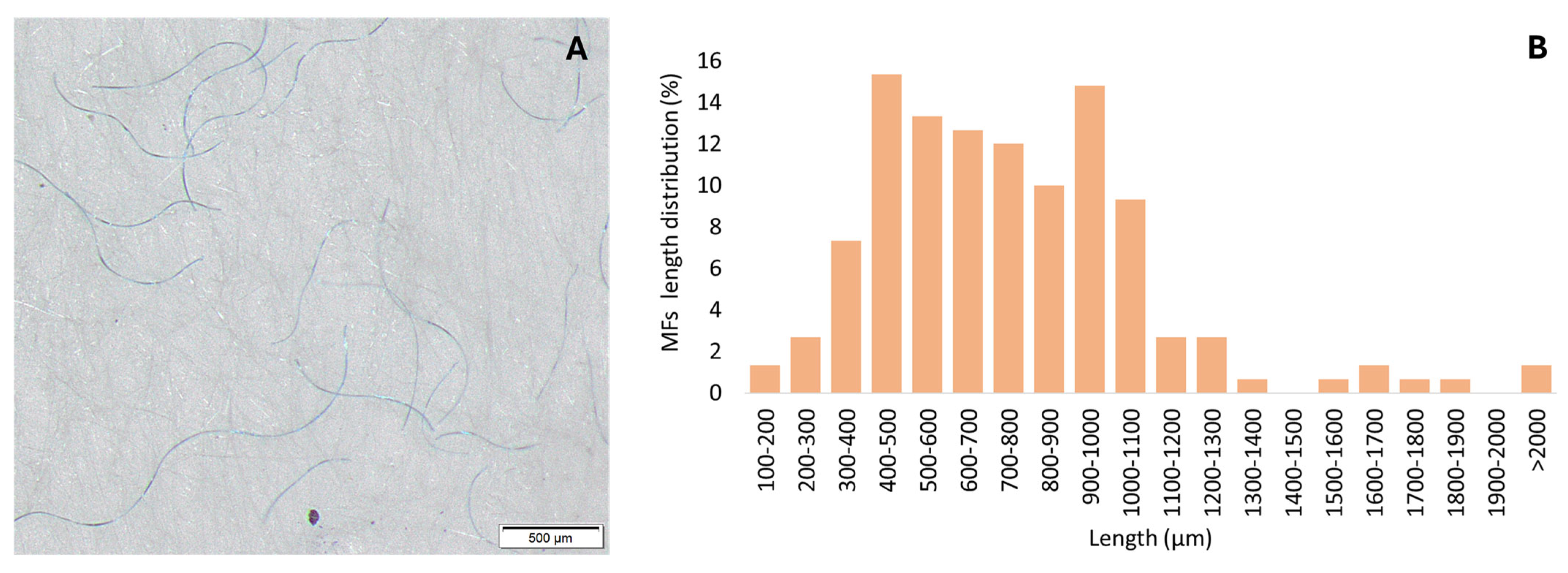
Under light microscopy, the MFs exhibited a bluish coloration and a heterogeneous range of lengths and shapes. The fiber morphology was preserved after grinding, appearing as long, narrow strips (Figure 1A). Although the target MFs length was 180–300 μm, many fibers exceeded the 300 µm mesh pore size. Their flexibility likely allowed them to bend, fold, and reorient under hydrodynamic forces, enabling passage through smaller mesh openings during sample processing. As a result of this plasticity, some MFs longer than 300 μm were able to pass through the 300 μm mesh sieve. The average MFs length was 743.24 ± 375.67 µm (n = 150). MFs ranging from 400 to 900 µm accounted for approximately 63.3% of the total fibers measured, with the highest proportion observed in the 400–500 µm length range (Figure 1B).

3.2. Seawater Quality Parameters

Natural seawater used during the acclimation and experimental exposure of mussels met the contaminant limits established by national legislation [67,68,69] (Tables S1–S5). No polychlorinated biphenyls (PCBs) were detected.
The mean values of the seawater quality parameters measured during the 14-day mussel exposure period, both in the control group and in the groups exposed to different microfiber concentrations, are presented in Table S6. The recorded values showed no significant variations in the measured parameters between the control group and the groups exposed to MFs. Seawater temperature ranged between 13.40 ± 0.35 °C (MF–T1) and 13.49 ± 0.50 °C (CTRL), salinity between 16.20 ± 0.61 psu (CTRL) and 16.36 ± 0.45 psu (MF–T1), pH between 7.53 ± 0.14 (MF–T3) and 7.56 ± 0.13 (CTRL) and dissolved oxygen between 9.93 ± 0.52 mg/L (MF–T2) and 10.15 ± 0.58 mg/L (CTRL).

3.3. Effect of Plastic Microfibers on the Lysosomal Membrane Stability of Hemocytes

Lysosomal membrane stability is a sensitive biomarker for MFs exposure, as it detects early cellular stress in hemocytes caused by physical and chemical disturbances [70]. Assessing LMS allows the identification of sublethal effects on cellular integrity and immune function, providing a biologically relevant measure of the potential impacts of MFs on mussel health.
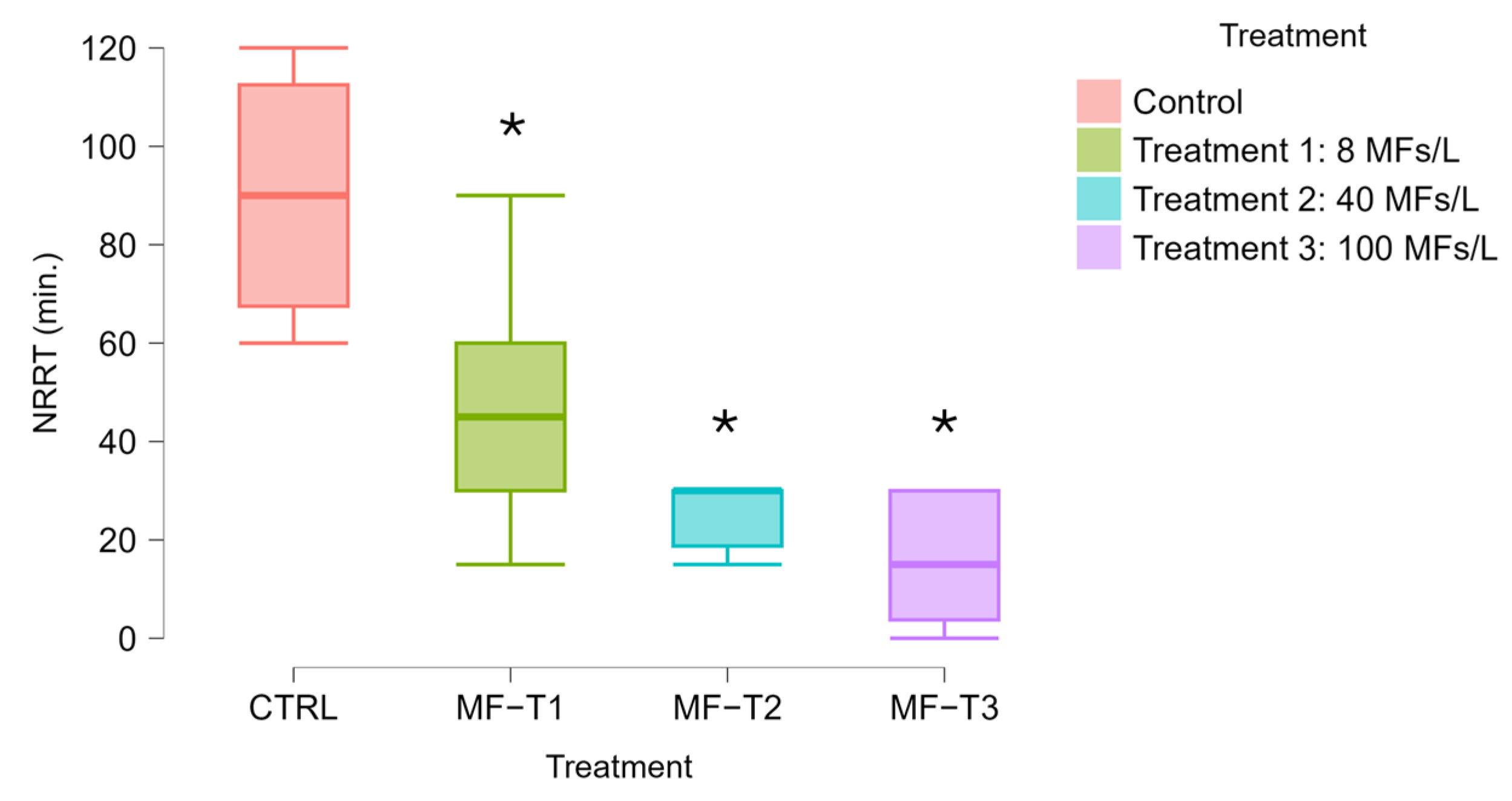
Lysosomal membrane stability, evaluated using the Neutral Red Retention Time (NRRT) assay, is shown in Figure 2. The highest mean NRRT value (±standard deviation) was observed in mussels from the control group (90 ± 24.5 min). Among the mussels exposed to microplastics, the highest NRRT was recorded in the group exposed to 8 MFs/L (49.5 ± 26.5 min), while the lowest was observed in the group exposed to 100 MFs/L (16.5 ± 13.1 min).
Significant differences in NRRT were observed among treatments (H(3) = 24.449, p < 0.001). Further, post hoc pairwise comparisons revealed that all microfiber-exposed groups differed significantly from the control (CTRL): CTRL/MF–T1 (p = 0.030), CTRL/MF–T2 (p < 0.001), and CTRL/MF–T3 (p < 0.001), with an additional significant difference between MF–T1 and MF–T3 (p = 0.011) (Table S8). No significant differences were observed between MF–T1/MF–T2 or MF–T2/MF–T3.
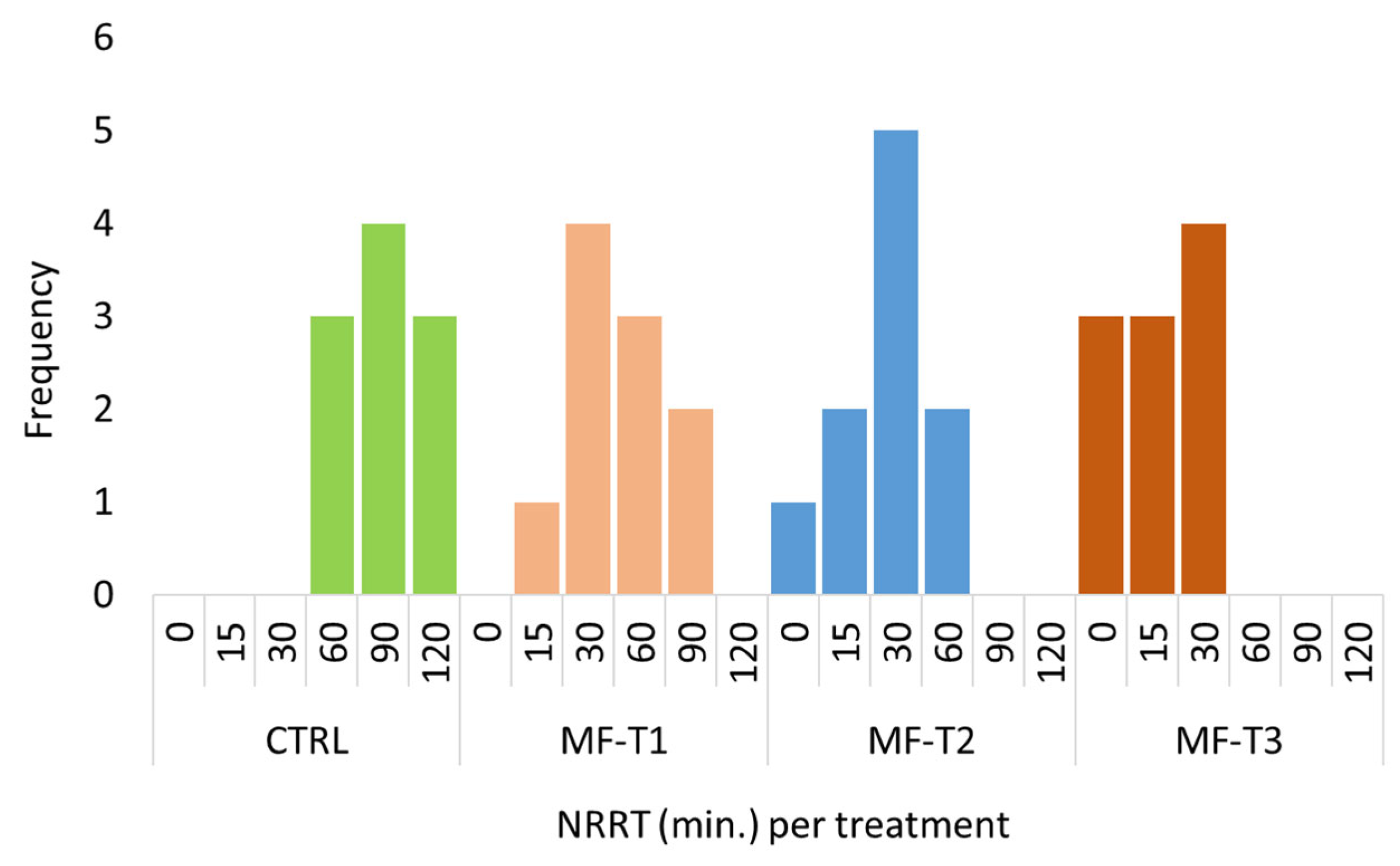
The NRRT ranged between 60 and 120 min in mussels from the unexposed (control) group, with most individuals retaining the dye for approximately 90 min (Figure 3). In contrast, mussels exposed to different MFs concentrations showed markedly lower retention times compared to the control group (C): 15–90 min for MF–T1 (8 MFs/L), 0–60 min for MF–T2 (40 MFs/L), and 0–30 min for MF–T3 (100 MFs/L). The highest frequency of dye retention was observed at 30 min, recorded for four individuals in MF–T1, five in MF–T2, and four in MF–T3. Mussels from the MFs-exposed groups exhibited a faster intralysosomal loss of the neutral red dye solution, and in some cases, no dye retention was recorded (0 min).
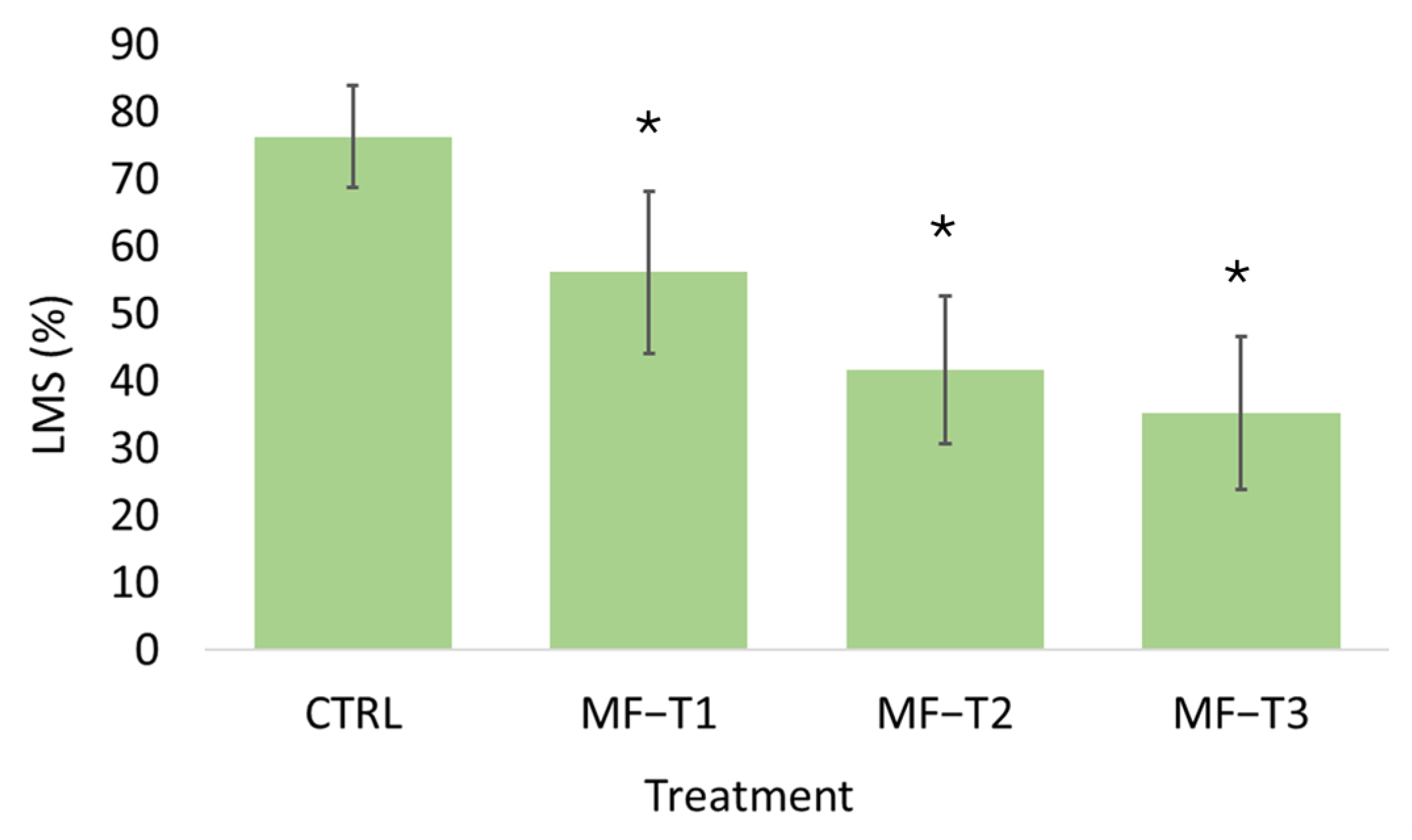
The highest mean value (±standard deviation) of lysosomal membrane stability was recorded in mussels from the control group (76.27 ± 7.59%), whereas the lowest value was observed in mussels exposed to 100 MFs/L (MF–T3) (Figure 4). Overall, a high degree of lysosomal damage was evident in the hemocytes of mussels exposed to plastic MFs.
Significant differences in the percentage of hemocyte lysosomal membrane destabilization were observed among treatments (F(3, 36) = 29.430, p < 0.001). Post hoc pairwise comparisons revealed that all MFs-exposed groups (8, 40, and 100 MFs/L) differed significantly (p < 0.001) from the control (CTRL) (Table S9).

3.4. Effect of Plastic Microfibers on Oxidative Stress and Neurotoxicity Biomarkers

Oxidative stress and neurotoxicity biomarkers provide insight into sublethal physiological effects in mussels by indicating antioxidant and detoxification responses, as well as potential neurotoxic impacts.
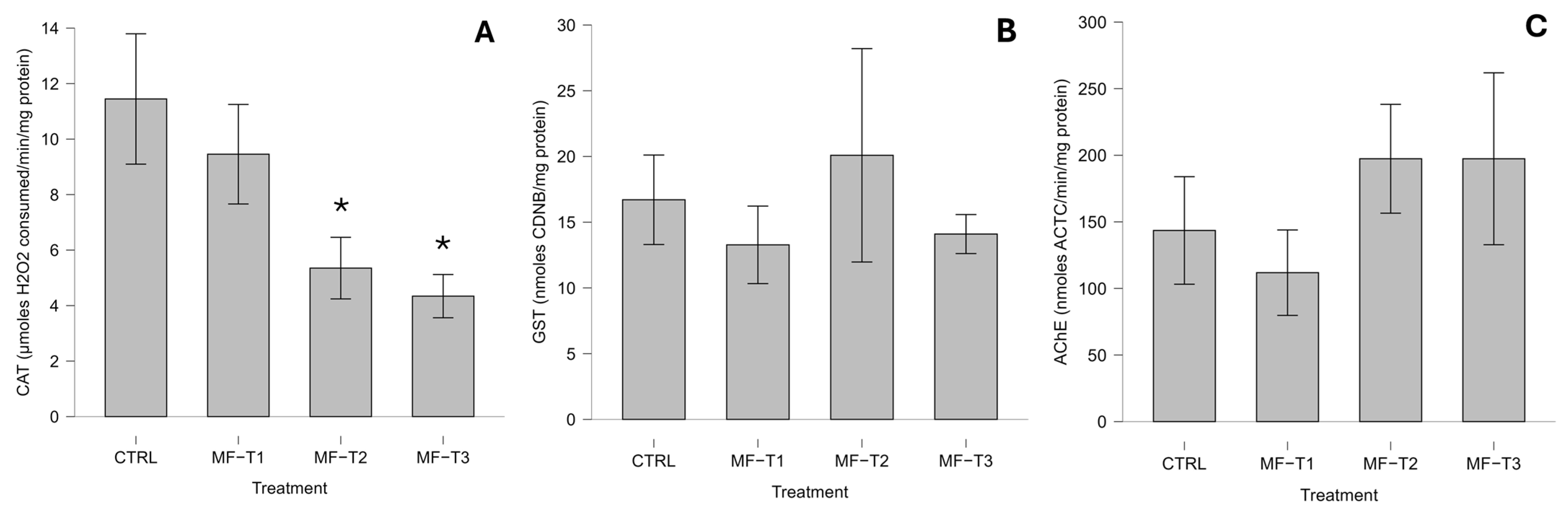
The effects of MFs exposure on the specific activities of catalase (CAT), glutathione S-transferase (GST), and acetylcholinesterase (AChE) at concentrations of 8 MFs/L (MF–T1), 40 MFs/L (MF–T2), and 100 MFs/L (MF–T3) are presented in Figure 5.
Exposure to MFs inhibited catalase (CAT) activity in the digestive gland, decreasing it by 31.2% (MF–T1), 53.3% (MF–T2), and 62.1% (MF–T3) compared to the control group (CTRL) (Figure 5A). Significant differences in CAT activity were observed among treatments (H(3) = 25.310, p < 0.001). Mussels exposed to MF–T2 (p = 0.001) and MF–T3 (p < 0.001) showed significantly reduced CAT activity in the digestive gland compared with the control group. Significant differences were further observed between MF–T1/MF–T2 (p = 0.014) and MF–T1/MF–T3 (p < 0.001) (Figure 5A, Table S10).
Glutathione S-transferase (GST) activity in the digestive gland of mussels exposed to MFs showed an inhibition of 19.2% at 8 MFs/L and 14.5% at 100 MFs/L, while an increase of 20.2% was recorded at 40 MFs/L (Figure 5B). Glutathione S-transferase activity in the digestive gland showed no significant differences among treatment groups (H(3) = 5.115, p = 0.164) (Figure 5B).
In the gills, acetylcholinesterase (AChE) activity decreased by 12.8% at 8 MFs/L, while a 37.5% increase was recorded at 40 and 100 MFs/L (Figure 5C). A significant effect of treatment on AChE activity in the gills of mussels (F(3, 36) = 4.305, p = 0.011) was observed. However, no significant differences were detected between the control group and any of the microfiber-exposed groups. Post hoc tests indicated significant differences only between MF–T1/MF–T2 (p = 0.026) and MF–T1/MF–T3 (p = 0.026) (Figure 5C, Table S11).
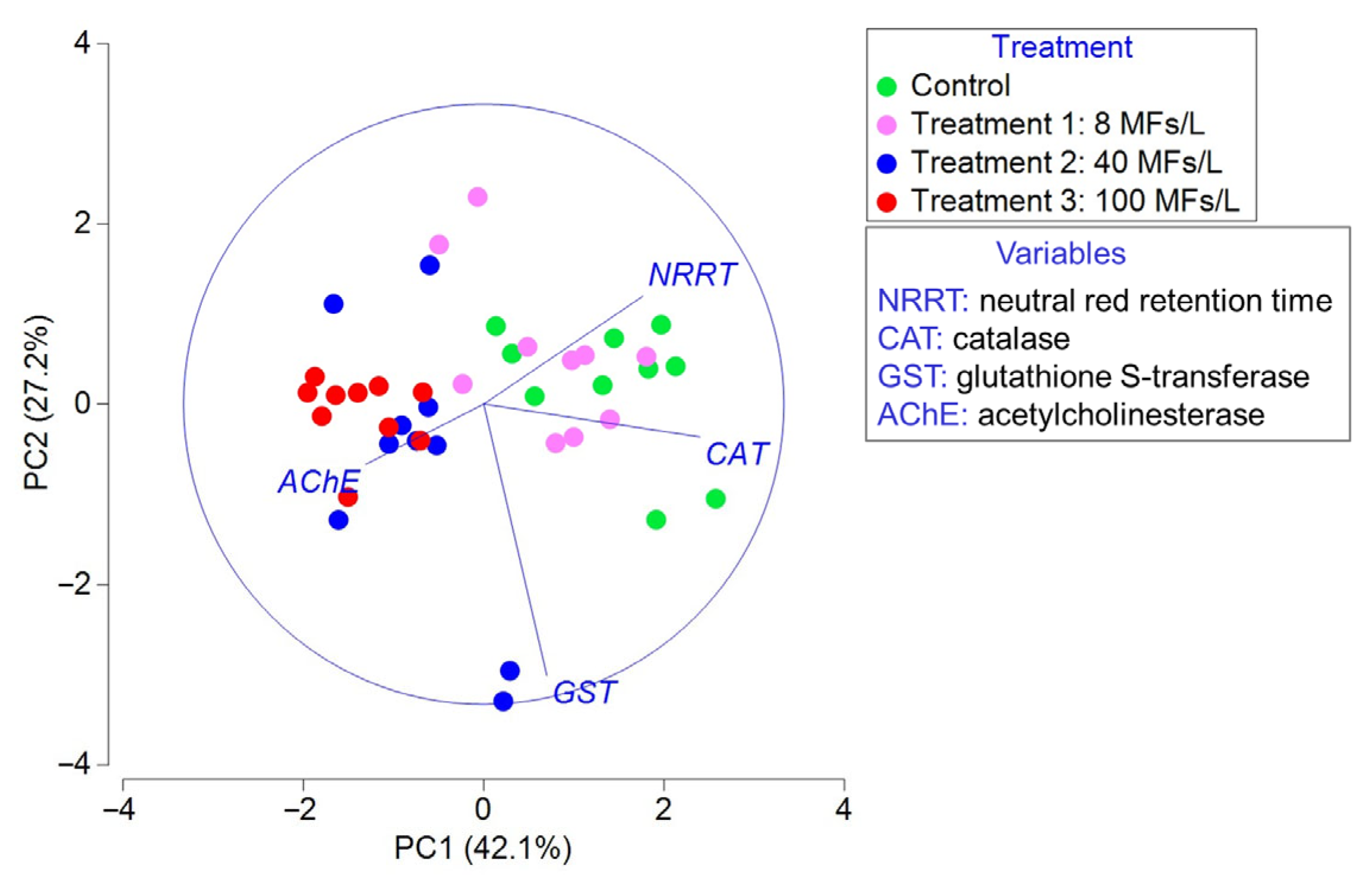
The PCA output for the mussel biomarker data from the MF treatments is shown in Figure 6. The two-dimensional pattern of the PCA explained 69.4% of the total variance in the dataset. The eigenvalues of the first two principal components were 1.68 (PC1) and 1.09 (PC2). PC1 accounted for 42.1% and PC2 for 27.2% of the total variability. PC1 showed positive loadings for NRRT (0.530) and CAT (0.721). The variable with the highest contribution on the PC2 was GST (–0.905).

4. Discussion

In this study, the effects of synthetic MFs on Mytilus galloprovincialis lysosomal membrane stability and enzymes activity were investigated for 14 days at three concentrations (8, 40, and 100 MFs/L). The MFs were generated by grinding a commercial microfiber cloth composed of 80% polyester and 20% polyamide to produce fibers of heterogeneous dimensions, resembling those released during a typical washing machine cycle [50]. We chose to use MFs derived from a synthetic textile rather than pristine industrial MFs to better reflect environmentally relevant exposure conditions. Microfibers entering aquatic ecosystems predominantly originate from domestic textile laundering and therefore are associated with various dyes, finishing agents, additives, and unintentionally added chemicals used during production. Pristine MFs, by contrast, do not reflect this chemical complexity and may underestimate the true toxicological risk posed by MFs pollution. Moreover, manufacturers rarely disclose the identity or concentrations of additives used during MPs production [71], meaning that even pristine MFs can contain unknown chemical constituents. Synthetic textile-derived MFs thus provide a more realistic chemical matrix, capturing the combined physical and chemical stressors, including dyes and other additives, that mussels are likely to encounter in the marine environment. Considering that synergistic interactions between MFs and their associated chemicals may be important drivers of toxicity, the use of synthetic textile-derived MFs enhances the ecological relevance and applicability of our findings.
Microplastics toxicity has been extensively investigated, revealing adverse effects on exposed organisms from cellular alterations to impaired physiological functions [72]. However, plastic polymers also contain numerous chemical additives (e.g., added to enhance plastic functions by modulating their physical and chemical properties), catalysts, production aids, and non-intentionally added substances, and they can act as vectors for additional contaminants, including heavy metals and organic pollutants [72,73]. The chemical effects of MPs arise from the leaching of additives introduced during manufacturing, non-intentionally added substances, or contaminants they have absorbed from the environment [72]. Microplastic toxicity affects organisms through tissue accumulation and physical damage, disruption of energy metabolism, and leaching of chemical additives, whose hazards to exposed organisms are not yet fully understood [72]. Hazardous substances used in synthetic textile printing and dyeing, including dyes, surfactants, heterocyclic compounds, anilines, heavy metals, and nonylphenols [74]. Dye adsorption onto MPs can enhance their toxic effects on aquatic organisms due to synergistic interactions, and the pollutants bound to MPs are often the primary drivers of their toxicity [75].
Numerous studies have documented changes in oxidative stress biomarkers across various species and microplastic types, including significant alterations in catalase (CAT), superoxide dismutase (SOD), glutathione S-transferase (GST), and other enzyme activities in the digestive gland, gills, and hemolymph [33,36,39,76]. Microplastics have also been shown to affect acetylcholinesterase (AChE) activity [39,76] and cause DNA damage and neurotoxicity [38,42,43,76].
Ingestion of MPs and their associated additives has been shown to induce biochemical alterations in mussels, affecting their metabolism, filtration capacity, and pollutant elimination [73]. Borges et al. [73] demonstrated that M. galloprovincialis, chronically exposed to polyamide (5 µg/L) and the additive tricresyl phosphate (TCP), exhibit a stronger enzymatic inhibition when exposed independently than in combination, with single exposures significantly suppressing CAT, AChE, and carboxylesterase (CE) activities, while combined exposure induces biomarker responses similar to controls. In contrast, Baettig et al. [72] reported that MPs exposure disrupts cellular metabolism and the immune responses, and that combined exposure to MPs and chemical additives (dibutyl phthalate, DBP) produced synergistic effects, suggesting that chemical additives may be drivers of MPs toxicity.
Lysosomal membrane stability (LMS) is a sensitive biomarker for overall stress in mussels, and a reduction in LMS is considered a predictor of adverse effects on growth and reproduction [70]. Lysosomes, membrane-bound organelles in mussel hemocytes, contain hydrolytic enzymes and play a crucial role in eliminating internal and external waste from the cell. Environmental stressors, including pollution and hypoxia, can compromise lysosomal membrane stability, reducing their ability to retain the neutral red dye [77]. Disruptions in lysosomal function and membrane integrity are often associated with pro-oxidant environments, leading to lipid peroxidation and membrane oxidation [70]. Microplastics have been shown to significantly impair lysosomal membrane stability and disrupt lysosomal functions, triggering cellular stress and impairing essential intracellular processes [35,38].
In line with these findings, our study revealed a significant reduction in the ability of mussels to retain neutral red dye in their hemocyte lysosomes after exposure to MFs, indicating compromised lysosomal stability. In contrast, short-term exposure to plastic MFs has been shown to increase lysosomal activity in mussels, suggesting immune and inflammatory responses [37]. According to Cole et al. [77], a 7-day exposure to MPs did not produce any detectable effects on lysosomal membrane stability. Santana et al. [78] demonstrated that chronic exposure to MPs had no significant impact on lysosomal membrane stability (LMS) in the cultivated mussel Perna perna. In contrast, other studies have reported a decrease in lysosomal membrane stability in the presence of microplastics [35,38]. In our study, however, after 14 days of exposure, we observed a significantly reduced ability to retain neutral red dye in hemocyte lysosomes, indicating compromised lysosomal stability. The NRRT across all experimental groups was below the threshold considered healthy for mussel populations. According to Martínez-Gómez et al. [59], NRRT values below 50 min indicate severe stress and potential pathological conditions in organisms, while values between 50 and 120 min suggest sub-lethal stress but still functional systems.
Catalase (CAT) is a key antioxidant enzyme that helps mitigate oxidative stress by catalyzing the breakdown of hydrogen peroxide into water and oxygen [79]. Glutathione S-transferase (GST) plays a crucial role in phase II detoxification by conjugating glutathione to reactive metabolites, facilitating their neutralization and excretion. GST is also critical in protecting DNA and lipids from oxidative damage [79]. Acetylcholinesterase (AChE), in addition to its role in acetylcholine hydrolysis, is involved in various cellular functions, including growth, stem cell differentiation, neurogenesis, and cell adhesion [40].
Christoforou et al. [80] investigated the long-term effects of MFs on the biofiltration capacity of Mytilus edulis. Their study found that prolonged exposure to MFs (39 days) significantly reduced clearance rates, with increased MFs accumulation in mussels’ digestive glands correlating with higher microalgal consumption. These findings may explain the reduced lysosomal stability and decreased CAT activity observed in the digestive glands of mussels in our study. The digestive gland in bivalves is essential for metabolic activities such as intracellular digestion and the storage of reserves. Swelling of lysosomes in the digestive gland’s epithelial cells is a recognized pathological response to various environmental stressors [70].
Capolupo et al. [70] also reported that chronic exposure to microplastics and nanoplastics led to reduced NRRT and decreased AChE activity in M. galloprovincialis exposed to polystyrene nanoparticles (PS-NPs), suggesting neurotoxic effects. However, no significant changes in CAT and GST activity were observed in the digestive gland, suggesting that, under chronic exposure conditions, these antioxidant defenses may remain unaffected. Our findings showed no significant changes in GST activity, a significant decrease in catalase activity, and an apparent increase in AChE activity in the gills of MF-exposed mussels, although this was not statistically significant. Several physiological mechanisms may underlie the reduced CAT activity observed in mussels exposed to MFs contamination [73,77,81,82]. Excessive reactive oxygen species (ROS) generated by MFs can oxidize CAT’s heme group, directly inhibiting the enzyme. Mussels may also redirect their antioxidant response toward alternative pathways (e.g., glutathione peroxidase, superoxide dismutase), leading to a compensatory reduction in CAT activity. Additionally, MFs exposure can disrupt energy metabolism and decrease ATP availability, limiting CAT synthesis and function. Physical abrasion of the gill and digestive gland tissues may also contribute to enzyme depletion. Together, these processes provide a plausible explanation for the decline in CAT activity under MFs exposure.
Pittura et al. [83] investigated the effects of synthetic (e.g., polyester and polyamide) and natural (e.g., cotton) MFs on mussels, reporting cellular stress, lysosomal destabilization, and changes in antioxidant enzyme activities, including CAT and GST. In agreement with these findings, our study also found significant reductions in CAT activity and evidence of lysosomal destabilization, indicating a stress response to MFs exposure. However, unlike Pittura et al. [83], we did not observe significant changes in GST activity. The results suggest that defense system activation may be particle type- and tissue-specific or influenced by exposure conditions and concentrations. The lack of significant changes in GST activity in mussels exposed to MFs may indicate that oxidative stress levels did not reach the threshold needed to activate glutathione conjugation pathways [77]. Other antioxidant defenses, such as CAT and superoxide dismutase, might have compensated for ROS detoxification, helping to maintain stable GST activity [73]. Overall, these results suggest that microfiber exposure under the tested conditions caused only mild stress, not enough to alter GST activity.
Auguste et al. [37] reported that short-term exposure to MFs increased CAT and GST activity in the gills and digestive gland, indicating oxidative stress. In contrast, our results showed a decrease in the activity of these enzymes after 14 days, further suggesting sustained oxidative stress. Microplastics induce oxidative stress in mussels by promoting the production of reactive oxygen species (ROS), such as superoxide anions and hydrogen peroxide, leading to cellular damage (e.g., proteins, lipids, and DNA) and overwhelming the organism’s antioxidant defenses [84]. Under elevated ROS, catalase (CAT) may become inactivated or degraded, and glutathione S-transferase (GST) can be oxidized or depleted of glutathione, impairing cellular detoxification and antioxidant capacity [85,86].
Choi et al. [40] exposed M. galloprovincialis to 50 and 100 µm polyethylene terephthalate microfibers (PET-MFs) and found that exposure induced necrosis, DNA damage, ROS production, and altered AChE activity. The study also reported that exposure to 50 µm PET-MFs significantly increased AChE activity, while no significant changes were observed in the 100 µm treatment group, suggesting a size-dependent response. Our results align with this, as we observed an increase in AChE activity in the gills of mussels exposed to 40 and 100 MFs/L, although the increase was not statistically significant. In contrast, Brandts et al. [39] reported reduced AChE activity in the hemolymph of M. galloprovincialis exposed to polystyrene (PS), suggesting neurotoxic effects. Acetylcholinesterase (AChE) is an essential enzyme that hydrolyses the neurotransmitter acetylcholine, thereby terminating neurotransmission at cholinergic synapses and preventing its accumulation in the synaptic cleft, which would otherwise cause prolonged and dysfunctional stimulation of nerves and muscles [87]. Increased AChE activity in response to MPs exposure is often seen as a compensatory physiological reaction to oxidative stress, neuroinflammation, or disrupted neurotransmission [88]. Rather than the typical inhibition associated with neurotoxicity, AChE may be upregulated as the nervous system tries to reduce excess acetylcholine signaling caused by stress-related processes. Oxidative stress may have caused lipid damage, leading to the rupture of acetylcholine-containing vesicle membranes in presynaptic neurons, resulting in excessive acetylcholine release into cholinergic synaptic clefts and overstimulation of postsynaptic receptors [88]. In response to oxidative stress and damage from MPs and their associated contaminants, AChE activity may be upregulated to prevent hyperexcitation of cholinergic pathways, as inflamed cells and tissues contain higher acetylcholine levels than healthy ones [89]. Microplastic exposure also induces pro-inflammatory cytokines in gill and digestive gland tissues, which can further modulate cholinergic signaling and contribute to excessive acetylcholine release [90].
Principal component analysis (PCA) revealed clear separation between the control group and mussels exposed to 40 and 100 MFs/L, indicating distinct biochemical responses to MFs exposure. This separation reflects the inhibitory effects of microfibers on NRRT and CAT activity in the digestive gland, as well as a stimulatory effect on AChE activity. However, the impact of MFs exposure on GST activity in the digestive gland was relatively mild, showing slight inhibition across treatments.

5. Conclusions

Overall, the findings of this study confirm that synthetic MFs exposure causes oxidative and lysosomal stress in mussels, as evidenced by reduced neutral red retention time (NRRT) and catalase (CAT) activity, along with altered neurophysiological function through the stimulation of AChE activity. The slight inhibition or stimulation of GST activity in the digestive gland indicates a limited detoxification response under MFs stress.
These effects were most pronounced at 40 and 100 MFs/L, indicating that higher MFs exposure can disrupt multiple cellular defense mechanisms in marine bivalves. Effects were observed even at an environmentally relevant level (8 MFs/L), highlighting that small amounts of MFs can affect cellular and biochemical functions, affecting individual organisms and, eventually, populations, with further significant implications for marine ecosystems.
For a more comprehensive understanding of MPs effects on mussels, future research should investigate the impact of long-term exposure to MFs at environmentally relevant concentrations, potential differences in toxicity among various MFs sizes, expand the panel of biomarkers applied, and investigate the influence of food availability during exposure on MFs uptake, accumulation, and toxicity.

Supplementary Materials

The following supporting information can be downloaded at: https://www.mdpi.com/article/10.3390/microplastics5010050/s1, Figure S1: ATR-FT-IR spectrum of Polyester-Polyamide (70%–30%) (4000–225 cm−1) from Database of ATR-FT-IR Spectra of Various Materials; Table S1: Baseline measurements of the seawater physicochemical parameters; Table S2: Baseline measurements of the nutrient concentrations in seawater; Table S3: Baseline measurements of heavy metal concentrations in seawater; Table S4: Baseline measurements of organochlorine pesticide concentrations in seawater; Table S5: Baseline measurements of polyaromatic hydrocarbon concentrations in seawater; Table S6: Mean value (±standard deviation) of the water quality parameters measured in the exposure aquaria after the daily renewal of seawater and 24 h after renewal (n = 14); Table S7: Results of the Shapiro–Wilk test for normality and Levene’s test for homogeneity of variances for neutral red retention time (NRRT), catalase (CAT), glutathione S-transferase (GST), and acetylcholinesterase (AChE) data; Table S8: Results of Dunn’s post hoc comparisons for neutral red retention time data; Table S9: Results of Tukey’s HSD Post Hoc comparisons for percentage of lysosomal destabilization data; Table S10: Results of Dunn’s post hoc comparisons for catalase data; Table S11: Results of Tukey’s HSD Post Hoc comparisons for acetylcholinesterase data.

Author Contributions

Conceptualization, E.-D.P. and E.S.; methodology, E.-D.P. and E.S.; software, E.-D.P.; validation, E.S., V.C. and A.-M.C.; formal analysis, E.-D.P., E.S., V.C., E.R. and A.-M.C.; investigation, E.-D.P., E.S. and A.-M.C.; resources, E.-D.P., E.S., V.C., E.R. and A.-M.C.; data curation, E.-D.P., E.S., V.C., E.R. and A.-M.C.; writing—original draft preparation, E.-D.P.; writing—review and editing, E.-D.P., E.S., V.C., E.R. and A.-M.C.; visualization, E.-D.P., E.S. and V.C.; supervision, E.S. and V.C.; project administration, E.-D.P. and E.S.; funding acquisition, E.S. All authors have read and agreed to the published version of the manuscript.

Funding

This research was supported by the Nucleu Programme SMART-BLUE 2023–2026 funded by Ministry of Research, Innovation, and Digitization, grant number 33N/2023, project code PN23230104. The APC was funded by Contract no. 9000014835/16.11.2023, order no. 9DR/3550000308-ROV6-RO ND-Chronic toxicity testing.

Institutional Review Board Statement

Ethical review and approval were not required for this study in accordance with Romanian legislation [91] (Law No. 43/2014, art. 1 a(5), which specifies that ethical approval is not necessary for experiments conducted on invertebrates.

Informed Consent Statement

Not applicable.

Data Availability Statement

The data belong to the National Institute for Marine Research and Development “Grigore Antipa” (NIMRD) and can be made available by request at http://www.nodc.ro/data_policy_nimrd.php.

Conflicts of Interest

The authors declare no conflicts of interest.

Abbreviations

The following abbreviations are used in this manuscript:
MFsMicrofibers
MPsMicroplastics
LMSLysosomal membrane stability
NRRTNeutral red retention time
CATCatalase
GSTGlutathione-S-transferase
AChEAcetylcholinesterase
PCAPrincipal Component Analysis

Appendix A

Enzymatic extracts were diluted in 100 mM phosphate buffer (pH 7.4) prior to protein determination. Digestive gland extracts were diluted 1:500, and gill extracts were diluted 1:200. Protein concentration was measured using the Bradford assay, which is based on the shift in maximum absorbance of Coomassie Brilliant Blue dye from 465 nm to 595 nm upon binding to proteins, resulting in a color change from brown to blue. The absorbance at 595 nm was measured and compared with a standard curve prepared from known protein concentrations to determine the sample protein content. For the assay, 100 µL of the diluted sample (or phosphate buffer for blanks) was added to each well of a microplate, followed by 280 µL of Bradford reagent. Absorbance was read at 595 nm after 1 min of color development, which remains stable for up to 1 h.

References

  1. Tursi, A.; Baratta, M.; Easton, T.; Chatzisymeon, E.; Chidichimo, F.; De Biase, M.; De Filpo, G. Microplastics in Aquatic Systems, a Comprehensive Review: Origination, Accumulation, Impact, and Removal Technologies. RSC Adv. 2022, 12, 28318–28340. [Google Scholar] [CrossRef] [PubMed]
  2. Wang, J.; Tan, Z.; Peng, J.; Qiu, Q.; Li, M. The Behaviors of Microplastics in the Marine Environment. Mar. Environ. Res. 2016, 113, 7–17. [Google Scholar] [CrossRef] [PubMed]
  3. Van Cauwenberghe, L.; Devriese, L.; Galgani, F.; Robbens, J.; Janssen, C.R. Microplastics in Sediments: A Review of Techniques, Occurrence and Effects. Mar. Environ. Res. 2015, 111, 5–17. [Google Scholar] [CrossRef] [PubMed]
  4. Arthur, C.; Baker, J.; Bamford, H. Proceedings of the International Research Workshop on the Occurrence, Effects, and Fate of Microplastic Marine Debris; NOAA Technical Memorandum NOS-OR&R-30 2009; University of Washington Tacoma: Tacoma, WA, USA, 2008. [Google Scholar]
  5. Botterell, Z.L.R.; Beaumont, N.; Dorrington, T.; Steinke, M.; Thompson, R.C.; Lindeque, P.K. Bioavailability and Effects of Microplastics on Marine Zooplankton: A Review. Environ. Pollut. 2019, 245, 98–110. [Google Scholar] [CrossRef]
  6. Cau, A.; Avio, C.G.; Dessì, C.; Follesa, M.C.; Moccia, D.; Regoli, F.; Pusceddu, A. Microplastics in the Crustaceans Nephrops norvegicus and Aristeus antennatus: Flagship Species for Deep-Sea Environments? Environ. Pollut. 2019, 255, 113107. [Google Scholar] [CrossRef]
  7. Chen, H.; Shen, X.; Lin, J.; Huang, Q.; Zhao, L.; Zhu, R.; Li, L.; Liu, Z.; Zhao, C. Microplastics in Crustaceans Imposing Potential Risk on Human Health: Transferring, Degradation, Synergy, and Metabolism. Crit. Rev. Food Sci. Nutr. 2025, 66, 1067–1087. [Google Scholar] [CrossRef]
  8. Khan, M.S.; Marma, T.U.; Sumi, S.N.; Chisim, A.; Shakib, I.A.; Rana, S. Plastic in Seafood: Are Crustaceans a Gateway to Microplastic Exposure in Humans? Sci. One Health 2025, 4, 100121. [Google Scholar] [CrossRef]
  9. Justino, A.K.S.; Lenoble, V.; Pelage, L.; Ferreira, G.V.B.; Passarone, R.; Frédou, T.; Lucena Frédou, F. Micro-plastic Contamination in Tropical Fishes: An Assessment of Different Feeding Habits. Reg. Stud. Mar. Sci. 2021, 45, 101857. [Google Scholar] [CrossRef]
  10. Hossain, M.B.; Pingki, F.H.; Azad, M.A.S.; Nur, A.-A.U.; Banik, P.; Paray, B.A.; Arai, T.; Yu, J. Microplastics in Different Tissues of a Commonly Consumed Fish, Scomberomorus guttatus, from a Large Subtropical Estuary: Accumulation, Characterization, and Contamination Assessment. Biology 2023, 12, 1422. [Google Scholar] [CrossRef]
  11. Lusher, A.L.; O’Donnell, C.; Officer, R.; O’Connor, I. Microplastic Interactions with North Atlantic Mesopelagic Fish. ICES J. Mar. Sci. 2016, 73, 1214–1225. [Google Scholar] [CrossRef]
  12. Digka, N.; Tsangaris, C.; Torre, M.; Anastasopoulou, A.; Zeri, C. Microplastics in Mussels and Fish from the Northern Ionian Sea. Mar. Pollut. Bull. 2018, 135, 30–40. [Google Scholar] [CrossRef]
  13. Navarro, A.; Luzardo, O.P.; Gómez, M.; Acosta-Dacal, A.; Martínez, I.; de la Rosa, J.F.; Macías-Montes, A.; Suárez-Pérez, A.; Herrera, A. Microplastics Ingestion and Chemical Pollutants in Seabirds of Gran Canaria (Canary Islands, Spain). Mar. Pollut. Bull. 2023, 186, 114434. [Google Scholar] [CrossRef] [PubMed]
  14. Taurozzi, D.; Scalici, M. Seabirds from the Poles: Microplastics Pollution Sentinels. Front. Mar. Sci. 2024, 11, 1343617. [Google Scholar] [CrossRef]
  15. Jeong, I.-Y.; Seo, J.-H.; Yoo, J.-C. First Report on the Detection of Microplastics from the Feathers of Black-Tailed Gulls in South Korea. Mar. Pollut. Bull. 2023, 196, 115592. [Google Scholar] [CrossRef] [PubMed]
  16. Sá, S.; Torres-Pereira, A.; Ferreira, M.; Monteiro, S.S.; Fradoca, R.; Sequeira, M.; Vingada, J.; Eira, C. Microplastics in Cetaceans Stranded on the Portuguese Coast. Animals 2023, 13, 3263. [Google Scholar] [CrossRef]
  17. Sletten, A.; Bryan, A.; Iken, K.; Olnes, J.; Horstmann, L. Microplastics in Spotted Seal Stomachs from the Bering and Chukchi Seas in 2012 and 2020. Mar. Pollut. Bull. 2025, 214, 117770. [Google Scholar] [CrossRef]
  18. Iyare, P.U.; Vanderlip, H.L.; Dias, M.; Provencher, J.F.; Zou, S.; Lougheed, S.C.; Groot, P.V.C.d.; Whitelaw, G.; Branigan, M.; Dyck, M.; et al. An Assessment of Microplastics in Fecal Samples from Polar Bears (Ursus maritimus) in Canada’s North. Arct. Sci. 2024, 10, 409–423. [Google Scholar] [CrossRef]
  19. Watts, A.J.R.; Urbina, M.A.; Corr, S.; Lewis, C.; Galloway, T.S. Ingestion of Plastic Microfibers by the Crab Carcinus maenas and Its Effect on Food Consumption and Energy Balance. Environ. Sci. Technol. 2015, 49, 14597–14604. [Google Scholar] [CrossRef]
  20. Wright, S.L.; Thompson, R.C.; Galloway, T.S. The Physical Impacts of Microplastics on Marine Organisms: A Review. Environ. Pollut. 2013, 178, 483–492. [Google Scholar] [CrossRef]
  21. Gregory, M.R. Environmental Implications of Plastic Debris in Marine Settings—Entanglement, Ingestion, Smothering, Hangers-on, Hitch-Hiking and Alien Invasions. Philos. Trans. R. Soc. B Biol. Sci. 2009, 364, 2013–2025. [Google Scholar] [CrossRef]
  22. Gasperi, J.; Wright, S.L.; Dris, R.; Collard, F.; Mandin, C.; Guerrouache, M.; Langlois, V.; Kelly, F.J.; Tassin, B. Microplastics in Air: Are We Breathing It In? Curr. Opin. Environ. Sci. Health 2018, 1, 1–5. [Google Scholar] [CrossRef]
  23. Walkinshaw, C.; Tolhurst, T.J.; Lindeque, P.K.; Thompson, R.C.; Cole, M. Impact of Polyester and Cotton Microfibers on Growth and Sublethal Biomarkers in Juvenile Mussels. Microplastics Nanoplastics 2023, 3, 5. [Google Scholar] [CrossRef]
  24. Zhang, F.; Man, Y.B.; Mo, W.Y.; Man, K.Y.; Wong, M.H. Direct and Indirect Effects of Microplastics on Bivalves, with a Focus on Edible Species: A Mini-Review. Crit. Rev. Environ. Sci. Technol. 2020, 50, 2109–2143. [Google Scholar] [CrossRef]
  25. Gaylarde, C.; Baptista-Neto, J.A.; da Fonseca, E.M. Plastic Microfibre Pollution: How Important Is Clothes’ Laundering? Heliyon 2021, 7, e07105. [Google Scholar] [CrossRef]
  26. De Falco, F.; Gullo, M.P.; Gentile, G.; Di Pace, E.; Cocca, M.; Gelabert, L.; Brouta-Agnésa, M.; Rovira, A.; Escudero, R.; Villalba, R.; et al. Evaluation of Microplastic Release Caused by Textile Washing Processes of Synthetic Fabrics. Environ. Pollut. 2018, 236, 916–925. [Google Scholar] [CrossRef]
  27. Galvão, A.; Aleixo, M.; De Pablo, H.; Lopes, C.; Raimundo, J. Microplastics in Wastewater: Microfiber Emissions from Common Household Laundry. Environ. Sci. Pollut. Res. 2020, 27, 26643–26649. [Google Scholar] [CrossRef]
  28. Palacios-Mateo, C.; van der Meer, Y.; Seide, G. Analysis of the Polyester Clothing Value Chain to Identify Key Intervention Points for Sustainability. Environ. Sci. Eur. 2021, 33, 2. [Google Scholar] [CrossRef]
  29. Akyildiz, S.H.; Fiore, S.; Bruno, M.; Sezgin, H.; Yalcin-Enis, I.; Yalcin, B.; Bellopede, R. Release of Microplastic Fibers from Synthetic Textiles during Household Washing. Environ. Pollut. 2024, 357, 124455. [Google Scholar] [CrossRef]
  30. Provenza, F.; Rampih, D.; Pignattelli, S.; Pastorino, P.; Barceló, D.; Prearo, M.; Specchiulli, A.; Renzi, M. Mussel Watch Program for Microplastics in the Mediterranean Sea: Identification of Biomarkers of Exposure Using Mytilus galloprovincialis. Ecol. Indic. 2022, 142, 109212. [Google Scholar] [CrossRef]
  31. Bolognesi, C.; Frenzilli, G.; Lasagna, C.; Perrone, E.; Roggieri, P. Genotoxicity Biomarkers in Mytilus galloprovincialis: Wild versus Caged Mussels. Mutat. Res. Fundam. Mol. Mech. Mutagen. 2004, 552, 153–162. [Google Scholar] [CrossRef]
  32. Li, J.; Lusher, A.L.; Rotchell, J.M.; Deudero, S.; Turra, A.; Bråte, I.L.N.; Sun, C.; Hossain, M.S.; Li, Q.; Kolandhasamy, P.; et al. Using Mussel as a Global Bioindicator of Coastal Microplastic Pollution. Environ. Pollut. 2019, 244, 522–533. [Google Scholar] [CrossRef]
  33. Sendra, M.; Sparaventi, E.; Novoa, B.; Figueras, A. An Overview of the Internalization and Effects of Microplastics and Nanoplastics as Pollutants of Emerging Concern in Bivalves. Sci. Total Environ. 2021, 753, 142024. [Google Scholar] [CrossRef] [PubMed]
  34. Bråte, I.L.N.; Blázquez, M.; Brooks, S.J.; Thomas, K.V. Weathering Impacts the Uptake of Polyethylene Microparticles from Toothpaste in Mediterranean Mussels (M. galloprovincialis). Sci. Total Environ. 2018, 626, 1310–1318. [Google Scholar] [CrossRef] [PubMed]
  35. von Moos, N.; Burkhardt-Holm, P.; Köhler, A. Uptake and Effects of Microplastics on Cells and Tissue of the Blue Mussel Mytilus edulis L. after an Experimental Exposure. Environ. Sci. Technol. 2012, 46, 11327–11335. [Google Scholar] [CrossRef] [PubMed]
  36. Paul-Pont, I.; Lacroix, C.; González Fernández, C.; Hégaret, H.; Lambert, C.; Le Goïc, N.; Frère, L.; Cassone, A.-L.; Sussarellu, R.; Fabioux, C.; et al. Exposure of Marine Mussels Mytilus spp. to Polystyrene Microplastics: Toxicity and Influence on Fluoranthene Bioaccumulation. Environ. Pollut. 2016, 216, 724–737. [Google Scholar] [CrossRef]
  37. Auguste, M.; Leonessi, M.; Bozzo, M.; Risso, B.; Cutroneo, L.; Prandi, S.; Kokalj, A.J.; Drobne, D.; Canesi, L. Multiple Responses of Mytilus galloprovincialis to Plastic Microfibers. Sci. Total Environ. 2023, 890, 164318. [Google Scholar] [CrossRef]
  38. Avio, C.G.; Gorbi, S.; Milan, M.; Benedetti, M.; Fattorini, D.; d’Errico, G.; Pauletto, M.; Bargelloni, L.; Regoli, F. Pollutants Bioavailability and Toxicological Risk from Microplastics to Marine Mussels. Environ. Pollut. 2015, 198, 211–222. [Google Scholar] [CrossRef]
  39. Brandts, I.; Teles, M.; Gonçalves, A.P.; Barreto, A.; Franco-Martinez, L.; Tvarijonaviciute, A.; Martins, M.A.; Soares, A.M.V.M.; Tort, L.; Oliveira, M. Effects of Nanoplastics on Mytilus galloprovincialis after Individual and Combined Exposure with Carbamazepine. Sci. Total Environ. 2018, 643, 775–784. [Google Scholar] [CrossRef]
  40. Choi, J.S.; Kim, K.; Hong, S.H.; Park, K.-I.; Park, J.-W. Impact of Polyethylene Terephthalate Microfiber Length on Cellular Responses in the Mediterranean Mussel Mytilus galloprovincialis. Mar. Environ. Res. 2021, 168, 105320. [Google Scholar] [CrossRef]
  41. Choi, J.S.; Kim, K.; Park, K.; Park, J.-W. Long-Term Exposure of the Mediterranean Mussels, Mytilus galloprovincialis to Polyethylene Terephthalate Microfibers: Implication for Reproductive and Neurotoxic Effects. Chemosphere 2022, 299, 134317. [Google Scholar] [CrossRef]
  42. Sussarellu, R.; Suquet, M.; Thomas, Y.; Lambert, C.; Fabioux, C.; Pernet, M.E.J.; Le Goïc, N.; Quillien, V.; Mingant, C.; Epelboin, Y.; et al. Oyster Reproduction Is Affected by Exposure to Polystyrene Microplastics. Proc. Natl. Acad. Sci. USA 2016, 113, 2430–2435. [Google Scholar] [CrossRef]
  43. Mai, N.T.Q.; Batjargal, U.; Kim, W.-S.; Kim, J.-H.; Park, J.-W.; Kwak, I.-S.; Moon, B.-S. Microplastic Induces Mitochondrial Pathway Mediated Cellular Apoptosis in Mussel (Mytilus galloprovincialis) via Inhibition of the AKT and ERK Signaling Pathway. Cell Death Discov. 2023, 9, 442. [Google Scholar] [CrossRef] [PubMed]
  44. Ding, J.; Sun, C.; Li, J.; Shi, H.; Xu, X.; Ju, P.; Jiang, F.; Li, F. Microplastics in Global Bivalve Mollusks: A Call for Protocol Standardization. J. Hazard. Mater. 2022, 438, 129490. [Google Scholar] [CrossRef] [PubMed]
  45. Qu, X.; Su, L.; Li, H.; Liang, M.; Shi, H. Assessing the Relationship between the Abundance and Properties of Microplastics in Water and in Mussels. Sci. Total Environ. 2018, 621, 679–686. [Google Scholar] [CrossRef] [PubMed]
  46. Mihailov, M.E.; Chiroșca, A.V.; Pantea, E.D.; Chiroșca, G. Machine Learning Approaches for Microplastic Pollution Analysis in Mytilus galloprovincialis in the Western Black Sea. Sustainability 2025, 17, 5664. [Google Scholar] [CrossRef]
  47. Pojar, I.; Dobre, O.; Baboș, T.; Lazăr, C. Quantitative Microfiber Evaluation in Mytilus galloprovincialis, Western Black Sea, Romania. Geo-Eco-Marina 2022, 28, 65–71. [Google Scholar]
  48. Ibryamova, S.; Toschkova, S.; Bachvarova, D.C.; Lyatif, A.; Stanachkova, E.; Ivanov, R.; Natchev, N.; Ignatova-Ivanova, T. Assessment of the bioaccumulation of microplastics in the Black Sea mussel Mytilus galloprovincialis L., 1819. J. IMAB Annu. Proceeding (Sci. Pap.) 2022, 28, 4676–4682. [Google Scholar] [CrossRef]
  49. Gedik, K.; Eryaşar, A.R. Microplastic Pollution Profile of Mediterranean Mussels (Mytilus galloprovincialis) Collected along the Turkish Coasts. Chemosphere 2020, 260, 127570. [Google Scholar] [CrossRef]
  50. Dreillard, M.; Barros, C.D.F.; Rouchon, V.; Emonnot, C.; Lefebvre, V.; Moreaud, M.; Guillaume, D.; Rimbault, F.; Pagerey, F. Quantification and Morphological Characterization of Microfibers Emitted from Textile Washing. Sci. Total Environ. 2022, 832, 154973. [Google Scholar] [CrossRef]
  51. Alnajar, N.; Jha, A.N.; Turner, A. Impacts of Microplastic Fibres on the Marine Mussel, Mytilus galloprovinciallis. Chemosphere 2021, 262, 128290. [Google Scholar] [CrossRef]
  52. Grasshoff, K.; Kremling, K.; Ehrhardt, M. Methods of Seawater Analysis, 3rd ed.; Wiley-VCH: Weinheim, Germany, 1999. [Google Scholar]
  53. IAEA-MEL. Training Manual on the Measurement of Organochlorine and Petroleum Hydrocarbons in Environmental Samples; International Atomic Energy Agency–Marine Environmental Laboratory: Monaco, 1995. [Google Scholar]
  54. IAEA-MEL. Training Manual on the Measurement of Heavy Metals in Environmental Samples; International Atomic Energy Agency–Marine Environmental Laboratory: Monaco, 1999. [Google Scholar]
  55. Strickland, J.D.H.; Parsons, T.R. A Practical Handbook of Seawater Analysis; Fisheries Research Board of Canada: Ottawa, ON, Canada, 1972; p. 3. [Google Scholar]
  56. Database of ATR-FT-IR Spectra of Various Materials. ATR-FT-IR Spectra of Various Fibres. Available online: https://spectra.chem.ut.ee/textile-fibres/polyester-polyamide-fibres/ (accessed on 30 November 2025).
  57. Baboș, T.; Dobre, O.; Lazăr, C.; Palcu, D.V.; Pojar, I. Characterisation of Floating Microplastic in Romanian Coastal Waters. Geo-Eco-Marina 2025, 31, 103–109. [Google Scholar]
  58. Savuca, A.; Nicoara, M.N.; Faggio, C. Comprehensive Review Regarding the Profile of the Microplastic Pollution in the Coastal Area of the Black Sea. Sustainability 2022, 14, 14376. [Google Scholar] [CrossRef]
  59. Martínez-Gómez, C.; Bignell, J.; Lowe, D. (Eds.) Lysosomal Membrane Stability in Mussels; ICES Techniques in Marine Environmental Sciences; International Council for the Exploration of the Sea (ICES): Copenhagen, Denmark, 2015; Volume 56, p. 41. [Google Scholar]
  60. Sinha, A.K. Colorimetric Assay of Catalase. Anal. Biochem. 1972, 47, 389–394. [Google Scholar] [CrossRef] [PubMed]
  61. Habig, W.H.; Jakoby, W.B. Assays for Differentiation of Glutathione S-Transferases. In Methods in Enzymology; Academic Press: New York, NY, USA, 1981; pp. 398–405. [Google Scholar]
  62. Ellman, G.L.; Courtney, K.D.; Andres, V.; Featherstone, R.M. A New and Rapid Colorimetric Determination of Acetylcholinesterase Activity. Biochem. Pharmacol. 1961, 7, 88–95. [Google Scholar] [CrossRef] [PubMed]
  63. Bradford, M.M. A Rapid and Sensitive Method for the Quantitation of Microgram Quantities of Protein Utilizing the Principle of Protein-Dye Binding. Anal. Biochem. 1976, 72, 248–254. [Google Scholar] [CrossRef]
  64. JASP Team. JASP, version 0.95.4.0. Computer Software. JASP Team: Amsterdam, The Netherlands, 2025. Available online: https://jasp-stats.org/download/ (accessed on 15 October 2025).
  65. Gross-Sampson, M.A. JASP, version 0.18.3; Statistical Analysis in JASP—A Guide for Students; JASP: Amsterdam, The Netherlands, 2024; p. 185. Available online: https://jasp-stats.org/wp-content/uploads/2024/03/Statistical-Analysis-in-JASP-2024.pdf (accessed on 10 November 2025).
  66. Clarke, K.R.; Gorley, R.N. PRIMER v7: User Manual/Tutorial; Plymouth Routines in Multivariate Ecological Research (PRIMER-e): Plymouth, UK, 2015. [Google Scholar]
  67. Directive 2000/60/EC of the European Parliament and of the Council of 23 October 2000 establishing a framework for Community action in the field of water policy. Off. J. Eur. Communities 2000, L 327, 1–73.
  68. Official Gazette of Romania. Order No. 161/2006 of the Ministry of the Environment and Water Management of 16 February 2006 for the Approval of Regulation on the Classification of Surface Water Quality in Order to Establish the Ecological Status of Water Bodies; Official Gazette of Romania: Bucharest, Romania, 2006; p. 511. [Google Scholar]
  69. European Union. Directive 2013/39/EU of the European Parliament and of the Council amending Directives 2000/60/EC and 2008/105/EC as regards priority substances in the field of water policy. Off. J. Eur. Union 2013, L 226, 1–17. [Google Scholar]
  70. Capolupo, M.; Valbonesi, P.; Fabbri, E. A Comparative Assessment of the Chronic Effects of Micro- and Nano-Plastics on the Physiology of the Mediterranean Mussel Mytilus galloprovincialis. Nanomaterials 2021, 11, 649. [Google Scholar] [CrossRef]
  71. da Costa, J.P.; Avellan, A.; Mouneyrac, C.; Duarte, A.; Rocha-Santos, T. Plastic Additives and Microplastics as Emerging Contaminants: Mechanisms and Analytical Assessment. TrAC Trends Anal. Chem. 2023, 158, 116898. [Google Scholar] [CrossRef]
  72. Baettig, C.G.; Laroche, O.; Ockenden, A.; Smith, K.F.; Lear, G.; Tremblay, L.A. Characterization of the Transcriptional Effects of the Plastic Additive Dibutyl Phthalate Alone and in Combination with Microplastic on the Green-Lipped Mussel Perna Canaliculus. Environ. Toxicol. Chem. 2024, 43, 1604–1614. [Google Scholar] [CrossRef]
  73. Borges, F.; Freitas, R.; Silva, A.L.P.; Soliz Rojas, D.L.; Paniagua González, G.; Solé, M. Could Mussel Populations Be Differentially Threatened by the Presence of Microplastics and Related Chemicals? Toxics 2025, 13, 181. [Google Scholar] [CrossRef] [PubMed]
  74. Zhou, H.; Zhou, L.; Ma, K. Microfiber from Textile Dyeing and Printing Wastewater of a Typical Industrial Park in China: Occurrence, Removal and Release. Sci. Total Environ. 2020, 739, 140329. [Google Scholar] [CrossRef] [PubMed]
  75. Khoshmanesh, M.; Sanati, A.M.; Shahcheragh, S.; Farjadfard, S.; Bonyadi, Z.; Ramavandi, B. Recent Advances in Dyes Uptake by Microplastics in Aquatic Environments: Influencing Factors and Ecotoxicological Behaviors. Arab. J. Chem. 2024, 17, 105737. [Google Scholar] [CrossRef]
  76. Ribeiro, F.; Garcia, A.R.; Pereira, B.P.; Fonseca, M.; Mestre, N.C.; Fonseca, T.G.; Ilharco, L.M.; Bebianno, M.J. Microplastics Effects in Scrobicularia Plana. Mar. Pollut. Bull. 2017, 122, 379–391. [Google Scholar] [CrossRef]
  77. Cole, M.; Liddle, C.; Consolandi, G.; Drago, C.; Hird, C.; Lindeque, P.K.; Galloway, T.S. Microplastics, Micro-fibres and Nanoplastics Cause Variable Sub-Lethal Responses in Mussels (Mytilus spp.). Mar. Pollut. Bull. 2020, 160, 111552. [Google Scholar] [CrossRef]
  78. Santana, M.F.M.; Moreira, F.T.; Pereira, C.D.S.; Abessa, D.M.S.; Turra, A. Continuous Exposure to Microplastics Does Not Cause Physiological Effects in the Cultivated Mussel Perna perna. Arch. Environ. Contam. Toxicol. 2018, 74, 594–604. [Google Scholar] [CrossRef]
  79. Baussant, T.; Bechmann, R.K.; Taban, I.C.; Larsen, B.K.; Tandberg, A.H.; Bjørnstad, A.; Torgrimsen, S.; Nævdal, A.; Øysæd, K.B.; Jonsson, G.; et al. Enzymatic and Cellular Responses in Relation to Body Burden of PAHs in Bivalve Molluscs: A Case Study with Chronic Levels of North Sea and Barents Sea Dispersed Oil. Mar. Pollut. Bull. 2009, 58, 1796–1807. [Google Scholar] [CrossRef]
  80. Christoforou, E.; Dominoni, D.M.; Lindström, J.; Stilo, G.; Spatharis, S. Effects of Long-Term Exposure to Microfibers on Ecosystem Services Provided by Coastal Mussels. Environ. Pollut. 2020, 266, 115184. [Google Scholar] [CrossRef]
  81. Shang, Y.; Wang, X.; Chang, X.; Sokolova, I.M.; Wei, S.; Liu, W.; Fang, J.K.H.; Hu, M.; Huang, W.; Wang, Y. The Effect of Microplastics on the Bioenergetics of the Mussel Mytilus Coruscus Assessed by Cellular Energy Allocation Approach. Front. Mar. Sci. 2021, 8, 754789. [Google Scholar] [CrossRef]
  82. Wang, S.; Zhong, Z.; Li, Z.; Wang, X.; Gu, H.; Huang, W.; Fang, J.K.-H.; Shi, H.; Hu, M.; Wang, Y. Physiological Effects of Plastic Particles on Mussels Are Mediated by Food Presence. J. Hazard. Mater. 2021, 404, 124136. [Google Scholar] [CrossRef]
  83. Pittura, L.; Nardi, A.; Cocca, M.; De Falco, F.; d’Errico, G.; Mazzoli, C.; Mongera, F.; Benedetti, M.; Gorbi, S.; Avella, M.; et al. Cellular Disturbance and Thermal Stress Response in Mussels Exposed to Synthetic and Natural Microfibers. Front. Mar. Sci. 2022, 9, 981365. [Google Scholar] [CrossRef]
  84. Romano, R.; Rosati, L.; Napolitano, G.; Ferrigno, F.; Chianese, T.; Motta, C.M.; Simoniello, P. Polystyrene Micro and Nanoplastics: A Comparative Study of the Cytotoxic Effects Exerted on Mytilus galloprovincialis Gills. Ecotoxicol. Environ. Saf. 2025, 302, 118683. [Google Scholar] [CrossRef]
  85. Gebicka, L.; Krych-Madej, J. The Role of Catalases in the Prevention/Promotion of Oxidative Stress. J. Inorg. Biochem. 2019, 197, 110699. [Google Scholar] [CrossRef] [PubMed]
  86. Eaton, D.L.; Bammler, T.K. Concise review of the glutathione S-transferases and their significance to toxicology. Toxicol. Sci. 1999, 49, 156–164. [Google Scholar] [CrossRef]
  87. Hafed-Khatiri, S.; Salinas-Torres, D.; Montilla, F. Assessing Acetylcholinesterase Catalytic Activity in the Marine Environment. Electrochim. Acta 2025, 521, 145930. [Google Scholar] [CrossRef]
  88. Massoulié, J.; Pezzementi, L.; Bon, S.; Krejci, E.; Vallette, F.-M. Molecular and Cellular Biology of Cholinesterases. Prog. Neurobiol. 1993, 41, 31–91. [Google Scholar] [CrossRef] [PubMed]
  89. Barboza, L.G.A.; Lopes, C.; Oliveira, P.; Bessa, F.; Otero, V.; Henriques, B.; Raimundo, J.; Caetano, M.; Vale, C.; Guilhermino, L. Microplastics in Wild Fish from North East Atlantic Ocean and Its Potential for Causing Neurotoxic Effects, Lipid Oxidative Damage, and Human Health Risks Associated with Ingestion Exposure. Sci. Total Environ. 2020, 717, 134625. [Google Scholar] [CrossRef]
  90. de Oliveira, P.; Gomes, A.Q.; Pacheco, T.R.; Vitorino de Almeida, V.; Saldanha, C.; Calado, A. Cell-Specific Regulation of Acetylcholinesterase Expression under Inflammatory Conditions. Clin. Hemorheol. Microcirc. 2012, 51, 129–137. [Google Scholar] [CrossRef]
  91. Romanian Parliament. Law No. 43/2014 on the Protection of Animals Used for Scientific Purposes. Off. Gaz. Rom. 2014, 326. Available online: https://www.dreptonline.ro/legislatie/legea_43_2014_protectia_animalelor_utilizate_scopuri_stiintifice.php (accessed on 13 November 2025). (In Romanian)
Figure 1. Microfibers (MFs) characterization. (A) Light microscopy image of the prepared MFs, observed as blue-stained filaments; (B) MFs length distribution (n = 150).
Microplastics 05 00050 g001
Figure 2. Lysosomal membrane stability of hemocytes in Mytilus galloprovincialis assessed by the neutral red retention time (NRRT) assay (n = 10) in the control and microfibers-exposed group. (*) Statistical significance between treatments (p < 0.05).
Microplastics 05 00050 g002
Figure 3. Frequency distribution of neutral red dye retention time (NRRT) in the lysosomes of hemocytes collected from the analyzed individuals (n = 10). CTRL: control; MF–T1: 8 MFs/L; MF–T2: 40 MFs/L; MF–T3: 100 MFs/L.
Microplastics 05 00050 g003
Figure 4. Percentage of hemocyte lysosomal membrane destabilization (LMS) in mussels exposed to different concentrations of microfibers (n = 10). CTRL: control; MF–T1: 8 MFs/L; MF–T2: 40 MFs/L; MF–T3: 100 MFs/L. (*) Statistical significance between treatments (p < 0.05).
Microplastics 05 00050 g004
Figure 5. Enzyme activity (mean ± SD, n = 5) in the digestive gland and gills of the mussels exposed to microfibers. (A) catalase (CAT) activity in the digestive gland; (B) glutathione S-transferase (GST) activity in the digestive gland; (C) acetylcholinesterase (AChE) activity in gills. CTRL: control; MF–T1: 8 MFs/L; MF–T2: 40 MFs/L; MF–T3: 100 MFs/L. (*) Statistical significance between treatments (p < 0.05).
Microplastics 05 00050 g005
Figure 6. Principal Component Analysis (PCA) of biomarker data in mussels exposed to various microfiber treatments. Data were square-root transformed and normalized.
Microplastics 05 00050 g006
Disclaimer/Publisher’s Note: The statements, opinions and data contained in all publications are solely those of the individual author(s) and contributor(s) and not of MDPI and/or the editor(s). MDPI and/or the editor(s) disclaim responsibility for any injury to people or property resulting from any ideas, methods, instructions or products referred to in the content.